Maps, drawings, and paintings shaped how 19th-century Americans imagined the West and Mexico, turning exploration, conquest, Indigenous encounter, and empire into powerful visual narratives.

By Dr. Hana Layson
Manager of School and Educator Programs
Portland Art Museum
By Diane Dillon
Assistant Director
Newberry Library
Originally published by Newberry Digital Collections for the Classroom, 07.03.2012, Newberry Library, republished with permission for educational, non-commercial purposes.
Introduction
In 1803 the United States bought the territory of Louisiana from France and began a century-long process of western exploration and conquest that would define the nation’s borders and have lasting consequences for its neighbors: American Indians, Mexicans, and Canadians. With the Louisiana Purchase, the United States doubled in size, acquiring an 800,000 square mile region that spanned from the Mississippi River to the Rocky Mountains and from New Orleans to Canada. At the time, Europeans and Americans knew little about the region, which was home to thousands of American Indians as well as a small number of European traders. The U.S. president, Thomas Jefferson, appointed Meriwether Lewis and William Clark to lead an expedition to map the territory and discover who lived there and what natural resources the region had to offer. Their efforts paved the way for the nation’s westward expansion. By mid-century, the United States would go to war with Mexico to acquire the region that would become Texas, California, and the Southwest. It would claim the Oregon Territory in the Northwest from Britain in 1846.
Visual representations, such as maps, drawings, and paintings, played an important role in the process of westward expansion. Maps created by the first explorers helped establish national claims to new territories by informing the government of routes and natural formations as well as the locations of Indian tribes. Maps also provided essential information to any settlers who hoped to establish themselves in the new territory. Furthermore, westward expansion facilitated the development of distinctively American forms of visual art. As artists followed explorers westward, they created stunning drawings and paintings of the vast wilderness landscapes and the indigenous people whom they encountered—landscapes and people who would be fundamentally altered by the very forces that brought the artists to them. The encounter with the West transformed nineteenth-century American art and enabled the development of new forms of landscape painting and portraiture. At the same time, artists’ representations informed public perceptions of the people and natural environment of the West and served to draw visitors to a region that, by the end of the century, was no longer a wild frontier—it had become, instead, a tourist attraction.
The following collection of documents offers four case studies of the exploration and visual art, broadly defined, of nineteenth-century America and Mexico, from the first expeditions up the Missouri River, to the development of everyday life along the Mississippi, to the discovery of Yellowstone and the establishment of the national park, to representations of the people and natural resources of Mexico.
Exploring the Missouri River
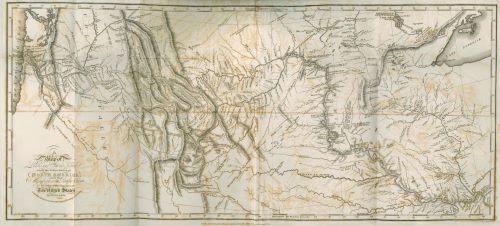
President Thomas Jefferson began planning an American expedition to find the source of the Missouri River in 1802. His goals were to open a route to the Pacific, to expand American participation in the fur trade, and to locate farmland. The purchase of the Louisiana Territory the following year made the project a priority. The U.S. Army was responsible for maintaining order in the frontier areas. So Jefferson appointed two Army captains, Meriwether Lewis and William Clark, to lead a 33-person expedition, which he named the Corps of Discovery. They departed from St. Louis in May 1804, traveled all the way to the Oregon coast, and returned in August 1806, a journey of over 8,000 miles. The expedition created the first comprehensive maps of the area. Earlier maps are almost completely blank between the Mississippi and the West Coast, showing just a small part of the Missouri River and a spare indication of the Rockies. Everything west of Fort Mandan was unknown to the explorers.
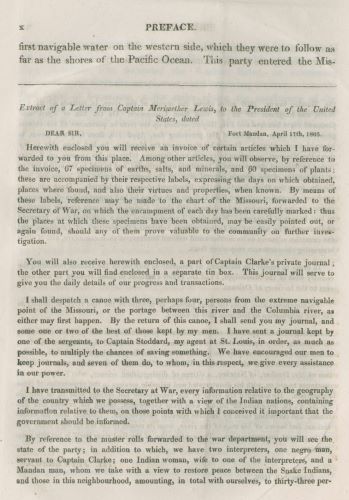
In addition to the two captains and the 26 Army recruits, the expedition officially included five other people who made the journey from Fort Mandan to the Pacific and back: York, an African American man who was Clark’s slave; a Mandan Indian man; two French Canadian fur traders and the Shoshone wife, Sacagawea, of one of them. (Sacagawea brought with her an infant son, nicknamed Pomp.) The French Canadian and Indian members were meant to act as interpreters and to aid in negotiations with tribes.
Portraying American Indians of the West
Lewis and Clark encountered almost 50 Indian tribes on their journey and observed a wide range of cultures and customs, from the agrarian Mandan who raised corn and lived in earth lodges to the nomadic Sioux who hunted buffalo and slept in tepees.
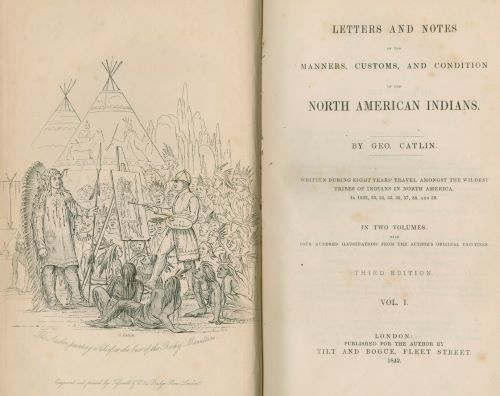
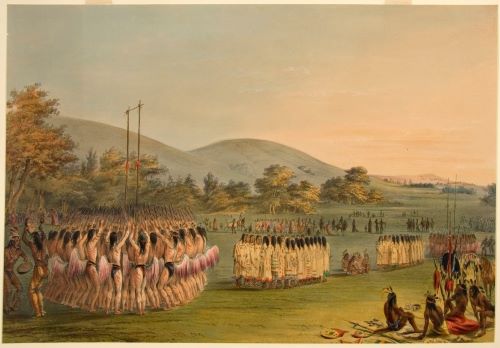
Three decades later, the artist George Catlin accompanied Clark on a diplomatic mission up the Mississippi River into Indian Territory. From there, Catlin traveled up the Missouri, on a mission to record the customs of every tribe he encountered. His painting, Ball-Play Dance, portrays Choctaw Indians near present-day Oklahoma. They engage in dancing and singing to solicit the aid of the Great Spirit before a game of lacrosse, itself an important and elaborate ceremony that could determine individuals’ status within the tribe.
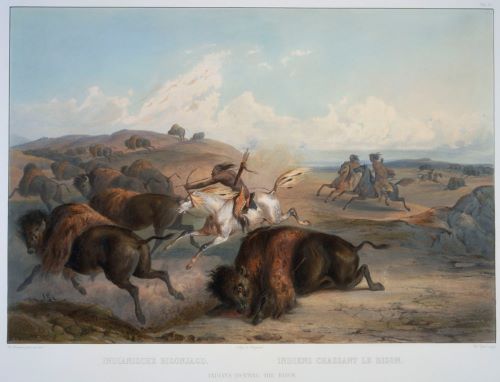
Swiss painter, Karl Bodmer ventured up the Missouri in 1834 in the company of the German Prince Maximilian of Wied-Neuwied. Bodmer created vivid paintings of the landscape and people he observed. His painting of the bison hunt portrays an essential activity of the Plains tribes in the nineteenth century. The bison’s body provided not only food, but also material for tents, clothing, and tools. Like Catlin,
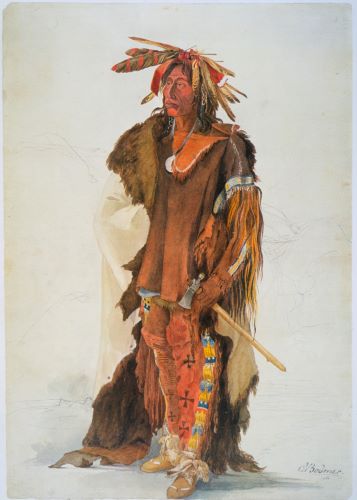
Bodmer also produced numerous portraits of individuals from the tribes he encountered. Both artists sought to create detailed, accurate representations of their subjects for a white American and European audience.
Commerce and Life on the Western Rivers
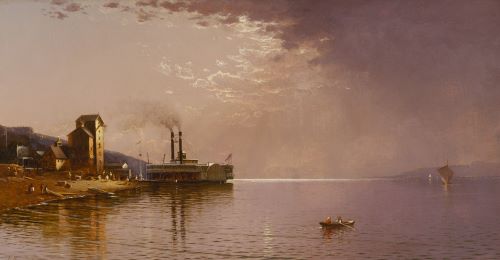
These paintings by Alfred Thompson Bricher and George Caleb Bingham portray everyday life along the Mississippi and lower Missouri Rivers in the 1850s and ‘60s. Bricher came from New Hampshire, but traveled west in the summer of 1866. In this painting, he portrays a sidewheeler, a wooden hull packet boat with a paddle wheel on each side, which was owned by the Northwestern Union Packet Company, a freight shipping firm. As the Terra Foundation notes in its interpretative text on the painting, “Sidewheelers were distinctive to the Mississippi, the Ohio, and other western waterways. Bricher’s portrait of this particular vessel lends an air of authenticity to his image of a region remote from the traditional landscape painting grounds of the American northeast.”
Bingham grew up in a Missouri River town and was “one of the first major American artists to hail from America’s frontier, and the first to make the West the subject of his art.” This scene portrays life on the Missouri not as it was in 1877, but as it had been two or three decades earlier, when barges and flatboats dominated the river. By the late 1870s, barges had been replaced by steamships and trains had displaced waterways as the primary means of transporting freight.
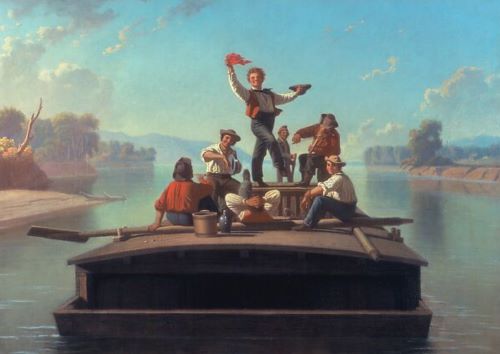
Both Bricher and Bingham were associated with the mid-nineteenth-century Hudson River School, whose painters portrayed American wilderness landscapes. Both employed a style now known as luminism in which “broad expanses of still water and sky” appear in “a pervasive, glowing light” and brushstrokes are rendered almost invisible.
Promoting Yellowstone
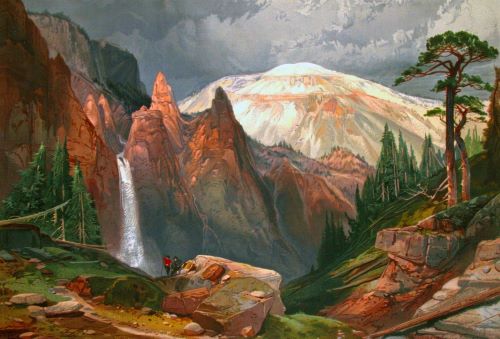
In 1869 Charles W. Cook, David E. Folsom, and William Peterson explored the headwaters of the Yellowstone River in the Montana Territory (now Wyoming). The region had only just begun to attract the attention of officials of the territory and the Northern Pacific Railroad. The following year, Cook published a vivid account of “the awful grandeur and sublimity” of this landscape of canyons, waterfalls, and hot springs, calling it “a scene of transcendent beauty, which has been viewed by but few white men.”
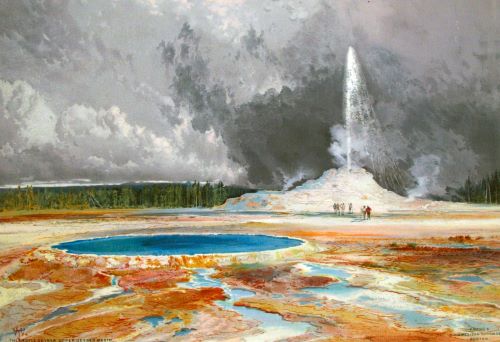
As Cook predicted, the region quickly attracted wider notice. In 1871, Ferdinand Vandeveer Hayden directed a government survey of the area, accompanied by the artist Thomas Moran, as well as scientists, a topographer, and others. Moran was an English-born, American painter associated with the Hudson River School and its attention to the American wilderness landscape. Hayden’s advocacy along with Moran’s vivid sketches of Yellowstone contributed to the U.S. Congress’ decision to declare the area the first national park in 1871. Officials with the Northern Pacific Railroad financed the construction of a hotel near the park’s entrance, accessible primarily by their rail line, which opened in 1884.
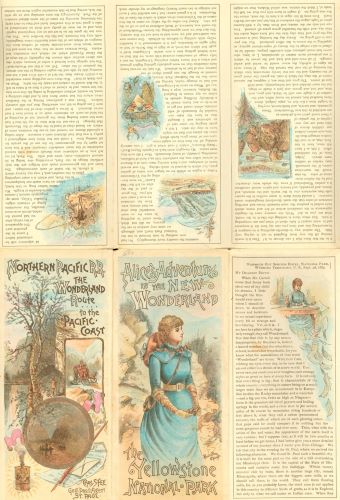
The Northern Pacific published Alice’s Adventures in the New Wonderland that same year. The brochure included a long letter written by a fictional English tourist, named after the heroine of Lewis Carroll’s children’s book. On the reverse, the brochure presented a detailed, topographic map of the park by two of the railroad’s civil engineers, Carl J. Hals and Arvid Rydstrom.
Representing Mexico
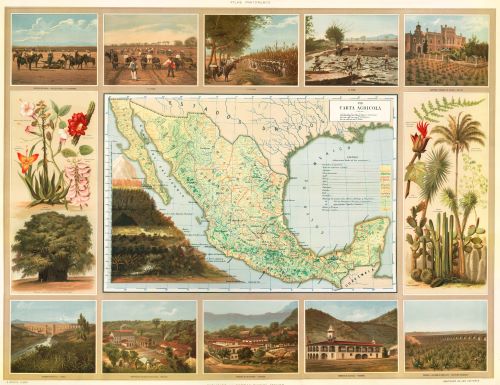
Mexican geographer and cartographer Antonio García Cubas dedicated his life to representing the distinctive land and cultures of nineteenth-century Mexico. In 1857, he produced the first map of the nation following its War of Independence from Spain (1810–1821). In subsequent decades, he produced atlases, portraits, and texts promoting ideas of Mexican national character and identity.
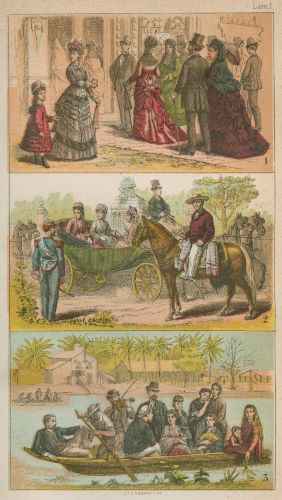
In The Republic of Mexico in 1876, García Cubas includes an ethnographic account of the Mexican people, identifying three primary groups: whites, or Spanish descendants; mestizos, or people of mixed European and American Indian ancestry; and full Indians. While the first two groups thrive, he writes, the last is dying out. García Cubas’ Atlas pintoresco é historico de los estados unidos mexicanos, or “Picturesque and Historical Atlas of the United Mexican States,” appeared the following decade. The atlas includes large maps illustrating Mexico’s archeological sites and colonial history as well as its topography, political structure, schools, ethnography, rivers, minerals, and agriculture. Bordering each map are vividly colored scenes relating to the map’s theme.
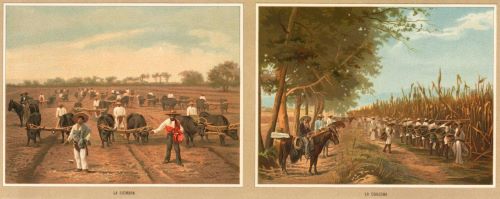
While García Cubas’ work does not concern exploration in the sense of discovering new lands, it addresses the idea of exploration in a metaphorical sense. He investigates—and helps to cement—the identity of a newly formed nation through visual and textual representations of the natural and human landscape.
About the Author