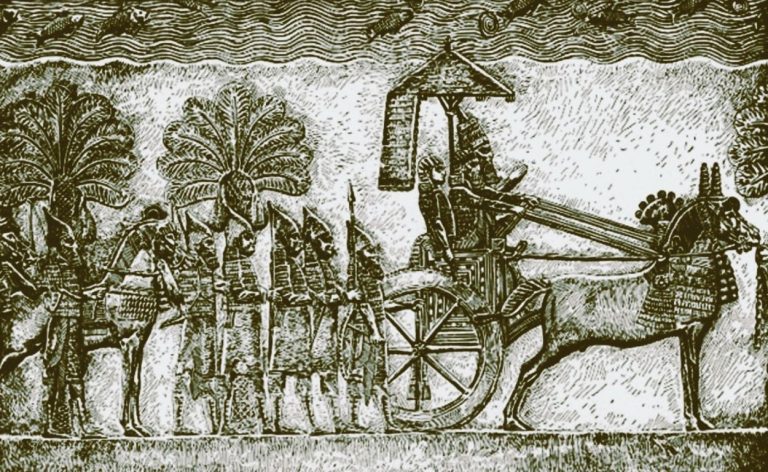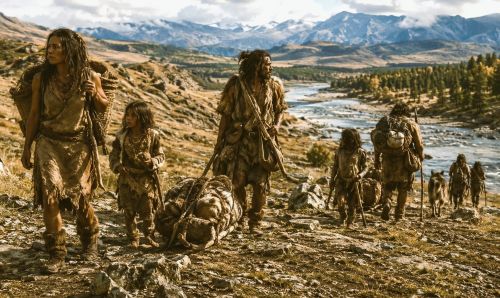
Before roads, prehistoric people moved through the world by foot, memory, muscle, water, animals, and ingenious technologies that made distance socially useful.

By Matthew A. McIntosh
Public Historian
Brewminate
Introduction: Movement Before Roads
Before there were roads, there was movement. Long before carts creaked over rutted tracks or sails pulled boats across river winds, prehistoric people traveled by foot, by memory, by muscle, by seasonal habit, and by careful attention to the land itself. The first mode of transportation was not a vehicle but the human body moving through known terrain: across grasslands, along rivers, over ridges, around marshes, through forests, and eventually across coastlines and sea passages. To speak of prehistoric transportation is not merely to ask when humans invented the wheel. It is to ask how people reduced the burden of distance before formal infrastructure existed, and how movement shaped survival, exchange, settlement, ritual, migration, and social life.
This requires a broader definition of transportation than the modern one. Prehistoric transportation included walking, carrying, dragging, floating, paddling, hauling, packing, and eventually riding or pulling with animals. It also included containers, cords, baskets, hides, shoulder poles, sledges, travois, rafts, dugout canoes, and the remembered routes that connected water, food, stone, timber, camps, burial places, and neighboring groups. Many of these technologies were made from wood, fiber, bark, hide, reeds, and other perishable materials, which means they often vanished from the archaeological record. Stone tools survive more easily than the baskets that carried food, the straps that held loads, the paddles that crossed rivers, or the sledges that moved meat and timber. The history of prehistoric transportation is partly a history of absence: the most ordinary and useful devices were often the least likely to endure.
The wheel deserves attention, but it should not dominate the story. It was a late prehistoric and early historic innovation, emerging in particular farming and pastoral worlds where woodworking skill, draught animals, settled routes, and heavy loads made wheeled vehicles useful. By the time wheeled carts appeared in the fourth millennium BCE, humans had already spread across continents, crossed water barriers, colonized islands, moved raw materials over long distances, and built social networks through repeated journeys. The wheel did not create long-distance movement from nothing; it entered a world already dense with paths, portages, animal trails, river corridors, coastal routes, seasonal rounds, and exchange networks. In some cases, wheeled vehicles made it easier to move heavy loads between settlements, fields, workshops, ritual centers, and markets. In others, they mattered less than boats, pack animals, human carriers, or sledges. Their usefulness depended on conditions that were themselves historical achievements: cleared routes, trained animals, durable axles, carpentry, repair knowledge, and communities able to organize the labor of hauling, loading, feeding, guiding, and maintaining. In many environments, wheels were not the best answer at all. A canoe could outperform a cart in wetlands, a sled could outperform wheels on snow or ice, a pack animal could move through terrain no wagon could cross, and the human porter remained indispensable wherever paths were narrow, steep, forested, or unstable.
Prehistoric transportation was not a simple march from primitive walking to advanced vehicles. It was an uneven, inventive, and highly local set of solutions to the problems of weight, distance, terrain, season, and social need. Transportation began with the body, but the body was gradually extended by containers, tools, animals, watercraft, and route-making. These innovations did not replace one another in a neat chronological sequence. They accumulated, overlapped, and adapted to particular landscapes. The great achievement of prehistoric transportation was not simply that people learned to move farther. It was that they learned to make movement itself into a technology: a practical art of carrying life across distance before roads made distance seem ordinary.
Walking Worlds: The Human Body as the First Vehicle

The oldest vehicle was the body itself. Before people harnessed animals, shaped carts, hollowed canoes, or raised sails, they moved by walking: step after step across environments that demanded endurance, memory, cooperation, and skill. This sounds simple only because walking is so familiar. In prehistoric life, walking was not merely locomotion. It was hunting, gathering, scouting, migrating, visiting, fleeing, courting, mourning, teaching, and returning. The human body carried tools, food, children, ornaments, fire-making materials, water containers, memories of danger, and knowledge of where to go next. To walk well was to know the world practically: where the ground hardened after rain, where animals crossed a valley, where a river could be forded, where stone could be found, where strangers might be encountered, and where a group could survive the next season.
The evidence for this walking world is both immense and elusive. Human dispersal across Africa, Eurasia, Sahul, and eventually the Americas required repeated acts of movement over many generations, but those journeys rarely left anything like a road. Archaeologists instead reconstruct them through fossils, genetic evidence, stone tools, changing settlement patterns, coastal corridors, ecological models, and occasional traces of footsteps preserved in mud, ash, lakebeds, or damp sediment. Trackways are powerful because they briefly restore movement to bodies otherwise known mostly through bones and artifacts. A footprint records weight, direction, speed, gait, surface conditions, sometimes age or body size, and occasionally group movement. It is a frozen gesture. It reminds us that prehistoric mobility was not abstract migration on a map, but bodies crossing real ground under real conditions. Even the most famous fossil footprints, such as those at Laetoli, are not evidence of “transportation” in the narrow sense, but they reveal something essential about the deeper prehistory of movement: upright bodies moving across a landscape, leaving behind momentary traces of direction, balance, stride, and social proximity. Later Pleistocene and Holocene footprints can be even more suggestive, showing children, adults, hunters, travelers, or groups moving across wet ground before the surface hardened and buried their passage. Such evidence does not give us a complete transportation system, but it forces us to begin with movement as lived experience. Before there were vehicles, there were tracks; before there were roads, there were repeated crossings; before there were maps, there were feet remembering the land.
Walking also shaped the scale of prehistoric life. Foragers did not move randomly across empty space. They lived within territories, ranges, pathways, and seasonal circuits that were learned socially and revised constantly. A camp might shift because game moved, plants ripened, water failed, wood was exhausted, fish returned, conflict threatened, or ritual obligation required assembly elsewhere. Some movements were daily and practical: from camp to water, from shelter to hunting ground, from hearth to gathering patch. Others were periodic and expansive, linking distant groups through exchange, marriage, ceremony, and news. The distances involved could be impressive, but the structure of movement mattered as much as the distance itself. Prehistoric mobility was often a pattern of return, not aimless wandering: people moved through landscapes thick with names, stories, landmarks, dangers, and remembered possibilities.
The body’s limits mattered. A person could walk long distances, but not without cost. Feet blistered, joints strained, children tired, injuries slowed the group, pregnancy changed mobility, and the elderly or sick required care. Food and water had to be carried or found along the way. Tools had to be light enough to transport yet useful enough to justify their weight. A group could not simply load itself with everything it owned and move indefinitely. This practical arithmetic of burden shaped prehistoric technology. Stone tools were curated, repaired, discarded, or replaced depending on raw material access. Camps were arranged around what could be carried, cached, borrowed, remade, or left behind. Even before baskets, packs, sledges, or animals extended human capacity, transportation forced decisions about value: what was worth carrying, what could be abandoned, and what had to be remembered rather than physically possessed.
Walking was also a form of social organization. People rarely moved as isolated individuals. They traveled in families, hunting parties, gathering groups, bands, visiting parties, and ritual assemblies. Knowledge moved with them: children learned routes by walking them; hunters learned animal behavior by following tracks; gatherers learned seasonal abundance by returning to patches at the right time; elders preserved memories of drought, flood, conflict, and refuge. Movement reproduced culture. It taught the young where they belonged, where danger lay, whom they might meet, and how far the known world extended. Paths existed before roads. They existed first in repeated bodily practice, then in shared memory, then in visible traces on the land. A trail was not only a line through space. It was a social inheritance.
This is why prehistoric walking should not be treated as the absence of transportation technology. It was the foundation upon which later transport systems were built. Containers increased what walkers could carry; sledges and travois reduced the drag of heavy loads; boats transformed rivers and coasts into corridors; animals shifted burdens from human shoulders to trained bodies; wheels eventually made some landscapes more productive for hauling. Yet none of these replaced walking. Every cart needed someone to guide it, every pack animal followed a human route, every canoe began and ended with feet on shore, and every exchange network depended on people who knew how to move through land. Even when later technologies expanded range or carrying capacity, they remained anchored in pedestrian knowledge: where to launch a boat, where to ford a river, where an animal could safely climb, where a wagon would mire, where a winter route differed from a summer one, and where strangers might become allies or enemies. The human body was the first vehicle not because it was primitive, but because all later prehistoric transportation extended its possibilities. Walking gave transportation its original grammar: path, burden, rhythm, return, exhaustion, orientation, and destination. Everything that followed enlarged that grammar but did not erase it.
Portable Life: How Prehistoric People Moved What Mattered

If walking was the first transportation method, carrying was its first great problem. Movement alone did not sustain prehistoric life; people had to move with things. Food, water, fire-making materials, stone tools, hides, infants, ornaments, medicinal plants, pigments, fibers, shell, bone, and ritual objects all had to be transported from one place to another. The human body could travel remarkable distances, but it could not move through the world empty-handed. Every journey involved choices about weight and necessity. A tool might be worth carrying because it could be repaired; a stone core might be abandoned because raw material could be found elsewhere; a child, a water skin, or a bundle of gathered plants could not be treated so casually. The history of prehistoric transportation begins not only with feet, but with hands, shoulders, backs, hips, and heads bearing the practical weight of survival.
The simplest carrying technologies were probably also among the most important. Baskets, bags, nets, slings, hide wraps, bark containers, wooden frames, carrying poles, and cords transformed the body into a more efficient vehicle. A person can carry only so much in the hands, but a basket on the back, a bag at the hip, a sling across the shoulder, or a load suspended from a pole changes both distance and labor. These devices allowed gathered foods to be collected in larger quantities, tools to be transported between camps, infants to remain close while adults worked, and fragile or numerous objects to move together. Their importance is easy to underestimate because they appear humble beside stone blades, painted caves, or monumental architecture. Yet a basket could change a day’s work as surely as a spear. Without containers, gathering is limited; without cords and straps, loads remain awkward; without bags and wraps, mobility becomes a constant negotiation between what the hands can hold and what the body must leave behind.
The archaeological problem is that many of these technologies belonged to what Linda Hurcombe has called the “missing majority” of material culture. Prehistoric people lived surrounded by perishable things: wood, fiber, leather, bark, reed, grass, sinew, hair, and plant cordage. These materials were not marginal simply because they rarely survive. They were frequently the connective tissue of daily life. The stone tool may survive because it was durable, but the basket it helped make, the cord it cut, the hide it scraped, or the carrying frame it shaped may have disappeared entirely. Rare preservation, impressions in clay, mineralized fibers, waterlogged finds, and indirect wear evidence all suggest that prehistoric communities possessed far more complex soft-material technologies than the surviving record usually shows. This matters for transportation because carrying types are exactly the kinds of technologies most likely to vanish. The ordinary devices that allowed people to move food, fuel, children, bedding, tools, and trade goods may have been central to prehistoric mobility while leaving only fragmentary traces behind.
Carrying also reorganized labor. In mobile societies, transport was never merely a matter of individual strength; it was divided, shared, negotiated, and embedded in social roles. Some members of a group might carry hunting gear, others gathered food, infants, shelter materials, water, ornaments, bedding, or tools. The old, the young, the injured, and the pregnant shaped the pace and burden of movement as much as the able-bodied hunter or scout. A group preparing to move camp had to decide what could be carried, what could be cached, what could be remade, what could be borrowed, and what had to be abandoned. These choices were not purely economic. They reflected attachment, memory, identity, ritual obligation, and social care. A shell ornament from a distant coast, a pigment bundle, a carefully made tool, or the remains of the dead might be carried not because it was immediately useful, but because it mattered. Portable life was not only practical life. It was emotional, symbolic, and social life made movable.
The development of carrying technologies also helped create broader exchange and interaction. Lightweight valuables could travel farther than heavy staples. Shells, beads, pigments, medicinal substances, obsidian flakes, fine stone tools, feathers, fibers, and ornaments could pass from hand to hand across landscapes, linking groups that never lived together permanently. Containers and carrying systems made such movement easier, but they also made accumulation possible. A person with a bag can gather more than a person with bare hands; a group with baskets can move more food from field, shore, forest, or marsh; travelers with packs can carry gifts, trade items, or ritual objects over longer distances. This mattered because prehistoric exchange was rarely only commercial in the later sense. Objects moved as gifts, obligations, marriage payments, signs of alliance, ritual offerings, tokens of memory, or evidence of distant relationships. A shell carried inland from a coast, a blade made from nonlocal obsidian, or a pigment bundle transported between camps could embody more than material usefulness. It could signal where someone had been, whom they knew, what ties they claimed, or what stories attached to a place. Carrying technologies allowed people not only to transport goods, but to transport social relationships. They made distance visible in portable form. Before carts and pack animals expanded transport capacity, the portable container was already altering the scale of prehistoric life. It made gathering more productive, exchange more flexible, and mobility less dependent on immediate consumption.
To treat baskets, bags, slings, poles, and cords as minor accessories would miss one of the deepest revolutions in prehistoric transportation. These technologies extended the body without replacing it. They did not eliminate fatigue, hunger, or distance, but they redistributed burden and made movement more efficient. A basket on the back, a sling across the chest, a tumpline across the forehead, a bundle tied to a pole, or a hide bag at the hip changed how much of the world could move with a person. Long before the wheel, prehistoric people had already learned that transportation was not only about traveling faster or farther. It was about carrying enough to make movement worthwhile. The portable world was built from perishable materials, but its consequences were durable: larger harvests, longer journeys, wider exchange, more flexible camps, and social lives that could be packed, lifted, and carried across the land.
Moving Heavy Things Without Wheels
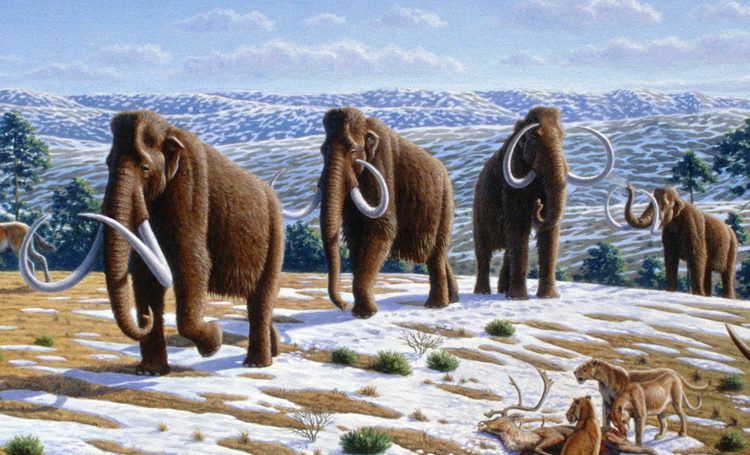
Carrying extended the body, but some things were too heavy, awkward, bloody, bulky, or socially important to be carried easily on the back. A large animal carcass, a timber beam, a bundle of hides, a stone slab, a shelter frame, a household’s heavier belongings, or a ritual object might demand another solution. Long before wheeled vehicles appeared, prehistoric people could still move heavy objects by dragging, sliding, rolling, floating, levering, lifting in teams, or combining several of these methods. The absence of the wheel did not mean the absence of heavy transport. It meant that friction, surface, season, and coordinated labor mattered more visibly. A load that could not be carried might be pulled across snow, skidded over wet grass, slid on wooden runners, dragged on hide, rolled over logs, or moved in stages from one prepared surface to another. These methods were physically demanding, but they were not crude. They required practical engineering: how to reduce resistance, distribute weight, avoid breakage, keep a load stable, and make human effort count.
Dragging was probably among the simplest of these techniques, but simplicity should not be confused with insignificance. A hide, bark sheet, wooden branch frame, or bundle of poles could turn an impossible load into a difficult one. Hunters who killed large game away from camp faced this problem constantly. Meat could be butchered and carried in portions, but bones, hides, antlers, fat, sinew, marrow, and other useful materials might still require pulling or staged transport. In some environments, dragging a carcass or hide-wrapped load over grass, sand, snow, or damp earth was more efficient than carrying it directly. The method did not require a wheel, axle, or formal vehicle; it required a surface that would allow movement and a group strong enough to manage the pull. It also required decisions about processing. A kill might be reduced at the site, moved whole only a short distance, divided among several carriers, or dragged toward a safer and more useful place. That choice depended on temperature, scavengers, distance from camp, the number of available people, the condition of the ground, and the social value of the animal’s parts. Transport and butchery were connected. The way a carcass was cut up often reflected not only anatomy or food preference, but the practical question of what could be moved before spoilage, exhaustion, or danger intervened. Even this humble technique changed the geography of use. A kill site did not have to be the place where every part of the animal was processed. Heavy materials could be moved toward camp, water, shade, fire, or a more secure location.
Sledges and skids developed this principle further. A sledge placed a load on runners or a flat platform so that it could slide rather than be lifted. In snowy and icy regions, sledges could be extraordinarily efficient, turning winter surfaces into transportation corridors rather than barriers. In dry or temperate settings, sledges could still work if the ground was prepared, wetted, smoothed, greased, or seasonally favorable. Wooden runners, bone elements, lashed frames, rawhide bindings, and fiber cords would all have been vulnerable to decay, which makes early sledging difficult to identify archaeologically. Yet the logic is clear: if a load is too heavy to carry but can be made to slide, the problem becomes one of traction, friction, and control. Sledging also scales well. A single person might drag a small load; a family might pull belongings; a coordinated group might move timber or stone. Unlike the wheel, the sledge did not require a rotating axle. It required surfaces, ropes, runners, and bodies working together.
This has important implications for prehistoric construction and monumentality. Large stones, wooden posts, earthworks, and architectural timbers did not require wheeled wagons to move, though moving them could require substantial planning. Neolithic and Bronze Age monuments across Europe, including megalithic tombs, stone circles, timber settings, and causewayed enclosures, remind us that heavy transport is as much a social achievement as a technical one. A community that can move a large stone is not only solving a mechanical problem. It is organizing labor, food, timing, leadership, ritual motivation, route preparation, and shared purpose. The labor begins before the object moves: selecting a stone or timber, detaching it, shaping or stabilizing it, clearing a route, preparing ropes or sledges, choosing a season when the ground helps rather than hinders, and ensuring that workers can be fed and coordinated. The transport itself may also have been performative. The movement of a stone, post, or ritual object could gather spectators, mark collective identity, demonstrate leadership, or transform the object through the very drama of relocation. A stone taken from a distant source was not merely heavy material; its journey could become part of its meaning. Experiments with megalith transport have shown how sledges, rollers, trackways, ropes, and coordinated pulling could move large weights under the right conditions, although no single experiment should be treated as a universal explanation. The broader point is that prehistoric societies could mobilize force without wheels by combining bodies, surfaces, devices, and collective discipline.
Rollers also belong in this world of wheel-less heavy transport, though they should not be treated as “almost wheels” in a simple evolutionary sequence. A log placed beneath a load reduces friction, but a roller is not the same as a wheel fixed to an axle. Rollers must be repositioned constantly, work best on suitable surfaces, and are more practical for some loads than others. They may have been useful for moving heavy stones, logs, platforms, or sledges across prepared ground, especially when combined with levers and ropes. But rollers could also be awkward, dangerous, or unavailable depending on terrain and timber supply. A roller system needs more than round wood. It needs relatively predictable ground, enough people to pull and steer, additional people to retrieve and reset rollers, and a load stable enough not to topple when its support shifts. In forests, timber might be plentiful, but roots, mud, slopes, and uneven ground could make rolling difficult. In open grassland or dry upland, the ground might be more suitable, but suitable logs might be scarce. In wetlands, floating or sledging might be preferable; in snow, runners might be vastly superior; on steep slopes, rolling could become uncontrollable. Sliding may have often been easier than rolling. The distinction matters because it prevents the wheel from seeming inevitable. Prehistoric people did not lack the intelligence to notice that round things roll. The technological leap was not “discovering roundness,” but creating durable wheels, axles, bearings, frames, draught systems, and surfaces where wheeled transport could reliably outperform older methods.
The travois occupies a related but distinctive place in this history. A travois is essentially a drag frame: two long poles joined by a platform or netted surface, with one end carried, harnessed, or attached while the other end trails along the ground. In later historically documented societies, particularly among Indigenous peoples of the North American Plains, travois were pulled first by dogs and later by horses, moving household goods, hides, poles, food, and children. Caution is necessary for deep prehistory. The travois is an excellent example of what a simple drag technology can do, but later ethnographic evidence should not be projected backward too mechanically. Similar principles could have arisen independently wherever people had poles, cordage, hides, and the need to move awkward loads. Whether pulled by humans or animals, the drag frame illustrates a crucial prehistoric insight: a load does not always have to be lifted completely off the ground to be transported. It can be partially supported, stabilized, and pulled.
Dragging, sliding, sledging, rolling, and travois-like hauling show that prehistoric transportation did not wait for the wheel to solve the problem of weight. These techniques were slower than carts in some circumstances, but they were flexible, repairable, and well suited to many landscapes. They could move meat from kill sites, timber from forests, stones to monuments, shelter materials between camps, and belongings across seasonal routes. They also reveal a central truth of prehistoric technology: movement was not created by devices alone. It emerged from the meeting of materials, terrain, weather, labor, and social coordination. A sledge on snow, a hide drag on grass, a timber roller on prepared ground, a stone pulled by a community, or a travois trailing behind a dog or person all belonged to a world in which friction was the enemy and ingenuity was measured in reduced resistance. Before wheels made some heavy transport easier, prehistoric people had already learned how to make the ground itself participate in the work.
Water as the First Highway

If dragging and sledging made the ground itself participate in transport, water did so even more dramatically. Rivers, lakes, marshes, estuaries, and coasts were not simply obstacles that prehistoric people learned to cross. They were corridors, food zones, boundaries, gathering places, and seasonal routes. A river could divide groups, but it could also connect them more easily than forest, mountain, or swamp. A lake might appear to enclose a community, yet it could also open access to fish, reeds, birds, shellfish, timber, clay, and neighboring shores. Long before formal roads, water offered something close to a natural highway: a surface on which weight could be floated rather than carried, friction could be reduced, and distance could be reorganized around currents, shorelines, portages, and landing places.
The earliest water transport probably left little or no direct trace. A person clinging to a log, a bundle of reeds tied together, a skin float, a bark raft, or a temporary crossing platform might vanish archaeologically almost at once. Yet prehistoric people had every reason to experiment with floating materials. Waterways contained food, but they also blocked movement. To fish more effectively, cross a river, reach an island, retrieve waterfowl, move a carcass, transport wood, or follow a coastline, people needed ways to use water rather than merely stand before it. The challenge is that the simplest watercraft were made from precisely the materials least likely to survive: reeds, bark, wood, hide, fiber, and cordage. The absence of very ancient boats is not evidence that very ancient people lacked water transport. It is evidence that the earliest watercraft belonged to a fragile material world that rarely endures.
The distinction between direct and indirect evidence is crucial. The Pesse canoe from the Netherlands, made from a hollowed pine trunk and dated to the Mesolithic, is often described as the oldest surviving boat, with the Drents Museum placing it roughly between 8250 and 7550 BCE. It is small, simple, and easily underestimated, but its importance lies in what it preserves: a dugout principle that must have required knowledge of wood, buoyancy, shaping, balance, and the practical conditions of shallow water. Direct evidence becomes richer in later prehistoric contexts, especially where waterlogged preservation protects wooden artifacts that would normally decay. The Neolithic canoes from La Marmotta, a lakeshore settlement near Rome, are important because they show that early Mediterranean communities possessed sophisticated woodworking and watercraft traditions. A 2024 study identified the La Marmotta canoes as the oldest known Neolithic boats in the Mediterranean and emphasized their importance for understanding early seafaring technology.
Indirect evidence pushes the story much farther back. The human settlement of Sahul, the Pleistocene landmass that included Australia, New Guinea, and Tasmania, required sea crossings from Island Southeast Asia. Even when sea levels were lower, no continuous land bridge connected Sunda to Sahul, and at least some open-water travel was necessary. This does not mean that archaeologists possess the boats themselves. They do not. The evidence lies in the fact of arrival, the geography of the route, models of drift and voyaging, and the archaeological record of early human presence in Australia and New Guinea. Such evidence is powerful because it shows that water transport may have been tens of thousands of years older than the oldest preserved wooden craft. It also complicates any transportation history that begins with surviving vehicles, because the most consequential journeys may have been made with craft that disappeared entirely. The people who crossed into Sahul did not need bronze tools, written navigation, or plank-built ships to transform human geography. They needed seaworthy enough watercraft, social coordination, practical knowledge of departure and landing places, and the willingness or necessity to cross water that could not be treated as an extended riverbank. Human beings were not merely shoreline scavengers by the late Pleistocene. In some regions, they had already become capable of deliberate maritime movement across difficult and dangerous water.
Water transport also changed the economics of movement. A person carrying a load on land must bear its weight directly, but a raft or canoe allows buoyancy to carry much of the burden. This made water vital for moving heavy, bulky, or awkward materials: timber, reeds, clay, stone, fish, shellfish, carcasses, hides, baskets of gathered food, and perhaps people unable to walk long distances. Rivers could carry goods downstream with less effort than overland hauling, while lakes and wetlands allowed repeated short crossings that linked camps, gardens, fishing places, reed beds, and ritual spaces. Even a modest dugout could transform local geography. What looked distant by land might be near by water. What seemed impassable on foot might become routine by paddle. A shoreline settlement was not isolated at the edge of land; it could be positioned at the center of a watery network.
Marshes deserve particular attention because they blur the modern distinction between land and water. To outsiders, marshes may seem like difficult terrain: unstable, wet, tangled, and slow. To people who knew them, they could be highly productive landscapes, full of fish, birds, eggs, reeds, tubers, shellfish, mammals, and seasonal resources. Transportation required flexible techniques: wading, poling, paddling, using reed bundles, dragging small craft, walking on raised paths, or shifting between foot and boat depending on water level. Marshland mobility was not simply primitive inconvenience. It could support complex knowledge of channels, hidden routes, seasonal flooding, safe ground, and resource patches. A marsh could be crossed only by someone who understood its changing surfaces: where mud would hold, where it would swallow, where reeds marked shallow water, where channels deepened after rain, where winter frost created temporary firmness, and where summer drying opened passages unavailable in other seasons. Such knowledge made marsh transport intensely local. The route was not always visible as a road or trail; it might exist as memory, timing, and bodily skill. Water transport did not always mean long-distance voyaging. Sometimes it meant knowing how to move through a landscape where walking and floating constantly alternated.
Coasts extended this logic outward. Coastal travel gave prehistoric people access to rich food zones and long linear routes where navigation could follow shorelines, currents, headlands, islands, reefs, and visible landmarks. Shell ornaments, obsidian, fishhooks, marine foods, and island colonization all point to the importance of waterborne movement in many regions. The sea could be dangerous, but it could also be connective. Coastal voyaging encouraged knowledge of tides, winds, currents, boat repair, landing beaches, weather signs, and the social rules of arrival. In the Mediterranean, the spread of Neolithic farming communities across islands and shorelines cannot be understood without some level of maritime skill. At La Marmotta and similar contexts, the evidence suggests not hesitant water crossing but communities already comfortable with boats as part of daily and regional life.
Water not merely one transportation environment among others. It was the great alternative to the burdened body. It allowed prehistoric people to move weight differently, imagine distance differently, and organize settlement around channels rather than roads. The dugout canoe, the reed raft, the log float, the skin boat, and the coastal craft all belonged to a world in which transportation was shaped by materials and landscape together. Wheels would eventually transform some overland routes, but water had already done something equally important: it taught people that distance could be carried by a surface other than the human body. Before roads, rivers and coasts offered routes that moved, shifted, flooded, froze, dried, and returned. To travel by water was to enter a transportation system already alive with current, wind, season, and risk.
The Ambiguous Beginning of Animal-Assisted Transport
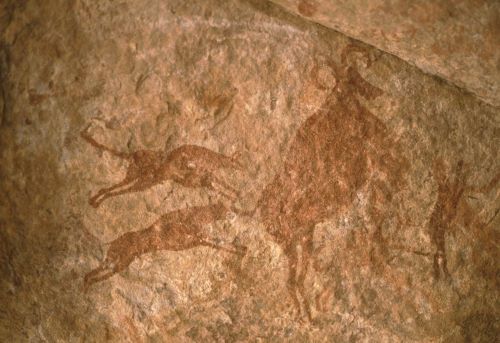
The first animal to assist human movement was almost certainly not the horse, ox, donkey, camel, or llama, but the dog. Yet this beginning is ambiguous because dogs entered human life as companions, hunters, guards, scavengers, ritual beings, sources of warmth, and social partners before they can be confidently described as transport animals everywhere. Dog domestication was not a single invention like a wheel or canoe. It was a long relationship between humans and canids, shaped by proximity, food sharing, hunting, camp life, mutual advantage, and eventually selective breeding. For transportation history, the important point is not simply that dogs were early domestic animals. It is that they introduced a new possibility: another living body could move with humans, carry human purposes, and extend human labor.
That extension did not have to mean riding or plowing. Dogs are too small to replace humans as major beasts of burden in most environments, but they could still change the arithmetic of mobility. They could carry packs, pull small loads, drag simple frames, help move equipment, transport food reserves, assist hunting, guard camps, and make movement through difficult environments more secure. This matters because prehistoric transport was often about marginal gains rather than spectacular revolutions. If a dog could carry even a modest pack, pull a light load, or help move household goods between seasonal camps, then human shoulders were freed for other burdens. That might mean an adult could carry more food, a child, a tool kit, a water container, or ritual goods instead of shelter parts or bedding. It might mean a group could move camp with fewer trips, relocate more safely before bad weather, or bring along supplies that would otherwise have been abandoned. In some environments, the dog’s greatest transport contribution may not have been the load itself, but the combined value of hauling, hunting, protection, and companionship. A dog moving with a human group was not merely an extra container on legs. It was a participant in mobility, one whose usefulness depended on training, temperament, season, terrain, and the social relationship between people and animals. The result was not necessarily faster travel. It was increased carrying capacity, greater flexibility, and a different relationship between people, animals, and portable life. Recent cross-cultural work on dog hauling has similarly emphasized that haulage dogs improved transport capacity even when they did not greatly increase travel speed.
The strongest early evidence for dogs as transport animals comes from northern environments, where sledging could turn snow and ice into usable corridors. The Early Holocene Zhokhov site in Arctic Siberia is important. Archaeological work there has identified dog remains around 9,000 years old and interpreted some of the animals as hunting and draught dogs, while genomic work on a roughly 9,500-year-old Siberian dog associated with sled technology has found notable connections to the ancestry of later Arctic-adapted sled dogs. This does not mean that all early dogs were sled dogs, or that dog transport began everywhere in the Arctic and spread outward in a simple line. It does show that in some prehistoric settings humans were already shaping dog bodies and dog labor around mobility. In snow country, the dog did not merely accompany movement. It helped make certain kinds of movement possible.
The travois belongs to the same broad history of animal-assisted transport, though its interpretation requires particular care. A travois is a drag frame, usually made from two long poles joined by a platform, netting, or hide surface, with one end attached to a person or animal while the other trails on the ground. In historically documented Indigenous societies of the North American Plains and Intermountain West, dogs pulled travois before horses transformed the scale of Plains transport. They moved shelter materials, hides, food, firewood, equipment, trade goods, and sometimes children. Archaeological work on the Birch Creek canids in the Intermountain West has argued that some dogs were large and strong enough for transport labor, including hauling travois and carrying pannier-style packs. But this does not give us permission to imagine a universal prehistoric dog-travois setup. The travois is both evidence and analogy: evidence for what dogs could do in some documented and archaeological contexts, and analogy for the kinds of drag technologies that may have existed elsewhere when people had poles, cordage, hides, and transport needs.
The ambiguity is important because animal-assisted transport is not only a question of animal strength. It also requires training, feeding, restraint, harnessing, breeding, social trust, and predictable cooperation. A dog that hunts well may not pull well. A dog that guards camp may not tolerate a load. A dog that can carry a pack still needs equipment that fits its body without injury. A travois requires poles, lashings, a harnessing system, and routes where dragging will not constantly snag or overturn. Transport animals also impose costs. They eat, tire, become injured, reproduce, die, and require care. In some circumstances, feeding and managing dogs may have been worthwhile because they helped move shelter, equipment, or food reserves that reduced risk during periods of scarcity. In others, direct human carrying or sledging may have been simpler. This is why dogs should not be treated as an automatic transport improvement. Their usefulness depended on a balance between the work they could perform and the resources required to keep them alive and cooperative. A group already short of food might not benefit from maintaining many working dogs unless those dogs also helped hunt, guard, or locate resources. A group moving through dense brush, broken ground, or rocky slopes might find a drag frame more trouble than it was worth. A group crossing snow, open grassland, frozen ground, or wide plains might find that the same animal and frame greatly expanded what could be moved. The dog’s role varied by ecology and task. In some cases, it was a haulage animal; in others, a hunting partner that indirectly improved transport by helping procure food; in others, a guard that made mobile camps safer. One Human Ecology study of dog travois transport argues that such transport was most useful under particular conditions and was better suited to moving shelter, equipment, and food reserves than to daily food acquisition alone.
Dogs mark a subtle but profound threshold in prehistoric transportation. They did not replace the human body, and they did not inaugurate animal transport in the later sense of mounted riders, pack caravans, or ox-drawn carts. Instead, they made mobility interspecies. A moving camp could include nonhuman partners whose bodies carried, pulled, guarded, hunted, and signaled danger. A route could be walked by people and animals together. A burden could be shared across species. This was not yet the great traction revolution of oxen, donkeys, horses, camels, and llamas, but it prepared one of its essential ideas: transport could be organized through relationships with animals. The beginning was ambiguous because dogs were never only tools. They were companions, workers, dependents, and social beings. That very ambiguity is what makes them so important. They show that prehistoric transportation was not merely a mechanical history of devices, but a living history of bodies moving together.
Pack Animals and Pastoral Mobility
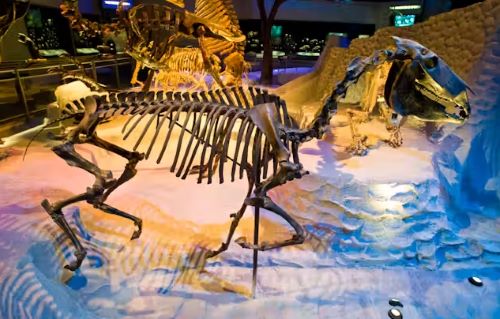
Dogs made mobility interspecies on a modest scale, but larger domestic animals transformed the relationship between transport, settlement, herding, and power. Donkeys, oxen, llamas, camels, and horses did not simply “carry things” in a neutral way. They altered how people calculated distance, seasonal movement, surplus, exchange, and territorial control. A person could carry only so much. A household with pack animals could move more food, more water, more tools, more shelter, and more trade goods. A community with draught animals could haul heavier loads, cultivate larger fields, and link settlements more reliably. But animal transport also changed the meaning of mobility itself. Movement was no longer only a matter of human stamina, group organization, and portable equipment; it became tied to pasture, fodder, water sources, breeding cycles, animal temperament, disease, training, and equipment. A route suitable for people might not be suitable for animals. A path that a walker could cross might injure hooves, exhaust a loaded beast, or fail because water was unavailable. The result was that animal-powered transportation expanded possibility while also creating new constraints. Yet this transformation was uneven. Animal transport depended on species, environment, breeding, training, fodder, disease, terrain, and equipment. The domestication of animals did not produce one universal transport revolution. It produced several regional revolutions, each shaped by the bodies of particular animals and the landscapes through which they moved.
The donkey was one of the great early transport animals because it was patient, relatively hardy, and useful in dry environments where heavy human carrying imposed severe limits. Descended from African wild asses, donkeys became central to movement in northeastern Africa and the Near East, especially as farming, trade, and early state structures expanded. Their value lay not in speed but in endurance and load-bearing. A donkey caravan could move food, water, copper, stone, textiles, prestige goods, and administrative supplies across distances that would strain human porters. Archaeological evidence from early Egypt is important because donkey skeletons from Abydos show pathologies consistent with load-bearing, suggesting that these animals were already being used for transport in elite and administrative contexts. The donkey belongs near the center of any history of prehistoric and early historic transportation. It was not glamorous like the horse, but it helped make long-distance overland exchange more practical.
Oxen changed transport in a different way. Cattle were not only sources of meat, milk, hide, horn, and social wealth; castrated males could become powerful draught animals. Their strength made them useful for pulling sledges, carts, wagons, and plows, especially in farming societies where heavy labor became increasingly important. Ox traction connected transportation to agriculture. The same animal that could help break soil or pull a plow could also haul harvests, timber, stone, household goods, or ceremonial loads. This is why the history of animal transport cannot be separated from the broader transformation sometimes called the “secondary products revolution”: the increasing use of animals not simply as meat on the hoof, but as living sources of labor, milk, wool, manure, traction, and transport. Even where scholars debate the timing or neatness of that model, its basic insight remains useful. Domesticated animals became engines of recurring energy. They allowed people to draw labor from living bodies over time rather than only consume them once as food.
In the Andes, the llama shows how transport revolutions could occur without wheels, carts, or large draught animals. Llamas could not pull wagons like oxen, and they could not carry riders like horses, but they were superb pack animals for mountainous environments. Their padded feet, tolerance for altitude, and ability to move through steep terrain made them essential to Andean mobility. They transported food, textiles, coca, salt, obsidian, metal goods, feathers, ceramics, and ritual materials across ecological zones. This mattered because Andean societies depended heavily on vertical movement between coast, valley, highland, and puna. Llama caravans made it possible to connect distinct environments without wheeled vehicles. The absence of practical wheeled transport in the Andes was not evidence of technological failure. It reflected a world in which terrain, animal bodies, road forms, and political economy favored pack caravans over carts.
Camels belong partly to the later edge of this story, but they reveal another principle: some animals become revolutionary only in particular ecological corridors. Dromedaries and Bactrian camels eventually transformed desert and steppe transport because they could carry loads through arid environments where water scarcity limited other animals. Their ability to travel long distances with limited water made them important for caravan systems across Arabia, North Africa, Central Asia, and adjacent zones. But camel transport did not emerge at the beginning of animal domestication, nor did it instantly replace donkeys or oxen. Its importance grew where desert routes, oases, trade demands, and specialized pastoral knowledge made camel management worthwhile. That knowledge was itself a transport technology. People had to understand watering intervals, grazing opportunities, heat, sand, animal pacing, load balance, and the dangers of overburdening an animal far from help. A camel caravan was not simply a line of animals crossing empty space; it was an organized network of route knowledge, animal management, commercial expectation, and environmental adaptation. Like the llama in the Andes, the camel reminds us that transport animals are not interchangeable. The animal’s body must fit the landscape. A camel is a solution to heat, thirst, and distance; a llama to altitude and mountain paths; an ox to traction and heavy hauling; a donkey to endurance and pack movement in dry country.
The horse is the most famous prehistoric transport animal, but it should be handled carefully. Horses eventually transformed mobility through riding, pack use, traction, chariots, herding, warfare, communication, and migration. Yet the earliest history of horse use is debated, particularly the relationship between domestication, riding, milking, traction, and warfare. The Botai culture of Kazakhstan has often been central to discussions of early horse management, with evidence interpreted as suggesting milking, harnessing, and close human control. Later research has complicated older assumptions about whether Botai horses were direct ancestors of modern domestic horses, but the broader importance of the horse remains clear: once people learned to manage equine bodies effectively, distance could be reorganized at a new scale. Horses could move people faster than walking, help manage herds, pull vehicles, and eventually support forms of raiding and warfare impossible for pedestrian societies alone. The horse did not invent mobility, but it changed its tempo.
Pack animals and pastoral mobility also changed society. Transport animals required pasture, water, breeding knowledge, veterinary care, herding skill, and equipment such as ropes, packs, pads, frames, yokes, bits, or harnesses. They created new forms of wealth and new vulnerabilities. A household with animals could move more, trade more, and survive some shortages better; but it also had to protect its herds, find grazing, manage disease, and defend animals from theft or predation. Animal transport could increase inequality because not every person or household had equal access to working animals. It could also expand political power. Chiefs, temples, palaces, or emerging states that controlled caravans, draught teams, pasture routes, or animal labor could move goods, tribute, soldiers, and building materials more effectively than communities dependent only on human carrying. Transportation became a form of authority.
The rise of pack animals and pastoral mobility marks one of the great turning points in prehistoric transportation, but not because animals simply replaced people. They extended human mobility while creating new dependencies on living labor. Donkeys, oxen, llamas, camels, and horses each solved different transport problems, and each did so within particular landscapes and social systems. The result was not a single animal-powered age but a mosaic of regional transport ecologies. In some places, the donkey caravan mattered most; in others, the ox team, llama train, camel caravan, or horse herd. These animals made distance more manageable, but they also made movement more complex. To travel with animals was to travel with hunger, thirst, temperament, training, reproduction, fatigue, and care. Animal-assisted transport enlarged the world, but it did so by binding human movement to the needs and capacities of other species.
The Wheel and the Cart: A Late but Transformative Innovation
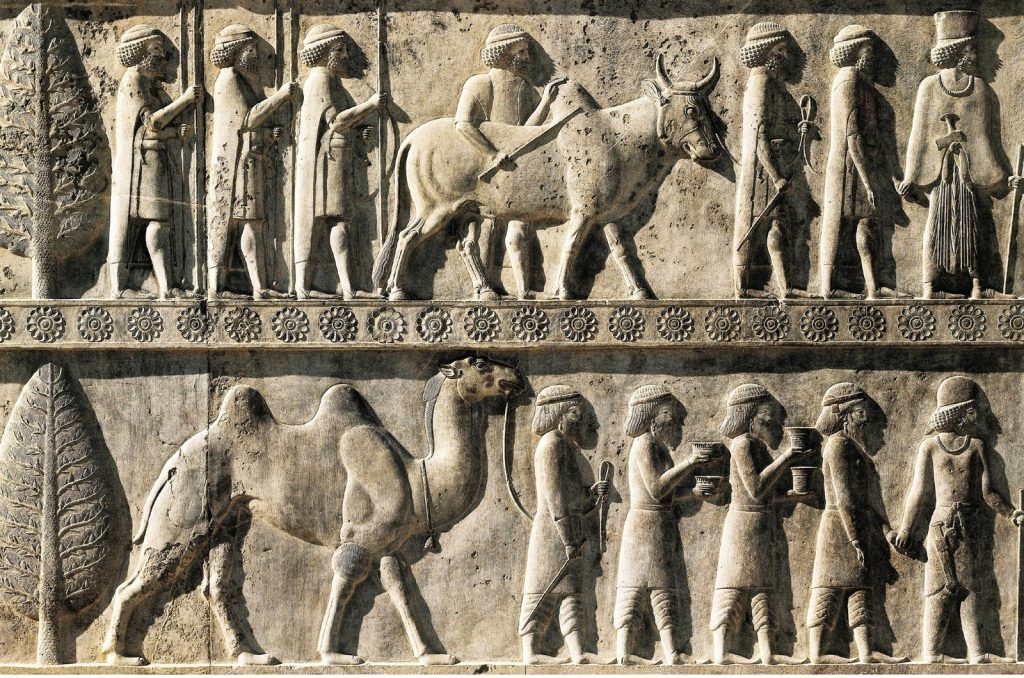
The wheel is so familiar that it is easy to imagine it as one of humanity’s earliest inventions, almost as if prehistoric people should have discovered it the moment they saw a log roll downhill. That assumption is misleading. Wheeled transport was not a Paleolithic breakthrough, nor was it the natural first solution to the problem of movement. People walked, carried, dragged, sledged, paddled, floated, and used animals long before wheeled vehicles appeared. The wheel belongs to a later world of woodworking skill, settled or semi-settled communities, animal traction, heavy loads, and routes where a wheeled frame could actually function. Its importance was enormous, but its timing matters. By the time carts and wagons entered the archaeological record in the fourth millennium BCE, prehistoric transportation already had a long history.
The earliest evidence for wheeled vehicles is complex because it comes in several forms: images, models, ruts, actual wooden wheels, and later textual or pictographic indications. No single object can bear the whole story. The Bronocice vessel from southern Poland is famous because it appears to show a wheeled vehicle, probably a wagon, in the mid-fourth millennium BCE. At Flintbek in northern Germany, parallel track marks beneath a megalithic long barrow have been interpreted as early wagon ruts. In the Near East, Late Uruk contexts provide another body of evidence for wheeled vehicles through imagery, models, and administrative signs. These finds matter not because they identify one single birthplace of the wheel, but because they suggest that wheeled transport appeared across parts of Europe and the Near East within a relatively narrow chronological window. The invention seems to have spread quickly, or perhaps emerged through closely connected traditions of carpentry, traction, and exchange.
The wooden wheel itself was a demanding object. A useful transport wheel was not simply a round slice of tree trunk. It had to be shaped, balanced, strengthened, joined to an axle, and fitted into a vehicle frame that could survive strain. Early wheels were generally solid wooden constructions, often made from planks joined together rather than single disks. The axle was just as important as the wheel, because the real innovation was the working wheel-and-axle system. A poorly fitted axle could seize, split, wobble, or break; a wheel too small could catch in ruts; a wheel too large could become too heavy; a vehicle frame too weak could collapse under load. Surviving wooden wheels, such as the Ljubljana Marshes wheel from Slovenia, are rare precisely because wood usually decays. Their preservation in wetland contexts gives us a glimpse of an otherwise vanished craft world of carpenters, joinery, wedges, axles, and heavy wooden machines.
The cart changed transport because it allowed loads to be supported by a frame rather than by the human back, an animal’s spine, or the sliding surface of a sledge. This could greatly increase the amount of material moved between fields, settlements, storage places, workshops, pastures, forests, and ritual centers. Carts were useful for agricultural communities because they could move harvests, manure, fuel, timber, stone, pottery, and household goods. A load that might exhaust several people over repeated trips could be consolidated into a single vehicle drawn by animals, especially when the route was familiar and the surface passable. That did not eliminate labor; someone still had to load the cart, balance the weight, guide the animals, maintain the wheels, repair the axle, and manage difficult ground. But it changed the distribution of labor. Human energy shifted from bearing weight directly to organizing animal power and vehicle movement. A cart also made certain kinds of accumulation more practical. Grain could be brought from fields to storage, timber from woodland to settlement, clay from source to workshop, stone from quarry to building site, and goods from one community to another. Wheeled transport encouraged stronger connections between production, storage, exchange, and authority. It also supported new forms of settlement and land use. A farming household with access to draught animals and a cart could exploit heavier soils, carry produce more efficiently, and connect dispersed fields or villages with storage and exchange points. The wheel did not merely make travel easier. It reorganized labor. It turned animal strength, carpentry, and route-making into a combined transport system.
Yet the wheel’s usefulness depended on conditions that were not automatic. A cart required animals strong enough to pull it, usually oxen or other draught animals in early contexts. It required harnessing or yoking systems that transferred animal force without injuring the animal or wasting energy. It required surfaces where wheels would not immediately sink, shatter, jam, or overturn. Deep mud, steep slopes, rocky ground, dense forest, wetlands, narrow mountain paths, and snow could make wheeled vehicles less useful than sledges, pack animals, porters, or boats. Roads did not need to be paved in the later Roman sense, but some kind of passable track mattered. Repeated wagon use could create ruts, and ruts could in turn guide or constrain later movement. This means that wheeled transport was not only an invention of the wheelwright. It was an invention of landscapes made cartable.
The social meaning of wheeled vehicles also deserves attention. Early carts and wagons were probably slow, heavy, noisy, and impressive. They may have simultaneously served practical, ceremonial, and symbolic roles. In some Bronze Age and steppe contexts, wagons appear in burial settings, suggesting that wheeled vehicles could become markers of status, identity, household mobility, or cosmological meaning. A wagon could move goods in life and signify movement in death. Later chariots, with lighter spoked wheels, would transform elite display and warfare, but they should not be confused with the earliest heavy carts. The first wheeled vehicles were not racing machines. They were wooden load-bearing structures, closely tied to cattle traction, farming, pastoral movement, and the ability to move weight over prepared or favorable ground.
The wheel was both late and transformative. It did not begin transportation, and it did not replace older methods. People continued to walk, carry, paddle, drag, sledge, and use pack animals wherever those methods worked better. But where the wheel did fit the landscape, it changed the scale of overland movement. It allowed heavy loads to move with less direct human carrying, made animal traction more efficient, supported agricultural surplus, and helped bind settlements into wider networks of exchange and control. Its significance lies precisely in this combination of power and limitation. The wheel was not inevitable, universal, or instantly superior. It was a brilliant answer to particular problems: heavy loads, animal traction, wooden engineering, and usable ground. When those conditions came together, the cart became one of the great machines of late prehistoric life.
Sails, Wind, and the Expansion of Waterborne Distance

Paddling, poling, drifting, and floating had already made water a powerful transportation surface, but the sail changed the scale of waterborne movement. A paddle turns human muscle into motion; a sail turns wind into labor. This did not make travel effortless, safe, or automatic. A sailboat still required a hull, mast, rigging, steering, landing knowledge, repair skill, and a close reading of weather and current. But once people learned to harness wind, water transport could move beyond the limits of human arms. The sail made it possible to imagine longer journeys, heavier cargoes, repeated crossings, and movement against or across currents that would otherwise demand exhausting labor. It did not replace paddling. Instead, it added a new source of energy to the prehistoric transportation system.
The earliest history of sailing is difficult to reconstruct because sails were made from perishable materials: linen, hide, matting, reeds, woven fiber, rope, wooden spars, and poles. A sail itself is unlikely to survive from deep prehistory, and even boats rarely survive unless preserved in waterlogged, sealed, or unusually dry conditions. Much of the evidence comes from images, boat models, later textual traditions, and the practical geography of riverine and coastal movement. This makes the earliest sail a problem of interpretation rather than a single dramatic discovery. Archaeologists and historians must ask when boat images show sails rather than standards, cabins, matting, or symbolic devices; when river journeys required wind power rather than paddling, poling, drifting, rowing, or towing; and when the scale of trade implies more efficient waterborne transport. They must also ask whether early depictions represent everyday working craft, ceremonial boats, funerary vessels, elite symbols, or mythic journeys. A mast-like form in an image may be technical, symbolic, or both. A large boat in art may suggest transport capacity, but not necessarily prove sailing. A coastline settled by farming communities may imply maritime skill, but not always reveal whether movement depended on paddles, sails, currents, or combined techniques. The problem is intensified by the fact that the most important parts of early sailing technology were often soft, flexible, and replaceable: cordage, lashings, woven sailcloth, matting, and rigging. These could be repaired, reused, discarded, or decay without leaving clear archaeological signatures. The history of sailing begins, in part, with this uncertainty. Its earliest traces are not a neat sequence of preserved sails, but a scattered record of images, hulls, routes, materials, and practical possibilities that must be read together.
Egypt provides one of the strongest early cases because the Nile created an ideal environment for sail technology. The river flows north, while prevailing winds often blow from the north toward the south. This meant that Egyptian boats could drift or row downstream with the current and sail upstream with the wind. The sail was not merely a convenience. It was a way of turning the Nile into a two-directional transport corridor. Grain, stone, timber, pottery, animals, people, officials, ritual goods, and building materials could move along the river more efficiently than they could overland. The Nile was already a highway; the sail made that highway more powerful. It helped bind long regions into a connected world, where river movement supported agriculture, administration, monument building, trade, and political integration.
Predynastic Egyptian boat imagery, especially from Naqada-period pottery, tomb painting, and rock art, shows how important boats were before the full emergence of the pharaonic state. These images must be interpreted carefully because boats could carry symbolic, ritual, or funerary meanings as well as practical ones. A painted boat may represent travel, prestige, divine movement, ceremonial display, or the passage of the dead rather than a literal cargo vessel. Still, the repetition of boat forms in Predynastic visual culture suggests a society deeply invested in waterborne mobility. Some images appear to show features that scholars have associated with sails or sailing rigs, though the details remain debated. What matters here is not that every boat image be treated as a technical diagram. It is that early Egyptian communities imagined power, distance, exchange, and authority through boats. Sailing emerged in a world where water transport was already socially and symbolically charged.
The sail also changed the relationship between transport and cargo. A paddled canoe or raft can carry useful loads, but human energy limits speed, range, and repetition. A sailboat can use wind to move larger burdens with less direct muscular effort, especially when conditions are favorable. This made sailing important for bulk goods and prestige materials alike. In Egypt and adjacent regions, waterborne transport helped move agricultural surplus, stone, wood, luxury objects, and possibly goods connected to Red Sea and eastern desert exchange. In the Mediterranean, even before the great sailing traditions of the Bronze Age, Neolithic and Chalcolithic communities were already crossing between islands and coasts, moving obsidian, animals, crops, pottery styles, and people. Whether every early voyage used sails is impossible to prove, but the broader pattern is clear: as watercraft became more capable, shorelines and islands became less isolated. The sea did not cease to be dangerous, but it became increasingly usable.
Wind power also required a new kind of knowledge. Walking depended on terrain, landmarks, endurance, and memory; sailing depended on all of these plus wind direction, currents, tides, clouds, seasonal patterns, boat balance, sail handling, and the choice of when not to depart. A boat under sail is never simply “pushed” by wind in a passive way. It must be managed. The mast must stand, the sail must catch wind without capsizing the craft, the hull must carry weight without taking on water, and the crew must understand how to steer, beach, unload, and repair the vessel. Early sailing belongs to the history of skilled perception. It transformed weather into usable energy only for people who had learned how to read and respond to it. This made sailing both empowering and dangerous. Wind could expand distance, but it could also carry travelers away from land, drive them onto rocks, delay return, or turn a crossing into a disaster.
The social consequences were substantial. Sailing encouraged longer-distance trade, but it also encouraged coastal knowledge, portage systems, landing communities, boat specialists, rope and textile production, woodworking, and new forms of authority over movement. Groups that controlled boats, landing places, river chokepoints, island routes, or maritime knowledge could become powerful intermediaries. Waterborne transport could carry goods, but also stories, styles, technologies, crops, animals, marriage partners, enemies, and ritual practices. A sailed boat could be a working vessel, a prestige object, a funerary symbol, and a political tool. In river valleys, it could connect settlements into administrative networks. Along coasts, it could turn neighboring shores into exchange partners. Across islands, it could make the sea less a boundary than a field of movement.
The sail was one of the great prehistoric and early historic extensions of transportation, but it should not be treated as a clean replacement for older watercraft. People continued to paddle, pole, tow, drift, raft, and carry boats across land. Many small journeys did not require sails at all. Marshes, narrow rivers, shallow lakes, and short crossings often favored paddles or poles. Sails mattered most where wind, hull design, cargo demands, and route geography made them useful. Like the wheel, the sail was transformative because it joined a device to an environment. It was not simply an object attached to a boat. It was a relationship among cloth, mast, hull, wind, water, cargo, and human judgment. Once that relationship was mastered, waterborne distance expanded. The world became not smaller, exactly, but more reachable.
The Making of Human Landscapes
Before roads were built, routes were made by repetition. A path could begin as an animal trail, a seasonal footway, a riverbank route, a ridge crossing, a portage between waters, or a line of movement between camp, quarry, spring, burial place, pasture, and gathering ground. Such routes did not require paving, surveying, or formal construction to matter. They emerged because people and animals returned to the same useful places often enough for movement to become visible, memorable, and socially meaningful. A trail was both a physical trace and a form of knowledge. It marked where feet had passed, but also where experience had accumulated. Long before states built roads to move armies, taxes, and officials, prehistoric communities were already making landscapes through habitual movement.
The earliest paths are difficult to identify because most were not built in durable form. A track worn into dry soil might vanish after rain; a route through grass might disappear with seasonal growth; a path over rock might leave no visible trace at all. Archaeologists often detect prehistoric routes indirectly, through distributions of raw materials, repeated site locations, quarry connections, river crossings, grave alignments, trackways, causeways, and the relationship between settlements and resource zones. A flint blade far from its geological source, an obsidian tool moved across water or mountains, or a shell ornament found inland may reveal not a single journey but a network of repeated passages. The landscape itself becomes a document, though one that must be read carefully. Routes are rarely preserved as lines; they are often reconstructed from the things, people, and practices that moved along them. Some prehistoric routes did become materially visible in wetland and lowland environments where movement required construction. Wooden trackways, brushwood paths, causeways, and raised walkways allowed people to cross marshes, bogs, and unstable ground that would otherwise slow or endanger travel. The Sweet Track in the Somerset Levels of England, dated to the early fourth millennium BCE, is one of the best-known examples. Built from timber laid across wet ground, it shows that Neolithic communities could invest substantial labor in making difficult landscapes passable. Such trackways were not roads in the later Roman sense, but they were infrastructure. They transformed marshland mobility by fixing a line across unstable terrain, linking dry ground, resources, and perhaps ritual or social destinations. Their construction required woodworking, planning, seasonal labor, and knowledge of how wood behaved in wet conditions.
Trails and tracks also organized perception. To move along a path is to experience the landscape in a particular sequence: hill after stream, grove after clearing, crossing after ridge, landmark after landmark. This sequence matters because prehistoric navigation was not based on abstract maps in the modern sense. It was embodied, remembered, spoken, demonstrated, and repeated. A child learned the landscape by walking it with others. A hunter learned where animals moved by following their paths. A traveler learned danger and safety through stories attached to places. A path could carry memory as well as feet. It could teach where a group had rights, where outsiders might appear, where ancestors were buried, where stone could be quarried, where water could be found in drought, and where movement should be avoided. Roads later made authority visible through construction; prehistoric paths made belonging visible through use. The making of routes also changed social geography. Camps, villages, quarries, springs, fields, ritual sites, and burial places did not exist as isolated points. They were connected by movement, and that movement helped define their importance. A quarry mattered not only because stone existed there, but because people knew how to reach it, extract material, and carry it away. A ceremonial place mattered not only because monuments stood there, but because groups could gather there from different directions. A river crossing could become a meeting place, danger point, exchange zone, or boundary marker. A portage between two waterways could become a strategic link between separate drainage systems. Repeated movement could make some places central and others peripheral. Transportation did not merely respond to settlement patterns; it helped create them.
As farming and pastoralism expanded, routes became more regular and sometimes more contested. Herds needed paths to pasture and water. Fields needed access from settlements. Harvests had to move to storage. Timber, stone, clay, manure, fuel, and building materials had to be carried or hauled. Carts and draught animals made some routes more heavily used, while pack animals favored others. Repeated wheeled movement could cut ruts into soil or soft stone, turning temporary tracks into durable corridors. Yet this did not mean that all paths became roads. Many prehistoric and early historic landscapes contained overlapping routes: footpaths, animal trails, cart tracks, river routes, seasonal droveways, and ritual approaches. Different travelers used different lines through the same landscape depending on load, status, animal, weather, destination, and purpose.
The history of prehistoric transportation requires attention not only to vehicles and animals, but to the landscapes they made possible and the landscapes they produced. A trail is a technology of repetition. A trackway is a technology of passage. A road, even before it is formalized by states, is a claim that movement should follow a certain line. Prehistoric routes made distance intelligible by turning terrain into sequences of known movement. They connected households to resources, communities to neighbors, bodies to memory, and local places to wider exchange. Before roads became instruments of empire, they were already the accumulated result of footsteps, hooves, sledges, carts, boats pulled over portages, and generations of people making the world passable by moving through it.
The Social Consequences of Transport

Transportation did not merely move things through prehistoric landscapes; it changed the kinds of societies that could exist within them. Once people could walk familiar routes, carry goods efficiently, drag heavy loads, paddle rivers, cross seas, harness wind, use pack animals, or haul carts, distance became socially productive. It could separate communities, but it could also connect them. Materials from one region appeared in another. People married across wider networks. Ritual objects traveled farther than their makers. Technologies spread without the whole community moving. Stories, styles, diseases, crops, animals, and social practices followed the same routes as stone, shell, timber, grain, wool, and metal. Transport was not a background convenience behind prehistoric trade and migration. It was one of the conditions that made trade and migration historically powerful. Long-distance exchange existed well before states, markets, coinage, or professional merchants. Obsidian is one of the clearest examples because its geological sources can often be identified with precision. When obsidian from Melos appears on the Greek mainland, or obsidian from Anatolian and Near Eastern sources appears far from its origin, it reveals networks of movement that linked islands, coasts, settlements, and inland communities. These networks did not necessarily require merchants in the later sense. Goods could move through down-the-line exchange, gift relationships, seasonal meetings, marriage alliances, ritual obligations, or specialized journeys. The object itself may have passed through many hands before reaching its final user. What matters is that transportation made distance material. A blade, core, or flake of nonlocal obsidian carried with it a hidden geography of paths, boats, crossings, and social contacts.
Shell, amber, pigments, stone axes, salt, copper, and later bronze goods show the same principle in different ways. Some materials traveled because they were useful; others traveled because they were beautiful, rare, durable, symbolically charged, or socially prestigious. A shell ornament found far inland was not merely decoration. It was evidence that coastal and inland worlds were connected. Amber moving across northern and central Europe, copper moving from mining regions into broader exchange networks, or polished stone axes transported far from their geological sources all show that prehistoric communities valued objects that condensed distance into visible form. The farther an object traveled, the more it could become a sign of relationship, status, memory, or power. Transport helped create prestige. It allowed certain people to possess things that visibly came from elsewhere.
Migration was equally dependent on transportation, but migration should not be imagined only as dramatic mass movement. Many prehistoric migrations were cumulative processes: families shifting territory, herders following animals, farmers expanding into new lands, seafarers colonizing islands, or communities relocating under pressure from climate, conflict, population growth, or opportunity. The spread of farming into Europe, the peopling of island worlds, the movement of pastoralist groups across the Eurasian steppe, and later Bronze Age population shifts all depended on transport systems suited to different scales of movement. Migrants carried seeds, animals, tools, foodways, language, ritual habits, and social organization. They also carried memory. A migrating community did not simply move bodies; it moved a way of living.
The social consequences of transport became notably visible when movement allowed some people to control access to valued goods or routes. A river crossing, mountain pass, harbor, portage, ford, oasis, quarry, pasture route, or copper source could become politically important because movement passed through it. Those who controlled such places could mediate exchange, demand obligations, host gatherings, restrict access, or claim ritual authority. Transport capacity itself could become a form of wealth. A household with pack animals, boats, carts, or reliable route knowledge could move more than one dependent only on human carrying. A leader who could organize labor for hauling stones, provisioning travelers, managing caravans, or building trackways possessed more than technical skill. He or she possessed the power to coordinate movement.
Transport also encouraged specialization. If goods could move reliably, not every community had to produce everything for itself. Some places could become known for stone, salt, pottery, metalworking, textiles, shells, timber, boats, or animal products. Craft specialization depended not only on skill and raw material, but on the ability to move finished goods and obtain necessary inputs. A potter needed clay and temper; a metalworker needed ore, fuel, tools, and exchange partners; a boatbuilder needed timber, cordage, pitch, and customers or kin who valued watercraft. The more dependable the transport network, the easier it became for specialized production to matter beyond the immediate household. Transportation helped turn local skill into regional influence. The same networks that carried goods could also carry danger. Migration and trade brought conflict as well as connection. Routes could be raided. Herds could be stolen. Travelers could be ambushed. Valuable goods could intensify competition. Newcomers could displace or absorb older communities. Transport also moved pathogens, invasive animals, crop diseases, and social disruptions. The power to move was never purely beneficial. It could support alliance, but also conquest; exchange, but also dependency; communication, but also surveillance. The later use of roads by states and empires had prehistoric foundations in this older ambiguity. A route that brings salt, shell, copper, or marriage partners may also bring enemies.
The social history of prehistoric transportation is the history of connection becoming consequential. Walking linked camps; containers made goods portable; boats joined shores; animals extended carrying capacity; carts moved bulk; sails expanded waterborne range; trails and roads stabilized repeated movement. Together, these forms of transport made larger social worlds possible. They helped create exchange networks, migration routes, ritual geographies, pastoral circuits, craft specializations, prestige economies, and emerging political authority. Prehistoric transportation did not simply shorten distance. It changed what distance meant. It made remoteness valuable, movement powerful, and connection one of the foundations of social complexity.
Why the Wheel Did Not Replace the Foot: Uneven Technologies and Local Ecologies

The wheel is often treated as the great dividing line between primitive and advanced transportation, but prehistoric mobility does not fit that story. Wheeled vehicles transformed some landscapes, yet they did not make older forms of movement obsolete. People continued to walk, carry, paddle, pole, drag, sledge, ride, pack, and herd because different environments rewarded different solutions. A cart could move heavy goods efficiently across firm ground, but it could become useless in deep mud, dense forest, steep mountain country, soft sand, marshland, snow, or narrow footpaths. A wheel is powerful only when the world around it cooperates. It needs surfaces, axles, traction animals, repair knowledge, and routes wide and stable enough for a vehicle to pass. Feet need far less. This is why the history of transportation is not a simple replacement sequence. It is a history of overlapping methods, each useful in particular ecological and social conditions.
Walking remained indispensable because it was flexible. A human being could cross broken ground, climb slopes, step over roots, squeeze through forest, ford streams, move silently, shift direction quickly, and travel where animals or vehicles could not. Human porters could carry loads through mountains, jungles, deserts, wetlands, and settlement interiors where carts were awkward or impossible. In many societies, porterage remained important even after pack animals and wheeled vehicles were available. The reason was not technological backwardness. It was practical efficiency. A narrow path across a ridge, a steep descent into a valley, or a marshy crossing might favor the foot over the wheel. The same person who walked a route could also judge weather, danger, landmarks, water, and social boundaries in a way no vehicle could solve. Walking also allowed movement to remain divisible and adaptive. A group on foot could split into smaller parties, scout alternate routes, change direction after finding tracks or water, abandon a dangerous crossing, or move quietly through contested territory. A cart, by contrast, committed people to the needs of the vehicle: width, surface, turning space, repair, and animal traction. Even where wheeled transport existed, final movement often still belonged to feet. Goods had to be carried from cart to house, from boat to camp, from field edge to storage pit, from mountain path to village, or from riverbank to ritual place. The foot was not merely the oldest transport technology. It was the most adaptable.
Boats offer an even clearer example of why the wheel did not conquer all movement. In river valleys, wetlands, lakes, deltas, and coastal zones, watercraft often carried bulk more effectively than carts. A dugout, raft, reed boat, or plank-built vessel could float timber, grain, stone, fish, reeds, pottery, animals, or people with less direct friction than overland hauling. Where rivers ran through agricultural landscapes, water transport could connect settlements more naturally than roads. Where coastlines linked islands and harbors, boats could make the sea a corridor rather than a barrier. Wheeled vehicles might matter near fields, workshops, and storage places, but they did not replace the canoe, raft, ferry, barge, or sailing vessel. The most efficient route was not always the shortest line over land. It was often the route that allowed weight to be carried by water.
Animal transport was equally uneven. Donkeys, oxen, llamas, camels, horses, and dogs each solved different problems, but none solved all of them. Oxen were powerful draught animals, but slow and dependent on fodder, water, and suitable terrain. Donkeys excelled as pack animals in dry regions, but they could not haul like oxen. Llamas were ideal for Andean mountain transport, but they were not draught animals and did not carry riders. Camels became transformative in deserts, but only where camel management, oasis systems, and long-distance route knowledge made them useful. Horses changed speed, herding, riding, and warfare, but their early transport history varied by region and use. The lesson is that animal bodies were not interchangeable engines. Each species brought strengths, limits, care requirements, and ecological preferences. Animal transport expanded human mobility by adding living labor, but it also tied movement to pasture, water, breeding, training, disease, and the animal’s own endurance.
The Andes are one of the best reminders that the absence of the wheel in practical transport does not mean the absence of sophisticated transportation. Wheeled toys are known from Mesoamerica, and the Andean world developed one of the most impressive road systems in the premodern world, yet wheeled vehicles did not become the basis of transport in either region before European contact. This was not because people were incapable of understanding wheels. In much of the Americas, the combination of terrain, animal availability, road design, and political economy made human porters, canoes, and llama caravans more useful than carts. In the Andes, steep paths, stairs, suspension bridges, high-altitude routes, and pack llamas created a transport system fitted to mountains rather than wagons. The Inka road network later demonstrated the extraordinary sophistication that could emerge from this logic: engineered roads, bridges, way stations, administrative storage, relay runners, and llama caravans connected enormous distances without depending on wheeled vehicles. Mountain transportation required different answers from lowland cart roads. A wheeled wagon struggles with stairs, narrow ledges, ravines, switchbacks, suspension bridges, and high-altitude terrain, while human carriers and llamas can move through such landscapes with far greater precision. The issue was not whether the wheel was known in the abstract, but whether it made practical sense as a transport technology. A wheeled cart without large draught animals and cartable roads is not a revolution. It is an awkward object. Technology only becomes transformative when the surrounding ecology and social construct allow it to work.
The same principle applies across prehistoric transportation. Sledges were superior on snow and useful for some heavy loads even without wheels. Travois-like drag frames could move awkward belongings where carts were unnecessary or unavailable. Pack animals could pass where wagons could not. Boats turned rivers and coasts into routes. Human carriers remained essential wherever paths were narrow, steep, unstable, forested, or socially controlled. The wheel was not the destiny of transportation but one member of a larger technological family. Its rise did not end the older world of bodies, animals, water, and landscape knowledge. Instead, it joined that world unevenly. Prehistoric transportation was successful precisely because it was plural. People did not ask which invention was most advanced in the abstract. They asked what would move this load, across this terrain, in this season, with these animals, these materials, and these social obligations. The answer was sometimes the cart, but often it was still the foot.
Are We Inventing “Transportation” as a Separate Prehistoric Category?
The following video from David Ian Howe discusses the history of horses:
A valid objection here might be that “transportation” may be a modern category imposed on people who did not separate movement from the rest of life. Prehistoric people almost certainly did not think in terms of transport systems, mobility infrastructure, logistical networks, or technological stages. A walk to a water source was also gathering, teaching, scouting, and remembering. A canoe crossing might be fishing, visiting, trade, ritual obligation, or marriage negotiation. A trail to a quarry might be economic, ancestral, territorial, and symbolic at once. To isolate transportation as its own subject risks making prehistoric life look more specialized, technical, and compartmentalized than it was. Modern observers may see “transport” where prehistoric people experienced a continuous field of movement, subsistence, kinship, danger, memory, and obligation.
A second objection concerns evidence. The surviving archaeological record is badly skewed toward durable things: stone, bone, fired clay, metal, and occasionally preserved wood. Yet much of prehistoric transportation depended on perishable materials: baskets, bags, cords, straps, paddles, poles, hide drags, reed rafts, bark containers, sledges, harnesses, yokes, and temporary trackways. These objects often disappeared long before archaeologists could find them. This means that any account of prehistoric transportation risks overemphasizing what survives spectacularly: wheels, ruts, dugout canoes, monumental stones, animal bones, and rare waterlogged trackways. Ordinary movement (the daily carrying of food, the short crossing of a stream, the hauling of firewood, the child carried on a hip, the bundle dragged over grass) may have mattered more in lived experience than the rare artifact that anchors modern discussion.
A third challenge is analogy. Because the prehistoric record is incomplete, scholars often look to ethnography, experimental archaeology, and later historically documented societies to imagine how people may have moved loads, used dogs, built boats, crossed marshes, or transported stones. These comparisons are useful, but they can be dangerous. A dog travois documented among Plains peoples, a llama caravan in the Andes, a reed boat in a later river society, or a sledge experiment involving megalithic stones does not automatically explain deep prehistory elsewhere. Similar materials and problems can produce similar solutions, but they can also hide major differences in social organization, ritual meaning, animal breeding, climate, gendered labor, or political authority. The temptation is to turn possibility into proof. A responsible history of prehistoric transportation must distinguish between direct evidence, plausible reconstruction, ethnographic analogy, and imaginative projection.
These objections are serious, but they do not defeat the argument. Instead, they refine it. If “transportation” was not a separate category in prehistoric life, that makes movement more important, not less. It means that transport was embedded in nearly everything: food procurement, settlement, social reproduction, ritual practice, exchange, migration, animal management, and landscape knowledge. The point is not that prehistoric people possessed transportation departments before they possessed states. The point is that the movement of bodies, things, animals, and meanings was one of the conditions that made prehistoric societies possible. By treating transportation broadly, we do not have to isolate it artificially from life. We can instead see it as a connective practice, the practical means by which people made distance socially usable.
These challenges strengthen the final interpretation by warning against technological determinism and modern categories. Prehistoric transportation was not a neat sequence of inventions marching from the foot to the wheel. It was not even always “transportation” in the narrow sense. It was movement woven into dwelling, memory, labor, exchange, ritual, and ecology. The very difficulty of separating transport from other activities shows how fundamental it was. People did not merely move through landscapes; they made landscapes through movement. They carried tools, food, stories, children, obligations, valuables, animals, and the dead. They followed routes that were both practical and symbolic. To call this transportation is useful only if the term remains wide enough to include the body, the path, the burden, the relationship, and the meaning of the journey.
Conclusion: The Long Road Before Roads
Prehistoric transportation began before vehicles, before roads, and before any clear boundary between travel, work, ritual, and survival. Its first instrument was the human body moving through a remembered world. Feet crossed grasslands, forests, marshes, mountains, riverbanks, coasts, and ice; hands carried tools, food, children, water, ornaments, and fire-making materials; backs, shoulders, hips, and heads bore the weight of portable life. From that bodily foundation came the first extensions of movement: baskets, bags, cords, slings, poles, hide drags, sledges, rafts, canoes, trackways, animals, carts, and sails. None of these should be treated as a simple replacement for what came before. They enlarged movement by solving particular problems of weight, distance, surface, season, and social obligation.
The great lesson of prehistoric transportation is that invention was ecological. A wheel was brilliant where animals, axles, carpentry, and cartable ground came together, but it was awkward or useless where mountains, marshes, snow, forests, or narrow paths favored other methods. A canoe could turn water into a road; a sledge could make winter ground useful; a llama caravan could cross Andean terrain where a wagon would fail; a donkey could extend dryland exchange; a sail could make wind into labor; a basket could make gathering and exchange more productive; a trail could turn memory into infrastructure. These were not lesser stages on the way to the “real” transportation of roads and vehicles. They were successful technologies in their own right, fitted to the worlds that made them useful.
Transportation also made prehistoric society larger than the immediate camp. It moved obsidian, shell, amber, salt, copper, timber, grain, animals, tools, bodies, stories, marriage ties, ritual practices, and the dead. It allowed people to gather at ceremonial places, settle islands, exploit seasonal territories, exchange with distant groups, migrate across generations, and create landscapes of repeated movement. It also produced inequality and authority. Those who controlled animals, boats, routes, crossings, quarries, storage, or labor could turn movement into power. Distance did not disappear, but it became something people could use: a source of prestige, danger, alliance, memory, and control.
The long road before roads was not a road at all, but a web of practices. It was the footpath through grass, the canoe route through reeds, the sledge track over snow, the portage between waters, the animal trail to pasture, the cart rut near a settlement, the coastal crossing by sail, and the remembered way to stone, water, kin, or ceremony. Prehistoric people did not simply wait for roads to begin transportation. They made movement itself into a technology. By carrying, dragging, floating, walking, paddling, harnessing, and remembering, they transformed distance into relationship. The human body was the first vehicle, but the prehistoric world was never moved by the body alone. It was moved by bodies joined to landscapes, animals, materials, weather, memory, and need.
Bibliography
Affiliate disclosure: Amazon links on this site are paid links. As an Amazon Associate I earn from qualifying purchases.
- Adovasio, J. M., Olga Soffer, and Bohuslav Klíma. “Upper Palaeolithic Fibre Technology: Interlaced Woven Finds from Pavlov I, Czech Republic, c. 26,000 Years Ago.” Antiquity 70:269 (1996), 526–534.
- Adovasio, J. M., Olga Soffer, and Jake Page. The Invisible Sex: Uncovering the True Roles of Women in Prehistory. New York: Smithsonian Books, 2007.
- Anthony, David W. The Horse, the Wheel, and Language: How Bronze-Age Riders from the Eurasian Steppes Shaped the Modern World. Princeton: Princeton University Press, 2007.
- —-. “Migration in Archeology: The Baby and the Bathwater.” American Anthropologist 92:4 (1990), 895–914.
- Arnold, Béat, ed. Pirogues monoxyles d’Europe centrale: Construction, typologie, évolution. Neuchâtel: Musée cantonal d’archéologie, 1995.
- Atkinson, R. J. C. Stonehenge. London: Hamish Hamilton, 1960.
- Bakker, Jan Albert, Janusz Kruk, Albert E. Lanting, and Sarunas Milisauskas. “Bronocice, Flintbek, Uruk and Jebel Aruda: The Earliest Evidence of Wheeled Vehicles in Europe and the Near East.” Antiquity 73:282 (1999), 778–790.
- Barber, Elizabeth Wayland. Prehistoric Textiles: The Development of Cloth in the Neolithic and Bronze Ages. Princeton: Princeton University Press, 1991.
- Bell, Martin, and Mike Walker. Late Quaternary Environmental Change: Physical and Human Perspectives. 2nd ed. Harlow: Pearson Prentice Hall, 2004.
- Bendrey, Robin. “New Methods for the Identification of Evidence for Bitting on Horse Remains from Archaeological Sites.” Journal of Archaeological Science 34:7 (2007), 1036–1050.
- Bennett, Matthew R., et al. “Early Hominin Foot Morphology Based on 1.5-Million-Year-Old Footprints from Ileret, Kenya.” Science 323:5918 (2009), 1197–1201.
- Bird, Michael I., et al. “Early Human Settlement of Sahul Was Not an Accident.” Scientific Reports 9 (2019), 8220.
- Bondár, Mária. “Prehistoric Innovations: Wheels and Wheeled Vehicles.” Acta Archaeologica Academiae Scientiarum Hungaricae 69:2 (2018), 271–298.
- Bradley, Richard. The Significance of Monuments: On the Shaping of Human Experience in Neolithic and Bronze Age Europe. London: Routledge, 1998.
- Broodbank, Cyprian. An Island Archaeology of the Early Cyclades. Cambridge: Cambridge University Press, 2000.
- —-. The Making of the Middle Sea: A History of the Mediterranean from the Beginning to the Emergence of the Classical World. Oxford: Oxford University Press, 2013.
- Bulliet, Richard W. The Camel and the Wheel. Cambridge, MA: Harvard University Press, 1975.
- Cann, J. R., and Colin Renfrew. “The Characterization of Obsidian and Its Application to the Mediterranean Region.” Proceedings of the Prehistoric Society 30 (1964), 111–133.
- Chambers, Jennifer, Andrew Quinlan, and Robert J. Quinlan. “Dog-Human Coevolution: Cross-Cultural Analysis of Multiple Hypotheses.” Journal of Ethnobiology 40:4 (2020), 414–433.
- Coles, Bryony, and John Coles. Sweet Track to Glastonbury: The Somerset Levels in Prehistory. London: Thames and Hudson, 1986.
- Darvill, Timothy. Stonehenge: The Biography of a Landscape. Stroud: Tempus, 2006.
- Davis, Simon J. M. The Archaeology of Animals. New Haven: Yale University Press, 1987.
- Diamond, Jared. Guns, Germs, and Steel: The Fates of Human Societies. New York: W. W. Norton, 1997.
- Dillehay, Tom D., and Jack Rossen. “Plant Food and Its Implications for the Peopling of the New World: A View from South America.” In The First Americans: The Pleistocene Colonization of the New World, edited by Nina G. Jablonski, 237–254. San Francisco: California Academy of Sciences, 2002.
- Earle, Timothy. How Chiefs Come to Power: The Political Economy in Prehistory. Stanford: Stanford University Press, 1997.
- Erlandson, Jon M. “Anatomically Modern Humans, Maritime Voyaging, and the Pleistocene Colonization of the Americas.” In The First Americans: The Pleistocene Colonization of the New World, edited by Nina G. Jablonski, 59–92. San Francisco: California Academy of Sciences, 2002.
- Gibaja, Juan F., Marco Mineo, Francisco Javier Santos, Beatriz Morell, Lidia Caruso-Fermé, Guillem Remolins, et al. “The First Neolithic Boats in the Mediterranean: The Settlement of La Marmotta (Anguillara Sabazia, Lazio, Italy).” PLOS ONE 19:3 (2024), e0299765.
- Groucutt, Huw S., Michael D. Petraglia, Geoff Bailey, Eleanor M. L. Scerri, Ash Parton, Laine Clark-Balzan, Richard P. Jennings, et al. “Rethinking the Dispersal of Homo sapiens out of Africa.” Evolutionary Anthropology 24:4 (2015), 149–164.
- Haak, Wolfgang, Iosif Lazaridis, Nick Patterson, Nadin Rohland, Swapan Mallick, Bastien Llamas, Guido Brandt, et al. “Massive Migration from the Steppe Was a Source for Indo-European Languages in Europe.” Nature 522 (2015), 207–211.
- Hatala, Kevin G., Brian G. Richmond, David R. Braun, Matthew R. Bennett, Roeland de la Torre, John W. K. Harris, Sarah Hlubik, et al. “Footprints Reveal Direct Evidence of Group Behavior and Locomotion in Homo erectus.” Scientific Reports 6 (2016), 28766.
- Helms, Mary W. Ulysses’ Sail: An Ethnographic Odyssey of Power, Knowledge, and Geographical Distance. Princeton: Princeton University Press, 1988.
- Hurcombe, Linda. Perishable Material Culture in Prehistory: Investigating the Missing Majority. London: Routledge, 2014.
- Hyslop, John. The Inka Road System. Orlando: Academic Press, 1984.
- Ingold, Tim. Lines: A Brief History. London: Routledge, 2007.
- —-. The Perception of the Environment: Essays on Livelihood, Dwelling and Skill. London: Routledge, 2000.
- Kelly, Robert L. The Foraging Spectrum: Diversity in Hunter-Gatherer Lifeways. Illustrated ed. Clinton Corners, NY: Percheron Press, 2007.
- Klimscha, Florian. “Transforming Technical Know-How in Time and Space: Using the Digital Atlas of Innovations to Understand the Innovation Process of Animal Traction and the Wheel.” eTopoi: Journal for Ancient Studies 5 (2016), 16–63.
- Kristiansen, Kristian, and Thomas B. Larsson. The Rise of Bronze Age Society: Travels, Transmissions and Transformations. Cambridge: Cambridge University Press, 2005.
- Leakey, Mary D., and Richard L. Hay. “Pliocene Footprints in the Laetoli Beds at Laetoli, Northern Tanzania.” Nature 278 (1979), 317–323.
- Lupo, Karen D. “Hunters Who Haul with Dogs: Man’s Best-Friend or Woman’s Little Helper?” Human Ecology 49 (2021), 733–749.
- Mark, Samuel. “The Earliest Sailboats in Egypt and Their Influence on the Development of Trade, Seafaring in the Red Sea, and State Development.” Journal of Ancient Egyptian Interconnections 5:1 (2013), 28–37.
- Marshall, Fiona, and Lior Weissbrod. “Domestication Processes and Morphological Change: Through the Lens of the Donkey and African Pastoralism.” Current Anthropology 52, supplement 4 (2011), S397–S413.
- McGrail, Seán. Boats of the World: From the Stone Age to Medieval Times. Oxford: Oxford University Press, 2001.
- Mithen, Steven. After the Ice: A Global Human History, 20,000–5000 BC. Cambridge, MA: Harvard University Press, 2003.
- Morey, Darcy F. Dogs: Domestication and the Development of a Social Bond. Cambridge: Cambridge University Press, 2010.
- O’Connor, Sue, Rintaro Ono, and Chris Clarkson. “Pelagic Fishing at 42,000 Years Before the Present and the Maritime Skills of Modern Humans.” Science 334:6059 (2011), 1117–1121.
- Olalde, Iñigo, Selina Brace, Morten E. Allentoft, Ian Armit, Kristian Kristiansen, David Booth, Nadin Rohland, et al. “The Beaker Phenomenon and the Genomic Transformation of Northwest Europe.” Nature 555 (2018), 190–196.
- Outram, Alan K., et.al. “The Earliest Horse Harnessing and Milking.” Science 323:5919 (2009), 1332–1335.
- Pearson, Mike Parker, et al. “The Stonehenge Riverside Project: Exploring the Neolithic Landscape of Stonehenge.” Documenta Praehistorica 35 (2008), 153-166.
- Pearson, Mike Parker. Stonehenge: Exploring the Greatest Stone Age Mystery. London: Simon & Schuster, 2012.
- Perri, Angela R., et.al. “Dog Domestication and the Dual Dispersal of People and Dogs into the Americas.” Proceedings of the National Academy of Sciences 118:6 (2021), e2010083118.
- Pesse Canoe. Drents Museum, Assen, Netherlands. Mesolithic, ca. 8250–7550 BCE.
- Piggott, Stuart. The Earliest Wheeled Transport: From the Atlantic Coast to the Caspian Sea. Ithaca, NY: Cornell University Press, 1983.
- Pitulko, Vladimir V., and Aleksey K. Kasparov. “Archaeological Dogs from the Early Holocene Zhokhov Site in the Eastern Siberian Arctic.” Journal of Archaeological Science: Reports 13 (2017), 491–515.
- Renfrew, Colin. “Trade as Action at a Distance: Questions of Integration and Communication.” In Ancient Civilization and Trade, edited by Jeremy A. Sabloff and C. C. Lamberg-Karlovsky, 3–59. Albuquerque: University of New Mexico Press, 1975.
- Renfrew, Colin, J. E. Dixon, and J. R. Cann. “Obsidian and Early Cultural Contact in the Near East.” Proceedings of the Prehistoric Society 32 (1966), 30–72.
- Rossel, Stine, et.al. “Domestication of the Donkey: Timing, Processes, and Indicators.” Proceedings of the National Academy of Sciences 105:10 (2008), 3715–3720.
- Sherratt, Andrew. “Plough and Pastoralism: Aspects of the Secondary Products Revolution.” In Pattern of the Past: Studies in Honour of David Clarke, edited by Ian Hodder, Glynn Isaac, and Norman Hammond, 261–305. Cambridge: Cambridge University Press, 1981.
- —-. “The Secondary Exploitation of Animals in the Old World.” World Archaeology 15:1 (1983), 90–104.
- —-. “What Would a Bronze-Age World System Look Like? Relations between Temperate Europe and the Mediterranean in Later Prehistory.” Journal of European Archaeology 1:2 (1993), 1–58.
- Sinding, Mikkel-Holger S., et al. “Arctic-Adapted Dogs Emerged at the Pleistocene–Holocene Transition.” Science 368:6498 (2020), 1495–1499.
- Soffer, Olga, et.al. “Perishable Industries from Dolní Věstonice I: New Insights into the Nature and Origin of the Gravettian.” Archaeology, Ethnology and Anthropology of Eurasia 2:2 (2000), 48–65.
- Soffer, Olga, J. M. Adovasio, and David C. Hyland. “The ‘Venus’ Figurines: Textiles, Basketry, Gender, and Status in the Upper Paleolithic.” Current Anthropology 41:4 (2000), 511–537.
- Snead, James E., Clark L. Erickson, and J. Andrew Darling, eds. Landscapes of Movement: Trails, Paths, and Roads in Anthropological Perspective. Philadelphia: University of Pennsylvania Museum of Archaeology and Anthropology, 2009.
- Tilley, Christopher. A Phenomenology of Landscape: Places, Paths and Monuments. Oxford: Berg, 1994.
- Velušček, Anton, ed. Stare Gmajne Pile-Dwelling Settlement and Its Era. Ljubljana: Založba ZRC, 2009.
- Vinson, Steve. Egyptian Boats and Ships. Princes Risborough: Shire Publications, 1994.
- Wachsmann, Shelley. Seagoing Ships and Seamanship in the Bronze Age Levant. College Station: Texas A&M University Press, 1998.
- Ward, Cheryl. Sacred and Secular: Ancient Egyptian Ships and Boats. Boston: Archaeological Institute of America, 2000.
- Welker, Martin H. “Travois Transport and Field Processing: The Role of Dogs in Intermountain and Plains Food Transport.” Human Ecology 49 (2021), 721-733.
- Welker, Martin H., and David A. Byers. “The Birch Creek Canids and Dogs as Transport Labor in the Intermountain West.” American Antiquity 84:1 (2019), 88–106.
- Wendrich, Willeke. The World According to Basketry: An Ethno-Archaeological Interpretation of Basketry Production in Egypt. Leiden: Centre for Non-Western Studies, Leiden University, 1999.
- Whallon, Robert, William A. Lovis, and Robert K. Hitchcock, eds. Information and Its Role in Hunter-Gatherer Bands. Los Angeles: Cotsen Institute of Archaeology Press, 2011.
- Wheatley, David, and Mark Gillings. Spatial Technology and Archaeology: The Archaeological Applications of GIS. London: Taylor & Francis, 2002.
- Wheeler, Jane C. “Evolution and Present Situation of the South American Camelidae.” Biological Journal of the Linnean Society 54:3 (1995), 271–295.
- Wheeler, Jane C., Ann J. F. Russel, and Hilary Redden. “Llamas and Alpacas: Pre-Conquest Breeds and Post-Conquest Hybrids.” Journal of Archaeological Science 22:6 (1995), 833–840.
- Williams, Bruce, and Thomas J. Logan. “The Metropolitan Museum Knife Handle and Aspects of Pharaonic Imagery before Narmer.” Journal of Near Eastern Studies 46:4 (1987), 245–285.
- Wylie, Alison. Thinking from Things: Essays in the Philosophy of Archaeology. Berkeley: University of California Press, 2002.
Originally published by Brewminate, 06.29.2026, under the terms of a Creative Commons Attribution-NonCommercial-NoDerivatives 4.0 International license.
About the Author