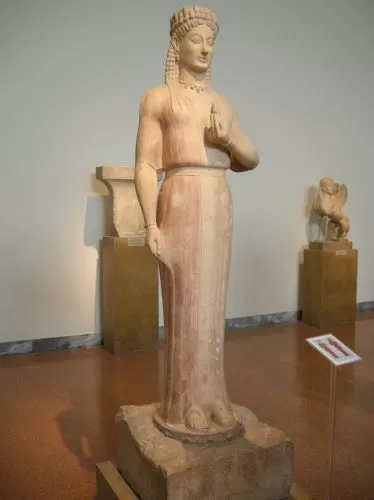
Archaic Greek korai were once richly painted and dressed in elaborate textiles. Their colors, patterns, embroidery, and gold ornament expressed wealth, ritual identity, and status.

By Dr. Susanna Harris
Senior Lecturer in Archaeology
University of Glasgow
Introduction
Iconography, the most prevalent source for Archaic Greek textiles, is often rejected because the representation of textile clothing on statues is considered unreliable and confusing. This perspective can now change because new research into preserved textiles provides an evidential framework within which to compare iconography with contemporary textile techniques.1 The aim of this paper is to interpret the textiles represented on the Archaic statues of young women (korai) by considering the number and quality of textiles used to make garments in the light of the preserved textile evidence. It argues that the representation of textiles on the near life-size statues of Archaic Greek young women displays details consistent with textiles known to have existed at the time. Applying an informed textile approach to two statues of young women from Attica, this research addresses how many and what kind of textiles were worn in each outfit. The results demonstrate the quality and quantity of textiles represented by the sculptors, provide a fresh interpretation of the clothing and indicate the sumptuous nature of the textile clothing worn by esteemed young women in 6th century BCE Greece.
Statues of elegantly dressed young women dating to the Archaic period (c. 600–480 BCE) are found across Greece. The Archaic statues of young women (kore,pl. korai) are monumental, realistic, though stylised, three-dimensional stone sculptures that were originally painted in bright colours, referred to as polychromy. Some were placed on the Acropolis as dedications to the gods, others are funerary monuments.2 The statues follow a recognisable format, which is considered to be both generalised and highly individualistic.3 Inscriptions on funerary statues sometimes identify the young women depicted by the statue, reinforcing the idea of them being portraits. At temples, statues may be goddesses or offerings to goddesses. Whether these women represent goddesses, such as Athena, Artemis or Hera, or young women from wealthy families, is still a matter of debate. Recently Catherine Keesling has argued that the Athenian Acropolis korai represent Athena.4 Whether interpreted as deities or wealthy individuals, the quality and quantity of the textiles suggests that they wore the most valuable forms of clothing of the period.
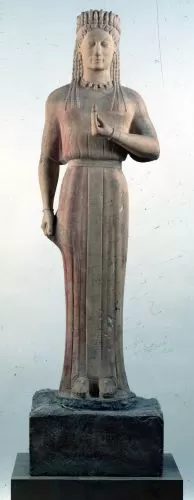
The korai belong to a representational tradition based on observation of form, shape, scale and colour. The statues were carefully sculpted, engraved and painted; the features are deliberate and intentional. Sculpted in the round, the statues can be examined from multiple angles, leading to a fuller understanding than can be gained from two-dimensional media such as vase painting. The in-the-round technique, close to life size, and the fine quality stone used enable a high level of detail as can be seen in the depiction of flowers and biological features such as the cuticles of the nails and details of the eyelids.5 The jewellery depicted on the statues finds parallels in archaeological finds.6 The statues of Phrasikleia and the Berlin Kore, for example, wear inverted pyramid earrings and pendant necklaces of types known from Archaic graves at Sindos and elsewhere on mainland Greece (Fig. 5.1).7
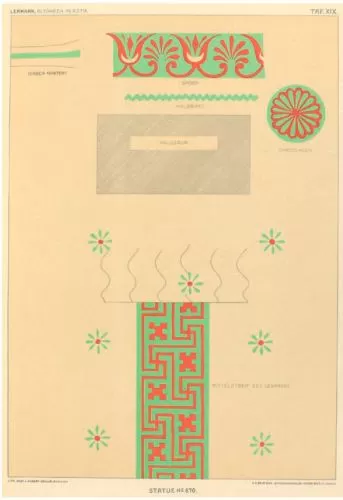
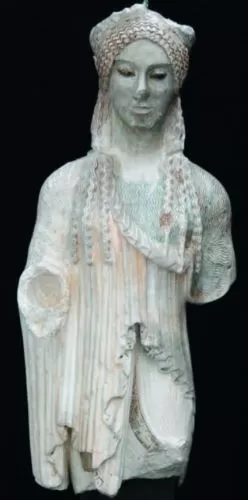
Painted surfaces add colour to the relief and engraved stonework. Vulnerable to environmental factors, pigments degrade due to their composition and are barely visible today. The early 20th-century watercolours of Swiss painter, Émile Gilliéron, plates by Wilhelm Lermann (Fig. 5.2) and a colour cast by sculptor Ingrid Kjær (Fig. 5.3) made shortly after the discovery of a korai from the Athenian Acropolis in 1885–1890 are important sources for understanding the painted areas and motifs.8
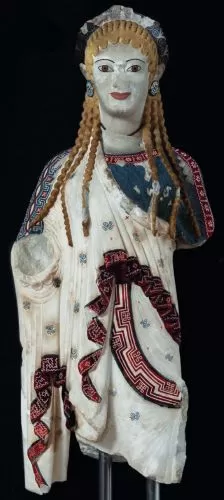
Recent scientific analyses and augmented virtual realities, such as those led by Vinzenz Brinkmann, Dimitrios Pandermalis and the CHESS9 Project, have produced startling rediscoveries of the statue’s original colour (Fig. 5.4).10
Clothing on Archaic Statues: A Confused History
Statues are widely studied aspects of Archaic Greek material culture.11 The art historical and literary traditions focus on the statues as art, their relationship to Greek myth and society, the evolution of naturalism, style and content, and the sculptor’s ability to represent the human body.12 The clothing is referred to as drapery, an obscure art historical term meaning neither clothing nor textiles. With some exceptions, the drapery of the korai is seen as a means to emphasise or reveal the body rather than as a subject for display and enquiry in itself.13 In many cases the writers shy away from the subject of textiles or clothing, considering it too complex, and argue that it does not appear to be realistic. For Boardman ‘the distinction in dress is thoroughly confused’14 and for Stieber ‘some of the clothing arrangements are so complex and, on occasion, so baffling as to defy attempts to explain and categorize them’.15 Why do present-day researchers come to these conclusions?
Tracing and understanding the genealogy of research on clothing involves three major stages: Lermann’s description of the sculptures and their polychromy shortly after their discovery;16 Margarete Bieber’s seminal work on ancient Greek clothing; and Gisela Richter’s monograph on korai (statues of young women) and kouroi (statues of young men). Of these, Bieber and Richter are the most influential today.17
Lermann’s description of the sculptures and polychromy is based on the observation of shape, relief and texture in combination with the pattern and colour of pigments. In his description of Kore Acr. 673, for example, Lermann identifies three garments with three distinct decorative bands, one on each garment (Fig. 5.5).18 The first, an underdress,19 is visible on the upper chest and left arm; it is painted green/blue20 with a red and blue patterned ornamental band along the upper edge, along the arm and beneath the throat. The second is a throw-over21 which is draped from both shoulders; the longest folds hang on the right of the body and the lower edge has a predominantly blue meander band. A third garment wraps the lower body and has a wide, vertical central stripe22 painted red, green/blue and blue.
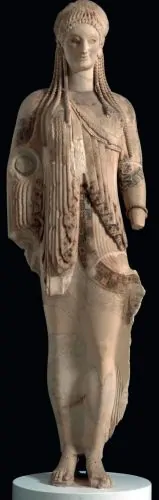
The first study to focus on dress was Bieber’s. Bieber examined the statues and literary sources and compared dress with the archaeological evidence for textiles and textile production found in vase painting and embroidered textiles from the Crimea.23 Following literary sources, including Herodotus, Thukydides and Aristophanes, Bieber identifies three garments in the ancient Greek women’s wardrobe: peplos (a rectangular, wrapped and pinned garment), chiton(a tunic–like garment) and mantle or himation (a mantle or wrap worn on the upper body).24 Most of her analysis is based on Classical, not Archaic, statues. Her description of the Archaic kore (Acr. 682) (Fig. 5.6) from the Acropolis, dressed similarly to Acr. 673 described by Lermann and summarised above, identifies only two garments: the chiton and the oblique mantle.25
Richter’s research follows Bieber, with whom she consulted, and starts from literary sources.26 She includes black and white inserts of Lermann’s colour plates to illustrate pattern. Richter identifies five garments in the Archaic Greek korai’s wardrobe: the peplos, the chiton, the Ionic himation (a short, pleated mantle), the epiblema (a shawl like wrap) and the ependytes (an informal short garment worn over the chiton).27 For Richter, Kore Acr. 673 wears two garments: a dual-coloured chiton beneath a short Ionic himation or mantle which ‘hangs down in a series of vertical, stacked folds with zigzag edges’ over both shoulders.28 Richter interprets the garments of Kore Acr. 682 in the same way.29 Despite her admiration for ancient Greek weaving and embroidery skills, and her view that ‘these decorated draperies supply evidence of the appearance of the actual garments worn by Greek women’, Richter sees a problem with the ‘drapery’.30 She cannot reconcile these flowing forms with the Classical Greek clothing and terms presented by Bieber.31 In frustration she writes, ‘we are after all confronted with works of art, not with living human beings’.32
Today, the dress on statues such as Acr. 673 and 682 continues to be identified as two garments. One, the chiton, often with a textured red or green/blue bodice and a smooth, light–colour lower part with a central band (paryphe); the other, a himation fastened at one or both shoulders in cascading pleats with a narrow painted edge band.33 This interpretation is visually confusing. It is unconvincing that sculptors and painters, trusted in their execution of body and inorganic artefacts, should fall short in their execution of textiles. As stated above, this interpretation stems from transferring to Archaic statues and art historical traditions a classical typology which prioritises the body over cloth. There is bias towards the written evidence in which words for garments were used more fluidly than today’s translations would allow; and incorrect assertions about textiles,34 such as the problems of dyeing linen, are accepted without question.35 Taken together, this results in the textile clothing being regarded as fanciful. This is problematic because a quite different conclusion can be reached by applying an understanding of textiles combined with a trust in the sculptors and painters of Archaic Athens as first-hand observers of the world around them: the results, instead of being ‘fanciful’, provide rich evidence for the textiles present. They show the quality and quantity of the textiles that made up these honoured young women’s outfits. Importantly, engaging with the textiles allows an exploration of any ideological points the sculptors were making and demonstrates that textiles provide a significant source with which to understand the Archaic world.
Method – An Informed Textile Approach
Hero Granger-Taylor and Elisabeth Wayland Barber championed the informed textile approach to clothing on Roman and Greek statuary in the 1980s and 1990s.36 A formal analysis such as they adopted is applicable where there are recognisable details to match those found in preserved textiles, suggesting that sculptors copied actual textiles. This approach is suited to detailed, naturalistic, three-dimensional iconography.37 In promoting an informed textile approach, it is necessary first to explain the relationship between textiles and clothing.
Technologies of dress can be separated into cloth, clothing and costume.38 Cloth is the fabric used to make the clothing; costume is the combination of clothing worn together in an outfit. In Archaic Greece, textiles were the cloth of clothing. Textiles include several technologies. Yarns, made from fibre, are woven on a loom to create a web of fabric called a textile.39 Yarns are characterised by their raw material, twist and diameter. Textiles are characterised by their yarn and fibre, weave structure, the sett of the warp and weft, finishing and weaving processes.40 Fibres, yarns or textiles can be bleached or dyed. Textiles can be decorated on or off the loom, pleated, folded, cut and sewn. Clothing can be wrapped or tailored. It appears that the clothing in Archaic Greece was mostly made from rectangular textiles, in contrast to central Italic Iron Age and Roman cultures where textiles were woven to shape.41 All processes affect the appearance of textiles and can find their way into the representational repertoire. The textiles of the Archaic korai have many such details. The informed textile approach developed for this paper is summarised as follows:
- Set aside the literary sources in the first instance.
- Observe textiles represented on statues through sculpture,relief, engraving and polychromy.
- Understand contemporary textile technology and the materials using preserved textile remains as comparisons.
- Use the knowledge of contemporary textiles to distinguish the number and type of textiles represented as textile products (here, clothing).
- Compare textile products with other iconographic and written evidence.
Instead of seeking to define ‘clothing’, this method first seeks to understand the textile technology of clothing based on a knowledge of preserved textiles. Here it is applied to two statues: the first a grave marker, the second a statue from the Athenian Acropolis.
Phrasikleia Kore, 550–540 BCE42
Overview
The first statue to be discussed here is of a young woman excavated in Merenda, eastern Attica, in 1972; it was buried in a pit with a statute of a naked young man (kouros, pl. kouroi).43 Dated to the mid- to late sixth century BCE (c.550–540 BCE), the statues are believed to have been grave markers of the Alcmaeonid family that were taken down and hidden before or shortly after the Persian destruction of Athens in 480 BCE.44 The statue of the woman is a complete, three-dimensional marble statue with a well-preserved surface. It is carved in the round with engraved details and visible traces of pigment. The inscription indicates that she is a bride.45 Stieber argues that the young woman’s statue is highly individualised and the inscriptions suggests that it is a likeness of the deceased young woman, Phrasikleia.46 The statue, complete with analysis of its polychromy, has been reconstructed.47
The Statue
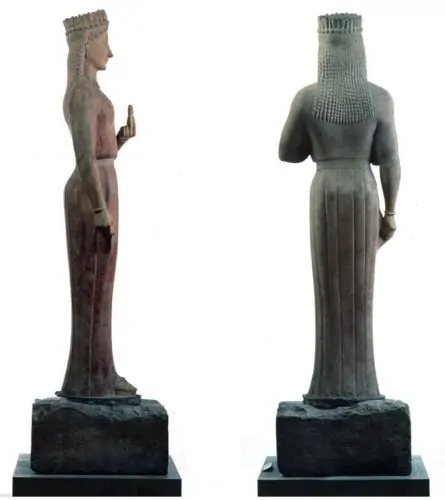
The young woman is dressed in a long red robe ornamented with yellow and orange patterned bands and motifs and fastened with a belt (Fig. 5.1, 5.7). On her head she wears a garland of flowers; her jewellery includes a necklace, earrings and a bracelet on each wrist; and she holds a closed lotus bud in her left hand. Her hair is tied back behind the ears with a narrow band. On her feet she wears sandals.
The fabric of the robe, indicated by the smooth surface and vertical folds, hangs from the shoulders and folds at the feet and is clasped at the waist with a belt. The front of the dress is asymmetrically decorated with rosette and swastika motifs. These motifs continue on the back with the addition of star and sun motifs. Two similar meander pattern bands run from one elbow to the other across the top of the arms, shoulders and front and back of the neck opening. These bands are engraved onto the stone surface and are flush with the fabric of the robe. The front and back bands meet along the arm and shoulders, creating a double line of bands. The bands are joined by a seam, depicted as a narrow ladder pattern from elbow to neck opening (Fig. 5.7a). The armholes are lined with identical meander patterned bands, which join the double band along the arms at close to a right angle. There is a central vertical band that extends from beneath the decorated band at the robe’s neckline to between the ankles which is engraved and painted with meander pattern. The edges of the vertical band are several millimetres higher than the robe surface. There are no visible side seams. The smooth fabric surface on the chest and back is interspersed with low relief folds which slightly overhang a patterned belt worn at the waist. Folds of fabric between the chest and upper arm indicate surplus fabric (Fig. 5.7b). From the belt down, the fabric eases over the hips. As the volume decreases mid-thigh, the fabric folds become deeper and fall around the feet in an undulating line. The lower edge of the robe is embellished with a band with u-shaped inserts, described as tongues or scales. The presence of simple red undulations between the patterned band suggests the plain reverse fabric. The vertical band superimposes the tongue-patterned band at the lower edge.
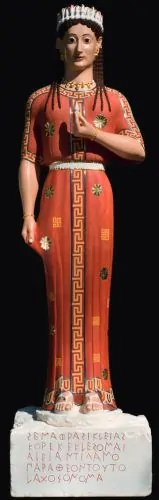
The statue was examined using UV-VIS absorption spectroscopy and X-ray fluorescence to identify the pigments.48 The analytical results were used to create a colour reconstruction of the statue (Fig. 5.8). The robe was painted with orangey-red ochre and iron oxide to create a bright orange-red colour. The inside folds at the bottom edge of the robe and the edge of the sleeves were painted with red ochre and iron oxide to produce a darker red. The rosette petals and stars that decorate the robe were painted with yellowish goethite and iron oxide to create a light yellow hue, alternate petals were painted in a violet colour. The swastikas were painted with a mixture of yellow ochre and orpiment (a type of fake gold used for pigments)49 to produce a luminous yellowish gold. The meanders on the central vertical band along the neckline and sleeves were painted with a very light yellow ochre on a background of dark red haematite and iron oxide, creating a light yellow meander on a deep red ground. The meander borders are painted the same violet colour as the rosette petals. The tongue patterns on the band along the lower band of the robe were painted alternately violet and a very light yellow ochre, on a background of dark red (haematite and iron oxide). Based on this examination of its original polychromy, the overall effect of the statue’s clothing is that of a stunning red robe with bright patterned bands and motifs in shades of yellow and orange, with details picked out in a shiny dark violet and gold.50
The Textiles and Gold Ornaments
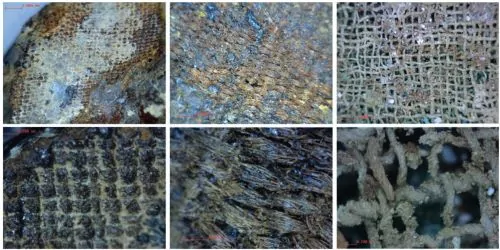
Which textiles were represented in Phrasikleia’s garment? The preserved textiles of the Geometric to Classical period in Greece (10th–5th centuries BCE) are woven in variations of plain weave51 which were either balanced tabbies (a similar number and type of threads in both warp and weft) or weft-faced tabbies (a higher density of weakly twisted weft threads in relation to the warp).52 Given that both balanced and weft-faced tabbies can be used to produce smooth fabrics, Phrasikleia’s robe could have been made from either one.53 In a cremation urn from the Ionian island of Corfu, 7th century BCE, fragments of textiles include a wool balanced tabby with 40–50 threads/cm, and a range of wool and linen weft-faced tabbies, with 60 to 120 wefts/cm made using wefts as fine as 0.15mm in diameter.54 A fine, dense, balanced tabby from Knossos, 8th century BCE, shows the quality of the yarn and the weaving (Fig. 5.9a).55 Many of the weft-faced tabbies in ancient Greece were high-quality and labour-intensive textiles with more than 50 weft threads per cm of weaving (Fig. 5.9b).56 Others are coarser textiles, as seen in a 6th-century BCE fragment from Vergina necropolis, central Macedonia, which had around 11 warps/cm and 20 wefts/cm; the wefts are 1 mm in diameter.57 The soft folds of Phrasikleia’s garment suggest that it is made of fine textiles.
The bold red textile and contrasting colour motifs indicate that the textiles were dyed. Most textiles in Greece are preserved through mineralisation and that is why few are suitable for dye analysis. Though rare, some preserved fragments of dyed textiles do exist. Two of the 7th-century BCE wool, weft-faced tabbies from Corfu, mentioned above, were dyed purple.58 At least one of the two garments worn by the burial known as the ‘Lady of Aigai’, a lavishly furnished burial excavated from a cemetery near Vergina, Central Macedonia, dated c. 500 BCE, was a light, bright purple.59 The purple of Textile 3, Lefkandi, dated 950 BCE, has been identified as shellfish purple.60 Threads from the patterned Band 1 from Lefkandi were originally dyed red, probably using the red dye plant, madder (Rubia tinctorum).61 Light coloured wool is readily dyed, though, conversely, it is difficult to maintain white wool as the fibres tend to yellow on exposure to sunlight or as they age.62 The colour of Phrasikleia’s robe is therefore entirely in keeping with dye technology of the time, whether depicting a purple or red textile of wool or linen.
Which textile techniques could have been used to create the swastika, star and rosette motifs? The weavers of 10th- and 5th-century BCE Greece used warp or weft stripes, supplementary wefts and warps,63 weft-wrapping or soumak64 and tapestry weave65 to decorate textiles during weaving, with embroidery66 applied to the finished textile.67 The swastika and star motifs on Phrasikleia’s robe could have been embroidered or woven into the red textile with yellow thread using any of these techniques. While the star motifs are more ambiguous, the square basis of the swastika motif lends itself to a woven design which could have been achieved using a coloured supplementary weft, soumak or tapestry weave incorporated into balanced or weft-faced tabby respectively. At Lefkandi (950 BCE) there are preserved remnants of tapestry weave and soumak or weft-wrapping.68 From 4th century contexts, there is a spectacular tapestry weave woven in gold and purple from Tomb II, Vergina;69 and from Bulgaria there are fragments of red and white tapestry from Zlatinitsa and gold thread tapestry from Golyama Kosmatka.70 The presence of tapestry weave designs in earlier and later centuries, together with the representation of figurative, patterned textiles in vase paintings, suggests that these textile techniques were used on Phrasikleia’s long robe.
In form and colour the light yellow and gold rosette decoration and triangular strips along the edges of Phrasikleia’s belt find archaeological and literary parallels in gold sheet appliqués, techniques practised throughout Greece from the Bronze Age to Hellenistic periods.71 Gold sheet bands, triangles and discs were sewn onto the Lady of Aigai’s garments, mentioned above for the purple textiles.72 The Lady of Aigai’s burial contained 23 gold discs measuring approximately 25 mm in diameter which were embossed with rosettes; two holes in the centre show how they were stitched to the fabric.73 Similar gold rosettes, double triangles and embossed plaques adorned the garments and shoes of another woman, called the ‘Lady of Archontiko’, a decadently furnished burial of the West Cemetery of Archontiko, Pella, 540–530 BCE.74 Both graves are among the most sumptuous burials found in either cemetery; the women are interpreted as members of a powerful Macedonian aristocracy, priestesses or queens.75 It appears that the sculptor of Phrasikleia’s statue portrays her in a similar vibrantly coloured textile embellished with gold.
What of the patterned bands that frame the shoulders and armholes and create the striking central vertical band on Phrasikleia’s robe and tie her hair? Taken at face value, the raised central band, the connection of shoulder and arm bands at 90°, and the plain reverse fabric on the lower edge of the robe, together indicate that the patterned bands were fixed onto, rather than woven into, the fabric. There are two narrow bands from Lefkandi, early 1st millennium BCE. Band 1 is 10 mm wide and woven in yarns of flax and wool with geometric patterns, probably using supplementary warp floats technique.76 There is a preserved narrow band from Bronze Age Kastelli in Chania, Crete, made from linen, nettle and goat’s hair.77 Ornate hair bands (mitrai) and belts (zonai) are common in early vase-paintings and are pointed out in Homer and Archaic poetry.78 These would have been suitable techniques to use to weave the wider and more complex meander and tongue patterned bands on Phrasikleia’s robe. The other major technique used to weave patterned bands in the Mediterranean in the 1st millennium BCE is tablet weaving.79 Tablet woven bands were often integral to the textile, rather than applied. Margarita Gleba, however, argues that tablet weaving is a central European and Italic textile tradition which has yet to be identified in Greece.80
The Garments
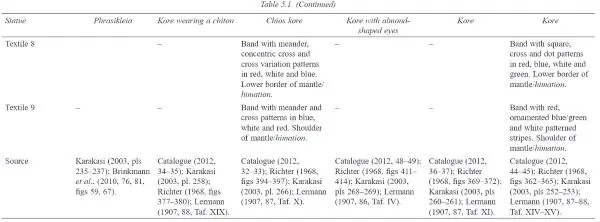
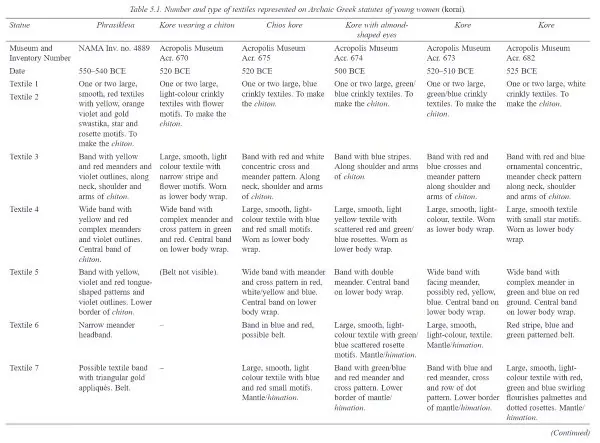
Phrasikleia’s robe is long, it falls to the floor. It was made of one or two large, rectangular textiles that were stitched together at the shoulders, with an opening for the head (Tab. 5.1). A prominent vertical band with meander patterns falls from neck to ankle. Its elevation from the surface of the robe suggests it is applied to the red fabric. Two meander-patterned bands run across the front and back of the upper edge of the textile with four short lengths of the same meander-patterned band found on the front and back of the armholes. The armholes are positioned within the long edge of the garment. The extra folds of cloth between the elbow and waist, together with the right-angled decorative bands on the arms, suggest the sleeves are side openings in a bag-shaped garment. The absence of side seams is curious. It could suggest Phrasikleia’s garment was woven in one piece to create a tubular fabric. Alternatively, it could have been made from two large textiles stitched together along the side and shoulder seams to create a tubular shape with openings left for the head and armholes. If this is the case, the sculptor chose not to represent the side seams. This bag-shape, or tunic-shape, is one of the simplest forms of garment; this interpretation has not been challenged in the academic literature.
There are numerous similar garments portrayed in statuary and vase painting. A comparable red floor-length robe is worn by the Berlin Kore, believed to originate from Keratea, Attica, 570–560 BCE.81 The Berlin Kore garment has meander bands at the neck and centre front and the dress construction appears the same with excess fabric between the elbow-length sleeves and chest.
The single garment worn by Phrasikleia is often interpreted as a chiton,82 fastened with a belt (zone).83 This fits in with the definition of a chiton as the Greek term for tunic.84 Others refer to Phrasikleia’s peplos, which highlights the inconsistency in translating garment names.85 There are numerous variations of the chiton in representation and literature. These include chitones from two large rectangles of textile sewn up the sides and those woven without seams.86 Chitones vary in length, were worn with or without a belt and could differ in the way they were fastened at the shoulder.87 Chitones were woven from linen or wool.88 The armholes in Phrasikleia’s garment are set within the side, at right angles to the shoulder seam, which is contrary to published patterns of chitones where the armholes are in the upper edge.89 In the academic literature on garments of the mid-7th to 6th century BCE, a chiton with loose folds, such as the one sculpted on the statue of Phrasikleia, is referred to as the Ionic chiton in contrast to the narrow, straight, columnar Dedalic chiton or peplos that preceded it.90
In short, Phrasikleia’s outfit is made of at least six textiles. There are one or two large, red rectangular textiles stitched to create a long robe. These were either balanced tabby or weft-faced tabby with embroidered or tapestry motifs and gold appliqué. Applied to the robe are three bands: a wide central band with complex meanders, a long band with simpler meanders around the neck and arms, a band with tongue-shaped patterns round the hem and a narrow meander pattern band to tie the hair. It is not clear whether the belt with triangular gold appliqué is textile based. The red textiles are noticeably long and highly embellished.
Kore Wearing a Chiton (Acropolis 670), 520 BCE91
Overview
The second statue discussed in this paper was found in 1886 to the north-west of the Erechtheion of the Athenian Acropolis (Fig. 5.10).92 This three-dimensional marble statue of a young woman is now only 1.15 m high. The main body is preserved but the hands, feet and lower area of the garments are missing.93 The polychromy of the statue was described by Lermann shortly after its discovery.94 There are no published scientific analyses of the pigments.
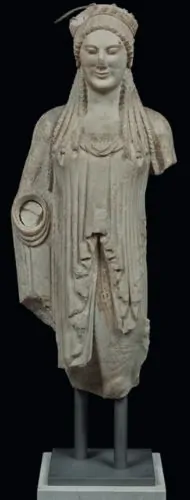
The ‘Kore wearing a chiton’, referred to here as Acr. 670,95 wears disc earrings and a decorative arced headdress (stephane) over long hair. Her clothing is represented by two distinct textures, a crinkly texture covering the upper body and a smooth texture with folds in the lower body. In her left hand she lifts up a deep concertina of folds from the lower garment.
The Statue
The upper body is carved with a fabric composed of closely spaced, wavy ridges that fall vertically from the shoulders and neckline and end at the hip where they curve under a horizontal fold of the fabric. The wavy ridges create a crinkly effect fabric. At the neck opening, the fabric is bordered within a smooth band several centimetres wide; Lermann noted green pigment on the collar.96 The crinkly fabric is joined along the shoulders and top of the arms by seven or eight small buttons. Three wavy crinkles radiate out from each button on the front and back of the garment. The fabric eases around the shoulders and joins into the vertical fall of the fabric, as can be seen from the back. The sleeves end in deep folds below the elbow. The direction of the wavy ridges and the excess fabric around the elbow indicate that the sleeves belong to the same rectangles of fabric as the main body of the garment. The fabric is ample around the chest, arms and waist and at the back follows the curve of the spine. The sculptor portrays a fine, crinkly textile; the left nipple pokes through the fabric. Painted flowers or stars, once green and now brown, are visible on the chest and hips.
In contrast, the fabric on the lower body is smooth with wide, low relief ridges. Low relief ridges radiate from the pubic area to the ankles and around the thighs, creating the impression of a fine fabric held tightly to the body. A prominent vertical central band sits on a deep concertina of fabric, emphasising a large quantity of cloth built up in the folds. The lower garment clings to the body, which contrasts to the baggy upper garment. Lermann observed a meander and cross pattern on the central strip of the skirt, painted red on green/blue. All that remains of the pigment now is a dark pigment highlighting the edge of the strip.97 What Lermann described as a green/blue strip at calf height is today a dark line encircling the body. It starts either side of the central strip, runs through the concertina folds and slants down across the shins to the back of the calves. Lermann describes the statue as lacking large areas of colour; small green stars with a red central dot are scattered across the entire fabric.98
The crinkly textured fabric on the upper body combined with the smooth fabric on the lower body find comparisons in other statues from the Acropolis (Acr. 683, Acr. 671). Kore Acr. 683 has a similar combination of crinkly textured fabric on the upper body and smooth fabric with a concertina of folds on the lower body.99 The so-called Peplos Kore (Acr. 679) wears a long robe of crinkly fabric beneath her smooth outer garments. The crinkly textured garment on the Peplos Kore peeks out at the left elbow and around the ankles at the lower edge of the clothing, indicating it to have been a long garment extending from shoulder to ankle.100
The Textiles
What type of textiles was the sculptor trying to represent? There are several possibilities for the crinkly textured fabric of the upper body. The closest textured textiles found amongst the preserved ones are the open, plain weave (tabby) textiles woven with fine, overspun yarns. Preserved fragments of this type of textile are known from the Orientalising to Hellenistic period in Greece and from the Greek city of Cumae in Italy, a city established by settlers from the Aegean.101 The balanced open tabbies at Cumae are woven in warp and weft with hard to very hard spun z-twist linen yarns that are 0.09–0.2 mm in diameter, with only 23–32 threads/cm of weaving.102 Similar fabrics wrapped a cremation burial in Eretria, Greece, c. 700 BCE.103 The notable characteristic of this fabric is that one thread system is very hard spun, creating overspun yarns that cause the fabric to kink.104 When cut from the loom, the overspin acts like a spring, causing the yarn to contract, which can create a crinkled effect known as crêpe.105 The narrow folds created by the contraction of the hard-spun yarns creates a type of pleat.106 The mechanical properties of flax fibre would enhance this effect because cellulosic fibres, such as flax, crease and wrinkle, in contrast to protein fibres, such as wool, which are resistant to wrinkling.107 The smooth fabric of the lower body, with its concertina of folds that flares out towards the feet, suggest a fine textile. The texture is similar to the fabric of Phrasikleia’s garment and represents a weft-faced or balanced tabby.
It is debatable whether these distinct textures are part of the same textile. It is possible to weave sudden changes in colours and textures in one textile.108 A preserved textile, interpreted as a robe-like garment from Lefkandi, is woven with two distinct weaves: a balanced plain weave and a plain weave with a pile of Turkish knots109 integrated into the weft.110 However, due to technical factors, weft-faced tabbies and overspun tabbies required a different loom set up, suggesting that they were woven as separate textiles. The warp yarns of preserved weft-faced tabbies known from Greece are typically over 0.2 mm in diameter, less than 20 threads/cm, and usually wool.111 Whereas the warp yarns of the overspun tabbies are less than 0.2 mm in diameter, with 23–32 threads/cm, and made of linen. Further consideration of this issue in relation to the garments is discussed below.
The flower patterns on the upper and lower fabric could be the result of a number of decorative techniques, as explained for Phrasikleia’s garment. The flower petals are akin to embroidery or non-continuous supplementary weft techniques. Embroidery was practised from the Bronze Age to the Classical Period in Greece. There are traces of embroidery found on a plain weave fragment from Xeste, Late Minoan Crete, c. 1400 BCE. Embroidery is also found on a 5th-century textile from Nikaia, Attica, and in motifs embroidered on textiles from Classical period Koropi, East Attica.112 The meander patterned central band is woven with a geometric pattern that is readily achieved in weaving, potentially with a supplementary warp technique as has been discussed above. The dark stripe in the textile at ankle height would have been easy to add by using coloured warp or weft yarns.
The Garments
Are the distinct textured fabrics separate garments? Like Phrasikleia’s garment, the fabric of the upper body garment appears to consist of two rectangles fastened together by multiple small buttons along the top of the arms and across the shoulders to form a tunic-like garment (Tab. 5.1). The front neck opening has a smooth strip several centimetres wide; unlike Phrasikleia’s, there are no fancy edges to the shoulder seams or armholes. The hypothesised belt of Kore Acr. 670 is invisible beneath the overhanging fabric (kolpos). On statues wearing similar clothing from near Laurion, Attica and the temple of Hera, Samos, c. 525 BCE, the sculptors show a belt intersecting the crinkled and smooth fabrics.113 The textile of the lower garment, with its smooth texture, is significantly bunched in the centre, and the concertina of folds hangs beneath the central vertical band with a meander pattern.
On other statues, the crinkly upper body garment is a different colour to the smooth, lower body wrap. On Kore Acr. 675, the ‘Chios Kore’ (Fig. 5.4), Kore Acr. 673 (Fig. 5.5), Kore Acr. 674, the ‘Kore with almond-shaped eyes’ (Fig. 5.3) dated between 520–500 BCE, the crinkly texture on the upper body is painted dark green/blue in contrast to the smooth, light colour fabric on the lower body and asymmetrical wrap on the upper body.114 The crinkly textiles on the so-called Peplos Kore (Acr. 679) may originally have been blue; on the ‘Red shoes kore’, Acr. 683 and Acr. 685, the crinkly textured upper garment is painted red.115 This indicates that the crinkly fabric, possibly linen, was sometimes dyed green/blue or red. The academic literature repeatedly notes that linen is a notoriously difficult fibre to dye.116 This assertion needs clarifying.117 Cellulose fibres, such as linen, can be dyed fast especially if they are vat dyed or treated first with a mordant; these were practices known in Iron Age Europe and described by Pliny in the 1st century CE.118 The light colour of the smooth fabrics can be achieved by using non-pigmented wool or plant fibres in their natural or bleached state.119
While the texture and colour could belong to the same textile, the structure of the garments suggests otherwise. The central vertical band ends at the top of the smooth fabric, suggesting it is attached to a separate textile. Most persuasive is the bunching of the fabric. The textile of the upper garment hangs evenly across the arms and shoulders, front and back, with excess fabric bunching at the side in the underarm and elbows. The lower garment, by contrast, is tightly wrapped around the back and sides of the lower body and is bunched into folds at the centre front. This means the excess fabric of the upper and lower body textiles is collected in different areas of the body. This pattern features suggests that they are two distinct garments.
There has been some debate about the separate lower body garment. Lermann describes it as a robe or dress.120 For Richter and nearly all subsequent writers, the young woman is wearing a single garment, the chiton, pulled over a belt to form a pouch (kolpos).121 On the basis of the contrasting colour and textures, Evelyn Harrison maintained that such garments are pieced together from several textiles.122 Based on representations on ceramics, Isabella Benda-Weber argues for garments composed of multiple textures and patterns from the Bronze to Iron Ages across Greece; different textiles may have been stitched together.123 Alternatively, Judith Schaeffer and Brunilde Ridgway suggest a separate skirt or lower body wrap.124 Evelyn Harrison opposed the idea of skirts in antiquity because she found no open edge indicative of a wrap on the Archaic kore.125 It is possible that efforts were made to conceal side seams within the concertina fold or beneath the central strip. Benda-Weber cites a terracotta figurine of a women revealing her pubic area by opening her wrap to the left of the central strip.126 The upper garment of the Peplos Kore (Acr. 679) opens over her left arm. In the academic literature himation usually describes the diagonal mantle worn over a chiton, although it is also a general term for clothing.127 Could the wrap be a himation worn lower down on the body? These are the kind of details that will always make interpretations of the korai’s clothing doubtful.
In summary, the ‘Kore wearing a chiton’ wears three or four textiles (Tab. 5.1). These are one or two large, light colour crinkly textiles with delicate, probably embroidered, flower motifs, fastened by small buttons along one edge to make a tunic-like upper garment. There is one large, light-coloured textile with narrow stripe and small embroidered flower motifs worn as a wide lower body wrap. Applied to the wrap is a wide band with complex green and red mean-der and cross patterns. The crinkly textile is large, falling in deep folds at the elbow and overhanging the belt. The lower body warp is very wide, with fabric piled in multiple pleats.
The Textile Evidence Provides Clarity, Not Confusion
The results gained by applying the informed textile approach to these two korai provide the framework within which to analyse the complex clothing combinations. The crinkly chiton and smooth wrap of Acr. 670 is found on other korai in combination with a diagonal pleated mantle over one or both shoulders. This increases the total number of textiles worn by an individual kore to as many as nine. For example, the ‘Chios Kore’128 (Fig. 5.4, Tab. 5.1) wears one or two crinkly blue textiles, with a red and white meander – and a flower-patterned upper border for the tunic-like chiton. On the lower body, she wears a smooth, light-coloured wrap with scattered motifs and a wide meander-patterned central band. At the top of the central band is a glimpse of a red and blue horizontal band, possibly a belt. Over the right proper shoulder is an ample, pleated, light-coloured mantle with the same small motifs as the lower body wrap; its lower border has a red, white and blue meander pattern and a diamond pattern and the shoulder fastenings are lined with a blue, white and red meander and cross-patterned band. The ‘Kore with almond-shaped eyes’ (Fig. 5.3) and Kore Acr. 682 (Fig. 5.6)129 wear a similar combination of garments (Tab. 5.1). Kore Acr. 673 (Fig. 5.5) has a variation with the mantle fastened over the right proper shoulder and also drawn over the left shoulder (Tab. 5.1).
Conclusion – Abundance and Splendor
With the results gained from the informed textile approach, this paper demonstrates the astonishing quality and quantity of textiles represented on statues of young women (korai) in Archaic Greece. Through comparing the representation of textiles on the statues with preserved textiles this research focuses on the textiles depicted by the sculptors and painters. Preserved textiles in Archaic Greece are mostly balanced plain weave tabbies, weft-faced tabbies and tapestry. Variations of these textiles were made with fine, textured yarns, dyed and decorated with supplementary wefts, sou-mak, weft wrapping, embroidery and gold appliqué. This analysis shows how the surviving textiles correspond to the textures and patterns of the clothing represented on the statues. Given that these textiles can be identified, their representation merits being treated with a level of recognition similar to that applied to the other features portrayed.
Archaic statues give a sense of the abundance of textiles in these young women’s dress assemblages. This fits in well with the literary evidence.130 Based on the textile analysis, Phrasikleia’s outfit required at least six textiles (Tab. 5.1). The ‘Kore wearing a chiton’ incorporates four or five textiles, the outfit of the ‘Chios Kore’ includes eight or nine textiles (Tab. 5.1). These are unique results gained by using the informed textile approach to investigate the quality and quantity of textiles, rather than focusing on clothing. The number of textiles attests to the sheer quantity of fabrics in the korai’s outfits. Many of these textiles are large; robes and wraps fall to the ankles, textiles have concertinas of folds and pleats, surplus fabric falls around the elbows and hangs over the belt. Textiles are piled on in layers, whether through applied decorative bands or the addition of wraps and pleated mantles. These oversized and layered textiles further emphasise the quantity of textiles used in the korai’s dress assemblages. The textiles are splendid; they are a sensory delight.131 They were dyed intense colours, patterned, embroidered, tapestry woven and appliquéd with gold. The sculptors represented textiles that required skilled crafting, colourful dyes, fine yarns and a range of weaving technologies. In number, type and size of textiles represented on the korai were expensive in terms of resources, this made them exclusive as they were accessible only to the wealthiest families. Where similar preserved textiles have been found in the burials of Aigia and Archontiko, they have been considered to be the textiles of princesses. All the evidence suggests the young women (korai) were represented in textiles of value.132
Statues of young women (korai) are primarily concerned with textiles unlike the statues of young men (kouroi) where the nude body prevails. Why was this? The answer, it seems, was that the athletic, nude male statue was making an ideological statement.133 What, then, was the corresponding ideo-logical significance of the textiles which adorned the female statues? The prevailing culture demanded that the woman’s body was covered and controlled.134 But the representation of these textiles also had a significance beyond this in that they marked the very essence of a Greek woman’s identity. Textiles were gifts, the products of women’s labour and part of the offerings made at sanctuaries.135 In the early 5th century BCE, textiles were intertwined with the aesthetics and ethics of Athenian notions of reciprocal gift-giving.136 Aristocratic women such as Penelope and Helen are famed for their weaving skills.137 Karakasi, for example, draws particular attention to the statues’ attributes – the fruits, animals and jewellery the women hold, offer or wear, all believed to be offerings or symbols of a divinity.138 These young women also hold and present their textile garments. Were then these textiles also offerings every bit as much as the other items? The Classical (mid-5th-century) Parthenon frieze in Athens shows the priest accepting the peplos destined to dress the statue of Athena Polias.139 Given that the Acropolis korai statues discovered in 1886 may have been offerings to Athena, goddess of weaving, it follows that the Acropolis korai would have worn the most elaborate and valuable textiles available at the time.140 If Phrasikleia is a bride, then she too shows her wealth, skill and connections through the display of fine textiles.
In short, by focusing on the quality and quantity of textiles, rather than merely on the style of clothing, it becomes apparent that textiles are potentially the most significant attribute of these statues of young women. In order to understand the visual message the Archaic sculptors and painters were trying to portray about their subjects, it is therefore essential to make full use of the evidence from the iconography.
Appendix
Endnotes
- E.g. Spantidaki and Moulhérat (2012); Spantidaki (2016); Gleba (2017); Margariti and Spantidaki (2020).
- The Acropolis kore were rediscovered during a digging campaign between 1885–1890. Richter (1968, 6).
- Highly individualistic as in Stieber (2004, 81–82), generalisedsee Keesling (2003, 6).
- Keesling (2003, 98).
- Stieber (2004, 148–149); Maßmann (2010, 72–73, figs 50–51).
- Karakasi (2003, 121).
- Castor (2008, 7); Ignatiadou (2012, 393, fig. 7).
- Lermann (1907), for bibliography of early research, see Vlassopoulou (2012, 8) and review by Gardner (1907, 237); for Ingrid Kjær, see Bundgaard Rasmusse (2019, 185, n. 26).
- CHESS – Cultural Heritage Experiences through Socio-personal interactions and Storytelling, funded by the EuropeanUnion Seventh Framework Programme.
- Brinkmann and Scholl (2010); Brinkmann etal. (2010c); Pandermalis (2012).See new work by Professor Pandermalis (Blatsiou, 2017).
- E.g. Ridgway (1993); Osborne (1998); Boardman (1999); Wagner-Hasel (2002); Stieber (2004); Donohue (2005); Pandermalis (2012).
- A legacy in the analysis of classical sculpture starting from Wincklelmann and Henri Lechat, c. 1903, ‘draped nudes and a unitary conception of stylistic development’ and ‘The assumption of a single artistic direction of improving naturalism in the representation of an undifferentiated category of “drapery” in relation to the nude’. For full critique, see Donohue (2005, 184).
- For exceptions, see Schaeffer (1975); Ridgway (1993); Lee (2015); Brøn̜s (2017).
- Boardman (1999, 67).
- Stieber (2004, 68).
- Lermann (1907, 87).
- Bieber (1928); Richter (1968; 1970).
- Lermann (1907, 87, Taf. X).
- Unterkleidin German (Lermann 1907, 87).
- Decay of pigments over time affects the colour. Nowadays the blue pigment appears green.
- Uberwerfin German (Lermann 1907, 87).
- Mittle streif der Gewand in German (Lermann 1907, 87).
- Bieber (1928, 6–8).
- Bieber (1928, 17).
- Bieber (1928, Taf. XXIII.1).
- Richter (1968, 7, n. 12).
- Richter (1968, 7).
- Richter (1968, 75).
- Richter (1968, 73).
- Richter (1968, viii, 15).
- Bieber (1928); Richter (1968, x–xi, 6–10).
- Richter (1968, 8).
- E.g. Catalogue (2012, 36–37 Acr. 673, 46–47 Acr. 682).
- E.g.peplos, Cleland etal. (2007, 143).
- ‘… linen is a notoriously difficult fibre to dye’. Lee (2015, 110).
- Granger-Taylor (1982); Barber (1991).
- For recent examples, see Demant (2011); Hildebrandt and Demant (2018).
- Stig Sørensen (1997, 97, fig. 2).
- Outline of textile technology, see Gleba and Mannering (2012); for textile definition, see Good (2001).
- Hammarlund (2013, 179, fig. 67).
- Granger-Taylor (1982).
- National Archaeological Museum, Athens, inv. no. 4889.
- Mastrokostas (1972); Stieber (2004, 141).
- Stieber (2004, 141).
- Wagner-Hasel (2002, 17).
- Stieber (2004, 143).
- Brinkmann etal. (2010a; 2010b).
- All scientific results from Brinkmann et al. (2010b, 195–197).
- Derived from the Latinauripigmentum, literally ‘gold pigment’, used as a substitute for gold in ancient polychromy (Brøns, this volume).
- Brinkmann etal. (2010a, 76, fig. 59).
- Plain weave, also called tabby, describes a weave structure where threads pass one over, one under, alternating in each pass of the weft; there are many variations of this simple weave.
- Gleba (2017); Spantidaki and Moulhérat (2012, 194).
- The main textile fibres in Archaic Greece were linen and wool. Balanced tabbies in Greece are typically woven from linen, while weft-faced tabbies are of wool (Gleba 2017, 1214–1215). Silk is a later development and, to date, not recorded in Archaic Greece; see Bender Jørgensen (2013).
- Spantidaki and Moulhérat (2012, 194–195).
- Textile analysed by M. Gleba, unpublished.
- Weft-faced tabbies, and the closely related tapestry weave, are a textile tradition that has origins in Bronze Age Near East and Egypt Gleba (2017, 1216, tab. 2).
- Spantidaki and Moulhérat (2012, 194–195).
- Spantidaki and Moulhérat (2012, 191–194, tab. 74); Margariti and Spantidaki (2020, 405). Although several centuries earlier, the Lefkandi evidence is rare proof of textile techniques such as dyeing, decorative narrow bands and tufted textiles in the early 1st millennium BCE; Margariti and Spantidaki (2020).
- Kottaridi (2012, 416).
- Margariti and Spantidaki (2020, 410).
- Margariti and Spantidaki (2020, 403, 406). Now beige yarns contained traces of alizarin dye molecule from the Rubiaceaeplant family, which includes the red dye plant, madder (Rubia tinctorum); Margariti and Spantidaki (2020, 403, 406).
- Collier etal. (2009, 96–97).
- Supplementary weft or warp (also pattern weft or brocade weft) is an additional weft or warp which is worked into the ground weave (i.e. the main warp or weft), usually to create a decorative effect (CIETA 1964, 5, 24).
- Weft-wrapping and soumak refer to a type of weave where the weft does not pass through the shed in the warp, but rather the weft is manually wrapped around one or more warps. These techniques are typically used to create a pattern in different colours (CIETA 1964, 46).
- Tapestry weave is a version of weft-faced tabby (plain weave) textile where distinctive coloured wefts are interwoven only in patches of the warp required by the pattern. The wefts completely cover the warps, making this an ideal technique to create decorative surfaces and defined motifs (CIETA 1964, 49).
- Embroidery is the application of surface stitching to create a decorative effect.
- Spantidaki and Moulhérat (2012, 194–195); Spantidaki (2016, 80–81). Embroidered textiles and textiles with additional wefts were discovered at Koropi, a 5th-century BCE funerary site in east Attica, southern Greece; Spantidaki (2016). Embroidery and weft-wrapping or soumak were used on the texiles from Lefkandi; Margariti and Spantidaki (2020, 401–408). Stripes can be created by using a warp or weft thread of contrasting colour. Additional wefts can be inserted across the width of the fabric (continuous additional weft) or inserted only at the exact places where it is required (discontinuous additional weft); Spantidaki (2016).
- Margariti and Spantidaki (2020, 408).
- Spantidaki (2016, 80–81); Drougou (2018). Tapestry weave textiles are known from Late Assyrian Ur in southern Iraq, mid- to late Bronze Age Qatna, Egypt, Gleba (2017).
- Dimova (2016, 672–674).
- Spantidaki (2016, 82–83).
- Kottaridi (2012, 416; Tomb 1988/ΛIL).
- Kottaridi (2012, 431, cat. 20, fig. 4).
- Similar rosettes were found in other women’s tombs at Archontiki; Chrysostomou and Chrysostomou (2012, Grave T2001/60; 370, fig. 8, Tomb 458).
- Chrysostomou and Chrysostomou (2012, 373); Kottaridi (2012, 413).
- The weave analysis cannot be confirmed as the band was stitched onto a fabric backing during conservation, meaning the reverse cannot be examined. Barber (1991, 197); Margariti and Spantidaki (2020, 46).
- Moulherat and Spantidaki (2009).
- Van Wees (2005, 49).
- Tablet weave: a twined warp weave made using tablets. The warp yarns are threaded through holes in the tablets, the tablets are twisted between each passing of the weft (CIETA 1964, 48).
- Gleba (2017, 1215, 1218).
- Maßmann (2010, 68–69). Chitons: alternative plural, chitones.
- The etymology of the chiton or khiton traces its origins to the Akkadian kitinnu orHebrew kutonneth,which becomes the Latin *ktunica, later simplified to tunica, and English tunic, Barber (1995, 12).
- Lee (2015, 106, fig. 107).
- Cleland etal. (2007, 32).
- Peplos in Osborne (1998, 84); Stieber (2004, 168).
- Cleland etal. (2007, 32–34).
- Cleland etal. (2007, 32–34).
- Cleland etal. (2007, 32–34).
- Boardman (1999, 68); Lee (2015, 107, fig. F.4.11).
- Boardman (1999, 67); Bonfante (2003, 32–33).
- Acropolis Museum, inv. no. Acr. 670.
- Richter (1968, 76–77).
- Richter (1968, figs 377–379).
- Lermann (1907, 88, Taf. XIX).
- Referred to by the inventory number as the name ‘Korewearing a chiton’ may be is misleading.
- Lermann (1907).
- Lermann (1907, 88, Taf. XIX, Bild 39).
- Lermann (1907, 88, Taf. XIX, Bild 39).
- Richter (1968, figs. 381–384) and Catalogue (2012, 42).
- Richter (1968, 72–73, fig. 355–357) and Catalogue (2012, 28–29).
- Spantidaki (2016, 83); Gleba etal. (2017, 51–57).
- Gleba etal. (2017, 53, tab. 1).
- Gleba etal. (2017, 56, tab. 2).
- Gleba etal. (2017, 55).
- Emery (1994, 11–12). For evidence of crimpy classical textiles, see Spantidaki (2016, 83–84).
- Grömer and Rast-Eicher (2019, 92).
- Collier etal. (2009, 79, 90).
- Benda-Weber (2018b, 129).
- Turkish knot is a knotted pile technique made by knotting short lengths of pile (yarn) around the warp in such a way that the pile ends stick out on one side creating a tufted surface (CIETA 1964, 27).
- The protruding knot ends create the pile surfaces; Margariti and Spantidaki (2020, 404–405).
- E.g. Spantidaki and Moulhérat (2012, 191).
- Moulhérat and Spantidaki (2007, 50); Spantidaki (2016, 81).
- Richter (1968, figs 441–444, 494).
- Catalogue (2012, n.13, 36–37, 48–49).
- Catalogue (2012, 28).
- E.g. Barber (1995, 12); Lee (2015, 110).
- Historically and in the present day, linen and other cellulosic bast fibres are dyed with a range of natural plant or animal dyes including woad (blue), madder (red), tree bark and walnut (yellow browns) and wild saffron (yellow); Baines (1989, 77, 81); Dunsmore (2006, 77).
- Bogensperger etal. (2017, 259). For the science of ancient Mediterranean dyeing, see Melo (2009). A range of plant and animal sources were used as dyestuff. For example, woad leaf (Isatis tinctoria) is a vat dye that can be used without a mordant and is known across Europe in the early 1st millennium BCE; woad typically dyes blue to blue-black; Baines (1989, 77, 81); Hopewell and Harris (2019). Madder root (Rubia tinctorum) is used with a mordant such as alum and dyes a peachy pink to deep red, even black; Baines (1989, 80–84).
- Wool is a protein fibre with natural colours ranging from light beige and white to brown and black. Linen is a cellulose fibre, depending on how the fibres are processed from the flax plant; bleached linen is white; unbleached linen ranges from light cream or grey to dark tan in colour; Collier etal. (2009, 89).
- Gewand in German; Lermann (1907, 88).
- Richter (1968, 76).
- A key point in Harrison’s argument rests upon a single representation of two women undressing who are holding up garments where the upper and lower areas are of contrasting colours and textures: ‘This appears to confirm our conjecture that the dresses were sometimes pieced together from separate lengths of differently patterned cloth’; Harrison (1977, 45, fig. 6.)
- Benda-Weber (2018a, 55; 2018b, 131–132).
- Schaeffer (1975); Ridgway (1993, 132).
- ‘It has been suggested that the discrepancies in colour and texture between the upper and lower parts of the dresses of sixth-century korai with diagonal himation be explained by suggestion that the korai wore a separate skirt … This seems impossible because separate skirts in antiquity always took the form of wrapped kilts, and no open edges are ever shown in the skirts of the korai. From the way in which the folds are stacked symmetrically to either side of the paryphe in the korai, it is clear that both edges of the paryphe were firmly attached to the dress …’; Harrison (1977, 44 n. 17).
- The figurine is from Axos and is in the Archaeological Museum in Rethymnon, Benda-Weber (2018b, 129).
- Cleland etal. (2007, 92).
- Acropolis Museum, inv. no. Acr. 675.
- And indeed many others, see Richter (1968) or Karakasi(2003).
- Van Wees (2005, 45).
- Harris (2017, 688).
- Jarva and Lipkin (2014); Harris (2017, 681–683).
- Lee (2015, 40–41).
- Lee (2015, 46).
- Lyons (2003); Meyers (2013); Brøns (2017, 46–47).
- McNeil (2005).
- Mueller (2010).
- Karakasi (2003, 16–17, 70–71).
- Barber (1991, 361); Meyers (2013).
- Richter (1968, 75, figs 386–372).
Bibliography
Affiliate disclosure: Amazon links on this site are paid links. As an Amazon Associate I earn from qualifying purchases.
- Baines, P. (1989) Linen: Hand Spinning and Weaving. London, Batsford.
- Barber, E.J.W. (1991) Prehistoric Textiles: The Development of Cloth in the Neolithic and Bronze Age with Special Reference to the Aegean. Princeton, Princeton University Press.
- Barber, E.J.W. (1995) Ancient Near Eastern Fibres and the Reshaping of European Clothing. In Contact, Crossover, Continuity: Proceedings of the Fourth Biennial Symposium of the Textile Society of America, September 22–24, 1994, 9–17. Los Angeles CA, Textile Society of America.
- Benda-Weber, I. (2018a) Early Greek Garments: Indications for Weaving Techniques and Textile Ornaments. In M.S. Busana, M. Gleba, F. Meo and A.R. Tricomi (eds), Textiles and Dyes in the Mediterranean Economy and Society. Proceedings of the VIth International Symposium on Textiles and Dyes in the Ancient Mediterranean World (Padova – Este – Altino, Italy 17–20 October 2016), 49–59. Zaragoza, Libros Pórtico.
- Benda-Weber, I. (2018b) Women’s Dress in Early Greek Art: Types, Patterns and Regional Development. In M. García Sánchez and M. Gleba (eds), Vetus Textrinum. Textile in the Ancient World. Studies in Honour of Carmen Alfaro Giner, 129–142. Barcelona, Editions de la Universitat de Barcelona.
- Bender Jørgensen, L. (2013) The Question of Prehistoric Silks in Europe. Antiquity 87, 581–588.
- Bieber, M. (1928) Griechische Kleidung. Berlin, Leipzig, W. de Gruyter and Co.
- Blatsiou, N. (2017) Acropolis Museum: Recreating the True Painted Colors of Ancient Statues [online]. https://www.greece-is.com/the-colors-of-antiquity/ (accessed 19 December 2020). Greece IS, Kathimerines Ekdoseis.
- Boardman, J. (1999) Greek Sculpture: The Archaic Period. A Handbook. Reprint 1978. London, Thames and Hudson.
- Bogensperger, I., De Moor, A., Verhecken-Lammens, C., Van Strydonck, M., Boudin, M. and Vanden Berghe, I. (2017). Alum in Ancient Egypt: The Written Evidence. In A. De Moor, C. Fluck and P. Linscheid (eds), Excavating, Analysing, Reconstructing Textiles of the 1st Millennium AD from Egypt and Neighbouring Countries. Proceedings of the 9th Conference of the Research Group ‘Textiles from the Nile Valley’ Antwerp, 27–29 November 2015, 254–263. Tielt, Belgium, Lannoo. Bonfante, L. (2003) Etruscan Dress, updated edn. Baltimore and London, John Hopkins University Press.
- Brinkmann, V. and Scholl, A. (2010) Bunte Götter. Die Farbigkeit Antiker Skuptur. Eine Ausstellung der Staatlichen Antikensammlungen und Glyptothek München. München, Hirmer Verlag.
- Brinkmann, V., Koch-Brinkmann, U. and Piening, H. (2010a) Das Grabmal der Phrasikleia. In V. Brinkmann and A. Scholl (eds), Bunte Götter: die Farbigkeit antiker Skulptur, 76–93. München, Hirmer Verlag.
- Brinkmann, V., Koch-Brinkmann, U. and Piening, H. (2010b) The Funerary Monument to Phrasikleia. In V. Brinkmann, O.Primavesi and M. Hollein (eds), Circumlitio. The Polychromy of Antique and Medieval Sculpture, 189–217. Munich, Hirmer.
- Brinkmann, V., Primavesi, O. and Hollein, M. (2010c) Circumlitio: The Polychromy of Antique and Mediaeval Sculpture. Munich, Hirmer Verlag.
- Brøns, C. (2017) Gods and Garments: Textiles in Greek Sanctuaries in the 7th to the 1st Centuries BC. Oxford, Oxbow Books.
- Bundgaard Rasmussen, B. (2019) Helvig Kinch: A Danish Painter and Member of the Danish Expedition to Rhodes. In S.Schierup (ed.), Documenting Ancient Rhodes. Archaeological Expeditions and Rhodian Antiquities, 178–200. Aarhus, Aarhus University Press.
- Castor, A.Q. (2008) Archaic Greek Earrings: An Interim Survey. Archäologischer Anzeiger, 1–34.
- Catalogue (2012) Exhibits Catalogue A: Marble Sculpture and Pedestals. In D. Pandermalis (ed.), Archaic Colours, 25–67. Athens, Acropolis Museum.
- Chrysostomou, P. and Chrysostomou, A. (2012) The Lady of Archontiko. In N.C. Stampolidis and M. Giannopoulou (eds), Princesses of the Mediterranean in the Dawn of History, 366–387. Athens, Museum of Cycladic Art. CIETA (1964) Vocabulary of Technical Terms: Fabrics: English, French, Italian, Spanish, 2nd edn. Lyon, Centre International d’Étude des Textiles Anciens.
- Cleland, L., Davies, G. and Llewellyn-Jones, L. (2007) Greek and Roman Dress from A to Z. Abingdon, Routledge.
- Collier, B.J., Bide, M.J. and Tortora, P.G. (2009) Understanding Textiles. Upper Saddle River, NJ, Pearson Prentice Hall.
- Demant, I. (2011) From Sone to Textile; Constructing the Costume of the Dama de Baza. Archaeological Textiles Review 52,37–40.
- Dimova, B. (2016) Textile Production in Iron Age Thrace. European Journal of Archaeology 19.4, 24–35.
- Donohue, A.A. (2005) Greek Sculpture and the Problem of Description. Cambridge, Cambridge University Press.
- Drougou, S. (2018) The Gold-Threaded Textile of Vergina-Aigai. In T. Korkut and B. Özen-Kleine (eds), Festschrift Für Heide Froning, 81–92. Istanbul, E Yayınları.
- Dunsmore, S. (2006) The Nettle in Nepal: Tradition and Innovation. Surrey, Land Resources Development Centre and Nepalese Textile Trust.
- Emery, I. (1994) The Primary Structures of Fabrics: An Illustrated Classification. Washington D.C., The Textile Museum.
- Gardner, P. (1907) Lermann’s Altgriechische Plastik. The Classical Review 21.8, 235–237.
- Gleba, M. (2017) Tracing Textile Cultures of Italy and Greece in the Early First Millennium BC. Antiquity 91, 1205–1222.
- Gleba, M. and Mannering, U. (2012) Introduction: Textile Preservation, Analysis and Technology. In M. Gleba and U.Mannering (eds), Textiles and Textile Production in Europe: From Prehistory to AD 400, 1–24. Oxford, Oxbow Books.
- Gleba, M., Menale, I. and Rescigno, C. (2017) Textiles and Rituals in Cumaean Cremation Burials. Origini 40, 45–63.
- Good, I. (2001) Archaeological Textiles: A Review of Current Research. Annual Review of Anthropology 30, 209–226.
- Granger-Taylor, H. (1982) Weaving Clothes to Shape in the Ancient World: The Tunic and Toga of the Arringatore. Textile History 13, 3–25.
- Grömer, K. and Rast-Eicher, A. (2019) To Pleat or Not to Pleat– an Early History of Creating Three-Dimensional Linear Textile Structures. Annalen des Naturhistorischen Museums in Wien. Serie A für Mineralogie und Petrographie, Geologie und Paläontologie, Anthropologie und Prähistorie 121, 83–112.
- Hammarlund, L. (2013) Visual Analysis and Grouping of the Hallstatt Textiles. In K. Grömer, A. Kern, H. Reschreiter and H. Rösel-Mautendorfer (eds), Textiles from Hallstatt; Weaving Cultures in Bronze Age and Iron Age Salt Mines. Textilien aus Hallstatt; Gewebt Kultur aus dem bronze – und eisenzeitlichen Salzbergwerk, 179–188. Budapest, Archaeolingua.
- Harris, S. (2017) From Value to Desirability: The Allure of Worldly Things. World Archaeology 49, 681–699.
- Harrison, E.B. (1977) Notes on Daedalic Dress. The Journal of the Walters Art Gallery 36 – Essays in Honor of Dorothy Kent Hill, 37–48.
- Hildebrandt, B. and Demant, I. (2018) Seamingly Customized. Tassels as Decorative Elements on Statuary Depictions of the Toga in the Ny Carlsberg Glyptotek. In M. Garcia-Sanchez and M. Gleba (eds), Vetus Textrinum. Textiles in the Ancient World. Studies in Honour of Carmen Alfaro Giner, 197–210. Barcelona, Publicacions i Edicions de la Universitat de Barcelona.
- Hopewell, P. and Harris, S. (2019) Blue Dyed Textiles in Early Iron Age Europe: Accessible or Exclusive? Archaeological Textiles Review 61, 42–55.
- Ignatiadou, D. (2012) The Sindos Priestess. In N.C. Stampolidis and M. Giannopoulou (eds), Princesses of the Mediterranean in the Dawn of History, 388–411. Athens, Museum of Cycladic Art. Jarva, E. and Lipkin, S. (2014) Ancient Textiles Were Expensive. How Do You Know That? Faravid 38, 23–38.
- Karakasi, K. (2003) Archaic Korai. Los Angeles, Getty Museum.
- Keesling, C. M. (2003) The Votive Statues of the Athenian Acropolis. Cambridge, New York, Cambridge University Press.
- Kottaridi, A. (2012) The Lady of Aigai. In N.C. Stampolidis and M. Giannopoulou (eds), Princesses of the Mediterranean in the Dawn of History, 413–433. Athens, Museum of Cycladic Art.
- Lee, M.M. (2015) Body, Dress, and Identity in Ancient Greece. New York, Cambridge University Press.
- Lermann, W. (1907) Altgriechische Plastik. Eine Einführung in die griechische Kunst des archaischen und gebundenen Stils. München, O Beck.
- Lyons, D. (2003) Dangerous Gifts: Ideologies of Marriage and Exchange in Ancient Greece. Classical Antiquity 22, 93–134.
- Margariti, C. and Spantidaki, S. (2020) Revisiting the Hero of Lefkandi. In M. Bustamante-Álvarez, E.H. Sánchez López and J. Jiménez Ávila, Redefining Ancient Textile Handcraft Structures, Tools and Production Processes. Proceedings of the VIIth International Symposium on Textiles and Dyes in the Ancient Mediterranean World (Granada, Spain 2–4 October 2019), 401–412. Granada, Universidad de Granada.
- Maßmann, W. (2010) Die Berliner Göttin. Überlegungen zu Form und Farbe einer archaischen Marmorskuptur. In V. Brinkmann and A. Scholl (eds), Bunte Götter: die Farbigkeit antiker Skulptur, 68–75.
- München, Hirmer Verlag. Mastrokostas, E. (1972) Η Κόρη Φρασίκλεια Ἀριστίωνος τοῦ Παρίου καἰ Κούρος μαρμάρινος ἀνεκαλύφθησαν ἐν Μυρρινοῦντι,Athens Annals of Archaeology 5, 298–314.
- McNeil, L. (2005) Bridal Cloths, Cover-ups, and Kharis: The ‘Carpet Scene’ in Aeschylus’ ‘Agamemnon’. Greece and Rome 52, 1–17.
- Melo, M.J. (2009) History of Natural Dyes in the Ancient Mediterranean World. In T. Bechtold and R. Mussak (eds), Handbook of Natural Colourants, 3–20. Chichester, John Wiley and Sons.
- Meyers, G.E. (2013) Women and the Production of Ceremonial Textiles: A Reevaluation of Ceramic Textile Tools in Etrusco-Italic Sanctuaries. American Journal of Archaeology 117.2, 247–274.
- Moulhérat, C. and Spantidaki, Y. (2007) Preliminary Results from the Textiles Discovered in Santorini. In A. Rast-Eicher, R. Windler and J.-P. Wild (eds), North European Symposium for Archaeological Textiles. NESAT IX, 2005: Braunwald, Switzerland, Archäologische Textilfunde – Archaeological Textiles, 49–52. Ennenda, Archeo Tex.
- Moulhérat, C. and Spantidaki, G. (2009) Cloth from Kastelli, Chania. Arachne 3, 8–15.
- Mueller, M. (2010) Helen’s Hands: Weaving for Kleos in the Odyssey. Helios 37, 1–21.
- Osborne, R. (1998) Archaic and Classical Greek Art. Oxford and New York, Oxford University Press.
- Pandermalis, D. (2012) Archaic Colours. In D. Pandermalis (ed.), Archaic Colours, 4–7. Athens, Acropolis Museum.
- Richter, G.M.A. (1968) Korai: Archaic Greek Maidens (A study of the development of the kore type in Greek sculpture with 800 illustrations including 400 from photographs by Alison Franz). London, Phaidon Press.
- Richter, G.M.A. (1970) Kouroi: Archaic Greek Youths: A Study of the Development of the Kouros Type in Greek Sculpture. London, Phaidon Press.
- Ridgway, B.S. (1993) The Archaic Style in Greek Sculpture. Chicago, Ares Publishers.
- Schaeffer, J.A. (1975) The Costume of the Korai: A Re-Interpretation. California Studies in Classical Antiquity 8, 241–256.
- Spantidaki, S. (2016) Textile Production in Classical Athens. Oxford, Oxbow Books.
- Spantidaki, Y. and Moulhérat, C. (2012) Greece. In M. Gleba and U. Mannering (eds), Textiles and Textile Production in Europe: From Prehistory to AD 400, 185–200. Oxford, Oxbow Books.
- Stieber, M. (2004) The Poetics of Appearance in the Attic Korai. Chesham, University of Texas Press.
- Stig Sørensen, M.L. (1997) Reading Dress: The Construction of Social Categories and Identities in Bronze Age Europe. European Journal of Archaeology 5, 93–114.
- Van Wees, H. (2005) Trailing Tunics and Sheepskin Coats: Dress and Status in Early Greece. In M. Harlow and L. Llewellyn-Jones (eds), The Clothed Body in the Ancient World, 44–51. Oxford, Oxbow Books.
- Vlassopoulou, C. (2012) History of the Research on Polychromy in Sculpture. In D. Pandermalis (ed.), Archaic Colours, 8–17. Athens, Acropolis Museum.
- Wagner-Hasel, B. (2002) The Graces and Colour Weaving. In L.Llewellyn-Jones (ed.), Women’s Dress in the Ancient Greek World, 17–32. Swansea, Duckworth and the Classical Press of Wales.
Chapter 5 (59-78) from Textiles in Ancient Mediterranean Iconography (Ancient Textiles Series 38), edited by Susanna Harris, Cecilie Brøns AND Marta Zuchowska, (Oxbow Books, 02.03.2022), published by OAPEN under the terms of a Creative Commons Attribution 3.0 Unported license.
About the Author