The New York Kouros stands as a striking example of early Greek sculpture, offering insight into how form, symbolism, and funerary practice shaped identity and memory in Archaic Greece.

By Dr. Monica Bulger
Andrew W. Mellon Postdoctoral Fellow
SmartHistory
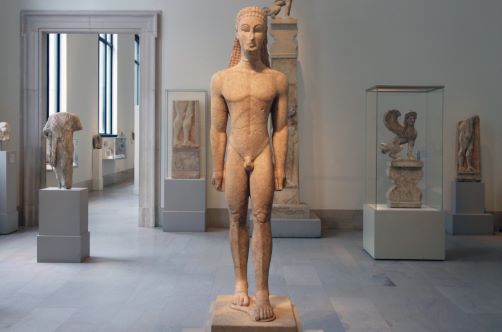
In 1932, The Metropolitan Museum of Art in New York City purchased an over life-size statue of a nude male youth. The ancient Greek sculpture was said to have been found near the town of Phoinikia in Attica, a region of Greece that is home to the city of Athens. It is an example of the kouros (plural: kouroi) type of Greek sculpture.
Kouroi are statues of young, nude men that were popular in the Archaic period. Unlike many kouroi, the kouros in New York is not entirely nude: he wears a choker style necklace and a fillet in his hair. Today, the statue is known as the New York Kouros because of its current location. Scholars date its creation to c. 600–580 B.C.E., making it one of the earliest examples of the kouros type.
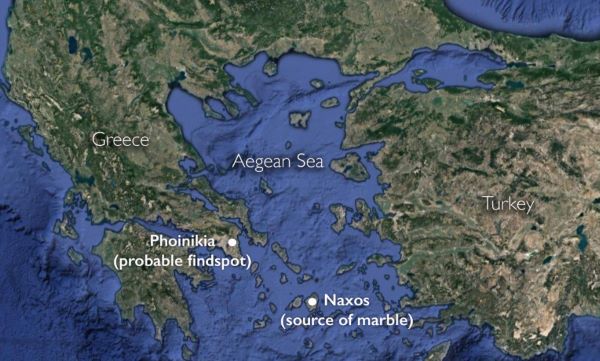
Some 2600 years ago, the New York Kouros functioned as a grave marker in Attica. Although it stood above a grave in this mainland Greek region, it is made of a type of marble that comes from hundreds of miles away, on the island of Naxos in the Cyclades.1 Naxos has large quantities of high-quality marble, notable especially for its shininess. People living on the island were already using the local marble to craft life-size statues of humans in the Protoarchaic period. By c. 600 B.C.E., they were exporting many of their sculptures to areas throughout the Greek world, including Attica.2 Although it remains somewhat unclear whether Naxian sculptors traveled to fulfill commissions, it is plausible that the skilled Naxian sculptors did travel to mainland Greece to create large kouroi for local elites beginning in the early Archaic period.3
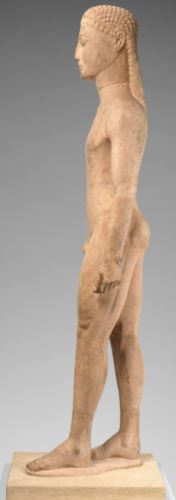
The early Archaic date of the New York Kouros is confirmed by its style. Overall, the New York Kouros is rigid and stiff, and seems to recall the four-sided marble block it was carved from. Greek sculptors who created kouroi may have been inspired by Egyptian stone sculptures they heard about or saw in the Protoarchaic and early Archaic periods. Indeed, some scholars believe the New York Kouros is so similar to Egyptian sculptures that its creators must have used the same rigid system of proportions that Egyptian sculptors did.4 However, Jane Carter and Laura Steinberg’s recent reevaluation of statistical comparisons between this kouros and the Egyptian canon of proportions disproves this.5 Although this kouros is block-like and carefully proportioned, it conforms to a distinctly Archaic Greek ideal. It has an impossibly large head, which sits atop a long neck that is adorned with a knotted ribbon.6 It has broad shoulders, a long waist, and short thighs.7 To prevent the marble of the kouros from breaking, the sculptor thickened its ankles slightly and left its fists attached to its thighs with narrow strips of stone.8
The sculptor’s goal was not to create a highly realistic image that closely resembled the deceased whose grave the kouros marked, but instead to create one that embodied the ideal of the period. For that reason, the anatomy of the figure is rendered in a series of patterns that appear almost decorative. The figure’s pelvis is distinguished by a prominent raised line that resembles a V, while the upper portion of his abdomen is marked out by a less prominently raised line that looks like an upside-down V.9
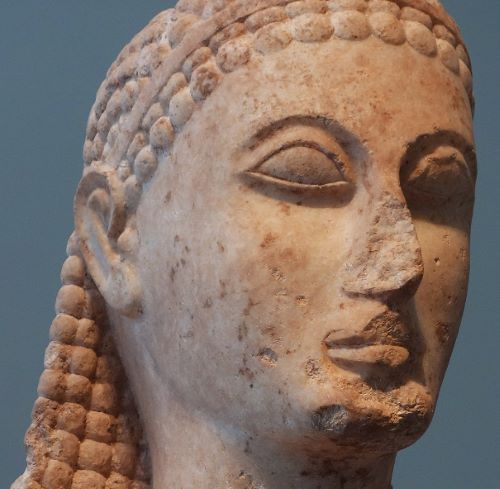
The sculptor’s focus on symmetry and pattern is especially noticeable in the face and hair of the figure. The cheeks are flat, while the eyebrows are indicated by single curving lines. The ears are curled like volutes. The hair is rigidly patterned, made up of a series of squared off strands that fall heavily on the figure’s back. Although none of these characteristics could have closely resembled an actual human, they are easily recognizable as human body parts. They have been made decorative to create a more perfect image of an elite male. In the Archaic period, the entire statue would have appeared even more ornamental because it would have been painted. Traces of pigment are still visible in the reddish tones that appear on the kouros’s fillet and hair.
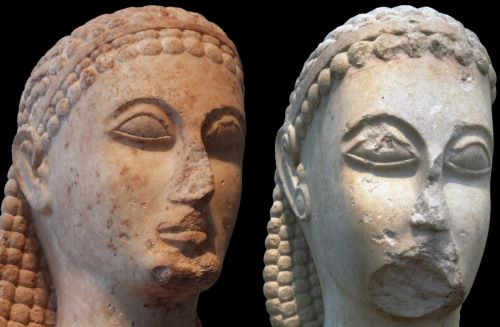
The highly decorative style of the New York Kouros is typical of the earliest Athenian kouroi. The head of another kouros that was found in Athens so closely resembles the New York Kouros that some scholars believe the two were created in the same workshop.10 The kouros’s head, now known as the Dipylon Head because it was found near the Dipylon cemetery in Athens, closely resembles that of the New York Kouros. Both kouroi have large, staring eyes under curved eyebrows, volute-like ears, and fillets in their hair. They have similar hairstyles, with heavy locks made up of squarish individual elements, though the Dipylon Head’s strands of hair interlock with one another rather than lying next to each other in the more grid-like pattern we see on the New York Kouros.11
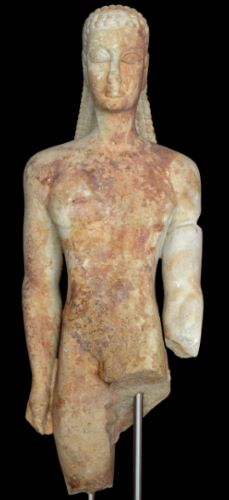
In 2002, archaeologists working in Athens found yet another kouros that closely resembles both the Dipylon Head and the New York Kouros, further enhancing our understanding of what kouroi looked like in the early 7th century B.C.E. This recently discovered kouros is known as the Sacred Gate Kouros because of its findspot. The Sacred Gate Kouros is more muscular than the New York Kouros, but it is similarly proportioned, and especially similar in the appearance of its hair and face.
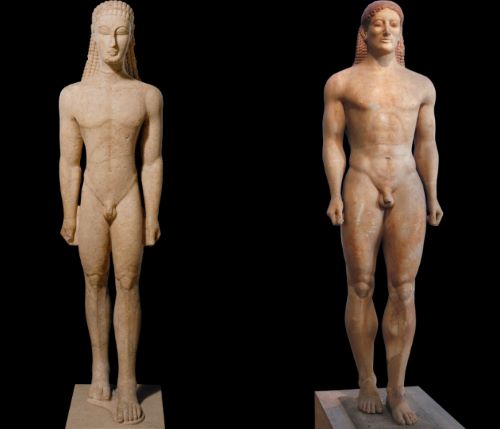
As the Archaic period progressed, the ideal form of the kouros shifted. These changes are especially noticeable when we compare the New York Kouros to the Anavysos Kouros, which was made about 60 years later. Both kouroi served as grave markers, perhaps even in the same cemetery, but they embody different ideals.12 The Anavysos Kouros is more naturalistic, or lifelike, than the earlier New York Kouros. Its muscles are carved more deeply and appear more rounded, and thus more closely resemble the proportions of an actual young man. The Anavysos Kouros’s proportions are also more realistic, with a smaller head, thicker waist, and less elongated calves. Both statues are nude and muscular, and both have elaborate hairstyles. Both also take slight steps forward with their left legs, advancing despite their stiffness and rigidity. However, it is clear that as the Archaic period continued, wealthy customers and the sculptors who worked for them were interested in more rounded and naturalistic kouroi.
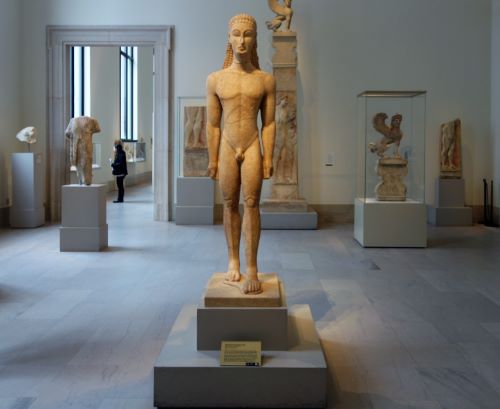
The New York Kouros now stands in the center of a gallery in the Metropolitan Museum of Art in New York. But why would a wealthy Athenian living in 600 B.C.E. want to mark a loved one’s grave with this statue? It could not have closely resembled the deceased, or any other real person. Instead, it projected a perfected image of the deceased to all who passed it. Kouroi were expensive monuments, and would have been available to only the most elite customers. The presence of the kouros would indicate to ancient viewers that the person who was buried beneath it was wealthy and honorable. The kouros’s nudity allows it to display its perfected, muscled body. Youth and strength were highly valued by the ancient Greeks, who understood these characteristics to be crucial to achieving success in athletic and military competitions.13 The decorative symmetry of the kouros was in keeping with the preferred style of the early Archaic period. Gazing out over the heads of those who walked by it, the New York Kouros would draw attention to itself and the person whose grave it marked, preserving the memory of the deceased and associating him with ideals of youth and strength.
Endnotes
- Scholars have long suspected that the statue is made of Naxian marble. This was recently proven definitively by scientific analyses conducted by Lorenzo Lazzarini and Clemente Marconi, “A New Analysis of Major Greek Sculptures in the Metropolitan Museum: Petrological and Stylistic,” Metropolitan Museum Journal, volume 49, number 1 (2014), pp. 117–40.
- Already in the Protoarchaic period, Naxian sculptors were exporting sculptures to other islands. Mary C. Sturgeon, “Archaic Athens and the Cyclades,” Affiliate disclosure: Amazon links on this site are paid links. As an Amazon Associate I earn from qualifying purchases.Greek Sculpture: Function, Materials, and Techniques in the Archaic and Classical Periods, edited by Olga Palagia (New York: Cambridge University Press, 2006), pp. 43–44.
- Olga Palagia, “Early Archaic Sculpture in Athens,” Scolpire il marmo: Importazioni, artisti itineranti, scuole artistiche nel Mediterraneo antico, edited by Gianfranco Adornato (Milan: LED, 2010), p. 42 believes that they must have, based on the existence of unfinished roof tiles made of Naxian marble that were found on the Athenian Acropolis.
- These scholars include John Boardman, Greek Sculpture: The Archaic Period (London: Thames and Hudson, 1978), p. 23; Brunilde Ridgway, The Archaic Style in Greek Sculpture, 2nd edition (Chicago: Ares Publishers, 1993), p. 34; and Seán Hemingway, How to Read Greek Sculpture (New York: The Metropolitan Museum of Art, 2021), p. 21.
- Jane B. Carter and Laura J. Steinberg, “Kouroi and Statistics,” American Journal of Archaeology, volume 114, number 1 (2010), pp. 103–28.
- Paul Zanker, “Cat. 1. Statue of a Kouros,” Afterlives: Ancient Greek Funerary Monuments in the Metropolitan Museum of Art, translated by Alan Shapiro (New York: Scala Publishers, 2022), p. 24.
- Gisela M. A. Richter, Kouroi: Archaic Greek Youths, 3rd edition (London: Phaidon, 1970), p. 41.
- Sturgeon (2006), p. 36.
- Richard Neer, Art & Archaeology of the Greek World, 2nd edition (London: Thames and Hudson, 2019), p. 157.
- Boardman (1978), p. 72 and Zanker (2022), p. 28.
- Boardman (1978), p. 72.
- Neer (2019), pp. 156–61 suggests that this kouros and the Anavysos Kouros came from the same grave plot in the town of Phoinikia in Attica. This grave plot was looted in the early 1900s, making it difficult to tell for sure if the kouroi come from the same place.
- John Griffiths Pedley, Greek Art and Archaeology, 5th edition (Upper Saddle River: Prentice Hall, 2012), p. 173.
Originally published by Smarthistory, 02.02.2024, under a Creative Commons Attribution-NonCommercial-ShareAlike 4.0 International license.
About the Author