
Syon Abbey’s medieval nuns built a disciplined religious community shaped by friendship, devotion, learning, shared labor, and Bridgettine spiritual identity.

By Dr. Alexandra Verini
Assistant Professor of English
Ashoka University
Introduction
In Margaret Cavendish’s 1668 protofeminist utopian play, The Convent of Pleasure, Lady Happy’s opening ambition to “live incloister’d” with other women who “are resolv’d to live a single life, and vow Virginity” frames the convent as a space composed of like-minded women in pursuit of a common goal: in other words, a community of friends.1 Female friendship, never fully separable from the suggestion and subsequent foreclosure of female same-sex desire—what Valerie Traub has called the trope of amor impossibilis—is integral to this play’s portrayal of convent life.2 Indeed, the Princess (who later turns out to be a Prince) first persuades Lady Happy to kiss by invoking their bond as women friends: “Not any act more frequent amongst us Women-kind; nay it were a sin in friendship, should we not kiss: then let us not prove ourselves Reprobates.”3 Though the convent eventually dissolves after the Prince, his identity revealed, marries a silent Lady Happy, this initial friendship between women, which blurs the lines between spiritual and carnal love (as friendship so often does), offers a glimpse into an early modern woman writer’s perception of the convent as a space in which women’s affective bonds operate transgressively to resist patriarchal norms.
Given that monastic life in Cavendish’s England belonged to the medieval past, we might then wonder: did possibilities for friendship exist in convents themselves, or were they confined to protofeminist utopian fantasies?4 We assume that nuns had friends, but is there any evidence of such bonds? After an overview of scholarship on medieval nuns, the answer to these questions might well be a shrug. Though convents would seem particularly conducive to the development of women’s friendships, there is little scholarship on the subject despite extensive consideration of friendship among medieval monks.5 One reason for this neglect, particularly in England, may be the dearth of surviving texts attributed to nuns.6 Another more insidious reason may be the omission of women from the classical friendship theories that both informed medieval views of friendship and shaped twentieth-century scholarship on the subject.7 Because medieval women’s bonds often defied the parameters set by classical theorists such as Aristotle and Cicero, they have not been recognized as friendships, necessitating Marilyn Sandidge’s call, in one of very few edited volumes to include medieval women’s friendship, to “look beyond male-centered language patterns and literary forms to recognize involvement of women.”8
To locate women’s friendship in medieval texts is to work both within and outside of canonical, androcentric theories. Thinkers from Plato to Aristotle to Cicero defined friendship as a virtuous, reciprocal relationship between identical male equals. For Aristotle, as for later philosophers, women’s perceived inability to make rational decisions meant that they lacked the virtue required for the highest form of friendship.9 Christian theologians, such as Augustine, Aquinas, Anselm, and Aelred, who absorbed and reconfigured these classical frameworks to include God, similarly excluded women from spiritual friend-ship. Indeed, medieval women’s lives might well have precluded them from the friendships between exact equals that these male authors envision, since, in the medieval household, women would have been more likely to form close bonds with female family members or with women of different social ranks—medieval romances, for instance, often foreground the bond between a maid and a noblewoman. Medieval women’s friendships, moreover, might often have been formed through networks that defied the limited number of friendships that classical thinkers like Plutarch insist on.10 Indeed, in this vol-ume, Jennifer N. Brown offers examples of how women’s spiritual friendships function differently from Aelred of Rievaulx’s vision of male monastic friendship, suggesting how frequently women’s bonds offer models that differ from those of their male contemporaries.
While women’s friendships may have exceeded androcentric classical theories, recognizing the tropes of classical friendship within medieval women’s bonds reveals how relationships that do not at first look like friendships might still have fit within this category. Greek philia included a much wider range of relationships than those described by the word friendship today. Of particular relevance to convents, philia emphasizes above all a “thorough-going likeness in characters, feelings, language, pursuits, and dispositions.”11 Beyond such identicality, friendship involves goodwill (wishing the other good) that is reciprocated and recognized.12 Epicurus, in particular, although his writings were not available in the Middle Ages, provides a source for thinking about friendships in convent settings since the Epicurean Garden shares with Christian monastic communities a desire to be set apart from the wider culture and an aspiration for salvation through the imitation of a divine man.13 Epicurean communities in their retreat from the public, masculine space of political life, unlike other models of friendship, also included women.14 An Epicurean notion of friendship is relevant to convent life not just because it portrayed friendship as crucial to freedom from pain and anxiety but also because it linked friendship to the absorption of philosophical truth. Friends within the community were expected to use “frank speech” (parrhêsia) to help one another in emulation of their chosen sage.15 An Epicurean view of friendship, more than an Aristotelian or Ciceronian one, thus anticipates the kinds of bonds that might have developed in cloistered female communities in which, as I show, women collectively worked through theological questions. And if we understand friendship as an alliance of like-minded people who are joined in goodwill and reciprocally sharpen each other’s virtue through philosophical conversations, we might more readily find examples of such bonds in convents. Only by recalibrating our understandings of friendship and working within and outside of traditional theories will we find what Karma Lochrie has called “the tracery of female relationships.”16 As the essays in this volume by Stella Wang, Jennifer N. Brown, and Andrea Boffa attest, women’s spiritual life is a particularly generative site at which to locate such tracery.
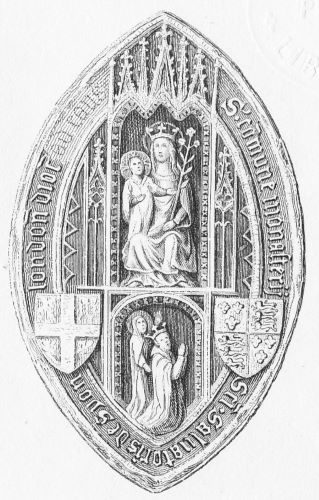
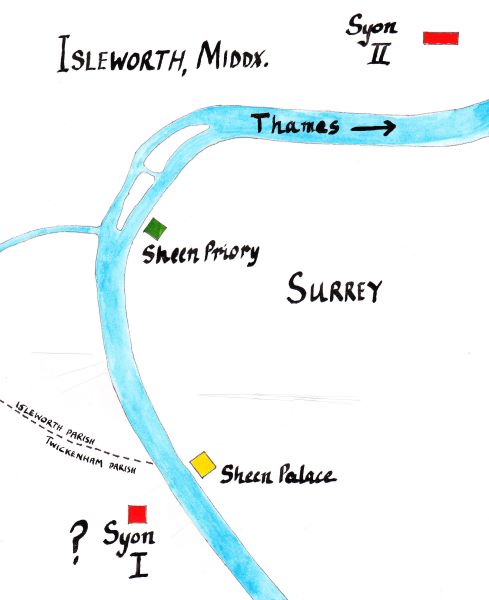
In this essay, I explore the records of medieval Syon Abbey as an exemplary site of women’s spiritual friendship. The only English house of the Bridgettine Order, which had been established by Saint Bridget of Sweden (c. 1303–73), Syon was founded by Henry V in 1415 at Twickenham in Middlesex (it later moved to Isleworth).17 In accordance with the Bridgettine rule, Syon had both men and women—sixty sisters and twenty-five religious men (thirteen priests, four deacons, and eight lay brothers)—who lived separately but were co-governed by an abbess and a confessor. While early scholarship on the abbey focused on the smaller but more extensively documented group of men, recent accounts have increasingly turned to the sisters, whose lives are glimpsed through a range of liturgical manuscripts written for them by male clerics at Syon. These texts, like The Convent of Pleasure, reveal the subversive potential of women’s friendships, as, by going to lengths to negate bonds between nuns, male clerical authors reveal the vitality and transgressive potential of such bonds. The latent force of friendship between sisters is confirmed both in a range of performance scripts from the medieval abbey and in a later manuscript possibly written by an early modern nun at Syon’s relocated foundation in Lisbon.
Women’s Friendship as Absent Presence at Syon
Friendship emerges as a vital source of female agency at Syon ironically through the efforts of male-authored liturgical guides to repress it. The best known of these guides is The Myroure of Oure Ladye, a fifteenth-century Middle English translation and explication, possibly by Thomas Fishbourne, of the fourteenth-century Latin Bridgettine office, which was written in honor of the Virgin and based on Bridget’s visions.18 This office validated the abbey’s female community in particular since the brothers did not have their own unique counterpart but rather recited the office according to diocesan use.19 A second crucial text for understanding the experiences of Syon’s sisters is the Middle English Additions, a document composed around 1425 to supplement Bridget’s Rule of Seynt Saviour and adapt it to the new foundation in England.20 While the Bridgettine order at its core foregrounds female community through imitation of the Virgin Mary and Saint Bridget, these guides go to great lengths to suppress any personal relationships or affinities between sisters.21
One way these texts implicitly discourage friendships is by promulgating an idealized uniform identity at the expense of particular bonds between sisters. As the Myroure’s title suggests and its prologue instructs, the Bridgettine sisters were intended to be mirrors of Bridget and the Virgin Mary. The narrator foregrounds their status as undifferentiated copies by likening them to wax impressions identically “reformed to the lykenesse of God” and to “pennies” that are “impressed” with the “the image of the kynge” (98).22 For their part, the Additions emphasize uniformity of action: “In the quyer, all schall be as angels, enclynge togyder, rysynge togyder, knelying togyder, stondynge, turnynge and syttng togyder, all after oo forme, goynge and comynge togyder” (102). This identicality would have been visually signified by the sisters’ habits with their distinctive crowns bearing five red pieces of cloth to signify Christ’s wounds, which imitated Bridget’s own.23 Any deviation from this uniform identity was to be censured: the Additions, for instance, threatens punishment “[i]f any come to dyuyne seruyse, or to Indulgete, seuen psalmes, confession, procession, conynge, chapter, De profundis, or collacion or generally to any conuentual acte vsed in the monastery without her holle habit” (2).
While identicality itself is not antithetical to friendship, these descriptions of sisterly community lack the reciprocity that often accompanies friendship. For Cicero, “When a man thinks of a true friend, he is looking at himself in the mirror,” but friendship is “complete identity of feeling about all things divine and human strengthened by mutual goodwill and affection.”24 Even friendships of a kind more flexible than Cicero’s model include some form of mutuality. The Myroure narrator’s emphasis on uniform identity, however, results ironically in solitary and separate selves who do not, in his account, display affection or even interest in each other. In his discourse on reading, for instance, he instructs them, “rede by yourself alone” (67). The construction of each sister as a solitary among many is a common trope in monastic life, but this Bridgettine guide takes the trope to a greater extreme, disallowing smaller groupings and intimacies that other rules more tacitly permit.25 As Rebecca Krug writes, “Bridgettine communities although composed of ‘daughters’ were to be little concerned with relations among siblings: the aim of Bridgettine communal reading was to establish a collective, visual identity, but that identity was in singular presence before God.”26
However, when the Myroure and Additions move from an implicit omission of personal relationships to active discouragement of female bonds, they a ring a bit of “thou dost protest too much.” For instance, when the Additions warns, “In the dortour none schal beholde other, nor make synge to other withoute a resonable cause: but all schal there kepe hygh silence” (140), we wonder whether this might be a regulatory response to chatter within the sister’s dormitory. The mandate that silence “is to be kepte in the lybrary, whyls any suster is there alone in recordying of redynge” (Additions, chapter 14, 72) suggests that the sisters might in fact have found opportunities to speak to each other when they were intended to be reading alone. Friendships from outside the abbey were also discouraged and regulated, as the Additions dictates, “If any sustres frendes, desire to se her, pe abbes schal not lyȝtly graunte thys but seldom in the ȝere” and recommends that “the abbes take counsell of the general confessour and know by hym whan she schal open þe wyndowe . . .” (75). These discouragements of the nuns’ friendships, however, draw attention to their prevalence in the abbey and invest them with a disruptive potential.
A more extended example of bonds between sisters whose presence is felt through their repression occurs in the Myroure’s chapter 8, On Divine Service. In an exemplum that warns against talking during service, the difference between the Myroure and its source text is revealing. In the story’s source, borrowed from Caesarius of Heisterbach’s (c. 1180–1240) Dialogus miraculorum, Gertrude, a ten-year-old girl, appears as a ghost to another girl of the same age to make amends for whispering “half words” during service, essentially for engaging in the kind of intimate encounter against which the Myroure warns.27 At the opening of Caesarius’s account, the narrator says that he has heard this story directly from the abbess of the monastery, a detail that privileges female narrative authority. The subsequent story reports how this abbess instructs the young novice who has seen Gertrude to say “Benedicite” when Gertrude returns and to ask where Gertrude comes from and what she is seeking. These words cause Gertrude’s ghost to retreat: “For in the sight of her friend she proceeded towards the cemetery, passing over the wall by a miracle.” The Myroure narrator reproduces this story but omits both the central role that Caesarius afforded the abbess and the description of the novice as a friend. The Myroure instead concludes more dogmatically with the admonishment “take ye hede” since “this younge mayde ten yere of age was punysshed so for half words; what shall they suffer that are of greater age for hole words spoken” during the time of silence (47). This omission and refashioning of the story suggest the ways in which Syon’s clerical authorities may have seen women’s intimacy as threatening. In this instance, the Myroure replicates what Lochrie calls the “official view” of the Middle Ages, a point Andrea Boffa also notes in her discussion of Clare of Rimini: “when women get together in deliberate acts of female fellowship, corruption ensues.”28 However, as is the case in other medieval religious works, clerical discomfort with female intimacy draws attention to the disruptive potential of such bonds and, thereby, invests same-sex female relationships with authority.
Despite these efforts by Syon’s clerical authors to suppress female collusion, the reality of life at Syon brought women together, often resulting in forms of collective agency. For one thing, recruitment within families appears to have been common at Syon, which meant that the women in the abbey might have had prior personal relationships with one another, which they might have further as they lived their life in close quarters.29 For another, women constituted the majority in the abbey, and their image was thus foundational to the order’s identity. This kind of collective identity differs from the Myroure narrator’s enforcement of uniform obedience, as it instead frames the sisters’ community as a group devoted to achieving a common purpose, something similar to what we see in Cavendish’s convent. Though this kind of collectivity does not readily present itself as friendship, it contains the kind of political authority that friendship often brings. We see this, for instance, in a passage that the Myroure narrator adds to the Latin office in his explanation of the Sunday service as he writes “we ar closed in thys holy Monastery as knyghtes in a castell where we ar beseged wyth greate multytude of fendes that nyght and daye laboure to gette gentre and pocessyon in oure soules . . .” (72). The nuns’ singing, he continues, will act as a “longe spere of fervente desyre of oure hartes stryeng up to god” to draw out “the sharpe swerde of the worde of god” (72). Unlike the descriptions of the sisters as pennies or wax impressions, which framed collectivity as passive imitation, this comparison of the sisters to knights defending a castle foregrounds their collective strength. Though they are not here described as friends, if we recall that pacts of friendship between medieval knights encouraged them to regard themselves as members of a community united by a common purpose, we might then understand the sisters’ alliances as containing the political strength that was found in medieval friendship.30
The paradoxical commitment to solitude and community that we find at Syon is endemic to monastic life itself and present in a wide range of rules, but the vehemence with which Syon’s rules discourage women’s friendship may have a historical root. The Bridgettine order because it was started by a woman had, from its beginnings, been beset by efforts to regulate female authority.31 While Bridget’s original rule mandated that the abbess as mother be head of both brothers and sisters, Pope Urban V insisted that the rule be revised to omit the dominance of a woman over men.32 Syon’s foundational charter of 1415 reverted to Bridget’s initial vision and declared the abbess head of both spiritual and temporal affairs. This assertion enabled Syon’s first abbess, Matilda Newton, to demand obedience from the general confessor and the brothers of the abbey as “hede and lady of the monastery.”33 The sisters supported Matilda’s position, but, in 1416, after a meeting arranged by Henry V and a council of clerics, Matilda was removed from the abbey. If, as C. Stephen Jaeger argues, love and friendship acted as “alternate and higher forms of governing” in the Middle Ages, then the attempts of the Myroure and the Additions, written shortly after Matilda’s dismissal, to stifle friendship among nuns might have been aimed at delimiting the sisters’ political agency.34 However, in these very efforts, as we have seen, they unwittingly draw attention to the powerful current of women’s bonds within the abbey.
Friendship at the Root of the Bridgettine Order

Syon’s liturgical guides make women’s friendships visible primarily through their omission of it, but The Life of St Bridget, which is attached to the Myroure manuscript, brings these bonds further to the fore. As Boffa’s essay in this volume indicates, women’s vitae are rich sites for the study of female friendship. Based on the vita of St. Birgitta compiled by Bishop Alfonso of Jæn and Petrus Olavi and written in Latin by Archbishop Birger Gregersson of Uppsala and Nicholas Hermanni, Bishop of Linköping, Bridget’s Life is no exception.35 The Middle English translator at Syon, possibly the same as the Myroure author, interpolated Bridget’s vita with episodes from the Life of her daughter Catherine, which was likely written by Johannes Johannis Kalmarnenen-sis.36 Through its omissions and additions, this composite Life, which prefaces the Myroure’s religious rule, at once displays anxiety about the transgressive potential of female friendships and shows how relationships between women were integral to Bridget’s order.
The Life begins by emphasizing the ways in which female bonding can lead to trouble. Moving more quickly to an example that the Latin life places later, the Myroure Life opens with an account of how a nun from the “Monastery of Shoo” berates Bridget’s grandmother for “the great pryde that she aduiged to be in hir” (xlvii). Such animosity from women continues in Bridget’s own life. When Bridget is twelve, her aunt finds her out of bed at night praying and, suspecting “the lyghtnesse of the virgin” (xlviii), beats her with a rod that miraculously breaks into pieces, proving Bridget’s holiness. Strikingly, the aunt assumes that a woman has led Bridget astray, exclaiming, “hath nat some women taught the some fals prayers” (xlviii). This comment is clarified by an episode from the Myroure manuscript, which describes how Bridget receives divine help with her sewing from an unknown maiden whom her aunt catches sitting with Bridget on her bed.37 This episode, which the Myroure translator omits, might account for the aunt’s assumption that a woman has taught Bridget and suggests anxiety about intimacy between girls. A similar fear about female companionship is expressed in a subsequent story that relates how the devil appears to Bridget while she is “playing with Maydens of lyke age” (xlviii). By omitting the story about the young girl who helps Bridget and focusing instead on the animosity that women direct toward Bridget’s grandmother and to Bridget herself, the Myroure’s Life foregrounds the saint’s exemplarity rather than her bonds with other women.
Though this text is wary of intimacy between female peers, it more readily foregrounds Bridget’s generative bonds with women in the spiritual realm. Such vertical friendships, as opposed to horizontal ones, might have supported the Myroure author’s interest in enforcing imitative obedience among the sisters, but they nonetheless foreground the power of women’s intimacy more broadly. An example of such vertical spiritual friendship occurs during Bridget’s childhood when a “Lady syttynge in bright clothynge” (xlvii) puts a crown on the young girl’s head, signifying divine feminine support. Bridget also develops a close relationship with the Virgin Mary, who appears to her in early childhood and during a life-threatening childbirth. While such bonds are not named as friendships and might seem to defy what we expect from friendship, the Virgin’s role as Bridget’s instructor, intercessor, and guide models a caring and intimacy akin to that of friendship. This affection may have offered an imitative example for the nuns of Syon, who were themselves encouraged to emulate the Virgin.
The Myroure Life, moreover, emphasizes friendly bonds between Bridget and her biological daughters. This vita, for instance, describes the saint’s attachment to her daughters, showing her distress when her daughter Inge-burgis, who was a nun at Rysburga, dies (not because her daughter is dead but because Bridget fears she did not provide adequate moral instruction) (li). Moreover, the episodes interpolated from the Life of Bridget’s daughter Katherine further emphasize bonds between women. Describing Bridget’s second daughter, the Life says that “after the deth of heir husband she was alwayes with heir moder seint Birget & lyued in the estate of wydowhod al hir lyfe” (l). Katherine later becomes a posthumous extension of her mother’s mission as she forms a community of virtuous women: “bycause she was feruent in deuocion . . . & lyued a blessyd lyfe to gyue other example of good lyving the most honest woman of Rome loued to be in hir company” (l). The value of this female community is confirmed by a miracle that occurs when Katherine is in their presence:
And when she was on a tyme desired by the moste noble matrons of the Cytie of Rome to walke with them for recreacyon without the Walles of the Cytie as they walked here & there amonge many clusters of grapes. They desired that the sayd blessyd virgyne Katheryn bycause she was of Eligant staute wold gather them to the sayd grapes/ & as she stretched vp hir armes to the grapes it semyd as thoughe hir armes had been apperelled with shyng cloth of golde.38
Here, in a reversal of Dinah’s story, in which a woman’s desire to leave the city to commune with other women was exegetically connected with her rape during the Middle Ages, women’s collectivity and movement outside the city (in a manner not dissimilar to convent life) results in visible signs from God.39 Bridget’s relationship with her daughters might not immediately read as friendship in modern terms, which tend to classify friendships as nonfamilial, but at Syon, where the nuns were often addressed as “sisters and daughters,” such familial intimacies might have registered as models for the sisters’ own bonds within their spiritual family. While relationships between women in different spiritual stations might seem only to support the efforts of the Myroure to render the sisters as passive and obedient, as these familial bonds then extend to create larger supportive communities of women, as they also do in the sisterboooks in Brown’s essay, they come to evoke the mutual sup-port and comfort provided by medieval friendship.

The Myroure’s Life of Bridget, like the Italian saints’ lives that Boffa examines in this volume, further demonstrates the generative nature of same-sex female bonds after the saint’s death through the miraculous cures of the women who visit her shrine. For instance, a woman from Rome named Agnes, who “fro hyr burthe had a greate grosse throte moche foule & dyfformyd,” is cured when she touches Bridget’s hand with a girdle that she then binds around her neck (lvi). In another episode that might have been particularly relevant for the female community at Syon, a nun from Saint Lawrence, who is “famylyer” with Bridget, is cured of “febleness and great sykenes that she had in her stomake” after she prays to Bridget “that she myght with hyr Susters be at deuyne seruyce and that she myght when nede shulde requyre goo aboute the moanstery withoute helpe” (lvii). This nun’s longing to return to the company of her fellow sisters foregrounds the spiritual value of women’s community, while her familiarity with Bridget, as with the other cured women, foregrounds a special spiritual connection with the saint. Such intimacy might seem hierarchal, but there also exists an element of reciprocity: just as Bridget offers cures to her female devotees, they provide evidence of her saintliness, performing the mutual benefits that friendship is thought to include both in classical theory and today.
Although the Life begins by highlighting the dangers of female companionship, it concludes with a rich testament to the power of female intimacy. Such ambivalence is evidence of the complexity of women’s friendships within the abbey: while clerical voices may have sought to suppress women’s bonds, such relationships would have been inescapable as women lived and prayed together in a confined space. As Eileen Power observed in her still canonical work on nunneries, the inhabitants of Syon, like those in any convent, “spent almost the whole of their time together. They prayed together in the choir, worked together in the cloister, ate together in the frater, and slept together in the dorter.”40 The relationships they developed through this constant contact might well have afforded them comfort and collective authority similar to that which relationships between women provide in Bridget’s Life.
Friendship Performed
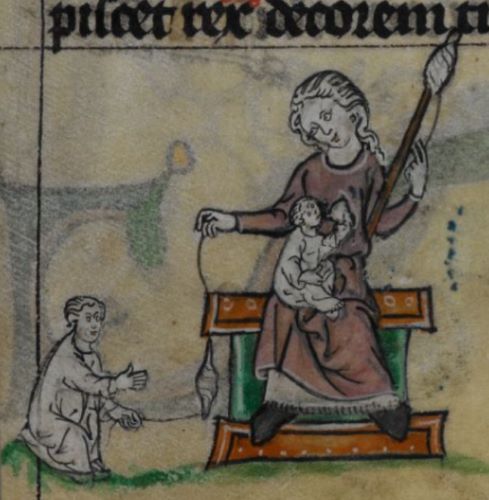
The palpable presence of women’s intimacies within the abbey would have also been visible in the ceremonies they collectively performed. In describing the office, the Myroure narrator, despite his instruction that the sisters read by themselves alone, also recommends that they rely on each other to understand the Latin text during religious rituals: “yf ye cannot vnderstone what ye rede. Aske of other that can teche you. And they that can oughte not to be lothe to teche other” (67). Such collaboration is equally encouraged in liturgical ceremonies themselves. While the Additions includes debasing punishment for the sisters in the mandate that a sister perform penance by lying prostrate on the church door and asking her fellow sisters to pray for her (26–27), they also include more generative interactions. For instance, before Evensong, the Myroure instructs the nuns to ask forgiveness from each other: “For yt is sayd in the name of all and therfore it byndethe all whether they saye yt or saye yt not and whether they be there or thense” (152). The sisters are exhorted to say “I forgyue & forgyue me” “in the name of all & in unyte of all” (152). While this ritual, on the one hand, imagines a collective self, the performance of this self relies on dialogue between sisters and necessitates interpersonal interactions that are absent from the Myroure’s and Addition’s vision of a uniform, undifferentiated community. Moreover, as the sisters here rely on each other for mutual forgiveness, they foreground their own collective agency rather than that of a priest.
Syon’s processionals further convey the ways in which the sisters would have participated in interpersonal exchanges as well as the authority these exchanges afforded them.41 St John’s College Cambridge MS 139, which has red English rubrics to clarify the Latin script for the sisters, particularly demonstrates the ways in which the sisters were brought into intimate contact and gives the nuns a determining role in the performance of their liturgy.42 It does this through rubrics that put the sisters into smaller groupings:
Uppon ester day at procession too sustris the two chauntresses or too othir that the cheef chauntresse allignyth shal in the myddes of the quere bygynne this procession. Salue festa dies. And ther stondyng ful shal synge the said use unto the ende whiche use the quere than first goynge forthe and not afor shal repete the two sustres that bygan goynge in the myddis of the processions and then too aloon shal synge euery vuse of the processsion and rest at eu[er]y use eeude and the quere shal at eu[ery] use cende [sic]. Shal repete the first use. Salue festa dies. And this forme is to be kept. (My transcription)
Similarly, on Saint Mark’s Day, “The too chauntrelles in the myddes of the quetre or othir too at the chief chauntresse assignment shal begyn.” While we cannot assume that the “too sustris” in these cases would have been friends in the way we understand the term now, such instructions reveal that the sisters were not always an undifferentiated homogenous group: they would have collaborated in smaller groupings and so might have understood themselves as allies, united in a common mission to serve God. These instructions also reveal that the sisters, despite the demand that “this forme is to be kept,” had a determining power in the performance of their religious ceremonies since the chantress could choose which sisters would play crucial roles in the service.
Syon’s performance texts thus reveal the ways in which, despite depersonalizing descriptions of the community, the nuns would, in fact, have been brought into intimate interpersonal contact on a regular basis. We cannot verify that such contact always resulted in friendship (enmity and indifference are also possibilities), but it did create the circumstances in which such bonds might be encouraged and thrive. As in Cavendish’s play, the bonds that might have resulted from Syon’s liturgical performances retain power precisely because they cannot fully be named or seen and because they leave no tangible trace. The tracery of their presence, however, suggests that such performances may have liberated the sisters from the uniform and singular identity that the male clerics in the wake of Matilda’s insubordination had prescribed for them. The liturgy the sisters performed, which was at the heart of the abbey’s spirituality, suggest that the sisters of Syon Abbey may have seen themselves as allies working toward a mutually beneficial cause and, thus, as friends.
Epilogue: Friendships in Early Modern Syon
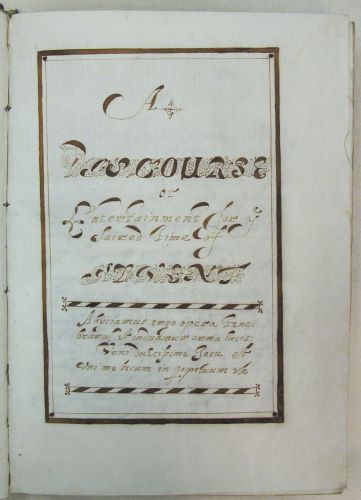
The vitality of women’s friendships at Syon is confirmed in the abbey’s later history. After the dissolution of the monasteries, Syon was forced out of England and, after many years of wandering, resettled in Lisbon in 1594 (they remained there until 1861, when the order was finally permitted to return to England). In addition to “The Life and Good End of Sister Marie,” which Brown analyzes in this volume, relationships between the sisters during their time in exile become visible through inscriptions in books that bear more than one woman’s name.43 An unpublished liturgical manuscript dated to 1657 and titled Discourse or Entertainment for the Sacred time of Advent makes female spiritual friendship even more explicit.44 Hitherto unmentioned in accounts of Syon’s nuns, this discourse consists of a dialogue between an abbess and several allegorical nuns as they prepare for Christ’s birth during Advent. As the opening of the manuscript outlines:
In this discourse the lady abbesse desirous her Nunnes should entertaine well ye saviorue at his birth enjoynes Placidda to adourne ye poor pores on Cribb wherein he is to be bourne, Lucilla to provide the babes Shirt, Esperanca ye Infants cloths. Serena his swaddling bands, Candida his cradle and cradle cloth and let Symplicia’s office bee to worke ye Cradle. The Abbesse [con]cludes with a survay of the whole weeke, and in ye first place or weeke Humility is pratised in the second Faith in ye Third Hope in ye fourth char-ity in ye fifth Recollection, in ye sixth, Love of our Neighbour is explained commended and peacified and the seventh weeke is spent a reiteration of all former Exercises. (Preface, my transcription)
The subsequent dialogue between these allegorical sisters, who cast lots to decide which role each will play in the preparations for Christ’s birth, may have been used as a script for performance, or it may simply have been read silently as a guide to devotion. In either case, given that there are no male speakers and that manuscript was produced at a time when there were very few brothers in the community, it seems likely that a nun at Syon composed the work (though neither the order nor Saint Bridget is mentioned).
In these dialogues, the abbess and the sisters develop a notion of spiritual friendship that trumps its worldly counterpart. The abbess argues that in “worldly friendship,” “communication is diminished” (18) and instead advocates for a higher form of human affection: “the good wee wish to o[u]r neighbour soe much more wee gain to ourselves and by how much more wee reconcise and contract friendship with them, soe much more foresight an union of souls are joyned to Almighty God” (18–19). In this description, friendship is construed not as preferential affection toward a particular person but as mutually beneficial goodwill that leads to union with God. Symplicia exemplifies this understanding when she describes her “good friends” in Purgatory whom she wishes to liberate and exhorts her fellow sisters to pray to God for “those which are in mortall sinn . . . and to desire with all earnestnesse that they may be received into his [God’s] friendship” (188). This view of friendship as a triangulated relationship between God and humans accords with the writings of Christian theologians, for whom “love for a friend symbolized love for God.”45 However, in this case, it places the sisters rather than male theologians in the pivotal position of initiating this spiritual love.
Indeed, the text, as a whole, privileges women as collective producers of spiritual knowledge. As in the Myroure, the sisters are encouraged to imitate the Virgin Mary but in a way that gives them more determining agency. When the abbess describes “how the soul spiritually [con]ceaves Christ o[u]r Lord and how it imitates in this his most Holy Mother” (5), she foregrounds female biological reproduction as a vehicle for generating spiritual understanding, thus giving women a privileged role in this process. The form of the work itself emphasizes the benefits of dialogue and mutual instruction between women in a manner that recalls Epicurus’s “frank speech.” Candida, for instance, asks for clarification of Serena’s words about the spiritual significance of choosing “the better part,” saying “hold a little sister, here is a doubt that may not be deferred and perhaps it will help you the better to declare what you are to say . . .” (107–8). Here, she tactfully implies that her fellow sister’s explanation needs to be expressed more clearly and hopes that her question will help sharpen Serena’s ideas. Later, Esperance confesses to Serena, “it hath alwayes beene very difficult to my poore understandi[n]g to apprehend how this can possibly be that God should conforme his will to the creatures . . . if they have no will at all?” (117–18). In moments like these, as an expression of confusion results in a further explanation and sharpening of theological points, the text enacts the Myroure’s call to the sisters two hundred years earlier to explain the liturgy to each other, but it does so in a way that generates spiritual knowledge collaboratively between women. In their conversations, the nuns display the kind of friendship that their theoretical discussions envision, one that promises to bring them closer to God.
Just as the ambiguous friendship between women was subsumed in the marriage between Lady Happy and the Prince in Cavendish’s play, women’s friendships at Syon were erased by the medieval clerical authors. And yet, the tracery of such bonds survives both in the discomfort that Syon’s documents show with female groupings and in the emphasis on women’s alliances in texts more closely connected with Bridget herself such as her Life and her liturgy. The strength of these bonds was later confirmed in the early modern liturgical text from Syon likely written by a nun. The relationships that emerge in this range of documents are not all explicitly identified as friendships, but they exhibit the intimacy, goodwill, and mutual benefits that friendships provide. Including these bonds between the sisters of Syon within the framework of friendship evades the passive uniform identity that clerical authors sought to promulgate and resists the androcentric language patterns by which friend-ship studies have been limited. Moreover, reading nuns’ relationships through the lens of friendship reinserts medieval religious women’s bonds into a nexus of politics and intimacy from which they have long been absent. The records of Syon Abbey reveal that religious women may indeed have participated in the kinds of friendships that Cavendish’s play imagines: because they were presumed to be impossible but also clearly existed, women’s friendships at Syon Abbey, as at the Convent of Pleasure, even in the process of being erased, had the power to unsettle patriarchal norms and offer women direct access to higher truths.
Endnotes
- Margaret Cavendish, The Convent of Pleasure, in Paper Bodies: A Margaret Cavendish Reader, ed. Sylvia Bowerbank and Sara Mendelson (Peterborough, ONT: Broadview, 2000), 101. A precedent for such a community, particularly given the convent’s focus on pleasure, exists in Epicurus’s garden, where friendships provide comfort and support. See John M. Rist, “Epicurus on Friendship,” Classical Philology 75, no. 2 (1980): 121–29.
- Valerie Traub, The Renaissance of Lesbianism in Early Modern England (Cambridge: Cambridge University, 2002), ch. 7.
- Cavendish, The Convent of Pleasure, 118.
- Cavendish would, however, have had direct experience of convent life during her exile in Antwerp. See Nicky Hallett, The Senses in Religious Communities, 1600–1800: Early Modern “Convents of Pleasure” (Farnham: Ashgate, 2013).
- A notable exception to the dearth of scholarship on nuns’ friendships is Ulrike Wiethaus, “In Search of Medieval Women’s Friendships: Hildegard of Bingen’s Letters to Her Female Contemporaries,” in Maps of Flesh and Light: The Religious Experience of Medieval Women Mystics (Syracuse, NY: Syracuse University Press, 1993), 93–111. Karma Lochrie also brings to light many multiple examples of possible friendships between religious women in “Between Women,” in The Cambridge Companion to Medieval Women’s Writing, ed. Carolyn Dinshaw and David Wallace (Cambridge: Cambridge University Press, 2003), 70–90. For an extensive consideration of male monastic friendship, see Brian Patrick McGuire, Friendship and Community: The Monastic Experience, 350–1250 (Ithaca, NY: Cornell University Press, 2010).
- Diane Watt’s recent book excitingly complicates the notion that writings from medieval nuns do not survive as it examines early medieval women’s literary engagement in monasteries such as Ely, Whitby, Barking, and Wilton Abbey. Diane Watt, Women, Writing and Religion in England and Beyond, 650–1100 (London: Bloomsbury, 2019).
- Alan Bray excluded women from the medieval sections of his seminal study of friend-ship, writing that before the seventeenth century, he did not find evidence for a public, “objective character” of female friendship, and that women only make themselves heard “as the troubling silence between the lines.” Alan Bray, The Friend (Chicago: University of Chicago Press, 2003), 11, 10.
- Marilyn Sandidge, “Women and Friendship,” in Friendship in the Middle Ages and Early Modern Age: Explorations of a Fundamental Ethical Discourse, ed. Albrecht Classen and Marilyn Sandidge (Berlin: de Gruyter, 2011), 93. In my own work, I have attempted to show how medieval women’s friendship exceeds the identicality and exact reciprocity demanded by thinkers like Cicero. See Alexandra Verini, “Models of Medieval Female Friendship in Christine de Pizan’s The Book of the City of Ladies and The Book of Margery Kempe,” Feminist Studies 42, no. 2 (2016): 365–91.
- Aristotle does allow for other forms of friendship advantage and pleasure in which women might more easily partake, but the highest form of friendship, virtue friendship, excludes women. Aristotle, Nichomachean Ethics Books VIII and IX, trans. Michael Pakaluk (Oxford: Clarendon Press, 1998).
- Plutarch, “On Having Many Friends,” in Plutarch’s Moralia, vol. 1, trans. F. C. Babbitt, Loeb Classical Library (Cambridge, MA: Harvard University Press, 1927).
- Plutarch, 96F–97D, 69.
- Aristotle, 1155b28–1156a6.
- On friendship in Epicurus, see Attila Németh, Epicurus on the Self: Issues in Ancient Philosophy (New York: Routledge, 2017), esp. ch. 5. Understandings of Epicurus in the Middle Ages come from Cicero, not Diogenes Laertius, and he tended to be understood as heretical.
- See Jane McIntosh Snyder, The Woman and the Lyre: Women Writers in Classical Greece and Rome (Carbondale: Southern Illinois University Press, 1989), 101–5.
- Martha Nussbaum, The Therapy of Desire (Princeton, NJ: Princeton University Press, 1994), 134–37. The fragmentary remains of On Frank Criticism by the Epicurean philosopher Philodemus (c. 110–35 bce) are explicit about the therapeutic role of candor. See Dirk Baltzly and Nick Eliopoulus, “The Classical Ideals of Friendship,” in Friendship, a History, ed. Barbara Caine (London: Equinox, 2009), 39–41.
- Lochrie, “Between Women,” 86.
- G. J. Aungier, The History and Antiquities of Syon Monastery, the Parish of Isleworth and the Chapelry of Hounslow (London, 1840), is still the standard history of Syon. See also John Rory Fletcher, The Story of the English Bridgettines of Syon Abbey (South Brent, Devon: Syon Abbey, 1933).
- No complete manuscript of this text survives: it is split between MS Aberdeen University W. P. R.4.18 and Oxford Bodleian MS Rawlinson C. 941, which are composed in a hand from the late fifteenth century or early sixteenth century (though the composition of the text is generally dated to 1420–50). John Henry Blunt’s edition is based on the printed text (STC 17542, Fawkes, 1530), which first appeared in 1530. Seven other partial manuscript copies exist, only three of which have the third part bound with them. Blunt tentatively attributed the work to Thomas Gascoigne, Chancellor of Oxford (1442–45), but this attribution has since been discredited and the work is now associated with either Thomas Fishbourne, the first confessor-general of Syon, or Syon deacon Clement Maydeston. For an overview of the text, see Ann Hutchison, “Devotional Reading in the Monastery and the Medieval Household,” in De Cella in Seculum: Religious and Secular Life and Devotion in Late Medieval England, ed. M. G. Sargent (Cambridge: Cambridge University Press, 1989), 215–27.
- See Katherine Zieman, “Playing Doctor: St. Birgitta, Ritual Reading, and Ecclesiastical Authority,” in Voices in Dialogue: Reading Women in the Middle Ages, ed. Linda Olsen and Kathryn Kerby-Fulton (Notre Dame, IN: University of Notre Dame Press, 2005), 309.
- Bridget had specified that new additions be drawn up for each new foundation. The additional rules for the sisters are grouped together in fifty-nine chapters and contain elaborate directions not only about the occupation, behavior, and special duties of the sisters but for exigencies of every kind. The Syon sisters’ additions have been edited by James Hogg, in The Rewyll of Seynt Sauioure, vol. 4, The Syon Additions for the Sisters from the British Library MS Arundel 146 (Salzburg, Austria: Institut Für Anglistik und Amerikanistik Universitat Salzburg, 1980).
- Julia Mortimer has noted similar efforts of erasure of Bridget’s persona itself both in the Latin versions of her texts and in their Middle English successors. Julia Mortimer, “Reflections in the Myroure of Oure Ladye: The Translation of a Desiring Body,” Mystics Quarterly 27, no. 2 (2001): 58–76.
- The Myroure of oure Ladye, containing a Devotional Treatise on Divine Service. With a Translation of the Offices used by the Sisters of the Brigittine Monastery of Syon, at Isleworth, during the Fifteenth and Sixteenth Centuries, ed. John Henry Blunt, Early English Text Society, ES 19 (London: N. Trübner, 1873). Quotations from this edition are cited parenthetically within the text.
- In The Rule of Our Saviour, Bridget says that Christ had prescribed the habit of her order: “upon the veyle must be sett a crowne of whyte lynen cloth, to the which must be sowyd five smale partyes of redde cloth, as five dropys.” From The Rule of our Savior, in Women’s Writing in Middle English, ed. Alexandra Barratt (New York: Routledge, 1992), 97.
- Cicero, “De Amicitia,” in Cicero de Senectute, De Amicitia, De Divinatione, trans. William Armistead Falconer (Cambridge, MA: Harvard University Press, 2001), 194, 187.
- McGuire notes that even while rules for monks like that of St. Benedict also display wariness of sexual contact between young monks and are relatively silent on monastic friendship, they still afforded some space for relationships between monks and resulted in spaces that cultivated a form of classically based friendship (Friendship and Community 83).
- Rebecca Krug, Reading Families: Women’s Literate Practice in Late Medieval England (Ithaca, NY: Cornell University Press, 2002), 182. Elizabeth Schirmer comes to similar conclusions in her analysis of the Myroure of Oure Ladye. See Schirmer, “Reading Lessons at Syon Abbey: The Myoure of Oure Ladye and the Mandates of Vernacular Theology,” in Voices in Dialogue: Reading Women in the Middle Ages, ed. Linda Olsen and Kathryn Kerby-Fulton (Notre Dame, IN: University of Notre Dame Press, 2005), 345–76, esp. 355.
- Caesarius of Heisterbach, The Dialogue on Miracles, vol. 1, ed. G. G. Coulton and Eileen Power (New York: Harcourt, Brace, 1929), 344–45.
- Lochrie, “Between Women,” 71. Mary Erler also illustrates what she calls “a sustrum of unacknowledged yet powerful unease with such female groupings” by pointing to medieval interpretations of the story of Dinah (Genesis 34:1–2), some of which attribute Dinah’s rape to her desire for female companionship. Mary Erler, Women, Reading, and Piety in Late Medieval England (Cambridge: Cambridge University Press, 2002), 8.
- Krug notes that there were at least three families represented at Syon in 1428 (Reading Families 183).
- Antonella Liuzzo Scorpo, Friendship in Medieval Iberia: Historical, Legal and Literary Perspectives (Burlington, VT: Ashgate, 2014), 106.
- See Hans Cnattingius, Studies in the Order of St Bridget of Sweden, vol. 1, The Crisis in the 1420s, Acta Universitatis Stockholmiensis, Stockholm Studies in History 7 (Stockholm: Almqvist & Wisk, 1963), 22–25. Mortimer notes other changes such as the shift from the first-person narrative of the original, in which the voice of Christ articulates the structure of the Order, to the third person, which eliminates the exchange between Christ and Bridget (“Reflections in the Myroure of Oure Ladye,” 68).
- Rewyll, fol. 56r–56v, cited in Nancy Warren, Spiritual Economies: Female Monasticism in Later Medieval England (Philadelphia: University of Pennsylvania Press, 2001), 11.
- Additions for the Sisters, 198. See Warren’s discussion of this historical moment (Spiritual Economies 11).
- C. Stephen Jaeger, Ennobling Love: In Search of a Lost Sensibility (Philadelphia: University of Pennsylvania Press, 1999), x.
- Birger Gregersson, Vita S. Birgittae in Scriptores rerum svecicarum medii aevi, 3 (Uppsala: Edvardus Berling, 1876); Birgerus Gregorii, Legenda S. Birgitte, ed. Isak Collijn (Uppsala: Almquist and Wiksells, 1946). A version of Bridget’s life also appears in Acta Sanctorum, Oct. 4, 50:377. Early sources attribute this life to Thomas Gascoigne based on a marginal note in Oxford, Bodleian Library, Digby 172B, fol. 27, in which Gascoigne mentions compiling the life of Saint Birgitta (Dictionary of National Biography 43). However, since Gascoigne’s authorship of the Myroure has been discounted, the authorship of this life is likely by a different author. The Myoure’s Middle English version of the Life was printed by Thomas Pynson in 1516.
- Catherine’s life appears in Oxford, Bodleian Library, MS Digby 172B, ff. 36–36v.
- Birgitta of Sweden: Life and Selected Revelations, ed. Marguerite Tjader Harris and trans. Albert Ryle Kezel (New York: Paulist Press, 1990), 73.
- This scene is illuminated with a drawing of two hands in sleeves plucking a bunch of grapes (Oxford, Bodleian Library, MS Digby 172B, fols. 36–36v).
- Mary Erler discusses interpretations of the story of Dinah in Women, Reading, and Piety in Late Medieval England, 2.
- Eileen Power, Medieval English Nunneries c. 1275 to 1535 (New York: Biblo and Tannen, 1964), 315.
- These include Additional MS 8885 (1460–80); Diurnale of Syon, Magdalene College MS F.4.1; and St John’s College Cambridge 139; EUL MS 262/1 Processionale Book.
- This manuscript may be in the hand of Thomas Raille. Christopher de Hamel, “The Medieval Manuscripts of Syon Abbey and Their Dispersal,” in Syon Abbey: The Library of the Bridgettine Nuns and Their Peregrinations after the Reformation (Otley: Roxburghe Club, 1991), 48–133.
- For example, on a blank page at end of an English translation of Lucas Pinelli’s The Mirror of Religious Perfection (1618) is written “Sister Agatha her Book given her by sister Theresa Bosswell God rest her soul amen.” On another copy of this text, “Lucy Smith” is written at bottom of the title page, and “Mary Lidd” on the last page. Christopher Fonseca’s A Discourse of Holy Love, by which the Soul is united unto God has on its title page the names of “ms Sor. Constantia Thers. De Jesus” and “n Amanda Sorrell.”
- This manuscript has not been edited or, to my knowledge, mentioned in previous scholarship. The date is based on a signature at the end of the manuscript. There are three copies of this text in the Exeter University Special Collections: EUL MS 262/add2/4; EUL MS 262/add2/5; EUL MS 262/add2/6.
- H. M. Canatella, “Friendship in Anselm of Canterbury’s Correspondence: Ideals and Experience,” Viator 38, no. 2 (2007): 351–68, at 366.
Chapter 4 (76-93) from Women’s Friendship in Medieval Literature, edited by Karma Lochrie and Usha Vishnuvajjala (Ohio State University Press, 07.11.2022), published by OAPEN under the terms of a Creative Commons Attribution-NonCommercial-NoDerivs 3.0 Unported license.
About the Author