Chaucer’s women reveal medieval friendship as intimacy, counsel, loyalty, rivalry, and community, expanding female relationships beyond marriage and romance.

By Dr. Karma Lochrie
Provost Professor Emeritus, English
Affiliate Professor Emeritus, Gender Studies
Indiana University Bloomington
Introduction
All these relationships between women, I thought, rapidly recalling the splendid gallery of fictitious women, are too simple. So much has been left out, unattempted. And I tried to remember any case in the course of my reading where two women are represented as friends.
Virginia Woolf, A Room of One’s Own1
“I only go to a movie if it satisfies three basic requirements,” she explains. “One, it has to have at least two women in it, who, two, talk to each other about, three, something besides a man.”
Alison Bechdel, Dykes to Watch Out For2

The famous graphic artist and MacArthur genius-grant recipient Alison Bechdel attributes her idea for what is now popularly known as the Bechdel test for movies to her friend, Liz Wallace, who, in turn, “stole it herself from Virginia Woolf.” Bechdel recounts the moment in book 5 of A Room of One’s Own in which Woolf imagines a sentence by a fictitious female author in a fictitious book: “Chloe liked Olivia.” This sentence inspires Woolf ’s reflection on the sheer anomaly of the fact that “Chloe liked Olivia perhaps for the first time in literature,” and she contrasts this with Cleopatra’s jealousy of Octavia and all the ways in which female friendship is “simplified, conventionalized, if one dared say it, absurdly.”3 Bechdel’s 1985 translation of Woolf ’s observation into an indirect critique of the limited range of female relationships in movies leads her to lay out the three criteria for a movie worth seeing—three criteria that seek to capture the spirit of Woolf’s “Chloe liked Olivia.” The triadic test aims to define as much as it indirectly critiques in contemporary cinema: the representation of female friendships and relationships that are not centered around men and heterosexual relationships. What is, perhaps, most telling about the Bechdel test is that it did not really become a “thing” until the 2000s, according to Bechdel herself. In 2021 it is widely and familiarly known to most college students, if my own experience is indicative, and this suggests that the critique remains largely relevant. In addition, there have been recent adaptations of the Bechdel test to include representations of people of color (the “DuVernay test”) and calls for a higher bar for representing women in film.4

Like modern movies, medieval texts seem characterized less by “all these relationships between women” than they are by a paucity of female companionship. Either representations of female friendships in medieval texts are so rare that scholars have hardly addressed them at all, even during the heyday of feminist scholarship in the 1980s and 1990s, or we simply do not know how to recognize them when they do appear in medieval texts. Using the Bechdel test as a guide might not help, as it would more likely eliminate most literature that medievalists write about and teach. Chaucer’s Canterbury Tales, for example, would probably fail the Bechdel test. Although it exceeds the two-women requirement easily, with three female pilgrims out of twenty-nine—the Wife of Bath, the Prioress, and the Second Nun—these figures do not speak to one another anywhere in the storytelling frame of the Canterbury Tales. Indeed, if the Bechdel test is applied to Chaucer’s other works, it would shine an accusatory light on the Legend of Good Women, a work that, for all its professed enshrinement of the goodness of women, explicitly and relentlessly positions that goodness within the perfidy of men’s faithlessness and untruth. Bechdel’s test would also find fault with the story of Criseyde in that famous story of the “double sorwe of Troilus,” in which, with the exception of the fleeting appearance of the female book club at the beginning of book 2, the heroine is isolated from peer women and even men to face Pandarus’s manipulations and her own exile at the hands of her fellow Trojans alone. Two of three of Chaucer’s dream poems entail the relegation of female characters offstage—to death, in the case of the Book of the Duchess, and to the final lines of the Parliament of Fowles—as the absent inspirations for masculine intimacy and performances of courtly love. “So much has been left out, unattempted,” I can imagine Virginia Woolf saying of Chaucer’s poetry, shaking her head in despair or, alter-natively, concocting a hypothetical medieval Mary Carmichael.
In the case of medieval literature and culture, scholarship has mostly focused on spiritual friendships, such as those between mystics and their advisors, or between fellow nuns, mystics, and religious women.5 In this volume, for example, Jennifer Brown extends the way we understand spiritual friend-ships among women in terms of collaboration, support, and community, while Alexandra Verini delineates a collective agency among women at Syon Abbey. Some studies of female friendship from the late 1990s and early 2000s, including my own, aimed at queering female friendships by invoking their erotic possibilities.6 Studies of secular women’s friendship as they emerge from historical documents and literary representations are still relatively nonexistent.7 This is especially noticeable in Chaucer scholarship, where the study of medieval associational forms especially in The Canterbury Tales has loomed large since the publications of two important studies, Paul Strohm’s Social Chaucer (1989) and David Wallace’s Chaucerian Polity (1994).8 Together but in different ways, these studies oriented the Canterbury Tales in particular around the larger social framework of the pilgrim community designated by the Middle English words felaweshipe, compagnye, and communitas, and those institutional associational forms of universitates, guilds, and confraternities. Women’s fellowship, company, community, and friendship, however, are noticeably absent from scholarly perspectives of medieval fellowship in Chaucer’s work. Indeed, the Canterbury Tales themselves seem to support such a one-sided, masculinist notion of fellowship. Although women might have participated in some medieval institutional forms of community and fellowship in Chaucer’s time, fellowship among women in the Canterbury company and even within the tales seems to be singularly lacking. Even female rivalry and debate on the scale of some of the altercations among the male tale-tellers is missing from the interstices of the tales. A medieval version of the Bechdel test, therefore, seems destined to fault the entire Canterbury project for its failure to imagine friendships, rivalries, or frenemies among the female pilgrims, much less to conjure representations of female intimacy within the tales.
And yet. What exactly am I looking for in Chaucer’s work when I claim that it is missing? In other words, to return to Bechdel, does female friend-ship become legible only when two women talk to one another about some-thing other than men? As fond as I am of the three-part rubric for critiquing contemporary film, I also think it potentially skews the evidence of medieval texts: for example, I would not want to rule out the Wife of Bath’s friend-ship with her gossip or any gossip based on the fact that their conversations are often about men and that such conversations bespeak an intimate com-munity, shared pleasure, and transgressive potential, as Carissa Harris has so powerfully argued.9 Female friendship in the Canterbury Tales, while it does involve two women, does not necessarily align with Bechdel’s other requirements. Instead, as I will suggest, although female friendship is rare in the Canterbury Tales, it is neither absent nor insignificant. It emerges in three different forms, all of which exert pressure against the particular constraints in which the women find themselves: identity of feeling, godsibbe femininity, and cross-species empathy.10
“She Is a Friend of My Mind”11
Most readers of the Canterbury Tales might expect an essay on female friendship in that work to begin and end with the Wife of Bath’s Prologue and Tale in fragment 3, but this one begins with the Man of Law’s Tale in fragment 2, where the issue of female friendship and female community first emerges as a side effect in the fifth tale. While women’s friendships do not appear in the tales that precede the Man of Law’s Tale, the destruction of female community as a prerequisite of Thesean regnal politics does: the Knight’s Tale begins with the conquest of the Amazon “regne of Femenye”12 and the translation of Hip-polyta and Emelye from Amazon royalty to wife and political pawn, respectively. This destruction of female community brings with it the domestication of Hippolyta as Theseus’s wife and the isolation of Emelye to conduct her own devotions to May and dedicate herself to Diana the chaste. In a tale that dis-guises masculine friendship under a more conventional rivalry over a heterosexual love interest, the issue of female community is situated in Hippolyta’s and Emelye’s past as Amazon warriors.13 Susan Crane is one of a few scholars to assert the “shadowed potential” of feminine community that erupts in the tale, first in the conquest of the Amazons, followed by the grieving Theban women and the women who intercede during the hunt to save Palamon and Arcite.14 In the succeeding fabliaux of the Miller’s Tale, the Reeve’s Tale, and the Cook’s Fragment, the potential for female friendship and community all but disappears as women in these tales negotiate male rivalries and their own desires without the benefit of female companionship.
The Man of Law’s Tale reintroduces female friendship not as a “shadowed potential” but as a recurrent crisis in the tale of Custance’s exile and conversion of pagan multitudes. A tale about a young Christian woman’s serial exile from Rome, Syria, and, finally, Northumbria might seem to exemplify heroic female abjection rather than female alliance. Indeed, Custance spends more of the tale exiled from all human contact—familial, romantic, and cultural—than she does in the company of others, female or male. The Man of Law intensifies Custance’s isolation rhetorically by structuring his tale around a feminine animus directed at her and polarizing the women who come into relationship to her. Donegild and the Sultaness are the two demonized women, both mothers of kings, who regard their sons’ prospective marriages to Custance as threatening either to them or to their religious faith and power. The degree of narrative animus directed at these two characters is also noteworthy, as it signals the narrator’s own affective investment in his tale—a misogynistic affect that erupts in over-the-top apostrophes addressed to each. The Man of Law calls out the Sultaness as the roote of iniquitee, a virago, a serpent under feminitee, and a feined woman (II.358, 359, 360, and 362). He imputes similar gender crimes to Donegild, including malice, tyrannye, traitorye, and mannishness (II.779, 783, and 782). Insubordination, treachery, treason, and underlying all these crimes, the perversion of masculinity in a woman—these are the implied horrors embodied by the two women. They are paganism, evil, and disorder personified, and they are determined to destroy innocent, virtuous, and sub-missive Custance, a figure of Christian femininity idealized.
By most modern standards of friendship, indeed, the Man of Law’s Tale fails the Bechdel test for female friendship, according to classical definitions that were applied exclusively to men; however, there just might be a “shad-owed potential” for friendship between Custance and the Sultaness. Cicero defines male friendship in De amicitia as “nothing else than an accord in all things, human and divine, conjoined with mutual goodwill and affection.”15 Aristotle’s definition of friendship in the Nicomachean Ethics includes an equal “comradeship” that is based on “identity of feelings and character,”16 an idea that is akin to Cicero’s “accord in all things.” In this respect (and minus the “mutual good will and affection”), Custance and the Sultaness share a kind of friendship that does not extend to a firm bond of affection. The “identity of feeling” that unites these two women otherwise divided by culture and religion is their experience of male authorities trafficking in them and their beliefs. Even though they express their distress in different registers and act on that distress in vastly different ways, they both object to the way in which they have been coerced by male authorities to be instruments of masculine designs. On the day of her departure for Syria to marry the Sultan and convert the Muslims to Christianity, Custance delivers a muted protest to her father:
Allas, unto the Barbre nacioun
I moste anon, sin that it is youre wille. . . .
I, wrecche womman, no fors thogh I spille:
Wommen are born to thraldom and penaunce,
And to been under mannes governaunce (II.281–87)
Although Custance seems to be accepting women’s condition of suffering and slavery in this passage, her remarks actually serve as an unambiguous rebuke to her father, even as she complies with his request of her. By constellating thraldom and penaunce with being under mannes governaunce, she throws shade on the motives for her journey, namely, the “destruccioun of Maumetrye, / And . . . encrees of Cristes lawe deere” (II.236–37). Custance’s use of the Middle English word thraldom, meaning “captivity, slavery, submission, and tyranny,” is emphatically negative. If she were merely expressing the proper submission of women to men, she would have used a different word, such as obesiaunce or submissioun. Suffering and slavery are the coordinates of “man’s governance” with respect to the effect of their governance on women. She accepts this condition, it is true, but not without a searing indictment of what her father, “the Pope, the Church and all chivalry” initiated “through treaty and diplomacy” (II.234–35 and 233).

The Man of Law’s sympathies are aligned with Custance throughout his tale, but in this one case, those masculine feelings reinforce the criticism implied in Custance’s complaint:
Allas, what wonder is it though she wepte,
That shal be sent to straunge nacioun
Fro frendes that so tendrely hire kepte,
And to be bounden under subjeccioun
Of oon, she knoweth nat his condicioun?
Housbondes been alle goode, and han been yore:
That knowen wives—I dar saye you namore (II.267–73)
In one respect, the Man of Law’s sympathies are of a piece with his sentimentalization of Custance’s victimhood; however, in this passage he goes beyond his usual mawkish commentary to suggest an equivalence between Custance’s exile to a strange, friendless land and her marriage to the Sultan. No wonder she wept, he remarks, because she was sent to a strange nation and “bound in subjection” to a husband she doesn’t know. The narrator’s sympathies seem to align with Custance’s point of view insofar as they mirror her equation of female suffering and women’s “subjection” to men, in the Man of Law’s words. In the last two lines, his sympathies shift abruptly to misogynistic sarcasm. By asserting that “husbands are all good and have always been so, / Wives know this—I dare say no more,” the narrator playfully contradicts himself. If this were true, Custance would have nothing to worry about. But the ostensible joke of these lines derives from the obvious fact that wives are the ones least likely to testify to the goodness of husbands. His parting “I dare say no more” invites a conspiratorial misogynistic smirk, since all the debates about marriage ventriloquize the evil of wives, as the Wife of Bath will point out. His gesture by way of making light of Custance’s suffering only highlights the equation she and he make between marriage and slavery, or subjection.
The Sultaness is framed by the narrator as the antithesis of Custance’s Christian femininity, but she also exhibits an uncanny “identity of feeling” with Custance’s expressed despair over the thralldom and suffering that devolve to women under man’s governance. The Man of Law’s intense aversion to the Sultaness notwithstanding, the Sultaness speaks in language that explicitly echoes Custance’s complaint in the context of religious conversion, not of forced marriage:
What sholde us tiden of this newe lawe
But thraldom to oure bodies and penaunce,
And afterward in helle to be drawe
For we renayed Mahoun oure creaunce? (II.337–40)
The thraldom and penaunce that Custance aligned with the condition of women are here expanded to include the condition of Muslims forced to convert to this newe lawe under the agreement between Rome and Syria for the Sultan’s marriage to Custance. Unlike Custance, the Sultaness refuses this slavery and suffering due to women under men’s laws, something the Man of Law, in his sputtering invectives for her, associates with mannishness and virility. For all of his narrative effort to claim the Sultaness as Custance’s Other—that pagan woman who refuses men’s governance in order to usurp it—nevertheless, her identity of feeling with Custance marks an uncanny affinity between these two women. Unlike Donegild, the Northumbrian mother of Alla who directs her animus toward Custance, the Sultaness directs her outrage not at the Christian woman on whose behalf the entire nation of Syria must convert to Islam but at the men behind the scheme.
What difference does this affinity that binds the Christian Custance with the Muslim Sultaness in the Man of Law’s Tale make? An identity of feeling between two women works against the narrator’s project of unifying and heroizing Christian identity against the religious Other in his tale. As Susan Schibanoff demonstrated, this tale chafes at the proximate threats to masculine, Christian identity, endeavoring to distance and oppose East and West, Christianity and Islam/paganism, and virtuous Christian woman and non-Christian virago.17 The two women might share the position of “proximate Other” in the tale, but I also want to claim for them this affinity in their shared experience of slavery and suffering under men’s governance. The Sultaness is not simply a version of Donegild, the jealous mother-in-law whose anger is directed at Custance. She is a “friend of her (Custance’s) mind,” one might say, in the sense of their shared experience of patriarchy, cultural differences not-withstanding. The irony of the Sultaness’s decision to wipe out the Christians and exile Custance is that it alienates her from the one person who shares her experience and sense of injustice. The “friendship” of Custance and the Sultaness remains forever circumstantial and merely plausible insofar as their affinities are forever fractured by religious and cultural difference and patriarchy.
The other affinity between women of alien cultures in the Man of Law’s Tale is marked not only by an identity of feelings but by intimacy and affec-tion. When Custance washes up on the Northumbrian shore, she is taken in by the Constable and his wife, Hermengild. Although they are both pagans and Christianity has fled to Wales, according to the Man of Law, nevertheless Hermengild “loved [Custance] right as hir lif ” (II.535) and eventually con-verts to Christianity. Because Christianity has been banished from England, Hermengild practices it with Custance in secret until the day on the beach when she performs a miracle in front of her husband at Custance’s insistence (II.554–67). This moment on the beach is a powerful one, however brief, as Hermengild recoils in fear from the blind man before Custance encourages her and “made hire bold” to cure him (II.566). Ultimate credit for the miracle goes to the Christian God, of course, but this fact does not diminish the strength Hermengild draws from Custance’s encouragement. Their friendship goes beyond shared beliefs as the two pray long hours into the night and sleep together.18 The murder of Hermengild ends this short friendship, but it is significant nonetheless because it is the only relationship in the tale—besides Custance’s relationship with Christ and the Virgin Mary—that is inti-mate and unbound by the demands of men. When she later marries Alla, she “moste take pacience at night / Swich manere necessaries as been plesinges / To folk that han ywedded hem with ringes, / And laye a lite hir holinesse aside” (II.710–13). Custance in the marriage bed returns to man’s governance, “laying . . . her holiness aside” in order to patiently endure that which is pleasing to her husband’s desire.
Identity of feeling between women slips through the Man of Law’s narrative strategy of opposing East to West, Christian to Muslim/pagan, and virtuous woman to evil virago. The friendship of Hermengild and Custance, while it partly serves the Man of Law’s vision of Custance’s conversion powers, also supplies an interlude apart from the grand Christian/heterosexual/Western triumphal narrative in the making. It might be worth pausing to con-sider what might have happened had Hermengild not been murdered—had Custance and she remained BFFs in Christ. It would have short-circuited the Man of Law’s need for a Custance adrift with her baby—that “floating tableau of twinned human connection” and the “human community in miniature” on which that image depends, in the words of Geraldine Heng.19 The tale of serial affinities between Custance and the Sultaness and Custance and Hermengild is not a story around which to build Christian identity and community. Female friendship, like female affinities through emotional identification, proves recalcitrant, if only briefly, to fantasies of heterosexual containment, empirical expansion, and religious conversion.
Chloe Gossiped with Olivia

Chloe and Olivia “share a laboratory,” which, for Woolf, “will make their friendship more varied and lasting because it will be less personal.”20 Woolf desires women’s friendships to free themselves of that element of the personal historically associated with them. But there is more than one way for Chloe to “like Olivia.” In medieval culture, gossip was chiefly a gendered language associated with women, and although it was regarded as a sin by the Church, as I have argued elsewhere, it also provided a transgressive oral community in which lay women formed friendships.21 According to medieval conduct manuals for women, women’s gossip entailed a specific kind of emasculation associated with betraying a husband’s most embarrassing secrets. In the Wife of Bath’s Tale, for example, the Wife digresses from her plot about the knight’s search for what women most desire to retell the story of King Midas as an object lesson in women’s indiscretion (with her key revisions to Ovid’s version).22 As I suggested earlier, I would like to redeploy the Middle English word for gossip, godsibbe, in its meaning of “close friend or companion,” by way of designating a particular kind of female fellowship found mainly the Wife of Bath’s Prologue and Tale,23 and at the same time, offering a counter-community to what Harris has termed “felawe masculinity.” I do not mean to suggest that godsibbe femininity poses a binary with the masculine rape culture signified by Harris’s term, so much as it might usefully delineate enclaves of feminine resistance to that community and spaces of collective conviviality and shared knowledge so prioritized by the Wife over marital intimacy. Like the fifteenth- and sixteenth-century cummar culture that Harris deftly documents in this volume, the Wife of Bath relies on the counsel and bawdy confidences of her godsibbe community. Ultimately, in using godsibbe femininity to designate the Wife of Bath’s important rhetorical, psychological, and affective affiliation with a circle of women, I am interested in shifting the emphasis of the word from “gossip” as a dissolute activity of women to “gossip” as the community in which an important kind of female fellowship, intimacy, transgression, and knowledge transmission occurs. The Wife overtly tags this community and its transgressive function in her preamble to the account of her fifth husband, Jankyn:
He somtime was a clerk of Oxenforde,
And hadde laft scole and wente at hom to borde
With my gossib, dwelling in oure toun—
God have hir soule!—hir name was Alisoun;
She knew myn herte, and eek my privetee,
Bet than oure parissh preest, as mote I thee.
To hire biwreyed I my conseil al,
For hadde myn housbonde pissed on a wal,
Or doon a thing that sholde han cost his lif,
To hire, and to another worthy wife,
And to my nece which that I loved wel,
I wolde han told his conseil everydel. (III.527–38)
Two seemingly ancillary details are worthy of note here: first, Jankyn’s lodging with the Wife’s gossip literally situates the object of her desire within her female community of gossips. The second detail is the indistinguishability of the Wife’s and her favorite gossip’s names—Alisoun, signaling the very alignment of perspective and solidarity she testifies to in this passage. Her gossip is, as the Wife boasts, privy to more of her secrets and her deepest attachments than is the parish priest: in the world of godsibbe femininity, gossip trumps confession as a source of truth, and no man’s secret is safe. The Wife’s brandishing of her indiscretion as a gossip is as much about her own intimacy and unfiltered “conseil” with her double, Alisoun, as it is about her revealing the most humiliating of her husband’s secrets. His humiliation or even death poses no hindrance to the Wife’s confidence in her fellow gossip. In using the Middle English word conseil twice in this passage, the Wife erects a firewall between the confidence and shared intimacy of her gossips and masculine secrets that she and her gossips traffic in. Conseil, it might be said, is an activity that binds the Wife and her circle in a nexus of intimacy, shared experience, and raucous irreverence of masculine vulnerability. As Harris in this volume suggests for later cummars, or gossips, this counsel assumes a pedagogical significance, too.
“Another worthy wife,” “my dame,” and a niece “whom I love very much” complete the Wife’s tight-knit community of women who know each other’s secrets, as well as her husband’s most embarrassing confidences, “that made his face often reed and hoot / For verray shame” (III.541–42). The superiority of her loyalty to, and intimacy with, her gossips over her discretion for the sake of her husband haunts both Prologue and Tale such that the abiding theme of female sovereignty in marriage turns out to be a function of the fellowship of her feminine enclave, where gossip, loyalty, and betrayal thrive on the margins of heterosexuality. The limitations of Bechdel’s condition for cinematic female friendship that women’s conversations not be about men could find no more powerful counterargument than the Wife’s gossiping cabal, which sustains and supports her, even as it provides her pleasure and the salutary sociality of storytelling. If readers are misled into thinking that the Wife is more allied with men than with women, they should attend to her scattered direct invocations to her imaginary audience: “ye wise wives” (III.225). She also reserves the collective pronoun “us” for herself and like-minded wives, again deploying godsibbe femininity to create a performative gossip circle replete with shared arcana, pleasures, and stratagems for women in a masculine culture and clerical narrative. The Wife’s plural subject position within a community of like-minded wives is so constitutive of who she is that she ends her tale with a prayer not for herself but for herself and all wives: “And Jesu Crist us sende / Housbondes meeke, yonge, and fresshe abedde— / And grace t’overbide hem that we wedde” (III.1258–60). The community of gossips, like that of wives, shares men’s secrets as well as those women’s intimacies that they don’t disclose to men. Their godsibbe friendship affords the Wife et al. that sovereignty that they do not otherwise enjoy in the culture at large in the form of transgressive speech. The Wife ultimately includes her reader in this rallying cry addressed to “us,” thereby ushering us into that privy and penumbral place where gossips salaciously thrive and female friendship finds fervent expression.
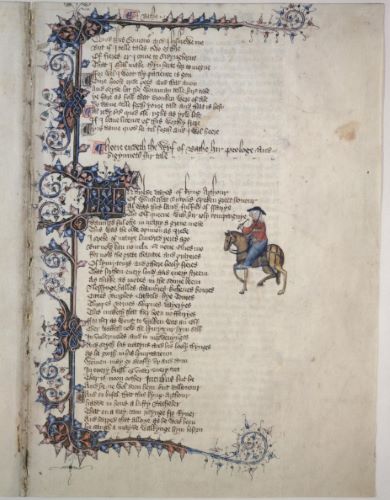
It is not surprising, given the Wife’s primary identification with a fellowship of women, that she populates her tale with analogous communities of women who know each other’s most intimate desires. There are two female courts in the tale. The first is an Arthurian court composed of the queen and her entourage who intercede in the rapist knight’s death sentence, convincing King Arthur to surrender the accused to their judgment and assigning him a quest to discover “what thing it is that wommen most desiren” (III.905). The other female court is a fairy one belonging to the Hag, who ultimately answers the riddle, saves the knight’s life, and marries him as her reward. In addition to these formal female courts, there are extensive and diverse communities of women that the knight surveys in order to discover the answer to the question of what women most desire. Before the Hag provides him the answer, the knight “seeketh every hous and every place” (III.919), and the volume of answers he receives attests to the underworld of sundry desires that resides in female communities: “Some saiden wommen loven best richesse; / Some saide honour, some saide jolinesse” (III.925–26), the Wife recounts, using anaphora to concatenate the variety of answers and plurality of voices reporting them. The knight’s visit to female communities across the realm is a fascinating example of what we might term medieval gender slumming, borrowing from the 1920s sense of that term to mean a dominant culture’s visitation of and exposure to nondominant worlds they otherwise would not have known.24The difference here is that the women consulted by the knight are hardly representative of an exotic underground comparable to 1920s black voguing and gay clubs, and the knight who is doing his slumming is doing so under duress; it is instead a community of women that crosses class divisions and yields a puzzlingly diverse array of answers to the knight’s question. His fruitless search provides an alternative answer to the queen’s riddle—one based on the Wife’s favorite discourse, the discourse of gossip—in the sense that the knight’s forced initiation into female communities reveals to him that women desire and that they desire many different things. This comes as depressing news to him, since it does not answer the question in a way that will save his life, but it does, nevertheless, provide him a record of the vast and varied array of women’s desires, and it predisposes him to pause before the dancing ladies in hopes of receiving any “wisdom” they might have. At this point, the knight is no longer that knight from the beginning of the tale, inflicting his own desire on women without regard for their consent; he is schooled in the communities of women—“every hous and every place” to register their desires and seek their wisdom. His life depends on it.
The answer to the riddle, that women desire to have sovereignty and mastery over lovers and husbands, reprises what has already happened in the tale, namely the claiming of sovereignty by women, first by Arthur’s female courtiers interceding in the knight’s fate; second, by the knight’s survey of all women’s desires; and finally, by the knight’s surrender to the Hag’s wisdom. He does, of course, require one final bit of schooling in a husband’s surrender of sovereignty, but the key role that feminine communities play in the knight’s transformation should not be subsumed under the “happy ending” of the story. The contingent transformations—of Hag into young, fair wife—and of knight-rapist into obedient husband—depend on the whole of the knight’s quest, not simply the Hag’s lecture. The Wife narrator, for all her assertion of her own desires for sovereignty in marriage, also insists on the female community from which she derives her stratagems and to which she speaks in the first-person plural in her Prologue and at the end of her tale. While the reader is not treated to conversations between the Wife and her female community, we are reminded that she is both a product of and participant in female com-munities of wives, gossips, and the imaginary fellowships of court and forest in her tale—those collective—if not always visible—sources of wisdom that rival masculine auctorite.
Cross-Species Female Friendship
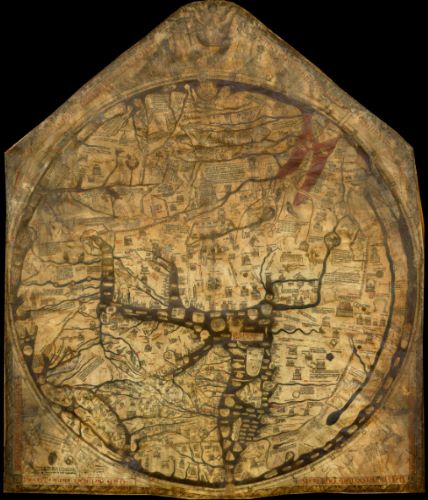
Female friendship in the Canterbury Tales is so far confined to the other-worldly terrains of romance in the Wife of Bath’s Tale and the hybrid realm of saint’s legend/romance in the Man of Law’s Tale. It is also noteworthy that in both tales, female community is often consigned to the margins of society, either the “barbarie nacion” of Syria or pagan Northumbria in the Man of Law’s Tale, or in the Wife of Bath’s Tale, the forest beyond the Arthurian court. In the Squire’s Tale, female affinity is rendered not spatially or geographically, but interspecially. Although the Bechdel test assumes female friendship to be a human bond, Chaucer’s tale shifts the terrain entirely, rendering female friend-ship posthuman, magical, and otherworldly. Set in the Mongol-Tartar empire of the Caucasus, a place often associated with monstrous races in medieval mappamundi,25 the tale “wraps itself in an aura of exotic alterity,” according to Kathryn Lynch. Other scholars have focused less on the alterity of the Cambiuskan’s court and more on its “sophistication and cosmopolitanism,” as well as its marvelous gifts from the king of Arabia and India: the flying brass horse, a ring that allows its wearer to understand animals, a magical mirror that reveals enemies and adversities, and a sword that can kill and heal.26 The tale is unfinished, making it difficult to tell how the four gifts might have figured in the Squire-narrator’s story, but part 2 of the tale recounts the adventure of the princess Canacee and her gift, the ring that allows her not only to understand the language of birds but to speak to them “in his langage” (V.152). When she goes for a walk with her new ring, Canacee encounters a formel, a female falcon the narrator cannot identify. “A faucon peregrin thanne seemed she / Of fremde land” (V.428–29). The falcon is both from a “foreign” (fremde) land and a peregrin, or traveler, a visitor from an unknown place. The Squire tells us that Canacee not only understood the falcon’s speech but was able to reply in falcon-speak under the ring’s power.
The scene of friendship, however magical, is also one of shared sensibilities and cross-species empathy, as Susan Crane has observed.27 Canacee’s morning walk is distracted by the “pitous vois” (V.412) and the bloody avian body of the female falcon in distress. Canacee asks in fluent bird-ese what the cause of her woe is (V.447–62). It is her expression of compassion and a desire to help the falcon even before she knows the cause of its despair, however, that is suggestive of her cross-species affinity with it:
I have of you so greet compassioun
For Goddes love, com fro the tree adoun
And as I am a kinges doghter trewe,
If that I verraily the cause knewe
Of youre disese, if it laye in my might,
I wolde amende it er that it were night. (V.463–68)
As Crane also points out, Canacee’s compassion and desire to help the bird occur without the benefit of the magic ring’s decoding of bird speech.28 The incomprehensible falcon shrieks are sufficient for Canacee to feel compassion for the bird and to seek to heal her self-inflicted wounds.
Speaking in her falcon idiom (haukes ledene, V.477), the falcon recognizes Canacee’s nobility precisely because of her empathy. This recognition and testimony to Canacee’s nobility from the perspective of an animal is both striking and significant insofar as such socialized cognition is usually reserved for human beings. The fact that the falcon recognizes human compassion and nobility without the benefit of a magical ring suggests that the capacity for cross-species empathy is mutual and that nobility is not confined to human beings. Their shared gentil herte affords not only empathy but a capacity for friendship:
“That pitee renneth soone in gentil herte,
Feeling his similitude in paines smerte,
Is preved alday as men may it see
As wel by work as by auctoritee;
For gentil herte kitheth gentilesse.
I see wel that ye han of my distresse
Compassioun, my faire Canacee,
Of verray wommanly benignitee
That nature in youre principles hath set” (V.479–87)
This is a remarkable passage for many reasons: first, the bird is quoting authorities and general received wisdom, as if birds and humans shared the same written traditions and emotional experience. The falcon also attributes Canacee’s pity to a “similitude” shared by bird and human, that is, the gentle heart that allows one to feel compassion and recognize itself in the pain of others, even other nonhumans. Finally, the falcon assigns this compassion born of a gentle heart to Nature, who herself installs “womanly kindness” in Canacee as an innate characteristic (“in your principles”). The implication is that this very natural gendered compassion is shared by bird and human princess alike, and that the “similitude” of female benignity crosses species boundaries.
The intimacy already shared by Canacee and the falcon is deepened in the falcon’s “confession” of her betrayal by a tercelet’s wooing and abandonment of her. Her story recounts a stock courtly tale of his complaints and pledges to serve her with “heigh reverence” (V.545). The falcon faults her own excessive pity and innocence in her surrender to his love, which turned out to be nothing but doubleness, feigning, and sophistry (V.556, 554). She says that she loved him and surrendered her will to his while “keeping the boundes of my worshipe ever” (V.571). After a year or two he leaves her, promising to return; instead, he becomes enamored of a kite and abandons the falcon. The falcon attributes his infidelity to men’s tendency to love newfanglenesse, or novelty. In the course of telling of the tercel’s falseness, the falcon conflates his behavior with that of human men, blurring the behaviors of men and male birds. She ends her complaint with a strange comparison of men who love novelty and caged birds (as if she were a human whose relationship to birds was as pets), who would rather escape to the woods to eat worms than remain in the com-fort of their cages. She ends her story by swooning in Canacee’s lap. Before the tale cuts off, Canacee takes the falcon home, builds her a mew lined with blue velvet for women’s troth and painted green outside to symbolize male infidelity, and places the mew at the head of her bed. She dedicates her life to healing the falcon by digging up and applying herbs to her wounds.
“The little mew Canacee constructs is a wonderfully complex attempt at hosting without taking hostage,” argues Crane,29 but I view the little coop and her own dedication to the bird as less a lesson in hospitality than a lesson in female friendship. The intimacy that inspired Canacee’s compassion and identification with the formal is the basis on which Canacee takes the bird into her care. The mew of female companionship displaces the cage of male infidelity that the falcon alludes to in her confession. In contrast to the love of novelty, the two female creatures—one human, the other avian—are joined by a female bond based on identification, a gentle heart, empathy, and courtly manners. The “metonymy of gentle hearts”30 uniting falcon and human not only erases the need for a magic ring’s access to species difference but also grounds a friendship across species in a shared nature.
“In the face of a true friend we see, so to speak, a second self.”31 This claim of Cicero’s in De amicitia captures the unusual dynamic between alien species, between the human Canacee and the female falcon, who perceive through compassion that second self in one another. The Squire’s Tale is interrupted by the Franklin soon after this strange episode of female friendship across species, making it difficult to determine what role this friendship would have taken in the tale as a whole.32 Perhaps it is fortunate that the Squire was not permitted to complete his tale, because within the fragments that are extant, the tale imagines cross-species female friendship based on empathy and compassion that reaches across difference and short-circuits an otherwise Orientalist narrative taken up with exotic Eastern cultures, gifts, and foreignness. Female friendship of the avian–human variety, in other words, actually does quite a bit of work despite the tale’s inconclusiveness—or rather, perhaps, precisely because of its inconclusiveness.
Chaucer and the “Vast Chamber”
For if Chloe likes Olivia and Mary Carmichael knows how to express it she will light a torch in the vast chamber where nobody has yet been.
Woolf, A Room of One’s Own33
I wonder what Woolf would have thought of my analysis of female friend-ships in Chaucer, whether she would have considered them sufficiently luminous to begin to “light a torch in the vast chamber where nobody has yet been.”34 Insofar as Woolf reserved the representation of female friendship—of Chloe liking Olivia—for future female authors, I suspect she would be disappointed in the fleeting and even quirky moments of women’s friendship that I have carved out of the predominantly male fellowship in the Canterbury Tales. Likewise, the Bechdel test, in its attempt to counteract the kinds of representation of female intimacy found in modern cinema, restricts the representation of women’s intimacy to confidential conversations that don’t involve men. The salutary effect of her test is that it brings its own torchlight to the striking absence of female intimacies in modern film, except where those intimacies are tandem to women’s heterosexual relationships with men.
Female friendships in premodern texts, like Chaucer’s Canterbury Tales, require a somewhat different corrective than those offered by Woolf and Bechdel. How might Chaucer’s few fleeting examples of female friendship provide us with the “torch,” so to speak, with which we might light the cavern of medieval representations of fellowship, friendship, and community more broadly? In other words, can we devise new parameters for “finding” and thinking about female friendship in medieval texts? Without claiming that Chaucer’s Canterbury Tales constitutes a bar for measuring other literary representations of female friendship—the way Woolf ’s “Chloe liked Olivia” or Bechdel’s test do—I would like to suggest a somewhat different, less aspirational, kind of rubric for thinking outside the usual parameters of female friendship in medieval texts. I will formulate this rubric as a series of questions in the spirit of Bechdel: What kinds of “identity of feeling” can be traced to reveal affinities between women—even those polarized by the text? What enclaves are afforded by misogynistic discourses surrounding women, such as their association with gossip? And finally, what surprises and resistances are possible in the mise-en-scène of female empathy? These questions derived from the three main examples of female friendship in the Canterbury Tales redirect our attention from what female friendships should look like and toward the kinds of things they are capable of doing. In the process, we are afforded an expanded understanding of female friendship both as a concept and as a historically specific phenomenon in premodern literary texts.
Endnotes
- Virginia Woolf, A Room of One’s Own (New York: Harcourt Brace & Co, 1981), 82.
- Alison Bechdel, “The Rule,” Dykes to Watch Out For (Ithaca, NY: Firebrand Books, 1985), 22.
- Woolf, Room of One’s Own, 82.
- Manohla Dargis coins the former after filmmaker Ava DuVernay in “Sundance Fights Tide with Films like ‘The Birth of a Nation,” New York Times January 29, 2016. For calls for more rigorous standards for “women’s stories,” see Alyssa Rosenberg, “In 2019, It’s Time to Move Beyond the Bechdel Test,” Washington Post, December 21, 2018.
- For example, see Ulrike Wiethaus, “In Search of Medieval Women’s Friendships: Hildegard of Bingen’s Letters to Her Female Contemporaries, in Maps of Flesh and Light: The Religious Experience of Medieval Women Mystics, ed. Wiethaus (Syracuse, NY: Syracuse University Press, 1993), 93–111; E. Ann Matter, “‘My Sister, My Spouse: Woman-Identified Women in Medieval Christianity,” Journal of Feminist Studies in Religion 2 (1986): 81–93; John M. Jeep, “Among Friends? Early German Evidence of Friendship among Women,” Women in German Yearbook: Feminist Studies in German Literature & Culture 14 (1999): 1–18.
- Karma Lochrie, “Between Women,” in The Cambridge Companion to Women’s Writing, ed. Carolyn Dinshaw and David Wallace (Cambridge: Cambridge University Press, 2003), 70–88. See also Lisa M. C. Weston, “Virgin Desires: Reading a Homoerotics of Female Monastic Community,” in The Lesbian Premodern, ed. Noreen Giffney, Michelle M. Sauer, and Diane Watt (New York: Palgrave Macmillan, 2011), 93–104; Susan Schibanoff, “Hildegard of Bingen and Richardis of Stade: The Discourse of Desire,” in Same-Sex Love and Desire among Women in the Middle Ages, ed. Francesca Canadé Sautman and Pamela Sheinborn (New York: Palgrave, 2001), 49–84; and Robert Mills, “Gender, Sodomy, Friendship, and the Medieval Anchorhold,” Journal of Medieval Religious Cultures 36, no. 1 (2010): 1–27.
- One recent exception is Alexandra Verini, “Medieval Models of Female Friendship in Christine de Pizan’s The Book of the City of Ladies and Margery Kempe’s The Book of Margery Kempe,” Feminist Studies 42, no. 2 (2016): 365–91. Albrecht Classen and Marilyn Sandidge’s volume of essays, Friendship in the Middle Ages and the Early Modern Age: Explorations of a Fundamental Ethical Discourse (Berlin: Gruyter, 2010), affords a range of studies on everything from monastic friendship to sworn brotherhood to Anglo-Saxon women’s epistolary friendships.
- Paul Strohm, Social Chaucer (Boston: Harvard University Press, 1989); David Wallace, Chaucerian Polity: Absolutist Lineages and Associational Forms in England and Italy (Stanford: Stanford University Press, 1994). See also Marion Turner’s argument that an antagonistic, divisive, and fragmented version of community emerges from an era of political and social turbulence, in Chaucerian Conflict: Languages of Antagonism in Late Fourteenth-Century London (London: Oxford University Press, 2006), 4–5.
- Harris uses the term pedagogy to capture the mutual education that occurs in late medieval texts; see Carissa M. Harris, Obscene Pedagogies: Transgressive Talk and Sexual Education in Late Medieval Britain (Ithaca, NY: Cornell University Press, 2018); see also her essay in this volume on cummar culture.
- “Godsibbe femininity” is a riff on Harris’s term for the rape culture of the Canterbury Tales , which she terms felawe masculinity. Unlike the masculine intimacy that takes place under the sign of japes intended to demean and enact violence against women, godsibbe femininity offers women an intimate community that seeks its own pleasure, knowledge, and resistance to masculine culture in the company of women. See Harris, Obscene Pedagogies, 26–66.
- Toni Morrison, Beloved (New York: Knopf, 1987), 272.
- Geoffrey Chaucer, Knight’s Tale, in The Norton Chaucer, ed. David Lawton (New York: Norton, 2019), I.866. Further references to this edition are cited parenthetically in the text.
- For a queering of the masculine friendship in the Knight’s Tale, see Tison Pugh, “‘For to be Sworne Bretheren til They Deye’: Satirizing Queer Brotherhood in the Chaucerian Corpus,” The Chaucer Review 43, no. 3 (2009): 282–310. For other treatments of male friendship, homo-sociality, and/or erotic relations between men, see Alcuin Blamires, Chaucer, Ethics, and Gender (Oxford: Oxford University Press, 2006), 20–45; Robert Stretter, “Rewriting Perfect Friendship in Chaucer’s ‘Knight’s Tale’ and Lydgate’s ‘Fabula Duorum Mercatorum,’” The Chaucer Review 37, no. 3 (2003): 234–52; Richard E. Zeikowitz, Homoeroticism and Chivalry: Discourses of Male Same-Sex Desire in the Fourteenth Century (New York: Palgrave, 2003); and Susan Crane, Gender and Romance in Chaucer’s “Canterbury Tales” (Princeton, NJ: Princeton University Press, 1994), 16–54.
- Crane, Gender and Romance, 200.
- “Est enim amicitial nihil aliud nisi omnium divnarum humanarumque rerum benevolentia et caritate consensio.” Cicero, De amicitia, in Cicero de senectute, de amicitia, de divinatione, trans. William Armisted Falconer (Cambridge, MA: Harvard University Press, 2014), 131 and 130. See Alexandra Verini’s discussion of Cicero and Aristotle’s idea of friendship as an “identity of feeling” in the context of Christine de Pizan, “Medieval Models of Female Friendship,” esp. 365–66.
- Aristotle, The Nicomachean Ethics, trans. H. Rackham, Loeb Classical Library, 2nd ed. (Cambridge, MA: Harvard University Press, 1934), VIII. xi.5, 495.
- Susan Schibanoff, “Worlds Apart: Orientalism, Antifeminism, and Heresy in Chaucer’s Man of Law’s Tale,” Exemplaria 8, no. 1 (1996): 59–96.
- I argue elsewhere that this relationship “represents the sole counter-voice to models of domestic and spiritual isolation of women found in most of the Canterbury Tales.” Karma Lochrie, “Between Women,” in The Cambridge Companion to Medieval Women’s Writing, ed. Carolyn Dinshaw and David Wallace (Cambridge: Cambridge University Press, 2003), 70–88, at 74.
- Geraldine Heng, Empire of Magic: Medieval Romance and the Politics of Cultural Fantasy (New York: Columbia University Press, 2003), 182.
- Woolf, A Room of One’s Own, 84.
- Karma Lochrie, Covert Operations: The Medieval Uses of Secrecy (Philadelphia: University of Pennsylvania Press, 1999), 56–92. See also Susan E. Phillips, Transforming Talk: The Problem with Gossip in Late Medieval England (University Park: Pennsylvania State University Press, 2007); and Harris, Obscene Pedagogies.
- The Wife of Bath riffs on the story in Ovid’s Metamorphosis in which Midas is cursed with asses’ ears hidden beneath his hair. Only his wife knows his secret, and she can’t bear to keep it. So instead of telling another human, she goes down to a marsh and whispers the truth in the reeds. The Wife ends her story here, as an illustration of how women cannot keep any secret, but Ovid’s story gives the revelation to a servant, not Midas’s wife, and it ends with the reeds whispering the secret forevermore: aures aselli, “asses ears” (III.952–82). For an example from Caxton’s English translation of Geoffrey de La Tour’s instruction to his daughters (ce1371), see William Caxton, Book of the Knight of the Tower, ed. M. Y. Offord, Early English Text Society, SS 217 (London: Oxford University Press, 1971), 191.
- Although the Middle English Dictionary defines the word as a gender-neutral reference to a close friend or companion, there are no examples among its quotations of the word applied to men; see the MED entry for god-sib(be): https://quod.lib.umich.edu/m/middle-english-dictionary/dictionary/MED18998/track?counte.
- See Scott Herring, Queering the Underworld: Slumming, Literature, and the Undoing of Lesbian and Gay History (Chicago: University of Chicago Press, 2007).
- See Lawton’s introduction to the tale, Norton Chaucer, 210–11.
- Kathryn L. Lynch, “East Meets West in Chaucer’s Squire’s and Franklin’s Tales,” Speculum 70, no. 3 (July 1995): 530–51, at 531. Patricia Ingham reads the tale in terms of its disenchanted rationalism and enchanted wonder for gadgets and novelty: “Little Nothings: The Squire’s Tale and the Ambition of Gadgets,” Studies in the Age of Chaucer 31 (2009): 53–80. Scott Lightsey, too, examines the role of wonder and mirabilia in the tale in Manmade Marvels in Medieval Culture and Literature (New York: Palgrave, 2007), 58–59, 61–62, and 73–75.
- Susan Crane, Animal Encounters: Contacts and Concepts in Medieval Britain (Philadelphia: University of Pennsylvania Press, 2012), 120–36. Sara Deutch Schotland views the friend-ship between bird and human as “female homosocial bonding” providing “protection in a dangerous world”: “Talking Bird and Gentle Heart: Female Homosocial Bonding in the Squire’s Tale,” in Friendship in the Middle Ages and Early Modern Age: Explorations of a Fundamental Ethical Discourse, ed. Albrecht Classen and Marilyn Sandidge (Berlin: de Gruyter, 2010), 525–42, at 531.
- Crane, Animal Encounters, 128.
- Crane, Animal Encounters, 133.
- Crane, Animal Encounters, 126.
- “Verum etiam amicum qui intuetur, tamquam exemplar aliquod intuetur sui,” Cicero, De amicitia, 132. My translation.
- An ambiguous precis of the next part of the tale concerning Cambiuskan and Cambalo raises the specter of incest involving Canacee and her brother, Cambalus, a specter that would seem utterly to supersede and obscure the female cross-species friendship in the second part of the tale. The incest suggestion comes in these lines: “And after wol I speke of Cambalo, / That fought in listes with the bretheren two / For Canacee, er that he mighte hire winne” (V.667–69). As Lawton in the Norton Chaucer explains, the implication of incest here is based on two assumptions: first, that the Cambalo mentioned here is the same person as Cambalus, Canacee’s brother mentioned earlier in the tale; second, that his possibly “winning” her means winning as his wife / love interest. John M. Fyler argues that incest as a theme serves up the romance genre’s desire for the exotic: “Domesticating the Exotic in the Squire’s Tale,” ELH 55 (1988): 1–26. In Lynch’s judgment, this possibility results from the Westernization of Eastern versions of this story, such that “the promised exotic ending is not just a horror; it is ludicrous”: “East Meets West,” 542. Elizabeth Scala has argued that “the incest narrative functions as a cipher for the narrative alterity it foregrounds”: “Canacee and the Chaucer Canon: Incest and Other Unnarratables,” Chaucer Review 30, no. 1 (1995): 15–39, at 31.
- Woolf, A Room of One’s Own, 84.
- Elizabeth Abel uses this same passage from A Room of One’s Own to focus on female friendships in contemporary literature: “(E)merging Identities: The Dynamics of Female Friendship in Contemporary Fiction,” Signs 6, no. 3 (Spring 1981): 413–35.
Chapter 9 (181-196) from Women’s Friendship in Medieval Literature, edited by Karma Lochrie and Usha Vishnuvajjala (Ohio State University Press, 07.11.2022), published by OAPEN under the terms of a Creative Commons Attribution-NonCommercial-NoDerivs 3.0 Unported license.
About the Author