Tracing the roots of modern media to the Great War, when propaganda mobilized the masses.

By Anne Wallentine
Writer, Editor, and Creative Director
Introduction
More than a century after World War I, all is not quiet on the Western Front. The aftershocks of the Great War continue to resonate, in part due to the revolutionary ways the conflict was depicted in art and media. At the Los Angeles County Museum of Art (LACMA), an exhibition titled “Imagined Fronts: The Great War and Global Media” explores the influence of wartime visual storytelling and propaganda, which brought the conflict home to citizens in ways that still shape how people envision combat today.
Between 2014 and 2018, a flurry of global exhibitions marked World War I’s centenary. LACMA’s show arrived almost a decade later, opening at the end of 2023 to mark the centenary of the Treaty of Lausanne, the last of the resolutions to the fighting that continued after the “official” armistice on November 11, 1918. Curator Timothy O. Benson timed the exhibition to illuminate the blurred historiographic boundaries of when wars start and end, as well as the lingering legacy of trauma and healing.
Visualizing the Incomprehensible
The immersive exhibition is organized into four sections featuring some 200 objects. At the beginning, viewers examine the influence of propaganda posters that were used to mobilize the masses. They then move through a wide range of battlefield imagery, artifacts illuminating global perspectives on the war and reactions in its aftermath.
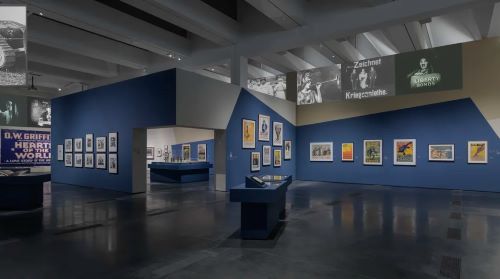
Benson says his aim was to illuminate the “role of imagination in war.” He quotes Surrealist Johannes Baader’s 1920 comment as inspiration: “The World War is a newspaper war. In reality, it never existed.” To Benson, this statement raises the question of “to what degree … people derive their knowledge of wars from the press.”
Media can reproduce statistics, photographs, footage—but each of these requires the audience’s imagination and analysis of their perspective. Jay Winter, a historian at Yale University who was not involved with the exhibition, argues, “The most powerful effect of the media was to create an illusion, an illusion that still exists—which is that war can be represented in the media.” This illusion is “a very dangerous one,” he adds.
“The true horrors of conflict appear to be documented through film, photography, posters, visual arts and so on,” Winter says, “and that led not only artists but propagandists and foreign policy agents to use the media to tell the people what war was ‘really like.’ The truth is they could never do so. The battlefields were always worse than their most horrific representation.”
The historian continues, “There’s a fundamental issue about whether war can be represented, and that makes the art exhibition and catalog in a way ironic.” By its nature, the show relies on multimedia methods to imagine war, while also analyzing the ways these forms of media conceptualize combat in the first place. Benson’s goal was to explore the “imagined” aspects of war, acknowledging that any display or retelling of history calls on the imagination as well.
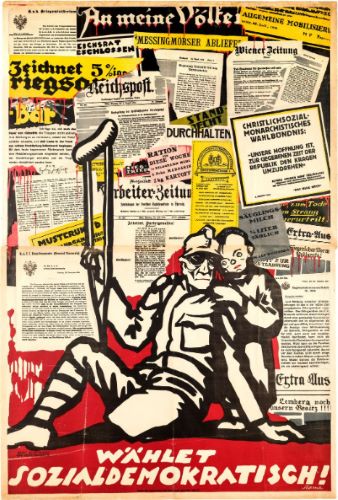

The exhibition foregrounds examples of the intentional “invention” of war through propagandistic, censored or retouched imagery. Examples include intentionally manipulated photos, paintings based on imagined events and early film footage that was edited for propaganda purposes. The many objects, sourced from different sides of the conflict, allow visitors to understand the varied perspectives and politics at play, from the personal objects that soldiers carried and created to the stories shared by governments and the media. The array of examples shows “just how very sophisticated, innovative and far-reaching the propaganda machine was,” says Santanu Das, a literary scholar at the University of Oxford who contributed to the catalog. “What the exhibition encourages is to let the exhibits speak, connect and occasionally even argue among themselves.”

Some of the most moving artifacts featured in the show are postcards sent by German soldier Otto Schubert to his future wife. Schubert painted images of the front, including illustrations of his company; a burning building; and a moonlit, makeshift graveyard. The covers of contemporary songbooks on display also reveal how music and art could cheerily militarize a population. The exhibition offers numerous ways to relate to individual and collective experiences, even if, in the end, the entirety of war remains incomprehensible.
World War I on Film
World War I coincided with the birth of film, which enabled an immersive, seemingly “real” experience of the front lines for civilians far from it. “The images of trench warfare, the flickering scenes of marching troops in early documentaries and the suffering of the soldiers informed the popular mind,” says Frank Wetta, a historian at Kean University who was not involved with the exhibition. The 1931 film Frankenstein, starring Boris Karloff as the eponymous doctor’s monster, “reflected the experience and memories of the First World War battlefield and its consequences—of men mutilated and then pieced back together,” Wetta adds.
The film industry also “provided many ways to turn war into entertainment, into romance, into heroism, into the excitement of … the ‘Knights of the Air,’” Winter says, alluding to the heroized culture of fighter pilots. Both documentaries and fictional films “served to reflect and shape the collective memory of the war through the war film genre,” which encompassed everything from combat to comedy, Wetta says.
Consuming war through film has had lasting effects on collective memory and awareness of conflict. The Battle of the Somme, the first war documentary, “attracted the largest audience for a motion picture until the appearance of Star Wars” in 1977, Wetta notes. The Manchester Guardian reported on the documentary’s release in 1916, commenting, “People should be made to feel the horror of it and realize that [war] is not merely a lively game that goes on in newspapers.”
“Imagined Fronts” includes a range of film footage, including a rare 1919 pacifist film, J’Accuse.Benson intentionally reserved the use of sound in clips until the end of the exhibition, as sound only arrived in film in the late 1920s, proving revelatory in how people experienced cinema. Though not playing in the galleries, links are also provided to playlists of contemporary war songs (think “It’s a Long Way to Tipperary”) and the oeuvre of James Reese Europe, an influential American jazz bandleader who traveled with a military band in France.
Colonialism’s Wartime Legacy
A standout section on the global, colonial reach of the war includes a station featuring foreign-language recordings made by prisoners of war in German camps, some of which had not been translated until this show. The languages include Punjabi, Turkish, Russian, Tunisian Arabic, Korean and Bantu. “I really wanted to somehow hear the voices—subaltern voices—of those whom it’s so easy to forget,”Benson explains.
Benson selected the 10 clips from more than 2,600 recorded by the Royal Prussian Phonographic Commission, which was established in 1915 as part of an ethnological study. German scholars asked prisoners to recite a poem or sing a song in their native language. Because the recordings were not intended for the public, they were left uncensored. Some soldiers simply followed the brief, but others spoke of missing home: Punjabi soldier Mall Singh, for instance, pondered why he left the comforts of home (and home cooking) to fight.
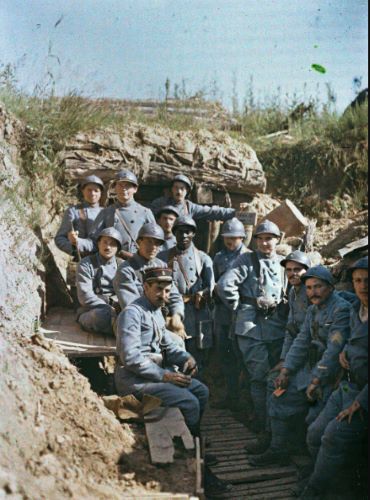
Due to British colonial rule, 1.5 million Indian soldiers fought in World War I; colonial regiments including Senegalese and Algerian soldiers joined the French. In contrast to the humanity of the recordings, posters in this section of the exhibition visualize the stereotypes of what were seen as “martial races,”a theory that ranked the “warlike” nature of different peoples and reinforced colonial hierarchies.
An interesting footnote of the show is the first mosque built in Germany, which was established for Muslim prisoners of war in 1915. This gesture originated from the colonial impulse to appear slightly better than the other oppressor, so as to gain colonial subjects’ support and weaken their rival.
In his catalog essay, Das explains that the armies involved in the conflict were “racially diverse but never inclusive or equal.” This inequality continued after the war, too: African American soldiers risked their lives in Europe but were subsequently mistreated upon their return to the United States. As Das tells Smithsonian magazine, “There is no one war; there were different wars for different people.”

Other artifacts recall the ways that soldiers told their stories. Mike Mountain Horse, a member of the Indigenous Kainai Nation, recounted his wartime experiences to Ambrose Two Chiefs, who inscribed them on a buffalo skin to create a traditional war story robe. While Indigenous people were exempt from conscription in Canada, Mountain Horse was among the roughly 4,000 who served during World War I. Seeing the pictograph-style paintings of wartime trauma and violence on the skin is, in some ways, more visceral than many hyper-realistic images of war.
The ways that global media shapes perceptions of the war require constant re-examination from numerous perspectives.World War I has been memorialized far less in the U.S., which entered the war late, than in Europe, which lost an entire generation. “It’s important that the Los Angeles museum landscape is turning to this as a long-forgotten moment when the first phase of globalization came to an end in a massive bloodbath,” Winter says.
Wetta points to a truism that borrows from Russian revolutionary Leon Trotsky: “You may not be interested in war, but war is interested in you.” The historian adds, “Centenary exhibitions serve to remind and inform us not only about the past but about our current world as well. World War I is not a tale from the dead past but a living, breathing entity to this day. We need to know this. We need an informed memory.”
As World War I memoirist Ernst Jünger put it, “This war is not the end but the prelude to violence.” World War I fed directly into World War II, a conflict that built on the horrific platform of the first “global war.”
“The world that came out of the First World War was a deeply, deeply violent one,” says Winter. “And violence has been increasingly directed at civilians from the First World War on.”
Benson adds, “The weaponization of media in the interest of this war became more widespread and deeper than hitherto. We still today are living with weaponized media that in some ways originated in this unprecedented war.”
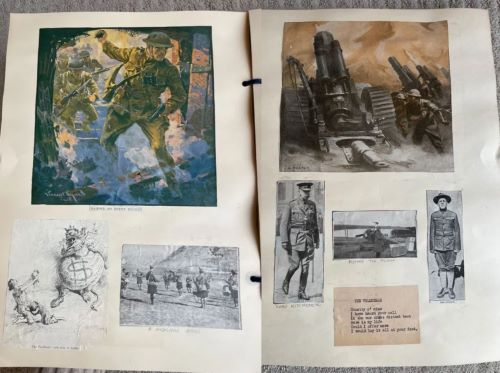
The effects of this media also happened to be preserved by my great-grandmother, Helen Garrity Yorke, who kept scrapbooks while growing up in Salt Lake City during the war. In a few pages, she captured the popular art of World War I—cartoons, reproduced paintings, poems—that shaped how contemporary Americans saw the conflict. Featured items included a typewritten copy of the poem “In Flanders Fields,” an anti-German propaganda cartoon labeled “Hun Gratitude,” and numerous heroic depictions of American soldiers and nurses. The violence of the images of the Western Front ends in the last few jubilant pages, filled with returning soldiers, family reunions and lighthearted punchlines. None of the lingering trauma is depicted here. The selected imagery simply closes the chapter on a happy ending—until I turn the page to World War II.
Originally published by Smithsonian Magazine, 01.18.2024, reprinted with permission for educational, non-commercial purposes.
About the Author