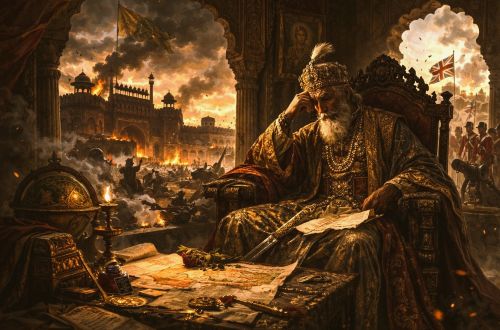
In 1857, rebels revived the Mughal emperor as sovereign symbol, exposing the widening gap between ceremonial monarchy and operational power in colonial India.

By Matthew A. McIntosh
Public Historian
Brewminate
Introduction: Empire in Name, Colony in Reality
By the time Bahadur Shah Zafar ascended the Mughal throne in 1837, the empire he nominally ruled existed more as memory than mechanism. The Mughal dynasty, once the paramount power across much of the Indian subcontinent, had long since ceded fiscal, military, and administrative supremacy to regional polities and, increasingly, to the British East India Company. Delhi remained the ceremonial center of imperial dignity, and the Red Fort still housed the trappings of sovereignty. Yet effective governance over vast territories had already passed into other hands. The emperor’s authority survived in titulature, court ritual, and inherited prestige rather than in enforceable command.
The eighteenth century had witnessed the gradual disintegration of centralized Mughal power following the death of Aurangzeb in 1707. Prolonged military campaigns in the Deccan had strained imperial finances, while succession disputes and court factionalism weakened the cohesion of the ruling elite. Provincial governors, originally appointed as imperial deputies, consolidated regional bases of authority and transformed themselves into semi-autonomous rulers in Awadh, Bengal, and Hyderabad. Simultaneously, Maratha expansion reshaped the political geography of North and Central India, further diminishing imperial reach. By the mid-eighteenth century, the Mughal emperor retained theoretical sovereignty but exercised little practical control beyond Delhi and its environs. Into this fragmented landscape entered the East India Company, whose military victories at Plassey in 1757 and Buxar in 1764 granted it decisive fiscal rights in Bengal and established it as a territorial power. Although the Mughal emperor continued to issue farmāns that conferred legitimacy upon Company arrangements, such gestures increasingly reflected accommodation rather than command. The emperor’s court became dependent upon Company pensions, and imperial recognition functioned less as governance than as ceremonial endorsement. Sovereignty endured in ritual and language even as its institutional foundations dissolved.
This distinction between symbolic authority and operational control defined the political landscape of mid-nineteenth-century North India. Zafar presided over a court renowned for its literary refinement and Sufi-inflected culture, yet he lacked an independent army, an autonomous treasury, or meaningful administrative reach beyond Delhi’s immediate environs. British residents oversaw political affairs, and Company structures shaped taxation, military deployment, and diplomatic negotiation. The emperor’s name carried resonance across religious and regional divides, but his capacity to direct events was sharply constrained. His throne embodied continuity; it did not command territory.
When rebellion erupted in 1857, insurgents turned to Zafar not because he governed effectively, but because he symbolized an older order whose legitimacy still carried weight. The proclamation of his restored sovereignty dramatized a tension long embedded in colonial India: empire in name, colony in reality. The events of that year did not create the emperor’s impotence; they exposed it. The Mughal throne functioned as a reservoir of symbolic capital that could be mobilized in moments of crisis, yet it lacked the institutional instruments necessary to convert reverence into coordinated resistance. Zafar’s reign offers a lens through which to examine the divergence between ceremonial monarchy and effective power at the threshold of formal British imperial rule.
The Long Decline of Mughal Authority
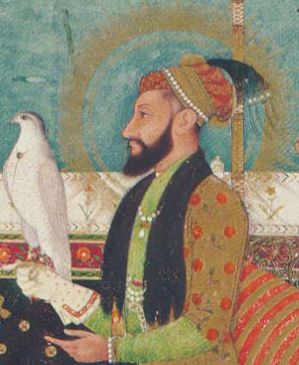
The erosion of Mughal authority did not occur in a single rupture but unfolded across decades of cumulative strain. The death of Emperor Aurangzeb in 1707 marked not an immediate collapse but the beginning of a protracted decentralization. His long reign had extended imperial frontiers yet exhausted fiscal reserves and military cohesion. Continuous warfare in the Deccan drained the treasury and dispersed seasoned troops far from the imperial core. Succession struggles that followed his death further destabilized the court, weakening the central government’s ability to discipline provincial elites or maintain unified command across distant territories.
Provincial governors, once appointed to administer on behalf of the emperor, increasingly entrenched themselves as autonomous rulers. In Awadh, Bengal, and Hyderabad, subahdars consolidated fiscal authority and established hereditary succession, transforming imperial provinces into semi-independent polities. These regional courts maintained the rhetoric of Mughal loyalty, continuing to mint coins in the emperor’s name and to seek formal recognition from Delhi. Yet practical sovereignty had shifted outward. The emperor’s sanction conferred prestige, but it no longer determined political reality. Ritual allegiance masked structural fragmentation.
Simultaneously, the Maratha Confederacy expanded northward, contesting Mughal control over central India and extracting revenue through systems of tribute and chauth. Their cavalry-based mobility and decentralized leadership structure allowed them to adapt rapidly to shifting alliances and regional vulnerabilities. Rather than attempting to replicate Mughal administrative centralization, Maratha leaders operated through negotiated authority and flexible military deployment, often inserting themselves into existing provincial disputes. Their incursions were not merely raids but sustained political interventions that reshaped revenue flows and allegiance networks across the subcontinent. Other regional powers, including Sikh confederacies in the Punjab and Jat polities in North India, further complicated the imperial landscape. These groups capitalized on Mughal weakness to carve out autonomous spheres of influence, drawing local elites and agrarian communities into alternative systems of protection and patronage. The cumulative effect was not total anarchy but a mosaic of competing authorities operating within what had once been a centralized imperial framework. Delhi remained symbolically paramount, yet its directives carried diminishing coercive weight, increasingly dependent upon negotiation rather than enforcement.
Into this fractured political order entered the British East India Company. Initially one of several commercial actors operating under Mughal sanction, the Company capitalized on regional rivalries, fiscal instability, and the weakening of centralized oversight. Its private armies, financed by trade and increasingly by territorial revenue, allowed it to intervene decisively in succession disputes and regional conflicts. The battles of Plassey in 1757 and Buxar in 1764 proved transformative, not merely because they secured battlefield victories, but because they granted the Company diwani rights in Bengal, Bihar, and Orissa. Control over these revenue-rich provinces provided the financial base necessary to sustain standing armies and bureaucratic administration independent of Mughal structures. With fiscal resources now at its disposal, the Company evolved from merchant intermediary into territorial sovereign, capable of dictating terms to both regional rulers and the imperial court. Though it continued to acknowledge Mughal authority in form, including the issuance of revenue in the emperor’s name for a time, the balance of power had decisively shifted. Imperial recognition became a veneer layered over expanding colonial governance.
The emperor’s role increasingly resembled that of a pensioned monarch sustained by external support. Following the Treaty of Allahabad in 1765, Mughal fiscal dependence on the Company deepened. Imperial authority survived through ceremony, court culture, and juridical symbolism rather than through taxation or military command. Coins, proclamations, and investiture rituals continued to invoke imperial sovereignty, yet these gestures functioned within a political ecosystem now dominated by Company administrators. The Mughal throne had become a node of legitimacy rather than a center of governance.
By the early nineteenth century, this transformation was complete. British residents exercised decisive influence within Delhi, and Company regulations structured legal and administrative life across expanding territories. Zafar inherited not a failing empire but an institution whose effective authority had long since migrated elsewhere. The decline of Mughal power represents less a sudden fall than a steady transfer of sovereignty from dynastic monarchy to corporate colonial state. The illusion of imperial continuity endured precisely because its ceremonial forms remained intact, even as its structural foundations had been fundamentally reconfigured.
Delhi before the Rebellion: Culture without Command
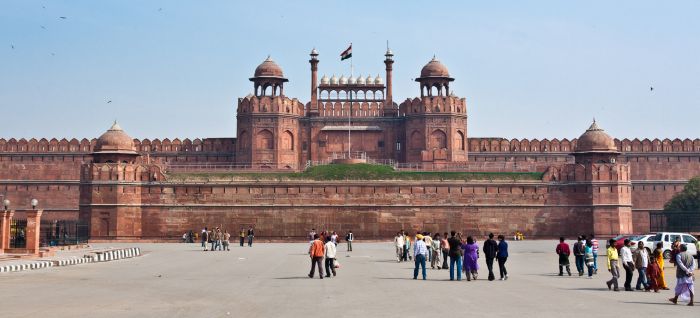
By the mid-nineteenth century, Delhi occupied a paradoxical position within North India. Politically diminished yet culturally radiant, it functioned less as an imperial capital and more as a symbolic heart of Indo-Islamic civilization. The Mughal court retained its architectural splendor within the Red Fort, where ceremonial audiences and ritual observances sustained the appearance of dynastic continuity. Poets, scholars, and Sufi mystics gathered under imperial patronage, reinforcing Delhi’s reputation as a center of refinement. Yet beyond the walls of the fort, British administrative structures and military oversight defined political reality. The city embodied prestige without power.
Zafar himself exemplified this transformation. Known more widely as a poet than as a political strategist, he cultivated an image of aesthetic and spiritual engagement rather than administrative command. His Urdu ghazals, infused with melancholy, exile, longing, and metaphysical reflection, circulated widely within elite literary circles and helped shape the late flowering of classical Urdu court culture. Zafar did not merely compose poetry; he curated a literary environment in which artistic excellence functioned as a surrogate for imperial grandeur. He presided over mushairas, patronized leading poets such as Ghalib and Zauq, and engaged in intellectual debates that reinforced the court’s cultural authority. Within these gatherings, the Mughal throne retained a magnetism rooted in refinement rather than rule. This literary vibrancy, however, did not translate into administrative strength. The emperor’s influence resided in language, ritual, and shared aesthetic memory rather than in fiscal command or military mobilization. Cultural sovereignty flourished even as political sovereignty narrowed.
British residency within Delhi underscored the imbalance. Company officials monitored court proceedings, mediated external communications, and shaped political appointments. Military garrisons stationed nearby ensured that any assertion of independent authority could be swiftly curtailed. Revenue collection and territorial administration operated through Company frameworks, leaving the emperor financially dependent upon stipends. Although formal courtesies acknowledged Mughal precedence, these gestures functioned within a colonial hierarchy in which ultimate decision-making authority lay elsewhere. Ceremonial sovereignty persisted under watchful supervision.
Religious and social dynamics further reinforced the emperor’s symbolic function. Zafar’s court maintained ties with Sufi networks and Islamic scholars, positioning the Mughal throne within a spiritual as well as dynastic lineage. At the same time, Delhi’s population was religiously diverse, and the memory of Mughal governance carried associations of imperial inclusivity that transcended communal divisions. Hindu elites, Muslim scholars, artisans, and merchants participated in a shared urban culture shaped by centuries of imperial presence. The emperor’s person, though politically constrained, embodied continuity across these social layers. His court functioned as a focal point for ceremonial festivals, legal acknowledgments, and symbolic patronage that sustained a sense of collective historical belonging. This residual integrative symbolism would later prove decisive in 1857, when insurgents sought a figure capable of unifying disparate grievances under a single banner. Yet prior to rebellion, this integrative potential remained largely dormant, confined to ritual affirmation rather than political activation.
Economically, Delhi had long since lost its status as a dominant fiscal center. Trade routes shifted toward coastal hubs aligned with British commercial interests, and the economic gravity of the subcontinent moved increasingly toward Calcutta and Bombay. The Mughal court no longer commanded extensive agrarian revenues or provincial tribute sufficient to sustain independent governance. Its expenditures were circumscribed by stipends negotiated with Company authorities, limiting the emperor’s ability to fund military or bureaucratic expansion. Urban life continued with vibrancy, sustained by artisanal production, intellectual exchange, and local commerce, but imperial administration had narrowed to municipal oversight and ceremonial obligation. The economic foundations that once supported expansive imperial ambition had been replaced by controlled dependency. Authority endured in etiquette and memory, not in revenue streams or coercive infrastructure.
On the eve of the rebellion, Delhi represented the culmination of Mughal transformation. It was a city of memory sustained by culture, a court of poets presiding over the afterimage of empire. Zafar’s reign within its walls reflected the final stage of a long historical process: sovereignty reduced to symbol, command replaced by ceremony. When insurgents would soon proclaim him emperor of a revived order, they would be mobilizing not a functioning state apparatus, but a reservoir of historical legitimacy preserved within a culturally luminous yet politically circumscribed capital.
1857: Rebellion and the Search for Legitimacy

The uprising that began in the spring of 1857 did not initially present itself as a coordinated national revolution. It emerged within the Bengal Army of the East India Company, where sepoy grievances over pay, promotion, overseas service, and the introduction of rifle cartridges rumored to be greased with animal fat ignited localized mutiny. Yet once the rebellion spread beyond isolated barracks, it required a political language capable of transforming military insubordination into sovereign challenge. Mutiny alone could destabilize Company rule; it could not replace it. For that transformation to occur, insurgents needed a symbol capable of legitimizing their actions in the eyes of soldiers, civilians, and regional elites alike.
Delhi provided that symbol. When mutinous troops entered the city in May 1857, they turned immediately to Zafar. The decision was strategic rather than sentimental. The Mughal emperor, though politically constrained, remained the only figure whose name resonated across North India with imperial authority embedded in two centuries of imperial governance. His lineage connected contemporary revolt to a remembered age of subcontinental sovereignty, and his court, though weakened, still embodied ceremonial continuity. By proclaiming him sovereign, insurgents sought to anchor their movement within a recognized dynastic framework rather than risk fragmentation into competing local uprisings. The emperor’s seal authenticated proclamations, his presence conferred political gravity upon rebel councils, and his historical stature offered a vocabulary through which disparate actors could imagine a restored order. In elevating Zafar, the rebels were not merely selecting a leader; they were invoking a political grammar capable of transforming rebellion into restoration.
This appeal to imperial continuity masked the structural limitations that defined Zafar’s position. The rebels who urged him to assume leadership effectively thrust sovereignty upon a monarch who lacked independent instruments of enforcement. Their proclamation did not restore a centralized state apparatus; it reanimated a symbol. Yet symbols possess mobilizing power. Urban populations, provincial leaders, and religious authorities could align themselves more readily with a recognizable dynasty than with a diffuse military uprising. The emperor’s name conferred coherence upon a movement that might otherwise have fractured along regional or sectarian lines.
Legitimacy in 1857 functioned as both political strategy and psychological necessity. The rebellion encompassed varied constituencies: disgruntled soldiers resentful of military policies, dispossessed aristocrats seeking restoration of lost privileges, peasants burdened by revenue settlements, and religious figures concerned about cultural and institutional encroachment. These groups did not share identical aims, nor did they articulate a unified constitutional vision for a post-Company order. What bound them together, however, was the invocation of Mughal sovereignty as a legitimizing framework capable of transcending local grievances. The emperor’s elevation provided a focal point around which rebel proclamations could be issued and loyalties declared. It allowed participants to imagine themselves acting not as insurgents against authority but as defenders of rightful rule. Yet this reliance on symbolic unification exposed a fundamental weakness: the emperor’s court lacked the administrative infrastructure to coordinate military strategy across regions or to mediate rival ambitions among rebel leaders. The invocation of sovereignty supplied ideological coherence but did not generate institutional discipline.
The search for legitimacy in 1857 revealed the paradox at the heart of the rebellion. Insurgents revived the Mughal throne precisely because its symbolic authority remained potent, even though its operational capacity had long since eroded. Zafar’s proclamation as emperor dramatized the distinction between ceremonial monarchy and effective governance. The rebellion’s initial success in seizing Delhi depended upon imperial symbolism; its eventual fragmentation exposed the limits of symbolism without structure. In elevating Zafar, rebels illuminated the enduring power of dynastic memory while simultaneously revealing the institutional vacuum beneath it.
The Emperor without Instruments of Power
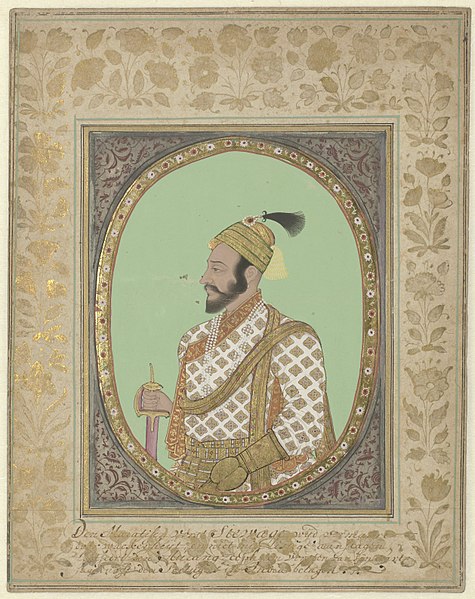
Zafar’s elevation during the rebellion did not alter the structural realities that had defined his reign for two decades. Sovereignty requires instruments: a treasury capable of sustaining administration and military expenditure, a chain of command able to enforce policy, and bureaucratic mechanisms that translate proclamation into governance. Zafar possessed none of these in independent form. His court had long functioned within fiscal dependency upon the East India Company, and the revenue systems that once sustained Mughal administration now operated beyond imperial control. The emperor’s authority, though ritually expansive and emotionally resonant, lacked material foundation. His seal could authenticate proclamations, but it could not command troops across provinces. His lineage could evoke imperial memory, but it could not restore fiscal autonomy. Decades of political marginalization had reduced the Mughal throne to a ceremonial nucleus surrounded by structures it no longer directed. When rebellion thrust sovereignty back upon him, it did so without returning the administrative and military capacities that had once defined imperial power.
Military weakness proved decisive. When rebel forces proclaimed Zafar emperor, they did not submit to an established imperial command structure; they brought with them fragmented loyalties and competing agendas. Sepoy regiments acted under their own officers, and regional leaders pursued distinct objectives shaped by local grievances. The emperor had neither a standing army under personal command nor a disciplined corps of officers capable of imposing strategic coherence. Rebel councils formed within Delhi, but they struggled to coordinate operations or enforce unified policy. The symbolic center of the uprising lacked the coercive capacity necessary to shape its direction.
Administrative capacity was equally constrained. The Mughal bureaucracy that had once governed vast territories had withered into a courtly apparatus oriented toward ceremony rather than governance. There existed no functioning provincial network through which imperial decrees could be transmitted and enforced across the subcontinent. Communications among rebel-held territories depended upon improvised channels rather than institutional infrastructure. Even within Delhi, rival factions vied for influence, and the emperor’s authority operated through negotiation rather than directive command. Sovereignty without administrative machinery could inspire allegiance but not sustain coordinated governance.
Fiscal impotence compounded these limitations. War requires revenue, and the rebels possessed no centralized system for taxation or resource allocation under imperial supervision. Supplies, munitions, and provisions depended upon ad hoc contributions and local requisition. Zafar’s court lacked the means to finance sustained military resistance or to reward loyalty systematically. The emperor occupied a paradoxical position: publicly proclaimed sovereign of a restored empire, yet privately constrained by the absence of the very instruments that define effective rule. His reign during the rebellion exposed the structural hollowness that decades of dependency had produced. Authority endured in name; power remained elsewhere.
British Retaliation and the End of the Mughal Line
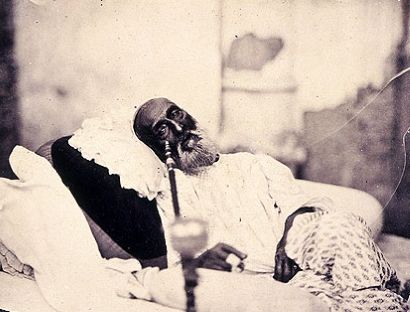
The British response to the rebellion combined military retribution with deliberate political transformation. After months of siege, Company forces recaptured Delhi in September 1857, marking a decisive turning point in the uprising. The retaking of the city was accompanied by extensive violence, executions, and the systematic dismantling of rebel networks. What followed was not merely the suppression of mutiny but the reassertion of colonial authority through exemplary punishment. Delhi, once the symbolic heart of Mughal sovereignty, became the site of imperial vengeance designed to extinguish both armed resistance and dynastic memory.
Zafar’s fate embodied this transition. Arrested after seeking refuge at Humayun’s Tomb, he was brought before a British military tribunal and charged with rebellion, treason, and complicity in the deaths of British civilians. The trial proceedings underscored the inversion of sovereignty that had taken place. A monarch whose ancestors had received foreign envoys and conferred titles now stood as a defendant before Company officers. Though the legal process adhered to formal procedures, its outcome was predetermined. Zafar was found guilty and sentenced to exile rather than execution, a decision that reflected both political calculation and the desire to remove him permanently from the symbolic landscape of North India.
The exile to Rangoon in 1858 severed the Mughal line from its historical seat of authority. Removed from Delhi, Zafar was stripped not only of territory but of context, culture, and courtly identity. In Burma, he lived under surveillance, physically isolated from the networks of poets, scholars, and nobles that had defined his world. The emperor’s displacement carried deliberate symbolic force: it transformed the former sovereign into a distant relic, disconnected from the geography that had sustained Mughal legitimacy for centuries. The British did not merely neutralize a political figure; they dismantled the spatial foundations of imperial memory. His sons were executed shortly after Delhi’s recapture, eliminating immediate succession and sending a clear message that dynastic continuity would not be tolerated. The Mughal Empire, long reduced in substance, was now formally extinguished in name, its institutional remnants dissolved into colonial administration.
The rebellion’s suppression also precipitated structural change within British governance. In 1858, the Government of India Act transferred authority from the East India Company to the British Crown. Company rule ended, and India entered a new phase of direct imperial administration under the Raj. The symbolic destruction of the Mughal throne facilitated this transformation. By eliminating the last vestige of indigenous imperial legitimacy, British authorities cleared the field for a new model of colonial sovereignty grounded in centralized bureaucratic control and imperial ideology.
Thus, the end of the Mughal line represented more than the removal of a monarch; it marked the definitive closure of a centuries-old political order. Zafar’s exile signaled the triumph of corporate colonial statecraft over dynastic monarchy and the consolidation of a new imperial paradigm in which sovereignty derived from parliamentary statute and administrative machinery rather than inherited lineage. The rebellion had momentarily revived imperial symbolism, but British retaliation converted symbolic resurgence into terminal dissolution. In extinguishing the Mughal throne, colonial power ensured that no alternative sovereign claim would rival its own, reshaping the political imagination of the subcontinent. Authority shifted irrevocably from ceremonial empire to bureaucratic empire, and the illusion of Mughal sovereignty dissolved under the weight of military force, legal restructuring, and imperial redefinition.
Memory, Myth, and Nationalist Afterlife
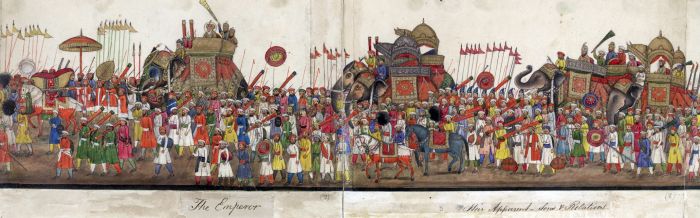
In the decades following his exile and death in Rangoon in 1862, Zafar underwent a transformation from displaced monarch to symbolic martyr. During his lifetime, he had presided over a court whose authority was circumscribed by colonial dominance. In death, however, his image acquired new resonance within emerging narratives of resistance. The very impotence that had defined his political position in 1857 receded from popular memory, replaced by an emphasis on suffering, exile, and dispossession. Historical defeat became moral testimony.
This transformation was not immediate but unfolded gradually as Indian intellectuals and political activists revisited the events of 1857. Early colonial historiography framed the rebellion as mutiny and disorder, emphasizing loyalty to British authority and depicting Mughal restoration as regressive. Indian reinterpretations, by contrast, increasingly characterized 1857 as a war of independence. Within this reframing, Zafar assumed a different role. He appeared not as a reluctant and constrained figurehead but as the last sovereign of a legitimate indigenous order overwhelmed by foreign rule. Memory compressed complexity into emblem.
Zafar’s poetry played a crucial role in this afterlife. His verses, already marked by themes of loss and transience, acquired retrospective poignancy when read against the backdrop of imperial extinction. Lines lamenting separation from homeland and the fragility of worldly power resonated deeply with later audiences. The poetic voice of exile fused with the political narrative of dispossession. In nationalist discourse, Zafar’s literary persona softened the harsher realities of administrative incapacity, allowing cultural memory to foreground pathos over powerlessness.
The Mughal emperor’s burial site in Rangoon further contributed to mythic reconstruction. For decades, his grave remained unmarked, a stark reminder of imperial erasure. When the site was later identified and commemorated, it became a locus of remembrance that connected anti-colonial sentiment to dynastic memory. Physical marginalization gave way to symbolic reclamation. The emperor who had been removed from Delhi’s Red Fort returned to public consciousness as a figure embodying both loss and endurance.
Historiographical debates have continued to reassess his role within the rebellion. Some scholars emphasize the structural constraints that limited his agency, portraying him as a reluctant participant swept into events beyond his control. Others underscore the symbolic indispensability of his endorsement, arguing that without the Mughal name the rebellion in Delhi might have remained an episodic military revolt rather than a broader political uprising. Still others situate Zafar within the cultural history of late Mughal Delhi, interpreting his significance less in terms of strategic leadership and more in terms of representational authority. These competing interpretations reveal how historical evaluation shifts according to interpretive framework: political history foregrounds command and capacity, while cultural history highlights memory and meaning. What remains consistent across these debates is recognition of the gap between symbolic invocation and material capability. Zafar’s afterlife demonstrates how historical actors can acquire meanings that exceed, and sometimes contradict, the practical limitations of their lived authority.
The nationalist reinvention of Zafar underscores a broader phenomenon in imperial decline: the conversion of hollow authority into moral capital. In 1857, his sovereignty lacked instruments of enforcement. In memory, that very lack became evidence of victimization and authenticity. The Mughal throne, extinguished as a political institution, persisted as a narrative resource. Through poetry, commemoration, and historical reinterpretation, Zafar emerged not as the last emperor of a weakened court but as a symbol of a lost order and a precursor to independence. The illusion of authority that defined his reign gave way to a myth of resistance that outlived empire itself.
Conclusion: Ceremonial Monarchy in an Age of Imperial Transition
Bahadur Shah Zafar’s reign illustrates the final stage of a long transformation in which sovereignty survived in ritual long after it had evaporated in practice. By 1857, the Mughal throne remained potent as symbol yet hollow as instrument. The emperor’s name could unify insurgents, inspire proclamations, and evoke centuries of imperial governance, but it could not command armies, regulate revenue, or coordinate provincial administration. The rebellion did not strip Zafar of power; it revealed how little structural power remained beneath ceremonial continuity.
The broader transition underway in mid-nineteenth-century India was not simply the replacement of one ruler by another. It marked the displacement of dynastic monarchy by corporate and later bureaucratic imperial governance. Authority shifted from lineage and courtly ritual to statute, administration, and centralized fiscal machinery. The Government of India Act of 1858 formalized what decades of political evolution had already established: sovereignty in India no longer derived from imperial genealogy but from parliamentary authorization and administrative consolidation. In this new order, ceremonial legitimacy yielded to institutional control.
Zafar’s experience underscores the limits of symbolic capital in moments of structural crisis. His elevation during the rebellion demonstrated that dynastic memory retained mobilizing force, yet the absence of military and fiscal infrastructure constrained the rebellion’s capacity to sustain itself. Ceremonial monarchy could ignite allegiance, but it could not substitute for coordinated governance. The Mughal throne functioned as a vessel of historical legitimacy without possessing the instruments necessary to transform that legitimacy into enduring political authority.
Zafar stands less as a failed sovereign than as a witness to imperial transition. His reign bridged two eras: the fading world of courtly empire and the ascendant age of bureaucratic colonial statecraft. The illusion of Mughal authority, maintained through ritual and memory, proved insufficient against the consolidation of modern imperial administration. Yet in memory, that illusion became narrative power. The ceremonial monarch who lacked effective command in life acquired enduring symbolic presence in death, reminding later generations that sovereignty can persist in imagination long after it has vanished in governance.
Bibliography
- Alam, Muzaffar. The Crisis of Empire in Mughal North India: Awadh and the Punjab 1707–1748. Delhi: Oxford University Press, 1986.
- Alam, Muzaffar, and Sanjay Subrahmanyam. Writing the Mughal World: Studies on Culture and Politics. New York: Columbia University Press, 2012.
- Ali, M. Athar. “The Passing of Empire: The Mughal Case.” Modern Asian Studies 9:3 (1975), 385-396.
- Bayly, C. A. The New Cambridge History of India: Indian Society and the Making of the British Empire. Cambridge: Cambridge University Press, 1988.
- Dalrymple, William. The Last Mughal: The Fall of a Dynasty, Delhi, 1857. London: Bloomsbury, 2006.
- Government of India Act, 1858.
- Kumar, Aman. “Trial as a Tool of Colonialism: The 1858 Trial of Mughal Emperor Bahadur Shah Zafar.” International Criminal Law Review 22:1-2 (2022), 166-188.
- Marshall, P. J. Bengal: The British Bridgehead, Eastern India 1740–1828. Cambridge: Cambridge University Press, 1987.
- —-. The Making and Unmaking of Empires: Britain, India, and America c. 1750–1783. Oxford: Oxford University Press, 2005.
- Metcalf, Thomas R. The Aftermath of Revolt: India, 1857–1870. Princeton: Princeton University Press, 1964.
- —-. Ideologies of the Raj. Cambridge: Cambridge University Press, 1994.
- Mukherjee, Rudrangshu. Awadh in Revolt, 1857–1858: A Study of Popular Resistance. Delhi: Oxford University Press, 1984.
- Pandey, Gyanendra. Remembering Partition: Violence, Nationalism and History in India. Cambridge: Cambridge University Press, 2001.
- Pearson, M. N. “Shivaji and the Decline of the Mughal Empire.” The Journal of Asian Studies 35:2 (1976), 221-235.
- Richards, John F. The Mughal Empire. Cambridge: Cambridge University Press, 1956.
- Stokes, Eric. The Peasant Armed: The Indian Revolt of 1857. Oxford: Clarendon Press, 1986.
- Zafar, Bahadur Shah. Kulliyat-i-Zafar (Collected Poetry).
Originally published by Brewminate, 03.02.2026, under the terms of a Creative Commons Attribution-NonCommercial-NoDerivatives 4.0 International license.
About the Author