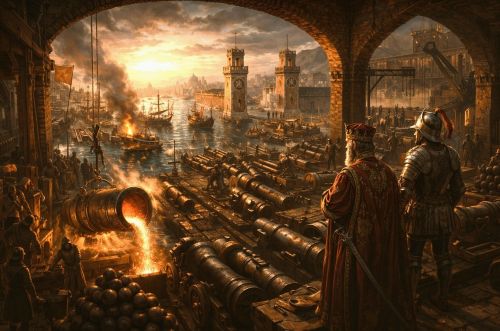
The Venetian Arsenal transformed shipbuilding into a state-controlled military system, centralizing technology and labor to secure maritime dominance.

By Matthew A. McIntosh
Public Historian
Brewminate
Introduction: Industry as Instrument of the State
In the late medieval and early modern Mediterranean, no political entity depended more visibly on naval power than the Venetian Republic. Unlike territorial monarchies whose authority rested upon landed wealth and feudal hierarchy, Venice was a maritime polity whose political identity was inseparable from the sea. Its lagoon setting offered protection, yet it also imposed limitation. The city lacked a substantial agrarian hinterland and depended heavily upon trade networks stretching from the Adriatic to the eastern Mediterranean. Commercial convoys, colonial outposts, and strategic ports formed the arteries of Venetian prosperity. Protecting those arteries required more than occasional fleet mobilization. It demanded sustained naval readiness. In this environment, shipbuilding was not merely an economic activity or a craft tradition. It was the structural foundation of sovereignty. The Venetian Arsenal, expanded and systematized between the fourteenth and sixteenth centuries, emerged as the institutional embodiment of that reality. It functioned not as a private yard serving merchant demand, but as a centralized engine of state strategy designed to secure the republic’s position in a competitive and frequently hostile maritime world.
By the fifteenth century, the Arsenal had evolved into one of the most sophisticated production complexes in Europe. Contemporary observers described its capacity to outfit galleys with remarkable speed, while later historians have emphasized its anticipatory resemblance to industrial organization. Analysis situates the Arsenal within Venice’s broader fiscal-military structure, arguing that naval construction was inseparable from the republic’s commercial and political ambitions. Robert C. Davis further demonstrates that the Arsenal’s organization integrated skilled labor, supply chains, and administrative oversight into a coordinated system designed explicitly for wartime mobilization. What distinguished Venice was not merely technological competence, but institutional centralization.
The Arsenal’s significance lies in its transformation of artisanal expertise into regulated state capacity. Shipwrights, rope makers, sail makers, and metallurgists did not operate as independent contractors responding to fluctuating market demand. They worked within a controlled environment overseen by magistracies and subject to detailed procedural rules. This administrative integration allowed Venice to standardize components, accumulate stockpiles, and maintain readiness in a volatile geopolitical landscape marked by rivalry with Genoa and later confrontation with the Ottoman Empire. As Carlo M. Cipolla has observed in his broader work on early modern economic systems, states capable of organizing production for military ends acquired advantages that extended far beyond the battlefield.
The Venetian Arsenal stands as more than a shipyard. It represents a deliberate fusion of technology, labor, and governance. By centralizing ship construction and safeguarding maritime techniques, the republic effectively converted industrial capacity into strategic capital. The Arsenal functioned as a state-controlled military-industrial complex, one in which technological innovation was monopolized, knowledge was restricted, and artisans were absorbed into a system designed for sustained naval dominance. In Venice, industry became an instrument of the state, and mastery of production became synonymous with political survival.
The Arsenal as a Centralized Production System
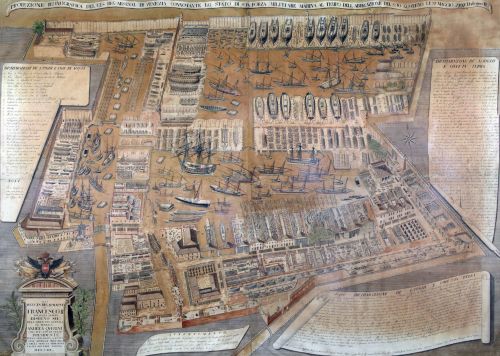
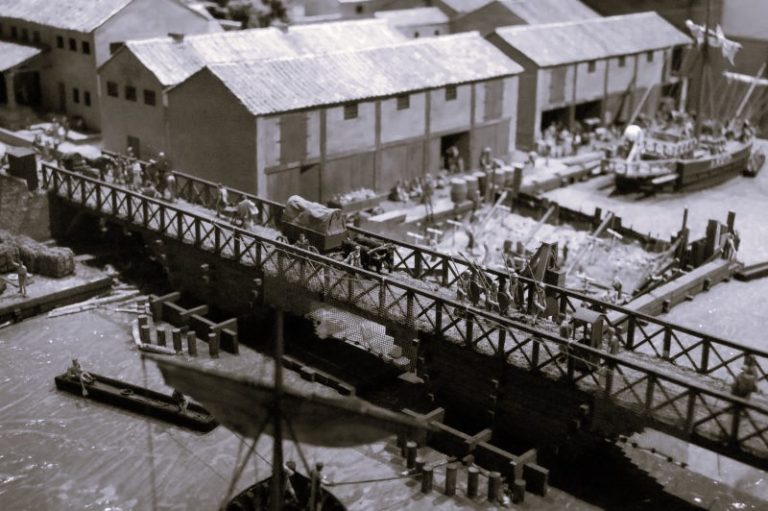
By the fourteenth century, the Venetian Arsenal had developed beyond a conventional shipyard into a tightly organized production complex embedded within the administrative framework of the republic. Its expansion was deliberate and cumulative. Enclosed by fortified walls and guarded gates, the Arsenal formed a semi-autonomous industrial district whose physical separation reinforced its political importance. What distinguished it was not merely its size, but its integration. Timber storage, rope walks, sail lofts, foundries, and assembly docks operated within a single coordinated environment. Production did not rely upon dispersed workshops scattered across the lagoon. It unfolded within a centralized system designed to align material supply, skilled labor, and state oversight.
One of the most remarkable features of the Arsenal was its approach to standardization. Venetian authorities promoted uniformity in hull design, component dimensions, and rigging systems, enabling interchangeable parts and predictable performance. The state’s insistence on regularized galley construction facilitated rapid deployment during wartime. Standardization reduced uncertainty and allowed the republic to maintain fleets that could be outfitted with greater efficiency than those of rival powers dependent on more fragmented production structures. In an era when naval warfare demanded coordination across multiple vessels, uniform construction enhanced tactical coherence.
The organization of labor further reinforced this centralized model. Robert C. Davis has shown that Arsenal workers, known as Arsenalotti, were not casual laborers hired per contract but a semi-permanent workforce integrated into the state apparatus. Specialized teams handled discrete stages of production, from keel laying to final fitting, and each stage was embedded within a clearly defined chain of supervision. Sequential workflow resembled a proto-assembly process, with materials moving systematically through designated zones where carpenters, caulkers, rope makers, and metalworkers contributed specialized skills in coordinated sequence. Although the technology remained preindustrial, the logic of coordination anticipated later industrial practice in its emphasis on routinized tasks and predictable output. The Arsenal’s ability to produce and refit multiple galleys in parallel rested upon disciplined task division, regulated schedules, and administrative monitoring that limited improvisation. Artisans were not merely craftsmen exercising personal discretion. They were components within a managed system, their expertise harnessed to collective production goals defined by the state.
Supply chain management also played a decisive role. The Venetian state secured timber from mainland territories and maritime colonies, ensuring consistent access to critical resources. Control over Dalmatian forests and other sources of oak and pine was not incidental to naval policy but integral to it. Raw materials entered the Arsenal under regulated procedures, where inventory could be monitored and allocated according to strategic need. Carlo M. Cipolla’s broader analysis of early modern economic systems underscores how states capable of organizing procurement alongside production gained structural advantages. Venice exemplified this principle by integrating resource acquisition with centralized manufacturing.
The Arsenal’s capacity for rapid mobilization became legendary. Contemporary accounts describe the ability to assemble or refit galleys with remarkable speed when conflict required expansion of the fleet. This responsiveness was not spontaneous efficiency but the result of accumulated planning, standardized design, and stockpiled components maintained within the Arsenal’s secure perimeter. By keeping partially prepared hulls and essential fittings in reserve, the republic minimized delays between political decision and naval deployment. Administrative records indicate that production could accelerate when magistrates authorized extended work schedules or redirected labor toward urgent priorities. In a Mediterranean environment characterized by sudden shifts in alliance and threat, such responsiveness provided strategic elasticity. Competitors reliant on dispersed craftsmen, each bound to local contracts and guild obligations, could not match this tempo without comparable institutional consolidation. The Arsenal translated organizational foresight into military advantage, compressing the timeline between intent and execution.
In sum, the Venetian Arsenal operated as a centralized production system that subordinated artisanal independence to coordinated state design. Its significance lies less in technological novelty than in institutional architecture. By aligning space, labor, resources, and oversight within a single managed complex, Venice converted shipbuilding from craft tradition into strategic infrastructure. The Arsenal’s model illustrates how centralized production can magnify political power, transforming maritime technology into a disciplined instrument of the republic’s long-term dominance.
Restriction of Technical Knowledge and State Secrecy
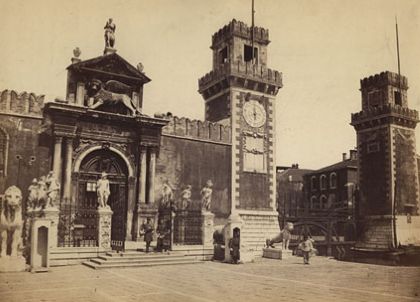
If centralized production gave Venice structural advantage, the restriction of technical knowledge ensured that advantage remained exclusive. The Venetian Republic understood that maritime superiority depended not only on material resources but on controlled expertise cultivated over generations. Ship design, hull proportions, sail configuration, artillery placement, and logistical coordination constituted a body of knowledge whose cumulative refinement translated directly into naval efficiency and battlefield resilience. Such knowledge could not be allowed to circulate freely in a competitive Mediterranean world defined by rivalry with Genoa, confrontation with the Ottoman Empire, and shifting alliances among European powers. In this respect, the Arsenal was not merely an industrial complex but a guarded repository of strategic intelligence. The state’s approach to naval technology reflected a deliberate policy. Innovation must remain within the republic’s institutional boundaries. Technical competence, once centralized, required containment to preserve its value.
Venetian law reinforced this policy through regulation, oversight, and calculated intimidation. The Council of Ten, the republic’s powerful security magistracy, exercised authority over matters deemed vital to state stability, including the protection of technical knowledge related to naval construction. Artisans employed in the Arsenal were subject to restrictions that limited their ability to transmit skills outside the state’s supervision, and foreign craftsmen were carefully monitored to prevent unauthorized observation of shipbuilding methods. Foreign access to production areas was tightly controlled, and the physical enclosure of the Arsenal served both defensive and informational functions. Robert C. Davis notes that the walls protected more than timber and hulls. They shielded processes, measurements, and standardized techniques refined within the complex. Unauthorized disclosure of shipbuilding practices could provoke severe penalties, underscoring the seriousness with which the republic treated technical secrecy. Surveillance, gatekeeping, and legal sanction worked in concert to ensure that maritime knowledge remained a guarded asset rather than a market commodity.
This culture of secrecy extended beyond immediate wartime considerations. Venice competed continuously with Genoa, the Ottoman Empire, and other maritime powers for control of trade routes and naval corridors. Technological diffusion would erode the structural advantage gained through centralization. Venice’s long-term dominance depended in part on its capacity to preserve institutional continuity in ship construction and fleet organization. By limiting the outward flow of technical expertise, the republic transformed maritime knowledge into a strategic monopoly. Secrecy functioned as an economic and military policy simultaneously.
The integration of artisans into this regime further illustrates how expertise was absorbed into state authority. Arsenal workers were not simply prohibited from exporting techniques. Their professional identity was reshaped by their attachment to the republic and by the privileges that accompanied that attachment. Employment within the Arsenal conferred economic stability, exemption from certain civic burdens, and access to state patronage networks, benefits that reinforced loyalty while reducing incentives to defect or disseminate knowledge abroad. Yet these advantages were balanced by expectation. Workers operated within a system that monitored conduct and demanded adherence to regulations protecting technical information. Academic work on Venetian political culture underscores how civic identity intertwined with service and surveillance. The Arsenalotti were not independent innovators negotiating open markets or forming autonomous guild alliances. They were participants in a controlled industrial order, their technical proficiency inseparable from state allegiance and oversight. Knowledge became embedded within institutional discipline, and discipline became the mechanism through which secrecy was sustained.
In this framework, maritime technology ceased to be a transferable craft tradition and became instead a guarded strategic asset. The Venetian Republic did not invent secrecy in military affairs, yet it institutionalized secrecy within an industrial environment to an unusual degree for its time. By centralizing production and restricting dissemination, Venice converted technical expertise into a durable instrument of power. The Arsenal exemplifies a broader historical pattern. Governments seeking military dominance frequently monopolize cutting-edge production systems and treat technological knowledge as property of the state rather than of individual artisans.
Artisans as Instruments of War-Making Capacity

The centralization of production and the restriction of knowledge within the Venetian Arsenal reshaped the social and political position of its workforce. The Arsenalotti were not independent craftsmen operating within the flexible structures of guild negotiation. They formed a semi-corporate labor body integrated into the fiscal and military architecture of the republic. Their skills were indispensable, yet their autonomy was circumscribed. The state did not merely employ artisans. It organized, supervised, and politically incorporated them into a system whose primary objective was sustained naval readiness.
Unlike many urban laborers in Renaissance Europe, Arsenal workers occupied a distinctive status. They received relatively stable wages and enjoyed privileges that reinforced loyalty to the state. These privileges included preferential treatment in certain civic matters and participation in public ceremonies that affirmed their importance to Venetian security. Yet privilege functioned alongside discipline. Work rhythms, assignments, and responsibilities were regulated by magistrates who prioritized efficiency and standardization. The artisan’s craft was preserved, but it was channeled through administrative oversight that aligned production with strategic demand.
The Arsenal’s labor organization illustrates how artisanal expertise could be absorbed into a bureaucratic framework without erasing technical skill. Specialized roles persisted, and mastery of carpentry, rope making, metal forging, and sail construction remained essential. However, these skills were embedded within a coordinated workflow that subordinated individual initiative to collective output. Tasks were sequenced according to production needs rather than personal preference or guild custom. The logic of war-making dictated tempo. During periods of heightened threat, labor intensity increased, and the workforce was expected to respond to the republic’s urgent requirements. Artisans operated within a structure where technical proficiency translated directly into military capacity.
The relationship between labor and loyalty was reinforced through civic ideology. Venice cultivated a political culture that emphasized collective survival and maritime destiny, embedding these themes within ritual, pageantry, and public discourse. As demonstrated by an examination of Venetian social institutions, the republic fostered forms of social integration that bound occupational groups to the state through both material benefits and symbolic recognition. Arsenal workers were not merely wage earners executing assigned tasks. They were portrayed as guardians of the republic’s lifeline, participants in a shared enterprise that defended commerce, territory, and civic honor. Public ceremonies, such as the launching of vessels, reinforced this connection between craft and sovereignty, transforming technical labor into a visible manifestation of collective strength. This ideological framing strengthened the absorption of expertise into war-making capacity by aligning personal identity with state purpose. When labor is embedded within a narrative of communal survival, compliance with regulation becomes not only pragmatic but culturally validated. Technical labor acquired symbolic weight that transcended the workshop.
At the same time, the Arsenal’s structure limited the emergence of independent entrepreneurial innovation within naval production. Because shipbuilding remained under state monopoly, artisans could not easily translate their expertise into private shipyards capable of rivaling the republic’s fleet. Economic mobility was mediated through institutional channels rather than market competition. This arrangement stabilized production and preserved secrecy, but it also ensured that technical advancement unfolded within state-approved parameters. The artisan’s creative potential was real, yet it was directed toward collective objectives defined by magistrates and naval planners.
In this integration of privilege, discipline, ideology, and economic structure, the Venetian Arsenal exemplifies how skilled labor can become an instrument of organized military power. The republic did not suppress craftsmanship. It harnessed it. Artisans retained technical authority within their domains, but that authority operated within a system calibrated for naval dominance. The Arsenalotti were neither independent producers nor mere coerced workers. They were participants in a controlled industrial regime in which expertise was systematically aligned with the strategic ambitions of the state.
Strategic Monopoly and Maritime Dominance
The Venetian Arsenal did not exist in institutional isolation. Its centralized production model underwrote a broader strategy of maritime dominance that shaped the republic’s trajectory from the late Middle Ages into the early modern period. Naval strength enabled Venice to secure trade routes across the Adriatic, protect commercial convoys bound for the eastern Mediterranean, and assert influence over coastal territories that supplied raw materials and staging points. The Arsenal transformed shipbuilding capacity into geopolitical leverage. Maritime power was not episodic. It was sustained through administrative continuity and industrial coordination.
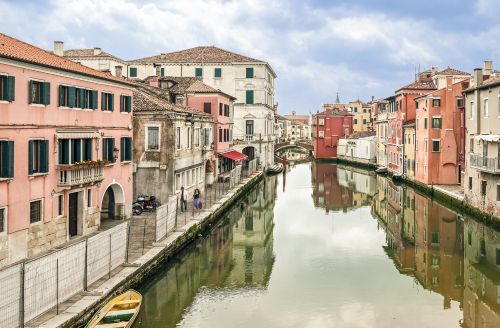
Venice’s long rivalry with Genoa in the fourteenth century illustrates the strategic implications of this centralized system. During the War of Chioggia (1378–1381), the republic confronted existential threat as Genoese forces advanced into the Venetian lagoon, capturing key positions and placing the city under severe strain. In this moment of crisis, the Arsenal’s organizational depth proved decisive. The capacity to mobilize and refit galleys rapidly enabled Venice not only to replace losses but to sustain counteroffensive operations. Scholastic analysis of Renaissance naval warfare underscores the importance of logistical resilience in determining outcomes at sea, particularly in protracted conflicts where endurance mattered as much as tactical brilliance. The Arsenal’s institutional stability allowed Venice to recover from setbacks more efficiently than competitors dependent upon dispersed or privately organized shipyards, where production delays could prove fatal. By concentrating materials, labor, and administrative authority within a single complex, Venice ensured that naval regeneration remained under direct state supervision. Production capacity translated directly into strategic endurance, enabling the republic to withstand siege, reverse disadvantage, and ultimately preserve its independence.
The expansion of Ottoman naval power in the fifteenth and sixteenth centuries further tested Venice’s maritime infrastructure. Conflicts over control of Aegean islands and eastern Mediterranean trade required fleets capable of sustained deployment. Studies of Venetian-Ottoman relations demonstrate that naval preparedness remained central to diplomatic and military calculations. The Arsenal’s ability to maintain and replenish galleys ensured that Venice could project force despite territorial pressures and shifting alliances. Maritime technology, centralized and standardized, functioned as the republic’s primary instrument of resistance against larger imperial systems.
Strategic monopoly also had economic dimensions. Venice’s commercial networks depended upon predictable convoy systems and armed escorts that deterred piracy and hostile interference. Control over ship design and production insulated the republic from reliance on foreign suppliers. This autonomy reinforced fiscal stability by aligning military expenditure with commercial revenue. Broader arguments regarding technological organization in early European expansion highlight how states that coordinated naval capacity with economic ambition gained disproportionate influence. Venice’s monopoly over its own maritime infrastructure enabled it to integrate war-making and commerce within a single administrative vision.
The Arsenal itself became a symbol of this strategic identity. Visitors remarked upon its scale and efficiency, and its existence reinforced Venice’s reputation as a maritime power whose strength derived from institutional discipline rather than sheer territorial size. Industrial centralization projected confidence. The republic’s control over production signaled to allies and adversaries alike that Venice possessed not only fleets but the capacity to regenerate them. Strategic monopoly functioned as both material capability and political messaging.
The very system that secured Venetian dominance revealed structural limits. As Atlantic powers developed new ship types and navigational systems, Mediterranean galley warfare gradually lost its primacy. The Arsenal’s organization, optimized for traditional galley construction, faced challenges adapting to changing technological paradigms. This evolution underscores an important distinction. Centralization magnifies existing advantage, but it can also entrench established models. Venice’s maritime dominance rested on the Arsenal’s capacity to monopolize production. When the broader strategic environment shifted, that monopoly required transformation to remain effective. Even so, for centuries, the Arsenal exemplified how centralized control over advanced production systems could sustain a republic’s geopolitical influence.
The Arsenal as Prototype of the Military-Industrial State
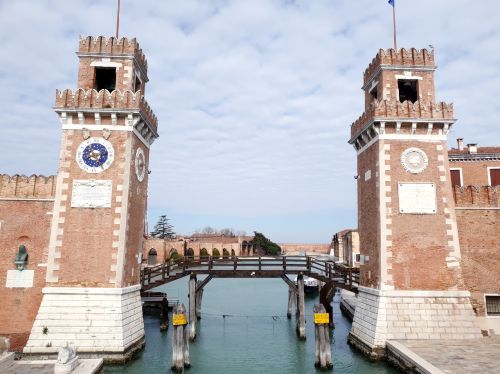
The Venetian Arsenal invites interpretation not merely as a preindustrial curiosity but as an early prototype of the military-industrial state. Long before the emergence of modern bureaucratic nation-states, Venice demonstrated how centralized authority could integrate production, labor, secrecy, and strategic planning within a single institutional framework. The Arsenal was not an auxiliary workshop supporting occasional campaigns. It was embedded within the republic’s governing logic. Its continuous operation reflected an understanding that military readiness required permanent infrastructure rather than temporary mobilization. In this respect, Venice anticipated later political systems that treated armament production as a standing component of state power.
The Arsenal’s structure reveals several features commonly associated with later military-industrial arrangements. First, it institutionalized the relationship between government oversight and technological innovation. Magistrates supervised procurement, labor allocation, and construction schedules, ensuring that production aligned with policy objectives. Second, it fused economic and military priorities. Shipbuilding served commerce and war simultaneously, erasing the boundary between economic infrastructure and defense apparatus. A broader analysis of state power emphasizes the importance of infrastructural capacity in sustaining political authority. Venice’s Arsenal embodied such capacity in concrete form. It provided the material backbone through which the republic projected force and maintained trade networks.
Third, the Arsenal demonstrates how states can internalize specialized knowledge to prevent technological dependency. Rather than outsourcing naval construction to private contractors vulnerable to market fluctuation or foreign influence, Venice maintained direct control over expertise and output. This internalization strengthened autonomy. War-making and state-making were mutually reinforcing processes. The Arsenal’s permanence allowed Venice to adapt to repeated conflicts without reconstructing its industrial base from scratch. Production continuity supported political continuity.
The Arsenal also illustrates the reciprocal influence of military needs on administrative evolution. Sustaining such a complex required record keeping, standardized procedures, and coordinated governance across multiple magistracies. The expansion of industrial capacity encouraged parallel expansion of bureaucratic competence. The Arsenal did not simply serve the state. It shaped the state’s internal architecture. Governance adapted to manage centralized production, embedding military logistics within routine administrative practice. The institutionalization of shipbuilding reinforced the republic’s broader capacity for organized rule.
To describe the Venetian Arsenal as a prototype is not to claim direct lineage to modern military-industrial complexes. The technological context, scale, and economic environment differed significantly. Yet the underlying principle is recognizable. When a government centralizes advanced production, integrates skilled labor into its administrative framework, and safeguards technical knowledge as strategic property, it constructs a durable apparatus for sustained power projection. Venice’s Arsenal stands as one of the clearest early examples of this phenomenon. It reveals that the convergence of industry and war-making, often associated with modernity, has deeper historical roots in the disciplined industrial strategies of preindustrial states.
Conclusion: Industrial Knowledge and the Architecture of Power
The Venetian Arsenal reveals that industrial organization can become a defining element of political architecture. Venice did not treat shipbuilding as a peripheral craft industry operating at the margins of governance. It embedded production within the state itself, aligning labor, technology, and administrative oversight with strategic ambition. Maritime dominance was not sustained by episodic mobilization or charismatic leadership. It rested on permanent infrastructure designed to convert technical knowledge into operational capacity. In this synthesis of industry and authority, the Arsenal became a structural pillar of the republic’s sovereignty.
The republic’s ability to standardize production, restrict dissemination of expertise, and integrate artisans into a disciplined labor regime illustrates how governments can transform technological systems into instruments of power. Industrial knowledge ceased to be the property of individual craftsmen and became an institutional asset guarded by law, regulation, and bureaucratic supervision. By centralizing advanced production within fortified walls, Venice constructed more than ships. It constructed resilience embedded in routine practice. The Arsenal’s organization ensured that maritime capability could be regenerated, expanded, and coordinated under conditions of crisis without reliance on ad hoc arrangements or external suppliers. Standardization minimized delay. Secrecy preserved advantage. Administrative oversight aligned technical innovation with strategic planning. Production and policy operated in tandem, reinforcing one another through predictable procedures and institutional memory. In this system, technological mastery was not episodic ingenuity but structured continuity.
At the same time, the Venetian experience underscores the reciprocal relationship between industrial systems and political form. The Arsenal required surveillance, record keeping, regulatory oversight, and logistical planning. These demands reinforced bureaucratic competence and fostered continuity within the governing elite. War-making did not simply draw upon industrial capacity. It shaped the administrative mechanisms necessary to sustain that capacity. The architecture of power expanded in order to manage the architecture of production. Industry and governance evolved together.
The Venetian Arsenal stands as an early and instructive case of how centralized control over cutting-edge production systems can anchor military dominance. When governments monopolize technology, regulate labor, and protect expertise as strategic capital, they embed industrial knowledge within the structure of sovereignty itself. Venice’s long maritime ascendancy was neither accidental nor purely geographical. It was institutional and procedural. The Arsenal demonstrates that mastery of production can become mastery of power, and that the organization of industry can define the limits and longevity of political authority. Centralization did not eliminate vulnerability, yet it furnished Venice with tools of regeneration and projection that outlasted many rival states. The broader lesson extends beyond the Adriatic. Political communities that consolidate advanced production systems within their governing framework do more than enhance efficiency. They reshape the balance between expertise and authority, transforming technological capacity into a durable architecture of rule.
Bibliography
- Camerin, Federico. “The Venetian Arsenal: Water, Culture and Heritage.” Blue Papers 3:2 (2024), 62-75.
- Cipolla, Carlo M. Guns, Sails and Empires: Technological Innovation and the Early Phases of European Expansion, 1400–1700. New York: Pantheon Books, 1985.
- Davis, Robert C. Shipbuilders of the Venetian Arsenal: Workers and Workplace in the Preindustrial City. Baltimore: Johns Hopkins University Press, 1991.
- —-. “Venetian Shipbuilders and the Fountain of Wine.” Past & Present 156 (1997), 55-86.
- Ferreiro, L. D. “The Aristotelian Heritage in Early Naval Architecture. From the Venice Arsenal to the French Navy, 1500-1700.” THEORIA. An International Journal for Theory, History and Foundations of Science 25:2 (2010), 227-241.
- Hale, John R. War and Society in Renaissance Europe, 1450–1620. Baltimore: Johns Hopkins University Press, 1985.
- Lane, Frederic C. Venice: A Maritime Republic. Baltimore: Johns Hopkins University Press, 1973.
- Mallett, Michael, and J. R. Hale. The Military Organization of a Renaissance State: Venice c. 1400 to 1617. Cambridge: Cambridge University Press, 1984.
- Mann, Michael. The Sources of Social Power, Volume I: A History of Power from the Beginning to A.D. 1760. Cambridge: Cambridge University Press, 1986.
- Pullan, Brian. Rich and Poor in Renaissance Venice: The Social Institutions of a Catholic State, to 1620. Cambridge, MA: Harvard University Press, 1971.
- Romano, Dennis. The Likeness of Venice: A Life of Doge Francesco Foscari, 1373–1457. New Haven: Yale University Press, 2007.
- Setton, Kenneth M. The Papacy and the Levant, 1204–1571. Philadelphia: American Philosophical Society, 1976.
- Tenenti, Alberto. Piracy and the Decline of Venice, 1580–1615. Berkeley: University of California Press, 1961.
- Tilly, Charles. Coercion, Capital, and European States, AD 990–1992. Cambridge, MA: Blackwell, 1990.
Originally published by Brewminate, 03.03.2026, under the terms of a Creative Commons Attribution-NonCommercial-NoDerivatives 4.0 International license.
About the Author