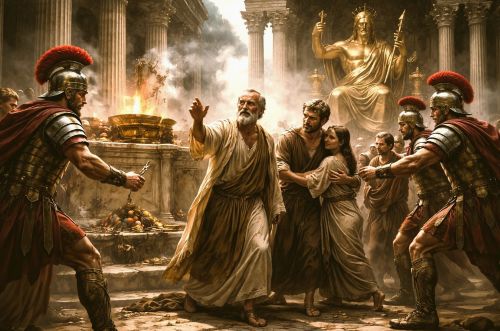
Early Christian martyrs challenged Rome not through rebellion, but through refusal, asserting divine authority over imperial power.

By Matthew A. McIntosh
Public Historian
Brewminate
Introduction: Civic Religion and Imperial Order
In the Roman Empire, religion was inseparable from governance. Ritual observance was not confined to private devotion but functioned as a public act sustaining the political community. Sacrifices, festivals, and vows affirmed the pax deorum, the peace between gods and state, upon which Roman stability was believed to depend. Magistrates presided over rites as part of their civic duties, and the emperor himself stood at the intersection of religious and political authority. Participation in cult was participation in Rome. Refusal was not easily interpreted as spiritual eccentricity. It appeared as withdrawal from the civic body.
The imperial cult intensified this fusion of devotion and loyalty. Honoring the emperor through sacrifice did not necessarily imply metaphysical belief in divinity. It signified recognition of imperial sovereignty and gratitude for order. Emperor worship functioned as a language of power, expressing political hierarchy in sacred form. To sacrifice for the emperor’s genius was to affirm Rome’s structure of rule. Public ritual became a visible performance of allegiance. In such a system, religious pluralism could be tolerated so long as it did not undermine civic obligation.
Early Christians disrupted this equilibrium. Their monotheism rejected the legitimacy of all other cults, including rites associated with the emperor, because acknowledgment of any rival divine power compromised their confession of one sovereign God. The issue was not political insurrection. Christians did not organize militias, advocate sedition, or call for the overthrow of imperial administration. Instead, they refused to perform acts that Roman authorities regarded as minimal and largely symbolic expressions of loyalty. Roman rule depended on consensus enacted through ritual performance and shared public symbolism. Christian abstention threatened that consensus by denying participation in its most visible expressions. The refusal to sacrifice was not a hidden interior conviction. It was a public absence in ceremonies that structured communal belonging. What appeared to Christians as fidelity to divine command appeared to officials as obstinate defiance, and to neighbors as antisocial withdrawal from shared civic life.
This tension reveals the deeper structure of the conflict. Rome conceived of religion as civic duty embedded within public order. Christians treated worship as exclusive allegiance to a transcendent authority. When imperial law required sacrifice, conscience refused. The state interpreted that refusal as destabilizing, because ritual participation functioned as visible confirmation of unity. Persecution emerged not from abstract theological dispute but from incompatible understandings of obligation. Civic religion demanded conformity. Christian conscience asserted a higher jurisdiction.
Religion as Civic Obligation in the Roman World

Roman religion operated as a system of reciprocal obligation between the community and its gods. The pax deorum was not a metaphor but a condition to be actively maintained through correct ritual practice, precision, and continuity. Sacrifice, augury, vows, and festival observance were mechanisms through which the state affirmed its loyalty to divine powers and sought their continued favor. Roman religious practice was less concerned with personal belief than with orthopraxy, the proper performance of rites according to inherited formulas and procedures. Stability depended on accuracy in words spoken, gestures made, and offerings presented. Ritual error could threaten collective well-being and require expiatory correction. Religion functioned as a matter of public security, embedded in the rhythms of governance and understood as indispensable to the endurance of Roman power.
Magistrates embodied this integration of sacred and civic authority. Political office carried priestly responsibilities, and leading senators often held major priesthoods. Roman religious institutions were embedded within the structures of elite competition and governance. Holding priestly office enhanced political prestige, while political power reinforced religious legitimacy. The boundary between temple and senate was porous. Decisions regarding war, treaties, and public works were framed within ritual consultation. Religion did not supplement statecraft. It structured it.
Public sacrifice operated as a visible enactment of communal unity. Participation in shared rites constituted belonging within the civic body. Festivals gathered diverse social strata into coordinated action, reinforcing hierarchy while affirming collective identity. Even conquered populations were often permitted to retain local cults, provided they also acknowledged Roman supremacy through participation in imperial rituals. Tolerance was conditional. It required recognition of Rome’s authority within the sacred sphere.
The imperial cult intensified these dynamics across the provinces. Imperial apotheosis articulated political subordination through religious language that bound center and periphery together. Temples dedicated to the emperor, provincial assemblies honoring imperial benefaction, and sacrifices for the emperor’s well-being formed part of the grammar of loyalty. Such practices did not necessarily imply metaphysical claims about the emperor’s essence. They communicated allegiance and gratitude for order maintained. By honoring the emperor in ritual form, subjects acknowledged his role as guarantor of peace, prosperity, and justice. These ceremonies were often sponsored by local elites eager to demonstrate fidelity and secure favor. Participation functioned as a public declaration of inclusion within the imperial order. Refusal signaled more than private dissent. It disrupted a shared vocabulary of submission and gratitude that sustained Rome’s legitimacy across diverse territories.
Legal enforcement reinforced these expectations. While Rome did not impose uniform religious doctrine across its territories, it did intervene when ritual refusal appeared to threaten public order or undermine imperial authority. Provincial governors bore responsibility for maintaining civic harmony, and nonparticipation in required rites could be interpreted as obstinacy or defiance. The correspondence between Pliny the Younger and Emperor Trajan illustrates how refusal to sacrifice became a practical test of compliance. Individuals accused of being Christians were ordered to offer wine and incense before imperial images. Those who complied were released. Those who persisted were punished. The issue was not interior belief but outward action. Religion functioned as a visible marker of civic reliability, and compliance became proof of loyalty.
Understanding Roman religion as civic obligation clarifies why Christian refusal provoked official reaction. The empire did not conceive of religion as private conscience insulated from political consequence. It regarded ritual participation as visible affirmation of belonging. To abstain was to step outside the communal compact that sustained imperial stability. In such a system, dissent began not with insurrection but with absence. The refusal to sacrifice was a refusal to participate in the performance of order itself.
The Christian Refusal: Theology over Imperial Authority

Early Christian refusal emerged from theological exclusivity rather than political ambition. At the center of Christian confession stood the proclamation that there was one God and one Lord, a claim rooted in Jewish monotheistic tradition and intensified by belief in Christ’s unique sovereignty. This conviction rendered participation in traditional cultic rites impossible. Sacrificing to Jupiter, Mars, or the genius of the emperor was not interpreted as a harmless civic gesture or diplomatic courtesy. It was idolatry, a direct violation of divine command. The first commandment forbade it without qualification, and early Christians understood themselves as bound by that prohibition regardless of social consequence. Christian monotheism was not merely numerical reduction of divine beings. It entailed exclusive allegiance that displaced all rival claims to sacred authority and demanded undivided loyalty of conscience.
This exclusivity distinguished Christian noncompliance from the flexibility that characterized much of Roman religious life. Roman polytheism generally accommodated additional deities, allowing foreign cults to coexist within the imperial framework so long as they did not disrupt public order. Gods could be translated, identified, and assimilated. Ritual practice was adaptable. Christians, however, rejected reciprocal inclusion. They would not add Christ to a pantheon nor render symbolic honor to the emperor’s divine status as one deity among many. Their theology permitted no such compromise. Early Christian identity crystallized around this boundary-making refusal, through practices that marked clear separation from surrounding cultic norms. To abstain from sacrifice was not only a theological act but also a communal one. It signaled a redefinition of belonging, locating primary identity within a translocal body of believers rather than within the civic structures of the empire.
Early Christian writers articulated this refusal in explicitly theological terms. Tertullian argued that Christians prayed for the emperor’s well-being but would not sacrifice to him, distinguishing intercession from worship. The Acts of the Martyrs portray defendants declaring that obedience to God superseded obedience to magistrates. Such texts reveal that Christians did not deny imperial authority in matters of taxation or civil order. They denied its claim upon worship. The line was drawn at ritual participation. Divine sovereignty could not be shared.
This posture did not initially aim at reforming Roman policy. Christians did not petition for religious liberty in modern terms. They accepted the legal consequences of refusal. Martyr narratives frame suffering as testimony rather than protest. The Greek term martys meant witness. Endurance under trial validated faith. Compliance would have secured release, but at the cost of theological integrity. Refusal became an act of fidelity rather than agitation.
Theological reasoning undergirded this defiance. Christian thought distinguished between earthly rule and divine kingship. The Gospels record Jesus’ instruction to render to Caesar what belongs to Caesar and to God what belongs to God. Early interpreters treated this as delimitation rather than fusion. Caesar’s jurisdiction extended to coinage, taxation, and civil administration. It did not extend to worship. When imperial demand crossed into sacred territory, obedience ceased. Conscience functioned as recognition of higher law.
The Christian refusal reconfigured the meaning of loyalty in a way that exposed the fragility of Rome’s religious-political synthesis. Romans interpreted sacrifice as civic affirmation and visible proof of solidarity with imperial order. Christians interpreted the same act as betrayal of divine covenant and rupture of eternal allegiance. The conflict did not arise from competing political programs or revolutionary agendas. It arose from incompatible theologies of authority and obligation. Imperial order rested on visible conformity enacted through ritual. Christian allegiance rested on invisible fidelity to a transcendent Lord whose command superseded imperial decree. When compelled to choose, early Christians chose refusal even when the penalty was imprisonment, torture, or execution. Their defiance was neither armed nor conspiratorial. It was principled noncompliance grounded in theological conviction, demonstrating that civil disobedience can begin not with rebellion, but with a refusal to perform what conscience deems forbidden.
Persecution and Legal Context

Persecution of Christians in the first three centuries of the Roman Empire did not begin as a systematic empire-wide policy. Rather, it emerged within the ordinary mechanisms of Roman provincial governance. Rome possessed no comprehensive statute outlawing Christianity during much of this period. Instead, governors exercised discretionary authority to preserve public order. When Christians were accused of refusing sacrifice or participating in illicit gatherings, officials responded within the framework of maintaining civic stability. Legal action was typically reactive rather than proactive, triggered by denunciation or local disturbance.
The correspondence between Pliny the Younger and Emperor Trajan around 112 CE provides the clearest evidence of this administrative logic. As governor of Bithynia-Pontus, Pliny sought guidance on how to handle individuals accused of being Christians. He reported that he interrogated suspects, asking them directly whether they were Christians, and warned them of the consequences of persistence. Those who denied the charge and proved it by offering wine and incense before imperial images, invoking the gods, and cursing Christ were released. Those who refused were executed, not for doctrinal content but for obstinacy. Trajan’s reply affirmed this procedure, advising that Christians should not be actively sought out or anonymously denounced, but that persistent refusal to sacrifice warranted punishment. The exchange reveals a legal posture grounded in pragmatism rather than ideology. Sacrifice functioned as a practical test of loyalty and submission to Roman authority. The law sought conformity of action. Refusal transformed religious identity into civic disobedience.
Throughout the second century, such enforcement remained localized and episodic. Later Christian memory sometimes magnified the scale of persecution. While martyrdom certainly occurred, it did not represent continuous, centralized repression. Governors responded to disturbances, public accusations, or imperial edicts requiring sacrifice. Christians were vulnerable not because of a standing death sentence, but because their refusal to participate in civic ritual placed them at legal risk when confronted by authorities.
A significant shift occurred under Emperor Decius in 249–251 CE. Decius issued an empire-wide edict requiring inhabitants to perform sacrifice and obtain certificates, known as libelli, verifying compliance. Surviving papyri from Egypt attest to the bureaucratic mechanisms used to record participation, demonstrating the administrative seriousness of the measure. The edict was not directed exclusively at Christians. It sought universal participation as a demonstration of unity during a period of military defeat, plague, and internal instability. However, Christians were disproportionately affected because their theology prohibited compliance under any circumstance. The Decian edict represented an attempt to reinforce civic cohesion through ritual conformity, not a targeted campaign of extermination. For Christians, the universal nature of the requirement transformed sporadic vulnerability into widespread peril. Refusal now carried documentary consequences, embedding theological conviction within an empire-wide system of verification.
The third century witnessed further escalations, including the persecution under Emperor Valerian and, later, the Great Persecution initiated by Diocletian in 303 CE. Valerian’s measures targeted clergy and required public sacrifice, reflecting concern over Christian leadership networks. Under Diocletian and his co-emperors, edicts mandated destruction of churches, confiscation of scriptures, imprisonment of clergy, and compulsory sacrifice. These actions unfolded within the broader context of administrative reform and imperial consolidation. The late third century was marked by external threats and internal fragmentation, prompting rulers to emphasize unity and discipline. Enforcing ritual participation functioned as a visible assertion of restored order. Christians were targeted not for speculative theology but for refusal to comply with publicly mandated rites that symbolized loyalty to the state. The scale of enforcement varied across regions, yet the principle remained consistent. Civic conformity was demanded through ritual action.
Understanding the legal context clarifies the nature of early Christian martyrdom. Roman authorities did not initially conceive of Christianity as a theological rival to be eradicated. They treated it as a problem of civic nonconformity. The law demanded participation in acts that symbolized loyalty. Christians declined. Punishment followed refusal, not belief alone. This distinction underscores the structural character of the conflict. The empire sought visible affirmation of unity. Christian conscience withheld it. Persecution arose from that impasse between ritual obligation and theological prohibition.
Martyrdom as Witness: The Construction of Conscience
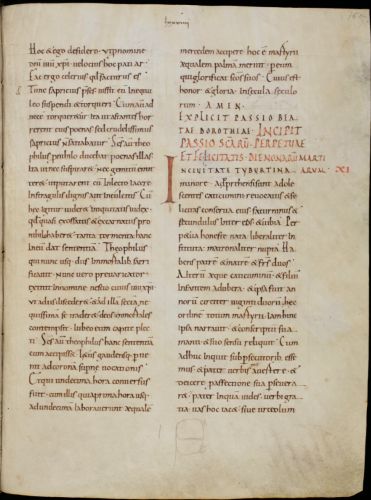
Martys originally meant “witness,” and early Christians appropriated the word to describe those who testified to their faith under threat of death. Martyrdom was not initially conceived as a search for suffering but as steadfast confession when compelled to choose. Legal interrogation became a stage upon which allegiance was declared. By refusing to sacrifice and publicly affirming Christ as Lord, the accused transformed a judicial proceeding into theological testimony. Execution did not negate the witness. It completed it.
Narratives of martyrdom reshaped the meaning of punishment. Roman authorities intended execution to reinforce civic conformity and deter defiance, demonstrating the consequences of obstinacy before imperial law. Christian communities interpreted the same events through an inverted moral lens. Death was not defeat but victory, not disgrace but vindication. The martyr’s suffering was framed as participation in Christ’s own passion, aligning personal endurance with sacred history. Martyr literature constructed scenes of dramatic reversal in which magistrates, soldiers, and crowds became unwitting instruments in a divine narrative. The courtroom was transformed into a theater of spiritual triumph. The condemned appeared before judges as defendants, yet within the textual logic of the narratives, they emerged as witnesses whose steadfastness exposed the moral fragility of imperial coercion. Punishment, meant to silence dissent, instead amplified testimony.
These accounts also constructed models of conscience. The martyr’s refusal was depicted not as impulsive stubbornness but as deliberated fidelity. The Passion of Perpetua and Felicity presents internal reflection, familial tension, and psychological struggle before execution. Perpetua’s refusal to renounce her faith despite paternal pleading illustrates the primacy of divine allegiance over social bonds. The narrative elevates conscience above kinship and citizenship alike. Martyrdom dramatized the hierarchy of obligations in Christian moral thought.
Gendered portrayals reinforced this redefinition of strength. Female martyrs, often depicted as physically vulnerable yet spiritually resolute, inverted conventional Roman ideals of power and honor. Their endurance under interrogation and torture unsettled assumptions about authority and masculinity embedded in Roman culture. The spectacle of the suffering body functioned as a site of contested meaning, where weakness became a sign of divine empowerment. In narratives such as that of Perpetua, visions and prophetic insight further elevated the martyr’s authority, positioning her as interpreter of her own fate. These stories circulated widely, read aloud in communal gatherings and copied for distribution. They provided not merely edifying tales but templates of resistance. The faithful were taught to see in these figures a pattern of conduct, one in which steadfast conscience overruled fear and public shame.
Through repetition and liturgical commemoration, martyrdom became foundational to Christian self-understanding. Annual feast days, readings of martyr acts, and veneration of relics embedded witness into communal memory. Conscience was not abstract theory but embodied example. The martyr stood as proof that loyalty to God could withstand coercion. In constructing narratives of witness, early Christians transformed episodes of legal punishment into enduring symbols of principled refusal. Civil disobedience became sanctified through memory, framed not as rebellion but as faithful endurance before imperial power.
Refusal without Revolution: The Logic of Nonviolent Defiance

Early Christian resistance did not take the form of organized revolt, political conspiracy, or armed uprising. There is no credible evidence of coordinated efforts to overthrow imperial administration, sabotage military infrastructure, or mobilize mass insurrection against Roman rule. Instead, the defining act was refusal. Christians declined to sacrifice, declined to swear by the emperor’s genius, declined to acknowledge divine honors for mortal rulers. Their dissent unfolded within courtrooms, marketplaces, domestic spaces, and ritual settings rather than battlefields. This pattern is historically significant because it distinguishes Christian noncompliance from the various revolts that punctuated Roman history, including Jewish uprisings and provincial rebellions. The absence of organized violence reveals that the conflict centered not on sovereignty in a political sense but on allegiance in a theological one. Christians did not seek to dismantle imperial governance. They refused to sacralize it.
This form of noncompliance rested on a particular logic of authority. Roman governance assumed that ritual participation expressed and reinforced civic unity. Christian theology posited a higher sovereignty that relativized imperial command. When the demands of the state intruded upon worship, obedience ceased. Yet Christians continued to pay taxes, obey civil laws, and pray for rulers. The refusal was targeted and specific. It did not reject government as such. It rejected the sacralization of government. Conscience functioned as a boundary marker separating legitimate political authority from illegitimate claims upon the soul.
Acceptance of punishment reinforced the nonrevolutionary character of this defiance. Martyrs did not attempt escape en masse, form underground militias, or retaliate through violence. They submitted to arrest and, in many accounts, approached interrogation and execution with composure that astonished observers. This posture distinguished Christian noncompliance from insurgency, which typically aims to alter political structures through force. The act of refusal was complete in itself and required no broader program of reform to retain meaning. Its force lay in exposing the limits of coercive power. Roman officials could command public ritual and enforce compliance through threat of death. They could not compel interior assent without destroying the body that bore it. By accepting punishment rather than resisting arrest, martyrs dramatized the boundary between physical authority and moral conviction. Their endurance reframed suffering as testimony, thereby neutralizing the state’s attempt to equate punishment with disgrace.
The logic of refusal without revolution introduced a new configuration of dissent within the imperial world. Loyalty to divine law superseded imperial decree, yet without translating into political insurrection. Civil disobedience, in this early Christian form, began with negation rather than construction. It withdrew participation from practices deemed idolatrous while leaving other civic obligations intact. In doing so, it revealed that authority grounded solely in visible conformity could be challenged by invisible conviction. The refusal to sacrifice became a quiet but enduring critique of imperial claims to sacred legitimacy.
From Persecuted to Imperial: The Paradox after Constantine

The conversion of Emperor Constantine in the early fourth century altered the political landscape that had shaped early Christian martyrdom. With the Edict of Milan in 313 CE, Constantine and Licinius granted legal toleration to Christianity, ending official persecution and restoring confiscated property. What had been a vulnerable minority defined by refusal now operated within the protection of imperial authority. The shift was not merely juridical. It reconfigured the relationship between conscience and power. Christians moved from resisting ritual coercion to negotiating the responsibilities of favor.
Imperial patronage transformed ecclesiastical structures. Constantine endowed churches, sponsored councils, and intervened in theological disputes, most notably at Nicaea in 325 CE. Eusebius of Caesarea celebrated the emperor as God’s chosen instrument, portraying him as a ruler who aligned imperial governance with divine providence. This new synthesis did not dissolve Christian distinctiveness but embedded it within the administrative fabric of the empire. Bishops acquired judicial and fiscal authority, serving as arbiters in civil disputes and beneficiaries of imperial benefaction. Martyr shrines, once local memorials of suffering, became focal points of imperial devotion and pilgrimage. The memory of persecution was preserved, yet it was reframed within a narrative of divine vindication through imperial conversion. The church’s institutional growth was inseparable from imperial resources, and ecclesiastical leadership increasingly navigated questions of policy, orthodoxy, and order in dialogue with the throne.
Yet this integration produced tension. A community formed through refusal now confronted the temptations and responsibilities of enforcement. Once Christianity gained imperial backing, dissenters within the church faced suppression not only from ecclesiastical authorities but from the state itself. The Donatist controversy in North Africa illustrates this paradox with particular clarity. Constantine intervened in disputes over the legitimacy of bishops who had lapsed during persecution, ultimately employing state power to enforce conciliar decisions. This intervention blurred the boundary between theological dispute and political coercion. What had once been a protest against compulsory sacrifice now became, in certain contexts, a willingness to invoke imperial authority in defense of doctrinal unity. The church, long defined by noncompliance, began to participate in structures capable of compelling compliance. Conscience remained focal, but its alignment shifted as ecclesial and imperial interests converged.
Theological interpretation of martyrdom adapted to these new circumstances. Martyrs were commemorated as heroes of an age of trial, even as persecution waned. Augustine later wrestled with the implications of using imperial force to correct heresy, arguing that coercion could serve charitable ends if directed toward unity. This reasoning marked a departure from earlier noncompliance. The memory of refusal persisted, but the church’s political position shifted from marginal dissent to institutional influence.
The transformation also affected imperial ideology. Christian emperors framed their authority as subordinate to divine sovereignty, yet they claimed responsibility for safeguarding true worship. The sacralization of imperial power did not disappear. It was reinterpreted. The emperor no longer demanded sacrifice as divine figure. Instead, he defended a Christian order. Roman political theology adapted rather than collapsed. The fusion of religion and governance endured, albeit under different symbols.
The paradox after Constantine reveals the structural complexity of conscience in power. Early martyrs had defined fidelity through refusal of imperial cult and steadfast endurance of punishment. After legalization, the church confronted the challenge of wielding authority without reproducing the coercive mechanisms it once resisted. The memory of persecution continued to shape Christian identity, but it functioned within a radically altered political environment. Civil disobedience, once expressed through principled noncompliance, gave way to questions of governance, discipline, and doctrinal enforcement. The transition from persecuted minority to imperial partner did not erase the logic of conscience. It relocated it within new arenas of authority, where the tension between faith and force persisted in transformed form.
Conclusion: Civil Disobedience as Theological Refusal
Early Christian martyrdom illuminates a distinctive form of civil disobedience grounded not in political theory but in theological conviction. The martyrs did not draft manifestos, organize resistance movements, or articulate constitutional principles. Their dissent was enacted through refusal. When commanded to perform rituals that violated their understanding of divine law, they declined. This negation carried profound consequences because Roman religion functioned as civic glue. In withholding participation, Christians disrupted the symbolic performance of unity upon which imperial authority depended.
The conflict was structural rather than accidental. Rome required visible affirmation of loyalty through sacrifice and ritual conformity. Christians required exclusive allegiance to a transcendent God. These commitments collided in moments of legal enforcement. Punishment followed not because Christians plotted rebellion, but because they would not comply. The legal system sought conformity of action. Conscience refused. Martyrdom emerged at the point where civic obligation and theological prohibition proved irreconcilable.
This pattern reveals a broader principle about civil disobedience. Resistance need not begin with revolution. It can begin with principled abstention from practices deemed unjust or idolatrous. Early Christians accepted the consequences of refusal, transforming judicial penalty into testimony. Their endurance exposed the limits of coercion. The state could compel outward action or impose death. It could not command inward assent. In that distinction lay the power of witness.
The legacy of early Christian refusal endured long after persecution ceased. Even as Christianity became intertwined with imperial structures, the memory of martyrs preserved an image of conscience standing before power. Civil disobedience, in its earliest Christian form, was neither violent nor programmatic. It was theological. It asserted that divine authority superseded imperial decree and that obedience to God defined the boundaries of civic compliance. In doing so, it introduced into the Roman world a durable concept: that sovereignty encounters limits when confronted by conscience grounded in transcendence.
Bibliography
- Ando, Clifford. Imperial Ideology and Provincial Loyalty in the Roman Empire. Berkeley: University of California Press, 2000.
- Beard, Mary, John North, and Simon Price. Religions of Rome, 2 Vols. Cambridge: Cambridge University Press, 1998.
- Boyarin, Daniel. Dying for God: Martyrdom and the Making of Christianity and Judaism. Stanford: Stanford University Press, 1999.
- Brown, Peter. The Rise of Western Christendom: Triumph and Diversity, AD 200–1000. 2nd ed. Malden, MA: Blackwell, 1996.
- Castelli, Elizabeth A. Martyrdom and Memory: Early Christian Culture Making. New York: Columbia University Press, 2004.
- Drake, H. A. Constantine and the Bishops: The Politics of Intolerance. Baltimore: Johns Hopkins University Press, 2000.
- Eusebius of Caesarea. Life of Constantine. Translated by Averil Cameron and Stuart G. Hall. Oxford: Clarendon Press, 1999.
- Frend, W. H. C. The Donatist Church: A Movement of Protest in Roman North Africa. Oxford: Clarendon Press, 1952.
- —-. Martyrdom and Persecution in the Early Church. Oxford: Basil Blackwell, 1965.
- Gradel, Ittai. Emperor Worship and Roman Religion. Oxford: Clarendon Press, 2002.
- Moss, Candida R. The Myth of Persecution: How Early Christians Invented a Story of Martyrdom. New York: HarperOne, 2013.
- Perpetua and Felicity. The Passion of Perpetua and Felicity.
- Pliny the Younger. Letters, Book 10.
- Potter, David. The Roman Empire at Bay, AD 180–395. London: Routledge, 2004.
- Rives, J. B. “The Decree of Decius and the Religion of Empire.” Journal of Roman Studies 89 (1999): 135–154.
- Rüpke, Jörg. Religion of the Romans. Cambridge: Polity Press, 2004.
- Scheid, John. An Introduction to Roman Religion. Translated by Janet Lloyd. Bloomington: Indiana University Press, 2003.
- Shaw, Brent D. “Body/Power/Identity: Passions of the Martyrs.” Journal of Early Christian Studies 4, no. 3 (1996): 269–312.
- —-. “The Myth of the Neronian Persecution.” Journal of Roman Studies 105 (2015): 73–100.
- Tertullian. Apology.
Originally published by Brewminate, 03.04.2026, under the terms of a Creative Commons Attribution-NonCommercial-NoDerivatives 4.0 International license.
About the Author