Aristocratic leaders shaped the Hundred Years’ War, but its battles, taxation, and devastation fell most heavily on peasants and common soldiers.

By Matthew A. McIntosh
Public Historian
Brewminate
Introduction: War, Aristocracy, and Unequal Burdens
The Hundred Years’ War (1337–1453) stands among the most prolonged and transformative conflicts of medieval Europe, reshaping political authority, military organization, and the social landscape of both England and France. Although often framed as a dynastic struggle between rival monarchies, the conflict was deeply embedded in the political culture of the medieval aristocracy. Kings, princes, and noble magnates pursued campaigns for territorial claims, prestige, and feudal rights, framing warfare as both a legitimate instrument of rule and a test of aristocratic honor. Strategic decisions about when and where to fight were typically made within narrow political circles at royal courts, where dynastic ambition and elite rivalry frequently outweighed considerations of the social costs of prolonged war. As a result, the conflict illustrates a recurring pattern in premodern warfare: the political direction of war remained concentrated among elites, while the practical burdens of fighting and survival were distributed far more widely across society.
The social composition of the armies that fought the war reveals a striking contrast between leadership and participation. Traditional narratives of medieval warfare often emphasize the role of mounted knights and noble commanders, yet by the fourteenth century military organization had already begun to shift toward larger forces of infantry and missile troops. In England especially, the development of the longbow transformed battlefield dynamics, creating armies in which thousands of archers drawn from the countryside served alongside smaller numbers of mounted elites. These men were not aristocrats but yeomen and common soldiers who fought for wages or under feudal obligations, and their battlefield effectiveness played a decisive role in English victories such as Crécy in 1346 and Agincourt in 1415. The success of such forces demonstrated that the conduct of war increasingly depended on the participation and sacrifice of the lower orders, even as aristocratic leadership continued to dominate strategy.
The human consequences of the conflict were felt most intensely far from the battlefield itself, particularly in the countryside of northern and western France. Military campaigns frequently relied on strategies designed to devastate agricultural production and undermine the economic base of enemy regions. Raiding expeditions known as chevauchées destroyed crops, burned villages, and forced rural populations into displacement or starvation. Both English and French governments imposed heavy taxation to finance military operations, placing additional pressure on communities already suffering from violence and economic disruption. The result was a war that transformed large regions of France into zones of chronic insecurity, where peasants and rural laborers endured the direct consequences of strategies devised by distant political elites.
These tensions between aristocratic leadership and popular suffering became increasingly visible as the war progressed. In moments of political crisis, resentment toward noble authority erupted into open rebellion, most dramatically during the Jacquerie uprising of 1358. Although the revolt was ultimately suppressed with brutal violence, its outbreak revealed how deeply the burdens of war had destabilized the social order. The Hundred Years’ War offers more than a story of dynastic rivalry or battlefield innovation. It provides a powerful lens for examining the unequal distribution of sacrifice in medieval warfare, demonstrating how aristocratic ambition could generate conflicts whose most severe consequences were borne by the lower classes who fought in the armies and struggled to survive in the devastated countryside.
Aristocratic Politics and the Origins of the War

The origins of the Hundred Years’ War lay less in popular conflict between England and France than in the complex political culture of the medieval aristocracy. The ruling elites of both kingdoms operated within a system of dynastic legitimacy, feudal obligation, and personal honor that made disputes over succession and territorial authority particularly volatile. Medieval monarchies were not centralized nation-states in the modern sense but networks of feudal relationships linking kings with powerful noble families. Within this structure, aristocratic prestige and territorial control were closely intertwined, and political disputes often escalated into armed confrontation when compromise threatened noble authority or dynastic claims.
A central catalyst for the conflict was the succession crisis that followed the death of King Charles IV of France in 1328. With the extinction of the direct Capetian male line, competing interpretations of succession law emerged among the French nobility. Edward III of England, whose mother Isabella was the sister of the deceased king, asserted a claim to the French throne through maternal descent. His claim was not merely symbolic but rested on a genuine dynastic connection to the Capetian line, and some contemporary observers regarded it as legally plausible under broader medieval inheritance customs. Nevertheless, the French political community interpreted the crisis through the lens of its own aristocratic interests. Leading nobles and royal advisers rallied behind Philip of Valois, a cousin of the deceased king, whose power base and political networks were rooted within France itself. The decision to crown Philip VI reflected more than a legal principle. It was also a strategic effort by the French aristocracy to maintain continuity and avoid the prospect of a powerful foreign monarch ruling France while simultaneously governing England. In retrospect, this moment exposed the tension between dynastic legitimacy and aristocratic political calculation, a tension that would continue to shape relations between the two kingdoms for decades.
The English crown’s acceptance of Philip VI in 1328 did not end tensions between the two kingdoms. England retained substantial territorial holdings in southwestern France, particularly the duchy of Aquitaine, which had long been a source of friction between the two monarchies. As Duke of Aquitaine, Edward III technically held these lands as a vassal of the French king, a relationship that placed a powerful monarch within the hierarchical structure of French feudal authority. Such an arrangement proved unstable, as French kings repeatedly attempted to assert legal and administrative control over the region. Disputes over jurisdiction, taxation, and appeals to French courts intensified the rivalry between the two monarchies, transforming what had once been a manageable feudal relationship into a persistent source of political confrontation.
The escalation toward open war in the late 1330s also reflected the broader ambitions of aristocratic elites on both sides of the Channel. Edward III’s eventual decision to revive his claim to the French throne in 1340 served not only as a dynastic assertion but also as a strategic tool for mobilizing support among the English nobility. The pursuit of war in France promised opportunities that were deeply embedded in aristocratic culture: the acquisition of honor through combat, the possibility of territorial expansion, and the economic rewards associated with ransom, plunder, and patronage. Campaigns across the Channel appealed strongly to noble households seeking prestige and advancement. The English crown used the language of chivalric obligation and feudal loyalty to frame the conflict as a legitimate defense of dynastic rights. On the French side, resistance to Edward’s claim likewise mobilized aristocratic solidarity around the Valois monarchy. Many nobles viewed the English challenge not merely as a dynastic dispute but as a direct threat to the political structure that sustained their own authority and privileges. In this way the emerging war drew momentum from the expectations and ambitions of elite society itself, making compromise increasingly difficult once aristocratic honor and prestige had become tied to military success.
Economic and geopolitical tensions further reinforced the aristocratic momentum toward conflict. Control of trade networks in the Low Countries and the wool trade that linked England to Flemish textile towns created strategic incentives for political alignment and military pressure. Edward III cultivated alliances among Flemish elites who depended heavily on English wool imports, while the French crown sought to counter these alliances through diplomatic and military measures. These entanglements widened the conflict beyond a purely dynastic dispute, drawing additional political actors into a struggle shaped by the interests of merchants, nobles, and regional rulers across northwestern Europe.
By the late 1330s these overlapping disputes had produced a political environment in which war became increasingly likely. The seizure of Aquitaine by Philip VI in 1337 marked a decisive step toward open conflict, prompting Edward III to escalate his challenge to French authority. What followed was not an inevitable clash between emerging national identities but a prolonged confrontation rooted in aristocratic politics, feudal claims, and dynastic ambition. The early stages of the Hundred Years’ War reveal how elite political calculations could transform legal disputes and regional rivalries into a conflict that would ultimately reshape the social and economic lives of millions across medieval Europe.
The Transformation of Medieval Armies

The Hundred Years’ War coincided with significant transformations in the composition and organization of European armies. Earlier medieval warfare had been dominated by aristocratic cavalry, with heavily armored knights serving as the core of military forces. These mounted warriors were supported by small numbers of retainers and infantry, but the social prestige and tactical dominance of the knight shaped both battlefield expectations and aristocratic identity. Warfare was closely associated with the elite class that could afford horses, armor, and the training required for mounted combat. By the fourteenth century, however, changes in military practice and economic organization were beginning to alter this structure.
One of the most important developments was the growing reliance on professional soldiers and wage-based military service. English and French rulers increasingly raised armies through contracts and paid service rather than relying exclusively on feudal levies. These arrangements, often formalized through indentures, enabled commanders to recruit larger and more flexible forces for extended campaigns. Under this system, a noble captain would contract with the crown to provide a specified number of troops, including men-at-arms and archers, who would receive wages for their service. This method allowed governments to mobilize armies more rapidly and to maintain them in the field for longer periods than traditional feudal obligations allowed. Paid soldiers included both members of the lesser gentry and large numbers of common infantrymen who served for wages rather than feudal duty. The shift toward contractual military service reflected broader political changes, including the increasing fiscal capacity of medieval governments and their ability to mobilize resources through taxation. It also marked an important transition toward more organized and administratively managed military forces, foreshadowing the gradual emergence of more permanent standing armies in later centuries.
This transformation also altered the tactical structure of armies in the field. Infantry forces, once considered secondary to mounted knights, began to play a more decisive role in military engagements. Organized formations of foot soldiers, often supported by missile troops, proved capable of resisting and even defeating cavalry under the right conditions. These developments did not eliminate the importance of knights, who remained prominent as commanders and elite combatants. Nevertheless, the growing effectiveness of infantry challenged the long-standing assumption that aristocratic cavalry alone could determine the outcome of battles.
English military practice during the Hundred Years’ War provides one of the clearest examples of these changes. English armies increasingly relied on large numbers of archers equipped with the longbow, a weapon capable of delivering rapid and powerful volleys of arrows. These archers were typically recruited from rural communities and trained through longstanding cultural traditions that emphasized archery practice. When deployed in coordinated formations alongside dismounted men-at-arms, longbowmen created defensive systems capable of disrupting cavalry charges and weakening enemy formations before close combat began. This tactical integration allowed English forces to achieve several notable victories against numerically superior opponents.
The reliance on common soldiers had broader social implications as well. Large numbers of non-aristocratic men now participated directly in major military campaigns, often traveling far from their home regions to fight in prolonged conflicts. Many of these soldiers came from village backgrounds where military service offered a temporary source of income that supplemented agricultural livelihoods. The system of wages and contracts also created new incentives for participation in warfare, encouraging men who lacked noble status to enter military service as a form of employment. While noble commanders continued to dominate strategic decision-making, the day-to-day experience of warfare increasingly involved soldiers drawn from villages, market towns, and urban communities. These men endured the hardships of campaigning, long marches, disease, and the dangers of combat while receiving modest pay and uncertain prospects for reward. Their service was motivated by wages, opportunity, or obligation rather than aristocratic ideals of chivalric glory. The transformation of medieval armies represented not only a tactical shift but also a social one, expanding the role of the lower orders within the machinery of war and reinforcing the growing gap between elite leadership and the broader population that supplied the manpower for sustained conflict.
Despite these changes, the political and cultural authority of the aristocracy remained largely intact. Noble commanders continued to lead armies, negotiate ransoms, and shape military strategy, preserving the traditional association between warfare and elite status. Yet the effectiveness of infantry and missile troops gradually eroded the exclusive dominance of knightly cavalry on the battlefield. The Hundred Years’ War stands as a critical period in the evolution of medieval military systems, illustrating how expanding armies, new tactical methods, and the growing participation of common soldiers reshaped the nature of warfare in late medieval Europe.
The Longbowmen and the Rise of Common Soldiers
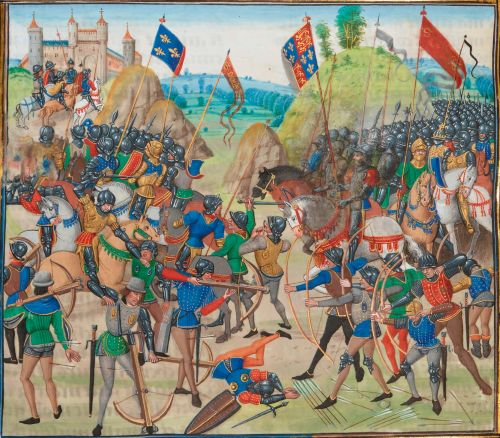
Among the most distinctive features of English military success in the conflict was the central role played by longbowmen. Unlike the mounted knights who traditionally dominated medieval battlefields, longbow archers were overwhelmingly drawn from the lower and middling ranks of society. Many came from rural communities where archery training had long been encouraged through royal statutes and local practice. The English crown had promoted archery for generations, requiring able-bodied men to practice regularly in order to ensure a reservoir of skilled missile troops. By the fourteenth century this policy created a large pool of trained archers who could be mobilized rapidly for military campaigns abroad.
The effectiveness of the longbow dramatically reshaped battlefield dynamics. Capable of delivering arrows with considerable force and at a high rate of fire, longbowmen could disrupt advancing cavalry and inflict significant casualties before enemy forces closed for melee combat. The longbow’s range and penetrative power made it particularly effective against densely packed formations of armored troops, especially when archers were deployed in coordinated lines capable of maintaining sustained volleys. At battles such as Crécy in 1346, Poitiers in 1356, and Agincourt in 1415, English commanders integrated archers into carefully arranged defensive formations, often positioning them behind stakes or natural obstacles that hindered cavalry charges and channeled enemy advances into narrow killing zones. These tactical preparations forced attacking forces to advance under continuous arrow fire while struggling through mud, terrain obstacles, or disrupted formations. The resulting combination of missile fire and defensive positioning proved devastating to attacking armies, particularly the heavily armored knights who formed the elite core of many French forces. These engagements demonstrated that disciplined formations of archers and infantry could defeat aristocratic cavalry under the right tactical conditions, challenging long-standing assumptions about the dominance of mounted knights in medieval warfare.
The prominence of longbowmen also highlighted the growing importance of common soldiers within the structure of medieval warfare. Although noble commanders continued to lead armies and shape overall strategy, the success of English campaigns often depended heavily on the performance of archers whose social standing lay far below that of the knightly elite. These soldiers were typically paid wages and served under contractual arrangements rather than traditional feudal obligations, reflecting the broader shift toward wage-based military service during the fourteenth century. Many archers came from the English yeomanry, a social group that occupied an intermediate position between peasants and the gentry. Their agricultural livelihoods and familiarity with rural life helped sustain the archery traditions that produced skilled bowmen, while wartime service offered an opportunity for wages, plunder, and occasional social mobility. Despite this, the cultural prestige of warfare continued to emphasize knightly combat and aristocratic valor. The achievements of longbowmen existed within a paradox: their military effectiveness was widely recognized by commanders, yet their contributions rarely translated into the social recognition granted to noble warriors.
This development did not eliminate the hierarchical nature of medieval military organization, but it altered the relationship between social status and battlefield effectiveness. Longbowmen rarely received the same recognition or rewards as noble warriors, despite their decisive contributions to military victories. Nevertheless, their prominence revealed a gradual shift in the social foundations of warfare during the late Middle Ages. The success of archers demonstrated that military power could increasingly be derived from trained common soldiers rather than solely from aristocratic cavalry, marking an important stage in the broader transformation of European armies.
Chevauchée Warfare and the Devastation of the Countryside
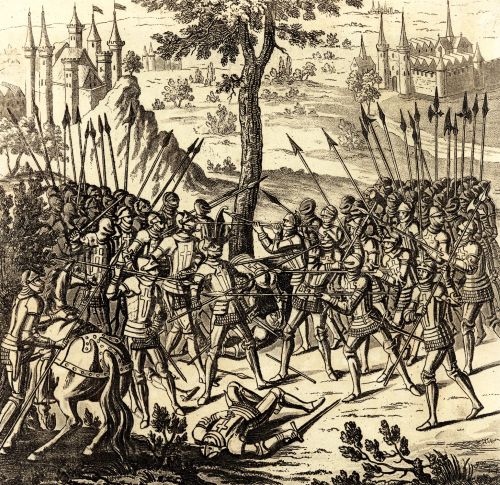
One of the most destructive military strategies employed during the Hundred Years’ War was the chevauchée, a form of mounted raiding designed to devastate enemy territory rather than capture and hold it. English armies, particularly in the early phases of the conflict, relied heavily on these campaigns to weaken French resistance and undermine the authority of the Valois monarchy. A chevauchée typically involved fast-moving forces that swept through rural regions burning villages, destroying crops, seizing livestock, and terrorizing local populations. The objective was both military and psychological. By inflicting widespread destruction, commanders hoped to force the French crown into battle or to erode confidence in its ability to protect its subjects.
These raids were not random acts of violence but carefully planned operations integrated into broader strategic objectives. English kings and their commanders understood that the French monarchy depended heavily on agricultural revenues and the loyalty of regional elites. By targeting the productive countryside, chevauchées disrupted taxation, trade, and local governance. The destruction of mills, barns, vineyards, and grain stores inflicted long-term economic damage that extended far beyond the immediate losses of the campaign itself. The chevauchée functioned as a form of economic warfare designed to weaken the foundations of French political authority.
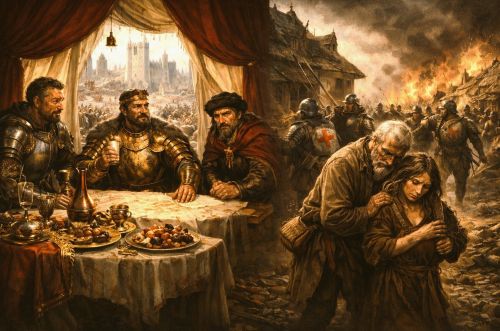
The social consequences of these campaigns fell overwhelmingly on rural communities. Peasants, tenant farmers, and village artisans were the primary victims of the raids, as their homes and livelihoods lay directly in the path of advancing armies. Entire regions experienced repeated cycles of devastation, forcing populations to abandon fields, flee to fortified towns, or live under constant threat of attack. Livestock theft and crop destruction could trigger famine conditions in areas already strained by taxation and the demographic pressures that followed the Black Death. Fields left uncultivated for even a single season could disrupt agricultural cycles for years, especially in regions where labor shortages already affected productivity. Villages that were burned or looted often lacked the resources to rebuild quickly, leaving communities vulnerable to further raids or exploitation by passing military forces. While aristocratic commanders treated such devastation as a strategic necessity within the logic of medieval warfare, for rural inhabitants it meant the collapse of everyday economic stability and the erosion of the fragile systems that sustained local survival.
The cumulative impact of chevauchée warfare transformed large areas of France into zones of chronic insecurity. Agricultural production declined in many regions, and the disruption of rural markets affected broader patterns of trade and taxation. In addition to English raids, French forces sometimes adopted similar tactics in retaliatory campaigns, further intensifying the cycle of destruction. These conditions also encouraged the rise of mercenary companies and bands of displaced soldiers who survived through plunder and extortion, blurring the line between organized warfare and banditry. The countryside became one of the primary arenas in which the social costs of the war were felt.
The strategy of the chevauchée reveals a stark contrast between aristocratic military objectives and the experiences of the broader population. For kings and nobles, such campaigns were instruments of pressure designed to shape political outcomes by undermining enemy resources and provoking decisive engagements. For peasants and rural communities, however, they represented repeated episodes of violence and displacement that could destroy entire local economies and social networks. Families were forced to abandon homes, livestock, and cultivated land, sometimes seeking refuge within fortified towns or migrating to less exposed regions. In many areas the cumulative effects of raids, taxation, and insecurity produced long-term demographic and economic decline. The devastation of the countryside illustrates how the conduct of aristocratic warfare during the Hundred Years’ War imposed severe burdens on those who possessed the least political power to influence the decisions that produced it.
Taxation, Displacement, and the Social Cost of War

Sustaining a prolonged conflict such as the Hundred Years’ War required financial resources on a scale that medieval governments had rarely attempted before. Kings in both England and France needed to pay soldiers, supply armies, maintain fortifications, and support naval operations. These demands pushed royal administrations to expand taxation systems, placing increasing pressure on the populations that ultimately financed the war. While aristocratic leaders directed military strategy and benefited from the political prestige associated with warfare, the fiscal burden of sustaining campaigns fell heavily on towns, rural communities, and the agricultural producers who formed the backbone of medieval economies.
In England, the crown developed increasingly sophisticated mechanisms for raising revenue through parliamentary taxation. Subsidies on movable goods, customs duties on wool exports, and other levies allowed the monarchy to finance campaigns in France and maintain armies abroad. Parliament often granted these taxes reluctantly, and their approval reflected a growing negotiation between the crown and political elites over the costs of war. Although noble landholders participated in these political processes, the practical burden of taxation frequently fell on ordinary households. Rural producers and urban merchants ultimately paid much of the revenue collected through national levies, making the financing of war a shared economic responsibility across English society.
In France, the financial consequences of war were even more severe. Repeated invasions, territorial losses, and internal political instability weakened the ability of the monarchy to collect revenues consistently. To sustain military resistance, the French crown expanded direct taxation, including the taille, which increasingly became a permanent levy on the rural population. The scale and frequency of taxation grew dramatically during the conflict, reflecting the need to support armies and recover from the devastation of repeated campaigns. Unlike earlier feudal levies that were occasionally imposed in times of crisis, these new taxes became increasingly regularized, marking an important shift in the fiscal structure of the French monarchy. Rural households that had previously paid relatively limited royal taxes now faced sustained financial demands that coincided with declining agricultural productivity and population disruption. In regions repeatedly exposed to military raids, peasants found themselves paying taxes to support a war that was simultaneously destroying the economic foundations of their livelihoods. This combination of fiscal pressure and physical devastation placed enormous strain on rural communities, deepening resentment toward both local authorities and the broader structures of aristocratic rule.
Displacement also became a common feature of life in many war-affected regions. As armies advanced across the countryside, villagers often abandoned their homes to avoid violence, plunder, or forced requisitioning of food and livestock. Some sought refuge in fortified towns, castles, or walled cities where defensive structures offered a measure of protection. Others migrated to regions less directly affected by military campaigns, contributing to shifts in local population patterns. Such movements disrupted agricultural cycles, leaving fields uncultivated and reducing the overall productivity of rural economies already strained by war.
The cumulative effects of taxation and displacement created profound social tensions within both kingdoms. Rural communities faced the dual pressures of providing revenue to the crown while also coping with the immediate dangers of military activity. In many regions, villagers were required to supply food, transportation, and labor for passing armies in addition to paying formal taxes. These demands could exhaust local resources, forcing households to sell livestock, abandon land, or incur debts that undermined long-term economic stability. In areas that experienced repeated campaigns or raids, the combination of taxation and requisitioning could push communities toward economic collapse. Households that had lost crops, animals, or family members to warfare often struggled to meet tax obligations imposed by royal officials who themselves faced pressure to maintain wartime revenues. This imbalance between fiscal demands and local capacity intensified feelings of injustice among rural populations and contributed to a growing sense that the burdens of war were distributed unfairly across society.
The experience of these communities highlights the broader social cost of the Hundred Years’ War. While kings and nobles debated strategy and territorial claims, the practical consequences of their decisions reverberated through the daily lives of ordinary people. Taxation, displacement, and economic insecurity became enduring features of life for many rural populations during the conflict. The war illustrates how prolonged aristocratic rivalry could impose extensive material and social burdens on populations that possessed little influence over the political decisions that initiated and sustained the fighting.
The Jacquerie and Popular Revolt
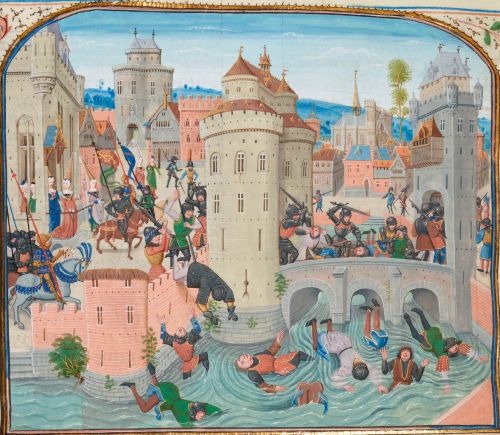
The social tensions produced by prolonged warfare, taxation, and rural devastation eventually erupted into open rebellion during the Jacquerie uprising of 1358. This revolt, which spread rapidly across parts of northern France, represented one of the most dramatic expressions of peasant anger during the Hundred Years’ War. The term “Jacquerie” derived from the nickname “Jacques Bonhomme,” a label used by the nobility to refer disparagingly to peasants. Although the uprising was relatively brief, its intensity reflected deep frustration among peasant communities who had endured years of military destruction, economic hardship, and political instability.
The immediate context for the revolt was the crisis that followed the French defeat at the Battle of Poitiers in 1356, where King John II of France was captured by English forces. The king’s imprisonment created a severe political vacuum within the kingdom, weakening central authority and leaving regional elites struggling to maintain order. With the monarch absent and the legitimacy of royal leadership temporarily compromised, political authority in many areas became fragmented and uncertain. Local nobles attempted to organize defense against further English incursions, but these efforts often required additional labor, taxation, and requisitions from the very rural populations already suffering from the effects of war. The broader political crisis in France included conflicts within the ruling elite itself, particularly tensions surrounding the regency government led by the dauphin, the future Charles V. Urban unrest in Paris and disputes among nobles over authority further contributed to a sense of instability that spread into the countryside. Rural communities experienced the state not as a source of protection but as a system demanding ever greater sacrifices during a moment of extreme insecurity.
Under these conditions resentment toward the aristocracy intensified. Peasants increasingly viewed the nobility as both unable and unwilling to provide protection from the violence of war. Instead, many rural communities experienced nobles primarily as sources of additional demands for labor, taxes, and supplies. The perception that aristocratic leadership had failed in its traditional responsibilities helped fuel the anger that erupted in 1358. When rebellion began in the region north of Paris, groups of peasants attacked manor houses and fortifications, targeting symbols of noble authority and, in some cases, killing members of the local aristocracy.
The uprising spread quickly across several regions, drawing in thousands of participants from villages and rural districts. Although the rebels lacked centralized leadership and formal military organization, their actions reflected a shared hostility toward aristocratic power. Participants were often motivated by immediate grievances connected to local conditions, including the destruction of crops, the burden of taxation, and the failure of local lords to provide security. Contemporary chroniclers, many of whom wrote from elite perspectives, described the rebels in highly hostile terms, portraying them as violent mobs intent on destroying noble society. Writers such as Jean Froissart emphasized scenes of brutality and chaos, reinforcing aristocratic fears of social disorder and portraying the uprising as a threat to the natural hierarchy of medieval society. Modern historians, however, have interpreted these accounts more cautiously, recognizing that chroniclers often exaggerated the violence of the rebels in order to justify the harsh repression that followed. Even allowing for exaggeration, the spread of the uprising indicates that grievances among rural populations were widespread and deeply felt.
The response from the nobility was swift and ruthless. Aristocratic forces rapidly organized to suppress the rebellion, and the revolt was crushed within a matter of weeks. Noble armies carried out widespread reprisals against suspected participants, executing large numbers of peasants and destroying villages associated with the uprising. The suppression of the Jacquerie restored aristocratic control but also reinforced the social hierarchies that had contributed to the revolt in the first place. Despite the rebels’ grievances, the existing structures of power remained firmly intact.
The Jacquerie did not fundamentally alter the course of the Hundred Years’ War, yet it revealed the profound social strain the conflict had imposed on rural society. Years of warfare, taxation, and insecurity had weakened the traditional bonds between peasants and the aristocracy that governed them. The revolt exposed a widening gap between the political ambitions of the ruling elite and the lived realities of the rural population that bore many of the war’s costs. Although the rebellion was suppressed quickly, it demonstrated that prolonged conflict could erode the legitimacy of aristocratic authority when elites failed to provide security or relief from economic hardship. The Jacquerie stands as a significant episode in the social history of the Hundred Years’ War, illustrating how the cumulative pressures of war could provoke collective resistance among those whose voices were otherwise largely absent from medieval political life.
Aristocratic Warfare and the Limits of Feudal Society

The prolonged conflict between England and France during the Hundred Years’ War exposed structural tensions within the social and political framework of medieval feudal society. Feudal systems had traditionally linked military service to aristocratic landholding, with nobles expected to provide mounted warriors in exchange for land and privilege. This arrangement functioned effectively when wars were relatively brief and geographically limited. The scale and duration of the Hundred Years’ War, however, placed far greater demands on these institutions. Sustained campaigning required larger armies, longer periods of service, and more reliable financial resources than traditional feudal obligations could easily provide.
As the war continued through successive generations, monarchies increasingly relied on administrative and fiscal innovations that extended beyond traditional feudal structures. Governments developed new systems of taxation, military contracting, and administrative oversight in order to support prolonged campaigns. These changes gradually strengthened the role of royal authority while reducing the purely feudal character of military organization. Noble leaders remained central figures in warfare, but they operated within increasingly bureaucratic systems that coordinated recruitment, supply, and payment for large armies. Royal officials began to maintain more detailed records of military obligations, payments, and logistical arrangements, reflecting the growing complexity of wartime administration. In England, for example, the use of indenture contracts allowed the crown to organize military forces through agreements with noble captains who pledged to provide specified numbers of troops. In France, the monarchy likewise experimented with new fiscal and administrative mechanisms designed to maintain armies and defend territory. These developments did not eliminate aristocratic influence, but they signaled a gradual shift toward more centralized forms of military organization that increasingly relied on administrative capacity rather than purely feudal obligation.
Despite these institutional changes, aristocratic values continued to shape the culture and expectations of warfare. Noble identity remained closely tied to ideals of chivalry, martial honor, and personal reputation. Knights and noble commanders sought prestige through military success, tournaments, and the capture of high-ranking opponents whose ransoms could bring both wealth and status. This cultural framework sometimes influenced strategic decision-making, encouraging bold offensives or risky engagements that reflected aristocratic notions of honor rather than purely pragmatic military calculations.
The growing role of infantry, archers, and mercenary companies revealed the practical limitations of a system that had once privileged aristocratic cavalry above all other forms of military power. Battles such as Crécy, Poitiers, and Agincourt demonstrated that disciplined formations of common soldiers could decisively defeat armies dominated by noble knights. These outcomes did not eliminate the aristocracy’s political influence, but they challenged the assumption that social rank naturally corresponded to military superiority. The battlefield increasingly rewarded coordination, tactical discipline, and effective leadership rather than the individual prowess traditionally associated with knightly combat.
The economic strain of prolonged warfare also exposed weaknesses in the feudal order. Noble households depended heavily on revenues from land, yet war frequently disrupted agricultural production and trade networks that sustained these incomes. Raids, destruction of crops, and the displacement of rural populations reduced the productivity of many estates, undermining the financial stability of aristocratic households. Monarchies demanded increasing financial contributions from the nobility to support campaigns, requiring loans, taxes, or direct military expenditures that strained noble resources. While some nobles benefited from warfare through ransoms, plunder, and royal patronage, these opportunities were unevenly distributed and often unpredictable. Others faced mounting financial pressures as the conflict continued, particularly those whose lands lay in contested regions subject to repeated military devastation. These economic challenges contributed to shifting alliances, political tensions, and occasional instability within the aristocratic order itself.
These developments illustrate how the Hundred Years’ War pushed feudal institutions to their limits. The traditional structures that had once organized medieval warfare proved increasingly inadequate for managing a prolonged, large-scale conflict. While aristocratic elites retained political authority, the practical realities of warfare required broader participation from common soldiers, more complex systems of administration, and expanded fiscal capacity from the state. The war stands as a turning point in the evolution of medieval society, revealing the strains placed on feudal systems when confronted with the demands of sustained military conflict.
Conclusion: Elite Strategy and the Human Cost of Medieval War
The Hundred Years’ War reveals the profound imbalance between those who directed medieval warfare and those who endured its consequences. Aristocratic elites shaped the conflict through dynastic claims, political rivalries, and strategic calculations that extended across generations. Kings and noble commanders determined when campaigns would begin, where armies would march, and how resources would be mobilized. Yet the implementation of these decisions relied heavily on common soldiers recruited from rural communities and on civilian populations whose labor and taxation sustained the war effort. The distance between elite political authority and the lived experience of warfare created a persistent tension within medieval society.
Military developments during the conflict further emphasized this divide. The growing importance of infantry forces and longbowmen demonstrated that battlefield success increasingly depended on the participation of soldiers drawn from outside the traditional aristocratic warrior class. While noble commanders still dominated military leadership and reaped the symbolic rewards of victory, the practical execution of warfare relied on the discipline and endurance of common troops. Strategies such as chevauchée raids deliberately targeted rural economies, ensuring that the violence of war extended far beyond the battlefield into the everyday lives of peasants and agricultural communities.
The social and economic pressures created by these conditions occasionally erupted into open resistance, as seen in the Jacquerie uprising of 1358. Although the revolt was quickly suppressed, its existence revealed the depth of frustration among populations who bore the costs of warfare without sharing in the political power that shaped it. Taxation, displacement, and repeated devastation of the countryside weakened traditional bonds between peasants and the aristocratic order that governed them. The Hundred Years’ War revealed deep strains within feudal society, illustrating how prolonged conflict could strain the legitimacy of elite authority.
Viewed in this broader perspective, the conflict was not simply a dynastic struggle between rival monarchies but a transformative episode in the social history of medieval Europe. The war reshaped military institutions, expanded the role of common soldiers, and intensified the economic burdens placed on rural populations. It demonstrated the limits of a political system in which strategic decisions remained concentrated among aristocratic elites. The human cost of the Hundred Years’ War lay not only in its battles and political outcomes but also in the enduring impact it had on the lives of the countless individuals whose labor, service, and suffering sustained the conflict.
Bibliography
- Allmand, Christopher. The Hundred Years War: England and France at War, c.1300–c.1450. Cambridge: Cambridge University Press, 1988.
- Ayton, Andrew, and J. L. Price, eds. The Medieval Military Revolution: State, Society and Military Change in Medieval and Early Modern Europe. London: I.B. Tauris, 1995.
- Contamine, Philippe. War in the Middle Ages. Oxford: Blackwell, 1980.
- Cox, Rory. “Asymmetric Warfare and Military Conduct in the Middle Ages.” Journal of Medieval History 38:1 (2012), 100-125.
- Curry, Anne. The Hundred Years War. 2nd ed. London: Palgrave Macmillan, 2002.
- DeVries, Kelly. Infantry Warfare in the Early Fourteenth Century: Discipline, Tactics, and Technology. Woodbridge: Boydell Press, 1996.
- Hilton, Rodney. Bond Men Made Free: Medieval Peasant Movements and the English Rising of 1381. London: Routledge, 1973.
- Loewen, Arley. “The Glass of Life: Medieval and Modern Stories on the Struggle to Gain and Maintain Honour.” British Journal of Middle Eastern Studies 40:1 (2013), 71-94.
- Ormrod, W. Mark. Edward III. New Haven: Yale University Press, 2005.
- Prestwich, Michael. Armies and Warfare in the Middle Ages: The English Experience. New Haven: Yale University Press, 1996.
- Rogers, Clifford J. The Military Revolution Debate: Readings on the Military Transformation of Early Modern Europe. Boulder: Westview Press, 1995.
- —-, ed. The Oxford Encyclopedia of Medieval Warfare and Military Technology. Oxford: Oxford University Press, 2010.
- —-. War Cruel and Sharp: English Strategy under Edward III, 1327–1360. Woodbridge: Boydell Press, 2000.
- Strickland, Matthew, and Robert Hardy. The Great Warbow: From Hastings to the Mary Rose. Stroud: Sutton Publishing, 2005.
- Sumption, Jonathan. The Hundred Years War, Volume I: Trial by Battle. Philadelphia: University of Pennsylvania Press, 1990.
- Tuchman, Barbara W. A Distant Mirror: The Calamitous Fourteenth Century. New York: Alfred A. Knopf, 1978.
- Vale, Malcolm. The Origins of the Hundred Years War: The Angevin Legacy 1250-1340. Oxford: Oxford University Press, 1996.
Originally published by Brewminate, 03.17.2026, under the terms of a Creative Commons Attribution-NonCommercial-NoDerivatives 4.0 International license.
About the Author