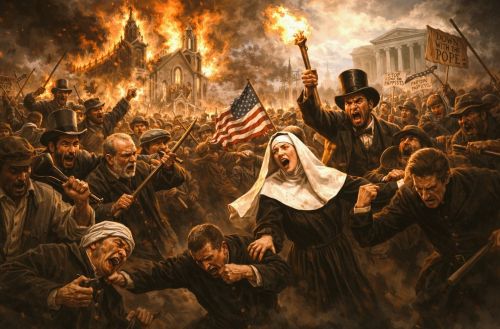
Anti-Catholic hostility in nineteenth-century America fused immigration fears, Protestant nationalism, and political anxiety, fueling riots and the rise of the Know-Nothing movement.

By Matthew A. McIntosh
Public Historian
Brewminate
Introduction: Religion, Immigration, and National Anxiety in the Early Republic
During the nineteenth century, the United States experienced rapid demographic change as large numbers of Irish and German immigrants, many of them Catholic, arrived from Europe. Their presence challenged a society shaped by Protestant institutions and raised fears that religious difference could threaten national identity and political stability. As Catholic communities expanded, immigration became increasingly tied to anxieties about loyalty, culture, and the future of the American republic.
Such anxieties intensified as immigration accelerated in the 1830s and especially during the 1840s. The Irish potato famine triggered a massive migration that brought hundreds of thousands of impoverished Irish Catholics to American ports, particularly in northeastern cities such as New York, Boston, and Philadelphia. German immigrants, including both Catholics and Protestants, arrived in large numbers seeking economic opportunity and political freedom following upheavals in Europe. The scale of this migration produced visible changes in urban neighborhoods, labor markets, and religious institutions. Catholic churches, schools, and charitable organizations multiplied rapidly to serve growing immigrant populations. To many native-born Protestants, however, the rapid expansion of Catholic institutions signaled a transformation of American society that raised questions about the future character of the nation.
Underlying these concerns was a set of political and religious assumptions about the relationship between Catholicism and republican government. Many nineteenth-century Protestants believed that Catholicism encouraged obedience to hierarchical authority rather than independent civic participation. Because the Catholic Church recognized the spiritual authority of the Pope in Rome, critics argued that Catholic citizens might prioritize loyalty to a foreign religious leader over loyalty to the United States. Anti-Catholic writers frequently portrayed the papacy as a political institution that sought influence beyond Europe and into the affairs of republican societies. Pamphlets, sermons, and popular literature warned Catholic immigrants could become instruments of papal power, undermining American political independence from within. These fears drew upon older Protestant traditions that long associated Catholicism with monarchy, authoritarian governance, and resistance to political reform. Immigrants were often depicted not merely as newcomers but as representatives of a religious system believed to be fundamentally incompatible with democratic governance. Such assumptions transformed theological disagreement into political suspicion and allowed nativist activists to frame immigration itself as a matter of national security.
This climate of suspicion shaped political movements, public debates, and episodes of violence throughout the antebellum period. Nativist activists increasingly portrayed Catholic immigration as a threat to the security and stability of the American republic. Anti-Catholic rhetoric circulated widely in sermons, pamphlets, newspapers, and political campaigns, creating a narrative in which religious difference became intertwined with fears about national survival. These developments reveal how immigration, religion, and political anxiety converged in nineteenth-century America. The experience of these communities demonstrates how rapidly changing demographics could transform religious prejudice into a broader language of nationalism and security that framed minority communities as potential dangers to the nation.
Immigration and Transformation: Irish and German Catholics in the United States

The demographic transformation of the United States during the nineteenth century was tied to unprecedented waves of immigration from Europe. Between the 1830s and the Civil War, millions of immigrants arrived on American shores, dramatically altering the social and cultural landscape of the country. Among the most prominent of these newcomers were Irish and German migrants, many of whom were Catholic. Their arrival increased the size and visibility of Catholic communities in a society that had long been shaped by Protestant traditions. As these populations settled in American cities and rural regions, they introduced new institutions, languages, and cultural practices that reshaped the religious diversity of the United States.
Irish immigration expanded rapidly during the 1840s as the potato famine devastated Ireland. The famine forced large numbers of impoverished Irish families to leave their homeland in search of survival and opportunity. Many of these migrants arrived in northeastern cities such as Boston, New York, and Philadelphia, where they often settled in densely populated working-class neighborhoods. Irish immigrants typically faced harsh economic conditions upon arrival, working in low-wage occupations such as construction, dock labor, and domestic service. Irish communities became deeply embedded in the labor economy, supplying workers for expanding infrastructure projects, transportation networks, and domestic employment within growing cities. Despite these hardships, Irish immigrants created tightly knit communities that provided mutual support and collective resilience. Catholic parishes, neighborhood associations, and extended family networks helped newcomers navigate the unfamiliar social and economic environment of American cities. These communities not only preserved religious traditions but also served as centers of political organization and social mobility in later decades.
German immigration followed a somewhat different pattern, though it also contributed significantly to the growth of Catholic populations in the United States. German migrants arrived for a variety of reasons, including economic hardship, political unrest, and the aftermath of the failed revolutions of 1848. Unlike many Irish immigrants, German migrants often included skilled artisans, farmers, and members of the middle class. Some settled in cities, while others moved westward into rural regions of the Midwest, establishing farming communities in states such as Ohio, Wisconsin, and Missouri. German immigrants included both Catholics and Protestants, but Catholic German communities played a major role in expanding the institutional presence of the Catholic Church in the United States.
The rapid growth of Catholic populations required extensive religious infrastructure. Catholic leaders worked to build churches, schools, hospitals, and charitable organizations capable of serving the needs of immigrant communities. Parish life became a central force within immigrant neighborhoods, offering not only religious services but also social support, education, and mutual aid. Catholic schools were particularly important because they allowed immigrant families to educate their children within an environment that preserved religious identity while preparing them for participation in American society. These institutions also served as cultural anchors that maintained linguistic traditions, particularly within German communities where parish schools often taught both English and German. Through these networks of churches, schools, and charitable institutions, Catholic communities constructed a parallel social infrastructure that allowed immigrants to adapt to American life while maintaining a strong sense of religious identity and communal solidarity.
The visibility of Catholic institutions intensified anxieties among many Protestant Americans. The rapid construction of churches and schools, along with the growing number of Catholic clergy and religious orders, appeared to some observers as evidence that Catholicism was expanding its influence within the United States. Critics argued that Catholic institutions operated under hierarchical authority that differed fundamentally from the more decentralized religious traditions common among American Protestants. These concerns were often framed within a broader narrative that depicted Catholic immigration as part of a larger cultural transformation that threatened the nation’s Protestant character.
The arrival of Irish and German Catholics transformed American society beyond simple demographic growth. Immigration reshaped urban communities, expanded religious diversity, and introduced new forms of social organization built around parish institutions. Catholic communities developed educational systems, charitable networks, and cultural organizations that allowed immigrants to maintain religious identity while gradually integrating into American public life. The visibility and institutional strength of these communities intensified debates about the meaning of American identity in a rapidly changing society. Protestant observers who had long assumed that the United States was fundamentally Protestant now confronted a reality in which religious diversity was becoming an enduring feature of national life. These tensions between demographic change and cultural expectation laid the groundwork for the rise of organized nativist movements that portrayed Catholic immigration as a political and cultural threat.
Protestant America and the Culture of Anti-Catholicism
Anti-Catholic sentiment in the United States did not originate in the nineteenth century, but the arrival of large Catholic immigrant populations intensified longstanding Protestant suspicions. From the colonial era onward, Anglo-American political culture had inherited a deep tradition of anti-Catholic rhetoric from Britain. English Protestant identity had historically been defined in opposition to Catholic Europe, particularly during periods of conflict with Spain and France. These older fears traveled across the Atlantic with English settlers and became embedded in American cultural memory. Even after independence, Protestant Americans often associated Catholicism with monarchy, authoritarianism, and political corruption, creating a cultural framework that predisposed many citizens to distrust Catholic immigrants.
During the early republic and antebellum period, these inherited suspicions took on new political significance as immigration increased. Protestant leaders frequently warned that Catholicism was incompatible with republican government because it emphasized obedience to ecclesiastical authority rather than individual conscience. Ministers, editors, and political activists argued that the Catholic Church functioned as a centralized institution capable of mobilizing believers under hierarchical direction. Within this narrative the Pope in Rome was depicted as a foreign ruler whose authority might influence the political behavior of American Catholics. Critics claimed that immigrants might vote or act politically according to directives from clergy rather than personal judgment, undermining the independence expected of republican citizens. Such arguments framed these groups not simply as religious outsiders but as participants in a transnational religious system believed to threaten the independence of American political institutions. In political speeches and popular publications, Catholicism was portrayed not only as a theological rival to Protestantism but also as a political system suspected of encouraging obedience to authority rather than democratic participation.
Popular culture played a powerful role in spreading anti-Catholic ideas among the broader public. Sensational literature, pamphlets, and public lectures portrayed Catholic institutions as secretive and oppressive. One of the most influential examples was Maria Monk’s widely circulated Awful Disclosures of the Hotel Dieu Nunnery, published in 1836, which falsely claimed to reveal immoral practices within Catholic convents. Although the book was later discredited, it sold widely and reinforced public suspicion of Catholic clergy and religious communities. Such publications presented Catholicism as both morally corrupt and politically dangerous, encouraging readers to believe that Catholic institutions operated in secrecy and sought to undermine American values.
Anti-Catholic fears were also reinforced through conflicts over public education. In many American cities, public schools incorporated Protestant practices such as Bible readings and religious instruction drawn from Protestant interpretations of Christianity. Catholic leaders objected to these practices, arguing that Catholic children should not be required to participate in religious instruction that contradicted their faith. When Catholic communities requested public support for their own schools or exemptions from Protestant instruction, critics interpreted these demands as evidence that Catholics rejected American civic norms. Disputes over education became symbolic battles over cultural authority, national identity, and the role of religion in public life. Protestant reformers often insisted that the public school system served as a crucial institution for shaping American citizenship, and they feared that separate Catholic schools would prevent immigrant children from assimilating into the dominant culture. These debates frequently portrayed Catholic resistance to Protestant religious instruction as proof that Catholics were unwilling to adopt American civic values, reinforcing the broader narrative that Catholicism posed a challenge to national unity.
The culture of anti-Catholicism did not remain confined to rhetoric and debate. Periods of intense tension occasionally erupted into violence directed at Catholic institutions and immigrant communities. In 1834 a Protestant mob burned the Ursuline convent in Charlestown, Massachusetts, amid rumors about the activities of Catholic religious orders. A decade later the Philadelphia Bible Riots of 1844 resulted in the destruction of Catholic churches and dozens of deaths after disputes over the use of the Bible in public schools. These incidents demonstrated how religious suspicion could escalate into collective violence when fears about cultural change and national identity became politically mobilized.
Together these developments created an environment in which immigrant Catholics were frequently portrayed as outsiders whose loyalty to the United States was uncertain. Anti-Catholic rhetoric framed religious difference as a political danger, suggesting that Catholicism threatened both republican governance and Protestant cultural dominance. As immigration continued and Catholic communities grew more visible, these fears increasingly found expression in organized political movements that sought to restrict immigration and limit the influence of Catholics in American public life. The culture of anti-Catholicism provided the ideological foundation for the emergence of nativist politics in the mid-nineteenth century.
Violence and Conflict: Anti-Catholic Riots in the 1830s and 1840s
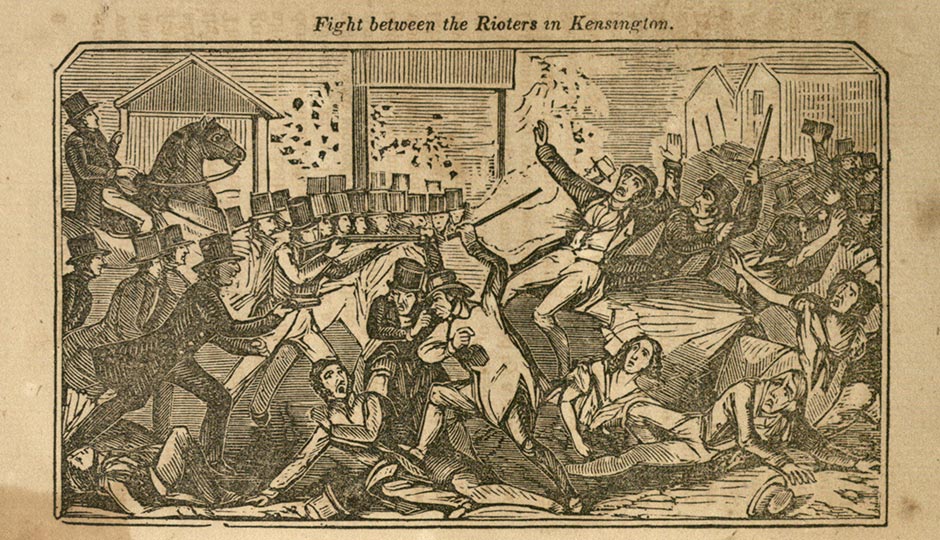
The tensions generated by anti-Catholic sentiment in the nineteenth century occasionally erupted into episodes of public violence. As immigration increased and Catholic communities expanded in American cities, nativist anxieties moved beyond rhetoric and political organizing into direct confrontation. Rumors, inflammatory publications, and religious controversies created an atmosphere in which Catholic institutions were portrayed as dangerous or subversive. When these suspicions combined with broader social tensions in rapidly growing urban centers, they sometimes produced riots that targeted Catholic churches, schools, and religious communities.
One of the earliest and most dramatic examples occurred in 1834 with the burning of the Ursuline convent in Charlestown, Massachusetts. The convent, operated by the Ursuline order of Catholic nuns, served as a school for girls and had become the subject of widespread rumor among nearby Protestant residents. Sensational stories circulated claiming that young women were being held against their will within the convent or subjected to immoral practices by Catholic clergy. These accusations reflected broader popular narratives that depicted Catholic religious institutions as secretive and corrupt. In August 1834, a Protestant mob gathered outside the convent, eventually setting the building on fire and destroying it entirely. Although local authorities investigated the attack, the perpetrators faced limited punishment, illustrating how anti-Catholic hostility could sometimes diminish the willingness of communities to protect Catholic institutions.
Violence intensified in the following decade during the Philadelphia Bible Riots of 1844, one of the most destructive episodes of religious conflict in nineteenth-century America. The riots grew out of disputes over the use of the Bible in public schools. Protestant educators commonly used the King James Bible as part of classroom instruction, but Catholic leaders objected to the practice because it reflected Protestant interpretations of scripture. Catholic bishops requested that Catholic students be permitted to read from the Douay-Rheims Bible or be excused from Protestant religious exercises. Nativist activists portrayed these requests as attempts by Catholics to remove the Bible from public education altogether, framing the issue as a struggle between Protestant American values and alleged Catholic hostility to scripture.
In May 1844 tensions erupted into violence in Philadelphia’s Kensington district, where clashes between nativist groups and Irish Catholic residents escalated into several days of rioting. Mobs burned homes, attacked Catholic churches, and fought with local militia units attempting to restore order. The violence resulted in numerous deaths and widespread destruction of property. When tensions resurfaced in July, rioters again targeted Catholic institutions, including St. Augustine’s Church, which was burned to the ground. The scale and intensity of the riots shocked observers across the country and revealed how quickly religious hostility could destabilize urban communities. Newspapers carried dramatic accounts of the violence, and political leaders debated how such conflicts could erupt in a nation that prided itself on religious liberty. For many Catholics, the destruction of churches and homes confirmed that religious prejudice could translate into direct threats to their safety and security.
These events reflected broader patterns of social instability within rapidly expanding American cities. Urban centers such as Philadelphia, Boston, and New York experienced rapid population growth during the mid-nineteenth century, often without adequate political or social infrastructure to manage the resulting tensions. Competition for jobs, housing, and political influence sometimes intensified conflicts between immigrant communities and native-born residents. Within this volatile environment, anti-Catholic rhetoric provided a powerful framework that allowed nativist activists to portray violence as a form of defensive action against a perceived cultural and political threat. Political organizations and local newspapers sometimes amplified these narratives, encouraging readers to view Catholic immigration as a destabilizing force within American society. Riots did not emerge solely from spontaneous mob action but were often fueled by weeks or months of inflammatory rhetoric that framed Catholic communities as adversaries within the nation itself.
The riots of the 1830s and 1840s revealed how deeply religious suspicion had become embedded in American political culture. Anti-Catholic ideas that circulated through sermons, newspapers, and political speeches could quickly translate into collective action when rumors or controversies ignited public anger. Anti-Catholic riots demonstrated how religious fear could escalate into organized violence when tied to concerns about national identity and immigration. The conflicts also helped strengthen nativist political movements that argued the United States needed stronger measures to defend its Protestant identity and political independence from perceived foreign influence. In the aftermath of these riots, political activists increasingly argued that immigration restrictions and tighter control over the political participation of immigrants were necessary to preserve national stability. Such arguments would soon find expression in the rise of organized nativist parties that sought to convert anti-Catholic sentiment into a durable political movement.
The Know-Nothing Movement: Nativism as Political Organization
The Know-Nothing movement transformed anti-Catholic sentiment into political action by linking immigration to fears of foreign influence and electoral control. Earlier decades had witnessed riots, pamphlets, and sermons warning of Catholic influence, but by the middle of the nineteenth century these anxieties increasingly took institutional form within political organizations. Nativist activists argued that the rapid expansion of immigration threatened the stability of American political institutions. Protestant critics often equated Catholic religious authority with political disloyalty, transforming theological difference into a perceived national security risk. By framing immigration and Catholicism as interconnected dangers, they sought to mobilize voters who believed that the nation’s Protestant identity and republican government were under threat from foreign influence.
The movement emerged from a network of secret societies that developed during the late 1840s and early 1850s. One of the most influential was the Order of the Star-Spangled Banner, a fraternal organization that required members to swear loyalty to nativist principles and maintain secrecy about the group’s activities. When questioned about the organization, members were instructed to respond that they “knew nothing,” a phrase that soon gave rise to the popular label “Know-Nothing.” Although secrecy initially helped the movement expand quietly within urban communities, it also reinforced public perceptions that nativist politics possessed a conspiratorial character similar to the secret Catholic plots that activists claimed to oppose. Lodges spread quickly through northeastern and mid-Atlantic cities where immigration had produced visible demographic change, and local chapters functioned both as political clubs and as social organizations that encouraged members to view themselves as defenders of American institutions. The secrecy of the organization helped strengthen solidarity among members while also generating curiosity and speculation among outsiders, which sometimes amplified the movement’s visibility. As these societies expanded, they gradually evolved from loosely organized fraternal groups into a more structured political movement capable of contesting elections and influencing public policy.
At the heart of the Know-Nothing platform was the belief that immigrants posed a political threat to American democracy. Nativist leaders argued that Catholic voters might follow the guidance of clergy rather than exercising independent political judgment. Because the Catholic Church recognized the authority of the Pope, critics insisted that Catholic citizens might prioritize religious loyalty to Rome over allegiance to the United States. These claims were rarely supported by evidence, but they proved politically effective in mobilizing voters who already feared the cultural changes produced by immigration. By linking Catholicism to foreign influence, the movement framed religious identity as a matter of national security.
The Know-Nothings translated these fears into concrete political proposals. Nativist activists advocated restrictions on immigration and sought to extend the naturalization period required for immigrants to become citizens. Some proposals called for a waiting period of twenty-one years before immigrants could vote or hold public office. These measures were intended to slow the political integration of immigrant communities and reduce the electoral influence of Catholic voters. Supporters argued that such policies would protect American institutions from what they portrayed as the destabilizing effects of rapid immigration. In campaign speeches and party platforms, nativist leaders presented these proposals as practical safeguards designed to defend the republic from external influence and internal division. The movement’s political language framed immigration control not merely as a cultural preference but as a necessary strategy for preserving national independence and democratic governance. Through these policy demands, the Know-Nothings attempted to transform widespread cultural anxieties into concrete legislative goals that could reshape the political landscape.
Despite its strong anti-Catholic rhetoric, the Know-Nothing movement also gained momentum because it emerged during a period of broader political instability. The collapse of the Whig Party in the early 1850s left many voters searching for new political affiliations. Nativist organizations capitalized on this uncertainty by presenting themselves as defenders of national unity at a time when sectional conflict over slavery was intensifying. In several states the movement achieved remarkable electoral success, winning governorships, legislative seats, and representation in Congress. For a brief moment in the mid-1850s, the Know-Nothing Party appeared capable of becoming a major national political force.
The movement’s rapid rise was matched by an equally swift decline. Internal divisions, particularly over the issue of slavery, weakened the organization as the sectional crisis deepened. Many northern members eventually shifted their support to the newly formed Republican Party, while southern nativists faced pressure to align with pro-slavery political coalitions. By the late 1850s the Know-Nothing movement had largely fragmented. Nevertheless, its brief prominence revealed how religious prejudice could be transformed into a powerful political ideology. The movement demonstrated that fears about immigration, religious difference, and national identity could mobilize voters and reshape political discourse within the American republic.
Religion, National Identity, and the Limits of American Pluralism
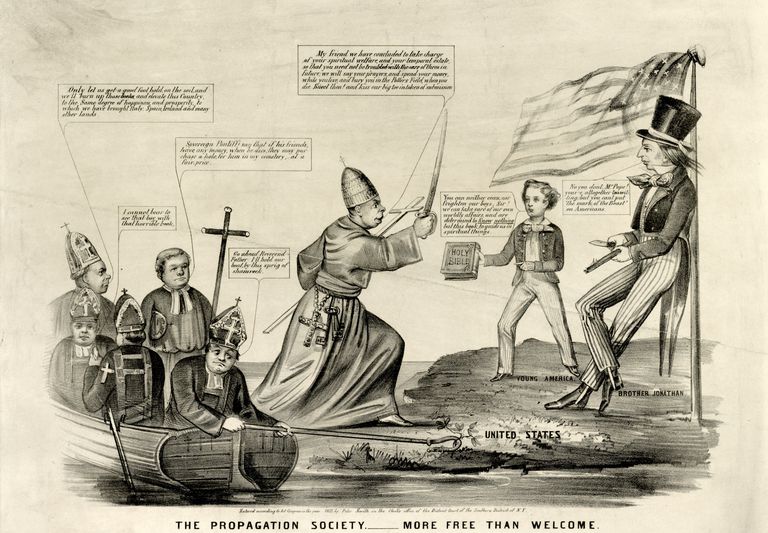
The rise of anti-Catholic nativism in the nineteenth century revealed deep tensions within the American ideal of religious liberty. Although the United States had been founded on principles that formally rejected established religion, the cultural identity of the nation remained strongly shaped by Protestant traditions. Public institutions, civic rituals, and educational practices often reflected Protestant assumptions about morality, scripture, and the role of religion in public life. When Catholic immigrants arrived in large numbers, they encountered a society that legally guaranteed religious freedom yet informally expected conformity to Protestant norms. This tension exposed the limits of American pluralism during a period when demographic change forced citizens to reconsider the relationship between religion and national identity.
For many Protestant Americans, the question was not simply whether Catholics could practice their faith privately, but whether Catholicism could coexist with republican citizenship. Critics frequently argued that the hierarchical structure of the Catholic Church conflicted with democratic ideals that emphasized individual judgment and civic independence. Because Catholic doctrine recognized the authority of the Pope, nativist writers claimed that Catholic citizens might ultimately place religious obedience above national loyalty. These arguments framed Catholicism as fundamentally incompatible with American political culture. By presenting religious difference as a political risk, nativist activists transformed theological disagreement into a broader debate about the security and stability of the republic. Such claims circulated widely through sermons, newspapers, and political speeches that warned readers about the supposed dangers of foreign religious influence. In this rhetoric, Catholicism became a symbol of external control and authoritarian tradition, while Protestantism was portrayed as the religious foundation of democratic liberty and moral independence.
The conflict involved competing interpretations of what it meant to be American. Nativists often defined national identity in explicitly Protestant terms, arguing that the nation’s founding values were inseparable from Protestant religious traditions. Catholic immigrants challenged this interpretation simply by existing within the political community while maintaining a distinct religious identity. Their presence raised questions about whether the United States was fundamentally a Protestant nation that tolerated minority religions, or a pluralistic society in which multiple religious traditions could coexist on equal terms. These debates unfolded in newspapers, political meetings, and church pulpits where writers and speakers argued about the meaning of the nation’s founding principles. Some insisted that Protestantism was essential to the preservation of republican government, while others contended that the constitutional guarantee of religious freedom required a broader understanding of national identity. The presence of Catholics forced Americans to confront these competing visions of the republic and to reconsider whether citizenship should depend upon cultural and religious conformity.
Catholic communities responded to these challenges by developing institutions that allowed them to maintain religious identity while participating in American civic life. Parishes, schools, charitable organizations, and fraternal societies created networks that supported immigrant families and encouraged integration into local communities. Catholic leaders emphasized that their faith was compatible with democratic citizenship and that immigrants could become loyal Americans without abandoning their religious traditions. By establishing schools and social institutions independent of Protestant control, Catholic communities asserted their right to participate in the nation on their own cultural and religious terms.
Institutional developments helped reshape the meaning of religious pluralism in the United States. As Catholic populations grew and became more economically and politically integrated, the perception that Catholicism was inherently incompatible with American democracy gradually weakened. These people and their descendants entered public office, served in the military, and participated in civic institutions, demonstrating that religious difference did not necessarily undermine loyalty to the nation. Catholic schools and charitable organizations expanded across the country, creating a durable institutional presence that allowed Catholic communities to educate their children and support their members without abandoning their religious traditions. These developments also fostered greater interaction between Catholics and Protestants within American society, gradually normalizing religious diversity within the broader civic culture. Although prejudice did not disappear, the growing visibility and participation of Catholic Americans helped reshape assumptions about the relationship between faith and citizenship.
The debates surrounding Catholic immigration in the nineteenth century illuminate broader patterns in American history. Periods of rapid social change often produce anxieties about cultural identity and political loyalty, particularly when new religious communities challenge established norms. Their experience shows how religious minorities can become the focus of fears that link cultural difference to national security. The gradual incorporation of Catholic communities into American public life demonstrates the evolving character of American pluralism, in which conflicts over identity eventually contribute to a more expansive understanding of religious and civic belonging.
Conclusion: Religious Suspicion and the Politics of Belonging
The nineteenth-century conflict surrounding Catholic immigration reveals how religious difference can become intertwined with broader fears about national identity and political loyalty. In a society that formally embraced religious freedom, Protestant cultural dominance nevertheless shaped assumptions about who fully belonged within the American republic. As Irish and German Catholics arrived in large numbers, their presence challenged existing expectations about the religious character of the nation. Anti-Catholic rhetoric portrayed these immigrants as representatives of a foreign religious system whose loyalties might lie outside the boundaries of American democracy.
These suspicions were not simply expressions of theological disagreement but were closely connected to anxieties about political stability and national security. Nativist activists argued that Catholicism threatened republican institutions by encouraging obedience to hierarchical authority rather than independent civic participation. By linking religious identity to political loyalty, critics transformed immigration into a question of national survival. Anti-Catholic riots, sensational literature, and the rise of the Know-Nothing movement all reflected a broader attempt to define American citizenship in cultural and religious terms. Political speeches, newspaper editorials, and pamphlets frequently warned that Catholic immigrants might undermine democratic institutions through collective voting directed by clergy or by allegiance to foreign authority in Rome. Although these claims were largely speculative, they proved politically powerful because they resonated with deeper cultural fears about foreign influence and social change. Religious identity became a symbolic marker used to distinguish those who were presumed to embody American values from those who were portrayed as outsiders whose loyalty required constant scrutiny.
Yet the long-term trajectory of American society demonstrated that these fears were neither inevitable nor permanent. immigrants and their descendants gradually integrated into the political and civic life of the United States while maintaining their religious traditions. Through participation in elections, public service, education, and military service, Catholic communities demonstrated that loyalty to religious authority did not prevent commitment to democratic citizenship. The growing presence of Catholics within American institutions helped expand the nation’s understanding of religious pluralism and challenged the assumption that Protestant identity was synonymous with national belonging.
The history of anti-Catholic nativism shows how democratic societies can frame religious difference as a threat during periods of rapid social change. Moments of rapid social change often generate fears that cultural or religious minorities pose a threat to national stability. This tension can transform differences in belief into broader narratives about loyalty, security, and identity. The eventual integration of previously marginalized communities shows how the meaning of citizenship can evolve as societies confront the realities of diversity. The nineteenth-century experience of Catholic groups reminds us that debates about religion and belonging are not simply historical episodes but part of an ongoing process through which nations define the boundaries of political community.
Bibliography
- Anbinder, Tyler. Nativism and Slavery: The Northern Know Nothings and the Politics of the 1850s. New York: Oxford University Press, 1992.
- Billington, Ray Allen. The Protestant Crusade, 1800–1860: A Study of the Origins of American Nativism. Chicago: Quadrangle Books, 1938.
- Broussard, James H. “Some Determinants of Know-Nothing Electoral Strength in the South, 1856.” Louisiana History: The Journal of the Louisiana Historical Association 7:1 (1966), 5-20.
- Cadbury, Henry J. “Persecution and Religious Liberty, Then and Now.” The Pennsylvania Magazine of History and Biography 68:4 (1944), 359-371.
- Carlson, A. Cheree. “The Rhetoric of the Know-Nothing Party: Nativism as a Response to the Rhetorical Situation.” Southern Communication Journal 54:4 (1989), 364-383.
- Carwardine, Richard. “The Know-Nothing Party, the Protestant Evangelical Community and American National Identity.” Studies in Church History 18 (1982), 449-463.
- Dolan, Jay P. The American Catholic Experience: A History from Colonial Times to the Present. New York: Doubleday, 1985.
- Franchot, Jenny. Roads to Rome: The Antebellum Protestant Encounter with Catholicism. Berkeley: University of California Press, 1994.
- Hamburger, Philip. Separation of Church and State. Cambridge: Harvard University Press, 2002.
- Higham, John. Strangers in the Land: Patterns of American Nativism, 1860–1925. New Brunswick: Rutgers University Press, 1955.
- Holt, Michael F. The Rise and Fall of the American Whig Party. New York: Oxford University Press, 1999.
- Kenny, Kevin. The American Irish: A History. London: Longman, 2000.
- McGreevy, John T. Catholicism and American Freedom: A History. New York: W. W. Norton, 2003.
- Miller, Kerby A. Emigrants and Exiles: Ireland and the Irish Exodus to North America. New York: Oxford University Press, 1985.
- Schrag, Zachary M. The Fires of Philadelphia: The Philadelphia Nativist Riots of 1844. New York: Oxford University Press, 2020.
Originally published by Brewminate, 03.20.2026, under the terms of a Creative Commons Attribution-NonCommercial-NoDerivatives 4.0 International license.
About the Author