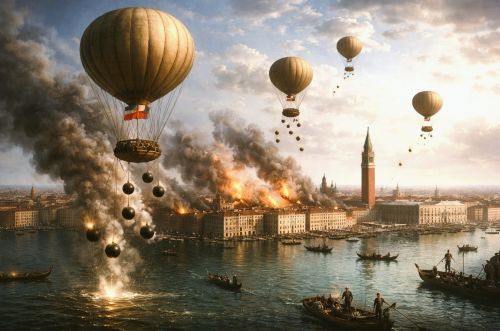
In 1849, Austria’s balloon attack on Venice revealed an early vision of remote warfare, where distance, technology, and uncertainty reshaped how violence could be delivered.

By Matthew A. McIntosh
Public Historian
Brewminate
Introduction: War beyond the Battlefield
In the summer of 1849, as the Austrian Empire struggled to suppress revolutionary movements across its territories, an unusual and largely experimental form of attack was launched against the besieged city of Venice. Austrian forces released a number of unmanned hot-air balloons, each carrying an explosive or incendiary device fitted with a timed fuse, in the expectation that prevailing winds would carry them over the city. The effort produced minimal material damage and was hampered by the uncontrollable nature of wind currents, yet the episode stands as one of the earliest documented attempts to deliver destructive force through the air without a human operator on board. In its conception, if not in its execution, the attack marked a departure from traditional battlefield engagement and suggested a future in which distance, technology, and indirect control would reshape the conduct of war.
The significance of the Austrian balloon bombardment lies not in its tactical success, which was limited, but in its conceptual implications. Warfare in the early nineteenth century remained grounded in proximity, whether through massed infantry formations, artillery exchanges, or naval blockades. Even siege warfare, though capable of targeting civilian populations, relied on relatively direct lines of engagement. The use of pilotless balloons introduced a different logic, one in which the act of violence could be separated spatially and temporally from the individuals who initiated it. This separation, however imperfect, enabled the possibility of striking an enemy without direct exposure to retaliation, a principle that would later become central to modern aerial warfare and unmanned systems.
The balloon attack revealed the profound limitations of early attempts at remote warfare. Unlike later guided munitions or remotely piloted aircraft, the Austrian devices possessed no mechanism for navigation beyond atmospheric drift. Control, in any meaningful sense, was absent. The reliance on wind patterns not only reduced accuracy but created the risk of reversal, with some balloons reportedly drifting back toward Austrian positions. This interplay between intention and environmental uncertainty underscores a key tension in the history of military technology: the desire to extend power beyond the battlefield while confronting the unpredictability of the natural world. The Venetian experiment was as much a demonstration of technological ambition as it was of constraint.
The Austrian use of explosive balloons during the siege of Venice represents an early, formative moment in the long evolution of remote and uncrewed warfare. Rather than treating the episode as a historical curiosity or failed innovation, it should be understood as part of a broader trajectory in which states sought to project force across distance while minimizing risk to their own personnel. By situating the 1849 attack within its political, technological, and conceptual contexts, and by tracing its connections to later developments in aerial and unmanned warfare, we can better appreciate how even limited and imperfect experiments contributed to the redefinition of combat beyond the traditional battlefield.
The Revolutions of 1848 and the Siege of Venice

The Austrian balloon attack on Venice in 1849 emerged from a broader crisis that had engulfed Europe the previous year. The Revolutions of 1848 were not isolated uprisings but a continent-wide wave of political upheaval driven by liberal, nationalist, and social demands. From Paris to Vienna, long-standing regimes faced challenges as populations pressed for constitutional reform, expanded suffrage, and national self-determination. Within the Austrian Empire, a multiethnic polity already strained by administrative complexity, these pressures proved especially volatile. The empire’s Italian territories, including Lombardy and Venetia, became focal points of rebellion as local populations sought independence from Habsburg rule.
In Venice, the revolutionary moment took on a distinct character shaped by both geography and history. The city’s legacy as a former maritime republic contributed to a strong sense of civic identity, which fueled resistance when news of unrest in Vienna weakened Austrian control. In March 1848, Venetian revolutionaries, led by Daniele Manin, declared the establishment of the Republic of San Marco. The expulsion of Austrian officials and the assertion of independence transformed Venice into both a symbolic and practical challenge to imperial authority. For the Habsburg leadership, allowing such a defiant enclave to persist risked encouraging further fragmentation across its already unstable domains. Venetian resistance was not simply reactive but ideologically grounded, drawing on a mixture of republican tradition, emerging Italian nationalism, and a broader European discourse of liberal reform. Public participation in the revolutionary government, along with widespread civic mobilization, reinforced the legitimacy of the new regime in the eyes of its supporters. This internal cohesion, even amid material hardship, would later help sustain Venice during the prolonged siege that followed.
The Austrian response unfolded within the broader framework of counterrevolution. After initial setbacks in 1848, imperial forces gradually regained the initiative, suppressing uprisings in key regions and restoring centralized control. Field Marshal Joseph Radetzky played a decisive role in northern Italy, defeating Piedmontese forces and reasserting Austrian dominance over Lombardy. Venice proved more difficult to subdue. Its lagoon setting provided a natural defensive barrier, complicating conventional military operations and limiting the effectiveness of direct assault. The Austrian strategy shifted toward containment and attrition rather than immediate conquest.
The siege of Venice that followed was characterized by a combination of blockade and bombardment. Austrian forces sought to isolate the city by cutting off supply lines, particularly food and essential goods, while applying intermittent artillery pressure. These measures caused severe hardship among the civilian population, contributing to shortages, disease, and declining morale. Yet the city’s defenders demonstrated considerable resilience, prolonging resistance far beyond what Austrian commanders had initially anticipated. The prolonged nature of the siege underscored both the strategic importance of Venice and the limitations of traditional siege warfare in a uniquely challenging environment. Disease, especially cholera, spread within the increasingly crowded and undersupplied city, compounding the effects of hunger and fatigue. Civilian suffering became a central feature of the conflict, blurring the line between military and noncombatant experience. Austrian forces faced their own logistical challenges, including maintaining the blockade and coordinating operations in difficult terrain. The result was a drawn-out confrontation in which neither side could easily achieve a decisive breakthrough.
Austrian leadership explored unconventional methods of attack. The inability to penetrate Venice quickly through standard means encouraged experimentation with alternative technologies, including the deployment of explosive-laden balloons. This innovation was not merely driven by technological curiosity but a response to specific operational constraints. The lagoon limited troop movement and artillery positioning, while the desire to maintain pressure on the city without incurring excessive casualties made indirect methods of attack increasingly attractive. The balloon experiment emerged from a convergence of necessity, ingenuity, and the broader nineteenth-century culture of scientific experimentation.
Understanding the Revolutions of 1848 and the siege of Venice is essential to interpreting the significance of the balloon bombardment. The attack did not occur in isolation but as part of a larger struggle over political authority, national identity, and imperial survival. The Austrian Empire’s willingness to experiment with new forms of warfare reflected both the urgency of the situation and the evolving relationship between military practice and technological innovation. The events in Venice illustrate how moments of crisis can accelerate the adoption of unconventional strategies, even when their effectiveness remains uncertain.
Technology before Flight: Balloons, Incendiaries, and Innovation
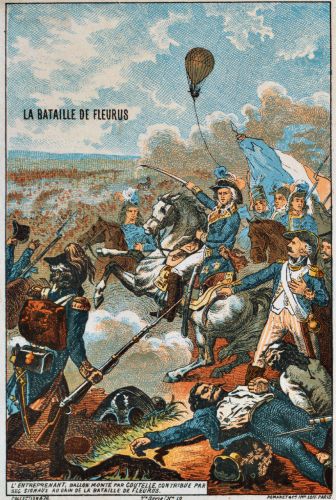
Long before the development of powered flight, the nineteenth century witnessed sustained experimentation with lighter-than-air technologies that captured public imagination. The first successful manned balloon flights in the late eighteenth century, particularly those of the Montgolfier brothers in 1783, demonstrated that human ascent into the sky was not only possible but repeatable. These early achievements quickly attracted attention beyond spectacle, as military observers began to consider how aerial vantage points might be used for reconnaissance and signaling. By the early nineteenth century, ballooning had moved from novelty to a field of practical inquiry, albeit one still constrained by technical limitations in materials, control, and endurance.
Military applications of ballooning initially focused on observation rather than attack. During the French Revolutionary Wars, the use of tethered balloons for battlefield surveillance marked an important step in integrating aerial technology into military planning. Observers could relay information about enemy positions, offering commanders a broader perspective than ground-based reconnaissance allowed. Although these efforts were limited in scale and often hampered by logistical difficulties, they established a precedent for viewing the sky as a domain with strategic value. The conceptual shift from ground-bound warfare to vertical observation laid the groundwork for more ambitious, if less reliable, applications in the decades that followed.
The Austrian use of balloons in 1849 represented a departure from observation toward offensive deployment. Instead of carrying human observers, these balloons were equipped with explosive or incendiary payloads designed to detonate after a fixed period. The technology involved was relatively simple in principle but complex in execution. Each balloon had to be constructed with sufficient lift capacity to carry its payload, while also incorporating a timing mechanism capable of igniting the explosive charge at an appropriate moment. These mechanisms, often based on slow-burning fuses, introduced a margin of uncertainty that compounded the already unpredictable nature of balloon flight. The absence of guidance systems meant that accuracy depended entirely on wind direction and speed. In practice, this required Austrian operators to make calculated judgments about weather patterns at the moment of launch, effectively transforming atmospheric conditions into a substitute for targeting systems. Even then, the delay between release and detonation meant that any shift in wind could render those calculations obsolete. The process illustrates how early attempts at remote attack relied not on precision but on probability, with success defined less by accuracy than by the chance that at least some devices would reach the intended area.
Incendiary technology itself had a long history by the mid-nineteenth century, drawing on earlier uses of fire as a weapon in both siege and naval warfare. From ancient Greek fire to early modern explosive shells, the destructive potential of combustion had been repeatedly harnessed to target fortifications, ships, and urban centers. By the 1840s, advances in chemistry and metallurgy had improved the reliability and potency of explosive devices, allowing for more controlled deployment. The Austrian balloon bombs combined these developments with aerial delivery, creating a hybrid system that merged established destructive methods with experimental means of transport. This combination illustrates how innovation often arises not from entirely new inventions but from the recombination of existing technologies in novel contexts.
Despite these innovations, the limitations of balloon technology remained stark. Unlike later developments in aviation, there was no effective means of steering or stabilizing a free-floating balloon once it had been released. Variations in temperature, air pressure, and wind currents could dramatically alter a balloon’s trajectory, making precise targeting virtually impossible. This lack of control not only reduced the effectiveness of the weapon but also created the risk of unintended consequences, including the possibility of friendly fire. Reports from the Venetian campaign suggest that some balloons failed to reach the city at all, while others drifted unpredictably across the lagoon, illustrating the gap between intention and outcome. The Austrian command could initiate the attack, but it could not guide it once set in motion. This dynamic underscores a broader technological reality of the period, in which the expansion of destructive capability often outpaced the development of systems capable of regulating or directing that force.
The balloon bombardment reflects a broader nineteenth-century culture of technological experimentation. The period was marked by rapid advances in science and engineering, from railways and telegraphs to industrial manufacturing processes, all of which contributed to a growing belief in the power of innovation to reshape society and warfare alike. Military institutions were not isolated from these trends but actively participated in them, seeking to adapt new discoveries to strategic needs. The use of explosive balloons against Venice can be understood as part of a wider pattern in which emerging technologies were tested under the pressures of conflict, even when their practical utility remained uncertain.
The 1849 Balloon Bombardment of Venice
The Austrian deployment marked the first known attempt to use uncrewed aerial devices for bombardment. Conceived during the protracted siege of the city, the operation sought to exploit prevailing wind patterns to carry incendiary payloads over Venetian defenses. Austrian forces, reportedly operating from positions on the mainland as well as from naval vessels in the lagoon, prepared a series of hot-air balloons fitted with timed explosive charges. The intention was straightforward in concept but uncertain in practice: release the balloons at a moment when the wind would carry them toward the city, allow them to drift overhead, and detonate their payloads within the urban environment.
In practical terms, the operation relied heavily on timing and environmental conditions. Each balloon was equipped with a fuse calibrated to ignite after a specific interval, ideally corresponding to the estimated duration of flight from launch point to target. This required Austrian operators to make precise, if ultimately speculative, calculations about wind speed and direction. Even slight variations in atmospheric conditions could disrupt these estimates, sending the balloons off course or causing premature or delayed detonation. The lack of any corrective mechanism once the balloons were released meant that the success of the attack hinged entirely on the accuracy of these initial assumptions.
Contemporary accounts suggest that approximately two hundred balloons were launched over the course of the operation, though the exact number and effectiveness remain subjects of historical debate. Some balloons are believed to have reached the vicinity of Venice, while others failed to travel the intended distance or detonated harmlessly outside the city. Notably, shifts in wind direction reportedly caused several devices to drift back toward Austrian lines, raising the possibility of unintended self-inflicted damage. This risk was not merely theoretical but a direct consequence of the system’s complete dependence on uncontrollable environmental forces. The operation exposed Austrian personnel to a degree of uncertainty that blurred the distinction between offensive and self-endangering action. Venetian observers reportedly witnessed the balloons drifting overhead, their slow and silent movement adding an element of unpredictability that conventional artillery lacked. The uneven distribution of results, with some devices reaching the city while others failed entirely, illustrates the experimental and probabilistic nature of the attack rather than any consistent operational method.
The physical impact of the bombardment appears to have been minimal. There is little evidence of significant structural damage or widespread fires resulting directly from the balloon strikes. Assessing the operation solely in terms of physical destruction risks overlooking its broader implications. The very act of attempting to bomb a city from the air without human pilots represented a conceptual breakthrough, even if its immediate results were modest. The operation demonstrated a willingness to explore new dimensions of warfare, expanding the battlefield vertically and introducing the idea that attacks could originate from beyond the visible horizon of traditional engagement.
In retrospect, the 1849 balloon bombardment of Venice can be understood as both a failure and a precedent. It failed in the sense that it did not decisively alter the course of the siege or inflict substantial damage on the target. Yet it also established an early model of uncrewed aerial attack, anticipating later developments in aerial bombardment and remote warfare. The episode illustrates how military innovation often proceeds through imperfect trials, where the significance of an experiment lies less in its immediate success than in the possibilities it reveals for the future conduct of war.
Autonomy, Chance, and Control
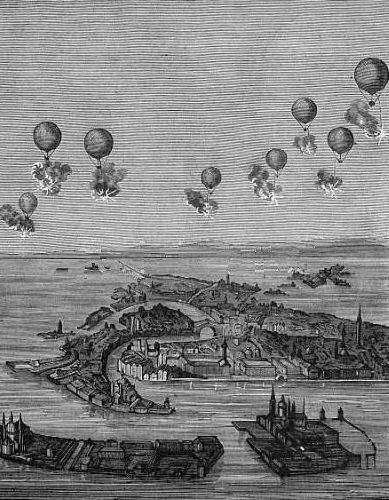
The Austrian balloon attack on Venice is often described as an early example of autonomous warfare, yet such a characterization requires careful qualification. In modern terms, autonomy implies a degree of independent decision-making or guided operation once a system is deployed. The balloons of 1849 possessed no such capabilities for navigation or adjustment. They did not navigate, adjust, or respond to changing conditions. Instead, they followed the path dictated by atmospheric forces after their release. What autonomy existed was conceptual rather than functional, residing in the separation between the human operator and the moment of impact rather than in any internal capacity of the device itself.
This distinction highlights a central tension in the development of remote warfare: the gap between intention and control. Austrian forces could determine when and where to launch the balloons, but they could not determine where they would ultimately land. Once released, the weapons entered a domain governed by wind, temperature, and pressure, all of which lay beyond human manipulation at the time. The act of attack was divided into two phases, one controlled and one entirely contingent. This division complicates any straightforward narrative of technological progress, suggesting instead that early innovations often expanded the reach of military power while simultaneously diminishing the precision with which that power could be applied.
Chance, rather than control, became the central operational principle of the balloon bombardment. Success depended on aligning a series of variables that could not be reliably predicted or reproduced. Wind direction had to carry the balloons toward the city, fuse timing had to correspond with flight duration, and the devices themselves had to remain intact long enough to detonate over the intended target. The failure of any one of these elements could render the entire operation ineffective. Moreover, the interaction between these variables was not linear but compounding, meaning that small deviations in one factor could amplify errors across the entire system. Austrian planners were forced to operate within a framework of uncertainty that limited their ability to replicate results or refine tactics based on prior attempts. The attack lacked not only precision but also consistency, making it difficult to evaluate success or failure in conventional military terms. Rather than a controlled deployment of force, the operation functioned as a probabilistic exercise in which outcomes were distributed unevenly and often unpredictably across space.
The legacy of the 1849 attack lies in this uneasy balance between aspiration and limitation. It foreshadowed a future in which military forces would seek to project power across distance while reducing direct exposure to danger, yet it also demonstrated the difficulties inherent in relinquishing control over the means of destruction. Later developments in guided munitions and unmanned systems would gradually close this gap, replacing reliance on environmental chance with increasingly sophisticated forms of control. The Austrian balloons, by contrast, occupy an early point on this trajectory, where the desire for remote warfare had emerged but the technological means to achieve it remained incomplete
Psychological Warfare and Symbolic Power
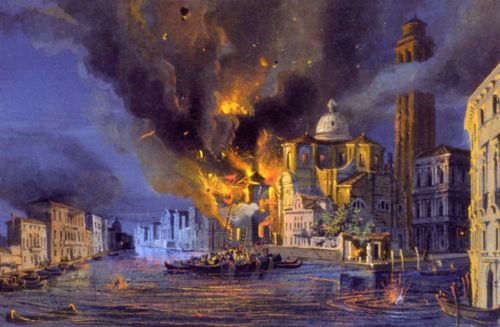
The limited physical damage caused by the Austrian balloon bombardment does not fully capture its significance, particularly when considered through the lens of psychological warfare. The appearance of explosive devices descending unpredictably from the sky introduced a new and unsettling dimension to the experience of siege. Traditional bombardment, whether by cannon or mortar, followed visible trajectories and recognizable patterns that allowed defenders to anticipate danger and seek shelter accordingly. The balloons, by contrast, moved slowly and silently, their arrival governed by forces beyond immediate perception. This altered the sensory and emotional landscape of the conflict, transforming the sky from a passive backdrop into a potential source of threat. The shift was subtle yet significant, as it disrupted established expectations about where danger originated and how it could be understood, replacing predictability with a diffuse and persistent sense of unease.
For the inhabitants of Venice, already enduring the strain of blockade and deprivation, the balloon attack likely intensified feelings of vulnerability and uncertainty. Even if the actual damage was minimal, the unpredictability of the weapons meant that danger could not be easily anticipated or avoided. The inability to determine when or where a device might descend created a diffuse sense of exposure that extended beyond the immediate sites of impact. In this respect, the balloons functioned less as precise instruments of destruction than as tools of disruption, undermining the psychological stability of a population already under pressure.
The symbolic implications of the attack extended beyond the immediate context of the siege. The use of uncrewed aerial devices suggested a form of warfare in which traditional boundaries between combatant and noncombatant space were increasingly blurred. By targeting a city from above without direct engagement, Austrian forces implicitly signaled a willingness to expand the scope of military action into areas previously considered peripheral to the battlefield. This shift carried broader implications for how war might be conducted in the future, particularly in urban environments where civilian populations were densely concentrated.
The novelty of the balloon attack further contributed to its psychological impact. New technologies in warfare often derive part of their effectiveness from their unfamiliarity, generating fear not only through their destructive capacity but through the uncertainty they introduce. In 1849, the idea of being attacked from the air by unmanned devices would have been both extraordinary and difficult to comprehend within existing frameworks of military experience. Unlike artillery, which had a long-established place in siege warfare, aerial bombardment lacked precedent in the lived experience of most civilians and soldiers. This absence of familiarity meant that individuals could not easily contextualize or rationalize the threat, amplifying its emotional impact. The sight of drifting balloons carrying unseen danger may have seemed as much a spectacle as a weapon, blurring the boundary between technological demonstration and active assault. This unfamiliarity amplified the perceived threat, even in the absence of significant material consequences, and reinforced the sense that the rules of conflict were evolving in unpredictable ways.
Ultimately, the Austrian balloon bombardment illustrates how the power of a weapon cannot be measured solely by its immediate physical effects. Its significance lies equally in its capacity to reshape perception, to alter the emotional experience of war, and to signal emerging possibilities in the conduct of conflict. In Venice, the balloons did not decisively break resistance, but they did introduce a new form of psychological pressure that foreshadowed later developments in aerial warfare, where the impact of attack would be felt as much in the mind as on the ground.
From Balloons to Drones: A Long Technological Arc
The Austrian balloon bombardment of Venice in 1849 occupies an early and frequently overlooked position in the broader history of aerial warfare. Although the technology itself was rudimentary and its immediate effects limited, the conceptual shift it represented would echo across subsequent developments in military strategy. The idea that destructive force could be delivered from above without exposing the attacker to direct danger marked a significant departure from traditional forms of combat. The balloons can be understood as a precursor not only to later aerial bombing campaigns but also to the logic that underpins modern unmanned systems.
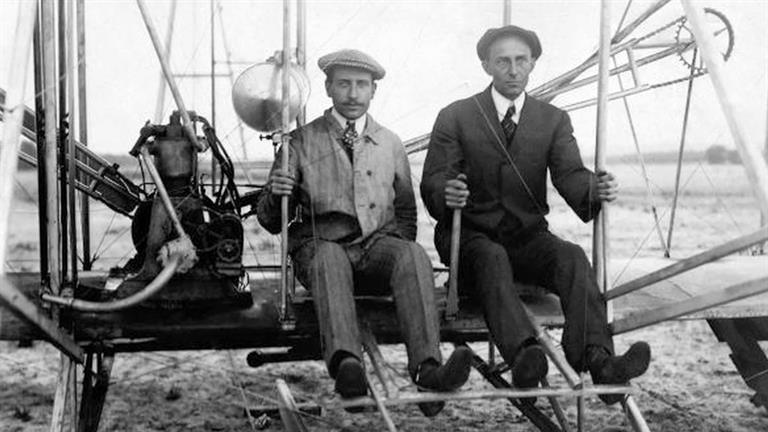
The late nineteenth and early twentieth centuries witnessed rapid advancements in aviation that transformed this conceptual possibility into practical capability. The invention of powered flight by the Wright brothers in 1903 opened new avenues for military application, and within a decade, aircraft were being used for reconnaissance and limited offensive operations during World War I. Unlike the Austrian balloons, these early aircraft were piloted and capable of controlled navigation, allowing for far greater precision in targeting. Yet the underlying principle remained consistent: the extension of military reach into the air as a means of overcoming the constraints of terrain and distance.
World War I and World War II further accelerated the development of aerial bombardment, turning it into a central component of modern warfare. Strategic bombing campaigns targeted not only military installations but also industrial centers and civilian populations, dramatically expanding the scope of conflict. Technological innovations such as improved bomb design, navigation systems, and long-range aircraft increased both the scale and effectiveness of these operations. The growing integration of air power into national military strategy reflected a belief that control of the skies could decisively shape the outcome of wars on the ground. These campaigns revealed the immense human cost associated with aerial bombardment, as cities became targets and civilian casualties mounted. The evolution from experimental balloon strikes to sustained bombing operations illustrates how an initial concept, once technologically feasible, could be expanded to a scale far beyond its original conception.
The postwar period expanded this trajectory with the emergence of guided missiles and remotely operated systems. Advances in electronics, computing, and communications made it possible to direct weapons toward specific targets with increasing accuracy. The development of cruise missiles and early unmanned aerial vehicles represented a shift toward forms of warfare in which human operators could remain physically distant from the battlefield while still exercising a degree of control over the weapon’s path. This marked a crucial step in bridging the gap between the uncontrolled drift of the 1849 balloons and the precision of later technologies.
In the late twentieth and early twenty-first centuries, unmanned aerial vehicles, commonly known as drones, became a defining feature of modern military operations. Equipped with advanced sensors, real-time communication systems, and precision-guided munitions, these platforms allow for sustained surveillance and targeted strikes with a level of control unimaginable in the nineteenth century. Operators can monitor and adjust missions from remote locations, effectively collapsing the distance between decision-making and execution. This capability represents the realization of a long-standing objective in military innovation: the ability to deliver force with minimal risk to one’s own personnel while maintaining a high degree of accuracy. The expansion of drone use in conflicts across the Middle East, Central Asia, and beyond has further demonstrated how these systems can be integrated into broader strategic frameworks, combining intelligence gathering with rapid response capabilities. Their use has sparked ongoing debates about accountability, legality, and the ethical implications of conducting warfare at a distance, where the human consequences of action may be physically removed from those who initiate it.
Despite these advancements, the lineage from Austrian war balloons to modern drones is not one of direct technological continuity but of conceptual evolution. The balloons of 1849 did not lead in a linear fashion to contemporary unmanned systems, yet they embodied an early recognition of the strategic value of uncrewed, aerial delivery of force. By examining this long arc, it becomes clear that even seemingly marginal experiments can contribute to enduring shifts in how warfare is imagined and conducted. The path from drifting balloons to precision-guided drones reflects not only technological progress but also a persistent redefinition of the relationship between distance, control, and violence.
Ethical Distance: Responsibility in Remote Warfare

The Austrian balloon attack on Venice in 1849 raises a fundamental question about the ethics of warfare conducted at a distance. By separating the act of launching a weapon from the moment and location of its impact, the operation introduced a form of detachment that complicated traditional notions of responsibility. In earlier modes of combat, the relationship between attacker and target was often direct and immediate, with combatants confronting one another within a shared physical space. The use of unmanned balloons disrupted this relationship, creating a gap between intention and consequence that made accountability less visible, even if it remained conceptually present.
This emerging distance did not eliminate responsibility but altered its character. Austrian commanders still made the decision to deploy the balloons, fully aware that their effects would fall upon a populated urban environment. Yet the lack of control over where individual devices would land introduced a degree of indeterminacy that blurred the boundaries of intentional harm. Unlike targeted artillery fire, which could be adjusted and corrected, the balloon attack operated without the possibility of real-time intervention. This raises important questions about the moral weight of actions taken under conditions of uncertainty, particularly when those actions expose civilian populations to unpredictable risk. It also complicates the distinction between intended and unintended consequences, since commanders could foresee the general danger posed by the balloons but could not specify its precise manifestation. Responsibility becomes diffuse rather than absent, extending from the decision to deploy the technology to the broader system that made such deployment possible. The inability to predict outcomes does not negate accountability but instead reframes it within a context of calculated risk and accepted uncertainty.
The Venetian case also anticipates later ethical debates surrounding aerial bombardment and, more recently, unmanned systems. As technology evolved to allow for greater precision, the justification for remote attacks increasingly rested on the claim that they could reduce collateral damage and limit unintended casualties. The underlying issue of distance remained. When those who authorize or execute an attack are physically removed from its effects, the psychological and moral experience of warfare changes. The Austrian balloons represent an early instance of this dynamic, in which the physical separation between operator and target begins to reshape how violence is perceived and rationalized. This separation can create a sense of abstraction, in which the consequences of action are mediated through layers of technology and distance, potentially diminishing the immediacy of moral reckoning. It raises questions about whether increased precision in later systems truly resolves ethical concerns or simply reconfigures them, shifting the focus from indiscriminate risk to issues of surveillance, targeting, and authority. The Venetian episode serves as a starting point for a much longer conversation about how distance influences both the conduct of war and the ethical frameworks used to evaluate it.
The limitations of the 1849 technology highlight a paradox in the ethics of remote warfare. Greater distance did not produce greater discrimination in targeting; on the contrary, it reduced it. The balloons could not distinguish between military and civilian spaces, nor could they be redirected once released. This indiscriminate quality complicates any attempt to view the attack as a precursor to more “surgical” forms of modern warfare. Instead, it suggests that the ethical challenges associated with remote violence have been present from the outset, even as technological advances have altered the degree, but not the nature, of those challenges.
Ultimately, the Austrian balloon bombardment underscores the enduring tension between technological innovation and moral responsibility in warfare. The desire to project power while minimizing risk to one’s own forces has consistently driven the development of new weapons systems, yet each advance introduces new ethical questions about control, accountability, and the protection of noncombatants. The events in Venice do not provide definitive answers to these questions, but they do reveal their early formation. The experiment with explosive balloons stands not only as a technological milestone but also as a moment in the evolving moral history of war.
Historiography and Interpretation
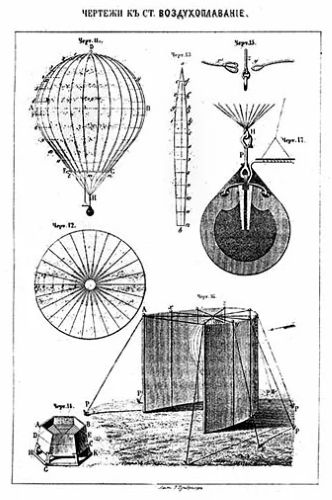
Historians have approached the Austrian balloon bombardment of Venice from a variety of perspectives, often reflecting broader debates about how to interpret technological innovation in military history. For some scholars, the episode is treated as a marginal curiosity, a brief and largely ineffective experiment that had little immediate impact on the outcome of the siege or the trajectory of warfare. From this viewpoint, the limited damage inflicted and the lack of follow-up development suggest that the balloons represent a technological dead end rather than a meaningful turning point. This interpretation emphasizes practical results over conceptual significance, placing the event within a category of failed or inconsequential innovations.
Other historians have argued for a more expansive reading of the event, viewing it as an early indication of a shift in how warfare could be imagined and conducted. Rather than focusing solely on the immediate effectiveness of the balloons, these interpretations highlight the broader implications of attempting to deliver explosives through uncrewed aerial means. The significance of the 1849 attack lies in its anticipation of later developments, including aerial bombardment and unmanned systems. The balloons are understood not as a direct technological ancestor of modern weapons, but as part of a lineage of ideas that gradually redefined the relationship between distance, control, and violence.
A key point of debate within the historiography concerns the extent to which the balloon attack should be considered “innovative” in a meaningful sense. Some scholars caution against projecting later technological developments backward onto earlier experiments, a tendency that can lead to exaggerated claims about historical precedence. From this perspective, labeling the Austrian balloons as precursors to modern drones risks oversimplifying the complex and nonlinear nature of technological change. Innovation, in this view, is not a single moment but a process shaped by multiple, often disconnected developments. The Venetian episode may contribute to that process, but it does not determine it. This caution reflects a broader methodological concern within historical scholarship, namely the danger of teleology, where past events are interpreted primarily in terms of what they seem to anticipate rather than what they meant within their own context. By resisting this tendency, historians aim to preserve the contingency of the past and avoid imposing a retrospective coherence that was not experienced by historical actors themselves. Acknowledging these methodological limits does not require dismissing the episode’s broader significance but rather situating it carefully within a network of parallel and intersecting developments that collectively shaped the evolution of modern warfare.
There is a growing recognition that even unsuccessful or short-lived experiments can hold analytical value. Military history has increasingly moved beyond a narrow focus on victories and decisive innovations to consider the broader landscape of trial, error, and adaptation. The Austrian balloon bombardment can be seen as part of a pattern in which new technologies are tested under the pressures of conflict, revealing both their potential and their limitations. This approach allows historians to examine not only what worked, but also what was attempted and why, offering a more nuanced understanding of how military practices evolve.
Ultimately, the historiography of the 1849 balloon attack reflects a tension between viewing the past through the lens of later developments and maintaining sensitivity to historical context. Whether interpreted as a curiosity, a precursor, or a case study in experimental warfare, the episode invites reflection on how historians assign significance to events that do not fit neatly into narratives of progress or success. By situating the balloon bombardment within both its immediate context and its longer conceptual legacy, scholars can better appreciate its place within the complex and often uneven history of technological change in warfare.
Conclusion: The First Glimpse of War at a Distance
The Austrian balloon bombardment of Venice in 1849 stands as a modest event in terms of immediate military impact, yet it reveals a profound shift in how warfare could be conceived. By attempting to deliver explosive force through uncrewed aerial devices, Austrian forces crossed an important conceptual threshold, separating the act of attack from direct human presence on the battlefield. Although the technology was primitive and the results limited, the underlying idea introduced a new dimension to the conduct of war, one in which distance and mediation would increasingly define the relationship between combatants and their targets.
This early experiment highlights the interplay between innovation and limitation that characterizes much of military history. The balloons demonstrated both the possibilities and the constraints of extending warfare into new domains. On one hand, they offered a means of bypassing physical barriers and projecting force into otherwise inaccessible spaces. On the other, their dependence on uncontrollable environmental factors underscored the absence of reliable control, reducing their effectiveness and introducing significant uncertainty. This tension between aspiration and capability would persist in later developments, shaping the trajectory of aerial and unmanned warfare over the following centuries.
The Venetian episode invites reflection on the broader implications of conducting war at a distance. The separation between operator and target, first glimpsed in the release of explosive balloons, would become increasingly pronounced with the advent of aircraft, missiles, and drones. As this distance expanded, so too did the ethical and psychological complexities associated with remote violence. The 1849 attack occupies an early point in a longer history in which technological innovation continually reshapes not only how wars are fought, but also how responsibility, risk, and human experience are distributed within them.
The significance of the Austrian balloon bombardment lies less in what it achieved than in what it revealed. It offered a glimpse of a future in which warfare would extend beyond the immediate presence of soldiers, mediated by machines and shaped by new forms of control and uncertainty. By situating this episode within its historical and conceptual contexts, we can better understand how even limited experiments contribute to enduring transformations in the nature of conflict. The sky above Venice in 1849 did not yet belong to modern warfare, but it had begun to change. What appeared at the time as an improvised and imperfect tactic can now be recognized as part of a broader reorientation in military thinking, one that increasingly privileged reach over proximity and possibility over certainty. The balloon bombardment stands as an early moment in the gradual redefinition of war itself, where the boundaries of the battlefield expanded and the relationship between human agency and technological mediation grew more complex.
Bibliography
- Barden-Powell, Lieutenant B. “Military Ballooning.” Royal United Services Institution 27:122 (1883), 735-756.
- Beales, Derek. The Risorgimento and the Unification of Italy. London: Longman, 1971.
- Clark, Christopher. Revolutionary Spring: Europe Aflame and the Fight for a New World, 1848–1849. New York: Crown, 2023.
- Edgerton, David. The Shock of the Old: Technology and Global History since 1900. Oxford: Oxford University Press, 2006.
- Ginsborg, Paul. Daniele Manin and the Venetian Revolution of 1848–49. Cambridge: Cambridge University Press, 1979.
- Faber, Harold. Military Ballooning during the Early Nineteenth Century. London: Her Majesty’s Stationery Office, 1970.
- Gooch, John. The Italian Army and the First World War. Cambridge: Cambridge University Press, 2014.
- Holmes, Richard. The Age of Wonder: How the Romantic Generation Discovered the Beauty and Terror of Science. London: HarperPress, 2008.
- Kennett, Lee. The First Air War, 1914–1918. New York: Free Press, 1991.
- Lynn, John A. Battle: A History of Combat and Culture. Boulder: Westview Press, 2003.
- Needham, Joseph. Science and Civilisation in China, Volume 5: Chemistry and Chemical Technology. Cambridge: Cambridge University Press, 1986.
- Overy, Richard. The Bombing War: Europe 1939–1945. London: Allen Lane, 2013.
- Riall, Lucy. The Italian Risorgimento: State, Society, and National Unification. London: Routledge, 1994.
- Singer, P. W. Wired for War: The Robotics Revolution and Conflict in the 21st Century. New York: Penguin Press, 2009.
- Sked, Alan. The Decline and Fall of the Habsburg Empire, 1815–1918. London: Longman, 1989.
- Stephenson, Charles. Fortifications of the Revolution: Siege Warfare in Europe, 1792–1815. Oxford: Osprey Publishing, 2005.
- van Creveld, Martin. Technology and War: From 2000 B.C. to the Present. New York: Free Press, 1989.
- Walzer, Michael. Just and Unjust Wars: A Moral Argument with Historical Illustrations. New York: Basic Books, 1977.
- Zamoyski, Adam. Rites of Peace: The Fall of Napoleon and the Congress of Vienna. New York: HarperCollins, 2007.
- Ziegler, Charles A. “Weapons Development in Context: The Case of the World War I Balloon Bomber.” Technology and Culture 35:4 (1994), 750-767.
Originally published by Brewminate, 03.24.2026, under the terms of a Creative Commons Attribution-NonCommercial-NoDerivatives 4.0 International license.
About the Author