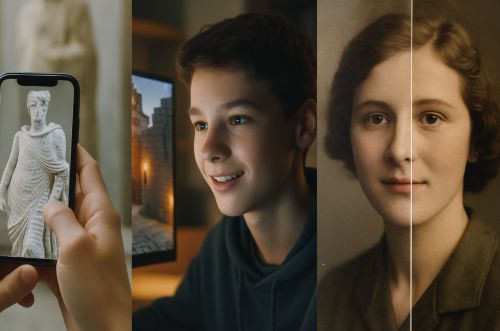
The three easy ways to preserve history are capturing reality through 3D photogrammetry, crowd-building historical sites inside popular video games, and utilizing artificial intelligence to restore damaged artifacts. These methods make cultural conservation accessible to non-experts.
According to UNESCO, one in three natural sites and one in six cultural heritage sites are currently threatened by climate change.
Additionally, 73% of World Heritage sites are highly exposed to at least one water-related hazard, and 21% face multiple overlapping risks.
Fortunately, technological advancements have significantly lowered the barrier to entry. This empowers educators, gamers, and local historical societies to protect disappearing cultural records without requiring institutional budgets.
Saving history does not have to be a government-funded operation reserved for specialists. Thanks to accessible technologies, the threshold for meaningful preservation work has dropped dramatically.
Each method outlined below is grounded in real-world projects with measurable results. They offer practical starting points you can act on today, most especially if you are an educator sourcing certified refurbished laptops from PCLiquidations to run historical reconstruction software.
Whether you are working within an institution or acting on personal initiative, these tools make preservation more achievable than ever. You might be a small museum director setting up an interactive iPad floor stand from VidaBox to digitize your local archive, or simply a community member who cares about what gets left behind. The power to preserve is now in your hands.
1. Capture Reality in 3D
When most people think of historical preservation, they imagine conservators in white gloves painstakingly repairing pottery shards. That image is not wrong, but it is incomplete. Today, one of the most powerful tools in a preservationist’s kit is a laser.
3D laser scanning works by emitting rapid pulses of light at a physical surface. It measures how long each pulse takes to return. The result is a point cloud, a three-dimensional map of millions of data points forming an accurate digital model. Some modern scanners capture accuracy within two millimeters across entire building facades.
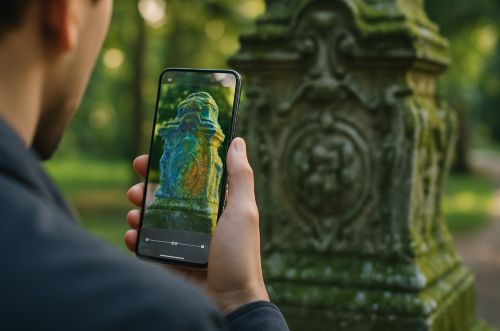
Photogrammetry is the more accessible cousin of laser scanning. Instead of lasers, it uses overlapping photographs taken from multiple angles that are stitched together by software into a 3D model. Crucially, this technique works with standard digital cameras and smartphones. Apps like Polycam and Scaniverse bring basic photogrammetric capture to anyone with a steady hand.
Both methods produce the same core asset. They create a permanent, navigable digital twin of a physical space or object. This digital record survives floods, fires, conflict, and time.
No organization better illustrates the urgency of this technology than CyArk. Founded in 2003, CyArk is a nonprofit dedicated to digitally preserving threatened cultural heritage sites. Their project portfolio includes the ancient city of Pompeii, the temples of Palmyra, and Chichén Itzá in Mexico.
Their work at Palmyra proved prescient. CyArk had already conducted a full 3D scan of the site before it was partially destroyed in 2015. Researchers retained a complete digital record of structures that were subsequently demolished. This record ensures the cultural memory of those spaces is never fully erased.
CyArk’s scans routinely capture tens of billions of data points per site. Several of their projects have been integrated into Building Information Modeling workflows. Engineers and architects can use the 3D data directly in professional design software. This is a significant proof point for institutional leaders considering digital capture.
The practical takeaway is that you do not need a six-figure laser scanner to make a meaningful contribution. Local historical societies and individual enthusiasts are already using smartphone photogrammetry. They document everything from historic gravestones to Victorian-era building facades. The barrier is low, the tools are inexpensive, and the output is highly durable.
A simple starting point involves downloading free applications like Polycam. Identify a local structure or artifact that lacks digital documentation. Follow the in-app guidance to capture a 3D model, then export and upload the file to a repository like Sketchfab. It starts a record where none existed before.
2. Crowd Build History Inside Popular Games
Some of the most effective historical reconstruction work happening right now is being done inside video games. Minecraft Education Edition has quietly become a legitimate tool for cultural heritage education and reconstruction. The platform allows educators to import real-world geospatial data. Students can create historically accurate 3D builds of ancient cities and vanished landscapes.
UNESCO has actively partnered with Minecraft Education to produce curriculum-aligned heritage builds. Their programs have put student groups inside virtual reconstructions of sites like Angkor Wat and Old Québec. Students are not passive viewers; they are active builders who contribute to the reconstructions. When a student builds an ancient Roman forum, they gain a spatial understanding that textbooks cannot replicate.
Ubisoft’s Assassin’s Creed franchise was always known for its historical settings. However, the release of the Discovery Tour editions crossed a notable line from entertainment into a genuine educational tool. The Discovery Tour mode strips away all combat and mission objectives. It leaves only a navigable, archaeologically informed open world.
Ubisoft employed historians, archaeologists, and cultural consultants to build these environments. The resulting models of Alexandria and Athens represent some of the most detailed digital reconstructions of ancient spaces ever produced. School districts in North America and Europe have formally incorporated these tours into history curricula. Museums also use the platform for public engagement programming.
If commercial games stumble into preservation territory, titles like Never Alone represent something far more intentional.
Developed in collaboration with the Iñupiaq community of Alaska, Never Alone is a puzzle platformer built explicitly around cultural transmission. Community elders and storytellers worked directly with the development team. They ensured that the game accurately represented Iñupiaq oral traditions and values.
Unlockable insights within the game feature documentary videos from community members. These videos explain the stories and traditions that inspired each element of the gameplay. The game is now used in Alaskan school curricula as a tool for language education. It represents a model for how indigenous communities can pass traditions directly to the next generation.
3. Let AI Restore Damaged Artifacts
Rembrandt’s The Night Watch was cut down in 1715 to fit into its new location at Amsterdam’s City Hall. The cropped sections were considered lost for over three centuries. In 2021, the Rijksmuseum announced that artificial intelligence had recovered them. The museum’s research team trained a machine learning model to analyze Rembrandt’s own brushwork and color palette.
The AI-generated reconstructed panels matched Rembrandt’s technique with incredible precision. The restored sections are now displayed alongside the original painting. Visitors can experience viewing the artwork in its intended dimensions. This was not AI replacing human expertise, as conservators and art historians evaluated the outputs.
The AI simply accelerated a process that would have taken years of manual work. The Rijksmuseum project is high profile, but the underlying research directions extend far beyond flagship paintings. Researchers at institutions like MIT have explored AI applications for reconstructing damaged artifacts from partial data. They also use neural networks to infer missing structural information from incomplete archaeological records.
For smaller institutions, the more immediately relevant implication is cost reduction. Traditional restoration and digitization work is expensive and slow. AI tools are progressively reducing both the time and the expertise threshold required. This makes conservation viable for regional museums, family archives, and community historical projects.
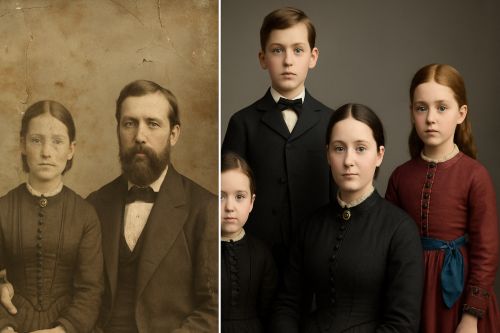
Institutions do not need a massive research budget to begin experimenting with AI-assisted preservation. A growing ecosystem of open source and low-cost tools is making entry-level AI restoration genuinely accessible. Programs like DeOldify are widely used by genealogists for colorizing historical photographs. Additionally, Real ESRGAN can significantly improve the resolution of low-quality historical scans.
While these tools offer incredible benefits, researchers urge caution regarding historical authenticity. Generative AI has been associated with popular large language models such as ChatGPT or even so-called ‘deepfakes’ that create false images that often appear very similar to a likely or original image. Therefore, AI restoration should always be carefully documented as such. Archival best practice is to preserve the unaltered original scan alongside any AI-processed version.
The Path Forward
Three methods present three very different entry points, yet they share a single urgency. 3D scanning is for those who want to create permanent records of physical spaces. Game-based reconstruction serves educators who want to make history tangible for younger audiences. AI restoration is ideal for institutions working with fragmentary records that conventional methods cannot recover.
The promise that these methods are surprisingly easy is real. However, meaningful preservation work grows in value when it is consistent, well-documented, and shared. A 3D scan uploaded to a public repository or a restored photograph added to a community archive represent vital acts of preservation.
The history documented today is the foundation the next generation builds upon. In a world where heritage sites and artifacts are disappearing fast, the most powerful thing anyone can do is start. Choose one method, find a local application, and begin securing the past for the future.
About the Author