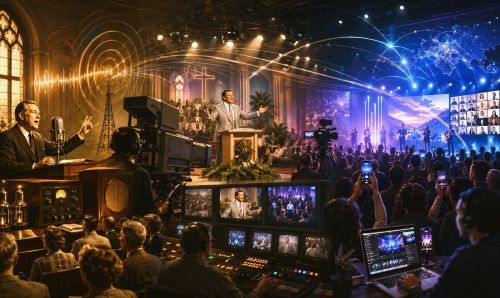
Radio, television, and televangelism transformed American religion by turning preaching into a mediated force of faith, commerce, celebrity, and politics.

By Matthew A. McIntosh
Public Historian
Brewminate
Introduction: The Gospel Enters the Airwaves
Religious broadcasting changed American religion by carrying preaching, prayer, music, testimony, and religious personality beyond the walls of the local congregation. Radio and television did not simply provide new channels for old messages. They altered the conditions under which religious authority could be heard, seen, funded, trusted, and contested. A preacher who once depended on pulpit, tent, revival platform, or denominational structure could now enter homes through a receiver and speak to listeners who might never join his church, meet his congregation, or submit to his institutional discipline. The gospel entered the airwaves as sound first, then as image, and eventually as a full commercial and political media system. This expansion changed the scale of religious address, but it also changed its texture. Broadcast preaching could feel intensely personal while remaining institutionally distant, intimate in tone yet anonymous in relationship. The listener alone in a kitchen, bedroom, car, hospital room, or farmhouse could feel directly addressed by a voice traveling through wires, towers, studios, and corporate networks. Religious presence was no longer limited to shared physical assembly. It could be transmitted, scheduled, sponsored, replayed, and built around personalities whose authority depended as much on mediated trust as on local accountability.
This transformation began with promise. Radio made religious speech intimate across distance, allowing sermons and sacred music to reach the sick, the isolated, the rural, the curious, and the unchurched. Television later added face, gesture, staging, healing, choir, architecture, and spectacle to that mediated presence. For many listeners and viewers, broadcast religion offered comfort, instruction, and a sense of belonging. It allowed people to pray with distant preachers, sing along with unseen congregations, and imagine themselves part of a wider spiritual community. Electronic media could make religion feel immediate, personal, and available at the turn of a dial or the push of a button.
Yet broadcast religion also introduced new pressures. Airtime had to be obtained, programs had to be produced, audiences had to be retained, and ministries had to be funded. These practical demands pushed religious broadcasting toward the habits of modern media: repetition, branding, donor cultivation, emotional appeal, personality-centered authority, and measurable audience response. The move from free public-service airtime to paid religious programming was especially important because it shifted power toward independent ministries able to purchase access and raise money directly from supporters. In that environment, the preacher became not only a religious leader but a broadcaster, fundraiser, performer, institutional entrepreneur, and sometimes political organizer.
The history of broadcast religion is a history of mediation and power. From Aimee Semple McPherson’s radio ministry in the 1920s to Rex Humbard, Oral Roberts, Pat Robertson, Jerry Falwell, Jim Bakker, Jimmy Swaggart, and the larger world of televangelism, electronic media remade the relationship between pulpit and public. It expanded access while weakening older gatekeepers. It gave evangelical and Pentecostal leaders national reach while tying ministry to market mechanisms. It created new devotional communities while encouraging spectatorship and celebrity. By the late 20th century, religious broadcasting had become more than a method of evangelism. It was an institution of American public life, blending faith, commerce, technology, and politics into the modern broadcast pulpit.
Radio Beginnings in the 1920s: Voice, Novelty, and Sacred Intimacy

Radio entered American religious life as both novelty and opportunity. By the 1920s, the medium was still technically young, culturally fascinating, and institutionally unsettled, which made it especially attractive to religious leaders willing to experiment. Churches, evangelists, denominations, and religious entrepreneurs quickly recognized that radio could carry sermons, hymns, prayers, and announcements beyond the physical limits of sanctuary or revival tent. The preacher’s voice no longer had to stop at the edge of a crowd. It could travel invisibly into homes, shops, farms, hospitals, and remote communities, arriving with an intimacy that print could not match and with a speed that itinerant preaching could not equal. Radio made religion portable, domestic, and strangely immediate.
The most important shift was acoustic. Radio restored voice to religious communication at mass scale. Printed tracts, newspapers, books, and denominational magazines had long circulated religious messages, but radio carried tone, hesitation, warmth, urgency, song, and emotional cadence. A sermon heard through a receiver could feel more personal than a printed sermon because it seemed to unfold in real time. Listeners encountered not only doctrine but vocal presence: the preacher’s pacing, confidence, tenderness, rebuke, humor, and appeal. This mattered profoundly for evangelical and Pentecostal religion, where spoken testimony, healing language, revival exhortation, and emotional directness already carried great weight. It also mattered for more formal religious traditions, because the medium could carry choir, liturgy, scripture reading, organ music, and public prayer into spaces that had previously been beyond the church’s physical reach. Radio gathered scattered listeners into an imagined acoustic congregation, one joined not by shared pews or common architecture but by simultaneous listening. That simultaneity was powerful. A person sitting alone could know that others were hearing the same hymn, sermon, or prayer at the same moment, and that awareness gave broadcast religion a communal quality even in solitude. Radio did not create the charismatic preacher, but it gave that figure a new acoustic body.
McPherson became one of the most vivid examples of this early religious broadcasting culture. From Angelus Temple in Los Angeles, she combined Pentecostal revivalism, theatrical staging, healing ministry, celebrity publicity, and modern communications with unusual skill. Her radio station, KFSG, launched in 1924, allowed her sermons, music, and religious persona to move beyond the thousands who could crowd into Angelus Temple. McPherson understood that radio was not merely a neutral pipe through which preaching could pass. It was a medium with its own emotional possibilities. Her voice could enter the home as preacher, comforter, performer, and spiritual authority, collapsing distance between public spectacle and private devotion. She also understood that the modern city, the popular press, the revival platform, and the broadcast studio could reinforce one another. Radio extended the drama of Angelus Temple, while newspaper coverage, public controversy, healing claims, charitable work, and McPherson’s own celebrity made the broadcast voice more recognizable and compelling. In her ministry, the older revival tradition met the modern communications age with almost theatrical confidence. She showed that broadcast religion would reward leaders who could master not only theology and organization, but timing, personality, and media presence.
Early radio religion was not limited to flamboyant evangelists or Pentecostal innovators. Mainline Protestant churches, Catholic broadcasters, Jewish organizations, local congregations, and denominational leaders also experimented with the medium. Some saw radio as a public-service extension of established religious life, a way to bring worship and moral instruction to those unable to attend in person. Others worried that broadcast preaching might weaken local church attendance, encourage religious individualism, or privilege theatrical personalities over settled pastoral care. These concerns were not misplaced. Radio created a new kind of religious audience: listeners could tune in without joining, receive comfort without accountability, and follow a preacher whose institutional location might be distant or unclear. The home became a chapel, but also a marketplace of voices.
The 1920s also revealed the importance of technical control and access. To broadcast, religious groups needed equipment, licenses, engineering knowledge, studio arrangements, and favorable relationships with stations or regulators. This meant that the airwaves were never simply open to everyone. Radio promised democratic reach, but access depended on institutions, money, technical skill, and regulatory permission. A congregation might possess zeal and a message, but without a transmitter, a station agreement, a license, or the money to sustain programming, that message remained local. The medium also required adaptation. Sermons built for a visible congregation did not automatically work for unseen listeners; music had to be arranged for microphones; speakers had to learn pacing suitable for broadcast; and religious leaders had to imagine an audience they could not see. Even at this early stage, religious broadcasting raised questions that would later define the field: Who should be allowed to speak in the name of religion? Should airtime be treated as public service, commercial property, denominational privilege, or evangelistic mission? Could religious broadcasting be trusted if its authority came through personality and audience response rather than local congregation, tradition, or ecclesiastical structure?
The first decade of religious radio established patterns that would endure throughout the history of broadcast religion. It made sacred speech intimate at a distance. It rewarded memorable voices and recognizable personalities. It extended religious participation to people outside the physical congregation while loosening the bonds of local religious discipline. It required churches and evangelists to negotiate technology, regulation, money, and audience expectations. Above all, it transformed the preacher’s voice into a mediated presence. The radio listener did not merely receive information about religion. The listener encountered a voice that seemed to arrive personally, invisibly, and authoritatively through the air. That strange intimacy became the foundation on which later television evangelism would build.
Mainline Control, Network Policies, and the Struggle over Religious Access
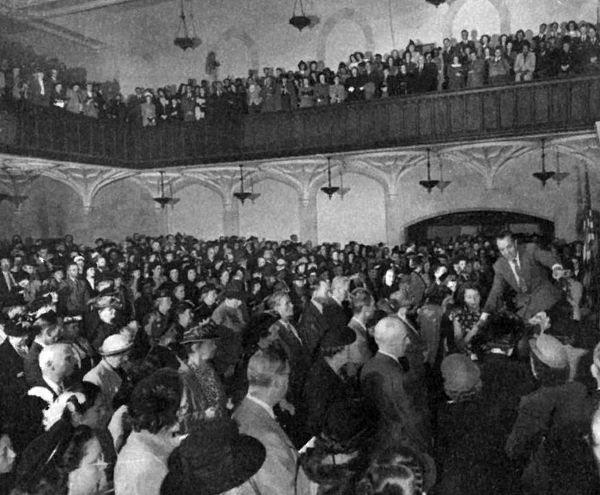
As radio matured from novelty into national institution, religious broadcasting became entangled with questions of gatekeeping. The airwaves were not an open commons where any preacher with a message could simply speak. Stations, networks, regulators, denominational committees, and public-service expectations all shaped who received access and under what conditions. In the early and mid-20th century, major broadcasters often preferred religious programming that appeared respectable, balanced, nonsectarian, and institutionally accountable. This favored mainline Protestant bodies, Roman Catholic representatives, Jewish organizations, and ecumenical councils that could claim to speak for broad religious constituencies. Independent evangelicals, Pentecostals, fundamentalists, and revivalist preachers often found themselves treated with more suspicion, not necessarily because they lacked audiences, but because they seemed divisive, emotional, entrepreneurial, or too doctrinally aggressive for broadcasters anxious about public responsibility.
The system of free or “sustaining” time reflected this preference. Networks and stations could present religious broadcasting as a civic service rather than a commercial product, but that model also allowed them to decide which religious voices counted as legitimate public religion. Religious programs offered in this setting were usually expected to avoid direct fundraising, partisan controversy, denominational attack, and excessive emotionalism. Such expectations were not unreasonable from the standpoint of broadcasters trying to serve a plural public, but they carried theological and cultural consequences. They defined acceptable religion in terms congenial to moderation, institutional representation, and middle-class respectability. A polished sermon by a recognized denominational leader fit the model. A revivalist appeal for conversion, a Pentecostal healing service, or a fundamentalist attack on theological liberalism did not. The result was a broadcast environment in which access could be publicly justified as fairness while still excluding or marginalizing forms of religion with deep popular appeal. The very language of public service could conceal a struggle over religious style. Broadcasters were not only deciding how much religion belonged on the air; they were deciding what religion should sound like when it addressed the nation. Calm, ecumenical, educated, and socially respectable religion appeared safe. Urgent, conversionist, anti-modernist, or charismatic religion appeared risky. That distinction helped shape the religious imagination of broadcasting long before paid-time evangelists overturned the older arrangement.
Conservative evangelicals increasingly understood this arrangement as a struggle over religious speech itself. Many believed that network policies gave liberal or mainline Protestant voices disproportionate authority while forcing evangelicals either to moderate their message or seek alternative routes to the audience. This resentment helped energize the formation and growth of evangelical broadcasting institutions, including the National Religious Broadcasters, which emerged in the 1940s amid disputes over network access and the place of independent religious programming. The conflict was not only technical or administrative. It was theological, cultural, and populist. Evangelical broadcasters argued that the gospel should not be filtered through ecumenical committees, denominational respectability, or network assumptions about public taste. They saw radio as a mission field, not simply a civic forum, and they believed that the right to preach directly to the public was inseparable from religious freedom.
These conflicts also exposed a deeper difference between two models of religious authority. Mainline and network-friendly religious broadcasting tended to assume that authority flowed through recognized institutions, trained clergy, denominational structures, and carefully balanced public representation. Independent evangelical broadcasting depended more heavily on calling, conversionist urgency, entrepreneurial organization, audience response, and donor support. Each model had strengths and vulnerabilities. Institutional broadcasting could avoid sensationalism and preserve public trust, but it could also become bland, cautious, and disconnected from popular religious energy. Independent broadcasting could speak with urgency, reach neglected audiences, and bypass elite gatekeepers, but it could also reward personality, controversy, and direct emotional appeal. The dispute was not only over access to airtime; it was over the definition of trustworthy religion in a mass-media age. Was religious credibility grounded in denominational office, theological education, and representative committees, or could it be grounded in audience response, conversion testimony, biblical confidence, and the perceived anointing of a preacher’s voice? That question would haunt religious broadcasting for decades. The later rise of paid-time religious broadcasting would not create this divide from nothing. It would give the independent model a new economic engine.
By the 1940s and 1950s, then, the foundations of later televangelism were already visible in radio’s access battles. The central issue was not only what could be preached, but who controlled the microphone. Network policy, public-service ideology, denominational representation, and regulatory caution all shaped the religious soundscape of American broadcasting. Evangelicals learned an enduring lesson from this period: if access was controlled by institutions suspicious of their message, then they would need their own stations, associations, funding systems, and eventually television networks. The struggle over airtime helped turn religious broadcasting from a public-service supplement into a self-conscious evangelical media movement. Long before the “electronic church” of the 1970s and 1980s, conservative broadcasters were already building the habits of independence that would later define religious television.
Television Arrives: The Preacher as Screen Presence

Television changed religious broadcasting by adding the body back to the mediated voice. Radio had made preaching intimate through sound, but television made the preacher visible as face, gesture, posture, clothing, setting, and performance. This mattered because religious authority is never communicated by words alone. A speaker’s gaze, movement, facial expression, stage arrangement, surrounding congregation, choir, altar, or healing line could now become part of the message. Television did not simply transmit sermons. It framed religious personality. The preacher became a screen presence, and the audience encountered faith through a carefully arranged combination of voice, image, music, space, and emotional pacing.
Early television evangelists had to learn a medium that rewarded different skills from pulpit preaching or radio address. The camera could magnify sincerity, but it could also expose awkwardness. A preacher who thundered effectively in a revival tent might seem excessive in a living room, while a quieter speaker could gain power through close-up, timing, and direct address. Television also changed the setting of religious communication. Worship services could be broadcast from churches, auditoriums, studios, or specially designed spaces, each carrying different meanings. A visible congregation suggested communal legitimacy. A choir added emotional fullness. A healing service gave television something dramatic to show. A carefully designed set could make a ministry appear stable, modern, prosperous, or intimate. Religious authority became partially visual.
Rex Humbard’s television ministry from Akron, Ohio, helped define the church-based model of early religious television. His weekly broadcasts, beginning in the early 1950s, presented worship from a recognizable church setting rather than only from a studio or revival platform. This approach mattered because it allowed viewers to imagine themselves joining an existing congregation, even from a distance. The televised church gave religious broadcasting a sense of regularity, order, and domestic accessibility. Humbard’s ministry demonstrated that television could make a local church into a national religious environment, one in which viewers saw worshippers, heard music, followed preaching, and encountered a pastor whose authority rested on repeated visual familiarity. The screen made continuity visible. It also made the congregation itself part of the broadcast message. Viewers did not simply see Humbard as an isolated religious personality; they saw him embedded in a worshipping community, surrounded by music, architecture, family, ritual order, and gathered people. That visual setting softened some of the anxieties that religious broadcasting might detach viewers from ordinary church life, even as it quietly expanded the idea of what church-like participation could mean. A person could sit at home and watch a service that appeared local, stable, and communal while experiencing it as a personal devotional appointment. Humbard’s model showed how television could preserve the appearance of congregational worship while extending it beyond the congregation’s physical boundaries.
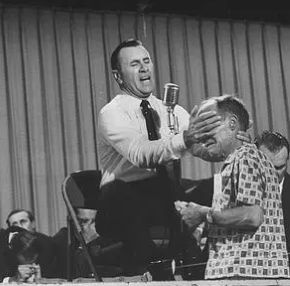
Oral Roberts represented a different but equally important adaptation of television to religious charisma. His healing ministry brought Pentecostal and revivalist practices into a medium hungry for visible action. Prayer, testimony, bodily affliction, expectation, touch, and claimed healing could be arranged as compelling television. Roberts understood that healing evangelism depended not only on doctrine but on the dramatic visibility of need and response. The camera could focus on faces, bodies, gestures, and moments of emotional intensity, allowing distant viewers to witness what radio could only describe. This visual grammar helped translate revival religion into national media culture. It also raised difficult questions about spectacle, evidence, suffering, and the vulnerability of viewers drawn to televised promises of divine intervention.
Television’s arrival also intensified the economic and institutional pressures already present in radio. Production costs were higher, visual quality mattered, airtime was valuable, and viewers had to be cultivated through regular programming, newsletters, offerings, books, records, prayer cloths, and donor appeals. Television rewarded ministries that could sustain an audience week after week while presenting themselves as trustworthy, emotionally compelling, and financially worthy. The preacher on screen became the center of a larger media apparatus: camera operators, musicians, producers, mailing lists, accountants, prayer lines, studio facilities, and eventually national distribution systems. Religious broadcasting was no longer only a voice on the air. It was becoming an organization built around repeatable screen intimacy. That intimacy required constant maintenance. Ministries had to persuade viewers not only to watch once, but to return, write, give, pray, subscribe, and imagine themselves as partners in a shared mission. The television ministry blurred the boundary between congregation, audience, and donor base. A viewer could be spiritually moved, emotionally attached, financially solicited, and institutionally counted without ever entering the same room as the preacher. This was one of television religion’s most consequential innovations: it made distance feel like belonging while converting that belonging into a durable support system.
The move from radio to television marked a decisive step toward televangelism. It did not yet produce the full “electronic church” of the 1970s and 1980s, but it established the basic visual logic that would make that later boom possible. The preacher had to be heard, but also seen. The ministry had to communicate doctrine, but also personality, atmosphere, professionalism, and emotional credibility. The audience was invited not merely to listen, but to watch, identify, support, and return. Television made religious authority more vivid while also more fragile. It could make a preacher beloved in millions of homes, but it also tied trust to image, production, charisma, and public performance. Once the pulpit entered the screen, American religion had crossed into a new kind of visibility.
The Paid-Time Revolution: From Public Service to Religious Marketplace
The paid-time revolution changed the structure of religious broadcasting more profoundly than any single preacher, program, or technology. Earlier broadcast religion had often been shaped by the logic of public service, with stations and networks offering free or “sustaining” time to recognized religious bodies that appeared representative, respectable, and broadly acceptable. That system favored institutional religion and allowed broadcasters to present religious programming as a civic responsibility rather than a commercial transaction. Paid-time broadcasting altered that balance. Once religious ministries could purchase airtime, access depended less on denominational legitimacy and more on financial capacity, audience loyalty, fundraising skill, and entrepreneurial ambition. The microphone and camera were no longer only granted by gatekeepers. They could be bought.
This commercial shift did not simply give independent evangelicals a larger platform; it changed what successful religious broadcasting required. Ministries now had to raise money continuously to remain on the air. They had to cultivate donors, collect addresses, send newsletters, sell books and records, operate prayer lines, organize rallies, and build emotional relationships with viewers who might never attend a local congregation. The audience became more than a listening or viewing public. It became a support base. This transformed religious media into a cycle of appeal and response: the program created trust, trust generated donations, donations purchased more airtime, and more airtime expanded the audience. The result was a new kind of ministry economy in which spiritual authority, technical production, and financial survival were tightly bound together.
The numbers reveal the scale of the transformation. In the older model, religious programming often appeared as part of a station’s public-service obligation, but by the late 20th century paid-time broadcasting had become dominant. Studies of religious television showed a sharp shift from sustaining-time programs toward purchased airtime, with paid religious television expanding dramatically by the 1970s. This mattered because the ministries most willing and able to pay for access were often independent evangelical, Pentecostal, fundamentalist, or charismatic organizations rather than mainline denominational bodies. The commercial model rewarded those who could make a direct emotional and financial appeal to viewers without relying on ecumenical approval, denominational committees, or network definitions of respectable religion. It also encouraged ministries to think nationally, because airtime purchased in one market could be joined to other markets, mailing lists, rallies, publications, and eventually satellite distribution. Paid time did not produce a neutral pluralism. It advantaged groups that could mobilize audiences directly, speak with emotional urgency, and turn viewer attachment into financial commitment. The religious marketplace rewarded those who could convert attention into support.
This new marketplace also changed the tone and structure of programming. A ministry buying airtime had to justify its expense, which meant that broadcasts increasingly included fundraising appeals, testimonies, prayer offers, crisis language, promised blessings, donor clubs, special gifts, and invitations to become a “partner” in the work. The viewer was not simply asked to watch or believe, but to participate financially in extending the broadcast. This could create a genuine sense of shared mission, especially for isolated viewers who felt personally connected to a ministry. A widow, shut-in, rural believer, new convert, or disaffected churchgoer could feel that a check, letter, phone call, or prayer request made them part of something larger than themselves. Yet it also blurred the line between pastoral care and marketing. Religious intimacy became monetizable. A preacher could look into the camera, address the viewer as a friend, ask for prayer requests, promise spiritual companionship, and then ask for money to keep the message on the air. In the most responsible forms, this created reciprocal religious community at a distance. In the most troubling forms, it made vulnerability, loneliness, fear, illness, and hope part of a fundraising system whose emotional power was difficult to audit.
The paid-time revolution prepared the way for the televangelism boom of the 1970s and 1980s. It weakened older mainline and network gatekeeping, empowered independent ministries, and made religious broadcasting dependent on market discipline. The consequences were enormous. Paid time democratized access for voices previously excluded from public-service models, but it also rewarded scale, charisma, urgency, and financial pressure. It allowed religious entrepreneurs to create national ministries outside traditional denominational structures, but it made those ministries vulnerable to excess, secrecy, donor manipulation, and personality-centered authority. Once airtime became a commodity, broadcast religion entered a new world. The question was no longer simply who deserved to speak for religion on the air. It was who could afford to stay there.
The Televangelism Boom of the 1970s and 1980s: Networks, Donors, and the Electronic Church
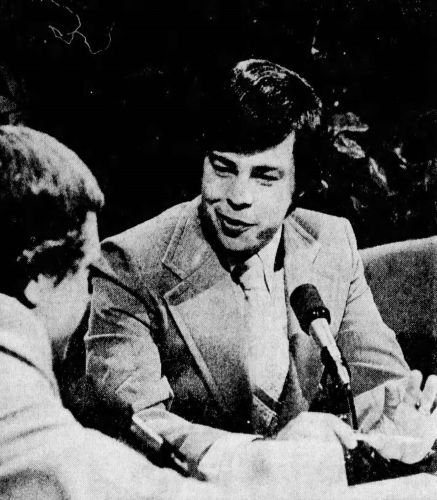
The 1970s and 1980s marked the great expansion of American televangelism, when religious broadcasting became a full media ecosystem rather than a supplement to church life. Earlier radio preachers and television evangelists had already demonstrated the power of electronic religion, but the paid-time system, expanding cable and satellite distribution, direct-mail fundraising, toll-free numbers, and increasingly professional production allowed ministries to operate at national scale. The result was what critics and scholars often called the “electronic church”: a religious world in which viewers could watch sermons, send prayer requests, donate money, purchase books or recordings, join donor clubs, and feel attached to a ministry without belonging to its local congregation. Televangelism did not eliminate ordinary churches, but it created a parallel religious structure with its own rhythms, personalities, institutions, and financial logic.
Pat Robertson’s Christian Broadcasting Network showed how ambitious this structure could become. What began as a religious broadcasting venture grew into a media institution with programming, fundraising systems, news commentary, and eventually significant political influence. He understood television not only as a pulpit but as an infrastructure for building a constituency. The viewer was not merely a passive recipient of preaching but a potential donor, activist, prayer partner, and member of a national religious public. The Christian Broadcasting Network helped demonstrate that evangelical television could be more than a program purchased on scattered stations. It could become a networked environment, capable of distributing devotional content, interpreting current events, shaping religious identity, and linking media consumption to public action. This was a crucial development because it moved televangelism beyond the figure of the isolated preacher and toward the creation of durable institutions. A network could repeat messages, cultivate loyalty, train viewers in a shared moral vocabulary, and frame national events through a religious lens. It could also gather data, maintain mailing lists, solicit recurring support, and transform occasional viewers into a recognizable constituency. His model showed that the future of religious television lay not only in preaching on camera, but in building a media system through which religion, fundraising, news, politics, and identity could continually reinforce one another.
Jerry Falwell’s Old-Time Gospel Hour represented another important model of televangelism. Falwell’s broadcast extended the reach of Thomas Road Baptist Church and presented fundamentalist preaching as both local church ministry and national religious address. Unlike ministries that emphasized healing, prosperity, or charismatic intimacy, Falwell projected doctrinal certainty, pastoral authority, institutional growth, and moral alarm. Television allowed him to speak beyond Lynchburg, Virginia, to viewers who shared his concerns about secularism, family, education, sexuality, and the perceived moral direction of the United States. His ministry showed how televangelism could join church-building, fundraising, education, and political messaging in one integrated system. The camera did not merely enlarge the pulpit. It helped turn the pulpit into a national platform.
Jim Bakker and the PTL ministry revealed yet another dimension of the electronic church: affective intimacy, entertainment, and religious community as mediated experience. PTL mixed talk-show informality, music, testimony, humor, emotional confession, fundraising, and eventually the creation of Heritage USA into a world that felt less like a single broadcast sermon than an alternative religious environment. Viewers were invited not only to hear a message, but to belong to a family, join a movement, and participate in a shared dream. This made PTL especially powerful for people seeking warmth, reassurance, and companionship. Bakker’s style depended on emotional availability: tears, laughter, conversational spontaneity, domestic familiarity, and the repeated suggestion that viewers were not strangers but partners and friends. That language gave the broadcast a pastoral texture, even though the relationship was mediated through cameras, letters, telephones, donations, and promotional systems. Heritage USA extended that fantasy into physical space, turning televised belonging into a destination that viewers could visit, support, and imagine as proof of the ministry’s divine favor and institutional success. It also exposed the risks of ministries built around emotional proximity without ordinary congregational accountability. The same mediated intimacy that created loyalty could make viewers vulnerable to financial appeals and personality-driven trust.
Other televangelists widened the field. Oral Roberts continued to connect healing, prosperity, education, and television spectacle. Jimmy Swaggart brought Pentecostal preaching, music, tears, denunciation, and emotional intensity to a large national audience. Robert Schuller’s Hour of Power, broadcast from the Crystal Cathedral, offered a more optimistic and therapeutic Protestantism shaped by architectural polish, positive thinking, and carefully staged visual beauty. Rex Humbard sustained the church-based television model, while numerous smaller ministries purchased regional airtime, built donor lists, and imitated the methods of larger broadcasters. The boom was not a single movement with one theology. It included Pentecostal, charismatic, fundamentalist, Baptist, prosperity, therapeutic, and broadly evangelical strands. What united them was not doctrinal uniformity but media form: repeated broadcast presence, donor support, direct address, and the construction of religious belonging at a distance.
The televangelism boom demonstrated both the power and instability of religious broadcasting as institution. Its greatest strength was reach. Millions of viewers could encounter preaching, music, prayer, testimony, and religious interpretation outside the limits of local church geography. Its greatest vulnerability was structure. Authority often centered on charismatic figures whose ministries depended on constant fundraising, audience loyalty, media visibility, and organizational expansion. The electronic church could comfort the isolated, mobilize the already convinced, and give conservative evangelicals a sense of national presence. But it could also blur the line between ministry and brand, congregation and audience, pastoral care and donor management, religious authority and celebrity. By the height of the 1980s boom, televangelism had become one of the most visible forms of American religion, and one of the most contested.
Broadcast Religion and the Religious Right

Broadcast religion became politically significant because it created more than audiences. It created communities of interpretation, networks of trust, and mechanisms for mobilization. By the late 1970s and 1980s, conservative evangelical broadcasters were not simply preaching to private souls. They were speaking to viewers and listeners who increasingly understood themselves as part of a national religious public under cultural siege. Television and radio helped translate diffuse anxieties about schools, courts, sexuality, feminism, abortion, secularism, crime, communism, and national decline into a shared moral vocabulary. The broadcast pulpit did not invent conservative Christian politics, but it gave that politics a voice, a face, a mailing list, and a recurring place in the American home.
This political turn must be understood carefully. The Religious Right did not emerge from television alone, nor did evangelical conservatism suddenly begin in the 1970s. Its roots extended through older fundamentalist-modernist conflicts, anti-communist activism, battles over education, resistance to desegregation in some white evangelical institutions, suburban growth, Sunbelt conservatism, and long-standing disputes over the moral authority of the state. Broadcast religion became powerful because it could connect these concerns across geography. A viewer in Texas, Virginia, California, or Ohio could hear the same warning about secular humanism, moral collapse, or judicial overreach and come to feel part of a larger struggle. Media made local grievances national without requiring a single denominational structure to contain them.
Falwell’s role illustrates this fusion of pulpit, television, and politics. Through the Old-Time Gospel Hour, Falwell had already built a national audience before he became one of the best-known faces of organized conservative evangelical politics. His public language joined biblical authority to cultural alarm, presenting political engagement as a defense of family, nation, morality, and Christian civilization. The Moral Majority, founded in 1979, depended on more than broadcasting, but television and direct-mail networks gave leaders like Falwell tools for rapid communication, fundraising, and identity formation. Falwell’s authority was not only that of a pastor in Lynchburg, Virginia. It was the authority of a mediated figure who could repeatedly enter homes, frame events, name enemies, and call viewers to action. That repetition mattered because political identity is not formed only through single arguments. It is formed through recurring stories, familiar phrases, trusted voices, and emotionally recognizable warnings. Falwell’s broadcasts helped teach viewers how to interpret public life through a moralized opposition between faithful Americans and hostile secular elites. The television ministry became a training ground for political perception, turning cultural anxiety into organized language and organized language into potential action.
Pat Robertson represented a related but distinct model. Through the Christian Broadcasting Network and The 700 Club, he helped create an evangelical media environment in which news, prayer, political commentary, prophecy, interviews, and activism could flow together. This mattered because it blurred the boundary between devotional programming and political interpretation. Viewers did not encounter politics as a separate civic subject detached from faith. They encountered it within a religious media world that interpreted current events through spiritual conflict, moral urgency, and providential meaning. his later presidential campaign in 1988 showed how broadcast religion could become a platform for direct political ambition. Even when such campaigns failed electorally, they demonstrated that religious broadcasting had created a recognizable constituency capable of being courted, organized, and counted.
Broadcast religion also changed the emotional style of conservative politics. Televangelists did not speak in the detached language of policy papers. They spoke in the language of crisis, testimony, conversion, family, threat, prayer, and deliverance. This style gave political issues religious immediacy. Abortion was not merely a legal question; it became a sign of national sin. School prayer was not merely a constitutional issue; it became evidence of secular exclusion. Feminism, LGBTQ rights, pornography, and changing sexual norms were not merely social transformations; they were framed as attacks on divinely ordered family life. Such framing could simplify complex issues, but it also gave viewers a powerful sense that political participation was a form of religious obedience. The broadcast format intensified this effect because it joined public controversy to private emotion. A viewer encountered national politics not in a town hall or party meeting, but in the intimate setting of the home, often through a preacher already trusted for prayer, comfort, and spiritual instruction. This made political appeals feel pastoral and moral rather than merely partisan. Voting, donating, writing letters, attending rallies, and supporting candidates became extensions of spiritual warfare and moral witness.
The relationship between broadcast religion and the Religious Right shows how media can transform religious identity into political capacity. Radio and television did not simply spread conservative evangelical ideas. They organized attention, repeated narratives, elevated leaders, gathered donors, and created a sense of shared embattlement. The same technologies that made viewers feel spiritually connected to distant preachers could also make them feel politically connected to distant allies. This was the deeper legacy of broadcast religion in American public life: it turned the mediated congregation into a mobilizable constituency. By the end of the 1980s, the broadcast pulpit had become not only a religious instrument but a political one, capable of shaping elections, party strategy, public morality, and the language of national crisis.
Scandal, Credibility, and the Limits of Media Ministry

The scandals that struck American televangelism in the late 1980s did not simply expose personal failures. They revealed structural vulnerabilities built into personality-driven, donor-funded religious broadcasting. Televangelists had cultivated intimacy at a distance, speaking into homes as pastors, friends, prophets, healers, and moral guardians. Viewers sent money, prayer requests, testimonies, and emotional trust to ministries they often knew only through screens, newsletters, and televised appeals. When scandal erupted, the damage reached beyond individual reputations. It called into question the entire machinery of mediated trust: the camera close-up, the tearful appeal, the donor letter, the prayer line, the promise that a distant ministry was spiritually accountable to the people supporting it.
Jim Bakker and the PTL ministry became the most visible symbol of this crisis. PTL had built a vast religious media world around affective intimacy, entertainment, prosperity language, donor partnership, and the dream of Heritage USA. Its collapse, involving financial misconduct and sexual scandal, showed how easily a media ministry could blend pastoral care, celebrity culture, real estate ambition, fundraising pressure, and institutional opacity. Bakker’s appeal had depended heavily on emotional connection, presenting viewers as members of a loving religious family. That made the betrayal feel personal to supporters. The problem was not only that money had been mishandled or that a leader had fallen morally. It was that the entire broadcast relationship had encouraged viewers to trust a mediated personality and organization whose internal operations were far less visible than its televised image.
Jimmy Swaggart’s scandal soon deepened the credibility crisis because it struck a preacher whose public authority rested heavily on moral denunciation, emotional intensity, and Pentecostal sincerity. Swaggart’s televised confession became one of the defining images of the period, demonstrating how scandal itself could become religious media. The same cameras that had carried sermons, music, tears, rebuke, and revival appeal now carried collapse, shame, apology, and public judgment. This was a crucial turn in the history of televangelism. Television had made religious authority visible, but it also made failure spectacular. The medium that built trust could dismantle it with equal force, especially when audiences saw the gap between preached morality and private conduct.
These scandals did not destroy religious broadcasting, but they damaged its moral confidence and exposed its dependence on charisma, secrecy, and continual fundraising. Ministries that operated outside strong denominational oversight or congregational accountability could expand rapidly, but they could also evade ordinary checks on leadership, finances, and pastoral responsibility. The donor base was broad, emotionally attached, and often geographically scattered, which made accountability difficult. A local congregation might know its pastor, board, budget, and community relationships directly. A television ministry asked viewers to trust edited images, urgent appeals, glossy newsletters, and the repeated claim that giving was participation in divine work. The scandals revealed that mediated intimacy could substitute for accountability without providing its substance. They also showed how easily religious success could become self-justifying. Large audiences, impressive facilities, emotional testimonies, and constant fundraising totals could be treated as signs of divine blessing, making criticism seem like opposition to the ministry itself. In that environment, donors might not know whether they were supporting evangelism, debt service, institutional expansion, personal luxury, or a media operation struggling to sustain its own image. The crisis exposed a fundamental weakness in the electronic church: it could create the feeling of closeness while placing the actual mechanisms of governance, money, and decision-making far from public view.
The late-1980s credibility crisis marked a turning point, but not an ending. Televangelism survived by adapting, fragmenting, professionalizing, and sometimes rebranding. Some ministries became more cautious with financial presentation. Others leaned further into cable, satellite, niche networks, prosperity teaching, political commentary, or later digital platforms. Viewers did not abandon religious media altogether because the needs it served remained real: comfort, instruction, prayer, identity, political interpretation, and a sense of belonging. Yet after Bakker and Swaggart, the electronic church could no longer be understood only as an expansion of evangelism. It had to be seen as a risky institutional form, capable of remarkable reach but vulnerable to celebrity collapse, financial manipulation, and the seductive power of appearing spiritually intimate while remaining structurally distant.
Cable, Satellite, Internet, and the Afterlife of Televangelism
This video from “Churchfront” covers church livestreaming:
The scandals of the late 1980s weakened the moral prestige of televangelism, but they did not end religious broadcasting. Instead, the form adapted to a more fragmented media environment. Cable television, satellite distribution, religious networks, video recordings, websites, email lists, livestreams, podcasts, apps, YouTube channels, and social media platforms extended the logic of televangelism beyond the classic era of three-network television and nationally famous broadcast preachers. The old electronic church did not disappear. It dispersed. Its methods migrated into new platforms where religious authority could be produced through recurring visibility, audience loyalty, donor systems, emotional intimacy, and direct address without necessarily depending on traditional congregational structures.
Cable and satellite television allowed religious broadcasting to survive by narrowing and intensifying its audience rather than always seeking broad national respectability. Dedicated religious channels and specialty networks could reach viewers already inclined toward evangelical, Pentecostal, charismatic, Catholic, prophetic, prosperity, or devotional programming. This changed the economics of religious media. Instead of fighting for limited airtime on general commercial stations, ministries could find space within niche ecosystems built for continuous religious content. Sermons, worship music, Bible prophecy programs, fundraising telethons, political commentary, healing services, and testimonial formats could fill entire schedules. Viewers were no longer simply encountering a weekly televangelist within a mixed broadcast environment. They could enter a media world where religious programming was always available, where one program led naturally to another, and where a channel’s identity reinforced the audience’s sense of belonging to a distinct religious public. Cable and satellite also allowed ministries to segment audiences more precisely, speaking to particular theological, political, ethnic, denominational, or devotional communities without needing to soften the message for a broad mainstream audience. The result was not the decline of televangelism but its specialization. Religious television became less a national spectacle shared by everyone and more a durable subculture sustained by committed viewers.
The internet then altered the field more radically by lowering barriers to entry. A preacher no longer needed a television contract, a studio, a satellite slot, or a large donor base to begin broadcasting. A smartphone, livestream account, podcast feed, website, or social media channel could create a public ministry almost instantly. This democratized religious media in ways earlier broadcasters could only have imagined. Small churches could stream services. Independent teachers could build followings. Worship leaders could release songs directly. Prophetic voices, apologists, political commentators, pastors, and influencers could reach audiences without denominational approval or network gatekeeping. Yet this openness also multiplied the old problems. Authority became easier to claim, harder to verify, and more dependent on visibility, engagement, emotional resonance, and platform algorithms.
Digital platforms also changed the nature of religious presence. Classic televangelism created scheduled appointments: a viewer tuned in at a certain time to watch a familiar preacher. Online religion is more continuous, searchable, shareable, and personalized. Sermons become clips. Testimonies become reels. Prayer becomes a livestream comment. Giving becomes a button. Controversy becomes an engagement strategy. A worship service can be watched live, replayed later, cut into short segments, embedded in a newsletter, posted across platforms, and recirculated by supporters. This creates new forms of religious community, but they are unstable and uneven. Followers may feel deeply connected to a preacher they have never met, while simultaneously moving among many online teachers, churches, and spiritual personalities. The mediated congregation becomes more fluid, less bounded, and more algorithmically shaped. The old broadcast audience gathered around a program; the digital audience gathers around feeds, recommendations, subscriptions, notifications, and shareable fragments. That shift matters because religious authority increasingly depends on being findable, repeatable, and emotionally legible in short form. A dramatic sermon clip may travel farther than the sermon itself. A prayer moment may become detached from the service that produced it. A political warning, prophetic claim, or fundraising appeal may circulate without local context or institutional accountability. Digital religion intensifies televangelism’s old promise and old danger at once: it can make religious speech extraordinarily accessible, but it can also detach charisma from community, message from accountability, and spiritual intimacy from durable relationship.
The afterlife of televangelism is especially visible in prosperity teaching, online charismatic ministries, political prophecy networks, megachurch livestreams, and religious influencer culture. The central figure may no longer appear primarily as a television evangelist in the old sense. He or she may be a pastor with a global livestream audience, a YouTube apologist, a prophetic commentator, a worship celebrity, a political preacher, a TikTok teacher, or a conference speaker whose clips circulate independently from any single event. Yet the inherited pattern remains recognizable: mediated intimacy, repeated access, donor cultivation, personal testimony, crisis language, and the claim that viewers are partners in a larger mission. What changed was the platform. The emotional and institutional logic of the electronic church remained remarkably durable.
This does not mean that digital religion is merely televangelism in new clothes. The internet also expanded access for small congregations, marginalized voices, homebound worshippers, disabled participants, diasporic communities, and people alienated from traditional institutions. It made archives available, connected scattered believers, enabled theological education, and allowed religious communities to survive moments of disruption, especially during the COVID-19 pandemic. But the history of broadcast religion warns that access and distortion often travel together. Cable, satellite, and internet media extended the reach of religious speech while intensifying questions about accountability, authority, audience formation, and money. The afterlife of televangelism is not a simple decline after scandal, but a migration into a platform world where the broadcast pulpit became portable, personalized, and almost impossible to contain.
Conclusion: The Broadcast Pulpit and the Making of Mediated Faith
The history of broadcast religion is not simply a story of new technology carrying old sermons to larger audiences. It is the story of a profound reorganization of religious authority in the age of electronic media. Radio first detached the preacher’s voice from the immediate congregation, allowing sacred speech to enter homes with a new intimacy. Television then restored image to that voice, making the preacher’s face, gesture, setting, choir, congregation, and emotional style part of the message. Cable, satellite, and digital platforms later multiplied that mediated presence, turning religious broadcasting from a scheduled program into a continuous environment. Across these changes, the pulpit did not disappear. It became portable, repeatable, commercial, visual, and increasingly personal.
This transformation expanded religious access in undeniable ways. Broadcast religion reached the sick, elderly, isolated, rural, curious, disaffected, and homebound. It gave many people sermons, prayers, music, healing language, political interpretation, and spiritual companionship they might not otherwise have received. It also gave evangelical, Pentecostal, charismatic, and fundamentalist leaders a way to bypass mainline gatekeepers and speak directly to national audiences. For communities that felt ignored or misrepresented by established religious and cultural institutions, the broadcast pulpit offered power, recognition, and connection. It created imagined congregations across distance, gathering people not through shared pews but through repeated listening, viewing, giving, writing, calling, and identification. This reach was not merely numerical. It reshaped the emotional geography of religious life, allowing a person far from a church, alienated from a denomination, or confined by illness, disability, work, geography, or family circumstances to feel addressed by a wider religious world. Broadcast religion could make distant believers feel less alone and could give scattered audiences a common language of prayer, crisis, hope, and moral belonging. That access was real, even when the structures behind it were flawed. The mediated preacher could not fully replace the local congregation, but the broadcast pulpit often met people at the exact places where ordinary congregational life had failed to reach them.
Yet the same system that widened access also changed the terms of trust. Broadcast religion tied ministry to airtime, production, fundraising, donor cultivation, audience retention, personality, and image. The move from public-service programming to paid-time religious media rewarded ministries that could turn attention into financial support. The televangelism boom of the 1970s and 1980s showed how powerful this model could become, while the scandals of the late 1980s exposed its fragility. Religious broadcasting could create pastoral intimacy without local accountability, institutional scale without transparency, and moral authority around figures whose private lives and financial systems remained hidden from the audience that sustained them. The broadcast pulpit could comfort, teach, and mobilize, but it could also sell, pressure, and perform.
Broadcast religion remade American faith by blending devotion, media, commerce, and politics into a new religious form. Its legacy is visible not only in classic televangelism, but in livestreamed worship, online preaching, religious podcasts, YouTube ministries, political prophecy networks, digital giving, and influencer pastors. The medium has changed, but the central questions remain familiar: who controls the microphone, who funds the message, who verifies the authority, who benefits from the relationship, and what kind of community is being formed? From radio revivalists to digital preachers, mediated faith has promised presence across distance. Its gift is reach. Its danger is distance disguised as intimacy. The broadcast pulpit became one of the most powerful religious instruments of modern America because it made belief audible, visible, fundable, and mobilizable through the technologies of mass communication.
Bibliography
- Balmer, Randall. Mine Eyes Have Seen the Glory: A Journey into the Evangelical Subculture in America. 4th ed. New York: Oxford University Press, 2014.
- Bowler, Kate and Wen Reagan. “Bigger, Better, Louder: The Prosperity Gospel’s Impact on Contemporary Christian Worship.” Religion and American Culture: A Journal of Interpretation 24:2 (2014), 186-230.
- Bruce, Steve. Pray TV: Televangelism in America. London: Routledge, 1990.
- Campbell, Heidi A. Digital Religion: Understanding Religious Practice in New Media Worlds. London: Routledge, 2012.
- Dochuk, Darren. From Bible Belt to Sunbelt: Plain-Folk Religion, Grassroots Politics, and the Rise of Evangelical Conservatism. New York: W. W. Norton, 2010.
- Falwell, Jerry. Listen, America!. Garden City, NY: Doubleday, 1980.
- Frankl, Razelle. Televangelism: The Marketing of Popular Religion. Carbondale: Southern Illinois University Press, 1987.
- Hadden, Jeffrey K. “The Rise and Fall of American Televangelism.” The Annals of the American Academy of Political and Social Science 527 (1993), 113-130.
- Hadden, Jeffrey K., and Charles E. Swann. Prime Time Preachers: The Rising Power of Televangelism. Reading, MA: Addison-Wesley, 1981.
- Hangen, Tona J. Redeeming the Dial: Radio, Religion, and Popular Culture in America. Chapel Hill: University of North Carolina Press, 2002.
- Harding, Susan Friend. The Book of Jerry Falwell: Fundamentalist Language and Politics. Princeton, NJ: Princeton University Press, 2000.
- Harrell, David Edwin, Jr. Oral Roberts: An American Life. Bloomington: Indiana University Press, 1985.
- Hilmes, Michele. Radio Voices: American Broadcasting, 1922–1952. Minneapolis: University of Minnesota Press, 1997.
- Hoover, Stewart M. Mass Media Religion: The Social Sources of the Electronic Church. Newbury Park, CA: Sage Publications, 1988.
- Hutchings, Tim. Creating Church Online: Ritual, Community and New Media. London: Routledge, 2017.
- Litman, Barry R. and Elizabeth Bain. “The Viewership of Religious Television Programming: A Multidisciplinary Analysis of Televangelism.” Review of Religious Research 30:4 (1989), 329-343.
- Lochte, Bob. Christian Radio: The Growth of a Mainstream Broadcasting Force. Jefferson, NC: McFarland, 2006.
- Martin, William. With God on Our Side: The Rise of the Religious Right in America. New York: Broadway Books, 1996.
- McLoughlin, William G. Modern Revivalism: Charles Grandison Finney to Billy Graham. New York: Ronald Press, 1959.
- Moore, R. Laurence. Selling God: American Religion in the Marketplace of Culture. New York: Oxford University Press, 1994.
- Nagata, Judith. “Beyond Theology: Toward an Anthropology of ‘Fundamentalism’.” American Anthropologist 103:2 (2001), 481-498.
- Peck, Janice. The Gods of Televangelism: The Crisis of Meaning and the Appeal of Religious Television. Cresskill, NJ: Hampton Press, 1993.
- Robertson, Pat. The Secret Kingdom. Nashville: Thomas Nelson, 1982.
- —-. Shout It from the Housetops. Plainfield, NJ: Logos International, 1972.
- Schultze, Quentin J. Christianity and the Mass Media in America: Toward a Democratic Accommodation. East Lansing: Michigan State University Press, 2003.
- —-. Televangelism and American Culture: The Business of Popular Religion. Grand Rapids, MI: Baker Book House, 1991.
- Sutton, Matthew Avery. Aimee Semple McPherson and the Resurrection of Christian America. Cambridge, MA: Harvard University Press, 2007.
- Voskuil, Dennis N. “The Power of the Air: Evangelicals and the Rise of Religious Broadcasting.” In American Evangelicals and the Mass Media, edited by Quentin J. Schultze, 69–95. Grand Rapids, MI: Zondervan, 1990.
- Wagner, Rachel. Godwired: Religion, Ritual and Virtual Reality. London: Routledge, 2012.
- Ward, Mark, Sr. Air of Salvation: The Story of Christian Broadcasting. Grand Rapids, MI: Baker Books, 1994.
- Wilcox, Clyde, and Carin Robinson. Onward Christian Soldiers? The Religious Right in American Politics. Boulder, CO: Westview Press, 2010.
- Williams, Daniel K. God’s Own Party: The Making of the Christian Right. Oxford: Oxford University Press, 2010.
Originally published by Brewminate, 05.08.2026, under the terms of a Creative Commons Attribution-NonCommercial-NoDerivatives 4.0 International license.
About the Author