Modern history shows that known lies endure when followers trade truth for loyalty, identity, fear, power, or imagined necessity.

By Matthew A. McIntosh
Public Historian
Brewminate
Introduction: The Political Life of the Known Lie
Modern political lying is rarely sustained by the liar alone. It survives because others decide, sometimes openly and sometimes by degrees, that truth has become less useful than loyalty. The most dangerous falsehoods in public life are not always the ones believed in innocence, nor even the ones imposed by censorship or fear. They are often the lies that followers, officials, intellectuals, parties, and institutions learn to defend after evidence has begun to break through the surface. At that point, deception becomes something more durable than error. It becomes a pact. The leader supplies the falsehood, but the supporter supplies its political life.
I begin from a distinction between being deceived and consenting to deception. Political communities have always depended on myth, memory, symbolism, and selective interpretation, but modern mass politics gave these older habits new instruments and scale. Newspapers, radio, film, television, intelligence briefings, party machines, polling, and digital media all expanded the reach of political narrative while narrowing the psychological distance between public identity and public falsehood. They also created new layers of mediation between event and citizen, allowing leaders and their defenders to turn uncertainty into certainty, scandal into persecution, defeat into betrayal, and evidence into conspiracy. A lie could now become more than a ruler’s convenience. It could become a badge of membership, a test of patriotism, a defense of class, party, army, race, nation, faith, or revolution. In that environment, supporters may not need to believe every false claim in a literal sense. They may only need to accept its usefulness, repeat its vocabulary, and punish those who refuse its terms. Once that transformation occurs, truth no longer functions as a corrective. It becomes an accusation.
The problem has an ancient philosophical shadow. Plato’s “noble lie” in the Republic imagined deception as a civic myth, a falsehood told for the supposed harmony of the city rather than for private gain. Yet the modern history of political falsehood shows how easily that logic mutates. The claim that deception serves order, security, progress, or national survival has justified forged evidence, imperial fantasy, racial propaganda, famine denial, electoral manipulation, covert escalation, criminal cover-up, and preventive war. What begins as the defense of a larger good can become the excuse by which people surrender the discipline of reality itself. The lie is no longer regrettable. It becomes necessary. Then it becomes virtuous.
I trace that political life of the known lie from nineteenth-century Bonapartism through the Dreyfus Affair, Nazi propaganda, Stalinist apologetics, Cold War exaggerations, Watergate, and the Iraq War. These episodes differ in scale, ideology, violence, and moral consequence, and they should not be flattened into equivalence. Yet they reveal a recurring pattern. People support leaders known to lie because the lie protects something they fear losing: authority, belonging, ideological hope, national innocence, material advantage, or political victory. Modern history does not merely show that leaders lie. It shows that lies become powerful when communities discover that they can live inside them.
Bonapartism after Napoleon: Persigny, Napoleon III, and the Romance of the Necessary Man
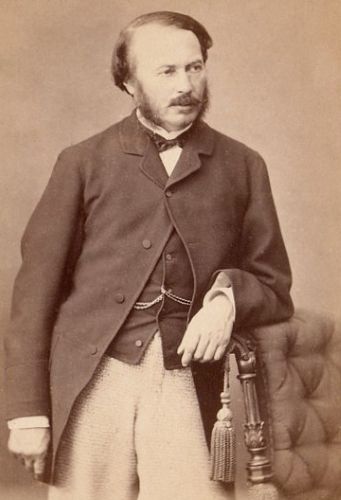
Bonapartism after Napoleon was not simply nostalgia for a dead emperor. It was a political faith built from memory, grievance, and theatrical expectation. The first Napoleon had left behind not only a military legend but a vocabulary of authority: order after revolution, glory after humiliation, central power after parliamentary drift, and popular sovereignty fused with personal command. To his loyalists, the Bonaparte name seemed to promise a way out of the exhausting instability that had marked France since 1789. That promise was already half myth, half program. It depended on a public willing to treat one family name as historical destiny, even when the living claimant offered more romance than evidence.
Louis-Napoléon Bonaparte, the future Napoleon III, entered politics through that mythology before he possessed any real political power. After the death of Napoleon II in 1832, he increasingly presented himself as heir to the Napoleonic cause, but the gap between imperial memory and practical capacity was glaring. His attempted military rising at Strasbourg in 1836 collapsed almost immediately, revealing the weakness of his conspiratorial network and the absurdity of expecting the army to recreate Napoleon’s return from Elba by sheer emotional reflex. His second attempt at Boulogne in 1840 was no more successful. He landed with followers, symbols, proclamations, and the expectation that spectacle could summon allegiance. Instead, he was arrested, tried, and imprisoned at Ham. The future emperor first appeared to much of official France not as a statesman, but as a romantic adventurer who mistook costume for legitimacy.
It is here that Jean-Gilbert Victor Fialin, later Viscount of Persigny, becomes especially revealing. Persigny’s significance lies less in his originality than in his loyalty to a political fantasy while it still looked ridiculous. He was not merely supporting a candidate. He was sustaining a myth before history had vindicated it. At Boulogne, Persigny stood among those who gambled on Louis-Napoléon’s improbable claim, and the failure did not discredit the cause in his eyes. To the hostile observer, this was delusion. To the committed Bonapartist, it was fidelity. The difference matters because political lies often survive first among small circles of believers who reinterpret failure as temporary misunderstanding, ridicule as persecution, and recklessness as prophetic audacity.
The lie at the center of early Bonapartism was not a simple factual claim that could be disproved and abandoned. It was a story about necessity. France, the Bonapartists implied, did not merely remember Napoleon. France still needed Napoleon, and if the original emperor was dead, history required a successor bearing his name. This was the romance of the necessary man: the belief that one figure, by blood, symbol, and will, could stand above ordinary politics because ordinary politics had failed the nation. Such a claim could absorb contradiction because it did not rest on ordinary proof. It rested on historical mood, wounded pride, and the psychological convenience of believing that national confusion could be resolved by personal restoration. If Louis-Napoléon failed at Strasbourg, it proved only that the hour had not yet come. If he failed at Boulogne, it proved only that the people and army had not yet recognized their own desire. Even imprisonment at Ham could be recast as preparation, martyrdom, and waiting rather than disgrace. Failure did not weaken the myth. It gave the faithful another reason to wait.
That waiting ended with the Revolution of 1848, when the collapse of the July Monarchy suddenly made the impossible plausible. Louis-Napoléon returned from exile into a republic frightened by socialism, exhausted by faction, and hungry for order. In December 1848, he was elected president by an enormous popular vote, not because French voters had all embraced a coherent Bonapartist doctrine, but because the Napoleonic name could mean many things at once. To peasants, it could evoke order, property, and memory. To conservatives, it could promise containment of revolutionary unrest. To some workers, it could suggest social concern without class war. To opportunists, it offered a vehicle to power. The same ambiguity that had made Louis-Napoléon seem unserious in conspiracy made him formidable in mass politics.
Persigny and other loyalists helped transform that ambiguity into a governing instrument. Bonapartism claimed to rise above parties while using party conflict to justify executive supremacy. It spoke the language of universal male suffrage while concentrating authority around a single ruler. It denounced parliamentary weakness while converting popular election into personal mandate. After Louis-Napoléon’s coup of December 2, 1851, the logic became unmistakable: the elected president presented the destruction of the republic’s constitutional limits as the fulfillment of the people’s will. The plebiscite then supplied democratic clothing for authoritarian consolidation, giving the regime a vocabulary of consent even as it narrowed the practical space for opposition. This was not a crude return to the old absolutism of kings. It was something more modern and more slippery: executive domination ratified by mass approval, managed through spectacle, press control, administrative pressure, and the repeated insistence that the ruler embodied the people more authentically than representative institutions did. Bonapartism did not reject popular sovereignty. It captured it, personalized it, and made obedience look like participation.
Karl Marx’s famous critique in The Eighteenth Brumaire of Louis Bonaparte saw this clearly, even through its polemical force. For Marx, Louis-Napoléon’s rise depended on the exhaustion and fragmentation of social forces that could not rule coherently through parliamentary forms. The nephew appeared as a diminished echo of the uncle, but that echo had power because French politics had become vulnerable to symbolic substitution. The past returned not as living grandeur, but as political performance. Yet Marx’s contempt should not obscure the depth of the phenomenon. Supporters did not need Louis-Napoléon to be Napoleon I. They needed him to make the Napoleonic legend politically usable again. That was enough. The gap between man and myth was not a fatal defect for Bonapartism. It was the condition that made Bonapartist politics possible, because the living claimant could be filled with meanings borrowed from the dead emperor. In that sense, Louis-Napoléon’s weakness as an individual politician became less important than his usefulness as a vessel. The necessary man did not have to possess necessity in himself. His followers could manufacture it around him.
Bonapartism after Napoleon belongs in a history of support for known or suspected deception because it shows the power of mythic consent. Persigny’s loyalty, Louis-Napoléon’s failed adventures, the election of 1848, and the coup of 1851 all reveal a politics in which evidence of recklessness could be overwritten by the hunger for providential leadership. The necessary man does not have to prove himself by ordinary standards because his supporters have already decided that ordinary standards are part of the national problem. This is how political falsehood becomes romance. It does not begin by saying that facts do not matter. It begins by saying that destiny matters more.
The Dreyfus Affair: Institutional Loyalty and the Lie That Protected the Army
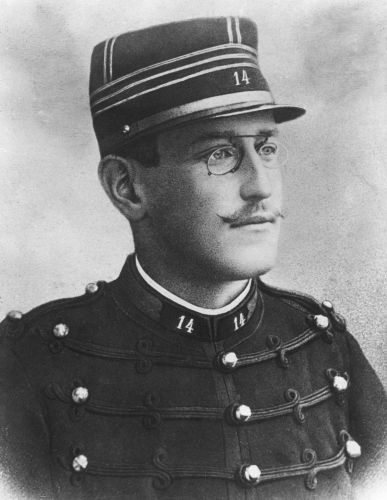
The Dreyfus Affair exposed one of the most corrosive forms of political deception: the lie defended not because it remains plausible, but because too much authority has already been invested in it. In 1894, Captain Alfred Dreyfus, a Jewish officer in the French army, was convicted of treason for allegedly passing military secrets to Germany. The case against him rested on handwriting analysis, secrecy, antisemitic suspicion, and a military culture that confused its own honor with the honor of France. Dreyfus was publicly degraded in the courtyard of the École Militaire, stripped of rank before a crowd that shouted for his death, and sent to Devil’s Island. The state had not merely convicted a man. It had staged a national ritual of purification, as if the army could cleanse itself of humiliation, espionage panic, and internal insecurity by sacrificing one officer who could be made to embody betrayal.
What made the affair historically decisive was not only the original injustice, but the stubbornness with which officials protected it after the case began to collapse. Lieutenant Colonel Georges Picquart, appointed head of the army’s intelligence section, discovered evidence pointing not to Dreyfus but to Major Ferdinand Walsin Esterhazy. In an institution governed by ordinary legal conscience, this should have reopened the case. Instead, Picquart was removed, discredited, and sent away, while forged documents and secret dossiers were used to preserve the conviction. The logic of the cover-up became more important than the facts of the case, because the General Staff had already bound its prestige to the claim that Dreyfus was guilty. Every new doubt became a threat not only to a verdict, but to the army’s self-presentation as the guardian of national security and patriotic honor. Colonel Hubert-Joseph Henry’s later confession that he had fabricated evidence revealed the moral structure of the affair with brutal clarity. The forgery was not an isolated aberration by a desperate officer. It was the visible symptom of an institution that had taught itself to prefer false certainty over public humiliation. The lie had become institutional property. To admit Dreyfus’s innocence would mean admitting that the army, military justice, the General Staff, and the nationalist press had collaborated in destroying an innocent man. The system defended the falsehood because the falsehood defended the system.
The anti-Dreyfusards did not all occupy the same moral position. Some were animated by raw antisemitism, convinced that Dreyfus’s Jewish identity made guilt believable before evidence was even weighed. Others trusted the army because they believed the army was the last sacred institution standing after decades of revolution, defeat, republic, monarchy, empire, and republic again. Still others understood enough to suspect that something had gone wrong but treated scrutiny itself as betrayal. This was the deeper danger. Institutional loyalty turned truth into disloyalty. To question the verdict was to attack France. To defend Dreyfus was to aid Germany. To expose forgery was to weaken the army. In this logic, evidence did not correct the public lie. Evidence became part of the enemy’s arsenal.
Émile Zola’s “J’Accuse…!” broke that moral arrangement by forcing the hidden machinery of the case into public speech. Published in L’Aurore in January 1898, Zola’s open letter named officials, exposed the conspiracy of silence, and turned Dreyfus’s conviction from a military matter into a national crisis over justice, republicanism, clericalism, antisemitism, and the meaning of citizenship. The affair divided France into camps because it asked whether the nation belonged to truth or to authority. That division explains why the case endured beyond Dreyfus himself. The affair became a referendum on whether republican society could survive the humiliation of admitting that its guardians had lied, forged, concealed, and persecuted in the name of national honor. Dreyfus’s eventual rehabilitation did not erase the damage. It revealed how long an organized falsehood could persist when wrapped in uniform, flag, and institutional pride.
The Dreyfus Affair belongs at the center of any modern history of support for leaders and institutions known to lie. It demonstrates that the supporter of falsehood is often not merely defending a claim, but defending a hierarchy of belonging. The lie protected the army, the army protected the nation, and the nation, in anti-Dreyfusard imagination, had to be protected from the destabilizing force of truth itself. This is why the affair remains so instructive. It shows how a state can move from mistake to cover-up, from cover-up to ideology, and from ideology to moral inversion. Once that inversion takes hold, the innocent man becomes dangerous because his innocence proves the guilt of the powerful.
Totalitarian Propaganda and the Nazi “Big Lie”: When Falsehood Becomes a Political World

Nazi propaganda belongs to a different order of deception from Bonapartist romance or the institutional cover-up of the Dreyfus Affair. It did not merely defend a false verdict or inflate a leader’s destiny. It constructed an entire political world in which falsehood became the organizing grammar of reality. The Nazi movement taught Germans to interpret economic hardship, military defeat, parliamentary conflict, cultural pluralism, and social anxiety through a single conspiratorial frame. In that frame, Germany was innocent, enemies were everywhere, and redemption required obedience to a leader who claimed to reveal what ordinary politics had concealed. The lie was not a detachable instrument. It became the atmosphere in which politics itself was meant to breathe.
The phrase “big lie” requires careful handling, because modern usage often collapses several things into one convenient formula. The idea is most directly associated with Adolf Hitler’s Mein Kampf, where he accused Jews of using a lie so enormous that ordinary people would not imagine anyone could distort reality on such a scale. The later irony is obvious and historically devastating: Nazi politics became one of the most destructive examples of precisely that method. Joseph Goebbels, as minister of propaganda, did not simply repeat slogans until people mechanically believed them. He coordinated press, radio, film, theater, education, rallies, posters, and ritual spectacle into a system of emotional instruction. The United States Holocaust Memorial Museum notes that Goebbels envisioned control over schools, universities, film, radio, and propaganda, a vision that turned communication into governance itself. The regime did not only tell Germans what to think. It taught them how to feel before thought could intervene.
At the center of this world stood the myth of national betrayal. Germany’s defeat in World War I, the Treaty of Versailles, inflation, unemployment, and Weimar instability were recast as evidence that the nation had been stabbed in the back by internal enemies. This story was false, but it was politically useful because it transformed humiliation into grievance and grievance into permission. It relieved supporters of the burden of historical complexity. Military defeat no longer required analysis of strategy, exhaustion, alliance systems, economic pressure, or state failure. It could be blamed on Jews, Marxists, republicans, liberals, cosmopolitans, and anyone else marked as alien to the national body. The conspiracy gave pain a target and failure a traitor.
That is why antisemitism was not incidental to Nazi falsehood. It was the central architecture of the Nazi political imagination. Jewish people were portrayed simultaneously as capitalist exploiters and Bolshevik revolutionaries, as weak parasites and omnipotent conspirators, as outsiders to Germany and secret masters of its institutions. The contradictions did not weaken the propaganda because coherence was not its purpose. Its purpose was mobilization. Nazi antisemitic propaganda trained audiences to accept mutually incompatible claims so long as all of them led to the same emotional conclusion: the Jew was the enemy. The United States Holocaust Memorial Museum’s account of Nazi propaganda emphasizes how the regime communicated its message through images, slogans, and repeated portrayals of Jews as existential threats. Factual inconsistency mattered less in this system than emotional consistency. Hatred supplied the continuity that reason could not.
The Führer myth gave this universe its human center. Hitler was presented not as one politician among others, but as the embodiment of German will, insight, and destiny. Ian Kershaw’s formulation of the “Hitler myth” remains indispensable because it shows that support for Hitler did not rest only on coercion or ignorance. Many Germans invested in an image of Hitler as a leader above corruption, faction, and ordinary self-interest, even when the regime around him was violent, chaotic, and predatory. Failures could be blamed on subordinates, enemies, saboteurs, or insufficient loyalty. Successes, whether real, exaggerated, or staged, were credited to the Führer’s genius. This arrangement protected the leader from reality by making reality pass through the filter of devotion.
Totalitarian propaganda also altered the moral status of lying itself. In liberal political culture, lies are at least formally treated as violations of public trust, even when politicians routinely commit them. In Nazi political culture, lying on behalf of the movement could be treated as service to a higher truth. The racial nation, not empirical reality, became the measure of meaning. A falsehood that strengthened the Volksgemeinschaft, the imagined national community, could appear more “true” than a fact that weakened it. The United States Holocaust Memorial Museum describes the Nazi idea of Volksgemeinschaft as a racialized national community that promised unity while excluding those defined as alien or unworthy. This was the moral inversion at the core of the propaganda state. Truth was not what corresponded to evidence. Truth was what served the racial mission.
This does not mean that every German supporter consciously knew every Nazi claim was false, nor that fear, censorship, conformity, and opportunism can be ignored. The point is more disturbing than that. Nazi propaganda created conditions in which people could simultaneously know and not know. They could see violence and call it restoration. They could hear threats and call them defense. They could watch neighbors disappear and call it purification, necessity, or none of their business. The political world built by propaganda gave them language for evasion. It allowed ordinary moral perception to be suspended without requiring every participant to sit down and openly confess complicity. A society does not need every citizen to be a fanatic for totalitarian lying to work. It needs enough citizens to accept the categories through which fanaticism explains the world.
The Nazi “big lie,” then, was not merely a large falsehood repeated frequently. It was a system that made falsehood socially useful, emotionally satisfying, and politically binding. It converted fear into loyalty, grievance into identity, prejudice into doctrine, and obedience into redemption. That is why Nazi propaganda remains essential to any modern history of support for lying leaders. It shows what happens when supporters do not merely excuse deception but inhabit it. Once falsehood becomes a political world, escape requires more than correction. It requires the collapse of the moral universe that made the lie feel like truth.
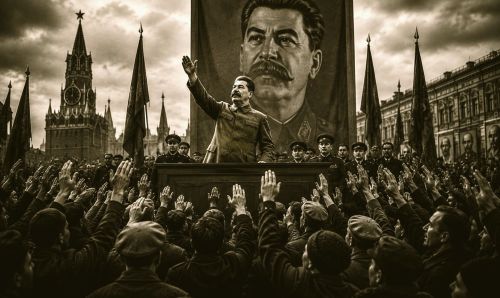
Stalin, Duranty, and the Western Defense of Revolutionary Illusion
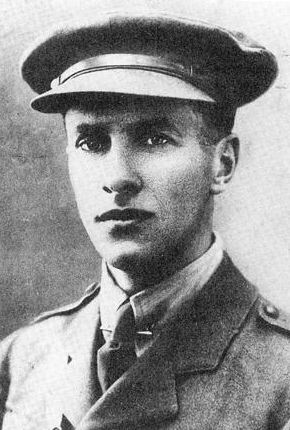
The defense of Stalinism by foreign admirers reveals another form of support for the known lie: not the loyalty of citizens trapped inside a dictatorship, but the loyalty of outsiders who could have looked more carefully and often chose not to. The Soviet Union under Joseph Stalin presented itself as the future made flesh, a society that had supposedly escaped capitalist exploitation, class hierarchy, imperial decadence, and liberal weakness. For many Western intellectuals, journalists, activists, and political pilgrims, that promise carried enormous emotional power. To admit the scale of Soviet coercion, famine, forced labor, censorship, and terror was not simply to revise an opinion about one government. It was to endanger a moral dream.
Walter Duranty, the Moscow correspondent for The New York Times, became one of the most infamous figures in this history because his reporting helped normalize Stalin’s regime for Western readers at a moment when Soviet violence was remaking society by force. Duranty was not a naïve tourist dazzled by official parades. He was an experienced reporter with access, contacts, and enough knowledge to understand that Soviet reality was darker than the official story. Yet his dispatches often minimized terror, excused coercion, and treated brutality as the painful but necessary cost of historical transformation. His most notorious failures came during the famine of 1932–1933, when millions died in Ukraine and other grain-producing regions while Soviet authorities denied, concealed, and distorted the catastrophe.
The contrast with Gareth Jones is crucial. Jones, a Welsh journalist who traveled through Soviet Ukraine, reported honestly on starvation, empty villages, and the human cost of collectivization. His reports were met not only with Soviet denial, but with dismissal by members of the foreign press corps who preferred access to truth. Duranty’s famous formulation that there was no actual famine, though there had been widespread food shortages, showed how language could preserve respectability while burying reality. The sentence did not have to sound like crude propaganda to function as propaganda. It softened mass death into administrative difficulty. It converted catastrophe into transition. It allowed readers who wanted to believe in the Soviet experiment to remain believers. Even more importantly, it offered Western sympathizers a vocabulary of evasion that sounded sober, informed, and balanced. Starvation could be described as “shortage,” state violence as “discipline,” and mass death as the tragic background noise of modernization. Jones forced famine into public view; Duranty helped make disbelief respectable.
The Western defense of Stalin cannot be explained only by ignorance. Ignorance existed, and the Soviet state worked hard to manufacture it through censorship, intimidation, staged tours, controlled interviews, and selective access. But ignorance was reinforced by desire. Many observers wanted the Soviet Union to be proof that history had another path. After the devastation of World War I, the failures of liberal capitalism, the Great Depression, and the rise of fascism, communism appeared to some as the only force with sufficient moral and organizational power to remake society. In that atmosphere, evidence of Soviet terror could be treated as hostile exaggeration, capitalist slander, or the tragic but temporary violence of necessary modernization. The lie survived because it was attached to hope. It also survived because admitting the truth would have required a profound psychological surrender. Western admirers had not merely defended a foreign state. They had invested personal reputations, political identities, friendships, publications, movements, and sometimes entire moral lives in the claim that the Soviet Union represented the future. To see the famine clearly was to see themselves implicated, not as executioners, but as enablers of illusion.
This was the revolutionary version of the “greater good” defense. Stalin’s defenders did not always deny suffering absolutely. Some acknowledged hardship but folded it into a narrative of industrialization, anti-fascist preparation, peasant backwardness, or socialist discipline. They asked readers to look beyond the dead toward the steel mills, dams, literacy campaigns, and planned economy. This moral arithmetic was devastating. It made victims appear as the cost of progress rather than the evidence against it. It also turned criticism into reaction. Those who exposed famine, prisons, purges, or forced labor could be dismissed as enemies of the future, apologists for capitalism, or tools of fascism. Once again, truth was not answered. It was politically classified.
The Moscow show trials of the late 1930s deepened the pattern. Stalin’s regime staged confessions by old Bolsheviks accused of sabotage, treason, espionage, and conspiracy. These performances were absurd in their allegations, but they were not merely intended to persuade through plausibility. They displayed the regime’s power to make reality submit to political necessity. Some Western communists and fellow travelers accepted the trials because rejection would have required them to admit that the revolutionary state was devouring its own founding generation. Others remained silent, hedged, or waited for permission from the party line. The result was a theater of belief in which confession replaced evidence and loyalty replaced judgment. The spectacle worked because it transformed political murder into ideological housekeeping. If the accused confessed, then the party was vigilant. If the accusations seemed impossible, then the doubter had failed to understand the depth of counterrevolutionary conspiracy. This circular logic made skepticism itself suspect. As with the famine, the lie did not need perfect credibility. It needed disciplined repetition, institutional endorsement, and a community of believers willing to treat disbelief as betrayal.
Stalinism’s foreign apologists matter because they show how modern political lies can attract voluntary defenders far beyond the borders of the regime that creates them. Duranty and others did not invent Stalin’s falsehoods, but they gave them Western credibility. They translated coercion into experiment, famine into shortage, terror into discipline, and dictatorship into progress. Their failure was not only journalistic. It was moral and historical. They demonstrate that people may support a lying power not because they are forced to kneel before it, but because they have already knelt before the future they imagine it represents.
The Missile Gap: Cold War Fear and the Useful Campaign Falsehood
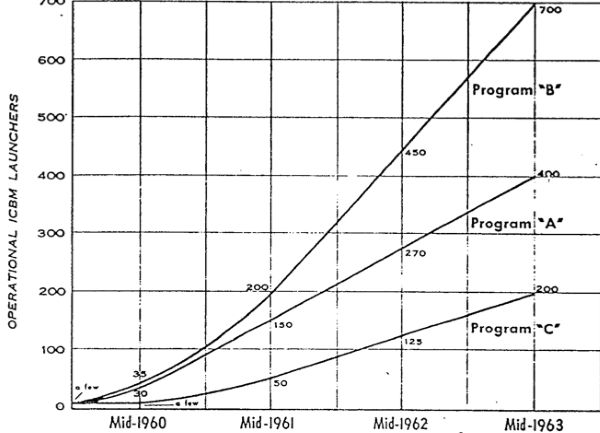
The missile gap controversy shows how political falsehood can flourish inside democratic competition when fear supplies the atmosphere and secrecy supplies the cover. Unlike the Dreyfus Affair or Stalinist apologetics, this was not a case in which an innocent man was destroyed or millions of deaths were denied. Its scale and moral character were different. Yet it belongs in this history because it reveals a subtler danger: the ability of political actors to convert uncertain or disputed national-security claims into public certainty when the claim is electorally useful. The lie did not need a totalitarian state. It needed anxiety, classified information, partisan incentive, and a public primed to believe that survival depended on being afraid enough.
The background was the early Cold War, when nuclear weapons transformed military rivalry into existential dread. The Soviet launch of Sputnik in 1957 intensified American fears that the United States was falling behind technologically, scientifically, and militarily. Rockets, satellites, and intercontinental ballistic missiles belonged to the same symbolic universe. If Moscow could place a satellite into orbit, many Americans feared that it could also deliver nuclear weapons across continents with decisive superiority. That fear was not irrational in the abstract. The nuclear age made uncertainty genuinely terrifying, and the public had good reason to understand that technical inferiority could carry catastrophic consequences. Yet the political meaning of Sputnik exceeded the technical evidence. It became a symbol of national vulnerability, educational failure, bureaucratic complacency, and possible strategic decline. The line between warning and exaggeration became a dangerously thin atmosphere. But uncertainty is precisely where political falsehood becomes useful. A gap did not need to be proven if it could be made plausible enough to mobilize voters.
John F. Kennedy used the missile gap as one of the sharpest weapons of his 1960 presidential campaign. He accused the Eisenhower administration, and by extension Vice President Richard Nixon, of allowing Soviet power to overtake American preparedness. The charge gave Kennedy a way to appear youthful but tough, critical of Republican complacency yet firmly anti-communist. It also allowed Democrats to reverse a familiar political vulnerability. Since the early Cold War, Republicans had often accused Democrats of weakness toward communism. The missile gap claim turned that accusation back on the party in power. If there was a gap, then Republican stewardship had endangered the country.
The problem was that the alleged Soviet advantage did not exist in the form Kennedy suggested. Intelligence available to President Dwight D. Eisenhower increasingly indicated that the United States was not behind in operational intercontinental ballistic missiles. Eisenhower knew from classified reconnaissance, including U-2 flights and other intelligence assessments, that Soviet missile strength had been exaggerated in public debate. Yet the president could not fully disclose the evidence without revealing sensitive intelligence capabilities. This secrecy created a democratic asymmetry. The administration possessed information that weakened the charge, but it could not easily prove its case in public. Kennedy and his supporters could press the issue with less evidentiary burden than the accused administration could answer it.
Kennedy’s defenders have sometimes argued that he did not have access to everything Eisenhower knew, and that Cold War intelligence estimates before satellite reconnaissance were often uncertain. That caution matters. The episode should not be reduced to a cartoon in which Kennedy privately knew the full truth and cynically repeated a sentence he knew to be false in every detail. The more revealing point is that his campaign continued to exploit the claim because it worked politically. The missile gap was useful even when its factual foundation was weak, contested, and increasingly suspect. It gave voters a simple story: danger had grown because leadership had failed. It also gave campaign supporters a way to sound responsible while amplifying alarm. They could present the charge not as opportunism, but as vigilance in the face of possible catastrophe. This is one reason national-security falsehoods are so resilient in democratic politics. They often hide behind the language of prudence. If the danger later proves exaggerated, supporters can say they erred on the side of safety. If opponents object too strongly, they can be accused of minimizing the enemy. In campaign politics, simplicity is often more valuable than accuracy.
Supporters of the claim participated in the same logic. Journalists, strategists, defense intellectuals, and partisan allies could treat skepticism as complacency because Cold War fear rewarded overstatement. To doubt the gap risked sounding naïve about Soviet intentions. To insist on the gap sounded vigilant, modern, and serious. The falsehood benefited from a moral imbalance common in national-security politics: exaggeration could be defended as prudence, while restraint could be condemned as weakness. In that atmosphere, being wrong in the direction of alarm appeared safer than being right in the direction of caution. Political ambition and strategic anxiety reinforced one another.
The missile gap controversy demonstrates how democratic publics can be led into useful falsehoods without formal censorship or dictatorship. The deception operated through selective emphasis, fear-laden inference, and the exploitation of classified uncertainty. It showed that supporters do not always defend lies because they reject democracy. Sometimes they defend them because the lie appears to serve democracy’s own urgent needs: security, vigilance, preparedness, and victory over an enemy. Yet the cost remains serious. When fear becomes an acceptable substitute for evidence, the public sphere does not merely become misinformed. It becomes easier to govern by alarm.
Gulf of Tonkin: Congressional Consent, Anti-Communism, and the Lie of Necessity

History and Heritage Command, Wikimedia Commons
The Gulf of Tonkin episode marked a more dangerous stage in the democratic politics of falsehood because it joined executive secrecy, military ambiguity, congressional fear, and Cold War ideology to the machinery of war. In August 1964, President Lyndon B. Johnson’s administration claimed that North Vietnamese forces had attacked American naval vessels in international waters on two occasions, first on August 2 and again on August 4. The first clash involving the USS Maddox was real, though its context was more complicated than the administration’s public presentation suggested. The second alleged attack was far more doubtful, with confusion, poor weather, sonar uncertainty, and conflicting reports casting immediate doubt on whether it had occurred at all. Yet ambiguity did not restrain the administration. It became the raw material of escalation.
Johnson presented the situation as one of clear aggression requiring firm but limited response. He transformed uncertainty into necessity. The administration did not tell the public that American naval operations in the Gulf were connected to a wider pattern of covert pressure against North Vietnam, including South Vietnamese raids supported through American planning and intelligence. Nor did it dwell on the uncertainty surrounding the alleged second attack, even though doubts existed within the government almost immediately and the available evidence was far less conclusive than the public statement implied. Instead, the president’s message framed North Vietnamese action as unprovoked aggression against United States forces peacefully operating in international waters. That framing mattered because it stripped the episode of its political and military context. It made the United States appear merely reactive, not already involved in an expanding and partially concealed conflict. It allowed Johnson to speak as the reluctant guardian of peace rather than as a president seeking wider authority in a war already deepening beneath the surface. This was the political genius and moral danger of the lie. It did not need to invent an entire war out of nothing. It needed only to simplify context, suppress doubt, and make hesitation appear irresponsible.
Congress responded with overwhelming support for the Gulf of Tonkin Resolution, which gave Johnson broad authority to use military force in Southeast Asia without a formal declaration of war. The vote revealed how fear of communism narrowed democratic deliberation. Many legislators were reluctant to challenge a president during an apparent attack on American forces. Others feared appearing weak in an election year or being blamed for the “loss” of Vietnam if the conflict worsened. The memory of China’s communist revolution, the Korean War, and years of domestic anti-communist accusation weighed heavily on the political imagination. In that atmosphere, skepticism carried a high price. Consent became easier than inquiry because consent looked patriotic, while inquiry could be made to look like surrender.
The lie of necessity operated through a familiar Cold War moral logic: action was dangerous, but inaction was supposedly worse. Johnson and his advisers did not simply seek retaliation for a naval incident. They sought usable authority for a deeper commitment to Vietnam while avoiding the political risks of openly asking the country whether it wanted a larger war. The resolution became a constitutional shortcut, allowing the administration to claim democratic authorization while preserving executive flexibility. Supporters could tell themselves that they were not endorsing open-ended war, only firmness in the face of aggression. Yet that self-protective distinction collapsed as the United States moved from limited response to sustained bombing, troop deployments, and full-scale war. The falsehood had done its work by the time its premises could be widely challenged.
The Gulf of Tonkin affair shows how supporters of political deception may participate not through ideological fanaticism, but through fear of responsibility. Congress did not need to know every hidden detail to understand that it was being asked to act under pressure, with incomplete information, in a political climate hostile to dissent. The administration’s presentation gave legislators a way to avoid owning the harder question: whether the United States should commit itself more deeply to a war whose aims, costs, and limits remained dangerously unclear. This is why Tonkin remains one of the defining episodes in the modern history of official lying. It demonstrates that the lie of necessity is most powerful when it tells frightened institutions that they are not surrendering judgment, but merely responding to emergency.
Watergate: Partisan Defense and the Slow Collapse of Denial
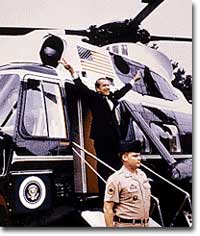
Watergate exposed a different kind of loyalty to falsehood, one rooted less in ideological utopia or wartime panic than in partisan defense, institutional self-protection, and the fear of political collapse. The scandal began with the June 1972 break-in at the Democratic National Committee headquarters in the Watergate complex, but its deeper meaning lay in the cover-up that followed. President Richard Nixon and his aides did not merely try to survive an embarrassing crime committed by campaign operatives. They sought to use presidential power, intelligence agencies, hush money, public denial, and partisan discipline to contain the truth. The machinery of concealment revealed how easily the institutions of government could be turned inward, away from public service and toward the private survival of a presidency. The lie was not a single statement. It was an operating system designed to protect power from accountability, converting the authority of the executive branch into a shield against exposure.
At first, the strategy worked because the truth emerged slowly and unevenly. Nixon’s defenders could dismiss the break-in as a minor campaign dirty trick, a Democratic obsession, or a media-driven attempt to delegitimize a president who had just won reelection in a landslide. That electoral victory mattered. To many supporters, Nixon’s mandate seemed to outweigh the scandal. The voters had spoken, they argued, and the press, courts, and congressional investigators appeared to be trying to undo what the electorate had decided. This framing allowed denial to masquerade as democratic loyalty. Defending Nixon became, for a time, defending the people’s choice against unelected enemies.
The administration’s own language helped sustain that defensive world. Nixon and his allies repeatedly portrayed themselves as victims of hostility from liberal journalists, bureaucratic opponents, congressional Democrats, and cultural elites who had never accepted his presidency. The charge had emotional force because it drew on a real political history of resentment among Nixon’s supporters. Many Americans believed that the press despised Nixon, that eastern elites mocked his constituency, and that antiwar critics had weakened the country during Vietnam. Watergate could be folded into a larger story of persecution. Evidence became suspect because the people presenting it were already distrusted. The scandal’s defenders did not need to refute every fact if they could discredit the institutions carrying those facts into public view.
Yet Watergate also showed that denial has a structure, and that structure can collapse. The Senate hearings, the testimony of John Dean, the revelation of the White House taping system, and the courts’ demand for evidence gradually changed the political terrain. The issue was no longer only whether campaign operatives had committed crimes, but whether the president himself had participated in obstruction, abuse of power, and concealment. Nixon’s defenders faced a narrowing path. They could claim ignorance, blame subordinates, attack investigators, or insist that national stability required moving on. Each defense bought time, but each also made the eventual reckoning more severe. The more the administration insisted that nothing significant had happened, the more damaging each disclosure became. Denial became harder to sustain because the scandal moved from rumor to testimony, from testimony to documents, and from documents to recordings made inside the White House itself. What had once been dismissed as partisan accusation became a record of presidential conduct. The cover-up’s gradual exposure forced supporters to confront not simply the possibility that Nixon had lied, but the deeper reality that the presidency had been used to organize, manage, and defend the lie.
The crucial break came when the tapes made denial impossible for many Republicans who had previously resisted abandoning the president. The so-called smoking-gun tape revealed Nixon discussing the use of the Central Intelligence Agency to limit the Federal Bureau of Investigation’s inquiry only days after the break-in. That evidence did not create the scandal, but it destroyed the last politically usable version of innocence. Republican leaders who had defended or hesitated now understood that continuing to support Nixon threatened not merely their reputations, but the constitutional order and the party’s survival. Their withdrawal of support was not simply a moral awakening, though moral judgment mattered. It was also the moment when the cost of loyalty exceeded the cost of truth.
Watergate belongs in this history because it demonstrates how supporters can defend a known or suspected lie until the evidence becomes institutionally unbearable. The scandal did not end because all partisans suddenly developed equal devotion to truth. It ended because courts, Congress, journalists, witnesses, documents, and tapes together made denial too expensive to maintain. That is both reassuring and sobering. Watergate showed that democratic institutions can still force truth into public life, but it also showed how long deception can survive when partisans persuade themselves that accountability is merely attack. The lie failed only when loyalty could no longer protect it from proof.
Iraq and Weapons of Mass Destruction: Security Fear, Intelligence Failure, and the Politics of Belief
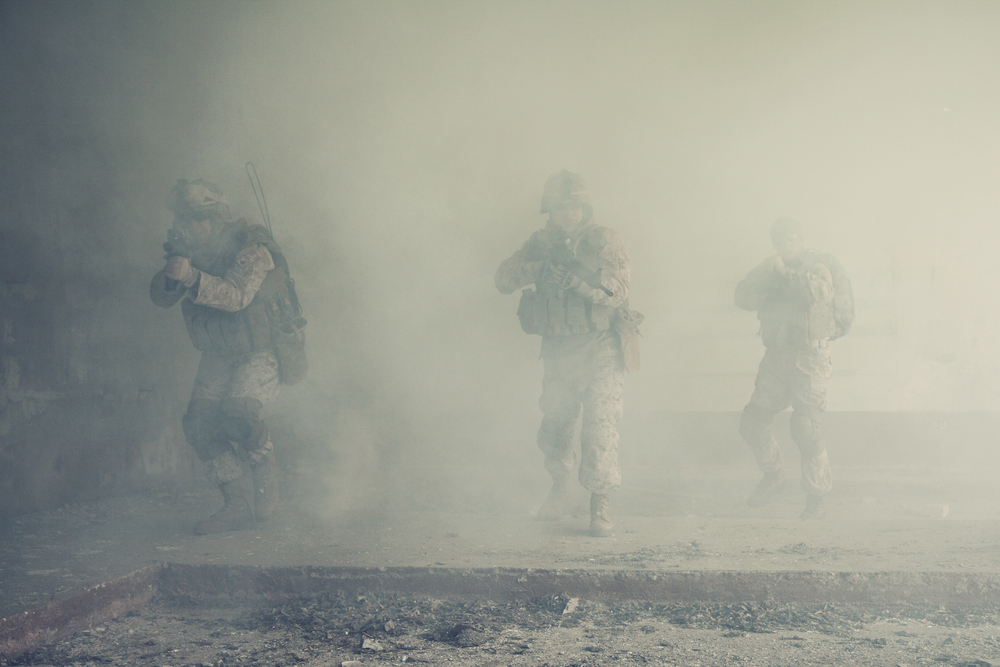
The Iraq War shows how a modern democracy can move from intelligence uncertainty to public certainty when fear, ideology, and executive persuasion converge. After the attacks of September 11, 2001, the United States entered a political atmosphere in which danger seemed both immediate and undefined. President George W. Bush’s administration argued that Iraqi President Saddam Hussein possessed weapons of mass destruction and might transfer such weapons, or the means to develop them, to terrorist groups. The claim did not emerge from nowhere. Hussein had previously pursued chemical, biological, and nuclear programs, had used chemical weapons, and had obstructed international inspections. Yet the administration transformed a record of past danger and ambiguous intelligence into a present-tense assertion of urgent threat. The difference between possibility and possession was narrowed until it almost disappeared.
That narrowing mattered because the public case for war depended on confidence. Administration officials spoke as if the central facts were already settled: Iraq had weapons of mass destruction, inspections could not be trusted, deterrence was too risky, and delay might invite catastrophe. The language of uncertainty was often replaced by the language of inevitability. Aluminum tubes, mobile biological laboratories, uranium claims, defectors’ reports, and disputed intelligence assessments were folded into a larger narrative in which Saddam Hussein’s guilt was assumed before the evidence was fully tested. Dissenting judgments existed within the intelligence community, and some claims were more fragile than public presentation suggested. But fragility was politically inconvenient. The administration needed not merely suspicion, but conviction. War required the appearance of knowledge. That appearance was produced through repetition, selective emphasis, and the moral pressure of the post-September 11 moment. Claims that should have remained conditional were presented as settled warnings, while contrary evidence was treated as secondary, technical, or insufficient to disturb the larger conclusion. The result was a public argument in which the burden of proof subtly shifted. Instead of requiring the government to prove that Iraq possessed active weapons stockpiles, skeptics were often pressed to prove that Hussein posed no danger at all. In the politics of fear, that was an impossible standard. Possibility became probability, probability became certainty, and certainty became the public language of war.
Supporters of the war participated in the politics of belief for several overlapping reasons. Some sincerely trusted the administration and the intelligence agencies after a national trauma that had shattered assumptions about American security. Some believed Hussein was dangerous regardless of the specific weapons claims and viewed regime change as strategically desirable. Others accepted the argument that after September 11, uncertainty itself had become intolerable. This was the preventive-war version of the “greater good” defense: if the threat might be catastrophic, then waiting for proof could be portrayed as reckless. In that moral atmosphere, doubt became difficult to sustain. Skeptics could be accused of naïveté, appeasement, or forgetting the lessons of September 11. The supporter of war did not need every intelligence claim to be airtight. He needed the larger story to feel true.
When no active weapons of mass destruction stockpiles were found after the invasion, the structure of support did not collapse immediately. Instead, many defenders shifted the terms of justification. The war had removed a brutal dictator. It had opened the possibility of democracy in the Middle East. It had enforced United Nations resolutions. It had sent a message to hostile regimes. These arguments were not identical to the original weapons case, but they helped protect supporters from confronting the full force of the failure. The absence of weapons did not simply discredit a policy judgment. It threatened the moral identity of those who had endorsed the war as necessary, responsible, and patriotic. As in other cases, the lie survived by changing shape.
The Iraq weapons of mass destruction case belongs in this history not because every supporter knowingly endorsed a claim he or she believed to be false, but because a society under fear accepted a lowered standard of proof for war. Intelligence failure, policy ambition, ideological confidence, and public trauma produced a political environment in which belief outran evidence. The administration’s claims gave supporters a language of necessity, and supporters gave those claims democratic force. That is the central lesson. In a frightened republic, the most consequential lies may not sound like crude inventions. They may sound like prudence, resolve, and the refusal to wait until it is too late.
Why People Support Known Lies: Partisanship, Identity, Fear, and Reward
The following video from the Bill of Rights Institute covers the origins of partisanship in America:
The cases traced so far differ sharply in moral scale, political structure, and historical consequence, but they point toward a common problem: people do not support known lies for only one reason. Some are deceived at first and then become trapped by pride. Some understand the lie partially but choose not to look too closely. Some know enough to doubt but not enough to break with their group. Others recognize the falsehood and defend it anyway because it protects power, status, identity, or hope. The supporter of the known lie is not a single type. He may be a party loyalist, a bureaucrat, a soldier, a journalist, a voter, an intellectual, a frightened citizen, or a beneficiary of the system the lie protects. What unites them is not ignorance alone, but permission. At some point, they permit the falsehood to stand because something else has been made to matter more.
Partisanship is one of the strongest engines of that permission. A lie spoken by an enemy is usually easy to identify, while a lie spoken by one’s own side arrives wrapped in familiar language, shared enemies, and emotional reassurance. Partisan identity turns political judgment into self-defense. To admit that a leader has lied may feel less like correcting an error than betraying a community. The lie becomes a test of belonging, especially when leaders and media allies frame skepticism as treason, weakness, elitism, or ideological impurity. This is why supporters often do not defend only the claim itself. They defend the right of their side to define reality against outsiders who are presumed hostile before their evidence is even considered.
Identity deepens the problem because political lies often attach themselves to stories people tell about who they are. The anti-Dreyfusards were not merely defending a verdict. They were defending an imagined France rooted in army, Catholic tradition, hierarchy, and nationalist honor. Nazi supporters were not merely accepting policy claims. They were entering a racialized world in which belonging depended on exclusion. Western apologists for Stalin were not merely misreading Soviet reports. They were defending the possibility that history had chosen socialism as the path beyond capitalist crisis. In each case, the lie became fused with identity so thoroughly that truth appeared as dispossession. To lose the falsehood was to lose a version of oneself.
Fear gives the lie urgency. It tells supporters that normal standards of evidence are luxuries for safer times. The missile gap, Gulf of Tonkin, and Iraq weapons claims all depended on this logic. In each case, uncertainty could be turned into pressure: what if the enemy is stronger than we think, what if hesitation invites attack, what if waiting for proof means waiting too long? Fear does not always make people believe stupid things. More often, it makes them accept lowered standards for claims that point toward action they already feel compelled to take. Once fear becomes the moral atmosphere of politics, caution can be rebranded as irresponsibility, and doubt can be made to look like surrender.
Reward also matters, and it is often less dramatic than open corruption. People may support known lies because the lie pays them in status, access, career advancement, party protection, ideological community, emotional comfort, or material benefit. Duranty’s access in Moscow depended in part on not alienating the regime that granted it. Nixon’s defenders protected not only a president, but a party structure and their own place within it. Supporters of war could gain reputations for seriousness, patriotism, and toughness. Ordinary followers may receive no envelope of money and no formal promotion, yet still benefit from the lie because it places them among the righteous, the strong, the realistic, or the chosen. The reward may be psychological, but that does not make it weak.
The “greater good” defense is where these motives become morally dangerous. Once supporters convince themselves that the lie serves order, security, revolution, nation, party, faith, or progress, they can treat truth as secondary without admitting that they have abandoned it. They may still speak the language of principle, but the principle has been rearranged around the falsehood. The army must be protected, so Dreyfus must remain guilty. The revolution must survive, so famine must become shortage. The nation must be safe, so intelligence must become certainty. The leader must prevail, so evidence must become persecution. This is the recurring pattern. Known lies endure when they become instruments of moral convenience, allowing supporters to feel virtuous while refusing reality.
The support of known lies cannot be dismissed as mere foolishness. It is a social and political act, often sustained by intelligent people who have learned to use intelligence defensively. The lie gives them a way to belong, to fight, to hope, to profit, to avoid shame, or to postpone reckoning. That is why correction alone so often fails. A fact can refute a claim, but it cannot by itself replace the identity, fear, reward, or moral drama that made the claim attractive. The history of political deception shows that truth must contend not only with falsehood, but with the human needs that falsehood has been recruited to serve.
Conclusion: The Lie as a Pact between Leader and Follower
The modern history of support for lying leaders and institutions reveals a pattern more disturbing than ordinary deception. Political falsehood becomes powerful not simply because rulers, parties, armies, journalists, or presidents manufacture it, but because supporters give it shelter after evidence begins to intrude. Bonapartism transformed weakness into destiny. The Dreyfus Affair made forgery into patriotic duty. Nazi propaganda turned conspiracy into a total world. Stalin’s foreign apologists converted famine and terror into the tragic vocabulary of progress. Cold War politics made fear a substitute for proof. Watergate showed how partisan loyalty can defend criminal concealment until evidence becomes impossible to absorb. Iraq revealed how a wounded republic could accept certainty where only contested intelligence existed. Across these cases, the lie did not merely travel downward from power to the people. It moved through a circuit of permission.
That permission took different forms. Sometimes it appeared as romance, the desire to believe in the necessary man who can rescue the nation from ordinary politics. Sometimes it appeared as institutional loyalty, the belief that the honor of the army, state, party, or presidency matters more than the innocence of the accused or the integrity of law. Sometimes it appeared as ideological hope, the refusal to admit that a promised future had become a machinery of coercion. Sometimes it appeared as fear, the insistence that danger is so urgent that doubt itself becomes irresponsible. Sometimes it appeared as self-interest, the quieter calculation that access, status, identity, or victory depends on staying inside the falsehood. These motives are not identical, but they converge around the same moral surrender: truth is demoted because truth threatens something the supporter wants protected.
This is why the “known lie” is more politically dangerous than the simple mistake. A mistake can be corrected without destroying the world around it. A known lie, once defended, begins to reorganize that world. It teaches its defenders to distrust evidence, punish dissent, reinterpret exposure as persecution, and treat loyalty as proof of virtue. The longer it persists, the more expensive honesty becomes, because admitting the truth also means admitting one’s own participation in its denial. That is the terrible durability of political falsehood. It creates accomplices not only through coercion, but through pride, belonging, fear, ambition, and shame.
The lie as a pact between leader and follower is one of the central problems of modern politics. Leaders lie, but they rarely lie alone. They require institutions willing to bury documents, parties willing to repeat slogans, intellectuals willing to refine excuses, journalists willing to soften catastrophe, legislators willing to avoid responsibility, and citizens willing to mistake loyalty for courage. The final danger is not only that people may be fooled. It is that they may learn to prefer the falsehood because it gives them a usable world. History’s warning is severe and plain: when truth becomes negotiable in the service of power, the lie does not merely corrupt public speech. It recruits a public willing to live by it.
Bibliography
- Applebaum, Anne. Gulag: A History. New York: Doubleday, 2003.
- —-. Red Famine: Stalin’s War on Ukraine. New York: Doubleday, 2017.
- Arendt, Hannah. “Truth and Politics.” The New Yorker, February 25, 1967.
- Begley, Louis. Why the Dreyfus Affair Matters. New Haven: Yale University Press, 2009.
- Beschloss, Michael R. Mayday: Eisenhower, Khrushchev, and the U-2 Affair. New York: Harper and Row, 1986.
- Bredin, Jean-Denis. The Affair: The Case of Alfred Dreyfus. Translated by Jeffrey Mehlman. New York: George Braziller, 1986.
- Burns, Michael. Dreyfus: A Family Affair, 1789–1945. New York: HarperCollins, 1991.
- Bush, George W. “Address Before a Joint Session of the Congress on the State of the Union.” January 28, 2003. The American Presidency Project.
- Conquest, Robert. The Great Terror: A Reassessment. New York: Oxford University Press, 1968.
- —-. The Harvest of Sorrow: Soviet Collectivization and the Terror-Famine. New York: Oxford University Press, 1986.
- Davies, R. W., and Stephen G. Wheatcroft. The Years of Hunger: Soviet Agriculture, 1931–1933. New York: Palgrave Macmillan, 2003.
- Dean, John W. Blind Ambition: The White House Years. New York: Simon and Schuster, 1976.
- Divine, Robert A. The Sputnik Challenge. New York: Oxford University Press, 1993.
- Drew, Elizabeth. Washington Journal: Reporting Watergate and Richard Nixon’s Downfall. Woodstock, NY: Overlook Press, 1975.
- Duelfer, Charles. Comprehensive Report of the Special Advisor to the DCI on Iraq’s WMD. Washington, DC: Central Intelligence Agency, 2004.
- Ellul, Jacques. Propaganda: The Formation of Men’s Attitudes. Translated by Konrad Kellen and Jean Lerner. New York: Vintage Books, 1962.
- Evans, Richard J. The Coming of the Third Reich. New York: Penguin Press, 2003.
- —-. The Third Reich at War. New York: Penguin, 2005.
- Festinger, Leon. A Theory of Cognitive Dissonance. Stanford: Stanford University Press, 1957.
- Fitzpatrick, Sheila. Everyday Stalinism: Ordinary Life in Extraordinary Times: Soviet Russia in the 1930s. New York: Oxford University Press, 1999.
- Freedman, Lawrence. The Evolution of Nuclear Strategy. 3rd ed. New York: Palgrave Macmillan, 2003.
- Gaddis, John Lewis. Strategies of Containment: A Critical Appraisal of American National Security Policy during the Cold War. New York: Oxford University Press, 1982.
- Gordon, Michael R., and Bernard E. Trainor. Cobra II: The Inside Story of the Invasion and Occupation of Iraq. New York: Pantheon Books, 2006.
- Harris, Ruth. Dreyfus: Politics, Emotion, and the Scandal of the Century. New York: Metropolitan Books, 2010.
- Hazareesingh, Sudhir. The Legend of Napoleon. London: Granta Books, 2004.
- Herf, Jeffrey. The Jewish Enemy: Nazi Propaganda during World War II and the Holocaust. Cambridge, MA: Harvard University Press, 2006.
- Herring, George C. America’s Longest War: The United States and Vietnam, 1950–1975. 5th ed. New York: McGraw-Hill, 2013.
- Hitler, Adolf. Mein Kampf. Translated by Ralph Manheim. Boston: Houghton Mifflin, 1943.
- Isikoff, Michael, and David Corn. Hubris: The Inside Story of Spin, Scandal, and the Selling of the Iraq War. New York: Crown Publishers, 2006.
- Jervis, Robert. Why Intelligence Fails: Lessons from the Iranian Revolution and the Iraq War. Ithaca, NY: Cornell University Press, 2010.
- Johnson, Lyndon B. “Radio and Television Report to the American People Following Renewed Aggression in the Gulf of Tonkin.” August 4, 1964. Lyndon Baines Johnson Library and Museum.
- Jones, Gareth. “Famine Rules Russia.” The Evening Standard, March 31, 1933.
- Kahneman, Daniel. Thinking, Fast and Slow. New York: Farrar, Straus and Giroux, 2011.
- Kennedy, John F. “Address Accepting the Democratic Party Nomination for the Presidency of the United States.” July 15, 1960. John F. Kennedy Presidential Library and Museum.
- Kershaw, Ian. The “Hitler Myth”: Image and Reality in the Third Reich. Oxford: Oxford University Press, 1980.
- Koonz, Claudia. The Nazi Conscience. Cambridge, MA: Harvard University Press, 2003.
- Kotkin, Stephen. Stalin: Waiting for Hitler, 1929–1941. New York: Penguin Press, 2017.
- Kunda, Ziva. “The Case for Motivated Reasoning.” Psychological Bulletin 108:3 (1990), 480–498.
- Kutler, Stanley I. The Wars of Watergate: The Last Crisis of Richard Nixon. New York: Knopf, 1990.
- Logevall, Fredrik. Choosing War: The Lost Chance for Peace and the Escalation of War in Vietnam. Berkeley: University of California Press, 1999.
- Marx, Karl. The Eighteenth Brumaire of Louis Bonaparte. 1852. Reprint, New York: International Publishers, 1963.
- Mason, Lilliana. Uncivil Agreement: How Politics Became Our Identity. Chicago: University of Chicago Press, 2018.
- Moïse, Edwin E. Tonkin Gulf and the Escalation of the Vietnam War. Chapel Hill: University of North Carolina Press, 1996.
- National Security Agency. Spartans in Darkness: American SIGINT and the Indochina War, 1945–1975. Fort Meade, MD: Center for Cryptologic History, 2002.
- Nixon, Richard. RN: The Memoirs of Richard Nixon. New York: Grosset and Dunlap, 1978.
- Nyhan, Brendan, and Jason Reifler. “When Corrections Fail: The Persistence of Political Misperceptions.” Political Behavior 32:2 (2010), 303–330.
- Packer, George. The Assassins’ Gate: America in Iraq. New York: Farrar, Straus and Giroux, 2005.
- Plato, The Republic of Plato. Benjamin Jowett, trans. Oxford: Clarendon Press, 1888.
- Peterson, Erik. “Partisan Gaps in Political Information and Information-Seeking Behavior: Motivated Reasoning or Cheerleading?” American Journal of Political Science 65:1 (2021), 133–147.
- Plessis, Alain. The Rise and Fall of the Second Empire, 1852–1871. Translated by Jonathan Mandelbaum. Cambridge: Cambridge University Press, 1985.
- Prados, John. Vietnam: The History of an Unwinnable War, 1945–1975. Lawrence: University Press of Kansas, 2009.
- Preble, Christopher A. John F. Kennedy and the Missile Gap. DeKalb: Northern Illinois University Press, 2004.
- Price, Roger. The French Second Empire: An Anatomy of Political Power. Cambridge: Cambridge University Press, 1972.
- —-. Napoleon III and the Second Empire. London: Routledge, 1997.
- Risen, James. State of War: The Secret History of the CIA and the Bush Administration. New York: Free Press, 2006.
- Smith, William H. C. Napoleon III. London: Wayland, 1972.
- Snyder, Timothy. On Tyranny: Twenty Lessons from the Twentieth Century. New York: Tim Duggan Books, 2017.
- Stanley, Jason. How Propaganda Works. Princeton: Princeton University Press, 2015.
- Sunstein, Cass R. Republic: Divided Democracy in the Age of Social Media. Princeton: Princeton University Press, 2017.
- Taylor, S. J. Stalin’s Apologist: Walter Duranty, The New York Times’s Man in Moscow. New York: Oxford University Press, 1990.
- Trachtenberg, Marc. History and Strategy. Princeton: Princeton University Press, 1991.
- United States Congress. Tonkin Gulf Resolution. Public Law 88-408. August 10, 1964.
- United States House of Representatives, Committee on the Judiciary. Impeachment of Richard M. Nixon, President of the United States. H. Rept. 93-1305. Washington, DC: Government Printing Office, 1974.
- United States Holocaust Memorial Museum. “Ministry of Propaganda and Public Enlightenment.” Holocaust Encyclopedia. Accessed May 16, 2026.
- United States Holocaust Memorial Museum. “Nazi Propaganda.” Holocaust Encyclopedia. Accessed May 16, 2026.
- United States Holocaust Memorial Museum. “Volksgemeinschaft: People’s or National Community.” Holocaust Encyclopedia. Accessed May 16, 2026.
- United States Senate Select Committee on Intelligence. Report on the U.S. Intelligence Community’s Prewar Intelligence Assessments on Iraq. Washington, DC: United States Government Printing Office, 2004.
- United States v. Nixon, 418 U.S. 683. 1974.
- Welch, David. The Third Reich: Politics and Propaganda. London: Routledge, 1993.
- Woodward, Bob, and Carl Bernstein. All the President’s Men. New York: Simon and Schuster, 1974.
- Zeldin, Theodore. France, 1848–1945. Volume I: Ambition, Love and Politics. Oxford: Oxford University Press, 1973.
- Zola, Émile. “J’Accuse…!” L’Aurore, January 13, 1898.
Originally published by Brewminate, 05.20.2026, under the terms of a Creative Commons Attribution-NonCommercial-NoDerivatives 4.0 International license.
About the Author