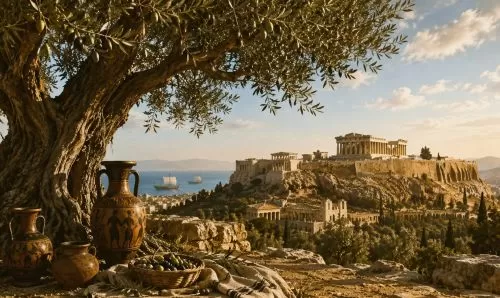
The olive tree was Athena’s sacred gift, a household necessity, a protected legal object, a source of oil and trade, and a symbol of civic survival across the Mediterranean.

By Matthew A. McIntosh
Public Historian
Brewminate
Introduction: The Tree That Made Athens Think in Centuries
The olive tree taught ancient Athens to imagine time differently. Grain answered the hunger of the year; vines promised a harvest after careful seasonal attention; but the olive demanded patience measured in decades, sometimes generations. To plant an olive was to make a claim about permanence. It assumed that a family, a farm, a legal order, and a community would still be there when the tree matured into abundance. In a city so often remembered for restless politics, democratic debate, imperial ambition, naval speed, and philosophical argument, the olive stood for something slower and deeper: rootedness. It linked the short life of the citizen to the long life of the land, turning agriculture into an argument about continuity.
For Athens, the olive was never only a crop. It was food, fuel, medicine, cosmetic, athletic equipment, ritual substance, prize, export, inheritance, and sacred sign. Olive oil passed through kitchens and workshops, lamps and gymnasia, temples and trading ships. It could soften bread, light a room, anoint a body, honor a god, or travel across the sea in a painted amphora. It belonged to women managing household stores, farmers tending marginal slopes, potters producing transport vessels, athletes scraping oil and dust from their skin, priests conducting sacrifices, merchants calculating profit, and magistrates overseeing sacred property. Few substances moved so easily between the intimate and the public, between the body and the polis. The same oil that fed a family could illuminate a symposium, mark a religious offering, reward victory in the Panathenaic Games, or enter the circuits of maritime exchange that tied Attica to the wider Mediterranean. The tree also stood at the center of Athenian myth, for Athena’s gift of the olive explained not merely why the city bore her name but why its prosperity could be imagined as divinely authorized. The myth did not float above material life; it gave sacred form to a practical truth. Athens depended on the olive because the olive made everyday survival, civic ceremony, and commercial ambition part of the same cultivated landscape.
Yet I cannot begin from the false premise that Athens invented the olive world. Olive cultivation was older than Classical Athens and broader than Attica. It belonged to a deep Mediterranean history of dry hillsides, winter rains, maritime exchange, and patient adaptation. Minoan and Mycenaean societies already used and administered oil long before the Athenian democracy came into being, and Greek settlers were only one group among many who shaped the ancient history of the olive. Phoenicians, Cypriots, Levantine communities, Etruscans, and later Romans all participated in the tree’s expanding geography. The more precise claim is not that Athens created olive culture, but that Athens made the olive unusually visible as a total civic institution: agricultural, economic, legal, religious, and symbolic at once.
The story that follows traces that transformation in chronological order, from the olive’s older Mediterranean background to its special place in Athenian myth, household life, law, trade, and imperial culture. It then follows the tree outward into the Greek colonial world, where olive cultivation helped settlers turn foreign coasts into durable communities while binding them into wider circuits of exchange. The olive tree was not simply carried from Athens to the Mediterranean like a portable emblem of Greekness; it was planted, adapted, contested, traded, protected, and reimagined in many local settings. But in Athens it became one of the clearest examples of how a plant could become a civilization’s shorthand for itself. The Athenian olive was rooted in soil, but it also grew in myth, law, memory, and the commercial imagination of the ancient sea.
Before Athens: The Deep Mediterranean History of the Olive

Long before the olive tree became a symbol of Athena, it belonged to a much older Mediterranean ecology. Wild olives grew across parts of the eastern Mediterranean, thriving in landscapes that were often difficult for other crops: rocky slopes, dry hillsides, thin soils, and regions marked by wet winters and long summer droughts. The tree’s resilience made it well-suited to the environmental rhythms of the sea that connected the Aegean, Anatolia, Cyprus, the Levant, Egypt, and North Africa. Its value did not come from abundance alone, but from adaptation. The olive could survive where grain struggled, and it could turn marginal land into productive inheritance. It was especially valuable because it did not require the same kind of broad, level, fertile fields demanded by cereal agriculture. Terraced slopes, stony ridges, and dry uplands could all become productive if communities had the patience and technical knowledge to manage trees over long periods. In that sense, the olive was not merely a crop planted in the Mediterranean; it was one of the plants that helped define what Mediterranean agriculture could be. It rewarded communities that learned to think across seasons, microclimates, and generations. For communities learning to live with the limits of Mediterranean climate, the olive offered a form of agricultural patience that was also a form of security.
The domestication and management of the olive unfolded gradually rather than through a single invention or discovery. Ancient cultivators selected trees for fruit size, oil content, reliability, and suitability to local conditions. They learned how to prune, graft, harvest, crush, press, store, and transport the product of the tree. This knowledge was practical, cumulative, and regional. It moved through families, estates, workshops, sanctuaries, and trade routes. The olive’s rise as a cultivated crop depended not only on nature but on technical memory: the repeated experience of knowing when to harvest, how to treat the fruit, how to separate oil from pulp and water, and how to keep oil from spoiling. It also depended on social stability. A community had to protect trees long enough for them to become productive, organize labor at harvest time, maintain presses and storage facilities, and preserve knowledge across generations. Olive cultivation was never just a matter of planting trees. It required a whole human network around the tree: land tenure, seasonal work, tools, containers, storage rooms, transport routes, and habits of consumption. Before the olive could become a sacred Athenian emblem, it had to become a technology of landscape management.
By the Bronze Age, olive oil had already entered the administrative and ritual systems of Aegean societies. Minoan Crete and Mycenaean Greece provide important evidence for oil production, storage, and redistribution. Palace economies did not merely consume oil casually; they recorded, managed, and allocated it. In Mycenaean contexts, Linear B tablets preserve references to oil and perfumed oil, showing that oil could be counted, stored, assigned, and transformed into elite or ritual products. This matters because it places olive oil inside constructs of bureaucracy and hierarchy long before the rise of the Classical polis. Oil was already a commodity of administration, craft specialization, religious use, and prestige. Athens inherited this world more than it invented it.
The olive also belonged to a wider pattern of Mediterranean agriculture often described through the triad of grain, vines, and olives. The phrase can be too tidy if used carelessly, because no single agricultural formula applied evenly across every region. Still, it captures an important reality: many Mediterranean communities built their food systems around crops that answered different needs and different timescales. Grain supplied daily calories and political urgency because failed harvests could mean hunger almost immediately. Vines created wine, a product of diet, ritual, sociability, and trade. Olives produced oil, which condensed food, light, medicine, cleanliness, religious offering, and commercial value into a durable liquid. Together, these crops helped ancient communities exploit varied terrain, balance risk, and participate in exchange networks that reached beyond the village or farm.
Because olive oil was portable, storable, and useful in many contexts, it naturally entered the world of long-distance exchange. It could travel by sea in ceramic containers, circulate as a prestige good, and serve communities far from the groves where it was produced. But its movement should not be imagined as a simple story of civilized producers exporting to passive consumers. The Mediterranean was already a dense world of contact, adaptation, and competition. Levantine, Cypriot, Egyptian, Aegean, and later Phoenician and Greek communities all participated in the circulation of agricultural products, technologies, containers, and tastes. Oil moved through harbors, palaces, sanctuaries, and households, but so did the knowledge attached to it: how to cultivate trees, how to press fruit, how to store liquids, how to perfume oil, how to use it in ritual, and how to make it desirable in exchange. The sea did not merely carry amphorae; it carried practices. A jar of oil could represent a landscape, a set of skills, a community’s surplus, and a network of relationships stretching across waters that were both barriers and highways. Olive cultivation expanded through this connected world because people recognized both its practical usefulness and its cultural power. The tree could belong to local subsistence, elite consumption, temple economies, and maritime commerce.
This older history changes how the Athenian olive must be understood. Athena’s sacred tree did not emerge from nowhere, and Athenian reverence for the olive was not an isolated miracle of civic imagination. It was the local intensification of a much older Mediterranean relationship between environment, cultivation, oil, trade, and symbolic meaning. What made Athens distinctive was not that it discovered the olive, but that it gathered many older possibilities into a single civic image. The olive could be agricultural labor, household necessity, sacred possession, legal object, athletic prize, export commodity, and mythic gift. By the time Athens made the olive its own, the tree already carried centuries of human experiment in its branches.
Athena’s Gift: Myth, Patronage, and the Sacred Origin of the Athenian Olive
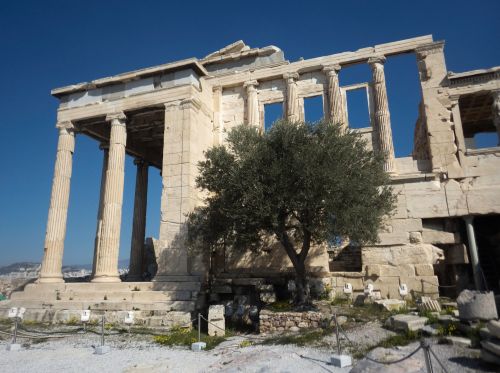
The olive entered Athenian self-understanding not only through fields and presses, but through myth. The city’s most famous origin story imagined a contest between Athena and Poseidon for patronage of the land that would become Athens. Poseidon struck the earth and produced a sign of maritime force, often described as a salt spring or sea-water well, while Athena offered the olive tree. The Athenians chose Athena’s gift, and the city took her name. Like many foundation myths, the story is not useful because it preserves literal historical memory, but because it reveals what a community wanted to say about itself. Athens imagined its identity beginning with a choice between two forms of power: the violent, unstable, and spectacular force of the sea, and the cultivated, durable, and generative power of the tree. The contest also placed civic identity inside a larger divine order. Athens was not merely a settlement that happened to prosper; in its own mythic imagination, it was a city selected, named, and instructed by a goddess whose gift taught the people how to live from the land. The olive tree became a kind of origin compressed into botanical form. It explained patronage, economy, territory, and destiny at once.
That opposition should not be pushed too simply, because Athens became one of the great naval powers of the Greek world. The city that chose Athena over Poseidon would later build triremes, command maritime routes, and depend heavily on imported grain and imperial tribute. Yet the myth’s tension is precisely what makes it so revealing. Athenian identity did not reject the sea; it sought to discipline maritime ambition through the image of cultivated intelligence. Athena’s olive was not merely peaceful in a sentimental sense. It represented a different kind of power: craft, foresight, technical knowledge, domestic stability, and the transformation of difficult land into lasting wealth. Poseidon’s gift erupted from the earth in a moment. Athena’s gift required care across generations. In that contrast, the myth turned agriculture into political philosophy.
The sacred olive also tied Athenian identity to the Acropolis itself. Ancient tradition located Athena’s original olive there, near the center of the city’s religious life. The tree was not simply a mythic object remembered in story; it was imagined as a living sign of divine presence, rooted in the sacred topography of Athens. The Acropolis gathered together temple, cult, memory, and civic display, and the olive belonged within that complex as a symbol of Athena Polias, the goddess who protected the city. To speak of the olive as Athena’s gift was to claim that the city’s prosperity grew out of a continuing relationship with its patron deity. The tree made divine favor visible in botanical form.
The myth became powerful because it joined sacred origin to everyday usefulness. Many divine gifts in ancient mythology are wondrous because they are rare, terrifying, or remote from ordinary life. Athena’s olive was different. Its sacredness was confirmed by its practicality. It produced oil for food, light, medicine, bathing, athletics, ritual, and trade. The Athenians did not have to separate religious imagination from material dependence, because the olive was useful in exactly the ways that made it symbolically rich. It nourished bodies, illuminated homes, anointed skin, honored gods, rewarded victors, and circulated through markets. It belonged to the ordinary rhythms of household labor as much as to the ceremonial world of temples and festivals. A lamp burning through the night, a meal enriched with oil, an athlete’s oiled body, a votive act, a storage jar, or a prize amphora could all point back, imaginatively, to the same divine gift. The myth did not elevate an ordinary tree into artificial importance. It explained why a tree already embedded in the economy of survival deserved to be understood as a divine foundation.
The story also helped Athens imagine itself as autochthonous, rooted in its own soil. Athenian civic ideology often emphasized native belonging: the idea that Athenians were not merely residents of Attica but people sprung from, attached to, and authorized by the land itself. The olive tree fit that ideology beautifully. It was rooted, enduring, and difficult to move once established. It did not suggest a wandering people or a temporary encampment, but a community whose identity had grown in place. Even as Athenians traded abroad, founded settlements, and projected power across the Aegean, the olive allowed them to tell a counter-story of rootedness. Their wealth might move by ship, but its sacred origin remained planted in Attic earth.
The most dramatic expression of this sacred resilience appears in traditions surrounding the Persian destruction of Athens in 480 BCE. When the Persians sacked the Acropolis, the devastation threatened not only buildings and dedications but the sacred memory of the city itself. Later accounts claimed that Athena’s olive, though burned, sent up a fresh shoot almost immediately afterward. Whether treated as miracle, patriotic memory, or symbolic reconstruction, the story gave Athens a language of survival. The city could be invaded, its temples damaged, its people displaced, and its sacred center violated, yet the olive could grow again. The tree became an image of civic rebirth: wounded but not extinguished, cut back but not uprooted, carrying divine continuity through historical catastrophe.
Athena’s gift did more than explain why the olive mattered. It made the tree a condensed symbol of Athenian civilization. In myth, the olive marked the city’s divine election; in cult, it belonged to the sacred landscape of the Acropolis; in ideology, it expressed rootedness and continuity; in memory, it promised recovery after destruction; and in daily life, it justified itself through constant usefulness. The Athenian olive was not sacred despite being practical. It was sacred because its practicality seemed to reveal the wisdom of the goddess who gave it. Through this myth, Athens transformed an ancient Mediterranean crop into a civic emblem: a tree whose roots reached into religion, economy, land, law, and historical imagination at once.
The Olive in the Athenian Household: Food, Light, Medicine, Skin, and Labor
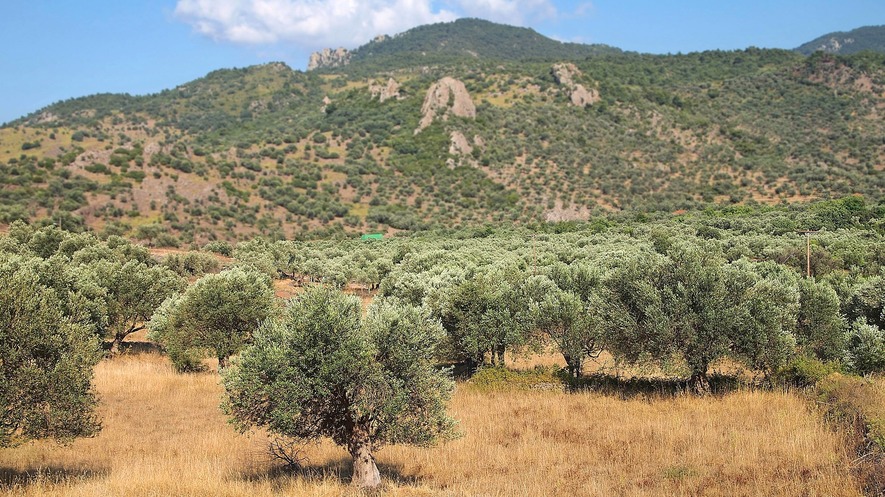
The sacred olive of Athena stood on the Acropolis, but most Athenian encounters with the olive happened closer to the ground: in courtyards, kitchens, storerooms, workshops, lamps, bodies, and fields. The olive’s civic and religious meanings depended on this domestic intimacy. A symbol cannot endure if it is not also useful, and olive oil was useful almost everywhere. It belonged to the oikos, the household economy that formed the basic unit of ancient social life. Before olive oil became export wealth, festival prize, or sacred substance, it was a stored necessity. It helped make ordinary life possible, and that ordinariness was part of its power.
In food, olive oil offered both calories and versatility. It could enrich grain-based meals, soften bread, dress vegetables, preserve certain foods, and add flavor to diets that depended heavily on cereals, legumes, greens, figs, cheese, fish, and seasonal produce. Ancient Greek food was not built around the modern abundance of oils and fats; reliable fat sources mattered. Olive oil occupied a place both modest and essential. It was not necessarily a luxury in every use, yet quality, quantity, and refinement could mark status. A poor household might use oil sparingly, while wealthier families could afford better grades and more generous consumption. The same substance could belong to subsistence, comfort, display, and refinement. It also helped bind together foods that might otherwise seem plain or monotonous. Bread, porridge, pulses, onions, olives, and greens could be transformed by the addition of oil, not into extravagance necessarily, but into a more sustaining and satisfying meal. In a society where diet reflected season, class, labor demands, and market access, oil gave households a way to add energy and taste without requiring meat or imported delicacies. Its use in food reveals both the simplicity and sophistication of Athenian eating: a cuisine built from ordinary staples but shaped by careful attention to texture, preservation, flavor, and bodily need.
Oil also changed the experience of night. In a world without electric light, the lamp was not a minor object. Olive oil fed the small flames that extended work, conversation, ritual, and domestic movement beyond daylight. A lamp could illuminate a room, a workshop, a shrine, or a symposium, and the quality of fuel affected the steadiness of light, the smell of the room, and the cost of illumination. To say that Athens depended on olive oil is also to say that it depended on managed light. The olive tree entered the household not only through the mouth but through the eye, shaping the hours in which people could cook, weave, mend, read aloud, drink, pray, or simply move safely after sunset.
The medicinal uses of oil further blurred the line between household habit and learned practice. Greek medical writers, including those associated with the Hippocratic tradition, treated oils, ointments, and applications as part of bodily care. Oil could be used to soften, warm, cleanse, soothe, carry other substances, or prepare the body for treatment. It belonged to medicine not because every use was technical, but because ancient medicine was deeply connected to diet, regimen, environment, and bodily balance. The household use of oil and the physician’s use of oil were not sealed worlds. Both assumed that the body could be managed through substances applied, ingested, rubbed, warmed, or mixed. Olive oil occupied a space between food, remedy, and daily maintenance.
The athletic body made oil even more visible. Greek athletes anointed themselves with oil before exercise and competition, then used the strigil to scrape away oil, sweat, and dust. This practice was hygienic, practical, aesthetic, and cultural at once. It protected and prepared the skin, but it also marked participation in a particular ideal of the trained male body. In the gymnasium and palaestra, oil helped define Greek habits of exercise, discipline, beauty, and sociability. For Athens, this mattered because athletics stood near the intersection of citizenship, education, competition, festival, and prestige. The oil used by athletes was not just a bodily lubricant; it was part of the grammar of civic masculinity.
Yet every visible use of oil rested on less visible labor. Olive cultivation required long-term care: pruning, clearing, watching, harvesting, transporting, crushing, pressing, settling, storing, and guarding. Harvest could demand intense seasonal coordination, and processing had to happen before fruit spoiled. Some labor took place in family settings, some through hired workers, tenants, dependents, or enslaved people, and some through specialized facilities. The oil that appeared in a lamp or on an athlete’s skin condensed a chain of work that began months or years earlier in the grove. Ancient consumers may have seen oil as a familiar household substance, but familiarity should not hide the complexity behind it. Olive oil was a product of skill, timing, equipment, and disciplined repetition. The tree itself required a rhythm of attention different from that of grain farming. It had to be protected from neglect, animals, theft, disease, and destructive cutting; it had to be pruned with an eye toward future yields rather than immediate extraction alone. The harvest then created its own pressure, because olives could not simply be gathered and forgotten. They had to be moved, processed, and stored within a workable span of time. Pressing oil also required tools, space, containers, and knowledge of separation and settling. Behind the smooth surface of stored oil lay bruised fruit, heavy baskets, stone presses, ceramic vessels, and bodies bent into seasonal labor.
Women’s labor was central to the household world in which oil was stored, rationed, and used. Athenian sources are often frustratingly male-centered, especially for the inner life of the household, but the management of food, textiles, lamps, small stores, and domestic ritual cannot be understood without women’s work. Oil entered cooking, lighting, bathing, child care, textile-related tasks, and religious observance. Its daily use required judgment: how much to spend, how much to save, what quality to use for which purpose, and how to make stores last. In elite discourse, the well-managed household was a moral and economic ideal, and oil belonged to that discipline of management. The olive economy did not stop at the edge of the field or marketplace; it continued inside the home through acts of storage, allocation, and care. This matters because household management was not passive consumption. It was a form of economic governance at domestic scale. A family’s oil supply had to be integrated with other stores, including grain, wine, dried foods, wool, tools, and fuel. Decisions about oil could reflect class position, season, household size, ritual obligations, illness, hospitality, and the unpredictable demands of daily life. Even when women’s work is only indirectly visible in surviving texts, the material logic of the household makes their role unavoidable. Oil became useful only when someone kept track of it, protected it from waste, and knew how to move it between kitchen, lamp, body, storeroom, and shrine.
The household olive also connected private life to the larger structures of the city. A jar of oil in an Athenian home could reflect the productivity of Attic land, the labor of enslaved and free workers, the skills of potters and press operators, the authority of household managers, the expectations of physicians, the habits of athletes, the needs of ritual, and the movement of goods through local markets. This is why the olive became such a powerful civic symbol. It was not imposed from above by myth alone. It earned its symbolic range by being present in so many ordinary acts. In Athens, the olive tree was sacred because Athena gave it, but it remained sacredly persuasive because Athenians kept eating by it, lighting by it, healing with it, exercising with it, trading in it, and organizing labor around it.
Law, Land, and Sacred Trees: Protecting the Athenian Olive

If the olive was a divine gift and household necessity, it also became a legal concern. Athens did not treat all trees as equal pieces of private property, because some trees carried public, sacred, and economic meanings that exceeded the boundaries of the farm on which they stood. This was particularly true of the sacred olives known as moriai, trees associated with Athena and protected as part of the religious patrimony of the city. Their importance shows how difficult it is to separate religion, law, agriculture, and politics in ancient Athens. A tree could grow on land worked by a household, but its sacred identity could make it a matter for magistrates, courts, ritual officials, and the wider polis. The olive’s roots were botanical, but its protection was civic.
Ancient traditions connected the protection of olive trees with early Athenian lawgiving, most notably with Solon. Later sources suggest that cutting down or damaging certain olive trees could bring serious penalties, though the details should be handled carefully. It is tempting to repeat the claim that Solon made the destruction of any olive tree a capital offense, but the surviving evidence points more securely toward strict protection for sacred olives and regulated treatment of productive trees rather than a simple universal death penalty for all olive cutting. The important point is not the dramatic severity of one rule, but the larger legal imagination behind it. Athens understood some trees as more than replaceable agricultural assets. They represented continuity, divine ownership, public wealth, and ancestral obligation. To harm them was not merely to damage a farmer’s property; it could be interpreted as an offense against the city’s sacred order.
The moriai make this overlap clear. These sacred olive trees were understood as belonging in some sense to Athena, even when they stood in the countryside rather than inside a sanctuary. Athenian law recognized that sacred property could be dispersed through ordinary landscapes. The countryside was not simply secular space beyond the city’s temples; it contained trees, boundary markers, shrines, tombs, and inherited claims that tied land to religion. Sacred olives transformed parts of Attica into an extended cultic landscape. Their protection required inspection, memory, and enforcement. The city had to know where sacred trees stood, who was responsible for the land around them, and whether anyone had damaged, removed, or exploited them improperly. This meant that sacred geography was also bureaucratic geography. A tree could become the reason for testimony, inquiry, accusation, and civic intervention. Its sanctity did not remove it from ordinary rural life; instead, it inserted divine ownership into the practical world of farms, leases, inheritance, and disputes between neighbors. The olive made religion administratively visible.
The famous case preserved in Lysias’ speech On the Olive Stump reveals how such protections could enter the courtroom. The speaker defends himself against the charge that he removed the stump of a sacred olive from his land. The details of the speech are shaped by legal strategy, as all forensic speeches are, but the case is invaluable because it shows the sacred olive as an object of litigation. A stump, not even a flourishing tree, could still matter if it belonged to the protected category of Athena’s olives. The accusation depended on memory, witnesses, land history, and the interpretation of what had once stood where. This is a striking example of how sacred landscape could survive in legal imagination even after the visible tree had been damaged, cut, or reduced. The law did not simply protect living productivity; it protected a remembered sacred status.
The protection of sacred olives also connected law to festival economy. Oil from Athena’s sacred trees was associated with the Panathenaic Games, where victors received amphorae filled with olive oil as prizes. These prize amphorae were not casual containers of agricultural produce. They transformed oil into civic honor, sacred abundance, and international prestige. The city’s protection of sacred trees helped sustain one of its most important ritual spectacles. In the Panathenaia, the olive moved from grove to press to amphora to athletic prize, carrying Athena’s patronage into the competitive world of Greek festival culture. The law that guarded the trees was also guarding a chain of meaning: sacred land, divine gift, civic festival, athletic excellence, and Athenian reputation abroad. The prize oil made the protected tree visible beyond the field itself. Once sealed in decorated amphorae, it could circulate through the hands of athletes, families, patrons, traders, and admirers, extending the symbolic reach of Athena’s grove into the wider Greek world. A victor who received Panathenaic oil did not receive merely a useful commodity, even if the oil had real market value. He received a portion of Athenian sacred abundance, packaged by the city and marked by its festival identity. Legal protection helped convert agricultural continuity into public spectacle and exportable prestige.
The legal history of the Athenian olive reveals a broader truth about ancient property. Modern categories such as public, private, sacred, economic, and symbolic do not map neatly onto the world of the polis. An olive tree could be privately tended, divinely owned, publicly protected, economically productive, and ritually significant all at once. That complexity is precisely why the tree mattered so much. Athens protected sacred olives because they condensed the city’s relationship to land: inheritance required law, prosperity required labor, religion required visible signs, and civic identity required continuity. The olive tree was not only a gift from Athena or a useful source of oil. It was a legal witness rooted in the soil, reminding Athenians that land carried obligations as well as wealth.
Oil as “Liquid Gold”: Athenian Export, Wealth, and Maritime Power

Olive oil was never only a sacred substance or household staple. In Athens, it also entered the hard world of exchange, profit, storage, transport, and maritime ambition. The phrase “liquid gold” is modern shorthand rather than an ancient technical category, but it captures something important about the value that oil could carry. Olive oil condensed land, labor, time, and skill into a durable product that could be stored and moved. Unlike fresh fruit or many seasonal foods, oil could travel. It could be sealed in ceramic vessels, loaded onto ships, sold in distant ports, consumed by households, used by athletes, burned in lamps, offered to gods, or resold through commercial networks. A grove in Attica could become wealth at sea.
Athens’ relationship with oil must be placed within the larger agricultural limits of Attica. The region was not ideally suited to feeding a large urban population entirely from its own grain fields, and by the Classical period Athens depended heavily on imported grain. That dependence has often, and rightly, drawn attention to the city’s maritime strategy and imperial policy. Yet the same landscape that made grain supply difficult could favor olives and vines. Stony, hilly, and less fertile land could still become productive through tree crops. The olive helped turn Attica’s environmental constraints into economic opportunity. It did not remove Athens’ need for imported food, but it gave the city a product that could participate in exchange and help integrate local agriculture into wider Mediterranean commerce. The export of olive oil depended on containers as much as on trees. Oil needed pottery, and pottery required clay, kilns, fuel, craftsmen, standard forms, and commercial habits. Amphorae made oil mobile. They allowed merchants to move agricultural value across the sea in measured, recognizable, and relatively durable form. Ceramic evidence is central to understanding ancient trade, because the oil itself usually disappears while the container survives. Athenian pottery traveled widely, and although not every Athenian vessel carried oil, the broader relationship between oil, ceramic production, and maritime exchange reveals how agriculture and craft reinforced one another. The economy of the olive was never simply rural. It passed through workshops, markets, ports, ships, and counting practices before it reached distant consumers.
Panathenaic amphorae offer a particularly vivid example of oil as prestige. These vessels, filled with oil from Athena’s sacred olives, were awarded to victors in the Panathenaic Games. They were not ordinary trade amphorae, and they should not be mistaken for the everyday packaging of commercial oil. Their importance lies elsewhere. They show how Athens could transform oil into an official civic object, marked by festival, imagery, competition, and divine patronage. The oil inside had material value, but the vessel and its context gave that value a public meaning. A victorious athlete received not merely fat, fuel, or merchandise, but a portion of Athenian sacred abundance. When such amphorae moved beyond Athens, they carried the city’s image with them: Athena, athletic victory, state ceremony, and the prestige of Attic oil joined in one object.
The commercial importance of oil should not be exaggerated into a single-cause explanation for Athenian power. Athens did not build its navy on olive oil alone. Its fifth-century rise depended on a much broader combination of factors: silver from Laurion, naval organization, tribute from allies, control of sea lanes, imported grain, skilled labor, political institutions, and strategic decisions made during and after the Persian Wars. Olive oil was part of this world, not the whole of it. To make oil the secret engine of Athenian empire would be to replace one oversimplification with another. But to ignore oil would also distort the picture. Athens’ maritime economy was sustained by many forms of movement, and oil was among the products that made Attic land commercially meaningful beyond Attica itself. Oil also mattered because it connected wealth to reputation. Trade goods are never only goods; they carry expectations about origin, quality, and cultural use. Athenian oil circulated in a Mediterranean world where Greek eating habits, athletic practices, religious customs, pottery styles, and social ideals were recognizable beyond the borders of any single polis. Oil could serve ordinary needs, but it could also participate in the spread of Athenian taste and status. The same product that lit a lamp or dressed a meal could also appear in elite exchange, festival prize culture, or overseas markets shaped by Greek communities and their neighbors. Oil helped Athens project a form of soft power. It did not conquer territory, but it helped make Athenian products, images, and habits visible.
The olive linked land and sea in a particularly Athenian way. Rooted trees produced a movable liquid; rural labor generated maritime commerce; sacred groves supplied festival prizes that circulated abroad; household necessity became export value. Athens is often remembered as a city of ships, harbors, silver, democracy, drama, and empire, but beneath those faster forms of movement stood slower agricultural systems. The olive tree did not explain all of Athenian wealth, and it certainly did not make Athens powerful by itself. Its importance was subtler and more durable. It allowed Athenians to imagine that their prosperity came not only from tribute, mines, or naval force, but from a cultivated landscape blessed by Athena and made profitable by human skill.
Colonization and Rootedness: Greek Settlement across the Mediterranean
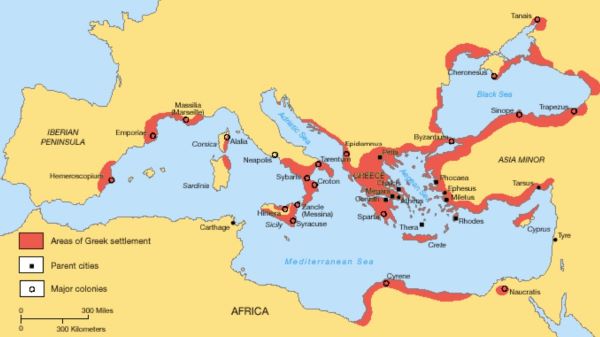
The movement of the olive beyond the Aegean belongs to the larger history of Greek settlement across the Mediterranean and Black Sea. From roughly the eighth century BCE onward, Greek-speaking communities founded new settlements along distant coasts: in southern Italy and Sicily, around the northern Aegean, along the Hellespont and Black Sea, on parts of the North African coast, in southern France, and in contact zones reaching toward Iberia. These movements were not a single centrally planned expansion, and they were certainly not simply an Athenian project. They involved many mother cities, including Corinth, Chalcis, Eretria, Megara, Phocaea, Rhodes, Miletus, and others. Athens would later develop its own forms of overseas settlement and imperial control, especially through cleruchies, but the earlier and broader story of Greek colonization was pan-Greek, diverse, and locally negotiated. The olive traveled within this world not as the possession of one city, but as part of a wider Greek repertoire of farming, eating, worship, trade, and settlement.
Colonization was never only the movement of people. It was the movement of habits, expectations, tools, gods, stories, crops, animals, measures, pottery forms, and social institutions. A new settlement needed walls, fields, water, harbors, shrines, burial grounds, political arrangements, and relationships with neighboring peoples. It also needed time. This is where the olive becomes important. Grain could be planted for the first harvests that kept settlers alive, but olive trees required a longer horizon. To plant olives was to declare that the settlement was not merely a trading station, raiding camp, or temporary refuge. It was an investment in permanence. The tree’s slow maturation made it a biological expression of colonial rootedness. It asked settlers to imagine children and grandchildren harvesting what the founding generation had planted.
This does not mean that every Greek colony began by planting olives, or that olives mattered equally in all colonial regions. Climate, soil, rainfall, elevation, local agricultural traditions, and commercial priorities shaped what could be grown. In some Black Sea settlements, grain, fish, timber, slaves, and access to inland trade mattered more than olive production. In southern Italy, Sicily, and parts of the western Mediterranean, the environmental conditions were often favorable to vines and olives, and Greek settlers could adapt familiar Mediterranean practices to new landscapes. The spread of olive cultivation was uneven. It followed ecological possibility as much as cultural preference. A Greek community could carry the idea of the olive, but the land itself determined whether that idea could take root. The colonial olive also complicates the meaning of “Greekness.” Settlers did not arrive in empty landscapes. They encountered Indigenous communities with their own agricultural systems, political structures, exchange networks, ritual practices, and claims to land. Greek settlement could involve trade, intermarriage, alliance, imitation, violence, displacement, and cultural borrowing, often simultaneously. Olive cultivation in colonial settings should not be imagined as Greeks simply imposing a finished agricultural package on passive territory. In some places, settlers introduced or intensified practices associated with olive oil production; in others, they adapted to existing cultivation or exchanged knowledge with local populations. Colonies were hybrid spaces, not replicas of the mother city. The olive could become a marker of Greek identity precisely because it also moved through zones of contact where identity had to be asserted, negotiated, and remade.
Southern Italy and Sicily offer important examples because they became some of the richest Greek colonial regions. Cities such as Syracuse, Gela, Acragas, Tarentum, Sybaris, Croton, and others developed complex economies tied to agriculture, trade, warfare, and local power. These communities were not culturally or economically dependent shadows of mainland Greece. They became major centers of wealth, artistic production, philosophy, athletics, and political experimentation in their own right. Tree crops helped create durable colonial landscapes. Olive groves and vineyards marked the transformation of territory into inherited property, and inherited property made new civic identities possible. A colony became more than a harbor when its hinterland was cultivated, divided, defended, worked, and remembered. The olive tree, slow and enduring, helped turn migration into settlement and settlement into belonging.
Massalia, founded by Phocaeans on the southern coast of Gaul, shows another side of this process. There, Greek settlers entered a western Mediterranean world already shaped by local communities and long-distance exchange. Greek wine, pottery, oil, and luxury goods moved through networks that connected coastal settlements with inland elites. Whether oil was locally produced, imported, or both, its presence in exchange carried cultural meanings. It belonged to diet, status, bodily care, and ritualized consumption. In these colonial and contact zones, Greek agricultural products were not merely foodstuffs; they were social objects. They could signal alliance, prestige, participation in Mediterranean styles of consumption, or access to distant trade. The olive did not have to be everywhere locally grown to matter. It could also travel as oil, as taste, as habit, and as a sign of connection to the sea. Colonial settlement also created new relationships between mother city and colony. The old model of a colony as a dependent daughter of a mother city is too simple, but the language of kinship, origin, cult, and memory still mattered. Colonies often preserved ties to founding cities through religious traditions, founder cults, calendars, dialects, political models, and stories of origin. Agricultural practice belonged to this world of remembered connection. Planting olives in a new landscape could help settlers reproduce familiar rhythms of life: meals seasoned with oil, lamps burning with oil, bodies anointed with oil, offerings made with oil, athletes trained with oil, and households organized around stores of oil. These continuities did not erase local difference, but they helped settlers make foreign territory feel inhabitable. The olive was not just a crop of export; it was a crop of memory.
By the time Athens became a major Classical power, it entered a Mediterranean already shaped by centuries of Greek mobility. Athenian merchants, potters, soldiers, settlers, and officials operated within networks that earlier colonization had helped create. The Athenian olive and Athenian oil moved through a world where Greek settlements had already made certain practices recognizable across distance. This is why the olive’s colonial history matters to the Athenian story. Athens did not single-handedly spread the tree across the Mediterranean, but it benefited from and contributed to a broader Greek world in which olives, oil, amphorae, festivals, athletic customs, and maritime trade connected scattered communities. Colonization made the Mediterranean more legible to Greek exchange, and the olive helped make that exchange feel rooted rather than merely commercial.
Olive Oil and the Colonial Economy: Trade, Identity, and Exchange

Olive oil helped give Greek colonial settlement an economic life beyond the first act of migration. A colony did not become stable simply because settlers arrived, marked out land, and built houses. It had to feed itself, negotiate with surrounding communities, create forms of property, establish cults, attract or coerce labor, and find a place within regional exchange. Olive oil could participate in all of those processes. It was at once a household staple, a commercial product, a ritual substance, and a marker of cultural habit. In colonial settings, this made it powerful. Oil could help settlers reproduce familiar practices from the Aegean, but it could also become a medium through which Greek communities entered local economies and reshaped relationships with non-Greek neighbors. The colonial economy was not a simple pipeline running from mother city to colony and back again. Greek settlements overseas were often founded in places already connected to older trade systems, and many became active economic centers in their own right. Oil could move in several directions: imported from older Greek regions, produced locally after groves matured, exchanged with Indigenous communities, consumed by colonial households, dedicated in sanctuaries, used in athletic spaces, or re-exported through coastal networks. This flexibility made olive oil useful in a world of scattered ports and varied ecological zones. A colony with productive olive groves could turn its hinterland into maritime value, while a settlement without extensive local production could still participate in oil culture through trade. The oil itself became a way of connecting landlocked labor to seaborne exchange.
In southern Italy and Sicily, where many Greek settlements gained access to fertile and diverse landscapes, olive oil formed part of a broader agricultural economy that also included grain, wine, livestock, and local craft production. These western Greek cities were not marginal outposts clinging to memories of the homeland. Some became immensely wealthy, politically ambitious, and culturally influential. Their economies depended on hinterlands as much as harbors. As land was divided, cultivated, inherited, and defended, tree crops helped stabilize colonial property regimes. Olive groves could mark permanence in the landscape, but once productive, they also generated surplus that could be stored, taxed, exchanged, or converted into prestige. The colonial olive was both a root and a route: rooted in local land, but capable of entering the routes of Mediterranean commerce.
Oil also carried identity through the body. Greekness in colonial contexts was not only expressed through language, temples, political institutions, or pottery styles; it was also practiced through eating, bathing, exercising, healing, and ritual. Olive oil belonged to all of these. In the gymnasium, it marked athletic discipline and the aesthetics of the trained male body. In the household, it shaped foodways and lighting. In sanctuaries, it could appear in offerings and ritual preparations. In medicine and bodily care, it connected practical treatment with inherited ideas about regimen and balance. These practices mattered intensely in colonial zones because identity had to be maintained across distance and amid contact. To use oil in familiar ways was to make the colonial body, household, and city recognizable as Greek, even when the surrounding landscape and neighboring peoples were not. Olive oil did not remain sealed inside Greek communities. It moved across cultural boundaries. Indigenous elites and neighboring populations could adopt, adapt, or reinterpret Greek goods and habits, while Greeks themselves borrowed from local environments and exchange systems. Amphorae, drinking vessels, oil containers, and residues of trade all point to a world in which objects crossed boundaries more easily than ethnic categories did. Oil could become a gift, a trade item, a luxury, a practical fuel, a ritual material, or a sign of participation in Mediterranean styles of consumption. In contact zones such as southern Gaul, Iberia, Sicily, and southern Italy, imported oil and related goods could help create new forms of local prestige. The colonial economy was not merely Greek expansion imposed outward; it was a set of exchanges in which goods acquired new meanings as they moved.
The container was crucial to this process. Olive oil required transport technology, and transport technology created archaeological visibility. Amphorae made oil measurable, movable, and marketable. Their shapes, fabrics, stamps, and distribution patterns allow historians and archaeologists to reconstruct commercial relationships even when the oil itself has vanished. In colonial settings, amphorae were more than packaging. They were part of an organization of trust and recognition. A buyer needed to know, or believe, what kind of product a vessel contained, where it came from, and what value it carried. Distinctive containers later helped link products to regions and habits of consumption. Oil traveled not as an anonymous liquid but as part of a material language of trade: jar, seal, shape, origin, quality, and expectation.
This colonial movement of oil helps explain why the olive became one of the great connective symbols of the Greek Mediterranean. It linked farms to ports, settlers to mother cities, Greek customs to Indigenous exchange, and local landscapes to distant markets. Yet its importance lay in more than commerce. Oil helped make colonial communities feel durable, embodied, and socially coherent. It lit their houses, seasoned their food, marked their athletes, supplied their rituals, and entered their ships. In Athens, the olive was tied to Athena, law, civic memory, and festival prestige; across the colonial world, olive oil performed a related but more varied work. It allowed Greek settlers and their neighbors to turn agriculture into exchange, exchange into identity, and identity into a shared but contested Mediterranean culture.
Athens, Empire, and the Symbolic Economy of Olive Oil

By the fifth century BCE, Athens had become far more than an agricultural city rooted in the fields of Attica. It was a naval power, an imperial center, a collector of tribute, a manager of alliances, a builder of monuments, and a cultural force whose drama, art, rhetoric, and political institutions became famous across the Greek world. Yet this expansion did not erase the older symbolism of the olive. If anything, Athenian power made the olive more visible, because the city could now attach its local sacred traditions to objects, festivals, images, and exchanges that traveled far beyond Attica. Olive oil belonged to the material economy of Athens, but it also belonged to what might be called its symbolic economy: the system through which the city turned sacred resources, civic rituals, and public images into prestige. The Panathenaic festival stood near the center of this symbolic economy. Dedicated to Athena, the festival displayed the city to itself and to others through procession, sacrifice, athletic contests, musical competition, civic participation, and visual splendor. It was not merely a religious event in the narrow sense. It was a performance of Athens as a community under divine protection, a city whose people, institutions, wealth, and myths converged around their patron goddess. Olive oil entered this public drama through the prize amphorae awarded to victors. These vessels, filled with oil from Athena’s sacred olives, converted agricultural produce into civic honor. A substance familiar from kitchens, lamps, bodies, and markets was elevated into a formal sign of victory and divine favor.
The Panathenaic amphora itself intensified that meaning. Decorated in a recognizable format, it typically displayed Athena on one side and an athletic event on the other, joining the goddess, the city, and competitive excellence in a single portable object. The oil inside had real value, and victors could keep, use, gift, or perhaps sell the contents. But the amphora did more than hold a commodity. It packaged Athenian identity. It made the city’s sacred landscape visible in ceramic form, carrying the authority of Athena’s olive trees into the hands of athletes and their communities. When these amphorae traveled beyond Athens, they did not simply export oil. They exported an image of Athens as a city where divine patronage, artistic production, athletic prestige, and material abundance reinforced one another.
This mattered in an imperial context because Athens increasingly understood display as a form of power. The Acropolis building program, the movement of tribute, the staging of festivals, and the circulation of Athenian pottery all helped present the city as the center of a larger world. Olive oil did not occupy the same fiscal place as tribute or silver, and it should not be mistaken for the principal engine of empire. But it participated in the same culture of projection. It allowed Athens to present its prosperity as something older and nobler than military domination. Tribute might reveal power over allies; silver might reveal access to mineral wealth; ships might reveal strategic force. The olive suggested that Athenian greatness was also rooted in sacred antiquity, land, cultivation, and Athena’s favor.
That symbolic claim was politically useful because empire could be morally uncomfortable. Athens celebrated freedom, democracy, and civic equality among citizens while exercising coercive power over subject allies. The olive could not resolve that contradiction, but it could soften the image Athens projected. In festival contexts, Athens appeared not as an extractor of tribute but as the guardian of sacred abundance. The prize oil of Athena implied generosity, order, and divine legitimacy. It connected victory to the city’s patron goddess rather than to the harsher mechanics of imperial finance. The symbolic economy of oil helped Athens tell a story about itself that was more attractive than empire alone: a story of cultivated prosperity, religious continuity, and public honor. Olive oil also linked Athenian imperial identity to the body. In the athletic world, oil marked training, discipline, beauty, and competition. These values were not uniquely Athenian, but Athens gave them a distinctive civic setting through the Panathenaia. The oiled athlete became part of a public spectacle in which individual excellence reflected glory back onto the city and the goddess. The prize amphora then extended that relationship beyond the moment of competition. It preserved the event materially, allowing victory to be remembered, displayed, exchanged, or carried home. Through oil, the trained body, the sacred tree, the painted vessel, and the imperial city all became linked. Athens could turn athletic success into a medium of civic communication.
The symbolic economy of olive oil reveals how Athens joined the rooted and the mobile. Sacred olives stood in Attic soil, but their oil could move across the Greek world. The goddess belonged to Athens, but her gift could be carried in amphorae beyond the city. The tree represented continuity, but the oil enabled circulation. This combination made the olive unusually well suited to an imperial polis that wanted to imagine itself as both ancient and expansive. Athens was a city of walls, ships, silver, courts, assemblies, and theaters, but it continued to explain itself through a tree. It transformed olive oil into more than an agricultural product. It became a portable fragment of Athenian memory, a sacred commodity through which the city projected an image of itself as wealthy, victorious, cultivated, and divinely favored.
Destruction, Resilience, and Memory: The Olive Tree in War and Crisis
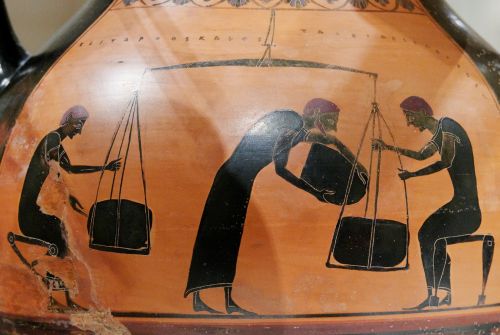
The olive tree’s strength was also its vulnerability. Because it lived slowly, matured gradually, and embodied years of accumulated labor, its destruction carried consequences beyond the loss of a single season. Grain could be burned and replanted the next year if seed, labor, and peace returned. An olive tree, by contrast, represented time already invested. To damage a grove was to attack future harvests, family inheritance, household stores, and the visible continuity of the landscape. War in the Greek world often targeted this agricultural foundation. Armies did not need to annihilate cities to wound them; they could trample fields, burn buildings, cut vines, damage trees, and make rural life uncertain. The olive, precisely because it stood for endurance, became a tempting object of violence.
For Athens, this vulnerability was not theoretical. The Persian sack of 480 BCE and the later invasions of Attica during the Peloponnesian War both forced Athenians to confront the fragility of their cultivated world. The city’s ideology could imagine Attica as ancestral soil protected by Athena, but enemy armies could still enter that soil and destroy what generations had planted. This was one reason rural devastation was so psychologically powerful. It did not merely reduce food or income. It struck at memory. Groves, shrines, graves, boundary stones, farmhouses, and paths all made the countryside legible as home. When invaders ravaged the land, they attacked not only economic resources but the map of belonging.
The tradition of Athena’s sacred olive sprouting again after the Persian destruction of the Acropolis gave Athens one of its most potent images of recovery. Herodotus preserves the story that after the barbarians burned the sanctuary, the olive associated with Athena sent up a new shoot. Whether read as religious miracle, patriotic symbolism, or retrospective memory, the episode reveals how Athenians wanted to understand survival. The sacred tree did not deny catastrophe; it grew out of it. The Acropolis had been violated, temples burned, and the old city shattered, yet the sign of Athena’s favor returned almost immediately in living form. In that story, the olive became a theology of resilience. It allowed Athens to imagine that its deepest identity could be damaged but not erased.
The Peloponnesian War created a different kind of crisis. Here the threat was not a single spectacular sack followed by triumphant rebuilding but repeated pressure. Spartan invasions of Attica pushed many rural Athenians behind the city’s walls, separating them from farms, tombs, local cults, and productive land. Thucydides’ account of the early war emphasizes the pain of this displacement for people accustomed to living in the countryside. The strategy associated with Pericles may have made military sense, preserving lives while relying on naval strength and imported supplies, but it came at a social and emotional cost. The countryside was not an abstract resource zone. It was where households had histories. To abandon it, even temporarily, was to feel the strain between imperial maritime strategy and older forms of rooted Attic life. How much permanent damage such invasions caused to olive groves remains debated. Some scholars have questioned whether ancient armies could easily destroy mature olive trees on a massive scale given the labor required to cut, burn, or uproot them thoroughly. Olive trees are hardy, and damaged trees can sometimes regenerate. Ravaging may have been uneven: devastating in some places, symbolic in others, and often less total than ancient rhetoric suggests. But this qualification does not make the threat unimportant. Even partial destruction could be economically painful, and the fear of destruction mattered in itself. A grove did not have to be completely eradicated to become a sign of wartime precarity. Broken branches, burned trunks, abandoned farms, interrupted harvests, and displaced labor could all make the landscape feel wounded.
This tension between vulnerability and endurance made the olive unusually powerful in Athenian memory. It could be cut, burned, neglected, or litigated over, but it could also regrow, be replanted, and be remembered. That doubleness mattered. The olive was not a symbol of invulnerability; it was a symbol of survival after injury. In war, Athens learned that rootedness could be painful, because what is rooted can be attacked. Yet the same rootedness also made recovery imaginable. The tree that took generations to mature could outlast the ambitions of kings, generals, and invaders. Its slow life gave Athenians a way to think beyond crisis. Even when ships, walls, assemblies, and armies dominated the immediate struggle, the olive remained a quieter measure of whether the city’s world could be restored.
Hellenistic and Roman Afterlives: From Greek Olive Culture to Mediterranean Oil Empires
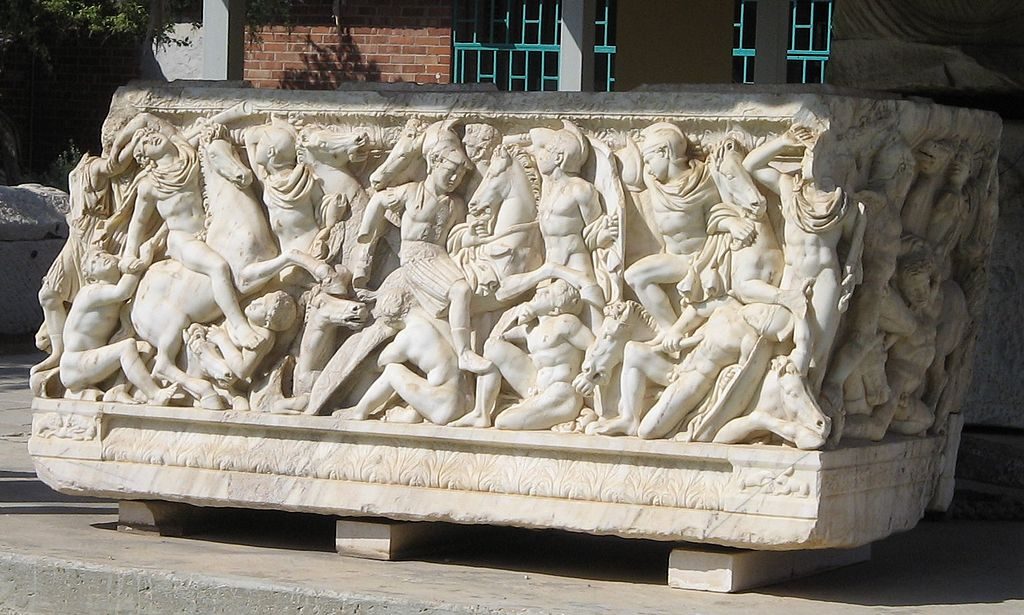
The story of the Athenian olive did not end with the decline of Classical Athens. After the fourth century BCE, the political center of gravity shifted across the eastern Mediterranean, first through Macedonian power and then through the Hellenistic kingdoms that followed Alexander’s conquests. Athens remained culturally prestigious, but it was no longer the commanding imperial city it had been in the fifth century. Olive cultivation continued to thrive within a much broader Greek-speaking world. Hellenistic cities, sanctuaries, estates, gymnasia, and trade networks preserved many of the older associations of oil: food, light, medicine, sacrifice, bodily care, athletic training, and civic display. The olive remained a Greek cultural marker, but it now belonged to a world larger than the polis of Athens.
The Hellenistic period expanded the geography of Greek habits. Greek language, institutions, art, religious forms, and civic practices spread through Egypt, Syria, Asia Minor, the Aegean, and beyond. In this wider setting, olive oil traveled not only as a commodity but as part of a recognizable way of living. Gymnasia, for example, became important institutions in many Hellenistic cities, and where gymnasium culture went, oil followed. The oiled athletic body continued to signify education, status, discipline, and participation in Greek civic life. Oil was folded into the social performance of Hellenism. It helped make Greekness visible on the skin. Yet the Hellenistic world also reminds us that olive culture was never uniform. Egypt, for example, had long traditions of other oils and agricultural products, and the ecology of the Nile Valley differed sharply from the dry hillsides of Attica or the Aegean islands. In some regions, olive oil remained a prestigious imported product rather than a universal staple. In others, local cultivation expanded where climate and demand allowed. The result was not the simple replacement of older foodways by Greek habits, but a layered economy in which oils, tastes, rituals, and agricultural systems overlapped. Greek olive culture spread through institutions and trade, but it always had to negotiate with local environments and existing practices.
Rome then transformed the scale of Mediterranean oil production. The Romans inherited, absorbed, and reorganized a world in which Greeks, Phoenicians, Etruscans, Carthaginians, and many others had already cultivated olives and traded oil for centuries. Under Roman power, olive oil became one of the great staples of imperial exchange. It supplied cities, armies, households, baths, lamps, workshops, religious practices, and enormous urban populations. Rome did not invent the Mediterranean oil economy, but Roman rule gave it new administrative, fiscal, and infrastructural reach. Roads, ports, estates, taxation, military supply, and long-distance shipping helped turn regional oil production into an imperial foundation.
The western provinces became especially important. Baetica in southern Spain produced vast quantities of oil, much of it shipped to Rome in amphorae whose remains still help archaeologists reconstruct ancient trade. North Africa, too, became a major zone of olive cultivation and oil production under the Roman Empire and into late antiquity. In these regions, the olive became tied to villas, presses, estates, tenant labor, taxation, and export networks on a scale far beyond the smaller civic economies of Archaic and Classical Greece. The Roman oil world was not merely a continuation of the Greek one. It was an intensification, bureaucratization, and imperialization of Mediterranean habits that had developed over many centuries. Material evidence makes this Roman afterlife particularly visible. Amphorae, press installations, storage facilities, inscriptions, shipwrecks, and urban refuse deposits show oil moving through systems of production and consumption that linked countryside to capital. Monte Testaccio in Rome, the enormous artificial mound made largely from discarded amphora fragments, is perhaps the most famous symbol of this scale. It represents not a single shipment or luxury trade, but repeated, organized, long-term movement of oil into the imperial city. The Athenian sacred olive belonged to myth, law, festival, and local identity; Roman oil amphorae belonged to empire, provisioning, taxation, and mass consumption. Both worlds valued oil, but they valued it through different political forms.
Still, the Greek legacy remained important. The Romans did not encounter olive oil as a blank commodity. They inherited a Mediterranean cultural grammar in which oil already meant nourishment, light, cleansing, athletic discipline, medicine, sacrifice, refinement, and civilized life. Greek myth and practice had helped give oil part of that prestige, even if they were only one strand in a much older and broader history. Athens’ contribution was notably symbolic. Its sacred olive, Panathenaic prize oil, legal protections, and civic mythology showed how a city could make the olive speak for identity itself. The later Roman oil empires operated on a vastly larger scale, but they still depended on the same basic transformation: a tree rooted in local soil could become a liquid moving through the arteries of an entire world.
Are We Making the Olive Too Athenian?
The following video from Lindsay Griffin discusses the olive tree in Athens:
The strongest challenge here is the risk of making Athens the center of a story that was never Athens’ alone. The olive was older than the polis, older than democracy, older than the Acropolis myths that later gave it such civic force. It belonged to a deep Mediterranean history of domestication, cultivation, exchange, and symbolic use that stretched across the Greek world. Minoan and Mycenaean societies already administered oil before Classical Athens existed as a political or cultural force. Phoenician, Etruscan, Punic, and Roman communities all shaped olive cultivation and oil commerce in ways that cannot be reduced to Greek influence. Even within the Greek world, Athens was only one participant among many. Corinth, Chalcis, Eretria, Phocaea, Megara, Miletus, Rhodes, Syracuse, Massalia, and other cities mattered profoundly to the movement of Greek goods, settlers, and agricultural habits. To tell the history of the olive as though it naturally culminated in Athens would be to mistake one city’s powerful symbolism for the whole Mediterranean story.
That caution is important when discussing colonization. Greek settlement across the Mediterranean was not a simple process in which Athenians, or Greeks generally, carried a superior agricultural civilization into empty or undeveloped lands. Colonists entered inhabited worlds. Indigenous communities already possessed their own food systems, land claims, exchange routes, religious practices, and political structures. In some regions, olives may already have been known or cultivated; in others, Greek settlers adapted cultivation to local conditions or relied on imported oil rather than local groves. The spread of olive oil was not a one-directional gift from mainland Greece to passive colonial landscapes. It was part of a dense and often unequal field of contact that included trade, imitation, intermarriage, alliance, coercion, violence, displacement, and mutual adaptation. The olive could mark Greek identity, but it could also become a shared, contested, or locally transformed product.
There is also a danger in letting the olive symbolize too much. Because oil appears in food, medicine, lamps, athletics, religion, law, trade, and colonial exchange, it can be tempting to make it explain nearly everything. That would flatten Athenian and Mediterranean history. Athens’ wealth did not rest on olive oil alone. Its power depended on silver, ships, tribute, imported grain, enslaved labor, skilled craftsmanship, political organization, military strategy, and a maritime empire whose coercive realities cannot be softened into a story of sacred trees and cultivated abundance. Nor did ordinary Athenians experience the olive in the same way. Elite landowners, small farmers, enslaved laborers, women managing household stores, merchants, athletes, priests, and consumers all encountered oil from different positions within social hierarchy. The olive connected these worlds, but it did not erase their inequalities.
Yet this challenge does not weaken the central interpretation so much as refine it. The argument is not that Athens invented olive culture, monopolized olive commerce, or single-handedly spread the tree through the Mediterranean. The argument is that Athens offers one unusually concentrated example of how a Mediterranean crop could become a total civic institution. In Athens, the olive was not only agricultural. It was attached to Athena’s patronage, the sacred topography of the Acropolis, household economy, bodily practice, legal protection, festival prizes, export value, wartime memory, and imperial display. Other societies cultivated olives and traded oil, often on larger scales. Rome eventually built a far more massive oil economy. But Athens made the olive speak with exceptional symbolic density. It became a tree through which the city imagined its land, its goddess, its continuity, and its place in the wider Greek world.
The counterpoint changes the final interpretation in an important way. The Athenian olive should not be treated as the origin of Mediterranean olive civilization, but as one of its most revealing local crystallizations. Its power came from the fact that it was both ordinary and exalted, both widely Mediterranean and intensely Athenian. The same tree that belonged to a shared ecology of dry hillsides and maritime exchange could also become, in one city’s imagination, the gift of a goddess and the sign of civic survival. Athens did not own the olive’s history. It gave that history one of its most memorable political and religious forms. That distinction matters. It allows the olive to remain what it truly was: not a single city’s invention, but a Mediterranean inheritance that Athens rooted in its own soil and turned into a language of identity.
Conclusion: The Olive Tree as Root, Commodity, and Memory
The olive tree gives the history of Athens a slower rhythm than the one usually associated with the city. Athens is often remembered through moments of speed and intensity: assembly debates, naval battles, theatrical festivals, legal contests, imperial decisions, philosophical arguments, and political crises. The olive asks for a different measure. It belongs to planting, waiting, pruning, inheritance, recovery, and return. Its fruit could be harvested in a season, but the tree itself lived across generations. That long life made it an unusually powerful symbol for a city that cared deeply about ancestry, land, divine favor, and civic continuity. In the olive, Athens found a way to imagine itself not only as a city of speech and ships, but as a city rooted in cultivated time.
The tree’s power came from its ability to move between worlds. It was sacred to Athena, yet also managed by farmers. It belonged to myth, yet fed households. It stood in soil, yet became oil that could travel by sea. It was protected by law, used in medicine, burned in lamps, rubbed into athletic skin, poured in ritual, stored in amphorae, awarded at festivals, and traded through maritime networks. Few things in Athenian life crossed so many boundaries so easily. The olive connected the Acropolis to the countryside, the household to the market, the body to the festival, and Attica to the Mediterranean. It made visible one of the central truths of ancient life: economy, religion, environment, labor, and memory were never separate systems. They grew through one another.
Beyond Athens, the olive participated in the wider history of Greek mobility and Mediterranean exchange. Greek settlers did not carry the tree into an empty world, nor did Athens create olive culture by itself. The olive’s history was older, broader, and more complicated than any single city’s myth. Yet Athens gave that broader inheritance one of its most concentrated civic forms. Through Athena’s gift, the protected moriai, Panathenaic prize oil, household use, legal anxiety, colonial movement, and wartime memory, the olive became a language through which Athenians explained prosperity and survival. It was ordinary enough to be used every day and exalted enough to stand for the city’s relationship with its goddess. That combination made it unforgettable.
The Athenian olive was not merely a tree and not merely a crop. It was a root, a commodity, and a memory. As root, it fixed identity in Attic soil and taught the city to think in generations. As commodity, it turned land and labor into portable value, joining Athens to the trading sea. As memory, it allowed Athenians to imagine that even fire, invasion, displacement, and political change could not wholly sever them from their sacred past. The olive did not explain all of Athens, but it revealed something essential about how Athens explained itself. Its branches reached into myth; its oil moved through markets; its roots held the city to the land.
Bibliography
- Apollodorus. The Library of Greek Mythology. Translated by Robin Hard. Oxford: Oxford University Press, 1997.
- Aristophanes. The Acharnians; The Clouds; Lysistrata. Translated by Jeffrey Henderson. Cambridge, MA: Harvard University Press, 1998.
- Aristotle. Athenaion Politeia [The Athenian Constitution]. Translated by H. Rackham. Cambridge, MA: Harvard University Press, 1935.
- Boardman, John. Athenian Black Figure Vases. London: Thames & Hudson, 1974.
- —-. The Greeks Overseas: Their Early Colonies and Trade. 4th ed. London: Thames & Hudson, 1999.
- Broodbank, Cyprian. The Making of the Middle Sea: A History of the Mediterranean from the Beginning to the Emergence of the Classical World. Oxford: Oxford University Press, 2013.
- Brun, Jean-Pierre. Archéologie du vin et de l’huile dans l’Empire romain. Paris: Errance, 2004.
- Burkert, Walter. Greek Religion. Translated by John Raffan. Cambridge, MA: Harvard University Press, 1985.
- Cartledge, Paul and Antony Spawforth. Hellenistic and Roman Sparta: A Tale of Two Cities. 2nd ed. London: Routledge, 2002.
- Coldstream, J. N. Geometric Greece: 900–700 BC. London: Routledge, 1979.
- Davidson, James. Courtesans and Fishcakes: The Consuming Passions of Classical Athens. Chicago: University of Chicago Press, 1997.
- Dodd, Emlyn. “Wine and Olive Oil Across the Ancient Cyclades: A Preliminary Report and New Thoughts on the Development of Greek and Roman Press Technology.” Mediterranean Archaeology 32/33 (2019/2020), 123-138.
- Domínguez, Adolfo J. “Greeks in the Iberian Peninsula.” In The Greeks in the West, edited by Gocha R. Tsetskhladze, 301–329. Leiden: Brill, 1999.
- Foxhall, Lin. Olive Cultivation in Ancient Greece: Seeking the Ancient Economy. Oxford: Oxford University Press, 2007.
- Garland, Robert. The Greek Way of Life: From Conception to Old Age. Ithaca, NY: Cornell University Press, 1990.
- Garnsey, Peter. Famine and Food Supply in the Graeco-Roman World: Responses to Risk and Crisis. Cambridge: Cambridge University Press, 1988.
- Graham, A. J. Colony and Mother City in Ancient Greece. Chicago: Ares, 1964.
- Hamilakis, Yannis. “Wine, Oil and the Dialectics of Power in Bronze Age Crete: A Review of the Evidence.” Oxford Journal of Archaeology 15:1 (1996), 1–32.
- Hanson, Victor Davis. Warfare and Agriculture in Classical Greece. Rev. ed. Berkeley: University of California Press, 1998.
- Harris, Edward M. The Rule of Law in Action in Democratic Athens. Oxford: Oxford University Press, 2013.
- Hartmann, Hudson T. and Plato G. Bougas. “Olive Production in Greece.” Economic Botany 24:4 (1970), 443-459.
- Herodotus. Histories. Translated by Robin Waterfield. Oxford: Oxford University Press, 1998.
- Hippocrates. Hippocratic Writings. Translated by G. E. R. Lloyd. London: Penguin Classics, 1983.
- Holladay, A. J. “Athenian Strategy in the Archidamian War.” Historia: Zeitschrift für Alte Geschichte 27:3 (1978), 399–427.
- Hopper, R. J. “The Laurion Mines: A Reconsideration.” The Annual of the British School at Athens 63 (1968), 293–326.
- Horden, Peregrine, and Nicholas Purcell. The Corrupting Sea: A Study of Mediterranean History. Oxford: Blackwell, 2000.
- Hornblower, Simon. A Commentary on Thucydides. Vol. 1. Oxford: Oxford University Press, 1991.
- Hurwit, Jeffrey M. The Acropolis in the Age of Pericles. Cambridge: Cambridge University Press, 2004.
- Isager, Signe, and Jens Erik Skydsgaard. Ancient Greek Agriculture: An Introduction. London: Routledge, 1992.
- Kallet, Lisa. Money and the Corrosion of Power in Thucydides: The Sicilian Expedition and Its Aftermath. Berkeley: University of California Press, 2001.
- Kearns, Emily. The Heroes of Attica. London: Institute of Classical Studies, 1989.
- Lysias. On the Olive Stump. In Lysias. Translated by W. R. M. Lamb. Cambridge, MA: Harvard University Press, 1930.
- MacDowell, Douglas M. The Law in Classical Athens. Ithaca, NY: Cornell University Press, 1978.
- Malkin, Irad. A Small Greek World: Networks in the Ancient Mediterranean. Oxford: Oxford University Press, 2011.
- Margaritis, Evi and Martin Jones. “Olive Oil Production in Hellenistic Greece: The Interpretation of Charred Olive Remains from the Site of Tria Platania, Macedonia, Greece (Fourth-Second Century B.C.).” Vegetation History and Archaeobotany 17:4 (2008), 393-401.
- Mattingly, David J. Imperialism, Power, and Identity: Experiencing the Roman Empire. Princeton, NJ: Princeton University Press, 2010.
- —-. Tripolitania. Ann Arbor: University of Michigan Press, 1995.
- Neils, Jenifer, ed. Goddess and Polis: The Panathenaic Festival in Ancient Athens. Princeton, NJ: Princeton University Press, 1992.
- Nevett, Lisa C. House and Society in the Ancient Greek World. Cambridge: Cambridge University Press, 1999.
- Osborne, Robin. Classical Landscape with Figures: The Ancient Greek City and Its Countryside. London: George Philip, 1987.
- —-. “Early Greek Colonization? The Nature of Greek Settlement in the West.” In Archaic Greece: New Approaches and New Evidence, edited by Nick Fisher and Hans van Wees, 251–269. London: Duckworth, 1998.
- Parker, Robert. Athenian Religion: A History. Oxford: Clarendon Press, 1996.
- —-. Polytheism and Society at Athens. Oxford: Oxford University Press, 2005.
- Pausanias. Description of Greece. Translated by W. H. S. Jones. Cambridge, MA: Harvard University Press (Loeb Classical Library), 1918.
- Peacock, D. P. S., and David F. Williams. Amphorae and the Roman Economy: An Introductory Guide. London: Longman, 1986.
- Peña, J. Theodore. Roman Pottery in the Archaeological Record. Cambridge: Cambridge University Press, 2003.
- Plutarch. Themistocles. In Lives. Translated by Bernadotte Perrin. Cambridge, MA: Harvard University Press, 1914.
- Purcell, Nicholas. “The Roman Villa and the Landscape of Production.” In Urban Society in Roman Italy, edited by Tim Cornell and Kathryn Lomas, 151–179. London: UCL Press, 1995.
- —-. “Wine and Wealth in Ancient Italy.” Journal of Roman Studies 75 (1985), 1–19.
- Renfrew, Colin. The Emergence of Civilisation: The Cyclades and the Aegean in the Third Millennium BC. London: Methuen, 1972.
- Shapiro, H. A. Art and Cult under the Tyrants in Athens. Mainz: Philipp von Zabern, 1989.
- —-. Myth into Art: Poet and Painter in Classical Greece. London: Routledge, 1994.
- Shear, Julia L. Polis and Panathenaia: The History and Development of Athena’s Festival. PhD diss., University of Pennsylvania, 2001.
- Shelmerdine, Cynthia W. The Perfume Industry of Mycenaean Pylos. Göteborg: Paul Åströms Förlag, 1985.
- Thucydides. History of the Peloponnesian War. Translated by Rex Warner. Revised by M.I. Finley. London: Penguin Classics, 1972.
- Thurmond, David L. A Handbook of Food Processing in Classical Rome: For Her Bounty No Winter. Leiden: Brill, 2006.
- Todd, S. C. The Shape of Athenian Law. Oxford: Clarendon Press, 1993.
- Tsetskhladze, Gocha R., ed. Greek Colonisation: An Account of Greek Colonies and Other Settlements Overseas. 2 vols. Leiden: Brill, 2006–2008.
- Tyree, E. Loeta and Evangelia Stefanoudaki. “The Olive Pit and Roman Oil Making.” The Biblical Archaeologist 59:3 (1996), 171-178.
- Woolf, Greg. Rome: An Empire’s Story. Oxford: Oxford University Press, 2012.
- Xenophon of Athens. Oeconomicus. Translated with commentary by Sarah B. Pomeroy. Oxford: Clarendon Press, 1994.
Originally published by Brewminate, 06.11.2026, under the terms of a Creative Commons Attribution-NonCommercial-NoDerivatives 4.0 International license.
About the Author