In early modern England, dying children were imagined not as silent victims but as emotional, spiritual actors who revealed a world shaped by family love, Protestant faith, and the nearness of death.

By Dr. Hannah Newton
Wellcome Trust Fellow
University of Reading
Introduction
Valuable scholarship has been produced on parents’ responses to the deaths of children in early modern England, but the emotional experiences of the young themselves have rarely been explored. This chapter seeks to rectify this deficiency by viewing death through the child’s eyes. Taking advantage of recent insights from the history of emotions, Newton argues that dying children expressed diverse and conflicting passions, from fear to ecstasy. The underlying question is to what extent children’s experiences differed from those of adults. While the range of emotions was similar, the preoccupations of children differed; these included a concern about surviving siblings, and a more vivid imagination of heaven. Through highlighting such distinctions, we come closer to what it was like to be an early modern child.
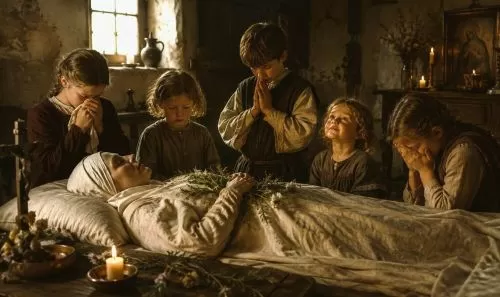
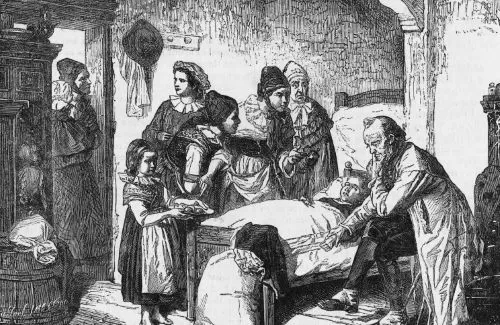
One day in 1665, twelve-year-old Caleb Vernon from Battersea began to feel hot and feverish. His mother put him to bed, wrapping him in ‘warm blankets, and propping him up with pillows’. Over the next month, the illness worsened, and Caleb became so weak that he was ‘not able to be got up out of his bed’. Feeling miserable and sore, Caleb asked his parents if ‘some living creature’ could be brought to his bed ‘to prevent Melancholly thoughts’; he suggested ‘a young Lamb, Pigeon, [or] Rabbit’. Caleb’s parents agreed, and decided that a squirrel would be best because ‘it might easily be procured’ from a local meadow. Later that day, Caleb overheard his little sister Nancy asking, ‘Who shall have Caleb’s [pet] … when he is dead?’ Caleb told his father, ‘Now I think I shall die’. His father ‘gushed out into tears’ and the boy seeing him called out, ‘Father do not weep, [but] pray for me, I long to be with God’. He bequeathed ‘all his toyes’ to his sisters Nancy and Betty, and told his mother, ‘Mother, I love your company dearly’. Caleb began to grow breathless, ‘as if choaked with plegm’, and his father, who was ‘in great care for him’, ran downstairs to fetch some medicines ‘for his relief’. Returning quickly, he saw his son ‘thrusting, first, his finger, and then his whole hand in to his mouth’ to clear his throat. Hearing his father coming, Caleb gasped, ‘O Father, what shall I do!’, and then ‘immediately lay back’, uttered ‘God, God’ and died.1
This account is taken from the biography of Caleb Vernon, which was written by his father, Dr John Vernon, and published a year after the boy’s death in 1666. It captures vividly the heart-breaking poignancy of child death. In some respects, Caleb appears no different from a modern child—he loves his family and is preoccupied with toys and pets. And yet something sets him apart. It is this disarming juxtaposition of the familiar and the foreign that intrigues me most about early modern children, and which inspired the subject of this chapter, the child’s emotional response to death in early modern England.
While much valuable scholarship has been produced on parents’ emotional responses to the deaths of children, the reactions of the young themselves have rarely been explored.2 Notable exceptions include David Stannard’s article, ‘Death and the Puritan Child’, published in 1974, and Ralph Houlbrooke’s more recent chapter, ‘Death in Childhood’ (1999). Although both scholars focus on puritans, they reach rather different conclusions. Stannard claims that godly children were made to ‘tremble’ about death: the new emphasis placed by Protestants on the ‘depraved and damnable’ nature of the young led parents to teach their offspring that they were destined for ‘the most hideous and excruciating fate imaginable’, hell.3 By contrast, Houlbrooke argues that while puritan children did suffer brief spells of ‘acute anxiety’, many ‘died in a state of cheerful confidence’.4 He implies that the fear of death may have been in decline in the late seventeenth century, as the existence of hell began to be called into question.5
This chapter takes advantage of recent insights from the history of emotions to offer a fresh perspective on children’s emotional responses to death. Drawing on a range of printed and archival sources, it argues that children expressed diverse and conflicting emotions, from fear and anxiety, to excitement and ecstasy. In contrast to Houlbrooke and Stannard, I have found that children’s responses seem to have changed little over the early modern period. This continuity is largely due to the endurance of the Christian doctrine of salvation, with its hauntingly divergent fates of heaven and hell. By exploring the emotional experiences of Protestants, the chapter contributes to the burgeoning literature on emotion and religion, and contests earlier depictions of reformed Protestantism as an inherently intellectual, rather than an affective, faith.6 This study also suggests that we revise the way we classify the emotions, resisting the intuitive urge to categorise them as either ‘positive’ or ‘negative’. The fear of hell, for example, though profoundly unpleasant, was regarded as a rational, commendable response, which demonstrated the work of the Holy Spirit in the soul and was a prerequisite for the attainment of a joyful assurance of heaven. Far worse, as the historian Alec Ryrie has argued, was numb indifference. 7 An underlying question is to what extent children’s responses to death differed from those of adults. I propose that although their reactions were broadly similar, the precise preoccupations of dying children were different. Through highlighting these distinctive features, we can come to a closer idea of what it was like to be a child in the early modern period.
The first part of the chapter introduces the sources upon which the study is based and discusses some of the methodological challenges involved. The next section asks how children became aware of the possibility of death and explores the preparations they undertook to ready themselves for this event. The rest of the discussions investigate two of the most powerful emotional responses to death: fear and joy.
Sources and Methods
The history of death presents a unique challenge: there exists no testimony from the dead themselves. As Timothy Rogers, a London clergyman, observed in a late-seventeenth-century sermon, ‘death … is a thing of which we know but little, and none of the Millions of Souls that have past into th[at] invisible World have come again to tell us how it is’.8 If we were dealing with adults, we could make use of the many near-death accounts which survive from the early modern era.9 But children rarely left written records in this period and so the difficulty is multiplied. Peter Stearns calls this the ‘granddaddy issue’ faced by historians of childhood.10
However, in the case of gravely ill children, the situation is rather different. Sickness was a context in which children’s voices were privileged in adults’ writings, often documented verbatim. Acutely aware of the likelihood of death, parents and other adults recorded the thoughts, words and actions of their ill children in unprecedented detail, conscious that these might soon be cherished as last memories. The resulting evidence, although written by adults, provides insights into the world of early modern children. At bedtime in 1625, Elizabeth Wallington, the three-year-old daughter of a London woodturner, ‘then being merry’, said to her father, ‘Father I goe abroode tomorrow and bye you a plomee pie’. Elizabeth’s father recorded this everyday sentence in his diary because ‘These were the last words that I did heere my sweete child speeke’. A few hours later, ‘the very panges of death seassed upon her … [which] were very grievous unto us the beholders’ and she died at 4 o’clock in the morning.11
Diary entries such as this one provide only snapshots into the child’s final days. To find more extended records of children’s emotional responses to death, we can turn to eulogies and pious biographies, accounts of the lives and deaths of particularly virtuous children, composed by relatives or clergymen. These documents functioned as didactic models for godly conduct and as memorials of the child’s life. The biography of Caleb Vernon, which opens the chapter, exemplifies this genre. Penned by his father as he sat by his son’s bedside, it is over 80 pages in length and purports that all the writings are ‘faithfully set down’ from Caleb’s own mouth.12 Of course, such claims are no guarantees of accuracy—it seems unlikely that parents could have remembered every utterance, however profound. Like all sources, biographies and eulogies were subject to processes of authorial and editorial filtering.
As well as using verbatim reports of children’s words, another strategy to help counter the problem of a lack of first-hand evidence is to analyse autobiographies.13 Although written in adulthood, these sources describe memories from childhood, including serious illnesses and injuries. The Bradford clothier Joseph Lister (1627–1709) recorded in his autobiography that at the age of about nine, he had suffered a fall from a horse and was ‘taken up for dead’, but ‘afterwards recovered’; he recollected ‘O how near was I to death at that time!’14 A life-threatening accident or illness was a rite of passage in many young people’s lives and a moment at which puritans often underwent a spiritual conversion; as such, it is not surprising that it occupies a central place in childhood narratives.15 Of course, it is not possible to discern how far reminiscences were influenced by hindsight or memory lapse.16 Other sources which yield insights into children’s feelings about death are letters. On those occasions when the child’s relatives had not been present at the deathbed, it was customary to request a written account—in the form of a letter—from whoever had witnessed the final hours.17 Although most parents endeavoured to be with their children during serious illness, the sudden onset of critical disease while the child was at boarding school, working as an apprentice in another household, or when parents were absent from the family home, meant that this was not always possible.18
One of the limitations of the sources used in this study is that they over-represent the socio-economic elites and, in the case of the religious literature, those of puritan inclinations. Here, ‘puritans’ are defined as ‘the hotter sort of Protestants’, differing from other Protestants in temperature rather than substance.19 It is possible that the experiences of educated, godly children may have differed from those of the poorer sectors of society. Nonetheless Patricia Crawford has shown that young people at all social levels encountered Christian ideas about death in many contexts.20 Church attendance was compulsory for much of the period and religious ballads about death and the afterlife were routinely chanted in public places. In any case, not all the children in the sources came from wealthy puritan households: a good proportion were conformist Anglicans and many of the families complained of financial troubles. The early modern period was a time of political instability and fluctuating levels of religious persecution; at many times, lay and clerical families found themselves in financial straits owing to the punitive measures imposed by Parliament or the monarchy.21
Besides these source-based problems, the task in hand presents an important conceptual challenge, hotly debated in the history of emotions. Namely, the question of whether it is ever possible to access the feelings of people from the past. Social constructionists, such as Fay Bound Alberti, believe that while ‘we can chart and analyse the language used to describe somatic experience … we cannot access experience itself’.22 Put another way, primary sources contain the expression of emotion, not the actual emotion. To distinguish between the two, leading scholars in the field have coined special terms, such as ‘emotionology’, ‘emotional communities’ and ‘emotional regimes’.23 The precise meanings of these terms differ, but broadly speaking they refer to the modes, attitudes and rules that govern the expression of particular emotions in past societies, as opposed to the ‘real’ experience of emotion. While these are useful conceptual tools, I am inclined to agree with Monique Scheer, who contends that the divide between the outward expression and inner experience of an emotion has been overstated. She argues that the manifestations of feelings—through words and gestures—are inseparable from the emotions themselves.24 This is because emotions are ‘a kind of practice’—they are ‘something we … do with our entire bodies, not just the brain’.25 From this stance, it is possible to gain insights into past feelings. To do this, we must find out how people at the time defined and conceptualised emotions and analyse the language that was used in contemporary emotional expressions (see also Chap. 4).
In the early modern period, the emotions were known as the ‘passions’ and ‘affections of the soul’. Passions were defined as ‘motions’ (physical movements) of the middle part of the human soul, the ‘sensitive soul’, instigated for the preservation of the human.26 ‘Affections’ were emotions of a higher moral status, which emanated from the top part of the soul, the ‘rational soul’; they were understood to be spiritual feelings, kindled by the presence of the Holy Spirit in the soul.27 Of crucial importance in discussions of the passions and affections were the heart and the ‘spirits’, the ‘subtle airy’ substances through which the functions of the body and mind were performed. Upon experiencing a passion or an affection, the heart drove the spirits outwards or inwards, depending on the nature of the particular feeling. This understanding of the emotions will help us to make sense of the child’s emotional responses to death.
Awareness and Preparation
The most common introduction to death for children was the demise of a sibling. The ‘first thing that did affect’ four-year-old John Sudlow from Middlesex was the death of his little brother in c. 1657: ‘when he saw him without breath, and not able to speak or stir, and then carried out of doors, and put into a pit-hole, he was greatly concerned’ and asked ‘whether he must die also’. His parents’ truthful answer made a ‘deep impression upon him’.28 These encounters were not accidental: parents deliberately exposed their children to deaths, even taking them to see dying neighbours. In 1715, the non-conformist gentlewoman Sarah Savage, living in Chester, recorded in her diary that ‘some of my young ones’ accompanied her to see a dying neighbour, Mr Starky. The children returned home ‘much affected, seeing him at the very Entrance of a boundless inconceivable Eternity—ghastly looks & gasping after a fleeting breath’.29 The purpose of these encounters was to kick-start the preparation for death, a religious process through which Christians became confident about their salvation and ready to meet their Maker. It was imperative to start early because death was so likely—over a quarter of children died before the age of fifteen.30 The ‘fittest time’ to begin this preparation was in health, because the patient’s mind was unclouded by pain.31
Once illness struck, the preparation for death intensified considerably: the sick were entreated to perform various acts of piety, such as prayer, Bible-reading, and repentance.32 Through carrying out these devotions, the dying demonstrated their inward faith, which in turn was evidence of God’s grace and salvation after death. Although the preparation was, in theory, the responsibility of the sick themselves, in the case of children, great dependence was placed upon relatives to initiate and guide this behaviour. They did this chiefly by asking their children if they thought they were dying or whether they were willing to die. In 1680, Lady Elizabeth Andrews from Buckinghamshire enquired of her thirteen-year-old daughter Margaret, ‘My Dear, Are you so ill that you think you should die?’33 Three hours later the girl died.
While it might seem cruel to question a child on such a foreboding subject, in the early modern period the practice was considered quite the opposite: ultimately, parents wished to help their children to reach a state of happiness about dying. By asking simple and direct questions about death, the child was given the opportunity to voice any anxieties and receive reassurance.34 The young would have been accustomed to this question-and-answer format, since catechism was the standard method of religious education in this period; this familiarity may have been comforting for children.35 It must be noted that in Calvinist theology, the idea that deathbed behaviour could influence the destiny of the soul was flawed: the doctrine of predestination taught that God had already decided who would be damned or saved, and nothing could be done to change His mind.36 However, in practice, families hoped that they held some sway over their salvation, perhaps considering that God had foreseen their godly conduct and built it into His plan.37 This was even the case for puritans, individuals traditionally regarded as the strictest proponents of predestination.38
Fear
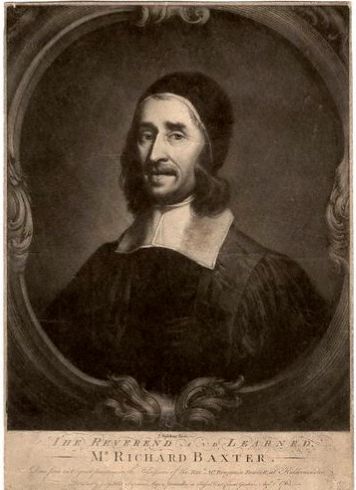
How did children react to the realisation that they were dying? The first response was usually fear, a passion defined as ‘an expectation of some future evill’.39 This emotion was thought to make the body ‘growe pale and trembling’ by drawing the blood and spirits from the outer parts to the heart.40 Fear was regarded as a natural reaction. The ejected minister and religious writer Richard Baxter (1615–1691) declared ‘who doth not dread … the face of Death? … Death is an Enemy to Nature … It is the Dissolution of the Man: It maketh a Man to become No man’.41 The cause of this instinctive fear was different for adults and children. For adults, it arose from the ‘long friendship’ enjoyed between the body and soul: death was defined as the separation of these two parts of the human being. Timothy Rogers mused,
[W]hen the day is come that the two Friends who have been so long acquainted and so dear to one another must part … when [the soul] consider[s] … what it is to have this Body, which we have tended with so long a Care, … maintain’d at so vast a Charge of Meat and Drink and Time … laid into the cold Grave, and there in a loathsome manner to putrifie … it cannot but occasion very great Commotions.42
Adults routinely mentioned this cause of fear in their personal documents, but it is noticeably absent from the accounts of children’s deaths.43
The likely reason for this difference is that the child’s body and soul had been together for a shorter time, and therefore had not attained the same degree of friendship. Instead, children’s natural fears centred on another form of separation—parting from their parents. In the 1670s, six-year-old Jason Whitrow from Covent Garden, took his mother by the hand, and said: ‘Mother, I shall dye, oh, that you might dye with me, that we might go to the Lord together’.44 This boy seems to have imagined death as a journey and one which he would have preferred to share with his mother. Several decades later, seven-year-old Betty Seymour from Wiltshire, sick of vapours, ‘fell into a passion of crying’ and told her mother, Lady Frances, if she died ‘she should not have so good a Mama, and that she would [like to] keep this Mama’.45
These examples provide insights into children’s feelings for their parents, a subject which is not usually visible to the historian. The fear of separation was put down to the ‘uniting vertue’ of the passion love, a quality which causes ‘him that loveth to aspire to unite himselfe to the thing beloved’. As the sixteenth-century philosopher Nicholas Coeffeteau explained: ‘the presence of the party beloved is so deare and pretious unto us …, that we feele our selves filled with content … whereas his absence and separation gives us a thousand torments’.46 Since death ‘is as it were a perpetuall absence’, it inevitably evoked deep fear in children. The uniting quality of love also explained why ill children derived comfort from their parents’ hugs and kisses.47
As well as expressing anxiety about leaving their parents, children worried about the practical difficulties of getting to heaven. Joseph Scholding from Suffolk, aged about five, ‘one Morning as he lay in his Bed very ill’, said to his mother, ‘Mother … I am thinking how my Soul shall get to Heaven when I die; my Legs cannot carry it [because] the Worms shall eat them’. His mother explained ‘God will send his Angels, and they shall carry it to Heaven’.48 Parents thus took their children’s fears seriously and sought to offer reassurance by depicting the passage to heaven in tangible terms, as a journey. Rather more ‘worldly’ concerns centred on what would become of toys, pets and belongings. Although the law did not allow those aged under 21 to draw up a will, children were encouraged to specify to whom they would like to pass on their personal possessions.49 Caleb Vernon was eager to settle the fate of his pet: he told his father ‘I will give it to my Sister Betty, who hath none, for Nancy hath one already’.50 Caleb’s thoughtful deliberation over which sister should gain custody of his pet demonstrates his serious approach to inheritance, as well as his care for his sister Betty and his sense of fairness.
Infinitely more terrifying than the above concerns, however, was the prospect of damnation. In the 1680s, four-year-old Mary Stubbs from Norfolk became convinced that she should go to hell. Her mother, trying to make her daughter aware of the necessity of repentance during illness, had warned her that ‘all that died, did not go’ to heaven. Subsequently, the girl had begun to ‘cry and mourn, fearing that she should go to Hell’. Mary had a vivid imagination of what hell would be like, telling her brother, ‘there is Fire and Brimstone, and the time will never end’.51 The reason Mary’s mother issued this frightening warning was that she did not want her daughter to suffer from ‘security’, a term which denoted ill-grounded confidence in one’s election.52
We have only to cast a glance at contemporary eschatological literature to discover why hell elicited such great fear.53 Tormenting Tophet or a Terrible Description of Hell (1618), by the puritan minister Henry Greenwood, describes hell as a ‘most lamentable and wofull place of torment … where there shall be scretching and screaming, weeping, wayling, and gnashing of teeth for eternity … easelesse, endlesse, remedylesse’.54 Conduct literature written specifically for children detailed these hellish horrors. Robert Russel’s Little Book for Children, published in the 1690s, states:
[If] thou wilt continue to be a naughty wicked Child … Then thou with all thy wicked Companions shall be tumbled into the Lake that burns with Fire and Brimstone … O my dear Child, Hell is a dreadful place, worse Ten thousand times than thy Parents beating thee.55
Authors tailored their descriptions of hell to their young audience, making them especially relevant to children by mentioning corporal punishment and schoolfellows. There is evidence that young people read these books. Fifteen-year-old Joseph Taylor read ‘a little Book’ which gave ‘a Pathetical Description of Hell’, he was ‘put into sore Amazement and very great Terrour’. He sat ‘groaning in the dark’, crying ‘O! How shall I do to bear this heavy Sentence! How shall I bear the tormenting Flames of Hell for ever and ever!’56 The boy seems to have been suffering from acute panic and feelings of helplessness.
Through modern eyes, the practice of teaching children about hell seems ethically abhorrent.57 However, an examination of the motivations that lay behind it reveals that for the most part, parents and clergy had benevolent intentions. At this time, it was believed that it was essential to confront the full horror of hell in order to fully repent of sin and eventually reach an assurance of heaven. This was implied by Greenwood, who stated, ‘We must goe by the gates of Hell to Heaven … We must after a sort be in Hell before ever we can be capable of Heaven’.58 Alec Ryrie suggests that an episode of fear was a necessary defence against accusations of false hopes: it made subsequent expressions of joyful assurance appear convincing.59 This positive attitude to fear may have made this emotion more bearable for children and, in some cases, pleasurable—they could rest assured that the feeling, however unpleasant, would be spiritually beneficial. Monique Scheer uses the modern analogy of the ‘pleasantly unpleasant’ experience of watching horror films.60 This may have been the case for the aforementioned Joseph Taylor: when a female member of his household heard him crying about hell, she told him she ‘was glad’ because it meant ‘God was at work’ in his soul. Joseph recorded in his autobiography, ‘I believed her, and so my fears were allayed’.61 Thus, the fear of damnation was mitigated by the conviction that this feeling was itself a sign of salvation. Such emotional complexity is a reminder that we should be cautious about classifying feelings as either ‘negative’ or ‘positive’, since cultural attitudes shape how emotions are felt.
A caveat should be added at this point. Not all children ‘trembled in the face of damnation’. As a teenager in the 1610s, Richard Norwood, an apprentice to a fishmonger, burnt his finger; a godly acquaintance asked him ‘what[,] doth a little burning of the finger trouble you so much? How dost thou think to endure the burning of hell?’ Richard replied defiantly, ‘I know not how I shall endure it. I conceive it to be very intolerable, but there will be many there besides me, and I must endure it as others do’.62 Although as an adult, Norwood was quick to condemn his youthful naivety and pointed out that it was soon overtaken by serious fear, the incident nonetheless provides an insight into a rather more apathetic attitude. Norwood may have heard so much about hell that it no longer held much emotional power. Barbara Rosenwein might interpret this boy’s response as an example of the tendency of youths to experiment with, or subvert, the emotional rules of their communities.63
Joy

It was hoped that children would eventually overcome their fears of hell and become imbued with a joyful assurance of their salvation. Judging from the eulogies and diaries, some young people did follow this course. Janeway’s biography of a nine-year-old poor boy from the parish of Newington Butts reports that the boy had initially been so ‘amazed and afraid’ of hell, that ‘the plague upon his body seemed nothing to that which was in his soul’. Upon receiving spiritual counsel from his godly neighbours, however, ‘it pleased the Lord to give him some small hopes’, which eventually hardened into a confident conviction that he would go to heaven. The boy was so delighted that he ‘gave a kind of leap in his bed, and snapt his fingers and thumb together with abundance of joy’.64
Metaphors of clothing were used to describe the experience of this emotion. When eleven-year-old Martha Hatfield believed she was ‘now going to Heaven’, she became ‘exceedingly rapt up with joy … laughing, and spreading her arms’, and crying out, ‘I have found my Christ, O, I have found my Christ, how sweet he is to me!’65 This metaphor, which suggests that joy was imagined to encase the whole body, is rooted in Scripture: Psalm 30 states: ‘thou hast put off my sackcloth, and girded me with gladness’.66 Joy was defined as ‘a motion of the minde to the outward parts, with a certaine gratefull and delighting desire to lay hold on that which may give us content’.67 Happy emotions were thought to make the heart dilate, and propel the spirits to the outer regions of the body; in turn, this centrifugal motion drove the ‘extreme parts’ of the body, the feet and hands, in an upwards direction.68 This was why the poor boy from Newington Butts leapt in his bed and Martha Hatfield lifted her arms. The upward movement was also explained in religious terms. Christians tended to picture heaven as a place high up, beyond the clouds; since the soul had an instinctive yearning to be with God, it directed its instrument, the body, towards the sky when contemplating paradise.69 These physical manifestations of joy support the recent emotions theory that feelings are bodily as well as mental phenomena.70
When examining children’s joyful responses to death, it is important to consider the possibility that such accounts may have been idealised. Joy on the deathbed was classed as a holy affection, a special spiritual emotion sparked by the presence of the Holy Spirit in the soul and indicative of election to heaven.71 In turn, the conviction that the child had gone to heaven was the greatest source of consolation for the bereaved.72 As such, parents may have overstated their child’s happiness as a way to convince themselves that he or she was now in paradise. This was likely in published eulogies, as well as diaries and letters, since authors wished to convey a prescriptive message about appropriate Christian deathbed carriage. Parents may have also put pressure on their children to voice more confidence in their salvation than they were actually feeling, out of a desire to comfort themselves. This was possibly the case for eleven-year-old John Harvy in the 1660s: his mother told him ‘if thou hadst but an assurance of Gods love I should not be so much troubled’, to which he replied, ‘I am assured, dear Mother, that my sins are forgiven, and that I shall go to Heaven’. The boy admitted that ‘nothing … grieved him’ more than ‘the sorrow that he saw his Mother to be in for his death’, from which it can be deduced that his expression of confidence was a ‘performance’, designed to comfort his mother.73 John’s words also show his love and concern for his mother.
Nevertheless, it would be unwise to be overly cynical about the authenticity of children’s joyful responses. The godly were acutely aware of the possibility of ‘false assurance’, a state of unfounded confidence in a person’s salvation. To avoid deluding themselves, it is likely that pious parents and clergymen would have been cautious in their assessments of their children’s deathbed carriage.74 In any case, a consideration of early modern beliefs about children makes their responses appear more credible. At this time, the young were thought to be more prone to joy than older people: the child’s humoral constitution was moist and warm, characteristics shared by this emotion.75 Furthermore, children were believed to be uniquely capable of spirituality, due to the fact that they had committed fewer sins than adults and were more inclined to accept divine truths at face value.76 These ideas are rooted in the Biblical passage, Matthew 18, verses 3–5, which begins: ‘Jesus called a little child unto him, and set him in the midst of them, and said, Verily I say unto you, Except you be converted, and become as little children, you shall not enter into the kingdom of heaven’. The spiritual potential of children was also indicated by God’s decision to send His son into the world as a little infant. Given this cultural backdrop, and the intense religious conditioning of children from an early age, it is quite conceivable that some young people would have been able to attain a sophisticated understanding of the doctrine of salvation, which may have shaped their emotional responses to death.77
An examination of the words of dying children reveals that there were several powerful reasons why death may have been welcomed at this time. First, children seem to have imagined heaven in special detail. Eleven-year-old Tom Josselin, son of a puritan vicar from Essex, dreamed in 1643 that Jesus took him ‘up to heaven’ to visit his sister Mary, who had died four years previously. They flew ‘over a mountain and over the sea’ to paradise, and there found angels ‘singing melodiously and praying all in white’, while Jesus sat ‘at the father’s right hand’. When it was time to go home, his sister ‘would not lett him come away’, but Christ ‘told him he must’.78 As well as revealing the strength of this boy’s imagination, the extract sheds light on the emotional bond between siblings in the early modern period: Mary and Tom’s relationship continued after death in the latter’s dreams. Such elaborate visions constitute an important difference between the deathbed experiences of children and adults: it is less common to find descriptions of heaven in adults’ memoirs—they seem to have been more transfixed by hell. Historians have suggested that this is because heaven is harder to describe—it is defined by negatives, a place where there is no weeping, pain, nor grief.79
Another reason that children longed for heaven was that they anticipated an affectionate welcome from Jesus. This idea sprang from the Biblical passage: ‘Suffer little children, and forbid them not, to come unto me: for of such is the kingdom of heaven. And he laid his hands on them’.80 Children spoke affectionately of Christ. Caleb Vernon told his father, ‘How great mercy have I that I should have such a tender Father in Earth, and in Heaven also!’81 Parents sometimes reminded their dying children of Christ’s love, perhaps hoping to make the potentially daunting occasion of meeting the Lord less intimidating, whilst reassuring children that life after death would not be devoid of the kind of love to which they were accustomed on earth. When ten-year-old Mary Warren clasped her arms around her mother’s neck, her mother said, ‘Thou embracest me, but I trust thou art going to the embracings of the Lord Jesus’.82 Mary’s mother seems to have been enjoying vicariously the affectionate embraces that Jesus would soon be giving to her daughter. The image of Christ as a loving, tender father is ubiquitous in accounts of child deaths, and it seems to appear less frequently in those of adults.
Arguably the most comforting aspect of heaven was the possibility of family reunion after death.83 In 1620, ten-year-old Cecilia D’Ewes contracted smallpox; her mother had died a short time previously, and therefore, the girl appeared not to mind dying, but instead ‘would speak of her religious mother’, crying with relief, ‘I will go to my mother, I will see her; I shall shortly be with her’.84 It was common for children to lose one or both of their parents in the early modern period: in Elizabethan Rye, for instance, nearly 60 per cent of the fathers who died left children under the age of fourteen.85 It is therefore not surprising that children looked forward to heaven—they longed to see their parents. Parents often reminded their offspring of this reunion, so as to comfort them during their last moments. A few hours before her death in 1679, Isaac Archer told his six-year-old daughter Frances, ‘she was going to heaven to her brothers and sisters, and that we should all meet againe’.86 The idyllic image of the reunited family evoked in the above extracts demonstrates the deeply loving nature of many family relationships.
Conclusion
The single greatest challenge in the history of childhood is not so much accessing children’s experiences, but rather it is overcoming our own doubts about the possibility of doing so. This chapter has sought to demonstrate that although the evidence is usually indirect, it is possible to glimpse children’s thoughts and feelings. From listening to their words as reported by adults, it has become apparent that dying children veered through diverse emotions, from fear and anxiety, to joy and excitement. The cause of these conflicting feelings was the doctrine of salvation and its polarising outcomes of eternal happiness and eternal doom. By investigating joyful feelings, as well as the more distressing ones, this study has sought to offer a more balanced picture of the emotional culture of early modern Protestantism than is usually offered.87 Nonetheless, it has also been suggested that we try not to distinguish too rigidly between ‘negative’ and ‘positive’ feelings, since these categories fail to accommodate the complexity of contemporary attitudes to such emotions.
The apparent lack of change over time in children’s emotional responses contests the historiographical view that attitudes to death were changing in the late seventeenth century. While hell may have been doubted in some quarters, it remained a powerful presence in the imaginations of children into the eighteenth century. The fact that religious doctrine played a large role in children’s responses to death also challenges the view that the spiritual education of those under the age of about 12 was not taken seriously.88 Indeed, the likelihood of death in childhood rendered the religious instruction of the young a pressing priority. Parents did not doubt their child’s ability to understand religious concepts and it seems that their high expectations were often met.
While children’s responses to death were largely similar to those of adults, there were some significant differences. For grown men and women, the ‘natural fear’ of death was thought to arise from the long acquaintance of the body and soul—death was defined as the separation of these parts of the human being and the two were personified as great friends or ‘playmates’, who loved one another dearly and were ‘loth to part’.89 By contrast, for children the fear of death stemmed from another form of parting—separation from close family members. Such reactions provide insights into the usually impenetrable subject of children’s feelings for their parents and siblings.
The intensity of children’s feelings may also have differed from those of adults: their bodies were thought to be humorally warm and moist, qualities shared by the affection of joy, and the result was that this emotion was more ‘easily framed in the hearts of children’ than in older people.90 Children’s imaginations, as well as their passions, were conceived as more powerful than those of adults, a capacity which enabled them to cultivate particularly vivid mental images of heaven and hell. Given that the former was reckoned to be much more difficult to picture than the latter, this feature of children’s responses seems especially pertinent. Other distinctive characteristics included children’s preoccupations with the disposal of their toys and pets, and their concerns about the practical aspects of getting to heaven. In view of these various differences, it can be proposed that children’s relationship with death was to some extent unique. The above findings enrich our understanding of what it meant to be a child in the early modern period, and above all, convey the depth of bonds that existed between children, parents and siblings.
Endnotes
- John Vernon, The Compleat Scholler; or, A Relation of the Life, and Latter-End Especially, of Caleb Vernon (London, 1666).2
- Hannah Newton, The Sick Child in Early Modern England, 1580–1720 (Oxford: Oxford University Press, 2012). [PMC free article] [PubMed]3
- David Stannard, ‘Death and the Puritan Child’, American Quarterly 26 (1974), 456–75. Others who believe that the fear of death was on the increase include Philippe Ariès, The Hour of Our Death, trans. Helen Weaver (London: Alfred A. Knopf, 1981) and Claire Gittings, Death, Burial and the Individual in Early Modern England (London: Vintage, 1984), 50.4
- Ralph Houlbrooke, ‘Death in Childhood: The Practice of the Good Death in James Janeway’s “A Token for Children”’, in Childhood in Question: Children, Parents and the State, ed. Anthony Fletcher and Stephen Hussey (Manchester: Manchester University Press, 1999), 37–56, at 8.5
- Ralph Houlbrooke, Death, Religion and the Family in England, 1480–1750 (Oxford: Oxford University Press, 1998), 50–6. The most famous proponent of this view was Daniel Pickering Walker, The Decline of Hell: Seventeenth-Century Discussions of Eternal Torment (London: Routledge & Kegan Paul, 1964).6
- On the importance of emotion in Protestant lives, see Arnold Hunt, The Art of Hearing: English Preachers and their Audiences, 1590–1640 (Cambridge: Cambridge University Press, 2010); Alec Ryrie, Being Protestant in Reformation Britain (Oxford: Oxford University Press, 2013). Other influential studies on emotion and religion, but for different places or periods, include Susan C. Karant-Nunn, The Reformation of Feeling: Shaping the Religious Emotions in Early Modern Germany (Oxford: Oxford University Press, 2010); Phyllis Mack, Heart Religion in the British Enlightenment: Gender and Emotion in Early Methodism (Cambridge: Cambridge University Press, 2008). For an introduction to this literature, see John Corrigan, ‘Religion and Emotions’, in Doing Emotions History, ed. Susan Matt and Peter Stearns (Urbana, IL: University of Illinois Press, 2014), 143–62.7
- Ryrie, Being Protestant, 20–21, 2649.8
- Timothy Rogers, Practical Discourses on Sickness & Recovery in Several Sermons (London, 1691), 65.9
- I am preparing a book on recovery from illness; one of the chapters is entitled, ‘Escaping Death’, and it uses near-death accounts to describe the experience of survival from life-threatening disease.10
- Peter Stearns, ‘Challenges in the History of Childhood’, Journal of the History of Childhood and Youth 1 (2009), 35–42, at 35.11
- Guildhall Library, London, MS 204, [his pagination] 408–9, Nehemiah Wallington, ‘A Record of the Mercies of God: or A Thankfull Remembrance’.12
- Vernon, The Compleat Scholler, to the reader.13
- On autobiographies, see Adam Smyth, Autobiography in Early Modern England (Cambridge: Cambridge University Press, 2010).14
- Joseph Lister, The Autobiography of Joseph Lister of Bradford, 1627–1709, ed. Thomas Wright (Bradford: John Russell Smith, 1842), 4.15
- Ryrie, Being Protestant, 439.16
- For studies of autobiography and memory, see Rudolf Dekker, Childhood, Memory and Autobiography in Holland: From the Golden Age to Romanticism (Basingstoke: Macmillan, 2000).17
- For example, see the letter from Ralph Verney to his wife Mary, about the death of their daughter Pegg in 1647: Frances Verney, ed., The Verney Memoirs, 1600–1659 (London: Longmans & Co, 1925, first published 1892), 1: 385. This can be contrasted with the medieval practice discussed by Maddern in Chap. 3.18
- For examples of children whose parents were unable to be with them during their illnesses, see Newton, The Sick Child, 103–4.19
- Patrick Collinson, The Elizabethan Puritan Movement (London: Jonathan Cape, 1967), 26–7.20
- Patricia Crawford, Parents of Poor Children in England 1580–1800 (Oxford: Oxford University Press, 2010), 130–2.21
- On religious persecution, see Alexandra Walsham, Charitable Hatred: Tolerance and Intolerance in England, 1500–1700 (Manchester: Manchester University Press, 2006).22
- Fay Bound Alberti, ed., Medicine, Emotion and Disease, 1700–1950 (Basingstoke: Palgrave Macmillan, 2006), xvii.23
- On ‘emotionology’, see Peter Stearns and Carol Stearns, ‘Emotionology: Clarifying the History of Emotions and Emotional Standards’, American Historical Review 90 (1985), 813–36 [PubMed]. On ‘Emotional communities’, see Barbara Rosenwein, Emotional Communities in the Early Middle Ages (Ithaca: Cornell University Press, 2006). On ‘emotional regimes’, see William Reddy, The Navigation of Feeling: A Framework for the History of Emotions (Cambridge: Cambridge University Press, 2001).24
- Monique Scheer, ‘Are Emotions a Kind of Practice (and Is That What Makes Them Have a History)? A Bourdieuian Approach to Understanding Emotion’, History and Theory 51 (2012), 193–220, at 195–6.25
- Ibid., 196.26
- Nicholas Coeffeteau, A Table of Humane Passions (London, 1621), 2. See Thomas Dixon, From Passions to Emotions: The Creation of a Secular Psychological Category (Cambridge: Cambridge University Press, 2003).27
- See my forthcoming chapter on ‘The Holy Affections’, in Early Modern Emotions: An Introduction, ed. Susan Broomhall (London: Routledge, forthcoming).28
- James Janeway, A Token for Children. The Second Part (London, 1673), 2–3.29
- Bodleian Library, Oxford, MS Eng. Misc. e. 331, p. 35, Diary of Sarah Savage, 1714–23.30
- Edward Anthony Wrigley and Roger Schofield, The Population History of England, 1541–1871: A Reconstruction (Cambridge: Cambridge University Press, 1981), 249.31
- John Kettlewell, Death Made Comfortable (London, 1695), vii.32
- See Houlbrooke, Death, Religion and the Family, Chapter 3; Newton, The Sick Child, 98–100, 117–18, 167–9, 182–3.33
- The Life and Death of Mrs. Margaret Andrews…who Died…1680, in the 14th year of her age (London, 1680), 60.34
- See, for example, the case of Joseph Scholding, on p. 10.35
- See Ian Green, A Christian’s ABCs: Catechisms and Catechizing in England c.1530–1740 (Oxford: Oxford University Press, 1995).36
- On predestination, see Leif Dixon, Practical Predestinarians in England, c.1590–1640 (Farnham: Ashgate, 2014).37
- On these tensions, see Ryrie, Being Protestant, 250; Alexandra Walsham, Providence in Early Modern England (Oxford: Oxford University Press, 2003), 153.38
- There is debate about the extent to which predestination was accepted by all brands of English Protestants. John Spurr implies that it was a doctrine distinctive to Puritans: The Post-Reformation: Religion, Politics and Society in Britain 1603–1714 (Harlow: Longman, 2006), 22–3. More recently, Alec Ryrie has argued that predestination was ‘the water in which the English church swam’ and that clerics’ claims that only a ‘tiny minority’ of godly parishioners believed in this doctrine ‘were preachers’ rhetoric rather than sober attempts at quantification’: Being Protestant, 7.39
- James Hart, Klinike, or the Diet of the Diseased (London, 1633), 343.40
- Coeffeteau, A Table, 17.41
- Richard Baxter, A Treatise of Death, the Last Enemy to be Destroyed (London, 1660), 4–5.42
- Rogers, Practical Discourses, 44–5.43
- For example, see Rachel Russell, Letters of Rachel, Lady Russell, 2 vols (Tennessee: General Books, 2010, first published 1773), 2: 38.44
- Rebecca Travers, The Work of God in a Dying Maid (London, 1677), 47–8.45
- Frances Seymour, The Gentle Hertford: Her Life and Letters, ed. Helen Hughes (New York: Macmillan, 1940), 77.46
- Coeffeteau, A Table, 161–2.47
- On physical affection between parents and children, see Newton, The Sick Child, 163–5.48
- William Bidbanck, A Present for Children. Being a Brief, but Faithful Account of Many Remarkable and Excellent Things Utter’d by Three Young Children (London, 1685), 76.49
- Houlbrooke, Death, Religion and the Family, 83–4.50
- Vernon, The Compleat Scholler, 53–4.51
- Bidbanck, A Present for Children, 44–5.52
- Ryrie, Being Protestant, 23.53
- See Philip Almond, Heaven and Hell in Enlightenment England (Cambridge: Cambridge University Press, 1994), 89.54
- Henry Greenwood, Tormenting Tophet; or a Terrible Description of Hell (London, 1650, first published 1618), 239–40.55
- Robert Russel, A Little Book for Children, and Youth (London, 1693–96), this book is un-paginated.56
- Joseph Taylor, Grace, Grace: or, The Exceeding Riches of Grace (London, 1702), 7–8.57
- This is the view implied by Stannard, ‘Death and the Puritan Child’.58
- Henry Greenwood, The Jaylers Jayl-Delivery (London, 1620), 8.59
- Ryrie, Being Protestant, 35.60
- Scheer, ‘Are Emotions a Kind of Practice?’, 210.61
- Taylor, Grace, Grace, 9.62
- Richard Norwood, The Journal of Richard Norwood, Surveyor of Bermuda, ed. Wesley Frank Craven and Walter Hayward (New York: Scholars Facsimiles & Reprints, 1945), 69.63
- Jan Plamper, ed., ‘The History of Emotions: An Interview with William Reddy, Barbara Rosenwein, and Peter Stearns’, History and Theory 49 (2010), 237–65, at 257.64
- James Janeway, A Token for Children Being an Exact Account of the Conversion, Holy and Exemplary Lives and Joyful Deaths of Several Young Children (London, 1671), 61, 71.65
- John Fisher, The Wise Virgin, or, A Wonderful Narration of the Various Dispensations Towards a Childe of Eleven Years of Age…Martha Hatfield (London, 1653), 6.66
- Psalm 30:11 (King James Version).67
- Hart, Klinike, 397.68
- See B.A., The Sick-Mans Rare Jewell (London, 1674), 30.69
- Ryrie, Being Protestant, 184.70
- For example, Alva Noe, Out of Our Heads: Why You Are Not Your Brain, and Other Lessons from the Biology of Consciousness (New York: Hill and Wang, 2009), 10.71
- See note 29 above.72
- See Richard Wunderli and Gerald Broce, ‘The Final Moment before Death’, Sixteenth Century Journal 20 (1989), 259–75.73
- Janeway, A Token for Children (Part 2), 86. The idea that emotions are performed was developed by Fay Bound Alberti, in her thesis, ‘Emotion in Early Modern England: Performativity and Practice at the Church Courts of York, c. 1660–1760’ (D.Phil, University of York, 2000).74
- See Wunderli and Broce, ‘The Final Moment before Death’, 259–75.75
- Coeffeteau, A Table, 299.76
- Alexandra Walsham, ‘“Out of the Mouths of Babes and Sucklings”: Prophecy, Puritanism, and Childhood in Elizabethan Suffolk’, in The Church and Childhood, Studies in Church History, ed. Diana Wood (Oxford: Ecclesiastical History Society, 1994), 285–300, at 286295.77
- This viewpoint is also expressed by Alison Shell, ‘“Furor Juvenilis”: Post-Reformation English Catholicism and Exemplary Youthful Behaviour’, in Catholics and the ‘Protestant Nation’: Religious Politics and Identity in Early Modern England, ed. Ethan H. Shagan (Manchester: Manchester University Press, 2005), 185–206, at 189.78
- Ralph Josselin, The Diary of Ralph Josselin 1616–1683, ed. Alan Macfarlane (Oxford: Oxford University Press, 1991), 335.79
- Almond, Heaven and Hell, 100.80
- Matthew 19: 14–15 (King James Version).81
- Vernon, The Compleat Scholler, 40.82
- H.P., A Looking-Glass for Children: Being a Narrative of God’s Gracious Dealings with Some Little Children (London, 1673), 9.83
- On reunion in heaven, see Peter Marshall, ‘The Company of Heaven: Identity and Sociability in the English Protestant Afterlife, c. 1560–1630’, Historical Reflections 26 (2000), 311–33.84
- Simonds D’Ewes, The Autobiography and Correspondence of Sir Simonds D’Ewes, Bart., ed. J.O. Halliwell, 2 vols (London: Richard Bentley, 1845), 157.85
- Crawford, Parents of Poor Children, 115.86
- Isaac Archer, ‘The Diary of Isaac Archer 1641–1700’, in Two East Anglian Diaries 1641–1729, ed. in Matthew J. Storey (Woodbridge: Boydell Press, 1994), 41–200, at 160–1.87
- On the gloomy emotional culture of Protestantism, see John Stachniewski, The Persecutory Imagination: English Puritanism and the Literature of Religious Despair (Oxford: Oxford University Press, 1991); David Stannard, The Puritan Way of Death: A Study in Religion, Culture, and Social Change (Oxford: Oxford University Press, 1977). On the rarity of studies of happiness, see Darrin McMahon, ‘Finding Joy in the History of Emotions’, in Doing Emotions History, ed. Susan Matt and Peter Stearns, 103–19.88
- Ryrie, Being Protestant, 429. See also, Patrick Collinson, Religion of Protestants (Oxford: Oxford University Press, 1982), 229–3..89
- Rogers, Practical Discourses, 86–7.90
- Coeffeteau, A Table, 299.
Chapter 5 from Affiliate disclosure: Amazon links on this site are paid links. As an Amazon Associate I earn from qualifying purchases.Death, Emotion and Childhood in Premodern Europe, edited by K. Barclay, K. Reynolds, and C. Rawnsley, London: Palgrave Macmillan (2017). Republished by the National Center for Biotechnology Information, National Library of Medicine, under the terms of a Creative Commons Attribution 4.0 International license.
About the Author