Thales and Anaxagoras to Hipparchus, the Antikythera Mechanism, and Ptolemy, Greek thinkers made eclipses problems of cause, geometry, measurement, and prediction.

By Matthew A. McIntosh
Public Historian
Brewminate
Introduction: When Day Became Night
In the sixth year of a war between Alyattes of Lydia and Cyaxares of Media, according to Herodotus, the armies met once more after a succession of indecisive campaigns. As the fighting continued, daylight suddenly gave way to darkness. Medes and Lydians alike ceased combat, and the eclipse that had interrupted their battle became the occasion for a negotiated peace, reinforced by the marriage of Alyattes’s daughter Aryenis to Cyaxares’s son Astyages. Herodotus added a detail that would give the episode an extraordinary afterlife: Thales of Miletus had allegedly foretold the transformation of day into night and had fixed the year in which it would occur. Modern calculations have encouraged historians to identify the phenomenon with the total solar eclipse of 28 May 585 BCE, whose path crossed portions of Anatolia. The resulting story possesses nearly irresistible dramatic symmetry: a philosopher predicts the heavens, nature interrupts human violence, and scientific knowledge triumphs at the very moment when terrified warriors lay down their weapons. Yet almost every element that makes the episode memorable also makes it historically difficult.
The prediction attributed to Thales has often been presented as one of the foundational moments of Western science, but Herodotus’s brief report cannot sustain all the achievements later attached to it. He does not say that Thales named the day, month, location, duration, or magnitude of the eclipse, nor does he explain what observations or calculations might have supported the forecast. He says only that Thales had designated the year as the limit within which the change would occur. Even the conventional identification of the eclipse depends upon reconstructing an uncertain chronology and locating a battlefield that Herodotus never names. More fundamentally, the traditional story collapses several distinct intellectual accomplishments into one seemingly miraculous act. To understand an eclipse as the interposition of one celestial body between another body and an observer is not the same as recognizing the numerical periods within which eclipses recur. Recognizing such recurrence is not the same as predicting the date of a particular eclipse, and predicting that an eclipse is astronomically possible is not the same as determining where a solar eclipse will be visible on Earth. The restricted geographical path of the Moon’s shadow makes local solar prediction demanding, even when a periodic cycle is known. These distinctions do not render the Thales tradition worthless, but they shift the historical question from whether one man suddenly invented eclipse science to how different forms of celestial knowledge gradually became connected. The “orbit” of the title signifies the increasingly systematic modeling of recurring celestial motions through circles, spheres, eccentrics, and epicycles, not a premature Greek discovery of the elliptical planetary orbits later associated with Keplerian astronomy.
That development did not unfold within an intellectually isolated Greece, nor did it require religious meaning to disappear before natural explanation could begin. Ionian thinkers inhabited a world connected through trade, warfare, migration, diplomacy, and imperial expansion to Lydia, Egypt, Phoenicia, and Mesopotamia, where observers had recorded and interpreted celestial phenomena over many centuries. Babylonian scholars treated eclipses as omens, but precisely because the heavens were believed to communicate consequential information, they cultivated practices of observation, documentation, comparison, and periodic forecasting that eventually became indispensable to Greek mathematical astronomy. Greek natural philosophers meanwhile proposed competing physical accounts of the Sun, Moon, Earth, light, and shadow, even as poets, soldiers, political leaders, and diviners continued to experience eclipses as potentially meaningful signs. Omen interpretation and astronomical inquiry were not simple opposites: fear could stimulate observation, divination could preserve data, and knowledge of physical causation did not logically exclude the possibility that a naturally produced eclipse carried divine significance.
The history traced here consequently begins with darkness understood as a portent but does not end with the defeat of religion by reason. It follows a series of overlapping transformations in which eclipses became natural obscurations, demonstrations of celestial geometry, evidence for the shape of Earth, instruments for estimating cosmic distances, recurring possibilities encoded in numerical periods, and events calculable through models, tables, and mechanisms. Early thinkers such as Anaximander, Empedocles, and Anaxagoras made eclipses physically arguable even when their broader cosmologies remained speculative or incorrect. Aristotle turned the lunar eclipse into a model of causal knowledge, while Aristarchus used the geometry of shadow to investigate the relative sizes and distances of the Sun, Moon, and Earth. Hipparchus joined long observational records and Babylonian numerical periods to Greek geometrical methods, and the Antikythera Mechanism embodied eclipse recurrence in geared bronze. By the time of Ptolemy in second-century CE Alexandria, eclipse prediction had become an organized sequence of observations, parameters, models, and tabular operations rather than an exceptional feat credited to a solitary sage. The path from omen to orbit was neither exclusively Greek nor steadily progressive, and older interpretations did not simply vanish as mathematical astronomy advanced. Its central achievement was instead the construction of a cosmos in which the terrifying disappearance of the Sun or Moon could remain wondrous and culturally charged while also becoming physically explicable, mathematically ordered, and, within carefully understood limits, predictable.
Darkness as a Message: Eclipses in Archaic Greek Thought
Archaic Greek responses to celestial darkness survive not in astronomical treatises but in poetry, where the heavens formed part of a world charged with divine agency. The Sun was more than a luminous object: it marked time, witnessed oaths, exposed concealed actions, and sustained the visible order separating ordinary life from chaos. Its disappearance during the day could appear as a rupture in the expected structure of existence. Such a rupture invited interpretation because extraordinary natural events were rarely treated as meaningless accidents. Yet the surviving evidence does not justify assigning one uniform “Greek belief” to communities scattered across different islands, cities, and generations. It reveals instead a repertoire of poetic and religious possibilities through which sudden darkness could become a warning, a demonstration of divine power, or an image of approaching death.
One of the earliest apparent images of an extinguished Sun occurs near the end of the Odyssey, when the seer Theoclymenus beholds the suitors surrounded by signs of destruction. Their faces seem covered in darkness, blood stains the walls, ghosts crowd toward the underworld, the Sun vanishes from the sky, and an evil mist spreads over everything. The vision unmistakably resembles the darkness of an eclipse, and modern attempts have connected it with a calculated solar eclipse in 1178 BCE. That interpretation requires the poem to preserve astronomical information from a much earlier historical moment and treats a cluster of underworld images as though it were a coded observational record. The passage’s dramatic setting offers a more immediate explanation: Theoclymenus perceives the suitors as men already claimed by death, although they continue to feast and laugh around him. Darkness here does not interrupt the narrative as an independently reported celestial event; it belongs to a prophetic vision whose other features are equally supernatural. Even ancient commentators recognized that the passage described inspired perception rather than an eclipse actually occurring within the action. The Homeric scene nevertheless remains important because it shows how readily the disappearance of sunlight could signify the collapse of human security. Daylight does not merely fail; it withdraws as the doomed men pass symbolically from the world of the living into the realm of the dead.
Far more securely connected with an observed eclipse is Archilochus fragment 122, generally associated with the solar eclipse of 6 April 648 BCE. The identification remains dependent upon the uncertain chronology of the poet’s life, his unknown location when the event occurred, and modern reconstruction of the ancient path of totality. Whatever its precise date and circumstances, the fragment plainly evokes an eclipse rather than darkness employed solely as metaphor. Archilochus describes night appearing at midday while the Sun was still shining, a reversal so overwhelming that fear descended upon humankind.
The poem does not respond to the eclipse by searching for an impersonal mechanism. Zeus, father of the Olympians, hides the Sun’s light and transforms noon into night, displaying an ability to overturn what human beings had regarded as the fixed limits of possibility. Archilochus consequently declares that nothing can any longer be dismissed as unexpected, unbelievable, or marvelous. He imagines land animals exchanging their habitat with dolphins, the beasts preferring the sea while the dolphins choose the wooded mountains. These impossible reversals are not random embellishments but extensions of the eclipse’s fundamental violation of expectation. If day can become night, then distinctions between land and sea, credible and incredible, or natural and unnatural no longer seem secure. The celestial event becomes a rhetorical instrument through which the poet destabilizes confidence in the ordinary arrangement of the world. Because the surviving fragment has lost its wider setting, its ultimate target cannot be recovered with certainty; the eclipse may have prepared an attack, joke, accusation, or reflection on some shocking human conduct. Its literary force nevertheless depends upon an audience that recognized both the event and the fear it produced. Archilochus does not preserve a passive specimen of “primitive superstition,” but an active interpretation that turns collective terror into an argument about the fragility of human certainty.
To call such an eclipse an omen was to place it within a comprehensible relationship between divine power, cosmic order, and human affairs. The interpretation could be flexible because the phenomenon did not carry one automatic meaning: its significance depended upon circumstance, authoritative explanation, and the event with which observers connected it. Poetry helped accomplish that interpretive work by converting an overwhelming spectacle into a memorable account of agency and consequence. This framework did not prevent close observation, for Archilochus’s contrast between shining noon and sudden night captures precisely the feature that made a solar eclipse physically astonishing. Nor did later natural explanations simply erase the older vocabulary of fear, wonder, and divine significance. As Greek thinkers began asking what material arrangement could hide the Sun, they inherited a phenomenon that archaic poets had already made intellectually urgent, a darkness whose terror arose from its apparent ability to suspend the rules of the world.
Ionia Beneath an Eastern Sky
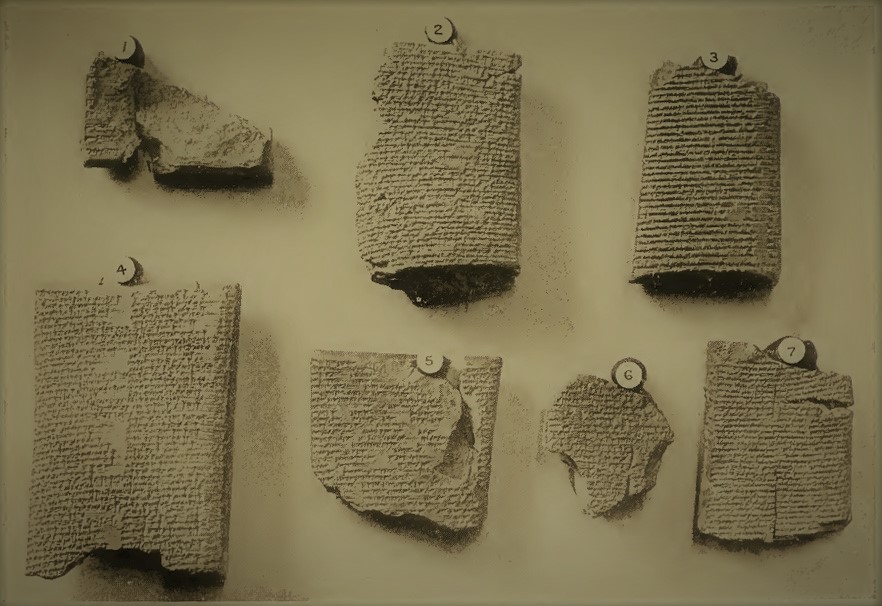
Miletus stood at the western edge of Anatolia, but its intellectual horizon extended far beyond the Aegean. Its harbors connected Ionian merchants and travelers with communities around the Black Sea, the Levant, Egypt, Cyprus, and the interior kingdoms of Anatolia. Milesians encountered Lydian power immediately to their east, while the expansion of the Achaemenid Empire later incorporated Ionia into a political network reaching through Mesopotamia to Central Asia. Goods were not the only things moving through these networks: navigational knowledge, calendrical practices, religious traditions, stories about the cosmos, and techniques of measurement could travel with merchants, mercenaries, craftsmen, interpreters, and court specialists. None of this proves that a particular Milesian philosopher studied a particular eastern text. It does make the familiar image of Greek natural philosophy arising in cultural isolation historically untenable.
Mesopotamian scholars had been observing and interpreting the heavens for centuries before Thales. The great omen series Enūma Anu Enlil, whose formation extended across the second and first millennia BCE, associated variations in the appearances of the Sun, Moon, planets, stars, and weather with possible consequences for kingdoms and rulers. Several tablets were devoted specifically to lunar eclipses, classifying them according to such features as timing, duration, direction of shadow, color, and the portion of the Moon affected. This was not prediction in the modern sense of calculating a mechanically predetermined future, for an omen warned of a possible consequence that ritual, political action, or favorable counter-signs might avert. Yet celestial divination demanded discrimination among phenomena, preservation of earlier judgments, and communication between trained observers and royal authorities. Neo-Assyrian letters and reports from the seventh century BCE show scholars informing kings about anticipated eclipse watches, recording whether an expected eclipse appeared, and explaining the political meaning of what they saw. Their concern with omens encouraged practices that would become essential to astronomy: regular surveillance, dated documentation, comparison of observations, and recognition that eclipses were restricted to recurring intervals. Divination and empirical inquiry were not rival enterprises within this scholarly culture. The belief that an eclipse mattered gave observers a compelling reason to determine when it might occur.
The surviving evidence also reveals why eclipse prediction developed unevenly. Lunar eclipses could be seen across the entire hemisphere facing the Moon, allowing observations made in widely separated places to refer to the same event. A solar eclipse, by contrast, might be invisible in Babylonia while producing terrifying darkness in Anatolia, because the Moon’s shadow crossed only a limited portion of Earth. Recognizing an eclipse season could justify watching for an obscuration without revealing whether a solar eclipse would be visible from any particular city. Even a correct recurrence period did not by itself provide the local geometry required to predict totality.
The possibility of transmission from Mesopotamia to Ionia must consequently be treated as a historical question rather than a convenient solution to the mystery of Thales. Seventh-century Assyrian and Babylonian reports indicate awareness that eclipse possibilities commonly returned after intervals of five or six lunar months, while later Babylonian texts display more systematic organization of eclipse possibilities within a period of 223 months. It would be anachronistic to place the entire mature apparatus of Late Babylonian mathematical astronomy in Thales’s hands. The best-preserved astronomical diaries, eclipse canons, procedural texts, and numerical schemes are generally later than the early sixth century BCE, even when they developed from older observations and practices. Nor does the existence of eastern knowledge prove that cuneiform tablets, trained scribes, or their methods reached Miletus in a form a Greek speaker could readily use. Knowledge could pass orally, through bilingual intermediaries, through simplified rules detached from their written origins, or through Anatolian courts without leaving a documentary trail, but each possibility remains an inference. Later stories that send Thales to Egypt or give early Greek sages extensive foreign instruction are evidence for how antiquity imagined wisdom, not reliable itineraries of intellectual apprenticeship. Conversely, excessive skepticism can be equally misleading if it assumes that only a surviving translation or named teacher could demonstrate cultural exchange. Ideas often crossed linguistic boundaries through practical contact long before authors acknowledged their sources. The historical challenge is to recognize the plausibility of eastern influence without transforming that plausibility into a fictional biography of Thales.
Greek astronomy would eventually provide unmistakable evidence of engagement with Babylonian observations, periods, units, and predictive techniques, especially in the work associated with Hipparchus and Ptolemy. The earliest Ionian phase is less secure, but it belongs within the same interconnected eastern Mediterranean world. Its distinctive contribution was not the sudden invention of rational inquiry by a people previously untouched by foreign knowledge. Ionian thinkers selected, reformulated, and argued about materials available within a broad environment of maritime exchange, imperial power, practical expertise, mythic speculation, and scholarly observation. They increasingly asked what physical structures and regular processes might produce the appearances recorded in the sky, while Mesopotamian specialists had already demonstrated that celestial signs could be systematically watched and, within limits, anticipated. Against this background, the tradition concerning Thales becomes more intelligible but no less problematic. It places a Milesian thinker at the meeting point between Greek speculation and eastern celestial knowledge, yet it leaves unanswered the decisive questions of what he knew, how he acquired it, and what he could actually predict.
Herodotus and the Battle of the Eclipse
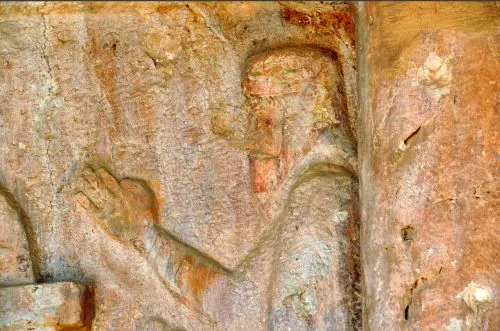
Herodotus places the celebrated eclipse within a war that arose from an elaborate chain of hospitality, injury, revenge, and failed diplomacy. A group of Scythians fleeing from the Median king Cyaxares had sought protection from Alyattes of Lydia, but Cyaxares demanded their surrender after they committed a gruesome act of retaliation against him. Alyattes refused, and the dispute drew the Lydians and Medes into a war that continued for five years. Neither kingdom secured a decisive advantage: Herodotus reports alternating victories and even a nocturnal battle, creating an impression of two powers locked in an exhausting equilibrium. In the sixth year, the armies met again, and day suddenly became night while the fighting was underway. The combatants abandoned the struggle and became eager to negotiate the peace that ordinary warfare had failed to produce.
Herodotus then introduces Thales of Miletus in a single sentence whose brevity contrasts sharply with the enormous claims later constructed from it. Thales, he says, had foretold the transformation to the Ionians and had fixed as its limit the very year in which it occurred. The wording attributes a forecast to Thales, but it does not state that he predicted the precise day, hour, location, magnitude, or path of the eclipse. It does not even indicate how far in advance he spoke or whether his announcement reached either army before the battle. Herodotus supplies no calculation, observational record, teacher, instrument, or explanatory theory that could disclose the basis of the forecast. His reference to the Ionians may suggest that the prediction had circulated beyond Miletus, but it does not establish the form in which that information was communicated. The phrase fixing the year as a limit is particularly important because it permits a broader warning than the exact prediction celebrated in many modern accounts. Herodotus may have understood Thales to have identified a year during which an eclipse was possible rather than to have named one event with modern astronomical precision. Whatever the intended degree of exactness, the historian does not pause to defend the prediction or present it as the beginning of a new science. Thales appears because his reputed foresight intensifies the wonder of an event that transformed both the sky and the political order beneath it.
The eclipse is conventionally identified with the total solar eclipse of 28 May 585 BCE, whose reconstructed path crossed parts of Anatolia. That identification is plausible, but it is not directly supplied by Herodotus, who gives neither an absolute year nor the location of the battlefield. The chronology must instead be assembled from royal genealogies, later chronographic traditions, and modern astronomical calculations, all of which contain uncertainties. The existence of a suitable eclipse strengthens the possibility that Herodotus preserved a memory of an actual event, but it cannot independently confirm every detail of his narrative or prove that Thales predicted it.
Within the structure of Herodotus’s account, the darkness performs a political and moral function as important as its astronomical one. The war began with violated relationships and retaliatory violence, persisted because neither monarch would yield, and ended only when the expected order of nature appeared to collapse. Medes and Lydians did not respond by admiring Thales’s knowledge; they responded with fear, stopped fighting, and urgently sought reconciliation. Syennesis of Cilicia and Labynetus of Babylon mediated the settlement, which was secured by the marriage of Alyattes’s daughter Aryenis to Cyaxares’s son Astyages. Herodotus also describes the blood ritual by which the Lydians and Medes confirmed agreements, drawing the eclipse into a sequence of peacemaking acts involving diplomacy, kinship, bodily sacrifice, and oath. The narrative moves from disorder in human relationships to darkness in the heavens and finally to the restoration of political order. It would be misleading to reduce this pattern to a simple confrontation between scientific prediction and superstitious terror. Thales’s forecast and the armies’ interpretation occupy the same story without canceling one another: the eclipse can be predictable in advance and still possess overwhelming significance when it occurs.
The report was written roughly a century and a half after the event it purports to describe, and Herodotus does not identify his source. Oral memories, Ionian traditions about Thales, Lydian court narratives, chronological reconstruction, and stories attached retrospectively to a known eclipse may all have contributed to the version he inherited. Later authors wrote at a still greater distance and increasingly treated the episode as an established achievement in the biography of a canonical sage. Cicero cited Thales when arguing that prolonged observation permitted the prediction of celestial phenomena, while Pliny incorporated the eclipse into a chronological account of astronomical discoveries. Diogenes Laertius likewise included eclipse prediction among the accomplishments that made Thales famous for his study of the heavens. These writers preserve valuable evidence for the growth of the tradition, but their confidence cannot simply be projected backward into the sixth century BCE. Each retelling belonged to an intellectual world in which Thales had already become one of the Seven Sages and a conventional founder of Greek natural philosophy. The sparse Herodotean statement consequently acquired greater precision and theoretical significance as later authors fitted it into narratives about the origins of astronomy.
Herodotus remains the indispensable witness, but he offers testimony to a remembered prediction rather than documentation of a demonstrable calculation. His account supports the cautious conclusions that a battle between Lydians and Medes was associated with a solar eclipse and that, by the fifth century BCE, Thales was credited with having announced its approximate time. It does not establish that the armies knew of the forecast, that the eclipse alone caused the final peace, or that Thales possessed a method capable of predicting local solar totality. The episode’s historical value extends beyond the question of whether its strongest version is literally true. By attaching celestial foresight to Thales, the tradition made the intelligibility of apparent cosmic disorder a defining mark of wisdom and prepared the Milesian philosopher to become the protagonist of a much larger story about the beginnings of Greek science.
The Thales Problem
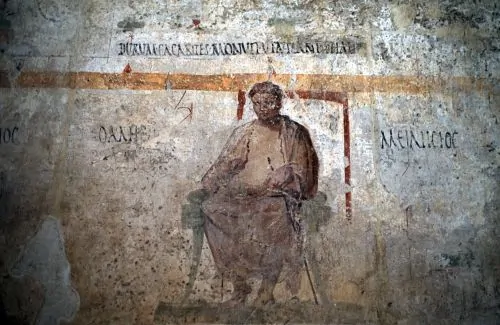
The problem of Thales cannot be solved merely by demonstrating that an eclipse occurred over Anatolia during the early sixth century BCE. A suitable celestial event would confirm only that Herodotus’s story was astronomically possible, not that its chronology, battlefield setting, political consequences, and prediction were all historically accurate. Several distinct questions have too often been compressed into the single claim that Thales “predicted an eclipse.” Did the battle actually coincide with a sudden solar obscuration? Did Thales issue any warning before it happened, and if so, how precisely did he describe its timing? Did he possess a repeatable method, or did a broad conjecture happen to succeed through favorable coincidence? Most importantly, could any technique plausibly available to a Milesian thinker have predicted that a solar eclipse would be visible from the particular region in which the armies fought? The surviving evidence answers none of these questions directly, leaving modern scholars to test ancient testimony against astronomy, chronology, and the known development of predictive methods.
The total solar eclipse of 28 May 585 BCE remains the strongest candidate for the event described by Herodotus. Modern calculations indicate that it produced total or nearly total darkness across substantial parts of Anatolia late in the day, whereas alternative eclipses proposed for 582 and 581 BCE would have been too limited there to turn day dramatically into night. The precise ground track cannot be reconstructed without allowing for uncertainty in Earth’s ancient rate of rotation, and the location of the battlefield remains unknown. Astronomy establishes that an appropriate eclipse occurred, but it cannot place unnamed armies beneath the Moon’s shadow or identify a prediction in advance of the event.
The most famous explanation of Thales’s achievement appeals to the period of 223 synodic months that would much later be called the saros. After approximately eighteen years and eleven days, the Sun, Moon, and lunar nodes return to a sufficiently similar configuration for another eclipse belonging to the same series to occur. The recurrence is extraordinarily useful, but it does not return the second eclipse to precisely the same place on Earth. Because the 223-month interval includes roughly one-third of a day, Earth has rotated about eight additional hours when the later eclipse occurs, shifting its visible region far westward. Differences in lunar distance and latitude also alter the magnitude, duration, and geographical path of the event. A triple recurrence of 669 months, later known as the exeligmos, compensates more effectively for the fractional day, but it requires an observational baseline of approximately fifty-four years. More decisively, the eclipse one exeligmos before that of 585 BCE was not visible from Miletus, depriving Thales of the local observation needed to apply that particular recurrence directly. A partial solar eclipse was visible there one saros earlier, but the recurrence alone could not reveal whether its successor would be total in Anatolia, partial, or invisible from the observer’s location. Nor is there evidence that early-sixth-century Babylonian scholars possessed a procedure capable of predicting the local circumstances of a solar eclipse and transmitted it to Thales. Invoking “Babylonian wisdom” consequently relocates the mystery rather than solving it.
A less ambitious possibility is that Thales recognized eclipse seasons rather than a long recurrence cycle. Eclipses can occur only when a new or full Moon falls sufficiently near one of the lunar nodes, and potential eclipses commonly return after intervals of five or six lunar months. Such a rule might have allowed an observer to identify periods of danger and announce that an eclipse was possible within a broadly defined year. It would not determine whether a solar eclipse would be visible from Ionia or the Anatolian interior, and no source states that Thales knew or used such a rule.
Other reconstructions replace a dependable cycle with an imperfect pattern that succeeded once. Willy Hartner examined possible sequences of eclipses and concluded that no known period could have enabled Thales to predict the eclipse of 585 BCE precisely; he suggested that Thales may instead have expected a different eclipse in 584 BCE and been surprised when darkness arrived a year earlier. Dirk Couprie later proposed that Thales might have inferred from earlier observations that solar eclipses occurred in clusters, with a second eclipse following after seventeen or eighteen lunations and a third appearing thirty-five lunations after the first. That pattern would have led to the right occasion in 585 BCE, but it was a temporary regularity rather than a genuine astronomical law. A successful announcement based upon it would resemble an intelligent but fortunate conjecture: derived from observation, rational in form, and accidentally correct. Miguel Querejeta’s statistical analysis substantially weakens even this possibility by adding potentially observable eclipses omitted from the reconstructed sequences. Once those events are included, the apparent clusters become less coherent, while the probability of correctly forecasting a locally visible solar eclipse through the proposed cycles remains low. Weather introduces another uncertainty, because an eclipse hidden by clouds could not enter an observer’s record even if it occurred above the horizon. The surviving database that Thales would supposedly have analyzed is itself hypothetical, since neither his records nor a list of observations used by him has survived. Pattern-based explanations prove that a lucky forecast was conceivable, but they do not demonstrate that one was made.
The alternative is that the prediction arose retrospectively as Thales’s reputation developed. Herodotus wrote approximately a century and a half after the presumed battle and offered no source, method, or indication that the forecast had been recorded before the eclipse. Later authors inherited a cultural image of Thales as sage, astronomer, geometer, and founder, making the successful prediction an ideal biographical illustration of his wisdom. Cicero presented the episode as evidence that long observation could reveal celestial regularities, while Pliny placed it within a history of discoveries and supplied chronological precision absent from Herodotus. Diogenes Laertius folded the prediction into a collection of competing traditions about Thales’s priority in astronomy. The growth of the story does not prove that Herodotus invented it, but it shows how easily an approximate warning, accidental success, or celebrated eclipse could be transformed into the founding achievement of a canonical philosopher.
The most responsible conclusion is deliberately uneven. The eclipse of 28 May 585 BCE provides a plausible astronomical basis for Herodotus’s darkness, although the battle’s date and location cannot be proved independently from the narrative. Thales may have announced an eclipse year, an eclipse season, or a generally dangerous interval, but no recoverable evidence reveals what he said or how he reasoned. A precise prediction of local solar totality would have required knowledge and data far beyond anything securely attributable to him, while a broad or fortuitous forecast remains possible precisely because Herodotus describes it so vaguely. The strongest version of the story, the solitary genius calculating the day and place of totality, should be regarded as retrospective legend rather than established history. Yet that judgment does not make the tradition historically empty. Its endurance reveals that later Greeks considered the ability to recognize order within terrifying celestial change an appropriate accomplishment for the thinker they placed near the beginning of natural philosophy. Thales’s greatest contribution to eclipse history may consequently have been not a demonstrable calculation, but the role assigned to him in a story declaring that even the apparent collapse of daylight could become an object of rational anticipation.
Making Darkness Natural: The Presocratic Search for Mechanisms
The surviving evidence for Presocratic astronomy is both indispensable and treacherous. Only fragments of the thinkers’ own writings remain, and many cosmological doctrines are known through Aristotle, Theophrastus, Aëtius, Hippolytus, Plutarch, Simplicius, and other authors who wrote decades or centuries after the theories originated. These witnesses excerpted, summarized, classified, criticized, and occasionally misunderstood ideas created for intellectual contexts different from their own. Their reports cannot simply be arranged into a smooth sequence in which each philosopher corrected the errors of his predecessor. Chronology is often uncertain, similar doctrines may have been attributed retrospectively to earlier figures, and later terminology can disguise how unfamiliar the original concepts were. Nevertheless, the testimonia preserve unmistakable evidence of sustained argument about the structure of the heavens. During the sixth and fifth centuries BCE, Greek thinkers increasingly attempted to explain celestial darkness through the composition, position, and motion of natural bodies rather than through a unique decision by a god.
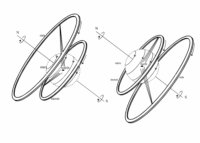
Anaximander of Miletus produced one of the earliest known attempts to place eclipses within a comprehensive physical model of the cosmos. He imagined the celestial lights not as solid spheres hanging visibly in space but as vast wheel-like rings filled with fire and enclosed within opaque air or mist. Openings in these rings allowed their internal fire to shine outward, making what human observers perceived as the Sun, Moon, and stars. The apparently circular Sun was an aperture through which a much larger fiery structure became visible. According to the doxographical tradition, a solar eclipse occurred when the Sun’s opening became obstructed or closed, while the Moon’s changes could likewise be explained through the partial or complete closure of its aperture. The model was physically incorrect, but it offered a unified mechanism for ordinary light, lunar phases, and sudden obscuration. Day did not become night because Zeus temporarily removed the Sun or because the celestial order had collapsed. Darkness resulted from a malfunction or alteration within the same structure that produced daylight under normal conditions. Anaximander also assigned numerical proportions to the heavenly rings and arranged them at different distances from Earth, although the transmitted figures are inconsistent and their reconstruction remains disputed. What matters most is that he treated an eclipse as a recurring possibility generated by the architecture of the cosmos itself.
The diversity of later Ionian explanations cautions against imagining a single, steadily improving school of eclipse theory. Anaximenes pictured the celestial bodies as broad, fiery objects carried around by air, while some reports also assign him invisible earthy bodies moving through the heavens. Those bodies have sometimes been interpreted as occulting objects introduced to explain eclipses, but the testimonia are difficult to reconcile and may reflect ideas associated more securely with later thinkers. Xenophanes explained the Sun through fiery accumulations arising from clouds or moist exhalations and apparently understood an eclipse as its temporary extinction. Heraclitus was credited with treating the Sun and Moon as bowl-like vessels whose luminous sides could turn toward or away from human observers. These theories contradicted one another, yet each relocated celestial disappearance within an ordinary process involving matter, motion, ignition, extinction, or orientation.
A more consequential development emerged from reflection upon the Moon’s light. Several early thinkers asked whether the Moon generated its own illumination, received light from the Sun, or combined reflected and intrinsic fire. Parmenides described the Moon as a night-shining, foreign light wandering around Earth and perpetually directed toward the rays of the Sun. The precise interpretation of his poetic language remains debated, but it strongly suggests recognition that lunar brightness depends upon sunlight. That recognition created the conceptual basis for relating the Moon’s phases to its changing position relative to the Sun. It also encouraged philosophers to treat heavenly bodies as objects possessing definite spatial relationships rather than as isolated lights undergoing independent transformations. Derived lunar light did not automatically produce a correct theory of eclipses because an observer still had to understand how the Sun, Moon, and Earth aligned and which body interrupted the illumination. The history of eclipse theory cannot be reduced to a single discovery from which every later conclusion immediately followed.
Empedocles supplies the clearest surviving poetic expression of the Moon physically obstructing sunlight, although his chronological relationship to Anaxagoras and the priority of their explanations remain disputed. In verses preserved by Plutarch, the Moon prevents the Sun’s rays from reaching Earth and casts a shadow corresponding to her own breadth. A solar eclipse could be explained through interposition: the dark body of the Moon passed between the observer and the source of light. This account replaced the closing apertures of Anaximander and the extinguished solar fire of Xenophanes with a geometrical relationship among independently existing bodies. The Sun continued to shine during the eclipse, but its light was intercepted along a particular line. Such an explanation also clarified why the phenomenon was temporary, why only part of Earth might be darkened, and why the obscuring body could possess a definite circular form. It did not require Empedocles to possess an accurate theory of lunar distance, orbital inclination, parallax, or eclipse recurrence. Nor did it provide the numerical techniques needed to calculate when the necessary alignment would occur. His broader cosmology of four elemental roots governed by Love and Strife remained radically different from modern physics. Yet the eclipse explanation was powerful because its central mechanism could remain valid even after the cosmological system surrounding it had been abandoned.
The Presocratic achievement was not the immediate discovery of modern astronomy but the creation of a contested field of natural explanation. Fire wheels, compressed air, luminous clouds, rotating bowls, reflected light, and intervening bodies offered incompatible answers, yet all made celestial darkness physically arguable. An eclipse no longer had to be treated as an event outside the normal operation of nature, even when observers continued to interpret it as a warning or divine sign. Incorrect theories contributed to this transformation because they demonstrated that the heavens could be modeled, criticized, and reconstructed without waiting for authoritative myth to settle the question. Competition among explanations made evidence increasingly important: the shape of the obscuration, the behavior of lunar light, and the relative positions of celestial bodies became tests that a persuasive account needed to confront. Naturalization did not eliminate wonder, theology, or fear, but it denied those responses a monopoly over the meaning of darkness. From this unstable collection of mechanisms emerged the intellectual setting in which Anaxagoras could unite matter, illumination, and shadow into antiquity’s most influential early account of eclipses.
Anaxagoras and the Geometry of Celestial Shadow
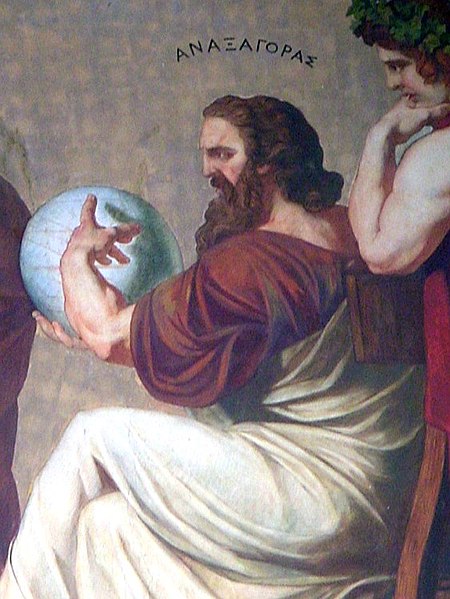
Anaxagoras of Clazomenae brought the Ionian search for physical causes into the intellectual and political world of fifth-century BCE Athens. Like earlier natural philosophers, he described a cosmos composed of material substances, but he attributed its initial organization to Nous, or Mind, which set the primordial mixture into rotation. Once that motion had begun, celestial phenomena proceeded through the separation, combination, compression, heating, and movement of matter rather than through repeated divine interventions. The Sun was a blazing mass of stone or iron, the stars were fiery stones carried by the cosmic rotation, and the Moon was an earthy body possessing features comparable to those of Earth. These claims stripped the heavenly lights of the radically different substance traditionally associated with gods. They also made eclipses problems of illumination and position: if the Sun and Moon were material bodies occupying definite places, one could obstruct the light of another.
The doxographical tradition credits Anaxagoras with recognizing that the Moon receives its light from the Sun and with explaining eclipses through the interposition of opaque bodies. During a solar eclipse, the Moon passes between Earth and the Sun, preventing sunlight from reaching part of Earth’s surface. During a lunar eclipse, according to the standard reconstruction of his theory, Earth passes between the Sun and Moon, and the Moon enters Earth’s shadow. Darkness is consequently produced not by the extinction of a celestial fire but by the interruption of light along a particular spatial alignment. This account explains why the Sun can remain luminous while disappearing from terrestrial sight and why the darkened portion of an eclipsed body possesses a curved boundary. It also unites solar and lunar eclipses as reciprocal arrangements among the same three bodies: the Moon obscures the Sun in one configuration, while Earth obscures sunlight from the Moon in the other. Yet the surviving testimonia are not completely consistent. Some sources also attribute certain lunar eclipses to invisible bodies moving below the Moon, perhaps an attempt to explain eclipses occurring while both Sun and Moon seemed close to the horizon. Anaxagoras’s reported belief in a flat Earth and possibly a disk-shaped Moon creates further difficulties for reconstructing a fully coherent theory of phases, shadows, and reflected light. Dirk Couprie has challenged the traditional conclusion that Anaxagoras possessed the correct explanation of lunar eclipses, arguing that later doxographers may have combined incompatible doctrines. The evidence securely associates him with celestial interposition, but it does not preserve a finished geometrical demonstration in his own words.
Even the standard reconstruction would constitute an explanation rather than a predictive procedure. Knowing that eclipses require the alignment of the Sun, Moon, and Earth does not reveal when that alignment will occur. A workable forecast also requires knowledge of the Moon’s path, its inclination to the Sun’s apparent path, the positions of the nodes, and the numerical periods governing their return. Without that additional structure, Anaxagoras could explain an eclipse after it appeared but could not calculate its date, magnitude, duration, or geographical visibility.
Daniel Graham and Eric Hintz have proposed that the solar eclipse of 17 February 478 BCE helped Anaxagoras develop his theory. By collecting reports from places that experienced different degrees of obscuration, he might have inferred that the Moon’s shadow covered a restricted region and used that region to estimate the Moon’s size. Because the Sun and Moon appear approximately equal in angular diameter, the greater distance of the Sun would then imply that it was substantially larger, perhaps providing the background for the reported claim that the Sun exceeded the Peloponnese in size. The reconstruction is ingenious, but no ancient source connects Anaxagoras with that particular eclipse or preserves the observations and calculations it requires. It remains a possible account of discovery rather than established biography. A later Athenian eclipse is documented more securely: Thucydides reports that during the summer of 431 BCE the Sun was eclipsed after midday at the time of a new Moon, became crescent-shaped, and allowed some stars to appear. Writing centuries afterward, Plutarch recounts that Pericles calmed his frightened helmsman during an eclipse by holding a cloak before the man’s eyes and asking how the cloth differed from the object hiding the Sun except in size. Plutarch explicitly associates Pericles’s composure with the natural philosophy of Anaxagoras, presenting knowledge of physical causation as an antidote to terror. The anecdote should not be accepted as a contemporary transcript, but it captures the practical force later writers attributed to the new astronomy: an eclipse could be frightening without being inexplicable.
That explanatory power also helps account for the political and religious traditions surrounding Anaxagoras. Later sources report that he was prosecuted for impiety because he described the Sun as a burning stone and the Moon as earth, although the date, legal circumstances, verdict, and relationship of the prosecution to attacks upon Pericles remain disputed. Plato’s Apology nevertheless confirms that Anaxagorean doctrines about the Sun and Moon remained sufficiently notorious for Socrates to distinguish them from his own teaching. Naturalizing the heavens did not merely solve an astronomical puzzle; it challenged assumptions about what celestial bodies were and how educated observers should interpret their behavior. Yet knowledge of eclipse geometry did not automatically abolish celestial religion, popular fear, or political omen reading. An observer could accept that the Moon obstructed the Sun and still believe that the timing of the obscuration possessed divine or political significance. Anaxagoras’s decisive contribution was narrower and more durable than a supposed victory of science over superstition. He transformed the darkness into a relationship among light, matter, distance, and alignment, creating a physical explanation that later astronomers could refine even after rejecting much of the cosmology in which it first appeared.
Knowing the Cause, Fearing the Sign
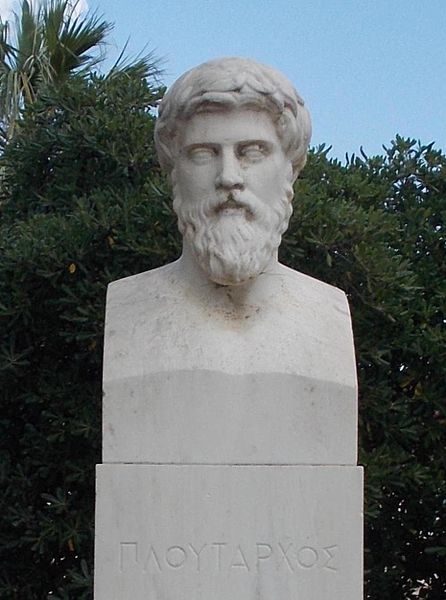
The emergence of a physical explanation for eclipses did not divide classical Greeks neatly into enlightened rationalists and frightened believers. Anaxagoras could explain how an opaque body interrupted celestial light, but that knowledge circulated unevenly through a society divided by education, occupation, status, and access to philosophical teaching. More fundamentally, mechanism and significance answered different questions. Knowing that the Moon covered the Sun did not necessarily explain why the eclipse occurred at a particular moment or whether the gods had arranged that natural conjunction as a warning. A celestial event could possess a regular material cause while also acquiring religious, political, or military meaning. The persistence of fear after eclipses became explicable was not simply a failure to understand astronomy; it reflected a culture in which natural processes could still serve as instruments of divine communication.
Thucydides provides the most valuable evidence for this coexistence because his history records eclipses with unusual observational restraint. In his opening assessment of the Peloponnesian War, he includes the frequency of solar eclipses among the extraordinary disturbances that distinguished the conflict from earlier wars. When the Sun was obscured during the first summer of the war in 431 BCE, he specifies that the event occurred after midday and at the new Moon, the only lunar phase at which he understood such an eclipse to be possible. He describes the Sun becoming crescent-shaped, the appearance of some stars, and the gradual restoration of the solar disk. Modern calculations identify the event as the annular eclipse of 3 August 431 BCE, although Athens lay outside the central path and experienced a substantial partial obscuration. Thucydides records another solar eclipse in March 424 BCE, again placing it near the beginning of the lunar month and noting that part of the Sun remained visible. His recognition of the relationship between solar eclipses and the new Moon demonstrates an awareness of regular celestial conditions, even if it does not prove that he could calculate an eclipse in advance. The events enter his chronology as observable phenomena rather than inexplicable ruptures, measured by season, lunar phase, time of day, and visible form.
That controlled language does not make Thucydides a modern secular observer. His narrative repeatedly shows earthquakes, storms, eclipses, sacrifices, oracles, and rumors affecting collective behavior, even when he supplies or implies natural explanations for some of them. He was interested not only in what occurred but in what human beings believed an occurrence required them to do. An eclipse could be physically intelligible to the historian while remaining a powerful historical cause through the reactions it produced.
Divination was not a marginal activity confined to the least educated inhabitants of Greek cities. Armies employed seers, commanders consulted sacrifices before battle, assemblies listened to interpreters of oracles, and political rivals contested the meaning of unusual events. A mantis did not usually claim to make the eclipse happen or necessarily deny that it possessed a material cause; his expertise lay in determining what the sign meant for the community confronting it. Interpretations could differ because celestial signs did not carry a single meaning independent of circumstances. An eclipse might warn against departure, favor concealment, threaten a commander, concern a particular city, or require only a temporary suspension of action. Such flexibility allowed divination to remain influential even as astronomical knowledge expanded. It also meant that authority mattered as much as observation: soldiers needed to know not merely what had darkened the Sun or Moon, but whose interpretation should guide their response. Commanders could not dismiss that concern as a private error when an army’s confidence depended upon favorable sacrifices and divine approval. Religious consultation consequently formed part of practical decision-making, especially under the uncertainty of war. The mechanism of an eclipse might be stable, but its social meaning was negotiated among philosophers, seers, officers, soldiers, and the wider civic community.
The most consequential example occurred during the Athenian expedition against Syracuse in 413 BCE. By late summer, the campaign had already deteriorated through failed assaults, Syracusan resistance, Spartan intervention, sickness, poor ground, and disagreements among the Athenian commanders. Demosthenes favored withdrawal, while Nicias initially resisted, partly because he feared the judgment awaiting him at Athens. As the military position worsened, the commanders finally prepared to depart secretly. On the night of 27 August, the full Moon entered Earth’s shadow in a total lunar eclipse. The celestial darkness arrived at precisely the moment when an exhausted army was about to abandon an imperial venture whose legitimacy and prospects had long been contested.
Thucydides reports that most of the Athenians took the eclipse seriously and urged the generals to wait. Nicias, whom the historian describes as excessively inclined toward divination, refused even to discuss departure until the army had remained for “three times nine days,” the interval prescribed by the seers. The passage does not say that every soldier was ignorant of eclipse geometry, nor does it identify the interpreters who recommended the delay or explain their reasoning. It instead exposes a failure of command in which private piety, professional divination, and collective fear converged at a moment demanding immediate action. The prescribed twenty-seven days did not pass uneventfully, because the Syracusans used the Athenians’ hesitation to intensify pressure on their position. They challenged the Athenian fleet, strengthened their control of the harbor, and eventually blocked its mouth. A final attempt to break out by sea ended in defeat, after which the surviving troops retreated overland in collapsing order. Demosthenes and Nicias surrendered, both commanders were executed, and thousands of captives died or endured confinement in the Syracusan quarries. The eclipse did not single-handedly destroy a healthy army, since the expedition was already compromised by disease, logistical weakness, strategic indecision, and earlier defeats. It became decisive because human interpretation converted a passing shadow into postponed movement, surrendered initiative, and a deepening crisis of morale.
Plutarch later sharpened the contrast between astronomical knowledge and Nicias’s reaction. He claimed that ordinary people had acquired some understanding of solar eclipses but found lunar eclipses more difficult to comprehend, while Anaxagoras’s account of the Moon’s borrowed light had spread only slowly and suspiciously. He also reported that Nicias’s experienced seer Stilbides, who had previously restrained his excessive fears, had died before the disaster. Citing the historian Philochorus, Plutarch observed that darkness could have been interpreted as favorable to men attempting a concealed escape, while another authority maintained that celestial portents normally required caution for only three days. These retrospective judgments reveal that the central problem was not simply belief against knowledge, but the selection of one meaning from several available interpretations. Plutarch moralized the episode as a failure of judgment, whereas Thucydides embedded it within the broader unraveling of Athenian power. Together, their accounts demonstrate that natural explanation did not automatically neutralize an eclipse’s religious force or political consequences. Classical Greece had learned enough to recognize the shadow’s cause, but no physical theory could prevent fear, authority, and circumstance from determining what people did beneath it.
Eclipse as Demonstration: Aristotle and the Logic of “Why”
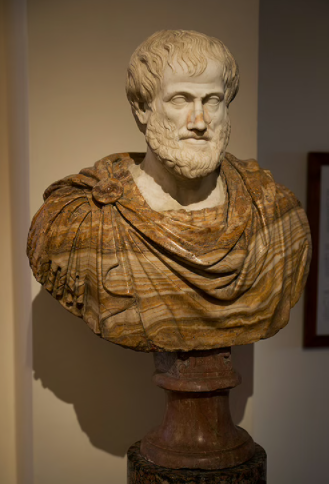
By the fourth century BCE, explaining an eclipse no longer required inventing a new physical mechanism. Aristotle inherited the understanding that a lunar eclipse occurs when Earth blocks sunlight from reaching the Moon, and he incorporated that mechanism into a spherical, geocentric cosmos. His distinctive contribution was to make the eclipse an exemplary problem in the theory of knowledge. The event appears repeatedly in the Posterior Analytics because it allowed him to distinguish observation, definition, causal explanation, and scientific demonstration with unusual clarity. An eclipse was not merely something that natural philosophy could explain; it became a model for what it meant to know anything scientifically.
Aristotle organized inquiry around four closely related questions: whether something is the case, why it is the case, whether something exists, and what it is. Applied to the Moon, an observer might first ask whether it undergoes eclipse. Once the occurrence has been established, the inquiry turns toward its cause. Asking what an eclipse is and asking why the Moon is eclipsed lead to the same explanatory middle term: Earth’s interposition between the Sun and Moon. Aristotle defines the eclipse as a deprivation of the Moon’s light caused by Earth’s obstruction. The definition does more than attach a name to a visible darkening, because it identifies the causal structure constituting the phenomenon. If the Moon merely extinguished its own fire, rotated a dark side toward Earth, or passed behind some invisible body, the visible result might appear similar while its essential explanation would be different. To know what an eclipse truly is, one must know why it occurs. Cause and essence converge because the event becomes intelligible only when the observer grasps the relationship among the illuminating body, the illuminated body, and the obstruction between them.
This distinction separates knowledge of the fact from knowledge of the reasoned fact. A person may know that the Moon is eclipsed through observation, repeated association, or a reliable predictive rule without understanding the cause. Such knowledge can be accurate and practically useful, but it remains incomplete because it does not reveal why the conclusion must be true. Scientific understanding arises when the cause appears in the demonstration as the term connecting the subject with the observed condition.
The eclipse example gives concrete form to Aristotle’s theory of the demonstrative syllogism. The Moon is deprived of light because Earth is interposed between it and the Sun; Earth is interposed in the relevant configuration; therefore the Moon undergoes eclipse. The interposition functions as the middle term linking the Moon to its darkening and showing why the conclusion follows. Reversing that order might permit an observer to infer that Earth has intervened because an eclipse is visible, but such an inference proceeds from effect to cause. It establishes that an interposition exists without demonstrating the eclipse through the cause that produces it. Aristotle insists upon this asymmetry because an effect does not explain its own cause, even when knowledge of the effect allows the cause to be discovered. A successful demonstration must reproduce the direction of dependence found in nature: the eclipse occurs because Earth obstructs the light, not the obstruction because an eclipse occurs. The logical arrangement of the argument is answerable to the physical arrangement of the celestial bodies. Demonstration does not merely generate a valid conclusion; it reveals the structure that makes the conclusion true.
Aristotle also used lunar eclipses as evidence within natural philosophy. In On the Heavens, he argues that the outline of Earth’s shadow upon the Moon is always curved, and that the form of the shadow reflects the form of the body casting it. The observation supports the conclusion that Earth is spherical, particularly when combined with the changing visibility of stars as an observer travels north or south. Here the eclipse becomes an instrument for investigating an otherwise inaccessible object, allowing Earth’s global shape to be inferred from the shadow it projects into space. Celestial darkness consequently reveals something not only about the Moon’s loss of light but about the world from which the shadow originates.
Aristotle’s use of eclipses nevertheless belonged to a philosophy of science rather than to a program of numerical eclipse prediction. Demonstrating why the Moon darkens did not by itself calculate when Earth, Moon, and Sun would enter the required alignment, how long the obscuration would last, or where it would be visible. Those questions required mathematical astronomy, accumulated observations, and increasingly sophisticated models of celestial motion. Aristotle recognized that observational astronomy might establish facts whose causes were demonstrated through mathematical reasoning, thereby distinguishing the collection of phenomena from the sciences capable of explaining them. The eclipse was valuable because its cause could be presented as physical, geometrical, definitional, and logical at once. Presocratic thinkers had made celestial darkness natural by proposing mechanisms, but Aristotle made the correct mechanism perform a second task: it illustrated how a cause becomes the basis of scientific knowledge. Beneath his analysis lay an enduring proposition, that prediction can tell an observer what will happen, while explanation answers the deeper question of why it must happen.
Measuring the Heavens with Darkness: Aristarchus and Eclipse Geometry

Aristotle had used the lunar eclipse to illustrate how knowledge of a cause could become scientific demonstration; Aristarchus of Samos transformed the same phenomenon into an instrument of measurement. Working during the early third century BCE, he asked not merely why the Sun and Moon darkened but how their illumination, apparent dimensions, and shadows could disclose their relative sizes and distances. His surviving treatise, On the Sizes and Distances of the Sun and Moon, contains no observational diary and identifies no particular eclipse from which its numerical assumptions were obtained. Instead, it begins with six hypotheses and develops their consequences through a tightly organized sequence of geometrical propositions. Some of those initial values were seriously inaccurate, but Aristarchus’s deductive reasoning from them was often ingenious and rigorous. Celestial darkness had become measurable evidence from which dimensions inaccessible to direct human inspection could be reconstructed.
The first part of Aristarchus’s argument depended upon the geometry of the half Moon rather than an eclipse. At the exact moment of dichotomy, when the visible lunar disk appears divided equally between light and darkness, the angle formed at the Moon by the lines extending toward Earth and the Sun must be a right angle. An observer on Earth can then estimate the angular separation between the half Moon and the Sun, creating a right triangle whose sides correspond to the Earth–Moon and Earth–Sun distances. Aristarchus assumed that the observed separation was one-thirtieth of a quadrant less than a right angle, equivalent in modern terms to 87 degrees. Without trigonometric functions, he used geometrical inequalities to prove that the Sun was more than eighteen but fewer than twenty times as distant from Earth as the Moon. Because the Sun and Moon appear approximately equal in angular size, he concluded that the solar diameter was likewise between eighteen and twenty times the lunar diameter. The reasoning was sound in structure, but the observed angle was not sufficiently accurate. At dichotomy the actual separation is close to 90 degrees, and a very small error near that limit creates an enormous error in the resulting distance ratio. The true Sun lies roughly 390 times farther from Earth than the Moon, not between eighteen and twenty times farther. Aristarchus nevertheless established a crucial principle of quantitative astronomy: an angular relationship visible from Earth could determine a ratio among distances extending far beyond it.
The lunar eclipse supplied the additional scale needed to connect the Sun and Moon with the size of Earth. As the Moon moved through Earth’s shadow, its familiar disk could serve as a unit for estimating the shadow’s apparent breadth. If the Moon’s motion were treated as approximately uniform, the durations of the eclipse’s successive phases could be compared with the time required for the Moon to advance by one of its own diameters. Aristarchus’s fifth hypothesis states that the breadth of Earth’s shadow was equal to two Moons, although the treatise does not explain which eclipse produced that value or how its phases were timed. The event converted the invisible dimensions of Earth as seen from space into a visible dark interval moving across the lunar surface.
Earth’s shadow could not simply be equated with Earth’s physical diameter. Because the Sun is larger than Earth, rays extending from the solar edges past Earth converge behind it, producing an umbral cone that narrows with distance. The shadow reaching the Moon is consequently smaller than the body casting it, and its size depends upon the relative diameters and distances of the Sun, Earth, and Moon. Aristarchus combined the eclipse-derived breadth of the shadow with his previously established solar-to-lunar distance ratio and the approximately equal apparent diameters of the Sun and Moon. Through a demanding sequence of constructions, inequalities, and comparisons among similar triangles, he bounded the solar diameter between 19/3 and 43/6 of Earth’s diameter. He then concluded that Earth’s diameter was greater than 108/43 but less than 60/19 of the lunar diameter, placing it between approximately 2.51 and 3.16 lunar diameters. The actual terrestrial diameter is about 3.67 times the lunar diameter, so his range was too small but retained the correct order of magnitude. His solar result was much less accurate, since the Sun’s true diameter is approximately 109 times Earth’s rather than between about 6.3 and 7.2 times it. Most of the discrepancy originated not in the geometry but in the initial observational assumptions, particularly the 87-degree elongation at dichotomy and the shadow breadth of two lunar diameters. Earth’s umbra at the Moon is actually closer to 2.6 lunar diameters across, with its precise apparent size varying according to the distances involved. Atmospheric refraction, the indistinct boundary between shadow and penumbra, variations in lunar velocity, and a noncentral passage through the umbra would all complicate naked-eye timing. Aristarchus’s achievement lay less in numerical precision than in recognizing that an eclipse supplied enough relational information to make the otherwise immeasurable Earth part of a solvable celestial diagram.
A further difficulty appears in the treatise’s assertion that the Sun and Moon subtend one-fifteenth of a zodiacal sign, conventionally interpreted as an angular diameter of two degrees rather than the actual value of approximately half a degree. Archimedes credits Aristarchus with a substantially better determination close to half a degree, raising the possibility that the surviving reading reflects a specialized meaning, an earlier estimate, or a problem in the text’s transmission. Modern scholars continue to debate how the hypotheses were obtained and whether every inconsistency belongs to Aristarchus himself. These uncertainties discourage the popular image of a lone observer deriving accurate cosmic distances directly from one perfectly timed eclipse. The treatise establishes ranges from assumed values rather than reporting modern-style measurements accompanied by observations and estimates of error. It also conducts its constructions within an Earth-centered geometrical frame, despite Archimedes’s separate report that Aristarchus proposed a moving Earth revolving around a stationary Sun. The surviving evidence does not securely establish whether On the Sizes and Distances preceded, accompanied, or followed that heliocentric hypothesis.
None of these limitations diminishes the treatise’s importance in the history of eclipse science. Aristarchus treated the Moon as both a physical world receiving sunlight and a measuring screen upon which Earth projected information about itself. The eclipse joined terrestrial and celestial geometry because the size of the shadow depended simultaneously upon the body casting it, the source illuminating it, and the distance to the surface upon which it appeared. One observation could connect four quantities that no traveler could measure directly: the sizes of the Sun, Earth, and Moon and the distances separating them. Later astronomers would refine the observational values, introduce more sophisticated models, and obtain far better estimates, but they continued to exploit the same principle that shadows reveal proportions among otherwise unreachable bodies. Aristarchus’s numerical universe was too compressed, yet it was no longer dimensionless. His work transformed eclipse darkness from a temporary deprivation of light into a ruler extending across the heavens. Where Aristotle had asked what cause made a lunar eclipse occur, Aristarchus asked what could be measured once that cause was understood. The shadow that once inspired fear had become a geometrical trace from which the architecture of the cosmos could be inferred.
Hipparchus’s Synthesis
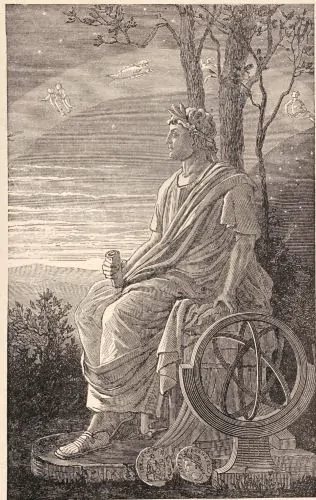
Hipparchus of Nicaea brought together the observational endurance of Babylonian astronomy and the geometrical ambitions of the Greek tradition. Active during the second century BCE and associated especially with Rhodes, he inherited a world in which the physical causes of eclipses were broadly understood but their numerical prediction remained demanding. Almost all his technical writings have been lost, leaving only his commentary on the astronomical poetry of Aratus and Eudoxus substantially intact. His eclipse work must be reconstructed primarily through Ptolemy’s Almagest, written nearly three centuries later, supplemented by Pappus, Theon, and scattered reports in other ancient authors. Ptolemy admired Hipparchus but also reorganized his results within a more comprehensive mathematical system, making it difficult to distinguish Hipparchus’s original procedures from later exposition. Even so, the surviving evidence reveals a decisive synthesis. Hipparchus treated eclipses simultaneously as recorded events, manifestations of periodic celestial motions, tests of mathematical models, and opportunities to estimate the scale of the cosmos.
The depth of the available eclipse record made this synthesis possible. Babylonian astronomers had preserved dated observations extending across centuries, including lunar eclipses from the reign of Mardokempad in 721 and 720 BCE that Ptolemy later incorporated into the Almagest. Such records specified dates, watches of the night, directions of obscuration, and sometimes the duration or magnitude of the event. Their value increased with age because widely separated observations allowed small errors in an assumed lunar period to accumulate until they became measurable. Hipparchus could compare eclipses separated by hundreds of years, count the intervening lunar cycles, and divide the elapsed time by the number of revolutions. Ptolemy credits him with establishing that 4,267 synodic months corresponded to 4,573 anomalistic months in approximately 126,007 days and one hour. The synodic month measured the return from one conjunction or opposition to the next, while the anomalistic month measured the Moon’s return to the same point in its varying speed. Their relationship enabled Hipparchus to connect the ordinary succession of lunar phases with the periodic acceleration and deceleration visible in the Moon’s motion. A complementary relation involving the Moon’s latitude and return to its nodes was essential because an eclipse required more than a new or full Moon: the Moon also had to be sufficiently close to the intersection of its path with the Sun’s apparent path. These period relations were not invented from a single dramatic observation. They were products of an archive in which one eclipse could be tested against another across generations, kingdoms, languages, and calendrical systems. Hipparchus transformed that inherited chronological depth into parameters for mathematical astronomy.
A period did not automatically yield a precise local forecast. A recurrence could indicate that the Sun, Moon, and lunar nodes would return to a broadly similar configuration, but differences in longitude, latitude, distance, and parallax affected the appearance of the event from any particular place. Solar eclipses were difficult because the Moon’s shadow crossed only a restricted portion of Earth, whereas a lunar eclipse could be seen simultaneously from most of the terrestrial hemisphere facing the Moon. Hipparchus’s work represented a movement beyond recognizing cycles toward modeling the motions that made each eclipse distinct.
The central problem was lunar inequality. The Moon does not appear to travel around the zodiac at a constant angular speed, so a calculation based solely upon its mean motion will increasingly diverge from observation. Hipparchus represented this first lunar anomaly through a geometrical model employing uniform circular motion, conventionally reconstructed as an eccentric circle or an equivalent epicycle arrangement. Eclipses offered particularly effective tests because they occurred at syzygy, when the Sun, Earth, and Moon formed the alignment required for conjunction or opposition. A recorded eclipse fixed the Moon’s position relative to the Sun at a definite time, allowing the parameters of the model to be adjusted against observation. By selecting groups of eclipses separated by carefully chosen intervals, Hipparchus could isolate the anomaly from the mean motion and determine both its period and approximate magnitude. His model did not capture every irregularity in lunar motion; Ptolemy later introduced an additional inequality, now associated with evection, because the simpler model failed away from conjunctions and oppositions. At eclipses, the first-anomaly model performed far better, which helps explain why eclipse observations occupied such an important place in its construction. Hipparchus had converted periodic rules into a geometrical system capable of assigning changing positions to the Moon rather than merely announcing that a recurrence was due.
Eclipses also allowed Hipparchus to resume Aristarchus’s attempt to determine celestial distances, but with more extensive observations and a more developed understanding of lunar motion. Pappus reports that Hipparchus composed a work in two books on the sizes and distances of the Sun and Moon. One reconstruction of the first book begins from a reported solar eclipse that was total in the region of the Hellespont but covered only four-fifths of the Sun at Alexandria. Since observers at the two locations saw different degrees of obscuration, the Moon must have appeared against slightly different parts of the Sun when viewed along their separated lines of sight. If the distance between the observing locations and their positions on spherical Earth were known, this lunar parallax could be translated geometrically into a distance. Hipparchus initially assumed that the Sun was so remote that its parallax could be treated as negligible, an idealization that produced a lunar distance of roughly seventy-seven Earth radii. In the second book, he instead introduced a finite minimum solar distance and combined solar-eclipse parallax with the breadth of Earth’s shadow measured during lunar eclipses. The resulting scheme placed the Sun at no fewer than approximately 490 Earth radii and gave lunar distances varying from about sixty-two to seventy-three Earth radii, with a mean of 67⅓. The modern mean is approximately sixty Earth radii, making Hipparchus’s estimate too large but far closer than the compressed cosmic dimensions derived from Aristarchus’s surviving assumptions. The ancient report of totality in the Hellespont and four-fifths obscuration at Alexandria is itself difficult to reconcile with securely identified eclipse paths, and modern reconstructions disagree about which historical eclipse underlay the calculation. Pappus’s abbreviated description also leaves uncertain whether the two books presented successive revisions, alternative hypotheses, or deliberate upper and lower limits. Yet the method was more important than any single numerical result. By comparing how one eclipse appeared from different terrestrial locations and how Earth’s shadow appeared upon the Moon, Hipparchus turned darkness into a form of triangulation conducted on a cosmic scale.
Hipparchus’s eclipse astronomy depended upon no solitary discovery comparable to the legendary prediction attributed to Thales. Its power arose from coordinating distinct kinds of knowledge: Babylonian records supplied chronological depth, period relations organized recurrent motion, Greek geometry represented inequality, and geographically distributed observations created measurable parallax. None of these elements alone could generate a satisfactory account of when an eclipse would occur, how extensive it would be, or what it revealed about celestial distances. Their combination produced a mathematical practice in which prediction and explanation continually tested one another. A calculated alignment could be judged against a recorded eclipse, while a discrepancy could expose an inaccurate period, an incomplete model, or a mistaken observational parameter. Hipparchus did not achieve the precision of modern eclipse calculation, and much of his work remains visible only through Ptolemy’s revisions. Nevertheless, he established the essential principle that reliable astronomy required records long enough to reveal periods and models flexible enough to explain departures from perfect recurrence. In his synthesis, the eclipse became not merely an event to foresee but a disciplined encounter between archive, observation, and mathematical theory.
Prediction in Bronze: The Antikythera Mechanism
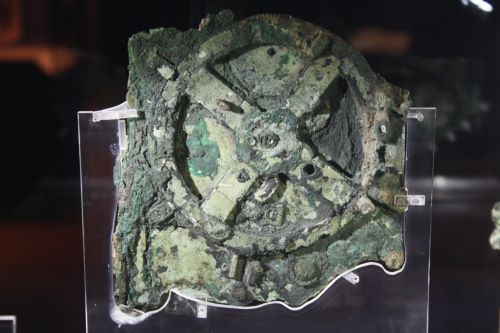
The synthesis achieved by Hipparchus survived chiefly in texts quoted or reorganized by later astronomers, but the Antikythera Mechanism embodied a comparable union of cycles, geometry, and observation in bronze. Greek sponge divers recovered its corroded fragments from a shipwreck near the island of Antikythera in 1901, among statues, ceramics, coins, and other cargo destined for an elite Mediterranean market. The wreck probably sank during the first century BCE, although the mechanism’s construction date and astronomical epoch remain disputed. Its surviving gears, plates, pointers, scales, and inscriptions originally formed a compact, hand-operated instrument enclosed within a wooden case. Turning an input advanced interlocking displays that coordinated calendrical cycles with the motions and phases of the Sun and Moon. The reconstructed front displayed celestial positions, while the rear organized calendars, athletic festivals, and eclipse predictions through spiral and subsidiary dials. What appeared at first to be an unremarkable mass of corroded metal eventually revealed the earliest surviving geared representation of an astronomical cosmos.
The eclipse predictor occupied the lower portion of the mechanism’s back plate. Its principal scale formed a four-turn spiral divided into 223 cells, each representing one synodic month from new Moon to new Moon. The period is now conventionally called the Saros, although that name was not used for the cycle by the mechanism’s maker. Its effectiveness results from an extraordinary near-commensurability: 223 synodic months correspond closely to 242 draconic months, governing the Moon’s return to its nodes, and 239 anomalistic months, governing its return to approximately the same distance from Earth. After slightly more than eighteen years, the Moon consequently reaches nearly the same phase, the same node, and the same position in its cycle of changing distance. Similar solar and lunar eclipses can then recur in a recognizable sequence. As the user turned the mechanism, a pointer moved around the spiral while a sliding follower guided it from one turn to the next. Cells in which an eclipse was considered possible carried abbreviated glyphs, while empty cells indicated months without a predicted event. A lunar glyph referred to an eclipse near the full Moon in the middle of the month, whereas a solar glyph referred to a possible eclipse near the new Moon at the month’s end. Some cells contained both possibilities because a lunar eclipse at one opposition could be followed approximately half a month later by a solar eclipse at the next conjunction. The mechanism did not solve the three-body geometry anew each time it was turned; it carried a precomputed, cyclically repeating schedule in which astronomical knowledge had been inscribed as a material lookup system.
The Saros does not contain an integer number of days, and each repetition occurs approximately eight hours later than the preceding one. During those eight hours Earth rotates through roughly one-third of a revolution, shifting the region from which a recurring solar eclipse can be observed by approximately 120 degrees of longitude. A small three-sector Exeligmos dial corrected the predicted hour by instructing the user to add zero, eight, or sixteen hours during successive Saros cycles. After three Saros periods, or about fifty-four years, the recurrence returned to nearly the same time of day, but the dial still could not map a solar eclipse’s path or guarantee its visibility from the user’s location.
The eclipse inscriptions transformed the dial from a simple recurrence counter into a compact astronomical almanac. Abbreviations within the glyphs distinguished the Sun from the Moon and recorded the predicted hour of the conjunction or opposition. Each glyph also carried an alphabetic index letter directing the reader to a corresponding paragraph inscribed elsewhere on the back plate. Those paragraphs grouped eclipses according to expected characteristics rather than merely listing their dates. The surviving solar-eclipse descriptions classify events by such features as magnitude and color and connect them with directional statements that may concern winds, the progress of the obscuration, or both. Much of this text remained inaccessible until reflectance transformation imaging and microfocus X-ray computed tomography revealed letters hidden beneath the corroded surfaces and inside the surviving fragments. Modern reconstructions suggest that the organization of the index groups depended substantially upon the Moon’s calculated latitude relative to the node. Eclipses occurring closer to a node could be classified as larger, while those occurring nearer the limits of possibility received different descriptive categories. The result was an ambitious attempt to predict not only that an eclipse might occur but what kind of event an observer should expect to see. Yet the surviving plate is incomplete, and scholars continue to disagree about the arrangement of the lost lunar-eclipse paragraphs, the distribution of some reconstructed glyphs, and the precise meaning of several descriptive terms. Color in particular could depend upon atmospheric and environmental conditions that no fixed gear train could calculate decades in advance. The inscriptions should be understood as a system of theoretically ordered expectations rather than a record of uniformly precise forecasts.
The intellectual ancestry of that system crossed the boundaries later imposed between Greek and Babylonian science. The 223-month recurrence belonged to the arithmetical tradition developed through centuries of Babylonian eclipse observation, while the mechanism’s geometrical displays and gearing translated periodic relations into a characteristically Greek physical model. Elsewhere in the instrument, a pin-and-slot arrangement represented variation in the Moon’s apparent speed, demonstrating that its designer understood more than simple uniform recurrence. The coexistence of that lunar-anomaly mechanism with the Saros predictor recalled the achievement of Hipparchus, who had likewise combined Babylonian records with Greek geometrical astronomy. It does not prove that Hipparchus designed the instrument or that it emerged from his workshop. No surviving inscription identifies the maker, patron, owner, or intended place of use, and proposed associations with Rhodes, Epirus, Corinth, Syracuse, or particular philosophers remain contested. The device may have served calculation, instruction, public demonstration, elite display, or some combination of those purposes.
Its limitations reveal precisely what kind of prediction the mechanism offered. Because the underlying cycles are close approximations rather than perfect identities, their errors accumulate, and the instrument required an epoch from which its preinscribed sequence could be calibrated. A lunar eclipse listed on the dial would be broadly visible wherever the Moon stood above the horizon, but a solar eclipse might miss the user’s region entirely even when the predicted conjunction produced an eclipse somewhere on Earth. The mechanism announced eclipse possibilities, times, and schematic characteristics rather than furnishing the exact local circumstances expected from a modern ephemeris. It also depended upon a knowledgeable operator who could set the date, turn the input, follow the pointers, apply the Exeligmos correction, and interpret the inscriptions. Nevertheless, its historical importance is difficult to overstate. Long records and complicated numerical relations had been compressed into a portable machine whose operation could reproduce conclusions without requiring its user to repeat the calculations behind them. The Antikythera Mechanism transformed an astronomical theory into an algorithm and then transformed the algorithm into an object. Celestial darkness, once interpreted through sacrifice or philosophical argument, could now be summoned decades in advance by turning bronze gears.
From Recurrence to Calculation: Ptolemy’s Eclipse Theory

The Antikythera Mechanism predicted eclipses by carrying a fixed recurrence scheme forward through geared rotations, but Claudius Ptolemy sought to calculate each event from a comprehensive model of celestial motion. Working in Alexandria during the second century CE, he assembled his eclipse theory primarily in Books IV, V, and VI of the Almagest. He inherited Babylonian period relations, Hipparchus’s lunar parameters, Greek geometrical models, and centuries of recorded eclipses. His achievement was not the discovery of a new physical cause or recurrence cycle, but the organization of existing knowledge into a systematic computational procedure. An eclipse became the result of a chain of determinations involving mean motions, true positions, lunar latitude, apparent diameters, parallax, and local time. Recurrence remained useful, but it no longer carried the full burden of prediction.
The calculation began with the motions of the Sun and Moon in longitude. Ptolemy’s tables allowed an astronomer to advance their mean positions from a chosen epoch to a proposed conjunction or opposition. Those mean positions then had to be corrected because neither luminary appeared to move uniformly around the zodiac. Solar inequality could be represented through an eccentric model, while the Moon presented a much more difficult combination of changing speed and position. Ptolemy retained the principal lunar anomaly modeled by Hipparchus and introduced a second inequality, later called evection, whose effects became conspicuous when the Moon stood away from conjunction and opposition. His combined geometrical construction generated corrections for the Moon’s true longitude and distance at a selected time. A mean conjunction or opposition could consequently be converted into the moment when the corrected longitudes of the Sun and Moon actually coincided or differed by 180 degrees. Even a perfect alignment in longitude did not guarantee an eclipse. Because the Moon’s orbit is inclined by approximately five degrees to the ecliptic, most new Moons pass north or south of the Sun, while most full Moons pass above or below Earth’s shadow. The astronomer had to determine the Moon’s position in its latitude cycle and its angular distance from one of the nodes. Ptolemy calculated maximum eclipse limits defining how far from a node a conjunction or opposition could occur while still producing at least partial obscuration. Only syzygies falling within those limits required a complete eclipse calculation.
The tables made this complicated theory usable. Instead of reconstructing geometrical models for every event, the calculator extracted arguments, corrections, and tabulated quantities in a prescribed order, interpolating when a value fell between entries. The Almagest thereby functioned not merely as an explanation of celestial motions but as a collection of executable procedures. Bronze gearing had materialized a repeating eclipse schedule, whereas Ptolemy encoded a more adaptable calculating machine in numbers, diagrams, and rules.
Lunar eclipses offered the more straightforward application because their circumstances were essentially geocentric. Once the true time of opposition had been determined, the astronomer calculated the Moon’s latitude and established how closely it would pass to the center of Earth’s shadow. That separation then had to be compared with the apparent radii of the Moon and the shadow at the Moon’s distance. The terrestrial umbra was not a cylinder of constant width, because the greater size of the Sun caused the shadow to narrow as it extended away from Earth. Its apparent breadth varied with the changing distances of the Sun and Moon, as did the apparent diameter of the Moon itself. Ptolemy constructed tables that incorporated these variations and allowed eclipse magnitudes to be expressed in twelfths of the lunar diameter. If the Moon’s disk penetrated the umbra only partially, the calculation yielded the maximum obscuration; if the entire disk entered, it also established the depth of totality. Durations required another geometrical step, since the Moon might cross the circular shadow centrally or cut an oblique chord through it. By combining the length of that path with the relative motion of the Moon and shadow, the astronomer could estimate the times of first contact, maximum eclipse, beginning and end of totality, and final emergence. These calculated stages could then be compared with observations recorded in watches, hours, or fractions of hours. Ptolemy repeatedly used dated eclipses from Babylonian and later records to test lunar positions, establish epochs, and refine the numerical parameters upon which subsequent predictions depended. The lunar eclipse was both an anticipated consequence of the model and one of the principal observations by which the model claimed authority.
Solar eclipses demanded a considerably more elaborate treatment because they were local events. A geocentric conjunction showed only that the Sun and Moon shared the same celestial longitude as viewed from Earth’s center; it did not reveal whether their disks would overlap for an observer standing on Earth’s surface. The Moon’s relative proximity produced substantial parallax, shifting its apparent position against the more distant Sun according to the observer’s latitude, local hour, and position beneath the celestial sphere. Ptolemy employed transformations among ecliptic, equatorial, meridian, and horizon relationships to determine the Moon’s zenith distance and total parallax. He then resolved that displacement into longitudinal and latitudinal components, correcting both the apparent time of conjunction and the apparent separation of the solar and lunar centers. Comparing that separation with the apparent semidiameters of the two bodies established whether the eclipse would be partial, total, or absent at the selected locality. The same geometry could provide the maximum magnitude and approximate duration of obscuration. A calculation valid for Alexandria could not simply be transferred to Rhodes, Babylon, or Rome, because the Moon’s shadow encountered each location differently. Ptolemy did not produce global maps of eclipse paths, but his method supplied the mathematical foundation for determining local visibility rather than merely announcing that a solar eclipse must occur somewhere.
Ptolemy had moved eclipse prediction beyond the recognition of repeating configurations. His astronomer began with a date, advanced mean motions, corrected them into true positions, tested the nodal limits, calculated apparent sizes, andwhen dealing with the Sun, translated a geocentric alignment into a local appearance. Every stage depended upon inherited observations, numerical parameters, chord tables, interpolation, and assumptions about celestial geometry. The resulting predictions were not exact by modern standards, and errors in epochs, geographical coordinates, timekeeping, or lunar motion could propagate through the entire calculation. Ptolemy’s device for reproducing the second lunar inequality also implied variations in lunar distance much larger than observation permits, even though its longitude predictions were the more immediate concern in eclipse work. Solar eclipses remained vulnerable to small errors because a slight displacement of the Moon could shift the shadow far across Earth’s surface. Yet the Almagest established a computational architecture that later Byzantine, Islamic, and Latin astronomers could preserve while correcting its parameters and revising its models. Prediction now meant more than identifying the month in which darkness might return: it meant making quantitative claims about an eclipse’s time, magnitude, duration, and visibility. Where the Antikythera Mechanism had turned a cycle into a machine, Ptolemy turned the heavens themselves into a sequence of calculable operations.
Was There Ever a Greek Journey from Omen to Orbit?
The following video from Launch Pad Astronomy is a brief overview of ancient Greek astronomy:
The history of Greek eclipse thought can easily be arranged as an ascent from Thales’s supposed prediction through Presocratic explanation, Aristotelian demonstration, Hellenistic measurement, and Ptolemaic calculation. Such an arrangement risks turning a complicated intellectual history into a story of inevitable progress from superstition to science. The metaphor of a journey suggests that Greek culture collectively abandoned one understanding as it adopted another. It also allows the endpoint of modern astronomy to determine which ancient developments appear important. The strongest counterargument is that no single Greek journey from omen to orbit ever occurred.
Greek communities did not move together through successive stages of enlightenment. Knowledge of eclipse mechanisms circulated unevenly according to education, location, occupation, and access to philosophical or astronomical texts. Natural explanations existed alongside ritual responses rather than replacing them. Anaxagoras could describe the Moon as an opaque body illuminated by the Sun, while Athenian soldiers could still regard a lunar eclipse as a warning against departure. Thucydides understood the connection between solar eclipses and the new Moon, yet his history also demonstrates the military power of divination. The eclipse at Syracuse became consequential because Nicias, the seers, and the army assigned practical meaning to an event whose physical cause was already available to educated Greeks. Nor were technical instruments such as the Antikythera Mechanism necessarily representative of popular knowledge. Its elaborate gearing, dense inscriptions, and uncertain elite context suggest specialized expertise rather than widespread astronomical literacy. Ptolemy himself composed both the mathematical Almagest and the astrological Tetrabiblos, demonstrating that precise celestial calculation did not require the abandonment of beliefs about heavenly influence. In some circumstances, successful prediction could even strengthen the authority of interpreters by allowing them to announce a portent before it appeared.
The word “orbit” introduces a second distortion. Most Greek mathematical astronomers represented celestial motion through circles, spheres, eccentrics, and epicycles rather than through orbital paths governed by universal forces. Aristarchus proposed that Earth revolved around the Sun, but the surviving testimony does not disclose a developed physical theory of heliocentric motion. Ptolemy achieved far more powerful eclipse predictions within an Earth-centered cosmos, showing that computational success did not depend upon movement toward modern celestial mechanics.
The idea of a distinctively Greek advance can also conceal how extensively Greek eclipse astronomy depended upon knowledge produced elsewhere. Babylonian observers accumulated the long eclipse records and numerical periods without which Hipparchus and Ptolemy could not have determined lunar motions with comparable precision. Greek astronomers reworked those materials through geometrical models, but synthesis should not be mistaken for isolated invention. The scientific world represented by Alexandria, Rhodes, Babylon, and the eastern Mediterranean crossed linguistic, political, and cultural boundaries that the label “Greek science” can obscure. Its reconstruction is further distorted by survival. The works of Hipparchus are largely lost, Aristarchus’s heliocentric proposal survives only in reports, and the Antikythera Mechanism remains the sole known example of a technological tradition that may once have produced other geared instruments. Ptolemy’s writings appear disproportionately central partly because they survived, were commented upon, translated, and transmitted. Even the celebrated beginning of the story, the eclipse attributed to Thales, depends upon retrospective testimony whose interpretation remains contested. A smooth narrative can be created only by joining fragmentary evidence separated by centuries and treating selected achievements as stages in a common project. Ancient practitioners themselves pursued different purposes: establishing causes, defending cosmologies, constructing calendars, predicting celestial configurations, interpreting divine significance, displaying expertise, or estimating distances. These purposes sometimes reinforced one another and sometimes remained independent. Mathematical models could save observable appearances without settling the physical reality of the constructions they employed. Prediction could be approximate, regional, or conditional rather than the exact advance determination implied by modern eclipse tables. What appears retrospectively as one road toward astronomy was historically a landscape of partially connected practices.
This challenge substantially modifies, but does not erase, the pattern traced through Greek eclipse thought. There was no universal cultural passage in which omens disappeared once physical causes became known, and there was no direct conceptual road from Thales to modern orbital mechanics. There was a cumulative transformation within specialized traditions of natural philosophy and mathematical astronomy. Eclipses increasingly became events whose causes could be defined, circumstances geometrically modeled, recurrences extracted from records, and local appearances calculated in advance. Each development enlarged the range of questions that could be answered without determining what every Greek believed an eclipse meant. The most defensible conclusion is not that Greece traveled from irrational fear to scientific truth, but that some Greek and Hellenistic investigators created new explanatory and computational languages while older religious meanings remained socially effective. The history is less a journey from omen to orbit than a widening of intellectual possibilities beneath a sky capable of sustaining both.
Conclusion: The Shadow Becomes a System
A Greek observer confronting an eclipse did not encounter a phenomenon whose meaning had already been settled. Darkness could signify divine displeasure, military danger, cosmic disruption, or the operation of an intelligible natural process. These interpretations did not replace one another in a clean sequence, and rational explanation never entirely silenced ritual anxiety. What changed was the growing ability of specialized investigators to separate the question of what an eclipse meant from the questions of why it occurred, when it would return, and what could be learned from it.
That transformation began with the recognition that celestial darkness had physical causes. The explanations attributed to Thales remain uncertain, but later Presocratic thinkers increasingly treated the Sun and Moon as material bodies governed by regular relationships rather than divine personalities acting unpredictably. Anaxagoras connected eclipses to obstruction and reflected light, making the phenomenon intelligible within a coherent account of the heavens. Yet the lunar eclipse before the Athenian withdrawal from Syracuse demonstrated that causal knowledge did not automatically neutralize fear. Natural philosophy had made the eclipse explainable without making its social effects disappear.
By the fourth and third centuries BCE, the shadow had become more than a phenomenon requiring explanation. Aristotle used the lunar eclipse to distinguish knowledge that something happens from scientific understanding of why it must happen, elevating Earth’s interposition into the causal middle term of a demonstration. Aristarchus then exploited that same geometry to estimate the relative sizes and distances of the Sun, Earth, and Moon. Even when his observational assumptions produced inaccurate values, his procedure established that inaccessible cosmic dimensions could be inferred from angles, apparent diameters, and the changing breadth of a shadow. Hipparchus joined such geometrical ambitions to long Babylonian observational records, using eclipses separated by centuries to refine lunar periods and models of inequality. The Antikythera Mechanism compressed related cycles into bronze gears and inscribed cells, allowing an operator to call forth eclipse possibilities by turning a handle. Ptolemy completed the ancient computational architecture by organizing mean motions, corrections, nodal limits, parallax, apparent diameters, magnitude, and duration into a repeatable sequence of calculations. Across these developments, an eclipse ceased to be merely an interruption of celestial order and became one of the most productive tests of whether that order had been correctly understood.
The resulting history was neither exclusively Greek nor a straightforward march toward modern astronomy. It depended upon Babylonian archives, unevenly preserved texts, disputed reports, specialized instruments, and models that remained geocentric while achieving considerable predictive power. Omens persisted beside calculations because prediction, physical explanation, and cultural meaning answered different human questions. The deeper achievement was the construction of a system in which darkness could be recorded, compared, demonstrated, measured, mechanically represented, and calculated in advance. The shadow had not lost every ancient meaning, but it had acquired an extraordinary new capacity: it could reveal the structure of the heavens.
Bibliography
Affiliate disclosure: Amazon links on this site are paid links. As an Amazon Associate I earn from qualifying purchases.
- Archilochus. Greek Iambic Poetry: From the Seventh to the Fifth Centuries BC. Edited and translated by Douglas E. Gerber. Loeb Classical Library 259. Cambridge, MA: Harvard University Press, 1999.
- Archimedes. The Sand-Reckoner. In The Works of Archimedes, edited and translated by Thomas L. Heath, 221–232. Cambridge: Cambridge University Press, 1897.
- Aristarchus of Samos. On the Sizes and Distances of the Sun and Moon. In Aristarchus of Samos, the Ancient Copernicus, edited and translated by Thomas L. Heath, 351–411. Oxford: Clarendon Press, 1913.
- Aristotle. On the Heavens. Translated by W. K. C. Guthrie. Cambridge, MA: Harvard University Press, 1939.
- —-. Posterior Analytics. Translated by Hugh Tredennick. Loeb Classical Library 391. Cambridge, MA: Harvard University Press, 1960.
- Asheri, David, Alan Lloyd, and Aldo Corcella. A Commentary on Herodotus, Books I–IV. Edited by Oswyn Murray and Alfonso Moreno. Oxford: Oxford University Press, 2007.
- Baragwanath, Emily. Motivation and Narrative in Herodotus. Oxford: Oxford University Press, 2008.
- Barron, J. P., P. E. Easterling, and B. M. W. Knox. “Elegy and Iambus.” In The Cambridge History of Classical Literature. Vol. 1, Greek Literature, edited by P. E. Easterling and Bernard M. W. Knox, 117–164. Cambridge: Cambridge University Press, 1985.
- Barton, Tamsyn. Ancient Astrology. London: Routledge, 1994.
- Berggren, J. L., and Nathan Sidoli. “Aristarchus’s On the Sizes and Distances of the Sun and the Moon: Greek and Arabic Texts.” Archive for History of Exact Sciences 61:3 (2007), 213–254.
- Burkert, Walter. Greek Religion: Archaic and Classical. Translated by John Raffan. Cambridge, MA: Harvard University Press, 1985.
- —-. The Orientalizing Revolution: Near Eastern Influence on Greek Culture in the Early Archaic Age. Translated by Margaret E. Pinder and Walter Burkert. Cambridge, MA: Harvard University Press, 1992.
- Byrne, Patrick H. Analysis and Science in Aristotle. Albany: State University of New York Press, 1997.
- Carman, Christián C. “Two Problems in Aristarchus’s Treatise On the Sizes and Distances of the Sun and Moon.” Archive for History of Exact Sciences 68:1 (2014), 35–65.
- Carman, Christián C., and James Evans. “On the Epoch of the Antikythera Mechanism and Its Eclipse Predictor.” Archive for History of Exact Sciences 68 (2014), 693–774.
- Carman, Christián C., and Rodolfo P. Buzón. Aristarchus of Samos: On the Sizes and Distances of the Sun and Moon—Greek Text, Translation, Analysis, and Relevant Scholia. New York: Routledge, 2023.
- Charles, David. Aristotle on Meaning and Essence. Oxford: Clarendon Press, 2000.
- Cicero. De Divinatione. Translated by William Armistead Falconer. Loeb Classical Library 154. Cambridge, MA: Harvard University Press, 1923.
- Couprie, Dirk L. “Anaxagoras on the Milky Way and Lunar Eclipses.” Hyperboreus 23:2 (2017), 181–207.
- —-. Heaven and Earth in Ancient Greek Cosmology: From Thales to Heraclides Ponticus. New York: Springer, 2011.
- —-. “How Thales Was Able to ‘Predict’ a Solar Eclipse without the Help of Alleged Mesopotamian Wisdom.” Early Science and Medicine 9:4 (2004), 321–337.
- Couprie, Dirk L., Robert Hahn, and Gerard Naddaf. Anaximander in Context: New Studies in the Origins of Greek Philosophy. Albany: State University of New York Press, 2003.
- Curd, Patricia. Anaxagoras of Clazomenae: Fragments and Testimonia—A Text and Translation with Notes and Essays. Toronto: University of Toronto Press, 2007.
- Dicks, D. R. Early Greek Astronomy to Aristotle. Ithaca, NY: Cornell University Press, 1970.
- Diogenes Laertius, Lives of Eminent Philosophers. Translated by R.D. Hicks. London: William Heinemann, 1925.
- Evans, James. The History and Practice of Ancient Astronomy. New York: Oxford University Press, 1983.
- Ferejohn, Michael. The Origins of Aristotelian Science. New Haven, CT: Yale University Press, 1991.
- Flower, Michael A. The Seer in Ancient Greece. Berkeley: University of California Press, 2008.
- Freeth, Tony. “Eclipse Prediction on the Ancient Greek Astronomical Calculating Machine Known as the Antikythera Mechanism.” PLoS ONE 9:7 (2014), e103275.
- —-. “Revising the Eclipse Prediction Scheme in the Antikythera Mechanism.” Humanities and Social Sciences Communications 5 (2019), article 7.
- —-, et al. “Decoding the Ancient Greek Astronomical Calculator Known as the Antikythera Mechanism.” Nature 444 (2006), 587–591.
- Freeth, Tony, Alexander Jones, John M. Steele, and Yanis Bitsakis. “Calendars with Olympiad Display and Eclipse Prediction on the Antikythera Mechanism.” Nature 454 (2008), 614–617.
- Gainsford, Peter. “Odyssey 20.356–57 and the Eclipse of 1178 B.C.E.: A Response to Baikouzis and Magnasco.” Transactions of the American Philological Association 142:1 (2012), 1–22.
- Goldin, Owen. Explaining an Eclipse: Aristotle’s Posterior Analytics 2.1–10. Ann Arbor: University of Michigan Press, 1996.
- Gorman, Vanessa B. Miletos, the Ornament of Ionia: A History of the City to 400 B.C.E. Ann Arbor: University of Michigan Press, 2001.
- Graham, Daniel W. Explaining the Cosmos: The Ionian Tradition of Scientific Philosophy. Princeton, NJ: Princeton University Press, 2009.
- —-. Science before Socrates: Parmenides, Anaxagoras, and the New Astronomy. New York: Oxford University Press, 2013.
- Graham, Daniel W., and Eric G. Hintz. “Anaxagoras and the Solar Eclipse of 478 BC.” Apeiron 40:4 (2007), 319–344.
- Harrison, Thomas. Divinity and History: The Religion of Herodotus. Oxford: Oxford University Press, 2000.
- Hartner, Willy. “Eclipse Periods and Thales’ Prediction of a Solar Eclipse: Historic Truth and Modern Myth.” Centaurus 14:1 (1969), 60–71.
- Heath, Thomas L. Aristarchus of Samos, the Ancient Copernicus: A History of Greek Astronomy to Aristarchus. Oxford: Clarendon Press, 1913.
- Herodotus. Histories. Translated by Robin Waterfield. Oxford: Oxford University Press, 1998.
- Hipparchus. Hipparchi in Arati et Eudoxi Phaenomena Commentariorum Libri Tres. Edited by Karl Manitius. Leipzig: B. G. Teubner, 1894.
- Hippolytus. Refutation of All Heresies. Translated by Burton Scott Easton. Ann Arbor: Cushing-Malloy, 1962.
- Homer. The Odyssey. Translated by A. T. Murray. Revised by George E. Dimock. 2 vols. Loeb Classical Library 104–105. Cambridge, MA: Harvard University Press, 1995.
- Hornblower, Simon. A Commentary on Thucydides. Vol. 3, Books 5.25–8.109. Oxford: Oxford University Press, 2008.
- Hunger, Hermann. Astrological Reports to Assyrian Kings. State Archives of Assyria 8. Helsinki: Helsinki University Press, 1992.
- Hunger, Hermann, and David Pingree. Astral Sciences in Mesopotamia. Handbook of Oriental Studies, Section 1, The Near and Middle East 44. Leiden: Brill, 1999.
- Iversen, Paul, and Alexander Jones. “The Back Plate Inscription and Eclipse Scheme of the Antikythera Mechanism Revisited.” Archive for History of Exact Sciences 73 (2019), 469–511.
- Jacoby, Felix. “The Date of Archilochos.” Classical Quarterly 35:3-4 (1941), 97–109.
- Janko, Richard. “Eclipse and Plague: Themistocles, Pericles, Anaxagoras and the Athenians’ War on Science.” Journal of Hellenic Studies 140 (2020), 213–237.
- Jones, Alexander. “The Adaptation of Babylonian Methods in Greek Numerical Astronomy.” Isis 82:3 (1991), 441–453.
- —-. A Portable Cosmos: Revealing the Antikythera Mechanism, Scientific Wonder of the Ancient World. New York: Oxford University Press, 2017.
- —-, ed. Ptolemy in Perspective: Use and Criticism of His Work from Antiquity to the Nineteenth Century. Dordrecht: Springer, 2010.
- Kahn, Charles H. Anaximander and the Origins of Greek Cosmology. Indianapolis: Hackett Publishing, 1960.
- Kirk, G. S., J. E. Raven, and Malcolm Schofield. The Presocratic Philosophers: A Critical History with a Selection of Texts. 2nd ed. Cambridge: Cambridge University Press, 1983.
- Laks, André, and Glenn W. Most, eds. and trans. Early Greek Philosophy. 9 vols. Loeb Classical Library 524–532. Cambridge, MA: Harvard University Press, 2016.
- Lloyd, G. E. R. Magic, Reason and Experience: Studies in the Origin and Development of Greek Science. Cambridge: Cambridge University Press, 1979.
- Marinatos, Nanno. “A Note on the Theiasmos of Nicias in Thucydides.” Classica et Mediaevalia 70 (2022), 1–16.
- McKirahan, Richard D., Jr. Principles and Proofs: Aristotle’s Theory of Demonstrative Science. Princeton, NJ: Princeton University Press, 1992.
- Mosshammer, Alden A. “Thales’ Eclipse.” Transactions of the American Philological Association 111 (1981), 145–55.
- “The Mysteries of the Mechanism of Antikythera.” Second–first century BCE. Bronze fragments. National Archaeological Museum, Athens, inv. X 15087.
- Neugebauer, Otto. The Exact Sciences in Antiquity. 2nd ed. New York: Dover Publications, 1952.
- —-. A History of Ancient Mathematical Astronomy. 3 vols. Berlin: Springer-Verlag, 1975.
- O’Brien, D. “Derived Light and Eclipses in the Fifth Century.” Journal of Hellenic Studies 88 (1968), 114–127.
- Panchenko, Dmitri. “Thales’s Prediction of a Solar Eclipse.” Journal for the History of Astronomy 25:4 (1994), 275–288.
- Pappus of Alexandria. Commentaires de Pappus et de Théon d’Alexandrie sur l’Almageste. Edited and translated by Adolphe Rome. 3 vols. Studi e Testi 54, 72, and 106. Vatican City: Biblioteca Apostolica Vaticana, 1931–1943.
- Parpola, Simo. Letters from Assyrian and Babylonian Scholars. State Archives of Assyria 10. Helsinki: Helsinki University Press, 1993.
- Pedersen, Olaf. A Survey of the Almagest. Odense: Odense University Press, 1974.
- Plato. Euthyphro, Apology, Crito, Phaedo. Translated by Christopher Emlyn-Jones and William Preddy. Cambridge, MA: Harvard University Press, 2017.
- Pliny the Elder. Natural History. Vol. 1, Books 1–2. Translated by H. Rackham. Loeb Classical Library 330. Cambridge, MA: Harvard University Press, 1938.
- Plutarch. Lives. Vol. 3, Pericles and Fabius Maximus; Nicias and Crassus. Translated by Bernadotte Perrin. Loeb Classical Library 65. Cambridge, MA: Harvard University Press, 1916.
- Plutarch. Moralia. Vol. 12, Concerning the Face Which Appears in the Orb of the Moon. Translated by Harold Cherniss and William C. Helmbold. Loeb Classical Library 406. Cambridge, MA: Harvard University Press, 1957.
- Price, Derek de Solla. “Gears from the Greeks: The Antikythera Mechanism—A Calendar Computer from ca. 80 B.C.” Transactions of the American Philosophical Society 64:7 (1974), 1–70.
- Pritchett, W. Kendrick. The Greek State at War. Berkeley: University of California Press, 1974.
- Ptolemy. Ptolemy’s Almagest. Translated and annotated by G. J. Toomer. Princeton, NJ: Princeton University Press, 1998.
- —-. Tetrabiblos. Edited and translated by F. E. Robbins. Cambridge, MA: Harvard University Press, 1940.
- Querejeta, Miguel. “On the Eclipse of Thales, Cycles and Probabilities.” Culture and Cosmos 15:1 (2011), 5–16.
- Rochberg, Francesca. Aspects of Babylonian Celestial Divination: The Lunar Eclipse Tablets of Enūma Anu Enlil. Archiv für Orientforschung Beiheft 22. Horn, Austria: Ferdinand Berger & Söhne, 1988.
- —-. The Heavenly Writing: Divination, Horoscopy, and Astronomy in Mesopotamian Culture. Cambridge: Cambridge University Press, 2004.
- Rood, Tim. Thucydides: Narrative and Explanation. Oxford: Clarendon Press, 1998.
- Sidoli, Nathan. “What We Can Learn from a Diagram: The Case of Aristarchus’s On the Sizes and Distances of the Sun and Moon.” Annals of Science 64:4 (2007), 525–547.
- Steele, John M. “Eclipse Prediction in Mesopotamia.” Archive for History of Exact Sciences 54:5 (2000), 421–54.
- —-. Observations and Predictions of Eclipse Times by Early Astronomers. Dordrecht: Kluwer Academic Publishers, 2000.
- Stephenson, F. Richard, and Louay J. Fatoohi. “Thales’s Prediction of a Solar Eclipse.” Journal for the History of Astronomy 28:4 (1997), 279–282.
- Taub, Liba Chaia. Ptolemy’s Universe: The Natural Philosophical and Ethical Foundations of Ptolemy’s Astronomy. Chicago: Open Court, 1993.
- Thucydides. History of the Peloponnesian War. Vol. 1, Books 1–2. Translated by Charles Forster Smith. Loeb Classical Library 108. Cambridge, MA: Harvard University Press, 1919.
- Toomer, G. J. “Hipparchus on the Distances of the Sun and Moon.” Archive for History of Exact Sciences 14:2 (1974), 126–142.
- Van Helden, Albert. Measuring the Universe: Cosmic Dimensions from Aristarchus to Halley. Chicago: University of Chicago Press, 1985.
- West, M. L. Early Greek Philosophy and the Orient. Oxford: Clarendon Press, 1971.
- —-. Studies in Greek Elegy and Iambus. Berlin and New York: Walter de Gruyter, 1974.
Originally published by Brewminate, 08.12.2026, under the terms of a Creative Commons Attribution-NonCommercial-NoDerivatives 4.0 International license.
About the Author