In Han China, solar eclipses were meticulously observed celestial events and potent political warnings that could expose imperial failure, empower remonstrants, and reshape court politics.

By Matthew A. McIntosh
Public Historian
Brewminate
Introduction: When the Sun Accused the Throne
Early in 178 BCE, during the second year of Emperor Wen’s reign, observers at the Han capital of Chang’an witnessed a solar eclipse. Modern calculations indicate that it was a relatively small partial eclipse, yet its political significance far exceeded its visual magnitude. In the edict preserved by Sima Qian and Ban Gu, Emperor Wen declared that Heaven had established rulers to govern and nourish the people but revealed calamitous signs whenever a ruler lacked virtue or governed unjustly. He placed responsibility for the condition of the empire upon himself, acknowledged that his failures had diminished the brilliance of the celestial lights, and instructed officials to identify errors that he had not recognized. He also called for the recommendation of virtuous and upright men capable of speaking frankly, converting a disturbance in the sky into an occasion for administrative scrutiny. The emperor’s response may have been shaped by established conventions of royal humility, but convention did not make it politically empty. Once the court had publicly interpreted the eclipse as an admonition from Heaven, the darkened Sun became an accusation to which the throne was expected to reply.
Why should the temporary passage of the Moon before the Sun have raised questions about the conduct of an emperor? The answer cannot be reduced to a timeless Chinese fear of eclipses or to an undeveloped confusion between natural phenomena and supernatural intervention. Celestial events acquired meaning within changing systems of cosmology, ritual, calculation, political authority, and written memory. An eclipse became dangerous to a ruler because institutions existed to observe it, specialists possessed recognized authority to interpret it, officials could connect it to failures of government, and scribes could preserve both the event and the imperial response for later judgment.
Those institutions had developed over many centuries. Late Shang kings placed divination and the recording of extraordinary events at the center of royal government, although their surviving oracle-bone inscriptions do not present the fully developed moral cosmology found in later texts. The Zhou conquest transformed older claims of sacred kingship by advancing the proposition that Heaven’s Mandate could pass from a disordered ruling house to a more virtuous one. Classical chronicles, poems, and political traditions subsequently made celestial irregularity part of the remembered history of rulers and states, while Warring States thinkers elaborated correspondences among Heaven, the seasons, the human body, ritual conduct, and political order. Qin unification and Han imperial government then concentrated calendrical regulation, astronomical observation, omen interpretation, and historical compilation within an increasingly elaborate state apparatus. The official calendar asserted the sovereign’s power to distribute time throughout the realm, and court specialists strengthened that authority by making celestial motion more regular, intelligible, and eventually predictable. Yet the same machinery exposed a fundamental vulnerability: a ruler who claimed to mediate between Heaven and humanity could not easily declare the heavens politically irrelevant when their patterns appeared disturbed. Astronomical expertise magnified imperial authority while furnishing ministers and historians with a language through which that authority could be criticized.
The history of eclipses in ancient China is consequently neither a simple history of superstition nor a triumphant progression from omen reading to scientific prediction. Observation, calculation, ritual, divination, administration, and historiography frequently reinforced one another even when individual practitioners disagreed about their purposes. The surviving evidence must nevertheless be approached critically, because court edicts could be stylized, astronomical positions could be added retrospectively, dates could be corrupted in transmission, and later historians could impose interpretive connections absent from the original report. Even so, the broad accuracy of the Han eclipse record makes wholesale invention implausible: the 127 dated solar-eclipse reports preserved in the official sources overwhelmingly correspond to real celestial events, despite occasional scribal mistakes and uncertain observation sites. From Shang divinatory archives through the collapse of the Eastern Han in 220 CE, the decisive development was not that eclipses compelled emperors to obey an unambiguous celestial command, but that the Chinese state created institutions through which darkness could be observed, recorded, interpreted, and transformed into an expectation of imperial self-examination.
Before Astronomy and Astrology Divided: Reading the Patterns of Heaven
Before an eclipse could become a warning to the throne, the sky had to be understood as an ordered field whose changes possessed terrestrial significance. The early Chinese expression tianwen, usually translated as “heavenly patterns” or “celestial patterns,” encompassed the configurations of the stars, the paths of the Sun, Moon, and planets, and unusual phenomena such as eclipses, comets, meteors, halos, and temporary stars. These patterns were not imagined as remote decorations suspended above human affairs. By the early imperial period, named asterisms represented palaces, markets, roads, armies, officials, gates, prisons, and other features of the political world, making the visible heavens resemble a celestial administration. The “Heavenly Patterns” chapter of the Huainanzi organized celestial motions within a wider account of seasons, directions, cosmic forces, and government, while Sima Qian’s “Treatise on the Celestial Offices” presented the sky as a differentiated realm corresponding to the newly unified empire below. Neither work should be projected unchanged into the distant Shang past, but both preserve traditions that made careful observation politically intelligible. An eclipse mattered because it altered a patterned relationship between the celestial and human orders, not merely because darkness was frightening.
Calling this field either astronomy or astrology risks imposing a modern division upon activities that early Chinese specialists organized differently. Measurement, mathematical calculation, omen interpretation, ritual scheduling, and political counsel could coexist without being regarded as contradictory, since a phenomenon’s regularity did not deprive it of significance. Yet it would be equally misleading to collapse every form of astral knowledge into a single undifferentiated cosmology. Early Chinese texts and institutions distinguished tianwen, which emphasized the observation and interpretation of celestial appearances, from li, the mathematical and calendrical procedures used to arrange recurring cycles. Their boundaries overlapped, their practitioners could draw upon one another’s knowledge, and their institutional relationships changed over time, but they were never simply two Chinese names for the modern categories of astrology and astronomy.
The term li is often translated as “calendar,” although a printed or written list of days conveys only the final product of a much larger technical enterprise. A calendrical system established procedures for coordinating lunar months with the solar year, determining new moons and seasonal points, inserting intercalary months, and arranging the cycles used to date ritual and administrative activity. Some systems also supplied methods for calculating planetary motions and anticipating solar or lunar phenomena, although the scope and precision of such procedures varied considerably. The court’s specialists did not merely discover a universal calendar waiting in nature; they constructed computational models that reconciled cycles whose durations did not divide evenly into one another. Small discrepancies accumulated, creating the need for correction, debate, and occasionally comprehensive reform. Because the government promulgated the official calendar throughout the realm, its calculations ordered sacrifices, court observances, agricultural expectations, official documents, and the temporal rhythm of imperial rule. Calendar making consequently joined technical expertise to sovereignty: the ruler demonstrated command of time by authorizing the system through which time was publicly known. When observation diverged from calculation, the discrepancy could expose a defective procedure, an incompetent official, or, under a more ominous interpretation, disorder within the government that had endorsed both.
Four separate activities must be distinguished whenever an early Chinese source mentions an eclipse. The first was observation: someone witnessed an obscuration, determined when it occurred, perhaps estimated its duration, magnitude, or position, and communicated the report through an administrative chain. Observation was conditioned by weather, local visibility, the competence of observers, and the geographical position from which the event was viewed, so an eclipse might occur without being seen at the capital even when it was visible elsewhere in the empire. The second activity was calculation, through which specialists identified a conjunction or opposition and attempted to determine whether an eclipse was possible, when it might begin, and how it would appear from a particular place. Such calculation depended upon the parameters and procedures of a particular calendrical system; a successful forecast demonstrated the effectiveness of that system, whereas an unexpected eclipse could provoke technical criticism or proposals for reform. The third activity was interpretation, which converted the event into a statement about rulers, ministers, warfare, punishment, succession, or some other terrestrial concern. Interpretation was not mechanically determined by the eclipse itself, since specialists might disagree about the significance of its timing, magnitude, direction, celestial location, or relationship to contemporary political events. The fourth activity was preservation, as observers’ reports entered court archives and were later selected, rearranged, abbreviated, or expanded by chroniclers, calendrical compilers, and dynastic historians. Each stage introduced its own possibilities of omission and transformation: an original report might disappear, a date might be corrupted in transmission, an interpretive gloss might be attached to an earlier notice, or a later historian might place separate pieces of information within a single causal narrative. These operations could be connected, but none proves that all the others occurred. A correctly dated record does not by itself demonstrate advance prediction, just as an interpretation preserved by a later historian need not reproduce what the original observer believed. Clouds might prevent observation of a calculated eclipse, a witnessed event might exceed existing computational abilities, and a terse archival notice might acquire elaborate political meaning only in retrospect. Much confusion about Chinese eclipse knowledge begins when a report in a surviving history is treated simultaneously as an eyewitness account, a successful forecast, an immediate omen judgment, and an untouched record.
Solar and lunar eclipses also carried unequal and historically variable political weight. In correlative schemes that associated the Sun with yang, daylight, supremacy, and the sovereign, the diminution of sunlight could represent an assault upon the position of the ruler or a visible weakening of his virtue. The Moon, associated with yin and a subordinate position, could be connected with ministers, empresses, women of the palace, or other powers whose proper place was defined in relation to the ruler. A solar eclipse could be described as yin encroaching upon yang, allowing officials to interpret celestial obscuration as evidence that subordinate forces had become dangerously powerful. These correspondences were never a single immutable code: interpretations could depend upon the eclipse’s date, direction, magnitude, celestial location, political circumstances, and the interests of the person explaining it. Lunar eclipses remained meaningful, but surviving political narratives generally assign solar eclipses the more direct capacity to admonish the sovereign. The hierarchy between the two phenomena arose from the political symbolism imposed upon the celestial lights, not from any universally accepted physical theory of how eclipses occurred.
The astral sciences of early China formed a collection of related practices rather than a seamless body of knowledge. Observers watched for change, calendrical experts calculated recurrence, omen specialists constructed correspondences, officials used those correspondences in political argument, and historians preserved selected results within narratives of legitimate and failed rule. Their work could strengthen the throne by presenting the emperor as the center of an intelligible cosmic order, yet it also created standards against which his government could be measured. The more completely the court claimed to regulate time and interpret Heaven, the more consequential an unexplained deviation or neglected warning could become. Prediction did not silence the heavens, because regular celestial processes could still reveal whether human government remained properly aligned with them. Long before the Han state brought these practices into a mature imperial bureaucracy, Shang kings had already joined celestial attention, specialized divination, royal authority, and written preservation within the government of the court.
The Shang King and the Watched Sky
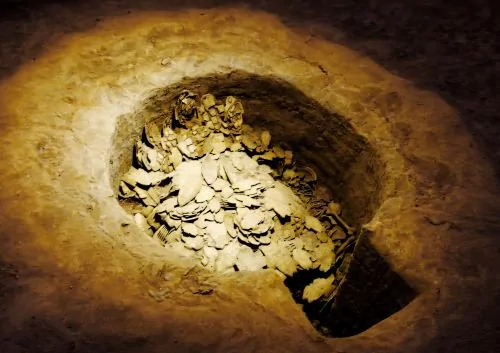
At Yinxu, the late Shang royal center near modern Anyang, the watched sky entered the earliest substantial corpus of writing preserved from China. Most surviving oracle-bone inscriptions date from the thirteenth through the eleventh centuries BCE and are associated with the final nine Shang kings, beginning especially with the reign of Wu Ding. They are not narrative histories, theoretical works on astronomy, or comprehensive registers of everything observed above the capital. Instead, they preserve particular moments when the royal house sought knowledge about an uncertain future and considered how human action might influence it. Tens of thousands of inscribed fragments accumulated or were deposited in pits around the palace-temple zone, where divination, sacrifice, record-making, craft production, and ancestral ritual converged. Their archaeological setting reveals that celestial attention belonged within the working institutions of kingship rather than to an independent community of astronomers. Selective and formulaic though they are, the inscriptions provide contemporary evidence of a court that made uncertainty visible, classified it, and preserved its responses in writing.
Divination commonly employed cattle scapulae and turtle plastrons, materials whose acquisition and preparation already mobilized resources extending beyond the individual diviner. Some shells and bones arrived as tribute, binding distant communities and subordinate powers materially to ceremonies conducted at the royal center. Technicians thinned or hollowed selected areas of the bone or shell and applied heat until cracks formed, after which the king or a specialist interpreted the resulting patterns. The inscription accompanying a divination might include a preface naming the sexagenary day and the diviner, a charge setting out the matter to be tested, a prognostication attributed to the king, and, less frequently, a later verification recording what occurred. Not every bone contains all these elements, and scholars continue to debate whether the statements conventionally called “charges” were spoken questions, declarations, forecasts, or propositions submitted to ritual testing. Some were arranged in contrasting pairs, presenting an auspicious possibility beside an inauspicious one, although the relationship between paired formulations was not always a simple opposition. Recurrent diviners, changing inscriptional styles, identifiable scribal hands, and surviving practice pieces demonstrate that the process required trained personnel whose work developed across generations. The finished object embodied several acts at once: ritual consultation, royal decision-making, technical production, and the creation of a record that could preserve the court’s encounter with uncertainty.
The subjects submitted to divination ranged across nearly every major responsibility and anxiety of the royal house. The king sought guidance about rainfall, harvests, warfare, hunting, journeys, construction, sacrifice, dreams, illnesses, childbirth, hostile communities, and the welfare of relatives and officials. A military expedition might generate repeated divinations about the proper day to depart, the assistance of an ancestor, the movements of an enemy, and the likelihood that the king would suffer harm. Regular inquiries concerning whether calamity would occur during the approaching ten-day week placed danger within a recurring temporal structure rather than treating it as wholly unpredictable. Divination did not replace planning, intelligence, labor mobilization, or military command; it accompanied those activities and helped authorize choices among uncertain alternatives. The result was a form of government in which religious knowledge and practical administration operated through the same royal institutions.
The powers addressed or considered in these inscriptions included royal ancestors and ancestresses, natural powers associated with rivers, mountains, winds, directions, the Sun, and other features of the environment, and the formidable being called Di. Di appears capable of commanding rain, wind, thunder, harvest, warfare, and disaster, but describing Di simply as the Shang “supreme god” can conceal how little the terse records disclose about divine identity. Scholars have debated whether Di was conceived as a single high deity, a title encompassing several powers, an ancestral being, or a celestial authority whose precise nature gradually changed. The inscriptions do not show Di receiving the same regular schedule of sacrificial offerings presented to royal ancestors, and the king’s relationship with Di appears less intimate and less ritually manageable. Some records suggest that powerful ancestors could influence or appeal to Di, but they do not establish one consistent chain of mediation extending from the living king through the dead to a single divine ruler. The ancestors were nevertheless more than commemorated relatives: they could cause illness, affect harvests, assist military undertakings, and respond favorably or destructively according to the ritual attention they received. Because the ruling lineage claimed a privileged relationship with these dead kings and consorts, ancestor worship converted genealogy into political power. No securely attested Shang formulation yet states that Di withdrew authority because a king lacked moral virtue, and the later Zhou identification of Shang Di with Heaven cannot simply be read backward into the oracle bones. Late Shang sacred kingship rested principally upon the ruler’s ability to consult, honor, and interpret powerful beings, not upon the fully developed doctrine that his right to rule depended upon Heaven’s judgment of his conduct.
Celestial observation belonged within this system, although the surviving evidence is much less continuous than popular accounts of ancient Chinese astronomy sometimes imply. Dates were expressed through the sixty-day cycle of heavenly stems and earthly branches, while months, lunar appearances, ritual cycles, and recurring ten-day periods helped organize royal activity. The court monitored the Sun, Moon, stars, weather, and seasonal change because these phenomena affected sacrifice, agriculture, travel, warfare, and the interpretation of unusual events. A small group of inscriptions, often counted as five, has been reasonably identified as recording lunar eclipses, and modern calculations have been used to associate them with possible dates during or near the reigns of Wu Ding and Zu Geng. These proposed correspondences are important because they may help anchor portions of late Shang chronology in absolute time. They are not beyond dispute, because many inscriptions supply a sexagenary day without a year, surviving fragments may be incomplete, the sequence and length of reigns remain contested, and more than one calculated eclipse can sometimes fit the available information. The most famous proposed solar-eclipse inscription is even less secure. Its description of haze, flames appearing to consume the Sun, and great stars becoming visible has been interpreted as an observation of totality and the solar corona, but many specialists regard it as a meteorological report or consider its crucial graphs too uncertain to support that conclusion. Nor does a correctly identified eclipse notice demonstrate that Shang specialists predicted the event in advance. The secure claim is narrower but still significant: late Shang record-makers recognized unusual lunar and solar appearances as matters worthy of dating and preservation within the documentary world of the court. This fragmentary evidence cannot sustain the image of a complete, uninterrupted Chinese eclipse archive extending backward for four millennia, but it shows that close attention to the sky had entered royal written practice long before the creation of systematic annals.
Nothing in these inscriptions yet resembles the elaborate imperial edicts of self-reproach or ministerial arguments that later followed solar eclipses. A darkened celestial light did not automatically announce that the Shang king had failed morally, and the oracle bones provide no equivalent of the mature Mandate of Heaven. It would nevertheless be mistaken to separate celestial observation from political authority merely because the later language of imperial accountability had not yet developed. The royal house controlled the personnel, materials, ritual settings, calendrical knowledge, and written procedures through which extraordinary events were transformed into questions that could be acted upon. When the king delivered a prognostication and the eventual outcome was recorded, the inscription could preserve evidence of his claimed ability to discern what hidden powers intended. Repeated consultation also created an institutional memory, allowing present dangers to be approached through formulas, categories, and ritual precedents inherited from earlier divinations. The watched sky strengthened sacred kingship not because every celestial event carried a settled political message, but because the court claimed the unique capacity to bring uncertain signs into an ordered field of royal knowledge.
The Shang legacy was institutional before it became the moral cosmology familiar from Zhou and Han texts. Late Shang rulers joined observation, calendrical order, ancestral communication, prognostication, administration, and writing within a single political center. The Zhou would inherit parts of this ritual and documentary world while transforming the relationship between celestial authority and human rule, eventually making Heaven’s favor morally conditional. That development should not be represented as the uninterrupted growth of one astronomical bureaucracy, because the fall of the Shang altered institutions, religious language, and the purposes for which earlier practices were remembered. Yet the oracle bones established a durable political grammar: the sky could contain meaningful changes, specialists could submit those changes to disciplined procedures, the ruler stood at the center of their interpretation, and writing could preserve the encounter. Before the Sun could accuse the throne, the Shang kings had made the heavens part of the court’s recorded business.
Heaven Can Withdraw Its Favor: Zhou Conquest and Conditional Kingship
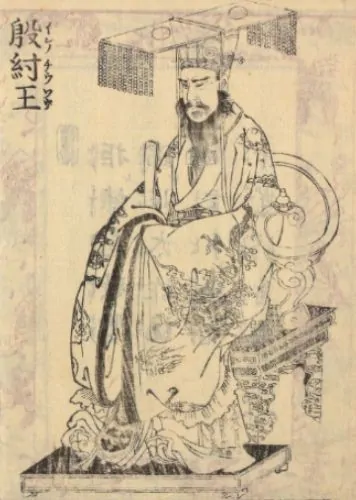
The Zhou conquest of the Shang in the mid-eleventh century BCE altered the political meaning of celestial authority. From their homeland in the Wei River valley, the Zhou assembled a coalition that defeated the last Shang king at the Battle of Muye, conventionally dated to approximately 1046 BCE. Military success gave the conquerors possession of the Shang heartland, but it could not by itself explain why a formerly subordinate people had acquired the right to rule communities long organized around another royal lineage. The Zhou also faced surviving Shang elites, powerful regional allies, and the possibility that conquest might appear to be no more than successful rebellion. Their rulers presented victory as the earthly consequence of a decision already reached in the celestial realm. Heaven had not merely assisted the Zhou army; it had transferred legitimate authority from a ruling house that had rendered itself unworthy to one capable of restoring order.
The power designated as Tian, or Heaven, did not simply replace every deity, ancestor, and natural force recognized under the Shang. Zhou kings continued to sacrifice to royal ancestors, invoked the achievements of Kings Wen and Wu, and grounded authority in a lineage whose deceased founders remained active sources of protection. They also inherited religious language associated with Shang Di, although the relationship between Di and Tian cannot be reduced to a straightforward change of divine names. What distinguished Zhou political theology was the increasing prominence of Heaven as a power capable of conferring a mandate upon one lineage and withdrawing it from another. Royal authority remained sacred, but sacred favor had become transferable.
The transmitted Book of Documents gives this doctrine its most forceful literary expression. In such chapters as the “Announcement to Kang,” the “Announcement of the Duke of Shao,” and “The Many Officers,” Zhou speakers explain that the Shang had once received Heaven’s mandate but lost it through misgovernment, ritual failure, intoxication, violence, and disregard for the people. The downfall of the Shang was represented not as evidence that its earlier legitimacy had been fraudulent, but as proof that legitimate rule could decay. King Wen’s reverence, restraint, and concern for order prepared the Zhou to receive what the last Shang ruler had forfeited, while King Wu’s conquest executed Heaven’s judgment in the human world. This account accomplished several political purposes simultaneously: it justified rebellion against a recognized king, reassured conquered Shang communities that their ancestors had once ruled legitimately, and warned Zhou rulers that conquest had not granted their descendants unconditional possession of power. Yet the Documents is a composite collection whose chapters were composed, transmitted, revised, and canonized over long periods. Its speeches cannot all be treated as verbatim records delivered during the conquest, and some formulations probably express later developments in Zhou and post-Zhou political thought. Their historical value lies partly in preserving early traditions and partly in revealing how successive communities remembered the conquest as the founding demonstration that Heaven’s favor could change.
Contemporary bronze inscriptions provide a firmer, though less comprehensive, view of Western Zhou royal ideology. The Da Yu ding inscription recalls King Wen’s receipt of the great mandate and contrasts the disciplined service of early Zhou officials with a depiction of Shang officers corrupted by wine. The He zun and other early vessels commemorate royal commands, territorial ambitions, sacrifices, appointments, and the consolidation of a new political center, while the later Shi Qiang pan places the Zhou kings within a carefully ordered account of dynastic achievement. Because such inscriptions were cast upon ritual objects intended to preserve grants, honors, and ancestral memory, they joined royal command to sacred commemoration. They confirm that mandate language and moralized comparisons between Shang and Zhou were not merely inventions of much later imperial historians, although they do not reproduce one complete or uniform doctrine of dynastic legitimacy.
Conditional kingship did not make the Western Zhou ruler answerable to a representative institution, an enforceable body of law, or a population empowered to dismiss him. Heaven did not publish an unambiguous verdict, and political success itself could be cited retrospectively as evidence that a transfer of authority had occurred. The doctrine was consequently better suited to explaining a completed conquest than to identifying the precise moment at which a reigning king became illegitimate. Nor did every drought, defeat, harvest failure, or celestial disturbance automatically cancel the mandate. Zhou political language nevertheless introduced a consequential limitation into claims of hereditary rule: descent from victorious ancestors could not guarantee that their descendants would remain worthy of Heaven’s support.
Royal virtue required attention to ritual, capable appointments, restraint in punishment and consumption, successful protection of the realm, and concern for the livelihood of the people. References to the people did not make them a sovereign electorate, but their suffering could be interpreted as evidence that the ruler had disrupted the order Heaven expected him to maintain. The mandate transformed political failure from mere weakness into a possible sign of cosmic disqualification.
The Zhou did not invent the connection between kingship and celestial power, but they gave that connection a more explicitly historical and moral form. Older practices of divination, sacrifice, observation, and ancestral mediation remained important, while the conquest demonstrated that the celestial order could condemn one royal house and authorize another. Astronomical reconstructions have even encouraged the hypothesis that unusual planetary configurations surrounding the Zhou rise helped shape the language through which victory was understood, although the precise influence of such phenomena remains disputed. No surviving eclipse can be shown to have caused the transfer of the mandate, and early Zhou evidence does not yet reveal the systematic political treatment of eclipses familiar from the Han. The crucial development was conceptual: once Heaven’s favor had been made conditional, disturbances above could more readily become evidence about the quality of government below. Later poems, chronicles, commentators, and imperial officials would extend that principle by turning particular eclipses into recorded moments when celestial disorder appeared to expose human failure.
Eclipses in the Classical Record
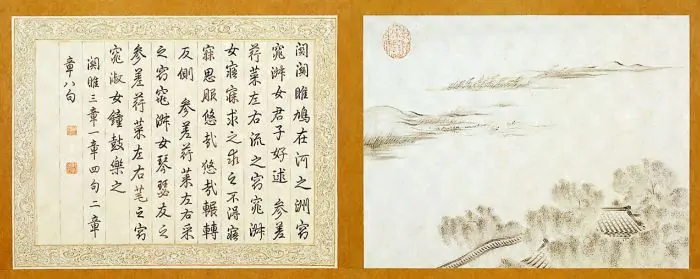
The classical tradition did not preserve eclipses in a single, steadily improving form. It remembered them as stories about official duty, poetic images of political disorder, and terse entries in chronological records. Each genre made a different claim upon the past. A story could explain why the court required celestial specialists, a poem could transform darkness into an accusation against named officials, and an annal could fix an eclipse within a sequence of public events. None of these forms should be treated as a transparent transcript of observation. They reveal how an unusual appearance of the Sun became attached to enduring ideas about administration, morality, and historical judgment.
The most famous early story concerns Xi and He, the celestial officials condemned during the legendary Xia dynasty. In the received “Punitive Expedition of Yin” chapter of the Book of Documents, they are accused of abandoning their offices, becoming disorderly through wine, and allowing the regulation of celestial time to fall into confusion. When the Sun was eclipsed on the first day of the last month of autumn, subordinate personnel and ordinary people responded in alarm, but Xi and He failed to recognize or perform the duties attached to the event. The ruler Zhong Kang consequently commissioned the lord of Yin to lead a punitive expedition against them. Later retellings compressed this account into the memorable claim that two astronomers were executed because they failed to predict an eclipse. That formulation assigns the story a degree of astronomical precision that the surviving narrative does not establish. The charge against Xi and He concerns a broader dereliction of calendrical, ritual, and administrative responsibility, not merely the failure to announce one conjunction of the Sun and Moon. Their offense was dangerous because the regulation of time had been entrusted to them as a public office upon which the proper coordination of court and people depended. The eclipse supplied the dramatic proof that specialists who neglected the sky could expose the entire political order to confusion.
The story cannot be accepted as a contemporary Xia record or used confidently to date an eclipse in the third millennium BCE. The “Punitive Expedition of Yin” belongs to the group of Old Text chapters that entered the received Book of Documents through a version presented during the Eastern Jin period, many centuries after the age it claims to describe. Earlier traditions may lie behind portions of the narrative, but the surviving composition cannot independently verify the existence, offices, punishment, or astronomical knowledge of Xi and He. Attempts to identify its eclipse with one of several calculated events have produced possibilities rather than an agreed historical date. Its strongest evidence concerns the society that transmitted the story: by then, calendrical office had become so essential to legitimate government that its imagined neglect could explain armed punishment.
The eclipse in the Book of Songs belongs to a very different world of expression. The poem conventionally titled “At the Conjunction of the Tenth Month” begins with a solar eclipse on the first day of the month, identified by the cyclical designation xinmao. It places the disturbance beside the dimming or eclipse of the Moon and declares that the celestial lights have departed from their proper paths. Yet the poem does not remain in the sky. Thunder and lightning, overflowing streams, collapsing hills, sinking heights, and rising valleys create an image of a social order turned violently upside down. The speaker then names powerful officeholders, directs particular anger toward the chief minister Huangfu, condemns oppressive labor demands, and complains that favored men accumulate wealth while others endure anxiety and dispossession. A prominent royal consort also appears within this catalogue of influence and misrule. Most strikingly, the poem insists that the suffering of the people did not simply descend from Heaven but arose through human contention. The eclipse consequently frames a political indictment without relieving ministers and favorites of responsibility for conditions they themselves created.
The poem also distinguishes between lunar and solar eclipses in a way that anticipates their unequal political symbolism. An eclipse of the Moon is treated as an occurrence within the expected order, whereas an eclipse of the Sun provokes the more urgent question of what has gone wrong. Traditional chronology associated the poem with the reign of King You and identified the event as an eclipse in 776 BCE. Modern astronomical analysis has challenged that identification, with a near-annular eclipse visible at the Zhou capital on November 30, 735 BCE offering a closer match to the xinmao day, the apparent dimming of the Sun, and the poem’s reference to a preceding lunar eclipse. That date would place the event after King You and complicate the traditional account of the poem’s political setting. Textual transmission, uncertain historical attribution, calendrical reconstruction, and changes in Earth’s rotation prevent the astronomical match from settling every literary question. Even if the 735 BCE eclipse supplied the poem’s original occasion, the received composition may combine observation, remembered disaster, political criticism, and later editorial arrangement.
With the Spring and Autumn Annals, eclipse memory assumes a more serial and impersonal form. Produced from the perspective of the state of Lu, the work records public events from 722 into the late fifth century BCE through highly compressed entries arranged by the reigns of Lu’s rulers, years, seasons, months, and days. Its thirty-seven solar-eclipse notices normally use a recurring formula stating simply that the Sun was eclipsed, sometimes adding the first day of the lunar month and a day in the sexagenary cycle. They rarely describe darkness, color, duration, magnitude, public fear, or the observer’s emotional response. Nor do they ordinarily explain what an eclipse meant for a ruler or predict the terrestrial event that would follow it. Their importance lies in repetition: an eclipse was no longer only a wonder dramatic enough to enter legend or poetry, but a recognizable category of occurrence assigned a place within the continuing record of government.
Modern calculations confirm that the great majority correspond to genuine solar eclipses, although several entries contain problematic months or cyclical dates and a few cannot be securely reconciled with events visible from Lu. Copying errors, calendrical irregularities, uncertain wording, weather, and the long transmission of the text complicate exact reconstruction. Those difficulties do not erase the fundamental achievement of the record. The sequence demonstrates that by the Spring and Autumn period, eclipse recording had acquired a regularity not securely attested in the scattered materials attributed to the Xia, Shang, or early Western Zhou.
The apparent silence of the Annals did not prevent later readers from hearing political judgment within it. The Zuo Tradition surrounded some of its eclipse entries with speeches, prognostications, and discussions of the ritual obligations imposed upon rulers and officials, while the Gongyang and Guliang traditions treated details of wording, dating, inclusion, and omission as clues to the moral principles of the sage who was believed to have shaped the chronicle. These commentaries preserved valuable traditions, but their elaborate explanations cannot automatically be attributed to the Lu observer or recorder who produced a terse notice centuries earlier. The historical eclipse, the original annalistic entry, the narrative attached by a commentator, and the doctrine constructed by later classical scholars represent distinct stages in the event’s political afterlife. Legend made celestial negligence punishable, poetry used darkness to expose oppression, and annalistic practice transformed isolated eclipses into a durable sequence against which later interpreters could measure rulers and states. The movement among these genres was not a simple progression from imagination to objective science, for every form selected and organized the past according to its own purposes. It nevertheless created the textual foundation upon which Warring States specialists could build more systematic relationships among celestial patterns, calendrical calculation, cosmic correspondence, and political order.
Making the Sky Legible: Warring States Calendars and Correlative Cosmology
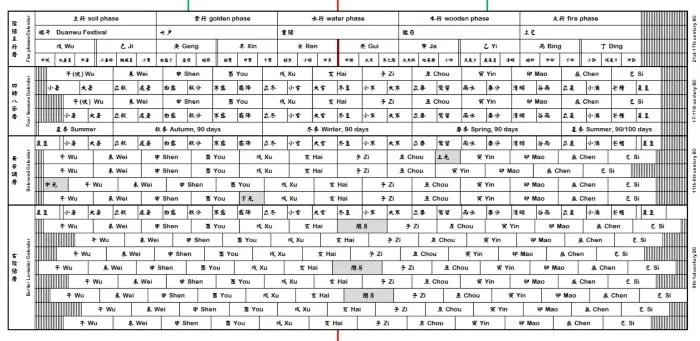
The political fragmentation of the Warring States period did not fragment celestial knowledge into isolation. Competing courts employed calendrical specialists, diviners, ritual experts, physicians, and observers whose learning circulated across state boundaries even as rulers sought to appropriate it for their own governments. Regional states differed in the month with which they began the year, the numbering of months, and the ritual traditions attached to their calendars, so a date expressed in one system could not always be transferred directly into another. These differences were more than antiquarian curiosities: calendars regulated sacrifices, military campaigns, agricultural labor, taxation, travel, and the issuing of official documents. A ruler who promulgated an authoritative calendar claimed the capacity to coordinate human activity with celestial and seasonal order. As larger territorial states absorbed smaller polities, the creation of legible and commensurable time became part of the broader struggle to make populations administratively governable.
Every regional calendar confronted the same astronomical difficulty. Twelve lunar months of twenty-nine or thirty days produced a year shorter than the solar cycle, requiring the periodic insertion of an additional month if agricultural seasons and named months were to remain aligned. Specialists tracked lunar phases, solstices, seasonal indicators, and the changing positions of stars while refining numerical procedures for reconciling cycles that never fitted together perfectly. Later sources associate the late Zhou world with quarter-remainder methods based upon a solar year of approximately 365¼ days and with increasingly systematic intercalation, although the exact dates at which particular computational rules became standard remain disputed. Material evidence confirms that the sky had already been organized into durable reference structures. A lacquered chest from the tomb of Marquis Yi of Zeng, sealed in 433 BCE, displays the names of the twenty-eight lunar lodges around a representation of the Northern Dipper, providing the earliest complete surviving list of a system later fundamental to positional astronomy and omen interpretation. Transmitted traditions also associate the fourth-century specialists Shi Shen and Gan De with observations of planets and stars, but their original works have disappeared, and texts bearing their names survive only through much later quotations and reconstructions. The Warring States achievement cannot be reduced to a single lost star catalogue or calendar. It lay in the the increasing coordination of observed phenomena, inherited cycles, named celestial regions, and numerical procedures within forms of knowledge that states could maintain and transmit.
Calendrical order also reached beyond the astronomical specialist. Excavated daybooks from late Warring States and Qin tombs classified days, directions, journeys, marriages, burials, construction, childbirth, sacrifice, and other activities as favorable or dangerous according to recurring temporal schemes. The Chu silk manuscript, probably produced around 300 BCE, arranged months, seasonal powers, mythic beings, directions, and warnings about improper calendrical conduct within a single visual and textual composition. Such materials did not constitute popular editions of a court ephemeris, nor did their possession prove that ordinary readers could calculate eclipses. They demonstrate instead that patterned time had become a practical medium through which people selected actions, interpreted danger, and located themselves within a cosmos filled with differentiated moments. The same society could support mathematically trained calendrical officers, itinerant experts, local diviners, and manuscript users whose methods overlapped without being identical.
The intellectual transformations of the period made this increasingly ordered sky more politically expressive. Yin and yang had earlier denoted contrasts such as shade and sunlight, darkness and brightness, passivity and activity, but Warring States thinkers developed them into complementary tendencies through whose alternation natural and human change could be described. The Five Phases (wood, fire, earth, metal, and water) likewise emerged from older classifications of materials and processes before becoming members of generating, overcoming, and political sequences. The concept of qi supplied another vocabulary for the dynamic stuff or vital influence through which transformations occurred. These schemes did not appear together as one finished doctrine, and their relationships remained inconsistent across texts and communities. Later accounts credited Zou Yan of Qi with systematizing yin and yang, the Five Phases, geography, and dynastic succession, but none of his works survives independently, making it difficult to separate his teachings from the intellectual developments subsequently attributed to him. “Correlative cosmology” is consequently a useful modern designation only if it does not suggest that every Warring States thinker accepted one rigid table of equivalences. Competing specialists connected seasons, directions, colors, tones, flavors, organs, animals, numbers, planets, rituals, and political offices in different combinations because they believed patterns could reveal relationships among domains that modern disciplines ordinarily separate. The point of a correlation was not merely to classify the world but to determine how action in one part of an interconnected order might produce, amplify, or disclose change elsewhere.
The twelve “Monthly Ordinances” placed at the opening of the Annals of Lü Buwei, compiled under the patronage of Qin’s chief minister in 239 BCE, display the governmental ambition of this approach. Each month receives its proper celestial markers, seasonal conditions, direction, color, musical pitch, sacrifices, foods, clothing, agricultural tasks, and administrative commands. The ruler does not passively watch the seasons arrive; he adjusts his residence, conduct, ritual, diet, and policies so that government moves with the dominant configuration of the time. Spring favors generation and the protection of growing life, whereas autumn is increasingly associated with contraction, judgment, punishment, and military action. Performing the regulations of one season during another is said to produce unseasonable weather, failed crops, epidemic illness, political disturbance, or military danger. These consequences made the calendar an instrument of moral and administrative diagnosis as well as chronology. A flood, drought, untimely frost, or celestial irregularity could suggest that officials had misunderstood the season, that the ruler had ordered inappropriate action, or that the entire government had ceased to correspond with the processes it claimed to regulate. The program was prescriptive rather than a literal description of every court’s conduct, but its comprehensiveness reveals how thoroughly calendar making could be imagined as state making.
This expanding cosmological framework did not make every eclipse predictable, nor did it assign one automatic meaning to every obscuration of the Sun. It did make an eclipse more legible by placing it within overlapping systems of dates, lunar conjunctions, celestial regions, seasonal forces, yin and yang, political hierarchy, and historical precedent. Calculation could explain when a conjunction was possible while correlative reasoning explained why its visible consequences might matter, and acceptance of the former did not logically cancel the latter. Indeed, the more orderly Heaven appeared, the easier it became to treat an irregular manifestation as evidence that something below required correction. By the eve of Qin unification, rival states had transformed celestial knowledge into an increasingly portable repertoire of observation, computation, classification, and political prescription. The Qin and Han empires would inherit that repertoire and concentrate it within institutions capable of imposing one calendar, collecting reports across an enormous territory, and making the ruler answerable to a sky the state itself had helped render intelligible.
The Empire Keeps Time: Qin-Han Sovereignty and the Official Calendar
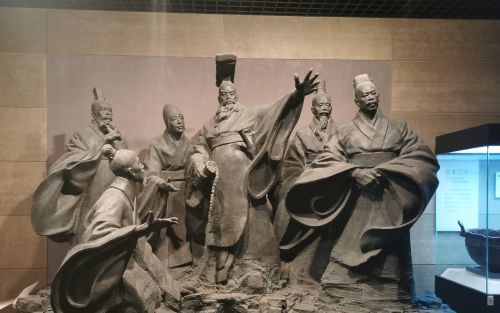
When Qin conquered its last rival in 221 BCE, political unification transformed the calendar from one courtly system among several into an instrument of universal imperial rule. Earlier states had maintained different beginnings of the year, month sequences, ritual schedules, and calendrical traditions, but the First Emperor placed the ordering of time beside his better-known standardizations of weights, measures, coinage, writing, and administrative procedure. The Qin year began with the tenth numbered month, while the dynasty associated itself with the cosmic power of Water, the color black, and the number six. Later Han sources identified the Qin system with the calendar attributed to the ancient ruler Zhuanxu, thereby placing imperial practice within a venerable genealogy of timekeeping. Excavated calendars on bamboo and wooden slips nevertheless warn against assuming that Qin officials simply applied the precise rules preserved in much later descriptions of the Zhuanxu calendar. The surviving dates suggest adjustments and computational practices more complicated than the received dynastic histories acknowledge. What mattered politically was not the existence of one timeless formula but the court’s claim that months, seasons, rituals, and official acts throughout the conquered territories should be coordinated according to a system authorized by the emperor.
The founders of the Han overthrew Qin while retaining much of the administrative machinery through which Qin had governed. Early Han rulers continued the Qin month order, beginning the civil year with the tenth month rather than immediately inventing a calendar that symbolized dynastic rupture. Such continuity was practical because officials, scribes, and local administrators already possessed habits and records organized according to the inherited system. Legal cases, tax accounts, labor registers, military reports, grain receipts, appointments, and communications between the center and commanderies all depended upon dates whose meaning had to remain intelligible across great distances. A shared calendar allowed events reported from different regions to be placed within one administrative sequence, making the empire governable not only in space but also in time. At court, responsibility for celestial and calendrical affairs belonged broadly within the institution headed by the Grand Scribe, although its observers, calculators, recorders, and interpreters performed distinguishable tasks. They monitored celestial appearances, maintained chronological records, calculated recurring cycles, and advised the throne when observation appeared to diverge from established procedures. The central government could then distribute the resulting calendar as an imperial ordering of the seasons. This system did not mean that every village possessed identical astronomical knowledge or that semi-autonomous kingdoms immediately surrendered all local practices. It nevertheless asserted that legitimate public time originated at the imperial center and radiated outward through the same documentary networks that carried laws, commands, taxes, and reports.
An official calendar was a mathematical construction whose errors accumulated even when it remained adequate for everyday administration. Its values for the lunar month and solar year were approximations, while its chosen epoch determined the point from which recurring motions were calculated. As discrepancies developed between predicted and observed conjunctions, solstices, seasonal points, or planetary positions, specialists could argue that the inherited system no longer corresponded sufficiently with Heaven. By the reign of Emperor Wu, calendrical dissatisfaction intersected with a much larger program of territorial expansion, centralization, new sacrifices, cosmic classification, and the redefinition of imperial authority. Reform promised more than technical improvement: it offered a public demonstration that the Han had ceased merely to occupy the Qin state and had established its own relationship with celestial order.
The Grand Inception reform of 104 BCE emerged from organized competition among experts rather than from the isolated discovery of a single court astronomer. Sima Qian’s account describes an imperial summons for calendrical proposals, tests of rival computations, and debates involving established officials as well as specialists brought to the capital from outside its normal scholarly circles. Sima Qian participated through his office as Grand Scribe, while Deng Ping and Luoxia Hong became particularly associated with the calculations ultimately accepted. Later tradition sometimes treated Luoxia Hong as the solitary creator of the new calendar, but the reform was a collective project shaped by technical rivalry, bureaucratic evaluation, ritual argument, and imperial choice. The adopted system became known as the Taichu li, or Grand Inception calendar, and one of its characteristic numerical procedures divided the day into eighty-one parts for calculating lunar motion. It coordinated 235 lunar months within a nineteen-year cycle, thereby providing a systematic basis for intercalation within a lunisolar calendar. The reform restored the first numbered month, associated with the beginning of spring, as the beginning of the civil year, replacing the Qin practice of opening the year with the tenth month. It also arranged intercalary months in relation to the solar terms so that a month lacking a central solar point could be designated as additional. Its scope extended beyond the naming of months to calculations involving the Sun, Moon, planets, seasonal divisions, and eclipse possibilities. Such procedures could anticipate celestial relationships with increasing regularity, although they could not eliminate uncertainty about local visibility, weather, magnitude, or the accuracy of every parameter. The name “Grand Inception” also designated the new imperial era, joining a calendrical beginning to a proclaimed renewal of Han rule. Emperor Wu did not personally perform the calculations, but only imperial authorization could select one proposal from its competitors and transform that proposal into the calendar of the empire. Technical knowledge supplied the possible systems; sovereignty determined which system would become public time.
The Grand Inception calendar did not end calendrical debate or establish an unchanging standard for the remainder of Chinese history. Observation continued to reveal deviations, inherited parameters remained open to criticism, and later specialists revised the system, most notably when Liu Xin incorporated its foundations into the more elaborate Triple Concordance calendar during the political transformations surrounding Wang Mang. Further reforms under the Eastern Han confirmed that official time was a continuing negotiation among mathematical models, accumulated observations, institutional interests, ritual programs, and dynastic claims. The court’s authority to promulgate a calendar never eliminated disagreement among those capable of constructing one. For the political meaning of eclipses, that tension was decisive. A successfully anticipated eclipse could display the reach of imperial knowledge, permit rituals to be prepared, and reinforce confidence in the specialists serving the throne. An unexpected eclipse, an incorrect date, or a visible event omitted from the official forecast could instead expose computational failure at the very center that claimed to keep Heaven and empire aligned. Qin and Han sovereignty made the calendar a powerful instrument of unification, but every assertion that the emperor governed through celestial time also made the condition of the heavens evidence by which his government could be judged.
Those Who Watched for the Emperor

The imperial calendar acquired its authority from the throne, but the emperor did not personally watch the sky or perform the calculations through which celestial order was made knowable. Han rulers depended upon an office headed by the taishi ling, a title translated variously as Prefect Grand Scribe, Grand Historian, Grand Astrologer, or Director of the Grand Scribes. None of these English equivalents captures the full combination of calendrical, observational, prognosticatory, archival, and ceremonial responsibilities attached to the position. The director occupied the middle ranks of the bureaucracy, traditionally receiving the salary grade of six hundred bushels and serving within the ritual-administrative structure of the court. His modest formal standing contrasted with the political sensitivity of the knowledge entrusted to his office. A functionary who lacked the power of a chancellor or general could nevertheless report that the movements of Heaven exposed disorder at the center of government.
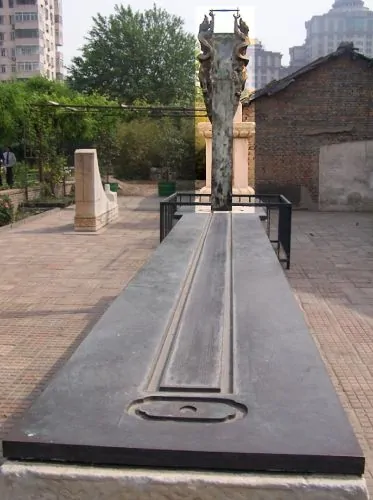
Beneath the director worked subordinate scribes, calculators, observers, timekeepers, and technical personnel whose precise titles and numbers changed across the four centuries of Han rule. Their tasks required different kinds of expertise even when surviving sources group them under broad labels associated with the Grand Scribe. Calendrical specialists manipulated numerical cycles, established month lengths, placed intercalations, and compared predicted positions with recurring celestial phenomena. Observers maintained watches of the Sun, Moon, planets, stars, clouds, and unusual lights, noting departures from expected appearance or motion. Gnomons allowed the changing length of the solar shadow to be measured, while clepsydras divided time independently of daylight and demanded constant supervision if their flow was to remain reliable. Armillary instruments increasingly supplied frameworks within which celestial positions could be located, although the development and refinement of such devices should not be attributed to one inventor or moment. During the Eastern Han, the Spiritual Terrace at Luoyang became the physical setting most closely associated with official celestial observation, and Zhang Heng served two terms as Grand Scribe while developing instruments, cosmological arguments, and calendrical criticism. The knowledge credited to celebrated individuals rested upon collective labor performed by less visible personnel who maintained instruments, kept watches, recorded appearances, copied results, and ensured that observations could reach the court.
Solar eclipses placed exceptional demands upon this system because they were brief, locally variable, and easily concealed by weather. Specialists knew that a solar eclipse belonged near lunar conjunction, making it possible to direct attention toward the Sun at potentially significant times even when no surviving record proves that every observed Han eclipse had been successfully calculated beforehand. Several recorded partial eclipses were so slight that their detection strongly suggests deliberate watching rather than accidental notice. Chang’an and Luoyang were not the only observation points, for the histories sometimes preserve reports from kingdoms or commanderies where an eclipse was more conspicuous than at the capital or was not visible from the capital at all. Administrative geography extended the emperor’s celestial vision, but it also complicated the archive by bringing together observations made from different locations under different weather conditions and by witnesses of unequal training. Descriptions such as “total,” “almost total,” or “like a hook” could reflect genuine differences in local appearance rather than contradictory reports of a single uniform spectacle.
The conjunction of astronomical and historical responsibility becomes visible in the careers of Sima Tan and his son Sima Qian. Sima Tan served as Grand Scribe under Emperor Wu and gathered materials for a history that would connect the origins of rulership with the political transformations of his own age. After his death in approximately 110 BCE, Sima Qian eventually succeeded to the office and continued the historical project his father had begun. He also participated in the investigations that produced the Grand Inception calendar of 104 BCE, although he was neither the reform’s sole calculator nor the unquestioned technical authority behind it. The resulting Records of the Grand Historian was not simply an official chronicle mechanically generated by the duties of the office, for its design, judgments, and vast historical ambition belonged to the intellectual undertaking of the Sima family. Its “Treatise on the Celestial Offices” nevertheless demonstrates what the position made possible. Sima Qian combined inherited star traditions, descriptions of celestial regions, planetary and atmospheric omens, remembered precedents, and interpretations of dynastic history within a single account of how the heavens disclosed human affairs. The sky itself appeared as an imperial administration, with its central palace, sovereign powers, ministers, armies, markets, roads, frontier regions, and subordinate offices. Celestial observation became historically meaningful because a present configuration could be compared with earlier configurations and their recorded terrestrial consequences. The Grand Scribe watched in two directions at once: upward toward changing appearances and backward toward the archive that taught the court what those appearances might mean.
An observation did not pass unchanged from the sky into a dynastic history. An observer might first note the date, time, direction, celestial location, color, apparent magnitude, duration, or motion of a phenomenon, after which a superior could abbreviate, classify, interpret, or incorporate the report into another document. Some information entered court diaries or annalistic records, while other material was preserved in calendrical discussions, omen manuals, imperial edicts, memorials, biographies, or collections organized according to the Five Phases. The compilers of the Book of Han drew upon the Records of the Grand Historian, surviving court records, earlier interpretive compilations, and materials assembled by scholars such as Liu Xiang and Liu Xin, but they rearranged this inheritance according to their own historical structure. The received Book of Later Han adds another layer because the treatises attached to Fan Ye’s history derive substantially from Sima Biao’s third-century Continuation of the Book of Han. A terse notice and an elaborate omen interpretation preserved beside it may have originated at different moments. Archives were also vulnerable to rebellion, dynastic collapse, fire, neglect, scribal corruption, and editorial selection, leaving the surviving record more uneven than the original flow of reports must have been. What remains is not the Han celestial archive intact, but the product of repeated acts of preservation through which selected observations outlived the institutions that first recorded them.
The recorded eclipse did not dictate its own political meaning. The Grand Scribe or another specialist might compare its date, magnitude, celestial position, and direction of obscuration with earlier precedents, while ministers and classical scholars could use different correlations to identify the person, policy, or administrative failure supposedly implicated. Officials outside the astronomical establishment were not necessarily barred from offering interpretations, particularly when an emperor requested broad counsel after an alarming event. One adviser might blame an empress or imperial favorite, another excessive punishment, another the obstruction of worthy ministers, and another a technical defect in the calendar. Such multiplicity made celestial interpretation a field of political competition rather than the exclusive possession of a single bureau. It also creates the temptation to assume that observers freely invented phenomena whenever an omen served a political argument. Modern comparison with calculated eclipses instead shows that the Han record is generally faithful to events that could actually have been seen, with most discrepancies explicable through damaged dates, copying mistakes, incomplete observation, or later interpolation. Political pressure could influence which events received emphasis, which explanations were preserved, and how an eclipse was connected to subsequent misfortune without requiring officials to fabricate the eclipse itself. The technical reliability of many notices and the political uses made of them were not opposites; accurate observation gave an interpretation greater authority precisely because the event could not easily be dismissed as imaginary.
The Han celestial service consequently did more than supply dates or reassure the emperor that specialists were watching on his behalf. It transformed a transient darkening witnessed from one or more places into an official datum capable of circulating through the bureaucracy and surviving within historical memory. Its authority depended upon trained observation, numerical procedure, administrative reporting, and the accumulation of precedents, yet none of those operations removed judgment from the process. The same archive that strengthened the throne by demonstrating the reach of imperial knowledge also preserved evidence that ministers could later turn against a ruler, consort, favorite, or failed policy. Those who watched for the emperor helped create a record before which the emperor himself could be summoned to answer.
Prediction Did Not Silence Heaven: Eclipse Cycles and Calendar Reform
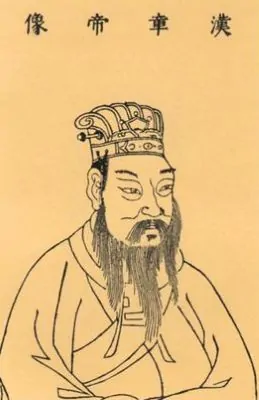
It is tempting to imagine that once Han specialists recognized the recurrence of eclipses, celestial darkness ceased to appear mysterious or politically threatening. The evidence instead reveals several overlapping levels of knowledge whose boundaries changed gradually. The Grand Inception system of 104 BCE, and Liu Xin’s later elaboration of it as the Triple Concordance system, could calculate mean conjunctions, oppositions, lunar phases, and recurring relationships among celestial cycles. Specialists knew that a solar eclipse was possible only near the conjunction of the Sun and Moon, while a lunar eclipse belonged near their opposition. In modern terms, either event also required the Moon to lie sufficiently close to one of the crossing points between its path and the apparent annual path of the Sun. Early imperial methods approximated these conditions numerically without possessing a modern gravitational model or a complete geometrical account of the observer’s position. Their calculations could identify times of increased possibility more readily than they could predict whether a particular solar eclipse would be visible at Chang’an or Luoyang. Prediction was consequently a spectrum of abilities rather than a single discovery that divided ignorance from knowledge.
Eclipse cycles made that spectrum more powerful because they allowed recorded phenomena to be compared across long intervals. The Triple Concordance system contained a 135-lunation “coincidence cycle” that brought relevant lunar relationships back into approximate alignment and could support the prediction of lunar eclipses. If a lunar eclipse occurred at one opposition, another became possible when a suitable number of lunations had carried the Sun and Moon into a comparable configuration. Recurrence was less dependable for solar eclipses at a particular location because the Moon’s shadow crossed only a narrow portion of Earth, and a broadly similar celestial arrangement did not guarantee visibility from the imperial capital. Liu Xin nevertheless used his system to test passages in the Spring and Autumn Annals, the Zuo Tradition, and other inherited records against reconstructed conjunctions, solstices, planetary positions, and eclipse possibilities. This was an important intellectual departure because an authoritative classical statement could now be examined through mathematical retrodiction rather than accepted only through commentary. It also exposed disagreements that Liu Xin did not always resolve impartially. Some recorded eclipses fitted his reconstruction, some required calendrical adjustments, and others were passed over when they contradicted the dates generated by his system. He may even have projected a solar eclipse backward from a later observation by using the 135-lunation cycle, although the evidence for that procedure remains indirect. Neither the Grand Inception nor the Triple Concordance system contained a fully developed method for forecasting locally visible solar eclipses. The existence of eclipse cycles demonstrates considerable computational sophistication without justifying the stronger claim that Western Han officials routinely predicted every darkening of the Sun.
The contrast between lunar and solar eclipses was crucial. A lunar eclipse could be observed across much of the night hemisphere and normally lasted long enough to be noticed from many places, whereas a solar eclipse might be conspicuous in one commandery, slight in another, and entirely invisible at the capital. A correct prediction of conjunction alone could not specify where the Moon’s shadow would fall, and early imperial calculators did not possess an adequate treatment of the positional effect now called lunar parallax. By the late Eastern Han, lunar eclipses had largely lost their status as major portents because their recurrence and visibility had become comparatively manageable. Solar eclipses retained their ominous force because their local appearance remained difficult to anticipate and because the Sun’s political association with the emperor made its obscuration uniquely disturbing.
Prediction also supplied the evidence through which an established calendar could be discredited. By 32 CE, officials were already reporting that the Triple Concordance system lagged behind observed lunar conjunctions, but Emperor Guangwu deferred a comprehensive reform while the restored Han was still consolidating its rule. The discrepancy became unmistakable in 62 CE, when the official system placed a lunar eclipse on the sixteenth day of the seventh month. The expectant official Yang Cen argued from accumulated errors that the eclipse would occur one day earlier, and observation confirmed his correction. The emperor then ordered comparisons extending across subsequent conjunctions, quarter phases, full moons, and lunar eclipses. Five consecutive tests favored Yang Cen over the official calendar, after which Zhang Cheng, Jing Fang, Bao Ye, and other specialists were instructed to test alternative quarter-remainder methods against his results. By 69 CE, those methods were being used for some lunar-phase and eclipse calculations, although their proponents had not yet established a complete system with an agreed computational origin. Further discussions produced no decisive reform, and the inherited calendar remained officially in force while its errors accumulated. By 85 CE, its predicted lunar phases lagged behind observation by approximately three-quarters of a day, calendar dates could differ from celestial events by a full day, and the calculated positions of the Sun and Moon among the lodges had noticeably diverged from the observed sky. Emperor Zhang commissioned Bian Xin and Li Fang to compare the competing procedures, then ordered the adoption of the Han Quarter Remainder system on March 18, 85 CE. The reform altered constants, reset the starting point from which motions were calculated, and brought conjunctions and lunar phases into closer agreement with contemporary observation. It was presented not merely as the correction of arithmetic but as the restoration of an imperial calendar that had fallen out of step with Heaven.
The Quarter Remainder system did not remain accurate indefinitely. By the second century CE, recorded lunar eclipses were again appearing earlier than official predictions, creating opportunities for specialists outside the established bureau to challenge its methods. Liu Hong responded by examining decades of eclipse records and developing the Uranic Manifestation system, which distinguished more effectively between mean and varying lunar motion and included procedures for calculating the Moon’s latitude. These innovations made it possible to estimate whether conjunction would occur sufficiently close to the Moon’s path across the Sun to create a serious possibility of solar obscuration. Later testimony reports that Liu Hong successfully forecast the time, direction, and approximate magnitude of a solar eclipse during or shortly after the Xiping period of 172–177 CE. The precise event cannot be identified with certainty, but reconstructed calculations make an eclipse in 178 or 179 CE a plausible candidate. His system was completed in some form before the end of the Han and transmitted into the post-Han astronomical tradition, even though it did not displace the official calendar throughout the empire before the dynasty collapsed. Progress in eclipse prediction emerged through criticism, competing calculations, retrospective testing, failed forecasts, and the repeated comparison of numerical systems with an archive of observed events.
None of these advances made celestial interpretation obsolete. A predicted solar eclipse could still be treated as a warning because regular causation and political significance belonged to different questions within Han cosmology. Court ritual provided for sacrifices around the beginning of the lunar month, when an eclipse was most likely, and an actual obscuration could activate ceremonies intended to assist or “rescue” the Sun. Advance knowledge allowed officials to prepare for the danger, but preparation did not absolve the emperor from asking why Heaven had permitted the event to appear during his reign. Conversely, a failed prediction could expose incompetent specialists, an obsolete calendar, or a government incapable of maintaining the correspondence between celestial and administrative order. Imperial edicts announcing calendar reform accordingly connected technical discrepancies with mistimed ceremonies, agricultural distress, disease, or wider disorder. The increasingly calculable character of eclipses could even strengthen their political power by placing them within a disciplined structure of dates, precedents, magnitudes, and expected consequences. Han specialists did not have to choose between an eclipse governed by recurring celestial motions and an eclipse bearing judgment upon human rule. By predicting Heaven’s rhythms, the imperial state made deviations more visible, its own responsibilities more exacting, and the darkened Sun more deeply embedded within the machinery of government.
When the Sun Darkened: Ritual Response and Imperial Self-Blame
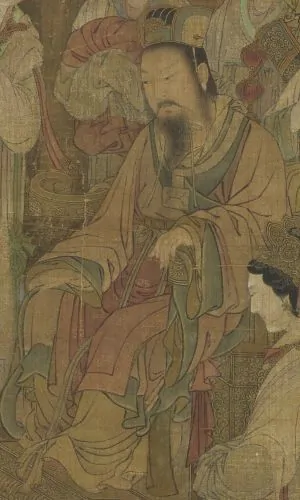
When the Sun began to disappear, the Han court confronted more than an astronomical occurrence. Classical precedents prescribed that the Son of Heaven suspend ordinary business and beat drums at the altar of Soil, while regional lords performed corresponding rites within their own domains. Other ritual traditions arranged banners, weapons, and drums according to rank, turning the response into a visible representation of political hierarchy. Such practices should not be reduced to the popular image of frightened crowds making noise to drive away a sun-devouring creature. Within court ritual, drums and martial objects mobilized yang forces, displayed collective vigilance, and demonstrated that the ruler and his officers were acting to restore endangered order. The eclipse was treated simultaneously as a temporary injury to the celestial sovereign, an interruption of normal government, and a warning that government itself might require correction.
Emperor Wen gave that warning unusually explicit political form after a solar eclipse on the final day of the eleventh month in 178 BCE. His edict began from the proposition that Heaven had established rulers to nourish and govern the people, not merely to possess authority over them. When a ruler lacked virtue or distributed government inequitably, Heaven revealed calamities to admonish him. Emperor Wen called an eclipse the greatest of such visible disasters and declared that the order or disorder of the realm ultimately rested upon him alone. He acknowledged his principal ministers as his arms and legs, but he did not make them absorb the entire burden of celestial displeasure. Instead, he ordered officials to identify his errors and matters that his knowledge had failed to reach. He called for the recommendation of worthy and upright men capable of speaking frankly and remonstrating forcefully. The edict also instructed the administration to reduce labor obligations and expenditures that burdened the people, disbanded forces under the General of the Guards, and redirected surplus government horses toward the imperial relay system. Later in the same regnal year, Emperor Wen abolished legal provisions against defamatory and portentous speech because they discouraged ministers from expressing their true views and prevented the ruler from learning of his faults. The eclipse response moved beyond ritual contrition: celestial darkness became the occasion for soliciting criticism, altering policy, and weakening some of the legal restraints that made criticism dangerous.
Imperial acknowledgment had already appeared in a more compressed form when a total eclipse darkened the day in 181 BCE and Empress Dowager Lü reportedly told her attendants that the event had occurred because of her. Under the Eastern Han, the response could become an elaborate performance of withdrawn sovereignty. Following the solar eclipse of 31 CE, Emperor Guangwu avoided the principal audience hall, suspended military activity, and refrained from hearing ordinary government business for five days. He proclaimed that his deficient virtue had caused the calamity displayed by the Sun and Moon and described himself as trembling before the celestial rebuke.
Officials were commanded to preserve the laws, fulfill their responsibilities, and act for the benefit of the population, while memorialists were encouraged to submit criticism without concealment. The emperor even forbade those addressing him from praising him as a sage, interrupting the honorific language through which court documents ordinarily magnified imperial perfection. A subsequent edict associated disturbances of yin and yang and eclipses of the celestial lights with faults resting upon the emperor, proclaimed a general amnesty, and ordered senior authorities to nominate worthy and upright candidates for examination at court. Refusal to occupy the main hall, the temporary silencing of imperial business, and the renunciation of flattering titles made the ruler’s diminished condition visible before the bureaucracy that normally approached him as the inexhaustible source of command.
Self-blame did not determine what an eclipse meant, because officials could connect the same obscuration with very different political disorders. Some interpretations treated the Moon’s encroachment upon the Sun as a sign that ministers, consort families, eunuchs, or favorites had usurped powers belonging to the ruler. Others argued that an overbearing emperor had frightened and constricted his ministers until the celestial relationship between sovereign and subordinate became correspondingly distorted. Invitations to speak after an eclipse opened a competitive field in which classical scholars, technical specialists, and political officeholders could redirect celestial danger toward particular policies or factions. The throne still decided which memorials to preserve, whose advice to accept, and whether an admission of fault would produce anything more substantial than ceremonial language. Yet the convention of self-reproach could give critics an officially sanctioned opportunity to say what ordinary court etiquette discouraged. Responding to the eclipse of 2 BCE, Kong Guang argued that factionalism, slander, avarice, excessive punishments, and burdensome taxation had weakened imperial virtue. He urged the employment of worthy officials, moderation of penalties and fines, and relief for the population, insisting that exorcistic ceremonies would accomplish nothing if the government failed to correct the conditions that had summoned the warning. In 92 CE, Ding Hong similarly used a solar eclipse to press Emperor He to restrain the increasingly dangerous power of the Dou clan, presenting political intervention rather than ritual noise as the necessary means of preventing a small disorder from becoming a dynastic catastrophe. The most consequential response to a darkened Sun was consequently not always an attempt to repel the phenomenon but an effort to remove its alleged human cause.
Imperial self-blame was neither constitutional accountability nor necessarily empty theater. Subjects possessed no institution through which they could compel the emperor to confess error, accept a particular interpretation, dismiss a favorite, or reverse a policy. An emperor could respond selectively, redirect blame toward ministers, perform humility without surrendering power, or allow the urgency of an eclipse to fade once the Sun returned. Nevertheless, the established language of celestial admonition required the ruler to acknowledge publicly that supreme authority carried supreme responsibility. Ritual withdrawal dramatized the vulnerability of the imperial person, while edicts seeking criticism converted that vulnerability into bureaucratic speech and sometimes into administrative change. Improved eclipse calculation did not diminish this obligation, since a phenomenon could be anticipated mathematically and still demand a morally appropriate response. For a few hours or days, the emperor who normally interpreted Heaven for the empire became the object whom Heaven, his ministers, and the historical record interpreted.
Who Spoke for Heaven?
Imperial edicts inviting criticism did not settle the most dangerous question raised by an eclipse: who possessed the authority to explain what Heaven meant. The obscuration itself might be widely visible, but its transformation into political judgment depended upon interpreters occupying very different positions within the imperial order. Grand Scribes and calendrical officials could establish the date, magnitude, celestial location, and technical circumstances of the event without controlling its moral meaning. Chancellors might accept responsibility or redirect suspicion toward their rivals, while censors and classical scholars connected the eclipse to precedents preserved in the Spring and Autumn Annals and its commentaries. Imperial relatives, palace eunuchs, consort families, and favorites could promote interpretations damaging to their enemies. Heaven appeared to speak through many voices, although those voices were neither equally protected nor equally likely to reach the emperor.
The symbolic language of eclipses made several allocations of blame possible. Because the Sun represented the ruler, its darkening could signify deficient imperial virtue, excessive ministerial power, the suppression of worthy advisers, or the intrusion of palace interests into public government. The Moon’s encroachment could implicate an empress, consort clan, eunuch, favorite, or subordinate official whose proper yin position had allegedly overwhelmed sovereign yang. One celestial event could support rival accusations without either side abandoning the accepted cosmological framework.
The struggles surrounding Emperor Yuan demonstrate how rapidly such interpretations could become matters of political survival. Xiao Wangzhi, Zhou Kan, and Liu Xiang sought to reduce the influence of the palace secretaries Hong Gong and Shi Xian, whose control of access to the emperor gave them extraordinary power despite their formally subordinate status. When the effort failed, Xiao was dismissed, Zhou and Liu were imprisoned, and Liu secretly assisted in preparing a memorial that attributed an earthquake to the persecution of worthy men by palace eunuchs. Discovery of his role returned Liu to prison and intensified the pressure that drove Xiao Wangzhi to suicide. Liu later presented an extensive interpretation of contemporary calamities, arguing that Emperor Yuan had entrusted government to petty and corrupt men while excluding the talented and upright. Hong Gong and Shi Xian answered by using a cold summer and a darkened Sun to accuse Zhou Kan and his associates of producing the very disorder that Liu had attributed to them. The emperor accepted their reading sufficiently to remove Zhou and his disciple Zhang Meng from the central court. Three years later, a fire at Emperor Xuan’s shrine followed by another solar eclipse allowed Emperor Yuan to reverse the political meaning of the portents. He declared that officials had exploited celestial abnormalities to slander Zhou, recalled some of the men who had been wronged, and now treated the disasters as evidence against their earlier accusers. Heaven had not changed factions; the emperor had changed which faction would be permitted to speak in Heaven’s name.
The conflict surrounding Wang Feng under Emperor Cheng reveals even more starkly how political influence could outweigh interpretive learning. Wang Feng was the emperor’s maternal uncle, the brother of Empress Dowager Wang, and the Commander-in-Chief at the center of an increasingly powerful consort clan. After he quarreled with Chancellor Wang Shang, an associate named Zhang Kuang submitted a memorial claiming that the chancellor’s failures had caused a recent solar eclipse. Wang Shang was dismissed, demonstrating how the expectation that a senior minister answer for cosmic disorder could provide a convenient mechanism for removing an opponent. Later eclipses and an earthquake enabled the Metropolitan Governor Wang Zhang to reopen the case from the opposite direction. He argued that Wang Shang had been innocent and that Wang Feng’s monopolization of authority had obstructed the emperor, inverted the proper relationship between ruler and minister, and provoked the celestial warnings. Emperor Cheng initially considered removing his uncle, and Wang Feng formally offered to resign. Empress Dowager Wang then threatened to starve herself if her brother were dismissed, bringing the coercive power of the inner palace directly into the supposedly moral adjudication of Heaven’s message. The emperor responded by assuming personal responsibility for the abnormalities and refusing Wang Feng’s resignation. Imperial self-blame, which could expose a ruler to criticism, here became a means of shielding the powerful minister whom the criticism had targeted. Wang Feng survived with greater authority and eventually arranged Wang Zhang’s execution and the exile of his family. The court had not failed to understand the eclipse; it had decided whose understanding would carry consequences.
Eastern Han remonstrance preserved the same combination of cosmological principle and political opportunity. In 92 CE, Ding Hong used a solar eclipse to submit a sealed memorial against the dominant consort general Dou Xian and his brothers. He portrayed the Dou family’s accumulation of authority as a subordinate power crossing its proper boundary and warned that a small distortion would become impossible to control if the emperor failed to suppress it early. The interpretation proved effective because the young Emperor He already wanted release from Dou domination and soon acted through a secret alliance involving his brother and palace eunuchs. The eclipse did not overthrow the Dou clan by itself, but it supplied an authoritative language through which a planned political strike could be represented as the restoration of both dynastic hierarchy and celestial order.
Eclipse remonstrance consequently created a genuine opening within imperial politics without establishing an impartial tribunal above it. A court official could transform a dispute over taxation, punishment, appointments, palace influence, or military policy into a question about the survival of the dynasty, making silence appear incompatible with loyal service. Success nevertheless depended upon office, patronage, access to the throne, factional alliances, the emperor’s disposition, and the ability to survive retaliation. Classical learning did not guarantee that a memorial would be accepted, moral reputation did not protect a critic, and even an apparently exact precedent could be defeated by an interpretation supported by greater institutional power. The dynastic historians added another layer of judgment by selecting memorials, placing eclipses beside later political events, and portraying some defeated remonstrants as prophetic defenders of the state. Heaven’s voice in the surviving record is inseparable from the archivists and historians who determined which interpretations posterity would hear. Eclipses did not create a constitutional right of opposition, but they furnished a durable language in which opposition could claim to defend something larger than personal or factional interest. The darkened Sun belonged to everyone who saw it; its political meaning usually belonged to those who survived the struggle to explain it.
Turning Darkness into Data: Dynastic History and the Reliability of the Record
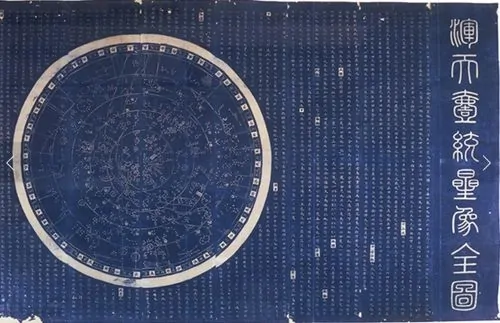
A Han solar eclipse notice was the surviving endpoint of a long process rather than an unmediated description of the sky. An observer first had to recognize the obscuration, determine its timing, and report what could be seen from a particular location. Scribes translated that experience into calendrical language by assigning it a regnal year, lunar month, numbered or sexagenary day, and sometimes an indication of magnitude, direction, or duration. Officials then decided whether the report belonged in a court diary, calendrical dossier, memorial, omen collection, or annalistic record. Later historians selected from these materials, abbreviated some notices, combined others with interpretations, and arranged them within narratives written after the political consequences of the eclipse were already known. What modern historians treat as astronomical data reached them through successive acts of observation, administration, preservation, and historiographical judgment.
The Book of Han did not preserve these materials in a single transparent list. Eclipse notices appear in imperial annals, chronological tables, calendrical discussions, biographies, and the “Treatise on the Five Phases,” where celestial events were grouped according to categories of disorder rather than simply by date. Their placement beside political crises encouraged readers to interpret temporal proximity as moral connection. For the Eastern Han, the transmission is still more layered because the astronomical and omen treatises attached to the received Book of Later Han derive principally from Sima Biao’s third-century continuation rather than from the original structure of Fan Ye’s fifth-century history.
Modern astronomical calculation nevertheless provides an unusually powerful means of testing this inherited record. The motions of the Sun and Moon can be computed backward with sufficient accuracy to determine whether an eclipse was astronomically possible on a recorded date, although uncertainty in the changing speed of Earth’s rotation complicates the reconstruction of exact ancient paths of totality. Han dates are useful because a notice may preserve not only the reign and month but also a day within the sixty-day sexagenary cycle. These overlapping chronological elements allow historians to detect impossible combinations, suspected copying errors, and dates displaced by a month or year. Most securely dated Han solar eclipse notices correspond to eclipses that modern calculation shows could have been visible somewhere within the empire, and many fit the capital region particularly well. The general agreement is too strong to explain as the product of random invention or the retrospective insertion of politically convenient darkness. Several records describe eclipses of such limited magnitude that they would probably have escaped casual notice, suggesting organized watching at times when specialists knew an eclipse was possible. Reports from outside the capital further correspond in some cases to differences in visibility predicted by modern reconstruction. Apparent contradictions between capital and provincial accounts may preserve geographical variation rather than administrative confusion. The record’s astronomical accuracy confirms that Han officials usually began with actual phenomena even when later historians placed those phenomena within heavily moralized narratives.
That conclusion does not require every notice to be exact. A scribal copyist could confuse similar characters, transpose a sexagenary designation, omit a month marker, or preserve an eclipse under the wrong regnal year. Calendar conversion creates additional problems because a reconstructed astronomical date must be matched to changing Chinese month arrangements and occasionally disputed intercalations. Clouds might conceal the beginning or end of an eclipse, while descriptions such as “nearly complete” or “like a hook” depended upon local conditions and observers without standardized instruments for measuring magnitude. Some notices may also combine a genuine observation with details supplied or reformulated during later calendrical analysis.
Absence from the histories is even more difficult to interpret than an inaccurate entry. Many solar eclipses calculated for the Han period were invisible from Chang’an or Luoyang, occurred near sunrise or sunset, crossed sparsely governed territory, or were too slight to attract attention. Others may have been hidden by weather, observed locally but never transmitted, recorded in documents that perished, or discarded by compilers who considered them unimportant. The survival of a notice could depend upon whether the eclipse prompted an edict, became attached to a famous remonstrance, coincided with a succession crisis, or was later believed to foreshadow a political disaster. Historians working under subsequent dynasties also possessed knowledge unavailable to the original observers, including the eventual fall of ministers, consort clans, emperors, and the Han itself. They could select an eclipse already preserved in the archive and position it within a narrative whose outcome made the warning appear prophetic. Their arrangement did not necessarily falsify the date or invent the obscuration, but it shaped the causal pattern readers were expected to perceive. A technically accurate record can remain historiographically selective. Modern eclipse catalogues reveal which recorded events were physically possible; they cannot recover every lost observation or demonstrate that an unrecorded eclipse carried no contemporary significance.
The Han eclipse record is most reliable when used to establish that an obscuration occurred and most uncertain when asked to prove that Heaven endorsed the political lesson attached to it. Astronomical verification distinguishes observed phenomena from textual corruption, but it cannot verify claims that an eclipse condemned a minister, exposed an emperor’s moral failure, or foretold a dynasty’s decline. But the political shaping of the histories does not render their observations worthless. The very credibility of the portent depended upon anchoring interpretation to an event that officials and subjects could have witnessed. Dynastic historians turned darkness into data by preserving dates, locations, and descriptions, but they also turned data back into history by arranging celestial events within narratives of responsibility and decline. The resulting record is neither a neutral observatory log nor a collection of fabricated omens: it is an archive in which accurate celestial watching and retrospective political judgment remain inseparably joined.
Did Eclipses Really Restrain the Emperor?
The following video from “Simply China” discusses mapping the stars and planets in ancient China:
The strongest challenge to the argument that eclipses limited Han rulers is that celestial admonition possessed no independent power of enforcement. An eclipse issued no command, identified no indisputable offense, and prescribed no compulsory remedy. No council of astronomers or classical scholars could require the emperor to dismiss a minister, reverse a policy, or relinquish authority. Even when the ruler confessed responsibility, he remained the person who decided what his confession meant. If restraint requires an institution capable of compelling obedience, the darkened Sun restrained the Han emperor very little.
Ritual self-blame could even strengthen imperial authority by allowing the throne to manage criticism before criticism became politically uncontrollable. The emperor ordinarily initiated the inquiry, determined which officials would respond, and chose whether their memorials deserved action. He could acknowledge a generalized deficiency in virtue while declining to admit the particular failure alleged by his advisers. Emperor Guangwu’s withdrawal from the audience hall after the eclipse of 31 CE dramatized humility, but the suspension of ordinary government was temporary and entirely under imperial control. Emperor Wen’s response in 178 BCE included meaningful measures of retrenchment and openness to remonstrance, yet those reforms remained benevolent acts of the sovereign rather than concessions extracted by an autonomous political body. Amnesties, reductions in expenditure, searches for worthy officials, and proclamations against flattery could all advertise renewed virtue while leaving the distribution of power essentially unchanged. The ritual response also offered a recognizable path back to normality: the ruler acknowledged the warning, ordered correction, and then resumed government with his legitimacy ceremonially repaired. A well-performed confession could absorb the eclipse into a narrative of imperial responsiveness. The emperor demonstrated that he remained Heaven’s chosen intermediary precisely by showing that he knew how a chastened Son of Heaven should behave.
The flexibility of omen interpretation made its coercive weakness still clearer. Because the same eclipse could be attributed to imperial misconduct, an overmighty minister, a consort clan, obstructed advisers, excessive punishment, or factional slander, no interpretation defeated its rivals through cosmological reasoning alone. Under Emperor Cheng, celestial abnormalities were first used to help Wang Feng remove Chancellor Wang Shang and later invoked against Wang Feng himself, only for the emperor’s assumption of blame to protect his powerful uncle. The outcome depended less upon what Heaven had unmistakably said than upon which interpretation possessed sufficient political support to prevail.
The careers of Han remonstrants likewise reveal that speaking for Heaven offered neither institutional independence nor personal security. Liu Xiang could assemble classical precedents and celestial correlations into a sweeping indictment of corrupt government, but his learning did not prevent imprisonment or ensure that Emperor Yuan would accept his conclusions. Xiao Wangzhi died amid the struggle against palace secretaries whom his allies had represented as sources of disorder, while Zhou Kan and others were dismissed when their enemies successfully redirected ominous signs against them. Ding Hong’s eclipse memorial against Dou Xian in 92 CE proved effective, but its success depended upon Emperor He’s existing desire to escape the Dou clan’s domination and upon a palace alliance capable of acting against it. The eclipse supplied language and urgency; it did not create the political coalition. Most interpreters depended upon offices, audiences, archives, and channels of memorial submission controlled by the state they sought to criticize. Astronomical officials could verify that an obscuration had occurred without possessing the authority to determine its political meaning, while classical scholars could propose correlations without compelling the throne to adopt them. There was no agreed procedure by which one explanation could be tested against another, and subsequent events could always be recruited to vindicate whichever interpretation survived. Dynastic historians further strengthened the apparent force of successful remonstrance by preserving warnings beside the disasters they seemed to anticipate, whereas ignored, inconclusive, or politically inconvenient readings were more easily lost. Repeated eclipses and other portents did not prevent the later Han court from suffering renewed domination by consort families and eunuchs, the persecution of partisan officials, rural rebellion, military fragmentation, and eventual dynastic collapse. If celestial warnings had exercised an autonomous restraint, their political effect should have been more consistent and less dependent upon the emperor’s interests. Viewed from this perspective, omen discourse often reproduced the existing balance of power instead of overcoming it.
Yet this counterpoint modifies rather than destroys the larger argument. Political restraint need not resemble a court judgment or a legally enforceable command to influence how authority is exercised. Han cosmology imposed an expectation that the emperor acknowledge disturbing celestial events, invite remonstrance, and present corrective action as a duty owed to Heaven and the people. An eclipse could synchronize criticism across the bureaucracy, lend moral legitimacy to otherwise dangerous accusations, and increase the reputational cost of ignoring visible disorder. Some rulers did alter policies, elevate critics, dismiss powerful figures, reduce burdens, or reconsider administrative failures in response to the pressure surrounding celestial signs. Eclipses did not restrain the emperor as an independent institution standing above the throne; they constrained the language of legitimate rulership and created recurring occasions upon which imperial conduct could be publicly judged. The darkened Sun could not force the emperor to obey, but it made it harder for him to claim that he owed an account to no one.
Conclusion: The Throne Beneath a Recorded Sky
The Han did not invent the belief that a darkened Sun revealed disorder in human government, but it gave that belief an exceptionally durable imperial form. Drawing upon earlier ritual traditions, classical chronicles, correlative cosmology, and the administrative demands of a unified empire, Han rulers made celestial observation part of the machinery of the state. Under this system, an eclipse could be at once a physical event, a calendrical problem, a ritual emergency, a moral warning, and a political opportunity. What changed across the dynasty was not a simple passage from superstition to science, but the increasing precision with which recurring celestial motions were observed, calculated, recorded, and interpreted. The throne stood beneath a sky that had become more predictable without becoming politically silent.
This system depended upon the conversion of fleeting darkness into durable information. Watchers observed the heavens from particular places, calendrical experts compared what they saw with inherited numerical systems, and scribes fixed the event within regnal and sexagenary time. Mathematical advances gradually improved the calculation of lunar motion and the identification of conditions under which eclipses might occur. Calendar reforms demonstrated that prediction had become an important measure of imperial competence, while failed forecasts exposed discrepancies between official knowledge and the observable sky. Yet technical understanding did not dissolve the moral significance of an eclipse because Han thinkers did not treat physical recurrence and political meaning as mutually exclusive explanations. A predicted obscuration could still demand ritual action, self-examination, and administrative correction. Once the eclipse entered the court record, it became available to emperors seeking to demonstrate humility, ministers attempting to redirect policy, factions struggling to discredit one another, and historians constructing narratives of dynastic success or failure. The ruler might withdraw from the audience hall, solicit criticism, reduce burdens, proclaim an amnesty, dismiss an official, or shield a favorite by assuming blame himself. Ministers could interpret the same darkness as evidence of excessive punishment, corrupt appointments, consort domination, eunuch influence, obstructed remonstrance, or the emperor’s deficient virtue. The political power of an eclipse lay not in an unambiguous message from Heaven but in the obligation it created to explain why the imperial Sun had been obscured.
No celestial procedure could compel the emperor to accept a particular explanation or remedy. Ritual contrition might become carefully managed theater, while factional power could determine whether an interpretation produced reform, dismissal, imprisonment, or death. Eclipse discourse never constituted an independent constitutional limit upon the throne. Its restraint was moral, rhetorical, and reputational rather than legally enforceable.
That limitation does not make the system politically meaningless. Eclipses created recurring moments in which the claims of universal monarchy collided with visible evidence that the cosmic order was not entirely at rest. They gave remonstrants a language through which criticism of taxation, punishment, appointments, warfare, or palace influence could be presented as loyal defense of the dynasty rather than private opposition to the ruler. They also required the emperor to perform an ideal of sovereignty in which authority remained answerable to Heaven, history, and the welfare of the people. The dynastic histories preserved this ideal selectively, arranging authentic celestial observations within retrospective narratives that made some warnings appear prophetic and allowed others to disappear. Their records are consequently neither neutral astronomical catalogues nor collections of invented political omens, but archives in which careful observation and moral judgment continually shaped one another. Beneath that recorded sky, the Han emperor remained immensely powerful, yet he could never plausibly claim that his conduct belonged entirely to himself. When the Sun darkened, the ruler who governed all beneath Heaven was reminded that he, too, remained beneath it.
Bibliography
Affiliate disclosure: Amazon links on this site are paid links. As an Amazon Associate I earn from qualifying purchases.
- Aaboe, Asger. “Remarks on the Theoretical Treatment of Eclipses in Antiquity.” Journal for the History of Astronomy 3:2 (1972), 105–118.
- Allan, Sarah. The Shape of the Turtle: Myth, Art, and Cosmos in Early China. Albany: State University of New York Press, 1991.
- Ban Gu. The History of the Former Han Dynasty. Translated by Homer H. Dubs. 12 vols. Baltimore: Waverly Press, 1938–1955.
- Bielenstein, Hans. The Bureaucracy of Han Times. Cambridge: Cambridge University Press, 1980.
- Cai, Liang. “The Hermeneutics of Omens: The Bankruptcy of Moral Cosmology in Western Han China (206 BCE–8 CE).” Journal of the Royal Asiatic Society 25:3 (2015), 439–459.
- Chapman, Jessey J. C. “The Rhetoric and Ritual of Celestial Signs in Early Imperial China.” PhD diss., University of California, Berkeley, 2015.
- Cook, Constance A., and Paul R. Goldin, eds. A Source Book of Ancient Chinese Bronze Inscriptions. Revised ed. Berkeley: Society for the Study of Early China, 2020.
- Cullen, Christopher, trans. Astronomy and Mathematics in Ancient China: The Zhou Bi Suan Jing. Cambridge: Cambridge University Press, 1996.
- —-. The Foundations of Celestial Reckoning: Three Ancient Chinese Astronomical Systems. New York: Routledge, 2016.
- —-. Heavenly Numbers: Astronomy and Authority in Early Imperial China. Oxford: Oxford University Press, 2017.
- —-. “Motivations for Scientific Change in Ancient China: Emperor Wu and the Grand Inception Astronomical Reforms of 104 B.C.” Journal for the History of Astronomy 24:3 (1993), 185–203.
- —-. “Understanding the Planets in Ancient China: Prediction and Divination in the ‘Wu xing zhan’.” Early Science and Medicine 16:3 (2011), 218-251.
- De Crespigny, Rafe. Portents of Protest in the Later Han Dynasty: The Memorials of Hsiang K’ai to Emperor Huan. Canberra: Australian National University Press, 1976.
- Durrant, Stephen, Wai-yee Li, and David Schaberg, trans. Zuo Tradition/Zuozhuan: Commentary on the “Spring and Autumn Annals.” 3 vols. Seattle: University of Washington Press, 2016.
- Eno, Robert. “Shang State Religion and the Pantheon of the Oracle Texts.” In Early Chinese Religion, Part One: Shang through Han (1250 BC–220 AD), edited by John Lagerwey and Marc Kalinowski, 41–102. Leiden: Brill, 2009.
- Falkenhausen, Lothar von. Chinese Society in the Age of Confucius (1000–250 BC): The Archaeological Evidence. Los Angeles: Cotsen Institute of Archaeology, University of California, Los Angeles, 2006.
- Fan Ye. Hou Han shu [Book of Later Han]. Beijing: Zhonghua Shuju, 1965.
- Han Ying. Han Shih Wai Chuan: Han Ying’s Illustrations of the Didactic Application of the Classic of Songs. Translated by James Robert Hightower. Cambridge, MA: Harvard University Press, 1952.
- Harper, Donald, and Marc Kalinowski, eds. Books of Fate and Popular Culture in Early China: The Daybook Manuscripts of the Warring States, Qin, and Han. Leiden: Brill, 2017.
- Hsu, Cho-yun, and Katheryn M. Linduff. Western Chou Civilization. New Haven, CT: Yale University Press, 1988.
- Hulsewé, A. F. P., trans. Remnants of Ch’in Law: An Annotated Translation of the Ch’in Legal and Administrative Rules of the 3rd Century B.C. Discovered in Yün-meng Prefecture, Hu-pei Province, in 1975. Leiden: Brill, 1985.
- Karlgren, Bernhard, trans. “The Book of Documents.” Bulletin of the Museum of Far Eastern Antiquities 22 (1950), 1–81.
- Kawabata, Kin-aki, Kiyotaka Tanikawa, and Mitsuru Sôma. “A Solar Eclipse Versified in the Shijing.” Publications of the Astronomical Society of Japan 56:5 (2004), 869–877.
- Keightley, David N. The Ancestral Landscape: Time, Space, and Community in Late Shang China, ca. 1200–1045 BCE. Berkeley: Institute of East Asian Studies, University of California, 2000.
- —-. “The Oracle-Bone Inscriptions of the Late Shang Dynasty.” In Sources of Chinese Tradition. Vol. 1, From Earliest Times to 1600. 2nd ed. Edited by Wm. Theodore de Bary and Irene Bloom, 3–23. New York: Columbia University Press, 1999.
- —-. “The Religious Commitment: Shang Theology and the Genesis of Chinese Political Culture.” History of Religions 17:3-4 (1978), 211–225.
- —-. “The Shang: China’s First Historical Dynasty.” In The Cambridge History of Ancient China: From the Origins of Civilization to 221 B.C., edited by Michael Loewe and Edward L. Shaughnessy, 232–291. Cambridge: Cambridge University Press, 1999.
- —-. Sources of Shang History: The Oracle-Bone Inscriptions of Bronze Age China. Berkeley: University of California Press, 1978.
- Kern, Martin. “Religious Anxiety and Political Interest in Western Han Omen Interpretation: The Case of the Han Wudi Period (141–87 B.C.).” Chūgoku Shigaku 10 (2000), 1–31.
- Kern, Martin, and Dirk Meyer, eds. Origins of Chinese Political Philosophy: Studies in the Composition and Thought of the Shangshu. Leiden: Brill, 2017.
- Khayutina, Maria. “The Beginning of Cultural Memory Production in China and the Memory Policy of the Zhou Royal House during the Western Zhou Period.” Early China 44 (2021), 19–108.
- Knoblock, John, trans. Xunzi: A Translation and Study of the Complete Works. 3 vols. Stanford, CA: Stanford University Press, 1988–1994.
- Knoblock, John, and Jeffrey Riegel, trans. The Annals of Lü Buwei: A Complete Translation and Study. Stanford, CA: Stanford University Press, 2000.
- Kory, Stephan N. “Omen Watching, Mantic Observation, Aeromancy, and Learning to ‘See’: The Rise and Messy Multiplicity of Zhanhou in Late Han and Medieval China.” East Asian Science, Technology, and Medicine 50:1 (2019), 67–132.
- Legge, James, trans. The Sacred Books of China: The Texts of Confucianism, Part I: The Shû King, the Religious Portions of the Shih King, and the Hsiâo King. Sacred Books of the East 3. Oxford: Clarendon Press, 1879.
- Li Feng. Bureaucracy and the State in Early China: Governing the Western Zhou. Cambridge: Cambridge University Press, 2008.
- —-. Early China: A Social and Cultural History. Cambridge: Cambridge University Press, 2013.
- Li Ling, and Constance A. Cook. “Translation of the Chu Silk Manuscript.” In Defining Chu: Image and Reality in Ancient China, edited by Constance A. Cook and John S. Major, 171–176. Honolulu: University of Hawai‘i Press, 1999.
- Liu An. The Huainanzi: A Guide to the Theory and Practice of Government in Early Han China. Translated and edited by John S. Major, Sarah A. Queen, Andrew Seth Meyer, and Harold D. Roth. New York: Columbia University Press, 2010.
- Liu, Ciyuan, Xueshun Liu, and Liping Ma. “Examination of Early Chinese Records of Solar Eclipses.” Journal of Astronomical History and Heritage 6:1 (2003), 53–63.
- Loewe, Michael. Crisis and Conflict in Han China, 104 BC to AD 9. London: George Allen and Unwin, 1974.
- —-. Divination, Mythology and Monarchy in Han China. Cambridge: Cambridge University Press, 1994.
- —-. The Government of the Qin and Han Empires: 221 BCE–220 CE. Indianapolis: Hackett Publishing, 2006.
- Mansvelt Beck, B. J. The Treatises of Later Han: Their Author, Sources, Contents and Place in Chinese Historiography. Leiden: Brill, 1990.
- Morgan, Daniel Patrick. Astral Sciences in Early Imperial China: Observation, Sagehood and the Individual. Cambridge: Cambridge University Press, 2017.
- Needham, Joseph. “Astronomy in Ancient and Medieval China.” Philosophical Transactions of the Royal Society of London. Series A, Mathematical and Physical Sciences 276:1257 (1974), 67-82.
- Nienhauser, William H., Jr., ed. The Grand Scribe’s Records. Vol. 2, The Basic Annals of Han China. Bloomington: Indiana University Press, 2002.
- Nylan, Michael. The Five “Confucian” Classics. New Haven, CT: Yale University Press, 2001.
- Pankenier, David W. Astrology and Cosmology in Early China: Conforming Earth to Heaven. Cambridge: Cambridge University Press, 2013.
- —-. “The Cosmo-Political Background of Heaven’s Mandate.” Early China 20 (1995), 121–176.
- —-. “On the Reliability of Han Dynasty Solar Eclipse Records.” Journal of Astronomical History and Heritage 15:3 (2012), 200–212.
- Queen, Sarah A. From Chronicle to Canon: The Hermeneutics of the Spring and Autumn, According to Tung Chung-shu. Cambridge: Cambridge University Press, 1996.
- Raphals, Lisa. Divination and Prediction in Early China and Ancient Greece. Cambridge: Cambridge University Press, 2013.
- Robinson, Rebecca. “Employing Knowledge: A Case Study in Calendar Reforms in the Early Han and Roman Empires.” In Rulers and Ruled in Ancient Greece, Rome, and China, edited by Hans Beck and Griet Vankeerberghen, 369–396. Cambridge: Cambridge University Press, 2021.
- Schaberg, David. A Patterned Past: Form and Thought in Early Chinese Historiography. Cambridge, MA: Harvard University Asia Center, 2001.
- Schwartz, Adam Craig, trans. The Oracle Bone Inscriptions from Huayuanzhuang East: Translated with an Introduction and Commentary. Berlin: De Gruyter Mouton, 2019.
- Shaughnessy, Edward L. Sources of Western Zhou History: Inscribed Bronze Vessels. Berkeley: University of California Press, 1990.
- Shigeru, Nakayama. “The Yabuuti Paradigm in the History of Chinese Science.” East Asian Science, Technology, and Medicine 19 (2002), 61-66.
- Sima Qian. Les mémoires historiques de Se-ma Ts’ien. Translated by Édouard Chavannes. Vol. 3, part 2. Paris: Ernest Leroux, 1899.
- —-. Records of the Grand Historian. Translated by Burton Watson. New York: Columbia University Press, 1993.
- —-. “The Treatise on the Celestial Offices.” Translated by David W. Pankenier. In Astrology and Cosmology in Early China: Conforming Earth to Heaven, 444–511. Cambridge: Cambridge University Press, 2013.
- Sivin, Nathan. “State, Cosmos, and Body in the Last Three Centuries B.C.” Harvard Journal of Asiatic Studies 55:1 (1995), 5–37.
- Smith, Adam. “The Evidence for Scribal Training at Anyang.” In Writing and Literacy in Early China: Studies from the Columbia Early China Seminar, edited by Li Feng and David Prager Branner, 173–205. Seattle: University of Washington Press, 2011.
- Stephenson, F. Richard. Historical Eclipses and Earth’s Rotation. Cambridge: Cambridge University Press, 1997.
- Stephenson, F. Richard, and Kevin K. C. Yau. “Astronomical Records in the Ch’un-Ch’iu Chronicle.” Journal for the History of Astronomy 23:1 (1992), 31–51.
- Stephenson, F. Richard, and M. A. Houlden. Atlas of Historical Eclipse Maps: East Asia 1500 BC–AD 1900. Cambridge: Cambridge University Press, 1986.
- Sun, Xiaochun, and Jacob Kistemaker. The Chinese Sky during the Han: Constellating Stars and Society. Leiden: Brill, 1997.
- Van Auken, Newell Ann. Spring and Autumn Historiography: Form and Hierarchy in Ancient Chinese Annals. New York: Columbia University Press, 2023.
- Waley, Arthur, trans. The Book of Songs: The Ancient Chinese Classic of Poetry. Edited with additional translations by Joseph R. Allen. New York: Grove Press, 1996.
- Wang, Aihe. Cosmology and Political Culture in Early China. Cambridge: Cambridge University Press, 2000.
- Wang, Haicheng. Writing and the Ancient State: Early China in Comparative Perspective. Cambridge: Cambridge University Press, 2014.
- Xu Zhentao. “Solar Observations in Ancient China and Solar Variability.” Philosophical Transactions of the Royal Society of London. Series A, Mathematical and Physical Sciences 330:1615 (1990), 513-515.
- Xu Zhentao, K. K. C. Yau, and F. Richard Stephenson. “Astronomical Records on the Shang Dynasty Oracle Bones.” Archaeoastronomy 14 (1989), S61–S72.
Originally published by Brewminate, 08.11.2026, under the terms of a Creative Commons Attribution-NonCommercial-NoDerivatives 4.0 International license.
About the Author