Forged by the sons of Ivaldi and carried by Odin into Ragnarök, Gungnir embodied war, sacrifice, sovereignty, runic knowledge, the selection of the slain, and the limits of divine power.

By Matthew A. McIntosh
Public Historian
Brewminate
Introduction: The Spear in the Hand of the All-Father
At the final battle of Ragnarök, Odin rides at the head of the gods and the dead, armored in gold and mail and carrying the spear called Gungnir. The image is among the clearest statements of the weapon’s place in Norse mythology. Gungnir is not merely something Odin happens to wield; it is the visible expression of his authority as commander, sovereign, sacrificer, and chooser of the slain. Thor possesses a hammer whose crashing blows defend the ordered world against giants, but Odin carries a weapon of direction and decision. A spear can be raised before an army, hurled over an enemy host, driven into a chosen victim, or carried as the emblem of one who determines when violence begins. In Odin’s hand, Gungnir belongs as much to ritual and rulership as it does to combat.
The surviving medieval literature does not provide Gungnir with a continuous biography comparable to the adventures surrounding Thor’s Mjölnir. Its appearances are scattered across poems, mythographic narratives, and allusions whose meanings depend upon the wider religious identity of its owner. Snorri Sturluson explains that the spear was fashioned by the sons of Ivaldi as part of the chain of events set in motion when Loki cut off Sif’s hair. He also describes its extraordinary virtue: once directed forward, its thrust could not be checked. Elsewhere, Odin opens the first war between the Æsir and Vanir by casting a spear over the opposing host, wounds himself with a spear during his ordeal upon the tree, receives warriors killed in battle, and finally carries Gungnir against Fenrir. The individual texts do not always name the weapon, and they do not authorize every connection later interpreters have made. Nevertheless, these episodes form a coherent symbolic field in which the spear marks persons, armies, and deaths as belonging to Odin.
That symbolic field reflects the peculiar nature of Odinic warfare. Odin is not primarily the divine embodiment of physical strength, nor does he guarantee the safety of the communities that honor him. He grants victory selectively, inspires battle-fury, confuses enemies, breaks the protection surrounding favored kings, and claims exceptional warriors for his hall. His patronage is valuable but perilous. A ruler who receives Odin’s favor may triumph spectacularly, yet the same god may arrange his death when a greater purpose requires it. Gungnir embodies this combination of precision and uncertainty. The spear itself is perfect, but the fortunes governed through it remain unstable. It strikes without hesitation even though Odin’s promises, alliances, and human favorites are rarely secure.
This tension gives Gungnir its deepest mythological significance. The spear concentrates many of Odin’s seemingly contradictory identities into a single object: god of rulers and outlaws, wisdom and frenzy, poetic inspiration and battlefield slaughter, sacred oaths and calculated deception. It is an instrument of command, but also of sacrifice; a weapon carried by the lord of victory, but also the weapon associated with his self-wounding and eventual defeat. Even at Ragnarök, when Odin confronts the enemy he has spent ages preparing to meet, Gungnir cannot deliver him from the fate he already knows. The unerring spear reveals the limits rather than the infinitude of divine power. It represents the capacity to choose, command, consecrate, and resist within a cosmos whose final course cannot be permanently diverted. To understand Gungnir is to approach one of the central paradoxes of Norse mythology: knowledge does not abolish doom, excellence does not ensure survival, and the highest form of courage may lie in advancing with a flawless weapon toward a battle that cannot be won.
The Problem of Reconstructing Gungnir
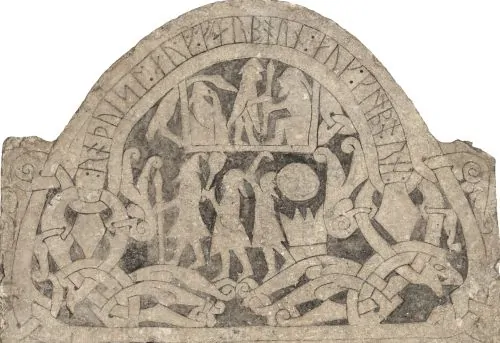
Any attempt to reconstruct Gungnir begins with an imbalance between the spear’s modern fame and its limited presence in the surviving medieval record. Contemporary summaries often present the weapon as though it possessed a settled biography, a precise inventory of magical powers, and a clearly defined role in every major episode involving Odin. The Old Norse sources offer something much less complete. They name Gungnir, identify its owner and makers, describe one of its exceptional properties, and place it in Odin’s hand at the final battle, but they do not preserve an extended sequence of adventures centered upon the spear. Much of its wider significance must be inferred from actions involving Odin, spears, sacrifice, and warfare even when Gungnir itself is not explicitly named. The resulting interpretation can be historically responsible only if it preserves the distinction between what a text states, what the broader tradition makes plausible, and what modern imagination has supplied.
The poems conventionally gathered under the title Poetic Edda provide some of the most important evidence for pre-Christian Norse mythology, but they do not constitute a single sacred book or systematic account of pagan belief. Most survive in manuscripts produced after Iceland’s conversion to Christianity, above all the thirteenth-century Codex Regius, although individual poems or portions of poems may preserve considerably older traditions. Their dates, places of composition, authorship, and histories of oral transmission remain subjects of debate. They also differ from one another in language, theology, narrative assumptions, and purpose. Völuspá, for example, recalls Odin’s casting of a spear over the host during the war between the Æsir and Vanir, while Hávamál presents Odin hanging upon the tree, wounded with a spear and offered to himself. Neither passage explicitly identifies the weapon as Gungnir. The association is compelling because the spear is Odin’s characteristic weapon and because later sources name his spear, but compelling is not the same as certain. To write that Odin unquestionably used Gungnir in each episode would erase a silence preserved by the poems themselves. A cautious interpretation may place these scenes within the symbolic history of Gungnir while acknowledging that the weapon’s name has been supplied retrospectively.
Snorri Sturluson’s Edda provides the most explicit narrative information. Composed in thirteenth-century Christian Iceland, the work was designed in large part to teach the traditional language, mythology, and metrical forms required for understanding and composing skaldic poetry. Snorri explains that Gungnir was made by the sons of Ivaldi after Loki’s mutilation of Sif set in motion the production of several divine treasures. He assigns the spear to Odin, describes its exceptional effectiveness, and later places it in the god’s hand when the forces of the gods advance at Ragnarök. Without Snorri, the surviving image of Gungnir would be substantially thinner. Yet Snorri was not recording a single intact pagan catechism. He organized inherited poems, poetic expressions, learned speculation, oral narratives, and perhaps his own deductions into an intelligible mythological structure for an audience that no longer practiced the religion from which those traditions emerged. His account is indispensable precisely because it is interpretive, but that same interpretive character requires scrutiny.
It would be equally misleading to treat Snorri’s Christian identity as sufficient reason to dismiss him. Much of what he reports can be compared with eddic and skaldic material independent of his prose narratives, and his knowledge of traditional poetic diction was extensive. The problem is not that a Christian author necessarily fabricated pagan mythology, but that every act of preservation also involves selection, arrangement, and explanation. Snorri sometimes links fragments into coherent stories, identifies figures left unnamed in poems, resolves apparent contradictions, or presents variant traditions as parts of a unified cosmology. Such work may preserve genuine inherited knowledge, but it can also conceal the diversity that existed before his synthesis. The orderly biography of a divine object may consequently reflect both pre-Christian tradition and the literary needs of a medieval mythographer.
Skaldic poetry offers a different kind of testimony. Some verses attributed to poets of the Viking Age may stand closer chronologically to active pre-Christian religion than the surviving manuscripts of either Edda. Their mythological kennings and compressed allusions indicate that poets and audiences shared a substantial body of stories that did not need to be narrated in full. This proximity does not make skaldic verse simple evidence. The poetry is extraordinarily dense, frequently survives embedded in prose works copied centuries after the events it supposedly commemorates, and can depend upon disputed attributions or difficult manuscript readings. Its value often lies less in providing complete narratives than in demonstrating that particular divine names, objects, relationships, and mythic episodes were already available to poets. In the case of Gungnir, skaldic diction can help establish the larger cultural association among Odin, spears, rulers, battle, and the slain, but it cannot by itself supply the missing life story of the weapon. The sagas, royal histories, legendary narratives, and antiquarian accounts widen the field still further. They contain stories of warriors dedicating enemies to Odin, rulers receiving or losing divine favor, victims being marked with spears, and battles beginning through ritualized acts of casting. These traditions are essential for understanding how medieval Scandinavians remembered the relationship between Odin and the spear. They are not direct transcripts of Viking Age ceremonies. A saga may combine inherited oral motifs, literary conventions, Christian judgments about paganism, local memory, political argument, and the narrative expectations of audiences living generations after conversion. The same caution applies to outside observers who described Scandinavian religion through Latin Christian categories. Such texts may preserve genuine practices, distort unfamiliar ones, or transform old ritual memories into dramatic signs of a superseded pagan age. They should illuminate Gungnir’s symbolic environment without being forced into the role of eyewitness documentation.
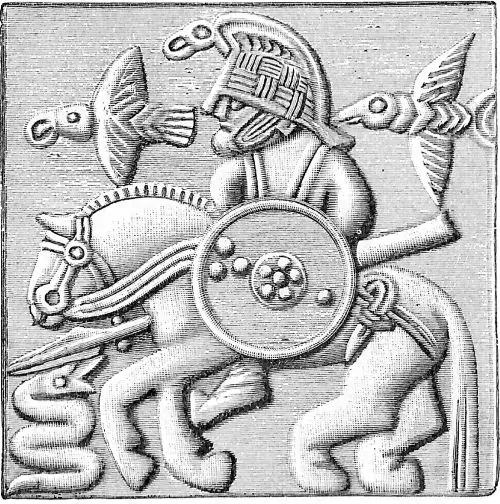
Material evidence promises an escape from the filters of medieval literature, but it introduces interpretive problems of its own. Archaeologists have recovered innumerable spearheads, weapons placed in graves, deliberately damaged arms, martial deposits in wetlands, runic inscriptions, and images of spear-bearing figures. Some representations accompanied by ravens, horses, distinctive headgear, or other attributes may plausibly depict Odin. Even so, a spear-bearing figure is not automatically Odin, and a spear associated with an Odinic figure cannot automatically be named Gungnir. Objects rarely identify themselves in the language provided by later texts. The danger of circular reasoning is considerable: an image is declared to represent Odin because it carries a spear, and the spear is then declared to be Gungnir because the figure has already been identified as Odin. Archaeology can confirm that spears possessed military, funerary, ritual, and representational importance across long periods of northern European history. It can also demonstrate that the cultural roots of the spear-bearing divine figure may be older than the manuscripts. It cannot reliably fill every narrative silence left by the literature.
The reconstruction of Gungnir must remain layered rather than seamless. At the most secure level stand the explicit statements of the sources: Gungnir is Odin’s spear, it was made by the sons of Ivaldi, it possesses an unsurpassed martial quality, and Odin carries it at Ragnarök. At a second level are associations strongly supported by Odin’s wider mythology, including spear-casting over armies, the consecration of battlefield victims, spear-wounding in sacrifice, and the god’s own ordeal upon the tree. A third level contains interpretations that are symbolically persuasive but textually less certain, such as a detailed connection between Gungnir and runic inscription or the claim that every spear used by Odin in every surviving narrative must be the named weapon. Beyond these stand plainly modern additions, including the frequently repeated assertion that Gungnir always returns to Odin’s hand after being thrown. Recognizing these levels does not diminish the spear. It reveals why Gungnir is historically significant despite the scarcity of stories devoted exclusively to it. The weapon’s importance lies not in the quantity of its appearances but in the density of meanings gathered around the hand that holds it. The silences surrounding Gungnir are not empty spaces to be filled indiscriminately; they are part of the evidence from which its mythology must be reconstructed.
The Name Gungnir
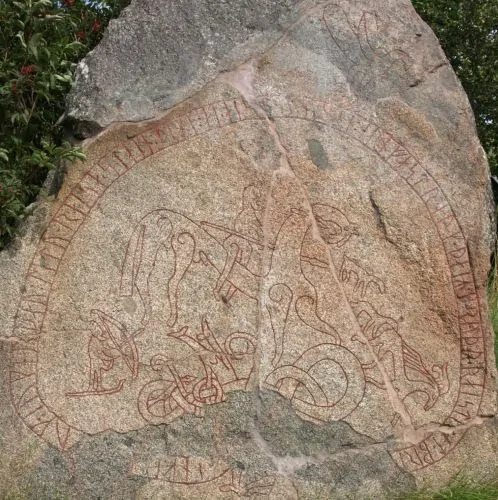
The name Gungnir has often been translated as “the swaying one,” “the shaking one,” or “the trembling one.” These renderings reflect its likely relationship to Old Norse words associated with swinging, vibrating, or unsteady movement, but none should be treated as a definitive title supplied by the medieval sources themselves. No surviving myth pauses to explain the name, and Snorri Sturluson offers no etymological gloss when recounting the spear’s manufacture. Modern scholars must work backward from related vocabulary, poetic usage, and the physical behavior of spears. The probable sense is clear enough to suggest movement, but not precise enough to establish whether the name originally referred to the weapon’s motion in flight, the vibration of its shaft, the shaking it produced in those who faced it, or some combination of these associations.
The simplest interpretation connects Gungnir with the movement of a spear immediately before and after release. A long wooden shaft may flex when thrown, quiver when held upright, or tremble after striking wood, earth, shield, or flesh. Such movement would have been familiar to audiences for whom the spear was an ordinary weapon rather than an exotic relic of a remote heroic age. The name may consequently preserve something concrete and visually immediate: the divine spear is the one that sways in Odin’s grasp, vibrates with gathered force, and passes from stillness into deadly motion. Its supernatural quality does not require it to cease behaving like a spear. Instead, the mythology magnifies the familiar properties of the weapon until physical movement becomes a sign of divine intention.
That emphasis upon motion is particularly appropriate because the spear’s religious meaning emerges most fully when it is cast. A sword normally remains joined to the hand that wields it, while a thrown spear crosses the open space between opposing bodies. It leaves the control of its bearer, travels above or through a boundary, and claims a destination at a distance. When Odin casts a spear over the Vanir host in Völuspá, the action does more than begin an exchange of weapons. It projects his authority across the space separating the armies and places the enemy beneath his claim. Whether the poem’s spear was already understood by its audience as Gungnir cannot be proven, but the gesture accords closely with the implications of the weapon’s name. Gungnir is not merely possessed by Odin; it extends Odin’s will outward, carrying consecration, hostility, and judgment from the god toward those whom he has selected. Shaking also belongs to the emotional and psychological world of Odinic warfare. Odin is associated with frenzy, terror, inspiration, confusion, and the collapse of ordinary mental boundaries. His influence can embolden one army while paralyzing another, transforming disciplined warriors into raging fighters or leaving opponents unable to defend themselves. Read within this wider mythology, Gungnir’s possible trembling is more than the vibration of wood and iron. It may evoke the shaking of bodies before violence, the instability of battle lines, and the sudden movement from ordered expectation into uncontrollable slaughter. The spear’s motion reflects the condition Odin creates: a world in which certainty disappears for human combatants even as the god’s own purpose remains precisely directed.
The name captures a productive tension between movement and inevitability. Gungnir sways, shakes, or trembles, yet its thrust cannot be checked. Its surface motion suggests instability, but its course expresses certainty. This combination mirrors Odin himself, a god of wandering, disguise, altered states, and strategic unpredictability whose actions nevertheless pursue long designs extending toward Ragnarök. Gungnir is the ideal weapon for such a deity because it turns apparent instability into directed force. The spear moves because power is being transferred; it trembles because an irreversible action is about to occur. Its name does not present it as a passive possession or static badge of rank. It identifies the weapon at the moment when divine intention becomes motion and motion becomes fate.
Before Gungnir: The Spear in the Germanic World
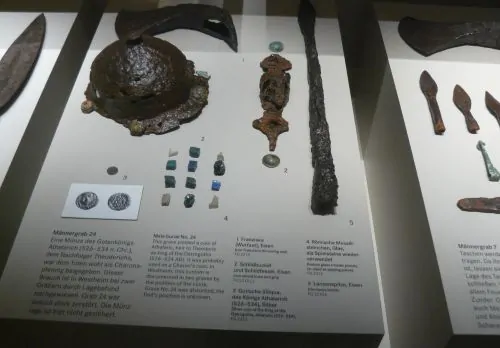
Long before medieval authors named Gungnir as Odin’s weapon, the spear occupied a central place in the material and imaginative world of northern European warfare. Spears appear throughout the archaeological record of the Bronze and Iron Ages, across regions inhabited by peoples whom Roman and later writers grouped under broad Germanic labels. They were carried in raids, battles, hunts, processions, and funerary ceremonies; deposited in graves and wetlands; represented in images; and remembered in poetry as extensions of the warrior’s reach. The spear’s prominence did not arise from mythology alone. Its practical usefulness made it one of the most familiar weapons through which ideas about courage, violence, authority, and supernatural favor could be expressed.
A spear combined a comparatively small iron head with a shaft that could be produced from locally available wood. This did not make every spear cheap or socially insignificant. Spearheads varied considerably in length, shape, workmanship, decoration, and intended use, while the quality of the shaft, balance, socket, and binding could determine whether a weapon survived the strain of combat. Even so, the production of a functional spear generally required less metal than the making of a sword, placing it within reach of a wider range of fighters. Tacitus, writing near the end of the first century CE, claimed that the Germanic peoples possessed relatively few swords or long lances and commonly used a weapon he called the framea, fitted with a narrow iron head and suitable for fighting either at close quarters or at a distance. His terminology cannot be matched perfectly with later Scandinavian weapon classifications, and his portrait of Germanic society served Roman literary purposes as well as ethnographic ones. Nevertheless, the account captures the versatility that made the spear so enduring: it could be thrust from behind a shield, thrown before bodies met, used on foot or horseback, and adapted to different formations and circumstances.
The distinction between spear and sword was partly a distinction between battlefield functions. A sword was designed principally for close combat and remained in the warrior’s hand, while a spear could control space before an enemy came within striking distance. Its extended shaft allowed a fighter to threaten an opponent beyond the reach of a shorter weapon. When thrown, it crossed the space between opposing lines and carried its owner’s violence into the enemy formation before direct contact began.
Because spears were widespread, they did not possess only one social meaning. Some belonged to ordinary fighters; others were finely made objects associated with wealthy graves, mounted warriors, retainers, or military leaders. Archaeologists must consequently avoid assuming that every weapon burial belonged to a person who had fought in war or that every spearhead represented the same rank and identity. Burial goods could communicate family claims, gendered ideals, inherited status, ritual roles, or the image that mourners wished to create for the dead. A spear placed beside a body might identify the deceased as a warrior, but it could also incorporate that person into an ancestral or heroic tradition regardless of his actual experience. The weapon was simultaneously equipment and statement. Its inclusion transformed the grave into a public representation of power, obligation, and membership within a community that valued the capacity for organized violence.
Spears also entered ritual contexts in which their military usefulness alone cannot explain their treatment. Large weapon deposits recovered from Scandinavian wetlands include spearheads, shields, swords, personal equipment, and other objects that were sometimes bent, broken, burned, or dismantled before deposition. Many such assemblages have been interpreted as captured military equipment offered after victory, although the precise events and beliefs behind individual deposits remain uncertain. Deliberate destruction removed weapons from ordinary circulation and altered their social condition. A spear that had threatened living bodies, belonged to an enemy, or participated in a victorious campaign could be transferred from the battlefield into a sacred landscape. Its deposition made the memory of violence material while surrendering the instrument of that violence to powers beyond the human community.
The spear was suited to becoming the attribute of a god who governed both war and its consequences. Its familiarity allowed worshippers and storytellers to recognize what it did, while its flexibility supported several layers of religious meaning. A spear could be carried as a sign of command, raised above a gathering, hurled to open battle, used to select an individual victim, or deposited as the enduring remainder of a victory. Unlike the sword, which emphasized the immediate contest between adjacent fighters, the spear could express authority exercised from a distance. The person who cast it determined a target before the weapon reached its destination; the commander who raised it might direct violence without entering the first collision of bodies. These qualities made the spear a natural emblem for Odin, whose power lay not simply in fighting but in initiating conflicts, distributing victory, consecrating the slain, and claiming the dead. Gungnir did not impose an alien mythology upon an ordinary tool. It perfected a weapon already saturated with the social and ritual meanings of the Germanic world.
Odin Before the Spear: A God of War Unlike Thor
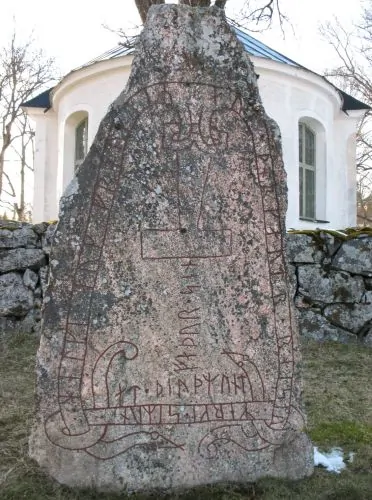
Odin’s possession of Gungnir becomes intelligible only when the character of his warfare is separated from the more visible violence associated with Thor. Both gods confront enemies, receive martial devotion, and appear in stories shaped by conflict, but they represent different kinds of power. Thor meets danger with bodily strength, direct assault, and the crushing force of Mjölnir. Odin more often governs the conditions under which violence occurs. He chooses leaders, inspires warriors, opens battles, confuses opponents, claims the dead, and determines when victory will be granted or withdrawn. Gungnir belongs to him because a spear can initiate, direct, and consecrate violence from a distance. It is the weapon of the commander and sacrificer rather than merely that of the strongest fighter.
Thor’s mythology repeatedly places him at the boundary between the inhabited world and the forces threatening it. He travels eastward to kill giants, protects the gods from monstrous intrusion, recovers his stolen hammer, and responds to danger through physical confrontation. Even when his actions are comic, excessive, or destructive, their basic purpose is usually comprehensible: an enemy has crossed a boundary and must be driven back. Mjölnir expresses this function through impact. It breaks skulls, shatters obstacles, returns to Thor’s hand, and restores a threatened order by force. The hammer also possesses consecrating and protective associations that extend beyond battle, linking Thor to marriage, fertility, burial, and the safeguarding of communities. His violence is not simply aggression. It is the repeated defense of a world that must be protected against powers of dissolution.
Odin’s relationship to order is much less reassuring. He may defend the gods and cultivate the warriors needed for Ragnarök, but he also creates instability, encourages conflict, breaks sworn arrangements, and abandons those who have relied upon him. His purposes are long-range, concealed, and frequently incomprehensible to human beings. The difference appears clearly in the kinds of warriors associated with each god. Thor is often imagined as the champion of gods and humans against giants, while Odin is linked more closely with kings, war bands, poets, berserkers, slain heroes, and men whose social position depends upon exceptional risk. He grants what Old Norse poetry presents as battle-fury, inspiration, eloquence, magical knowledge, and the capacity to dominate others through terror or deception. The very name Óðinn is related to óðr, a difficult term encompassing fury, ecstasy, inspiration, and heightened mental force. Odinic power disrupts ordinary consciousness. A warrior under its influence may become fearless, frenzied, or apparently immune to pain; an enemy may become confused, weakened, or unable to use his weapons effectively. Odin’s war is fought not only through strength but through perception, morale, memory, speech, and the alteration of the mind.
His role as a giver of victory is correspondingly unstable. Odin can raise a king to power, provide tactical insight, inspire a poet to preserve a ruler’s fame, or send Valkyries to determine the outcome of battle. Yet his favor is never a guarantee of safety. In heroic traditions, those closest to Odin may be marked for destruction because the god desires them among the einherjar, the slain warriors gathered in Valhöll for the final struggle. What appears to mortals as divine betrayal may serve Odin’s preparation for Ragnarök. The god’s chosen warrior is both privileged and endangered. To receive Odin’s attention is to enter an economy in which triumph, renown, sacrifice, and death cannot be separated.
This dangerous patronage distinguishes Odin not only from Thor but also from Týr. Týr’s surviving mythology is fragmentary, yet his sacrifice of the hand in the binding of Fenrir associates him with courage, obligation, and the cost of maintaining communal order. Odin, by contrast, repeatedly gains advantage through disguise, manipulation, broken expectations, and unequal exchange. He seeks knowledge from the dead, steals the mead of poetry, masters runes through self-sacrifice, and pursues wisdom even when its acquisition violates ordinary boundaries. His authority does not rest upon consistent moral reliability. It rests upon superior knowledge and the ability to convert knowledge into power. Gungnir is suited to such a god because its unerring movement contrasts with the ambiguity of the hand that directs it. The spear travels straight even when Odin’s path toward his purpose does not. The literary contrast between Odin and Thor also reflects different relationships with human society. Thor appears in several eddic poems as a blunt, recognizable protector whose strength can be invoked against immediate threats. Odin appears as wanderer, riddler, guest, seducer, necromancer, kingmaker, and instigator of conflict. In Hárbarðsljóð, the two gods exchange insults that expose this division. Thor boasts of killing giants and defending the world, while the disguised Odin boasts of stirring warfare, seducing women, acquiring knowledge, and influencing rulers. The poem is comic and adversarial, but its opposition is revealing. Thor measures achievement through enemies struck down; Odin measures it through the number of human destinies he has redirected.
Gungnir does not merely identify Odin as another armed deity. It clarifies what kind of war god he is. The spear can be held as a sign of command, thrown over an army to mark its victims, or used to wound a body offered in sacrifice. Its reach exceeds the immediate collision of combatants, just as Odin’s influence exceeds the battlefield itself. He governs the decision to fight, the fear preceding battle, the fury within it, the selection of those who fall, and the memory that survives afterward. Thor defeats the enemy standing before him. Odin determines who will stand, who will fall, and what purpose the fall will serve. Before Gungnir can be understood as a perfect weapon, it must be understood as the attribute of a god whose power lies in making violence meaningful.
The Chain of Events That Produced Gungnir
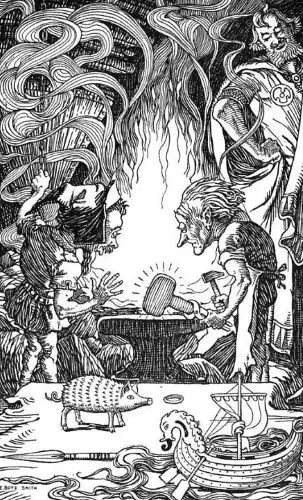
Gungnir enters the surviving mythology through an act that initially has nothing to do with Odin or warfare. In Skáldskaparmál, Snorri Sturluson recounts that Loki secretly cuts off all of Sif’s hair. The motive is not explained, and the mutilation appears as one of the abrupt, destructive impulses characteristic of Loki’s role in myth. Thor responds with immediate threats, seizing Loki and promising to break every bone in his body unless the damage is repaired. Faced with punishment, Loki swears that he will obtain new hair for Sif, fashioned from gold but capable of growing like living hair. The story begins with violation and coercion. A goddess’s body is altered without consent, Thor’s protective violence is awakened, and Loki is forced to transform injury into compensation.
Loki travels to the beings Snorri calls the sons of Ivaldi, supernatural craftsmen whose personal identities remain obscure even though their creations become central possessions of the gods. They make the golden hair for Sif, but they do not stop there. They also fashion Skíðblaðnir, the marvelous ship later given to Freyr, and Gungnir, the spear presented to Odin. Snorri does not explain why the repair of Sif’s hair expands into the manufacture of a ship and a weapon, nor why Loki is able to acquire all three objects. The narrative assumes a world in which compensation can exceed the original loss and in which access to extraordinary craftsmanship may produce a surplus of divine power. What begins as the restoration of one violated body becomes an enlargement of the gods’ collective resources. This unexplained expansion is crucial. Gungnir is not forged because Odin commissions a weapon or proves himself worthy of one. It arises indirectly from Loki’s misconduct.
The episode consequently presents disorder as a productive force. Loki’s act is malicious and humiliating, yet without it the gods would not receive several of their greatest treasures. This does not make the offense beneficial in any simple moral sense. Rather, the myth shows that divine order repeatedly depends upon the management of disruption rather than its permanent elimination. Loki creates crises, but he also carries messages, negotiates with hostile beings, acquires impossible objects, and opens routes into worlds inaccessible to the other gods. His usefulness cannot be separated from his danger. Gungnir embodies this pattern from the moment of its creation: the perfect instrument of Odinic authority is produced through a chain of events initiated by deception, bodily violation, fear, and compelled restitution. The first set of treasures also forms a revealing group. Sif’s golden hair restores beauty and perhaps evokes fertility and ripening grain; Skíðblaðnir grants movement, capacity, and perfect navigation; Gungnir provides irresistible martial force. Together, the objects touch upon regeneration, mobility, and sovereignty. They do not merely replace what Loki damaged. They redistribute powers among major divine figures. Thor regains Sif’s hair through the restoration of his household, Freyr receives a ship that suits his associations with prosperity and sacral rulership, and Odin receives the weapon that will become one of his most recognizable attributes. The craftsmen do more than create marvelous objects. They materially define the gods who possess them.
Loki’s involvement then extends the episode into a second contest. After obtaining the three works of the sons of Ivaldi, he approaches the brothers Brokkr and Eitri and wagers his own head that they cannot produce objects equal to the first set. While Eitri works the forge, Brokkr operates the bellows and is repeatedly bitten by a fly, generally understood within Snorri’s narrative to be Loki in disguise. Despite the sabotage, the brothers create Gullinbursti for Freyr, Draupnir for Odin, and Mjölnir for Thor. Only the hammer shows a flaw: its handle is shorter than intended because Brokkr briefly stops working the bellows when the fly attacks his eyelid. Even this damaged object is judged the finest of all the treasures because it offers the gods their strongest defense against the giants. Loki loses the wager but avoids decapitation by arguing that Brokkr may take his head but has no right to his neck. The craftsmen respond by sewing his lips together, temporarily punishing the speaker whose words have driven the entire sequence.
Gungnir belongs to a mythology of gifts, rivalry, and dangerous exchange. The gods do not create their own greatest instruments of power; they acquire them from beings whose technical knowledge lies outside the divine community. Odin’s authority is strengthened by the labor of craftsmen he does not rule absolutely, just as Loki’s destructive cunning becomes the means by which the weapon reaches him. The spear’s perfection should not obscure the disorder surrounding its origin. Gungnir is born from a damaged body, a threatened trickster, an unexplained surplus of craftsmanship, and a competition whose final judgment favors communal defense over royal offense. Before the spear can symbolize Odin’s command of war, it already carries a deeper lesson about the Norse divine world: power is rarely self-generated, order is never wholly pure, and the most stable symbols of sovereignty may emerge from chains of accident, rivalry, and deceit.
The Sons of Ivaldi and the Authority of Supernatural Craftsmanship
The sons of Ivaldi occupy remarkably little narrative space considering the importance of what they create. Snorri Sturluson does not introduce them through ancestry, appearance, residence, or individual personality. They enter the story because Loki requires craftsmen capable of repairing the harm done to Sif, and they disappear after producing the golden hair, Skíðblaðnir, and Gungnir. Their identities remain subordinate to their work. This anonymity gives them a distinctive authority: the gods may dominate the mythology as rulers, warriors, and recipients of worship, but the material forms of some of their greatest powers originate beyond the divine community. Odin can master runes, acquire poetic inspiration, and manipulate the fortunes of kings, yet even he does not forge his own perfect spear. Gungnir must be made for him by specialists whose knowledge he receives rather than invents.
The collective designation “sons of Ivaldi” raises questions that the surviving texts do not answer. Ivaldi himself never becomes an active participant in the episode, and Snorri does not name the individual craftsmen or specify their number. They should not be casually identified with Brokkr and Eitri, who produce the competing set of treasures later in the same narrative. The two groups serve parallel functions, but Snorri presents them separately. Efforts to combine them into one family or assign familiar dwarf names to the makers of Gungnir often arise from later systematization rather than explicit medieval testimony.
Dwarfs throughout Old Norse literature are repeatedly associated with extraordinary craftsmanship, especially the production of weapons, jewelry, ships, fetters, and other objects possessing qualities unavailable through ordinary human labor. Their skill is not merely superior technique. It approaches a form of magic because the finished object exceeds the normal possibilities of its material. Golden hair grows from Sif’s head like living hair; Skíðblaðnir can hold the gods and their equipment yet be folded small enough to carry; Gungnir cannot be checked once it has been directed forward. Elsewhere, dwarfish craftsmen produce Mjölnir, Draupnir, Gullinbursti, the fetter Gleipnir, and treasures whose beauty or destructive capacity alters the balance of power among gods and heroes. The recurring pattern suggests that craftsmanship occupied an ambiguous conceptual position. It transformed matter through guarded knowledge, controlled heat, patience, and specialized skill, making the smith resemble a magician who understood hidden properties that rulers and warriors could exploit but not necessarily reproduce.
The authority of these craftsmen does not depend upon political sovereignty. The sons of Ivaldi do not command armies, sit in judgment among the gods, or claim the honors that their creations make possible. Their power lies in production. They can place capacities into matter and then transfer those capacities to others. Once Gungnir enters Odin’s possession, the spear becomes an emblem of the All-Father, but its perfection continues to testify silently to knowledge that originated elsewhere.
This dependence complicates any simple hierarchy in which the gods possess all meaningful power and lesser beings merely serve them. In the treasure myth, the gods are consumers, judges, and beneficiaries of supernatural labor. They receive completed objects but do not control every stage of their making. Loki must travel outward to obtain them, and the craftsmen’s work is valuable precisely because it cannot be duplicated in Ásgarðr. The relationship is also potentially dangerous. Dwarfs in Old Norse narratives are not consistently docile helpers; they can defend their property, impose conditions, curse treasures, retaliate against coercion, or use their skills in ways harmful to gods and humans. Their knowledge gives them bargaining power even when stronger beings can threaten or deceive them. Supernatural craftsmanship exists within an economy of unequal exchange in which physical strength, social rank, cunning, and technical knowledge belong to different parties. The ruler may possess the finished weapon, but the craftsman determines what kind of weapon it can become.
The three works of the sons of Ivaldi demonstrate the range of this creative authority. Sif’s hair crosses the boundary between artifact and living body, joining manufactured gold to organic growth. Skíðblaðnir overcomes the normal conflict between capacity and portability, becoming enormous when needed and compact when stored. Gungnir perfects directed violence by overcoming resistance to its thrust. Each object resolves an ordinary material limitation. Metal cannot normally grow as hair grows; a ship cannot ordinarily contain an armed company and then be folded into a small space; a spear can usually be blocked, diverted, broken, or made ineffective. The sons of Ivaldi do not simply decorate existing objects or make superior examples of familiar forms. They redefine what those forms are capable of doing.
Gungnir embodies two kinds of authority at once. After its presentation, it represents Odin’s sovereignty over battle, sacrifice, and the selection of the slain. Before that presentation, it represents the authority of craftsmanship over matter. Odin determines where the spear will be directed, but the sons of Ivaldi determine that it will be irresistible when he directs it. Their creation converts technical knowledge into political and religious power, allowing the god to wield as personal authority something he did not personally produce. The myth does not treat this dependence as a humiliation. Instead, it presents divine order as collaborative, competitive, and materially constructed. The greatest powers of the gods are not always innate. Some must be acquired through relationships with beings who remain obscure in narrative but indispensable in function. Gungnir is both Odin’s spear and the enduring proof that even the All-Father’s sovereignty required the knowledge of others.
The Contest of Treasures: Gungnir among the Gifts of the Gods
Gungnir does not emerge from an isolated act of craftsmanship but from a contest in which the gods compare several objects that will become essential to their identities. After the sons of Ivaldi produce Sif’s golden hair, Skíðblaðnir, and Gungnir, Loki challenges the brothers Brokkr and Eitri to create treasures of equal worth. The resulting competition yields Gullinbursti, Draupnir, and Mjölnir. Snorri Sturluson presents the episode with the rhythm of a comic tale (complete with boasting, sabotage, disputed payment, and Loki’s evasive wordplay) but the judgment of the treasures establishes a serious hierarchy of divine powers. Each object extends the capacities of its recipient, and together they provide the gods with forms of mobility, fertility, wealth, defense, and martial authority that they did not previously possess in material form.
Gungnir is presented to Odin as the spear that cannot be stopped in its thrust. Its excellence lies in directed force. The weapon does not merely increase Odin’s strength; it gives physical expression to his ability to impose intention across distance. Skíðblaðnir, by contrast, grants Freyr perfect transportation, while Sif’s hair repairs a bodily violation through a manufactured substance that behaves like living matter. The first set of treasures overcomes three different limitations: resistance, distance, and the boundary between artifact and life.
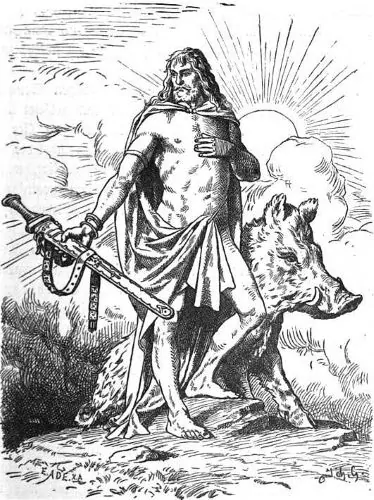
The second set provides a parallel but not identical distribution of power. Gullinbursti gives Freyr speed, radiance, and a magnificent animal appropriate to a god associated with prosperity and sacral rulership. Draupnir gives Odin a ring from which eight rings of equal weight reproduce every ninth night, making abundance itself cyclical and automatic. Mjölnir gives Thor a weapon capable of crushing giants and defending the divine community. The recipients are significant. Freyr receives both Skíðblaðnir and Gullinbursti, objects associated with movement, brilliance, and wealth. Odin receives both Gungnir and Draupnir, joining the authority to direct death with the power to generate treasure and distribute gifts. Thor receives the restored hair of his wife indirectly and the hammer directly, linking his household role with his larger responsibility as defender of the gods. The treasures do not simply reward individual deities; they arrange the divine world according to complementary functions.
When the gods judge the objects, Mjölnir is declared the greatest because it offers the strongest protection against the giants. This verdict places Gungnir within an important limitation. The spear may be flawless as an offensive weapon, but perfect attack is not the same as preservation of the cosmic order. Odin can initiate battle, choose victims, and direct the course of war, yet Thor’s hammer is judged more immediately necessary because the giants represent a continual threat to the boundaries of Ásgarðr and the inhabited world. The contest distinguishes sovereign power from protective power. Gungnir serves the god who calculates, commands, and sacrifices; Mjölnir serves the god who responds when the established order is physically endangered. Snorri’s judgment does not diminish Odin’s spear so much as define its role. Gungnir is not the gods’ universal defense. It is the specialized instrument of the ruler whose authority over conflict includes deciding when violence begins and who will be claimed by it. The contest also reveals that divine identity is partly constructed through possession. Odin is already a god of wisdom, war, poetry, and the dead before receiving Gungnir and Draupnir, but the treasures make those powers visible, portable, and transmissible through narrative and image. The spear becomes so closely associated with him that later audiences can recognize the armed, one-eyed ruler through the weapon in his hand. The same process occurs with Thor and Mjölnir, though with much greater prominence in surviving devotional material. These objects are not detachable accessories. They condense complex divine functions into recognizable forms. Gungnir stands among the treasures as the material sign of Odinic sovereignty: not the greatest object according to the gods’ judgment, but the one that most precisely embodies the authority of the god who receives it.
The Anatomy of a Perfect Spear
The surviving medieval sources define Gungnir through function rather than appearance. Snorri Sturluson identifies it as Odin’s spear, attributes its manufacture to the sons of Ivaldi, and states that its thrust could not be stopped. Beyond this, the physical description is remarkably sparse. No authoritative account supplies its length, weight, color, ornamentation, shaft wood, metal composition, or precise shape. The texts do not describe a glowing spearhead, an elaborate golden socket, or a shaft covered from end to end in magical symbols. Even when Odin carries Gungnir into the battle of Ragnarök, Snorri devotes more attention to the god’s golden helmet, magnificent coat of mail, and position at the head of the divine host than to the visual details of the weapon itself. Medieval audiences were apparently expected to understand what a spear looked like. What distinguished Gungnir was not exotic anatomy but the supernatural certainty with which it performed the essential action of a spear.
The wording used to describe that performance deserves care. English retellings commonly state that Gungnir “never misses,” but this familiar phrase is an interpretive condensation rather than a precise translation accepted in every edition. Snorri’s account more directly indicates that the spear cannot be stopped during its thrust or movement toward its target. The difference is subtle but meaningful. A weapon that never misses possesses perfect aim; a weapon whose thrust cannot be checked possesses irresistible force. The first quality emphasizes accuracy, while the second emphasizes the impossibility of resistance. Gungnir may reasonably be understood as unerring because Odin’s intended strike cannot be prevented from reaching its purpose, but the surviving description does not provide the detailed targeting mechanism imagined in modern fantasy. It says nothing about the spear independently searching for an enemy, altering its course in flight, or striking a target regardless of how carelessly it is thrown. Its perfection instead appears to eliminate the ordinary uncertainties of spear combat. A human spear could be deflected by a shield, caught in armor, turned by an opponent’s weapon, broken at the shaft, poorly aimed, or thrown with insufficient force. Its effectiveness depended upon the strength, judgment, balance, and timing of the person who used it. Gungnir removes resistance from that sequence. Once Odin directs the spear, the weapon carries his intention forward without the interruption that normally separates desire from result. Supernatural craftsmanship does not transform it into an entirely different category of object. It remains recognizably a spear, but it becomes the absolute realization of what a spear is meant to do: extend the wielder’s power into another body or across the space of battle.
Several additional powers frequently assigned to Gungnir have much weaker foundations. The medieval sources do not clearly state that it returns to Odin’s hand after being thrown. That quality belongs explicitly to Mjölnir in Snorri’s description of Thor’s hammer and may have migrated to Gungnir through analogy between the two divine weapons. Nor do the principal accounts describe Gungnir as indestructible, capable of killing any being with a single wound, or obedient only to Odin. It is not said to multiply, shrink, summon lightning, open passages between worlds, or possess an independent consciousness. Modern novels, comics, games, and mythological reference sites often add such characteristics because contemporary audiences expect legendary weapons to have a complete inventory of mechanically defined powers. Medieval myth operates differently. A single extraordinary quality could carry enormous symbolic weight without being expanded into a comprehensive system of abilities.
The claim that runes were carved upon Gungnir must be approached with similar caution. Odin is the divine master of runes, and Sigrdrífumálc refers to victory-runes being carved upon the hilt and other parts of a sword while invoking Týr. Archaeological spearheads bearing runic inscriptions also demonstrate that weapons could be marked with names, formulas, or signs. These facts make a runically inscribed Gungnir conceivable, and later artists have understandably adopted the image. They do not amount to a direct medieval description of runes carved on Odin’s spear. The association is symbolically persuasive because both runes and Gungnir convert knowledge into effective action, but it should be presented as interpretation rather than recovered detail. Odin’s mastery may explain why he can direct an irresistible weapon, yet the sons of Ivaldi (not Odin) are credited with giving the spear its extraordinary material quality.
The true anatomy of Gungnir is conceptual. Its shaft represents directed purpose, its point concentrates that purpose upon a chosen target, and its unstoppable thrust collapses the distance between Odin’s decision and its fulfillment. The spear is perfect because it cannot be diverted from the intention imposed upon it. Yet this perfection has limits. Gungnir does not make Odin omnipotent, render him immortal, or overturn the structure of fate. He carries it against Fenrir at Ragnarök and is nevertheless swallowed by the wolf. The weapon performs flawlessly within its nature, but no weapon can cancel the doom governing the cosmos. Gungnir’s perfection is narrower and more interesting than simple invincibility. It grants certainty to an individual act of violence while leaving the larger outcome of history unresolved. The spear cannot fail in its course, but the god who casts or thrusts it can still lose the world he is attempting to defend.
The Spear and the Runes: Knowledge Cut into Matter
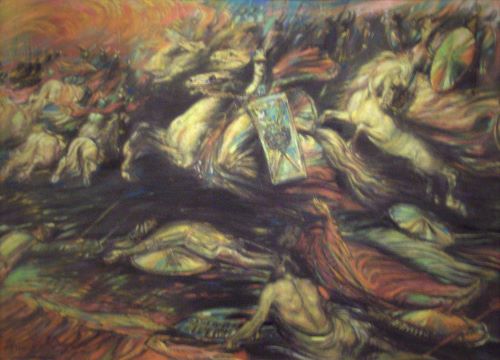
Unlike several powers casually attributed to Gungnir in modern retellings, the spear’s association with runes is not purely speculative. In Sigrdrífumál, the Valkyrie Sigrdrífa teaches Sigurðr a complex body of runic knowledge involving victory, protection, healing, childbirth, speech, and the control of dangerous situations. As the poem expands from practical instruction into a vision of runes distributed throughout the cosmos, it names “Gungnir’s point” among the places upon which runes had been inscribed. The passage does not reproduce the signs, identify the person who carved them, or explain precisely what power they gave the spear. It nevertheless provides direct poetic evidence that Gungnir was imagined as rune-marked, at least within this strand of the Eddic tradition. The important distinction is not between an attested inscription and a wholly modern invention, but between the source’s brief statement and the elaborate designs, formulas, and magical mechanisms later audiences have added to it.
Runes were first of all a writing system, not a collection of timeless occult symbols possessing fixed supernatural meanings. They could record names, ownership, memorial statements, prayers, jokes, commercial messages, makers’ signatures, and ordinary communications. Both inscriptions and medieval literature demonstrate that runic writing could be used in ritual, healing, protection, cursing, divination, and other practices understood as magical. The two functions were not necessarily opposed. Writing a name upon an object could establish possession, preserve memory, assert status, or bind an identity to material form, while a formula intended to protect or harm still depended upon the communicative power of written language. Modern interpretation often errs in one of two directions: either every runic inscription is treated as a spell, or the magical associations preserved in poetry and archaeology are dismissed as later fantasy. The evidence supports a more complicated history in which runes functioned as letters while their rarity, physical form, secrecy, ritual use, and connection with specialized knowledge could give particular inscriptions extraordinary force.
Odin’s relationship with runes makes their presence on Gungnir particularly significant. In Hávamál, he does not invent them casually or inherit them as a natural privilege of divinity. He acquires them through suffering, hanging for nine nights upon the wind-beaten tree, wounded by a spear and offered to himself. Knowledge is gained through bodily ordeal, and the spear wound stands beside the runes at the moment of revelation. The god who later wields a rune-marked weapon has paid for runic mastery with his own suspended and pierced body.
Sigrdrífumál also places the runes upon weapons more broadly. Sigrdrífa instructs Sigurðr to carve victory-runes upon a sword’s hilt and associated surfaces if he desires success in battle, accompanied by an invocation of Týr. The poem does not present runes as vague decoration. They must be correctly located, properly cut, understood, and joined to intentional action. Elsewhere in the same sequence, runes are assigned to drinking horns, hands, fingernails, ships, healing practices, speech, and the assistance of women in childbirth. Their effectiveness depends not merely upon possessing recognizable symbols but upon knowledge of which signs belong where and how they are to be used. Gungnir’s inscription belongs within this larger system. Its point is the place where the spear’s purpose becomes concentrated, where the shaft’s movement ends in penetration. To place runes there is to join written knowledge to the weapon’s decisive surface.
Archaeological evidence confirms that weapons could bear runic inscriptions, although it does not allow every such inscription to be classified as magical. Early spearheads and lanceheads from northern and central Europe preserve brief sequences that have been interpreted as personal names, weapon names, descriptions, ownership marks, makers’ statements, or formulas whose meanings remain disputed. Their brevity is itself important. An inscription did not need to contain a long spell to transform the social identity of an object. A few signs might identify the owner, proclaim the quality of the weapon, name the spear as though it possessed an individual character, or associate it with a restricted body of knowledge. Yet uncertainty remains unavoidable because many early inscriptions are isolated, linguistically difficult, damaged, or composed of words whose cultural associations are no longer recoverable. The archaeological record supports the plausibility of an inscribed divine spear, but it does not reveal which runes appeared upon Gungnir or prove that any surviving human weapon was intended as its imitation.
The union of spear and rune brings together two forms of directed power. A spear carries force toward a selected body; an inscription carries meaning into matter. Each requires intention, skill, and correct execution. A poorly cast spear fails to reach its target, just as badly cut or misunderstood runes may fail, deceive, or cause harm in Old Norse literature. Gungnir overcomes the ordinary uncertainty of the first process because its thrust cannot be checked. The runes upon its point suggest a parallel mastery of the second: knowledge has been fixed into the weapon at the place where divine intention becomes physical consequence. This does not mean that the runes necessarily create every property attributed to the spear. Snorri credits the sons of Ivaldi with its craftsmanship and extraordinary effectiveness, while Sigrdrífumál simply includes its point within a cosmic catalogue of inscribed surfaces. The sources preserve related traditions without explicitly explaining their mechanical relationship. Gungnir should be imagined neither as a blank weapon accidentally associated with a god of writing nor as a fantasy artifact covered in a decipherable catalogue of modern rune symbols. The medieval evidence supports a more restrained and more powerful image: runes are cut at the spear’s point, but their forms and wording remain hidden. Their silence preserves the authority of restricted knowledge. Odin understands what others cannot read, directs what others cannot stop, and carries into battle a weapon in which craftsmanship and inscription have become inseparable from sovereign purpose. The rune-marked point transforms Gungnir into knowledge made material, but it also reflects the limits of human reconstruction. The poem tells its audience that the signs exist without granting access to them. Like much of Odin’s wisdom, their power lies partly in the fact that they are known completely only by the god who paid the price to possess them.
Odin’s First Cast: Gungnir and the Æsir–Vanir War
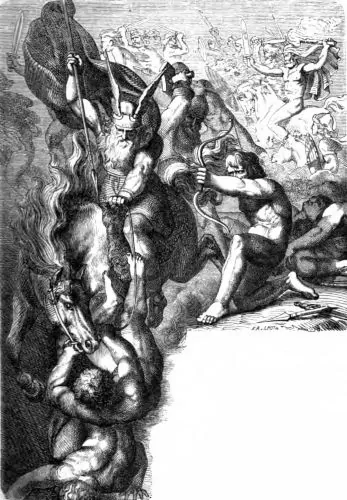
The first great war of the gods begins not with a charge, a duel, or the clash of shield walls, but with a thrown spear. In Völuspá, the seeress recalls the conflict between the Æsir and Vanir by describing Odin casting a weapon over the opposing host. The poem does not explicitly call that spear Gungnir, and the distinction matters. The passage may preserve a tradition older than the fully developed narrative of the spear’s manufacture in Snorri Sturluson’s Edda, or it may assume that an audience already recognized Odin’s characteristic weapon without requiring its name. Either way, the action belongs naturally within Gungnir’s symbolic history. Odin’s cast does not simply send the first missile into enemy ranks. It declares that the conflict has entered his domain and that those who die within it may be claimed as his own.
The war itself occupies an ambiguous place in Norse cosmogony. The Æsir and Vanir are both divine communities, yet they appear initially as rivals whose dispute erupts into open violence. Völuspá presents the conflict in compressed and difficult language, alluding to breached defenses, contested outcomes, and the uncertain question of whether the Æsir alone should receive tribute. Snorri later supplies a more orderly account in which the two sides exchange hostages and establish peace, but the poem retains a harsher atmosphere. This is not a simple struggle between gods and monsters. It is a civil war within the divine world, fought over authority, honor, and the distribution of sacred power. Odin’s spear-cast gives ritual form to that struggle. By throwing the weapon over the enemy host, he marks the Vanir as a collective target before the outcome has been decided. The gesture transforms an opposing army into a consecrated body.
Similar acts appear elsewhere in Old Norse literature, where commanders throw a spear over an enemy formation and dedicate those standing beneath it to Odin. Such accounts were written down after conversion and cannot be treated as uncomplicated records of pre-Christian battlefield practice. Nevertheless, their repeated association of spear-casting with dedication suggests that the gesture carried a meaning deeper than tactical aggression. The cast crosses the boundary between the two armies and places the enemy under divine claim. Those struck in the battle that follows do not merely die as casualties; they become the slain of Odin, gathered into the religious economy over which he presides. The spear inaugurates both warfare and sacrifice.
The use of Gungnir in this context also clarifies the nature of Odinic sovereignty. Odin does not wait passively for war to reveal its victors. He attempts to define the meaning of the conflict from its first moment. By casting the spear, he asserts the right to name the enemy, open the battle, and possess its deaths. The physical flight of the weapon becomes a declaration of jurisdiction. This is why the spear suits Odin more fully than a weapon of close combat would. A sword kills the person immediately before its wielder, but a cast spear can pass over an entire formation. Its path encompasses a multitude, extending the god’s intention beyond a single victim and across the whole field of battle. Gungnir becomes not only an instrument of killing but also a sign that violence has been enclosed within Odin’s authority. Yet the episode also exposes the limits of that authority. The Æsir–Vanir War does not end in the straightforward annihilation or submission of Odin’s opponents. The surviving traditions point instead toward exhaustion, broken defenses, negotiation, hostage exchange, and eventual incorporation. The Vanir are not eliminated; they enter the divine order and transform it from within. Njörðr, Freyr, and Freyja become central figures among the gods, while members of the Æsir pass in the opposite direction. Odin’s first cast consecrates a conflict whose conclusion he does not wholly dictate. Gungnir opens the war, but the spear cannot reduce the political and sacred differences between the two divine communities to a single victorious thrust.
This tension makes the episode foundational for the mythology of Gungnir. The spear marks, initiates, and claims, but it does not abolish complexity. Odin can define the battlefield as sacrificial space and project his will over the opposing host, yet even divine war produces consequences that exceed the intention of its initiator. The Æsir–Vanir conflict ends not with the permanent supremacy of one side but with a reconfigured divine society formed through violence and exchange. Gungnir’s first remembered cast anticipates the paradox that will accompany it throughout the mythology: Odin’s weapon moves with irresistible purpose, while the world into which it is thrown remains governed by uncertainty, compromise, and fate.
“Odin Owns You All”: Consecration and Battle Ritual
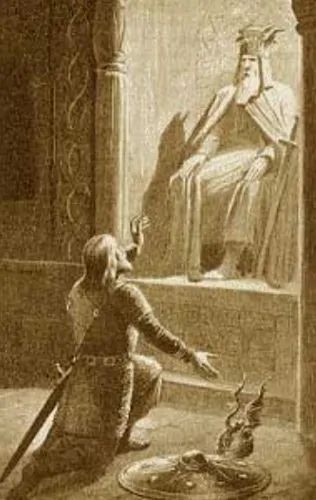
The words “Odin owns you all” express the religious logic underlying the casting of a spear over an enemy army. The gesture did not merely announce that combat was beginning. It symbolically transferred the opposing force into Odin’s possession before the first deaths occurred. An army passing beneath the flight of the spear became a collective offering whose members might be claimed through the violence that followed. The weapon crossed more than the physical distance between battle lines. It crossed the boundary between ordinary enemies and consecrated victims, redefining warfare as an encounter conducted under the authority of the god of battle and the slain.
The mythological precedent appears in Völuspá, where Odin throws a spear into or over the Vanir host during the first war in the world. The poem does not preserve the formula “Odin owns you all,” nor does it explicitly identify the weapon as Gungnir. Nevertheless, the scene establishes a model in which Odin inaugurates war by extending his spear over an opposing force. Later literary traditions make the sacrificial implications of that action much more explicit. The most dramatic example survives in Styrbjarnar þáttr Svíakappa, a short narrative preserved in Flateyjarbók. Facing the invading army of Styrbjörn the Strong, the Swedish king Eiríkr enters Odin’s sanctuary and offers himself to the god in return for victory, accepting that his own death will follow after a fixed period. A mysterious tall man wearing a broad or low-hanging hood then gives him a reed and instructs him to cast it over Styrbjörn’s army while declaring, “Óðinn á yðr alla,” “Odin owns you all.” Once thrown, the apparently harmless reed assumes the deadly significance of a spear, and the enemy is struck by blindness and supernatural catastrophe. The episode binds together self-dedication, divine patronage, spear-casting, and the destruction of a consecrated host. It also displays Odin’s characteristic economy of exchange: Eiríkr receives victory, but the god’s assistance is purchased with the king’s future life.
The words accompanying the cast function as a performative declaration. They do not describe ownership after Odin has won the battle; they attempt to create that ownership before the outcome is known. The enemy is verbally assigned to the god, while the spear gives material force to the claim. Speech and weapon act together: the formula names the intended transfer, and the cast carries it across the battlefield.
A related atmosphere appears in the heroic traditions surrounding the war between Goths and Huns in Hervarar saga. In the poem usually called Hlöðskviða, the aged warrior Gizurr confronts the Hunnish host with a threatening invocation declaring its army terrified, its leader doomed, its battle-banner raised above it, and Odin hostile toward it. The scene does not reproduce every detail of Eiríkr’s ritual, but it joins proclamation, spear imagery, divine hostility, and foreordained defeat. Such literary examples suggest that the opening moments of battle could be imagined as a contest of religious claims as well as weapons. Before formations collided, a leader might attempt to define the enemy as already doomed, undermine its confidence, and present his own cause as supported by the god who controlled the destination of the dead. The ritual’s psychological and political usefulness did not make its religious meaning insincere. In a society where warfare, sacrifice, rulership, and divine favor overlapped, declaring the enemy Odin’s property could simultaneously express belief, intimidate opponents, strengthen followers, and legitimize violence.
The evidence does not establish that every Scandinavian commander performed a standardized spear-casting ceremony before battle. The surviving narratives were recorded in Christian manuscripts, often centuries after the periods they depict, and they combine inherited motifs with heroic storytelling and political memory. A dramatic literary ritual cannot automatically be converted into a universal account of Viking Age military practice. Yet the recurrence of the association among Odin, thrown spears, dedicated enemies, and collective death is too coherent to dismiss as accidental. It preserves a conception of battle in which the slain could be offered rather than merely defeated. Within that conception, Gungnir becomes the archetypal instrument of consecration. Its flight places an army beneath Odin’s claim, while the spoken declaration makes explicit what the spear signifies: those standing below it have been named as the god’s possession, although the uncertain struggle of human beings must still determine how that claim will be fulfilled.
Gungnir and the Economy of Victory
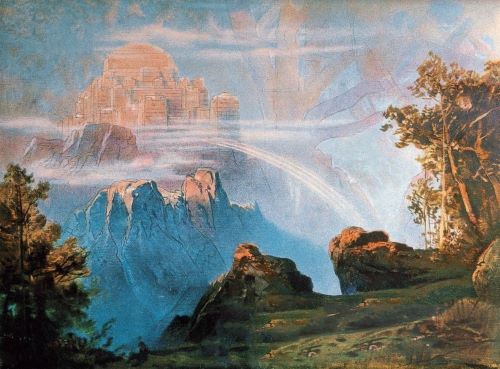
Odin’s relationship with victory is not that of a dependable patron who rewards loyalty according to a stable moral law. He grants success selectively, sometimes for reasons visible to human beings and sometimes in service of designs known only to himself. Kings seek his favor because he can inspire courage, disorder enemy formations, reveal hidden knowledge, and determine which side will prevail. Yet the same traditions that depict him as a giver of victory also portray him withdrawing support at the decisive moment. Odinic favor is powerful precisely because it is uncertain. It resembles a gift that creates obligation without guaranteeing permanence, binding rulers and warriors to a god whose purposes may eventually require their defeat.
Gungnir embodies this economy of conditional favor. The spear itself is flawless, but those who depend upon Odin are not protected by its perfection. A king may receive victory through the god’s intervention and still remain marked for death. A warrior may be granted exceptional strength or renown only because Odin intends to claim him for Valhöll. The weapon’s unerring quality belongs to the divine giver rather than to the mortal recipient. Human beings may participate briefly in Odin’s power, but they never possess it securely.
This instability appears vividly in the legendary traditions surrounding Odin’s favored heroes. In Völsunga saga, Sigmundr enjoys extraordinary success while carrying a sword associated with Odin, yet the god later appears in battle and breaks the weapon with his spear. The scene is not centered on Gungnir by name, but it expresses the same Odinic logic. The god who once enabled Sigmundr’s greatness becomes the agent of his defeat. Divine favor has not proved false because it was never an unconditional promise of survival. Sigmundr’s heroic destiny includes the moment when Odin withdraws the power that sustained him, redirecting the warrior from earthly victory toward death and posthumous fame. The episode reveals how Odinic gifts remain subject to recall. Weapons, victories, and royal authority may be granted, but their ultimate ownership stays with the god.
The gathering of the einherjar gives this apparent betrayal a larger purpose. Odin collects distinguished warriors in Valhöll, where they fight each day, feast each night, and prepare for Ragnarök. From a mortal perspective, the death of a favored champion may look like abandonment at the moment when divine protection is most needed. From Odin’s perspective, it is recruitment. The best warrior is valuable not only because he can win present battles but because he can be added to the host required for the final one. Victory and death operate within the same economy. Odin may allow a warrior to triumph long enough to acquire skill, reputation, and followers, then arrange his fall when his continued life has become less useful than his presence among the slain. The god’s patronage elevates its recipients while gradually making them suitable sacrifices. This economy also explains why Odinic kingship carries an element of danger. A ruler who claims descent from Odin or seeks his assistance may gain legitimacy through association with divine wisdom, conquest, and charisma. Yet such a ruler also places himself within a relationship of exchange. Victory may require offerings, vows, or future payment, and the king’s own life can become the final price. Odin does not simply protect sovereigns; he produces them, tests them, and at times destroys them. Gungnir is the ideal symbol of this arrangement because it represents the certainty of the god’s claim rather than the security of the human beneficiary. The spear does not promise that Odin’s chosen will live. It promises that his purpose will reach them.
The economy of victory transforms Gungnir from a weapon of conquest into an instrument of selection. Odin’s favor creates heroes, but it also prepares victims. His gifts are real, his victories can be decisive, and his chosen rulers may reshape entire kingdoms, yet none of these advantages frees them from the god’s ownership. The same divine hand that directs the spear toward an enemy may eventually turn it against a former favorite. Gungnir’s perfection lies in carrying Odin’s decision without resistance, not in preserving those who once benefited from it. Through the spear, victory becomes temporary possession, fame becomes preparation for death, and divine favor reveals itself as one of the most dangerous gifts a warrior can receive.
The Marked Victim and Sacrifice to Odin
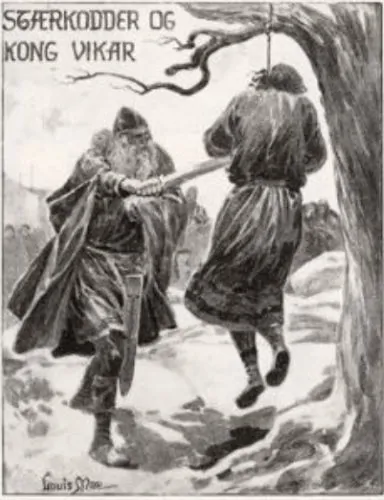
The spear associated with Odin does more than kill. It identifies, consecrates, and transfers. In both mythological and legendary traditions, a body pierced by a spear can be marked as belonging to the god, just as an army beneath a cast spear can be declared his possession before battle begins. The wound carries a ritual meaning beyond its physical effect. It opens the body to death while simultaneously assigning that death to a divine recipient. Gungnir represents the perfected form of this claim: an irresistible point directed by the god who governs sacrifice, warfare, and the destination of the slain.
Hanging forms the second major element in this Odinic pattern. Odin is repeatedly associated with the gallows, the hanged, and those suspended between life and death. One of his names, Hangatýr, identifies him as the god of the hanged, while other poetic names connect him with gallows and sacrificial victims. Hanging was a particularly powerful form of death because the victim was lifted away from ordinary human space and placed in a condition of suspension. The body no longer stood among the living, yet it had not disappeared into burial or cremation. It hung visibly between earth and sky, exposed to weather, birds, decay, and the gaze of the community. Within an Odinic framework, that suspension could signify transfer from the human world into the god’s possession.
The combination of hanging and piercing appears most dramatically in the legendary death of King Víkarr in Gautreks saga. According to the saga, Víkarr’s fleet is trapped by unfavorable winds, and divination reveals that Odin requires a human sacrifice chosen by lot. The lot repeatedly falls upon the king, but his followers initially attempt to satisfy the demand through a symbolic ceremony. A loose noose is placed around Víkarr’s neck, a branch is bent down to serve as a mock gallows, and Starkaðr touches him with what appears to be a harmless reed while declaring that he gives the king to Odin. At that moment, the ritual imitation becomes real. The reed turns into a spear, the noose tightens, and the branch springs upward, leaving Víkarr pierced and hanged. The episode unites declaration, spear wound, suspension, and divine ownership in a single sacrificial transformation. The story cannot be treated as a straightforward report of an actual pre-Christian ceremony. Gautreks saga is a late legendary saga shaped by heroic convention, supernatural storytelling, and medieval reflection upon a pagan past. Yet the scene’s ritual logic is remarkably coherent. The victim is selected, verbally dedicated, marked with a spear, and lifted from the ground. Each action moves him farther from ordinary social identity and closer to the status of an offering. The apparent mock sacrifice also reveals the danger of ritual performance: once the correct words and gestures are enacted, human participants may lose control over the result. Odin accepts the symbolic offering literally.
The killing of Víkarr also exposes the political dimension of sacrifice. A king ordinarily stands above his followers as the source of protection, judgment, and military success, but the sacrificial crisis reverses that hierarchy. The ruler becomes the offering required to restore movement and communal fortune. His body pays for the release of the fleet, while Starkaðr becomes both executioner and ritual intermediary. Odin’s demand reaches into the center of sovereignty. Kingship does not exempt a ruler from divine ownership; it may make him a more valuable victim. The spear that ordinarily signifies command is turned against the commander, demonstrating that all human authority remains subordinate to the god who grants and withdraws victory.
Other medieval accounts associate hanging with Scandinavian sacrifice, though their evidentiary value requires caution. Adam of Bremen’s description of the cult at Uppsala reports that human and animal victims were killed and hung in a sacred grove during a major festival. Adam wrote from a Christian perspective, relied heavily upon informants, and shaped his narrative according to polemical and biblical models. His account does not allow every hanged victim to be assigned specifically to Odin. Even so, the report belongs to a wider northern European pattern in which bodies, weapons, and offerings were suspended, deposited, or publicly displayed in ways that removed them from ordinary circulation. Literary and historical sources alike suggest that hanging could function not merely as execution but as a visible transfer of life to supernatural powers.
The spear wound and the noose operate together as complementary signs. The spear penetrates and marks; the rope lifts and suspends. One identifies the victim through the weapon of Odin, while the other places the body within the god’s characteristic mode of death. This combination also blurs the line between battlefield killing, execution, and sacrifice. A warrior struck beneath Odin’s claim, a king pierced and hanged, and the god himself wounded upon the tree all enter the same symbolic structure. Their deaths are not identical, but each involves selection, bodily marking, and transfer across a boundary. Gungnir’s significance lies within this structure. Its point does not merely end life; it declares whose death has occurred and to whom that death belongs.
Odin Wounded by the Spear: The God as His Own Sacrifice

The most profound meeting of Odin and the spear occurs not when he directs it against an enemy but when its point is turned upon his own body. In Hávamál, Odin recounts how he hung for nine nights upon a wind-beaten tree, wounded by a spear, denied food and drink, and given to Odin, himself to himself. The passage does not name the spear as Gungnir, and the text should not be made to say more than it does. Yet the weapon belongs unmistakably to the same symbolic complex. Odin undergoes the form of death associated with his victims: he is pierced, suspended, and dedicated to the god who receives the slain. The divine sacrificer becomes the sacrificial offering.
The apparent contradiction in the formula “myself to myself” is central to the ordeal. In ordinary sacrifice, the officiant, victim, and divine recipient occupy distinct positions. Someone performs the ritual, another being is offered, and a god receives the gift. Odin collapses all three roles into himself. He chooses the ordeal, suffers it, and accepts its consequences as the supernatural power to whom it is dedicated. This self-division reflects the wider instability of Odinic identity. Odin moves among gods, giants, humans, the living, and the dead; he assumes disguises, conceals his name, and crosses boundaries that normally separate social and cosmic categories. Upon the tree, this fluidity becomes sacrificial structure. The god treats himself as another being so that he can acquire knowledge unavailable even to him in his ordinary condition.
The spear wound authenticates the offering. Odin does not gain the runes through detached contemplation or inherited divine privilege. Knowledge must be purchased through injury, hunger, thirst, exposure, and proximity to death. The wound marks his body as the spear marks a warrior or king dedicated to him.
The tree upon which Odin hangs is never explicitly named as Yggdrasil in the poem, although the identification is natural and widely accepted. It is described as a tree whose roots no one knows, placing the god within a landscape of hidden origins and uncertain depth. Hanging removes Odin from stable human orientation: his feet do not rest on the ground, yet he has not ascended freely into the sky. He remains suspended between worlds, deprived of ordinary nourishment and social support. The spear intensifies that liminality by opening the body without immediately ending consciousness. For nine nights Odin occupies the threshold between life and death, subject and object, seeker and sought. Only after looking downward and crying out does he seize the runes and fall from the tree. Revelation comes at the point where endurance has stripped away the boundaries of his previous identity.
The ordeal also distinguishes Odin’s pursuit of wisdom from passive omniscience. Norse mythology does not present him as a god who knows everything simply because he is divine. He repeatedly pays for knowledge. He sacrifices an eye for a drink from Mímir’s well, risks himself to obtain the mead of poetry, questions dead seers, and enters dangerous contests of wisdom. The hanging sacrifice is the most radical expression of this pattern because the price is not treasure, reputation, or a bodily part but the temporary surrender of the whole self. Odin acquires power by accepting wounds that cannot be separated from what they teach him. His authority rests upon accumulated acts of loss.
The relationship between the unnamed spear of Hávamál and Gungnir should be understood symbolically rather than mechanically. The poem does not explain whether Odin uses his own weapon, whether another being wounds him, or whether the piercing is enacted through ritual means beyond ordinary physical logic. What matters is that the god is subjected to the mark by which he claims others. The spear reverses direction, turning the sovereign power of consecration back upon its source. This reversal does not weaken Odin’s authority; it establishes the suffering through which that authority becomes legitimate. He can govern the spear-marked dead because he has entered their condition. He can receive the hanged because he has hung. He can command runic knowledge because he has allowed knowledge to be cut into his own body before it is cut into wood, bone, metal, or the point of Gungnir. The god’s self-sacrifice reveals the deepest foundation of the spear’s symbolism: mastery is achieved not by remaining untouched, but by enduring the wound one later has the power to give.
Yggdrasil and the Vertical Structure of the Cosmos
The symbolic relationship between Gungnir and Yggdrasil begins with form. Both spear and tree are vertical structures that connect separated regions of existence. Yggdrasil rises through the cosmos while its roots descend into hidden and distant realms; the spear extends outward from the hand of its wielder and concentrates force at a single point. One stabilizes the worlds around an enduring axis, while the other carries divine intention across boundaries. The surviving texts never declare that Gungnir is a miniature Yggdrasil or that the world tree is cosmically equivalent to a spear. Nevertheless, their shared verticality creates a powerful interpretive connection, especially because Odin is bound so intimately to both.
Yggdrasil is not simply a large tree located within the Norse cosmos. It is the structure around which divine assemblies, wells of knowledge, hostile creatures, human destinies, and cosmic destruction are organized. Its roots reach into realms associated with gods, giants, and the dead, while its branches extend over the world. Gods ride to it for judgment, the Norns shape destinies beneath it, and creatures continually damage it from above and below. The tree sustains cosmic order, but it is not untouched or invulnerable. It suffers as the world suffers. Odin’s ordeal upon the tree makes that suffering personal. In Hávamál, he hangs for nine nights upon a tree whose roots are unknown, wounded by a spear and deprived of food and drink. The poem does not explicitly name the tree as Yggdrasil, but its cosmic obscurity and later mythological associations make the identification compelling. Odin’s body becomes suspended along the vertical line between the tree’s hidden depths and its exposed height. He neither stands among the living nor fully enters the world of the dead. The spear wound holds him within this threshold, piercing the body while the tree supports it.
The spear and the tree perform complementary actions in the scene. The tree suspends Odin between worlds; the spear opens him to transformation. Hanging removes him from ordinary horizontal existence, where bodies stand, walk, fight, and participate in society. Piercing breaks the integrity of the body itself. Together, these actions dismantle Odin’s previous condition and create the circumstances in which the runes can be perceived and seized. Revelation does not descend gently from above. It emerges through bodily dislocation, suffering, and the collapse of normal boundaries.
This relationship may also illuminate the name Yggdrasil, commonly understood as “Yggr’s horse,” with Yggr, “the Terrible One,” being one of Odin’s names. The tree becomes Odin’s horse because the hanged person metaphorically rides the gallows. Such language belongs to a wider poetic tendency to describe execution and sacrifice through compressed and unsettling images. Odin does not merely hang upon the cosmic tree; he rides it as a condemned victim rides the instrument of death. The vertical axis not passive scenery. It carries him through an initiatory passage, just as a horse might transport a rider between places. The spear wound confirms the journey as a sacrificial one, marking the rider as an offering even when the god who receives the offering is the same being who suffers it.
Gungnir can be understood as a mobile counterpart to this fixed cosmic axis. Yggdrasil stands at the center of the world and connects realms through endurance. Gungnir moves through the world and connects Odin to selected targets through directed force. The tree gathers the cosmos around itself; the spear projects the god’s authority outward. When cast over an army, it crosses the boundary between opposing hosts. When used to mark a victim, it joins that body to Odin’s sacrificial domain. When carried at Ragnarök, it accompanies the god as he moves toward the final collapse of the order Yggdrasil has sustained. The comparison does not require the spear to possess the tree’s full cosmological significance. It reveals instead how both objects organize relationships between separated states: divine and human, living and dead, order and destruction, knowledge and suffering. There is also a contrast between them. Yggdrasil is continually threatened, gnawed, and shaken, yet it endures as the structural center of the cosmos. Gungnir is described as irresistible in its thrust, yet it cannot save its wielder from Fenrir. The wounded tree survives injury while supporting the worlds; the perfect spear succeeds in its immediate function but cannot prevent cosmic defeat. One represents endurance amid damage, the other certainty within action. Odin stands between these forms of power. He seeks knowledge upon the suffering tree and exercises authority through the unfailing spear, but neither grants him escape from fate.
The symbolic convergence of Gungnir, Yggdrasil, and Odin’s body reveals a cosmology built around penetration, suspension, and connection. The spear pierces bodies and boundaries; the tree links worlds while holding the sacrificial victim between them; Odin transforms himself by occupying the point where these structures meet. Yet the interpretation must remain proportional to the evidence. The medieval texts offer images rather than a formal theology equating spear and tree. Their relationship emerges through repeated patterns of verticality, sacrifice, and passage rather than explicit explanation. Gungnir becomes meaningful beside Yggdrasil because each makes visible a different aspect of Odinic power: the tree is the place where the god submits to the cosmos to gain knowledge, while the spear is the instrument through which he imposes that knowledge as directed will. Together they express the paradox of a deity who can cross boundaries, command death, and penetrate hidden mysteries but still cannot stand outside the cosmic order that makes those powers possible.
The Selection of the Slain
The Valkyries belong to the same structure of battlefield sovereignty embodied by Gungnir. Their name, Old Norse valkyrjur, is conventionally understood as “choosers of the slain,” joining words associated with those killed in battle and the act of choosing. They do not merely arrive after combat to escort warriors whose deaths have already been determined by other forces. In many traditions, they participate in the determination itself. They ride above armies, influence the direction of weapons, decide which fighters will fall, and carry selected dead to Odin. Their presence transforms the battlefield into a place where mortal action and supernatural judgment overlap. Warriors may experience battle as a contest of courage, strength, leadership, and chance, but the Valkyries reveal another level in which death is distributed according to divine purpose.
Their relationship with Odin is intimate but not entirely uniform across the surviving sources. Some poems present them as his servants, riding at his command and bringing chosen warriors to Valhöll. Others preserve figures who resemble Valkyries but possess independent desires, heroic relationships, prophetic knowledge, or identities overlapping with shield-maidens and supernatural women. The medieval tradition did not reduce them to a single orderly class with one fixed function. Nevertheless, their clearest Odinic role is the selection of warriors for the god’s hall. In Grímnismál, named Valkyries serve drink to the einherjar, the slain fighters gathered around Odin. In the skaldic memorial poems Eiríksmál and Hákonarmál, Odin prepares Valhöll for the arrival of dead rulers and sends Valkyries to choose them from battle. The deaths of such kings are not presented as meaningless defeats. They are acts of recruitment. Earthly sovereignty ends so that the dead ruler can enter Odin’s military household, joining the force being assembled for Ragnarök. The Valkyries mediate between battlefield loss and supernatural incorporation. They convert a fallen warrior into one of Odin’s chosen dead.
Gungnir performs a closely related symbolic action. A spear points, marks, penetrates, and claims a particular target. Even when cast over an entire army, its path establishes a field of selection beneath Odin’s authority. The Valkyries enact in personal form what the spear expresses materially: the movement from possibility to decision. Before battle, many warriors may live or die; after the divine choice, particular bodies belong to the slain. Gungnir’s irresistible thrust is an appropriate emblem for a process that appears uncertain to mortals but settled within Odin’s designs. Its precision does not mean that every death is individually caused by the weapon. Rather, the spear makes visible the principle that Odinic violence is directed rather than random.
The choice of the slain is not portrayed gently. In Darraðarljóð, preserved in Njáls saga, supernatural women weave the outcome of battle upon a horrifying loom constructed from human bodies and weapons. Intestines form the warp and woof, severed heads serve as weights, arrows become shuttles, and swords beat the fabric into place. The women announce who will die while producing the battle as though it were cloth. Selection here is not a graceful passage conducted by romanticized warrior maidens. It is a bloody manufacture of fate.
This imagery helps correct the later tendency to treat Valkyries primarily as beautiful attendants who reward heroic men. Their mythology includes service and welcome, but it also includes terror, bodily destruction, and the imposition of outcomes upon people who cannot perceive the forces arranging their deaths. They stand at the intersection of fate and command. Some traditions bring them close to the Norns, while others emphasize their obedience to Odin or their capacity to grant victory to favored warriors. The boundaries among these roles are not always stable. What remains consistent is their association with the transformation of battle into selection. They identify who will cross from the living host into the community of the dead, and their judgment may override the expectations of even the most accomplished fighter. The selection also exposes the double nature of Valhöll. To be chosen by a Valkyrie can appear as the highest confirmation of heroic worth, granting the warrior continued honor, feasting, combat, and proximity to Odin. Yet the honor depends upon premature and violent death. Odin does not gather the einherjar out of generosity alone. He needs them for the last battle. The Valkyries offer both distinction and dispossession: they elevate the warrior by removing him from earthly life, family, kingship, and future achievement. A ruler welcomed into Valhöll is simultaneously honored and taken.
Gungnir, the Valkyries, and the einherjar together reveal Odin’s war-making as a system extending beyond victory in any single conflict. The spear establishes divine claim, the Valkyries identify and gather the chosen, and Valhöll converts the dead into a reserve army for Ragnarök. Human battles become sources from which Odin draws the fighters needed for a cosmic war he knows he cannot ultimately survive. The accuracy associated with Gungnir symbolizes more than the ability to strike an enemy. It represents the precision of selection itself. Odin does not merely preside over death in the abstract; he identifies useful deaths, assigns agents to secure them, and gives the fallen new purpose within his household. The spear points toward the victim, the Valkyrie confirms the choice, and the gates of Valhöll complete the transfer from mortal warrior to possession of the god.
Gungnir and Odin’s Sovereignty
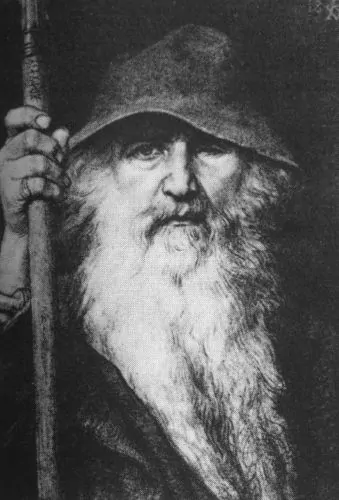
Gungnir is not merely Odin’s weapon but an emblem of his sovereignty. In the medieval sources, Odin’s authority extends over rulers, battle, sacrifice, poetry, wisdom, and the dead; the spear gives these dispersed powers a visible and unified form. Carried at the head of an army, it identifies him as commander. Cast over an enemy host, it marks the opposing force as subject to his claim. Driven into a victim, it transforms violence into consecration. Gungnir resembles a weaponized scepter: an object through which the right to command becomes inseparable from the power to wound, condemn, and kill.
This sovereignty differs from the orderly administration of a settled monarch. Odin often rules through charisma, secrecy, movement, and unequal knowledge rather than through transparent law. He appears under many names, travels in disguise, tests rulers, manipulates succession, and grants victory without becoming permanently bound to those who receive it. His authority is personal and unstable, grounded in the belief that he sees farther than human kings and possesses access to forces beyond their control. Gungnir embodies that superior perspective. Its unimpeded thrust suggests that once Odin has made a decision, the chosen target cannot escape simply by appealing to courage, rank, or justice. The spear carries divine judgment without requiring the god to explain the grounds upon which judgment has been made. The weapon also expresses Odin’s relationship with human kingship. Rulers claiming descent from him could present military success, poetic fame, and dynastic authority as signs of divine inheritance. Yet Odinic kingship was never a guarantee of protection. The god who raised a ruler could also abandon him, demand his life, or redirect him toward death and Valhöll. Sovereignty was consequently imagined as a gift burdened by obligation. A king ruled because he possessed favor, followers, treasure, and the ability to win battles, but these powers remained vulnerable to the god who stood behind them. Gungnir symbolized the source of royal command while reminding rulers that their own bodies could eventually become its targets.
The spear’s sovereignty is also juridical in the broad sense that it distinguishes those protected by an order from those exposed to its violence. By throwing a spear over an army, Odin defines its members collectively as enemies and prospective offerings. The gesture creates a boundary: on one side stand those acting under divine favor, and on the other those assigned to the god as slain. Such authority does not depend upon an impartial legal proceeding. It is the primal power to decide when peace ends, who may be killed, and what meaning death will possess. Gungnir reveals the violence beneath political order because every ruler’s ability to protect a community rests partly upon the capacity to designate threats and direct force against them. In Odin’s mythology, that capacity is sacred, but it is not morally uncomplicated. The god of rulers is also the god of betrayal, hanging, frenzy, and the battlefield corpse.
Gungnir condenses the central paradox of Odinic sovereignty. It represents command with perfect direction, yet it belongs to a god whose methods are elusive and whose favor is uncertain. It signifies the right to initiate war, distribute victory, mark sacrifices, and gather the dead, but it cannot free Odin from the fate governing the cosmos. At Ragnarök, he carries the supreme emblem of his authority into battle and is nevertheless swallowed by Fenrir. The moment does not empty the spear of meaning. It reveals that sovereignty in Norse mythology is never absolute mastery over existence. Odin can direct violence, claim victims, and shape kingdoms, but he cannot permanently command the future. Gungnir is both the highest expression of his rule and the measure of its limits: the spear flies according to the sovereign’s will, while the world itself continues toward an end no sovereign can forbid.
The Unerring Word
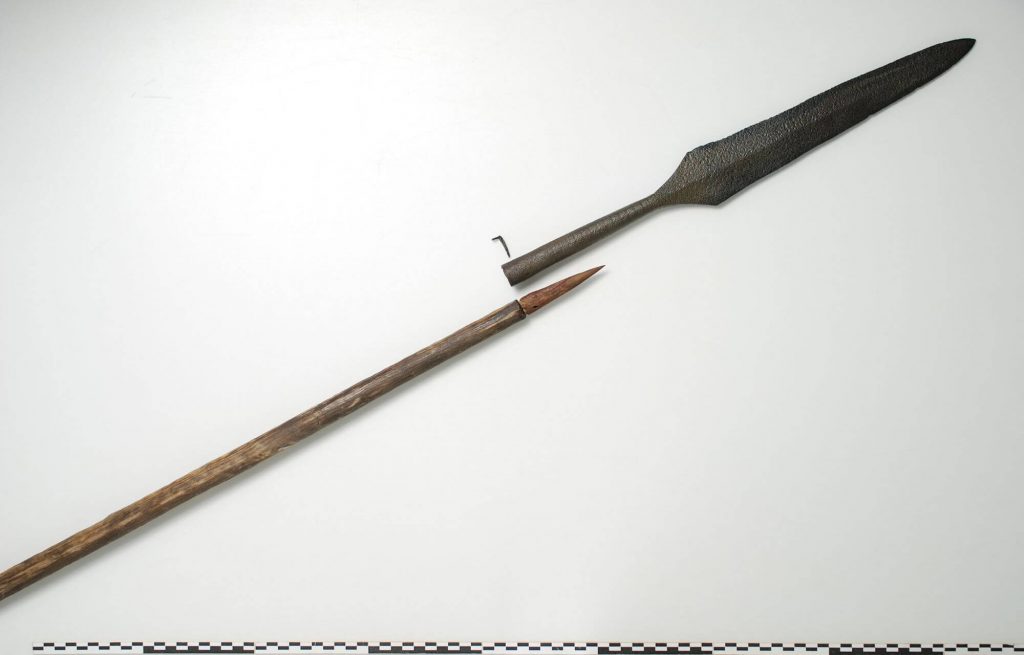
Gungnir’s unerring thrust invites comparison with the binding force of an oath. The medieval sources do not state that Odin’s spear functioned as an oath-object, nor do they describe contracts routinely sworn upon it. The connection must remain interpretive rather than factual. Even so, the symbolism is strong. Both the spear and the oath transform intention into consequence. Once Gungnir is directed, its thrust cannot be checked; once a solemn promise is spoken before witnesses and supernatural powers, the speaker is expected to move toward fulfillment. Each act fixes the will and exposes the person who initiated it to consequences that cannot easily be recalled.
Oaths were essential to the legal and social order of medieval Scandinavia. They confirmed testimony, established loyalty, supported settlements, and bound followers to rulers and companions. Their authority rested upon witnesses, reputation, ritual form, and the threat of dishonor or punishment if the words proved false.
Weapons could participate in this culture of obligation because they united prestige with the power to enforce a promise. Swords, spears, shields, and rings were not interchangeable ritual instruments, and the surviving evidence does not support a single universal Scandinavian oath ceremony. Nevertheless, weapons could materialize the seriousness of spoken commitments. A declaration made in the presence of an armed ruler or warrior community existed within a world where betrayal might lead to feud, outlawry, loss of status, or death. The weapon did not create the obligation by itself, but it represented the force standing behind the words. It reminded those present that social trust was protected not only by custom and reputation but also by the capacity to punish those who violated it.
Gungnir intensifies this relationship between speech and consequence. Its defining quality is directed certainty rather than uncontrolled destruction. The spear reaches the end assigned to it, just as an oath ideally binds the speaker to the conclusion contained within the promise. Its runic associations strengthen the comparison, joining spoken language, carved signs, and physical force within the same symbolic field.
The comparison becomes more complicated when placed beside Odin’s own conduct. Odin is a god of knowledge, poetry, counsel, and binding speech, but he is also a master of disguise, manipulation, and calculated ambiguity. He acquires the mead of poetry through deception, enters contests under assumed names, exploits weaknesses in agreements, and frequently withholds his full purpose from those who depend upon him. In Hávamál, he offers instruction about hospitality, loyalty, friendship, and reputation while repeatedly warning that human beings should not trust too readily. Odin understands the power of words precisely because he understands how they can conceal as well as reveal. Gungnir is straight and unerring, but the intentions of the god directing it are rarely transparent. The contrast exposes an unequal structure of authority: mortals are expected to keep promises faithfully, while the sovereign god preserves the freedom to reinterpret relationships according to a purpose known only to himself.
Gungnir represents both the ideal of the unbroken word and the danger of authority controlling what words mean. The spear obeys its direction perfectly, but perfection of execution does not guarantee justice in the decision behind it. In Odin’s hand, the weapon becomes the promise transformed into action, the judgment given a point, and the command that can no longer be withdrawn once released. Its symbolism rests not simply upon truthfulness but upon enforceability. Oaths create alliances, households, armies, and kingdoms, yet their credibility depends upon the expectation that betrayal will produce consequences. Gungnir gives that expectation material form while reminding the audience that the sovereign who enforces obligations may not be bound by them in the same way as those who serve him.
Spear and Poetry: The Penetrating Power of Inspired Speech
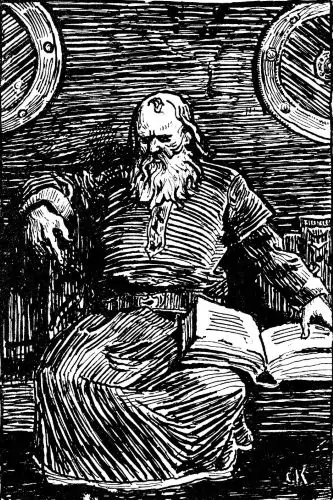
Odin’s possession of Gungnir belongs beside his mastery of poetry because the spear and the poem represent two forms of directed power. Each crosses a distance between its origin and its recipient. The spear leaves the hand, penetrates the body, and alters the victim’s physical condition; the poem leaves the speaker, enters the hearing and memory of an audience, and alters the social condition of the person it praises or condemns. Neither is effective merely because it exists. A spear must be correctly aimed and forcefully cast, while a poem must be shaped through meter, diction, sound, memory, and knowledge of the audience it seeks to move. Gungnir perfects the first process by carrying Odin’s intention without being stopped. Inspired poetry offers a verbal equivalent: language sharpened until it reaches its intended mark.
Odin does not possess poetry as a gentle ornament of civilization. He acquires the mead of poetry through desire, deception, seduction, theft, and transformation. The drink grants access to inspired speech, but the story of its acquisition makes poetic authority resemble captured treasure. Like Gungnir, it comes to Odin from beyond the community of the gods and becomes part of his sovereignty only after dangerous negotiation and unequal exchange. Poetry is another power he appropriates, controls, and redistributes.
Skaldic poetry demonstrates how forcefully inspired speech could operate within courts and warrior societies. Its densely patterned meters, internal rhymes, compressed syntax, heiti, and kennings required technical skill from the poet and interpretive competence from the audience. A successful praise poem could magnify a ruler’s generosity, courage, ancestry, victories, and right to command. It transformed temporary achievements into memorable form and carried a king’s reputation beyond the immediate gathering in which the verse was first performed. A ruler who distributed weapons, rings, and wealth could receive poetry in return, creating an exchange in which material gifts became verbal immortality. The poet did not merely report power; he helped construct it. That constructive power possessed a destructive counterpart. Satire, insult, accusation, and níð could wound reputation, challenge masculinity, expose cowardice, and undermine the honor upon which political authority depended. In a society where public standing shaped alliances and loyalty, hostile speech could function as social violence. A spear injured the body that carried a name, while a poem could injure the name after the body had survived.
The parallel between Gungnir and poetry becomes clearest in their relationship to memory. The spear selects who will enter Odin’s company of the slain; poetry determines how warriors and rulers remain present among the living. Odin governs both processes. Through battlefield sovereignty, he claims the dead; through poetic inspiration, he shapes the language through which death becomes fame, warning, or political inheritance. The skald converts battle into patterned speech, giving coherence to confusion and permanence to an event that would otherwise disappear with its witnesses. Poetry completes what the spear begins. Gungnir penetrates the mortal body and assigns it to death, while verse penetrates cultural memory and preserves the identity of the fallen. Both forms of power depend upon precision, and both can be directed toward praise or destruction. Odin’s spear and his poetry express the same underlying sovereignty: the capacity to choose a target, cross the distance separating intention from consequence, and leave a mark that resists removal.
Gungnir and Mjölnir: Two Models of Divine Power
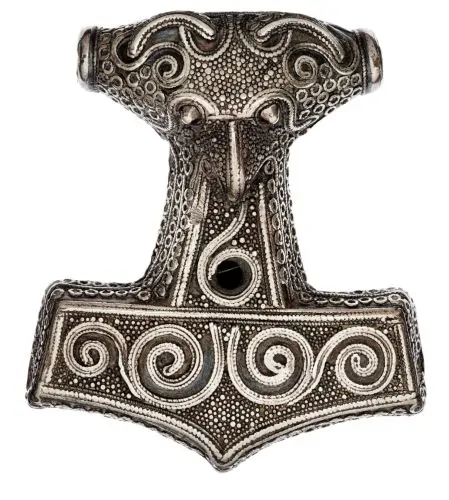
Gungnir and Mjölnir are the two most recognizable divine weapons in Norse mythology, yet they express fundamentally different models of power. Gungnir belongs to Odin, the god of sovereignty, hidden knowledge, sacrifice, war leadership, and the selection of the dead. Mjölnir belongs to Thor, the defender of gods and humans against giants and other forces threatening the inhabited world. Both weapons were produced through the supernatural craftsmanship set in motion by Loki, and both perfect the characteristic powers of their owners. Their similarity ends there. Gungnir directs, marks, and consecrates; Mjölnir strikes, shatters, and restores. The spear represents power exercised through decision and distance, while the hammer represents power exercised through impact and immediate presence. This contrast appears in the movements of the weapons themselves. A spear points toward a chosen target and carries its wielder’s intention across space. A hammer meets resistance directly and destroys it through concentrated force. Gungnir is associated with the opening of conflict, the designation of victims, and the authority to determine who belongs to Odin. Mjölnir is repeatedly used after a threat has already appeared, crushing giants, recovering stolen order, or consecrating people and objects. Odin acts as strategist and sovereign; Thor acts as defender and enforcer.
The different temperaments of the gods deepen this distinction. Odin’s actions are frequently ambiguous, manipulative, and oriented toward distant purposes. He supports kings but may later abandon them, gathers warriors for Ragnarök by allowing them to die, and pursues knowledge through deception, sacrifice, and perilous exchange. Gungnir reflects this form of power because its perfection lies in carrying out a decision whose full purpose may remain concealed from everyone except Odin. Thor’s violence is usually more transparent. A giant threatens the gods, steals an important object, violates a boundary, or attempts to deceive him; Thor responds by reaching for Mjölnir. His methods can be excessive or comic, but his basic function is comprehensible. The hammer does not usually conceal the nature of its judgment. It identifies a danger and removes it.
The treasure contest in Skáldskaparmál makes the hierarchy explicit. Although Gungnir is an unsurpassed spear, Mjölnir is judged the greatest of the divine gifts because it offers the gods their strongest defense against the giants. The verdict does not establish Thor as more powerful than Odin in every sense. It distinguishes the immediate preservation of the divine community from the broader exercise of sovereignty. Gungnir may begin wars and claim armies, but Mjölnir keeps the walls of the ordered world from being overwhelmed.
Their religious and material afterlives also differed. Hammer-shaped pendants survive in substantial numbers from the Viking Age and are generally interpreted as signs connected with Thor, protection, communal belonging, and perhaps resistance to the expanding presence of Christianity. No comparably widespread class of clearly identifiable Gungnir amulets has been established. This imbalance may reflect Thor’s accessibility as a protective deity whose weapon could be worn as a compact and recognizable sign. Odin’s spear carried more dangerous associations with elite warfare, sacrifice, ecstatic knowledge, kingship, and the dead. Gungnir expressed the authority to select and claim, while Mjölnir expressed the power to defend and consecrate. Together, they reveal that Norse divine power was not imagined as a single quality measured only by destructive strength. Odin’s spear governs the meaning, direction, and ownership of violence; Thor’s hammer prevents violence from dissolving the world the gods inhabit.
Gungnir and the Warrior Elite

Gungnir belongs naturally to Odin because the spear was not only a battlefield weapon but also an emblem of command. A ruler carrying a spear could stand behind or before the fighting line, signal the beginning of combat, designate an enemy, and direct the movement of armed followers. In Odin’s hand, these practical functions become cosmic authority. He does not simply fight beside kings; he grants them victory, reveals strategy, legitimizes dynasties, receives their sacrifices, and determines when their usefulness has ended. Gungnir represents the power behind royal violence: the sovereign right to begin war, identify legitimate targets, and transform the deaths that follow into evidence of divine favor.
Odin’s association with rulers was strengthened by genealogical traditions that traced royal houses back to him. Such ancestry allowed kings to claim more than inherited land or military success. It placed dynastic power within sacred history and suggested that charisma, conquest, wisdom, and poetic renown descended from the god himself. The political value of Odinic ancestry was strong in societies where kingship depended upon personal loyalty, martial success, and the distribution of wealth. A ruler maintained authority by attracting capable followers, rewarding them with rings, weapons, land, feasts, and public honor, and leading them successfully in war. The warrior elite surrounding him was not merely an army in the modern institutional sense. It was a social body formed through reciprocal obligation. The king gave gifts, protection, and opportunities for fame; his retainers offered service, counsel, and their willingness to die. Odin’s own hall mirrors this structure. Valhöll is populated by chosen warriors who feast under his authority and prepare to fight for him at Ragnarök. Gungnir stands at the center of this model because it symbolizes the command that binds sovereign and warrior together. The spear in the ruler’s hand directs the violence through which treasure, land, and reputation are acquired, while the spear of Odin claims the elite dead when their earthly service is complete.
The relationship was not secure. Odin’s patronage could raise a ruler above rivals, but it could also make him a desirable sacrifice. The king favored by Odin was valuable precisely because he possessed the qualities the god sought: courage, intelligence, charisma, military skill, and the capacity to command others. Those qualities could produce victory in life, yet they also made the ruler suitable for Valhöll. Odinic kingship was shadowed by the possibility that divine attention would eventually turn from support to possession.
This danger appears throughout traditions in which rulers bargain with Odin, dedicate enemies to him, or lose his protection at decisive moments. The god’s support resembles an unequal political alliance. He grants success without surrendering the right to withdraw it, and the human beneficiary may never know the full terms of the exchange. A king may believe victory confirms permanent divine approval, while Odin may regard that same victory as one stage in preparing the ruler for a later death. Gungnir expresses the asymmetry clearly. The weapon belongs to the god, not to the king. Mortal rulers may imitate its authority by carrying spears, opening battles, and claiming descent from Odin, but they cannot possess its certainty. Their sovereignty remains conditional upon the supernatural power they invoke. The warrior elite also shaped how Odinic authority was remembered. Court poets celebrated rulers as ring-givers, battle leaders, descendants of gods, and companions of the slain. Their verses converted military success into durable reputation and presented the king’s household as a center of order within a violent world. Odin governed this process as patron of both warfare and poetry. Through Gungnir, he represented the power to select and destroy; through inspired speech, he represented the power to preserve the names of those selected. Royal authority consequently depended upon two forms of direction: the spear that organized violence and the poem that organized memory.
Gungnir embodies the ideal and the peril of aristocratic warfare. It represents disciplined command, elite identity, loyalty, conquest, and the ruler’s capacity to turn armed followers into an effective host. This reminds kings that the authority they exercise is an imitation of a greater and more dangerous sovereignty. Odin can elevate a dynasty, receive its devotion, and make its victories famous, but he can also end its fortune with the same decisiveness with which his spear reaches its mark. The royal spear commands the warrior band; Gungnir commands the king.
The Spear in Archaeology and Visual Culture
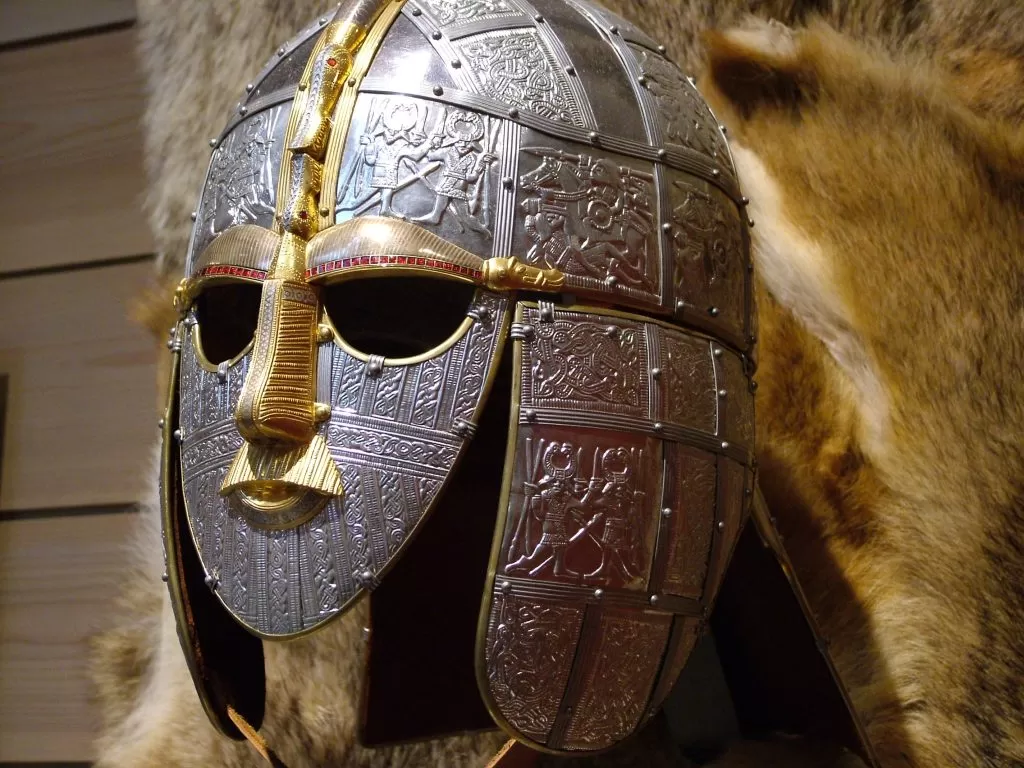
Archaeology offers the possibility of tracing the spear-bearing god beyond the thirteenth-century manuscripts in which Gungnir is named, but it cannot provide a straightforward illustrated history of Odin’s weapon. Images, ornaments, weapon deposits, and miniature objects survive from periods much closer to active pre-Christian religion than Snorri Sturluson’s Edda. They demonstrate that spears carried military, political, funerary, and religious significance throughout Iron Age Scandinavia. Yet an artifact rarely declares which god, hero, ruler, or ritual it represents. Archaeologists must identify figures through combinations of attributes, contexts, recurring motifs, and comparisons with later literature. The result is necessarily probabilistic. A spear may help identify Odin, but a spear alone is never sufficient.
This caution is important because the archaeological evidence spans many centuries. Migration Period bracteates, Vendel Period helmet plates, Viking Age picture stones, and late pagan pendants did not belong to one unchanging visual system. Images could retain old motifs while acquiring new meanings, and stories known in one region or century may have been unknown or differently understood in another. Later written mythology can illuminate earlier art, but it can also tempt interpreters to impose coherence where the material record preserves variation.
Gold bracteates of the fifth and sixth centuries provide some of the earliest visual material frequently connected with Odin. These thin, single-sided pendants adapted elements of Roman imperial medallions but transformed them into a distinctly northern repertoire of oversized heads, riders, horses, birds, weapons, and enigmatic signs. Some scholars have interpreted particular combinations as scenes involving an early form of Odin, especially where a commanding human figure appears with a horse or bird. Related martial imagery occurs on helmet plates and die-impressed metal foils from sites such as Vendel, Valsgärde, Torslunda, and Sutton Hoo. Armed riders, horned or crested figures, weapon dancers, birds, and spear-bearing warriors appear upon equipment associated with elite male burials and ceremonial display. These images may have done more than decorate armor. Worn in halls, processions, or battle, they could have presented the ruler as participating in divine power, temporarily blurring the distinction between human war leader and supernatural patron. Some figures may depict Odin; others may show warriors imitating him, acting under his protection, or performing roles that invoked an Odinic identity. The ambiguity may have been part of their effect rather than a failure of ancient artists to identify their subjects clearly.
The picture stones of Gotland preserve another important body of evidence. Their carved scenes include ships, armed riders, processions, halls, women bearing drinking vessels, battles, executions, and figures sometimes interpreted through myths known from later literature. On the early stone fragment from Stenkyrka church, dated broadly to the fifth or sixth century, a spear appears to fly over a ship and its crew, perhaps cast by a faint anthropomorphic figure above them. The image has been interpreted as a visual counterpart to the Odinic spear dedication described in literary tradition: the weapon may mark the ship’s occupants as doomed, dead, or claimed by the god. Similar flying spears appear or have been proposed on later stones above ships and mounted figures. These identifications remain debated, but they demonstrate that the spear could function visually as more than equipment carried by a warrior. It could be a sign suspended over a scene, indicating divine intervention, fatal selection, or the transition of human beings into the company of the dead.
Miniature spearheads and small spear-shaped objects from Viking Age contexts provide a more intimate form of material evidence. Made from iron, silver, copper alloy, wood, and other materials, they may have been worn on the body or carried among sets of ritual equipment. Their rarity makes it impossible to interpret them as a universal sign of Odinic devotion, but their form, contexts, and association with power and ritual have led scholars to consider whether some served as amulets or insignia connected with Odin. Unlike a full-sized weapon, the miniature spear could make martial and divine authority portable without retaining a spear’s practical function.
None of these objects can be identified securely as Gungnir in the same sense that Snorri’s prose names Odin’s spear. Even where a figure is plausibly Odin, the weapon may represent divine spears generally rather than a specific artifact with the biography preserved in Skáldskaparmál. The danger of circular reasoning is considerable: a figure is called Odin because he carries a spear, and the spear is then called Gungnir because the figure has already been identified as Odin. More persuasive interpretations depend upon clusters of evidence: a missing or emphasized eye, accompanying ravens, an exceptional horse, elite martial context, ritual movement, or a scene corresponding closely to an independently attested tradition. Modern documentation has added another layer of caution by showing that weathering, old painted reconstructions, accidental scratches, and poor lighting can create or erase crucial details. Three-dimensional scanning and reflectance imaging have revised some earlier readings while leaving others unresolved. Archaeology cannot recover Gungnir as a fully visible object with a fixed shape, but it can establish the deeper visual world from which the named spear emerged. Across pendants, helmets, stones, weapons, and miniatures, the spear repeatedly signifies command, elite identity, divine presence, selected death, and movement across the boundary between warriors and the slain.
Human Spears as Reflections of the Divine Weapon
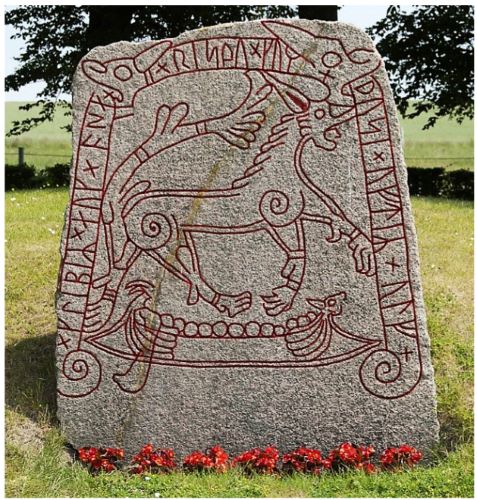
No surviving spear can be securely identified as a deliberate copy of Gungnir, yet human weapons could participate in the same symbolic world as Odin’s divine spear. Warriors did not need to believe that their weapons possessed Gungnir’s exact powers to understand them through Odinic ideas of direction, victory, sacrifice, and possession. A spear carried into battle, marked with an inscription, inherited from an ancestor, or deposited after victory could acquire an identity extending far beyond its practical construction. Gungnir represented the perfect realization of the spear’s purpose, while human spears approached that ideal through craftsmanship, ritual treatment, reputation, and association with particular owners.
Runic inscriptions offer one means by which an ordinary weapon could be distinguished from others of the same general form. Several spearheads and lanceheads from the early Germanic world bear brief inscriptions, though their readings and meanings are often disputed. Some may preserve personal names, weapon names, descriptive terms, makers’ marks, ownership claims, or formulas intended to affect the weapon’s performance. The inscription did not necessarily transform the spear into a magical object, but it attached language to matter and made the weapon identifiable. Naming a spear could grant it a biography, allowing victories, killings, inheritances, and transfers of ownership to accumulate around a stable identity. In a culture where Gungnir’s point was remembered as rune-marked, the inscription of a human spear could also place the weapon within a wider conception of knowledge directed toward violent action. The parallel must remain cautious: a rune-carved spearhead is not automatically an imitation of Gungnir, and no surviving inscription explicitly announces such an intention. Nevertheless, both divine and human weapons could unite craftsmanship, written signs, personal identity, and the expectation that a properly directed point would fulfill its purpose. Heirloom spears could also reflect divine authority through continuity rather than supernatural performance. A weapon transmitted across generations carried the memory of earlier owners and linked the living warrior to ancestral claims. Its value lay not only in metal and wood but in the history attached to it.
The treatment of captured or obsolete spears reveals another dimension of this reflection. Archaeological deposits from Scandinavian wetlands contain weapons that were deliberately bent, broken, burned, dismantled, or otherwise made unusable before deposition. Such destruction was not necessarily contemptuous. Removing a weapon from ordinary circulation could complete its transfer from human ownership to a sacred or commemorative sphere. A spear taken from a defeated army had already participated in a contest of sovereignty; by destroying and depositing it, the victors could convert military success into a lasting offering. The act resembles the logic of Odinic spear-casting in reverse. At the beginning of battle, the cast spear marks an enemy host as belonging to the god; after battle, deposited weapons materialize the transfer by surrendering the defeated army’s instruments of violence. Human spears moved through stages of social existence: manufacture, ownership, combat, capture, ritual destruction, and deposition. Their biographies could mirror the divine spear’s association with command and sacrifice even when no participant consciously identified a particular weapon as a copy of Gungnir. The important similarity lay in the understanding that weapons could be claimed, transformed, and removed from human use through acts carrying religious and political meaning.
Human craftsmanship also allowed rulers and warriors to approach the ideal represented by Gungnir. A finely balanced shaft, carefully forged head, decorated socket, or prestigious inscription could distinguish an elite spear from common military equipment. Such refinement did not grant irresistible force, but it made excellence visible. The weapon testified to the resources of its owner, the skill of its maker, and the social network through which valuable materials and specialized labor were obtained. A leader carrying an exceptional spear could evoke the image of the divine war sovereign without requiring a literal claim to possess Gungnir’s powers. The resemblance was one of hierarchy: as Odin stood above human rulers, Gungnir stood above human weapons.
Human spears should be understood as reflections of the divine weapon rather than failed replicas of it. They could never possess Gungnir’s absolute certainty, but they could imitate its directedness, bear inscriptions recalling the union of runes and violence, embody ancestral or royal authority, and pass through rituals of dedication and destruction. Their imperfections were part of the comparison. A mortal spear could miss, break, be captured, or outlive its owner; Gungnir represented freedom from those ordinary limitations. The divine weapon established the ideal against which human weapons acquired meaning, while human practices gave that ideal recognizable material form. Gungnir magnified the spear already present in graves, halls, battles, and sacred deposits, transforming a familiar instrument of warfare into the supreme emblem of Odin’s power to direct, claim, and consecrate.
The Weapon with a Biography

Gungnir is not important merely because it is effective. Like many legendary weapons, it acquires meaning through the sequence of events, makers, owners, and conflicts attached to it. Its biography begins with Loki’s mutilation of Sif, continues through the intervention of the sons of Ivaldi, and enters the divine world as part of a larger exchange of treasures. From that point onward, the spear becomes inseparable from Odin’s identity. Its significance lies not only in what it can do but in where it came from, how it was acquired, and the kinds of authority it came to represent. This distinguishes Gungnir from an anonymous weapon taken from an armory. A named weapon possesses continuity. It can be recognized across different stories and remembered as the same object even when its appearance is barely described.
The importance of such continuity is familiar throughout Old Norse heroic literature. Swords, spears, helmets, rings, and other objects often pass between generations, linking descendants with ancestors and present conflicts with earlier deeds. Their value grows through use. A weapon may carry the prestige of its maker, the reputation of former owners, the memory of victories, and the danger of curses or obligations attached to its transmission. Human weapons can be inherited, stolen, broken, reforged, buried, or recovered, and each change adds another layer to their identities. Gungnir participates in the same narrative logic at a divine level. The sons of Ivaldi give it the authority of supernatural craftsmanship; Loki’s role attaches it to disorder and compensation; Odin’s possession joins it to sovereignty, sacrifice, runes, and the selection of the dead. The weapon becomes a point where several mythological communities meet: craftsmen make it, a trickster carries it, gods judge it, warriors fear what it signifies, and the dead enter the order governed by its owner.
Its biography also changes the meaning of its perfection. Gungnir is not simply a flawless technological object. Its irresistible thrust becomes more significant because the spear belongs to a god whose knowledge and authority were themselves acquired through ordeal, deception, and sacrifice. The weapon’s properties appear stable, but the circumstances surrounding it are morally and politically unstable. It originates in Loki’s offense, strengthens Odin’s rule, consecrates conflict, and accompanies the god toward a battle whose outcome he cannot reverse. Every stage adds a new tension. The spear represents order but comes from disorder; it expresses sovereignty but depends upon external craftsmen; it guarantees the completion of a thrust but cannot guarantee the survival of its wielder.
The final stage of Gungnir’s biography is marked by silence. Snorri places it in Odin’s hand at Ragnarök, but the surviving sources do not explain what happens to the spear after Fenrir devours him. It is not recovered by Víðarr, transferred to a successor, or preserved as a relic of the fallen world. That absence is significant. Gungnir’s story ends where Odin’s sovereignty ends, leaving the weapon suspended between destruction and the renewed cosmos that follows. Its biography is complete not because every episode is known, but because its known history traces the rise, exercise, and limitation of Odinic power.
Gungnir at Ragnarök
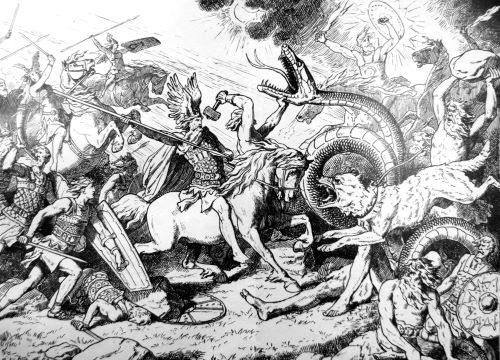
Gungnir reaches the culmination of its mythology at Ragnarök, when Odin rides at the head of the gods and the einherjar toward the final confrontation with the forces of destruction. In Gylfaginning, Snorri Sturluson describes him wearing a golden helmet and magnificent coat of mail and carrying Gungnir as he advances against Fenrir. The scene presents Odin in the fullest visible form of his sovereignty: armored as a war leader, accompanied by the warriors he has gathered from human battlefields, and armed with the spear that embodies his authority over victory, sacrifice, and the slain. Yet the grandeur of the image is shadowed by foreknowledge. Odin does not ride toward an uncertain contest whose outcome might still be changed. He advances toward the death that prophecy has already assigned him.
The surviving account does not describe an elaborate duel between spear and wolf. Odin confronts Fenrir, and Fenrir swallows him. Gungnir is present, but its individual blow is not narrated. That silence sharply distinguishes Ragnarök from modern battle scenes in which legendary weapons receive spectacular final demonstrations of their powers. Snorri does not explain whether Odin casts Gungnir, thrusts it into Fenrir, wounds the wolf, or loses it at the instant of his death. The spear’s presence matters symbolically more than tactically. Odin carries into the last battle the finest weapon available to him, just as he brings the accumulated strength of the einherjar and the knowledge gained through sacrifice, prophecy, and interrogation of the dead. Nothing has been neglected. He has prepared for the crisis across the entire span of mythic history. Nevertheless, preparation does not produce escape. Gungnir’s irresistible thrust can guarantee the completion of a particular act, but it cannot overturn the larger structure of fate within which that act occurs.
Fenrir is a fitting opponent for the spear-bearing god. The wolf had once been contained through deception when the gods persuaded him to accept the fetter Gleipnir, sacrificing Týr’s hand to secure the binding. At Ragnarök, that imposed order collapses. Fenrir breaks free, opens his jaws across the world, and consumes the ruler who had spent ages preparing against him. Gungnir represents direction, hierarchy, and controlled violence; Fenrir represents force that can no longer be bounded by promises, fetters, or divine strategy. Their encounter is more than a contest between weapon and monster. It is the collision between sovereign control and the return of what sovereignty had only temporarily suppressed.
Odin’s death does not remain unanswered. His son Víðarr immediately avenges him by killing Fenrir, though the surviving traditions differ over whether he tears the wolf’s jaws apart or drives a weapon into its heart. Gungnir plays no stated role in the vengeance. The spear does not pass automatically to the son, and Víðarr does not become a new Odin by inheriting it.
The fate of Gungnir after Odin’s fall is left entirely unstated. No surviving source describes it shattered, swallowed with the god, recovered from Fenrir’s corpse, or carried into the renewed world that follows Ragnarök. This absence should not be repaired through invention. The silence binds the weapon’s biography to Odin’s own. Gungnir enters mythology as the material expression of his sovereignty and disappears when that sovereignty reaches its limit. Its final significance lies precisely in its inability to transform perfection into deliverance. Odin carries an unfailing spear, commands the chosen dead, understands the prophecy of his destruction, and still cannot prevent Fenrir from swallowing him. Gungnir at Ragnarök reveals one of the deepest principles of Norse mythology: excellence remains meaningful even when it cannot secure survival. The weapon does not fail by becoming weak or inaccurate. It fails only in the larger sense that no weapon, however perfect, can free its wielder from the fate governing gods and worlds alike.
The Unfailing Spear and the Failure of Its God
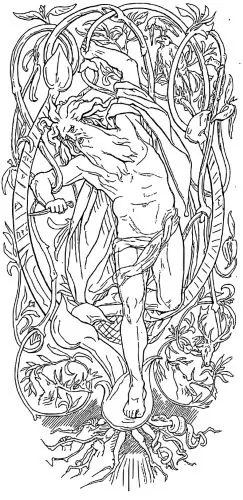
The deepest paradox of Gungnir lies in the difference between the perfection of the weapon and the mortality of the god who wields it. Snorri Sturluson describes the spear as incapable of being stopped in its thrust, yet Odin carries it into a battle in which he is destined to die. The contradiction disappears only if Gungnir’s power is understood precisely. It guarantees the completion of a directed action; it does not grant omnipotence, immortality, or mastery over the entire course of events. The spear may strike exactly as intended while its owner still loses the larger struggle. Its perfection is real, but it is bounded. Odin’s defeat is not caused by defective preparation. He has sacrificed for wisdom, questioned the dead, learned the runes, gathered the einherjar, and armed himself with the greatest spear produced by supernatural craftsmanship. Ragnarök arrives despite all of it.
This apparent failure reveals the distinctive relationship between knowledge and fate in Norse mythology. Odin does not remain ignorant of his doom until the moment Fenrir attacks. He actively pursues knowledge of the future, hears prophecy, and shapes much of his conduct around the catastrophe he expects. His gathering of slain warriors in Valhöll can be read as a sustained attempt to strengthen the divine host before the final battle. Yet foreknowledge does not provide an escape route. It tells Odin what is coming without granting him the power to abolish it. Gungnir occupies the same structure. The spear removes uncertainty from the path of a thrust, but it cannot remove uncertainty or necessity from the cosmos. Odin’s tragedy arises not from blindness but from clarity: he understands the limits of his power and still acts within them.
To describe Odin as a failed god requires qualification. He fails to survive Fenrir and fails to preserve the existing cosmic order, but he does not fail in the sense of refusing his role. He rides to battle, confronts the enemy assigned to him, and participates fully in the struggle whose end he has long anticipated. Nor is his death entirely without consequence. Víðarr avenges him, several gods survive, and a renewed world emerges after destruction. Odin cannot save himself, but the preparations associated with his reign contribute to a history extending beyond his own life. His failure is personal and cosmic, not necessarily moral or strategic in every respect. Gungnir makes this tragic structure visible because it is the object most likely to suggest mastery. A flawless weapon ordinarily promises that skill and preparation will overcome resistance. Norse mythology denies that expectation at the highest level. Odin possesses the spear that cannot be checked, but he faces a fate that cannot be checked either. The meeting of these two forms of inevitability exposes the limits of instrumental power. Weapons can determine how a battle is fought, whom a blow reaches, and what authority the wielder projects, but they cannot guarantee that history will conform to the wielder’s desire. Gungnir succeeds as a spear while failing as a means of salvation.
The result is not nihilism. The mythology does not imply that action is meaningless because doom cannot be escaped. On the contrary, Odin’s advance against Fenrir affirms the value of action even when victory is impossible. Knowledge, courage, preparation, and excellence remain worthy because they define how one meets the end, not because they abolish it. Gungnir symbolizes a severe form of agency: the power to act with precision inside circumstances one did not choose and cannot ultimately master. The spear flies true, Odin falls, and both facts remain equally significant. His death does not expose Gungnir as fraudulent; it exposes the fantasy that any weapon, wisdom, or sovereign authority could place its owner outside fate. The unfailing spear becomes the clearest proof that even divine perfection has limits.
Christian-Era Preservation and Medieval Reinterpretation

Nearly everything known about Gungnir depends upon texts written after the conversion of Scandinavia to Christianity. Iceland formally accepted Christianity around 1000 CE, while the principal manuscripts preserving eddic poetry and Snorri Sturluson’s Edda were produced centuries later. The people who copied, organized, and interpreted these traditions inhabited a religious world different from the one in which Odin had been worshipped. They encountered Gungnir not as the sacred weapon of a living cult but as part of inherited poetry, ancestral memory, learned history, and an increasingly distant pagan past. That distance did not make preservation impossible. Christian scribes could regard the old gods as false while still valuing the stories attached to them. Mythological knowledge remained necessary for understanding traditional poetry, genealogies, place-names, royal histories, and the cultural prestige of the Scandinavian past.
Snorri’s Edda is the clearest product of this double relationship. It preserves an extraordinary body of mythological information, including the account of Gungnir’s manufacture, because skaldic poetry depended upon kennings and allusions that could not be understood without knowledge of the gods. A poet who called battle the “storm of Odin” or referred indirectly to a divine treasure assumed that an audience recognized the myth behind the expression. Snorri explains stories not primarily to restore pagan worship but to make an inherited poetic language intelligible and usable. His work is both antiquarian and creative. He quotes older verse, organizes scattered traditions, supplies narrative connections, and constructs a sufficiently coherent mythology to serve as a handbook for poets. Gungnir survives within this educational project because the spear belonged to the vocabulary of Odinic power.
The Christian framework is most visible in the prologue to Snorri’s Edda, where the pagan gods are presented through euhemerism as powerful human rulers later mistaken for deities. This strategy allowed mythological material to be narrated without affirming its religious truth. The gods could remain culturally important while being placed beneath Christian history. Christian transmission may also have influenced the form in which particular myths reached the manuscripts. Odin’s hanging upon the tree, the destruction and renewal of the world in Völuspá, and the suffering of Baldr have often invited comparison with Christian narratives. Similarities do not prove that medieval writers invented these traditions after conversion, nor should every apparent parallel be reduced to Christian borrowing. Oral poetry could preserve ancient material while also changing through performance, reinterpretation, and contact with new religious ideas. A Christian poet or scribe might recognize pagan images through biblical categories, preserve language that carried several meanings, or reshape inherited traditions without consciously falsifying them. The surviving mythology is neither untouched pagan testimony nor merely Christian fiction. It is the result of a long process in which old stories continued to live because new audiences found ways to understand and reuse them.
Gungnir itself may have been comparatively resistant to overt Christian reinterpretation because Snorri treats it principally as a poetic and mythological object. The spear’s making, supernatural quality, ownership, and presence at Ragnarök fit easily into his organized account of divine treasures. Yet even this apparent simplicity reflects medieval selection. Snorri explains enough about Gungnir to clarify poetic references and Odin’s final battle, but he does not preserve a complete ritual theology of the weapon. Practices once associated with spear dedication, sacrifice, royal authority, or battlefield consecration survive only in scattered poems and later narratives. Modern reconstruction must treat Christian scribes neither as passive windows nor as hostile destroyers. They were active mediators whose literary choices saved Gungnir from disappearance while permanently shaping the form in which the spear can now be understood.
From Antiquarian Curiosity to Romantic Nationalism
The modern history of Gungnir began with the early modern recovery of Old Norse literature as an object of antiquarian study. Scandinavian scholars collected manuscripts, published chronicles, examined runic inscriptions, and attempted to reconstruct the beliefs of the pre-Christian North. Figures such as Ole Worm, Thomas Bartholin, and Peder Hansen Resen treated northern antiquity as a source of evidence about ancestral religion, law, language, and national origins. Their work was shaped by Christian assumptions and by the scholarly methods available to them, but it prevented important textual traditions from remaining confined to scattered manuscripts. Gungnir did not yet possess the independent cultural prominence it would later acquire, yet the recovery of Odin’s mythology made the spear legible as one of the defining objects of the old northern world. Antiquarian scholarship supplied the manuscripts, editions, and historical frameworks from which later poets and artists could build a far more imaginative mythology.
During the eighteenth century, translations and adaptations carried Norse mythology beyond Scandinavian learned circles. Paul-Henri Mallet’s influential account of northern antiquities, translated into English by Thomas Percy, helped popularize the image of a heroic, severe, and martial North as an alternative to the classical Mediterranean past. The Eddas increasingly appeared not as remnants of superstition but as monuments of national poetry comparable to Homeric epic. Odin entered European culture as a northern lawgiver, magician, war god, and ancestral sovereign. Gungnir accompanied him as a recognizable sign of command, though most writers remained more interested in the god’s character than in reconstructing the spear’s limited medieval biography.
Romanticism transformed this antiquarian inheritance into a language of cultural identity. Poets, historians, philologists, composers, and painters treated myth as the expression of a people’s deepest collective character, preserved in language, legend, and heroic memory. In Denmark, Norway, Sweden, Iceland, Britain, and the German-speaking lands, Norse mythology became entangled with debates over national origins, political independence, cultural renewal, and the proper relationship between modern societies and their imagined ancestors. Writers such as Adam Oehlenschläger, Esaias Tegnér, and N. F. S. Grundtvig reworked northern myth and legend for audiences seeking an indigenous heroic tradition. The Brothers Grimm placed Germanic mythology within a vast comparative reconstruction of language and folklore, while later scholars increasingly sought systematic relationships among gods, rituals, and peoples. Gungnir became more than a sparsely described mythological possession. It served as a visual shorthand for Odin’s sovereignty, martial intelligence, and command over the destiny of nations.
Nineteenth-century visual culture helped standardize an image that the medieval texts had left largely undescribed. Illustrators and painters portrayed Odin as an aged, bearded, often one-eyed ruler carrying a long ceremonial spear, frequently surrounded by ravens, wolves, warriors, or storm-darkened landscapes. The spear was given a grandeur appropriate to the god’s newly elevated status as patriarch of the North. Artists supplied ornament, proportions, and visual drama absent from the sources, creating an imagined Gungnir that later audiences could immediately recognize. Repetition gradually made these inventions appear traditional, even when they owed more to Romantic aesthetics than to medieval description.
Richard Wagner’s monumental operatic cycle Der Ring des Nibelungen intensified the modern association between the spear and divine government, although Wagner’s Wotan and his spear do not reproduce Old Norse mythology directly. Wagner combined medieval German and Norse sources, contemporary philosophy, political disillusionment, and his own dramatic invention into a new mythic system. Wotan’s spear bears the treaties and laws supporting his authority, making it an emblem of contracts, rule, and the self-defeating structures of power. This conception helped popularize the spear as the material foundation of the god’s sovereignty, even though it should not be read backward as a faithful account of Gungnir in the Eddas. By the end of the nineteenth century, antiquarian recovery, Romantic nationalism, philology, illustration, and opera had collectively transformed Odin’s weapon. Gungnir had moved from scattered medieval references into the modern imagination as the unmistakable spear of northern divine authority.
Appropriation, Extremism, and the Politics of Odin’s Spear

The modern political life of Gungnir cannot be separated from the broader appropriation of Odin and Germanic antiquity by racial nationalists, fascists, neo-Nazis, and white supremacist movements. The spear’s associations with divine sovereignty, warrior hierarchy, sacrifice, ancestral identity, and uncompromising purpose make it adaptable to ideologies seeking symbols of militant authority. Gungnir may appear in tattoos, insignia, artwork, organizational names, or stylized combinations with runes and other supposedly ancient signs. Yet the weapon possesses no inherently extremist meaning. Its politicization results from modern selection and reinterpretation, not from an ideological message permanently contained within the medieval sources.
The groundwork for such appropriation was laid during the nineteenth and early twentieth centuries, when Romantic nationalism, racial theory, comparative mythology, and occult speculation increasingly transformed the ancient Germanic past into a story of ethnic origins. Norse mythology could be presented as the spiritual inheritance of a supposedly unified Nordic or Aryan people, despite the enormous differences among ancient societies and the fragmentary nature of the evidence. Odin became attractive because he could be interpreted as an ancestral ruler, initiator of warriors, master of hidden wisdom, and god of conquest. His spear reinforced this image by functioning as an emblem of command. Gungnir could be detached from its mythological ambiguity (Odin’s deception, self-sacrifice, dependence upon craftsmen, and eventual defeat) and reduced to a sign of racial will directed toward an enemy. This process replaced the complexity of the medieval god with the simplified authority required by modern political myth.
National Socialism drew heavily upon an invented Germanic antiquity, although neither Adolf Hitler nor the Nazi state operated according to a single coherent pagan theology. Heinrich Himmler and circles surrounding the SS showed particular interest in ancestral symbolism, runes, archaeological claims, and ritualized visions of a racial elite. Their use of Germanic imagery did not amount to a historically faithful revival of Norse religion. It was an ideological program that selected useful fragments from mythology, folklore, pseudoscience, and occultism while subordinating them to racial empire, military obedience, and genocide.
Gungnir was never as institutionally dominant within Nazi symbolism as the swastika, the SS runes, or certain solar and victory signs. Nevertheless, the cultural transformation of Odin into a model of authoritarian leadership created a symbolic environment in which his spear could be interpreted as a weapon of racial sovereignty. Postwar neo-Nazi and white supremacist subcultures expanded this repertoire, often combining the spear with runes, ravens, wolves, helmets, knotwork, and slogans about blood, ancestry, or European identity. Such combinations are frequently designed to remain ambiguous. An image may be recognizable to ideological insiders while still allowing the wearer or organization to deny extremist intent by appealing to mythology, heritage, popular entertainment, or personal spirituality. Gungnir’s relatively limited public familiarity can make it particularly useful for this coded communication. Unlike the swastika, it does not immediately identify its political meaning to every observer. Context is essential. A spear-shaped pendant, tattoo, or illustration cannot be classified as extremist solely because it refers to Odin; interpretation depends upon accompanying symbols, language, affiliations, conduct, and the setting in which it appears.
This ambiguity creates serious problems for scholars, museums, modern pagans, reenactors, artists, and ordinary readers interested in Norse mythology. Treating every representation of Odin’s spear as evidence of extremism falsely grants racialists ownership over a cultural tradition far older and broader than their movements. Refusing to acknowledge appropriation can allow extremist organizations to hide behind claims of harmless historical interest. Responsible interpretation must hold both realities together. Norse symbols are not intrinsically racist, but racists have repeatedly used them to naturalize modern political projects by presenting hierarchy, conquest, and exclusion as ancient ancestral truths.
Modern Heathen communities have been divided sharply over this issue. Inclusive practitioners often reject racial definitions of religion, oppose white supremacy, and insist that devotion to Odin is open to people regardless of ancestry, nationality, sexuality, or ethnicity. Folkish and racialist groups, by contrast, may portray the gods as the exclusive inheritance of biologically defined peoples and use Odinic warrior symbolism to support ethnonationalism. Gungnir consequently occupies a contested symbolic field. It can represent disciplined pursuit of knowledge, the seriousness of oaths, sacrifice, poetic inspiration, or acceptance of fate; it can also be manipulated into a badge of authoritarian purity and racial violence. The task is not to strip the spear of all modern meaning but to expose how meaning is made. Extremist appropriation works by removing Gungnir from the complicated mythology of a wounded, deceptive, knowledge-seeking, and doomed god and turning it into a simple image of domination. Recovering the spear’s historical complexity is itself a challenge to the political myths built around it.
Gungnir in Modern Paganism
In modern Heathen and Norse pagan practice, Gungnir functions less as a reconstructed cult object than as a symbol through which practitioners interpret Odin’s character. Pendants, altar images, ritual spears, tattoos, and devotional artwork may represent commitment to wisdom, disciplined purpose, sacrifice, sovereignty, poetic inspiration, or acceptance of difficult truths. The meanings assigned to the spear vary widely because modern Heathenry is not governed by a single theology or central religious institution. Some practitioners emphasize Gungnir’s unerring thrust as an image of determination, while others connect it with Odin’s authority over battle, the dead, runes, and ecstatic knowledge. Its significance comes not from universal agreement but from its ability to condense several Odinic powers into a recognizable form.
Modern use of Gungnir also demonstrates the difference between reconstructing an ancient religion and creating a viable contemporary one. The medieval sources provide no complete ritual manual explaining how worshippers addressed Odin through his spear, what offerings accompanied such devotion, or whether miniature spears served as standardized personal emblems. Modern practitioners work with fragmentary poetry, saga narratives, archaeological interpretations, comparative scholarship, folklore, and personal religious experience. Some communities attempt to remain as close as possible to historically documented practices, while others openly incorporate meditation, modern ceremonial forms, new prayers, or individually composed rites. A spear placed upon an altar may be understood as a historically inspired sign of Odin without being claimed as an exact survival from the Viking Age. Religious authenticity depends less upon reproducing an unrecoverable ancient ceremony than upon acknowledging where evidence ends and modern interpretation begins.
For some devotees, Gungnir represents the seriousness of commitment. The spear’s inability to be checked once directed toward its goal makes it an attractive symbol of promises that should not be made casually. It may appear in personal rites involving vows, dedications, initiatory decisions, or the acceptance of demanding obligations, even though direct evidence for ancient oaths sworn specifically upon Gungnir remains limited.
The spear’s sacrificial associations can carry equally important modern meanings, though these are usually interpreted symbolically rather than through literal violence. Odin gains wisdom by surrendering comfort, bodily security, and part of himself; his followers may understand sacrifice as the disciplined relinquishment of time, wealth, pride, certainty, or habits that obstruct a chosen path. An offering made before a representation of Gungnir might acknowledge that knowledge and transformation require cost. Yet this symbolism can also become spiritually dangerous when romanticized into self-destruction, coercive authority, or the belief that suffering is valuable merely because it hurts. Responsible practitioners often distinguish meaningful sacrifice from needless harm, emphasizing consent, proportion, and the ethical consequences of vows. Gungnir’s point may represent clarity of purpose, but the mythology of Odin also warns that relentless pursuit of power and knowledge can isolate, deceive, and consume the seeker. Devotion to the spear-bearing god is rarely interpreted as uncomplicated admiration. It can involve sustained engagement with ambiguity, danger, and the limits of personal control.
Gungnir also stands within modern Heathenry’s struggle over ancestry, inclusion, and political identity. Inclusive communities may use the spear to represent courage, knowledge, and devotion available to anyone who approaches the tradition respectfully, regardless of race, nationality, sexuality, or family background. Folkish and racialist groups may instead present Odinic symbols as the exclusive inheritance of biologically defined northern Europeans. The same image can consequently appear in radically different religious environments, making context essential. Gungnir is neither inherently inclusive nor inherently extremist; its modern meaning is created through the community, language, ethics, and practices surrounding it. For contemporary pagans who reject racial ownership of the gods, reclaiming the spear means refusing to reduce Odin to an emblem of ethnic domination. It becomes instead a demanding symbol of purpose shaped by knowledge, sacrifice, responsibility, and the recognition that even the strongest will cannot place itself beyond fate.
Modern Media and the Expansion of Gungnir’s Powers
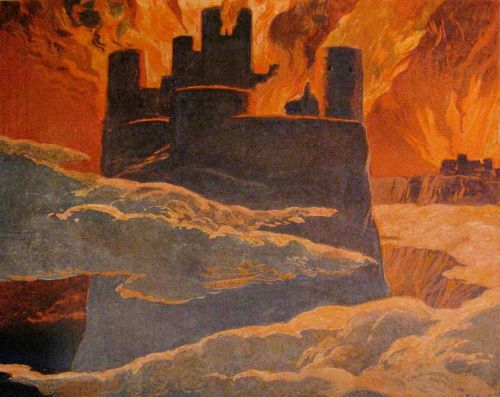
Modern popular culture has transformed Gungnir from a sparsely described divine weapon into a highly specified instrument of supernatural power. The medieval sources identify it as Odin’s spear, credit the sons of Ivaldi with its manufacture, describe its irresistible thrust, associate runes with its point, and place it in Odin’s hand at Ragnarök. Contemporary fantasy usually demands more. Audiences accustomed to rule systems, visual effects, character statistics, and ranked magical equipment expect a legendary weapon to possess an identifiable range of abilities. Gungnir consequently becomes indestructible, self-guiding, capable of returning after being thrown, able to pierce any defense, or charged with lightning, cosmic energy, and reality-altering force. These additions are rarely arbitrary, but they expand brief medieval statements into a complete mythology of performance.
Video games encourage this expansion because weapons must function within systems of measurable difference. A spear called Gungnir cannot merely carry symbolic authority; it must possess superior damage, unusual accuracy, elemental power, or a special attack that distinguishes it from ordinary equipment. In role-playing games, it frequently appears as a rare or late-stage weapon, rewarding players who recognize the name while teaching unfamiliar players that Gungnir belongs among the most powerful spears imaginable. The medieval claim that its thrust cannot be stopped is translated into game mechanics such as ignoring armor, guaranteeing a hit, increasing critical damage, or bypassing resistance. Myth becomes statistics, and symbolic perfection becomes numerical superiority.
Japanese games and fantasy franchises have been influential in detaching Gungnir from Odin while preserving its status as an ultimate spear. The name appears across role-playing games, tactical games, and franchises influenced by global mythological reference books, where it may be wielded by gods, knights, warriors, or characters with no direct relationship to Norse religion. In some settings, “Gungnir” designates a weapon; in others, it becomes the name of a magical attack, military project, machine, missile, or apocalyptic device. Such uses depend upon the name’s accumulated prestige rather than strict fidelity to the Eddas. The audience is expected to hear “Gungnir” and recognize precision, divine authority, penetration, and overwhelming force. A Norse spear can be absorbed into fictional worlds built from Greek, Hindu, Celtic, Christian, and Japanese materials without requiring the traditions to remain historically separate. This process produces a shared international mythology in which famous divine weapons operate as interchangeable signs of power. Gungnir’s original connection with sacrifice, kingship, and the selection of the slain may fade, but its reputation for certainty survives.
Comics and superhero films tend to emphasize Gungnir’s visual and political functions. In Marvel adaptations, Odin’s spear frequently serves as both weapon and royal insignia, reinforcing his position as ruler of Asgard. It may project energy, control destructive forces, or function as a ceremonial object through which authority is recognized and transferred. These powers owe more to the requirements of superhero spectacle than to medieval description. Even so, the combination of scepter and weapon preserves something important about Gungnir’s older symbolism: Odin’s right to govern is inseparable from his capacity to command violence.
The God of War series offers a different transformation by placing Gungnir within a morally critical reimagining of Odin. In God of War Ragnarök, the spear belongs to a manipulative ruler whose pursuit of knowledge has become inseparable from domination, fear, and control. The weapon’s precision suits a character who attempts to direct every person and event toward his own purposes. Its use in fast, spectacular combat gives the spear greater tactical variety than the medieval texts describe, but the adaptation retains the connection between Gungnir and sovereignty. Similar reinterpretations appear in comics, novels, animation, and tabletop games, where the spear may symbolize the authority of an aging king, the danger of forbidden knowledge, or the destructive consequences of refusing to accept fate. Modern media expand Gungnir’s powers not only to create impressive action scenes but also to make the weapon participate visibly in the characterization of Odin.
These adaptations create a feedback loop that reshapes popular understanding of the medieval weapon. A player encounters a returning, lightning-charged, armor-piercing Gungnir in a game, sees similar powers repeated in comics or online summaries, and may later assume that all of them came directly from Norse mythology. Modern inventions gradually acquire the appearance of inherited tradition through repetition. This does not make adaptation illegitimate; myth has always changed as it moved among audiences, genres, and historical circumstances. The scholarly task is to preserve the distinction between reception and attestation. Medieval Gungnir is powerful partly because the sources leave much unstated, while modern Gungnir is powerful because creators fill those silences with visible, measurable, and narratively useful abilities. The expansion of the spear’s powers reveals as much about contemporary expectations of legendary weapons as it does about Odin’s original mythic attribute.
Is Gungnir Really a Major Norse Mythological Object?
The following video from Jackson Crawford is a brief discussion of Gugnir:
The case for treating Gungnir as one of the major objects of Norse mythology is less secure than its modern reputation suggests. Compared with Mjölnir, the spear appears infrequently, receives little sustained narrative attention, and rarely acts as the central mechanism of a myth. Thor’s hammer is stolen and recovered, used repeatedly against giants, employed in consecration, and represented extensively in Viking Age material culture. Gungnir has no comparable sequence of adventures. Snorri Sturluson explains its manufacture, identifies its remarkable quality, and places it in Odin’s hand at Ragnarök, but the weapon does not drive a substantial independent story. Its importance may be secondary and attributive: Gungnir matters because Odin carries it, not because the spear possesses a developed mythological identity of its own.
A stricter reading of the sources further narrows the case. Odin casts a spear over the Vanir host in Völuspá, hangs wounded by a spear in Hávamál, and is associated elsewhere with spear-marked victims, but these weapons are not explicitly named Gungnir. Identifying every Odinic spear as the same named object creates a coherence that the surviving poems do not themselves establish. The association is plausible, and perhaps even likely in some cases, yet it remains an act of reconstruction. Modern interpreters may consequently be transferring the full symbolic weight of Odin’s relationship with spears onto one particular weapon whose direct attestations are much more limited.
The argument can be pressed further. Many qualities attributed to Gungnir belong either to spears generally or to Odin more broadly. A spear can signify command, battlefield initiation, distance, penetration, and the selection of a target without requiring reference to Gungnir. Odin’s associations with sacrifice, kingship, runes, poetry, the slain, and unstable victory are securely rooted in the larger tradition, but the texts do not explicitly state that every one of these powers is concentrated in his named spear. To interpret Gungnir as a symbol of oaths, sovereignty, cosmic verticality, poetic speech, and the entire economy of Odinic sacrifice risks turning an object with a few surviving features into a universal key to Odin’s mythology. The method can become circular: Gungnir is assumed to symbolize everything Odin governs because it belongs to Odin, and Odin’s powers are then cited as evidence that the spear possesses those meanings. Archaeological evidence does not fully resolve the problem. Spear-bearing figures, weapon deposits, runic spearheads, and miniature weapons demonstrate the importance of spears, but they rarely identify Gungnir specifically. The named divine weapon may be far less central to pre-Christian religion than the general image of the spear-bearing god.
Modern reception has magnified this imbalance. Fantasy literature, games, comics, films, online mythographies, and neopagan symbolism often present Gungnir as the Norse pantheon’s supreme spear, equipped with a clearly defined catalogue of powers. Repetition has made attributes such as automatic return, perfect targeting, indestructibility, and universal armor penetration appear traditional even where medieval evidence is absent or ambiguous. Gungnir’s present fame may reflect the expectations of modern audiences more than its prominence in Viking Age storytelling. Contemporary culture prefers named artifacts with distinctive powers, recognizable designs, and measurable superiority, while medieval poetry could evoke divine authority through a single compressed allusion.
Yet these objections do not make Gungnir insignificant. Mythological importance cannot be measured only by the number of surviving adventures devoted to an object. Gungnir appears at crucial points in Snorri’s organization of the mythic world: it is produced during the creation of the gods’ greatest treasures, given to the sovereign deity, defined by irresistible action, and carried into the final battle. Its limited narrative activity may result from the nature of an insignia. A royal crown or scepter does not need to become the protagonist of repeated stories to express authority, and Gungnir may have operated similarly as the recognizable sign of Odin’s command over war and the slain. The strongest conclusion is a qualified one. Gungnir was probably not a mythological object with an independent narrative importance equal to Mjölnir, nor can every Odinic spear motif be assigned to it without caution. Its significance lies instead in the density of meanings concentrated around a small number of attestations. It is major not because it dominates the surviving mythology, but because the moments in which it appears reveal the character and limits of the god who holds it.
Conclusion: The Spear That Could Not Defeat Fate
Gungnir stands among the most concentrated symbols of Odin’s power. Forged by the sons of Ivaldi and acquired through the disorder set in motion by Loki, it embodies supernatural craftsmanship, royal command, ritual consecration, and the direction of violence toward a chosen end. Its point bears the associations of runic knowledge; its cast over an army marks the enemy as belonging to the god; its presence beside sacrifice connects the spear wound with bodies transferred from human society into Odin’s possession. Yet the surviving sources never reduce Gungnir to a simple instrument of destruction. The spear belongs to a deity whose authority extends beyond combat into poetry, kingship, ecstasy, deception, memory, and the gathering of the dead.
Its perfection is best understood as the perfection of directed purpose. Gungnir cannot be checked in its thrust because it closes the distance between Odin’s decision and its physical consequence. It represents the sovereign command that becomes action, the spoken dedication that becomes sacrifice, and the selection that transforms a living warrior into one of the slain. Human spears could fail through weakness, poor balance, resistance, or misjudgment; Gungnir transcends those ordinary uncertainties. Nevertheless, the weapon’s certainty never grants certainty to the world around it. Odin may choose a victim without controlling every consequence of the death. He may open a war without dictating the form of its settlement. He may gather the greatest warriors into Valhöll without ensuring that they will prevail at Ragnarök. Gungnir is absolute within the narrow course assigned to it, while the cosmos remains unstable, contested, and subject to powers greater than any individual act of will.
That distinction explains why the spear’s final appearance is so important. Odin rides against Fenrir wearing the regalia of the divine war leader and carrying the finest weapon supernatural craftsmanship can provide. He possesses wisdom purchased through suffering, knowledge drawn from prophecy, and an army assembled from generations of human battlefields. Nothing in the mythology suggests that he meets his doom unprepared. Yet preparation cannot transform foreknowledge into escape. Fenrir swallows him, Víðarr avenges him, and the sources fall silent about the weapon that had represented his authority. Gungnir does not break, miss, or betray its owner. It simply cannot perform a task no weapon was capable of performing: removing Odin from the fate in which gods, monsters, and the world itself are entangled.
The spear that could not be stopped becomes the clearest measure of what Odin could not command. Its symbolism does not culminate in invincibility but in limitation. Odin can penetrate hidden knowledge, mark sacrificial victims, inspire poets, elevate kings, manipulate battles, and redirect the lives of warriors, but he cannot establish a permanent order exempt from destruction. Nor does the mythology treat this limitation as proof that his striving was meaningless. Odin continues to seek knowledge, gather allies, and prepare for the final struggle even after learning that he will fall. Gungnir accompanies him because it expresses the kind of agency still available within fate: purposeful action, undertaken with full awareness that excellence cannot guarantee survival. The spear flies true, but truth of direction is not mastery of destination. In that paradox lies Gungnir’s enduring significance. It is the weapon of a god who reaches farther than any other, sees more clearly than most, and pays terrible prices for power, yet remains part of the same mortal cosmos he attempts to govern. Gungnir could defeat resistance, consecrate death, and make Odin’s will present across the battlefield. It could not defeat fate.
Bibliography
- Abram, Christopher. Myths of the Pagan North: The Gods of the Norsemen. London: Continuum, 2011.
- Adam of Bremen. History of the Archbishops of Hamburg-Bremen. Translated by Francis J. Tschan. New York: Columbia University Press, 1959.
- Arvidsson, Stefan. Aryan Idols: Indo-European Mythology as Ideology and Science. Translated by Sonia Wichmann. Chicago: University of Chicago Press, 2000.
- Atlus. Shin Megami Tensei V. Tokyo: Sega, 2021.
- Barnes, Michael P. Runes: A Handbook. Woodbridge: Boydell Press, 2012.
- Birkett, Thomas. Reading the Runes in Old English and Old Norse Poetry. London: Routledge, 2017.
- Byock, Jesse L., trans. The Saga of the Volsungs: The Norse Epic of Sigurd the Dragon Slayer. Berkeley: University of California Press, 1990.
- —-. Viking Age Iceland. London: Penguin Books, 2001.
- Calico, Jefferson F. Being Viking: Heathenism in Contemporary America. Sheffield: Equinox Publishing, 2018.
- Cleasby, Richard, and Gudbrand Vigfusson. An Icelandic-English Dictionary. Oxford: Clarendon Press, 1874.
- Clunies Ross, Margaret. Prolonged Echoes: Old Norse Myths in Medieval Northern Society. 2 vols. Odense: Odense University Press, 1998.
- Cook, Robert, trans. Njal’s Saga. London: Penguin Books, 2001.
- de Vries, Jan. Altnordisches etymologisches Wörterbuch. 2nd ed. Leiden: Brill, 1962.
- Dennis, Andrew, Peter Foote, and Richard Perkins, trans. Laws of Early Iceland: Grágás I. Winnipeg: University of Manitoba Press, 1980.
- —-, trans. Laws of Early Iceland: Grágás II. Winnipeg: University of Manitoba Press, 2000.
- Dronke, Ursula, ed. and trans. The Poetic Edda. Vol. II, Mythological Poems. Oxford: Clarendon Press, 1997.
- —-, ed. and trans. The Poetic Edda. Vol. III, Mythological Poems II. Oxford: Clarendon Press, 2011.
- Dumézil, Georges. Gods of the Ancient Northmen. Edited by Einar Haugen. Berkeley: University of California Press, 1973.
- Frank, Roberta. Old Norse Court Poetry: The Dróttkvætt Stanza. Ithaca, NY: Cornell University Press, 1978.
- Gardell, Mattias. Gods of the Blood: The Pagan Revival and White Separatism. Durham, NC: Duke University Press, 2003.
- Goodrick-Clarke, Nicholas. Black Sun: Aryan Cults, Esoteric Nazism, and the Politics of Identity. New York: New York University Press, 2001.
- Guðbrandur Vigfússon and C. R. Unger, eds. Flateyjarbók: En Samling af norske Konge-Sagaer med indskudte mindre Fortællinger om Begivenheder i og udenfor Norge samt Annaler. 3 vols. Christiania: P. T. Malling, 1860–68.
- Gunnell, Terry. “Eddic Poetry.” In A Companion to Old Norse-Icelandic Literature and Culture, edited by Rory McTurk, 82–100. Oxford: Blackwell, 2005.
- —-. The Origins of Drama in Scandinavia. Cambridge: D. S. Brewer, 1995.
- Härke, Heinrich. “Warrior Graves? The Background of the Anglo-Saxon Weapon Burial Rite.” Past & Present, no. 126 (1990), 22–43.
- Harris, Joseph. “Eddic Poetry.” In Old Norse-Icelandic Literature: A Critical Guide, edited by Carol J. Clover and John Lindow, 68–156. Ithaca, NY: Cornell University Press, 1985.
- Hedeager, Lotte. Iron Age Myth and Materiality: An Archaeology of Scandinavia AD 400–1000. London: Routledge, 2011.
- Himmler, Heinrich. Heinrich Himmler: Geheimreden 1933 bis 1945 und andere Ansprachen. Edited by Bradley F. Smith and Agnes F. Peterson. Frankfurt am Main: Propyläen, 1974.
- Hines, John. “Ritual Hoarding in Migration-Period Scandinavia: A Review of Recent Interpretations.” Proceedings of the Prehistoric Society 55 (1989), 193–206.
- Hultgård, Anders. “The Religion of the Vikings.” In The Viking World, edited by Stefan Brink and Neil Price, 212–218. London: Routledge, 2008.
- Ilkjær, Jørgen. Illerup Ådal: Archaeology as a Magic Mirror. Højbjerg: Moesgård Museum, 2002.
- Jesch, Judith. The Viking Diaspora. London: Routledge, 2015.
- Kaplan, Jeffrey. Radical Religion in America: Millenarian Movements from the Far Right to the Children of Noah. Syracuse, NY: Syracuse University Press, 1997.
- Larrington, Carolyne, trans. The Poetic Edda. Oxford: Oxford University Press, 2014.
- Lassen, Annette. Odin’s Ways: A Guide to the Pagan God in Medieval Literature. New York: Routledge, 2021.
- Liberman, Anatoly. In Prayer and Laughter: Essays on Medieval Scandinavian and Germanic Mythology, Literature, and Culture. Moscow: Paleograph Press, 2016.
- Lindow, John. Norse Mythology: A Guide to Gods, Heroes, Rituals, and Beliefs. Oxford: Oxford University Press, 2001.
- MacLeod, Mindy, and Bernard Mees. Runic Amulets and Magic Objects. Woodbridge: Boydell Press, 2006.
- Mallet, Paul-Henri. Northern Antiquities: Or, a Description of the Manners, Customs, Religion and Laws of the Ancient Danes, and Other Northern Nations. Translated by Thomas Percy. 2 vols. London: T. Carnan and Co., 1770.
- Marshall, David W., ed. Mass Market Medieval: Essays on the Middle Ages in Popular Culture. Jefferson, NC: McFarland, 2007.
- Marvel Studios. Thor. Directed by Kenneth Branagh. Burbank, CA: Paramount Pictures, 2011.
- McKinnell, John, Rudolf Simek, and Klaus Düwel. Runes, Magic and Religion: A Sourcebook. Vienna: Fassbaender, 2004.
- McMullen, K. James. “War Words and Battle Spears: The Kesja and Kesjulag in Old Norse Literature.” In Journal of Medieval Military History, vol. 12, edited by Clifford J. Rogers, Kelly DeVries, and John France, 39–50. Woodbridge: Boydell Press, 2014.
- Meulengracht Sørensen, Preben. The Unmanly Man: Concepts of Sexual Defamation in Early Northern Society. Translated by Joan Turville-Petre. Odense: Odense University Press, 1983.
- Miller, William Ian. Bloodtaking and Peacemaking: Feud, Law, and Society in Saga Iceland. Chicago: University of Chicago Press, 1990.
- Mitchell, Stephen A. “Learning Magic in the Sagas.” In Old Norse Myths, Literature and Society, edited by Margaret Clunies Ross, 335-345. Odense: University Press of Southern Denmark, 2003.
- Motz, Lotte. “The Craftsman in the Mound.” Folklore 88:1 (1977), 46–60.
- Nørgård Jørgensen, Anne. Military Aspects of Scandinavian Society in a European Perspective, AD 1–1300. Copenhagen: National Museum of Denmark, 1997.
- O’Donoghue, Heather. Old Norse-Icelandic Literature: A Short Introduction. Malden, MA: Blackwell, 2004.
- Oehrl, Sigmund. “Documenting and Interpreting the Picture Stones of Gotland: Old Problems and New Approaches.” Current Swedish Archaeology 25:1 (2017), 87–122.
- Orchard, Andy. Dictionary of Norse Myth and Legend. London: Cassell, 1997.
- Pálsson, Hermann, and Paul Edwards, trans. Gautrek’s Saga and Other Medieval Tales. New York: New York University Press, 1968.
- Pearce, John. Swords of the Viking Age. Woodbridge: Boydell Press, 2002.
- Pettit, Edward, ed. and trans. The Poetic Edda: A Dual-Language Edition. Cambridge: Open Book Publishers, 2023.
- Price, Neil. Children of Ash and Elm: A History of the Vikings. New York: Basic Books, 2020.
- —-. The Viking Way: Magic and Mind in Late Iron Age Scandinavia. 2nd ed. Oxford: Oxbow Books, 2013.
- Rood, Joshua. “The Cult of Óðinn in the Early Scandinavian Warrior Aristocracy.” In Myth and History in Celtic and Scandinavian Traditions, edited by Emily Lyle, 197–218. Amsterdam: Amsterdam University Press, 2021.
- Saxo Grammaticus. Gesta Danorum: The History of the Danes. Edited by Karsten Friis-Jensen. Translated by Peter Fisher. 2 vols. Oxford: Clarendon Press, 2015.
- Schjødt, Jens Peter. Initiation between Two Worlds: Structure and Symbolism in Pre-Christian Scandinavian Religion. Translated by Victor Hansen. Odense: University Press of Southern Denmark, 2008.
- Schnurbein, Stefanie von. Norse Revival: Transformations of Germanic Neopaganism. Leiden: Brill, 2016.
- Sigurðsson, Gísli. The Medieval Icelandic Saga and Oral Tradition: A Discourse on Method. Translated by Nicholas Jones. Cambridge, MA: Harvard University Press, 2004.
- Simek, Rudolf. Dictionary of Northern Mythology. Translated by Angela Hall. Cambridge: D. S. Brewer, 1993.
- Snook, Jennifer. American Heathens: The Politics of Identity in a Pagan Religious Movement. Philadelphia: Temple University Press, 2015.
- Snorri Sturluson. Heimskringla. Vol. 1, The Beginnings to Óláfr Tryggvason. Alison Finlay and Anthony Faulkes, trans. London: Viking Society for Northern Research, 2011.
- —-. The Prose Edda. Translated by Jesse L. Byock. London: Penguin Classics, 2005.
- —-. The Younger Edda. Edited by Rasmus B. Anderson. Chicago: S. C. Griggs and Company, 1880.
- Steinsland, Gro. Norrøn religion: Myter, riter, samfunn. Oslo: Pax Forlag, 2005.
- Strmiska, Michael F., ed. Modern Paganism in World Cultures: Comparative Perspectives. Santa Barbara, CA: ABC-CLIO, 2005.
- Square Enix. Final Fantasy XIV: A Realm Reborn. Tokyo: Square Enix, 2013.
- Sundqvist, Olof. An Arena for Higher Powers: Ceremonial Buildings and Religious Strategies for Rulership in Late Iron Age Scandinavia. Leiden: Brill, 2016.
- Tacitus. Agricola. Germania. Dialogue on Oratory. Translated by M. Hutton and W. Peterson. Loeb Classical Library 35. Cambridge, MA: Harvard University Press, 1914.
- Tolkien, Christopher, trans. The Saga of King Heidrek the Wise. London: Thomas Nelson and Sons, 1960.
- Vogt, Helle. The Function of Kinship in Medieval Nordic Legislation. Leiden: Brill, 2010.
- Wagner, Richard. Der Ring des Nibelungen. Mainz: B. Schott’s Söhne, 1876.
- Wanner, Kevin J. Snorri Sturluson and the Edda: The Conversion of Cultural Capital in Medieval Scandinavia. Toronto: University of Toronto Press, 2008.
- Wawn, Andrew. The Vikings and the Victorians: Inventing the Old North in Nineteenth-Century Britain. Cambridge: D. S. Brewer, 2000.
- Wells, Peter S. “Weapons, Ritual and Warfare: Violence in Iron Age Europe.” In The Cambridge World History of Violence, edited by Garrett G. Fagan, et.al., 142–159. Cambridge: Cambridge University Press, 2020.
- Whaley, Diana, ed. Poetry from the Kings’ Sagas 1: From Mythical Times to c. 1035. 2 vols. Turnhout: Brepols, 2012.
- Wilson, David M. Vikings and Gods in European Art. Aarhus: Aarhus University Press, 1997.
- Young, Helen. Race and Popular Fantasy Literature: Habits of Whiteness. New York: Routledge, 2015.
Originally published by Brewminate, 07.31.2026, under the terms of a Creative Commons Attribution-NonCommercial-NoDerivatives 4.0 International license.
About the Author