A leaking tank towered over Boston’s North End until it burst in 1919, killing 21 people. The molasses flood exposed neglected warnings and a long fight to hold its owner accountable.

By Matthew A. McIntosh
Public Historian
Brewminate
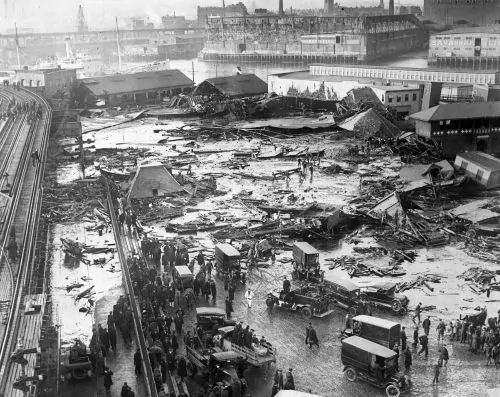
At lunchtime on January 15, 1919, Boston’s North End was struck by a flood that carried buildings off their foundations. The liquid pouring through the streets was molasses. A storage tank on the waterfront had ruptured, releasing about 2.3 million gallons into a crowded neighborhood. Twenty-one people died, and approximately 150 were injured. Among the dead were children and workers going about an ordinary day. The disaster exposed a danger that had stood beside them for years: an enormous industrial container whose apparent solidity concealed serious weaknesses.
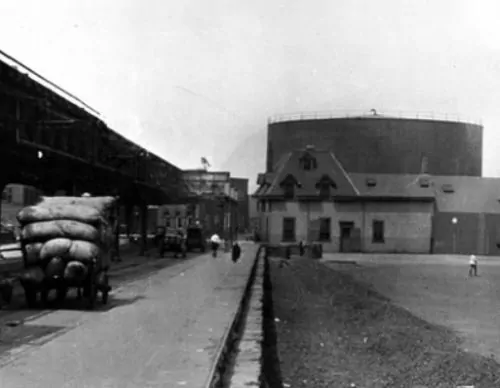
The tank had been built in 1915 to serve a business that reached far beyond the kitchen. Molasses could be distilled into industrial alcohol, which had manufacturing uses that included the production of wartime explosives. Shipments arrived at the waterfront and were stored until the material could be transported to distilleries. The location made commercial sense: access to ships and rail connections helped move a valuable raw material efficiently. Yet that convenience placed a huge volume of heavy liquid close to homes and workplaces. The tank rose about fifty feet above the neighborhood, making industrial storage part of the physical setting of daily life.
Trouble showed itself almost immediately. Molasses seeped through the tank’s seams, and neighborhood children collected the drippings in containers to take home. Complaints about leakage brought a response that changed the tank’s appearance: it was painted brown, making the escaping syrup harder to see. Its strength had never been established through a full water test before it entered service. Later investigations exposed shortcomings in construction and oversight. Holding millions of gallons required walls capable of resisting enormous pressure, and the people responsible had failed to ensure that the structure could do so safely. A tank could remain standing through repeated fillings while still being dangerously inadequate. Each successful use might make the next seem less worrying, even though the underlying weakness persisted. By January 1919, a familiar neighborhood landmark had become a threat whose outward appearance offered little assurance of its actual condition.
Once the tank broke apart, the enormous quantity of molasses gave an ordinarily sluggish substance devastating force. Buildings were damaged or swept from their foundations, and debris became part of the moving flood. People caught in the wreckage faced the additional struggle of escaping a dense, sticky liquid. Naval cadets from the nearby USS Nantucket joined civilian rescuers at the scene. Later research into the fluid’s behavior helps explain why conditions remained so difficult: as the molasses cooled in the winter air, it would have grown thicker. Searching the wreckage and reaching trapped people became exhausting work. Cleanup required sustained effort, with crews pumping harbor water into the affected area to wash away the residue.
In the aftermath, the tank’s owner, United States Industrial Alcohol, argued that anarchists had caused the collapse through sabotage. That explanation placed the disaster within the period’s fears of political violence, directing attention toward an alleged attack. Victims and their families pursued claims against the company, insisting that the tank itself had been unsafe. The resulting proceedings stretched across years and examined the history of its construction and operation. In 1925, court-appointed auditor Hugh Ogden found negligence responsible and rejected the sabotage explanation. Survivors secured compensation, although a legal remedy could scarcely replace those who had died. Establishing responsibility required taking residents’ earlier observations seriously and testing the company’s account against evidence about its own equipment.
The flood’s unusual material can make it easy to remember while drawing attention away from the people whose lives it ended. Its history also reveals how a commercial routine can continue despite visible evidence of danger. Neighbors could observe the leaks, but observation alone did not give them the power to secure repairs or stop the tank’s use. The brown paint remains a particularly telling detail: a warning could be made less conspicuous while the risk remained. Boston’s molasses flood began long before the syrup reached the streets. The danger was already showing through the seams.
Originally published by Brewminate, 10.05.2026, under the terms of a Creative Commons Attribution-NonCommercial-NoDerivatives 4.0 International license.
About the Author