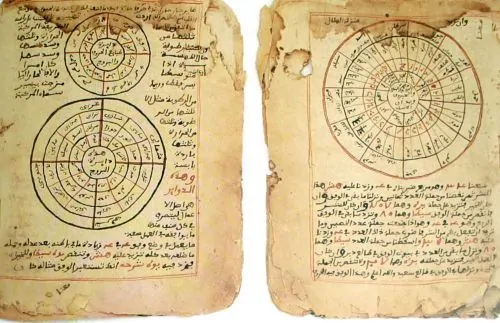
Timbuktu’s manuscripts traveled between scholars and households, carrying lessons and family memories. Their pages reveal a culture of learning sustained through copying and exchange.

By Matthew A. McIntosh
Public Historian
Brewminate
On May 9, 1687, a teacher in Medina certified that a pilgrim from Timbuktu was entitled to teach a book he had studied. The student, Ahmad ibn Muhammad al-Masini al-Tinbukti, had made a copy of a legal commentary. His written authorization, called an ijazah, survives among the holdings of Timbuktu’s Aboubacar Ben Said family library. It names the teacher and traces a chain of instruction back to the commentary’s author. This manuscript carried something useful alongside its principal text. Its owner possessed written evidence that an established scholar had recognized his learning and authorized him to pass it on.
Timbuktu’s reputation for scholarship grew alongside its commercial importance during the fifteenth and sixteenth centuries, especially under the Songhay Empire. Situated near the Niger River in present-day Mali, the city participated in exchanges linking West Africa with the Mediterranean world. Books arrived from North Africa, and scholars traveling on pilgrimage acquired or copied works along the way. Local writers produced their own studies and commentaries. Arabic connected this intellectual activity with a much wider community of Muslim scholarship. Mosques such as Sankore were important places of instruction, and scholarly households maintained collections of their own. Learning depended heavily on relationships between teachers and pupils. A family’s books could support successive generations of study, and access to another scholar’s collection expanded the texts available for consultation. The manuscripts now associated with Timbuktu reflect many households and journeys, including books composed elsewhere that became useful within the city’s intellectual life.
Consider how such a book could work during instruction. A surviving poem by the scholar al-Mukhtar al-Kunti teaches Islamic legal principles concerning orphans and married women. Another manuscript sets out rules governing commercial transactions in verse. The poetic form helped students memorize material they would need to understand and apply. These subjects connected advanced learning with questions about property and obligations between people. The physical construction of many manuscripts also suited their use. Loose leaves were commonly kept inside a leather covering. Catchwords, which repeated the opening word of the next leaf on the preceding one, helped readers keep the pages in order. This format allowed an owner to lend a section of a substantial legal work for another reader to copy or memorize. A scholar seeking guidance on almsgiving might need only the relevant portion of a larger treatise. Students, meanwhile, could build their copies as their instruction advanced. If study stopped before the whole work had been covered, the manuscript might remain unfinished. Some apparently fragmentary documents preserve the actual extent of somebody’s reading or copying. Others lost pages through damage or separation. Their condition requires interpretation, because an incomplete text might have begun as a deliberately selected extract rather than as an entire book.
Within families, the spaces around a text could acquire another purpose. Manuscripts in the Fondo Kati collection at the Biblioteca Andalusí de Tombuctú contain signed marginal notes recording contemporary events and family history, sometimes with dates. Many additions have little connection with the principal work. A book could carry a scholarly text while accumulating a record of the people who owned it. Different handwriting allows researchers to distinguish contributions made by individual relatives. These annotations make the margins valuable historical evidence in their own right.
Keeping books available required labor. Professional copyists worked for payment, and their closing notes, known as colophons, sometimes identify both the person who commissioned a manuscript and the fee. One copyist recorded charging 500 cowrie shells for a twenty-five-page work about Ramadan. Such details place manuscript production within an economy of skilled work. Copying could also serve relationships within a household or a circle of scholars. People made texts for relatives and teachers, as well as for their own use. Some of Timbuktu’s scribes belonged to families whose names recur across surviving collections. Descendants of the Alfa Banya family, associated with the Djinguereber Mosque, copied many manuscripts preserved in its library. A woman named Khadijah al-Awfi, for example, copied a collection of poems, decorating parts of her text in red ink. Collections could grow through the work of their users, with a fresh copy providing another reader access to an existing text. A fee recorded at the end of a manuscript preserves something the main text rarely explains, the cost of putting that knowledge into another reader’s hands.
The dates of the surviving books also extend Timbuktu’s intellectual history well beyond its most celebrated period. The Aboubacar Ben Said collection includes the seventeenth-century manuscript carrying the teaching license, but most of its texts date to the eighteenth or nineteenth centuries. In 2021, catalogers reported that many others had been produced within the preceding fifty years. Its holdings include medical remedies combining Qur’anic verses with local plants and animals, in manuscripts containing Bambara and Fulfulde written in Arabic script. These pages preserve knowledge directed toward bodily and spiritual concerns. A comparatively recent copy can transmit a much older composition, while its annotations document circumstances specific to later readers. The handwriting and the author’s name may belong to people separated by centuries. Each has a place in the history of the book, including the later reader who considered an old work worth copying again.
Originally published by Brewminate, 10.31.2026, under the terms of a Creative Commons Attribution-NonCommercial-NoDerivatives 4.0 International license.
About the Author