New Jersey’s radium dial painters helped prove that their work had poisoned them. Their fight for compensation exposed how corporate denials and legal deadlines could obstruct recovery.

By Matthew A. McIntosh
Public Historian
Brewminate
In 1927, investigators wrapped photographic film around bones taken from the grave of Amelia Maggia, a former watch-dial painter. The bones exposed the film. Radioactive material remained inside her body five years after her death. Two of Maggia’s sisters were among the women pursuing the company that had employed them. For these families, establishing what had happened meant allowing a grave to be opened and a sister’s remains to be tested. Their former employer, the United States Radium Corporation, disputed responsibility for the illnesses spreading among its workers. Evidence had to survive that dispute before it could help pay a medical bill.
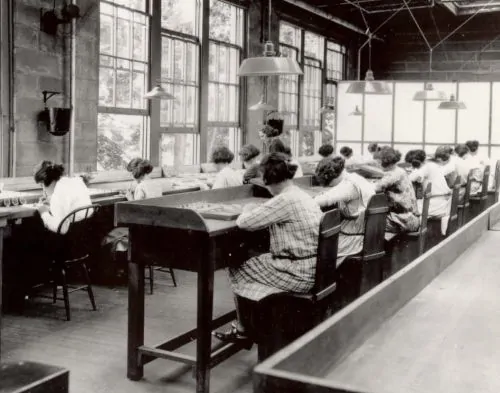
A decade earlier, luminous watches had offered a practical answer to a wartime problem. Soldiers needed to read their watches in darkness without striking a match. At a factory established in Orange, New Jersey, in 1917, young women painted the tiny markings with a mixture containing radium and zinc sulfide. Radiation energized the zinc sulfide, producing the useful glow. Wartime production employed as many as 250 dial painters at the plant, some as young as fifteen. Fine brushwork mattered, and workers were taught to draw their brushes between their lips to restore a sharp point. Each repetition could introduce a little paint into the mouth. Supervisors assured them that the practice was safe. Radium’s reputation helped make those assurances plausible; its medical applications existed alongside extravagant claims for rejuvenating products. Radiation burns were already known to researchers, but knowledge of exposure hazards was uneven, and the consequences of repeatedly swallowing small amounts remained poorly understood. The women were producing a fashionable consumer good under instructions that made their own bodies part of the manufacturing process.
Illness could appear after a painter had moved on to another job. Grace Fryer left the Orange factory in 1920; in 1924, a dentist examining her deteriorating jaw suspected a connection with her former work. Other painters suffered devastating mouth injuries or severe anemia. Radium behaves chemically enough like calcium to become incorporated into bone, where it keeps irradiating surrounding tissue. Leaving the factory did not remove what the workers had swallowed.
Identifying that process required outside investigators and people willing to challenge the company’s account. In 1924, a Harvard team led by industrial hygiene specialist Cecil Drinker examined the factory and recommended protective measures. Company president Arthur Roeder maintained that an infection acquired elsewhere explained the illnesses and threatened legal action against publication of the findings. Alice Hamilton, a physician active in occupational health, then learned through a Consumers League contact that the company had submitted an altered version of the report to New Jersey officials. Its reassuring conclusions contradicted the investigators’ findings. Alerted to this, the researchers published their work. Meanwhile, Essex County medical examiner Harrison Martland and his collaborators assembled evidence of radioactive material retained in workers’ bodies, publishing their findings in 1925. Measurements of living patients and examinations after death connected the workplace exposure with a recognizable occupational disease. For the painters’ legal campaign, physicist Elizabeth Hughes later measured radioactive gas in their breath. Radium decays into radon; detecting that gas helped demonstrate that the contamination persisted inside them. Company counsel challenged Hughes’s qualifications in court, emphasizing that she was currently a housewife and questioning the significance of her results. She explained her testing procedures. The dispute had reached the details of how evidence was produced and who qualified to interpret it. The painters needed scientific allies who could defend their findings under hostile questioning.
Raymond Berry filed suit in 1927 for Fryer and four other former painters, including Maggia’s sisters. As proceedings continued in 1928, the company’s request for a lengthy postponement drew public criticism because the plaintiffs were seriously ill. Their declining health made delay consequential regardless of how lawyers justified it. The women rejected an initial settlement offer that would have deducted medical and legal costs from the proposed payment. In June, they accepted an agreement providing each with $10,000, an annual payment of $600, and coverage of medical expenses under specified arrangements. Publicity and painstaking scientific work had helped them obtain financial support, although treatment expenses remained subject to a committee of doctors. The corporation admitted no liability, and a negotiated payment established no general rule guaranteeing compensation to other painters. Their success depended on resources that another sick worker might struggle to assemble while her condition worsened.
That limit became clear in the case of Irene La Porte, who died in 1931 after Martland diagnosed radium poisoning. Her husband pursued a claim, but in 1935 a federal court refused to prevent the company from invoking New Jersey’s two-year filing deadline. The judge reasoned that the period could have expired in 1922, years before her diagnosis, and concluded that the company’s earlier knowledge did not establish the concealment needed to overcome that defense. Medical causation was accepted; access to a remedy remained blocked. The judge acknowledged the extraordinary situation but left its correction to lawmakers. La Porte had carried radioactive material inside her long after leaving the factory. By the time doctors established what the work had done to her, the legal deadline could already stand between her family and compensation.
Originally published by Brewminate, 10.26.2026, under the terms of a Creative Commons Attribution-NonCommercial-NoDerivatives 4.0 International license.
About the Author