
John de Crophill’s delayed funeral exposes a medieval struggle over customary dues and access to burial, revealing the limits church law placed on financial pressure at the grave.

By Matthew A. McIntosh
Public Historian
Brewminate
Introduction: A Funeral Interrupted
On August 15, 1297, men from Wiverton carried the body of John de Crophill to the cemetery of St. Andrew’s church in neighboring Langar. Their arrival brought them into a confrontation with William, the parish priest, who prevented the corpse from entering for what surviving testimony described as a considerable time. One of the bearers attributed this obstruction to a demand concerning the deceased’s mortuary, a customary obligation arising at death. Another witness confirmed the delay but professed ignorance of its cause. These accounts preserve different degrees of knowledge about an encounter in which the expected reception of a parishioner’s remains became uncertain. Before the disputed financial claim could be examined by higher ecclesiastical authority, the men responsible for transporting Crophill already faced the immediate problem of obtaining his burial.
The alleged demand requires careful definition because a mortuary was not simply a charge for conducting a funeral. It represented a customary claim against a deceased person’s estate, although liability and the property owed could vary according to local practice. The distinction matters for assessing William’s conduct, since possession of a legitimate entitlement would not necessarily authorize every means of securing it. The heading introducing Wiverton’s witnesses accused him of withholding admission until security was supplied for the mortuary, while a bearer’s damaged deposition referred to satisfaction by the executors. Neither passage establishes the amount involved, and neither warrants an assumption that Crophill’s household lacked the resources to meet the demand. Earlier legislation within the diocese of York expressly prohibited denying ecclesiastical burial on the pretext of debt, supplying a contemporary standard against which the allegation can be considered. Such provisions recognized a danger inherent in allowing financial claims to interfere with religious ministrations whose timing could not readily accommodate extended negotiation. The historical question concerns the relationship between an enforceable customary due and an obligation toward the dead that ecclesiastical government itself sought to protect.
Relations between the settlements subsequently became entangled with the maintenance of their shared religious provision. Wiverton possessed a chapel but remained connected to the mother church at Langar, and its inhabitants’ refusal to contribute toward repairs implicated other parishioners who were expected to bear those expenses. Retaliation for the interrupted funeral offers a plausible explanation for the refusal, although the surviving documents do not establish every step connecting the grievances. Langar’s residents had financial interests of their own, while local clergy occupied positions that could require mediation as well as enforcement. Once ecclesiastical censure and the adequacy of canonical warning came into dispute, the controversy reached beyond the priest’s encounter with the funeral party. A disagreement over the treatment of one body had become part of a larger contest over the conditions under which neighboring communities sustained a parish.
Preserved in Archbishop Henry of Newark’s register and examined closely by Andrew Taubman, the evidence permits a detailed investigation without providing a definitive judgment on the burial allegation. Its uneven survival demands discrimination between what witnesses reported, what administrators decided, and what historians can reasonably infer from the relationship between events. The contribution order that survives cannot resolve the separate question of William’s responsibility for obstructing Crophill’s interment. Yet the absence of that determination does not empty the episode of historical significance. The dispute exposes the vulnerability created when people responsible for essential pastoral care also pursued claims against those who depended upon their ministry. It also reveals how objections to their conduct could proceed through ecclesiastical expectations and procedures, even while dividing parishioners whose religious affiliations overlapped. Crophill’s interrupted funeral opens an inquiry into pastoral trust as a practical relationship, maintained through the performance of duties and endangered when participants disagreed over which obligations could properly be made conditional upon others.
August 15, 1297, and the Limits of Reconstruction

The feast of the Assumption provides the clearest chronological marker in the testimony concerning Crophill’s funeral. Henry Paget identified that feast as the occasion on which William obstructed the reception of the body, supplying the basis for dating the encounter to August 15. Its placement in 1297 emerges from relating the deposition to the subsequent warnings around Christmas and Epiphany and to the proceedings recorded under Henry of Newark. A major religious festival could have affected attendance at church and the organization of work, but the documents do not establish how many people witnessed the confrontation. The liturgical date locates the incident within the community’s religious calendar without permitting a reconstruction of a crowded churchyard or a congregation collectively observing the priest’s actions.
Paget’s account gains specificity from his explanation of how he knew what had happened. Asked about the basis of his knowledge, he stated that he had been among those carrying the bier and had heard the exchange. His evidence claimed direct participation in the attempted admission, rather than knowledge acquired through subsequent discussion in Wiverton. The reference to a feretrum supports the presence of a bier, although it tells us little about the equipment used to transport the corpse. A coffin, its construction, and the appearance of the funeral party cannot be supplied from that term alone. Nor does Paget’s participation establish a familial relationship with Crophill, since bearing a neighbor’s body could involve responsibilities extending beyond kinship. What his statement does establish is the position from which he claimed to have encountered William’s intervention. His credibility on the alleged demand rested upon an asserted opportunity to hear it while personally engaged in bringing the deceased for burial.
William’s obstruction concerned the body’s entry into the cemetery and its acceptance for interment. Those are closely connected actions, but neither requires an architectural setting more precise than the record supplies. Despite the usefulness of a churchyard gate as an image of exclusion, no surviving description identifies a gate, a locked entrance, or a physical struggle over passage. The practical significance of the encounter lay in the priest’s reported ability to interrupt the movement from arrival to burial, leaving the bearers unable to proceed as they had apparently expected.
The financial explanation appears through two related components of the evidence. An introductory statement identifies the purpose for which Wiverton produced its witnesses, namely to establish that William would not permit Crophill’s body to enter the cemetery or receive it for burial until security had been given for the principale seu mortuarium. This was a proposition submitted for proof, and its presence at the head of the testimony cannot itself be treated as independent confirmation. Paget’s damaged deposition then connects admission with satisfaction concerning the mortuary by the deceased’s executors. The difference in formulation matters because a statement about security and an incomplete account of satisfaction do not preserve the terms of a fully recoverable agreement. They should be read together without being converted into evidence that William issued two separate demands. The reference to executors also locates the alleged responsibility within the administration of Crophill’s estate; it does not demonstrate that every bearer was personally liable or authorized to pledge its property. If Paget’s account is accepted, the pressure arose from attaching a condition to the reception of the corpse when those accompanying it had already undertaken the work of bringing it to the cemetery.
John son of Walter supplied a narrower account of the same obstruction. He stated that William had prevented the corpse from being carried into the cemetery for a lengthy interval, while expressly declining to identify the cause. His uncertainty does not directly contradict Paget, since the men could have possessed different knowledge of an encounter in which they both participated. But it does prevent their statements from being combined into an undifferentiated body of testimony confirming the financial allegation. John Knycht’s evidence survives only through the abbreviated ut supra, whose precise scope cannot confidently be expanded into a detailed deposition. Adam, the chaplain of Wiverton, and William son of Robert also appear in the witness list, but their inclusion does not supply missing accounts or establish that they heard the condition attributed to the priest. The resulting evidentiary pattern supports a distinction between corroboration of the impediment and corroboration of its explanation, with Paget providing the most explicit surviving basis for the latter. The duration and ending of the encounter remain difficult to recover. John son of Walter’s description conveys an appreciable delay, yet it cannot be translated into a specific number of hours or extended into an assertion that the corpse remained unburied for days. Toward the end of Paget’s deposition, a damaged clause refers to doing what ought to be done concerning the funeral, but the surviving wording does not securely identify the subsequent actions or even settle the subject of the verb. It cannot establish that the bearers obtained admission, arranged burial elsewhere, or completed a certain sequence of rites. Taubman’s reconstruction draws attention to the significance of this fragment, while the printed text preserves the damage that limits its interpretation. No continuous account follows the body from William’s intervention to a known grave. The encounter is most securely understood as a documented interruption whose alleged condition can be examined closely, while its practical resolution remains beyond the surviving testimony.
How a Burial Grievance Survived in an Archbishop’s Register
Archiepiscopal recordkeeping brought Crophill into written history through the business of governing a diocese. Henry of Newark’s register assembled documents concerning the exercise of ecclesiastical authority, including instructions to officials and accounts of contested proceedings. Within that administrative setting, the disagreement involving Langar and Wiverton required decisions about contributions and the enforcement of compliance. The funeral entered this documentary environment because parishioners introduced it into a controversy that had acquired institutional consequences. Its preservation reflects the circumstances under which a grievance became relevant to proceedings before the archbishop. Understanding that route into the record helps explain both the unusual detail available about Crophill and the uneven attention given to the allegation concerning his burial.
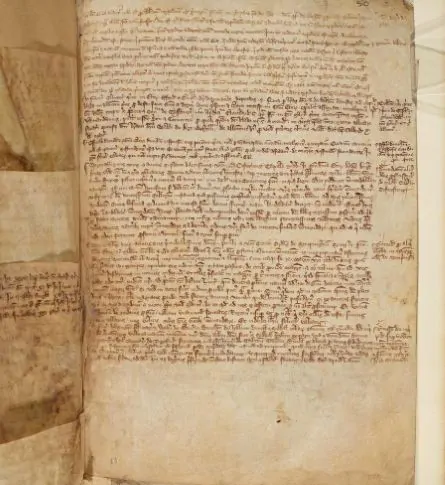
The material now encountered in print also has a more complicated arrangement than the appearance of a continuous account might suggest. Taubman identifies the relevant portions of Newark’s manuscript register at the Borthwick Institute as folios 30r–v, 32r, and 33r–v, describing damage that affects their interpretation. Some associated documents appear to have been inserted, and Brown’s edition identifies an interpolated leaf containing another copy of one document. Related evidence survives across different locations within the manuscript rather than as a single uninterrupted report. Brown brought administrative memoranda and witness material together under his numbered entries, giving modern readers a practicable means of following the dispute. His entry 248, extending across several printed pages, incorporates components whose original functions must be distinguished. The orderly presentation of an edition can make those components easier to consult without resolving every question about their relationship. Manuscript placement, documentary purpose, and editorial grouping each contribute to the form in which the case reaches its readers.
Administrative compression affected the controversy’s written shape as much as physical survival did. An instruction requiring contributions needed to identify the people bound by it and specify how officials should secure obedience; it had less reason to reproduce every grievance raised during the preceding exchanges. Matters that participants considered central to the justice of their position could occupy little space in the resulting direction. That disparity offers an explanation for selective coverage without excluding the possibility of institutional partiality, which requires assessment through the relationship between the surviving documents rather than inference from an omission alone.
Witness evidence introduces a further stage of documentary construction. The men named in connection with the case appeared within a process concerned with establishing defined propositions, and their answers were recorded according to the requirements of that process. Their statements retain traces of individual knowledge, yet they have also passed through questioning and clerical formulation. The Latin record supplies the language in which their evidence was preserved, without necessarily reproducing the precise expressions used during examination. Equally, the production of witnesses gave local people an opportunity to influence which events entered official consideration. Wiverton’s representatives could place the priest’s treatment of Crophill before an authority whose immediate concern extended to the village’s own conduct. Their participation makes the testimony valuable as evidence of deliberate engagement with ecclesiastical government. These are situated interventions by people seeking an outcome, and their purposes form part of the evidence rather than a reason to disregard it.
Chronology presents a revealing test of how the register should be read. Brown dates entry 126, the mandate concerning contributions, to March 13, 1298–9, a notation identifying March 1299 when the year is reckoned from January 1. Entry 248 opens with the appeal of March 26, 1298, but continues with appearances in February 1298–9. Its later portion refers to a pronouncement following an inquiry and directs the reader to the form recorded in the Nottingham archdeaconry section. Taubman proposes placing the contribution instruction earlier in the sequence, partly because its requirement for canonical warning appears to anticipate the subsequent complaint about defective warning. The printed dates and the continuation of the proceedings require that proposal to remain visible as an interpretation. A direction enforcing payment after an inquiry need not be the same administrative act that originally prompted opposition. Nor can the smaller number assigned to an entry establish that its contents preceded material printed later in the volume. Reconstructing the sequence requires attention to cross-references and the distinction between an initial enforcement action and a subsequent restatement of the obligation.
Selective preservation also sets limits on the broader conclusions this episode can sustain. A controversy reaching archiepiscopal attention generated documents that an uneventful parish funeral would have had little reason to produce in the same form. The resulting concentration of evidence around conflict can make obstruction unusually visible while leaving ordinary cooperation largely undocumented.
Crophill’s case cannot establish how frequently priests delayed burials or how commonly mortuary demands produced resistance. Its greater strength lies in revealing the processes through which an allegation was advanced and made available for official consideration. The register preserves criticism of a local priest within records created under ecclesiastical authority, showing that such an archive could accommodate competing accounts of clerical conduct. It offers access to a contested encounter whose survival depended upon the administrative machinery drawn into managing its repercussions.
Langar and Wiverton within a Divided Parish

Langar and Wiverton occupied different positions within an ecclesiastical organization that joined their inhabitants together. St Andrew’s at Langar was the mother church, while Wiverton possessed a dependent chapel whose existence provided local religious provision without dissolving that connection. The governing documents expressly described Wiverton’s residents as parishioners of Langar, making their relationship more substantial than an occasional association between neighboring congregations. Both settlements belonged to the archdeaconry of Nottingham within the diocese of York, an arrangement in which ecclesiastical jurisdiction crossed boundaries that might otherwise appear decisive on a county map. The archbishop’s authority over the controversy followed from this established organization. The relevant community extended beyond either village, although its constituent settlements could develop different expectations about the benefits and burdens of membership.
A functioning chapel gave Wiverton an identifiable center for religious activity close to the community it served. Adam, described in the evidence as its parish chaplain, provided a clerical presence through which ecclesiastical business could be communicated locally. His account of announcements made after the Gospel confirms that the chapel accommodated services and public communication, although it does not establish a complete schedule of worship. Such provision made the settlement more than an outlying collection of households whose religious affairs occurred entirely at Langar. Its inhabitants could encounter ecclesiastical authority through a place and a minister associated with their own village. That experience could encourage a sense of local religious cohesion while remaining compatible with the chapel’s subordinate position. Dependence upon a mother church did not require every activity to take place there, just as access to local ministry did not necessarily bring a separate set of parochial rights. The arrangement allowed proximity in worship and institutional dependence to coexist, leaving room for disagreement when the obligations attached to that dependence became burdensome.
The movement of Crophill’s body to Langar demonstrates one occasion on which the connection between the settlements became active. Those arranging the funeral treated St Andrew’s cemetery as the appropriate destination, bringing the deceased into the sphere of the mother church’s ministry. This action establishes the practical importance of Langar for this burial, without settling the full extent of Wiverton’s privileges or proving an absolute prohibition on burial at its chapel. A local place of worship could serve a community whose arrangements at death still required engagement with another settlement and another priest.
The financial dispute concerned the maintenance of this wider institution. The documents identify contributions toward repairs to the mother church and the enclosure of its cemetery, tying Wiverton’s inhabitants to facilities situated at Langar. These were communal charges whose purpose must be distinguished from the claim against Crophill’s estate. A mortuary arose in relation to a death, whereas the repair obligation sustained property serving the parish beyond the needs of a single funeral. Treating both as money demanded by a priest would obscure the different interests involved and imply a common destination for payments that the evidence does not establish. The upkeep of the church and cemetery concerned the continuing capacity of the parish to provide its recognized functions. Wiverton’s resistance could affect an institution to which its own residents remained attached, even if they considered its administration objectionable. Their position combined participation in parish life with opposition to a demand made within it, a combination that allowed the disagreement to persist without requiring an abandonment of the shared religious structure.
The prescribed assessment also indicates that contribution was conceived in terms of differing resources. Wiverton’s inhabitants were to bear their part according to their lands and means, rather than through an explicitly uniform payment imposed upon every household. The mandate further envisaged an assessment informed by the counsel of all the parishioners or their greater part. This language placed local participation alongside ecclesiastical enforcement, although it supplies neither a numerical formula nor an account of how individual voices were weighted. The settlement described collectively in the proceedings contained differences that could matter to the distribution of costs, even where the written record presented a common position.
For Langar’s inhabitants, maintaining Wiverton’s contribution could be a matter of protecting their own position within that distribution. A refusal by one group threatened the expected resources available for work that other parishioners still supported. Depending upon how the shortfall was managed, it might encourage further demands upon contributors or postpone necessary repairs. Those possibilities gave Langar’s residents reasons to insist upon established arrangements that did not depend upon approval of William’s behavior toward the funeral party. Their interest in securing payment cannot be translated into demonstrated solidarity with him over the burial allegation. The dispute placed people who shared a parish on different sides of a financial question, while leaving their views on other aspects of the controversy incompletely known. Common religious membership supplied the setting for these competing claims; it did not guarantee that concern for a neighboring household would override concern about the allocation of communal expense.
Evidence from a later controversy helps prevent these alignments from hardening into a permanent opposition between the villages. In the mid-fifteenth century, a dispute involving Lenton Priory’s claim to a portion of Langar’s tithes brought testimony from members of both settlements into a common cause. Taubman uses this later material to show how people divided over one obligation could share interests when faced with a different claimant. The interval between the proceedings rules out treating the later witnesses as direct evidence of the intentions of those involved in Crophill’s case. It demonstrates that the institutional relationship joining Langar and Wiverton could accommodate cooperation as well as rivalry. Their separate local identities operated within a parish whose members might defend collective interests against an outside institution while contesting their responsibilities toward one another. “Divided” accordingly describes the configuration of interests exposed by the burial and contribution disputes, rather than a permanent rupture in the religious community. The parish remained the framework through which both settlements could demand support, assert entitlement, and seek an authoritative account of what membership required.
What Christian Burial Required of the Living

Care for the dead began with work performed upon and around the body. Household members and neighbors could wash the deceased, arrange a covering, and attend the remains before their removal for burial, with practices varying according to local circumstances and available resources. These actions gave practical expression to an obligation that survived the individual’s capacity to speak or act, placing responsibility upon others to complete the transition from death to interment. The corpse required attention during that interval, and those undertaking it needed cooperation from people whose contributions might involve physical labor rather than authority over the deceased’s possessions.
Participation in a funeral extended beyond the closest relatives. Neighbors could help carry a body, accompany its movement, and support a household whose usual activities had been interrupted by death. Their involvement made the undertaking communal without requiring every participant to share the same relationship with the deceased. Carrying placed an immediate responsibility upon identifiable individuals, who had to bring the body to the place where the next stage of its reception would occur. Crophill’s bearers were already performing this work when their progress was stopped, so their encounter with William took place after a practical commitment had been made. They had brought the deceased into the custody of a group whose ability to finish its task depended upon cooperation at the destination. The interruption affected an undertaking shared between lay participants and clergy, each providing something the others could not readily supply alone.
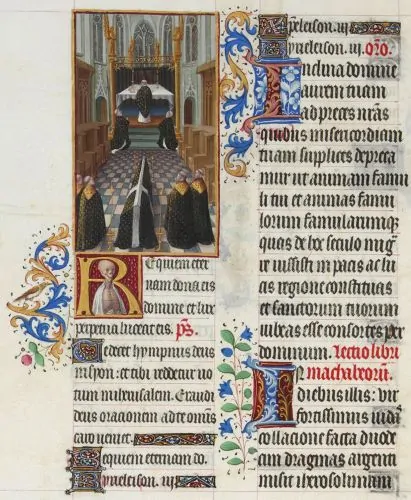
Clerical ministry gave the funeral a liturgical form. The Office of the Dead, with its psalms and readings, belonged to a repertoire of observances through which medieval Christians addressed death, alongside prayers accompanying the body’s movement and interment. These services must be distinguished from ministrations to someone approaching death, including confession, anointing, and communion received as viaticum. The latter concerned a living recipient’s preparation, whereas funeral worship addressed the situation created by death and the needs of those who remained. Timing and elaboration varied, and the surviving Langar evidence supplies no complete account of the offices arranged or performed for Crophill.
Mass for the dead placed the deceased within the intercessory worship of the Church. Its significance arose from the conviction that the living could assist departed Christians through prayer and the offering of the Eucharistic sacrifice. By the late thirteenth century, teaching about purgatorial purification supplied an important explanation of why such assistance mattered after death. Christians who died within the faith might still require purification, and the actions of others could contribute to their spiritual benefit. This understanding encouraged expenditure and effort on behalf of people who could no longer organize those acts themselves. It did not make a funeral a transaction through which a specified observance mechanically secured salvation. Intercession depended upon divine judgment and mercy, and its religious meaning cannot be reduced to the resources committed to it. Nor does this shared doctrinal setting establish the precise understanding of every person involved in Crophill’s funeral, although it helps explain why obtaining appropriate ministry could be regarded as a serious responsibility.
Consecrated ground gave bodily disposition a further religious significance. A cemetery associated the remains with a place of worship in which the living continued to gather, situating the deceased within an enduring community of prayer. Christian expectation of bodily resurrection also gave a theological reason to treat human remains with care, even as death exposed their vulnerability to decay. A churchyard grave expressed that relationship between body, faith, and community without determining the individual’s ultimate spiritual condition.
Responsibility for securing a funeral could overlap with the administration of an estate, but the two activities involved different powers. Executors handled goods and obligations entrusted to them, and, where a testament contained relevant instructions, they might also be responsible for arranging expenditure on religious observances. Those who prepared or transported the body could undertake their work without possessing comparable authority over property. Cooperation among these people was important, especially when an undertaking required resources that only some participants could release or promise. A demand addressed to an executor might become difficult to answer immediately if directed through others who were already attending the corpse. The Langar allegation makes this distribution of responsibility relevant because the condition attributed to William concerned the executors, while the obstruction confronted the bearers. The distinction shows how disagreement over an estate could interfere with work being performed by people whose immediate role was to deliver the deceased for burial.
Ritual also provided an ordered setting in which loss could be acknowledged publicly. Accompanying the body and witnessing its reception allowed participants to act upon their relationship with the deceased, even where their private feelings remain inaccessible to the historian. An interruption could unsettle that ordered sequence, requiring further decisions at a moment when those present had expected to proceed with an established task. The surviving witnesses do not describe their emotional responses, but the practical disruption itself is recorded and should retain its significance without an invented account of grief or humiliation.
Interment completed the disposition of the body while leaving other responsibilities open. Prayers could continue through the ordinary worship of the community, and those with sufficient means might arrange further Masses or anniversary observances. Almsgiving and charitable provision offered additional ways of acting for the benefit of the departed, connecting remembrance with assistance to living recipients. The resources supporting these practices varied considerably, and individual endowments represented only one form of participation in a wider culture of intercession. People lacking elaborate commemorative arrangements could still be included in collective prayers for the faithful dead. Burial belonged to a longer relationship in which surviving Christians remained capable of helping those who had died. Within that relationship, receiving a corpse was an early act of care whose completion enabled others to carry their responsibilities forward.
The Mortuary as a Customary Claim on an Estate

An English mortuary attached an ecclesiastical claim to the disposition of possessions at death. Under an applicable custom, goods belonging to the deceased could become due to a religious recipient as part of the settlement of the estate. The alternative designation “principal” reflected a claim to a leading item among those possessions, although local usage determined what that description meant in practice. In the Langar allegation, the language of principal or mortuary identifies the entitlement William was reportedly seeking to secure. The funeral brought that entitlement into immediate contention, but its customary basis requires examination independently of the service whose performance had become uncertain.
Local usage governed questions that a general definition cannot answer. Establishing a mortuary claim required attention to the circumstances under which someone became liable and the entitlement of the person seeking it. Paul Cavill’s study of early sixteenth-century England supplies extensive evidence of this variability, although its later material cannot establish the rule operating at Langar in 1297. One instructive example concerns a claim at Broadwater in 1507 involving two unmarried sisters. When their father disputed the demand on the grounds of contrary custom, the ecclesiastical court required proof of the usage alleged by the claimant. The disagreement turned upon identifying an enforceable local arrangement rather than simply invoking the existence of mortuaries elsewhere. This comparison illustrates why custom must be treated as something capable of investigation and dispute. An assertion that a payment was customary carried a claim to authority whose substance still depended upon evidence about the relevant place and circumstances.
The property constituting a mortuary could also differ substantially. Later English evidence includes animals and valuable personal possessions, with cash sometimes substituting for the object otherwise due. The familiar description of a mortuary as the deceased’s second-best beast captures one arrangement arising where a superior claim, commonly a manorial heriot, took precedence. A heriot derived from lordship or tenancy, giving it a different foundation from the ecclesiastical usage supporting a mortuary. Both might become payable after the same death, and even reach the same institution, without becoming a single obligation. Such variation makes it important to resist supplying Crophill’s disputed due with a livestock valuation or an identifiable possession that his record does not name.
Religious explanations gave these claims meanings beyond the transfer of an asset. One justification associated the mortuary with omissions in the deceased’s payment of tithes, presenting it as a means of addressing obligations that might have remained imperfectly discharged. That explanation did not necessarily amount to an account of a specific unpaid sum, still less proof that every person owing a mortuary had deliberately withheld ecclesiastical income. Cavill notes testamentary evidence in which a mortuary appeared alongside a separate provision for forgotten tithes, demonstrating that the two could be distinguished by those arranging their affairs. The duty could possess an accepted religious rationale without functioning as a precise calculation of lifetime arrears. Its appearance in wills also complicates an interpretation based wholly upon unwilling surrender. A testator might acknowledge an established liability while incorporating its discharge into a personally directed settlement. The testamentary form expressed participation in that arrangement, although it cannot by itself establish that payment would have been optional in the absence of the bequest.
From the recipient’s perspective, a mortuary could represent a continuing institutional entitlement as well as an immediate receipt. Allowing a customary due to lapse might weaken the practical recognition upon which later claims depended, giving an incumbent reasons to pursue it beyond the value of a single object. Clerical vigilance could arise from an understanding of responsibility for preserving rights attached to a church, even where collection also supported the person exercising ministry there. This possibility broadens the range of motives worth considering without establishing William’s financial position or identifying who would ultimately have retained the property sought from Crophill’s estate.
The allegation that William required security introduces a further distinction between possession of an asset and assurance of future performance. Security could reduce uncertainty about whether an entitlement would eventually be honored while leaving delivery to a later stage. A condition framed in those terms need not imply an insistence upon cash immediately available beside the corpse. It could impose a substantial commitment, because providing assurance meant accepting responsibility for something still to be discharged. The surviving wording does not reveal the arrangement contemplated at Langar, and its reference to security cannot be expanded into a known agreement about valuation or delivery. Its analytical importance lies in the relationship between the assurance reportedly sought and the admission being withheld. Even if the intention was to permit later settlement of the mortuary, making burial conditional upon that assurance would still have brought the timing of interment into the management of the claim.
A legitimate entitlement and an acceptable method of collection required separate justification. Recognizing that distinction prevents the financial issue from being decided merely through sympathy with either the funeral party or the clergyman seeking satisfaction. Crophill’s estate might have owed a mortuary under a defensible custom while the alleged obstruction remained open to criticism on other grounds. Conversely, an objection to the priest’s conduct would not automatically extinguish an otherwise valid duty. The decisive issue becomes the point at which efforts to protect ecclesiastical income were permitted to interfere with obligations toward the deceased, a boundary that contemporary legislation expressly addressed.
Ecclesiastical Limits on Financial Pressure
Archbishop Walter de Gray’s legislation addressed debt directly in regulating access to religious ministry. It prohibited the denial of communion or ecclesiastical burial on the pretext of an unpaid obligation, placing both within a rule against financial obstruction. The reference to any debt gave the provision a broad scope, rather than reserving protection for a narrowly defined category of claim. Its relevance to Langar lies in the existence of an established York standard under which a creditor’s interest could not automatically determine whether a body received burial. William’s reported conduct can be examined against a prohibition belonging to the ecclesiastical order within which he exercised his ministry.
Legislation associated with Archbishop Godfrey Ludham expressed a related restriction through the language of pastoral responsibility. Its opening comparison presented parents as providing for their children, invoking a relationship in which care imposed duties upon those possessing authority. The provision then condemned demands or exactions for funerals and burials, alongside other ecclesiastical acts, even when custom was advanced as their justification. Archdeacons and their officials were included among those addressed, extending the concern beyond misconduct by individual parish priests. Such breadth matters because it located the possibility of abuse within several levels of ecclesiastical administration. The regulation sought to prevent religious acts from becoming conditional bargains, and its reference to simony gave that concern a moral seriousness exceeding ordinary disagreement over accounts. An appeal to established practice required scrutiny when the practice alleged amounted to compulsory payment for ministry. Custom possessed authority within ecclesiastical government, but its invocation could not by itself make every demand acceptable.
Simony concerned the improper exchange of spiritual things for material advantage. Burial belonged within this wider concern about religious ministry without becoming one of the seven sacraments. The grouping of funeral observances with other ecclesiastical acts directed attention to the danger of making their provision depend upon a financial bargain. It did not establish that every gift, customary due, or material expense associated with a funeral constituted the same offense, since the character and conditions of an exchange mattered to its assessment.
The Fourth Lateran Council of 1215 articulated that distinction with specific clarity. Canon 66 condemned clerics who demanded payments for funeral rites and manufactured impediments when their expectations were unmet. The council recognized obstruction itself as a possible instrument of extraction, making the passage closely relevant to an allegation that reception of a corpse had been withheld until an assurance was supplied. Yet the same canon also defended pious and praiseworthy customs against malicious lay attempts to overthrow them. Its criticism operated in both directions, resisting clerical exactions while refusing to authorize a general withdrawal from recognized obligations. The local bishop was to restrain wrongful challenges once the facts had been established, a qualification that made investigation central to the exercise of authority. Read alongside the York provisions, the canon required a distinction between maintaining an entitlement and erecting an improper obstacle to ministry. These connected sources came from different legislative settings and should not be flattened into a single national rule with an identical history of enforcement everywhere.
Written prohibitions also need to be distinguished from the knowledge possessed by people making a complaint. Nothing in the surviving Langar material demonstrates that Wiverton’s inhabitants had read these enactments or cited their wording when challenging William. Their expectations could have arisen through participation in parish life, without depending upon familiarity with a formal legal text. Correspondence between those expectations and an ecclesiastical prohibition would make their grievance intelligible within the Church’s own standards, although it would not establish the intellectual route by which they reached it. The legislation supplies a basis for historical assessment while leaving individual understandings incompletely recoverable.
Applied to Crophill’s case, the strongest conclusion remains conditional upon the reported demand. If William made admission for burial dependent upon satisfying or securing the mortuary, his action conflicted with a recognized prohibition against withholding burial for debt. Establishing that conflict would still require a judgment about what occurred, and the surviving proceedings do not provide a conviction for simony or mortuary extortion. Nor would a finding against the priest automatically settle every obligation disputed by the villages. Contributions toward the mother church and cemetery supported a communal institution, and any claim that misconduct released parishioners from those contributions would require its own justification. Ecclesiastical regulation provided grounds for criticizing financial pressure without making resistance to every related demand self-validating. The same framework that limited a priest’s leverage could continue to require parishioners to support obligations properly established against them.
From an Interrupted Burial to Withheld Contributions

Withholding support changed the scale of the confrontation. The men accompanying Crophill had encountered a decision affecting the reception of one body, whereas the refusal to contribute concerned obligations attributed to Wiverton’s inhabitants more broadly. A grievance arising during a funeral had become associated with the maintenance of the institution expected to receive the deceased. That enlargement brought people without any demonstrated responsibility for Crophill’s estate into a controversy extending beyond its settlement. Explaining the connection requires attention to how an objection against William could acquire collective force through an obligation that his parishioners possessed some practical ability to resist.
Several dated episodes make a retaliatory interpretation plausible without establishing an uninterrupted chain of events. Within Taubman’s reconstruction, the August funeral preceded the warnings described around Christmas and early January. Testimony also refers to an official instruction dated October 19, indicating an intervening stage in efforts to obtain compliance. These references establish that the contribution dispute had generated enforcement activity by the period covered by the witnesses’ accounts. They do not identify the day on which support was first withheld or preserve a declaration explaining the refusal. An earlier disagreement about repair obligations remains possible, and Crophill’s treatment could have intensified an antagonism already developing for other reasons. Equally, the funeral may have supplied the principal stimulus for opposition that subsequently acquired additional justifications. The surviving sequence favors consideration of a connection while leaving the precise origins of the financial resistance open.
Collective action would also have required the grievance to become intelligible beyond those present at the cemetery. The differences in knowledge visible among the witnesses suggest that participants did not all possess the same explanation of William’s intervention. People deciding whether to support a response could have relied upon the accounts and judgments of others. A claim involving funeral ministry was capable of carrying significance beyond Crophill because the practice alleged concerned circumstances that other households might eventually encounter. Supporting resistance could express concern about the terms on which their own dead would be received, as well as solidarity with those immediately affected. Taubman’s suggestion of a temporary coalition helps explain this possible movement from a limited encounter to a broader refusal. Yet it remains an interpretation of mobilization rather than evidence of a recorded meeting or a formally adopted communal policy.
Contributions offered an available means of sustaining pressure after the immediate encounter had passed. Those expected to provide support could impede its collection even though they lacked authority to direct the priest’s ministry. Because maintenance required cooperation whenever expenditure became necessary, resistance could prolong a disagreement beyond the occasion that had first drawn attention to it. This gave refusal a potential strategic value, although the documents reveal neither an agreed timetable nor a stated condition under which Wiverton would resume contributing.
The pressure was indirect, and its effects could extend beyond the person whose behavior had provoked complaint. The mortuary claim concerned property sought from an estate, while repair contributions supported facilities maintained for the parish. Withholding the latter did not simply recover the former or deprive William of an equivalent personal receipt. It interfered with a separate arrangement involving other contributors, whose expectations could be disturbed regardless of their judgment about the funeral. That displacement helps explain how an attempt to obtain acknowledgment of one grievance could create another. The refusal might make the underlying complaint harder for ecclesiastical authorities to ignore, while also giving fellow parishioners reasons to demand enforcement against Wiverton. Its effectiveness as leverage carried a risk of redirecting attention toward the conduct of those seeking redress. The response could widen the audience for the burial allegation while weakening the willingness of others to accept the means chosen to pursue it.
The procedural setting in which the funeral grievance appears makes this tension important. Wiverton’s inhabitants raised the treatment of Crophill within proceedings arising from demands placed upon themselves, rather than through a separately preserved initial prosecution of William. Introducing the funeral could give a different account of why cooperation had failed, challenging any description of their behavior as simple disregard of parish obligations. A genuine grievance could also be strategically useful, since establishing misconduct by the priest might strengthen their position in seeking accommodation. This possibility does not determine whether their refusal was justified, but it clarifies why the earlier encounter remained relevant once the dispute concerned contributions and sanctions. The parties were contesting responsibility for the deterioration of relations as well as the immediate requirements of compliance. Such a response need not have rested upon a single motive shared equally throughout Wiverton. Concern about Crophill’s reception could coexist with dissatisfaction over expenditure, and households might support the same refusal for different reasons. The records do not allow those considerations to be ranked securely. What they show is a situation in which resistance to one exercise of authority became entangled with the performance of another obligation, exposing the resisters to claims against their own conduct. Each additional disagreement could make accommodation more demanding by increasing the matters requiring resolution. The resulting controversy drew its force from that accumulation, as the alleged failure at the funeral became inseparable in practice from a dispute over how the parish would continue to be supported.
Cemetery Maintenance and the Interests of Other Parishioners
Protecting a cemetery required continuing attention to the boundary separating it from surrounding uses of land. Consecration established the ground’s religious character, but a physical enclosure helped preserve the conditions appropriate to that character. Its upkeep could require resources at intervals unrelated to the occurrence of a funeral. Those responsible for providing them sustained a place whose function continued between burials and beyond the concerns of any single household. At Langar, the disputed contributions connected this material responsibility with the parish’s arrangements for maintaining its mother church.
York legislation addressed cemetery enclosure through a combination of prescribed purpose and local flexibility. A provision examined by Taubman sought to prevent burial grounds from being fouled by animals and required their enclosure by those upon whom the responsibility customarily rested. It permitted a wall, a hedge or fence, or a ditch, allowing different forms of protection rather than imposing masonry as a universal requirement. The choice of means could accommodate local conditions while pursuing the same protective end. Equally important was the reference to customary responsibility, which left the identification of those liable dependent upon an established arrangement. The enactment supplied no single distribution of costs applicable without qualification to every settlement. Determining how Wiverton should contribute required more than demonstrating that cemetery protection was desirable. It required an account of how the relevant burden belonged to its inhabitants within the organization of the parish.
The same provision also addressed conduct involving the animals themselves. It threatened a penalty against those permitting their own or others’ animals to graze within the cemetery, recognizing a responsibility distinguishable from supplying its enclosure. Adequate protection involved both maintaining a boundary and controlling activities that could defeat its purpose. The rule establishes a contemporary concern about animal fouling, although it provides no evidence that livestock entered Langar’s cemetery during this dispute or caused the repairs under discussion.
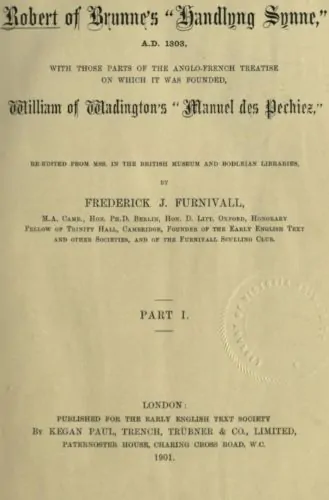
Pastoral literature offers a useful comparison with that legislative concern. In Handlyng Synne, begun in 1303, Robert Mannyng recounts an episode in which broken churchyard walls allow a knight’s animals to enter and foul the ground. A local man rebukes the knight, whose eventual response is to enclose the cemetery so that the animals cannot return. The episode locates responsibility within relationships of local power, making the conduct of a lord and those tending his animals subject to religious criticism. Its moral force depends upon treating the burial ground as a place whose protection could be demanded from someone possessing the means to provide it. The narrative also allows a person of lower standing to articulate that demand, giving care for sacred space an authority exceeding the immediate social rank of the speaker. Mannyng’s suggestion that churchyard walls were often broken remains a literary generalization, not a measurable account of their condition. Nor can this near-contemporary story be transferred to Langar as an explanation of the actual defect there. Its value lies in showing how neglect of an enclosure could be understood as a failure of responsibility toward the dead.
The Langar proceedings joined church repair with cemetery enclosure without making them physically identical undertakings. Maintaining a building and protecting the boundary of a burial ground could involve different work, even when contributions toward both formed part of the same controversy. The proposed assessment according to lands and means situated those expenses within a distribution of resources across the parish. It did not calculate responsibility simply by counting how many funerals each household had recently required. The cemetery’s continued availability made its protection a recurring concern whose costs could reach people with no immediate burial to arrange.
Langar’s inhabitants had grounds for pursuing contributions independently of William’s personal interest in Crophill’s mortuary. Their appearance as a party seeking compliance indicates that enforcement answered a concern extending beyond the priest’s receipt of a customary due. If expected support failed to arrive, the arrangements under which work was undertaken became less dependable, potentially requiring other contributors to respond to a shortfall or accept delay. The evidence does not establish a quantified increase in anyone’s payment, and that possibility should not be converted into an accomplished transfer of the entire burden. It explains why residents could regard Wiverton’s refusal as an injury to their own position. They might seek to preserve the contribution arrangement while holding an unfavorable opinion of the obstruction at the funeral. Their demand for enforcement cannot settle their judgment of that episode, just as sympathy for Crophill would not necessarily have persuaded them to absorb its financial repercussions. The proceedings brought these interests into a common forum without demonstrating that those pursuing them shared a single view of the priest.
Responsibility for the cemetery extended across activities that no one participant fully controlled. Those expected to contribute toward an enclosure were not necessarily identical with those managing animals near it, while the people arranging a burial depended upon protection maintained through earlier cooperation. This distribution of duties made the ground a continuing object of negotiation as well as devotion. A demand for repair contributions could defend an important communal provision and still encounter a legitimate challenge over the way compliance was sought. Once coercive measures entered the controversy, the existence of a maintenance obligation could no longer answer every objection to enforcement. The adequacy of the warnings preceding those measures became a question with consequences of its own.
The Right to Challenge Procedure

The enforcement of contributions depended partly upon steps taken before resistance was punished. Canonical monition, a formal warning, gave those addressed notice of what ecclesiastical authority required and an opportunity to comply before further action followed. The contribution mandate preserved in Newark’s register expressly required legitimate warning before officials compelled payment through ecclesiastical censure. Observance of that condition formed part of the authority being exercised, rather than an optional courtesy toward reluctant contributors. Disagreement about whether a warning had been properly delivered could become a substantial issue even where an obligation to contribute remained enforceable.
Adam’s testimony provides the most detailed surviving account of the announcements at Wiverton. He referred to an instruction dated October 19, directed to the priests of Langar, Wiverton, and Berneston, requiring action concerning attendance at the mother church and contributions to its maintenance. Acting upon that authority, he said, he warned the inhabitants in Wiverton’s chapel. Asked about the occasions, he identified four feast days, three before Christmas and one afterward. This was an account of the announcements he claimed to have made, not a statement that every canonical warning required four repetitions. Although he could not recall all the dates, he placed the final monition after the Gospel on the Sunday immediately preceding Epiphany. Within the chronology reconstructed from the testimony, that Sunday was January 5, 1298. His recollection combined uncertainty about some earlier occasions with a more definite account of the last announcement.
The competing assertions left the validity of the process unresolved. William maintained that the mandate had been duly executed, while Wiverton’s inhabitants denied that they had received canonical warning. Adam’s evidence introduced a further distinction, since he denied that William had warned them in Wiverton’s chapel but described announcements that he himself had made there. Issuing instructions, performing the required acts, and establishing their legal adequacy were separable matters. The surviving statements do not fully explain why the inhabitants regarded the warning as defective, and their denial of canonical monition cannot safely be reduced to a claim that no announcement of any kind had occurred.
Publication of the sentence followed the final warning, according to Adam, on the next Sunday, January 12. His account also associated postponement with hopes of obtaining a remedy when the archdeacon arrived. The official subsequently suspended Adam for delaying, showing that those responsible for carrying out enforcement could themselves become subject to discipline. The scope of that suspension is not established sufficiently to describe it as permanent removal from ministry. Its occurrence reveals pressure upon an intermediary whose conduct affected when sanctions reached the community. For the inhabitants against whom excommunication was pronounced, the measure brought ecclesiastical standing into the effort to secure obedience. It gave the financial disagreement a coercive force extending beyond an ordinary request for payment. That escalation made the regularity of the preceding steps impactful, since an asserted defect now concerned the foundation of a serious religious censure.
On March 26, 1298, inhabitants of Wiverton appeared before Henry, then styled archbishop-elect, and complained that they had been excommunicated without prior canonical warning. Their appearance carried the objection upward within ecclesiastical government, requiring an answer from those responsible for the sentence. The recorded action demonstrates a practical capacity to challenge enforcement through the Church’s own hierarchy. It does not establish a uniformly accessible remedy for every parishioner, but it shows these complainants pursuing review rather than simply treating the sanction as something they could disregard. Henry responded to the disputed process by absolving those present after they swore to obey the Church’s commands. He delegated the absolution of absent inhabitants to the vicar of Granby under comparable conditions. This relief addressed their position under the censure while preserving an undertaking of ecclesiastical obedience. It neither canceled the contribution obligation nor established that Adam’s account of warning was false. The official and William were required to justify the process and supply proof concerning the monition. Questions about what the inhabitants owed could remain open to determination after their immediate position under the sentence had been addressed. The response separated restoration from complete vindication, allowing further examination without requiring the complainants to concede that the challenged enforcement had been regular.
Procedure supplied more than a technical interruption in the collection of parish income. It made the conduct of enforcing clergy an object of inquiry alongside the conduct of those refusing to contribute. An official’s assertion that instructions had been issued could be tested against evidence about their execution, while parishioners’ objections also required examination rather than automatic acceptance. The dispute changed shape when compliance became inseparable from demonstrating that authority had proceeded correctly. Henry’s intervention maintained the possibility of enforcing a financial obligation while recognizing that the means already employed remained contestable. The resulting inquiry required ecclesiastical government to account for its own actions as it sought to regulate those of the parishioners.
Henry of Newark’s Intervention

Henry directed the controversy toward a question that could be answered through inquiry into established usage. The represented parties accepted his investigation of contributions owed to mother churches by inhabitants of settlements possessing chapels where services were celebrated. They also agreed to observe the ordinance resulting from that investigation, authorizing him to proceed in their absence. Their undertaking gave him a basis for determining the disputed relationship beyond the assertions advanced by either settlement. The issue submitted for examination concerned the obligations accompanying dependent chapels, rather than a general prosecution of misconduct surrounding Crophill’s funeral.
Diocesan custom offered a wider frame of reference than the immediate disagreement between Langar and Wiverton. Henry could consider how comparable relationships were ordinarily managed within his jurisdiction, bringing local expectations into relation with usages recognized elsewhere. The inquiry acknowledged that a chapel’s provision of services did not by itself answer every question about support for its mother church. It also required attention to the customary content of that support, rather than assuming that ecclesiastical superiority supplied an unlimited financial claim. Henry expressed an intention to investigate before Pentecost, identified in the record as May 25. That statement records a projected timetable whose fulfillment cannot be inferred merely from its announcement. The continuation of the proceedings shows that the documentary account extended beyond the initial plan. Gathering information and obtaining an effective determination remained processes involving further appearances and decisions.
Representation itself became a substantive obstacle at a later hearing. In Brown’s printed chronology, Robert de Langar appeared on February 13, 1298–9, seeking a ruling for himself and his coparishioners. His party had not produced authorization from Eva de Tipetoft and other leading members of Langar’s community, leaving its capacity to act for the interests it claimed to represent insufficiently established. Failure to produce that authorization does not prove that none existed, but it mattered enough to prevent the requested decision from proceeding immediately. Eva’s involvement is significant because it makes a woman’s influence visible within proceedings otherwise dominated by named male representatives and witnesses. The record does not define her position sufficiently to attribute a general veto over parish business to her. It does show that obtaining her assent was considered consequential to resolving this controversy. The apparent unity of a settlement’s claim depended upon relationships of authority within the community, as well as its opposition to demands coming from elsewhere.
The adjournment allowed an opportunity for accommodation alongside the correction of that representative deficiency. Langar’s parishioners were to consult Eva and obtain her assent, while the parties were to negotiate peace before their next appearance. Henry thereby kept the matter within his jurisdiction without insisting that every outstanding difference be resolved exclusively through a contested judgment. The direction preserved a role for local agreement, although the surviving record does not establish the terms discussed or demonstrate that negotiations themselves produced a settlement.
At Newark on February 26, the parties appeared through representatives, and an inquiry conducted by Henry’s official was read before the pronouncement. The entry refers the reader to the form recorded in the Nottingham archdeaconry section, linking this stage to the contribution determination preserved elsewhere in the register. Under Brown’s dating, the associated mandate of March 13, 1298–9, required Wiverton’s inhabitants to contribute with their fellow parishioners according to their lands and means. Assessment was to involve the counsel of the parishioners, or their greater part, and coercion remained dependent upon legitimate warning. The direction maintained the obligation while specifying conditions for its allocation and enforcement. It supplied more than a declaration that the mother church must be supported, since the process of determining each share remained part of the prescribed arrangement. Its survival establishes an authoritative order, without demonstrating that contributions subsequently arrived or that relations between the settlements became harmonious.
Clemency also formed part of Henry’s handling of the controversy during its earlier stage. At the request of Roger Bret and other Wiverton inhabitants, he remitted the displeasure he had conceived toward William and the archdeacon’s official concerning their handling of the mandate. Their intervention complicates any assumption that Wiverton’s residents sought punishment of the priest as the necessary outcome of their complaint. It also prevents the remission from being understood simply as protection imposed by the hierarchy against the wishes of every lay participant. The act addressed Henry’s response to the officials’ conduct without adjudicating the separate allegation about burial. Taken with the inquiry and contribution order, it left room for renewed cooperation while retaining authority over obligations that remained enforceable. The surviving intervention was directed toward making the parish relationship governable again, even though the record cannot establish how successfully its participants resumed that relationship.
Clerical Intermediaries and Attempts at Accommodation
Adam’s place in the witness material reveals relationships crossing the apparent divisions within the case. William produced him concerning the delivery of canonical warning, while Wiverton’s community also named him among those associated with its allegation about Crophill’s burial. The parties could regard the same clergyman as possessing knowledge relevant to different aspects of their positions. His inclusion in both lists does not establish that he had been accepted as a neutral mediator, and his testimony concerning the funeral has not survived. It does show why identifying him exclusively with either the enforcing priest or the resisting inhabitants would obscure his position.
As Wiverton’s chaplain, Adam occupied a point at which pastoral service and administrative responsibility met. Instructions reaching him from higher authority had to be communicated among people whom he also served in worship. His participation in that communication made him answerable for its execution, while his local ministry placed him close to those expected to comply. These responsibilities could pull in different directions without requiring him to reject either one. Evidence confirming that warnings had been announced might assist William’s position, even if Adam also possessed information useful to Wiverton’s complaint. Giving such evidence would concern the accuracy of a claim rather than necessarily endorsing every action taken by the party producing him. The distinction matters because testimony could divide a controversy into questions whose answers favored different participants. Adam’s usefulness within the proceedings arose from his involvement in those intersecting relationships, not from a clearly documented allegiance governing everything he said or did.
William’s conduct also included a postponement of enforcement. According to Adam, the priest of Langar refrained from publishing the sentence in consideration of Roger Bret. The endpoint of that postponement is missing from the text and cannot be supplied from Adam’s separate account of publication at Wiverton. The reference establishes that William’s part in the controversy included responsiveness to a local intervention, complicating an interpretation of his behavior as an uninterrupted effort to apply the maximum available pressure.
Bret’s importance lay in an influence that could operate through personal consideration. Taubman associates him with property in Wiverton and Berneston through later patent-roll evidence, providing grounds for understanding him as a locally connected landholder without reconstructing his precise authority in 1297. The proceedings demonstrate his capacity to matter to William’s handling of the sentence, although they do not establish that he controlled the benefice or possessed a formal power to cancel ecclesiastical sanctions. His involvement at the archiepiscopal level likewise shows that intercession could pass beyond the immediate relationship between priest and parishioners. Such access offered a different means of seeking adjustment from the collective refusal of contributions. It could address how authority was exercised while leaving the financial claim itself available for determination. These interventions also allowed support for local inhabitants to coexist with efforts to spare officials further displeasure. The interests pursued through accommodation were broader than obtaining a victory over one clerical opponent.
Postponement carried risks for the minister responsible for implementing instructions. Adam’s suspension demonstrates that delay could bring impacts upon an intermediary as well as respite for those awaiting enforcement. The hope expressed in his account of obtaining a remedy from the visiting archdeacon operated within a hierarchy capable of disciplining him. Anticipated intervention from that superior offered a possible route toward adjustment, but it did not give Adam unrestricted discretion to defer the mandate’s execution.
Timing emerges from these episodes as an important part of practical clerical authority. Between receiving an instruction and carrying it into effect, local ministers could encounter requests that changed the pace at which its consequences reached a community. The interval between the dated letter and the later publication cannot be filled with an imagined continuous negotiation, yet the specific references to postponement establish that delay was sometimes purposeful. William’s consideration for Bret and the expectation surrounding the archdeacon’s arrival indicate distinct openings through which accommodation might be sought. Neither opening required the contribution obligation to disappear before the manner of enforcing it could be reconsidered. Equally, flexibility in handling a later sanction cannot resolve the allegation concerning Crophill’s reception at the cemetery. What it reveals is a range of responses within the local clergy, shaped by personal intervention and constrained by the demands of supervising authorities.
What Was Decided and What Remains Unresolved
The proceedings produced several definite exercises of authority without preserving a comprehensive settlement of the controversy. Decisions regulating contributions coexist with an unanswered allegation concerning the reception of Crophill’s body. Relief from excommunication addressed the position of those under censure, while the treatment of the enforcing officials concerned another aspect of the dispute. These acts had significance within their respective fields, even though none supplied a judgment encompassing everything the participants had contested. The case requires an account of outcomes that distinguishes an enforceable direction from the resolution of every grievance associated with it.
A determination of Wiverton’s contribution obligation does survive. The mandate preserved as Brown’s entry 126 required its inhabitants to share the relevant burdens with their coparishioners, and the continuation of entry 248 cross-references the pronouncement recorded in the Nottingham section. This constitutes stronger evidence than an announced intention to investigate or a proposal awaiting acceptance. Its language extended to contributions whenever the specified repairs became necessary, giving the direction a prospective significance beyond the collection of one identifiable bill. The prescribed assessment remained sensitive to resources and collective counsel, so the order established a framework whose application required further action. It did not leave Wiverton free to withdraw permanently from supporting the mother church and cemetery enclosure. Taubman’s broader statement about the absence of a recorded substantive decision requires qualification concerning maintenance. The unresolved disposition of the burial allegation must be kept distinct from the financial obligation established in the surviving mandate.
The absolution granted by Henry was likewise an accomplished act, rather than merely a promise to reconsider the sentence later. Those receiving it after the required oath obtained relief from their position under excommunication while remaining bound to ecclesiastical obedience. That result did not conclusively establish that the earlier warning had been defective, since further proof concerning the process was still required. Nor could a later determination that contributions were owed retrospectively demonstrate that every earlier enforcement step had been valid. Henry’s remission of his displeasure toward William and the official also had a limited object, addressing his response to their handling of the mandate. It cannot be enlarged into either an adjudication of the funeral grievance or a finding that no misconduct had occurred. No corresponding final determination settles the accusation concerning Crophill’s burial. The surviving evidence supports an interruption at the cemetery, while the financial explanation depends upon testimony whose significance has to be weighed without a recorded adjudication. An ecclesiastical finding might have addressed whether a mortuary was owed and whether the condition attributed to William had actually been imposed. Such questions cannot be answered by transferring the result of the maintenance proceedings to the funeral. Wiverton’s liability for repairs did not establish the validity of a separate demand against the deceased’s estate. Equally, the absence of a judgment against William supplies no formal exoneration from the allegation preserved against him. Historical assessment must work with the testimony as evidence while acknowledging that the court’s final evaluation of that accusation is unavailable.
Implementation introduces a different set of uncertainties. The contribution order establishes what was required, without preserving the resulting individual assessments or demonstrating that collection followed. Its existence provides no sufficient basis for describing a repaired boundary or a completed building project. Compliance, had it occurred, would also have remained distinguishable from reconciliation, since payment under an enforceable order could coexist with dissatisfaction. Nothing in the surviving direction establishes that confidence in the priest’s ministry was restored.
Several explanations for the missing burial determination remain possible. Local agreement might have removed the need for a separately recorded sentence, particularly if the participants found a way to address their immediate concerns outside further contested proceedings. A disposition could also have occurred without entering the surviving administrative account. Physical loss offers another possibility within material already affected by damage and incomplete preservation. Continuing disagreement could have outlasted the documented stages, leaving an unresolved grievance alongside an enforceable contribution requirement. The evidence does not permit these explanations to be ranked securely. Choosing reconciliation because it offers an orderly ending would be as unwarranted as treating silence as proof of an enduring refusal to provide burial. The disappearance of the body’s subsequent history from the record cannot extend the documented delay into an otherwise unattested period.
The resulting limits narrow the claims that can responsibly be made about the episode. They prevent an account of proven extortion followed by a known punishment, but they also prevent the financial ruling from becoming a complete vindication of the priest. What remains demonstrable is that alleged obstruction of a funeral entered a dispute in which parishioners and officials contested their respective responsibilities. Ecclesiastical intervention established a continuing obligation of support without preserving an answer to every accusation raised during that process. The question of how to interpret William’s reported condition accordingly remains dependent upon the character of the mortuary claim and the competing interests represented in the testimony.
Was Burial Used as Leverage, or Was a Customary Obligation Being Defended?
The following video from Curious Histories features Dr. Helen Frisby discussing medieval death rituals:
The strongest defense of William begins with the possibility that he was pursuing an entitlement recognized within the parish. Cavill’s reassessment of mortuaries cautions against allowing contentious cases to determine the meaning of a duty that could also receive ordinary acknowledgment. Although his evidence principally concerns a later period, that warning is relevant to the assumptions brought to Langar. A request for security might have reflected concern that an estate’s assets would be distributed before an ecclesiastical claim was satisfied. Such an interpretation supplies a plausible institutional purpose without recovering William’s actual reasoning. It challenges any account in which financial insistence becomes sufficient evidence of personal greed.
The evidentiary basis of the accusation also deserves scrutiny beyond recognition that the testimony is incomplete. Wiverton introduced the funeral grievance while defending its position in proceedings concerning its own resistance, giving the allegation a usefulness distinct from obtaining an answer about Crophill. The article framing the witnesses’ evidence identifies what the community sought to establish and cannot serve as confirmation independent of their statements. Paget’s assertion of direct hearing gives his account weight, but John son of Walter’s knowledge stops at the delay. Their evidence leaves the financial explanation less securely corroborated than the obstruction itself. Accepting Paget’s account would not establish that the later withholding of contributions arose exclusively from concern about the funeral. The response could have drawn force from grievances over expenditure that the surviving material does not fully disclose. The interpretation contains separate judgments about what William demanded and why a broader group subsequently resisted, each requiring its own evidentiary support.
Contemporary regulation reinforces the need to take the institutional defense seriously. Fourth Lateran Council canon 66 upheld pious customs while condemning exactions and the fabrication of obstacles to funeral ministry. Its provisions required ecclesiastical authority to discriminate between a protected usage and an abusive demand, rather than treating opposition to payment as inherently justified. The York prohibitions remain highly relevant if the alleged condition was imposed, but their existence establishes a standard of conduct rather than proof that the events satisfied every element of an offense.
A further challenge concerns the description of the controversy as a failure of pastoral trust. Taubman’s emphasis upon negotiation allows another reading in which disagreement formed part of the ordinary management of relationships whose terms required repeated adjustment. The surviving evidence does not establish the previous quality of relations between William and Wiverton, making it difficult to identify a moment when mutual confidence definitively broke down. Appeals to superior authority and efforts to postpone enforcement could indicate that participants still expected those relationships to produce an acceptable remedy. Henry’s willingness to examine procedure likewise shows ecclesiastical government responding to objections, even while maintaining a disputed financial obligation. Resort to that government cannot prove confidence in every aspect of its operation, especially when its sanctions constrained the options available. It cautions against making institutional failure the sole explanation of a dispute that also demonstrates continued engagement with established forms of authority.
These objections refine the central interpretation by separating the purpose attributed to William from the effect of the condition reported against him. Defending a customary obligation and using burial as leverage were compatible possibilities, so choosing between them cannot resolve the case. If reception of the body depended upon security for a mortuary, the demand could exert financial pressure even where the underlying entitlement was sound. The defensible claim is a narrower one, concerning a firsthand allegation of conditional access supported by testimony to a delay, rather than an adjudicated finding of extortion. Its significance lies in exposing a point at which the protection of ecclesiastical income could conflict with a recognized responsibility toward the dead, while the resulting proceedings also reveal resources for contesting that conflict within parish government.
Conclusion: What a Parish Owed Its Dead
What a parish owed its dead included dependable care when the deceased could no longer participate in arranging it. Those bringing Crophill to Langar acted upon an expectation that religious ministry would accompany the work they had already undertaken. Their reported encounter with William exposed the vulnerability of that expectation when another claim intervened before interment. Whether a mortuary was legitimately due remained important to the administration of the estate, but it could not alone determine the acceptability of the condition attributed to the priest. Earlier ecclesiastical prohibitions supplied grounds for questioning such conduct within the religious order responsible for providing burial.
Dependable ministry required material support, and the controversy demonstrates how disputes over its provision could affect people beyond the immediate encounter. The cemetery needed protection, while responsibility for sustaining the mother church reached inhabitants who worshipped at a dependent chapel. Wiverton’s withholding of contributions engaged interests that neither the funeral party nor William could represent in their entirety. Other parishioners could insist upon support without endorsing the alleged obstruction, just as a local chaplain could execute instructions while seeking room for adjustment. These overlapping positions gave the disagreement a complexity that a single opposition between clerical authority and lay resistance would conceal. Henry’s intervention preserved an obligation to contribute while making the conduct of enforcement answerable to scrutiny. The parish remained an institution through which its members contested their relationships, although continued government did not establish that their grievances had been answered or their confidence restored.
The clearest administrative outcome concerns those continuing financial responsibilities. No surviving determination gives equivalent certainty about William’s liability for the treatment of Crophill, and the body’s subsequent history remains unrecoverable. This imbalance reflects the limits of the transmitted record rather than demonstrating that the deceased received either satisfactory care or permanent exclusion. It leaves the financial ruling available for interpretation while requiring the allegation of burial leverage to retain its qualified status.
Crophill’s case is most revealing where an asserted entitlement encountered a responsibility that ecclesiastical legislation sought to protect. The counterpoint sharpens that interpretation because a defensible customary claim could still be pursued through an objectionable condition. Conversely, a complaint against the priest could coexist with obligations that those complaining remained required to fulfill. The episode concerns the discipline of reciprocal claims within a community whose members depended upon one another’s performance. Its significance does not require a verdict of extortion or evidence that the conflict typified medieval parish life. What the parish owed its dead was a form of care protected against the use of burial as a means of settling financial disagreements among the living.
Bibliography
- Binski, Paul. Medieval Death: Ritual and Representation. London: British Museum Press, 1996.
- Brown, William, ed. The Registers of John le Romeyn, Lord Archbishop of York, 1286–1296. Part II. And of Henry of Newark, Lord Archbishop of York, 1296–1299. Surtees Society 128. Durham: Andrews & Co., 1913-1917.
- Cavill, Paul. “Mortuary Dues in Early Sixteenth-Century England.” Continuity and Change 36:3 (2021), 285–308.
- Daniell, Christopher. Death and Burial in Medieval England, 1066–1550. London: Routledge, 1996.
- Frisby, Helen. Traditions of Death and Burial. Oxford: Shire Publications, 2019.
- Howe, John. “The Nobility’s Reform of the Medieval Church.” The American Historical Review 93:2 (1988), 317-339.
- James, Edward. “Burial and Status in the Early Medieval West.” Transactions of the Royal Historical Society 39 (1989), 23-40.
- Orme, Nicholas. “Church and Chapel in Medieval England.” Transactions of the Royal Historical Society 6 (1996), 75-102.
- —-. Going to Church in Medieval England. New Haven, CT: Yale University Press, 2021.
- Pounds, N. J. G. A History of the English Parish: The Culture of Religion from Augustine to Victoria. Cambridge: Cambridge University Press, 1994.
- Powicke, F. M., and C. R. Cheney, eds. Councils and Synods with Other Documents Relating to the English Church. Vol. 2, A.D. 1205–1313. 2 parts. Oxford: Clarendon Press, 1964.
- Sayer, Duncan, and Howard Williams, eds. Mortuary Practices and Social Identities in the Middle Ages: Essays in Burial Archaeology in Honour of Heinrich Härke. Exeter: University of Exeter Press, 2009.
- Tanner, Norman P., ed. Decrees of the Ecumenical Councils. 2 vols. London: Sheed & Ward; Washington, DC: Georgetown University Press, 1990. Fourth Lateran Council, canon 66.
- Taubman, Andrew W. “Clergy and Commoners: Interactions between Medieval Clergy and Laity in a Regional Context.” PhD diss., University of York, 2009.
- William of Wadington. Roberd of Brunnè Handlyng Synne. Edited by Frederick J. Furnivall. London: J. B. Nichols and Sons, 1862.
Originally published by Brewminate, 11.18.2026, under the terms of a Creative Commons Attribution-NonCommercial-NoDerivatives 4.0 International license.
About the Author