At Delphi, the Siphnian Karyatid embodies the intersection of art, religion, and power, revealing how sacred imagery shaped ritual meaning and visual identity in ancient Greece.

By Dr. Petros Themelis
Professor of Classical Archaeology
University of Crete
Introduction
According to the testimony of Herodotus (3.57), the Treasury of the island of Siphnos was one of the most striking wonders of Delphi. The Siphnians, at the time of the building’s dedication, were at the height of their power, which was based largely on the intensive exploitation of the gold and silver mines on the island.1 Herodotus also recounts how Samian fugitives, who had revolted against the tyrant Polycrates, plundered Siphnos about 525 B.C. Fortunately, however, this was after the completion of the Treasury. Its overwhelming importance rests not only on its artistic value, but also on the fact that it is the best dated monument of the Greek Archaic period. With the exception of the foundation, it is built entirely out of Parian marble. It had the form of a distyle in antis with two Karyatids instead of columns supporting the cornice and the entablature on the west facade. All parts of the Treasury were richly decorated.2
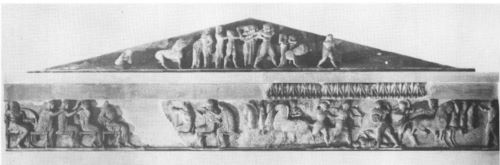
The subject of the pedimental composition of the east side (the west pedimental sculpture either did not exist or has not been preserved) is supposed to be the dispute between Heracles and Apollo for the possession of the oracular tripod (Fig. 1).3 A continuous relief frieze ran around the building, like a ribbon, above the solid walls and above the architrave on the west front. It was framed by an Ionic kyma below and a Lesbian one above. The west and south sections of the frieze, which probably display the judgement of Paris and the Rape of Helen (or the Lefkippidai) respectively, are attributed to the so-called Master A who employs sharp outlines and rather flat relief and avoids overlapping. He is considered to be an Ionian who kept close contacts with the centres of Asia Minor. The east and north sides of the frieze (those immediately visible from the sacred way) representing the Trojan Battlefield with the Olympian’s Assembly (Fig. 1) and the Gigantomachy are the work of Master B, who attempted a free superimposition of figures and perspective arrangements. He was an inspired sculptor from the Cyclades, probably from Paros, who seems to have spent a good deal of his career in Athens.4
The continuous relief frieze, as well as Karyatids instead of columns, seem to have made their appearance first on the entablature of the Knidian Treasury around 550–540 B.C. The Knidian Karyatids are called “ἀγάλματα”, in a dedicatory inscription relating to the building’s construction, which means that they were considered to be statues of Korai dedicated to the sanctuary to please the God, i.e., they had not only an architectural but also a votive function.5 Shortly after, in 530–525 B.C., the relief frieze and the Karyatids of the Siphnian Treasury were made.
The Siphnian Karyatid
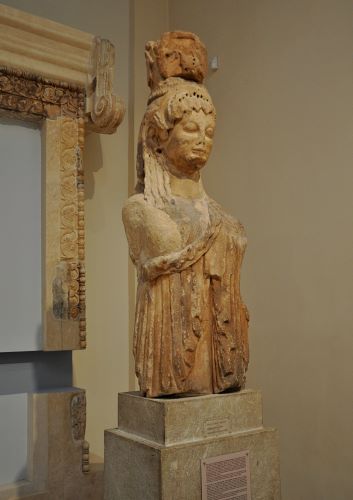
We shall leave out of our discussion the so-called ex-Knidian Karyatid-head with inserted eyes and cylindrical polos which carries a scene in low relief representing Apollo playing the kithara accompanied by four Nymphs, three Graces and Hermes;6 it has been convincingly dissociated from the Siphnian Treasury. We shall confine the study to the one Karyatid-torso, which certainly belonged to the Siphnian Treasury (Fig. 2). It has been recomposed from five fragments of Parian marble accidentally found either in gardens or in walls of modern houses in the village of Kastri to the west or southwest of the holy precinct.7 Two of the fragments are of unknown provenance.
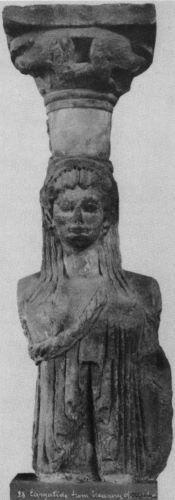
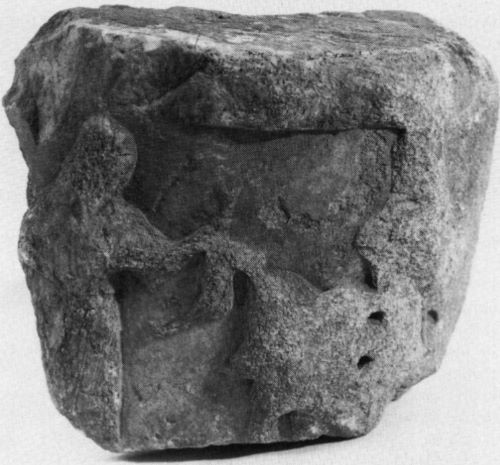
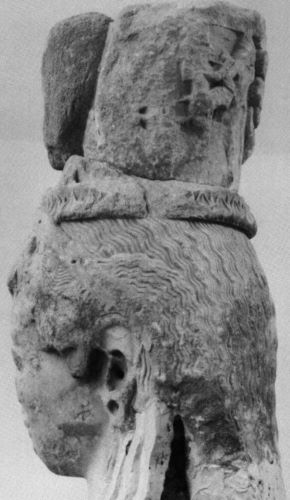
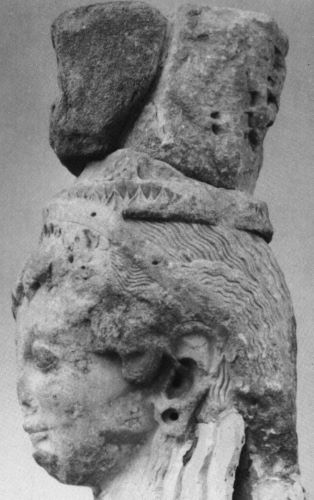
The Siphnian Karyatid wears a thin chiton with stylized wavy folds and above it the Cycladic diagonal mantle gathered in rich, large and hollow folds.8 She lifts her skirt with the missing left hand and proffers a gift with the also missing outstretched right. Her body is powerful and bulky with prominent breasts and massive thighs. On her head is balanced the basket-shaped polos (kalathos) with a scene in high relief to which we shall return below. The missing front part (Inv. no. 11.875) was found November 16, 1980 by the restorer of the Delphi Museum, Andreas Mavragannis, built into a modern terrace wall of an olive yard about 50 m south of the Arachova-Delphi road (Figs. 3–4). On the polos stood an elaborated capital the echinus of which bears a daring relief of two lions attacking a stag (Inv. no. 1554) (Fig. 2).
The Siphnian Karyatid must have been made by a Cycladic master and most probably by the Parian Master Β who worked on the east and north section of the frieze.9 The attribution to a Parian master is supported by the fact that the architecture of the Treasury is also connected with Paros.10 Nevertheless, Siphnos had never been a sculptural centre, in contrast to neighbouring Paros. A kouros head and a lion head found on Siphnos are attributed to Parian workshops, too.11
The hieratic, rigid posture and costume, the diadem and the coiffure, the decorated polos, the unusual amount of added metal jewellery form a complex of elements that “would remain outside the human sphere and would characterize the Siphnian Karyatid as a divine image”,12 as a polos-wearing Nymph, whose votive function can be assumed according to the Knidian parallel mentioned above.
The Polos Relief
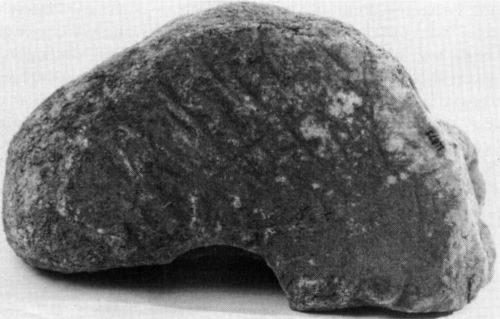
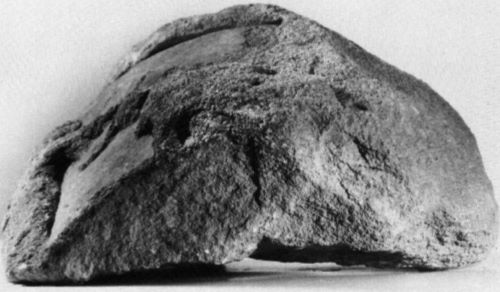
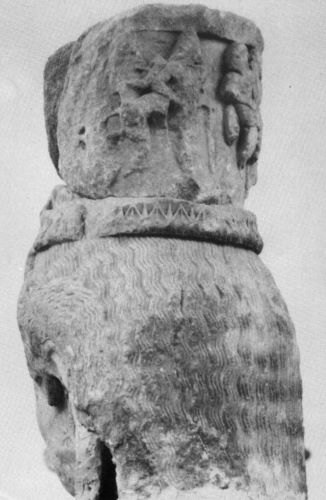
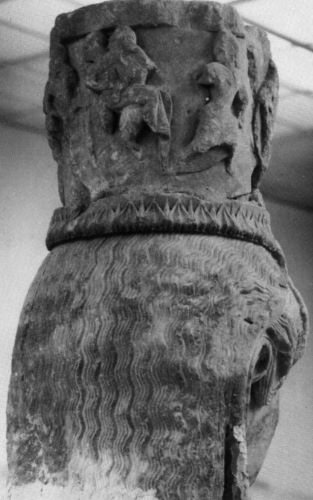
The new fragment (Figs. 3, 4a–c) completes the relief scene that runs around the cylindrical body of the polos and calls for a new attempt of brief description and interpretation. The strongly damaged state of the front right part inevitably leaves open some essential questions.
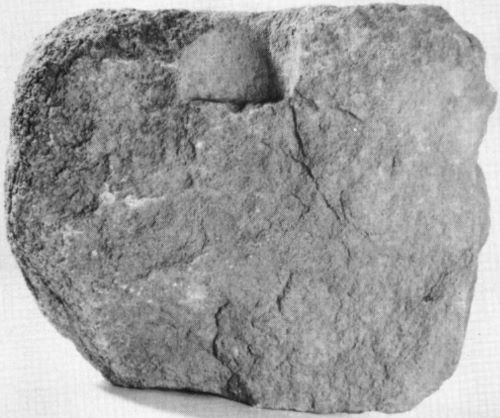
The polos, 0.305 m high, ends with a reverse Lesbian kyma around the lower edge and a plain band of 0.04 m on the upper. A circular cutting in the middle of the upper surface, 0.085 m in diam. and 0.06 m deep, served the vertical connection with the capital (Fig. 4a,b). The cylinder of the polos, 0.215 m high and larger above (0.32 m) than below, Carries a relief scene divided into two sections, comprising two groups of figures, who participate in two different practices. The same phenomenon can be observed on the continuous frieze of the Treasury, where each side is filled with different topics, the sequence of which is not quite apparent, while the selected topic of the east frieze comprises two events not united in neither time nor space: the Olympians’ Assembly and the Trojan Battlefield. Each section fills almost equal space on the back and front of the polos.
On the better preserved back part13 the scene is composed of five figures (Fig. 5): three naked Satyrs with long hair and beards and especially long equine tails, and two Nymphs with loose hair and long chitons. The representation seems to develop from left to right, starting with a large pithoid krater with high neck, rounded shoulders, ovoid body and remnants of fenestrated handles from shoulder to rim (Fig. 6a).14 A Satyr follows, turned to the right, who raises his right leg in a dancing position and brings to his mouth with both hands a missing object, which has been recognised as a drinking cup (Fig. 6a,b).15 The act of drinking does not seem to be connected with standing or dancing figures, so I prefer to complete the missing object with the double pipes, on the basis of parallels from vase painting and the poros pedimental relief from Dionysos’ Eleuthereus (?) temple in Athens (NM 3131).16 It is the aulos music that guides the dancing steps of the Satyr and attracts the attention of all the members of the thiasos, who turn their heads towards him.
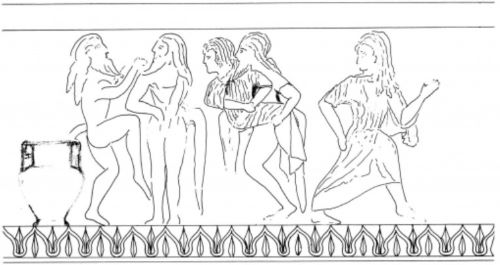
The next Satyr, very close to the first one, is almost frontal and in an immobile posture (Fig. 6b), his right hand bent in front of his body; he turns his head in profile to our left. There follows the group of a Satyr abducting a Nymph (Fig. 6c); he raises his right leg while bending the left in a position, interpreted as dancing.17 The act of rape however cannot be combined with dancing but rather with running. The abducted woman seems to wear a kind of short, smooth veil above the chiton that looks like animal skin (nebrid); she must be a Maenad.18
Abduction representations are rare in the Dionysiac iconography of the 6th c. B.C. The ones I know are depicted in the Return of Hephaistos scene on the François vase (Florence 4209).19 A more or less similar rape scene is used as an emblem on the Thasian coins from their first appearance in about 525 B.C. to the end of the 5th c. B.C. On the coins the iconographie development of the rape scene can be easily followed, passing gradually from “erotism to tenderness”.20 The type of the bearded satyr with the long horse’s tail was not foreign to Thasian art; the marble relief from the end of the 6th c. B.C. carved on the interior marble slab of one of the gates of the city of Thasos is well known.21 Nymphs and Satyrs comparable to ours appear also on various numismatic types of Thrace and Macedonia (esp. Pieria).22 Thasos had very close links with its mother city of Paros and kept contacts with the Thracian tribes of the opposite mainland.23
The Maenad at the right end of the back scene, who flees to the right while turning her head backwards (Figs. 6c, 7a) seems to wear the same leather garment, probably a nebrid, above her long chiton. Her movements and gestures betray astonishment and fear and are explained by her attempt to avoid abduction.
Most of the aspects of Dionysiac thiasos scenes appear first with narrative content around 560 B.C., one generation or so earlier than the construction of the Siphnian Treasury, in the works of Lydos and the Heidelberg painter. Lydos’ Satyrs are fully human but for animal ears and tail, while their feminine companions bear attributes of true Maenads.24
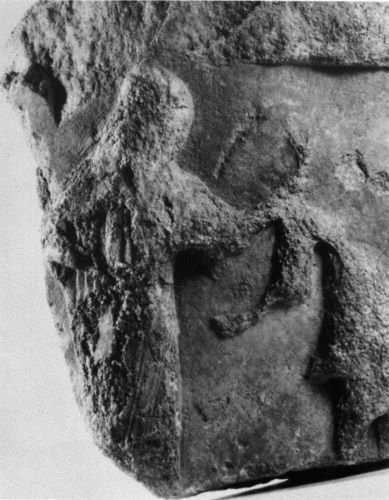
The new fragment offers precious information about the front half of the polos relief, which was apparently most important and quite essential for the understanding of the whole representation. On the left stands the solemn figure of a woman, turned to the right (Fig. 7a–b). She is dressed like the two Maenads on the back section we described above: long chiton with large, short sleeves, animal skin (nebrid) around the shoulders bound in front; her head bent slightly downwards. In her right hand, which is kept close to her body at the height of the waist, she was holding an object no longer recognisable; with her outstretched left hand she is tightly holding a small dead animal by the fore legs. It looks more like a young goat (ἐρίφιον) than a hare, as is indicated by the hoofs and the form of the body (Figs. 8b, 9). The animal’s body hangs vertically with its hind legs close together and immovable, its head hangs lifelessly backwards (Fig. 9).
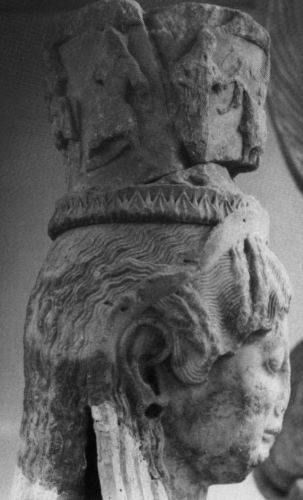
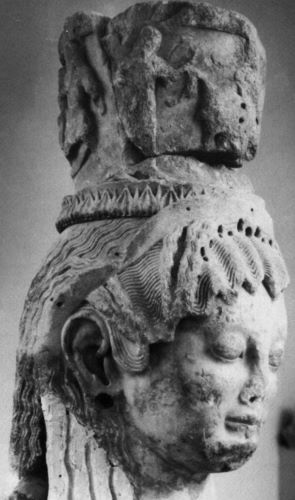
What remains of the object that followed immediately to the right, occupying the centre of the scene above the Karyatid’s face, is only the strange outline of a worn mass supported by or standing on animal legs (Figs. 3, 8a, 9). Two hoofs of the animal legs are preserved on the lower border, close to the reverse Lesbian kyma; the first hoof is turned to the left, the second seems to be turned to the right. At first sight it appears to be the rear or the front part of a bull turning its missing head backwards. The antithetic position of the hoofs, however, and the shape of the preserved upper part of the legs, as well as the size and the outline of the worn mass do not allow such an identification.
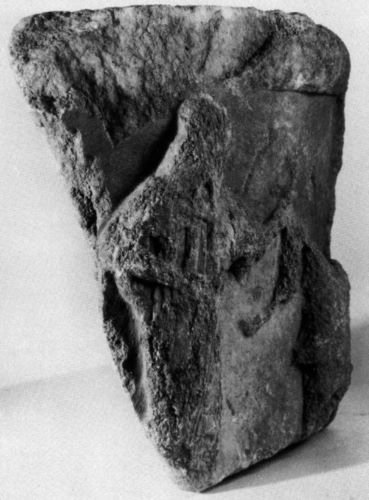
It seems more justified to accept that a three-legged table with perpendicular animal legs, on which stood a kind of corb or cradle, was represented here (Figs. 3, 8a, 9). Close to and above the cradle-like object and partially in front of it, there are the remains of what seems to be an erected bulky pole or pillar with a rounded projection to the left (Figs. 3, 9) and a figure, whose legs are preserved on the lower edge. The scene closes with a female figure turned to the left. Only her legs and part of her long chiton are visible on the edge below (Fig. 7c).
The Dionysiac Ritual
The static, ritual solemnity of the front section of the relief frieze is in contrast to the vivid rhythm and Dionysiac revelry of the back.25 This combined use and mixture of an ordinary cult scene with an orgiastic one of a mythological character is not unparalleled; it will suffice to mention the red-figured volute krater from the necropolis of Spina, Ferrara 2897 (T128) and certain Lenaea vases, which immediately interest us as being related to the cult of Dionysos.26 The differences are not confined to formal elements only: In the back section, action develops horizontally in both directions despite the fact that the dancing and music-making Satyr seems to attract special attention. In the front there is a central area of great importance, on both sides of which stand exclusively female participants. This central area must comprise the cult image of the god; the preserved remains and contours allow one, in my opinion, to recognise an animal-legged table with a liknon on it, empty or containing the mask of Dionysos and close by a bulky pole or pillar (?) intended to receive the mask (which was brought in the liknon) or with the mask already hung up on it, illustrating the next ritual (Figs. 3, 9).27
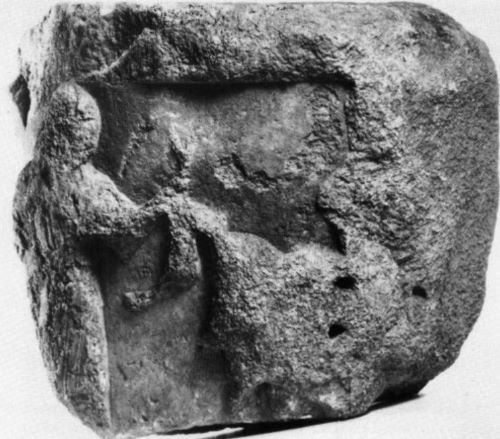
The cultic character of the whole scene is undeniable: a Maenad-priestess (?) offers a dead animal, probably a young goat to the idol of Dionysos; she is attended by at least two more persons’, who would have also proffered gifts, one of which is probably a Maenad, too; the Dionysiac thiasos moves around the area where the ritual takes place.
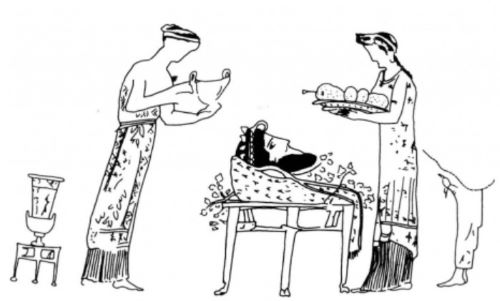
Liknon was not sacred in itself but like other profane implements sometimes occurred in sacred use, as Nilsson argues.28 The Ferrara krater29 and the Vlastos oinochoe (Athens 266; Fig. 10)30 are the only Classical monuments, on which liknon seems to have a specific cultic use. Literary sources on the subject are not very conclusive either.31 The mask as a cult image of Dionysos first appears on Attic vases in the late third quarter of the 6th c. B.C. and becomes more popular towards the end of the century and in the early 5th.32 The representation of a liknon-mask-pillar complex on the Karyatid’s polos would then be the earliest one, if my decipherment of the worn symbols is correct, and would constitute one more innovation ascribed to the Siphnian Treasury; the others are: a) the peculiar technique of the pedimental sculpture, partly in relief and partly in the round, b) the earliest continuous frieze on the Greek mainland, and c) the first and unique (among temples or treasuries) use of the Gigantomachy for a frieze,33 not to mention the Karyatids’ prostase, which first appeared in the Knidian Treasury.
Liknon and mask-idol are connected with the Attic Anthesteria spring festival also celebrated in East Greece. E. Simon argues that Dionysos took the form of a mask placed on a pillar or column both as Eleuthereus and as Lenaeus.34
On the Athenian vases of the late 6th and early 5th centuries, on which the mask-idol of Dionysos appears, there is no animal offering or sacrifice;35 in front of or near the idol in some cases stands a three-legged table (trapeza), in one case an altar, women or maenads (in some cases also Satyrs and in one case a man) dance around, make music and veneration gestures, bring wine (wine kraters are also represented), fruit, cakes and/or place them on the table.36 The offering of the killed sacrificial animal by the Maenad-priestess (Figs. 3, 9) is a ritual act, which differentiates the Delphic cult scene from its Attic parallels and adds to it a specific connotation. The only iconographic parallel is found on the Ruvo amphora in Naples (Heydemann 2411), the whole representation of which is very important for the understanding of our cult scene and its connection to the Lenaea representations. “On the upper level, an ephebe-god half-reclined among women and satyrs, below, a bearded god in embroidered clothes, standing erect between a table and sacrificial altar. The second Dionysos, who wears the mask of a cult statue, occupies the centre of a ritual arrangement. Among the officiants, all female, some of whom play cymbals and drum while others wave torches and the thyrsos, two women carry out the task of the sacrifice. Different actions are addressed to the same idol. While one of the women places fruit and a basket of cakes on the table as a bloodless offering and flameless sacrifice, the other carries out an animal sacrifice in front of an altar where the sacrificial fire is burning. Her right hand lifts up a knife over the head of a kid (depicted under her left forearm), the victim whose blood will drench the altar.”37 The similarities are striking. The Maenad-priestess on the left of the Delphic cult-scene who carries out the sacrifice of a kid was probably holding a knife in her right hand, while the women on the right of the Dionysos idol could have been carrying a basket with fruit and cakes.
Although blood sacrifice and everything connected with meat was a male monopoly and women had no rights to the cauldron, the spit, or the knife, there are exceptional cases.38 On the occasion of the Anthesteria, the Basilinna attended by fourteen maids of honour, the Gererai, carried out sacrifices and secret rites (Demosthenes, Contra Neaeram 73–75). In the ritual of the Thesmophoria, women had the right to sacrifice together and divide the victims up among themselves. In the calendar of the deme of Erchia in Attica, on the occasion of a sacrifice offered by a priestess of Semele and Dionysos, the parts of the victim, a goat, are distributed among the women and consumed on the spot. Another example is found at Olympia in the context of the celebrations of Heraia organised by the “college of the sixteen women of Elis” (Pausanias 5.16, 2–4).39
The sacrifice of a kid to the Dionysos-idol on the Karyatid’s polos, performed by a woman priestess dressed as a Maenad, attended by women and surrounded by the Dionysiac thiasos, is iconographically connected via the Ruvo amphora in Naples to the so-called Lenaea vases. On the other hand, the Basilinna with the fourteen Gererai, the priestess of Dionysos and Semele with the women of Erchia, as well as the college of the sixteen women of Elis are closely related to the college of the Thyiads and their leader (’Αρχηίς), who performed the “Awakening of Dionysos Liknites” ritual, during the biennial winter or early spring Dionysos festival at Delphi together with Thyiads from Athens. The same college of women performed every eight years at Delphi the “Heroine” and “Charila” rituals, both related to Dionysos and his mother Semele.40
Henrichs has distinguished three broad types of Dionysiac festivals: those confined to women, usually involving maenadism, those dominated by men, usually involving drinking, and those open to both sexes and often celebrating the annual epiphany of the God.41 At Delphi, where the cult of Dionysos was a vital one and existed side-by-side with that of Apollo at least from the Archaic to the late Roman period, the biennial festival can be ascribed to the first type of Henrichs’ distinction. The main role in the ceremonial rites and the Awakening of the Liknites ritual was played by the college of Thyiads,42 a local version of Maenads, guided by their Archeis. The Awakening of the Liknites was not the awakening of a sleeping god of vegetation but the raising of him from the dead, as Nilsson argues;43 the biennial period is contradictory to the yearly awakening of vegetation; also the ennaeteric festival “Herois” at Delphi refers, according to him, to the ascent of Dionysos from the realm of the dead. Orphic myths and ideas are apparent in the arousing of the Liknites. In the Peisistratid period, Onomakritos introduced Orphic rites (ὄργια) of Dionysos which told (or reenacted) the god’s suffering at the hands of the Titans (Pausanias 8.37,5) and his descent to the Underworld to bring his mother Semele to Olympos, where she was renamed Thyone (Diodorus 4.25.4).44
Very important for the form of the cult image of Dionysos worshipped at Delphi during his festival is the information given by Pausanias (10.19,3) that among the dedications standing at the temple area on the north-east was a bronze mask of Dionysos that was apparently erected on a pillar or wooden pole like a xoanon. This mask was dedicated by the people of Methymna on Lesbos; fishermen of Methymna had caught in their nets a mask (prosopon) of olive-wood, which looked divine but was unusual for Greek deities; the Pythia who was asked by the people of Methymna, whether the image was that of a god or a hero advised them to establish a cult of Dionysos (Ke-)phallen; hence the people of Methymna dedicated to Delphi a bronze copy of the original wooden idol of Dionysos, which was kept on their island and worshipped with sacrifices and other rites.45
The evidence, both literary and iconographic, leads to the following conclusions:
- the cult scene on the polos of the Siphnian Karyatid seems to represent the Delphic ritual of Dionysos Liknites,
- the Maenad-priestess, who performs the kid sacrifice might be recognised as the Archeis (leader) of the college of Thyiads,
- the liknon placed on the table in the centre of the scene alludes to the “Liknites”, and
- a pillar or wooden pole with the mask of Dionysos hung on it was probably erected behind or close to the table.
Endnotes
- Pausanias 10.11,2. Cf. J. D. Muhly, “Gold analysis and the sources of gold in the Aegean”, TUAS 8 (1983) 1–14.
- G. Lippold, HdA VI (1950) 70 (with bibliography); B. S. Ridgway, The Archaic style in Greek sculpture (1977) 267ff; A. Stewart, Greek sculpture (1990) 128, Pis. 187–189; L.V Watrous, “The sculptural program of the Siphnian Treasury at Delphi”, AJA 86 (1982) 160f.; P. de la Coste-Messelière, Au Musée de Delphes (1936) 284–436; N. Bookidis, A study of the use and geographical distribution of the architectural sculpture in the Archaic period (Ph. D. Diss. Bryn Mawr 1967) Ann Arbor 1979, 327.; M. B. Moore, “The Gigantomachy of the Siphnian Treasury”, in; Études delphiques (BCH-Suppl. IV; 1972) 305ff; F. Felten, Griechische tektonische Friese archaischer und klassischer Zeit (Schriften aus dem Athenaion der Klassischen Archäologie Salzburg, 4), Salzburg 1984, 23 and 38ff.; Fouilles de Delphes, II: Topographie et Architecture, Le Trésor de Siphnos, by G. Daux and E. Hansen (Paris 1987). See also B. A. Sparkes, “Greek Art”, in: Greece and Rome, New Survey in the Classics, no. 22 (Oxford 1991) 4—6 and notes 16—26 for further bibliography on the problems of dating and interpretation of the sculptural decoration.
- D. von Bothmer, “The Struggle for the Tripod”, in: Festschrift für Frank Brommer (1987) 51ff.; Watrous (supra n. 2) 160f; H. A. Shapiro, Art and cult under the tyrants in Athens (1989) 61–64.
- Ridgway (supra n. 2) 270. L. H. Jeffery has integrated the signature on the Giant’s shield as “Aristion of Paros” (= Ridgway, supra n. 2, 279: Bibliography for page 270). Cf. M. Guarducci, in Studi Banti (1965) 167; L. H. Jeffery, Archaic Greece, 185; W Deyhle, “Meisterfragen der archaischen Plastik Attikas”, AM 84 (1969) 22ff., who discusses the attribution of the East and North friezes to Endoios.
- Chr. Karousos, Delphi (1974) 109; G. Gruben, Die Tempelder Griechen (19684) 82; F. Salviat, “La dédicace du Trésor de Cnide”, in: Études delphiques (BCH-Suppl. IV; 1972) 23–36.
- FdD IV 2 (1928) 1ff., Figs. 1–2; P. de la Coste Messelière, “Sur les caryatides cnidiennes de Delphes”, BCH 62 (1938) 286f.; idem and J. Marcadé, “Corés delphiques”, BCH 77 (1953) 354f., Pl. 43; G. M. Richter, BCH 82 (1958) 92. There is some iconographie relation to the early 5th c. relief of the Theories Passage on Thasos: J. Pouilloux, RFA (1959) 284–290; K. Despini, “Η ερμηνεία των αναγλύφων της διόδου των θεωρών”, ArchDelt 31 (1976) Α, 175, nn. 68 and 69.
- FdD IV 2 (1928) 58–64, Fig. 30, Pls. IV-V; BCH 77 (1953) 360–364.
- N. Himmelmann, IstMitt 15 (1965) 29; H. Herdejürgen, Untersuchungen zur tbronenden Göttin aus Tarent in Berlin und zur archaischen und archaistischen Schrägmanteltracht (1968) 54–56, 59–61.
- Ridgway (supra n. 2) 101; K. Despini, Προβλήματα παριακής πλαστικής του 5ου π.Χ.αι. (Dissertation; Thessaloniki 1979) 176, 178–180. Cf. Ε. Langlotz, FB, 138f, ΑΜΑ 35, note 32. Idem, Studien zur nordgriechiscben Kunst (1975) 168; Fr. Croissant, in: Études delphiques (BCH-Suppl. iv, 1972) 361.
- G. Gruben,JdI 78 (1963) 146f.; MüJb 23 (1972) 7f, 28f.
- G. Lippold (supra n. 2) 71, nn. 6, 7; N. Kontoleon, Aspects de la Grèce préclassique (1970) 64, n. 2; Chr. Karouzos, ArchEph 1937, 599; AA 1939, 265; Despini (supra n. 9) 176, n. 549.
- Ridgway (supra n. 2) 109. Cf. E. Simon, RA 1972, 205–220, who discusses the polos in conjunction with Hera and the Nymphs and stresses the funerary character of the 5th c. Erechtheion Karyatids, which she would consider polos-wearing Nymphs (= Ridgway, loc. cit.).
- FdD IV 12 (1928) 60ff, Fig. 30, Pls. IV, V XX.
- Recognised as a typical shape used in the Cyclades in the 7th and 6th c. B.C.: E. C. MacNeil Bogges, The development of the Attic pithos (1972) 278f. (= Ridgway, supra n. 2, 101).
- FdD IV, 61, no. 2.
- Th. H. Carpenter, Dionysiac imagery in Archaic Greek art, its development in black-figure vase painting (1986) 77ff, Pls. 19, 20, 23; R. Heberday, Altattische Porosskulptur (1913) 75; J. Boardman, Greek sculpture, The Archaic period (1978) Pl. 201.
- FdD IV, 61, no. 4. It seems more probable that the Satyr is running carrying the Maenad away.
- The distinction between Nymphs and Maenads is not so clear, “I limiti non sono ben definibili” as E. Simon, “Menadi”, EAA V, 1002–13 believes. See T. H. Carpenter (supra n. 16) 80, nn. 16–17 for further bibliography on the representations of maenads.
- J. Boardman, Athenian black figure vases (1974) Figs. 46–47. The François vase is the first work in which Maenads (or Nymphs) and Satyrs appear as companions of Dionysos: Carpenter (supra n. 16) 76 and 81f.
- Ο. Picard, “Monnaies et gravures monétaires à Thasos”, Philia epe eis G. E. Mylonan II (1987), 151, n. 6, who notes that, although the abducted woman does not carry a Dionysiac attribute, “c’est sans doute une Ménade”. Nymphs’ cult is attested on Thasos: J. Pouilloux, Recherches sur l’histoire et les cultes de Thasos I (1954) 339–340 (= Picard, loc. cit.).
- Études Thasiennes VIII, 85–111; Guide de Thasos (1967) 58f., Figs. 22–23; Boardman (supra n. 19) Pl. 223.
- J. Svoronos, “L’hellénisme primitif de la Macédoine prouvé par la numismatique et l’or du Pangée”, JIAN 19 (1918/19) 92–100.
- O. Rubensohn, RE XVIII.4 (1949) s.v. Paros, 1813f. Cf. L. Robert, BCH 59 (1953) 500, n. 3; D. Lazarides, Νεάπολις-Χριστούπολις, (Kavalla 1969) 15; Despini (supra n. 9) 172f, 201.
- Shapiro (supra n. 3) 90f.; A. Schöne, Der Thiasos: eine ikonographische Untersuchung über das Gefolge des Dionysos in der attischen Vasenmalerei des 6. und 5. Jhs v. Chr. (Göteborg 1987); Carpenter (supra n. 16) 83.
- An analogous differentiation is generally observed between east (front) and west (back) pedimental compositions.
- F. Sartori, “Il cratere della tomba 128 nella necropoli di Spina”, Rendiconti dell’accademia dei Lincei V (1959) 233f., Pls. I-III; S. Aurigemma, Il r. museo di Spina (Ferrara 1953) 180, Pl. 96; J. Beazley, ARV 696. The identity of the gods on the Ferrara krater is disputed: Μ. Ρ Nilsson, The Dionysiac Mysteries of the Hellenistic and Roman Age (1957) 24f., nn. 11–12. Cf. J. Boardman, Athenian red figure vases, the Classical period (1989) Fig. 157, 1–2; C. Bérard and J.-L. Durand, “Entrer en imagerie”, in: La cité des images (1984) 19f., Fig. 21a–f; I. Loucas, “Meaning and place of the cult scene on the Ferrara krater Τ128” (in the present volume). On the Lenaea vases see: A. Frickenhaus, Lenäenvasen (Berl WPr 72, 1912); G. van Hoorn, Choes and the Anthesteria (1951); Nilsson (supra) 28f., nn. 14–16; E. Simon, Festivals of Attica (1983) 100f.; G. Ferrari, “Eye-cup”, RA 1986,17–20; F. Frontisi-Ducroux, “Face et profil, les deux masques”, in: Images et société en Grèce ancienne, ed. C. Bérard (1987) 89–102.
- Nilsson (supra n. 26).
- Loc. cit.
- J. E. Harrison, “Mystic vannus Iacchi”, JHS 23 (1903) 316, Fig. 13; Bérard and Durand (supra n. 26) 25.
- ARV 275–10; van Hoorn (supra n. 26) 38; Nilsson (supra n. 26) 26f.; Boardman (supra n. 26) Fig. 233; F. Frontisi-Ducroux, “Au miroir du masque”, in: La cité des images (supra n. 26) 148, Fig. 209.
- Sophocles, Frg. 760, Nauck, 2nd ed. (στατοῖς λίκνοισι); Demosthenes, De corona 18, 259 (λικνοφόρος); Plutarch, Alexander 2 (μυστικῶν λίκνων); Callimachus, Hymns, ί, 47 (λίκνῳ ἐνΐ χρυσέῳ) and scholia ad locum; Homeric Hymn in Merc. w. 150f.
- W. Wrede, “Der Maskengott”, AM 53 (1928) 66–65; Shapiro (supra n. 3) 99, n. 167. Cf. supra n. 26. In early fifth century lekythoi the mask appears either frontal or in double profile: F. Frontisi-Ducroux and J. L. Durand, “Idoles, figures, images”, RA 1982, 81–108; Frontisi-Ducroux, “Face et profil” (supra η. 26).
- Ridgway (supra n. 2) 211, 267, 268. The second example of the use of the Gigantomachy for a frieze is the Pergamon altar.
- Simon, loc. cit. (supra n. 26); Shapiro, loc. cit. (supra n. 32). Cf. R. Martin and H. Metzger, La religion grecque (1976) 122f.; C. Bérard and E. Bron, “Le liknon, le “masque” et le poteau. Images du rituel dionysiaque”, in: Mélanges P. Lévêque (to appear) (= C. Bérard, “Hommes, prêtres et dieux. L’ordre anthropomorphique dans l’imagerie grecque”, in: L’Islam. une religion, J. Waardenburg, ed. (1989), 100, n. 7).
- On an amphora by Amasis, Cabinet des Médailles 222 (ARV 152.25) two maenads embracing each other bring a hare and a young stag (not necessarily dead) to Dionysos, but the scene does not seem to be cultic and it is not connected to the Dionysos festivals. Cf. Carpenter (supra n. 16) 66 and 90, nn. 51 and 65, PI. 17.
- See, for example: stamnos by the Villa Giulia Painter, Boston 90 155; ARV 621.34; stamnos by the Dinos Painter, Naples 2419; ARV 1151.2 (Frontisi-Ducroux, supra n. 26, Pl. III, labels the vase as “Londres Ε 451”?); cup by Hieron and Makron, Berlin 2290; ARV 462.48; stamnos, Louvre G 532, CVA France 4, PL 21 (= Satyr offering wine). See also the list of black figured lekythoi in Frontisi-Ducroux, “Face et profil” (supra η. 26) 102. Cf. Wrede, loc. cit. (supra η. 32); Ε. Coche de la Ferté, “Les Ménades et le contenu réel des représentations de scènes bacchiques autour de l’idole de Dionysos”, RA 1951, n. 6; Nilsson (supra n. 26) 28–29, nn. 15–16.
- M. Detienne, “The violence of wellborn ladies: Women in the Thesmophoria”, in: The cuisine of sacrifice among the Greeks, eds. M. Detienne and J. P. Vernant, (Chicago & London 1989) 140; F. Cumont and A. Vogliano, “La grande iscrizione bacchica del Metropolitan Museum”, AJA 37 (1933) 242f., PL 31,1; N. Marinatos, “The imagery of sacrifice, Minoan and Greek”, in: R. Hägg and N. Marinatos, eds., Early Greek cult practice (1988) 12, Fig. 4.
- Detienne (supra n. 37) 132–141.
- All the above examples are described and analysed by M. Detienne, loc. cit. (supra n. 38), who stresses the political dimension of “Women at the sacrifice” and refers to two more examples of sacrifices by women: in the ritual of Ares Gynaikothoinas at Tegea (Paus. 8.48, 4–5) and of Artemis Pergaia in Pamphylia. Cf. P. Lekatsas, Dionysos, origin and evolution of the Dionysiac religion (in Greek) (Athens 19712) 126 and 140f., who points out that the “sixteen women of Elis” formed a maenadic thiasos who served Dionysos’ cult, too: Paus. 5.16.6–7.
- Plutarch, De Iside et Osiride 35 (365A) (364E); Quaestiones graecae 12 (293C); Consolatio ad Uxorem 10 (611D); De Ε apud Delphos 9 (388E); Mulierum virtutis 13 (249E); Quœstiones Convivales 2,3 (636E); Paus. 10.4.3; L. Lerat, BCH 61 (1936) 359, PI. 44; G. van Hoorn, “La résurrection de Dionysos Liknites”, Bulletin van de Vereniging tot Bevordering der Kennis van de antieke Bescbaving 24 (1949) 7f.; H. Jeanmaire, Dionysos (1951) 157–219; Nilsson (supra n. 26) 38f.; J. Fontenrose, Python. A study of Delphic myth and its origins (1959) 377, 458–461; G. Roux, Delphi: OrakelundKultstatten (1971) 160–167. Cf. É. Loucas-Durie, “Simulacre humain et offrande rituelle”, Kernos 1 (1988) 160; Lekatsas (supra n. 39) 192f. (= § 78), 189f. (= § 77), (§ 37 and 41); W. Burkert, Griechische Religion der archaischen und klassischen Epoche (1977) 342, 434; G. Dimitrokallis, “Additional astronomie data for the interpretation of Octaeteris” (in Greek), Philia epe eis G.E. Mylonan II (1987) 211; M.-Chr. Villanueva Puig, “À propos des Thyiades de Delphes”, in: L’association dionysiaque dans les sociétés anciennes, Actes de la table ronde organisée par l’École française de Rome, 24–25 mai 1984, Collection de l’École française de Rome no. 89 (Rome 1986), 31–51.
- A. Henrichs, “Changing Dionysiac identities”, in B. F. Meyer and Ε. Ρ Sanders, eds., Jewish and Christian self-definition 3 (London 1982) 137–160.
- Paus. 10.19,4; F. Croissant, “Les frontons du temple du ive siècle à Delphes. Esquisse d’une restitution”, in: Archaische und klassische griechische Plastik II (1986) 187–197; R Themelis, ArchEph 1976, Chron. 8ff; idem, BCH 103 (1979) 518f.
- Nilsson (supra n. 26) 30f.
- Shapiro (supra n. 3) 87f.
- Roux (supra n. 40) 167; M. Casevitz and F. Frontisi-Ducroux, “Le masque du «Phallen». Sur une épiclèse de Dionysos à Méthymna”, Revue de l’histoire des religions 206 (1989) 115–127.
Pages 49-72 from The Iconography of Greek Cult in the Archaic and Classical Periods, Robin Hägg (dir.), Proceedings of the First International Seminar on Ancient Greek Cult, organised by the Swedish Institute at Athens and the European Cultural Centre of Delphi (Delphi, 16-18 Novembre 1990), published by OpenEdition Books under an Open Access license.
About the Author