Construction on Santa Maria del Fiore, in Florence, began in 1296 under the direction of Arnolfo di Cambio. While the nave, transept, and apse rose fully built, the octagonal drum, perched 180 feet up, left the interior exposed to the elements for decades, with water reaching the central altar during storms. Though such a vast dome appeared in the original plans, its construction method remained unknown. By 1418, no builder had solved how to make it stand.
Root issues began with Di Cambio’s plan. Rather than adopt flying buttresses, structures common in northern European Gothic churches to transfer lateral thrust to the ground, he dismissed them outright. In their absence, any dome placed above the crossing must contain its own outward forces by relying only on stone walls. An octagon replaced a circle for the base shape, which led forces to gather intensely at all eight vertices. Each angle bore a heavier load as a result. With a diameter of about 144 feet, this task was even more challenging than the Roman Pantheon, which was built over a millennium earlier.
The impossible span
During medieval times, constructing domes and arches usually depended on centering, with wooden supports built underneath to hold up stonework until it stood on its own. Beneath the dome of Florence, though, such framing would have needed vast amounts of timber, hoisted high where handling materials turned nearly impossible. In fact, some calculations show that the lumber alone might have exceeded all remaining construction expenses combined. Financial strain ruled out this option; further, suitable trees, large enough and strong enough, were rare across Italy’s cleared hillsides by 1400.
The Opera del Duomo, the civic body that managed the cathedral works, put out a call for solutions. What came back was mostly uninspired: more centering, bigger centering, cleverer centering. One proposal, though, was memorably absurd. Fill the entire interior of the cathedral with dirt, the idea went, and mix coins into the soil. Once the dome was finished, citizens would dig the mound away for free, hunting for money. Among all the entrants, only one dismissed centering altogether. His name was Filippo Brunelleschi, a man trained as a goldsmith rather than an architect. Instead of a formal apprenticeship in masonry, Brunelleschi’s expertise came from an exhaustive, self-funded study of Roman ruins. He spent years in Rome documenting the structural logic of ancient buildings, focusing on how they remained standing without modern supports. What builders of his age struggled to grasp, the past quietly demonstrated, if one knew how to look.
In 1420, he was appointed to lead the project, though the authorities forced him to work alongside his rival, Lorenzo Ghiberti. The two men had despised each other since 1401, when both competed for the bronze doors of the Florentine Baptistery, and Ghiberti won. Now they had to share authority over the biggest construction project in Italy. Brunelleschi, who was secretive on his best days and combative on all the others, treated the arrangement as a personal insult. He considered Ghiberti dead weight. A few years into the project, the Opera’s own paperwork settled the question. Brunelleschi was named sole inventor and director of the cupola. His salary went up. Ghiberti’s stayed put.
The machine that changed everything
Scholars have long focused their analysis on the dome’s physical structure: its dual shells, the diagonal herringbone brickwork, and the hidden chains of stone and iron. Yet the true shift in building technology may have been the lifting devices Brunelleschi designed, a facet of the project that receives far less attention today.
Upward movement posed the core difficulty. Not only bricks, over four million, but also heavy sandstone beams, iron fittings, alongside countless batches of mortar, required elevation from ground level to the rising rim of the dome, advancing skyward with each new layer. Material quantity defied common scale. Experts who later studied the effort concluded the dome demanded close to 37,000 tons of brick and stone. Even assessing the volume of mortar alone, something easily estimated now with a cubic yard calculator, reveals the staggering effort required to supply a site choked by the narrow, medieval streets of Florence.
Back then, hoisting devices moved at a crawl and worked one way only. Inside a treadwheel, workers stepped steadily, turning a wheel that drove the machine. Movement upward happened smoothly; yet once empty, returning the hook meant disengaging laborers or shifting effort. Reversal slowed everything. Each workday lost time to this repeated stoppage.
Before this, hoisting devices moved at a crawl. Most relied on a treadwheel, where laborers stepped inside a massive wooden drum to drive the mechanism. These machines worked only in one direction; to return an empty hook, the entire process had to stop so the effort could be reversed. Brunelleschi’s fixation on efficiency made this unacceptable. He was disturbed by the fact that lifting a 500-pound stone took the same amount of time as lifting a payload four times that mass. Even more frustrating was the sight of oxen being detached and rotated every time a load needed to descend.
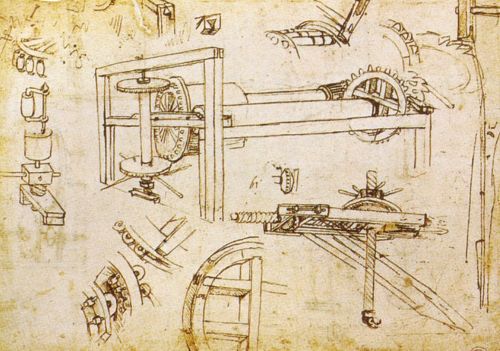
From this frustration emerged a device unknown in Western engineering before: a hoist powered by oxen, capable of reversing direction, operating across three speeds. Powered by two oxen moving in circles, the machine, occasionally named the Castello, used a horizontal tiller for motion. What set it apart emerged from linked gears, driveshafts, and clutches, enabling gear changes mid-operation, no halt needed. Switching setups let the lift move heavy payloads slowly, using full turning force, while lighter ones rose faster. Oxen kept pace steadily forward; yet whether cargo moved upward or downward depended on an internal shift. That switch, seen today as an early form of clutch, managed reversal without altering animal movement.
Embedded within Brunelleschi’s mechanism, gear proportions responded precisely to load demands. Driving a smaller wheel with a larger one brought quick motion yet reduced torque, effective when the weight was minimal. With the reverse setup, a small driver turning a broad follower, rotation slowed, but power increased, essential for moving dense stone blocks. Back then, such balance emerged not from computation but careful shape-based reasoning and hands-on testing. Today, a gear ratio calculator reveals identical behavior: the tooth count between interlocked wheels defines how speed and torque trade off against each other.
Before this, nothing resembling such machinery was known in medieval times. Centuries passed before Europe saw another design allowing multiple speeds and reverse operation. Arriving in Florence during the 1460s as a youth, Leonardo da Vinci examined Brunelleschi’s devices closely. His pages soon carried numerous renderings of these mechanisms. Long afterward, the lifting system still held influence. Even Bonaccorso Ghiberti, descendant of Brunelleschi’s rival, recorded precise illustrations of it well past the dome’s completion.
A paradigm shift on the scaffold
What appears at first as mere mechanical ingenuity carries deeper significance. Brunelleschi did not only devise tools for building; he reshaped how knowledge meets action.
Skilled by long-standing custom, medieval builders shaped grand cathedrals without fanfare. Their craft evolved slowly, handed forward through guild networks. Progress crept in quietly, unseen and unclaimed. Over time, small changes settled into shared routines instead of standing out as personal achievements.
Brunelleschi stepped away from this routine. He came to the dome guided not by habit but by inquiry into how things stand and hold. Time in Rome brought no idle gazing at broken stone. Instead, a close study took place regarding how old walls stayed upright and how weight moved through vaults made long ago. The same analytical mind that would later produce the first demonstrations of linear perspective had already turned to pulleys lifting heavy loads, joints bearing stress, and surfaces resisting collapse. Rather than refine older cranes step by step, the ox-hoist emerged as one unified structure, every piece built for a specific purpose, planned fully from the start.
From tradition-bound practice to purposeful design, this transformation shaped how Renaissance minds approached making. Soon after, figures such as Leon Battista Alberti laid down rules of architecture through written theory. Creators started viewing their work through the lens of applied science rather than inherited craft. The once-overlooked mechanical knowledge slowly gained standing among serious intellectual pursuits. The dome of Santa Maria del Fiore was completed in 1436, sixteen years after construction began. Still today, no larger masonry dome exists anywhere. Brunelleschi died in 1446 and was buried in the cathedral crypt, directly beneath the structure he made possible. A tribute carved there names him gifted with divine intellect. Yet what truly reshaped construction was not inspiration alone. It was his relentless focus on mechanics, his insistence that understanding why things worked mattered more than following tradition. Because of this mindset, architecture moved forward differently.
About the Author