The restoration of icons in 843 ended Byzantium’s second period of iconoclasm, returning sacred images to official favor and affirming familiar gestures of devotion for worshippers.

By Matthew A. McIntosh
Public Historian
Brewminate
On March 11, 843, a procession in Constantinople carried religious images through the capital to Hagia Sophia. The occasion celebrated something that Byzantine Christians had spent decades disputing: whether they could honor pictures of Christ and the saints without committing idolatry. Under Empress Theodora, governing for her young son Michael III, the empire had reversed its religious policy. Icons could again receive official recognition as objects of Christian veneration. The ceremony ended Byzantium’s second period of iconoclasm, the campaign against sacred images. For supporters of icons, their return restored a familiar means of approaching the holy, now backed by the same imperial authority that had opposed it.
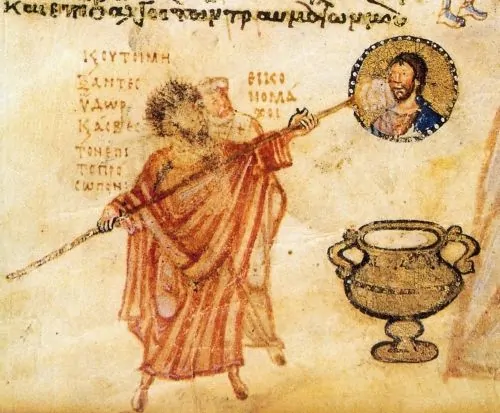
An icon could be a small painted panel kept close to its owner or a monumental mosaic inside a church. Worshippers addressed prayers through these images to the figures represented, seeking help with illness or protection from danger. Kissing an icon made that relationship physical. Iconoclasts honored the cross but feared that devotion to sacred portraits repeated the idolatry condemned in scripture. Images of Christ raised another difficult question: how could a painter represent someone believed to be both human and divine? Defenders answered that Christ had become visibly human in the incarnation. Portraying him affirmed that he had truly entered the material world. They also distinguished the reverence offered to an image from the worship owed to God alone. Honor passed through the picture to the person depicted; the wood and paint were not themselves divine. Neither side regarded this as a minor disagreement about church decoration. Each claimed to protect Christian belief, and each could interpret the other’s position as a serious distortion of the faith. The dispute concerned what an apparently ordinary gesture meant for a Christian’s relationship with God.
Imperial involvement followed from the ruler’s responsibility for the Christian empire. Emperors were expected to defend correct belief, and religious error could be understood as a danger to the whole community. Military defeat gave that concern particular force. After disastrous Byzantine losses to the Bulgars early in the ninth century, supporters of iconoclasm could point to the military achievements of earlier emperors who had opposed images. Their successes appeared to offer evidence of divine approval. This did not establish that icons caused defeat, but it made religious policy part of an argument about imperial survival. Rulers could summon councils and influence the appointment of patriarchs, the church’s senior leaders. A disagreement over pictures consequently affected who held ecclesiastical office and whose teaching carried institutional authority. Clergy who resisted imperial policy could face removal or exile.
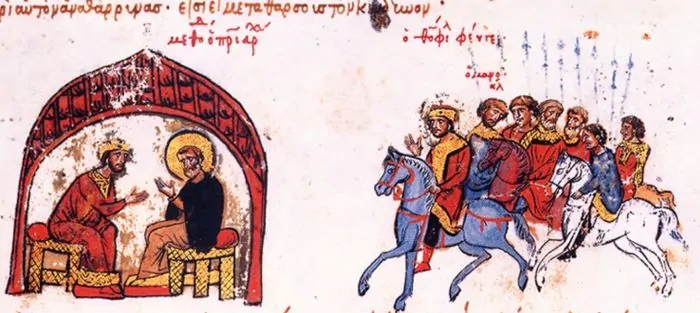
The reversal in 843 came after an earlier restoration had already failed to last. In 754, a council held under Constantine V had endorsed opposition to sacred images. Empress Irene subsequently supported the Second Council of Nicaea in 787, which approved their veneration. Yet Emperor Leo V reinstated iconoclasm in 815, reopening a dispute that some worshippers had seen settled within their lifetimes. The final opportunity for change followed the death of Emperor Theophilos in 842. Theodora became regent, and her government, including the powerful official Theoktistos, arranged a new settlement. John the Grammarian, the patriarch associated with iconoclasm, was replaced by Methodios, a defender of images. A synod in 843 reaffirmed the decisions of Nicaea rather than inventing an entirely new theological position. The arrangement also accommodated the ruling family: Theophilos escaped the posthumous condemnation directed against other supporters of iconoclasm. His widow could reverse his policy while protecting his reputation. These negotiations caution against imagining that a single procession spontaneously resolved the controversy. The public celebration followed decisions made within the court and church leadership, where restoring images also required deciding how to treat the recent past. Religious reconciliation involved a carefully managed change of personnel and an agreed account of legitimate belief.
For worshippers devoted to icons, restoration vindicated familiar gestures. Kissing a painted face or lighting a lamp before it could again express officially accepted devotion. An image gave prayer a visible focus and sustained a believer’s sense of a saint’s continuing presence. This did not mean that every household had previously surrendered its pictures, or that every church received replacements immediately. Enforcement had varied, and the surviving evidence cannot support a picture of uniform destruction across the empire. What changed decisively was the official standing of those images and the gestures surrounding them.
The settlement’s endurance gave the ceremony a significance its participants could not have guaranteed. Byzantine governments had changed direction before; this time, imperial iconoclasm did not return. The first Sunday of Lent became the annual celebration of the Triumph of Orthodoxy, renewing the association between sacred images and correct belief. Over the following decades, church interiors increasingly gave visible form to that judgment. In 867, Patriarch Photios preached in Hagia Sophia on an image of the Virgin and Child, celebrating sacred representation in the empire’s foremost church. The mother holding her child expressed the argument that defenders of icons had made about the incarnation: Christ had become visible in human flesh. The church’s answer to a controversy that had occupied emperors could now be encountered by anyone looking toward the sanctuary. Above the altar, the relationship between the divine and the material world took the recognizable form of a mother holding her child.
Originally published by Brewminate, 10.26.2026, under the terms of a Creative Commons Attribution-NonCommercial-NoDerivatives 4.0 International license.
About the Author