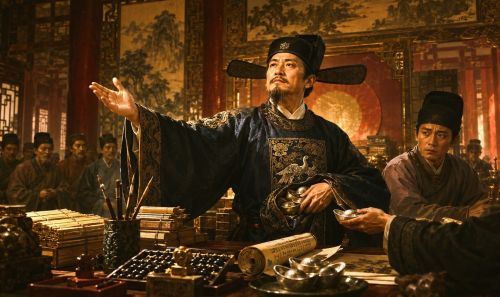
Confucian statecraft praised virtue, merit, frugality, and loyalty, yet imperial administration often depended on privilege, informal extraction, patronage, and compromise.

By Matthew A. McIntosh
Public Historian
Brewminate
Introduction: Confucian Virtue and the Administrative Problem
Imperial Chinese government presented itself as a moral order before it presented itself as a technical machine. The ruler was expected to govern through virtue, officials were expected to cultivate integrity through classical learning, and administration was imagined as an extension of ethical self-discipline. Confucian political thought did not treat office as merely employment. It treated office as a public test of character, learning, loyalty, frugality, and humane concern for the people. The official ideally stood between ruler and populace as a morally formed servant of order, someone whose private conduct, family discipline, ritual propriety, and public judgment were supposed to belong to the same ethical world. In principle, the empire was to be governed by men who had internalized the classics deeply enough that law, taxation, punishment, recommendation, and remonstrance would all be shaped by cultivated virtue rather than appetite, fear, or private gain.
Yet the administrative realities of medieval and early modern China repeatedly strained that ideal. The empire was vast, populous, fiscally demanding, socially layered, and politically dangerous. Officials who were expected to embody uprightness also had to maintain households, hire clerks and runners, manage transportation, respond to emergencies, navigate court politics, supervise taxation, avoid accusations, cultivate patrons, satisfy superiors, and protect their families. The state praised frugality while expecting officials to perform costly administrative work. It celebrated merit while permitting family privilege, recommendation, and elite reproduction. It condemned corruption while relying on informal payments, gifts, fees, and negotiated local arrangements that kept offices functioning. It exalted loyalty to the throne and the people while rewarding survival within bureaucratic hierarchies where truth-telling could be risky and moral purity could be politically fatal. A magistrate could be expected to serve as moral exemplar, fiscal agent, judge, police supervisor, famine responder, ritual representative, and mediator of local conflict, often with insufficient formal resources and limited reliable personnel. The central state demanded rectitude, but local administration required improvisation. The classics supplied a language of cultivated virtue, yet the yamen depended on clerks, runners, servants, brokers, and customary practices that rarely matched the clean moral image of Confucian office. The problem was not simply that officials failed to live up to Confucian norms. It was that the machinery of government often made those norms difficult to practice without compromise.
I treat hypocrisy in Chinese state administration as an institutional problem rather than a collection of private moral defects. Hypocrisy here means the recurring gap between publicly affirmed norms and privately tolerated practices: the scholar-official who condemned eunuch influence while seeking eunuch favor, the state that praised incorruptibility while underfunding office, the elite that celebrated merit while protecting kinship advantage, the literati who preached frugality while embracing luxury, and the late Qing official who denounced foreign arrogance while purchasing foreign weapons and technical expertise for imperial survival. These contradictions should not be flattened into a simple charge that Confucian statecraft was insincere. Confucian moral language mattered. It shaped education, law, ritual, political criticism, family discipline, and ideals of office across centuries. Precisely because it mattered, it created standards by which administrative practice could be judged. The higher the language of virtue rose, the more visible became the compromises beneath it.
I trace this tension chronologically from Tang-Song foundations through Song literati culture, Ming court politics, Qing fiscal practice, and the late Qing crisis of reform and foreign power. The story is not one of steady decline from pure principle into corruption. It is a recurring pattern in which moral statecraft and administrative necessity developed together. Examination merit coexisted with family advantage. Frugality coexisted with elite consumption. Anti-corruption rhetoric coexisted with institutionalized informal extraction. Confucian suspicion of private interest coexisted with networks of relationship, obligation, and patronage. Anti-foreign civilizational confidence coexisted with selective dependence on Western technology. Imperial China’s administrative hypocrisy was not the negation of its moral order. It was one of the forms that moral order took when asked to govern an empire.
Tang-Song Foundations: Merit, Family, and the Moral State
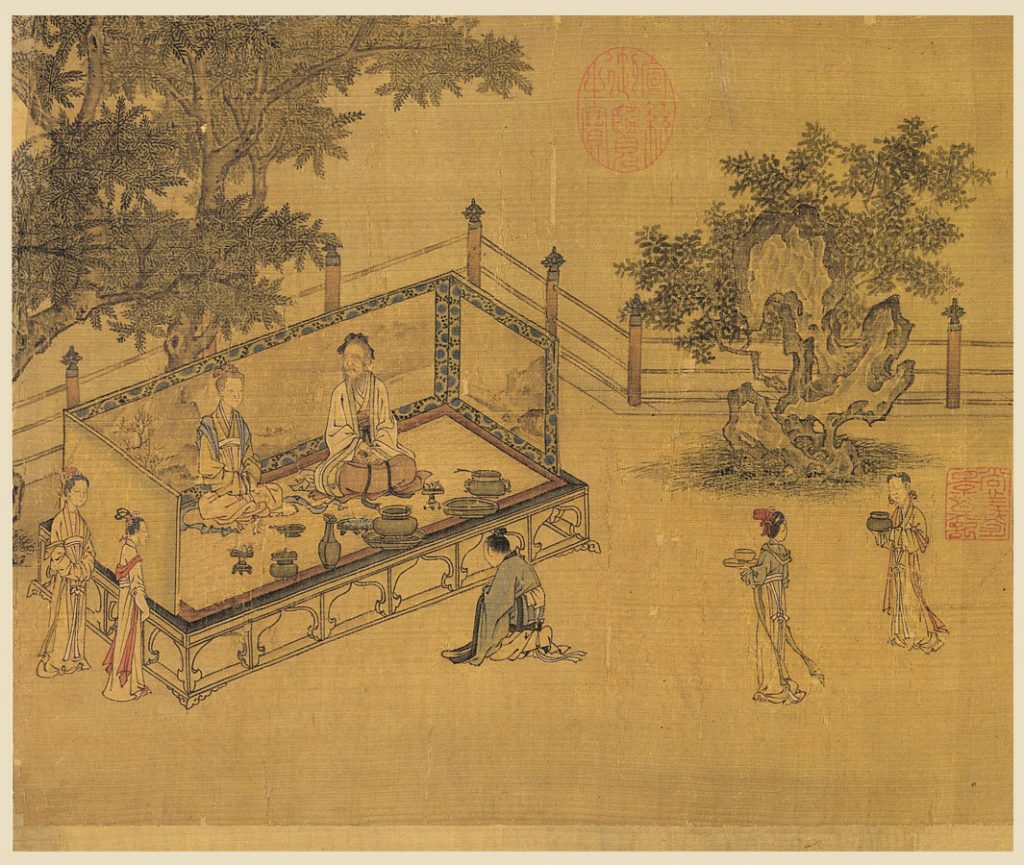
The administrative hypocrisy of later imperial China did not emerge from nowhere. It developed from one of the most consequential transformations in Chinese political history: the growing identification of state service with classical learning, moral cultivation, and examination success from the Tang into the Song. Earlier Chinese states had already valued scholarship, recommendation, and bureaucratic competence, but the Tang-Song transition gave new prominence to the idea that government should be staffed by men whose mastery of the classics reflected disciplined character as well as technical skill. The official was not supposed to be merely useful. He was supposed to be morally formed. This ideal drew strength from Confucian assumptions about the relationship between personal cultivation and public order. A man who had disciplined himself through study, ritual, filial conduct, and literary refinement could be trusted to discipline administration in turn. The state imagined merit as something more than talent. Merit meant cultivated virtue made visible through learning. This was a powerful administrative ideal because it joined moral aspiration to bureaucratic recruitment. The empire could claim that its officers were not merely selected for loyalty or utility, but for participation in a shared civilizational culture rooted in textual mastery and ethical discipline. Yet that claim also created the standard against which later compromises would be judged. Once office was defined as the reward of cultivated virtue, every advantage of family, wealth, patronage, and private connection became harder to admit openly.
The examination system became the chief institutional symbol of this moral state. By the Song, examinations helped shift elite identity away from the older aristocratic dominance of great hereditary houses and toward a broader literati class whose status depended heavily on education, writing, and service. This did not mean that birth ceased to matter, but it did mean that official legitimacy increasingly required performance within a classical curriculum. The examination hall presented itself as a disciplined moral space in which family background, personal wealth, and private influence were supposed to yield before textual mastery and intellectual accomplishment. The examinations embodied one of the great administrative promises of imperial China: office should belong to the worthy, not merely to the well-born. The candidate who succeeded through learning could appear as proof that the dynasty governed through principle rather than favoritism. The bureaucratic order could then claim that hierarchy itself was moral because it selected, ranked, and employed men according to demonstrated cultivation.
Yet the promise of merit contained its contradiction from the beginning. Examinations could widen access, but they did not create social equality. Preparing for them required years of education, access to books, tutors, family resources, leisure, and a household able to support a son through repeated attempts at success. Families with prior officeholding experience possessed cultural capital that could not be measured in the examination room but shaped who reached it. They knew what texts mattered, how essays should be composed, which teachers carried reputation, how marriage alliances could support status, and how local prestige could be converted into official opportunity. The state could present examination success as individual merit, but that merit was often produced collectively by families, lineages, schools, and regional networks. The contradiction was not that examinations were fraudulent. They were serious, competitive, and often demanding. The hypocrisy lay in the tendency to treat success as pure moral achievement while obscuring the social conditions that made success possible.
The Song literati order deepened this ambiguity because family and state were not enemies in Confucian thought. Filial duty, ancestral continuity, household discipline, and lineage reputation were themselves moral goods. A man did not become virtuous by abandoning family obligation; he became virtuous in part by fulfilling it. This meant that the official who advanced his kin, educated his sons, protected his lineage, and cultivated family prestige could imagine himself not as violating Confucian morality but as completing it. The difficulty arose when family obligation collided with the state’s claim to impartial service. The same moral universe that praised loyalty to ruler and care for the people also honored the continuity of the household. Elite families learned to present their own reproduction as service to civilization. A successful lineage did not merely preserve privilege; it preserved learning, ritual practice, local leadership, and administrative talent. That claim was not always false. Many elite families did produce capable officials and serious scholars. But it also allowed inherited advantage to wear the language of moral stewardship. The family became both the nursery of public virtue and the vehicle of private continuity. This dual role made hypocrisy difficult to isolate because the same act could be described in two moral languages at once. To support a promising son, nephew, or lineage member could appear as devotion to kin and as investment in the state’s future servants. To cultivate elite marriages and educational networks could appear as private strategy and as preservation of cultured order. The boundary between moral responsibility and status protection was persistently unstable.
This is why Tang-Song meritocracy should be understood as both a real achievement and a managed illusion. It was real because it created institutional routes through which education, competition, and literary accomplishment mattered enormously. It reshaped elite culture, weakened older aristocratic monopolies, and gave the imperial state a powerful means of recruiting talent and binding educated men to dynastic service. But it was an illusion when imagined as a clean separation between merit and privilege. The examination system did not abolish elite reproduction; it refined it. It encouraged families to convert wealth into education, education into degrees, degrees into office, and office back into family prestige. The moral state depended on the very social structures it claimed to transcend. Its language of public merit gave legitimacy to a hierarchy that remained deeply shaped by private resources. The mask was subtle because it did not conceal a hollow institution. It concealed the mixed character of a successful one. Examination culture disciplined ambition by forcing it through classical learning, but it did not eliminate ambition. It moralized competition, turning family strategy into a pursuit of cultivated distinction. This made the system remarkably durable, because it could absorb inequality without openly abandoning merit. Failure could be interpreted as insufficient preparation, weak talent, or moral inadequacy, while the deeper advantages of lineage wealth, local reputation, and educational inheritance remained partially hidden behind the language of effort and worthiness.
The Tang-Song foundations established one of the central patterns of Chinese administrative hypocrisy: virtue and advantage did not merely oppose each other; they intertwined. The state needed families to cultivate the men who would serve it, but those families used service to reproduce status. The examinations gave moral form to bureaucratic recruitment, but they also turned classical learning into a competitive inheritance. Officials were expected to serve the empire above private interest, yet their very formation as officials depended on households, teachers, patrons, and lineages invested in their advancement. The result was an administrative culture in which moral claims were sincere but never socially innocent. From the beginning, the imperial meritocracy was both an ethical aspiration and a mechanism of elite continuity. That tension would shape later conflicts over frugality, corruption, eunuch power, kinship privilege, and the practical compromises of governing a vast empire.
Song Literati Frugality and the Sedan Chair Reversal
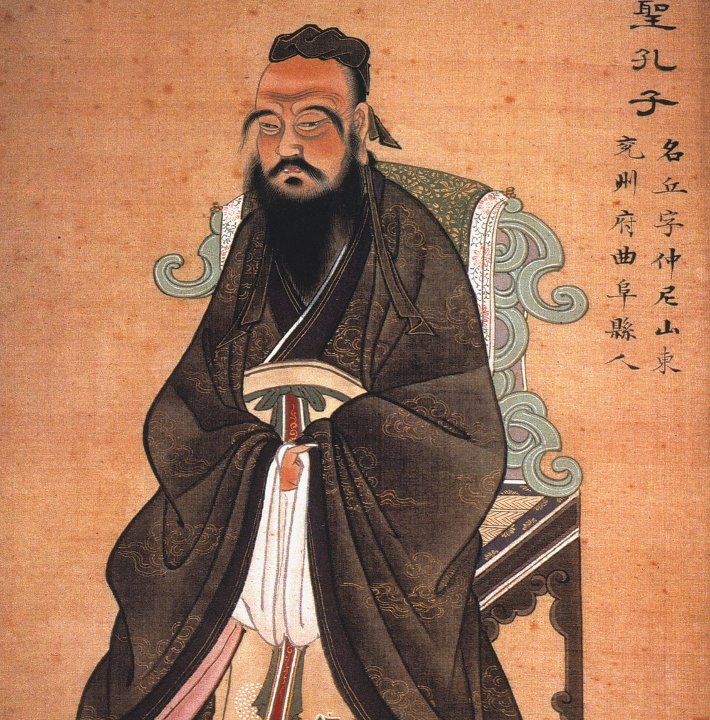
Song literati culture placed unusual moral weight on the visible habits of elite life. The scholar-official was not merely expected to govern well; he was expected to appear properly governed within himself. Clothing, food, housing, transport, ritual conduct, household discipline, and modes of leisure all carried ethical meaning because they could reveal whether a man had mastered desire or surrendered to comfort. Frugality became more than an economic preference. It was a sign of moral seriousness, a way of proving that public office had not become a path to softness, vanity, or exploitation. In an administrative culture shaped by Confucian ideals, the official who lived modestly could claim that his personal restraint reflected his concern for the people. The official who displayed luxury risked appearing detached from hardship and corrupted by status. This made elite consumption a moral problem, not merely a matter of taste.
The sedan chair became a revealing object within this moral world because it transformed comfort into visible hierarchy. To be carried by other human beings suggested a physical relationship of domination that could trouble literati ideals of humane government and personal restraint. Early criticism of sedan-chair use drew force from the sense that a cultivated man should not make other bodies bear his ease as though they were animals of burden. Transport was not neutral. Walking, riding, being carried, and displaying attendants all expressed a social relation. The official who denounced extravagance but allowed himself to be borne through the streets by laboring men made a public statement about whose comfort mattered and whose bodies could be used to sustain it. The sedan chair condensed a larger ethical contradiction. Song literati moralism could speak eloquently of benevolence and frugality, yet elite life continually generated practices that turned service, labor, and bodily inequality into symbols of refinement.
The practice became increasingly normalized among officials and wealthy urban elites, especially as Song society grew more commercialized, urbanized, and socially differentiated. The same literati culture that praised modesty existed within a world of expanding markets, refined consumption, book collecting, garden culture, fine foods, elegant furnishings, and increasingly elaborate markers of status. The growth of elite comfort did not necessarily appear to its participants as moral collapse. It could be redescribed as appropriate dignity, necessary convenience, age- or rank-based accommodation, or the ordinary style of respectable officeholding. That is precisely what made the reversal significant. A practice once vulnerable to moral criticism could be absorbed into the routines of elite life when enough people of standing adopted it. The moral objection did not have to be refuted directly; it could simply be worn down by habit, status, and convenience. What had once seemed like a visible violation of humane restraint became part of the expected equipment of social distinction. The shift also reveals how moral categories are often controlled by the class most able to benefit from their flexibility. When a poor man sought comfort, it could be read as laziness or presumption; when an official claimed comfort, it could be folded into the needs of office, dignity, health, or cultivated leisure. The sedan chair moved from ethical scandal to social normality not because the labor disappeared, but because elite interpretation changed. The bodies carrying the chair remained visible, but the moral discomfort they represented became easier for the upper class to ignore.
This pattern reveals how hypocrisy can develop gradually through cultural accommodation rather than abrupt betrayal. Few officials needed to announce that frugality no longer mattered. They could continue praising restraint while redefining what counted as excessive. Luxury often enters moral societies through exception: illness, age, rank, weather, official necessity, ceremonial propriety, or the burden of public responsibility. Once accepted for some, it becomes imaginable for others. Once repeated by the respected, it becomes difficult to condemn without seeming rigid or impractical. The sedan chair reversal illustrates an important feature of Song elite morality: ideals survived, but their practical boundaries shifted as the class that voiced them became more comfortable. Frugality remained a virtue in discourse, yet the material life of the literati increasingly made room for practices that earlier moralists had treated as signs of indulgence. The hypocrisy was not only personal. It was cultural, embedded in the ability of elites to preserve moral language while softening its demands upon themselves.
The larger significance of the sedan chair lies in what it reveals about Song statecraft and literati identity. The scholar-official claimed legitimacy through moral cultivation, but his social world depended on labor, wealth, household management, and public display. He was supposed to stand apart from crude appetite, yet he also belonged to an elite whose authority had to be seen. He was supposed to care for the people, yet his comfort could rest on the bodies of those beneath him. The sedan chair becomes more than a detail of transport. It becomes a small but vivid emblem of the administrative mask: the cultivated servant of the public order, borne by others while speaking the language of humility and restraint. Song literati culture did not abandon Confucian morality. It refined, debated, and deepened it. But it also demonstrated how easily moral ideals could bend around the habits of those who possessed the power to interpret them.
Meritocracy, Privilege, and the Family State: Examinations, Protection, and Yin Privilege
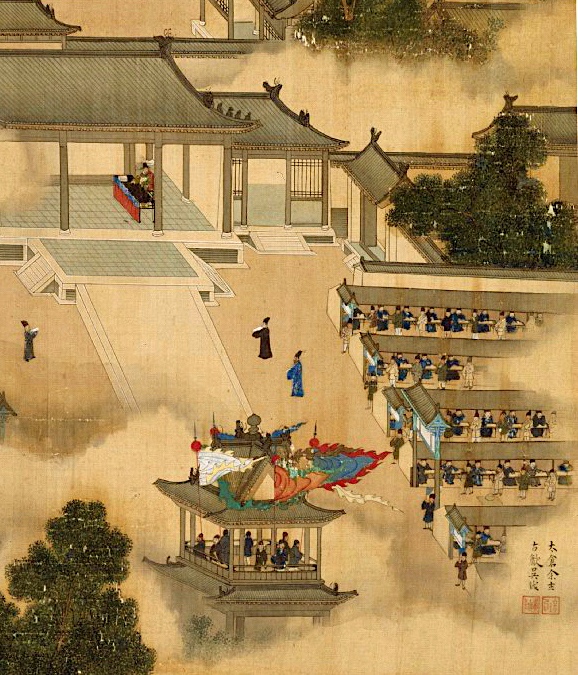
The examination system gave imperial China one of its most enduring claims to moral administration: office should be earned through learning rather than inherited through blood. In theory, the state selected men who had disciplined themselves through the classics, mastered literary form, absorbed ethical teaching, and demonstrated the capacity to think within the moral language of governance. This ideal mattered deeply. It distinguished the scholar-official from the hereditary aristocrat, the military strongman, the merchant seeking profit, and the court favorite dependent on personal access. The examination candidate appeared before the state as an individual moral intellect, tested by text, composition, and judgment. Yet the very success of this ideal created a powerful illusion. Merit could be examined, but the conditions that produced merit were never equally distributed. The examination hall could conceal the household behind the candidate, the lineage behind the household, and generations of accumulated advantage behind the appearance of individual achievement.
Yin privilege, or protection privilege, made that contradiction explicit. In various forms across imperial history, the relatives of high-ranking officials could receive access to office, rank, or appointment through family connection rather than through ordinary examination success. The practice did not simply abolish merit, nor did it always produce incompetent officials. It existed within a political culture that regarded family continuity, filial obligation, and service lineage as morally meaningful. A dynasty could justify such privilege as reward for distinguished service, recognition of loyal households, or preservation of administrative families whose members had already proven their usefulness to the state. But the tension remained obvious. The same state that celebrated competitive moral selection preserved routes by which official status could be transmitted through kinship. Protection privilege exposed the family inside the meritocracy. It showed that imperial administration never fully separated public office from private lineage, even when its official ideology encouraged people to imagine that it had. The contradiction was especially sharp because protection privilege made visible what the examination system often disguised: that officeholding was not only an individual achievement but a family asset. A father’s rank could open doors for sons; a household’s record of service could become a claim upon the state; official virtue could be converted into inherited opportunity. The rhetoric of reward softened the appearance of favoritism, but it did not remove the moral problem. If the state claimed that the classics and examinations revealed the worthy, then any hereditary shortcut raised the question of whether worthiness was being recognized or manufactured by status.
The contradiction was sharpened by the fact that Confucian morality did not treat family loyalty as corruption in itself. On the contrary, the family was the first school of virtue. Filial piety, ancestral obligation, household discipline, ritual continuity, and respect for elders were foundational ethical commitments. A man who neglected his family could hardly be trusted to govern others. This created a genuine moral complexity. When an official educated his sons, recommended relatives, maintained lineage property, or protected kin in times of difficulty, he could understand himself as fulfilling Confucian duty rather than betraying public service. Yet bureaucracy required another ideal: impartiality. The official was supposed to serve the ruler and the people, not merely the descent group that had produced him. The family state lived with an unresolved tension. It depended on households to cultivate officials, but it also feared that those households would capture office for themselves. The same kinship structures that produced disciplined candidates could produce favoritism, faction, and the quiet monopolization of opportunity. A lineage that invested in education might sincerely see itself as preserving moral culture, while outsiders could experience the same lineage as a gatekeeper of privilege. This made the boundary between virtue and advantage difficult to police. Family duty could become a language through which private advancement entered public office without appearing nakedly selfish. Hypocrisy appeared not because family morality was false, but because family morality and public morality could be made to shelter the same privilege.
The examination system itself intensified this tension by becoming the central mechanism through which families reproduced status. Success in the examinations required long preparation, specialized teachers, access to books, time away from manual labor, and an environment that valued literary discipline. Families with resources could support repeated attempts across years or decades, while poorer households faced far greater risks. Even when the system was formally open, the social costs of participation narrowed the field. Elite families treated education as a long investment: one son’s degree could strengthen the entire lineage, improve marriage prospects, increase local standing, attract students and clients, and create opportunities for younger relatives. In that sense, the examination system did not simply oppose inherited privilege. It gave privilege a morally acceptable form. Wealth could be converted into learning, learning into degree status, and degree status into political authority. The cycle was not automatic, and failure remained common, but the structure allowed families to describe social reproduction as the triumph of merit.
This does not mean that imperial meritocracy was merely decorative. Its competitive pressure was real, and its cultural effects were enormous. The examinations standardized elite learning, tied ambition to classical study, and gave the central state a powerful instrument for disciplining local elites. They also created genuine opportunities for men outside the most established families, especially in periods when the state expanded recruitment or when regional educational cultures shifted. But the moral claim of the system always exceeded its social reality. The state could celebrate the worthy man rising through talent while leaving largely unspoken the unequal distribution of the tools needed to become “worthy.” It could denounce favoritism while preserving protected appointments. It could insist that office belonged to cultivated virtue while accepting that virtue was most often cultivated in households already possessing leisure, teachers, libraries, and connections. This was not a crude contradiction between a fake ideal and a corrupt practice. It was a durable administrative compromise in which merit and privilege were braided together so tightly that each could legitimate the other.
The result was a family state wearing the face of meritocracy. Imperial China’s bureaucratic order was not simply hereditary, and it was not simply open. It was a moralized field of competition in which families, lineages, teachers, patrons, and candidates all participated in the production of official worth. Yin privilege revealed the older logic of family protection, while the examinations revealed the newer logic of cultivated competition. Together, they made imperial administration both flexible and hypocritical. The state needed merit to claim legitimacy, but it needed families to produce the men who could display merit. It condemned private interest, yet relied on private households to sustain public service. It praised impartial selection, yet tolerated channels of inherited access and elite reproduction. The contradiction would persist into later dynasties because it was built into the very relationship between Confucian ethics and bureaucratic governance. In a civilization where family was the foundation of moral life, the state could never fully prevent family from entering the machinery of office.
Ming Moral Rule and the Eunuch Problem
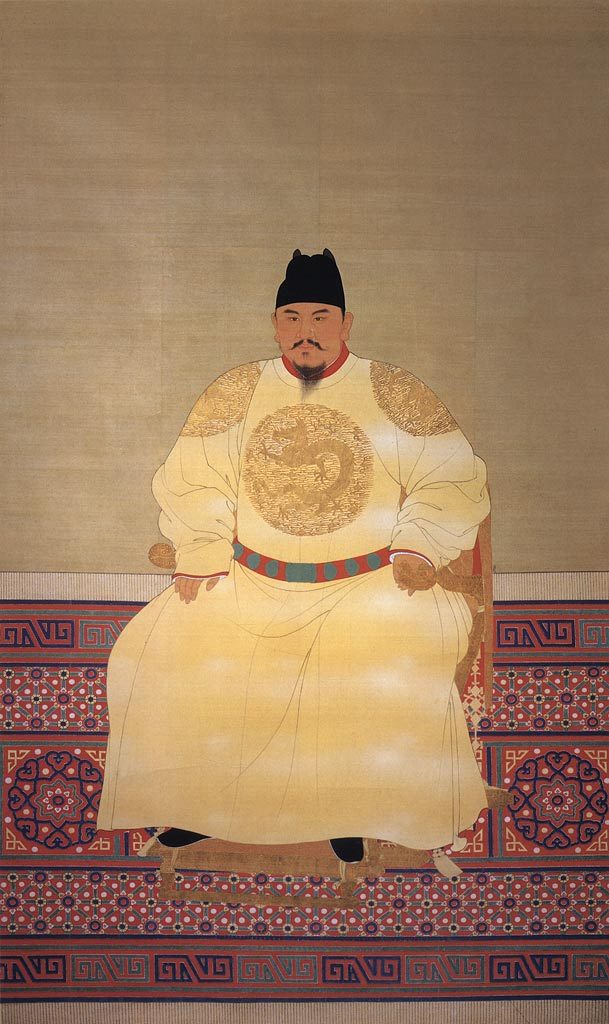
The Ming dynasty made the contradiction between moral administration and imperial power especially visible. Founded after the expulsion of Mongol rule, the dynasty presented itself as a restoration of proper Chinese governance, agrarian order, ritual hierarchy, and Confucian moral discipline. The Hongwu emperor distrusted ministerial arrogance, punished corruption ferociously, and sought to bind officials to a vision of service grounded in obedience, frugality, and administrative severity. In theory, the scholar-official stood at the center of this order: classically educated, morally trained, and responsible for guiding policy through loyal remonstrance and bureaucratic competence. Yet Ming monarchy was never simply Confucian bureaucracy in action. The emperor remained the personal source of sovereignty, and the court contained institutions and agents that did not fit comfortably within scholar-official ideals. Among these, eunuchs became the most controversial. They served inside the palace, answered directly to imperial authority, and embodied a form of power that literati officials found morally suspect, socially irregular, and politically dangerous.
Scholar-official hostility toward eunuchs rested on more than administrative rivalry. It drew upon deep Confucian assumptions about the body, family continuity, and moral personhood. Because eunuchs had been castrated, they were often portrayed by literati critics as men cut off from ordinary filial reproduction and from the family order that grounded Confucian virtue. They belonged to the inner court rather than the outer bureaucracy, to personal service rather than public office, to palace intimacy rather than classical selection. This made them easy targets for moral condemnation. Eunuch influence could be denounced as secretive, corrupting, feminized, servile, and dangerous to proper government. The official bureaucracy could present itself as the guardian of public principle against palace manipulation. Yet this contrast was never as clean as the rhetoric suggested. Eunuchs were not merely parasites upon the Ming state. They were instruments through which emperors governed, monitored officials, managed sensitive tasks, commanded military operations, supervised workshops, participated in ritual and diplomatic activities, and sometimes performed functions scholar-officials could not or would not perform. The moral language of eunuch corruption often concealed a more practical fact: the emperor used eunuchs because they allowed him to bypass, balance, or discipline the scholar-official bureaucracy.
The hypocrisy became sharper when officials who condemned eunuch power also sought eunuch favor. Because eunuchs had access to the emperor, controlled palace channels, and sometimes held influence over appointments, investigations, punishments, and policy, they became unavoidable figures within the political ecology of the Ming court. Scholar-officials could denounce them in memorials, histories, and moral discourse while privately cultivating connections when career, factional survival, or policy success required it. The problem was not simply that individual officials were weak. It was that Ming governance created two overlapping systems of authority: the public moral bureaucracy of the scholar-officials and the personal administrative machinery of the imperial household. Officials could claim that legitimate government flowed through classical learning, law, and bureaucratic procedure, but the emperor’s proximity to eunuchs gave palace service its own kind of power. A man who wished to serve the state might find that the moral route and the effective route were not the same. The result was a politics in which condemnation and dependence could coexist, with eunuchs publicly treated as symbols of disorder while privately functioning as brokers of access.
The most notorious eunuch episodes made this contradiction impossible to ignore. The Ming state developed powerful eunuch-led organs of surveillance and punishment, including the Eastern Depot and later related secret-police institutions, which operated alongside or above ordinary bureaucratic channels. These agencies gave emperors tools to investigate, intimidate, and bypass officials, especially when trust between throne and bureaucracy deteriorated. In the fifteenth century, eunuch commanders and agents participated in military, diplomatic, and maritime projects, while in later periods figures such as Wang Zhen and Wei Zhongxian became symbols of catastrophic eunuch overreach. Wei Zhongxian’s dominance under the Tianqi emperor was especially damaging to the moral claims of Ming governance because it appeared to confirm every literati warning: a palace servant, outside the proper channels of classical office, could dominate appointments, persecute critics, and create a cult of political loyalty around himself. Yet even this extreme case should not be read only as an aberration. It revealed a structural vulnerability within Ming monarchy. When emperors withdrew from regular bureaucratic engagement or used personal agents to discipline officials, eunuch power could expand into the spaces where formal moral administration could not control the palace. The scholar-official critique of eunuchs was partly true, but also self-protective. It blamed palace corruption while often avoiding the harder question of why the Ming imperial system repeatedly empowered such intermediaries.
The Ming eunuch problem exposes one of the clearest forms of administrative hypocrisy in early modern China. The dynasty praised Confucian moral rule, but emperors relied on agents whom Confucian officials described as morally and institutionally improper. Scholar-officials denounced eunuchs as corrupt intruders, yet many maneuvered within eunuch-dominated channels when survival or advantage demanded it. The court condemned disorder while creating parallel mechanisms that made disorder politically useful. This was not simply a clash between good officials and bad eunuchs, though Ming moral histories often encouraged that reading. It was a contradiction built into imperial governance itself. The emperor needed scholar-officials to administer the realm and supply the language of legitimate rule, but he also needed personal servants who could counterbalance that bureaucracy and preserve direct imperial control. Eunuchs became the living sign of that contradiction. They were reviled as violations of Confucian government while remaining indispensable to the monarchy that claimed to embody Confucian order.
Ming Commercial Expansion and the Moral Language of Anti-Profit

Late Ming society exposed another contradiction in Confucian administration: the persistent moral suspicion of profit in a world increasingly organized by commerce. Classical political language had long privileged agriculture, frugality, social hierarchy, and moral cultivation over the pursuit of private gain. Merchants were not always despised, and commercial activity had always been indispensable to imperial life, but the official moral hierarchy still tended to treat profit-seeking as spiritually and socially dangerous when it escaped proper regulation. The ideal scholar-official was supposed to serve the public order, not chase wealth. The good household was supposed to preserve ritual discipline, not dissolve into appetite and display. Yet by the sixteenth and seventeenth centuries, Ming China had become deeply commercialized, with expanding markets, monetized taxation, urban consumption, publishing, luxury goods, merchant-literati interaction, and increasingly visible forms of wealth. The state and the literati could continue speaking the language of restraint, but the society around them was becoming harder to describe in those terms.
This commercial expansion did not simply undermine Confucian culture from outside. It entered the literati world itself. Scholar-officials and degree-holders bought books, collected antiques, built gardens, consumed fine foods, commissioned paintings, exchanged elegant objects, and participated in the refined material culture of late Ming urban life. Merchants, meanwhile, used wealth to acquire education, patronize scholars, sponsor publishing, marry into elite circles, purchase cultural prestige, and imitate literati styles. The boundary between moral learning and monetary power became increasingly porous. This did not mean that all elite culture became cynical or hollow. Late Ming commercial prosperity also supported printing, scholarship, drama, art, local philanthropy, and wider circulation of texts. But it made the older moral opposition between cultivated virtue and vulgar profit difficult to sustain. Literati could condemn greed while enjoying commercial abundance; merchants could be criticized as profit-seekers while financing the very cultural world that scholars inhabited. Anti-profit language remained powerful because it preserved hierarchy, but daily practice made that hierarchy unstable. The scholar-official’s moral superiority depended partly on claiming distance from the marketplace, yet his books, servants, art objects, furniture, travel, entertainment, and household comforts were often made possible by the same commercial energies he was expected to distrust. Likewise, the merchant’s supposed moral inferiority became harder to maintain when merchant families educated sons for examinations, endowed temples and schools, funded public works, and behaved as patrons of precisely the classical culture that defined elite legitimacy. Commerce did not simply buy things; it bought proximity to status, and that proximity unsettled the symbolic boundaries on which Confucian social ranking depended.
The contradiction appears vividly in the moral anxiety surrounding luxury. Late Ming writers often criticized extravagance, sensuality, gambling, display, and the erosion of older social boundaries. Such criticism was not baseless. Commercial wealth could produce predatory lending, corruption, conspicuous consumption, and competition for status through objects rather than virtue. Yet anti-luxury rhetoric frequently functioned as a way for elites to police social distinction while protecting their own refined consumption. A poor man’s desire for comfort could be dismissed as disorder, while a literatus’s expensive garden might be described as cultivated withdrawal. A merchant’s spending could be called vulgar display, while an official’s collection of rare books, bronzes, paintings, or furniture could be understood as evidence of taste. The moral problem was not consumption alone, but who possessed the authority to define consumption as proper or corrupt. Confucian anti-profit language could become a mask for class anxiety. It condemned the destabilizing force of money most sharply when money threatened to imitate or compete with older forms of elite prestige.
Literature from the period captured this world with unusual sharpness. The Plum in the Golden Vase should not be read as a simple documentary record of Ming administration, but it is invaluable as a literary anatomy of transactional society. Its world is saturated with money, sex, bribery, household competition, gifts, favors, appetite, religious display, and social calculation. Moral language remains present, but it is repeatedly hollowed out by exchange. Relationships that should be governed by kinship, loyalty, propriety, or affection become entangled with advantage. That literary vision reflects a broader late Ming concern that the language of moral order had become increasingly theatrical in a society where wealth could buy access, bodies, honors, objects, and protection. The novel’s force lies in its refusal to let readers imagine corruption as only a bureaucratic defect. It shows a social world in which profit has entered the household, the bedroom, the temple, the marketplace, and the administrative imagination. The result is not a world without morality, but a world in which morality is constantly being spoken, quoted, invoked, and displayed while practical life moves according to calculation. This is what makes the text so useful for the larger argument. It dramatizes hypocrisy as social atmosphere rather than isolated wrongdoing. People still know the language of propriety, but that language circulates alongside gifts, loans, sexual bargaining, status display, religious manipulation, and the pursuit of advantage. Hypocrisy becomes cultural rather than merely official: people speak the inherited language of virtue while organizing life around benefit.
Late Ming commercial expansion revealed a persistent weakness in the moral vocabulary of administration. The Confucian state needed commerce, taxed commerce, used silver, depended on markets, and relied on merchants, yet its official language remained uneasy about profit as a governing motive. Scholar-officials could denounce commercial vulgarity while participating in the status culture commerce made possible. Merchants could be morally subordinated while economically indispensable. Luxury could be condemned in principle while practically refined. The result was not the disappearance of Confucian morality, but its selective adaptation to a monetized world. Anti-profit rhetoric continued to distinguish the gentleman from the merchant, public service from private gain, and cultivated taste from vulgar accumulation. But those distinctions grew increasingly difficult to defend cleanly. The administrative mask widened: moral rule still claimed to stand above profit, even as profit shaped the society, institutions, and elite habits through which moral rule was performed.
Qing “Clean” Government and the Fiscal Logic of Informal Extraction
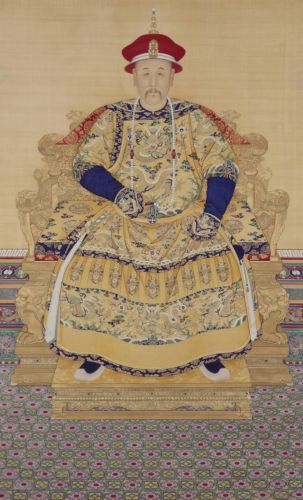
The Qing dynasty inherited the Confucian ideal of clean government and gave it a powerful administrative vocabulary. Officials were expected to be frugal, upright, restrained, impartial, and devoted to the welfare of the people. The magistrate, especially, was imagined as the moral face of the state in local society: judge, tax supervisor, ritual representative, famine responder, police authority, and paternal guardian of order. In theory, his personal integrity mattered because administration was not merely technical. A corrupt official did not simply steal money; he damaged the moral bond between ruler and people. Qing emperors, especially in the early and high Qing, repeatedly denounced corruption, disciplined officials, demanded truthful reporting, and presented themselves as guardians of a purified bureaucratic order. Yet this rhetoric of clean government existed within a fiscal system that made purity almost impossible. Officials were supposed to govern with integrity, but the resources formally provided to them were often insufficient for the actual costs of governing.
The contradiction was built into the ordinary life of office. A county magistrate did not govern alone. He depended on clerks, runners, scribes, servants, guards, messengers, legal specialists, tax handlers, and informal local intermediaries. Many of these people were poorly paid, irregularly paid, or not fully supported by official salary structures, yet they were indispensable to the daily functioning of the yamen. Documents had to be copied, prisoners watched, lawsuits processed, taxes collected, roads traveled, reports sent, granaries inspected, and local disputes managed. The official also had to sustain the dignity of office, receive visitors, participate in ritual obligations, maintain a household, and prepare for transfers or emergencies. The state’s moral image of the solitary upright magistrate concealed a complex administrative organism whose expenses exceeded the clean lines of formal compensation. Fees, customary payments, gifts, surcharges, and negotiated exactions filled the gap. Some were abusive, some were routine, and many occupied the gray space between administrative necessity and corruption. This was especially true because the formal state remained remarkably thin at the county level, where a single magistrate might be responsible for a large population, sprawling territory, and a wide range of judicial, fiscal, ceremonial, and police responsibilities. The ideal of personal moral rule depended on a practical apparatus of subordinates whose behavior the magistrate could never fully control. Clerks and runners possessed procedural knowledge, local familiarity, and access to litigants and taxpayers, which gave them opportunities to extract fees or manipulate administrative process. The magistrate might condemn such practices while still relying on the very personnel who carried them out. Clean government, in other words, required dirty hands somewhere in the system, even if official ideology preferred not to see them.
This gray space is where Qing hypocrisy became institutional rather than merely personal. The state condemned corruption, but it also knew that local administration could not function on moral exhortation alone. If officials refused all informal revenue, they might be unable to pay staff, maintain operations, or meet expectations from superiors. If they accepted too much, they became predators upon the people. The problem was not simply greed; it was structural underfunding combined with enormous administrative responsibility. The result was a culture in which everyone understood that certain unofficial payments would occur, while official rhetoric continued to define them as morally suspect. A magistrate could publicly proclaim incorruptibility while privately tolerating clerks’ fees or extracting customary charges to keep the office running. Superiors could demand clean government while expecting subordinates to deliver tax quotas, maintain order, and finance local operations through means the central state did not fully acknowledge. The moral language remained pure because the fiscal system was impure.
The Yongzheng emperor’s fiscal reforms are crucial because they reveal that the Qing state itself recognized the contradiction. Yongzheng sought to rationalize local finance and reduce corruption through measures such as huohao guigong, the conversion of meltage fees into public funds, and yanglian yin, commonly translated as “integrity-nourishing silver.” These supplements were intended to provide officials with legitimate income beyond their basic salaries, thereby reducing dependence on extortion and informal extraction. The reform was morally revealing. It admitted, without saying so in crude terms, that officials could not be made honest simply by commanding them to be virtuous. Clean government required material support. Integrity had to be “nourished,” not merely preached. Yet the reform also showed the limits of moral administration. Once the state formalized some supplemental revenues, it acknowledged that the boundary between legitimate administrative funding and corrupt extraction had never been as clear as official ideology pretended. The system had to rescue virtue by legalizing part of the fiscal reality that virtue had previously condemned. Yongzheng’s reforms exposed the paradox at the heart of Qing administrative morality: the state needed to preserve the appearance that upright officials served from principle, but it also had to accept that principle alone could not pay for government. By converting some informal revenues into recognized public funds, the dynasty tried to distinguish necessary fiscal support from corrupt abuse. But that distinction was difficult to maintain because local officials still faced uneven costs, regional variation, pressure from superiors, and the persistent influence of clerical subordinates. Reform could discipline the system, but it could not remove the gap between the ideal of moral office and the economics of administration.
Even after reform, the problem did not disappear. Informal extraction remained difficult to eliminate because local administration was embedded in relationships, expectations, and practical pressures that could not be fully standardized from the capital. Clerks and runners often possessed local knowledge that rotating magistrates lacked. Local elites mediated tax collection, litigation, famine relief, and social order. Magistrates needed cooperation from people whose interests did not always align with imperial morality. Meanwhile, the population grew, administrative burdens expanded, and the number of formal officials remained relatively small in proportion to the scale of society. The result was a thin formal state resting on dense informal practices. Qing administrative culture depended on a double vision. Officially, the magistrate embodied imperial virtue and impartial law. Practically, he governed through negotiated authority, local brokers, customary charges, clerical expertise, and financial improvisation. The clean official existed as an ideal, but the functioning office required arrangements that made clean government permanently vulnerable.
Qing “clean” government reveals one of the most sophisticated forms of administrative hypocrisy in imperial China. The dynasty did not simply ignore corruption, nor did it lack serious moral concern. Its rulers and reformers understood that corruption threatened legitimacy, burdened the people, and weakened the state. But they also governed through fiscal and bureaucratic arrangements that made informal extraction predictable. This produced a recurring pattern: moral condemnation, practical tolerance, partial reform, renewed abuse, and renewed condemnation. The hypocrisy was not a superficial failure of rhetoric. It lay in the state’s need to preserve the image of Confucian integrity while relying on practices that integrity could not fully endorse. Qing administration preached purity from above while absorbing impurity below. In that tension, the administrative mask became almost unavoidable: officials had to appear clean, the state had to demand cleanliness, and yet the machinery of local government often ran on money that no one wished to name too clearly.
Gifts, Guanxi, and the Moral Ambiguity of Administrative Relationships
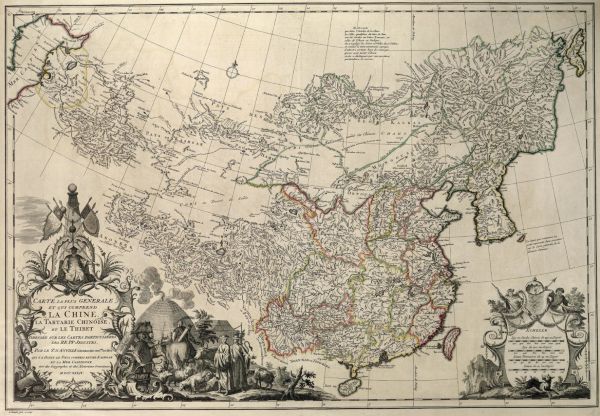
Late imperial administration did not operate through impersonal rules alone. It worked through relationships: kinship, native-place ties, teacher-student obligations, patronage, recommendation, gift exchange, clerical mediation, elite sponsorship, and local reputation. These networks were not accidental intrusions into an otherwise clean bureaucracy. They were part of the social fabric through which officials gathered information, secured cooperation, managed disputes, and built careers. Confucian political morality itself placed enormous value on properly ordered relationships. A good society was not imagined as a world of isolated individuals obeying abstract procedure, but as a hierarchy of roles shaped by obligation, reciprocity, ritual propriety, and moral discernment. That made the boundary between legitimate relationship and corrupt connection especially difficult to draw. A gift could be courtesy or bribery. A recommendation could be mentorship or favoritism. A personal tie could support good administration or capture it for private advantage.
The term guanxi is often used loosely today to describe Chinese networks of connection, but for late imperial history it should be handled carefully. The problem was not a timeless national habit or some uniquely Chinese weakness for personal influence. All bureaucracies depend to some degree on trust, access, recommendation, informal communication, and social capital. What made the Ming-Qing world distinctive was the tension between a Confucian moral order that openly valued relationships and a bureaucratic ideal that required impartial service to the ruler and the people. Officials were expected to know how to conduct themselves within webs of hierarchy and reciprocity, but they were also expected not to let those webs distort judgment. This produced a permanent ambiguity. The same relationship could be morally praised as humane attentiveness or condemned as partiality depending on circumstance, outcome, and observer. A teacher’s recommendation might be understood as the transmission of learning and trust, but it could also become a channel of factional advancement. A native-place tie might allow an official to understand local conditions and support a worthy man, but it could also protect insiders from scrutiny. A patron could help talent reach office, yet that help could create obligations that later compromised judgment. Administrative hypocrisy flourished in that ambiguity because personal influence could be defended as proper relationship even when it functioned as private leverage. The moral vocabulary of relationship did not merely hide corruption after the fact; it gave influence a respectable language before anyone had to call it corrupt.
Gift exchange made the contradiction visible in everyday form. Gifts were not inherently corrupt within Chinese social life. They expressed respect, gratitude, ritual obligation, apology, hierarchy, friendship, and seasonal propriety. Refusing a gift could itself be rude or politically provocative. Yet gifts also created expectations. They could soften a decision, open a door, remind an official of obligation, or disguise payment for favor. The danger lay precisely in the fact that the same object could carry multiple meanings. A bolt of silk, a book, a meal, travel expenses, a New Year’s offering, or support for an official’s staff might be framed as courtesy while functioning as influence. This was not merely a matter of individual deceit. It was a social system in which moral forms could protect practical exchange from blunt description. A bribe called a bribe violated official morality. A gift embedded in ritual language could move through respectable channels while leaving everyone aware of its likely purpose. The mask was not silence; it was etiquette.
Local administration intensified this ambiguity because officials were rarely independent actors floating above society. Magistrates rotated from place to place, often lacking deep local knowledge, while clerks, runners, lineage heads, merchants, degree-holders, and gentry figures possessed the information and networks necessary to make government work. The state wanted officials to remain impartial, but effective governance required cooperation with local intermediaries whose influence came from precisely the social ties impartiality was supposed to restrain. A magistrate who ignored local elites might fail to collect taxes, suppress violence, manage famine relief, or understand litigation. A magistrate who depended too heavily on them risked becoming their instrument. The same dilemma appeared in recommendation and career advancement. A senior official could help a talented junior man enter service or gain recognition, but such support could also create factions, debts, and protected circles of influence. The bureaucratic state needed personal trust because documents alone could not govern the empire, yet trust easily became patronage.
This relational order also blurred the distinction between public and private morality. Confucian ethics did not teach men to abandon personal obligations when they entered office. It taught them to order obligations properly, beginning with family and extending outward toward ruler, community, and all under Heaven. The ideal official was not a cold functionary without attachments, but a morally cultivated man capable of judging relationships according to principle. But the ability to define “proper” relationship often belonged to those already powerful enough to benefit from it. A favor for kin could be defended as filial responsibility. Protection of a protégé could be described as support for talent. Assistance to someone from one’s native place could appear as humane solidarity. Intervention in a case could be justified as correction of injustice. None of these claims was automatically false, and that is exactly why the system was so difficult to police. The language of moral relationship could shelter generosity, justice, and mentorship, but it could also shelter nepotism, factionalism, bribery, and the quiet conversion of office into social capital.
The ambiguity of gifts and relationships reveals a subtle form of administrative hypocrisy in Ming-Qing governance. The state publicly demanded impartial service, clean judgment, and loyalty to the public order. Yet it governed through a society in which obligation, reciprocity, and personal access were indispensable. Officials condemned corruption, but they navigated a world in which influence rarely appeared nakedly as corruption. It came clothed as gratitude, ritual, friendship, kinship, mentorship, shared origin, or moral concern. This made hypocrisy harder to expose than simple theft. The corrupt official could look like a generous patron. The manipulative gift could look like proper courtesy. The factional network could look like a community of shared learning. Late imperial administration rested on a persistent double truth: relationships made governance possible, and relationships made governance morally vulnerable. The administrative mask was woven not only from laws and salaries, but from the silk threads of obligation itself.
The Late Qing Crisis: Anti-Foreign Morality and Western Tools

The nineteenth-century Qing crisis forced the imperial state to confront a contradiction that had long been present but now became impossible to manage quietly: the empire claimed civilizational and moral superiority over foreign powers while increasingly depending on foreign techniques, weapons, ships, diplomatic forms, and industrial knowledge for survival. Earlier administrative hypocrisy had emerged from the tension between Confucian ideals and internal governance. The late Qing crisis shifted that tension onto the world stage. Defeats in the Opium Wars, the unequal treaties, the Taiping Rebellion, the Arrow War, the expansion of treaty ports, and later defeats by France and Japan all exposed the limits of older assumptions about Chinese centrality and foreign inferiority. Qing officials could still describe Western powers as morally crude, commercially predatory, and culturally inferior, often with reason when confronting imperial violence and the opium trade. Yet those same officials increasingly recognized that the dynasty needed Western artillery, steamships, arsenals, translation bureaus, military training, diplomatic knowledge, and technical education. The moral language of anti-foreign superiority survived, but the practical needs of state defense pulled policy in the opposite direction.
The Self-Strengthening Movement tried to manage this contradiction by separating moral essence from technical use. Reform-minded officials argued that Chinese learning should remain the foundation while Western learning could be adopted for practical functions. This formula allowed the state to borrow without openly surrendering its civilizational hierarchy. Western machines could be useful, but they did not have to be morally authoritative. Guns, ships, mathematics, engineering, telegraphy, and diplomatic procedure could be treated as tools rather than as signs that the Confucian order required deeper transformation. In one sense, this was a reasonable distinction. A society can adopt foreign technology without abandoning its ethical inheritance. The hypocrisy lay not in borrowing itself, but in the rhetorical need to condemn the foreign world as inferior while depending on that world’s material power to preserve the dynasty. Qing officials sought to defeat Western threats by acquiring Western means, while insisting that the moral core of Chinese governance remained fundamentally superior and intact.
This tension shaped the careers of major late Qing statesmen. Zeng Guofan, Li Hongzhang, Zuo Zongtang, and Zhang Zhidong all operated in a world where military and administrative survival required selective adaptation. Arsenals were built, students were sent abroad, foreign experts were hired, translation projects were supported, and modern naval and military programs were attempted. Yet reform remained cautious, fragmented, and often defensive because it had to pass through a political culture suspicious of foreign influence and protective of established moral authority. The result was not simple cowardice or ignorance. Many officials understood the seriousness of the crisis. But they had to speak in a language that made reform acceptable to court politics, literati opinion, and Confucian legitimacy. Western knowledge could be praised as technically useful while being denied the status of moral or institutional model. That distinction allowed adaptation to begin, but it also limited how far adaptation could go. The state could modernize arsenals more easily than it could modernize assumptions about sovereignty, bureaucracy, education, military command, or public accountability.
Anti-foreign morality also had a political function. It preserved dignity in the face of humiliation. After military defeat and treaty coercion, to insist on Chinese moral superiority was not merely empty pride; it was a way to resist the total collapse of civilizational confidence. Foreign powers had imposed unequal treaties, extracted indemnities, forced open ports, and defended opium commerce through violence. Qing suspicion of the West cannot be dismissed as irrational prejudice. The problem was that moral condemnation of foreign aggression could also become a shield against institutional self-critique. Officials could blame barbarian greed, missionary intrusion, commercial exploitation, and military aggression while avoiding the harder question of why the Qing state had become so unable to defend itself. The language of moral superiority could preserve cultural identity, but it could also postpone reform. It allowed the dynasty to say that the West possessed machines but not virtue, power but not civilization, technique but not moral order. That claim contained truth as critique of imperial violence, but it became hypocritical when it enabled dependence on foreign tools without honest reckoning with the institutional weaknesses those tools exposed. Anti-foreign rhetoric could operate as both resistance and evasion. It named real violence done to China, but it also allowed officials to preserve the comforting belief that defeat had resulted from technical deficiency alone rather than from deeper failures in fiscal organization, military command, diplomatic understanding, industrial capacity, and bureaucratic adaptation. The foreigner could be morally condemned without forcing the state to ask whether its own governing habits had become inadequate to the world it now faced.
The late Qing crisis brought administrative hypocrisy into a new imperial and global frame. Earlier contradictions had involved merit and privilege, frugality and luxury, clean government and informal extraction, relationship and impartiality. Now the contradiction involved civilizational confidence and geopolitical dependence. The dynasty needed Western technology while fearing Westernization, needed reform while defending inherited authority, needed new institutions while preserving old legitimacy, and needed to admit weakness without appearing morally defeated. This was the administrative mask under foreign pressure: the state publicly affirmed the superiority of Confucian order while selectively borrowing from those it named culturally inferior. Self-strengthening was both practical and evasive. It recognized that survival required change, but it often treated change as a technical supplement rather than a challenge to the moral and institutional structure of Qing rule. The problem was not that China borrowed from the West. The problem was that the dynasty tried to borrow power without fully confronting what its dependence revealed.
Late Qing Reform, Purchased Office, and the Collapse of Moral Administration
The following video from “Epic History” covers the collapse of the Chinese imperial system:
By the late nineteenth century, the contradictions of Qing administration had moved from chronic tension to systemic crisis. The dynasty faced military defeat, foreign indemnities, treaty-port pressures, population growth, rebellion, fiscal exhaustion, and widening doubts about the competence of the imperial order. Earlier forms of administrative hypocrisy had been survivable because the state could still present its moral claims as broadly credible. Officials might take informal fees, families might preserve privilege, and local networks might bend impartiality, but the larger structure of Confucian rule remained intact. In the late Qing, the distance between moral language and administrative reality became harder to conceal. The state continued to speak of upright office, public service, moral cultivation, and loyalty to the people, while relying increasingly on emergency finance, purchased titles, militarized regional power, bureaucratic shortcuts, and reform measures that exposed the weakness of the institutions they were meant to save. What had once appeared as administrative compromise now looked increasingly like institutional exhaustion. The old moral vocabulary still had force, but it no longer possessed the same capacity to stabilize public confidence. A dynasty could survive many contradictions when it appeared strong; when it appeared weak, the same contradictions became evidence of decay.
Purchased office and degree sales were among the clearest signs of this erosion. Imperial China had long maintained a complex relationship between formal merit and alternative routes into status, but the late Qing fiscal crisis gave monetary access new urgency. Degrees, titles, and offices could be sold or monetized to raise revenue, especially under the pressure of rebellion, military campaigns, disaster relief, and foreign indemnities. Such practices did not simply produce administrative inefficiency; they struck at the moral heart of the examination state. If office and status were supposed to reflect cultivated learning and ethical formation, then their sale turned moral rank into fiscal instrument. The dynasty could justify these measures as necessity, and necessity was real. The state needed money to survive. Yet the cost was profound. Every purchased title weakened the claim that hierarchy rested on merit. Every fiscal shortcut reminded the public that the language of virtue could be bent by the needs of revenue. The moral state was, quite literally, selling pieces of its own legitimacy.
The problem was intensified by the growth of regional military and administrative power after the Taiping Rebellion. The Qing court survived in large part because officials mobilized regional armies, local financing, gentry networks, and new forms of military organization. Their achievements were significant, and without them the dynasty might have fallen earlier. Yet their success revealed the weakness of the central bureaucratic order. Loyal officials acted in the name of the dynasty while building power through regional bases, personal followings, and semi-autonomous fiscal arrangements. The Confucian ideal of centralized moral administration remained rhetorically intact, but practical authority increasingly depended on men whose effectiveness came from improvising beyond the old bureaucratic frame. This was not simple disloyalty. It was loyal decentralization, which made it all the more revealing. The state survived through methods that exposed the insufficiency of the state’s own administrative ideals. Loyalty to the throne required the circumvention of normal structures.
Reform deepened the contradiction because it simultaneously acknowledged and denied institutional failure. Late Qing reformers called for new schools, military reorganization, industrial development, legal revision, constitutional experiments, bureaucratic restructuring, and eventually the abolition of the civil service examinations in 1905. These reforms were not cosmetic. They represented a serious recognition that classical learning alone could no longer sustain governance in a world of imperial competition, industrial warfare, global diplomacy, and domestic unrest. Yet reform was also constrained by the need to preserve dynastic legitimacy. The Qing court had to admit enough weakness to justify change, but not so much that the moral authority of imperial rule collapsed entirely. Reformers often framed transformation as recovery rather than rupture, adaptation rather than abandonment, strengthening rather than surrender. The old language of moral governance remained useful even as the institutions built upon that language were being dismantled. The abolition of the examinations was especially symbolic: the dynasty ended the very mechanism that had long joined learning, merit, and official legitimacy, while still hoping to preserve a moral state through new administrative forms.
The sale of office, the rise of regional power, and the pressure of reform all converged to produce a crisis of trust. Subjects and local elites could still hear the language of Confucian responsibility, but they also saw officials extracting revenue, titles being purchased, armies organized through personal networks, foreign debts shaping policy, and reform decrees arriving from a court struggling to command confidence. The old administrative mask no longer fit securely. Earlier hypocrisy had depended on the ability to keep contradiction manageable: informal extraction could be treated as abuse rather than structural necessity, kinship privilege as exception rather than pattern, commercial wealth as morally subordinate despite practical importance. In the late Qing, those distinctions weakened. Fiscal need became too visible, foreign pressure too humiliating, military dependence too decentralized, and reform too disruptive. The dynasty’s claim to moral administration did not disappear overnight, but it became increasingly difficult to believe that virtue, hierarchy, and classical order could still hold the empire together. The problem was not simply that people stopped believing in Confucian values; it was that the institutional world claiming to embody those values seemed increasingly unable to enact them. Moral language remained available, but its connection to administrative reality grew thin. When office could be bought, when military authority could be regionalized, when foreign powers shaped fiscal decisions, and when reform required dismantling inherited structures, the old claim that the state governed through cultivated virtue became harder to sustain without appearing evasive.
The collapse of Qing moral administration was not merely a collapse of ethics. It was a collapse of plausibility. The state had long survived by translating compromise into moral language: fees became administrative necessity, patronage became relationship, family privilege became service lineage, selective borrowing became self-strengthening, and hierarchy became cultivated order. By the late Qing, the scale of crisis made translation harder. Purchased office revealed money beneath merit. Regional armies revealed personal power beneath centralized rule. Reform revealed institutional inadequacy beneath civilizational confidence. The dynasty’s hypocrisy was not that it lacked sincere defenders or serious reformers. Many late Qing officials were deeply committed to saving the state, strengthening society, and preserving moral order. The tragedy was that the administrative forms available to them increasingly contradicted the values they invoked. In trying to survive, the Qing state exposed the limits of the moral order that had once justified its rule.
Conclusion: Moral Government and the Administrative Mask
The history of hypocritical state administration in medieval and early modern China is not a story of Confucian ideals simply failing before human weakness. It is a story of moral government becoming entangled with the practical conditions of imperial rule. Confucian political thought placed extraordinary ethical weight on office: the ruler was to govern through virtue, the official was to embody cultivated integrity, and administration was to extend moral order into law, taxation, ritual, education, and local society. Yet the empire was too large, too socially complex, too fiscally demanding, and too politically unstable to be governed by moral aspiration alone. The result was a recurring administrative mask. Officials spoke the language of frugality, merit, loyalty, impartiality, and public service while navigating systems of family privilege, gift exchange, informal extraction, court access, commercial wealth, and political survival. The mask did not always conceal conscious fraud. More often, it concealed compromise.
That is why the contradictions traced here were so persistent. The Tang-Song examination order genuinely elevated learning, but it also allowed elite families to convert wealth and lineage culture into the appearance of individual merit. Song literati frugality remained a respected value, yet upper-class comfort and practices such as sedan-chair use showed how easily moral restraint could bend around status. Ming scholar-officials condemned eunuch power as a violation of proper Confucian administration, while emperors depended on eunuchs and officials maneuvered through eunuch channels when power required it. Late Ming anti-profit language continued to distinguish the cultivated gentleman from vulgar commerce, even as commercial expansion shaped literati life itself. Qing clean-government rhetoric condemned corruption, but local offices often depended on fees, gifts, surcharges, clerks, runners, and practical arrangements the state could not fully acknowledge. Late Qing reformers defended Chinese moral substance while borrowing foreign tools, selling status, reorganizing administration, and dismantling institutions once central to imperial legitimacy.
The deeper pattern is that Chinese imperial hypocrisy was often produced by the same moral order that condemned it. Confucian statecraft did not merely impose impossible ideals from above; it created a language through which officials understood their duties, criticized abuses, educated themselves, and justified service. That language mattered. It gave the state standards of conduct and gave critics a way to expose failure. Yet because Confucian morality valued hierarchy, family, relationship, cultivation, and public order, it also created gray zones where private advantage could appear as filial duty, patronage as mentorship, gift exchange as ritual propriety, elite reproduction as service to civilization, and coercive reform as moral rescue. The problem was not that virtue disappeared. It was that virtue became administratively useful. Once moral language became the currency of legitimacy, power learned to spend it.
Imperial China’s administrative mask reveals a broader truth about moral states. The higher a government lifts its ethical claims, the more vulnerable it becomes to the exposure of contradiction. Qing officials did not need to reject integrity to participate in informal extraction. Ming officials did not need to admire eunuchs to seek their influence. Song elites did not need to renounce frugality to reinterpret comfort as dignity. Late Qing reformers did not need to abandon Chinese civilization to rely on Western techniques. Hypocrisy endured because it occupied the space between ideal and necessity, between what the state said it was and what governing required it to become. The Confucian state was not merely false. It was morally ambitious, administratively strained, and repeatedly forced to translate compromise into virtue. That translation was its achievement, its vulnerability, and finally one of the clearest signs of its limits.
Bibliography
Affiliate disclosure: Amazon links on this site are paid links. As an Amazon Associate I earn from qualifying purchases.
- Biggerstaff, Knight. The Earliest Modern Government Schools in China. Ithaca: Cornell University Press, 1961.
- Bol, Peter K. Neo-Confucianism in History. Cambridge, MA: Harvard University Asia Center, 2008.
- —-. “This Culture of Ours”: Intellectual Transitions in T’ang and Sung China. Stanford: Stanford University Press, 1992.
- Brook, Timothy. The Confusions of Pleasure: Commerce and Culture in Ming China. Berkeley: University of California Press, 1998.
- Chaffee, John W. The Thorny Gates of Learning in Sung China: A Social History of Examinations. Cambridge: Cambridge University Press, 1985.
- Clunas, Craig. Superfluous Things: Material Culture and Social Status in Early Modern China. Urbana: University of Illinois Press, 1991.
- Confucius. Analects: With Selections from Traditional Commentaries. Translated by Edward Slingerland. Indianapolis: Hackett, 2003.
- Crawford, Robert B. “Eunuch Power in the Ming Dynasty.” T’oung Pao 49:3 (1961), 115–148.
- Ebrey, Patricia Buckley. The Aristocratic Families of Early Imperial China: A Case Study of the Po-ling Ts’ui Family. Cambridge: Cambridge University Press, 1978.
- Elman, Benjamin A. Civil Examinations and Meritocracy in Late Imperial China. Cambridge, MA: Harvard University Press, 2013.
- —-. A Cultural History of Civil Examinations in Late Imperial China. Berkeley: University of California Press, 2000.
- —-. On Their Own Terms: Science in China, 1550–1900. Cambridge, MA: Harvard University Press, 2005.
- Esherick, Joseph W. The Origins of the Boxer Uprising. Berkeley: University of California Press, 1987.
- Fairbank, John King. Trade and Diplomacy on the China Coast: The Opening of the Treaty Ports, 1842–1854. Cambridge, MA: Harvard University Press, 1953.
- Fan Zhongyan. “Memorial to Emperor Renzong.” In Sources of Chinese Tradition, Vol. 1, edited by Wm. Theodore de Bary and Irene Bloom. 2nd ed. New York: Columbia University Press, 1999.
- Feng Guifen. “On the Adoption of Western Learning.” In Sources of Chinese Tradition, Vol. 2, edited by Wm. Theodore de Bary and Richard Lufrano. 2nd ed. New York: Columbia University Press, 2000.
- Gernet, Jacques. Daily Life in China on the Eve of the Mongol Invasion, 1250–1276. Translated by H. M. Wright. Stanford: Stanford University Press, 1959.
- Guy, R. Kent. Qing Governors and Their Provinces: The Evolution of Territorial Administration in China, 1644–1796. Seattle: University of Washington Press, 2010.
- Hamilton, Gary G. “Patriarchalism in Imperial China and Western Europe: A Revision of Weber’s Sociology of Domination.” Theory and Society 13:3 (1984), 393–425.
- Hartwell, Robert M. “Demographic, Political, and Social Transformations of China, 750–1550.” Harvard Journal of Asiatic Studies 42:2 (1982), 365–442.
- Hong Mai. Record of the Listener. Selected translations in A Sung Bibliography, edited by Yves Hervouet. Hong Kong: Chinese University Press, 1978.
- Huang, Ray, trans. The Records of Ming Scholars. Honolulu: University of Hawai‘i Press, 1987.
- Hucker, Charles O. The Traditional Chinese State in Ming Times, 1368–1644. Tucson: University of Arizona Press, 1961.
- Hymes, Robert P. Statesmen and Gentlemen: The Elite of Fu-chou, Chiang-hsi, in Northern and Southern Sung. Cambridge: Cambridge University Press, 1986.
- Hymes, Robert P., and Conrad Schirokauer, eds. Ordering the World: Approaches to State and Society in Sung Dynasty China. Berkeley: University of California Press, 1993.
- Kang Youwei. “Memorials to the Guangxu Emperor.” In Sources of Chinese Tradition, Vol. 2, edited by Wm. Theodore de Bary and Richard Lufrano. 2nd ed. New York: Columbia University Press, 2000.
- Ko, Dorothy. Teachers of the Inner Chambers: Women and Culture in Seventeenth-Century China. Stanford: Stanford University Press, 1994.
- Kuhn, Dieter. The Age of Confucian Rule: The Song Transformation of China. Cambridge, MA: Belknap Press of Harvard University Press, 2009.
- Kuhn, Philip A. Rebellion and Its Enemies in Late Imperial China: Militarization and Social Structure, 1796–1864. Cambridge, MA: Harvard University Press, 1970.
- —-. Soulstealers: The Chinese Sorcery Scare of 1768. Cambridge, MA: Harvard University Press, 1990.
- Lanling Xiaoxiao Sheng. The Plum in the Golden Vase, or, Chin P’ing Mei. Translated by David Tod Roy. 5 vols. Princeton: Princeton University Press, 1993–2013.
- Li Hongzhang. “Memorials on Self-Strengthening.” In Sources of Chinese Tradition, Vol. 2, edited by Wm. Theodore de Bary and Richard Lufrano. 2nd ed. New York: Columbia University Press, 2000.
- Liang Qichao. “On Renewing the People.” In Sources of Chinese Tradition, Vol. 2, edited by Wm. Theodore de Bary and Richard Lufrano. 2nd ed. New York: Columbia University Press, 2000.
- Liu, Kwang-Ching, and Richard J. Smith. “The Military Challenge: The North-West and the Coast.” In The Cambridge History of China, Vol. 11: Late Ch’ing, 1800–1911, Part 2, edited by John K. Fairbank and Kwang-Ching Liu. Cambridge: Cambridge University Press, 1980.
- Liu, Kwang-Ching, and Samuel C. Chu, eds. Li Hung-chang and China’s Early Modernization. Armonk, NY: M. E. Sharpe, 1994.
- Mann, Susan. Local Merchants and the Chinese Bureaucracy, 1750–1950. Stanford: Stanford University Press, 1987.
- —-. Precious Records: Women in China’s Long Eighteenth Century. Stanford: Stanford University Press, 1997.
- Mencius. Mencius. Translated by Irene Bloom. New York: Columbia University Press, 2009.
- Metzger, Thomas A. The Internal Organization of Ch’ing Bureaucracy: Legal, Normative, and Communication Aspects. Cambridge, MA: Harvard University Press, 1973.
- Miyazaki, Ichisada. China’s Examination Hell: The Civil Service Examinations of Imperial China. Translated by Conrad Schirokauer. New Haven: Yale University Press, 1981.
- Ni, Shawn, and Pham Hoang Van. “High Corruption Income in Ming and Qing China.” Journal of Development Economics 81:2 (2006), 316–336.
- Ouyang Xiu. Historical Records of the Five Dynasties. Translated by Richard L. Davis. New York: Columbia University Press, 2004.
- Pong, David. Shen Pao-chen and China’s Modernization in the Nineteenth Century. Cambridge: Cambridge University Press, 1994.
- Pu Songling. Strange Tales from a Chinese Studio. Translated by John Minford. London: Penguin, 1740.
- Robinson, David M. Martial Spectacles of the Ming Court. Cambridge, MA: Harvard University Asia Center, 2013.
- Ropp, Paul S. Dissent in Early Modern China: Ju-lin wai-shih and Ch’ing Social Criticism. Ann Arbor: University of Michigan Press, 1981.
- Rowe, William T. China’s Last Empire: The Great Qing. Cambridge, MA: Harvard University Press, 2009.
- Shen Fu. Six Records of a Floating Life. Translated by Leonard Pratt and Chiang Su-hui. London: Penguin, 1983.
- Sima Guang. Family Instructions. In Sources of Chinese Tradition, Vol. 1, edited by Wm. Theodore de Bary and Irene Bloom. 2nd ed. New York: Columbia University Press, 1999.
- Smith, Richard J. The Qing Dynasty and Traditional Chinese Culture. Lanham, MD: Rowman & Littlefield, 2015.
- Spence, Jonathan D. The Search for Modern China. New York: W. W. Norton, 1990.
- The Great Ming Code / Da Ming lü. Translated by Jiang Yonglin. Seattle: University of Washington Press, 2005.
- The Great Qing Code. Translated by William C. Jones. Oxford: Clarendon Press, 1994.
- Tsai, Shih-shan Henry. The Eunuchs in the Ming Dynasty. Albany: State University of New York Press, 1996.
- Walton, Linda. Academies and Society in Southern Sung China. Honolulu: University of Hawai‘i Press, 1999.
- Wang Yangming. Instructions for Practical Living and Other Neo-Confucian Writings. Translated by Wing-tsit Chan. New York: Columbia University Press, 1963.
- Wen Zhenheng. Treatise on Superfluous Things. Translated by Craig Clunas. In Superfluous Things: Material Culture and Social Status in Early Modern China. Urbana: University of Illinois Press, 1991.
- Widmer, Ellen, and Kang-i Sun Chang, eds. Writing Women in Late Imperial China. Stanford: Stanford University Press, 1997.
- Will, Pierre-Étienne. “Officials and Money in Late Imperial China: State Finances, Private Expectations, and the Problem of Corruption in a Changing Environment.” In Corrupt Histories, edited by Emmanuel Kreike and William Chester Jordan, 33–76. Rochester: University of Rochester Press, 2004.
- Wright, Mary C. The Last Stand of Chinese Conservatism: The T’ung-Chih Restoration, 1862–1874. Stanford: Stanford University Press, 1957.
- Yongzheng Emperor. Tingxun geyan: Sacred Edict of the Yongzheng Emperor. Selections in Sources of Chinese Tradition, Vol. 2, edited by Wm. Theodore de Bary and Richard Lufrano. 2nd ed. New York: Columbia University Press, 2000.
- Yuan Mei. Zi Bu Yu: What the Master Would Not Discuss. Translated by Paolo Santangelo and Yan Beiwen. Leiden: Brill, 2013.
- Zelin, Madeleine. The Magistrate’s Tael: Rationalizing Fiscal Reform in Eighteenth-Century Ch’ing China. Berkeley: University of California Press, 1984.
- Zeng Guofan. The Autobiography of a Chinese Statesman. Translated by H. C. Chang. New York: Paragon Book Reprint, 1967.
- Zhang Dai. The Dream Memories of Tao’an. Translated by Philip A. Kafalas. Boston: Cheng & Tsui, 2007.
- Zhang Tingyu et al. Ming shi [History of the Ming]. Beijing: Zhonghua shuju, 1974.
- Zhang Zhidong. China’s Only Hope: An Appeal. Translated by Samuel I. Woodbridge. New York: Fleming H. Revell, 1923.
- —-. “Exhortation to Learning.” In Sources of Chinese Tradition, Vol. 2, edited by Wm. Theodore de Bary and Richard Lufrano. 2nd ed. New York: Columbia University Press, 2000.
- Zhu Xi. Family Rituals: A Twelfth-Century Chinese Manual for the Performance of Cappings, Weddings, Funerals, and Ancestral Rites. Translated by Patricia Buckley Ebrey. Princeton: Princeton University Press, 1991.
- —-. Learning to Be a Sage: Selections from the Conversations of Master Chu, Arranged Topically. Translated by Daniel K. Gardner. Berkeley: University of California Press, 1990.
Originally published by Brewminate, 05.13.2026, under the terms of a Creative Commons Attribution-NonCommercial-NoDerivatives 4.0 International license.
About the Author