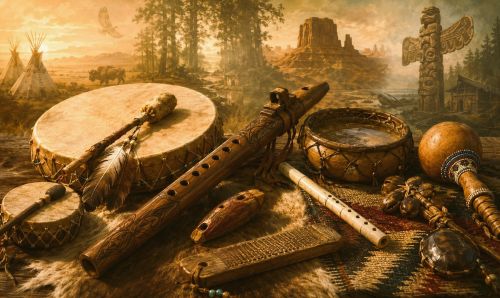
Native American musical instruments carried memory, ceremony, movement, breath, and survival through centuries of adaptation, colonization, revival, and Indigenous sovereignty.

By Matthew A. McIntosh
Public Historian
Brewminate
Introduction: Sound before Category
To begin a history of Native American musical instruments with classification is useful, but also dangerous. Drums may be called membranophones, rattles idiophones, flutes aerophones, and rare stringed instruments chordophones, yet such labels can quickly make living sound worlds look like museum drawers. Indigenous instruments were not created first as categories. They were made as relations: between people and place, between breath and wood, between hide and hand, between animal bodies and ceremonial obligations, between memory and movement. Across Native North America, musical instruments belonged to particular communities, languages, landscapes, and protocols. They accompanied song, dance, healing, diplomacy, mourning, courtship, storytelling, warfare, renewal, and prayer. Their meaning cannot be reduced to the mechanics of vibration.
Nor can “Native American music” be treated as a single tradition. The phrase names a vast field of peoples and histories, from Eastern Woodlands nations and Plains communities to Pueblo, Diné, Apache, Northwest Coast, Arctic, Subarctic, California, Basin, Plateau, and Southeastern sound worlds. Some traditions centered drums and collective song; others developed distinctive flutes, whistles, rattles, shell instruments, carved ceremonial objects, or highly localized sound-making forms. Even when similar materials appear across regions, such as hide, wood, bone, cane, gourds, turtle shell, clay, or animal hooves, they did not carry one uniform meaning. A water drum in one ceremonial context, an eagle-bone whistle in another, a cedar rattle in a third, and a courting flute in a fourth all require interpretation on their own terms.
The modern language of instrument families can still help the historian, provided it remains a tool rather than a master key. It allows comparison across broad patterns of sound production: struck skins, shaken containers, blown tubes, vessel flutes, and vibrating strings. It also helps correct stereotypes by showing that Indigenous musical life was technically varied, regionally diverse, and historically adaptive. Yet the more important question is not simply how an instrument produced sound, but what that sound did. A drum could organize collective time. A rattle could make movement audible. A flute could carry personal longing or contemplative solitude. A whistle could mark ceremonial power. Instruments were technologies of sound, but they were also technologies of social presence.
I begin before category, with sound as relation. It follows Native American musical instruments chronologically from pre-contact material ecologies through colonization, adaptation, archival recording, intertribal powwow culture, flute revival, and contemporary Indigenous musical sovereignty. The purpose is not to build a catalog of objects but to trace a history of continuity under pressure. Indigenous instruments endured because they were never merely things. They were practices, responsibilities, memories, and ways of keeping human communities in audible relationship with the more-than-human world.
Deep Origins: Sound, Material Ecology, and the First Instrument Worlds
The earliest histories of musical instruments are difficult to write because so many instruments were made from materials that decay. Wood, cane, hide, feathers, plant fibers, gourds, and sinew rarely survive in archaeological contexts unless preserved by exceptional conditions. This creates a documentary imbalance. Stone, shell, bone, and fired clay are more likely to remain, while drums, rattles, wooden flutes, and other perishable instruments may disappear almost completely from the material record. The result is not evidence of musical absence but evidence of archaeological selectivity. Indigenous sound worlds almost certainly extended far beyond what excavated objects can prove, especially because voice, body, dance, and rhythm left few durable traces.
The materials that did survive still reveal an important principle: early instruments belonged to local ecologies. Sound was shaped from what the land, water, animals, and plants made available. Bone could become whistle or flute. Shell could become trumpet, rattle, ornament, or resonant object. Clay could become vessel flute or ocarina. Turtle shells, gourds, seeds, pebbles, hooves, and carved wood could become rattles. Hide stretched over a frame could become a drum, though drums are among the most vulnerable instruments archaeologically because skin and wood decay so easily. Indigenous instrument-making was not separate from environmental knowledge. It required understanding the density of wood, the resonance of hollow bodies, the behavior of stretched hide, the carrying power of breath, and the acoustic possibilities of small moving objects inside a container.
This material intelligence varied by region, and that variation is crucial to any serious history of Indigenous instruments. In the Southwest, archaeological work has identified flutes, whistles, rasps, shell trumpets, tinklers, bells, and other sound-producing objects, showing that pre-contact sound-making involved far more than percussion alone. Shell trumpets, for example, point toward long-distance exchange networks as well as ceremonial sound, since marine shell could travel far inland through trade and ritual circulation. Clay whistles and vessel flutes likewise suggest experimentation with breath, chamber, pitch, and form, while rasps and tinklers show that rhythm could be scraped, shaken, worn, or attached to the moving body. In the Great Plains, later collections and ethnographic evidence emphasize the central role of the drum in accompanying the human voice, but whistles and rattles also remained important additions to Plains musical practice. On the Northwest Coast, carved rattles, drums, and whistles could become visually elaborate ceremonial objects, joining sound to sculpture, performance, status, and spiritual representation. These examples matter because they resist the false image of a single “Native American instrument tradition.” The earliest instrument worlds were plural, regional, technically varied, and deeply tied to place.
The first instrument worlds also suggest that sound was understood through relation rather than abstraction. A rattle did not simply produce rhythm; it could make the hand, foot, or dancing body audible. A drum did not merely mark a beat; it gathered singers into shared time. A flute or whistle did not only produce melody or signal; it transformed breath into intentional sound. Even when later scholars classify these instruments as idiophones, membranophones, or aerophones, the older logic was practical, ceremonial, and relational. Instruments joined human bodies to animal materials, plant forms, water, air, and earth. They were technologies of contact between visible and invisible worlds, between daily labor and sacred performance, between individual expression and communal participation.
Because of this, the deep origins of these musical instruments should not be imagined as a simple line from primitive noise to musical complexity. The better historical model is one of long experimentation within specific environments. Indigenous makers learned how objects sounded when shaken, scraped, struck, blown, filled, hollowed, stretched, or carved. They developed instruments that could travel, survive ceremony, accompany dance, support song, and hold meaning across generations. The earliest recoverable instruments are only fragments of a much larger acoustic history. Behind every surviving flute, whistle, rattle, shell, or drum form stands a wider world of perishable sound, embodied memory, and ecological craft.
Drums and the Communal Pulse: Membranophones before and beyond Contact
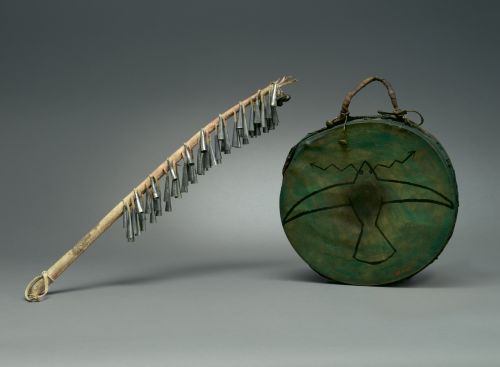
The drum is often treated as the central instrument of Native American music, and for many traditions that emphasis is justified, though it must still be handled carefully. No single instrument can represent the full diversity of Indigenous North America, yet drums appear across a wide range of communities as instruments of song, ceremony, dance, healing, and collective gathering. In organological terms, drums are membranophones: instruments whose sound is produced through the vibration of a stretched membrane, usually hide, over a resonant body or frame. But as with all such classifications, the technical description tells only part of the truth. A drum was not simply a struck object. It was a way of joining hands, voices, bodies, and time. It could accompany public dances, support healing songs, mark ceremonial sequence, gather singers into a single acoustic center, or carry the presence of a community across open space. Its importance came not from volume alone, but from its power to create shared rhythm. A drum could make people listen together, move together, remember together, and enter ceremonial time together.
The materials of drum-making were themselves meaningful. Wood gave the frame or body its form. Animal hide carried both acoustic and relational significance, since the skin of an animal became the surface through which communal sound emerged. Water, in some traditions, changed pitch and resonance, turning the drum into a more flexible and living acoustic body. Size, shape, construction, and context varied widely. Some drums were small enough to be held by one singer. Others were larger social instruments around which multiple singers gathered. Some were double-headed frame drums; others were single-headed or vessel-like forms. The category “drum” includes many different Indigenous objects, each embedded in particular practices rather than one uniform design.
In many traditions, the drum accompanied the human voice rather than replacing it. This matters because Indigenous music across North America has often placed song at the center, with instruments supporting, intensifying, organizing, or answering the voice. The drum could anchor rhythm, but it also gathered singers into common breath and common pulse. In Plains contexts, drums became especially important in social and ceremonial music, while whistles and rattles often augmented the sound world around them. In Eastern Woodlands traditions, water drums held important ceremonial roles, including in Haudenosaunee contexts where altered resonance and controlled pitch were part of the instrument’s power. In other regions, frame drums, hand drums, and related forms accompanied healing, dance, prayer, and communal memory. The point is not that all Native nations understood drums identically, but that drums repeatedly served as instruments of gathering. They made community audible.
The history of Native drums also crosses the line between pre-contact continuity and post-contact transformation. Before European colonization, drums already belonged to ceremonial, social, and expressive life. After contact, they survived in a world of disruption: warfare, missionization, disease, forced removal, reservation confinement, and federal attempts to suppress Indigenous ceremony. In that context, the drum became even more than a musical instrument. It could hold a community together when land, language, and political autonomy were under assault. Colonial authorities often feared Indigenous dances and ceremonies precisely because they gathered people into shared memory and collective identity. The drum’s pulse could become a sign of endurance, not because it was unchanged, but because it remained socially powerful under radically altered conditions. Its sound marked continuity without requiring stasis. Communities could alter performance contexts, adapt materials, incorporate new circumstances, or shift public and private uses while still preserving the drum’s deeper role as an instrument of collective presence. The drum’s history is not a simple story of survival by preservation alone. It is a history of survival through use, flexibility, guarded knowledge, and repeated return.
That endurance is especially visible in later powwow traditions, where the large communal drum became a public center of intertribal sound. Powwow should not be projected backward unchanged into the pre-contact past, but neither should it be separated from older Indigenous practices of gathering, singing, dancing, and ceremonial performance. The modern powwow drum gathers singers around a shared center and supports dancers, families, veterans, visitors, and communities in a space of both continuity and adaptation. It represents one of the clearest examples of Indigenous musical survivance: old materials, older principles, new historical circumstances, and living cultural authority. To call the drum the “heartbeat” can risk cliché if used carelessly, but the metaphor persists because it captures something real. The drum organizes presence. It gives social life a pulse.
Rattles, Shakers, and the Sound of Movement: Idiophones in Ceremony and Dance
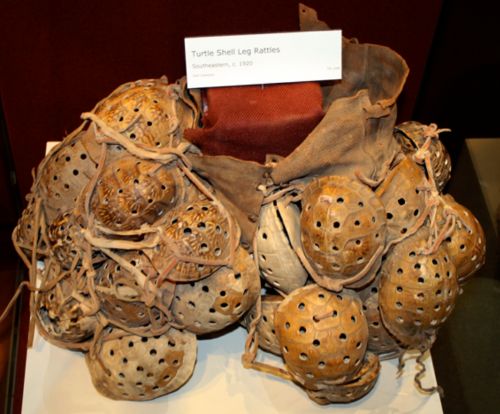
Rattles and shakers belong to the family of idiophones, instruments whose own bodies produce sound when struck, shaken, scraped, or otherwise set into vibration. Yet here again, the technical category is only a beginning. In Native American musical traditions, rattles were rarely mere accessories to song. They could organize rhythm, mark ceremonial sequence, intensify dance, identify ritual authority, and make bodily movement audible. A drum might gather singers into a shared pulse, but a rattle often carried rhythm directly through the hand, wrist, arm, ankle, or foot. It joined sound to gesture. It turned movement into music. The simplest container rattle could be made from a hollow gourd, turtle shell, carved wood, rawhide, horn, or other resonant body filled with seeds, pebbles, clay pellets, shells, or small stones. Its sound depended on several choices: the material of the container, the substance placed inside it, the thickness of the wall, the length and shape of the handle, and the manner of shaking. A gourd rattle could produce a dry, crisp sound; a turtle-shell rattle might carry a heavier and more textured resonance; a rawhide rattle could produce a softer, enclosed tone. These differences mattered because rhythm was not simply counted. It was felt, colored, and placed within a particular ceremonial or social setting.
Rattles also made visible the deep connection between instrument-making and local ecology. A turtle shell, deer hoof, gourd, seed pod, or carved wooden chamber was not an interchangeable sound container. It came from a particular landscape and from a network of relationships with animals, plants, water, and seasonal cycles. The instrument’s materials often carried meanings beyond acoustics, especially when associated with healing, medicine, dance, or ceremonial responsibility. In some traditions, a rattle could be handled by particular people, used in particular contexts, or understood as more than a musical object. Its sound was not simply produced by matter. It emerged from matter placed inside a cultural order.
Wearable rattles further complicate the distinction between instrument and body. Deer-hoof rattles, shell ornaments, leg rattles, jingle-like attachments, and other sound-making elements tied to clothing or regalia allowed dancers to produce rhythm through movement itself. The dancer did not merely move to music; the dancer helped create the music. Each step, turn, bend, or shift of weight could add texture to the collective sound. Rhythm became embodied rather than external. It lived in the moving body and traveled through the space of performance. This is especially important for understanding dance traditions in which sound, regalia, movement, and social identity cannot be separated into neat categories. The body became both performer and instrument, not metaphorically but materially, because sound emerged from the contact between flesh, clothing, ornament, and ground. A line of dancers wearing hoof or shell attachments could produce a layered rhythm that no single handheld instrument could create alone. The sonic field was distributed across many bodies, each contributing to a larger pattern of communal motion. Such instruments also made dance visually and acoustically inseparable: the eye followed the movement, while the ear registered its force, repetition, and timing. In that fusion, music was not something placed behind the dance. It was generated by the dance.
Some rattles were also highly elaborated visual objects. On the Northwest Coast, carved rattles could combine sound, sculpture, social rank, and ceremonial meaning. In other regions, turtle-shell rattles or gourd rattles might appear more visually modest but remain equally powerful within their proper contexts. The historian must resist judging significance by ornament alone. Some of the most important instruments in Indigenous musical life were not designed to impress outsiders visually. Their power lay in use, sound, memory, and protocol. A rattle’s meaning could reside in when it was lifted, who held it, what song it accompanied, what body moved with it, and what relationships it activated.
The history of rattles and shakers reveals a broader truth about the instruments: sound was often inseparable from motion. Rattles converted the body into rhythm, and rhythm into social presence. They could accompany healing, prayer, dance, storytelling, and communal gathering, but they also remind us that Indigenous music was not always organized around melody in the Western sense. It could be organized around pulse, texture, repetition, vibration, and embodied participation. To listen historically to the rattle is to hear more than a shaken object. It is to hear the hand, the foot, the dancer, the maker, the animal, the plant, and the community moving together.
Breath, Bone, Cane, and Wood: Flutes, Whistles, and Indigenous Aerophones
If drums and rattles made rhythm through skin, shell, seed, and movement, aerophones made sound through breath. This distinction matters because breath carried a different symbolic and practical force. A flute, whistle, shell trumpet, or vessel flute did not simply vibrate under the hand. It required air from the body, shaped by mouth, finger, chamber, and tube. The instrument transformed breathing into audible intention. In many Indigenous contexts, that made wind instruments especially suited to personal expression, signaling, courtship, ceremony, and communication across distance. They could be intimate or public, soft or piercing, solitary or ritualized. What joined them was not one design, but the conversion of human breath into culturally ordered sound. Unlike the drum, which often gathered bodies around an audible center, the flute or whistle could project a more directional and individualized presence. It could call, invite, warn, accompany, charm, or mark a ceremonial moment with a sound that seemed to emerge from inside the person and move outward into the world. Breath made these instruments especially immediate. The player’s body was not only operating the instrument; the body was entering it.
The oldest and most widespread aerophones in Indigenous North America included flutes, whistles, and related blown instruments made from bone, cane, reed, wood, clay, and shell. Some were simple open tubes; others were more carefully carved or bored. Some used finger holes to alter pitch; others produced a limited number of tones or served primarily as signals. Bone whistles could be made from bird or animal bones, while cane and reed instruments drew directly on riverine and wetland environments. Wooden flutes required different forms of craft knowledge: selection of a resonant material, hollowing or boring, shaping the airway, placing finger holes, and in some forms attaching or carving a block that directed the air stream. As with drums and rattles, local ecology shaped both possibility and sound.
The Plains or courting flute has become one of the most recognizable Indigenous aerophones, though its modern fame can obscure its historical specificity. Traditionally associated in many accounts with courtship, personal song, and solitary reflection, the flute allowed a player to produce melody outside the collective space of the drum. It could be used for romantic address, but it was not only a love instrument in the shallow modern sense. Its sound could carry longing, restraint, privacy, and self-presentation. The player’s breath became a form of speech beyond ordinary speech, intimate enough to be personal yet audible enough to reach another person. The courting flute occupied a different social register from many communal drums and rattles. It did not replace the voice, but it gave breath another path. Its association with courtship also points to an important feature of music as social action: sound could communicate where ordinary speech might be too direct, too public, or too constrained by custom. A melody could approach without demanding, reveal feeling without fully exposing it, and create an emotional space between player and listener. That made the flute not merely an instrument of romance, but an instrument of disciplined expression, where craft, restraint, and feeling met in a single breath-shaped line.
Whistles belonged to a related but distinct sound world. Some whistles were used in dance, ceremony, signaling, or ritualized communication, and their power often lay in their sharpness, intensity, and symbolic specificity. Eagle-bone whistles are especially well known in some Plains ceremonial contexts, though it would be misleading to treat them as universal to all Native traditions. Their sound could cut through the sonic field rather than blend into it, marking moments of emphasis, invocation, or disciplined movement. Other whistles made from bone, wood, cane, or antler could serve different purposes according to region and tradition. The category “whistle” includes both simple sound tools and highly charged ceremonial instruments whose use was governed by protocol. This distinction matters because the whistle’s apparent simplicity can mislead modern observers. A short tube, a piercing tone, and a limited pitch range may look technically modest, but such instruments often worked through precision rather than melodic elaboration. Their importance could lie in timing, placement, authorization, and relationship to a specific song, dance, or ceremonial action. In some settings, a whistle did not accompany the event so much as punctuate it, opening or intensifying a moment that listeners recognized through inherited knowledge.
Vessel flutes and ocarinas require separate attention because they have often been confused with other wind instruments. Unlike tubular flutes, ocarinas produce sound through an enclosed resonating chamber, commonly made from clay or ceramic in many ancient American contexts. Their tones depend on chamber shape, air opening, and finger holes rather than on the length of a tube alone. Archaeological finds from the broader Indigenous Americas show the sophistication of clay aerophones, including animal-shaped, human-shaped, and abstract forms. These instruments demonstrate that Indigenous sound-making was not limited to what later observers most often recorded in North America. Breath could be given shape through clay as well as wood, cane, bone, or shell. This widens the history of Native aerophones from the familiar image of the wooden flute to a much older and more diverse field of acoustic experimentation.
The arrival of Europeans did not erase Indigenous aerophone traditions, but it did change their historical conditions. Missionaries, soldiers, traders, anthropologists, and collectors encountered flutes and whistles unevenly, often misunderstanding their meanings or reducing them to curiosities. Some traditions declined under pressure from missionization, boarding schools, ceremonial suppression, and the disruptions of removal and reservation life. Others persisted in guarded, localized, or transformed forms. By the late nineteenth and twentieth centuries, ethnographers and collectors recorded or collected flutes, but often outside the social settings that gave them meaning. A flute in a museum case could preserve evidence of craft while losing the courtship practice, personal discipline, ceremonial restriction, or local memory that once surrounded it. The instrument survived materially, but its full sound world could be harder to recover.
Modern Native flute revival has further complicated this history. Artists such as Doc Tate Nevaquaya and R. Carlos Nakai helped bring Indigenous flute traditions into concert performance, recording, education, and international circulation. Their work expanded the expressive range of the instrument and introduced many listeners to a sound they came to associate with Native identity. Yet that popularity also produced risks: commercialization, generic “Native American” branding, non-Native imitation, and the flattening of specific tribal histories into a single marketable atmosphere of spirituality and calm. The flute’s contemporary life carries both power and tension. It remains a vehicle of Indigenous creativity and renewal, but its history asks listeners to hear more carefully. Behind the breath is not an abstract mood. There are makers, nations, materials, songs, restrictions, revivals, and living artists insisting that beauty not be separated from context.
Regional Sound Worlds before Colonization: Plains, Woodlands, Southwest, Northwest Coast, and California
Before colonization, Indigenous musical instruments belonged to regional sound worlds shaped by ecology, ceremony, language, movement, and social structure. The broad categories of drum, rattle, flute, whistle, and bow are useful, but they become meaningful only when placed in specific landscapes. The same general instrument family could serve different purposes in different regions. A rattle might accompany healing in one setting, dance in another, and ceremonial authority in a third. A flute might be personal and intimate in one community, while whistles elsewhere might belong to highly regulated ritual contexts. The point is not to divide Native North America into sealed musical territories, because trade, migration, intermarriage, warfare, diplomacy, and ceremonial exchange created movement across boundaries. Rather, regional analysis helps restore particularity to traditions too often flattened under the single label “Native American music.”
On the Great Plains, later ethnographic and historical sources emphasize the importance of song supported by drums, rattles, and whistles. The Plains drum, especially in social and ceremonial contexts, became one of the best-known symbols of Indigenous music, but it should not be imagined as an isolated object. It functioned with voices, dance, regalia, spatial arrangement, and collective participation. Whistles, including bone whistles in some ceremonial contexts, added sharp sonic markers that could cut through the density of song and percussion. Rattles supplied texture, movement, and localized rhythm. Plains sound worlds were also shaped by mobility, horse culture after European contact, warfare, diplomacy, and later reservation life, but their older foundations lay in the connection between song, body, ceremony, and social memory. The drum did not simply keep time. It gathered people into time. It also helped make large-scale social sound possible in open landscapes, where collective singing, dance, and public ritual depended on a strong rhythmic center. The Plains drum’s later prominence in intertribal powwow culture can sometimes make it seem timeless in its modern form, but the deeper continuity lies less in one fixed performance style than in the drum’s role as an instrument of gathering. It could hold singers together, support dancers, and create an audible center around which community could assemble, remember, compete, mourn, celebrate, and pray.
In the Eastern Woodlands, instrument traditions included water drums, hand drums, turtle-shell rattles, gourd rattles, wooden or bark instruments, and wind instruments associated with particular communities and ceremonial systems. Water drums are especially important because they show how Indigenous instrument-making could manipulate resonance through fluid, pressure, and enclosed space. Their sound was not fixed in the same way as a simple struck surface; it could be adjusted and shaped by the amount of water inside and by the tension of the covering. Among Haudenosaunee and other Woodlands traditions, drums and rattles were deeply tied to song cycles, medicine societies, dances, and communal rituals. Turtle-shell rattles and gourd rattles also show how local materials became ceremonial sound. These were not simply instruments that happened to be made from the environment. They were instruments through which environment, community, and obligation met.
The Southwest presents a particularly rich record of pre-contact sound-making because the archaeological survival of some materials allows historians to see instruments that might be invisible elsewhere. Flutes, whistles, rasps, shell trumpets, tinklers, bells, and clay sound-producing objects all appear in studies of prehistoric Southwestern music. This range complicates the stereotype that Indigenous North American music was overwhelmingly percussive. Breath, scraping, shaking, striking, and resonant chamber design all mattered. Shell trumpets point toward both sound and exchange, since marine shell could travel far inland through trade and ceremonial networks. Clay aerophones suggest experimentation with pitch, chamber, form, and symbolic design. Rasps and tinklers reveal sound as texture and motion, produced by scraping or bodily movement as much as by formal melody. In this region, the archaeological record opens a wider window onto sonic creativity before written documentation. The survival of shell and clay is especially valuable because it preserves traces of sound technologies that may once have existed alongside many more perishable instruments. A wooden flute, hide drum, reed whistle, or fiber attachment might vanish, while a ceramic vessel flute or shell trumpet remains as archaeological evidence. The Southwest teaches caution: what survives is not the whole soundscape, but it can reveal the sophistication of acoustic thinking. Sound was shaped through chamber, aperture, breath, scrape, impact, and bodily motion, producing an instrument world more diverse than later stereotypes allowed.
The Northwest Coast offers another distinctive sound world, one in which instruments could be deeply integrated with carving, ceremony, social rank, and visual representation. Drums, whistles, and rattles were not only acoustic tools but also sculptural and ceremonial objects. Carved rattles could depict human, animal, ancestral, or supernatural figures, joining sound to image and performance. Their significance lay partly in sound, but also in who used them, what ceremonies framed them, and what relationships they represented. Northwest Coast musical instruments challenge any sharp division between music, art, ritual, and political authority. A rattle could be heard, seen, held, displayed, inherited, and activated. Its meaning did not reside in one sensory field alone. It belonged to a ceremonial world in which sound, image, movement, and social order reinforced one another. This integration is crucial because it shows that an instrument’s surface could be as meaningful as its tone. Carving, form, material, and iconography were not decorative additions to an otherwise musical object; they were part of the object’s ceremonial presence. The rattle or whistle could carry ancestral reference, clan identity, spirit association, or social distinction, while its sound helped activate those meanings in performance. The instrument was not fully itself when silent in a collection or display case. It came into fuller being through use, handling, movement, song, and the relationships that made its sound intelligible.
California and neighboring western regions reveal yet another set of musical possibilities, including rattles, whistles, flutes, clappers, musical bows, and other localized instruments. The musical bow is especially important because stringed instruments were less common in pre-contact North America than percussion and wind instruments, but they were not entirely absent. A musical bow could be made from a bent piece of wood with a single string, sometimes sounded by striking or plucking and sometimes using the mouth as a resonator. Such instruments remind us that Indigenous musical creativity cannot be reduced to the most familiar categories. California’s extraordinary linguistic and cultural diversity also cautions against easy generalization. Instrument traditions varied sharply across communities, environments, and ceremonial systems. Sound-making could be intimate, public, sacred, playful, practical, or socially regulated, depending on context. Clappers and split-stick instruments, for example, could produce sharp rhythmic articulation distinct from the pulse of drums or the texture of rattles. The mouth-resonated bow, where present, made the player’s body part of the acoustic chamber, much as breath animated flutes and whistles. These forms underline how western Indigenous sound worlds experimented with resonance in subtle and localized ways. They also remind us that rarity in the historical record is not the same as marginality in lived practice. A less widespread instrument could still carry deep meaning within the community that used it.
These regional sound worlds show that Native American musical instruments before colonization were neither primitive nor uniform. They were complex responses to place, material, ceremony, and social need. The Plains emphasized powerful combinations of song, drum, whistle, and dance. The Woodlands developed resonant drum and rattle traditions tied to ceremonial life and ecological materials. The Southwest preserved evidence of broad acoustic experimentation in clay, shell, bone, and wood. The Northwest Coast fused sound with sculpture, rank, and ceremonial display. California and western traditions remind us that even less common forms, such as musical bows, belonged to the Indigenous soundscape. The deeper pattern is not sameness but relation. Each region shaped sound from the world around it, and each made instruments into more than objects: they were local ways of hearing land, body, community, and spirit together.
Contact, Colonization, and Musical Exchange: New Materials, New Pressures, New Instruments
European contact did not introduce change into static Indigenous musical worlds; change was already part of those worlds through trade, migration, diplomacy, intermarriage, and regional exchange. What colonization introduced was a different scale and kind of pressure. New materials, new instruments, new religious expectations, new forms of violence, and new systems of surveillance entered Indigenous life together. Metal, glass beads, cloth, horsehair, manufactured tools, bells, and imported instruments became available through trade and mission networks, but they did not arrive in neutral circumstances. They came with disease, land seizure, missionization, warfare, slavery, forced labor, and attempts to reorder Indigenous communities around European political and religious authority.
The musical consequences of this encounter were uneven. In some places, Indigenous musicians incorporated new materials into older sound practices. Metal cones, bells, and other resonant objects could be attached to clothing or regalia, expanding the acoustic possibilities of movement. Glass beads and trade goods could reshape visual design while older principles of rhythm, dance, and ceremonial display continued. Manufactured tools may have altered the making of drums, flutes, rattles, and other instruments without necessarily changing their cultural purpose. The presence of new materials did not automatically mean cultural replacement. Indigenous makers could absorb foreign objects into Native systems of meaning, turning trade goods into local sound rather than simply adopting European music on European terms. This distinction is essential because colonial materials often entered Indigenous life through coercive economies, yet once acquired, they could be reworked according to Indigenous aesthetics, ceremonies, and social needs. A bell, bead, metal cone, or piece of cloth did not remain culturally European simply because it came through European trade. Attached to dance clothing, incorporated into regalia, or used to intensify movement, it could become part of a Native sound world governed by Native meanings. The object crossed a colonial boundary, but its sound could be claimed, redirected, and made answerable to older forms of communal expression.
Colonization brought direct attacks on Indigenous ceremonial life. Missionaries, colonial officials, and later federal agents often interpreted Indigenous songs, dances, and instruments through suspicion, fear, or contempt. Because music was tied to healing, governance, seasonal ritual, spiritual power, and communal memory, it could appear dangerous to authorities who wanted conversion, labor discipline, and political control. Drums, rattles, whistles, and dance regalia were not always suppressed because they were “music” in the narrow sense. They were suppressed because they helped sustain worlds that colonial systems sought to break. The instrument could become a target precisely because it gathered people into relationships beyond colonial command.
Musical exchange also produced hybrid forms, some of which resist easy classification. The Apache fiddle, or tsii’ edo’a’tl, is one of the clearest examples. Made traditionally from a hollowed stalk such as agave or mescal and strung with horsehair, it is a bowed string instrument associated with Apache musical life. Its history is complex because scholars and museums have debated whether it represents an Indigenous development, a response to European bowed instruments, or some combination of both. That uncertainty is not a weakness in the history; it is the history. The Apache fiddle shows how Indigenous musicians could work in a changing world without simply abandoning Native sound. Even where European influence may have shaped the instrument’s emergence, its materials, uses, naming, and performance belonged to Apache cultural practice rather than to European violin tradition.
Other imported or adapted instruments entered Indigenous life in similarly selective ways. European fiddles, guitars, accordions, brass instruments, and church instruments appeared in different Native communities at different times, but adoption did not mean assimilation in any simple sense. Indigenous musicians could use non-Native instruments to accompany Native songs, perform new social repertories, engage mission music strategically, entertain in domestic settings, or participate in intercultural economies while retaining older ceremonial systems elsewhere. In some contexts, Christian hymnody and Indigenous song traditions interacted; in others, they remained sharply divided. The larger pattern is one of negotiation. Musical instruments crossed cultural boundaries, but they did not carry fixed meanings across those boundaries intact. A guitar in Native hands, a fiddle at a social gathering, a bell on dance clothing, or a hymn sung in an Indigenous language could carry meanings very different from those intended by missionaries, traders, or settlers. These instruments could become tools of accommodation, survival, satire, devotion, memory, or pleasure, depending on the community and setting. Such uses do not erase the violence of colonization, but they do complicate the assumption that every borrowed object signaled cultural surrender. Indigenous musicians often turned imported instruments into vehicles for Native expression, using them to move through colonial conditions without allowing colonial culture to define the whole meaning of the performance.
The history of contact and colonization requires a double vision. On one side, Indigenous instruments endured under coercion, and their survival must be read against the real violence of colonial systems. On the other side, Indigenous musicians were not passive victims of outside influence. They selected, rejected, transformed, concealed, revived, and reinterpreted materials and instruments according to local needs. Colonization changed the soundscape, but it did not erase Indigenous authority over sound. The drum, rattle, flute, whistle, and newer hybrid instruments continued to speak through Native hands, breath, bodies, and communities. Their history after contact is not a simple story of loss or borrowing. It is a history of pressure, adaptation, refusal, and creative survival.
The Nineteenth Century: Removal, Reservation Life, Ceremony, and Survival through Sound
The nineteenth century placed Indigenous musical instruments inside one of the most violent transformations in Native North American history. Removal, treaty violation, military conquest, missionization, forced dependency, and reservation confinement did not merely alter where Native peoples lived. They attacked the social worlds in which instruments had meaning. Drums, rattles, flutes, whistles, and dance regalia were not isolated artistic objects that could be separated from land, kinship, foodways, ceremonial calendars, and political autonomy. When communities were displaced, confined, or made subject to federal and missionary authority, musical practice had to survive in conditions of rupture. Instruments continued to sound, but the world around them had been deliberately unsettled.
Removal made this rupture especially visible. The forced displacement of southeastern nations, the long pressure on Great Lakes and Woodlands peoples, the violence against Plains nations, and the confinement of western communities all changed the conditions under which songs and instruments could be made, taught, heard, and protected. Instruments could travel, but not everything around them could travel intact. A drum might be carried, remade, hidden, or reconstructed, but the ceremonial geography that once framed its use might be fractured. A rattle could continue to accompany song, yet the social networks through which that song had circulated might now be scattered across new and often hostile terrain. Sound became one means by which people remembered older worlds while being forced to inhabit new ones. It could preserve orientation when maps, treaties, military boundaries, and reservation lines attempted to reorder Indigenous space. This did not mean that music simply replaced lost homelands, because no song could undo the violence of dispossession. But instruments helped hold fragments of place in embodied practice: the motion of the hand, the rhythm of a remembered dance, the timbre of a drum, the breath pattern of a flute, the sound of a rattle associated with older obligations. In that sense, musical instruments became portable anchors. They could not carry the whole world that colonization had attacked, but they could carry enough of it to keep memory active.
Reservation life intensified this tension. Federal policy often aimed to replace Indigenous forms of governance, subsistence, education, and spirituality with systems controlled by agents, missionaries, and military power. Ceremonies, dances, and communal gatherings were frequently regarded with suspicion because they sustained collective identity outside colonial supervision. Drums and rattles could be treated as dangerous not because of their physical force, but because of their social force. They gathered people. They supported remembered obligations. They carried songs that did not depend on English, churches, schools, or federal offices for legitimacy. In a reservation context, an instrument could become a quiet form of refusal simply by continuing to organize Indigenous time.
The attack on ceremony did not produce uniform silence. Some practices were pushed underground. Others were adapted, shortened, relocated, or reframed in ways that allowed them to continue under surveillance. Still others were folded into new social gatherings where older sounds could be preserved in altered form. Drums, hand drums, rattles, and whistles remained useful precisely because they could serve multiple kinds of practice: healing, mourning, social dance, seasonal ritual, personal song, and public gathering. The same instrument might carry different meanings depending on whether it was used in a guarded ceremonial setting, a family space, a public event, or an intertribal encounter. Survival often depended on this flexibility. Cultural continuity did not always look like open preservation. Sometimes it looked like concealment, adaptation, substitution, or selective disclosure.
The Ghost Dance movement of the late nineteenth century reveals how deeply music, movement, and hope could unsettle colonial authority. Emerging in a world of dispossession and despair, the Ghost Dance joined song, dance, prophecy, and collective longing for renewal. The movement varied across communities and should not be reduced to one uniform expression, but its spread shows how embodied sound could carry religious and political meaning across distance. Songs were remembered, shared, and performed; bodies moved together; communities entered a ritual space that promised a transformed world. Colonial officials and military authorities feared the movement not because its instruments were weapons, but because collective performance could gather grief into power. The tragedy at Wounded Knee in 1890 stands as one devastating example of how Indigenous ceremony could be misread, criminalized, and met with state violence. The importance of the Ghost Dance for a history of instruments lies not in any single object, but in the way sound, movement, and collective embodiment became inseparable. Song did not merely express belief after the fact. It helped create the ritual field in which belief could be shared, intensified, and remembered. The dancer’s body, the singer’s voice, the rhythmic structure of the gathering, and the surrounding ceremonial objects formed a whole that colonial observers often failed, or refused, to understand. Their failure was not innocent. By reducing Indigenous ceremonial sound to hysteria, threat, or superstition, officials could transform religious practice into a security problem and justify violent intervention.
Yet even in this period of coercion, Indigenous sound worlds were not frozen in victimhood. Reservation life also created new forms of intertribal contact. Peoples who had once lived in distinct territories were brought into closer proximity through confinement, schools, agencies, and forced relocation. These conditions were colonial in origin, but Native musicians and communities could still create new exchanges within them. Songs traveled. Dances changed. Instruments appeared in shared settings where older regional boundaries did not disappear, but they did become more porous. The later growth of intertribal powwow culture cannot be understood apart from this history of displacement and contact. It was not simply an invention of modern festival culture. It grew from older practices of gathering and from newer conditions of Native survival in a colonial world.
The nineteenth century also changed the way outsiders listened to Indigenous instruments. Soldiers, missionaries, travelers, and early ethnographers often described Native music through racial stereotypes, religious fear, or aesthetic misunderstanding. Drums were dismissed as noise; songs were treated as primitive repetition; rattles and whistles were stripped of ceremonial context. These descriptions helped justify suppression by portraying Indigenous sound as disorder rather than knowledge. Some observers began collecting, transcribing, or describing songs and instruments, laying groundwork for later ethnographic archives. This produced a paradox that would become even sharper in the early twentieth century: the same colonial society that tried to discipline Indigenous music also tried to possess it as data, curiosity, or salvage. The outsider ear was never neutral. It heard through assumptions about race, religion, civilization, and progress, often mistaking unfamiliar scales, vocal techniques, rhythmic structures, or performance settings for musical deficiency. Instruments suffered from the same misreading. A rattle could become a “fetish,” a drum a sign of savagery, a whistle a curiosity, a dance object a specimen. Such language did not merely describe Indigenous music poorly. It reorganized it inside colonial categories that made suppression, collection, and display seem like reasonable acts. To recover the history of these instruments, the historian must read those sources against their grain, using them cautiously without accepting their judgments.
For Native communities, the deeper story was continuity under pressure. Instruments helped carry memory when policy tried to sever memory from land. A drumbeat could gather people who had been made dependent on ration lines and agency permission. A rattle could sustain healing knowledge in a world of disease, hunger, and imposed religion. A flute or whistle could preserve personal and ceremonial sound even when public performance became dangerous. The nineteenth century did not leave Indigenous musical instruments untouched, and it would be false comfort to pretend otherwise. But neither did it empty them of meaning. Under removal, reservation confinement, and ceremonial assault, instruments became vessels of survival: portable, adaptable, guarded, and still capable of calling a people back into relation.
Boarding Schools, Ethnographers, and Wax Cylinders: The Archival Capture of Indigenous Sound
By the late nineteenth and early twentieth centuries, Indigenous musical instruments and songs entered a new and deeply contradictory historical setting. Federal boarding schools, missionary institutions, reservation agencies, and assimilation policy worked to suppress Native languages, ceremonies, kinship systems, and public expressions of Indigenous identity. Ethnographers, folklorists, museum collectors, and federal researchers began recording Native songs on wax cylinders, collecting instruments, and documenting performance traditions. The result was one of the sharpest paradoxes in the history of Native American music: the same colonial world that tried to discipline Indigenous sound also tried to preserve it, classify it, and store it in archives.
Boarding schools were central to that violence. Their purpose was not simply education, but cultural replacement. Children were removed from families, punished for speaking Native languages, trained into Euro-American labor expectations, and taught to see Indigenous lifeways as backward or shameful. Native music was often tolerated only when reshaped into forms acceptable to school authorities, patriotic pageantry, Christian worship, or staged performance for non-Native audiences. The drum, rattle, whistle, flute, and song traditions associated with home communities could be treated as obstacles to assimilation. This mattered because music was not an extracurricular detail. It carried language, memory, ceremonial order, bodily discipline, kinship, and social belonging. To attack Indigenous sound was to attack one of the ways children remained connected to home.
Yet Native students and families were not passive within these institutions. Even under discipline, children remembered songs, heard fragments of language, carried rhythms in the body, and later returned to communities where suppressed knowledge could be renewed. Some learned brass instruments, band music, hymnody, piano, violin, or choral singing in school settings, and those experiences sometimes entered Native musical life in unexpected ways. This did not make boarding schools benign. It shows instead how Indigenous people could take tools intended for assimilation and redirect them into Native futures. The same child forced to sing patriotic music in English might later help sustain tribal song, social dance, church music in an Indigenous language, or intertribal performance. Colonial institutions tried to break continuity, but continuity often survived through memory, adaptation, and the stubborn refusal of sound to stay where power placed it. Music learned under coercion could be separated from the purpose for which it had been imposed, then reworked through Native memory, family practice, and community need. A school band instrument, hymn melody, or choral technique might become part of a Native performance world not because assimilation had succeeded, but because Indigenous musicians retained the authority to reinterpret sound. This is one of the difficult truths of colonial musical history: even oppressive institutions could not fully control what their students would do with the sounds they were forced to learn.
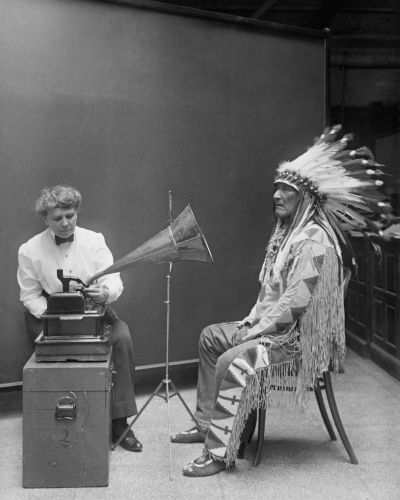
Ethnographic recording created a different kind of capture. The cylinder phonograph made it possible for researchers to record voices, songs, stories, and instrumental sounds with a vividness that written transcription could not match. Jesse Walter Fewkes’s 1890 Passamaquoddy recordings are often identified among the earliest ethnographic field recordings, while Frances Densmore’s work for the Bureau of American Ethnology produced thousands of recordings of Indigenous songs in the early twentieth century. The Library of Congress now holds one of the largest bodies of early Indigenous American recordings in the United States, including roughly ten thousand wax cylinders of songs and stories, and the Densmore papers note that many of her recordings for the Bureau of American Ethnology are now held there. These collections are historically invaluable. They preserve voices, repertories, languages, and musical details that might otherwise be far harder to reconstruct.
But preservation was never neutral. Wax cylinders captured sound while often separating it from the ceremonial, social, and political relationships that gave it meaning. A song recorded for an ethnographer was not necessarily the same event as a song performed in ceremony, mourning, healing, courtship, or communal dance. The recording machine could preserve melody, rhythm, vocal quality, and sometimes instrumental sound, but it could not fully capture protocol, place, audience, restriction, obligation, or the authority of the person who held the song. Ethnographers also shaped what was recorded by asking particular questions, selecting particular performers, privileging songs that fit scholarly interests, and translating Indigenous sound into Western categories. The archive contains real Indigenous voices, but it also contains the conditions of colonial listening. Even the act of recording could change performance, since a singer asked to perform into a machine for a researcher was placed in a very different relationship from a singer performing for community, ceremony, or kin. Time limits, recording quality, institutional expectations, and the presence of outsiders could shape what was sung, how it was sung, and what was withheld. Some songs may have been offered strategically, some simplified, some withheld entirely, and some performed with meanings the collector did not understand. The wax cylinder preserved sound but also froze a particular encounter: Indigenous knowledge passing through colonial equipment, scholarly desire, and unequal authority.
Instruments suffered a related transformation when collected by museums. A drum, rattle, whistle, flute, or Apache fiddle could enter a museum catalog as an object with dimensions, material description, tribal attribution, date, and donor history. Such documentation can be useful, especially when communities seek to recover older forms of construction or trace dispersed cultural materials. But the museum object was often separated from use. A rattle that once sounded in ceremony might become a silent specimen. A drum might be admired for its hide, frame, or painted surface while the songs that animated it remained inaccessible. A whistle might be labeled by material while its restrictions, permissions, and ceremonial force were ignored. The archive and museum could preserve evidence while also producing absence.
The contemporary significance of these collections lies partly in return. Digital repatriation, tribal archive projects, and collaborative curation have begun to shift authority away from institutions alone and toward descendant communities. The Library of Congress’s Ancestral Voices initiative, for example, focused on thousands of Native American cylinder recordings with the goal of sharing copies with communities for linguistic maintenance, reclamation, and cultural heritage work. The Passamaquoddy experience with early wax-cylinder recordings has become a powerful example of how archival sound can return home in new forms, supporting language revitalization and cultural memory while also raising questions about privacy, restriction, and tribal control. These returns do not erase the violence or imbalance of the original collecting conditions. They do show that captured sound can be reactivated when Indigenous communities determine how it should be heard, taught, protected, or withheld.
The history of boarding schools, ethnographers, and wax cylinders deepens the larger argument. Indigenous instruments and songs survived not because archives saved them, and not because colonial institutions were benevolent, but because Native people carried, guarded, adapted, and reclaimed sound across generations. The archive can be a resource, but it is not the source of Indigenous musical life. A wax cylinder may hold a voice, but the authority of that voice belongs to the people, descendants, language communities, and ceremonial worlds from which it came. To write this history responsibly is to listen in two directions at once: toward the fragile evidence preserved in institutions, and toward the living Indigenous sovereignty that decides what those sounds mean now.
Powwow, Intertribalism, and the Modern Public Drum
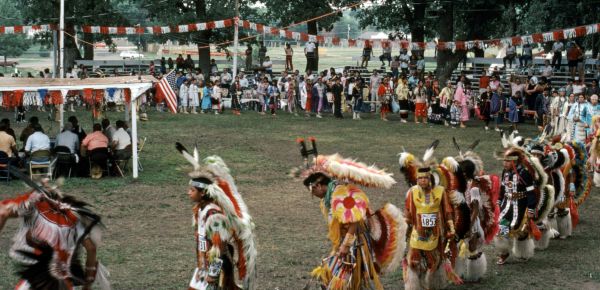
The modern powwow is one of the most visible public settings in which musical instruments continue to organize community, memory, and identity. Its central sound is often the large drum surrounded by singers, a formation that can appear timeless to outside observers but is better understood as both rooted and modern. Powwow draws on older Indigenous practices of song, dance, gathering, honoring, and ceremonial performance, especially from Plains traditions, while also reflecting histories of removal, reservation life, military service, urban relocation, intertribal exchange, and contemporary Native public culture. It is not a museum survival of a frozen past. It is a living form in which instruments, voices, bodies, regalia, and protocol continually remake Indigenous presence in public space.
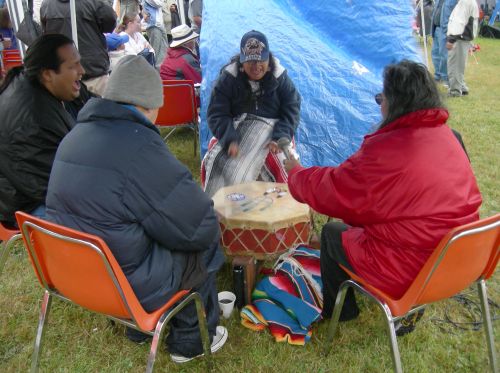
The powwow drum is not simply an enlarged percussion instrument. It is a social center. Singers sit around it, and their arrangement creates a visible and audible circle of responsibility. The drumbeat supports dancers, but it also structures the event’s emotional and ceremonial movement: grand entries, honor songs, veterans’ songs, contest dances, memorial moments, giveaways, and community recognitions. Its sound gathers people across distance, and in many powwow contexts it is treated with respect that exceeds ordinary musical handling. The drum may be spoken of as living, powerful, or requiring proper conduct, though beliefs and protocols vary among communities. What matters historically is that the drum becomes a public focus through which sound, authority, and belonging are organized. It establishes a center without turning that center into a hierarchy of spectatorship. The singers are not background musicians, and the dancers are not simply performers moving to accompaniment. They are part of a shared field of sound, movement, obligation, and response. The drum’s pulse tells dancers when to enter, when to intensify, when to stop, and when to mark the honor beats that carry particular emotional and ceremonial weight. The powwow drum does not merely accompany the event. It helps govern the event’s structure, pacing, and collective attention.
Powwow culture also reveals the importance of intertribalism. Colonial policy forced many Native peoples into new relationships through reservations, boarding schools, military service, wage labor, relocation programs, and urban Native communities. These pressures were destructive, but Native people turned enforced proximity into new forms of social and cultural exchange. Songs traveled. Dance styles developed broader circulation. Regalia incorporated older regional forms and newer intertribal aesthetics. The large drum, already central in many Plains-related traditions, became an instrument through which diverse Native communities could gather without erasing their distinct nations. Intertribalism did not mean sameness. It meant the creation of shared public forms through which difference could be present within a common ceremonial and social frame.
The public drum also marks a shift in how Native instruments are heard by Native and non-Native audiences. In earlier colonial contexts, drums were often described by outsiders as threatening noise or primitive repetition. In modern powwow settings, the drum is openly powerful, disciplined, and communal. It does not ask permission to exist in public. Its sound carries histories of suppression, but it also refuses to remain confined to those histories. Dancers respond to the drum through highly developed forms of movement, timing, and style, from traditional and grass dance to fancy dance, jingle dress, and women’s categories shaped by particular histories and protocols. The drum’s power lies partly in this relationship between pulse and visible motion. It makes the arena into a space of collective attention.
Powwow performance should not be reduced to spectacle. For outside visitors, the colors, movement, and force of the drum can be visually and emotionally striking, but the public visibility of powwow does not mean that every meaning is publicly available. Songs may have histories. Drums may have names. Certain honors, gestures, and protocols may be legible only to those formed within the community. Contest structures, announcer explanations, vendor spaces, and open public attendance can make powwow accessible, but accessibility is not ownership. The historian must resist treating powwow as a convenient display case for Native tradition. It is a contemporary Indigenous social world, not a performance staged for outside interpretation alone. The difference matters because spectacle invites consumption, while protocol demands respect. A non-Native visitor may be welcomed, moved, and educated by the sound of the drum, but welcome does not dissolve boundaries around sacred knowledge, family history, song ownership, or ceremonial authority. Public performance can coexist with guarded meaning. Indeed, that coexistence is one of powwow’s defining strengths: it allows Native communities to assert presence in public while still maintaining control over what is explained, what is withheld, and what remains accountable to Indigenous knowledge rather than outsider curiosity.
The modern public drum brings together many themes in the history of the instruments: material continuity, adaptation, colonial pressure, intertribal exchange, and cultural sovereignty. It shows how an instrument can be old in principle and modern in form, inherited and innovative at once. Around the powwow drum, sound becomes collective memory without becoming nostalgia. It honors the dead, welcomes the living, marks veterans, supports dancers, strengthens families, and teaches younger generations through participation rather than abstraction. In that circle of singers and in the dancers moving around them, the drum does what Indigenous instruments have done throughout this history. It turns material, body, breath, and rhythm into relation.
The Flute Revival: From Courting Instrument to Pan-Indigenous and New Age Sound

The late twentieth-century revival of the Native flute brought one of the most intimate Indigenous instruments into a much wider public soundscape. Earlier flute traditions had been regional, personal, and culturally specific, often associated with courtship, solitude, reflection, or localized ceremonial and social practice. By the 1970s and 1980s, recordings, festivals, workshops, concerts, and educational programs helped transform the flute into a highly visible symbol of Native musical expression. This revival did not simply resurrect an untouched ancient form. It reassembled fragments of older flute traditions, modern performance practices, recording technology, Indigenous artistic innovation, and non-Native listener desire into a new public life for the instrument.
Nevaquaya was one of the central figures in this revival. A Comanche artist and musician, he helped reassert the flute as a serious Indigenous instrument at a time when many older local traditions had been weakened by colonization, boarding schools, and cultural suppression. His Comanche Flute Music, released by Folkways in 1979, became especially important because it presented the flute not as background atmosphere, but as a named Native artistic practice tied to a living performer and a particular cultural identity. Nevaquaya’s work mattered because it stood against the idea that Native musical instruments belonged only in museums, salvage archives, or anthropological descriptions. The flute could be played, recorded, taught, adapted, and heard as contemporary Indigenous art. Just as importantly, Nevaquaya’s performances emphasized that revival did not require surrendering specificity. He was not offering the flute as an anonymous emblem of generalized Indigeneity, but as an instrument connected to personal memory, Comanche identity, artistic discipline, and the wider history of Native survival. His recordings helped listeners hear the flute as a voice shaped by individual style rather than as a decorative sound effect. In that sense, Nevaquaya did more than recover an instrument. He helped reframe Indigenous musical performance as authorship, not artifact.
Nakai expanded that public presence even further. Of Diné-Ute heritage, Nakai brought the flute into concert halls, recordings, collaborations, and educational settings, while also speaking about its cultural, political, and historical dimensions. His 2010 Library of Congress performance, American Indian Flute Music from Arizona, placed the instrument within the American Folklife Center’s Homegrown series, making it part of a national public archive of living tradition. Nakai’s success also helped shape the sound many non-Native listeners now associate with the Native flute: spacious phrasing, breath-rich tone, melodic openness, and a sense of reflective interiority. That sound has often been beautiful and artistically serious, but its reception has also been complicated by the market’s appetite for a generalized “Native” mood.
The revival produced both renewal and distortion. On one side, Native musicians reclaimed and reimagined an instrument that colonial disruption had marginalized in many communities. The flute became a vehicle for composition, improvisation, teaching, healing work, intertribal performance, and collaboration with jazz, classical, folk, and world music traditions. It allowed Native artists to assert continuity without being trapped in ethnographic expectation. On the other side, commercial recordings, gift shops, tourism, New Age spirituality, and non-Native flute circles often flattened diverse Indigenous flute histories into a single pan-Indigenous sound. The instrument could be marketed as timeless, mystical, natural, or universal in ways that detached it from tribal specificity, maker knowledge, and cultural accountability.
That tension is especially clear in debates over the difference between older North American Indigenous flute traditions and the modern commercial “Native American flute.” Some contemporary Indigenous musicians and scholars have pointed out that the mass-market instrument now sold under that name does not map neatly onto any single traditional form. It has become a standardized, portable, teachable, and widely available instrument used by Native and non-Native players alike. This does not make it meaningless, nor does it erase the work of Indigenous artists who have made profound music with it. But it does mean that listeners must hear carefully. The modern flute revival is not only a story of return. It is a story of Indigenous agency, commercial simplification, pan-Indigenous symbolism, non-Native appropriation, and ongoing negotiation over who gets to define the sound of Native identity.
Contemporary Indigenous Sound: Tradition, Experiment, Repatriation, and Digital Futures
Contemporary Indigenous sound is not a struggle between tradition and modernity. It is a field in which Native musicians, makers, singers, dancers, archivists, and communities decide how older instruments and sound practices will live under present conditions. Drums still gather singers and dancers in powwow arenas. Hand drums support social songs, healing contexts, family gatherings, and public performance. Flutes continue to appear in solo repertoire, collaborative recordings, film scores, and educational settings. Rattles, whistles, bells, and wearable sound objects remain tied to movement, protocol, and community authority. Indigenous artists now work with electric guitars, synthesizers, samplers, digital audio workstations, orchestras, hip-hop production, experimental sound art, and museum archives. The central question is not whether such work is “authentic,” but who controls its meaning.
This control matters because Indigenous instruments have long been collected, displayed, recorded, and marketed by outsiders. Museums and archives often preserved objects and recordings while separating them from the communities that made them meaningful. Contemporary repatriation work challenges that imbalance. The Native American Graves Protection and Repatriation Act of 1990 provides a federal process for the return of human remains, funerary objects, sacred objects, and objects of cultural patrimony, and its implications reach beyond bones and burial goods into the broader ethics of cultural authority. Some musical instruments, regalia, and ceremonial objects may fall within these categories depending on their history, function, and community claims. The issue is not merely where an object sits, but who has the right to decide whether it should be displayed, handled, heard, copied, taught, or returned. A drum in a collection, a rattle in a drawer, a whistle in a catalog, or a recorded song in an institutional archive may appear to outsiders as preserved heritage, but preservation without authority can become another form of possession. For descendant communities, the question may involve sacred restriction, family lineage, ceremonial responsibility, or the need to restore knowledge interrupted by removal, boarding schools, or museum collecting. Repatriation is not only a legal or curatorial process. It is a cultural and moral reordering, returning decision-making power to the people whose ancestors, makers, singers, and ceremonial systems gave these objects and sounds their meaning in the first place.
Digital repatriation has created another path, especially for sound recordings. Wax cylinders, field tapes, photographs, catalog notes, and early ethnographic documentation can now be copied, shared, restricted, or returned in digital form, though digital access is not the same as full repatriation. The Library of Congress’s Ancestral Voices collection grew from the Federal Cylinder Project, an effort connected to fragile field recordings, many dating to the late nineteenth and early twentieth centuries. Such collections can support language reclamation, song recovery, historical research, and community memory when descendant communities guide their use. They also raise hard questions. Some recordings may contain songs not meant for public circulation. Some may have been recorded under unequal conditions. Some may belong in tribal archives rather than open online databases. Digital futures require more than access. They require Indigenous governance over access.
Contemporary Indigenous musicians also use older instruments in new artistic settings without reducing them to museum survivals. A hand drum can appear in a protest song, a community honor song, a school performance, a healing gathering, or a professional recording. A flute can move through jazz collaboration, classical composition, ambient recording, film music, and tribally grounded performance. Rattles and bells can enter stage works and contemporary dance while still carrying older associations with movement and embodiment. These uses show that tradition is not preserved by freezing it. It is preserved by being carried forward with responsibility. The danger lies not in innovation itself, but in innovation detached from community, permission, history, and accountability.
The digital future of Indigenous instruments will likely be defined by this balance between circulation and protection. Streaming platforms, online archives, social media, virtual teaching, and digital recording tools make Indigenous sound more accessible than ever, but accessibility can easily become extraction when songs, instruments, or ceremonial materials are detached from context. The most promising future is not one in which everything is made public, but one in which Indigenous communities decide what should circulate, what should remain restricted, what should return home, and what new sounds can be made from old responsibilities. Native American musical instruments have always been more than artifacts. In the present, as in the past, they are living relations: made from material, activated by bodies, governed by memory, and carried into futures that Indigenous people continue to define.
Does Instrument Classification Help or Distort Indigenous Music History?
The following video from Twin Cities PBS covers the experience of a Native American Powow:
Instrument classification is useful because it gives the historian a language for comparison. Terms such as membranophone, idiophone, aerophone, and chordophone describe how instruments physically produce sound: a stretched membrane vibrates, a solid body resonates, air is set in motion, or a string is made to sound. These categories help readers distinguish drums from rattles, flutes from whistles, and musical bows from percussion objects. They also prevent a vague romanticism in which every Indigenous instrument is described only through atmosphere, spirit, or symbolism. Classification can discipline the analysis. It reminds us that Native American instruments were technically varied, materially sophisticated, and acoustically intentional. A water drum, a turtle-shell rattle, an eagle-bone whistle, a clay ocarina, and an Apache fiddle do not produce sound in the same way, and serious history should not pretend otherwise. The value of classification is especially clear when it corrects stereotype. Too often, Native American music has been reduced in popular imagination to drums and chant, as if percussion and voice exhausted the field. Organological language helps show a wider soundscape: shaken containers, scraped surfaces, enclosed chambers, blown tubes, shell trumpets, whistles, flutes, wearable sound objects, and rare stringed forms. In that sense, classification can expand rather than narrow historical understanding, provided it is used as a doorway into complexity rather than as a substitute for it.
Yet classification can distort as much as it clarifies. The Hornbostel-Sachs system, influential though it remains, emerged from a European scholarly effort to organize the world’s instruments according to sound-producing mechanisms. That approach can be valuable in museum catalogs, comparative musicology, and organological study, but it can also pull instruments away from the cultural systems that made them meaningful. A rattle classified as an idiophone may be technically well described, but culturally underinterpreted. It may have belonged to a healer, a dancer, a society, a family, a ceremony, or a restricted body of knowledge. A drum labeled as a membranophone may be accurately categorized while its social authority, ceremonial restrictions, or role in collective memory disappears from view. The category is not false. It is incomplete.
The danger is especially sharp in Indigenous history because colonial institutions often used classification to possess. Museums, archives, schools, and ethnographic projects turned instruments into specimens, recordings into data, and songs into transcriptions. Classification could make Indigenous sound legible to outsiders while making Indigenous authority easier to ignore. A whistle could be described by material and dimensions, while the question of who had the right to use it was omitted. A drum could be cataloged as wood and hide, while the songs that activated it remained unrecorded or inaccessible. A flute could be turned into an example of “Native American music” rather than understood within a specific nation, maker, performer, and history. In these cases, classification did not merely organize knowledge. It changed the balance of power over knowledge. The catalog entry, museum label, field notebook, or cylinder archive could make an instrument appear knowable while withholding the very relationships that made it meaningful. This is why classification must be treated as historically situated, not innocent. A colonial collector’s ability to name, sort, and store an instrument did not mean that he understood it. Often, it meant only that Indigenous sound had been translated into a language useful to institutions that claimed custody over objects while excluding the communities whose knowledge animated them.
Still, abandoning classification entirely would create its own problems. Without some descriptive framework, we would risk flattening very different instruments into a generalized language of sacred sound. That would be another form of distortion. Indigenous musical traditions deserve both technical attention and cultural respect. The better method is double vision: classify the instrument, then return it to relation. Call a drum a membranophone, but also ask what community gathered around it, what songs it supported, what ceremonies governed it, and how its sound changed under colonization. Identify a flute as an aerophone, but also ask whether it belonged to courtship, solitude, public performance, revival, or commercial circulation. Describe a rattle as an idiophone, but also ask whose hand moved it, whose body wore it, and what kind of motion it made audible.
The answer, then, is that classification helps only when it remains subordinate to Indigenous context. It should open inquiry, not close it. Used carefully, organology can show the remarkable diversity of Native American instrument-making across regions and centuries. Used carelessly, it can turn living relations into detached objects. The historian’s task is to hold both truths at once. Native American instruments were things made from hide, wood, bone, shell, cane, clay, fiber, metal, and string. They were also practices shaped by breath, hand, movement, memory, permission, and place. To understand them historically, we need categories, but we must never mistake the category for the world.
Conclusion: Instruments as Memory, Breath, Motion, and Survival
Native American musical instruments are best understood not as isolated artifacts, but as living witnesses to relationship. Across this history, drums, rattles, flutes, whistles, shell trumpets, water drums, musical bows, Apache fiddles, and wearable sound objects have shown how Indigenous peoples shaped sound from the materials of their worlds. Hide, wood, bone, cane, clay, shell, gourds, turtle shells, hooves, seeds, fibers, and later metal or manufactured materials were never merely raw supplies. They were transformed through knowledge, obligation, and use. An instrument carried the ecology from which it came, the hands that made it, the body that activated it, and the community that knew how to hear it.
That is why category alone can never explain the history. A drum may be a membranophone, but it is also a gathering place. A rattle may be an idiophone, but it is also motion made audible. A flute may be an aerophone, but it is also breath shaped into memory, courtship, solitude, performance, or revival. A musical bow or Apache fiddle may be classified as a chordophone, but its deeper meaning depends on the community, materials, and historical pressures through which it emerged. These instruments teach that sound was not detached from life. It belonged to ceremony, dance, healing, mourning, diplomacy, social identity, family memory, and the ongoing work of cultural continuity.
Colonization changed the conditions under which Indigenous instruments were made, heard, and protected, but it did not erase their authority. Removal, reservation confinement, boarding schools, missionary pressure, museum collecting, and ethnographic recording all tried, in different ways, to discipline or possess Indigenous sound. Yet instruments continued to move through Native hands and communities. Some were hidden, some adapted, some recorded, some revived, some returned, and some transformed in new public settings such as powwow arenas, concert stages, digital archives, and contemporary Indigenous art. Survival did not require sameness. It required responsibility, memory, and the ability to carry older relations into altered worlds. A drum could sound differently in a reservation gathering than it had in an older ceremonial landscape and still carry continuity. A flute could move from courtship into concert performance without becoming empty, provided its history and makers remained visible. A recording made under unequal archival conditions could become, generations later, a resource for language work, song recovery, or community reflection when returned under Indigenous authority. This is the deeper lesson of survival through sound: continuity is not the absence of change, but the refusal to let change be defined entirely by conquest.
The enduring power lies in this refusal to become only objects. They are material things, but they are also practices of relation. They join breath to wood, hand to hide, foot to rattle, shell to distance, song to memory, and community to time. To hear them historically is to hear Indigenous creativity under pressure, Indigenous continuity without stasis, and Indigenous sovereignty over sound. Their melodies, pulses, textures, and silences remind us that music is never merely ornament to history. In Native North America, as elsewhere, sound has been one of the ways people remember, resist, gather, heal, and remain.
Bibliography
Affiliate disclosure: Amazon links on this site are paid links. As an Amazon Associate I earn from qualifying purchases.
- Brady, Erika. A Spiral Way: How the Phonograph Changed Ethnography. Jackson: University Press of Mississippi, 1999.
- Brown, Emily J. Musical Instruments of the Prehistoric Southwest: A Study of Prehistoric Musical Instruments from the American Southwest. Tucson: University of Arizona, 2005.
- Browner, Tara. Heartbeat of the People: Music and Dance of the Northern Pow-wow. Urbana: University of Illinois Press, 2002.
- —-. “Historic Flute Traditions of Native North America in Transition: 1890 to the Present.” Živá Hudba 8 (2017), 11–30.
- —-, ed. Music of the First Nations: Tradition and Innovation in Native North America. Urbana: University of Illinois Press, 2009.
- Conlon, Paula. “The Native American Flute: Convergence and Collaboration as Exemplified by R. Carlos Nakai.” The World of Music 44:1 (2002), 61-74.
- Densmore, Frances. The American Indians and Their Music. New York: Women’s Press, 1926.
- —-. Chippewa Music. Washington, DC: Government Printing Office, 1910.
- Diamond, Beverley. Native American Music in Eastern North America: Experiencing Music, Expressing Culture. New York: Oxford University Press, 2008.
- Ellis, Clyde, Luke Eric Lassiter, and Gary H. Dunham, eds. Powwow. Lincoln: University of Nebraska Press, 2005.
- Fewkes, Jesse Walter. A Contribution to Passamaquoddy Folk-Lore. South Yarra: Leopold Classic Library, 1890.
- Galpin, F. W. “Aztec Influence on American Indian Instruments.” Sammelbände der Internationalen Musikgesellschaft 4:4 (1903), 661-670.
- Hoefnagels, Anna. “Powwow Songs: Traveling Songs and Changing Protocol.” The World of Music 44:1 (2002), 127-136.
- Hoefnagels, Anna, and Beverley Diamond, eds. Aboriginal Music in Contemporary Canada: Echoes and Exchanges. Montreal: McGill-Queen’s University Press, 2012.
- Hornbostel, Erich M. von, and Curt Sachs. “Classification of Musical Instruments: Translated from the Original German by Anthony Baines and Klaus P. Wachsmann.” The Galpin Society Journal 14 (1961), 3–29.
- Ingle, Gary L. “Decolonizing Music.” American Music Teacher 67:2 (2017), 16-18.
- Kartomi, Margaret J. On Concepts and Classifications of Musical Instruments. Chicago: University of Chicago Press, 1990.
- Library of Congress. “About This Collection: Ancestral Voices.” Library of Congress. Accessed May 30, 2026.
- —-. “Celebrating Native American Heritage Month with Library of Congress Resources.” NLS Music Notes, November 3, 2022.
- —-. “Frances Densmore Papers.” Library of Congress. Accessed May 30, 2026.
- —-. “Indigenous American Cylinder Recordings and the American Folklife Center.” Folklife Today, November 27, 2013.
- Metropolitan Museum of Art. “Apache Fiddle (Tsii’ Edo’a’tl).” The Metropolitan Museum of Art. Accessed May 30, 2026.
- —-. “Great Plains Indians: Musical Instruments.” Heilbrunn Timeline of Art History. Accessed May 30, 2026.
- —-. “Northwest Coast Indians: Musical Instruments.” Heilbrunn Timeline of Art History. Accessed May 30, 2026.
- Mooney, James. The Ghost-Dance Religion and the Sioux Outbreak of 1890. Washington, DC: Government Printing Office, 1896.
- National Park Service. “Native American Graves Protection and Repatriation Act.” National Park Service. Accessed May 30, 2026.
- Nettl, Bruno. North American Indian Musical Styles. Philadelphia: American Folklore Society, 1954.
- Neustadt, Robert. “Reading Indigenous and Mestizo Musical Instruments.” Music and Politics 1:2 (2007).
- Nevaquaya, Doc Tate. Comanche Flute Music. Folkways Records FE 4328, 1979.
- Powers, William K. War Dance: Plains Indian Musical Performance. Tucson: University of Arizona Press, 1990.
- Peabody Museum of Archaeology and Ethnology, Harvard University. “Ocarinas of the Americas: Music Made in Clay.” Cambridge, MA: Harvard University.
- Scales, Christopher A. Recording Culture: Powwow Music and the Aboriginal Recording Industry on the Northern Plains. Durham, NC: Duke University Press, 2012.
- Smithsonian Center for Folklife and Cultural Heritage. “The Courting Flute in Native American Tradition.” Smithsonian Folklife Festival, 1973.
- —-. “North American Indigenous Flute vs. ‘Native American Flute.’” Smithsonian Folklife Magazine, November 30, 2020.
- —-. “Off the Shelf and into the Conversation: Indigenous Music and Shared Stewardship.” Smithsonian Folklife Magazine, October 1, 2020.
- Smithsonian Folkways Recordings. Comanche Flute Music. Doc Tate Nevaquaya. Folkways Records, 1979.
- Smithsonian Institution. “American Indian Music.” Smithsonian Music. Accessed May 30, 2026. https://www.si.edu/spotlight/native-american-music
- Titon, Jeff Todd, ed. Worlds of Music: An Introduction to the Music of the World’s Peoples. 6th ed. Boston: Schirmer Cengage Learning, 2016.
- Troutman, John W. Indian Blues: American Indians and the Politics of Music, 1879–1934. Norman: University of Oklahoma Press, 2009.
- Vennum, Thomas, Jr. The Ojibwa Dance Drum: Its History and Construction. Washington, DC: Smithsonian Institution Press, 2009.
- Wapp, Ed, Jr. “The Courting Flute in Native American Tradition.” Smithsonian Center for Folklife and Cultural Heritage, 1973.
Originally published by Brewminate, 06.04.2026, under the terms of a Creative Commons Attribution-NonCommercial-NoDerivatives 4.0 International license.
About the Author