Debates over Lorca’s sexuality helped reshape Spanish literary criticism. Queer readings challenged inherited exclusions and explored how gay writers reclaimed a suppressed tradition.

By Dr. Łukasz Smuga
Faculty of Philology
Institute of Romance Studies
University of Wroclaw
Lorca Experts: Early Gay and Queer Criticism in Spain
Ah yes, that Lorca expert put ‘truth serum’ in your drink, sir, the stuff used by Americans in their interrogations; it’s against the law.
Michał Witkowski, Lovetown1
To the mundo hispánico Lorca is what Wilde is to the Anglo-American world. His life and work are where any discussion of contemporary homo-erotic prose in Spain should begin. Federico García Lorca not only made his mark on 20th-century European literature, but he has also become an icon of the Spanish gay emancipation movement, albeit against his will. All narratives need a hero. A gay narrative needs a ‘gay’2 hero. The Span-ish Oscar Wilde never aspired to play this role. Nonetheless, he had it thrust upon him. As a result of the vicissitudes of the Civil War, one of the most distinguished poets and playwrights of the Generation of ’27 was murdered in 1936 by agents of the forces that were soon to seize power – and consequently control of knowledge3 – in Spain for decades to come. It is not my intent to discuss in detail homoerotic elements in Lorca’s work or to address his personal dilemmas occasioned by his sexual otherness; these issues have been comprehensively examined by a host of researchers, though, in fact, Lorca scholarship still abounds in lacunae. However, Lorca’s tragic fate and the history of the reception of his texts are noteworthy and relevant to the development of Spanish studies research on the construction of non-normative identities in literature. What demands particular attention is the attitude of Spanish critics and foreign Spanish literature scholars. Despite Spain having been a fully democratic state for decades, as well as Pedro Almodóvar’s international success and the legislation introduced by the José Luis Rodríguez Zapatero cabinet both promoting the image of Spain as a progressive country friendly to sexual minorities, queer studies faced an uphill struggle trying to enter Spanish academia and for quite a while was unable to settle comfortably in the literature departments of Spanish universities. Of course, this does not mean that queer perspectives were entirely absent in Spanish scholarship. However, while the body of home-produced publications on the writings of sexual minorities is steadily increasing in Spain, a significant proportion of early queer-critical studies of Spanish literature symptomatically came from abroad, mainly from the UK and the US.
To outline the state of the art, let us go back to the murdered poet and the dispute among ‘Lorca experts,’ factors which are far too relevant to the understanding of the Spanish context not to be given due attention before we steep ourselves in turn-of-the-millennium Spanish homoerotic fiction, which is the central object of my argument. Lorca biographers – above all Irish scholar Ian Gibson – have braved serious challenges to identify and illuminate the events that directly preceded the poet’s tragic death. As the political conflict escalated and acts of terror began to proliferate in Spain before the outbreak of the Civil War in 1936, Lorca left Madrid in the hope that he would be safer in Granada, with his family and friends, than in the capital, the centre of political upheaval. As he would soon discover, it was an ill-advised – literally fatal – decision, and Granada was the most dangerous place for him. Granada was taken over by the rebels in a matter of days after an armed insurrection against the Republic was proclaimed, while Madrid remained in the Republican hands until the very last moments of the Civil War. Seizing control over Granada on 23rd July 1936 alone did not guarantee that the nationalists would maintain the status quo. Hence, they immediately commenced eliminating potential hubs of resistance. The city was combed in search of left-wing activists and people suspected of socialist sympathies. Those arrested were as a rule directly executed at the wall of the graveyard neighbouring the Alhambra, and a number of individuals fell victim to more or less secret assassinations by the so-called Black Squad.4 Lorca was perfectly aware of the gravity of the danger he was facing. His writings, with their explicit criticism of conservative mores5 and outspoken sensitivity to social injustice, and his involvement with the La Barraca theatre clearly spoke to his allegiance to the opposing party in the conflict. The Falangists, who founded their sense of self-worth on the myth of Spain as a military power and treated their warfare as a new Reconquista, a holy mission of wrenching the country out of the hands of the ‘Reds,’ that is, the new ‘infidels,’ certainly could not be expected to condone the poet’s opinion of his compatriot’s blind nationalism and his critical view of the consequences of reclaiming Granada from the Moors in 1492. The ‘liberators’ of the city in which Lorca sought shelter must have been particularly irked by what Lorca told El Sol on 10th July 1936:
It was a disastrous moment [in our history], even though we are taught just the opposite at school. We lost admirable civilisation, poetry, astronomy, architecture and sophistication of a unique quality in the world. Now, we have an impoverished and cowardly town instead […], whose peace is wrecked today by the members of Spain’s worst bourgeoisie. […] I am integrally a Spaniard and I wouldn’t be able to live outside of my geographical boundaries, but I hate Spaniards who are nothing else but Spaniards. I am brother to all people and am loath of those who commit themselves to the abstract idea of nationalism only because their love of the country is blind. A good Chinaman is much dearer to me than a vile Spaniard. I extol Spain and feel that it saturates all my being, but I am first and foremost a man of the world and a brother of all people.6
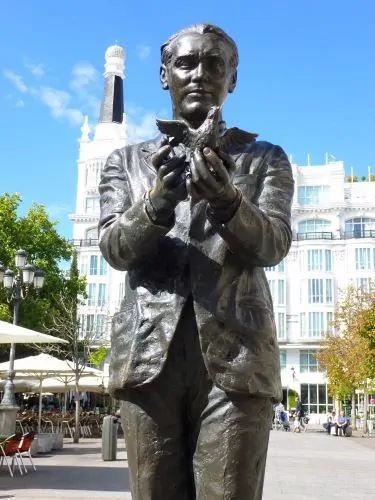
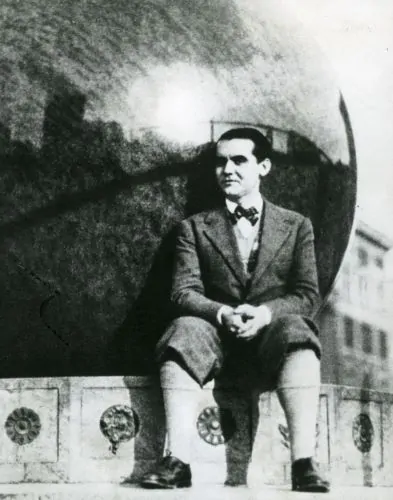
Printed in the daily one week before the outbreak of the war, these cosmopolitan words could not but aggravate the poet’s situation. Aware of the risk, he asked the befriended Rosales family for help as they had political links to the Falange (Spanish: Falange Española, literally Spanish Phalanx).7 He stayed in hiding at the Rosales’ house until 16th August, when the nationalists launched another hunt for him, following the failed attempt to detain him at his family home and, this time, having been tipped about his exact whereabouts. Mrs Rosales, who was then alone at home with Lorca, phoned one of her sons to tell him what was going on. Despite the desperate attempts, the commanding officer could not be dissuaded and arrested Lorca. The Rosales brothers immediately sought to get Lorca out of jail, using their connections in extreme right-wing circles. To no avail, however. José Rosales was told that there were too many serious charges against the poet for the commander José Valdés Guzmán to cave in to persuasion and let Lorca walk free, without risking accusations of treason and parleying with the ‘Reds.’8 As it turned out later, this was only an excuse. José Rosales made one more attempt and obtained a written order to release Lorca from Colonel Antonio González Espinosa the next morning. But when he presented the order, José Valdés Guzmán lied that the poet had already been transported from jail,9 which could only mean one thing to Rosales: Lorca was dead. In fact, Lorca was shot on 18th August at dawn.10 Where his body was buried has still not been established, which continues to spark speculations and spurs the imaginations of many researchers. Günter W. Lorenz, one of Lorca’s biographers, has written that only dry grass and a bunch of hyacinths are growing where the poet was brutally murdered.11 A more poignant vision of the burial place of the gay artist, one of the first victims of Francoism, would indeed be difficult to picture.
Without a doubt, the death of Federico García Lorca was politically driven. He was a far too well-known public personality and too directly associated with leftist views for the nationalists to fail to recognise him as one of their chief enemies. The account of the events provided by Gibson, where Valdés Guzmán was ordered to kill Lorca by General Queipo de Llano himself, sounds very probable. Otherwise, the Franco regime would have been less dedicated to hushing up the story and – when banning talk of it was no longer tenable – to misrepresenting the events, suppressing evidence and obstructing the investigation. The poet’s death became taboo very quickly. During the Civil War, it was dangerous to talk about him and even to have his books in Granada. As a result of his family’s consistent efforts, the authorities eventually issued Lorca’s death certificate, which described the circumstances of his passing in an oblique way: ‘died in 1936, in the month of May, of injuries sustained in warfare.’12 Notably, the document was issued on 20th June 1973.13 The gap between the tragic events of the first days of the Civil War and the issuing of the official statement amply indicates how troublesome an issue the famous poet’s death was to the Franco regime.
The attempts at finding out what exactly happened to Lorca were not only hampered by the reluctance of the state administration. Overly inquisitive researchers were also not welcome by all those who wanted to keep the poet’s homosexuality secret for fear of what is referred to as el ‘qué dirán’ in Spanish.14 Lorca’s family, some of his friends and a troop of literary scholars wished to defend Lorca’s ‘good name.’ They were afraid that making details of his private life public knowledge would deprecate his literary accomplishments, stain the family’s honour and – equally importantly – possibly occasion satisfaction to the regime, which was openly homophobic and persecuted its non-heterosexual citizens.15 If there were some grounds for such overcautious attitudes under Francoism, though even this is doubtful to some extent,16 they can only be regarded as ill will and a glaring disservice to Lorca in democratic Spain. In his book on Lorca, ‘Caballo azul de mi locura’: Lorca y el mundo gay [‘Blue Horse of My Madness’: Lorca and the Gay World],17 Gibson devotes considerably more room than in his earlier studies to the poet’s amorous relationships and the development of his homosexual sensibility. Re-examining Lorca’s work in the light of new facts, Gibson argues that some resources were not accessible to scholars even at the beginning of the 21st century as a result of misconceived concerns about the good fame of the heroes of those days. As a corroboration of this view, he cites the publication of Carlos Morla Lynch’s famous diary En España con Federico García Lorca [In Spain with Federico García Lorca] in 1957. The heirs of Morla Lynch, a Chilean diplomat who worked in Madrid under the 2nd Republic and during the Spanish Civil War, did not choose to release an unabridged version of the text when its re-edition was pub-lished in 2008. The prologue to the diary declares that even if the diplomat’s family decides to publish a more complete version someday, it will anyway be censored so as ‘not to harm the third parties.’18 While, in this case, the object is not to reveal that Morla Lynch himself was homosexual, the same mechanism is at work as that which impedes scholars’ efforts to find and reveal the truth about Lorca and his circle. Gibson certainly knows what he is talking about because he has been grappling with this mechanism since 1965, when he came to Spain to complete his dissertation on the origins of Lorca’s poetic universe, then to do research for his book El asesinato de Federico García Lorca (The Assassination of Federico García Lorca) published in the 1970s, and later to write his celebrated comprehensive, two-volume biography of Lorca (1985 and 1987). In this biography, Gibson illuminates not only the political background of his death but also the role of local animosities, family feuds, the envy of some of Lorca’s countrymen and the common homophobia of Span-ish society. Gibson’s findings imply that to claim that Lorca fell victim to the twists and turns of Spanish politics in the 1930s does not convey the complete picture of the events; nor does the notion that the crime was fuelled exclusively by right-wing hatred of homosexuals. As is often the case with explaining tragedies, calamities are triggered by a bundle of circumstances and factors, rather than by one cause.
Symptomatically, Gibson’s investigations coincided with the rise of the gay and lesbian emancipatory movement in the US, which prompted the development of gay and lesbian studies at British and American universities. In its pursuit of signs of homosexual identity in literary texts, gay criticism often reached for authors’ biographies as an essential point of reference. Such biographism tended to be denounced, especially by structuralist-minded literary scholars, as a too vulgar approach to lit-erary works, but it proved invaluable in the case of texts which relied on allusions, were thoroughly metaphorical or extensively used double coding to express homoeroticism. While biographism has lost a lot of its relevance in the study of more recent homoerotic literature produced in the post-emancipation times, it is still a method eagerly used by researchers of homosexuality in strictly canonical literature (such as Lorca and other poets of the Spanish Generation of ’27) to highlight the aspects of the text which other frameworks would either struggle to comprehend or even fail to notice.19 Known in Spain as a meticulous biographer rather than a literary scholar, Gibson also applies the gay critical methodology in his 2009 book on Lorca. He discovers new facts in Lorca’s life and re-reads his texts, ranging from the juvenilia to his last writings, to re-interpret them in a new context and from a new perspective.20 This approach to the study of literature inspires little enthusiasm in Spanish literary scholars, particularly those who believe that Gibson’s efforts are more geared towards finding sensational details in Lorca’s biography rather than to telling the truth about his life and work and making him a human rather than a monument. Emphatically, Gibson, who is a Spanish studies scholar from outside Spanish-speaking culture, time and again demonstrates that reading Lorca without taking into account what has been dubbed the ‘homosexual sensibility’ is bound to be fragmentary and reductive. Many of the refined Lorca interpreters and eminent experts were not always ready for such insights.21
As already argued, any examination of the construction of non-normative sexual identities in Spanish literature should commence from Lorca and the controversy around the relevance of homosexuality to the interpretation of his work. Of course, Federico García Lorca was not the first Spanish author to meaningfully engage with homoeroticism in his writings. However, the circumstances of his death, the aura of mystery enveloping him and the fact that he is the most recognisable member of the Generation of ’27, as well as an unquestionable fixture in the canon of Spanish letters and in the history of world literature, have all caused any new discovery about his life and/or work to almost immediately pro-voke wide-ranging responses. This is what happened when his Sonetos del amor oscuro (Sonnets of Dark Love) were published in the Saturday supplement to the daily ABC on 17th March 1984. The event was among the factors that contributed to the emergence of gay criticism in Spanish literary studies. As leading figures in Spain’s literary criticism responded to the publication all too cautiously and made sure not to mention ‘homosexuality’ in their comments on the poems, researchers from outside the Iberian Peninsula were prompted to examine Lorca’s work from another angle.
By the mid-1980s, the forbidden topic had practically not been raised when talking about Lorca, but the breaking of this taboo was looming on the horizon: when the sonnets were published, Gibson was already completing the first volume of his Lorca biography. Essentially, the poet’s family had not planned to reveal these texts to the public as they were permeated with ‘dark’ eroticism and their addressee was referred to in masculine pronouns. What was it then that inclined Lorca’s heirs to eventually allow the publication of the poems, which had only been seen by the poet’s closest friends when he had still been alive? At the end of 1983, a few months before this unexpected literary event, 250 unauthorised copies of the sonnets were printed and mailed to selected recipients. The anonymous sender had retained the original title and arranged the text, as was later established by Miguel García-Posada, on the basis of the photocopies of the sonnets in possession of Spanish studies scholar André Belamich.22 Unlike the ‘pirated’ edition of 1983, the poems printed in ABC bore the curtailed title of Sonetos de amor [Sonnets of Love]. The whole of the Saturday supplement was devoted to them, including write-ups by Lorca’s nephew Manuel Fernández-Montesinos and papers by distinguished critics Fernando Lázaro Carreter and Miguel García-Posada, whose collaboration had been solicited by Lorca’s family and who were aware how delicate the situation was. As neither of them dared call the love on which the sonnets dwelled by its proper name, they used veiled allusions and applied the strategy of universalisation. Quite often employed in critical commentaries on homoerotically infected and thus inconvenient literary texts,23 the strategy consists in underlining that even if some ‘specific’ love is at stake, this basically does not matter, because the texts are about ‘love as such’ and if they are read in any other way, they are approached reductively and with blatant incompetence. Does great literature not take human experience ‘as such’ as its object? Is it not universal? Within this logic, critics who highlight the specific in literature negate its greatness as if homoerotic literature could not be both homo-erotic and great at the same time, as if these two properties were mutually exclusive.24 According to García-Posada, ‘dark love’ meant difficult, desperate, unhappy love and little else.25 If so, why did the adjective ‘dark’ disappear from the title in ABC? Was it by any chance the case that Lorca himself did not know exactly what love he was writing about? Did he not realise that his poems were about love ‘as such,’ love that does not tolerate any epithets? What else, if not an epithet (in the colloquial sense of the term), must ‘dark love’ have been in the censors’ view that they decided to tailor the title the way they did?26
The Spanish term oscuro does not connote homosexuality. The sonnets themselves do not engage with the theme too explicitly either, except a few details, such as the masculine addressee in one of them, as already mentioned. An inattentive reader may easily miss this, engrossed in other aspects of the text. However, the leading literary critics are not likely to have been inattentive readers. Some metaphors, keywords and symbols only become fully comprehensible if considered in the context of an author’s entire body of writings, especially in the case of a distinguished writer who consciously aspired to chisel his unique idiom. Recurrent motifs in Lorca’s works, such as ruins, infertility, a seaman, the colour blue,27 the night with its darkness, and knives piercing and killing the male body, all acquire a different shade of meaning if viewed in relation to the features distinctive to homoerotic literature of the day. The modernist expression of homoeroticism through the combination of Eros and Thanatos can be found in other national literatures.28 Besides incorporating such shared devices, the homosexual writers of the Generation of ’27 crafted their private codes including a range of other characteristic motifs. As Lorca experts refused to take this context into account, two pioneering studies that articulated what had long been left unsaid appeared in the second half of the 1980s.
First came Paul Binding’s Lorca: The Gay Imagination (1985), published in Spain as García Lorca o la imaginación gay (García Lorca, or the Gay Imagination) two years later.29 Binding’s references to Lorca’s biography are kept at the indispensable minimum, and his focus is on exploring homosexual sensibility in Lorca’s poetic imaginary. He elucidates the characteristic coupling of Eros and Thanatos, particularly in Lorca’s later writings, including the sonnets, as well as casidas and gacelas in Diván de Tamarit (The Tamarit Poems). He also identifies Romancero gitano (Gypsy Ballads) as Lorca’s first collection to image the male body through a gay lens30 and comments on the elements of his dramas (both the well-known and the earlier ones) which attest to Lorca’s specific sense of alienation caused by his sexual otherness in a society that did not accept homosexuality. Binding’s argument, though rambling a bit at places and rather scarce on reliable evidence, demonstrates how Lorca gradually realised that, as a homosexual writer, he could explore the human condition from the perspective of his own queerness. Binding locates the breakthrough moment in the period when Lorca was working on Poeta en Nueva York (A Poet in New York), a volume which not so much sublimates homoerotic desire (as Lorca’s early writings do) as rather consciously builds on the homoerotic tradition and attempts to work through sexual otherness, especially in confrontation with the unfriendly modern world symbolised by the dehumanised New York.31 In the concluding chapter, Binding closely scrutinises casidas, gacelas and the newly published Sonnets of Dark Love. He explains the meanings of oscuro in the context of the dance of eroticism and death, which as he claims are of special significance to homosexual authors,32 and in relation to anal intercourse as a deeply taboo element of male same-sex eroticism. He also argues that Lorca’s sonnets characteristically cast their I-speaker as passive vis-à-vis the addressee – the ‘tú’ of the poems that embodies dominant masculinity and does not refrain from mocking or spurning the courtship. The lover addressed by the I-speaker appears predominantly interested in sexual contacts and at the same time failing to comprehend the depth of the affection he is offered and unable to fully requite such love.33 Such a reversal with the passive, suffering I-speaker and the active, pain-inflicting addressee is not typical of love poetry written from the perspective of a heterosexual male. Rather, as Binding seems to imply, it is a product of the gay imagination.
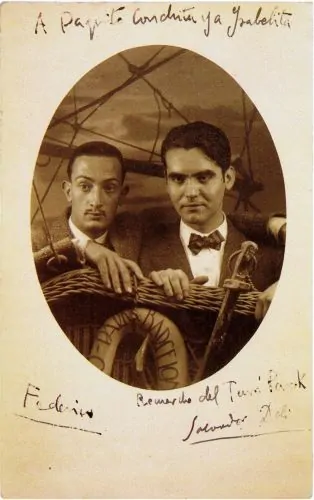
The other study is a revised version of Ángel Sahuquillo’s doctoral dis-sertation, Federico García Lorca y la cultura de la homosexualidad mas-culina (Federico García Lorca and the Culture of Male Homosexuality), whose subtitle suggests a broader context than that in Binding’s book: Lorca, Dalí, Cernuda, Gil-Albert, Prados y la voz silenciada del amor homosexual [Lorca, Dalí, Cernuda, Gil-Albert, Prados and the Silenced Voice of Homosexual Love]. Completed in 1986 at the University of Stockholm, the dissertation was published in Spain by the Juan Gil-Albert Cultural Institute in Alicante in a limited print-run in 1991. The study comprehensively discusses expressions of homoeroticism in Lorca and compares them with the writings of other authors from the Generation of ’27 to identify interactions between poetry and visual art practised by the group that clustered around the Residencia de Estudiantes, a famous student hall of residence and a cradle of the most brilliant talent of 20th-century Spanish art.34 Sahuquillo argues that some of the members of the Generation of ’27 coded homoeroticism by means of a range of motifs, symbols, allusions and intertextual references associated with the culture of homosexuality. To be able to decode them, readers must possess a certain cultural competency and a profound knowledge of the entire body of work of respective authors, and consider the uniqueness of their poetic idioms. If some allusions to homosexuality are easily decipherable by an educated readership (e.g. references to ancient Greece and its mythology, to the Biblical narrative of the destruction of Sodom and Gomorrah, to the poetry of Walt Whitman, Paul Verlaine and the English Uranian poets, to Plato’s Symposium and Socrates, to the work of Jean Cocteau, etc.), some other motifs connoting homosexuality may be more obscure, especially if they are bound up with a private code used by a group of friends or in one author’s texts alone. Sahuquillo examines numerous references to ancient Greek myths (e.g. pointing out the echoes of the Ganymede myth in Juan Gil-Albert, explaining the meanings of the sea and sea foam in Lorca as the semen in the context of the Ouranos myth and exploring Apollonian motifs already analysed by Binding) and explicates the hidden meanings of the adjective amargo (bitter), which often appears both in Lorca as well as in Cernuda and Gil-Albert.35 Another equivocal adjective frequently found in Lorca is verde (green), which in Spanish denotes not only a colour but also lewdness or lechery36; Sahuquillo quotes the famous passage in ‘Ode to Walt Whitman’ about ‘men with that green look in their eyes who love men’ and the phrase ‘the green blood of Sodom’37 in ‘Carne’ (‘Flesh’). Sahuquillo completes the list of Lorca’s characteristic motifs, some of which also surface in other authors of the Generation of ’27, with venas (veins), sangre (blood), rosas (roses), puñales (daggers), palomos (male doves), macho cabrío (male goat) and torres (towers). This catalogue may come across as somewhat surprising and stir suspicions of overinterpretation. Given this, Sahuquillo meticulously investigates the context38 and often emphasises that coding is all about the constant game of veiling and unveiling, in which the writer does not conclusively state anything and leaves readers alone with their assumptions, while communicating with those versed in the code. Sahuquillo is aware of the challenges faced by a researcher who seeks to decode the meanings hidden in the texts, especially those bound up with the theme that stirs considerable animosity (‘has enough enemies’39) and justifies the length of his heavily overquoted and repetitive study by the imperative to carefully document his theses. He also refutes the objection of the non-inclusion of Vicente Aleixandre in the study by pointing out that the Nobel Prize winner was still alive when the book was published. Admittedly, so were Juan Gil-Albert and Salvador Dalí, but, unlike Aleixandre, who kept his sexual orientation secret, they did not object to having their work discussed in the context of ‘the culture of homosexuality.’40
This detail deserves some attention, given that when gay criticism appeared in Spanish studies, homosexuality was still a strong taboo in literary research. The two pioneering studies – by Binding and Sahuquillo – received scant attention,41 have never been re-edited, and their copies are poorly accessible in Spain. While Sahuquillo’s book was published again in 2007, it only appeared in an English translation in the US.42 The ‘truth serum’ has failed to entice enthusiasm in Spanish criticism. Yet it has proven abidingly attractive to researchers from outside the Iberian Peninsula.
Critically Queer? Spanish Studies in Anglo-American Academia
The reluctance of Spanish mainstream criticism to acknowledge authors’ homosexual sensibility as relevant to the interpretation of their works results not only from the decades of taboo on non-normative sexualities in public space (though this has certainly been a factor in the dispute about Lorca). This reluctance can equally be attributed to the tradition of literary studies in Spain, which comes across as a hermetic discipline, distrustful of reading literature against the grain, standing in stark contrast to the methodological plurality of Anglo-American literary research. As observed by Alberto Mira, Harold Bloom’s The Western Canon: The Books and School of the Ages of 1995 attracted considerable interest from Spanish critics. Widely commented in English-speaking countries, Bloom’s publication – a ‘manifesto against postmodernist approaches to literature’43 – served Spanish scholars to defend the status quo, that is, the traditionally conceived literary studies, even though gender, postcolonial and queer criticisms neither were practised widely nor enjoyed a strong position in Spain. Consequently, it may come as somewhat of a surprise that Spanish researchers voiced such determined views and appeared so committed to joining an academic dispute unfolding in the foreign context of the US and the UK. Mira claims that the slightly exaggerated attack launched by such critics as García-Posada against the more recent tendencies in literary research resulted from the ignorance of their methodological underpinnings and from a wrong belief that the study of texts in terms of cultural notions, such as gender, sexual identity and ethnicity, reduced the meaning of the works and threatened canonical readings, as if only one way of interpreting literature were correct or, indeed, possible.44 While much of such a distrust has already been overcome by literary gender criticism, which is gaining more and more currency in Spain, with more and more Spanish scholars relying on queer criticism in their research, most of the first queer-inspired Spanish-studies publications were produced at American, British and Australian universities, that is, in the environment where queer criticism was born. This had some unwelcome ramifications, such as an obliviousness to specific local conditions and an unexamined over-acceptance of American theorisations of sexual non-normativity.
Nevertheless, the authors of the most important studies (especially those hailing from the Iberian Peninsula) seek to withstand the temptation of generalisations and all too easy analogies and call for modifications to the research toolkit developed in queer theory in order to adjust it to Spanish realities. They point out that some Spanish studies researchers who build on American publications fail to notice that some findings of Anglo-American research are incompatible with the Iberian context.45 Alfredo Martínez Expósito ponders whether it is even possible to apply the queer paradigm (as conceived of in Anglo-American academia) to a country which has had no prior strong feminist tradition and has not generated a recognisable, homogeneous movement of gay and lesbian emancipation.46 To grasp Martínez Expósito’s objections, let us go back to the beginnings of queer studies in the US and compare them with what happened in Spain.
The founding of queer studies in the US and the UK at the turn of the 1980s was entangled in the dispute on essentialism and constructionism. Characteristic of gay and lesbian studies and the second wave of feminism, the former presupposed a trans-historical (sexual, gender) identity which was immutable and shared by the entire group oppressed by the majority (respectively, gays and lesbians discriminated against by heterosexuals and women marginalised by patriarchal society). The essentialist (minority) model of identity was the lynchpin of emancipatory movements at the turn of the 1960s, which fought for equal rights of women and sexual minorities. However, the equal-rights identity politics soon proved to embrace binaries, such as homosexuality/heterosexuality and masculinity/femininity and to reinforce such distinctions rather than interrogating them. The exclusion of lesbians, who were a minority both in the gay-dominated emancipatory movement and in the feminist movement (where they were ‘incomplete’ as non-heterosexual women) prompted women intellectuals engaged in these movements to propose different theorisations of identity. What received some spotlight was the obvious fact that, for example, the social position of low-income women who were members of sexual and ethnic minorities drastically differed from the position of WASPs (White Anglo-Saxon Protestants), who were dominant both in the gay-and-lesbian and feminist movements in the US. Michel Foucault’s ideas and post-structuralist theories helped re-think identity as an outcome of discursive strategies, rather than as a stable and historically permanent essence shared by particular groups. Known as constructionism, this standpoint stresses the input of multiple (social, economic, political and historical) contingencies into how notions such as gender, sexual and ethnic identity, function and are perceived. Constructionists also explore power relations inscribed in the hetero-homo and male-female binaries and the role of hegemonic discourses in the production of these identity notions in social and cultural spaces. Unlike gay and lesbian studies, queer studies does not focus on capturing homosexual identity as shared by a given group discriminated against by the heterosexual majority within the homo-hetero dichotomy. Rather, it scrutinises the very mechanisms of stigmatisation of otherness and the entire system based on an array of exclusion-triggering binaries.47 As such, queer studies offers a broader perspective which brings trans-sexuality, transgender and other non-normative identities (e.g. bi-and intersexuality) into the orbit of scholarly reflection. At the same time, it helps explore sexualities from various points of view, for example, in combination with postcolonial approaches, which is particularly relevant in US society with its considerable diversity. The interrogation of essentialism precipitated by the monolithic character of the emancipatory movements of the 1960s and 70s contributed to the foundation of queer studies as part of the humanities, therein literary research.
Martínez Expósito observes that the Anglo-American debate on essentialism and constructionism stirred hardly any interest among Spanish activists, who tended to regard the problem of excessive essentialism as ‘artificial’ and irrelevant to their realities. Since their onset in the 1970s, gay and lesbian movements in Spain have largely been disengaged from identity-thinking and preoccupied with the socio-economic circumstances of homosexual lives, without erecting homosexual identity into an indisputable core of the community. Besides, these movements were scattered across Spain’s various regions and did not make up a unified and centralised formation which could be accused of monopolising the discourse. While the American emancipatory movement mainly acted on behalf of the middle class, the Spanish movements were originally inspired by Marxist ideas48 as a result of attempts to overcome the decades-long supremacy of right-wing ideology. The emergence of a strong identity politics was also thwarted by the overall atmosphere of the late 1970s and early 80s, which is not mentioned by Martínez Expósito but deserves attention. The period was marked by the development of the movida madrileña, a counter-cultural artistic movement which was a vehement response to the long years of Franco’s pompous Spain with its emphatically conservative mores. The fertile breeding ground of talent epitomised, for instance, by Pedro Almodóvar, the movida madrileña was characterised by an eruption of sexuality and frivolity – an urban festa of postmodern dandies fascinated with pop-art, punk and camp. The celebration of sexuality (including homosexuality as one of the many viable options) was not accompanied by any desire to do serious politics, not even to struggle for gay and lesbian rights.49 The opposite was the case: the young wanted a break from politics; they wanted free love and flippant art.50
Of course, there are many more differences to be taken into account. They also result from a different conceptualisation of homosexuality in Spanish culture, from the Spanish language with its different metaphors and from the specific perception of masculinity and femininity in societies which are still ridden with machismo, such as Spain and other Spanish-speaking countries.51 Martínez claims that this represents ‘an extremely interesting case of epistemological untranslatability, which stems from an utter asymmetry of homosexuality concepts espoused by Anglophone and Spanish critics.’52 As a result, Paul Julian Smith, the first scholar to apply the queer perspective to the study of Spanish let-ters and flm (1991), rues the fact that no study comparable to Jeffrey Weeks’s Sexuality has been produced in Spain and the existing literature subscribes to obsolete viewpoints, unlike British and American publica-tions. Smith is also surprised that despite a wealth of Spanish writings and art probing homosexuality, the theme has hardly been touched upon in Spanish research.53 This gap was to be partly bridged by the efforts of philosophers (Paco Vidarte and Paul B. Preciado), social scientists (Ricardo Llamas and Javier Sáez) and translators of Judith Butler, Eve Kosofsky Sedgwick, Guy Hocquenghem and Leo Bersani. Their work, as well as the dedication of the distinguished queer studies scholar Rafael M. Mérida Jiménez, the editor of the ground-breaking reader Sexualidades transgresoras,54 ushered queer theory into Spain and helped other disciplines face up to its ‘epistemological untranslatability’ and accommodate it to Spanish realities.
In literary studies, a handful of noteworthy publications appeared in the 1990s, but most of them – with the notable exception of Mar-tínez Expósito – did not emphasise the urgency to re-examine the partial incompatibility between Anglo-American queer studies and the Spanish context. Smith’s pioneering collection of essays, Laws of Desire: Questions of Homosexuality in Spanish Writing and Film, 1960–1990 (Las leyes del deseo. La homosexualidad en la literatura y el cine español 1960–1990), looks into the work of writers, such as Terenci Moix, Juan Goytisolo (the so-called trilogy of treason) and Esther Tusquets (the sea trilogy), as well as filmmakers: Pedro Almodóvar and less known Eloy de la Iglesia. Smith also examines feminist and gay autobiographical writing (Rosa Chacel, Juan Goytisolo and Terenci Moix). In contrast to the earlier studies by Binding and Sahuquillo, Smith addresses ‘the risk of essence’55 and draws on the concepts of Judith Butler, Diana Fuss and Lee Edelman. (The latter’s concept of homographesis will later be employed by queer Spanish studies scholars, which I discuss below.)
Smith also co-edited ¿Entiendes? Queer Readings, Hispanic Writings, a volume of contributions chiefy on Latin American literature, such as a discussion of ‘homosexual panic’ in Jorge Luis Borges and the homosexual ‘closet’ in Virgilio Piñera, side by side with an analysis of Lorca’s ‘Ode to Walt Whitman’ and a paper on Cervantes’s monumental work with the telling title ‘Aldonza as Butch: Narrative and the Play of Gender in Don Quijote.’56
Four years later, Duke University Press released a collection of essays on queerness in mediaeval and Renaissance writings in the Iberian Peninsula – a borderland of three cultures and a site of communing with otherness. Its preface explains that the volume continues upon the preceding one and springs from an interest in the uniqueness of the Spanish Middle Ages, which stood out from the rest of Christian Europe due to the strong presence of Moors and Jews.57 The medievalist research into sexual non-normativity was inspired by the already classic works of the Spanish historian Américo Castro, who coined the term convivencia (literally: coexistence or living-together)58 to capture the relations among then-diverse inhabitants of the Peninsula and its lost multiculturality, which Lorca believed to have been inestimable and which Juan Goytisolo adulates in his writings. The editors of the collection emphasise that Castro, as it were, queers history by ‘exposing the Semitic roots of modern Spanish identity,’59 which is predominantly founded on the myth of Catholic Spain as ‘pure’ as a result of ousting the Other. Queering in this case consists in reclaiming the different and the disturbing, that which has been driven away from the collective consciousness. As a consequence, the discourse in place is turned inside out. This was also the aim pursued by the authors of Queer Iberia, who set out to identify the role of non-normative sexualities and the attitudes to queers in Iberian culture from the Middle Ages to the Renaissance. For example, Mark D. Jordan’s contribution analyses the cult of St Pelagius, a Christian ephebe taken captive by Moors. When the Córdoban caliph Abd ar-Rahmān III fell in love with him, Pelagius not only refused to disown his faith but also categorically rejected the caliph’s courtship, which cost the boy his life. Jordan explores various versions of the saint legend to conclude that the Christian authors who wrote about Pelagius gradually erased erotic allures contained in his image to prevent their male audience from yielding to irresistible desire (as the hateful caliph did) stirred by too evocative depictions of the beautiful ephebe. Pelagius’s attractiveness proved as much of a problem to Spanish culture as the sinful presence of infidels. From version to version, Pelagius was transforming from an alluring ephebe into a mature Christian militant, whose manly valour could be ‘safely’ admired, which Jordan interprets as a sublimation of forbidden desire.60 In the same volume, Daniel Eisenberg posits that Juan Ruiz’s Libro de Buen Amor (The Book of Good Love) was written in response to the commonness of homosexual behaviour among non-Christians and the ‘queerness’ of Muslim al-Andalus, against which his brethren in faith had to be protected by having the pleasures of heterosexual intercourse advertised to them.61 The anthology as a whole implies that the processes observed by Américo Castro involved progressing heteronormativisation. Spanish identity was constructed by expelling not only the infidel but also the sexual queer as the former’s double,62 which in the long run bred the homophobia of the Francoist ideology.
Among English-language studies published in the 1990s, there are also a guide to Spanish gay- and lesbian-themed literature,63 modelled on The Gay and Lesbian Literary Heritage,64 a short introduction to the work of Luis Antonio de Villena,65 Brad Epps’s extensive study on Juan Goytisolo’s fiction from 1970–1990 (containing a noteworthy chapter on homosexuality in the context of the AIDS epidemic in Las virtudes del pájaro solitario [The Virtues of the Solitary Bird])66 and a book by Robert Richmond Ellis, which picks up the issues outlined in the first chapter of Smith’s The Laws of Desire, specifically gay autobiographic writings in contemporary literature.67 Drawing on Leo Bersani,68 Ellis develops the concepts of homo- and heterorelationality to come up with a typology of homosexual autobiographies.
Heterorelationality is understood as defining identity through its opposite (‘I’m a woman, so not a man,’ ‘I’m heterosexual, so not homosexual’). Such a definition is enclosed within the hetero/homo dichotomy whereas in homorelationality, it involves the suspension of this binary, indifference to the difference inscribed in it and self-definition despite the dichotomy. Taking Leo Bersani’s observations in Homos as his starting point, Ellis discusses homosexuality not in terms of some gay essence, understood as a Derridean supplement, a sine qua non of heterosexuality, but in terms of ‘gay praxis,’ based on the desire for sameness. This is about repudiating heteronormativity inscribed in the hetero-homo and male-female dichotomies as the point of reference for the positions of gays and lesbians (‘homo-acts’), and at the same time about dismantling the idea of a shared core identity that determines these positions/acts.69 This reasoning leads Ellis to identify three types of autobiographical texts: gay autobiography, queer autobiography and homobiography. Gay autobiography pictures homosexual identity in an essentialist way, and its major objective is to come out and afrm and freely express the previously repressed identity. This approach is not successful in Spanish writings of this type. As essentialism frmly inscribes identity in the structure of heterorelationality, identity comes to be determined by meanings accumulated around heterosexualism and perceived through the lens of the hetero/homo dichotomy. Queer autobiography ‘neither affirms nor denies gay and lesbian identities but endeavors to destabilize all sexual and gender identities by allowing them to free-float across the hetero/homo and masculine/feminine binary divides.’70 Similarly to queer theory, this results in ‘eras[ing] gay and lesbian specifcity.’71 The third type of text, homobiography – only represented by Juan Goytisolo’s Las virtudes del pájaro solitario (The Virtues of the Solitary Bird72) – manages to steer clear of the reefs into which gay and queer autobiography bumps. Homobiography is best understood by recourse to the deconstructive notion of homographesis, which was proposed by Lee Edelman73 and has become popular with Spanish studies scholars.
Homographesis is basically a double operation. On the one hand, it involves the incorporation into a text of homosexual ‘identity marks’ consistent with the essentialist representations of homosexual identity in circulation since the mid-19th century (inscription), and, on the other, it consists in undermining – in the same text – these labels imposed by a ‘foreign,’ external discourse (description). In other words, homographesis is a discursive game in which a homosexual writer surrenders to the necessity of articulating difference in conformity with the heterosexual imaginary, without which his otherness would remain unrecognised and transparent, but he simultaneously questions the relevance of difference in defning identities.74 Juan Goytisolo’s homobiography succeeds in performing this feat because, as Ellis insists, it focuses on sameness rather than on difference, is ‘indifferent’ to the latter and brackets it of, at the same time shifting emphasis onto gay praxis.75
While precious and in many senses innovative, the works of Anglo-American Spanish studies scholars referenced above use the toolkit of queer theory, which arose in a context divergent from the Spanish one. Ellis’s argument pivots around the Anglo-American debate on essentialism and constructionism, a division which breeds certain reservations about its applicability to the Spanish setting. Similar echoes of Anglo-American perspectives reverberate in the other studies, though it must be admitted that several insights offered by Anglo-American queer studies scholars are pertinent to Spanish culture, especially that culture as such is increasingly globalised, which affects the ways sexual minorities function and are perceived. The critics of Anglo-Saxon approaches are rather concerned with details and call for an adjustment, and not a total rejection, of the queer criticism methodology. The language in which studies are produced is one such detail. The publications of the 1990s were written in English and determined by this language. This begs the question of in how far today’s lingua franca is capable of conveying nuances of the Spanish tongue. How important is it to write in Castilian? The monopoly of the English language was dented at the end of the 1990s, when the first studies by Spanish literary scholars affiliated with queer criticism appeared.
‘¿Entiendes?’ Towards an Epistemology of ‘the Opposite Pavement’

An alternative title of this section could read Metaphors ‘We’ Live By, only differing from George Lakof and Mark Johnson’s formulation by the inverted commas used to highlight the specificity of sexual minorities. Admittedly, Martínez Expósito does not refer to the famous cognitivists (rather building on the texts of Susan Sontag and Gayle Rubin exploring the impact of the AIDS epidemic on the perception of homosexuality76), but he underscores the immense role of metaphorical renderings of homosexuality in language. He himself proposes the metaphor of a scribe to depict writers of homoerotic literature. Somewhat against chronology, before discussing Martínez Expósito’s concepts in Los escribas furiosos. Confguraciones homoeróticas en la narrativa española [Frenzied Scribes: Homoerotic Configurations in Spanish Fiction] (1998), the first literary-historical queer study published in Castilian, I will present his slightly later observations on the adaptation of queer studies to Spanish cultural realities.
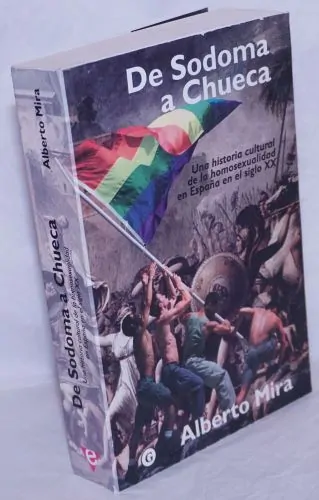
The year 2004 was marked by the publication of two ground-breaking studies: Escrituras torcidas. Ensayos de crítica ‘queer’ [Twisted Writings: Essays in Queer Criticism77] by Martínez Expósito and De Sodoma a Chueca. Una historia cultural de la homosexualidad en España en el siglo XX by Mira, a monumental monograph which in many senses heeded Martínez Expósito’s earlier appeals by offering the so-far most complete discussion of male homosexuality in Spanish literature and film. In this way, it remedied the deficit which Martínez Expósito described four years before:
We already have a more or less established canon of homosexual writers or writers with homosexual sensibility; we possess some good historical studies of the legal status of homosexuality in Spain; and there is also a tolerably entrenched critical awareness that such research should be developed. But we still lack several basic analyses: we have not identified several texts and authors that could contribute to this homophile canon, and we practically know nothing about how the various homoerotic traditions that coexist in Spanish literature are interlocked.78
When this gap had been bridged (with Los escribas furiosos having considerably contributed to this), the already mentioned ‘epistemological untranslatability’ of Anglo-American queer studies became a more pressing issue. Martínez Expósito explored it throughout the first part of Escrituras torcidas, which includes chapters entitled ‘Literatura queer y teoría torcida’ [‘Queer Literature and Twisted Theory] and ‘Metáforas y desplazamientos semánticos’ [‘Metaphors and Semantic Shifts’]. The chapters relate the development of queer criticism in the UK and the US and investigate language as a factor that conditions knowledge. Martínez Expósito observes that Spanish sexual minorities tend to use the verb entender79 (to understand) when referring to sexual non-normativity, which in a sense corresponds to English ‘queer,’ as indicated by its inclusion in the title. ¿Entiendes? Queer Readings, Hispanic Writings. However, as Martínez Expósito laments, the authors of the papers in the collection fail to follow this path or to attempt a deeper reflection on the role of language. He argues that Spanish uses different metaphors than English and consequently categorises reality in entirely different ways. For example, is the widespread metaphor of the closet equally expressive as it is in Anglo-American culture?80 Does Castilian use another meta-phor which entails certain epistemological consequences? In exploring these queries, Martínez Expósito comments on the homosexual closet metaphor:
In English, one of the most frequent metaphors associated with homosexuality plays on the closet into which the most shameful secrets are shoved. This skeleton in the closet, proof of concealed guilt, shows how important privacy is for English-speaking societies and how fraught the relations between the private and the public or social spheres are. […] The English metaphor of the closet institutes a relationship between two spaces – internal and external – which symbolise the hidden and the revealed, the private and the public. Sedgwick has shown that the 20th century was, among other things, a time when the closet in which European society had locked up sexual diversity for almost a thousand years was gradually being opened.81
Martínez Expósito contrasts the closet metaphor with the Spanish expression ser de la acera de enfrente (literally: ‘to be from the opposite pavement’), which also ‘institutes a relationship between two spaces,’ but it does so in an altogether different way. This fixed phrase has been used by heterosexuals in Spain for two purposes: firstly, to point at a homosexual individual (as belonging to ‘another’ world, to the space ‘over there’) and, secondly, to emphasise their own identity (as belonging to ‘this’ world, to the ‘here’ space). Martínez Expósito explains that the expression stems from a widespread habit in Spanish-speaking countries, described by Juan Eslava Galán,82 specifically from the ritual of strolls, taking which groups of men and women would walk separately on the opposite sides of the street; this made it possible to keep eye contact and watch potential partners while retaining distance between the male and female worlds, a division more powerful on the Iberian Peninsula than in other European countries. The phrase ser de la acera de enfrente also appeared in other versions,83 but what all of them always had in common was splitting the space into ‘over there’ and ‘here,’ differently than in the ‘internal’/‘external’ division envisioned in the closet metaphor. In Martínez’s view, this has a range of implications. Firstly, the opposite pavement metaphor contributes to a stronger naturalisation (essentialising) of homosexual identity by heterocentric discourse. Identifying a homosexual individual immediately entails ascribing him/her to another world (‘over there’), from where there is no coming back to the hetero-sexual ‘side of the street.’ Thus-framed, homosexuality is not a matter of practising certain sexual behaviour from time to time, which would not prevent a person from fitting in at ‘both sides of the street’; instead, it is the very core of identity and embeds one permanently in the alien space. Secondly (and consequently), the process of coming out of the closet, as discussed by Kosofsky Sedgwick, is barely identifiable in the Spanish context. Instead of the gradual unveiling of the secret by the individual in question, there is a single act of identity ascription by a third party, which is followed by the establishment of distance from the homosexual. Thirdly, the private-public opposition is relegated to the background as the public moves to the foreground: ‘The popularity garnered by the pavement metaphor in Spanish speaks to a conceptualisation which grants the supreme status to the public sphere and which closely links sexuality to the staging of identity and feelings.’84 In other words, ‘sexual identity, too, should be publicly performed, staged and enacted.’85 ‘Too’ is crucial in this observation because it refers to the concept of gender performativity developed by Judith Butler, who sought to problematise the connection between sex and gender and to question the sex-gender opposition. Sex comes across as natural as a result of regular, daily repetition of strictly cultural gestures.86 Martínez Expósito thus insists that, in the Spanish context, the mechanism depicted by Butler concerns not only sex but also sexual identity, which is naturalised by the heterocentric imaginary as effectively as sex. Fourthly, another, equally fundamental consequence caused by the pavement metaphor is a closer coupling of gender and sexual identities, that is, the binding of the masculine/ feminine binary to the heterosexuality/homosexuality dichotomy.87 On learning that somebody is gay, a Spanish speaker immediately draws a false conclusion that if the person prefers men, he must be like a woman; and because a lesbian falls in love with women, she must be like a man.88

Martínez Expósito proposes that his conclusions be taken into account in Spanish queer studies and, paraphrasing Eve Kosofsky Sedgwick’s classic title,89 examines the 20th-century history of homosexuality on the Iberian Peninsula in terms of the ‘epistemology of the opposite pavement.’ He certainly has a point as such a local perspective helps explain why, since its onset, the Spanish emancipatory movement has rejected the identitarian framework. The constant naturalisation (essentialising) of homosexuality by ‘third parties’ – the state apparatus of the Franco regime (legal and medical discourses) – prompted an urge to oppose such positions even though the dismissal of the identitarian idea was, arguably, more ‘intuitive’ than theoretically informed. Unlike their English counterparts, Spanish gay and les-bian movements did not have an extended intellectual base at their disposal. I believe that the popularity of gestures which tend to be called campy has also been propelled by the binding of gender and sexual identities fuelled by the pavement metaphor. Intrinsic to the camp style, an ironic attitude to gender and sexual identities is quite ingrained in Spain and acquires an interesting colouring in combination with the tradition of Spanish Catholicism (which is where the central difference between the Spanish and Anglo-American camp varieties lies).90 These examples indicate that Martínez is right to assert that both entender and acera de enfrente ‘offer extraordinary epistemological possibilities and may in many cases prove more fruitful in exploring literary texts than the hackneyed references to the closet.’91
Besides the Spanish-specific metaphor of the opposite pavement, Martínez also discusses the metaphors for homosexuality ubiquitous in Western culture, such as an abominable sin (pecado nefando), stemming from mediaeval theology,92 crime and disease: ‘a sodomite is a sinner, an inverted man, a sick one; a homosexual is a delinquent.’93 The three metaphors are products of the hegemonic discourses of, respectively, the church, medicine and law. While this was seminally explored by Foucault in the first volume of The History of Sexuality, subtitled Will to Knowledge,94 a matter of interest is how these discourses work in Spanish culture. This is what Mira examines in his De Sodoma a Chueca, which covers almost the whole of the 20th century. Mira studies the sources of institutional homophobia, which Franco’s dictatorship and the Catholic Church jointly sustained over several decades, the taxonomy of homo-sexuality and the few attempts at defending homosexuals within medical discourse.95 Mira’s study, however, is more than just an investigation of the three discourses which adapts Foucault’s insights to Spain. The subtitle reading Una historia cultural de la homosexualidad en España en el siglo XX [A Cultural History of Homosexuality in Spain in the 20th Century] announces Mira’s interest as lying not so much in the hegemonic discourses themselves (they only provide a starting point for his argument) as rather in the reactions to them which are discernible in culture (mainly in literature and film). Mira scrutinises art for both representations and expressions of homosexuality, that is, for stereotypical renderings of homosexuals and for responses to these stereotypes in the works of writers and artists who identify with the culture of sexual minorities.
Mira argues that the three hegemonic discourses contributed to the emergence of three traditions or paradigms of homoerotic expression in 20th-century Spain: the ‘accursed homosexuality’ (malditista) model, also dubbed decadent (decadentista), the homophile model and the camp model. The malditista paradigm arose as a reaction to the stereotype of the homosexual as a degenerate criminal, produced by legal discourse. This paradigm ‘accepts the externally imposed marginalisation but appreciates it as positive in a gesture of protest: this involves choosing what society defines as evil in order to demonstrate the denial of society’s founding values.’96 This model was formatively influenced by 19th-century authors, such as Oscar Wilde and Lautréamont, and was at the peak of popularity in the 1960s and 70s, when the Franco regime ostentatiously trumpeted bourgeois values and intensifed repression against homosexu-als. Mira underscores that the endorsement of ‘accursed homosexuality’ was paired with anti-Franco attitudes, which is particularly pronounced in the fiction of Juan Goytisolo, a friend of Jean Genet and admirer of his work, which embraced the same attitude to homosexuality.97 The homophile model ‘seeks to integrate homosexuals in society, calling for the recognition of their “normality.”’98 This paradigm emphatically refuses to accept the peripheral position as a value and underscores that the homo-phile approach is the only acceptable avenue for coming to terms with society. According to Mira, this position has been espoused by Luis Cernuda, Juan Gil-Albert and later writers of the transición española period – Armand de Fluvià and Jordi Petit. This model was practically absent under the dictatorship,99 but it dates back to the 1920s, when André Gide’s homophile treatise Corydon, inspired by ancient homoeroticism, garnered considerable popularity. Interestingly, this essentialising, proto-gay paradigm is not very much in vogue in Spain, which may be attributed to the dominance of the Francoist discourse, which precluded any favourable expression of homosexual identity, and to the repudiation of the so-called identity thesis by Spanish activists shortly after the fall of the dictatorship. Third on Mira’s list, the camp model is associated with the stereotype of the inverted type, that is, with ‘hermaphroditism of the soul,’ as Foucault put it, which has been and is perpetuated in language through the metaphor of the opposite pavement. The Spanish camp ‘is expressed in what came to be called pluma (affectation, mannerism) in the second decade of the century,’100 and its first signs can be traced back to the work of Antonio de Hoyos and Álvaro de Retana in the early 20th century. In later periods, the camp tradition has been continued by Terenci Moix, Lluís Fernàndez, Nazario and Eduardo Mendicutti and by Pedro Almodóvar in film. Mira explains that ‘[c]amp contradicts science, truth, sincerity and reason and is associated with irony, sense of humour, flippancy, exaggeration, language games, theatricalisation and some hedonism. In particular, it questions heterosexism and ideologies behind gender roles.’101 This insight deserves highlighting since camp in Spain is mainly conceived as synonymous with homosexual affectation (pluma), which ‘dissolves moral injunctions by using irony and questioning all intents of seriousness.’102 Consequently, camp literature appears to hold the greatest potential of subversiveness, which surfaces in writings I discuss later in the book.
Mira examines an impressively opulent body of texts, which also includes little known works from outside mainstream Spanish literature. His study heeds two pleas articulated by Martínez Expósito in Los escribas furiosos: for discovering forgotten writers and texts which could add to the canon of Spanish gay literature and for investigating various literary traditions that make it up.103 Martínez Expósito himself embarked on such a venture and published his findings in 1998. Los escribas furiosos was the first literary-historical study of homoeroticism in contemporary fiction (from the 1960s to the mid-1990s) to be published in Spanish. Unlike Smith and his colleagues, Martínez Expósito undertook to examine texts by not necessarily canonical, albeit tolerably established, authors alongside books by writers of such repute as Álvaro Pombo and Terenci Moix.
Martínez Expósito concluded that homoerotic fiction produced in the period falling under his study displayed some regularly recurring features: the construction of protagonists was closely linked to the respective authors’ ideas about homosexuality; homosexual themes were often combined with national and/or religious topics; the tragic was the most frequently applied plot solution; and the characters were portrayed as suffering from a range of maladies.104 Besides, they led double lives, stable and happy couples were hard to find, most homosexual relationships ended up in a failure, causing frustration and pain, and relations as such were typically asymmetrical, with partners having unequal statuses.105 Martínez Expósito located the heyday of homoerotic literature in the 1970s but pointed out that quantity eclipsed quality at that time as the increase in the number of texts rarely went hand in hand with artistic value.106 The turn of the 1980s saw a certain shift in handling homosexual themes as the tragic was gradually abandoned for the ‘poetics of humour.’107 Martínez Expósito also identified exceptions from these rules and listed signature features of respective authors, especially those who boasted unique styles and original idioms. One of his conclusions was that in the early 1970s a shift had begun away from literature about homosexuality to literature written from the perspective of homosexuality (that is from representation to expression, to use Mira’s terminology), even though the latter was still dominated by the representations of homosexuality as a condition best rendered through the disease metaphor.
As mentioned at the beginning of this section, Martínez Expósito himself relies on the metaphor of a scribe to capture writers’ attempts to write novels from the homosexual perspective. The metaphor results from the observation that the period is pervaded with works which boast little aesthetic quality, though Martínez Expósito immediately adds that this assessment is not fully applicable to Eduardo Mendicutti and Álvaro Pombo.108 The eponymous escribas furiosos (‘frenzied scribes’) are writers who strive to sustain certain traditions which have developed in literature since antiquity and in pursuit of this goal commit themselves to selfless exertions for the sake of anonymous, immemorial discourse with which they identify and to which they submit. Therefore, they ‘rewrite’ motifs from prior homoerotic texts, which serve as models to be imitated by their own ‘copies’ with a view to disseminating their culture and preserve it for the generations to come: ‘Whether this tradition survives or perishes depends on their skill.’109 Instead of accurate ‘rewriting,’ the skill consists in the perseverant, artisan-like production of countless ‘copies,’ which should circulate even if they include errors and distortions.110
This vivid and compelling metaphor helps Martínez convey the situation of writers during the transición española, when censorship was lifted and homoerotic literature could be freely written. The adjective furioso refers to the atmosphere of newly regained liberty and the irresistible drive to work of the decades of silence imposed on homosexual writers. However, as Martínez Expósito insists, ‘the frenzy did not reside in the scribe, but in the discourse,’111 which forcefully rushed to reveal itself. A similarly violent momentum was specific to the movida madrileña, which disappeared as spontaneously as it had arisen. Was Spanish homoerotic literature an equally ephemeral phenomenon, or were los escribas furiosos successful in prolonging the tradition and inspiring new copyists to continue such efforts?
Los escribas furiosos and De Sodoma a Chueca cover the periods ending in the mid-1990s. Martínez Expósito’s later Escrituras torcidas is a collection of separate essays that examine manifestations of homosexuality in Spanish literature and film in various timeframes. Structurally, it has more in common with Smith’s The Laws of Desire than with Los escribas furiosos. So far, no study has picked up the scribe metaphor as a lens through which to analyse the latest gay-themed literature from the queer perspective. While multiple new publications have obviously appeared, none of them examines the work of the ‘scribes’ in a similar, literary-historical framework and by means of the concepts proposed in the seminal studies of Alfredo Martínez Expósito and Alberto Mira. In this sense, this book can be read as a continuation of the enterprise launched by these two scholars.
The latest homoerotic fiction is no longer written ‘in frenzy.’ It is informed by an increasing awareness of varied cultural factors that affect such literature and registers the transition from a scribe’s naive gesture to deliberate writerly strategies, from submission to discourse to endeavours to play with it. The surrender of escribas furiosos to homoerotic discourse stemmed from the ‘desire of influence,’ a striving to defer to certain traditions. In the following two decades, do scribes feel, for a change, an ‘anxiety of influence’ which transfigures their imitative scribbling in original writing? Do they enter into a critical dialogue with dis-courses that have grown around homosexuality? These are some of the questions I seek to answer here.
Against Nature and Culture: Attempts at Subversive Writing
The position of writers who identify with the homoerotic tradition is highly challenging even today, in the post-emancipation era. For centuries, homosexuality has been branded as being ‘against nature’ and at the same time treated as being ‘against culture,’ which is vividly illustrated by the dispute around the homosexuality of Lorca, a figure from the exclusive pantheon of Spanish literature. Writers who have aspired to be acknowledged as mainstream authors have either practised self-censorship or availed themselves of sundry strategies of indirect expression, or coding homoeroticism in their texts.112 For this reason, as Ellis states, many of them have dubbed themselves ventriloquists in their autobiographies.113 In North American literature, 1969 marks the symbolic date of the passage from pre-emancipatory to gay literature. This was the year of violent riots at the Stonewall bar. Robert Ferro, one of the writers who refer to themselves as gay, elucidates the importance of this turning point:
Since the small but symbolically important act of rebellion in a gay bar in 1969, which was a long-needed symbolic shift from victim to activist, an army of scribes [sic!] have attempted to replace this central destructive myth with others. It has been a collective effort to change the perception of homosexuality in society, to write ourselves out of one role and into one workable and self-assigned.114
The passage establishes a clear link between gay literature and activism. Writers such as Robert Ferro and Edmund White sought to dismantle the image of a homosexual as victimised and to write literature from the point of view of gays. Similarly to the ‘team from Poznań,’ satirically portrayed by Witkowski in Lovetown,115 they were striving to foster a positive image of homosexuals in society and a new, friendly ‘myth.’ Given this, the term ‘gay literature’ should be used to refer to engaged literature with a pronounced emancipatory investment rather than as an umbrella term also subsuming the works of writers who are critical of various ‘myth-making’ ventures and voice this attitude in their texts. Consequently, to discuss Spanish fiction of the turn of the millennium in this book, I adopt a broader term – homoerotic literature.
Any analogous turning point representing a clear line between pre- and post-emancipatory literature is difcult to pinpoint in Spanish literary history (and some other vernacular traditions, including that of my native Polish116). Definitely, a crucial breakthrough came with the death of General Franco and the onset of the transición española. The Spanish ‘scribes’ of that time aimed less at producing a positive image of a homosexual in literature and more at reviving and sustaining the homoerotic tradition, which had been severely repressed in the preceding decades. Consequently, their writings hardly qualify as gay in the sense and with connotations that the term has acquired in Anglo-American culture. Activist engagement was not necessarily paired with literary pursuits. In Spain, the axial concern rather lay in endeavours to overcome the taboo imposed on homosexual themes by the Franco regime, and this brings to mind the homosexual closet metaphor, which Martínez Expósito has argued is not really compatible with the Spanish tradition. Given this, I propose putting aside the pre- and post-emancipatory distinction and, instead, talk of Spanish homoerotic literature in terms of ‘ventriloquist literature’ and ‘literature of self-reveal.’117 These terms seem more germane and convenient as they may also refer to various stages in the work of individual authors, which do not necessarily coincide or overlap with historical turning points affecting the development of homoerotic literature. For example, most texts by Lorca would count as ‘ventriloquist’ since he resorted to a special code to express homoeroticism. But Lorca also wrote in ways that explicitly addressed issues of homosexual identity and homoerotic desire, for example in The Public and Sonnets of Dark Love, works which may be described as ‘literature of self-reveal.’
The dilemma of disclosure or concealment of homoerotic experience in literature, in which the former has been the more frequent choice in recent decades, is not the only quandary faced by homosexual writers. The decision in favour of a ‘literary coming-out,’ that is, writing openly about queerness, entails making other choices as well. Writers must consider what homosexual ‘self’ will emerge from the reading of their works; in other words, what identity will self-reveal in the text and which discourse will effect its subjectivation, to use Foucault’s terminology. Will the image of homosexuality refer to the existing stereotypes in one way or another? Will the text align itself with one of the homoerotic traditions in place, or will it perhaps engage in a polemic with it? At the turn of the millennium, the place from which writers write is peculiar since on the one hand homophobic discourses, which evoke negative stereotypes of homosexuality, are still strongly entrenched, but on the other a range of homoerotic (homophile, ‘accursed homosexuality’ and camp) traditions have already taken definite shape and firmly established themselves in response to the prior frameworks in which queer identities were cast. Authors aware of these cultural factors must find their own path amidst the thick of these multiple discourses around homosexuality.
In the last two decades, Spanish homoerotic literature has not abruptly relinquished the three models of homoerotic expression identified by Mira in De Sodoma a Chueca. While they continue to coexist, they are no longer as distinctive as they were previously, and the lines between them are blurring. When homosexuality lost its status of radical alterity in Western societies and institutional homophobia changed into liberal homophobia, literary responses to it also lost some of their sharp edge. Turn-of-the-millennium writers still refer to these paradigms, but rather as components of the homosexual culture of the previous century. In doing so, they do not really respond to a given homophobically underpinned discourse but consciously evoke such responses, cite the tradition and ‘rewrite’ it in a new cultural conjuncture. As such, they indeed perform a scribe’s gesture, but this scribe is more aware of the diversity behind the notion of ‘homosexuality’ and his object is to problematise identity by writing, as it were, ‘against culture,’ precisely speaking against mainstream culture. The Spanish homoerotic fiction I discuss in this book has a counter-cultural slant. Resorting to allusion and intertextual devices, the authors engage with the entrenched literary traditions in order to ‘rewrite’ them from their own, marginal point of view. Equally importantly, the most recent texts level criticism against urban gay subcultures, which in Spain are associated with Madrid’s Chueca and Barcelona’s Eixample neighbourhoods. Authors such as Álvaro Pombo and Luis Antonio de Villena are acutely aware of some developments implicated by globalisation and Americanisation, which affect sexual minorities as incisively as the majority of society. Thereby, they oppose homonormativity and are committed to undermining not only stereotypes but also auto-stereotypes of homosexuality, championing diversity and pluralism. This represents a certain novelty as compared with the writings that Martínez Expósito discussed in Los escribas furiosos, which were committed to overcoming the taboo rather than to developing an in-depth (self-)reflection on so-called gay culture. Elaborating on his metaphor of a copyist, we can observe that the turn-of-the-millennium ‘copyists’ have developed a greater awareness, which translates into their increased eagerness to undertake a critical dialogue with the existing discourses, both homophobic and homoerotic. Admittedly, Martínez Expósito’s insight about ‘selfless exertions for the sake of anonymous, immemorial discourse with which they identify and to which they submit’ remains applicable to a host of literati, but several reputed and critically acclaimed authors, such as Juan Goytisolo, Álvaro Pombo, Luis Antonio de Villena and Eduardo Mendicutti, do not rest content with simply thematising homosexuality in their works. They problematise homosexuality-related issues, imbue their works with ironic detachment and portray homosexual identity as ensnared in multiple discourses. In other words, what they bring into lit-erature is not so much the previously mufed voices (which was the case in ‘ventriloquist literature’) as rather their individual, distinctive contribution to the discussion. Though they rely on a range of staple motifs and plotting devices generated and rehearsed in the homoerotic literary tradition, they make sure their voice is inimitable and recognisably their own. In this sense, they are more mature heirs to the Martínezian scribes. Their attitude is best embodied in Mazuf, the protagonist of José Luis de Juan’s Este latente mundo (This Breathing World), a Syrian scribe in ancient Rome who – in a gesture of subversion – modifies and alters the classic texts which are copied in his workshop. In this way, he morphs into a rebel artist who clandestinely overthrows the cultural order in place, in which he is barred from the world of grand literature as a copyist and a slave. In the semblance of Mazuf, turn-of-the-millennium Spanish homosexual novelists ‘rewrite’ the existing literary traditions in an attempt to make their individual imprint on the literary history of ‘queers.’
Appendix
Endnotes
- Michał Witkowski, Lovetown, trans. William Martin (London: Portobello Books, 2010), e-book.
- The English loan word ‘gay’ has already become entrenched in Spanish as a term for a homosexual male. While the word itself boasts a long history, its current meaning is closely associated with the American emancipatory movement of the latter half of the 20th century and connotes the affirmation of homosexuality combined with an aspiration of the complete assimilation of homosexuals in society. For this reason, using ‘gay’ as a noun or an adjective to refer to prior periods is quite controversial. In such contexts, ‘gay’ should be applied with caution and awareness, signalled by inverted commas. On the etymology of the word and its usage in Spanish, see Félix Rodríguez González, Diccionario gay-lésbico. Vocabulario general y argot de la homosexualidad (Madrid: Gredos, 2008), 161–6, and Alberto Mira, Para entendernos. Diccionario de cultura homosexual, gay y lésbica (Barcelona: Ediciones de la Tempestad, 2002), 325–6.
- Michel Foucault insists that knowledge and power are inextricable from each other. To convey this coupling, Foucault came up with the notion of ‘power-knowledge,’ which, first, ‘assumes that power is not from the top down, from a dominant class upon a dominated class: power is immanent, diffused throughout society, on all levels. Second, knowledge (savoir) is not ideal and abstract, but material and concrete; it cannot be divorced from the workings of power throughout society, again at all levels. Third, as a consequence of the second, science cannot be arbitrarily divorced from ideology because science, as a form of knowledge (connaissance), is embedded in power relations (pouvoir-savoir).’ Charles C. Lemert and Garth Gillan, Michel Foucault: Social Theory and Transgression (New York: Columbia University Press, 1982), 136, https:// doi.org/10.7312/leme91998 (accessed 15 August 2021).
- Ian Gibson, Vida, pasión y muerte de Federico García Lorca, vol. 2 (Barcelona: Folio, 2003), 567.
- This criticism is at its most straightforward in Lorca’s dramas about women, which I analysed in my unpublished MA thesis, Violencia cultural en dramas escogidos de Federico García Lorca [Cultural Violence in Selected Dramas by Federico García Lorca], supervised by Professor Marcin Kurek (University of Wrocław, 2005).
- ‘Fue un momento malísimo, aunque digan lo contrario en las escuelas. Se perdieron una civilización admirable, una poesía, una astronomía, una arquitectura y una delicadeza únicas en el mundo, para dar paso a una ciudad pobre, acobardada […], donde se agita actualmente la peor burguesía de España. […] Yo soy español integral, y me sería imposible vivir fuera de mis límites geográficos; pero odio al que es español por ser español nada más. Yo soy hermano de todos y execro al hombre que se sacrifica por una idea nacionalista abstracta por el solo hecho de que ama a su patria con una venda en los ojos. El chino bueno está más cerca de mí que el español malo. Canto a España y la siento hasta la medula; pero antes que esto soy hombre del mundo y hermano de todos.’ Federico García Lorca, Obras completas III. Prosa, ed. Miguel García-Posada (Barcelona: Galaxia Gutenberg, 1997), 637. Unless indicated otherwise, all translations in this volume are by its author and translator. All bracketed insertions and ellipses in quotations are by the author.
- When in Madrid, Lorca regularly kept in touch with Luis Rosales, who returned to Granada at approximately the same time as Lorca. Luis’s two brothers – Antonio and José – were locally prominent members of the Falange, even though their father, Miguel, did not endorse their involvement. At Luis’s request, Miguel Rosales took the immense risk of giving Lorca refuge at his home despite the rumours that hiding ‘the Reds’ could be punishable even with death. There was hope that the rebels would not dare search the house of such high-profile Falange activists as Antonio and José. Gibson, Vida, 572–3.
- Gibson cites José Valdés Guzmán’s refusal to José Rosales’s requests: ‘If it weren’t for this denunciation, Pepe, I’d let you take him, but it’s impossible because just look at what it says’ (‘Si no fuera por esta denuncia, Pepe, yo te dejaría que te lo llevaras, pero no puede ser porque mira lo que dice’). Gibson adds that the denunciatory note painted Lorca as a dissident writer who had a radio for contacting Russians, mentioned the poet’s homosexuality as an incriminating circumstance and accused the Rosales family of helping a ‘Red.’ The denouncing letter was sent by Ramón Ruiz Alonso, who arrested Lorca at the Rosales’ house. Ibid., 583.
- Gibson claims that Valdés Guzmán was determined to intimidate the local community. The death of a famous poet was a clear signal that the nationalists would not shun any measures. For this reason, he chose not to obey the colonel’s order but to consult the Lorca case with a higher-ranked officer, General Queipo de Llano, who ordered to shoot the prisoner. Ibid., 587.
- Ian Gibson, ‘Caballo azul de mi locura.’ Lorca y el mundo gay (Barcelona: Planeta, 2009), 371.
- Günter W. Lorenz, Federico García Lorca, trans. Krzysztof Radziwiłł and Janina Zeltzer (Warszawa: Państwowy Instytut Wydawniczy, 1963), 117. It is obviously an allusion to the myth of Apollo and Hyacinthus. Driven by his jealousy for Hyacinthus, Zephyrus defected the discus thrown by Apollo so that it lethally wounded the youth. Apollo turned his lover’s blood into a beautiful flower which has memorialised Hyacinthus’s name ever since.
- ‘falleció en el mes de Agosto de 1.936 a consecuencia de heridas producidas por hecho de guerra.’ The document was reproduced in Gibson, Caballo, 361.
- Ibid., 367.
- Used as a noun, the phrase is a rough equivalent of ‘neighbours talking.’
- Fernando Olmeda, El látigo y la pluma. Homosexuales en la España de Franco (Madrid: Oberon, 2004).
- That Lorca’s family and literary scholars did not address his homosexuality can also be considered counterproductive. Hindering access to private archives, self-censorship and resentment against inquisitive biographers perfectly dovetailed with the regime’s policy of the ‘conspiracy of silence.’ Of course, one must be very cautious today when judging the decisions of Lorca’s relatives and friends, whose situation was often extremely difficult. In fact, both talking about Lorca’s homosexuality and being silent about his private life suited the regime. Still, not disclosing some private records that could shed new light on the poet’s last days solely in order to avoid revealing inconvenient facts illustrates the mechanism of Foucault’s ‘power-knowledge,’ which does not work vertically (‘from a dominating class upon a dominated class’) but, capillary and dispersed as it is, permeates all levels and manifests itself in specific situations, including the interactions of people unrelated directly to power, yet acting, albeit sometimes involuntarily and unwittingly, in ways that further its interests. Given the specific historical conjuncture, the Foucauldian ‘power-knowledge’ is the only context in which attitudes fuelled by the fear of el ‘qué dirán’ can be fathomed without passing unfair opinions on those who sought to protect the memory of Lorca under Francoism. While their position was far more complicated than it may seem at first sight, continuing half-truths or conscious misrepresentations of the truth after the fall of the dictatorship seems entirely unwarranted.
- The title alludes to Federico y su mundo [Federico and His World], a book authored by Lorca’s brother Francisco García Lorca (who died in 1976) and published in 1980, which entirely passes over entails of the poet’s personal life that his family found inconvenient.
- ‘para no perjudicar a terceras personas.’ Gibson, Caballo, 377–8.
- Of course, to say that gay criticism comes down to biographism is entirely unfounded. References to biography are only an auxiliary element or sometimes a starting point for gay criticism, which predominantly focuses on the study of discursive manifestations of homoeroticism in literature and more often than not constructs its argument without recourse to writers’ private lives.
- For example, Gibson cites an unpublished letter which Lorca sent from the US to his friend and literary critic Rafael Martínez Nadal, in which he outlines a flippant image of New York’s Harlem bars frequented by homosexuals and sexual orgies he had witnessed. Gibson argues that the visit to the US and contacts with New York’s homosexual community impacted Lorca’s self-acceptance process and his resolution to write bolder and with more forthright homoerotic fair than Oscar Wilde (Ibid., 204, 332). Such findings necessitate revising ideas about Lorca’s writings from the New York period. An excellent case in point is his drama El público (The Public), a critical edition of which edited by the reputed scholar María Clementa Millán in 1987 (and re-edited multiple times without modifications, including post-2000), as part of the prestigious student-favourite Letras Hispánicas series, entirely ignored its evident ‘gay’ dimension. María Clementa Millán, ‘Introducción,’ in Federico García Lorca, El público (Madrid: Cátedra, 2001), 9–115.
- I mainly have in mind Miguel García-Posada here. Alberto Mira cites numerous instances of his deprecatory treatment of gay criticism, as if it posed a threat to traditionally conceived literary research. See A. Mira, De Sodoma a Chueca. Una historia cultural de la homosexualidad en España en el siglo XX (Barcelona and Madrid: Egales, 2004), 258–62.
- Gibson, Caballo, 18–19.
- See Błażej Warkocki, Homo niewiadomo. Polska proza wobec odmienności (Warszawa: Sic!, 2007), 53–5.
- As Warkocki aptly notices, the universalisation and marginalisation of homoeroticism in literature are coupled with each other and interdependent. Ibid., 54.
- Gibson, Caballo, 22.
- Because several manuscripts of the Sonnets of Dark Love were in circulation, Lorca’s family could be thought to possess a version with the shortened title and believe that it was the original. This, however, was not the case. In 1996, Miguel García-Posada admitted that the title was manipulated at an express request from Lorca’s heirs and that the sonnets had been written with Rafael Rodríguez Rapún in mind. García-Posada did not mention then that Rodríguez Rapún was Lorca’s lover (Gibson, Caballo, 30). Interestingly, the notion that in writing the sonnets Lorca was inspired by Rodríguez Rapún has recently been questioned, and the idea that Lorca composed them having Juan Ramírez de Lucas on his mind has gained some currency among Spanish studies scholars. See Justyna Ziarkowska, ‘Wstęp,’ in Federico García Lorca, Wiersze i wykłady, sel. Marcin Kurek, ed. Justyna Ziarkowska, (Wrocław: Zakład Narodowy im. Ossolińskich, 2019), XCVIII–XCIX.
- The colour makes one think of the wok of British poets, such as Oscar Wilde and John Addington Symonds. Alison Victoria Matthews explains that, ‘[b]lue would also seem a natural color for a Uranian poet, since the appellation is derived from the Greek Ouranos, or the sky.’ Alison Victoria Matthews, ‘Aestheticism’s True Colors: The Politics of Pigment in Victorian Art, Criticism, and Fashion,’ in Women and British Aestheticism, ed. Talia Schafer and Kathy Alexis Psomiades (Charlottesville: University of Virginia Press, 1999), 185.
- See German Ritz, Nić w labiryncie pożądania. Gender i płeć w literaturze polskiej od romantyzmu do postmodernizmu, trans. Bronisław Drąg, Andrzej Kopacki and Małgorzata Łukasiewicz (Warszawa: Wiedza Powszechna, 177–95); German Ritz, Jarosław Iwaszkiewicz. Pogranicza nowoczesności, trans. Andrzej Kopacki (Kraków: Universitas, 1999), 97–121.
- Paul Binding, Lorca: The Gay Imagination (London: GMP, 1985) (García Lorca o la imaginación gay, trans. Rafael Peñas Cruz [Barcelona: Laertes, 1987]).
- Ibid., 196–7.
- An attempt at framing homosexuality in positive terms is illustrated by, for example, a reference to Apollo in ‘Tu infancia en Mentón’ (‘Your Childhood in Menton’). Binding argues that the poem articulates a desire of physical communion with a male love object and its absence is framed as unnatural. According to Binding the verse expresses I-speaker’s need for a complete affirmation as engaged in a homoerotic relationship (Ibid., 21–2). He also analyses ‘Oda a Walt Whitman’ (‘Ode to Walt Whitman’), where Lorca writes directly about homosexual identity, turning Whitman into an incarnation of Apollonian love, masculinity, courage and unique brotherhood. Such a vision of a homosexual relationship is clashed with an image of lavatorial, mercenary and cynical homosexuality as dehumanised as the city itself (see Justyna Ziarkowska, Ucieczka do głębi. O surrealizmie w literaturze hiszpańskiej przed 1936 [Wrocław: Wydawnictwo Uniwersytetu Wrocławskiego, 2010], 203, 211). Interestingly, the passages in ‘Ode to Walt Whitman’ which brand cheating, false homosexuals have sometimes been used to argue that Lorca hated homosexuals as such, so he could not possibly have been one himself. Such scholarly malpractice is abundantly illustrated by the studies of Ramón Sainer Sánchez, which juxtapose decontextualised passages with other poems in which the I-speaker addresses a woman. Ramón Sainero Sánchez, Lorca y Synge. ¿Un mundo maldito? (Madrid: Editorial de la Universidad Complutense, 1983), 123.
- Binding explains that while homosexual males, whose love acts do not lead to procreation, experience passion more intensely (since erotic intercourse is always an aim in and of itself), this contemplation of the beauty of eroticism is accompanied by an awareness of the power and majesty of death, which they face entirely ‘naked.’ In this sense, homosexual writers and artists obtain a better insight into existential issues of life and death than heterosexual ones and more fully express them in art, which is intended for both homo- and heterosexual audiences. Binding, Lorca, 208.
- Ibid., 208 pass.
- For more information on the history of this academic hub and its relevance to the development of culture, see Ziarkowska, Ucieczka, 65–77.
- ‘Ser de la cáscara amarga’ (literally ‘to have a bitter skin/peel’) is a fixed phrase in Spanish which means ‘to be homosexual.’ It involves a metaphor of a bad-tasting fruit among a bushel of tasty ones. Just like trees sometimes produce bad fruit, parents sometimes happen to bring offspring with the ‘flaw’ of homosexuality into the world. See Ángel Sahuquillo, Federico García Lorca y la cultura de la homosexualidad masculina. Lorca, Dalí, Cernuda, Gil-Albert, Prados y la voz silenciada del amor homosexual (Alicante: Instituto de Cultura ‘Juan Gil-Albert,’ 1991), 132–5. Federico García Lorca and the Culture of Male Homosexuality, trans. Erica Frouman-Smith, with a Foreword by Alberto Mira (Jeferson, NC, and London: McFarland & Company, Inc, 2007), 84–7.
- In colloquial Spanish viejo verde means ‘an old lech/a dirty old man’ and chistes verdes, ‘dirty jokes.’
- ‘hombres de mirada verde que aman al hombre,’ ‘verde sangre de Sodoma.’ Sahuquillo, Culture, 25, 124.
- Sahuquillo discusses the fascination of the Generation of ’27 with Freud, who interpreted objects capable of piercing the body (daggers, knives etc.) as phallic symbols (Culture, 85–7) (hence also the popularity of the St Sebastian iconography in gay culture). He explains that as vena (vein; Ibid., 81) was used in this language to refer to the penis, sangre (blood) is interpretable as the semen (Ibid., 82). Rosas (roses), which are usually recognised as a symbol of heterosexual love, were also recast as the male genitals, as suggested by examples in Cernuda (where a seaman, another motif commonly associated with homoeroticism, transmutes into rosa dejada [‘an abandoned rose’] after breve espasmo [‘a brief spasm’]) and in Lorca, where kissing a rose is an embarrassing act and Doña Rosita, the Spinster (Doña Rosita la soltera o el len-guaje de las flores; literally Doña Rosita the Spinster, or the Talk of Flowers) tends to be interpreted as a drama about infertility (with a rose standing for transient beauty which fails to replenish life). A dove cote is supposed to metaphorically convey the situation of homosexuals, who are prevented from spreading their wings (the dove metaphor is also employed in Eduardo Mendicutti’s novel El palomo cojo [The Lame Pigeon]). Macho cabrío (billy goat) appears in Lorca as a reference to the Bacchanalia and the demonisation of homosexuality in Christian culture. Sahuquillo observes that in Lorca’s texts macho cabrío never desires what is within his hand’s reach, and ‘becomes a eunuch’ but of a ‘contextual’ kind, only being one when surrounded by she-goats (Ibid., 142). Torres (towers) are discussed by Sahuquillo in conjunction with the drawings of Salvador Dalí, who gave them clearly phallic shapes as a private joke for friends who often talked about onanism in the days of the Residencia de Estudiantes; hence Lorca’s torre de sangre (‘tower of blood’). Sahuquillo also mentions Dalí’s insistence on exploring the subconscious in search of suppressed homo-erotic desires, which provoked André Breton’s disapproval. Ibid., 201–22, Cultura, 126–8, 135–9, 163, 213–28, 288–91.
- ‘tiene bastantes enemigos.’ Sahuquillo, Cultura, 10.
- Ibid., 9.
- Alberto Mira observes that the few critics who have anyway addressed the issue of homosexuality among the major members of the Generation of ’27 have adopted three strategies: universalisation, heterosexualisation and psychologism. As already mentioned, universalisation involves arguing that ‘this’ has no interpretive consequences because literature talks of feelings ‘as such.’ Heterosexualisation is connected to Proust’s ‘Albertine strategy,’ where critics believe that since a same-sex male relationship is impossible in the context of desire, one of the partners must identify with femininity (while retaining the male body). The critics insist that femininity is the key to understanding a homosexual author, viewing it not as a tool for expressing homosexuality (‘Albertine’s strategy’) but as the essence of homosexual identity. Psychologism also acknowledges homosexual traces in the text but explains metaphors expressive of the subject’s suffering as ensuing not from surrounding homophobia but from homo-sexual identity itself, as if a ‘happy homosexual’ were always an oxymoron. Mira adds that such attitudes often do not in the least speak to the critics’ homophobia, instead stemming from their ineptness and unconscious reproduction of clichés inherent in heterosexist representations of homosexuality. He also mentions a fourth strategy adopted by literary critics, in which the inconvenient topic is simply not mentioned altogether (invisibilización), as exemplified by María Clementa Millán’s critical edition of The Public. For more details on the responses of Spanish critics, see Mira, De Sodoma, 247–62.
- Sahuquillo, Federico García Lorca and the Culture of Male Homosexuality.
- ‘un manifesto contra las visiones posmodernas de la literatura.’ Mira, De Sodoma, 258.
- Ibid.
- Martínez Expósito describes two clear tendencies: on the one hand, the reluctance of Spanish intellectuals to address homosexual issues and, on the other, ‘the servility some of the latest studies display in following Anglo-American theories’ (‘servilismo con que algunos de los textos más recientes parecen seguir las teorías anglosajonas’). Alfredo Martínez Expósito, Escrituras torcidas. Ensayos de crítica ‘queer’ (Barcelona: Laertes, 2004), 51. The latter of the attitudes branded by Martínez blatantly contradicts the very core of queer thinking, which is founded on a (self-)critical approach to sexuality discourses. Queer theorists encourage creative re-employment of one’s own works, constant re-signification of concepts and augmentation of perspectives. Consequently, imitative applications of queer theory, the pursuit of closures and the stabilisation of the theory itself herald its end. As stated by Judith Butler in relation to political action and academic reflection: ‘If the term “queer” is to be a site of collective contestation, the point of departure for a set of historical reflections and futural imaginings, it will have to remain that which it is, in the present, never fully owned, but always and only redeployed, twisted, queered from a prior usage in the direction of urgent and expanding political purposes. This also means that it will doubtless have to be yielded in favor of terms that do that political work more effectively. Such a yielding may well become necessary in order to accommodate – without domesticating – democratizing contestations that have and will redraw the contours of the movement in ways that can never be fully anticipated in advance.’ Judith Butler, ‘Critically Queer,’ in Bodies That Matter: On the Discursive Limits of ‘Sex’ (New York and London: Routledge, 1993), 228.
- Martínez Expósito, Escrituras, 52–3.
- See Joanna Mizielińska, Płeć, ciało, seksualność. Od feminizmu do teorii queer (Kraków: Universitas, 2006), 111–21.
- Martínez Expósito, Escrituras, 15.
- Weronika Bryl-Roman, Madrycka movida jako ruch kulturowy (Poznań: Wydawnictwo Poznańskie, 2008), 93–110.
- Pedro Almodóvar embodies queer art avant la lettre. Elements characteristic of the New Queer Cinema of the 1990s already appeared in Almodóvar’s first feature film Pepi, Luci, Bom y otras chicas del montón (Pepi, Luci, Bom and Other Girls on the Heap) of 1980. Yet Almodóvar’s style and the trajectory of his art are closely linked to the movida aesthetics, which tends to be overlooked in queer film studies analyses.
- It is commonly acknowledged that while, in North America and most Europe, the axis of the sexuality system stretches along the heterosexuality-homosexuality dichotomy, in South America the poles of this axis are different because the division is between activity (identified with masculinity) and passivity (identified with femininity). This determines who is and who is not considered homosexual, effecting a peculiar displacement in which the active party in a same-sex male intercourse is not necessarily branded as homosexual whereas the passive party is strongly stigmatised as such. Dieter Ingenschay, ‘Introducción. La literatura/cultura gay y lesbiana actual en Latinoamérica: postmodernidad y postcolonialidad,’ in Desde aceras opuestas. Literatura/cultura gay y lesbiana en Latinoamérica, ed. Dieter Ingenschay (Madrid: Iberoamericana, 2006), 9.
- ‘un caso realmente curioso de intraducibilidad epistemológica, que consiste en una asimetría radical en la concepción de la homosexualidad entre críticos de habla inglesa y críticos españoles.’ Alfredo Martínez Expósito, Los escribas furiosos. Confguraciones homoeróticas en la narrativa española (New Orleans: University Press of the South, 1998), 6.
- Paul Julian Smith, Laws of Desire: Questions of Homosexuality in Spanish Writing and Film, 1960–1990 (Clarendon Press, 1992), 2–3. Spanish edition: Paul Julian Smith, Las leyes del deseo. La homosexualidad en la literatura y el cine español 1960–1990 (Barcelona: Ediciones de la Tempestad, 1998).
- Rafael M. Mérida Jiménez, Sexualidades transgresoras. Una antología de estudios queer (Barcelona: Icaria, 2002).
- Smith, Laws, 15 pass.
- Emilie L. Bergmann and Paul Julian Smith (eds.), ¿Entiendes? Queer Readings, Hispanic Writings (Durham and London: Duke University Press, 1995).
- Josiah Blackmore and Gregory S. Hutcheson, ‘Introduction,’ in Queer Iberia: Sexualities, Cultures, and Crossings from the Middle Ages to the Renaissance, ed. Josiah Blackmore and Gregory S. Hutcheson (Durham and London: Duke University Press, 1999), 1–5.
- Castro’s coinage was supposed to convey the image of productive ‘living together’ – a culture-enriching coexistence.
- Blackmore and Hutcheson, ‘Introduction,’ 3.
- Mark D. Jordan, ‘Saint Pelagius, Ephebe and Martyr,’ in Queer Iberia, ed. Blackmore and Hutcheson, 23–47.
- Daniel Eisenberg, ‘Juan Ruiz’s Heterosexual “Good Love,”’ in Queer Iberia, ed. Blackmore and Hutcheson, 250–74.
- Interestingly, Spanish studies on non-normative sexual identities often talk about ‘sexual heterodoxy’ (heterodoxia sexual), and this Spanish propensity for yoking together religious and sexual themes has been skilfully used in some camp writings I discuss in Chapter 3.
- David William Foster (ed.), Spanish Writers on Gay and Lesbian Themes: A Bio-Critical Sourcebook (Westport and London: Greenwood Press, 1999).
- Claude J. Summers (ed.), The Gay and Lesbian Literary Heritage: A Reader’s Companion to the Writers and Their Works, from Antiquity to the Present (London: Bloomsbury, 1997).
- Chris Perriam, Desire and Dissent: An Introduction to Luis Antonio de Villena (Oxford and Washington: Berg, 1995).
- Brad Epps, Significant Violence: Oppression and Resistance in the Narratives of Juan Goytisolo, 1970–1990 (New York: Oxford University Press, 1996).
- Robert Richmond Ellis, The Hispanic Homograph: Gay Self-Representation in Contemporary Spanish Autobiography (Urbana and Chicago: University of Illinois Press, 1997).
- In Homos, Leo Bersani addresses the ‘dilution’ of gay and lesbian identity caused by the emergence of queer theory, which rejected the minority (essentialist) model and precipitated the loss of gay and lesbian specificity (‘de-gaying gayness’) for the sake of a non-identity labelled as ‘queer’ – one which is always fluid and defies any definition. Bersani claims that deconstructive pursuits of queer theorists aimed at undermining the division into heterosexuals and homosexuals have contributed to the erasure of gays and lesbians from social and cultural space, which is actually the main goal of homophobic discourse. Bersani insists that homoerotic desire – that is, the desire for sameness, which works even if homosexual identity is ‘erased’ – is a potential site of resistance which at the same time helps retain what he calls gay specificity. Leo Bersani, Homos (Cambridge, MA: Harvard University Press, 1996), 4–6.
- Ellis, Homograph, 6.
- Ibid., 14. Ellis adds that, in the Spanish context, queer autobiographies rely on camp to achieve this effect.
- Ibid.
- Pájaro, literally ‘a bird,’ is a jargon term for a homosexual.
- Lee Edelman, Homographesis: Essays in Gay Literary and Cultural Theory (New York and London: Routledge, 1994).
- ‘[H]omographesis would name a double operation: one serving the ideological purposes of a conservative social order intent on codifying identities in its labor of disciplinary inscription, and the other resistant to that categorization, intent on describing the identities that order has so oppressively inscribed.’ Ibid., 10. See Martínez Expósito, Escrituras, 85–6.
- Ellis, Homograph, 14.
- Susan Sontag, Illness as Metaphor and AIDS and Its Metaphors (New York: Farrar, Straus and Giroux, 1990); Gayle S. Rubin, ‘Thinking Sex: Notes for a Radical Theory of the Politics of Sexuality,’ in The Lesbian and Gay Studies Reader, ed. Henry Abelove, Michele A. Barale and David M. Halperin (New York and London: Routledge, 1993), https://doi.org/10.4324/9780203820575 (accessed 15 August 2021).
- Translating the term ‘queer theory’ into Spanish has proven problematic and challenging. Spanish sociologist Ricardo Llamas came up with teoría torcida in 1998 (Ricardo Llamas, Teoría torcida. Prejuicios y discursos en torno a «la homosexuali-dad» [Madrid: Siglo XXI de España, 1998]). The verb torcer means ‘to twist,’ ‘to turn,’ ‘to bend’ or ‘to warp,’ but in some contexts it is related to ‘making somebody change their mind.’ By choosing this particular world, Llamas sought to convey the subversive potential of ‘queer’ in Spanish. Martínez Expósito’s title captures the dual investment of essays in his volume, which concern both subversive literary writings and the very methodology of queer studies.
- ‘Tenemos una lista más o menos canónica de escritores homosexuales o sensibles a la imaginería homosexual; disponemos de algunos buenos estudios históricos sobre las condiciones legales de la homosexualidad en España; y existe ya una conciencia crítica relativamente asentada sobre la importancia de desarrollar este tipo de estudios. Pero aún nos falta mucha investigación básica: aún no hemos identificado muchos de los textos y autores susceptibles de formar ese canon homofílico, y desconocemos prácticamente todo sobre la imbricación de las diversas tradiciones homoeróticas que se dan cita en las letras españolas.’ Martínez Expósito, Escribas, 7.
- Félix Rodríguez’s dictionary, which compiles Spanish jargon expressions in one volume, explains that the question ¿entiendes? (do you understand?) has become a convenient and safe way to establish whether the interlocutor engages in homosexual practices. Importantly, it concerns not so much ‘being’ homosexual as rather practising homosexuality or even the ability to practise it. This pertains both to gays and to lesbi-ans, so the phrase is somewhat indeterminate, as ‘queer’ is. At the same time the Spanish expression is positively coloured (analogously to ‘gay’) and positions homosexual individuals as privileged, who possess knowledge and, as such, control the situation, in contrast to people who do not ‘understand’ what the question is actually all about. These implications have been noted by Mira, who put together the second dictionary of homosexual culture available in Spain (Mira, Para entendernos, 261–2). Rodríguez adds that, according to author Lluís Fernàndez, the source of this usage of entender goes back to the 1950s and is to be found in an advertising slogan for a soft drink called Trinaranjus: ‘Drink Trinaranjus, show that you’re in the know’ (‘Toma Trinaranjus, se nota que entiendes’). The notion of ‘showing to be in the know’ (or, literally, ‘one seeing right away that you’re in the know’) quickly caught on, and the verb entender soon came to stir a campy, playful game of associations, becoming a widespread usage in the 1960s. To order the popular beverage was also a recognisable signal to those in the secret gathered at the bar. Rodríguez González, Diccionario, 138–41.
- Martínez Expósito already signalled this issue in his 1998 book: ‘The immoderate application of this metaphor is one of the most frequent errors committed by Anglo-American critics who try to understand Spanish gay literature’ (‘La aplicación inmoderada de esta metáfora es uno de los defectos más imperdonables de los críticos anglosajones que tratan de comprender la literatura gay hispana’). Martínez Expósito, Escribas, 32.
- ‘Una de las metáforas homosexuales más usadas en el idioma inglés hace referencia a un armario en el que cada cual oculta sus secretos más inconfesables. Ese esqueleto en el armario, prueba de la secreta culpa, refeja la importancia que para las sociedades de habla inglesa tiene la esfera privada, y sus nunca fáciles relaciones con la esfera social o pública. […] La metáfora inglesa del armario establece una relación entre dos espacios, dentro y fuera, que simbolizan lo oculto y lo revelado, lo privado y lo social. Sedgwick ha mostrado que el siglo XX ha sido, entre otras cosas, una historia de progresiva apertura de ese armario en que las sociedades europeas habían encerrado la pluralidad sexual durante casi mil años.’ Martínez Expósito, Escrituras, 68 (italics original).
- Martínez cites Juan Eslava Galán, Coitus interruptus: la represión sexual y sus heroicos alivios en la España franquista (Barcelona: Planeta, 1997).
- Martínez provides examples of variants comprising a street (ser de la calle de enfrente – ‘to be from the other side of the street’) or even a railway platform. The latter is illustrated in Ramón Gómez de la Serna’s words about the homosexuality of the Nobel Prize winner Jacinto Benavente: ‘He is a faithful and honest friend, his manners are impeccable, but he peeks at the other platform’ (‘Es amigo fel, correcto, de buenas maneras, pero mira hacia otro andén’). Qtd. in Martínez Expósito, Escrituras, 65.
- ‘La popularidad alcanzada en español por la metáfora de la acera atestigua una concepción que otorga primacía a la dimensión pública, y en la que la sexualidad está íntimamente ligada a la escenificación de identidades y sentimientos.’ Ibid., 68.
- ‘también la identidad sexual debe ser ejecutada, escenificada y representada en público.’ Ibid.
- For more on the concept of gender and sex performativity, see Judith Butler, Gender Trouble: Feminism and the Subversion of Identity (New York and London: Routledge, 2006/1990), 175–93; and Judith Butler, Bodies That Matter: On the Discursive Limits of ‘Sex’ (New York and London: Routledge, 1993), 230–42.
- This coupling is the foundation of the so-called heterosexual matrix, which ‘produces’ heterosexual identity as the only possibility, based on the sequence of sex → gender → heterosexuality. How the heterosexual matrix works can easily be illustrated by the fact that girls are brought up to be wives in marriage to men, but never to be partners in lesbian relationships. The term is used by Judith Butler’s Gender Trouble in a chapter discussing the production of heterosexuality from the psychoanalytical perspective. See Butler, Gender Trouble, 47–106.
- Martínez Expósito, Escrituras, 55–72. Of course, such a conceptualisation of homosexuality is not a Spanish ‘invention,’ but, as explicated by Michel Foucault, an ‘invention’ of 19th-century psychiatric discourse, which produced the category of the homosexual by defining homosexuality as ‘inverting the masculine and the feminine in oneself. Homosexuality appeared as one of the forms of sexuality when it was transposed from the practice of sodomy onto a kind of interior androgyny, a hermaphroditism of the soul’ (Michel Foucault, The History of Sexuality, Vol. 1: Will to Knowledge, trans. Robert Hurley [New York: Vintage: 1980], 43). The pavement metaphor discussed by Martínez contributes to the perpetuation of this view among unaware language users.
- Eve Kosofsky Sedgwick, Epistemología del armario, trans. Teresa Bladé Costa (Barcelona: Ediciones de la Tempestad, 1998); Epistemology of the Closet (Berkeley and Los Angeles: University of California Press, 1990).
- I discuss camp in the context of Catholicism when analysing novels by Juan Goytisolo and Eduardo Mendicutti in Chapter 3.
- ‘ofrecen extraordinarias posibilidades epistemológicas y en muchos casos pueden resultar más fructíferas para el análisis de textos literarios que el manido recurso del armario.’ Martínez Expósito, Los escribas, 32.
- See Krzysztof Skwierczyński, Mury Sodomy: Piotra Damianiego Księga Gomory i walka z sodomią wśród kleru (Kraków: Towarzystwo Wydawnicze ‘Historia Iagellonica,’ 2011).
- ‘el sodomita es un pecador, el invertido es un enfermo, el homosexual es un delincuente.’ Martínez Expósito, Escrituras, 62.
- Foucault, The History of Sexuality, Vol. 1.
- He cites the eminent, world-renowned endocrinologist Gregorio Marañón, who was one of the first physicians to oppose the stigmatisation of homosexuals.
- ‘acepta la marginación impuesta desde fuera, pero se valora positivamente como signo de rebeldía: se elige lo que la sociedad defne como el mal para mostrar el desacuerdo con los pilares de la sociedad.’ Mira, De Sodoma, 24 (italics original).
- In 2009, Galaxia Gutenberg published a collection of essays by Goytisolo, including reminiscences about Genet’s stay in Barcelona, ponderings on his writing and the correspondence that the two writers exchanged between 1958–1974. Juan Goytisolo, Genet en el Raval (Barcelona: Galaxia Gutenberg, 2009).
- ‘tiene como objetivo la integración del homosexual en la sociedad, reclamando su “normalidad.”’ Mira, De Sodoma, 25.
- The most important work within this model, Heraclés. Sobre una manera de ser [Heracles: About a Way of Being], inspired by Corydon, was written by Juan Gil-Albert in 1955, but it was not published until 1975, when Franco’s death was looming. Juan Antonio González-Iglesias, ‘Introducción,’ in Juan Gil-Albert, Heraclés. Sobre una manera de ser (Valencia: Pre-Textos, 2001), 9.
- ‘Tiene expresión en lo que desde la segunda década del siglo se denomina “la pluma.”’ Mira, Sodoma, 25–6. Pluma is Spanish for ‘pen,’ ‘feather’ and ‘quill,’ but the word is also used in the sense of affectatious, ‘mincing,’ ‘mincy,’ mannerisms of homosexual individuals’ effeminate behaviour. Pluma connotes feminine fragility and at the same time ties in with the image of a bird (pájaro), a popular Spanish metaphor for homosexuality.
- ‘Lo camp se opone a la ciencia, a la verdad, a la sinceridad y a la razón, se relaciona con la ironía, el sentido del humor, la frivolidad, el exceso, el juego lingüístico, la teatralización y cierto hedonismo. En particular se cuestiona el heterosexismo y las ideologías que se asocian a los roles de género.’ Ibid., 26.
- ‘disuelve los imperativos morales a través de la ironía y el cuestionamiento de cualquier intento de seriedad.’ Ibid.
- Martínez Expósito, Los escribas, 7.
- Ibid., 9.
- Ibid., 52–3.
- Ibid., 29.
- Ibid., 137.
- Ibid., 15.
- ‘De su habilidad depende que el mensaje de esa tradición se perpetúe o se diffumine.’ Ibid., 14.
- Ibid., 14–15.
- ‘la furia no residía en el escriba, sino en el discurso.’ Ibid., 15.
- Self-censorship is perfectly exemplifed by E.M. Foster’s Maurice, a novel written in 1913–1914, but only published after Foster’s death in 1971. The publication history of Juan Gil-Albert’s Heraclés. Sobre una manera de ser was similar: the text composed in 1955 was released in 1975.
- Ellis, Homograph, 27.
- Robert Ferro, ‘Gay Literature Today,’ in The Violet Quill Reader: The Emergence of Gay Writing after Stonewall, ed. David Bergman (New York: InsightOut Books, 2001), 395–6.
- In Lovetown, one of the protagonists addresses Michalina la Belletriste, the narrator, as follows: ‘Write a novel about us. Us gays … It should be a narrative about two middle-class, educated gay men, doctoral students in management and finance, who wear glasses and woolly jumpers … They’ve established a stable, long-term relation-ship, and now they want to adopt a child. But they’ve run into some trouble. Society, you see, doesn’t accept them, even though they’re well bred and well behaved, as the reader can tell.’ Michalina’s comment on this proposal is thoroughly ironic: ‘Oh what a wonderful idea for a book! The perfect gift for Valentine’s Day! All gay couples can go buy it for each other at the galeria. I’ll just pop along and write it. I’ll better clear of now. I might even make some money!’ Witkowski, Lovetown.
- Wojciech Śmieja, Literatura, której nie ma: Szkice o polskiej ‘literaturze homoseksualnej’ (Kraków: Universitas, 2010), 30.
- The original expression used in the Polish version of the book is ‘literatura ujawniona,’ which literally means ‘revealed literature,’ but whose italicised ja – the equivalent of ‘I’ in Polish – envelops this core meaning in a layered mesh of references. Specifically, ‘ujawniona’ deliberately repeats the italicisation of ja in ‘ujarzmienie,’ which is the by-now entrenched Polish translation of Foucault’s ‘assujettissement,’ most frequently translated into English as subjection, subjectivation or subjectification. The Polish ‘ujarzmienie’ literally means subjugation, subduing, taming, etc., but the italicised ja superimposes the sense of ‘becoming/producing an I’ on these primary dictionary denotations. In this way, the emergence of an I in the process of being mastered (in the Polish ‘ujarzmienie’) corresponds to the emergence of a subject/ivity in a like process (in the French ‘assujettissement’ and the English ‘subjection/subjectivation/subjectification’). Foucault stressed in this way that identity/subject is a construct, an effect of discourse which subordinates individuals and produces their identities ‘from outside’: ‘The notion of “assujettissement” is based on a play on words as the term has sujet – a subject – hidden in it […]. Power relations work to make individuals internalise the norm so thoroughly that it becomes the founding and constitutive element of their inner selves […]. Individuals acquire the constructed knowledge of themselves, a knowledge that becomes their own “inner truth,” their “identities”’ (Jacek Kochanowski, Fantazmat zróżNICowany. Socjologiczne studium przemian tożsamości gejów [Kraków: Universitas, 2004, 29–34]). Playing on the notion of ‘ujarzmienie’ (assujettissement/ subjection), the phrase ‘literatura ujawniona’ was supposed to convey the idea that a similar mechanism is observable in the ways in which the authors of homoerotic literature reproduce external discourses of homosexual identity. Regrettably, the rich allusiveness of ‘ujawniona’ is not neatly translatable into English. Hence, ‘literature of self-reveal,’ where ‘self-reveal’ both echoes ‘self-avowal’ and references the gesture in which a magician explains the devices behind the trick that the audience has taken for reality and thus lays bare the constructedness of its truth.
Bibliography
Affiliate disclosure: Amazon links on this site are paid links. As an Amazon Associate I earn from qualifying purchases.
- Bergmann, Emilie L., and Smith, Paul Julian, editors. ¿Entiendes?: Queer Readings, Hispanic Writings. Durham and London: Duke University Press, 1995.
- Bersani, Leo. Homos. Cambridge, MA: Harvard University Press, 1996.
- Binding, Paul. García Lorca o la imaginación gay. Translated by Rafael Peñas Cruz. Barcelona: Laertes, 1987.
- Binding, Paul. Lorca: The Gay Imagination. London: GMP, 1985.
- Blackmore, Josiah, and Hutcheson, Gregory S. ‘Introduction.’ In Queer Iberia: Sexualities, Cultures, and Crossings from the Middle Ages to the Renaissance, edited by Josiah Blackmore and Gregory S. Hutcheson, 1–19. Durham and London: Duke University Press, 1999.
- Bryl-Roman, Weronika. Madrycka movida jako ruch kulturowy. Poznań: Wydawnictwo Poznańskie, 2008.
- Butler, Judith. Bodies That Matter: On the Discursive Limits of ‘Sex.’ New York and London: Routledge, 1993.
- Butler, Judith. Gender Trouble: Feminism and the Subversion of Identity. New York and London: Routledge, 2006/1990.
- Edelman, Lee. Homographesis: Essays in Gay Literary and Cultural Theory. New York and London: Routledge, 1994.
- Eisenberg, Daniel. ‘Juan Ruiz’s Heterosexual “Good Love.”’ In Queer Iberia: Sexualities, Cultures, and Crossings from the Middle Ages to the Renaissance, edited by Josiah Blackmore and Gregory S. Hutcheson, 250–74. Durham and London: Duke University Press, 1999.
- Ellis, Robert Richmond. The Hispanic Homograph: Gay Self-Representation in Contemporary Spanish Autobiography. Urbana and Chicago: University of Illinois Press, 1997.
- Epps, Brad. Significant Violence: Oppression and Resistance in the Narratives of Juan Goytisolo, 1970–1990. New York: Oxford University Press, 1996.
- Eslava Galán, Juan. Coitus interruptus: la represión sexual y sus heroicos alivios en la España franquista. Barcelona: Planeta, 1997.
- Ferro, Robert. ‘Gay Literature Today.’ In The Violet Quill Reader: The Emergence of Gay Writing after Stonewall, edited by David Bergman, 387–97. New York: InsightOut Books, 2001.
- Foster, David William, editor. Spanish Writers on Gay and Lesbian Themes: A Bio-Critical Sourcebook. Westport and London: Greenwood Press, 1999.
- Foucault, Michel. The History of Sexuality, Vol. 1: Will to Knowledge. Translated by Robert Hurley. New York: Vintage: 1980.
- García Lorca, Federico. Obras completas III. Prosa, edited by Miguel García-Posada. Barcelona: Galaxia Gutenberg, 1997.
- Gibson, Ian. ‘Caballo azul de mi locura’: Lorca y el mundo gay. Barcelona: Plan-eta, 2009.
- Gibson, Ian. Vida, pasión y muerte de Federico García Lorca, Vol. 2. Barcelona: Folio, 2003.
- González-Iglesias, Juan Antonio. ‘Introducción.’ In Heraclés. Sobre una manera de ser, edited by Juan Gil-Albert, 7–27. Valencia: Pre-Textos, 2001.
- Goytisolo, Juan. Genet en el Raval. Barcelona: Galaxia Gutenberg, 2009.
- Ingenschay, Dieter. ‘Introducción: La literatura/cultura gay y lesbiana actual en Latinoamérica: postmodernidad y postcolonialidad.’ In Desde aceras opuestas. Literatura/cultura gay y lesbiana en Latinoamérica, edited by Dieter Ingen-schay, 7–20. Madrid: Iberoamericana, 2006.
- Jordan, Mark D. ‘Saint Pelagius, Ephebe and Martyr.’ In Queer Iberia: Sexualities, Cultures, and Crossings from the Middle Ages to the Renaissance, edited by Josiah Blackmore and Gregory S. Hutcheson, 23–47. Durham and London: Duke University Press, 1999.
- Kochanowski, Jacek. Fantazmat zróż NICowany. Socjologiczne studium przemian tożsamości gejów. Kraków: Universitas, 2004.
- Lemert, Charles C., and Gillan, Garth. Michel Foucault: Social Theory and Transgression. New York: Columbia University Press, 1982. https://doi.org/ 10.7312/leme91998. Accessed 15 August 2021. Llamas, Ricardo. Teoría torcida. Prejuicios y discursos en torno a ‘la homosexualidad.’ Madrid: Siglo XXI de España, 1998.
- Lorenz, Günter W. Federico García Lorca. Translated by Krzysztof Radziwiłł and Janina Zeltzer. Warszawa: Państwowy Instytut Wydawniczy, 1963.
- Martínez Expósito, Alfredo. Escrituras torcidas. Ensayos de crítica ‘queer.’ Barcelona: Laertes, 2004.
- Martínez Expósito, Alfredo. Los escribas furiosos. Confguraciones homoeróticas en la narrativa española. New Orleans: University Press of the South, 1998.
- Matthews, Alison Victoria. ‘Aestheticism’s True Colors: The Politics of Pigment in Victorian Art, Criticism, and Fashion.’ In Women and British Aestheticism, edited by Talia Schafer and Kathy Alexis Psomiades, 172–91. Charlottesville: University of Virginia Press, 1999.
- Mérida Jiménez, Rafael M. Sexualidades transgresoras. Una antología de estudios queer. Barcelona: Icaria, 2002.
- Millán, María Clementa. ‘Introducción.’ In Federico García Lorca El público, edited by María Clementa Millán, 9–115. Madrid: Cátedra, 2001.
- Mira, Alberto. De Sodoma a Chueca. Una historia cultural de la homosexualidad en España en el siglo XX. Madrid and Barcelona: Egales, 2004.
- Mira, Alberto. Para entendernos. Diccionario de cultura homosexual, gay y lésbica. Barcelona: Ediciones de la Tempestad, 2002.
- Mizielińska, Joanna. Płeć, ciało, seksualność. Od feminizmu do teorii queer. Kraków: Universitas, 2006. Olmeda, Fernando. El látigo y la pluma. Homosexuales en la España de Franco. Madrid: Oberon, 2004.
- Perriam, Chris. Desire and Dissent: An Introduction to Luis Antonio de Villena. Oxford and Washington: Berg, 1995.
- Ritz, German. Jarosław Iwaszkiewicz. Pogranicza nowoczesności. Translated by Andrzej Kopacki. Kraków: Universitas, 1999.
- Ritz, German. Nić w labiryncie pożądania. Gender i płeć w literaturze polskiej od romantyzmu do postmodernizmu. Translated by Bronisław Drąg, Andrzej Kopacki, and Małgorzata Łukasiewicz. Warszawa: Wiedza Powszechna, 2002.
- Rodríguez González, Félix. Diccionario gay-lésbico. Vocabulario general y argot de la homosexualidad. Madrid: Gredos, 2008.
- Rubin, Gayle S. ‘Thinking Sex: Notes for a Radical Theory of the Politics of Sexuality.’ In The Lesbian and Gay Studies Reader, edited by Henry Abelove, Michele Aina Barale, and David M. Halperin, 3–44. New York and London: Routledge, 1993. https://doi.org/10.4324/9780203820575. Accessed 15 August 2021.
- Sahuquillo, Ángel. Federico García Lorca and the Culture of Male Homosexuality. Translated by Erica Frouman-Smith. Jefferson and London: McFarland and Company, Inc., 2007.
- Sahuquillo, Ángel. Federico García Lorca y la cultura de la homosexualidad masculina. Lorca, Dalí, Cernuda, Gil-Albert, Prados y la voz silenciada del amor homosexual. Alicante: Instituto de Cultura ‘Juan Gil-Albert,’ 1991.
- Sainero Sánchez, Ramón. Lorca y Synge. ¿Un mundo maldito? Madrid: Editorial de la Universidad Complutense, 1983.
- Sedgwick, Eve Kosofsky. Epistemología del armario. Translated by Teresa Bladé Costa. Barcelona: Ediciones de la Tempestad, 1998.
- Sedgwick, Eve Kosofsky. Epistemology of the Closet. Berkeley and Los Angeles: University of California Press, 1990.
- Skwierczyński, Krzysztof. Mury Sodomy. Piotra Damianiego Księga Gomory i walka z sodomią wśród kleru. Kraków: Towarzystwo Wydawnicze ‘Historia Iagellonica,’ 2011.
- Śmieja, Wojciech. Literatura, której nie ma. Szkice o polskiej ‘literaturze homoseksualnej.’ Kraków: Universitas, 2010.
- Smith, Paul Julian. Las leyes del deseo. La homosexualidad en la literatura y el cine español 1960–1990. Barcelona: Ediciones de la Tempestad, 1998.
- Smith, Paul Julian. Laws of Desire: Questions of Homosexuality in Spanish Writing and Film, 1960–1990. Oxford: Clarendon Press, 1992.
- Sontag, Susan. Illness as Metaphor and AIDS and Its Metaphors. New York: Farrar, Straus and Giroux, 1990. Summers, Claude J., editor. The Gay and Lesbian Literary Heritage: A Reader’s Companion to the Writers and Their Works, from Antiquity to the Present. London: Bloomsbury, 1997.
- Warkocki, Błażej. Homo niewiadomo. Polska proza wobec odmienności. Warszawa: Sic!, 2007.
- Witkowski, Michał. Lovetown. Translated by William Martin. London: Porto-bello Books, 2010, e-book.
- Ziarkowska, Justyna. Ucieczka do głębi. O surrealizmie w literaturze hiszpańskiej przed 1936. Wrocław: Wydawnictwo Uniwersytetu Wrocławskiego, 2010.
- Ziarkowska, Justyna. ‘Wstęp.’ In Federico García Lorca, Wiersze i wykłady, selected by Marcin Kurek, edited by Justyna Ziarkowska, V–CXII. Wrocław: Zakład Narodowy im. Ossolińskich, 2019.
Chapter 1 (1-40) from Queer Rebels: Rewriting Literary Traditions in Contemporary Spanish Novels, edited by Łukasz Smuga, translated by Patrycja Poniatowska (Routledge, 01.31.2022), published by OAPEN under the terms of a Creative Commons Attribution-NonCommercial-NoDerivatives 4.0 International license.
About the Author