Our body has three types of muscles, including skeletal muscles, cardiac muscles, and smooth muscle. Each type has a different function and structure. For instance:
However, Duchenne Muscular Dystrophy (DMD) is a genetic disorder that affects skeletal muscles only. Skeletal muscles are attached to our bones and help us move our body. They are mostly voluntary muscles that we can consciously control.
It causes muscles to become progressively weaker and damaged over time. It mostly affects children, especially boys. In severe cases, it can affect the heart and muscles involved in breathing.
DMD is caused by changes or mutations in the DMD gene. This gene provides instructions for the production of dystrophin protein, which helps maintain the structure and stability of muscle fibers.
However, mutations prevent the body from producing enough functional dystrophin. As a result, the muscle fibers become more vulnerable to damage during normal contraction. Repeated muscle injury eventually leads to muscle fiber loss and progressive weakness.
Its symptoms can be seen from early childhood. The severity and timing can vary. Common symptoms include:
- Delayed motor development
- Frequent falls
- Difficulty running or jumping
- Difficulty climbing stairs
- Difficulty getting up from the floor
- A waddling gait
- Walking on the toes
- Enlarged calf muscles
- Progressive difficulty walking
- Muscle weakness, particularly in the hips, thighs, and shoulders
A child may use their hands to “walk up” their legs when getting up from the floor. This is called Gowers’ sign and occurs because of weakness in the muscles around the hips and thighs.
Some children may also experience learning, speech, or developmental difficulties.
DMD doesn’t affect just one muscle. As the disease progresses, muscle weakness can affect several parts of the body, including:
- Hips
- Pelvis
- Thighs
- Shoulders
As a result, it can interfere with:
- Movement and mobility
- Blood pumping
- Breathing, especially during sleep
That is why early diagnosis and treatment of DMD are crucial. Here is where the Human Utrophin (UTRN) ELISA kit comes into play.
What Is Utrophin?
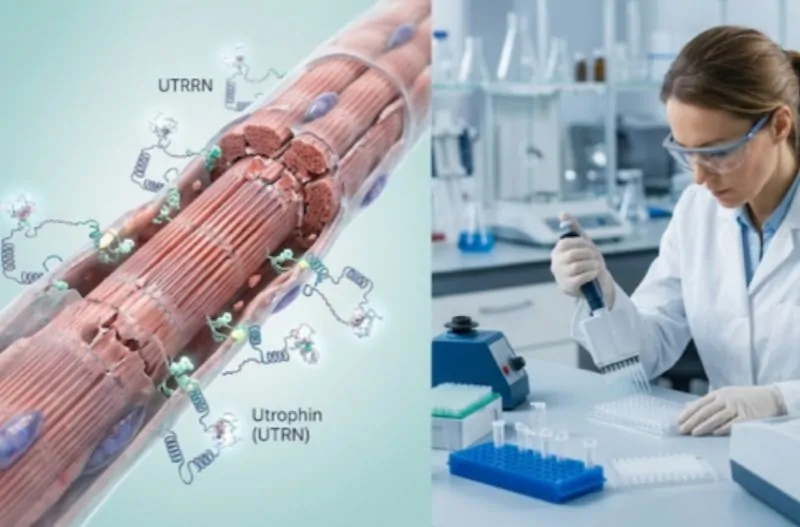
Utrophin is a protein encoded by the UTRN gene. It is considered a functional paralogue of dystrophin. This means that the two proteins have related structures and functions.
In healthy skeletal muscle, utrophin is mainly found around the neuromuscular junction, while dystrophin is more widely distributed along the muscle fiber membrane. However, utrophin expression can increase and become more widely distributed in certain muscle diseases, including DMD.
This natural increase in utrophin is important for DMD research. Scientists have proposed that increased utrophin may partially compensate for the loss of dystrophin and help stabilize muscle fibers. However, utrophin does not completely replace all functions of dystrophin.
What is ELISA?
ELISA stands for enzyme-linked immunosorbent assay. It is a plate-based technique used to detect and quantify the presence of an analyte in a biological sample. The analyte can be a protein, hormone, antibody, etc.
It relies on antigen-antibody interaction. An enzyme-linked antibody is added to the sample to produce a measurable signal. The signal is usually a color change. It is directly proportional to the amount of analyte present in the sample.
This technique is known for:
- High sensitivity
- High specificity
- Compatibility and versatility
- Fast and reproducible results
- Affordability
It has four formats, including:
- Direct ELISA
- Indirect ELISA
- Sandwich ELISA
- Competitive ELISA
Depending on the requirements, the researchers can use any format for their experiment.
Human Utrophin (UTRN) ELISA kits are designed to specifically detect and quantify the amount of utropin in the sample.
How Does a Human Utrophin (UTRN) ELISA Kit Help in DMD Research?
Measure Changes in Utrophin Expression
Researchers usually measure and compare utrophin levels between various experimental groups. They compare samples from healthy controls and DMD models to investigate differences in utrophin expression.
They can also compare untreated and treated experimental groups. If a candidate treatment is designed to increase utrophin expression, measuring UTRN levels can help researchers determine whether the treatment produces the intended molecular response.
Evaluate Utrophin-Upregulating Compounds
Researchers need to identify compounds that increase utrophin production during DMD. So, they expose muscle cells or suitable experimental models to candidate compounds and then measure UTRN levels.
They use an ELISA-based approach to screen compounds that increase utrophin A expression in muscle cells and dystrophic mice. Such approaches can help researchers identify candidates for further investigation. This makes quantitative protein measurement further help in the drug-development process.
Support Therapeutic Research
Utrophin-based therapies aim to compensate, at least partly, for the loss of dystrophin. So, researchers need reliable ways to determine whether an experimental intervention actually changes utrophin levels.
At times, human UTRN ELISA kits provide quantitative measurements that can be compared across treatment groups, time points, or experimental conditions.
However, UTRN concentration should not be considered a standalone measure of therapeutic success. Researchers may also need to examine muscle structure, localization of utrophin, muscle function, regeneration, and other disease-related biomarkers. So, they need to measure and study multiple biomarkers to evaluate treatment effects.
Study Disease Mechanisms
UTRN ELISA assays can also help researchers investigate the biological mechanisms involved in DMD.
For example, researchers can study whether changes in dystrophin-related pathways are associated with altered utrophin expression. They can compare UTRN levels across different cell models, genetic backgrounds, or experimental conditions.
This can help researchers understand how muscle cells respond to dystrophin deficiency and why some cells show greater utrophin upregulation than others.
The Bottom Line
Human Utrophin (UTRN) ELISA kits can support Duchenne muscular dystrophy research by enabling quantitative analysis of utrophin protein. Researchers can use these assays to study natural utrophin responses, evaluate utrophin-upregulating compounds, compare experimental models, and investigate potential therapeutic strategies.
So, it can turn out to be an effective tool for DMD research. However, before you go ahead, make sure you buy ELISA kits from a reliable source. Otherwise, you may have to compromise on your results.
About the Author