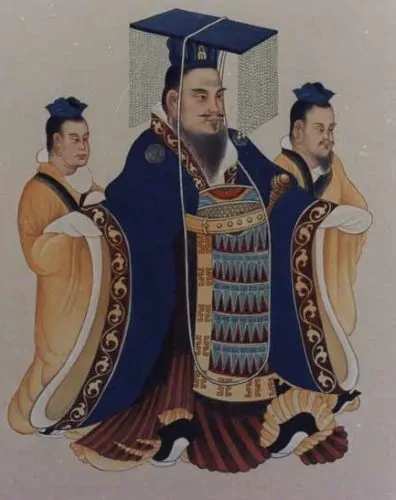
In 91 BCE, Emperor Wu’s hunt for hidden witchcraft turned searches, coercive interrogations, and palace suspicion into rebellion, civil violence, and dynastic ruin.

By Matthew A. McIntosh
Public Historian
Brewminate
Introduction: Searching for an Enemy No One Could See
At the height of his authority, Emperor Wu of Han confronted a danger that armies, palace walls, gate guards, and armed attendants could not reliably intercept. In 91 BCE, while ill at Ganquan Palace, the aging emperor suspected that people close to him were using wugu (harmful ritual practices involving curses, figurines, buried objects, and other concealed acts) to injure him. Such a threat was politically explosive precisely because it could not be observed at the moment of attack. Its presumed material traces might lie beneath a floor or courtyard, while its alleged practitioners could continue to appear obedient and loyal. Protecting the sovereign seemed to require the state to penetrate the very residences and palatial spaces that ordinary security was meant to defend, searching for physical evidence of intentions no witness could directly see.
The catastrophe that followed is commonly told as the story of Jiang Chong, an unscrupulous official who exploited Emperor Wu’s fears in order to destroy Crown Prince Liu Ju. Jiang was unquestionably central to the final phase of the crisis, but the investigation did not begin when he entered the crown prince’s residence. In 92 BCE, imperial cavalry conducted an eleven-day search associated with Shanglin Park and the environs of Chang’an, while the capital’s gates were closed and movement through the city was restricted. Accusations arising from the cases of the knight-errant Zhu Anshi, Chancellor Gongsun He, and Gongsun He’s son had already carried suspicions of witchcraft into the highest ranks of government and the imperial family. By the time Jiang received authority to dig for incriminating objects within the palace compound, the court had already accepted that an extensive hidden threat might justify extraordinary searches, coercive interrogation, and collective punishment. Investigators reportedly questioned and killed enormous numbers of people before the search advanced through the inner palace, from less-favored women to Empress Wei and finally to Liu Ju. When paulownia-wood figurines and other allegedly incriminating materials were discovered in the crown prince’s residence, Liu Ju feared that he would be unable to establish his innocence. Unable to obtain direct and reliable access to his father at Ganquan, he arrested and executed Jiang under the color of imperial authority, mobilized armed supporters, and was soon treated by Emperor Wu as a rebel. Five days of fighting in Chang’an ended with Liu Ju’s defeat, Empress Wei’s suicide, the prince’s flight and eventual death, and the destruction of the succession that the investigation had ostensibly been protecting.
To describe this sequence as a surveillance panic is not to claim that the Western Han possessed a modern surveillance state or a permanent secret police apparatus. Surveillance here denotes a broader political process through which imperial agents monitored movement and association, closed gates, searched extensive territories, entered residences, excavated floors and courtyards, interrogated suspects, collected denunciations, and controlled the information through which the ruler perceived danger. The central mechanism was recursive. Suspicion authorized more intrusive investigation; investigation produced objects, confessions, and names; those discoveries appeared to confirm the original suspicion; and confirmation justified another expansion of official power. Because harmful magic was believed to operate secretly, an unsuccessful search did not necessarily disprove the threat, while a denial could be interpreted as concealment rather than exoneration. Investigators consequently possessed unusual discretion not only to locate evidence but also to decide which objects, statements, relationships, and behaviors should count as evidence. The calamity emerged when an emperor seeking certainty about an invisible danger became increasingly dependent upon officials whose institutional authority grew with every new indication that the danger was real.
That interpretation requires particular caution because the surviving narratives are themselves political constructions. The fullest account appears in Ban Gu’s Hanshu, whose biographies and annals were assembled after the catastrophe and shaped by moral judgments about loyal heirs, treacherous ministers, imperial excess, and the consequences of misgovernment; Sima Guang’s much later Zizhi tongjian then arranged these materials into a compelling chronological drama. These sources depict Jiang Chong as a calculating villain who understood Emperor Wu’s fears, manipulated the investigation, and deliberately moved against a future emperor whom he had reason to fear. That reconstruction remains possible, but its motives and conspiratorial details cannot always be independently verified. Older interpretations often made political intrigue the true cause of the disaster and treated witchcraft as a convenient pretext, whereas Hanmo Zhang’s recent reappraisal argues that Emperor Wu’s genuine belief in the efficacy of harmful magic was not merely background but a force that initiated and shaped the campaign. The strongest interpretation need not choose between sincere belief and political manipulation: Jiang and others could exploit imperial fear precisely because that fear was genuine, while Emperor Wu’s willingness to authorize coercive searches created opportunities for personal ambition, false accusation, and retrospective fabrication. The Witchcraft Calamity was more than an eruption of superstition and more than the private conspiracy of one malicious investigator. It was a systemic failure in which concentrated imperial power, culturally credible fears, invasive searches, coercive information gathering, and restricted access to the sovereign combined until the government could no longer distinguish intelligence about conspiracy from accusations produced by the machinery searching for it, and in attempting to defend the dynasty against an unseen enemy, helped turn the emperor’s own heir into an enemy who could finally be seen.
Reconstructing a Calamity from Partisan Sources
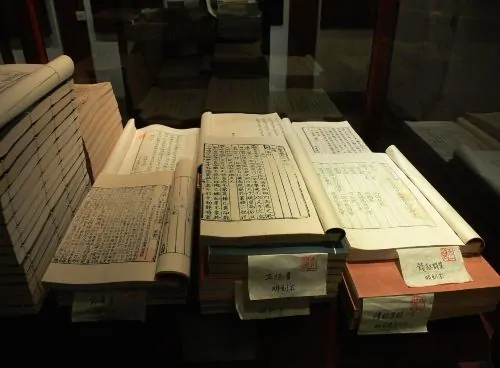
Any reconstruction of the Witchcraft Calamity begins with an uncomfortable fact: the most detailed surviving accounts were written after the event and arranged by authors who were not merely preserving information but explaining what the disaster meant. The indispensable source is Ban Gu’s Hanshu, compiled during the Eastern Han more than a century after the violence of 91 BCE from earlier histories, court records, memorials, archival materials, and inherited narratives. Its chronological and biographical materials preserve details unavailable anywhere else, yet their survival inside a later dynastic history means that selection and interpretation cannot be separated cleanly from transmission. Sima Qian’s Shiji stands much closer in time to Emperor Wu, but the calamity occurred during the complicated final period of that work’s formation, and the transmission and supplementation of portions concerning the late reign make it impossible simply to treat the Shiji as an independent eyewitness account of the entire crisis. The historian confronts not a single continuous dossier of investigations, interrogations, orders, and battlefield reports, but fragments preserved by texts with different dates, purposes, and relationships to the political world they describe.
The Hanshu is powerful because Ban Gu could draw upon materials much nearer to the events than his own lifetime, including administrative documents and earlier historical writings that have otherwise disappeared. That does not make its narrative a transparent window into 91 BCE. Ban Gu was an active historian who copied, abbreviated, rearranged, juxtaposed, and judged his materials, sometimes criticizing rulers and officials explicitly and elsewhere allowing the structure of a biography to supply the judgment. The Witchcraft Calamity is consequently distributed among accounts of different actors rather than preserved as the record of a single investigation, forcing modern historians to reconnect events that Ban Gu presented according to biographical and dynastic purposes. This matters particularly for Jiang Chong. Within the retrospective architecture of the disaster, his earlier conduct, his conflict with members of the crown prince’s establishment, his role in the witchcraft searches, and his eventual death can be arranged into a morally satisfying trajectory in which previous behavior reveals the character of the man who later precipitated catastrophe. Liu Ju, conversely, becomes intelligible as the wronged heir driven to desperate resistance, while Emperor Wu becomes the sovereign whose failure to recognize malicious counsel produces both familial and political ruin. None of those judgments must be false, but their narrative coherence is itself something to analyze rather than evidence that events unfolded with the same clarity for the people experiencing them.
The political history through which these memories passed adds another layer of difficulty. Liu Ju did not remain simply a defeated rebel in Han memory: the story of his destruction was subsequently reframed as a grievous miscarriage of imperial judgment, and his surviving grandson eventually became Emperor Xuan. Traditions of Wu’s regret, the punishment of individuals associated with the calamity, and the rehabilitation of the dead prince consequently belonged to a political world in which assigning innocence and responsibility had implications extending well beyond private family grief. The surviving record may preserve genuine evidence that Emperor Wu came to believe his son had been falsely endangered, but later knowledge of the outcome inevitably encouraged historians to read earlier events backward from the catastrophe. Once Liu Ju was remembered as unjustly destroyed, actions that had appeared ambiguous during the crisis could be reorganized as signs of innocence, while Jiang Chong’s behavior could be interpreted as stages in a deliberate plot whose final purpose was visible only retrospectively.
The source problem becomes still sharper with Sima Guang’s eleventh-century Zizhi tongjian, whose extraordinarily influential chronological narrative often supplies the connective tissue through which modern readers encounter the calamity. Sima Guang possessed historical materials unavailable today and remains invaluable, but he wrote nearly twelve centuries after Emperor Wu and constructed his history as a work of political instruction as well as chronological scholarship. Xin Deyong has challenged influential modern reconstructions that rely heavily upon the Zizhi tongjian, arguing that Sima Guang incorporated substantially later traditions when shaping the final years of Emperor Wu and that those additions cannot automatically be projected backward as reliable Han testimony. Yet privileging the Hanshu simply because it is earlier would solve the problem too neatly.
Hanmo Zhang has rightly emphasized that the earlier sources are themselves selective, scattered, and purposefully composed, so antiquity alone does not guarantee neutrality. A statement in the Hanshu about Jiang Chong’s intentions, a report that incriminating objects were deliberately planted, or an assertion about what Emperor Wu privately believed may preserve excellent information, but each still requires a different evidentiary judgment from a record of an appointment, execution, military mobilization, or change of office. Later sources can sometimes preserve lost traditions of value, while earlier sources can transmit interpretation as though it were fact. The hierarchy of sources must remain important without becoming mechanical.
For that reason, the calamity is best reconstructed through graded certainty rather than by pretending that every dramatic detail occupies the same evidentiary level. Some elements are exceptionally difficult to doubt: a major witchcraft campaign occurred; the state conducted extensive searches and prosecutions; Jiang Chong exercised delegated authority within that campaign; investigators ultimately entered Liu Ju’s household; the crown prince killed Jiang and mobilized armed resistance; fighting occurred in Chang’an; Liu Ju fled and died; and Emperor Wu subsequently punished individuals associated with the affair and reconsidered aspects of what had happened. Other claims require more restraint, including the exact scale of casualties, the degree to which specific evidence was planted, the precise motives of Jiang Chong, the extent to which communications with the emperor were intentionally obstructed, and whether particular participants understood themselves from the beginning as members of a political conspiracy. This distinction does not reduce the episode to an unknowable fog. On the contrary, it allows the most defensible pattern to emerge more clearly: an imperial investigation expanded through accusation, search, interrogation, and delegated authority until its own information became inseparable from the political incentives and fears of those producing it. The partisan nature of the sources complicates the details of villainy and innocence, but it does not erase the larger institutional catastrophe they collectively preserve.
The Political Reality of Invisible Harm
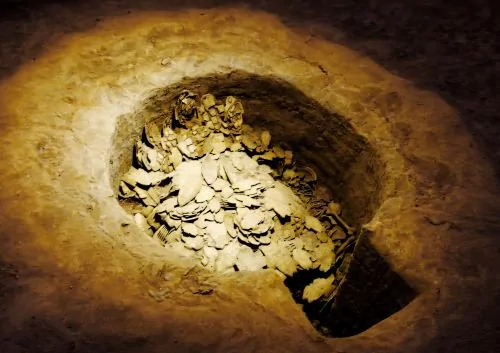
To understand why the court of Emperor Wu could unleash an enormous investigation in pursuit of buried figurines, curses, and ritual attacks, it is necessary to resist treating witchcraft as an obviously fictitious danger dressed in the language of an irrational age. Han political life existed within a religious and cosmological world in which spirits, omens, divination, ritual efficacy, curses, and supernatural intervention could be taken seriously by educated officials as well as by people outside the court. The category conventionally translated as wugu encompassed practices believed capable of producing injury through ritual means, but it should not be imagined as a precisely defined equivalent of the European concept of witchcraft. Harm might be attributed to curses, ritual specialists, figurines or effigies, buried materials, sacrifices, and manipulation of unseen powers, with the precise practices varying according to context and source. What united them politically was the possibility that one person might injure another without approaching the victim openly or employing an ordinary weapon. For a ruler whose body was inseparable from the stability of the dynasty, belief in such mechanisms transformed apparently private ritual behavior into a potential problem of imperial security.
Emperor Wu was particularly unlikely to dismiss claims that supernatural forces could materially affect human affairs, because his reign had been saturated with efforts to communicate with, influence, and obtain benefits from those forces. He patronized ritual specialists and fangshi, sought contact with divine beings, sponsored major imperial sacrifices, pursued techniques associated with longevity and immortality, and repeatedly reorganized state cults in attempts to secure cosmic as well as terrestrial legitimacy. Sima Qian devoted extraordinary attention to these activities, sometimes with evident skepticism toward practitioners who promised the emperor access to spirits or immortality, but the persistence of Wu’s patronage demonstrates that such claims remained politically consequential even when particular specialists were exposed as frauds. The emperor’s religious policy contained no inherent contradiction between employing supernatural techniques beneficial to himself and punishing supernatural practices believed to be harmful. Han authorities did not have to choose between accepting all magic and rejecting all magic; they could distinguish authorized sacrifice, divination, healing, communication with spirits, or quests for transcendence from clandestine rites directed against another person. Wu himself could execute a fraudulent practitioner without abandoning the broader assumption that unseen powers existed, just as discovering a dishonest physician would not require concluding that medicine itself was imaginary. The later witchcraft prosecutions consequently emerged from an established imperial habit of taking ritual efficacy seriously, not from a sudden eruption of supernatural fear in an otherwise secular political order. Hanmo Zhang’s reassessment is particularly important on this point: the attempt to explain the calamity almost entirely as political intrigue risks reducing witchcraft to scenery when belief in its actual efficacy helps explain why accusations carried such extraordinary force.
A precedent from much earlier in Wu’s reign demonstrates how dangerous that force could become inside the palace. In 130 BCE, Empress Chen was accused of involvement with the woman Chu Fu and of employing prohibited ritual practices against her rival Wei Zifu, who had gained the emperor’s favor. The Hanshu reports that Wu ordered an exhaustive investigation, that more than three hundred people were implicated and executed, and that Empress Chen was formally deposed. Whatever uncertainties surround the precise acts attributed to her, the episode establishes that alleged magical aggression within the imperial household could already trigger investigation, mass punishment, and a fundamental alteration of the succession environment decades before Liu Ju’s destruction. The events of 91 BCE had a precedent within Wu’s own experience: a member of his immediate family had previously been judged capable of using invisible ritual means against another person inside the palace.
The political logic of such accusations becomes clearer once harmful magic is treated as a security threat rather than simply a religious offense. An ordinary attack generated evidence familiar to government: a weapon, a wound, an intruder, witnesses, suspicious movement, or preparations for violence. A magical attack could supposedly occur while the victim remained physically inaccessible, and its mechanism might be hidden under the ground, concealed inside a residence, performed through an intermediary, or completed long before its effects became apparent. That made absence of visible aggression weak evidence of innocence. Indeed, the very secrecy expected of such practices encouraged investigators to interpret concealment as characteristic of the offense rather than as evidence that no offense had occurred. The accusations against Gongsun Jingsheng and Princess Yangshi illustrate the danger. Zhu Anshi reportedly alleged not merely improper relations and other misconduct but the employment of ritual specialists to curse Emperor Wu and the burial of figurines beneath an imperial route leading toward Ganquan Palace. If believed, such an accusation collapsed the distinction between religious behavior and assassination: an apparently inert object buried in the earth became an instrument directed against the sovereign’s body. The alleged attacker needed neither access to the emperor’s chamber nor command of armed followers; hostile intention could supposedly be embodied in an object placed where the emperor would pass. Consequently, the state could not protect Wu merely by guarding doors and inspecting visitors. It had to search places, examine objects, question relationships, identify specialists, reconstruct ritual behavior, and infer intention from material traces whose meaning depended upon the assumptions of investigators. The invisible nature of the supposed harm furnished a powerful rationale for investigative penetration into spaces that conventional palace security could leave untouched.
Recognizing that logic does not require accepting the historical reality of magical injury, nor does it require portraying Emperor Wu and his officials as incapable of skepticism. What mattered was that enough participants considered harmful ritual action possible for an accusation of witchcraft to function as actionable political intelligence. That distinction helps explain why the later calamity became so difficult to contain: the state was not knowingly hunting an imaginary crime, but attempting to detect an offense whose alleged mechanism made definitive disproof extraordinarily difficult. The same emperor who had repeatedly sought supernatural assistance for longevity, divine favor, and imperial legitimacy could regard hostile ritual activity as an authentic attack upon his person, while officials operating beneath him had every incentive to present ambiguous discoveries as evidence of danger. Once the ruler’s health and security were linked to concealed ritual acts, a curse could be treated as conspiracy, a figurine as a weapon, and a buried object as proof of treasonous intention. The political reality of witchcraft lay not in whether magic actually worked, but in the fact that belief in its possible efficacy could mobilize the coercive machinery of the Han state against enemies who were, by definition, extremely difficult to see.
An Aging Emperor and the Politics of Vulnerability
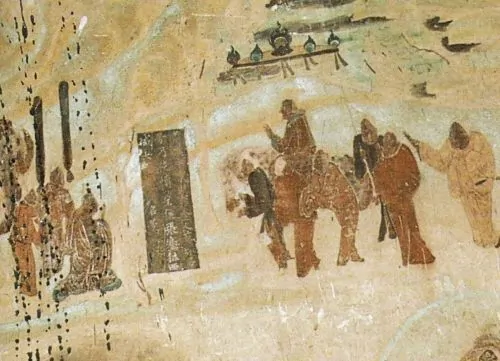
By 91 BCE, Emperor Wu had occupied the Han throne for roughly half a century, an extraordinary span of personal rule that had made his body, judgment, and continued survival central facts of imperial politics. He had come to the throne in 141 BCE as a young ruler and had since presided over military expansion, administrative centralization, major fiscal experimentation, court purges, religious innovation, and repeated struggles over the conduct of officials and imperial relatives. Age alone did not make him politically weak, and the surviving sources give no reason to imagine that he had ceased directing government. Yet the position of a ruler in his mid-sixties was fundamentally different from that of the energetic emperor who had launched the great campaigns of the earlier reign. Every illness could raise questions not only about his immediate health but about succession, access to authority, and the loyalties of those expecting power to change hands. In that environment, danger to Wu’s body was inseparable from danger to the political order, because the emperor’s death would instantly reorder the fortunes of every family, official, consort, and faction tied to the court.
The long reign had also accumulated enemies, grievances, exhausted alliances, and memories of punishment. Emperor Wu had repeatedly employed harsh legal and administrative measures against officials whom he believed corrupt, disloyal, ineffective, or threatening, while his military campaigns and fiscal policies had placed enormous demands upon the empire. High office offered extraordinary prestige but little permanent security: chancellors, generals, imperial relatives, and other powerful figures could rise rapidly and fall catastrophically, sometimes with their households and associates implicated alongside them. The government of the late Western Han was not simply a court divided into stable modern-style factions, yet personal connections and kinship networks inevitably mattered in an environment where proximity to the emperor determined access to patronage and survival. The deaths of the great generals Wei Qing in 106 BCE and Huo Qubing much earlier in 117 BCE had also changed the constellation surrounding Empress Wei and her son Liu Ju. Wei Qing in particular had provided the empress’s family with exceptional military prestige and political weight, and his disappearance removed a formidable figure whose position had once reinforced that of the crown prince. Meanwhile, younger consorts, newer favorites, different officials, and alternative imperial sons existed within a court that knew Wu could not reign indefinitely. Such circumstances did not require an organized conspiracy against Liu Ju to generate uncertainty around the succession. They required only the ordinary calculations of courtiers who understood that the emperor’s death would produce winners and losers. The longer Wu survived, the longer those calculations continued, and the more politically charged signs of his mortality became.
Illness intensified that vulnerability because it invited competing explanations for something taking place inside the emperor’s own body. The Hanshu explicitly places Wu’s sickness at Ganquan within the immediate setting of the later witchcraft investigation, and its narrative portrays him as increasingly concerned that harmful ritual practices might be responsible. Modern historians should be cautious about converting such accounts into retrospective psychiatric diagnosis. Terms such as paranoia may describe the political dynamics of the crisis, but they become misleading if used to imply that historians can clinically diagnose an emperor who died more than two millennia ago from literary narratives composed for purposes very different from modern medicine. Wu’s suspicion did not emerge within a cultural vacuum: as earlier episodes of his reign demonstrate, he regarded supernatural causation, ritual efficacy, omens, spirits, and hidden magical harm as potentially real features of the world. When an aging emperor became ill and ordinary observation did not disclose an attacker, the hypothesis that concealed ritual aggression was involved could appear not as an absurd alternative to political reasoning but as one possible explanation within it. Precisely because illness had no visible human assailant, it opened a space in which investigators and ritual specialists could offer information that conventional guards, physicians, and administrators could not independently verify.
The succession magnified the consequences of that uncertainty. Liu Ju had been designated crown prince for decades and was no youthful placeholder awaiting adulthood; by 91 BCE he was a mature political figure with a household, advisers, family connections, and an established expectation of inheriting the throne. The Hanshu presents important differences of disposition between father and son, portraying Liu Ju as comparatively lenient while Wu had long favored more severe methods of government, but later historians have disagreed over how far such contrasts translated into an actual political rupture. It is tempting to imagine the late court divided cleanly between a “crown prince faction” and enemies determined to prevent his succession, yet the evidence is too fragmentary to sustain so tidy a map of political allegiance. What can be said more securely is that the impending succession gave officials powerful reasons to think about their own futures. Jiang Chong had previously offended members of Liu Ju’s entourage by enforcing regulations against their misuse of an imperial road, and the Hanshu later explains his actions during the witchcraft crisis through his fear that the crown prince would retaliate after becoming emperor. That motive is plausible, but it is also precisely the sort of retrospective explanation dynastic history could employ to make catastrophe morally intelligible. Jiang did not need to have conceived a long-standing plan to destroy Liu Ju for succession politics to influence his choices; an investigator who believed his position endangered under the next emperor had an obvious incentive to interpret evidence against that future emperor aggressively. Other courtiers faced comparable, if less dramatic, calculations about which relationships would protect or endanger them once Wu died. The crown prince’s security depended upon more than his formal title. It depended upon a living emperor continuing to recognize him as a loyal son while officials around both men interpreted increasingly ambiguous information about each other’s intentions.
This is where physical proximity acquired a dangerous political meaning. Palace security normally operated on the assumption that those admitted closest to the sovereign had been filtered through layers of status, office, kinship, and controlled access. Witchcraft reversed that logic because intimacy could itself become evidence of opportunity. Consorts, attendants, servants, relatives, ritual specialists, and officials with access to palace spaces were precisely the people imagined to possess the knowledge or opportunity required to conceal objects, perform rituals, or enlist intermediaries capable of harming the ruler. The safer and more exclusive the imperial environment appeared from the perspective of ordinary violence, the more threatening its inhabitants could appear once the hypothesized danger was invisible. Under that logic, searches moving inward toward the palace did not necessarily indicate that investigators had failed; they could be interpreted as evidence that the true enemy had been concealed closer to the emperor all along.
The political vulnerability of Emperor Wu in 91 BCE should be understood as a structural condition rather than a story of an elderly despot simply losing his reason. He remained an exceptionally powerful sovereign, but concentrated authority did not protect him from dependence upon information produced by other people. Illness heightened his need to know whether hidden enemies existed, succession politics increased the stakes surrounding every report, and physical separation from Chang’an during crucial moments of the crisis made access to trustworthy communication even more important. The very extent of Wu’s authority created a dangerous asymmetry: once he accepted the possibility that witchcraft was causing his illness, officials acting under imperial mandate could acquire extraordinary powers to search for its source, while few institutions existed that could independently adjudicate the information they returned. A ruler who demanded certainty about an invisible threat had to rely upon intermediaries whose careers, fears, rivalries, and assumptions shaped what he was told. Nothing in this explanation requires assuming that Wu was senile, delusional, or manipulated at every turn, nor does it absolve him of responsibility for the powers he authorized. The more consequential conclusion is that an aging emperor remained politically formidable while becoming informationally vulnerable. The calamity of 91 BCE emerged from precisely that combination: immense sovereign power joined to an increasingly urgent need to distinguish loyal intimates from hidden enemies at a moment when the mechanisms chosen to make that distinction were themselves becoming sources of danger.
Before Jiang Chong: The Crisis Was Already Expanding

The destruction traditionally associated with Jiang Chong began before he became the principal investigator of witchcraft at court. In late 92 and early 91 BCE, accusations of harmful magic were already passing through some of the highest levels of the Western Han political establishment, demonstrating that Emperor Wu had accepted both the possibility of concealed ritual attacks and the legitimacy of extraordinary measures to uncover them. The crucial early case involved Chancellor Gongsun He, his son Gongsun Jingsheng, and the notorious figure Zhu Anshi. Gongsun He was not a marginal official vulnerable to casual denunciation: he had served Wu for decades, had been associated with the emperor since before Wu’s accession, and was connected by marriage to Empress Wei’s powerful family. His eventual destruction showed that rank, long service, and imperial kinship offered little protection once an accusation acquired the character of a threat against the emperor himself. By the time Jiang Chong later directed searches inside the palace, the political threshold permitting investigations to reach the highest families had already been crossed.
The immediate sequence began with misconduct that had nothing inherently supernatural about it. Gongsun Jingsheng, who held the important office of Chamberlain for the Imperial Stud and was related to Empress Wei through his mother, was accused of unlawfully appropriating nineteen million coins belonging to the Northern Army and was imprisoned. At roughly the same time, Emperor Wu was attempting to capture Zhu Anshi of Yangling, a prominent youxia, or wandering strongman, whose ability to evade arrest had made him a conspicuous problem for the authorities. Hoping to redeem his son, Gongsun He volunteered to capture Zhu, and the emperor accepted the proposal. Gongsun He succeeded, but the arrest produced consequences opposite to those he intended. According to the Hanshu, Zhu Anshi responded from prison by accusing Gongsun Jingsheng of an illicit relationship with Princess Yangshi and, more explosively, of employing ritual practitioners to curse Emperor Wu. Zhu further alleged that figurines had been buried along the imperial road used by the emperor on journeys to Ganquan and that hostile incantations had been directed against him. The accusation transformed a case of financial malfeasance and criminal pursuit into one involving the emperor’s physical safety, his own daughter, prominent imperial relatives, and an alleged magical attack embedded within the landscape through which he traveled. Officials were ordered to investigate, and the resulting inquiry did not stop with determining whether Jingsheng had misused military funds. Gongsun He and his son died in prison, their family was destroyed, and the logic of the investigation began spreading outward through the networks attached to them.
The widening circle soon reached the imperial house itself. Princess Yangshi and Princess Zhuyi, both daughters of Emperor Wu, were condemned in connection with witchcraft accusations, while Wei Kang, son of the celebrated general Wei Qing and a nephew of Empress Wei, was also executed. These deaths are difficult to reconcile with an interpretation in which Jiang Chong single-handedly manufactured the entire witchcraft crisis for the purpose of eliminating Crown Prince Liu Ju. The prosecutions had already penetrated the empress’s extended family and killed imperial daughters before Jiang received the authority that would later make his name inseparable from the calamity. Hanmo Zhang consequently treats the Gongsun affair not as incidental background but as a genuine first phase of the wider witch-hunting campaign. Whether Zhu Anshi revealed actual ritual practices, embellished rumors circulating through elite social networks, or invented accusations in retaliation for his imprisonment cannot now be established. What can be established is that Emperor Wu and his government considered the charges serious enough to authorize investigations whose consequences reached deeply into the dynasty.
Another episode from late 92 BCE reveals the scale of coercive spatial control already available to the imperial government, although it must be handled carefully because it is sometimes too readily folded into the witchcraft narrative. The Hanshu annals record the mobilization of cavalry from the metropolitan region for a massive search of Shanglin, accompanied by the closing of Chang’an’s gates and an eleven-day search before the restrictions were lifted. The immediate context appears to have involved pursuit of a suspicious armed intruder rather than a straightforward hunt for magical objects, so it should not simply be described as one of Jiang Chong’s witchcraft searches. Its importance is institutional rather than evidentiary. When Emperor Wu believed that a concealed danger existed near the capital, the state could rapidly mobilize mounted personnel, restrict movement through the city, seal gates, and search an enormous imperial landscape. The episode occurred in the same period in which the annals announce the outbreak of the witchcraft troubles, and together the events reveal a government already accustomed to responding to uncertain threats by expanding the geographical scope of official scrutiny. Surveillance did not require continuous observation of everyone in Chang’an; it could take the form of temporarily converting whole spaces into controlled search zones in which movement, access, and presence became matters of state concern. The same governing reflex would soon be applied to an even less visible danger. Once buried ritual objects rather than an armed intruder became the presumed target, there was no obvious natural boundary at which searching had to stop.
Jiang Chong entered a crisis whose essential mechanisms were already functioning. Accusation had demonstrated its ability to redirect an investigation from one offense to another; interrogation could widen responsibility beyond the initial suspect; allegations of witchcraft could overcome enormous differences of status; and the emperor had shown himself willing to permit investigations to reach ministers, military resources, imperial daughters, and the Wei family itself. This chronology does not exonerate Jiang from whatever manipulation he later practiced, but it removes from him a power he did not possess: he did not persuade an otherwise skeptical government to invent the problem of witchcraft in order to attack Liu Ju. He inherited an investigative environment in which invisible threats had already justified extraordinary coercion and in which each discovery created reasons to look elsewhere for additional offenders. That distinction changes the meaning of the calamity. If Jiang alone created the crisis, the disaster can be explained chiefly as the success of one malicious courtier; if the system was already expanding before his ascendancy, Jiang becomes something more unsettling, a highly empowered participant in a process whose political logic had already been established by the sovereign and the state. The road to Liu Ju’s palace began not with an investigator suddenly deciding to frame the heir apparent, but with earlier searches and prosecutions that progressively normalized the idea that concealed enemies might exist anywhere, including inside the emperor’s own family.
Jiang Chong: Imperial Agent and Retrospective Villain
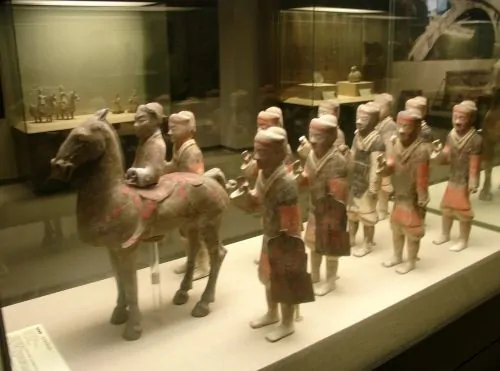
Few figures in the Witchcraft Calamity have carried a heavier burden of retrospective blame than Jiang Chong. In the Hanshu, his career appears almost designed to culminate in catastrophe: an outsider of comparatively humble origins advances through denunciation and uncompromising enforcement, wins Emperor Wu’s confidence, antagonizes Crown Prince Liu Ju, exploits the emperor’s fear of witchcraft, and finally directs an investigation into the heir’s own residence. Liu Ju then kills him while denouncing him as a man who had already brought ruin upon one royal father and son before attempting to divide another. Later tradition strengthened the portrait by making Jiang not merely an aggressive investigator but the conscious architect of a frame-up. The sequence is compelling, yet precisely because it is so compelling it demands caution. Jiang unquestionably exercised extraordinary and destructive authority in 91 BCE, but explaining the calamity by his wicked character alone risks allowing retrospective biography to substitute for political analysis.
Jiang’s earlier career already reveals why later historians found the language of personal vengeance so persuasive. Originally named Jiang Qi and associated with Handan in the kingdom of Zhao, he had been connected to the household of King Liu Pengzu, Emperor Wu’s half-brother, while Jiang’s sister became associated by marriage with Liu Dan, Liu Pengzu’s heir. Relations between Jiang and Liu Dan deteriorated severely after the prince reportedly suspected Jiang of revealing his private conduct to the king. Jiang fled while members of his own family were arrested and executed, after which he escaped westward, changed his name, and carried accusations against Liu Dan directly to the imperial court. Those accusations included sexual misconduct within the Zhao royal household and connections with powerful lawbreakers whom local officials supposedly could not control. Emperor Wu acted against Liu Dan despite Liu Pengzu’s insistence that Jiang was merely using the emperor to avenge a private grievance. Whether every charge was true cannot now be independently established, but the episode introduced a pattern that later readers could hardly miss: Jiang had survived conflict with a future ruler by reaching over him to a more powerful sovereign and converting private danger into an imperial prosecution. His success also demonstrated something important about Emperor Wu. The emperor had learned early that Jiang was willing to expose privileged men whom others might hesitate to accuse.
Wu subsequently gave Jiang opportunities to prove that quality on a much larger stage. The Hanshu describes an impressive personal encounter in which the emperor questioned him about affairs of state and responded favorably to his answers, after which Jiang served on a mission to the Xiongnu and later received authority as a special investigative official in the metropolitan region. In that capacity he became known for pursuing misconduct by imperial relatives, aristocrats, and other powerful persons who expected their status to protect them. He enforced restrictions on luxury and privilege, confiscated vehicles and horses, and subjected elite offenders to regulations that lesser officials might have hesitated to apply. Those actions made enemies, but they also suited an emperor who repeatedly employed personally trusted agents to cut through ordinary hierarchies and discipline powerful interests. Jiang’s effectiveness cannot be reduced to sycophancy. His advancement rested at least partly upon a demonstrated willingness to enforce the emperor’s will against people whose social position made enforcement politically difficult. Even his later witchcraft authority followed a recognizable pattern: Wu repeatedly valued officials who appeared loyal to the throne precisely because they did not defer to rank.
The encounter that later became the presumed motive for Jiang’s attack on Liu Ju emerged from the same enforcement mentality. Members of the crown prince’s establishment improperly used a roadway reserved for imperial traffic, and Jiang seized their vehicles and reported the offense rather than allowing Liu Ju’s household to resolve it quietly. Liu Ju reportedly sent a request asking Jiang not to expose the matter to Emperor Wu, explaining that he feared his father would judge him incapable of controlling his retainers; Jiang nevertheless made the report, and Wu praised him for behaving as a proper minister. The incident gave Liu Ju an understandable reason to dislike Jiang and Jiang an equally understandable reason to wonder what would happen when the prince eventually inherited supreme authority. The Hanshu explicitly interprets Jiang’s later actions through that fear, claiming that he expected Liu Ju to execute him after Wu’s death. Yet this is where description slips easily into retrospective mind-reading: the earlier confrontation establishes hostility and potential danger, but it does not prove that Jiang had already decided to destroy the heir or that every subsequent investigative act arose from a private vendetta.
When Emperor Wu’s illness and the spreading witchcraft prosecutions created demand for a new investigation, Jiang arrived not as an adventurer suddenly inventing an imaginary threat but as exactly the kind of imperial agent Wu had previously rewarded. The emperor believed harmful magic might be responsible for his condition and ordered the matter investigated thoroughly. Jiang agreed that witchcraft lay behind the illness and received delegated authority to pursue those thought responsible. According to the Hanshu, his investigators worked with ritual specialists, dug for buried figurines, identified sites associated with nocturnal sacrifice or spiritual pollution, arrested suspects, and employed brutal coercion to obtain confessions. Those accused then implicated others, while officials treated witchcraft against the sovereign as an offense of the gravest political character. The resulting prosecutions allegedly involved tens of thousands before Jiang received permission to search Liu Ju’s residence, a chronological point that substantially alters the traditional story. Jiang did not begin with the crown prince and manufacture a nationwide witch hunt around him. He first presided over an enormous campaign that Emperor Wu had authorized because the emperor himself wanted hidden practitioners found. The destruction of Liu Ju emerged at the end of that expansion, not at its beginning. That correction does not make Jiang a passive bureaucrat carrying out mechanically defined instructions. The discretion inherent in the assignment gave him enormous power to determine where the search should move next, and the Hanshu specifically portrays him as adept at discerning Emperor Wu’s suspicions. Jiang reported that traces of witchcraft existed within the palace itself and progressively directed inquiry through increasingly sensitive spaces, from women who had lost imperial favor toward the household of Empress Wei and finally Liu Ju. By that stage, investigators were not simply executing a warrant against a known suspect; they were searching for an invisible offense whose supposed material traces acquired meaning through the interpretations of the searchers themselves. Later tradition claimed that Jiang’s associates actually planted the paulownia figurines discovered in the crown prince’s quarters, but Hanmo Zhang has emphasized that the explicit planting story rests upon later material rather than contemporary Han testimony and cannot simply be treated as established fact. It is safer to distinguish two propositions: Jiang clearly drove the investigation into Liu Ju’s residence, while the stronger claim that he personally arranged fabricated evidence remains much less secure.
Jiang Chong is consequently most useful historically when neither acquitted nor converted into the sole explanation for the calamity. He had a documented history of denunciation, a serious prior conflict with Liu Ju’s household, considerable personal reason to worry about the succession, and extraordinary discretion once Emperor Wu entrusted him with the witchcraft investigation. Those facts make deliberate hostility toward the crown prince entirely plausible, and the progressive direction of the searches toward Liu Ju suggests that Jiang’s own agency mattered enormously. Yet the later image of a solitary villain also served an obvious historiographical function: after Liu Ju’s destruction became understood as a tragic injustice, concentrating guilt upon the dead investigator helped explain how a celebrated emperor could have allowed his own heir to be destroyed. Emperor Wu’s eventual punishment of Jiang’s family strengthened that interpretation and made Jiang’s guilt part of the dynasty’s retrospective settlement with the catastrophe. Modern scholarship gains little by replacing the old villain with an innocent civil servant, but it gains much by restoring the hierarchy of responsibility. Jiang exploited, intensified, and perhaps deliberately redirected the witchcraft campaign, but Emperor Wu created the authority under which he operated, demanded that concealed enemies be discovered, and trusted an official whose career had been built upon uncompromising investigation of powerful people. Jiang Chong was dangerous not because he stood outside the Han construct, but because he had learned unusually well how to act within the incentives of imperial government and how much power could belong to the man who convinced the emperor that he alone was willing to find what others were afraid to see.
Digging for Treason: When Search Became a Method of Government
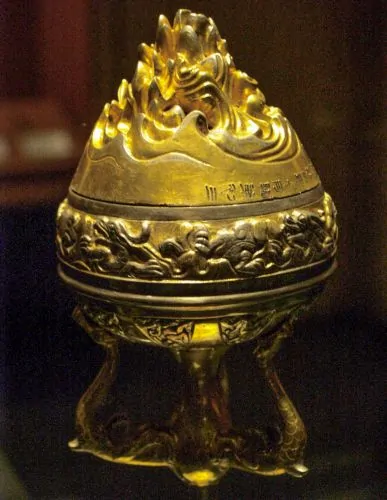
The phrase jue gu, literally the digging or excavation of witchcraft, captures something distinctive about the investigative campaign of 91 BCE. Officials were not merely questioning people already suspected of performing prohibited rites; they were physically searching for material traces of practices believed to have been deliberately concealed. Floors could be broken open, earth excavated, buildings disturbed, and buried figurines or other objects recovered and interpreted as evidence of hostile intent. The Hanshu describes Jiang Chong’s investigators entering increasingly sensitive palace spaces and digging so extensively that they damaged the emperor’s own seating area before proceeding toward the quarters associated with Empress Wei and Crown Prince Liu Ju. Investigation had become spatial as well as interpersonal. The state sought hidden disloyalty by penetrating the places in which it believed disloyalty might have been materially deposited.
That technique was powerful because the alleged offense was constructed around concealment. A wooden figurine buried beneath a residence could not normally be discovered by watching a suspect’s public behavior, and an accusation that someone had performed harmful ritual acts in secret offered investigators little obvious reason to respect the surface appearance of an orderly household. The search consequently depended upon an inversion of ordinary evidentiary reasoning: investigators already had to believe that something might be hidden before they could justify digging for it, but once something was found, the discovery appeared to vindicate the decision to search. Objects did not speak for themselves. A figurine might acquire criminal significance from its location, associated inscriptions, ritual context, testimony extracted from suspects, or the interpretation supplied by specialists accompanying the investigators. That interpretive dependence placed unusual authority in the hands of the searchers, because they controlled both the process of discovery and much of the explanation of what had been discovered. Hanmo Zhang has emphasized that digging for witchcraft became a distinctive investigative method during the later years of Emperor Wu’s reign, one aimed at identifying material evidence of hostile ritual activity within politically important households. Once such searches received imperial sanction, government agents possessed authority not merely to observe suspicious conduct but to uncover a concealed world presumed to exist beneath visible appearances. The deeper political problem was that the method contained no simple internal mechanism for determining when the assumption behind the search had been disproved.
Jiang Chong’s movement into the palace illustrates how rapidly such authority could erode conventional boundaries around protected space. According to the Hanshu, he reported that an ominous presence or signs of witchcraft existed inside the palace and was permitted to carry the investigation into its inner precincts. Emperor Wu did not entrust the mission to Jiang alone: Han Yue, the censor Zhang Gan, the palace official Su Wen, ritual practitioners, and others participated in or supported aspects of the inquiry. That matters because the searches were governmental operations carried out under delegated imperial authority, not clandestine burglaries performed by a private enemy of the crown prince. Even spaces defined by their proximity to the Son of Heaven became legitimate objects of disruption once the emperor accepted that an invisible attack might originate within them. The normal sanctity of palace space yielded to the greater imperative of locating whatever was believed to be threatening the sovereign’s body.
Search also altered the relationship between political status and vulnerability. In ordinary circumstances, entry into the residences of the imperial family was governed by rank, palace regulation, and highly restricted access, while a crown prince’s establishment possessed an institutional dignity approaching that of a subordinate court. The witchcraft mandate cut through those protections because its justification came directly from the emperor and because the supposed danger involved the emperor himself. Investigators could move through a hierarchy of increasingly privileged spaces without treating privilege as presumptive evidence of innocence. Indeed, the search’s progressive movement inward created the opposite implication: if previous excavations had not eliminated Wu’s illness, then the source of the harm might remain somewhere still closer to him. The methodology encouraged expansion. A failure to discover sufficient witchcraft in one place did not require investigators to abandon the underlying hypothesis; it could justify extending the search elsewhere. When Jiang moved from less-favored palace women toward Empress Wei and ultimately Liu Ju, the investigation was operating according to a logic in which the continued existence of the emperor’s symptoms could be treated as evidence that the true source had not yet been found. Such reasoning transformed physical proximity to the ruler from protection into exposure. Those closest to Wu were simultaneously those inhabiting the spaces investigators increasingly had reason to penetrate. The procedure thereby erased one of the palace’s essential political distinctions: the line separating trusted insiders from potential enemies became contingent upon what investigators claimed to uncover beneath their floors.
The evidentiary imbalance became most acute once investigators reached Liu Ju’s residence. The Hanshu reports that wooden figurines were excavated there, while the broader narrative associates the discovery with written material interpreted as profoundly incriminating. Yet the same source tradition preserves Shi De’s striking acknowledgment that the prince could not know whether the objects had genuinely been buried by someone within his household or had been placed there by the investigators or ritual specialists themselves. That uncertainty exposes the structural weakness of jue gu. The accused had limited ability to establish the history of an object recovered from a location controlled during the search by hostile or potentially hostile officials. A discovered figurine could create an evidentiary fact without establishing a secure chain between the object and the accused person’s intentions. Later narratives hardened suspicions of manipulation into more explicit stories of planted evidence, but the earlier material itself already demonstrates that contemporaries recognized the possibility that discovery and fabrication could become indistinguishable. Liu Ju’s crisis arose not simply because evidence existed against him, but because the investigative procedure made it extraordinarily difficult for him to contest how that evidence had come to exist.
The significance of jue gu extends beyond the dramatic image of officials tearing up palace floors in search of buried magic. Search had become a method of government because it joined imperial suspicion to delegated power, physical intrusion, specialist interpretation, interrogation, and political judgment in a single investigative process. None of this required a modern doctrine of search warrants, privacy rights, or evidentiary procedure, concepts that would be anachronistic if simply imposed upon the Han state. What matters instead is the distribution of political power created by the investigation: Emperor Wu authorized the hunt for a hidden offense, but officials on the ground determined where to dig, whom to question, which discoveries mattered, and how those discoveries should be reported upward. The state acquired more information while simultaneously increasing its dependence upon the integrity of those producing that information. Every excavation promised to make an invisible threat visible, yet every expansion of investigative discretion created additional opportunities for ambiguity, exaggeration, coercion, and manipulation. By the time the search reached the crown prince, the distinction between finding treason and constructing a persuasive case for treason had become dangerously thin. That is why the digging campaign belongs centrally in the history of surveillance: it demonstrates how a government seeking hidden danger can move beyond watching people to penetrating their spaces, reconstructing their intentions from ambiguous traces, and ultimately allowing the search itself to determine what reality the sovereign is permitted to see.
The Confession Machine
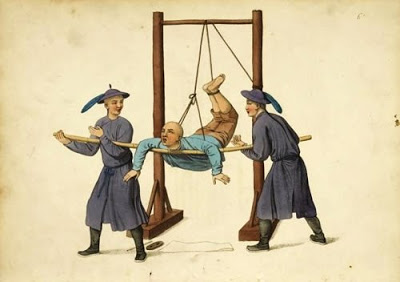
Once the witchcraft investigation moved beyond the discovery of suspicious objects, its most dangerous instrument became the production of testimony. Han officials did not merely search residences and excavate floors; they arrested people, interrogated them, demanded explanations, and sought admissions connecting ritual acts to particular individuals. In an ordinary investigation, testimony could potentially narrow the field of suspicion by identifying specific acts and participants. In the witchcraft campaign, interrogation often had the opposite effect because every confession could generate additional names. A suspect who admitted involvement, or who accused another person while attempting to survive interrogation, created a new investigative target whose questioning might produce still more suspects. Information accumulated through a process capable of expanding faster than officials could independently verify it.
Coercion made that process particularly unstable. The Hanshu portrays the investigation under Jiang Chong as exceptionally brutal, describing severe physical interrogation and a climate in which accused people implicated one another in order to escape or mitigate punishment. Such descriptions should not be generalized into a claim that Han criminal justice consisted simply of unrestricted torture. Surviving early imperial legal materials reveal formal investigative procedures, distinctions among offenses, expectations that officials establish facts, and penalties for certain forms of administrative misconduct. Nevertheless, physical coercion formed part of the repertoire available to investigators, while confession occupied an important place in the establishment of criminal responsibility. A suspect’s admission could transform uncertain allegation into apparently resolved fact, particularly when officials believed that the offense was one normally concealed from observation. Witchcraft posed an almost ideal environment for abuse because investigators could begin with little more than suspicion, search for ambiguous material evidence, and then subject those associated with the place to questioning designed to explain what had been found. If the suspect denied knowledge, the denial could encourage harsher interrogation; if the suspect confessed, the confession validated the investigators’ assumptions. Under those conditions, coercion did not simply extract information from an existing conspiracy. It could create an evidentiary structure that increasingly resembled the conspiracy investigators expected to find.
The distinction between confession and denunciation consequently began to collapse. A person questioned about his or her own conduct could be required to identify accomplices, ritual practitioners, household members, patrons, clients, or others allegedly connected to the prohibited acts. Those names did not necessarily emerge from independent observation by the government. They could arise from fear, rivalry, misunderstanding, attempts to satisfy interrogators, or efforts to shift responsibility elsewhere. Yet once entered into the investigative process, an accusation acquired institutional weight because officials could arrest the newly named individual and ask whether that person would confirm or enlarge the story. The investigation thereby converted interpersonal suspicion into state intelligence.
This recursive quality helps explain how a prosecution originating in particular allegations could grow to a scale that the sources themselves regarded as extraordinary. The Hanshu states that people throughout the capital region falsely accused one another of witchcraft and that prosecutions spread from Chang’an and its surrounding administrative districts into commanderies and kingdoms farther away. It also reports that tens of thousands ultimately died, a figure that should be treated as an indication of perceived enormity rather than accepted uncritically as a modern statistical count. The precise number matters less than the mechanism the narrative describes. Each accusation could authorize another investigation, and each investigation could yield additional accusations through interrogation. New cases then appeared to demonstrate that the original suspicion of widespread witchcraft had been justified. The process possessed a form of circular confirmation: the government believed hidden practitioners were numerous because investigators continued finding them, while investigators continued finding them because the government had authorized ever broader questioning on the assumption that hidden practitioners were numerous. Unlike a conspiracy defined by membership in a known organization, witchcraft required no identifiable headquarters, fixed command structure, written program, or public act of allegiance. Almost any social connection could potentially become the bridge by which suspicion moved from one person to another. A household servant might implicate a master, a ritual practitioner might identify a patron, a prisoner might accuse an enemy, or an official might reinterpret an existing relationship after an allegation had been made.
Informants mattered not merely as people who supplied intelligence to the state but as participants in the construction of the crisis. Zhu Anshi’s earlier accusation against Gongsun Jingsheng had already demonstrated how dramatically a prisoner’s denunciation could redirect official attention, carrying an investigation from financial misconduct into sexual scandal, witchcraft, and alleged attacks upon the emperor. During the larger campaign, information passed upward from accused persons, ritual specialists, subordinate investigators, palace personnel, and officials operating under Jiang Chong’s authority. The sovereign at the top of this chain could not personally observe most of the conduct being described. Emperor Wu depended upon intermediaries to tell him what searches had revealed, what suspects had admitted, which locations appeared polluted, and which relationships investigators considered significant. Surveillance consequently became an information hierarchy in which the people closest to the investigation controlled much of the raw material from which imperial judgment was formed.
There was an additional problem: coercive investigation changed the behavior of the population being investigated. People who believed that an accusation might result in imprisonment, interrogation, execution, or punishment of relatives had powerful reasons to anticipate suspicion rather than wait passively for it to arrive. Some might distance themselves from compromised associates, destroy suspicious objects, flee, conceal relationships, or denounce others before being denounced themselves. Each defensive action could then appear to investigators as additional evidence that clandestine activity existed. Fear thereby produced behavior that resembled concealment, while concealment intensified official fear. The same dynamic operated inside interrogation. Investigators seeking confirmation of a hidden network could interpret reluctance to name others as evidence of loyalty among conspirators, whereas prisoners who supplied names reinforced the belief that such networks were extensive. Even contradictions need not halt the process, because conflicting accounts could justify further questioning rather than discredit the underlying premise. This was not simply a defect of individual credibility; it was an epistemological weakness built into the investigation itself. The government had created circumstances in which nearly every possible response could be incorporated into the theory of danger. Confession confirmed guilt, accusation expanded guilt, silence suggested concealment, resistance implied fear of discovery, and the appearance of new suspects confirmed that previous investigators had not searched widely enough. The more aggressively the state pursued certainty, the more information it generated, and the greater the difficulty of distinguishing intelligence produced by actual observation from narratives produced by coercion.
The witchcraft campaign can be understood as a confession machine not because every testimony was necessarily false, but because its procedures systematically multiplied claims faster than they could be tested. Han officials possessed genuine administrative methods for investigating crime, and it would be misleading to portray the entire legal order as irrational or indifferent to evidence. The danger arose when those methods were applied under extraordinary political pressure to an offense believed to be secret, potentially ubiquitous, and directed against the emperor’s life. Torture increased the likelihood of admissions, denunciation transformed suspects into sources, and every new source supplied additional targets for surveillance. What began as an attempt to discover hidden enemies became capable of producing an expanding map of enemies through its own operation. By the time that map reached the imperial palace and the crown prince, Emperor Wu was no longer confronting only whatever hostile ritual activity might actually have existed. He was confronting an enormous body of accusations, confessions, discoveries, and official reports generated by a system in which the search for corroboration had itself become one of the principal mechanisms creating corroborative evidence.
From the City to the Palace: Surveillance Moves Inward
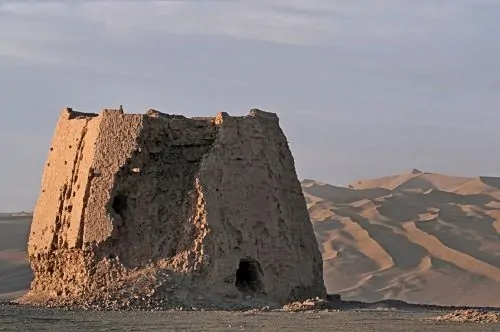
The witchcraft campaign acquired much of its political force from the direction in which it moved. Earlier investigations had already reached across Chang’an, the metropolitan region, aristocratic households, and the extended imperial family, while searches for concealed danger demonstrated the government’s willingness to control movement and penetrate spaces ordinarily protected by status. By 91 BCE, Jiang Chong’s investigation began narrowing toward the physical center of imperial power. The problem was no longer merely that hostile ritual practitioners might exist somewhere among the emperor’s subjects. Jiang reported that signs of witchcraft existed inside the palace itself, implying that the source of Emperor Wu’s illness might be concealed among the people and spaces closest to him. Once Wu accepted that possibility, the distinction between the protected imperial interior and the dangerous world outside it began to collapse.
The Hanshu describes Jiang entering the palace precincts with authority to search for buried evidence, accompanied or assisted by other imperial officials and ritual specialists. His investigation reportedly reached the inner quarters and became physically destructive, with floors broken open and even the ground near the emperor’s own seat excavated. Such actions were extraordinary not because Han rulers lacked power over palace space, but because the palace existed precisely as an environment structured by controlled access, hierarchy, and proximity to the sovereign. The search temporarily subordinated those ordinary arrangements to a new principle: wherever witchcraft might be concealed, investigators were entitled to penetrate. When nothing encountered at one level of the palace definitively resolved Wu’s fears, the search could continue deeper. The absence of a clearly identified perpetrator did not close the inquiry but created grounds for expanding it. An investigation intended to restore security was progressively redefining more of the emperor’s own environment as potentially contaminated. The search had moved from guarding the palace against infiltration to treating the palace itself as territory requiring investigation.
This inward movement had particularly serious implications for the women of the imperial household. The palace contained numerous consorts, attendants, servants, and other dependents whose access to imperial spaces placed them close to Wu while also making their private activities difficult for outsiders to observe. Sources describing the investigation indicate that searches passed through the quarters of women who had lost imperial favor before approaching the household of Empress Wei. Their declining or uncertain political standing may have made them vulnerable once investigators began looking for concealed ritual practices, but the larger point is structural. Intimacy with the emperor did not protect palace inhabitants from suspicion when the alleged means of attack depended upon intimacy itself. The closer a person lived to Wu, the easier it became to imagine that person possessing opportunities unavailable to an ordinary subject.
The transformation was especially consequential because Jiang Chong did not operate merely as an individual intruder who had somehow breached palace protocol. Emperor Wu authorized the investigation, and other officials participated in the governmental apparatus surrounding it. The Hanshu names Han Yue, the censor Zhang Gan, and the palace eunuch Su Wen among those ordered to assist Jiang, while ritual practitioners helped identify or interpret supposed traces of witchcraft. This multiplicity of participants gave the search an institutional character even though Jiang remained its dominant figure. Each participant possessed a different relationship to information: some exercised legal or censorial authority, some moved within the palace establishment, and some claimed specialized knowledge concerning ritual danger. Their combined activity blurred the boundaries between policing, court administration, supernatural expertise, and political intelligence. A report that a particular area contained a dangerous ritual presence could lead to physical excavation; excavation could produce an object; specialists could interpret that object; and officials could report the resulting conclusion to the emperor as evidence discovered under lawful authority. The system consequently transformed interpretation into administrative fact through a chain of delegated credibility. Wu did not have to witness the alleged witchcraft himself. He had empowered officials to tell him where it existed.
The crucial threshold came when that authority reached the two people whose positions made them central to the continuation of the dynasty: Empress Wei and Crown Prince Liu Ju. The empress had held her position for decades, while Liu Ju had been the designated heir since childhood, yet neither status created an inviolable boundary once the investigation had been permitted to move through the inner palace. The earlier destruction of Gongsun He, imperial princesses, and members of the Wei family had already demonstrated that kinship with the emperor did not automatically defeat allegations of witchcraft. Now the same logic operated against the emperor’s immediate household. The Hanshu explicitly places the crisis of Empress Wei and Liu Ju within an investigation that had progressively advanced inward rather than appearing suddenly at the crown prince’s door. That chronology makes the ultimate confrontation less an isolated assault upon Liu Ju than the terminal stage of a search process whose permitted field had continually expanded.
Seen in those terms, the movement from city to palace illustrates one of the most dangerous properties of surveillance organized around an elusive threat. Ordinary defensive mechanisms normally become more restrictive as they approach the ruler: gates, guards, restricted roads, controlled audiences, and palace protocol determine who may come closer and under what conditions. The witchcraft investigation reversed that architecture. Because harmful magic supposedly required concealment, each protected layer could be interpreted not as evidence of safety but as another screen behind which the real danger might remain hidden. The failure of earlier searches to end Wu’s illness encouraged rather than discouraged further penetration, while the political authority of investigators increased as they approached spaces from which other officials were normally excluded. Surveillance moved inward until it reached the paradoxical conclusion embedded in its own assumptions: if an unseen enemy could operate anywhere, then the most carefully protected household in the empire could not be presumed secure. By the time Jiang Chong entered Liu Ju’s residence, the state was no longer simply investigating threats surrounding the emperor. It had converted the imperial household itself into the final and most consequential field of suspicion.
The Crown Prince Becomes a Target
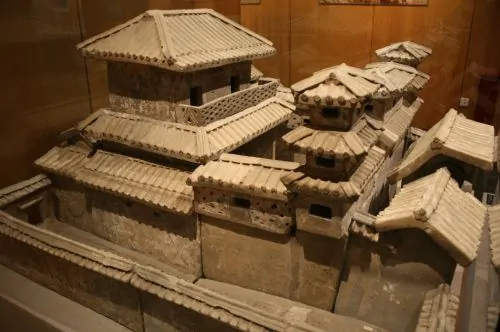
By the time Jiang Chong’s investigators reached Crown Prince Liu Ju, they were no longer approaching an obscure courtier who could easily be sacrificed to an imperial investigation. Liu Ju had been designated heir apparent in 122 BCE, when he was still a child, and had spent more than three decades occupying the most important position beneath the emperor himself. His mother, Empress Wei, had likewise held imperial status for decades, while the crown prince possessed his own household, retainers, tutors, and established place within the governing order. The Hanshu portrays Liu Ju as temperamentally different from his father, more inclined toward leniency while Emperor Wu had long relied upon severe officials and rigorous enforcement, although the extent to which these differences constituted a coherent political opposition is uncertain. Modern interpretations have sometimes reconstructed powerful competing factions around the emperor and heir, but the surviving evidence does not establish a neatly organized struggle for succession before the witchcraft crisis. What is certain is that Liu Ju had much more to lose than an ordinary accused person. An investigation that reached his residence threatened not merely an individual but the succession itself.
Jiang nevertheless had reason to regard the crown prince as a legitimate investigative target once Emperor Wu ordered the search for witchcraft to continue within the imperial household. Earlier prosecutions had already destroyed Gongsun He and Gongsun Jingsheng, implicated two imperial princesses, and reached members of Empress Wei’s extended family. The emperor’s illness persisted, while Jiang reported that a harmful ritual presence remained within the palace. Under the logic of the campaign, Liu Ju’s rank could not automatically exempt him without undermining the premise that those closest to the emperor might be responsible for the concealed attack. The very fact that the crown prince occupied a protected and politically privileged space could make his household a particularly consequential place to search. What conventional palace hierarchy treated as intimacy and trust, the witchcraft investigation could reinterpret as access and opportunity.
The investigators entered Liu Ju’s residence with imperial authorization and began digging for the material traces associated with wugu. The Hanshu states that wooden figurines were discovered beneath the crown prince’s quarters, exactly the sort of objects the investigative campaign had been seeking elsewhere. Their discovery was devastating because earlier prosecutions had established what such evidence could mean when interpreted as an attempt to harm Emperor Wu. Liu Ju was not confronting a vague rumor that could simply be denied; imperial agents could now claim to have recovered physical objects from his own residence. Yet the evidentiary problem was profound. The objects established that something had been found, but they did not by themselves demonstrate who had buried them, when they had been placed there, who knew of their existence, or what intention accompanied them. The Hanshu itself preserves this uncertainty in the advice of Liu Ju’s junior tutor Shi De, who observed that the prince could not know whether the witchcraft practitioners had placed the objects there or whether they represented genuine evidence of activity within his household. Later tradition went further and asserted that Jiang Chong’s associated ritual specialists had deliberately planted the figurines before uncovering them. Hanmo Zhang has emphasized that this explicit planting story is not supported by surviving Han literature and appears in later material, making it unsafe to present fabrication as securely established fact. The possibility of manipulation is historically important, but so is the possibility that someone within the enormous establishment surrounding the crown prince had actually engaged in ritual practices without Liu Ju’s direct participation. The evidence permits suspicion in several directions while allowing certainty in none.
That ambiguity placed Liu Ju in an almost impossible procedural position. Earlier victims of the campaign had died after accusations of witchcraft, and the crown prince knew that imperial kinship had not saved even Emperor Wu’s own daughters from punishment. The investigators who discovered the figurines were themselves acting under the emperor’s authority, which meant that Liu Ju could not simply dismiss their conclusions as private slander. Nor could he easily prove a negative by demonstrating that no one in his household had performed secret rites or buried objects beneath spaces that investigators had already declared incriminating. His political status actually intensified the danger because an accusation that the heir wished magical harm upon the reigning emperor could be interpreted not merely as religious misconduct but as an attempt to accelerate the succession. In a dynastic monarchy, wishing for the emperor’s death and positioning oneself to inherit his authority could readily collapse into a single accusation of treasonous intent. Liu Ju faced evidence whose alleged meaning reached directly from ritual practice to political rebellion.
The importance of this moment lies less in determining retrospectively whether Liu Ju was absolutely innocent of every ritual practice than in understanding how the investigation transformed him into a target from whom innocence became increasingly difficult to demonstrate. Jiang Chong had entered the crown prince’s residence with authority derived from Emperor Wu, searched according to methods already accepted elsewhere, and emerged with precisely the category of evidence that the campaign had defined as proof of harmful witchcraft. Liu Ju, by contrast, possessed no independent investigative mechanism capable of establishing the history of those objects before Jiang’s findings reached the sovereign. The traditional narrative resolves that imbalance by identifying Jiang as a deliberate fabricator and Liu Ju as an innocent victim, but the surviving Han evidence leaves the physical origin of the figurines uncertain. That uncertainty actually strengthens the institutional interpretation of the calamity. A surveillance system becomes most dangerous not only when officials fabricate evidence, but when its procedures make genuine discovery, mistaken interpretation, and deliberate fabrication nearly impossible for the accused to distinguish or challenge. Once the searchers controlled the site, the excavation, the interpretation, and the report sent upward, the crown prince’s formal position offered little protection against the narrative their investigation produced. Liu Ju had been heir apparent for more than thirty years, yet in a matter of days he was forced to confront the possibility that the state created to secure his eventual succession now possessed physical evidence portraying him as a hidden enemy of the emperor. The next crisis would turn upon something even more fundamental than the figurines themselves: whether Liu Ju could reach his father before the investigators’ version of events became the only version Emperor Wu believed.
The Sovereign at a Distance: When Information Became the Battlefield

The crisis inside Liu Ju’s residence became far more dangerous because Emperor Wu was not physically present in Chang’an when the confrontation reached its decisive stage. He was staying at Ganquan, where the sources place him during a period of illness, while Jiang Chong and the officials associated with the witchcraft investigation exercised delegated imperial authority in the capital. That separation mattered because the crown prince could not simply appeal across a palace courtyard to his father or demand an immediate audience in which accuser and accused confronted one another. Information had to travel through messengers, palace officials, seals, verbal reports, and chains of command. The question of who could reach the emperor became almost as important as the question of what had actually been found beneath Liu Ju’s floors.
The Hanshu dramatizes this problem through the advice given to Liu Ju by his junior tutor Shi De. Faced with the discovery of incriminating figurines and the prospect that Jiang Chong would report the findings to Emperor Wu, Shi De invoked one of the most notorious episodes in Qin history: the death of Crown Prince Fusu. After the death of Qin Shi Huang in 210 BCE, Zhao Gao and Li Si had helped manipulate the succession by issuing a forged command ordering Fusu and the general Meng Tian to die; Fusu obeyed rather than challenge what appeared to be an imperial order. Shi De reminded Liu Ju that Emperor Wu was ill at Ganquan and that reliable communication from him had been absent long enough to create uncertainty about what was actually happening around the sovereign. The implication was terrifying: Liu Ju could not know whether Jiang Chong was faithfully executing Wu’s wishes, manipulating a distant and sick emperor, or concealing an even more serious change in imperial authority. Shi De advised the prince not to repeat Fusu’s fatal obedience. The historical analogy mattered because it converted hesitation into danger. If the imperial command system itself might be compromised, obedience to officials claiming to represent the sovereign could become a path to destruction rather than evidence of loyalty.
The comparison with Fusu should not be taken as proof that Liu Ju actually believed Emperor Wu was dead or that a fully developed coup was underway at Ganquan. The surviving account gives us Shi De’s warning as later historiography preserved it, not a transcript of the prince’s private thoughts. Nor can it securely establish that Jiang Chong or his allies had deliberately severed communications between father and son. What it does demonstrate is that contemporaries or later Han historians regarded control over imperial information as central to understanding Liu Ju’s predicament. A crown prince who could not verify his father’s intentions faced a different problem from one merely accused of a crime.
That information problem became still more acute after Liu Ju acted against Jiang Chong. The palace eunuch Su Wen, already hostile to the crown prince in the narrative tradition, escaped from Chang’an and reached Emperor Wu at Ganquan with news that Liu Ju had risen against the investigators. Crucially, Wu did not initially accept the most catastrophic interpretation of what he heard. According to the Hanshu, he reasoned that the crown prince had probably become frightened and enraged by Jiang Chong and the others, and that these emotions had produced the disturbance. Wu sent an envoy to summon Liu Ju, an action suggesting that he still regarded direct clarification as possible and had not yet concluded that his son intended to seize the throne. The attempt at verification then failed disastrously. The envoy, afraid to enter the turbulent capital, returned to Ganquan without actually meeting the crown prince and reported that Liu Ju’s rebellion was already complete and that the prince had intended to kill him. Emperor Wu now received what appeared to be confirmation from his own emissary, even though the emissary had not performed the investigation for which he had been sent. A false report thereby acquired the authority of imperial intelligence precisely because the sovereign had no immediate means of checking it against events in Chang’an.
The episode exposes the distinction between possessing information and possessing reliable information. Emperor Wu commanded an enormous administrative system capable of moving orders across the empire, mobilizing armies, registering populations, collecting taxes, and transmitting reports from distant officials, yet the decisive question in 91 BCE concerned events only a relatively short distance from the sovereign. Political proximity did not guarantee informational clarity. Su Wen could reach the emperor with one interpretation, the crown prince struggled to establish his own, and the envoy sent to resolve the discrepancy introduced another layer of misinformation instead. Once Wu accepted the report that Liu Ju had moved from frightened resistance to full rebellion, the meaning of every subsequent action changed. Armed mobilization by the prince no longer appeared primarily as desperate resistance to Jiang Chong’s investigation; it could be read as confirmation that the heir had turned against the ruler himself. The informational battle was not peripheral to the military confrontation that followed. It helped determine which side would be recognized as defending legitimate imperial authority before the fighting had been resolved.
The tragedy lay in the absence of an effective independent mechanism for separating accusation, inference, and verified intelligence at the moment when that distinction mattered most. Jiang Chong’s investigators had already controlled the searches that produced evidence against Liu Ju, while officials and palace intermediaries controlled much of the information traveling between Chang’an and Ganquan. Shi De’s invocation of Fusu encouraged Liu Ju to distrust the apparent commands of the imperial system, but acting upon that distrust required the prince to employ extraordinary authority of his own, making him increasingly resemble the rebel his enemies could claim he had become. Emperor Wu, meanwhile, attempted at least once to obtain clarification but depended upon an envoy whose fear produced a report divorced from direct observation. The sovereign remained legally supreme while becoming epistemically dependent: enormous coercive power rested with a ruler who could act only upon the competing representations of events delivered to him. This is one of the clearest points at which the Witchcraft Calamity became a surveillance crisis rather than merely a witchcraft prosecution. A system created to tell the emperor where concealed danger existed had generated incompatible accounts of reality, and the emperor lacked a trustworthy channel through which to determine which one was true. Once information itself became the battlefield, political survival depended not simply upon what had happened in Chang’an but upon which version of what had happened reached Ganquan first, carried sufficient official credibility, and persuaded Emperor Wu to transform suspicion into force.
The Moment Surveillance Became Rebellion
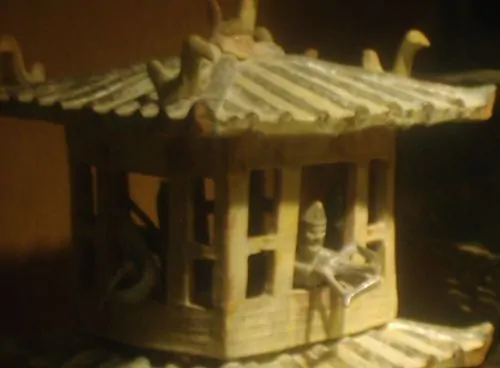
Liu Ju did not immediately respond to the discovery of incriminating objects in his residence by declaring rebellion against his father. The Hanshu instead portrays him as frightened, uncertain, and initially reluctant to take the drastic course urged by his junior tutor Shi De. Shi De reminded him that Gongsun He and his son, two imperial princesses, and members of the Wei family had already died in the witchcraft prosecutions, while the provenance of the objects supposedly uncovered in the crown prince’s quarters could not be established with confidence. More ominously, Emperor Wu was ill at Ganquan and communications with him were sufficiently uncertain for Shi De to invoke the fate of the Qin crown prince Fusu, who had obeyed a forged imperial command and died without verifying his father’s intentions. Liu Ju reportedly preferred at first to go to Ganquan and explain himself directly to Wu. Yet delay carried its own danger because Jiang Chong’s accusation could reach the emperor before the prince did. The surveillance investigation had placed Liu Ju in a dilemma in which submission appeared potentially fatal and resistance could itself be construed as treason.
In the seventh month of 91 BCE, Liu Ju crossed the decisive legal and political threshold. Acting on Shi De’s advice, he sent a man impersonating an imperial messenger and employed a fabricated command to arrest Jiang Chong and the officials working with him. Han Yue, the Marquis of Andao, recognized or suspected the deception and refused to submit, whereupon the prince’s men killed him. The imperial censor Zhang Gan was wounded but escaped and ultimately reached Ganquan, providing another channel through which news of Liu Ju’s actions could reach the emperor. Jiang Chong was captured. The Hanshu then depicts Liu Ju confronting the investigator personally, accusing him of having already disrupted the royal house of Zhao and now attempting to destroy the imperial father and son, before having him executed. This was much more than an angry prince dismissing an official from his household. Jiang had been conducting an investigation under Emperor Wu’s authorization, and Liu Ju had neutralized that authority by counterfeiting authority of his own. The prince’s action may have been intended as an emergency defense against what he believed to be a murderous frame-up, but the means he selected (false imperial orders, arrest of imperial agents, and the killing of an official who resisted) made it possible to describe that defense as defiance of the emperor himself. The line between resisting Jiang Chong and resisting Emperor Wu had suddenly become perilously difficult to maintain.
Liu Ju then destroyed more of the machinery that had produced the case against him. The sources report that the ritual practitioners associated with the witchcraft investigation were killed, with the Hanshu describing the prince as having them burned in the Shanglin area. Such violence can be read as an attempt to eliminate people whom Liu Ju believed had fabricated or manipulated the evidence discovered in his residence, but it simultaneously removed potential witnesses and reinforced the appearance that he was suppressing an imperial investigation by force. Liu Ju informed Empress Wei of what had occurred, and she used the authority available within her establishment to support her son’s efforts to defend himself. Palace guards, vehicles, weapons, retainers, and eventually broader bodies of manpower now entered a confrontation that had begun with excavation and accusation. The crisis was no longer confined to determining whether buried figurines proved witchcraft; control of armed personnel and legitimate command had become the immediate question.
Whether this moment should be called the beginning of a rebellion depends partly upon whose perspective defines the term. From Liu Ju’s position, his actions could plausibly appear defensive: he believed Jiang Chong intended to destroy him, doubted the integrity of the evidence, lacked secure access to his father, and had before him recent examples of imperial relatives dying under comparable accusations. The prince did not initially proclaim himself emperor, announce the deposition of Wu, or present a program for replacing the dynasty’s government. Yet from the standpoint of imperial administration, his conduct already contained unmistakably rebellious elements. He had fabricated an imperial command, killed an officer who refused it, executed the emperor’s appointed investigator, destroyed associated personnel, and begun mobilizing armed resources outside the ordinary chain of command. Motivation and political classification diverged. Liu Ju could understand himself as protecting the legitimate succession against corrupt ministers while Wu’s officials could understand exactly the same acts as an heir using military power against imperial authority. Once coercive force replaced appeal, neither interpretation could easily be contained within normal procedure. What had begun as an epistemic dispute over whether the evidence of witchcraft was genuine had become a constitutional dispute over who possessed the right to act in the emperor’s name.
This transformation exposes the most destructive feedback loop in the entire calamity. The witchcraft investigation generated evidence that Liu Ju believed he could not safely contest through the mechanisms available to him; fear of that evidence induced him to attack the investigators; attacking the investigators then generated observable behavior far easier to classify as treason than the original allegations of invisible magic. Surveillance had crossed from detecting supposed rebellion into helping create the conditions for actual armed resistance. That does not mean Liu Ju lacked agency or that every step he took was inevitable. He chose forged commands, execution, and mobilization, and those choices materially escalated the conflict. Yet they were choices made inside an investigative environment in which he had substantial reason to believe that passive obedience might end in his death.
The terrible efficiency of the process lay precisely there: an investigation created to expose a hidden enemy eventually provoked its target into conduct that made the hidden accusation appear publicly confirmed. Once Liu Ju resorted to violence, Emperor Wu no longer had to imagine what disloyalty might look like beneath the floors of the crown prince’s palace; armed men, dead officials, counterfeit commands, and disrupted government supplied visible evidence of a political crisis. Surveillance had not merely found rebellion. It had helped convert fear of accusation into the rebellion it claimed to reveal.
Five Days in Chang’an: Intelligence Failure Becomes Civil Violence
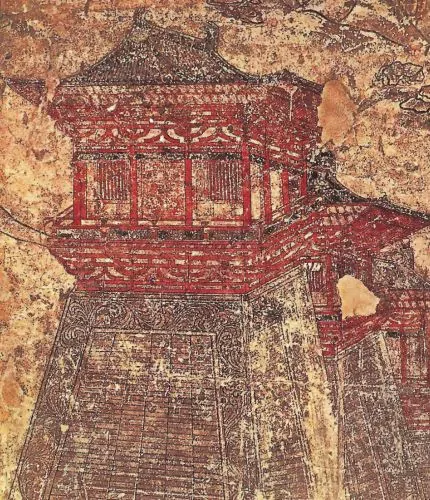
Once Emperor Wu accepted reports that Liu Ju had moved beyond resistance to Jiang Chong and into rebellion, the information crisis immediately became a military crisis. Wu left Ganquan and established himself at Jianzhang Palace west of Chang’an, bringing the sovereign physically closer to the capital and making unmistakable that he remained alive and in command. He ordered Chancellor of the Left Liu Quli to suppress the uprising, close the city gates, and prevent participants from escaping. The chancellor was instructed to avoid unnecessary close combat where possible while nevertheless capturing or killing those classified as rebels. That classification itself was consequential: men who only days earlier had been servants, retainers, prisoners, or civilians caught within a contested investigation could now be treated as participants in armed treason. The machinery of surveillance had ceased merely to identify dangerous people and had begun sorting the population of the capital according to wartime loyalty. Chang’an, the administrative center of the Han Empire, became a battlefield because competing interpretations of imperial authority could no longer be reconciled through communication.
Liu Ju confronted Wu’s response without secure command of the regular military forces that normally protected the capital. Using purported imperial authority, the crown prince ordered prisoners in the central government jails released and armed from state stores, placing groups under Shi De, Zhang Guang, and other associates. He also attempted to draw upon cavalry forces stationed at Changshui and Xuanqu, dispatching Ru Hou with a credential authorizing their mobilization. Imperial attendant Mang Tong arrived with contrary orders, warned the cavalry that the prince’s authority was false, killed Ru Hou, and secured those troops for the emperor’s side. An even more important test occurred when Liu Ju approached Ren An, who supervised the Northern Army, and presented the credential commanding him to mobilize his forces. Ren An accepted it but then shut the military gates and refused to commit the Northern Army to the prince. Liu Ju failed to gain control of the most important organized military resource within reach. He instead drew manpower from among Chang’an’s inhabitants, with the Hanshu describing people gathered from the city’s four markets until the prince’s improvised force numbered in the tens of thousands. What had begun within the enclosed world of palace investigation was now pulling prisoners, market populations, palace guards, officials, and soldiers into the same violent struggle.
Authentication of authority became almost as important as manpower. Liu Ju could issue commands in the emperor’s name because as crown prince he possessed access to the forms, symbols, and personnel through which imperial instructions ordinarily circulated. Emperor Wu’s government responded by differentiating its own credentials and making clear that orders originating with the prince were not genuine imperial commands. The political question was increasingly visible to soldiers and civilians who had previously possessed only fragmentary information: was Liu Ju acting for an incapacitated emperor against treacherous ministers, as his supporters claimed, or had he taken up arms against a living father who was now openly commanding his suppression? Once Wu’s continued personal authority became unmistakable, neutrality grew harder to sustain. The battle for Chang’an was simultaneously a battle over who could convincingly embody the state.
The principal fighting came near the western gate of Changle Palace, where Liu Ju’s forces encountered the army commanded by Chancellor Liu Quli. According to the Hanshu, the struggle continued for five days and killed tens of thousands, with the memorable description that blood flowed into the drainage channels. The casualty figure belongs to a historiographical tradition fond of using large numbers to convey the enormity of disorder and should not be treated as a modern battlefield count, but there is little reason to doubt the fundamental scale and ferocity of the confrontation. Fighting inside the imperial capital meant that streets, palace approaches, gates, markets, and administrative spaces normally used to organize government became military terrain. Liu Ju’s heterogeneous force faced an imperial army whose institutional resources and legitimacy became stronger as the confrontation continued. The chancellor’s manpower increased, while the prince’s ability to portray himself as the defender of legitimate imperial authority deteriorated. Regular troops that might have transformed the contest remained outside his effective control, and civilian enthusiasm or coercive recruitment could not compensate indefinitely for that disadvantage. The extraordinary result was something approaching civil war at the geographic center of an empire whose sovereign and designated successor both claimed to be acting against dangerous traitors.
The collapse of Liu Ju’s position did not end the struggle over gates and loyalty. After his forces were defeated, he fled south and escaped through Fugang Gate, where Tian Ren, the senior official responsible for the gate, failed to stop him. Liu Quli wanted Tian executed immediately, but Grand Censor Bao Shengzhi objected that an official of his rank should not be killed without first referring the case upward. Emperor Wu reacted furiously when he learned of the intervention, regarding Tian’s failure to prevent the escape of an imperial rebel as sufficient grounds for severe punishment; Bao Shengzhi subsequently killed himself, while Tian Ren and Ren An were eventually condemned. Ren An’s earlier refusal to mobilize the Northern Army had not saved him, because his acceptance of Liu Ju’s credential allowed his neutrality to be construed as divided loyalty. Officials were punished not only for actively helping the prince but for actions that could retrospectively be interpreted as hesitation at a moment when the emperor demanded unmistakable allegiance. After Liu Ju escaped, troops were stationed at Chang’an’s gates while the search for the fugitive heir continued.
The five days of violence reveal how thoroughly the original witchcraft investigation had escaped its supposed purpose. Emperor Wu had authorized intrusive searches because he wanted officials to identify a hidden attack against his person; those searches produced evidence against Liu Ju; uncertainty over that evidence produced resistance; failed communication transformed resistance into reported rebellion; and the report of rebellion brought armies into the streets of Chang’an. At each stage, measures intended to clarify danger instead created a new and more observable form of danger. Yet the outcome should not be reduced to an automatic chain in which Liu Ju possessed no meaningful choices. He released prisoners, appropriated weapons, issued false commands, sought control of military forces, and mobilized civilians, actions that gave Wu substantial grounds to treat the situation as an armed uprising regardless of how it had begun. The institutional catastrophe lies in the fact that the investigative system helped place the crown prince in circumstances where such actions could appear to him preferable to submission. Surveillance had begun by searching underground for figurines whose political meaning was uncertain; it ended with identifiable armies fighting under competing commands before the gates of an imperial palace. By then Emperor Wu no longer faced the epistemological problem of determining whether an invisible magical attack existed. He faced thousands of armed men in his capital, dead officials, disputed credentials, uncertain commanders, and a fugitive heir. Intelligence failure had made the enemy visible by helping to create the conditions in which father and son finally confronted one another through force.
The Destruction of the Heir
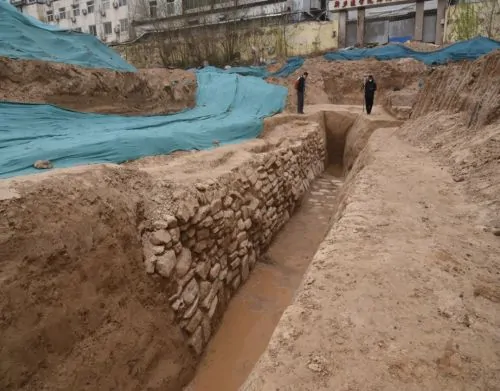
Liu Ju’s defeat in Chang’an ended his ability to challenge the imperial forces, but it did not immediately end the political crisis. Escaping through Fugang Gate after five days of fighting, the crown prince fled eastward while Emperor Wu’s government treated him as a fugitive rebel and extended the search beyond the capital. The failure of gate official Tian Ren to stop his departure later became grounds for punishment, demonstrating how rapidly responsibility expanded to encompass officials whose actions could be interpreted as facilitating escape. Liu Ju had lost the palace guards, prisoners, civilians, and improvised forces through which he had resisted the government, leaving him dependent upon a handful of companions and private assistance. The man who for more than three decades had stood immediately below the emperor in the dynastic hierarchy now moved through Han territory as someone whose discovery could bring reward and whose concealment could endanger anyone assisting him. The collapse was extraordinary in its speed: within weeks, an established heir apparent had been transformed by accusation, armed resistance, and military defeat into a hunted enemy of the state he had expected to inherit.
Empress Wei’s fate made the political destruction of Liu Ju’s position unmistakable. After the prince’s defeat, Emperor Wu sent officials to reclaim the empress’s seal and cord, the insignia through which her status was formally embodied. Rather than submit to deposition, she committed suicide. The Hanshu records that her body was placed in a small coffin and buried south of Chang’an at Tongbai, a strikingly diminished end for a woman who had served as empress for thirty-eight years. Her death removed not merely Liu Ju’s mother but the senior court figure whose standing had anchored his legitimacy within the imperial household.
The destruction extended through the prince’s family and political world. Liu Ju’s consorts, children, household members, retainers, and those classified as supporters became vulnerable to execution, imprisonment, or other punishment as the government suppressed the remnants of the uprising. The sources summarize the catastrophe in terms of the near-extinction of the Wei family, an outcome that reflected both the immediate rebellion and the earlier witchcraft prosecutions that had already killed prominent members of Empress Wei’s extended kin. One infant survived whose significance could not possibly have been apparent amid the violence: Liu Bingyi, the newborn son of Liu Ju’s son Liu Jin, was taken into official custody rather than killed. His survival would eventually transform the dynastic meaning of the catastrophe, because decades later he would ascend the throne as Emperor Xuan. In 91 BCE, there was no reason to assume that this imprisoned infant would ever restore the line. Liu Ju’s defeat appeared instead to have eliminated the branch of the imperial family through which Emperor Wu had expected the succession to continue. The investigative crisis had accomplished something far greater than the removal of suspected witchcraft practitioners: it had shattered an established dynastic future.
Even while Liu Ju remained a fugitive, voices began attempting to alter Emperor Wu’s interpretation of what had happened. A local elder associated with Huguan, identified in later commentary as Linghu Mao, submitted a memorial arguing that the rupture between father and son had resulted from Jiang Chong’s slander and that Liu Ju had taken his father’s weapons principally to save himself from destruction. The Hanshu states that Emperor Wu was moved or awakened by the argument, suggesting that his certainty about the prince’s intentions had already begun to weaken. Yet recognition did not immediately produce a pardon or an effective order halting the search. That delay proved decisive, because the coercive machinery unleashed against Liu Ju continued operating even as the emperor’s interpretation of his son was beginning to change.
The fugitive prince eventually reached Hu County and concealed himself at Quanjiuli in the household of a poor man who supported him despite possessing little wealth. The Hanshu presents the episode in deliberately poignant terms: an heir who had once inhabited palaces now depended upon a host who sold shoes to maintain the household. Liu Ju apparently knew that remaining indefinitely would impose an impossible burden and attempted to contact a wealthier acquaintance in the area. That effort exposed his location. Local officials learned where he was hiding and surrounded the residence, converting what might have been an opportunity for reconciliation into a final confrontation. With escape apparently impossible, Liu Ju withdrew inside and hanged himself rather than submit to capture. Zhang Fuchang forced entry into the house, while Li Shou became one of the officials prominently associated with the seizure of the prince; two of Liu Ju’s sons who had fled with him also died in the confrontation, as did members of the household sheltering him. The surviving accounts contain narrative details shaped by the later tragedy of the prince, and not every dramatic element should be treated as though independently documented. Yet the central outcome is secure: before Emperor Wu reversed the governmental pursuit, officials acting under the incentives created by that pursuit found the crown prince, and Liu Ju died as a hunted fugitive.
The circumstances of the final pursuit reveal another consequence of converting dynastic conflict into a state security operation. Officials searching for Liu Ju had reason to capture him because the government had defined his apprehension as loyal service, while ordinary people who aided him risked association with rebellion. Personal sympathy operated against institutional incentives. The poor household that sheltered the prince entered the political crisis simply by providing refuge, while the officials who closed in upon him could expect advancement or reward for successful enforcement. Emperor Wu might privately reconsider whether his son had intended treason, but until that reconsideration changed official commands, local administrators encountered Liu Ju not as a wronged heir but as a wanted rebel. Bureaucratic momentum outlasted the certainty that had created it.
Liu Ju’s death completed the devastating inversion at the heart of the Witchcraft Calamity. Emperor Wu had authorized investigations to protect himself and preserve imperial order, yet those investigations ultimately contributed to the death of his empress, the destruction of his designated heir, the killing or punishment of much of that heir’s household, and a profound disruption of the succession. The catastrophe cannot be attributed wholly to surveillance, because Liu Ju made consequential decisions of his own when he forged commands, killed imperial agents, mobilized armed followers, and fought the emperor’s forces. Nor can every subsequent death be reduced to Jiang Chong’s personal manipulation when the pursuit had become a governmental response to an actual armed confrontation. What the sequence demonstrates is how difficult it became to reverse a security process once suspicion had been translated into institutional action. Search produced accusation, accusation produced resistance, resistance produced rebellion, rebellion produced pursuit, and pursuit continued until the heir whom the state had once been organized to protect was dead. The later survival and accession of Liu Bingyi as Emperor Xuan would give the story an extraordinary dynastic coda, but it could not undo the destruction of 91 BCE. By the time Liu Ju died at Quanjiuli, an investigation into invisible threats against the emperor had inflicted a very visible wound upon the Han dynasty itself.
After Jiang Chong: Recognition Without Full Repudiation
Emperor Wu’s reassessment of the catastrophe did not occur in a single moment of revelation, nor did it begin only after Liu Ju was dead. While the prince was still a fugitive, the elder Mao of Huguan submitted a memorial arguing that Jiang Chong had exploited the emperor and that Liu Ju had seized his father’s weapons only because he feared being killed. The Hanshu says that Wu was moved by the argument, suggesting that his confidence in the official interpretation of the rebellion had begun to weaken even before the final pursuit ended. Yet he did not immediately cancel the search for his son, and Liu Ju died at Quanjiuli while the imperial machinery established against him was still operating. This sequence is important because it prevents later remorse from being projected backward into an instantaneous recognition of innocence. Wu could begin doubting Jiang Chong’s handling of the affair while still believing that the crown prince had committed grave offenses and while continuing to regard witchcraft as a genuine danger.
A more decisive reinterpretation followed through the intervention of Tian Qianqiu, later known as Ju Qianqiu, who defended the dead prince in language carefully designed to minimize the political meaning of his rebellion. Qianqiu reportedly compared Liu Ju’s seizure of imperial weapons to a son taking up his father’s weapons and attributed his argument to a white-haired elder who had appeared to him in a dream, thereby couching political admonition in a supernatural form likely to resonate with Emperor Wu. Wu responded favorably, first promoting Qianqiu to Chamberlain for Dependencies and later raising him to the exceptionally powerful office of counselor-in-chief. The remarkable advancement signaled that the emperor was no longer merely grieving privately but had accepted a public interpretation in which Liu Ju’s armed resistance could be understood as a desperate mistake produced by fear rather than a deliberate attempt to overthrow his father.
Rehabilitation of the prince necessarily raised the question of responsibility for his destruction. Jiang Chong himself had already been killed by Liu Ju, but Emperor Wu subsequently ordered the extermination of Jiang’s family, ensuring that retrospective condemnation extended beyond the investigator personally. Su Wen, the palace eunuch who had carried damaging reports about Liu Ju and played a prominent role in the conflict, was burned to death on Heng Bridge. Men who had benefited from pursuing or attacking the fugitive prince also found that imperial favor could reverse as rapidly as it had been granted. The official associated with violence against Liu Ju at Quanjiuli, after initially receiving advancement, later suffered destruction together with his lineage. Such reversals converted yesterday’s loyal enforcers into participants in a miscarriage of imperial justice. They also served a political purpose beyond vengeance: by punishing those identified with the fatal escalation, Wu could acknowledge that his son had been wronged without declaring the entire authority of the throne responsible for the disaster. Responsibility could be relocated downward onto officials who had misused, distorted, or overextended the confidence invested in them. Yet the severity of these punishments also reveals how deeply Wu’s own judgment had changed concerning the information on which he had acted.
The commemorative response made that change visible. The Hanshu records that Wu ordered construction of the Sizi Palace, conventionally understood as the Palace of Longing for the Son, together with a terrace at Hu associated with watching and hoping for the son’s return. Later historical memory understandably transformed these structures into monuments to an aged father devastated by the realization that he had destroyed his own heir. Their precise emotional meaning cannot be recovered independently from the literary tradition, and the language surrounding them contributes to the Hanshu’s powerful moral shaping of the calamity. Even so, imperial commemoration of the condemned prince unmistakably reversed the public meaning of Liu Ju’s death: the fugitive rebel was being remembered by the sovereign himself as a son whose loss demanded mourning rather than continued denunciation.
The crucial question is what Emperor Wu believed he had actually been wrong about. The Hanshu states that, as time passed, many matters connected with the witchcraft cases proved unreliable and that Wu came to understand that Liu Ju had acted from fear rather than possessing a larger rebellious intention. It is easy to read this passage as describing a wholesale awakening in which the emperor finally recognized witchcraft accusations as fraudulent superstition. Hanmo Zhang has demonstrated why that interpretation is difficult to sustain. Wu punished Jiang Chong’s family and Su Wen because their conduct had helped drive the crown prince into armed resistance, but nothing securely indicates that the emperor concluded harmful magic itself was impossible. Indeed, his subsequent policy moved in the opposite direction. In 89 BCE, Emperor Wu established the office of Metropolitan Commandant, reporting directly to the throne and charged in part with investigating witchcraft and monitoring particularly dangerous offenders within the metropolitan region. Witchcraft investigations continued after Liu Ju’s death, and the sources portray high officials as deeply uneasy about the severity with which Wu persisted in pursuing them. When Tian Qianqiu and other senior officials attempted to discourage further harshness through carefully worded praise and admonition, Wu responded by insisting that practitioners of witchcraft still remained at large and continued to threaten his health. The calamity had shaken his confidence in particular accusations and investigators without destroying his confidence in the reality of the offense they had been ordered to investigate.
This distinction fundamentally changes the meaning of Emperor Wu’s late repentance. He did not simply progress from credulity to enlightenment, discover that witchcraft was imaginary, and renounce the security policies produced by his earlier fear. Instead, he appears to have separated two conclusions that modern retellings often collapse: the investigation of 91 BCE had produced false or unreliable accusations, and harmful ritual practices nevertheless remained a real danger requiring governmental suppression. Wu could consequently rehabilitate Liu Ju, punish Jiang Chong’s family, destroy Su Wen, memorialize his dead son, and still strengthen official capacity to investigate witchcraft. His response amounted to recognition of catastrophic investigative failure without repudiation of the threat model that had made such investigation possible. That makes the aftermath more unsettling than a conventional story of an emperor finally realizing his mistake. Wu revised his judgment about who had been guilty, but he did not abandon his conviction about what kinds of hidden enemies could exist, leaving intact the central assumption from which the surveillance panic had grown.
The Surveillance Panic as a System

The Witchcraft Calamity becomes most intelligible when its separate episodes are treated not as an accidental sequence of bad decisions but as interacting parts of a political system. No single element was sufficient to produce the catastrophe. Belief in harmful magic had existed long before 91 BCE; Han officials had long conducted investigations; imperial government routinely depended upon informants, messengers, interrogations, and delegated authority; and court rivalries were hardly peculiar to Emperor Wu’s final years. The crisis emerged when these ordinary and extraordinary elements reinforced one another around a threat thought capable of operating invisibly against the emperor himself. Suspicion authorized searches, searches produced evidence, evidence justified interrogation, interrogation generated new accusations, and accumulating accusations seemed to confirm that the threat was broader than originally imagined. The resulting process possessed a momentum greater than the intentions of any single participant, including Jiang Chong.
At the foundation of that process lay a threat unusually resistant to falsification. Harmful witchcraft supposedly required neither an armed attack nor the physical presence of an assassin, and its material traces could be deliberately hidden beneath floors, courtyards, roads, or other controlled spaces. Emperor Wu confronted an epistemic problem: if the danger existed precisely because it was concealed, the absence of immediately visible evidence could not establish safety. His illness intensified the problem because continuing symptoms could be interpreted as proof that investigators had not yet located the source. Delegating the search to officials such as Jiang Chong solved one difficulty while creating another. The emperor acquired agents capable of entering spaces he could not personally search, questioning people he could not personally interrogate, and consulting specialists whose knowledge supposedly made concealed ritual activity legible. Yet those same agents also acquired discretion over what constituted suspicious ground, which objects deserved interpretation, which testimony appeared credible, and whose relationships warranted additional scrutiny. The sovereign could command an investigation without independently reproducing its findings. Consequently, the further the campaign expanded, the more Emperor Wu depended upon the investigators to describe the threat whose existence justified their authority in the first place. What looked from above like an increasingly detailed picture of conspiracy could contain genuine discoveries, misunderstandings, coerced statements, malicious denunciations, and deliberate fabrication without supplying the ruler with a reliable method for distinguishing among them.
Coercive interrogation transformed this uncertainty into recursive validation. Suspects accused under pressure could identify additional participants, and those newly named people became fresh sources of testimony after their own arrest. The growing number of cases then appeared to prove that the government had correctly diagnosed a widespread danger. Failure no longer necessarily counted against the investigation: finding no decisive culprit could justify searching elsewhere, while finding one could justify asking how many accomplices remained undiscovered. Such a system could expand even if many participants acted sincerely, because false information did not require a centrally organized conspiracy to enter the evidentiary stream.
Political incentives made the resulting information even harder to evaluate. Jiang Chong had reasons to fear Liu Ju’s eventual accession, palace officials possessed their own histories of conflict and dependence, accused persons had obvious reasons to redirect suspicion, and local or subordinate officials understood that failing to act against someone later judged disloyal could endanger their own careers or lives. Emperor Wu’s physical distance from Chang’an during the decisive confrontation placed additional weight upon messengers and intermediaries. The failed mission of the envoy sent to summon Liu Ju provides a strikingly revealing example: Wu attempted to verify reports of rebellion, but the envoy never confronted the prince and returned with a claim that nevertheless entered imperial decision-making as if it represented direct intelligence. The system suffered from an absence of genuinely independent verification. The investigators who discovered incriminating material also interpreted it; accused persons generated new names under coercion; intermediaries reported developments to a distant ruler; and officials whose careers depended upon imperial favor often had incentives to provide decisive answers rather than preserve uncertainty. Once Liu Ju attacked Jiang Chong and mobilized armed followers, observable rebellion appeared to vindicate earlier suspicions even though the rebellion had partly arisen from the prince’s fear of the investigative process itself. The system had completed a self-confirming circuit: surveillance helped provoke conduct that could retrospectively be cited as evidence that surveillance had been necessary.
Calling this a surveillance panic does not require imagining a Han equivalent of a modern intelligence service or claiming that Emperor Wu deliberately constructed a permanent apparatus of total observation. The relevant system was more contingent and personal, assembled from imperial commands, legal investigation, palace access, searches, interrogation, informants, ritual expertise, messengers, gate controls, military force, and the exceptional authority of the sovereign. Its danger came from the interaction among those components under conditions in which the perceived threat was hidden, politically intolerable, and difficult to disprove. Nor does the interpretation depend upon deciding that witchcraft was merely a cynical fiction. Precisely because Emperor Wu and others could sincerely believe that harmful ritual action was possible, officials who claimed to discover it operated within a framework that made their findings inherently consequential. The calamity demonstrates how surveillance can become self-amplifying when rulers demand certainty about concealed enemies but lack independent means to test the information produced in response. In 91 BCE, the Han state did not simply fail to detect the truth about a conspiracy. It created an investigative environment in which the distinction between observing danger, interpreting danger, and producing danger progressively collapsed.
Beyond “Superstition”: What the Crisis Reveals about Han Government
The Witchcraft Calamity becomes misleading if it is explained as an eruption of primitive superstition into an otherwise rational system of government. Han rulers and officials did not organize their political world according to a modern boundary separating religion from administration, supernatural belief from law, or cosmology from public policy. Ritual, omens, sacrifice, divination, ancestral powers, celestial phenomena, legal procedure, bureaucratic reporting, taxation, military command, and criminal investigation all belonged to overlapping fields through which order was interpreted and maintained. Emperor Wu could employ sophisticated officials, supervise an enormous territorial administration, command armies across Central Asia, reform fiscal institutions, and simultaneously take seriously the possibility that ritual action might affect his health. None of those activities appeared inherently contradictory within the conceptual world of the Western Han. The danger of 91 BCE arose not because government temporarily ceased to function rationally, but because highly developed governmental capacities were directed toward a category of danger contemporaries regarded as real.
Han sovereignty itself encouraged the political integration of phenomena that modern observers might separate into natural, supernatural, religious, and administrative spheres. The emperor occupied more than the position of supreme executive authority; he stood at the center of a political cosmology in which order among human beings could be related to larger patterns joining Heaven, Earth, ancestors, spirits, seasons, and the conduct of rulers. Portents could provoke policy discussion, ritual failures could carry political implications, and unusual natural events might be interpreted as warnings about government. Michael Loewe has shown how concepts of Han sovereignty increasingly represented the ruler as an essential participant in maintaining relationships between cosmic and human order, even though officials disagreed about precisely how such relationships should be interpreted. Emperor Wu’s extensive sacrificial programs, interest in divine beings, patronage of ritual specialists, and attempts to secure longevity belonged to his exercise of kingship rather than existing wholly outside it. If beneficial ritual action could strengthen the emperor or the empire, harmful ritual action could logically be imagined as capable of doing the reverse. Witchcraft directed against the ruler consequently occupied a political category comparable in seriousness, though not in mechanism, to assassination or conspiracy. The state’s response followed from that political meaning: something believed capable of injuring the sovereign could become an object of investigation regardless of whether the alleged weapon was a sword, a poisoned substance, a curse, or a buried figurine.
The administrative response nevertheless depended upon institutions that were anything but mystical. Han government maintained hierarchies of officials, systems of written communication, registers of population and property, mechanisms of judicial inquiry, censorial supervision, prisons, military forces, and local administrations capable of carrying orders far beyond the capital. When Emperor Wu demanded action against witchcraft, these ordinary capacities gave material force to an invisible threat. Officials could arrest suspects, seal gates, conduct searches, seize property, interrogate prisoners, transmit accusations, and mobilize armed men. The supernatural assumption and the bureaucratic response were not competing explanations for the calamity; they were the two components that made its scale possible.
The crisis also reveals how Han government determined which kinds of specialized knowledge would count as legitimate. The imperial court regularly dealt with diviners, physicians, ritualists, omen interpreters, fangshi, and other people claiming knowledge inaccessible to ordinary observation. Their expertise could be rewarded when it served imperial purposes and criminalized when it appeared deceptive, unauthorized, or hostile. The witchcraft investigations exploited this ambiguous boundary. Ritual specialists assisting Jiang Chong could claim to identify polluted locations or interpret objects that ordinary officials might not understand, while legal and administrative officials supplied the coercive authority required to act upon those interpretations. Once the two forms of expertise were joined, an investigator could translate an esoteric judgment into an administrative fact: a place was declared suspicious, excavation followed, an object was recovered, and the recovery entered an official report. The state did not merely accept supernatural knowledge passively; it selected practitioners, authorized their activity, and embedded their conclusions within governmental procedures. The very flexibility that allowed Han authorities to incorporate specialized knowledge created opportunities for abuse. An emperor who could not personally evaluate the ritual significance of every object discovered beneath a palace floor had to trust specialists and officials who claimed that they could. Administrative sophistication did not eliminate uncertainty. It multiplied the number of institutions through which uncertain knowledge could acquire official authority.
The calamity consequently exposes both the strength and the weakness of the centralized imperial system constructed by Qin and developed under Han. Emperor Wu possessed enough authority to initiate investigations across social and spatial boundaries that would otherwise have protected powerful families and palace residents. His government could pursue suspects through the capital, investigate imperial relatives, authorize excavation within protected residences, and eventually mobilize forces against the crown prince himself. Yet the same concentration of authority placed enormous consequences upon the quality of information reaching the sovereign. Delegation was unavoidable because Wu could not personally inspect every site, interrogate every suspect, or verify every report. When investigators interpreted the evidence they themselves discovered, coerced suspects generated further accusations, and messengers shaped what the distant emperor knew about events in Chang’an, centralization created an informational bottleneck at precisely the moment when independent confirmation was most necessary. The government possessed great power to act but comparatively weak mechanisms for determining whether the knowledge prompting that action had been corrupted. Its administrative strength magnified the consequences of epistemic failure.
The larger significance of 91 BCE is not that Han China should be reclassified as a primitive surveillance state or that its officials were uniquely vulnerable to irrational fear. Such labels would flatten institutions separated from modern governments by radically different political, technological, legal, and cultural assumptions. The episode instead demonstrates that administrative capacity is politically neutral in one important sense: the same machinery capable of enforcing useful policies can enforce disastrous ones if the threat definition guiding it becomes unreliable. Han bureaucracy did not save Emperor Wu from a surveillance panic because bureaucracy itself does not determine whether the premises supplied to it are true. Once the emperor accepted that concealed witchcraft threatened his body, organized government supplied the personnel, coercion, mobility, record keeping, interrogation, spatial access, and military force necessary to pursue that belief on an imperial scale. The catastrophe belongs neither wholly to the history of religion nor wholly to the history of state formation. It occurred where the two intersected, when a government sophisticated enough to search systematically for hidden enemies confronted a danger whose very invisibility made the search increasingly difficult to falsify. Far from demonstrating that “superstition” displaced government, the Witchcraft Calamity shows something more troubling: government continued to function, and its capacity to function was precisely what allowed fear to become so destructive.
Was This Really a Surveillance Panic?
The following video from “Bedtime & Historian” is an entire history of the Han dynasty:
Calling the events of 91 BCE a “surveillance panic” risks imposing a modern conceptual framework upon institutions that neither understood themselves nor operated as a surveillance state. Emperor Wu possessed no permanent intelligence service comparable to a modern security agency, no technologies of continuous observation, and no bureaucratic doctrine devoted to systematic monitoring of an entire population. Jiang Chong’s investigators operated through imperial commissions, criminal inquiry, palace authority, denunciation, ritual expertise, and coercive search rather than through an institution organized around surveillance as a distinct governmental function. Even the closing of gates, excavation of residences, questioning of suspects, and pursuit of informants belonged to practices that could arise from ordinary policing and imperial security rather than from a coherent surveillance apparatus. If the modern vocabulary is allowed to determine the interpretation too strongly, it may create an artificial unity among actions that contemporaries experienced as separate responses to crime, ritual danger, palace disorder, and rebellion.
A second objection is more substantial because it concerns the word “panic.” The label can imply that the threat was imaginary and that officials abandoned rational judgment in pursuit of something no reasonable contemporary could have believed existed. That would badly distort the intellectual and religious setting of the Western Han. Wugu was understood as a category of harmful ritual action, and Emperor Wu’s belief that ritual techniques, spirits, curses, and other invisible forces could affect human beings was consistent with much broader assumptions about causation in his political world. Nor is it possible to prove that every person prosecuted during the campaign was innocent of performing prohibited rituals. Some subjects almost certainly did engage in practices that officials classified as illicit magic, just as some accusations may have arisen from genuine conflicts over ritual activity rather than deliberate fabrication. Hanmo Zhang’s reappraisal is important here because it challenges interpretations that reduce witchcraft to a convenient fiction invented by politicians seeking to destroy Liu Ju. Emperor Wu appears to have believed that harmful magic was actually being used against him, and his continuation of witchcraft investigations after the prince’s death indicates that he did not regard the entire category as fraudulent. If a ruler sincerely believed that a real but difficult-to-observe method of attack threatened his life, investigation was not necessarily evidence of panic in itself.
The conventional villainization of Jiang Chong creates a related difficulty. The Hanshu offers powerful reasons to suspect him of personal hostility toward Liu Ju, and his earlier conflict with the crown prince’s household made later accusations appear retrospectively purposeful. Yet the surviving Han evidence does not securely prove every element of the familiar story in which Jiang deliberately planted objects, fabricated a case, and engineered the entire calamity in order to save himself from punishment after Liu Ju’s accession. His investigations were already enormous before they entered the crown prince’s residence, and they operated under authority supplied by Emperor Wu. A historical interpretation that merely replaces the Hanshu’s “evil minister” with the modern category of “rogue surveillance official” would reproduce the same explanatory simplification in different language.
There is also a danger in treating expansion itself as proof of irrationality. Investigations of conspiratorial offenses often widen because accomplices actually exist, because testimony reveals new connections, or because searches uncover genuinely relevant evidence. The mere fact that interrogations produced additional names cannot demonstrate that those names were false, just as the discovery of objects in multiple locations cannot by itself prove that investigators planted them. The reported scale of the prosecutions is preserved through texts whose casualty figures and moral descriptions require caution, and the precise sequence by which individual cases connected with one another is often difficult to recover. Even Liu Ju’s final conduct complicates the language of victimization. Whatever pressures produced his decision, he forged imperial commands, killed officials acting under his father’s authority, released prisoners, sought military support, mobilized armed followers, and fought government forces in the capital. Emperor Wu’s conclusion that an actual rebellion had developed was not simply a hallucination produced by bad intelligence. By the time the five days of fighting began, a genuine armed conflict existed, even if the investigation had helped create the conditions that produced it. The strongest objection to the surveillance-panic interpretation is that it risks reading the beginning of the crisis through knowledge of its end: because the investigation ultimately destroyed an heir later remembered as wronged, historians may be tempted to assume that every preceding suspicion must have been irrational, every discovery fraudulent, and every investigative expansion illegitimate.
Those objections require modifying rather than abandoning the interpretation. The Witchcraft Calamity need not be called a surveillance panic because witchcraft was unreal, because Jiang Chong secretly fabricated everything, or because Emperor Wu became incapable of rational thought. It qualifies more persuasively because an elusive but sincerely perceived threat generated progressively broader powers of search, interrogation, denunciation, and information collection while the means of independently verifying the resulting intelligence remained weak. The crucial pathology was recursive: evidence justified wider investigation, wider investigation generated further evidence, and the expanding body of accusations strengthened the premise that the danger was pervasive. Political incentives, coercive testimony, restricted access to the sovereign, and ambiguous material discoveries then entered the same informational stream as potentially genuine evidence. “Surveillance panic” should describe the structure of escalation rather than pronounce judgment on the reality of Han religious belief. Used with that limitation, the concept clarifies rather than modernizes away the distinctive character of the crisis: the Han state possessed enough administrative and coercive capacity to search systematically for a danger that its own procedures made increasingly difficult to disprove. The strongest counterargument strengthens the final interpretation by shifting responsibility away from superstition or a single villain and toward the interaction between sincere belief, political vulnerability, investigative discretion, and a government whose search for certainty ultimately generated more danger than certainty.
Conclusion: When the Search for Hidden Enemies Reached the Throne
The Witchcraft Calamity of 91 BCE was not simply a story about superstition, nor can it be reduced to the malice of Jiang Chong or the tragic misjudgment of an aging emperor. It was a crisis produced by the interaction of belief, political insecurity, coercive investigation, restricted information, and concentrated imperial authority. Emperor Wu confronted a threat that seemed uniquely difficult to defend against because harmful ritual action was believed to operate invisibly and at a distance. Once the government accepted that premise, ordinary signs of safety lost much of their reassurance: loyal appearances could conceal hostile intentions, protected residences could conceal buried objects, and proximity to the emperor could signify opportunity rather than trust. The state responded by searching more deeply, questioning more people, and empowering investigators to interpret what they found. Each extension promised greater certainty, yet each also increased the number of intermediaries through whom suspicion could be transformed into official knowledge. The calamity began with the understandable political desire to know whether the sovereign was in danger and ended by demonstrating how dangerous the pursuit of certainty could become when the object of investigation was extraordinarily difficult to verify.
Jiang Chong became the most infamous representative of that process because his actions brought the search directly into Liu Ju’s household, but his role cannot bear the entire explanatory weight later historiography placed upon it. The witchcraft campaign had already destroyed officials and imperial relatives, mobilized searches, encouraged denunciation, and normalized intrusive investigation before Jiang’s confrontation with the crown prince reached its climax. He had genuine incentives to fear Liu Ju, exercised enormous discretion, and may well have manipulated the investigation for political purposes, yet he also acted within authority granted by Emperor Wu and within assumptions the emperor himself accepted. That distinction shifts the calamity from the realm of personal villainy into the history of institutions. A corrupt investigator is dangerous; an investigative structure capable of amplifying the motives of a corrupt investigator is more dangerous still.
The destruction of Liu Ju revealed the final paradox. Surveillance was supposed to expose concealed disloyalty before it could become open danger, yet the investigation progressively created conditions in which the crown prince came to believe that resistance offered a better chance of survival than submission. His seizure of imperial authority, killing of Jiang Chong, mobilization of armed followers, and five days of fighting in Chang’an were consequential choices for which he retained responsibility. But those choices did not arise independently of the investigative machinery surrounding him. Ambiguous discoveries became accusations, accusations became existential threats, uncertain communications made imperial intentions difficult to verify, and resistance then supplied visible evidence that could be read as confirming earlier suspicion. Once Liu Ju was defeated, the same machinery pursued him beyond the capital until the designated heir of the Han throne died as a fugitive. Emperor Wu later punished several of those associated with the disaster, restored sympathy toward his son, and memorialized Liu Ju’s loss, yet he did not conclude that harmful magic itself was imaginary. His continued concern with witchcraft demonstrates that the lesson he drew was narrower: particular investigators and accusations had failed catastrophically, but the hidden threat they claimed to combat could still be real. Recognition came without repudiation, leaving the intellectual foundation of the original panic largely intact.
The lasting significance of 91 BCE lies in that unresolved contradiction. The Han state possessed formidable administrative capacity, but capacity could not compensate for uncertainty when the same institutions that gathered evidence also interpreted it, coerced testimony, transmitted conclusions upward, and acted upon those conclusions with little independent verification. The episode should not be converted into a modern morality tale about a totalitarian surveillance state that did not exist, yet neither should its institutional warning be confined to the peculiarities of ancient magical belief. Governments become vulnerable to self-reinforcing error when they pursue hidden enemies whose absence is difficult to prove and when officials gain authority by demonstrating that the danger is larger than previously believed. Emperor Wu sought to make an invisible enemy visible; instead, the search penetrated his capital, his palace, his family, and finally the succession itself. The most devastating threat to the throne proved not to be a buried figurine whose supernatural power can never be historically established, but a political process in which suspicion generated investigation, investigation generated accusation, accusation generated resistance, and resistance generated the very catastrophe that fear had been mobilized to prevent.
Bibliography
Affiliate disclosure: Amazon links on this site are paid links. As an Amazon Associate I earn from qualifying purchases.
- Ban Gu. Hanshu [Book of Han]. Beijing: Zhonghua shuju, 1962.
- Barbieri-Low, Anthony J., and Robin D. S. Yates. Law, State, and Society in Early Imperial China: A Study with Critical Edition and Translation of the Legal Texts from Zhangjiashan Tomb No. 247. 2 vols. Leiden: Brill, 2015.
- Cai, Liang. Witchcraft and the Rise of the First Confucian Empire. Albany: State University of New York Press, 2014.
- Clark, Anthony E. Ban Gu’s History of Early China. Amherst, NY: Cambria Press, 2008.
- De Crespigny, Rafe. “Inspection and Surveillance Officials under the Two Han Dynasties.” In State and Law in East Asia: Festschrift Karl Bünger, edited by Dieter Eikemeier and Herbert Franke, 40–79. Wiesbaden: Otto Harrassowitz, 1981.
- Hulsewé, A. F. P. “Notes on the Historiography of the Han Period.” In Historians of China and Japan, edited by W. G. Beasley and E. G. Pulleyblank, 31–43. Oxford: Oxford University Press, 1961.
- —-. Remnants of Han Law. Leiden: E. J. Brill, 1955.
- Lewis, Mark Edward. The Construction of Space in Early China. Albany: State University of New York Press, 2005.
- —-. The Early Chinese Empires: Qin and Han. Cambridge, MA: Harvard University Press, 2007.
- Loewe, Michael. “Ban Gu: Copyist, Creator and Critic.” Bulletin of the School of Oriental and African Studies 78:2 (2015), 333–355.
- —-. “The Cosmological Context of Sovereignty in Han Times.” Bulletin of the School of Oriental and African Studies 65:2 (2002), 342–349.
- —-. Crisis and Conflict in Han China, 104 BC to AD 9. London: George Allen and Unwin, 1974.
- —-. Divination, Mythology and Monarchy in Han China. Cambridge: Cambridge University Press, 1994.
- —-. Faith, Myth, and Reason in Han China. Indianapolis: Hackett Publishing Company, 2005.
- —-. The Government of the Qin and Han Empires: 221 BCE–220 CE. Indianapolis: Hackett Publishing, 2006.
- —-. The Men Who Governed Han China: Companion to A Biographical Dictionary of the Qin, Former Han and Xin Periods. Leiden: Brill, 2004.
- —-. “The Religious and Intellectual Background.” In The Cambridge History of China. Vol. 1, The Ch’in and Han Empires, 221 B.C.–A.D. 220, edited by Denis Twitchett and Michael Loewe, 649–725. Cambridge: Cambridge University Press, 1986.
- Poo, Mu-chou. In Search of Personal Welfare: A View of Ancient Chinese Religion. Albany: State University of New York Press, 1998.
- Powers, Martin J. Art and Political Expression in Early China. New Haven: Yale University Press, 1991.
- Sima Guang. Zizhi tongjian [Comprehensive Mirror for Aid in Government]. Beijing: Zhonghua shuju, 1956.
- Sima Qian. Records of the Grand Historian: Han Dynasty. Translated by Burton Watson. New York: Columbia University Press, 1993.
- Zhang, Hanmo. “Witchcraft and Witch-hunting in the Later Years of Emperor Wu’s Reign: A Reappraisal.” Bulletin of the Jao Tsung-I Academy of Sinology 8 (2021), 139–216.
Originally published by Brewminate, 08.24.2026, under the terms of a Creative Commons Attribution-NonCommercial-NoDerivatives 4.0 International license.
About the Author