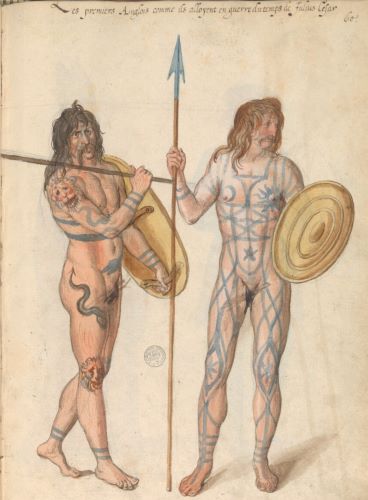
Rome imagined Britain as both imperial possession and unsettling frontier, a familiar province made strange by distance, resistance, and Roman anxiety.

By Dr. Gil Gambash
Professor of Mediterranean History
Co-Founder and Director, Haifa Centre for Mediterranean History (HCMH)
University of Haifa
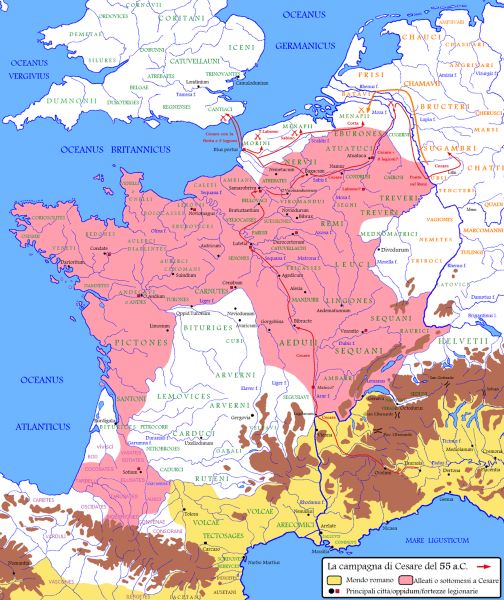
On the eve of the Roman invasion of Britain, reports Dio, there arose a mutiny among the troops stationed in Gaul, on the banks of the Atlantic Ocean. The soldiers, we are told, were resentful at the thought of conducting a campaign ‘outside the limits of the known world’.1 Whether or not that was the reason for the mutiny, or whether a mutiny took place at all, the fact remains that, to contemporary historians and, by implication, to their readers, there would have been nothing exceptional in perceiving Britain as lying outside the limits of the known world in the year 43 CE. Indeed, to the audience which regularly fed off imperial propaganda—whether in Rome or elsewhere in the empire—that same perception would not have seemed exceptional even later, since Claudius persisted throughout his reign in celebrating his British achievement as one won in unknown, primitive regions of the world.2 However, a substantial body of evidence speaks strongly for an intense direct relationship between Rome and Britain, the outset of which corresponds to Caesar’s invasions of the island in 55 and 54 BCE. This article sets out this long-enduring Roman ambivalence regarding Britain, and ultimately aims to explain a whole century of atypical imperial inaction.
The suggestion that Caesar’s two campaigns on the island left no enduring impression on the relationship between Rome and Britain was made by Strabo, and then again, about a century later, by Tacitus.3 Each of them probably had reasons of his own for making the claim: Strabo maybe supporting a line opposed to the invasion; Tacitus wishing to aggrandize later campaigns.4 But Caesar’s achievement, in fact, is likely to have been both significant and enduring. The technical and legal terms—such as deditio (capitulation) and vectigal (impost)—employed by him in his report on the conditions of surrender of the Britons, imply that a British province was possibly in the first stages of being formed.5 To be sure, treaties had been drawn up, hostages taken, and the tribute that was imposed was in all likelihood paid. There is no reason to doubt that these agreements lasted at least until political changes in Britain had taken place, well into Augustus’ reign. For those emperors who sought it, Caesar had made available ‘legitimate’ claim over Britain.
Regarding Augustus and Tiberius, Tacitus says: ‘and even when there was peace [i.e. from civil war], there was a long oblivion of Britain. Augustus called it policy (consilium), Tiberius—a received precept (praeceptum) .’6 It may be understood from this statement that the first two emperors did not want to invade Britain. Yet Tacitus’ zeal for the acquisition of Britain is given away all too clearly throughout the Agricola, where he parades the exploits of his father-in-law on the northern parts of the island, and reproves all previous governors of the province who failed to pursue expansion before him.7 At least with regard to Augustus, it has to be assumed that Tacitus in fact criticizes the reality after the death of the princeps, rather than his actual intents during his lifetime. Literary evidence suggests that Augustus may very well have been on his way to invade Britain more than once.
Dio mentions three instances, in the early 20s BCE, when Octavian/Augustus initiated a campaign against Britain.8 In the first attempt, interrupted by unrest in Dalmatia, Octavian is said to have wanted to emulate his father. Diplomacy was ultimately preferred in the later attempts. Of course, Augustus’ expansionist ambitions and familiarity with Gaul would have made the consideration of invading Britain viable. It should also be noted that the Augustan poets appear to have conducted a complex dialogue with the idea of imperial expansion and the implications of its possible discontinuation. It is noteworthy that Britain and the prospects of its conquest are often used in these works to epitomize potential Augustan expansion.9
More importantly, in his Res Gestae Augustus mentions approaches made to him by kings from Britain, Dumnobellaunus and Tincommius.10 As was the case with preparations for most other Roman invasions of Britain—from Caesar to Claudius—contacts with indigenous kings would have played a significant role in the intensification of Roman involvement in local politics.11 From the second century BCE onwards, such contacts were a key feature across the Mediterranean in those cases of Roman foreign diplomacy that ended with occupation.
It is true, of course, that embassies from all over the empire, as well as from beyond its frontiers, came to Rome to be heard by the Senate, and later also by the emperor. But it would be far too simplistic to assume that all such diplomatic visits shared in aim and were alike in nature. The interests of the visitors would have varied greatly in accordance with their relationship to Rome; and the specific destination of their visit—the emperor, the Senate, the Capitol, and so on—would have been dictated by their particular needs. The Res Gestae itself supplies a useful distinction between embassies from remote regions, whose sole aim was to obtain Rome’s amicitia, and visits of kings from closer places, arguably already within Roman hegemony, who came as suppliants to seek refuge.12 An Indian prince would not have fled to Augustus had he been driven away from his kingdom. British kings came to see the princeps also for pragmatic needs. A similar pattern may be seen in the visits to Rome of Gallic embassies, and in treaties that were made with Gallic tribes long before the conquest of Gaul, all symptomatic of Rome’s increasing control over the region.13
The presence of a friendly king in a frontier region would perforce have indicated Roman interests in that region. Visits of kings to Rome should therefore be particularly noted, since they signified an important step in the development of the relationship.14 Since the passage in the Res Gestae relevant to Britain appears to relate to foreign kings who sought refuge in Rome, it is plausible that there was urgency in the implication of Rome in British local affairs.
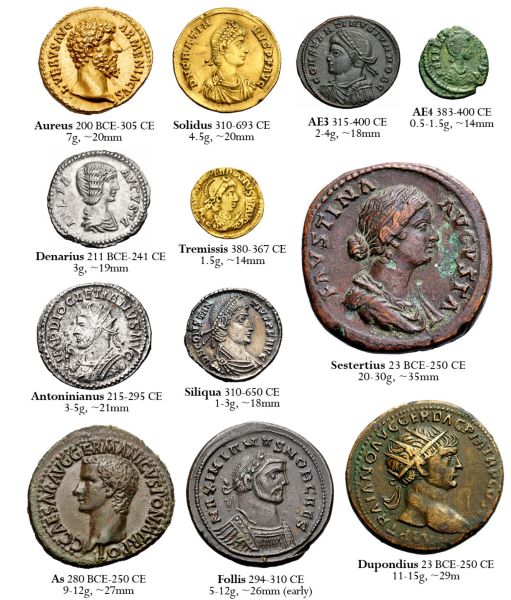
Rasiel Suarez, Wikimedia CommonsOne indication that Augustus indeed responded to the approaches of British kings by involving Rome in the political issues of Britain comes from coins. The use of coinage accompanied local processes of centralization in political power witnessed in Britain during the first century BCE. The initial emergence of Romanized coin-types in Britain in the 20s BCE may be related to the Romanization of Gallic coinage.15
But, against this background of common influence over Britain of developments in Gaul, stands out the dramatic change in coinage design which was witnessed in southeastern Britain around 15 BCE. At this time, the coinage of Tincommius suddenly changed, to resemble Roman coin-types closely. The quality of the coins is so high that it encourages modern scholars to think that the dies must have been the work of Roman engravers. Three pairs of dies have been identified through Tincommius’ coinage, and their presence in Britain strongly suggests that the king had entered one form or another of a treaty-relationship with Rome, probably around 16 BCE.16 The fact that the Res Gestae relates to Tincommius later as a refugee and suppliant in Rome supports the idea, as does the fact that later kings of his line had the title REX inscribed on their coins—not a British title, but rather one that would have been assumed along with recognition from Rome.
It is noteworthy that Strabo’s brief survey of the island indicates that the geographer did not think Britain worthy of invasion.17 Local agriculture and patterns of settlement—two key criteria by which the Geography measures the degree of development of the civilizations surveyed by it—are evaluated as backward. The revenue that would be collected is estimated to be equal to the cost of a garrison of ‘one legion and some cavalry’—the force needed, in Strabo’s eyes, to secure the payment of taxes from the corresponding region. It has been suggested that this passage could have been polemical; it has at least to be noted that it represents a point of view opposite to the one taken by the Augustan poets, and that it may have been, on the other hand, agreeable to Tiberian reluctance to expand the empire further, in accord with Augustus’ said consilium.18
That is not to say, however, that Tiberius did not maintain Rome’s relationships with British kings. Such activity would have been in accord with Tiberian diplomatic efforts elsewhere to enhance and fortify the sphere of client relationships.19 Hints of such ties may be found in the coins of Verica, king of the British Atrebates, and of Cunobelinus, king of the Catuvellauni, which have been recognized as bearing resemblance in the portrait on their obverse to the head of the emperor.20 If a replication of the imperial head was indeed intended, it may be suggestive of an involvement of Tiberius in British affairs, possibly even to the point of accepting local allegiances.21
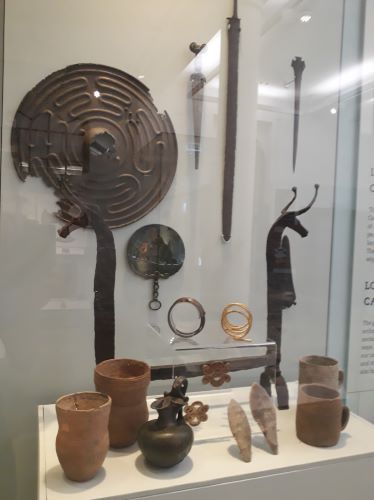
Beyond coinage, there is abundant evidence of intensification in Roman trade contacts with southeast Britain. The emergence in Britain of Roman and continental goods such as wine, pottery, glass, and metalwork would have helped to increase the differentiation between tribal elites and lower classes. Roman burial artifacts retrieved from iron-age tombs should be seen as part of the same phenomenon. According to the widely accepted hypothesis, members of the British elite monopolized imported Roman goods and controlled their distribution, in order to enhance their local prestige, and, thus, their control over society.22
Furthermore, Strabo actually saw Britons in Rome, and could base his description of their appearance on these encounters.23 These Britons could have been anything from imported slaves to those British kings who were said by Strabo, as well as by Augustus’ Res Gestae, to have come to see the princeps as supplicants.24 In fact, Strabo’s testimony to British kings making offerings on the Capitol should be highlighted, especially coming as it does from an original source and a likely eyewitness:
At the present, however, some of the chieftains there obtained the friend-ship of Caesar Augustus by their embassies and solicitations, and have not only dedicated offerings in the Capitol, but have also managed to make the whole of the island virtually Roman property (καὶ οἰκείαν σχεδόν τι παρεσκεύασαν τοῖς Ῥωμαίοις ὅλην τὴν νῆσον). Further, they submit so easily to heavy duties [. . .] that there is no need of garrisoning the island.
The privilege of offering such dedications would have been granted to kings with the status of clients, whereas the circumstances of the dedication could have been the very act of the formal Roman recognition of these kings as rulers.25 Since the time of the republic, foreign rulers had offered their acceptance of Roman hegemony through sacrifices and dedications made on the Capitol, and copies of treaties would have been kept there too.26
Now, Gaius Caligula’s intentions with regard to Britain are seldom taken seriously. The hostile literary sources—Suetonius and Dio—are not greatly helpful in clarifying the emperor’s designs in relation both to Britain and to Germany.27 At least regarding the bridge of boats built in 39 CE across the northern part of the bay of Naples, between Baiae and Puteoli, Suetonius knew of two seemingly rational prevailing interpretations for the arrangement of the spectacle: some thought that it was done in imitation of Xerxes’ bridging of the Hellespont, others, that it was meant to inspire fear in Germany and Britain.28
The fact that a campaign indeed followed in the regions of the Rhine and the British channel does lend force to these explanations. And, despite Suetonius’ scorn of the event, we should pay heed to another British leader, Adminius son of Cunobelinus, who escaped from Britain to Gaius, an act paraded in Rome ‘as if the entire island submitted to him.’
Seen against this backdrop of a tightening relationship between Rome and southern Britain, it is a remarkable fact that, throughout the century that elapsed between the invasions of Caesar and Claudius, the role of Britain remained constant in Roman cosmology—as a distant, primitive place, located beyond the boundaries of the inhabited world. Indeed, to begin at the very end, even conquest itself did not introduce too rapid a change to this representation, and, as the southern part of the island was moving towards standardized forms of provincialization, familiar to the historian from the provincial world in its entirety, estranging descriptions such as that of Pomponius Mela could still be written:29
The nature of Britain and its inhabitants should soon be described more clearly and on the basis of greater exploration. For, after it has been closed for so long, the greatest emperor is opening it up, the conqueror of peoples not only yet untamed, but also completely unknown. Just as he is pursuing the truth of facts themselves in war, so he is bringing it back to be presented in his triumph.
Such statements, it must be emphasized, did not just strive to present the achievement of the emperor in a flattering light, regardless of the actual situation in the field. They rather fell in line with a long series of similar previous representations, which had gradually grown more dissonant with the dynamic reality.
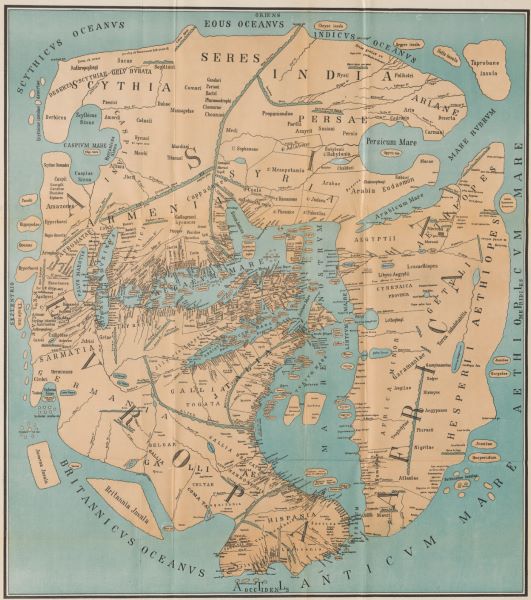
The main reason for this growing dissonance appears to lie in the strong emphasis that was usually put on Ocean as the boundary of the inhabited world, and, by implication, on Britain as a place beyond that boundary. While this cosmology regularly played a symbolic part in the daily routine of imperial propaganda, it could have had distinctly tangible implications when the actual boundary-line of the empire had to be negotiated, in this case for the purpose of its extension to include Britain. It was a world-order inherited from similar Greek ideas, though it was probably Alexander’s empire above all that accentuated the physical role of Ocean as the endpoint to all expansionist ambitions.30
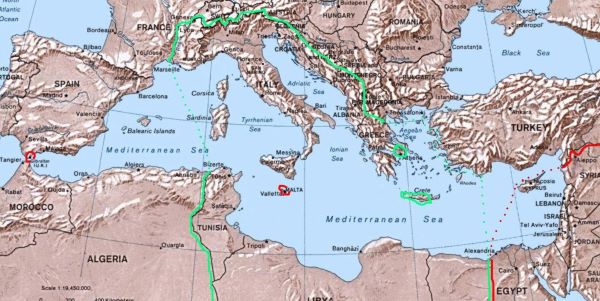
The notion of mare nostrum is essential here, and, since modern interpretations of it are often misguided, it deserves some attention. The problem usually lies in drawing too direct lines between the occurrence of the term and an alleged Roman perception of political ownership over the Mediterranean. Such a reading of mare nostrum would typically go hand in hand with simplistic descriptions of Roman imperialism, recognizing the early Punic wars—particularly the second one—as the origin of Roman aspirations in the Mediterranean; and the conquests of the late republic, culminating with Augustus and the annexation of Egypt, as realizing these aspirations in a gradual process of expansion, concluding with the obtainment of control over the sea in its entirety.31 More nuanced interpretations go as far as to suggest that the title—and, by implication, the imperialistic agenda which it must have represented—were conceived teleologically, with Roman thinkers and politicians narrating past motivations in light of present achievements.32
When examined in context, however, the employment of mare nostrum by Roman writers, especially in its early occurrences, does not reveal itself to be connotative of political power and empire. Instead, it is employed mostly in order to supply geographical distinction and a means to differentiate between the sea in ‘our side of the world’ and other regions of the known world—be it the Atlantic Ocean on the West; the Mesopotamian empires on the East; or, more specifically, the further, landlocked end of Mediterranean provinces, such as Africa.33 Pomponius Mela himself, quoted above as the very example of partisanship for Claudian imperialism beyond the Mediterranean realm, merely defines the term mare nostrum as the Mediterranean’s proper name, and continues to use it as such on more than a dozen occasions in his Description of the World.34 If these descriptions go beyond using the term mare nostrum as a mere geographical name, it is only to connote a sense of a sea shared by the sum of all societies residing on its shores and islands.35
The mare nostrum that emerges from these descriptions is recognizable from the Greek usage of that self same term, and close derivatives thereof. From Hecataeus of Miletus onward, the Mediterranean had been described by Greek thinkers as anything from ‘our sea’ to ‘the sea next to us’, or ‘the sea in our part of the world’.36 Of course, even when Thucydides and others refer to the Mediterranean as a ‘Hellenic sea’, they refer to a phenomenon which is cultural far more than it is political.37 When they write about ‘their sea’, therefore, also the Roman writers should be seen as imagining themselves more as part of Plato’s congregation of frogs than as the masters of the Mediterranean.38 When the time comes, it is leaving the familiarity of this pond that proves most difficult.
Caesar was ever mindful of the otherworldliness of Britain, even as his approach remained practical, allegedly sailing to Britain to eliminate threats he recognized there to his achievements in Gaul, and dealing with the vicissitudes inflicted on him by the unfamiliar Ocean in a straightforward manner—for example by learning to anchor his ships at a greater distance from one another on account of the higher Atlantic tides. Indeed, this approach is characteristic of the Roman general in the field, somewhere on the outskirts of the known world, venturing to cross into the unfamiliar, usually for the declared purpose of reconnaissance—and for the unhidden desire for private glory. The list of such ventures is long and distinguished enough, and includes C. Cornelius Gallus’ campaign in the Sudan in 29 BCE; L. Cornelius Balbus’ expedition to the land of the Garamantes in 19 BCE; and C. Suetonius Paullinus’ crossing of the Atlas mountains in 41 CE. To be sure, these daring reaches beyond the cosmological conventions regularly concluded in retreat, and, beyond introducing novelties to Roman awareness, they had little actual effect on Roman expansion.
Despite Caesar’s significant contribution to the Roman world’s familiarity with Ocean and Britain, the sea continued to be represented as the natural boundary line of the empire, and the island—as the very contrast of Roman civilization. The tension between this dichotomic representation and the growing familiarity portrayed above may be seen in all its clarity during the Augustan period, when the administration’s contacts with Britain were left out of the Roman cosmology as it was represented in such documents as Strabo’s Geography and the Res Gestae;39 and when those same poets who imagined Augustus invading Britain continued to regard the island as a place completely detached from their own world.40
If doubts regarding the role of Ocean in Roman cosmology began to infiltrate during the Augustan period, they disappeared quickly as a result of a catastrophic expedition along the coasts of the Northern Sea early during the reign of Tiberius. The campaign of Germanicus in the year 16 is an episode little-heeded by modern day scholarship, yet it is transmitted by the sources as a significant event, traumatic not only to the commander and his troops, but also to Roman society more generally. The ambitious endeavor saw a fleet of one thousand ships launched from the region of the lower Rhine, down that river, and into the Wadden Sea. The fleet then sailed an estimated distance of 150 km in the Ocean itself, to the point of the outlet of the Ems, where it turned to sail up that river, towards the disembarkation of the troops and the land-campaign that followed against the Cherusci.
It was the way back, taken along the same route, that saw this gigantic army encounter Ocean’s wrath, in a storm that scattered the fleet as far as Britain, and destroyed a significant part of it. Tacitus tells us that ‘not a man returned from the distance without his tale of marvels — furious whirlwinds, unheard-of birds, and enigmatic shapes half-human and half-bestial.’41 A still more vivid testimony comes from the contemporary Albinovanus Pedo, a poet and a soldier in Germanicus’ army, who was in all likelihood an eyewitness to the disaster:42
Where are we being carried? Day itself is in flight, furthest nature shuts off in everlasting shadows the world we have left. Are we looking for races beyond, in another clime, a new world untouched by breezes? The Gods call us back, forbid us to know the end of creation with mortal eyes. Why do our oars violate seas that are not ours, waters that are holy? Why do we disturb the quiet home of the Gods?
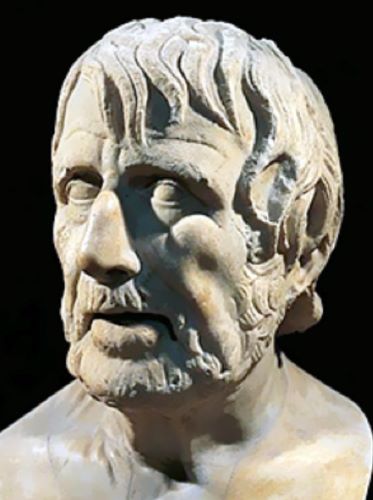
The lines may be poetic, but their tones are shared by the practical elaboration of another contemporary—Seneca the Elder—who chose this timing to dedicate his first suasoria to the topic: ‘Alexander considers whether he should sail the Ocean.’43 The declamatory narration, rhetorical in nature, gives a wide stage to the traditional perception of Ocean, falling in line with the familiar cosmology of the age, and easily imaginable as complementary of Strabo’s practical arguments against crossing to Britain.
It is this mindset of Albinovanus Pedo, his fellow soldiers, and the Roman public more generally, that we should keep in mind as we turn, finally, to consider once more Gaius Caligula. The variety and nature of his unique maritime undertakings may receive a rational interpretation when aligned with this atmosphere of general apprehension regarding Ocean. Other than the bridge of boats in the bay of Naples we have to consider the much ridiculed event of the battle-line drawn by Gaius against the shores of Ocean, and the collection by the troops of sea-shells as booty:44
Finally, as if he intended to bring the war to an end, he drew up a line of battle on the shore of the Ocean, arranging his ballistas and other artillery; and when no one knew or could imagine what he was going to do, he suddenly bade them gather shells and fill their helmets and the folds of their gowns, calling them ‘spoils from the Ocean, due to the Capitol and Palatine.’
The episode has been interpreted as describing a mutiny of the troops and the ridiculing punishment conceived by the emperor in return for their cowardice.45 A mutiny, as we shall see, may well have broken out. But Gaius’ actions here may be interpreted more plausibly as aiming to produce a symbolic subjugation of the Sea, that comes as a prelude to crossing it. And the symbolism of this act was in effect supplemented by the measure—at once symbolic and practical—of building a lighthouse on the spot which would have been envisioned as the port of departure for the invasion, and the future link of the invading forces with the mainland they leave behind.46
Such an approach should also encompass the ship that was built to bring the Vatican obelisk from Egypt, and was later sunk by Claudius at the entry to the harbor of Portus, forming the base for the artificial island on which the famous lighthouse was mounted.47 Other innovative vessels—Liburnian galleys with ten banks of oars—are reported by Suetonius, who obviously focuses on their fanciful luxuriousness.48 And the list of enterprises of maritime nature does not end here: the reference to seawalls (moles) built into the open sea may well refer to the construction of harbors, based on the experience accumulated in Herodian Caesarea Maritima, and anticipating—or maybe even initiating—the building of Portus itself.49 To be sure, the two gigantic ships built in Lake Nemi have so far been considered in context with the emperor’s notorious profligacy.50 The archaeology of the ships demonstrates state-of-the-art technology, and notable innovations in naval technology, manifested, for example, in the anchors and the water-pumps.51 The fact that the ships were probably deliberately sunk in the lake shortly upon Gaius’ assassination suggests common public knowledge of them.52
In light of the discussion presented here, it may very well be that Gaius—who personally did not particularly like the sea and did not know how to swim—had far more practical intentions behind these projects than previously imagined.53 Conceivably, he was guided by aspects of public opinion and the mental preparation of the army towards a major reach beyond the cosmological convention of mare nostrum—namely, the invasion of Britain. By portraying himself as a leader capable of mastering the sea, he was not so much aiming to intimidate his intended enemies beyond Ocean, but rather to instill confidence in the hearts of his own people, in effect foreseeing the mutiny that was bound to arise at the eve of the Channel crossing.
Endnotes
- Dio 60.19: Καὶ οὕτως ὁ Πλαύτιος στρατηγήσας τὸ μὲν στράτευμα χαλεπῶς ἐκ τῆς Γαλατίας ἐξήγαγεν. ὡς γὰρ ἔξω τῆς οἰκουμένης στρατεύσοντες ἠγανάκτουν, καὶ οὐ πρότερόν γε αὐτῷ ἐπείσθησαν . . . [‘Thus it came about that Plautius undertook this campaign, but he found it difficult to lead his army outside of Gaul. For the soldiers were vexed by the thought of car-rying on a campaign outside the known world, and would not be prevailed upon . . .’]. Unless stated otherwise, translations are supplied by the author of the article.
- In 49, for example, the pomerium of the city of Rome was extended on the grounds of Claudius’ conquests ‘beyond Ocean’. See Tac. Ann. 12.23–4; ILS 212–13; G. Gambash, ‘Official Roman Responses to Indigenous Resistance Movements: Aspects of Commemoration’, in H. Cotton, J. Geiger, and G. Stiebel (eds.), Israel’s Land: Collected Papers (Tel Aviv/Jerusalem 2009), 54–56.
- Strabo 4.5.3; Tac. Agr. 13: ‘So, first of all the Romans, the divine Julius invaded Britain with an army. Although he scared the inhabitants with successful fighting and gained control over the coast, he can be seen to have revealed the island to posterity, not to have delivered it to them.’
- See more below on both authors and their biases.
- S.S. Frere, Affiliate disclosure: Amazon links on this site are paid links. As an Amazon Associate I earn from qualifying purchases.Britannia: a History of Roman Britain (London/ New York 1978), 27; D. Braund, Rome and the Friendly King: the Character of the Client Kingship (London/ New York 1984), 64.
- Tac. Agr. 13.
- G. Gambash, ‘To Rule a Ferocious Province: Roman Policy and the Boudican Revolt’, Britannia 43 (2012), 1–15.
- Dio 49.38.2; 53.22.5; 53.25.2.
- Hor. Odes 1.35.29–30; 3.5.1–4; 4.14.45–8; Epodes 7.7–8. Tibullus 3.7.148–50. Ovid (Met. 15.752) goes as far as to proclaim that Augustus ‘conquered the Britons, surrounded by the sea’. See also Virg. Ecl. 1.66: ‘The Britons, wholly isolated from the entire world’ (with Servius commenting: ‘[Britain] is an island set in the northern Ocean, and poets call it “another world” ’). See J. Arieti, ‘Horatian Philosophy and the Regulus Ode (Odes 3.5)’, TAPA 120 (1990), 209–220.
- RG 32. See also P. Salway, Roman Britain (Oxford 1981), 47.
- For Caesar see BG 4.21; 5.20. For Gaius see Suet. Cal. 44. For Claudius see Dio 60.19.
- RG 31: Ad me ex India regum legationes saepe missae sunt non visae ante id tempus apud quemquam Romanorum ducem. Nostram amicitiam appetiverunt per legatos Bastarnae Scythaeque et Sarmatarum qui sunt citra flumen Tanaim et ultra reges, Albanorumque rex et Hiberorum et Medorum [‘Embassies were often sent to me from the kings of India, a thing that had not happened until that time to any other Roman leader. Ambassadors came to seek our friendship from the Bastarnae and Scythians, and from the kings of the Sarmatians who live on either side of the river Tanais, and from the king of the Albani and of the Hiberi and of the Medes’]. Cf. RG 32: Ad me supplices confugerunt reges Parthorum Tiridates et postea Phrates regis Phratis filius. Medorum Artavasdes, Adiabenorum Artaxares, Britannorum Dumnobellaunus et Tincommius, Sugambrorum Maelo, Marcomanorum Sueborum . . . rus [‘The kings of the Parthians, Tiridates and then Phrates, the son of king Phrates, fled to me as suppliants. Of the Medes Artavasdes, of the Adiabeni Artaxerxes, of the Britons Dumnobellaunus and Tincommius, of the Sugambri Maelo, of the Marcomanni and Suevi . . . rus’].
- G. Woolf, Becoming Roman: the Origins of Provincial Civilization in Gaul (Cambridge 1998), 36–37.
- Braund 1984, op. cit. (n. 5), 55–8; 165–7.
- The Atrebates/Regni; the Catuvellauni/Trinovantes; and Kent. See D. Nash, Settlement and coinage in Central Gaul c. 200–50 BC (Oxford 1978).
- D. Nash, Coinage in the Celtic World (Oxford 1987), 128–130. Frere 1978, op. cit. (n. 5), 29–30.
- Strab. 2.5.8: ‘For although they could have held Britain, the Romans disdained to do so, because they realized that there was no reason to fear the Britons—they are not powerful enough to attack us—and that they would gain nothing by occupying their country’.
- D. Braund, Ruling Roman Britain: Kings, Queens, Governors and Emperors from Julius Caesar to Agricola (New York 1996), 80–89.
- For example, beyond the Rhine, in the region from lower Germany to the middle Danube; see E.N. Luttwak, The Grand Strategy of the Roman Empire from the First Century A.D. to the Third (Baltimore 1976), 21.
- For Verica see R.D. Van Arsdell, Celtic Coinage of Britain (London 1989), 170, 533–1; 172, 551–1. For Cunobelinus see ibid. 421, 2089–1.
- M. Crawford, Coinage and Money under the Roman Republic (London 1985), 273–5.
- C.C. Haselgrove, ‘Wealth, Prestige and Power: the Dynamics of Late Iron Age Political Centralization in South East England,’ in C. Renfrew and S. Shennan (eds.), Ranking, Resource, and Exchange (Cambridge 1982), 79–88; C.C. Haselgrove, ‘Romanization before the Conquest: Gaulish Precedents and British Consequences,’ in T.F.C. Blagg and A.C. King (eds.), Military and Civilian in Roman Britain (Oxford 1984), 1–64; M. Millett, The Romanization of Britain. An Essay in Archaeological Interpretation (Cambridge 1990), 35–9; D.J. Mattingly, An Imperial Possession: Britain in the Roman Empire, 54 BC–AD 409 (London/ New York 2006), 84.
- Strabo 4.5.2: ‘I myself saw in Rome young men towering as much as half a foot above the tallest people in the city, although they were bandy-legged and their figure presented no attractive lines otherwise’.
- Strabo 4.5.3.
- For the significance and circumstances of dedications made on the Capitol by client kings and communities see C. Reusser, Der Fidestempel auf dem Kapitol in Rom und seine Ausstattung (Rome 1993); Braund 1996, op. cit. (n. 18), 85.
- F. Millar, Rome, the Greek world, and the East: vol. 2: Government, Society, and Culture in the Roman Empire (Chapel Hill, NC 2004), 200; R. Mellor, ‘The Dedications on the Capitoline Hill’, Chiron 8 (1978), 319–330.
- Suet. Cal. 44 & 46. Dio 59.25. For the event and its interpretations, see S.J.V. Malloch, ‘Gaius on the Channel Coast’, CQ 51.2 (2001), 551–556.
- Suet. Cal. 19: ‘I know that many people thought that Gaius devised such a bridge in emulation of Xerxes, who drew considerable admiration by bridging the narrower Hellespont; others thought that it was to inspire fear in Germany and Britain—which he planned to invade—by the rumor of some stupendous project’.
- Pomp. Mel. 3.41.
- See, for example, Diod. Sic. 17.104; Justin, Epitome 12.10.6.
- Examples are ubiquitous, and come from various perspectives on the Mediterranean; below I borrow a couple of useful definitions for such perspectives from: P. Horden, ‘Mediterranean Excuses: Historical Writing on the Mediterranean Since Braudel,’ History and Anthropology vol. 16/1 (2005), 25–30. To Matvejević (dubbed by Horden the ‘rhapsode’), the Romans employed the term merely because the sea ‘belonged’ to them: P. Matvejević, Mediterranean: a Cultural Landscape (trans. M.H. Heim, Berkeley 1999), 142–143. And Abulafia (a ‘reductivist’, according to Horden) dedicates a traditional chapter to ‘our sea’, highlighting Roman political and economic ambitions, culminating under Augustus in a ‘single rule over mare nostrum’: D. Abulafia, The Great Sea (Oxford 2011), 191–203. The same notion pervades discussions which adopt a wider scope, observing longue durée processes in the Mediterranean: Rome’s objective was thus ‘to defeat all Mediterranean rivals, until the sea became mare nostrum’, as puts it S.C. Calleya, ‘Bridging History and Future Security Policy’, in J.B. Hattendorf (ed.), Naval Policy and Strategy in the Mediterranean (London 2000).
- E.g. H. Beck, ‘The Second Punic War: The Reasons for the War’, in D. Hoyos (ed.), A Companion to the Punic Wars (Malden, MA 2011).
- Thus Livy’s descriptions of the western parts of the Mediterranean, bordering with Ocean (e.g. Liv. 26.42; 28.1; 41.1); Sallust’s geographical setting for the Jugurthine War (Sal. Jug. 17); and Caesar’s practical insights regarding differences between sailing the Ocean and ‘our sea’ (Caes. BG. 5.1). The same applies to later writers, already living alongside a politically unified Mediterranean, certainly Pliny the Elder, who makes abundant usage of the term (e.g. Plin. NH 6.32; 6.35; 12.32; 13.48).
- Pomp. Mel. 1.7; then passim.
- Livy’s mare nostrum is just as Carthaginian as it is Roman (Liv. 26.42; 28.1). The Mediterranean appears on a good number of occasions as the home of a variety of peoples and cultures: Sal. Jug. 18; Pomp. Mel. passim; Plin. NH passim.
- Hecataeus F302c: ἡ ἡμέτερα θάλασσα; Hecataeus F18b: ἡ κάθ’ ἡμάς θάλασσα; Plato, Phaedo 113a: παρ’ ἡμίν θάλασσα; Herodotus prefers ‘this sea’ (Hdt. 1.185; 4.39; 4.41: ἀπὸ τῆσδε τῆς θαλάσσης).
- Thuc. 1.4.
- Plato, Phaedo 109 a–b: ‘I believe that the earth is immense and that those of us located between the pillars of Heracles and the river Phasis (Rioni) live in a small part of it around the sea, like ants or frogs around a pond, and that many other people live in many other such places.’
- Strab. 2.5.5: ‘In one of these quadrilaterals (it is of no consequence in which one) we say that our inhabited world is situated, surrounded by the sea and like an island’; RG 26.1–2: ‘I extended the boundaries of all the provinces which were bordered by races not yet subject to our empire. The provinces of the Gauls, the Spains, and Germany, bounded by the Ocean from Gades to the mouth of the Elbe, I reduced to a state of peace’.
- See above, note 9.
- Tac. Ann. 2.24.
- Albinovanus Pedo (ap. Seneca Suas. 1.16–23), here in the translation (and see also the useful commentary) of M. Von Albrecht, Roman Epic (Leiden 1999), 209–215.
- Seneca Suas. 1: ‘Nature gave limits to everything to which she gave magnitude: nothing is infinite other than Ocean! [. . .] Here lies the motionless sea, an indolent, shapeless mass of nature, isolated within its own boundaries. This deep great void nourishes terrible, unknown shapes, and great monstrosities; the light is mixed with dense mists; the day is carried off by darkness; the heavy water lies fixed; and there are no stars, or they are unknown. This is, Alexander, the nature of things: beyond everything there lies the Ocean, beyond the Ocean—nothing.’
- Suet. Cal. 46; Dio 59.26.
- A. Winterling, Caligula: A Biography (Berkeley 2011).
- See Braund 1996, op. cit. (n. 18), 91–5.
- See Plin. NH 16.201. The report on the ship’s connection to Portus is supplied by Suetonius (Suet. Claud. 20).
- Suet. Cal. 37: ‘He also built Liburnian galleys with ten banks of oars, their sterns studded with gems, their sails multicolored, with great baths, colonnades, and banquet-halls, and even a great variety of vines and fruit trees; so that he might travel along the shores of Campania amid songs and choruses, reclining at table from an early hour’.
- Suet. Cal. 37.3: Et iactae itaque moles infesto ac profundo mari . . .
- R. Lanciani, ‘The Mysterious Wreck of Nemi’, The North American Review 162.471 (1896), 225–234; R. Lanciani, New Tales of Old Rome (New York 1902), 212; J.F. Gummere, ‘The Ships in Lake Nemi’, The Classical Weekly 22.13 (1929), 97–98; G. Ucelli, Le Navi di Nemi (Rome 1950).
- P.A. Gianfrotta, ‘Ancore “romane”. Nuovi Materiali per lo studio dei traffici marittimi’, Memoirs of the American Academy in Rome 36 (1980), 103–116.
- Ucelli 1950, op. cit. (n. 50), 85–97.
- Suet. Cal. 54.
Chapter 2 (20-32) from Rome and the Worlds Beyond Its Frontiers, Edited by Daniëlle Slootjes and Michael Peachin (Brill, 11.17.2016), published by OAPEN under the terms of a Creative Commons Attribution-NonCommercial 4.0 International license.
About the Author