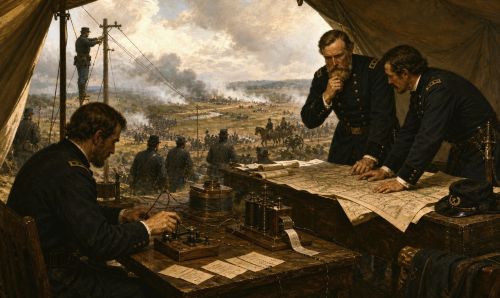
The telegraph transformed warfare by compressing distance, accelerating command, coordinating logistics, and creating the foundations of modern military communication.

By Matthew A. McIntosh
Public Historian
Brewminate
Introduction: War Before Instant Communication
Before the electric telegraph, military command moved at the speed of bodies, animals, ships, roads, weather, and human endurance. Orders traveled by courier, dispatch rider, staff officer, signal flag, semaphore tower, drumbeat, bugle call, naval signal, or written message carried across uncertain terrain. These systems could be sophisticated, disciplined, and effective within their limits, but they remained bound to physical movement. A ruler in a capital might wait days or weeks for reliable news from a distant army. A general might make decisions from intelligence already stale by the time it arrived. A subordinate commander might act with broad discretion because no superior could intervene quickly enough to shape events in real time. Distance did not merely separate armies from governments. It created independent zones of decision, uncertainty, rumor, and risk.
This slower communications world shaped strategy itself. Commanders had to plan with delay in mind, issuing broad instructions rather than continuous direction. Campaigns depended on anticipation, staff organization, local initiative, and the ability to interpret incomplete information. Even highly organized military systems could not escape what later theorists would call the friction of war: roads failed, messengers were captured, dispatches were misunderstood, weather blocked movement, and battlefield conditions changed faster than information could travel. In the Napoleonic era, for example, courier networks, staff procedures, optical semaphore systems, and written orders allowed large armies to operate across wide spaces, but they did not create instantaneous command. Napoleon could coordinate corps with remarkable skill, yet even his system required subordinates to act before fresh instructions could reach them. War remained a contest fought partly inside the gap between event and knowledge.
The telegraph changed that relationship by compressing time. It did not abolish confusion, distance, or error, but it made long-distance military communication less dependent on the movement of a horse, ship, or courier. Once electric messages could pass across wires in minutes, political leaders and senior commanders began to imagine new forms of strategic control. Armies could be monitored more closely, railroad movements coordinated with greater precision, and orders revised in response to news that would previously have arrived too late to matter.
I trace that transformation chronologically, from the limits of pre-telegraph command to the emergence of electric communication, its early military and imperial uses, and its decisive importance during the American Civil War. It pays particular attention to Abraham Lincoln’s use of the War Department telegraph office, the Union’s integration of telegraphy with railroads and logistics, the work of military operators near the front, and the new problems of interception, wire-cutting, cipher security, and information overload. The telegraph did not make war orderly. It changed the structure of disorder. It gave commanders faster access to events while creating new pressures to act before meaning was clear. It laid the foundations for modern command-and-control systems and for one of modern warfare’s central dilemmas: the belief that faster communication can master uncertainty, even as it creates new forms of dependence and vulnerability.
Couriers, Signals, and the Limits of Pre-Telegraph Command

Before electric communication, military command depended on systems that were ingenious but slow. Armies used mounted couriers, staff officers, runners, drums, bugles, flags, beacon fires, naval signal books, and written dispatches to move information across distance. These methods gave commanders practical tools for coordination, but none freed war from geography. Messages still had to cross roads, rivers, mountains, seas, enemy patrols, weather, and exhaustion. Communication was not a neutral background to strategy. It shaped what commanders could know, when they could know it, and how much independence they had to grant to subordinates operating beyond immediate reach.
Couriers were the most flexible and enduring form of long-distance military communication. They could carry detailed written orders, interpret instructions when trusted, and adapt their routes to changing conditions. Yet their strengths were also their limits. A courier could be delayed, lost, captured, killed, bribed, or misunderstood. A message might arrive after the situation it described had already changed. Commanders often wrote orders with that uncertainty in mind, giving broad intentions rather than precise real-time instructions. This meant that military command before the telegraph depended heavily on judgment at the edges of authority. Subordinate officers were expected to understand not only what had been ordered, but what the commander would likely want if the original situation no longer existed.
Armies also used visual and acoustic signals, but these worked best within limited tactical spaces. Drums and bugles could regulate movement, formation, camp routine, and battlefield action, but they could not carry complex strategic information across long distances. Flags, rockets, lamps, and semaphore systems extended the range of signaling, especially in naval warfare and fixed territorial networks. The French optical telegraph, developed in the revolutionary era, showed how messages could move faster than couriers when stations were properly placed and visibility was favorable. But optical systems depended on line of sight, trained operators, fixed infrastructure, daylight, and workable weather. They could accelerate state communication, yet they remained vulnerable to fog, darkness, terrain, and disruption. Their greatest limitation was that they improved speed without fully escaping geography. A semaphore station could transmit rapidly only if the chain remained intact, the operators were present, and the next station could be seen. In wartime, those conditions were fragile. A broken link, obscured horizon, or captured station could interrupt the entire system.
The Napoleonic Wars reveal both the power and the limits of pre-telegraph command. Napoleon Bonaparte’s armies depended on staff work, courier networks, written orders, maps, reports, and the corps system, which gave subordinate commanders enough autonomy to move and fight at some distance from the main army. This system allowed speed and flexibility, but it also required trust, anticipation, and risk. Orders issued from headquarters might not reflect the situation by the time they arrived. Corps commanders might misunderstand the larger plan or act too slowly, too boldly, or too independently. Even Napoleon’s remarkable operational reach did not eliminate the delay between event and decision. His system worked because it managed uncertainty, not because it escaped it.
Naval warfare faced similar constraints. Fleets developed elaborate signal systems using flags, pennants, lanterns, guns, and prearranged codes, allowing admirals to direct formations, maneuvers, and attacks across visible distance. Such systems could be highly effective when fleets remained in sight and signals were recognized quickly. But storms, smoke, darkness, battle confusion, and the curvature of the horizon imposed hard limits. Once ships separated, admirals often lost direct control. Strategic communication over oceans still depended on dispatch vessels, ports, winds, and time. A government might learn of a naval victory, defeat, or blockade only after the event had already reshaped diplomatic and military possibilities. Even within a fleet, communication could break down at precisely the moment it mattered most. Battle smoke could hide flags, damaged rigging could prevent signals from being hoisted, and captains might interpret the same signal differently under pressure. Naval command required a balance between centralized direction and cultivated initiative, since admirals could not assume that their intentions would remain visible once combat began.
The result was a command culture built around delay. Before the telegraph, effective commanders expected gaps in knowledge and built strategy around them. They issued instructions broad enough to survive changing circumstances, relied on trusted subordinates, and accepted that battlefield reality would outrun communication. This did not make pre-telegraph warfare primitive. It made it differently organized. Authority was distributed because distance required it. The telegraph would not abolish uncertainty, but it would attack one of the oldest facts of war: the time between an event and the moment when distant authority learned of it.
Morse, Electric Telegraphy, and the Birth of Instant Distance
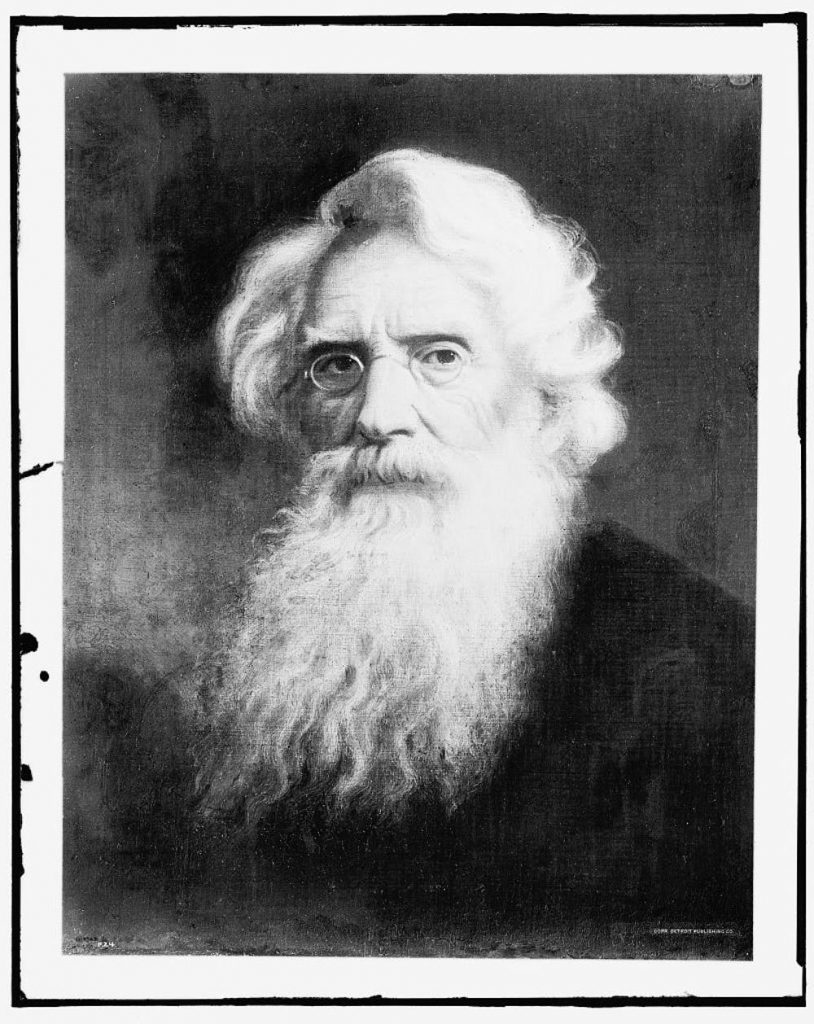
The electric telegraph emerged from a broader 19th-century world of scientific experiment, commercial ambition, state interest, and expanding communications networks. It should not be treated as the product of one isolated inventor or one sudden moment of genius. Experiments in electricity, magnetism, signaling, and coded transmission had been underway in Europe and the United States for decades before telegraphy became a practical system. Yet Samuel F. B. Morse, working with collaborators such as Alfred Vail and supported by public demonstration and federal funding, helped create a version of electric telegraphy that proved commercially and institutionally successful in the United States. The significance of the technology lay in its ability to detach communication from physical travel. A message no longer had to move only as fast as a horse, ship, train, or courier. It could move as an electrical signal across wire.
The famous 1844 message from Washington to Baltimore, “What hath God wrought,” captured the sense of wonder surrounding this new power. The phrase itself was biblical and ceremonial, but the achievement was practical. It announced that distance could now be crossed almost instantly by encoded language. The message traveled along a line linking the United States Capitol with Baltimore, demonstrating that electric communication could connect political centers, commercial hubs, newspapers, and transportation routes. The telegraph did not abolish the need for roads, rails, ports, or messengers, but it changed their relationship to information. Physical movement still carried people and goods. The telegraph carried instructions, warnings, market prices, election results, military reports, and news ahead of them.
Morse code was essential because it turned language into a transmittable system of electrical pulses. Letters became patterns of short and long signals that trained operators could send, receive, and translate. This was a technical transformation, but also an institutional one. Telegraphy required wires, batteries, instruments, offices, maintenance crews, trained operators, standardized procedures, and networks of trust. The machine alone did not create instant distance. Human skill and organizational discipline did. Operators became mediators between written language and electrical transmission, and their work introduced a new kind of communication labor into government, commerce, journalism, and eventually war. The telegraph was both an invention and a system. Its usefulness depended on routine as much as brilliance: messages had to be composed clearly, encoded accurately, transmitted over functioning lines, received without distortion, copied faithfully, and delivered to the correct person. The telegraph converted communication into infrastructure. Speed required not only electricity but administration.
Its early growth was driven largely by civilian needs. Merchants wanted faster price information. Newspapers wanted fresher reports. Railroads needed better coordination. Politicians and government officials recognized the value of rapid communication between cities. Telegraph companies expanded lines along commercial corridors, especially where business demand justified investment. This civilian expansion mattered for later warfare because military systems rarely arise from technology alone. They draw upon existing infrastructure, trained personnel, and institutional habits. By the time major conflicts required telegraphic command, the technology had already been woven into the economic and informational life of modernizing states. War would militarize a system that commerce and politics had helped build.
The military implications were visible before they were fully realized. A technology that could transmit market prices and election returns could also transmit mobilization orders, intelligence reports, logistics instructions, and warnings of enemy movement. Governments could communicate with distant commanders more quickly, coordinate transport, and respond to crisis with a speed earlier rulers could scarcely imagine. Yet adoption was uneven because military institutions had to learn how to use the telegraph effectively. Commanders accustomed to dispatches, couriers, and broad discretion had to adjust to a world in which superiors could ask for immediate reports and issue new instructions from afar. The telegraph offered control, but it also threatened established habits of command. It narrowed the space in which distant officers could act without scrutiny, even as it increased the amount of information flowing back to political centers. This produced a new tension between field judgment and central direction. The wire promised coordination, but it also invited intervention.
By the 1850s, electric telegraphy had begun to change expectations about time, distance, and authority. It created what might be called instant distance: the ability to communicate across space faster than armies, officials, or supplies could move. This new capacity would not make warfare simple. Messages could still be delayed, garbled, intercepted, or rendered useless by broken wires. But the strategic imagination had changed. Once leaders knew that distant events could be reported quickly, delay itself became less acceptable. The telegraph created a new standard for military and political responsiveness, laying the groundwork for the communication systems that would shape the Crimean War, imperial crises, and above all the American Civil War.
Early Military Uses: Europe, Empire, and the Testing of Telegraphic War

Before the American Civil War made the telegraph central to large-scale military command, European and imperial conflicts had already begun to reveal its strategic possibilities. The 1850s were a testing ground rather than a fully mature telegraphic age. Governments, armies, newspapers, merchants, and colonial administrators were still learning what electric communication could do and where its limits lay. The telegraph did not yet create seamless command over distant forces, but it shortened the distance between battlefield, capital, press, and public. It changed how quickly war could be reported, how rapidly decisions could be reconsidered, and how intensely governments could be judged by readers far from the front. Military communication was no longer simply a matter between commanders. It was becoming part of a larger informational system.
The Crimean War offered one of the first major demonstrations of this new relationship between war, communication, and public opinion. Britain, France, the Ottoman Empire, and Russia fought across a distant theater, but reports from the conflict reached home audiences with unprecedented speed compared with earlier wars. Telegraphy worked alongside steamships, newspapers, and war correspondence, creating a compressed political environment in which battlefield failures, supply problems, medical neglect, and command disputes could become public controversies. The telegraph did not eliminate logistical chaos or strategic confusion in Crimea. Indeed, the war became infamous for exposing administrative weakness. But it helped make that weakness visible more quickly. Distant war was no longer safely distant in political terms.
This change placed new pressure on governments and commanders. Reports from Crimea could shape parliamentary debate, public criticism, newspaper campaigns, and ministerial accountability. The famous journalism of William Howard Russell for The Times depended on broader changes in communication, including faster transmission and a public hungry for timely war news. The telegraph altered not only command but scrutiny. Military leaders and governments had to operate in an environment where failures could travel home faster than official explanations. This mattered for strategy because public opinion, logistics, and political authority were becoming harder to separate. A badly supplied army could become a domestic crisis. A distant defeat could become an argument about competence, reform, and national honor. The line between battlefield information and political consequence narrowed sharply. Command decisions still took place under conditions of uncertainty, but that uncertainty was now observed, criticized, and debated more quickly by civilians who were not physically near the war. The telegraph helped create a new burden for modern military states: they had to fight the enemy while also managing the speed at which failure became public knowledge.
Imperial settings revealed another side of telegraphic power. In India, telegraph lines became instruments of colonial administration and military response during the Indian Rebellion of 1857. British authorities used telegraphy to send warnings, coordinate movement, and communicate across distances that would previously have imposed much longer delays. The technology did not determine the outcome by itself, and British military power still depended on troops, railways, roads, informants, local allies, and brutal repression. Yet telegraphy strengthened the colonial state’s capacity to react across space. It gave officials a faster way to connect garrisons, administrative centers, and strategic nodes during crisis. In an empire built on distance, speed of communication became a form of power. The telegraph allowed fragments of information from scattered places to be gathered into administrative awareness, even when that awareness was incomplete or distorted by colonial assumptions. It also allowed orders, alarms, and requests for reinforcement to move ahead of physical force. This was crucial because imperial authority often depended less on constant presence than on the ability to project power quickly when challenged. Telegraphy made that projection more coordinated and more psychologically forceful.
The rebellion also showed that telegraphy created vulnerable infrastructure. Lines could be cut, stations attacked, operators threatened, and messages interrupted. The telegraph extended state power, but it also exposed new targets. Insurgents and rebels did not have to defeat an army to disrupt communication; they could attack the wires and stations that allowed officials to coordinate. This vulnerability would become a recurring feature of modern war. The same network that made command faster also created dependencies that enemies could exploit. Telegraphic warfare involved both communication and countercommunication: building lines, guarding them, repairing them, intercepting messages, and denying their use to opponents.
By the late 1850s, the telegraph had already proven that future wars would be fought in a different informational environment. Crimea showed that electric communication could bind battlefield events to newspaper publics and political accountability. India showed that telegraphy could reinforce imperial administration and military response while creating new vulnerabilities. These early uses did not yet amount to full modern command-and-control, but they changed expectations. Governments learned that information could arrive quickly enough to demand action. Publics learned that distant war could be followed with new immediacy. Armies learned that communications infrastructure could become as strategically important as roads, depots, and fortifications. The American Civil War would take these lessons further by integrating telegraphy into national strategy on an unprecedented scale.
The American Civil War as Telegraphic Turning Point
The American Civil War marked the decisive moment when the telegraph moved from promising communications technology to central instrument of military strategy. Earlier conflicts had shown that electric communication could accelerate news, strengthen administration, and connect distant theaters to political centers. The Civil War tested those possibilities on a continental scale. The United States and the Confederacy fought across immense distances, multiple fronts, river systems, railroad corridors, coastal zones, and contested border regions. In that environment, speed of information became inseparable from command. Reports of troop movements, battlefield outcomes, supply problems, railroad disruptions, and political emergencies could reach Washington or Richmond far faster than any courier could carry them. War was no longer governed only by the movement of armies. It was increasingly governed by the movement of information.
The Union held a major advantage because the North possessed stronger telegraph infrastructure, greater industrial capacity, more extensive railroad connections, and better access to the technical and administrative systems needed to sustain wartime communication. Telegraph lines connected Washington to major cities, military departments, supply centers, and railroad hubs. As Union armies advanced, military telegraph operators extended lines into the field, repaired broken wires, and linked commanders to higher authority. This did not make Union command smooth or omniscient. Messages could still be delayed, misread, intercepted, or rendered useless by changing events. But the Union’s communications network gave political and military leaders a capacity for coordination that the Confederacy struggled to match consistently.
The United States Military Telegraph Corps became one of the essential institutions of this new system. Although many of its operators were civilians, their work was inseparable from military operations. They transmitted orders, intelligence, casualty reports, logistical instructions, railroad notices, political messages, and urgent requests from commanders in the field. They followed armies, worked in exposed locations, repaired lines under pressure, and handled information whose value depended on speed and secrecy. Their labor also required judgment. Operators had to manage priority, accuracy, confidentiality, and the physical fragility of the system itself. A message sent too late, copied incorrectly, or delayed by a broken line could lose its military value almost immediately. The Corps showed that telegraphic war required more than wires and instruments. It required trained personnel, procedures, discipline, maintenance, security, and trust. A telegraph network was not simply a technology spread across the map. It was a human organization operating under wartime conditions, and its effectiveness depended on the people who kept electricity, language, and military necessity connected.
The telegraph also changed the relationship between Washington and the field. Political leaders could receive battlefield news in hours rather than days, and senior commanders could be pressed for updates with unprecedented immediacy. This altered the rhythm of strategy. Campaigns were still shaped by terrain, weather, logistics, morale, disease, and command judgment, but they were increasingly monitored from the capital. The government could track multiple theaters at once, compare reports, coordinate reinforcements, and respond to crises more quickly. The effect was not always positive. Faster communication could produce impatience, micromanagement, and pressure based on incomplete information. Yet even these problems reveal how much had changed. The telegraph made distance feel politically intolerable.
Confederate forces also used telegraphy, but their system faced severe structural weaknesses. The South had fewer industrial resources, more limited manufacturing capacity, shortages of wire and equipment, and a communications network vulnerable to Union advances. Confederate commanders and officials relied on telegraph lines where available, but those lines were harder to maintain, replace, and protect as the war strained southern infrastructure. Union raids and territorial gains disrupted communications, while the Confederacy’s broader logistical weaknesses limited its ability to exploit the technology as effectively. The contrast was not absolute, since Confederate telegraphy could be valuable and skillfully used, but the imbalance mattered. The war demonstrated that communications power depended on economic and industrial capacity as much as invention.
The Civil War became a turning point because it integrated telegraphy into the daily practice of national war. The technology helped connect political leadership, armies, railroads, supply systems, newspapers, and public opinion into a faster and more centralized wartime environment. It did not end uncertainty, nor did it guarantee good decisions. It changed the structure within which decisions were made. Commanders and governments could now act within a narrower interval between event and response. That compression of time became one of the defining features of modern warfare. In the Civil War, the telegraph proved that military power in an industrializing age would depend not only on soldiers, weapons, and transportation, but on the ability to collect, transmit, interpret, and act on information before opportunity disappeared.
Abraham Lincoln and the “Wired” Presidency

Abraham Lincoln’s use of the telegraph made the American Civil War a turning point not only in military communications but also in presidential war leadership. Earlier presidents could receive dispatches, consult generals, and issue orders, but they remained dependent on the slow movement of written reports and messengers. Lincoln governed in a different communications environment. The War Department telegraph office became one of his most important working spaces, a place where he could read military reports, follow campaigns, send inquiries, and communicate with commanders across distant theaters. This did not make him omniscient, nor did it eliminate the fog of war. It did reduce the distance between the presidency and the battlefield in ways no previous American administration had experienced.
Lincoln’s telegraphic habits reflected his broader development as commander-in-chief. He used the wire to ask questions, press for movement, request clarification, compare reports, and test the judgment of generals who often frustrated him by delay or caution. The telegraph allowed him to monitor George B. McClellan’s campaigns, follow developments in the western theater, communicate with Ulysses S. Grant, and respond quickly to emergencies. His messages could be brief, direct, and probing. They did not always command in detail, but they made clear that the president was watching, thinking, and expecting action. The telegraph strengthened civilian oversight of war by giving political authority a faster channel into military operations.
Yet the “wired” presidency also created new tensions. Telegraphic speed encouraged impatience because delay became harder to tolerate when communication itself appeared almost instantaneous. Lincoln could receive reports quickly, but those reports were often incomplete, contradictory, or shaped by the anxieties of the sender. A message from a general, governor, railroad official, or War Department officer might reveal a crisis without explaining its full context. The president faced a new burden: information arrived faster than interpretation. A fast report could make inaction look like negligence even when the facts remained uncertain. It could tempt leaders to intervene before commanders in the field had assessed terrain, supply, weather, enemy movement, and morale. It could also intensify political pressure, since Washington was not only a command center but a capital filled with congressmen, journalists, lobbyists, office-seekers, and anxious citizens. Lincoln’s skill lay partly in his ability to use the telegraph without entirely surrendering judgment to the urgency of the wire. He pressed commanders, but he also learned when distance still required trust.
Lincoln’s use of the telegraph helped establish a more modern model of presidential command. The commander-in-chief was no longer only a constitutional authority who set broad policy and waited for military news. He could participate in the rhythm of war as events unfolded, coordinating strategy, monitoring personalities, and responding to danger with unprecedented immediacy. This transformation did not make the telegraph a substitute for generalship, logistics, intelligence, or political judgment. It made those things more tightly connected to the executive center. By turning the War Department telegraph office into a nerve center of national strategy, Lincoln showed that modern war would bind political leadership to communications infrastructure as never before.
Telegraphy, Railroads, and the Logistics of Modern War

The military power of the telegraph was greatest when paired with the railroad. Each technology solved a different problem. The telegraph moved information faster than bodies could travel, while the railroad moved bodies and supplies faster than roads, rivers, and animal transport usually allowed. Together, they changed the operational scale of war. A commander could send orders ahead of troop movements, redirect trains, coordinate depots, report shortages, request reinforcements, and adjust supply priorities without waiting for couriers to cross the same distance. This did not make logistics effortless, but it made logistical command more responsive. War became less dependent on isolated columns carrying what they could and more dependent on networks of communication, transportation, repair, scheduling, and administration.
The American Civil War revealed this relationship with particular force. The Union’s advantage did not rest only on population, industry, finance, or manpower. It also rested on its ability to connect armies, factories, rail hubs, depots, ports, and political centers through communications and transport systems. Telegraph lines often followed railroad corridors, and railroad stations became natural nodes of military communication. This allowed Washington and departmental commanders to track movement, organize supply, move troops between threatened fronts, and respond to emergencies more rapidly than earlier command systems allowed. The railroad made speed physically possible. The telegraph made that speed governable.
Railroad logistics required coordination at a level that older military transport systems did not. Trains had to be scheduled, routed, loaded, unloaded, repaired, protected, and prioritized. Tracks could become congested. Bridges could be burned. Rolling stock could be insufficient. Civilian rail companies, military officers, quartermasters, engineers, and telegraph operators all had to cooperate under pressure. The telegraph helped make that cooperation possible by turning scattered railroad movements into a more visible system. A delayed train, damaged bridge, missing shipment, or urgent reinforcement request could be reported quickly and acted upon before the problem became strategically disastrous. It also helped administrators compare needs across different fronts, deciding whether troops, ammunition, food, or medical supplies had to move first. That kind of prioritization was itself a strategic act. The telegraph did not merely assist logistics. It helped make large-scale railroad logistics intelligible, turning movement into a managed system rather than a chain of isolated local decisions.
This integration was especially important because Civil War armies consumed enormous quantities of food, ammunition, clothing, medical supplies, animals, equipment, and replacement parts. The larger the army, the more it depended on reliable supply lines. Campaigns could stall not because soldiers lacked courage, but because wagons, railcars, rails, bridges, forage, and depots failed to keep pace with operational plans. Telegraphy allowed commanders and administrators to identify bottlenecks, request corrections, and coordinate movement across distance. It also made logistics more political. When a campaign failed, officials in Washington could ask more quickly whether the problem was generalship, transportation, supply, or administrative delay. The wire turned logistical failure into a question that could be pursued from the center.
The Confederacy’s difficulties showed the opposite side of the same transformation. Southern railroads were less integrated, often built with incompatible gauges, and increasingly strained by shortages, military pressure, and Union destruction. Telegraphy could help Confederate authorities coordinate where lines survived, but communication could not overcome structural weakness by itself. A message ordering supplies to move could not create locomotives, repair rails, replace bridges, or manufacture wire. Nor could rapid communication compensate for the cumulative damage caused by blockade, industrial scarcity, military raids, and the sheer difficulty of sustaining armies across a weakening transportation network. This distinction is important because it prevents exaggerating the telegraph as a magic instrument of modern war. Communication magnified capacity where capacity existed. Where industrial and transportation systems were fragile, the telegraph could expose weakness faster than it could solve it.
By linking communication and transportation, the Civil War pointed toward a modern understanding of strategy. Victory depended not only on battlefield maneuvers but on the ability to organize movement over time and space. Railroads gave armies reach; telegraphs gave administrators and commanders the means to coordinate that reach. Together they made war more centralized, more technical, and more dependent on infrastructure. They also created new targets. Rails could be torn up, bridges burned, wires cut, stations raided, and supply hubs attacked. Modern logistics expanded both military power and military vulnerability. The army that could move and communicate through networks gained enormous advantages, but it also had to defend the networks on which its speed depended.
Field Telegraphy, Operators, and the Human Infrastructure of Instant War

The telegraph’s military importance depended on people as much as machinery. Wires, batteries, poles, instruments, and portable equipment could not create instant command by themselves. They had to be installed, repaired, guarded, operated, interpreted, and integrated into military routine. During the American Civil War, this human infrastructure became especially visible through the work of telegraph operators, line repair crews, engineers, scouts, guards, clerks, and administrators who kept communication moving under conditions of uncertainty and danger. The telegraph made command faster, but only because human beings transformed electrical signals into military information.
Field telegraphy brought communication closer to the operational zone. As armies moved, telegraph workers extended lines toward headquarters, railroad depots, supply points, river landings, and forward positions. These lines were not permanent monuments of technology. They were fragile wartime systems stretched across contested landscapes. Poles could fall, wires could break, batteries could fail, and advancing or retreating armies could leave communications behind. Operators and repair crews worked in a rhythm of construction and improvisation. They built temporary networks, restored damaged connections, and tried to keep messages flowing even as military geography changed around them. This meant field telegraphy had to follow the war’s motion rather than simply wait in established offices. Communication lines were laid, shifted, abandoned, rebuilt, and protected according to the movement of armies. The result was a form of military infrastructure that was both technical and mobile, constantly adapting to terrain, weather, enemy action, and operational need.
Operators occupied a delicate position between civilian expertise and military necessity. Many had learned their skills in commercial telegraphy before the war, but military service placed those skills inside a world of secrecy, urgency, and command hierarchy. They transmitted orders, intelligence reports, logistical instructions, casualty information, and political messages that could affect campaigns and reputations. Accuracy mattered intensely. A misplaced word, delayed message, or misunderstood abbreviation could have consequences far beyond the telegraph office. Operators were not merely mechanical transmitters. They were trusted handlers of sensitive information, often working under pressure while surrounded by officers who needed the wire to produce certainty faster than war could supply it.
Their labor could also be dangerous. Telegraph personnel sometimes worked near active campaigns, exposed to cavalry raids, artillery fire, guerrilla attack, disease, exhaustion, and capture. Lines had to be repaired where they were broken, not where conditions were convenient. A severed wire could mean a lost connection to headquarters, a delayed order, or an army temporarily cut off from higher command. This gave repair work strategic importance. Restoring communication could be as urgent as repairing a bridge or clearing a railroad line. The telegraph operator and the line repairer became part of the army’s operational nervous system, keeping command connected across distances that the war constantly threatened to tear apart.
The human infrastructure of telegraphy also depended on discipline and trust. Commanders had to trust that messages were transmitted accurately and confidentially. Operators had to know which messages took priority, how to handle coded material, and when speed mattered more than procedural perfection. Administrators had to maintain personnel systems, equipment supplies, office routines, and relationships between military authorities and civilian telegraph companies. The telegraph’s apparent immediacy concealed a complex chain of labor. Before a general received a message, someone had written it, encoded or copied it, transmitted it, received it, transcribed it, delivered it, and sometimes repeated or clarified it. Every link in that chain could strengthen or weaken command. The process also required habits of reliability that could not be improvised in the middle of crisis. Operators needed shared conventions, steady nerves, and technical familiarity with instruments that might malfunction at the worst possible moment. The army’s confidence in the wire rested on the repeated performance of ordinary tasks under extraordinary pressure.
Field telegraphy reveals the social reality behind technological revolution. The Civil War did not become a telegraphic war simply because wires existed. It became one because skilled workers made those wires usable under military pressure. The promise of instant communication rested on hands, eyes, memory, judgment, and endurance. This matters because modern war often hides labor behind systems. The telegraph seemed to collapse distance, but it created a new class of military communication workers whose skill made distance manageable. They were not the most celebrated figures of the war, but without them the “instant” command of the telegraphic age would have remained an aspiration rather than a working military fact.
Speed, Security, and the New Problem of Interception

The telegraph accelerated command, but it also created new vulnerabilities. Every military communications system solves some problems while introducing others, and electric telegraphy was no exception. Messages could travel with unprecedented speed, but they traveled through exposed physical infrastructure: wires, poles, stations, relays, batteries, and operators. The same network that allowed commanders to transmit orders across distance also gave enemies something to cut, tap, capture, or deceive. Speed made information more powerful, but it also made communication more fragile. The faster command became, the more dangerous disruption could be.
Interception became one of the defining problems of telegraphic warfare. A courier could be captured with a dispatch in his pocket, but a telegraph line created broader possibilities for listening, tapping, copying, and manipulating communication. Armies could attach instruments to enemy wires, monitor traffic, seize stations, or exploit abandoned equipment. Messages were valuable not only for what they ordered but for what they revealed: troop movements, supply needs, command anxieties, strategic intentions, and political pressures. This made telegraphy part of military intelligence. A captured or intercepted message could expose more than an immediate order. It could reveal patterns of command, the location of headquarters, the urgency of shortages, the timing of reinforcements, or the confidence and hesitation of senior officers. Even routine traffic could become meaningful when read alongside maps, prisoner statements, newspaper reports, or cavalry reconnaissance. Control of communication increasingly meant control of knowledge, and control of knowledge could decide whether speed served one’s own army or the enemy.
Security measures developed, especially through codes and ciphers. Sensitive messages could be encoded so that interception did not automatically reveal meaning, but encryption introduced its own complications. Codes had to be distributed, protected, updated, and used correctly. Operators had to transmit coded groups accurately, even though such messages could be harder to check by ordinary sense. A single error could distort meaning or render a message unreadable. Ciphers also created administrative burdens: commanders needed access to codebooks, trusted personnel, and procedures for deciding which messages required protection. The telegraph created a new relationship between communication and secrecy. Messages could move faster than ever, but making them safe required discipline that sometimes slowed or complicated the very speed the technology promised.
The telegraph also increased dependence on infrastructure that could be physically attacked. Cavalry raids, guerrilla action, sabotage, weather, and ordinary wear could sever lines and isolate commanders. Cutting wires became a way to blind an opponent, delay reinforcements, confuse headquarters, or interrupt railroad coordination. Repair crews could restore service, but restoration took time, labor, and protection. This meant that communications infrastructure became part of the battlefield. A telegraph pole, wire, relay station, or operator’s office might look less dramatic than a fort or cannon battery, but its destruction could have strategic consequences. Modern war was beginning to reveal a new kind of target: the network.
Speed itself carried dangers even when messages arrived safely. Rapid communication could encourage leaders to act on incomplete reports, demand immediate answers, or mistake fast information for full understanding. A telegram could compress a complex battlefield situation into a few urgent lines, stripping away uncertainty, tone, and context. Commanders far from the front might receive fragments and feel compelled to intervene before local officers understood conditions clearly. The problem was not that the telegraph produced too little information, but that it produced information at a tempo that could outrun judgment. Telegraphy changed the fog of war rather than dispelling it. It made some facts arrive sooner while leaving their meaning uncertain.
Late 19th-Century Warfare and the Global Telegraphic Battlefield
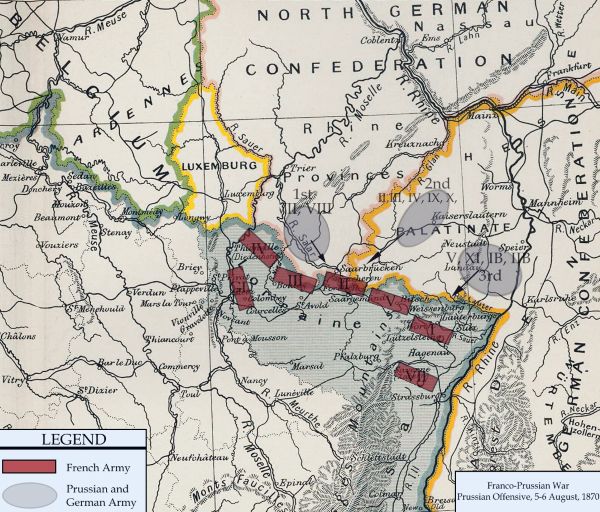
After the American Civil War, telegraphy became increasingly embedded in the military and imperial systems of the late 19th century. European states, colonial administrations, and general staffs recognized that rapid communication was no longer a useful supplement to command. It was becoming part of command itself. Wars were larger, armies more bureaucratic, mobilization schedules more complex, and empires more geographically dispersed. The telegraph helped connect capitals, ports, frontier posts, railway stations, naval bases, and administrative centers into strategic networks. Military power now depended not only on men, weapons, money, and transport, but on the ability to move information through these networks quickly enough to influence action.
The Franco-Prussian War of 1870–1871 showed how telegraphy fit into a broader system of modern military organization. Prussian success cannot be reduced to any single technology. It depended on staff planning, mobilization procedures, rail coordination, training, artillery, leadership, and French weaknesses. Yet telegraphic communication belonged to that larger structure. It helped connect political leadership, military headquarters, railway movement, and operational planning. The Prussian system demonstrated that speed in war was not only battlefield speed. It was administrative speed: the ability to mobilize, concentrate, communicate, and adjust faster than an opponent. Telegraphy made that administrative speed more practical.
Late 19th-century imperial warfare also depended heavily on communications infrastructure. Telegraph lines allowed European powers to connect colonies to metropolitan capitals, regional command centers, ports, and military outposts. Undersea cables extended this system globally, helping governments communicate across oceans in hours rather than weeks. This changed imperial strategy because distance no longer insulated colonial officials from metropolitan supervision in the same way. A crisis in Egypt, India, South Africa, or East Asia could be reported quickly, debated in parliament, and answered through orders from a distant capital. The imperial battlefield was increasingly connected to finance, diplomacy, newspapers, and public opinion at home. Telegraphy also allowed imperial governments to compare crises across regions, shift attention from one theater to another, and coordinate military response with commercial and diplomatic interests. A colonial uprising, border dispute, or naval incident could become part of a wider imperial calculation because information moved fast enough to be integrated into central decision-making. The empire was still vast, uneven, and difficult to control, but the telegraph made it appear more governable by turning scattered events into messages that could be collected, ranked, and answered from the center.
This global communications system also strengthened imperial coercion. Telegraphy helped administrators monitor unrest, coordinate troop movements, request reinforcements, and manage crises across dispersed territories. It supported the projection of power by making distant violence more quickly visible to the imperial center and by allowing the center to respond before events moved completely beyond control. Yet the same system exposed the fragility of empire. Telegraph lines, cable stations, relay points, and colonial offices became strategic vulnerabilities. Rebels, rival powers, and local opponents could disrupt communications by cutting lines, damaging stations, or threatening operators. The infrastructure of command became a target precisely because it had become valuable.
Naval strategy was transformed as well. The expansion of submarine telegraph cables meant that fleets, ports, coaling stations, and imperial bases could be integrated into wider systems of information. Sea power increasingly depended on communications as well as ships. Governments could relay orders to distant squadrons, receive intelligence from consuls and naval officers, and coordinate diplomacy with naval movement. But undersea cables also created strategic chokepoints. Control of cable routes and landing stations became part of international rivalry. A state that could protect its own communications and disrupt an enemy’s could gain advantages before major battle even began. Telegraphy extended the battlefield into the infrastructure of global connection.
By the end of the 19th century, warfare had entered a world in which communication networks were strategic terrain. The telegraph helped bind armies, navies, empires, markets, and publics into faster systems of decision and response. It did not remove uncertainty, nor did it guarantee efficiency or wisdom. But it changed what governments expected war to be. Commanders and ministers increasingly assumed that distant events should be knowable, that orders should travel quickly, and that military systems should be coordinated across wide spaces. The global telegraphic battlefield was not simply a matter of wires and cables. It was a new strategic environment in which power depended on controlling the movement of information as much as the movement of troops.
Command, Control, and the Foundations of Modern Military Communication
The following video from “IT’S HISTORY” is a history of the telegraph:
The telegraph helped create the foundations of modern command-and-control by linking political authority, military headquarters, field operations, logistics, intelligence, and transportation through communications networks. Earlier command systems had depended on delay, discretion, and broad instructions because distance made continuous supervision impossible. Telegraphy did not eliminate that older world all at once, but it changed its assumptions. Leaders increasingly expected reports to arrive quickly, orders to move rapidly, and distant theaters to remain connected to the strategic center. This was the beginning of a modern military problem: how to command forces spread across vast spaces without drowning in information, overreaching from headquarters, or confusing speed with understanding.
The transformation was not simply technological. It was institutional. Telegraphic command required signal organizations, trained operators, standardized procedures, message priority systems, cipher practices, repair crews, administrative discipline, and integration with railways, depots, staff offices, and political decision-making. A wire was useful only when embedded in a system capable of turning messages into action. This is why the telegraph’s military significance was clearest in states and armies with strong administrative capacity. Communication could accelerate command, but only institutions could make acceleration meaningful. Without organization, a fast message could produce confusion as easily as coordination.
The telegraph also altered the relationship between civilian and military authority. Political leaders could monitor campaigns more closely, demand reports more frequently, and intervene more directly than earlier rulers or ministers could. This strengthened central oversight, but it also created the temptation to manage war from a distance. The American Civil War showed both sides of this change. Abraham Lincoln used the telegraph with unusual skill, pressing generals and coordinating strategy while still learning the limits of remote command. Later military systems inherited the same tension. Faster communication gave leaders greater reach, but it did not give them perfect knowledge. The commander at headquarters could know more than before and still misunderstand what the field commander saw.
Modern command-and-control grew out of a paradox. The telegraph reduced delay while preserving uncertainty. It made information arrive faster, but not necessarily clearer. It allowed armies to coordinate across distance, but it also made them dependent on fragile infrastructure. It empowered central authority, but it required trust in subordinates who still faced realities that could not be fully transmitted through brief messages. This paradox would continue into the age of telephone, wireless radio, undersea cable, cryptography, radar, satellite communication, and digital networks. Each new system promised to master distance, and each created new forms of vulnerability, overload, interception, and misjudgment.
The enduring significance of the telegraph lies in this reorganization of military thought. It taught commanders and governments to imagine war as a networked activity in which information, movement, logistics, and authority had to be synchronized. It did not make war clean or predictable. It made war faster, more connected, and more dependent on systems that had to be protected and interpreted. The telegraph was not merely a predecessor to later military communication technologies. It established the basic modern dilemma of command: the more quickly information moves, the more urgently leaders must decide what it means.
Conclusion: The Speed of Command and the Burden of Instant Knowledge
The telegraph transformed warfare by changing the relationship between distance, information, and authority. Before electric communication, commanders and governments lived with delay as a basic condition of war. Orders traveled slowly, reports arrived late, and distant officers often acted within wide zones of discretion because no superior could supervise them in real time. The telegraph did not abolish uncertainty, but it attacked delay with unprecedented force. It allowed messages to move across hundreds or thousands of miles faster than troops, trains, ships, or couriers could travel. That compression of time altered military strategy by making distant events more immediately visible and distant command more actively possible.
Its greatest impact appeared when communication became part of a broader system. The telegraph mattered because it connected political leaders, generals, railroads, depots, operators, intelligence networks, newspapers, and imperial administrations. In the American Civil War, this integration reached a new level as Abraham Lincoln used the War Department telegraph office to follow campaigns, question generals, and coordinate national strategy. Railroads moved troops and supplies, but the telegraph helped make that movement governable. Field operators and repair crews turned wires into working military infrastructure, often under dangerous conditions. By the late 19th century, telegraphy had become part of global strategy, linking empires, fleets, colonies, and capitals into faster systems of command and response.
Yet instant communication brought burdens as well as power. Messages could be intercepted, garbled, delayed, misread, or severed by the cutting of a wire. A faster report was not always a truer report. A brief telegram could compress complicated battlefield conditions into urgent fragments, encouraging leaders far from the front to act before meaning was clear. Telegraphy changed the fog of war rather than removing it. It gave commanders more information, but it also made them more dependent on fragile networks and more vulnerable to the illusion that speed itself produced understanding.
The telegraph’s enduring importance lies in this paradox. It made modern command possible while introducing the modern anxiety of instant knowledge: the demand to decide quickly because information has arrived quickly. Later technologies, from telephone and radio to satellite systems and digital networks, would extend the same problem rather than solve it. The telegraph was the first great electric step toward networked warfare, where power depends not only on weapons and armies but on the movement, protection, interpretation, and timing of information. It did not make war orderly. It made war faster, more connected, and more intensely governed by the difficult burden of knowing sooner than wisdom can always follow.
Bibliography
Affiliate disclosure: Amazon links on this site are paid links. As an Amazon Associate I earn from qualifying purchases.
- Andrews, J. Cutler. “The Southern Telegraph Company, 1861-1865: A Chapter in the History of Wartime Communication.” The Journal of Southern History 30:3 (1964), 319-344.
- Bates, David Homer. Lincoln in the Telegraph Office: Recollections of the United States Military Telegraph Corps During the Civil War. New York: Century, 1907.
- Bayly, C. A. Empire and Information: Intelligence Gathering and Social Communication in India, 1780–1870. Cambridge: Cambridge University Press, 1996.
- Bell, Danna. “Right to the Source: How the Telegraph Changed the World.” The Science Teacher 84:9 (2017), 60.
- Black, Robert C., III. The Railroads of the Confederacy. Chapel Hill: University of North Carolina Press, 1987.
- Boritt, Gabor S., ed. Lincoln, the War President: The Gettysburg Lectures. New York: Oxford University Press, 1992.
- Brown, J. Willard. The Signal Corps, U.S.A. in the War of the Rebellion. Boston: U.S. Veteran Signal Corps Association, 1896.
- Bucholz, Arden. Moltke and the German Wars, 1864–1871. New York: Palgrave, 2001.
- Coe, Lewis. The Telegraph: A History of Morse’s Invention and Its Predecessors in the United States. Jefferson, NC: McFarland, 1993.
- Elting, John R. Swords Around a Throne: Napoleon’s Grande Armée. New York: Free Press, 1988.
- Figes, Orlando. The Crimean War: A History. New York: Metropolitan Books, 2010.
- Fishel, Edwin C. The Secret War for the Union: The Untold Story of Military Intelligence in the Civil War. Boston: Houghton Mifflin, 1996.
- Hagerman, Edward. The American Civil War and the Origins of Modern Warfare: Ideas, Organization, and Field Command. Bloomington: Indiana University Press, 1988.
- Headrick, Daniel R. The Invisible Weapon: Telecommunications and International Politics, 1851–1945. New York: Oxford University Press, 1991.
- —-. The Tools of Empire: Technology and European Imperialism in the Nineteenth Century. Oxford: Oxford University Press, 1981.
- Hochfelder, David. The Telegraph in America, 1832–1920. Baltimore: Johns Hopkins University Press, 2012.
- Howard, Michael. The Franco-Prussian War: The German Invasion of France, 1870–1871. London: Rupert Hart-Davis, 1961.
- Hughes, B. P. Firepower: Weapons Effectiveness on the Battlefield, 1630–1850. London: Arms and Armour Press, 1974.
- Kennedy, Paul M. The Rise and Fall of British Naval Mastery. London: Allen Lane, 1976.
- Lambert, Andrew. The Crimean War: British Grand Strategy, 1853–56. Manchester: Manchester University Press, 1990.
- Mahan, Alfred Thayer. The Influence of Sea Power upon History, 1660–1783. Boston: Little, Brown and Company, 1890.
- McPherson, James M. Battle Cry of Freedom: The Civil War Era. New York: Oxford University Press, 1988.
- —-. Tried by War: Abraham Lincoln as Commander in Chief. New York: Penguin Press, 2008.
- Morse, Samuel F. B. An Argument on the Ethical Position of Slavery in the Social System, and Its Relation to the Politics of the Day. New York: Papers from the Society for the Diffusion of Political Knowledge, 1863.
- Plum, William Rattle. The Military Telegraph During the Civil War in the United States. 2 vols. Chicago: Jansen, McClurg & Company, 1882.
- Pound, Roscoe. “The Military Telegraph in the Civil War.” Proceedings of the Massachusetts Historical Society 66 (1936-1941), 185-203.
- Raines, Rebecca Robbins. Getting the Message Through: A Branch History of the U.S. Army Signal Corps. Washington, DC: Center of Military History, United States Army, 1996.
- Rothenberg, Gunther E. The Art of Warfare in the Age of Napoleon. Bloomington: Indiana University Press, 1978.
- Russell, William Howard. The War: From the Landing at Gallipoli to the Death of Lord Raglan. London: George Routledge & Co., 1855.
- Standage, Tom. The Victorian Internet. New York: Walker & Company, 1998.
- Thompson, Robert Luther. Wiring a Continent: The History of the Telegraph Industry in the United States, 1832–1866. Princeton: Princeton University Press, 1947.
- Turner, George Edgar. Victory Rode the Rails: The Strategic Place of the Railroads in the Civil War. Indianapolis: Bobbs-Merrill, 1953.
- Vail, Alfred. The American Electro Magnetic Telegraph: With the Reports of Congress, and a Description of All Telegraphs Known, Employing Electricity or Galvanism. Philadelphia: Lea and Blanchard, 1845.
- Van Creveld, Martin. Command in War. Cambridge, MA: Harvard University Press, 1985.
- Wawro, Geoffrey. The Franco-Prussian War: The German Conquest of France in 1870–1871. Cambridge: Cambridge University Press, 2003.
- Weber, Thomas. The Northern Railroads in the Civil War, 1861–1865. New York: King’s Crown Press, 1952.
- Wheeler, Tom. Mr. Lincoln’s T-Mails: The Untold Story of How Abraham Lincoln Used the Telegraph to Win the Civil War. New York: HarperCollins, 2006.
- Williams, T. Harry. Lincoln and His Generals. New York: Knopf, 1952.
- Winkler, Jonathan Reed. “Telecommunications in World War I.” Proceedings of the American Philosophical Society 159:2 (2015), 162-168.
Originally published by Brewminate, 05.05.2026, under the terms of a Creative Commons Attribution-NonCommercial-NoDerivatives 4.0 International license.
About the Author