Thomas Aquinas sought true reality through faith, reason, metaphysics, and divine truth, shaping medieval debates about being, knowledge, and God.

By Dr. Therese Cory
Associate Professor of Thomistic Studies
University of Notre Dame
Introduction
Some years ago, I was rushing past the treasures of the Louvre in Paris, on the way to the “Mona Lisa,” when a painting stopped me in my tracks.
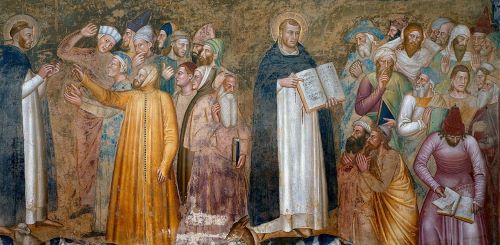
Massive and unusually elongated, “The Triumph of St. Thomas Aquinas” depicts the 13th-century saint throned in a golden sun, with Aristotle and Plato standing reverently on either side. The Renaissance artist Benozzo Gozzoli paints Christ and the writers of the Gospels looking down at Aquinas approvingly.
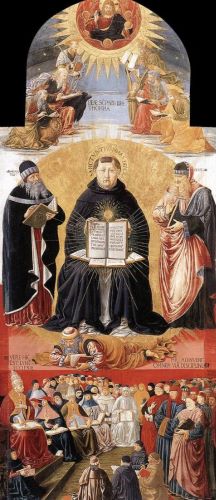
But who is the turbaned figure under Aquinas’ feet, crushed by his frankly famous weight and crawling away in defeat? That would be the 12th-century Muslim philosopher Ibn Rushd, or Averroes, as he became known in Latin Europe.
“Oh no,” I said out loud.
Us vs. Them
As a Catholic philosopher and avid student of Aquinas, I am always fielding questions about whether this medieval saint is “still worth” reading today, nearly 800 years after his birth.
Aquinas is a giant of Western philosophy and theology, and for good reason. His writing is clear, well organized, free from bombast – ideas shine through his words. Famously, he insisted that faith and reason are in harmonious partnership, integrating the known science, philosophy and theology of his day into a comprehensive, interconnected system. All this helps explain why his work has maintained an enduring appeal, even as equally brilliant medieval thinkers have sunk into oblivion.
But Aquinas’ devotees have often used his ideas as blunt instruments, wielding the weight of his words against their own foes – giving him a reputation as a Catholic battle-ax.
There is a story that Aquinas was once dining with King Louis IX of France. Suddenly, the saint slammed his massive fist on a table, making the cups rattle. “That settles the Manichees!” he exclaimed, referring to an ancient religious sect.
His thoughts wandering, Aquinas had come up with a rebuttal against the Manichees’ belief that physical matter was evil – a view Aquinas fundamentally opposed, given his deep convictions about the goodness of all creation.
His followers have a history of attempting the same: thumping Aquinas’ writings down on the table to smite their enemies.
That’s the spirit Gozzoli and other painters channeled in their own times, painting Aquinas as a defeater of Muslim philosophy. They worked in the 15th century, as tensions between Christian and Muslim kingdoms were boiling over into war, from Spain and Italy to Constantinople.
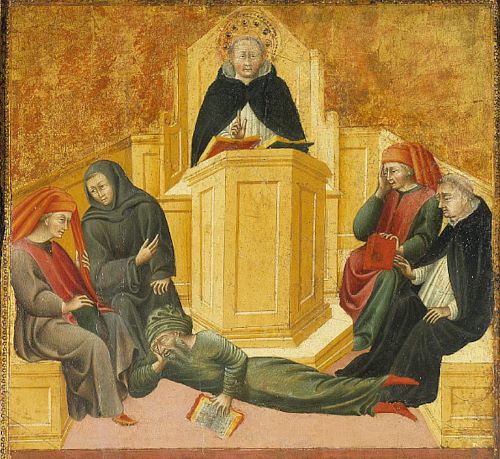
Similarly, in the 19th century, Catholic seminaries and universities elevated Aquinas’ teachings to beat back threatening ideas from modern philosophy – like the claim that all reality is material and that all truths can be deduced through reason alone.
In our own age, that kind of “us or them” dynamic is easy to recognize. Addicted to outrage endlessly amplified by social media, we are all too eager to cheer on champions who can “settle” our foes for us. We thrive on the public takedown, the snide meme, the clever quip from our political heroes, regardless of whether what they say is true.
Yet that dynamic leaves a bad taste. Aquinas’ dominance of Catholic theology collapsed in the 1960s. Today, many scholars of medieval philosophy sideline Aquinas, arguing that he has already had enough attention.
The ‘O.G.’ Aquinas
After all this, is it still worth reading Aquinas?
Well, which Aquinas?
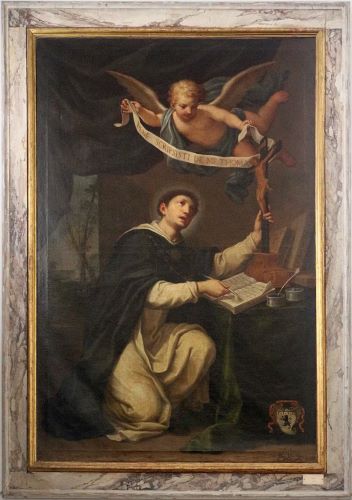
The Aquinas who gets hauled out to settle scores is, I’d argue, not the “O.G.” Aquinas. The Italian friar who crisscrossed Europe on foot, teaching and writing a mind-boggling 8 million words, offers a different kind of role model – one who sought intellectual understanding, not just victory.
Ironically, on my visit to the Louvre, I was in Paris for a conference of the Aquinas and the Arabs group. These researchers are documenting the extensive influence that Muslim and Jewish thinkers exerted on Aquinas. More broadly, the group also studies those thinkers’ impact on the tremendous burst of philosophical and theological creativity at universities across 13th-century Europe.
Take Averroes, the philosopher cowering under Aquinas in Gozzoli’s painting. Aquinas certainly had sharp things to say about Averroes’ notion of the soul, arguing, for instance, that it undermined free will. In one of his more heated moments, the typically more mild-mannered Aquinas wrote that Averroes’ theory was “repugnant to what is obvious.”
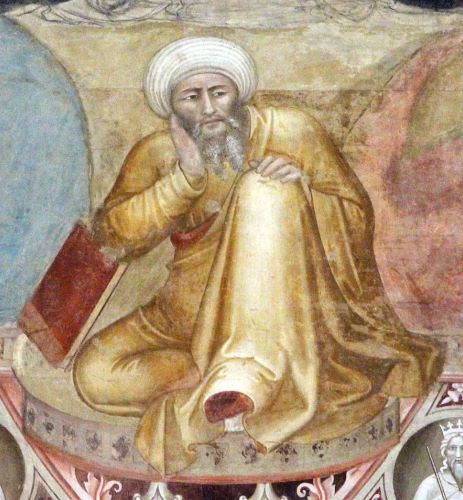
Yet Aquinas’ entire theory of human knowledge is built on principles inherited from Averroes. Even in describing the highest Christian goal – beholding God in the afterlife, the “beatific vision” – Aquinas borrowed from the Muslim philosopher’s explanation of how human minds can be lifted to a higher plane of being.
Indeed, Aquinas continually drew inspiration from other thinkers with whom he did not share a faith: He cites the Persian Muslim philosopher-physician Ibn Sīnā, or Avicenna, the Jewish rabbi Maimonides, the Roman statesman and skeptic Cicero, and Aristotle himself.
Aquinas’ embrace of their insights stems from his passionate pursuit of the truth about God and creatures – a pursuit that demands an open heart.
If I don’t yearn to see reality for what it really is, there is no point listening to someone else’s insights. If nothing is true, there is no reason to disagree – but they have nothing to teach me either. I can collect their ideas like so many pebbles in a display case, but I cannot enter into a genuine conversation with them.
The reason that Aquinas is still worth reading today is not that he was right about everything, or that he provides easy-to-swallow, prepackaged formulas. Rather, it is that he opens up a great journey, urging readers to “lift up our minds and pursue the goal” of truth – a goal everyone can share.
At the end of his life, having experienced a vision of God beyond words, Aquinas said, “all I have written is straw.” To undertake such a great journey, with such a generous guide – this might just be the tonic we need today.
Originally published by The Conversation, 11.21.2024, under the terms of a Creative Commons Attribution/No derivatives license.
About the Author