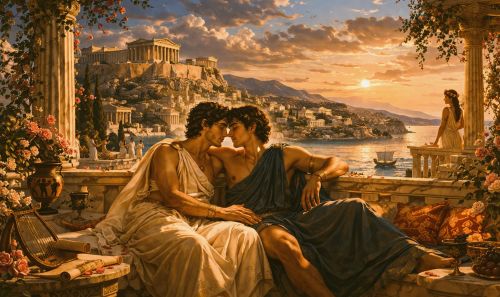
How ancient Greeks understood love and desire, revealing a complex interplay of philosophy, social norms, and deeply human emotional experience.

By Dr. David Albertson
Associate Professor of Religion
Dornsife College of Letters, Arts and Sciences
University of Southern California
Introduction
Two people are supposed to meet, the arrows of Cupid strike them unwittingly, and they have no choice but to fall in love. They face obstacles, they overcome them, and then they run into each other’s arms. Love is a delightful sport, and neither reason nor the gods have anything to do with it.
This model of romance flows from Roman poetry, medieval chivalry and Renaissance literature, especially Shakespeare. But as a professor of religion, I study an alternative vision of eros: medieval Christian mystics who viewed the body’s desires as immediately and inescapably linked to God, reason and sometimes even suffering.
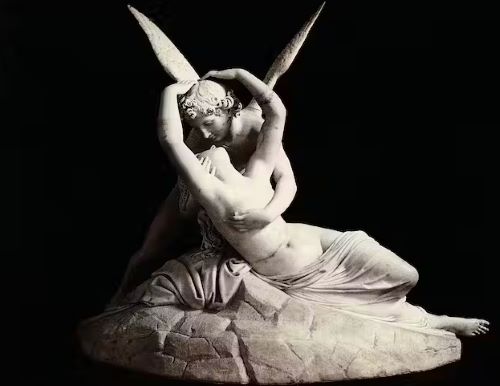
Yet this way of thinking about love has even older roots.
My favorite class to teach traces connections between eros and transcendence, starting with ancient Greek literature. Centuries before Christianity, the Greeks had their own ideas about desire. Erotic love was not a pleasant diversion, but a high-stakes trial to be survived, quivering with perilous energy. These poets’ and philosophers’ ideas can stimulate our thinking today – and perhaps our loving as well.
Deadly Serious
For the ancient Greeks, eros – which could be translated as “yearning” or “passionate desire” – was a matter of life and death, even a danger to avoid.
In the tragedies of Sophocles, when someone feels eros, typically something is about to go terribly wrong, if it hasn’t already.
Take “Antigone,” written in Athens in the fifth century B.C.E. The play opens with the title character mourning the death of her brother Polyneices, who betrayed her father and killed her other brother in battle.

After this civil war, King Creon, Antigone’s uncle, forbids citizens from burying Polyneices: an insult to his memory, but also a violation of the city’s religion. When Antigone insists on burying him anyway, she is condemned to death.
The play is often interpreted as a lesson on duty: Creon executing the laws of the state versus Antigone defending the laws of the gods. Yet, uncomfortably for modern readers, Antigone’s devotion to Polyneices seems to be more than sisterly love.
Antigone leaps at the chance to die next to her brother. “Loving, I shall lie with him, yes, with my loved one,” she swears to her law-abiding sister, “when I have dared the crime of piety.”
Were Polyneices her husband, child, parent or even fiancé, Antigone says, she would never have violated the law. But her desire for Polyneices is so great that she is willing to face “marriage to Death.” She compares the cave where Creon buries her alive with the bedroom on a wedding night. Rather than starve, she hangs herself with her own linen veil.
Scholars have asked whether Antigone has too much eros or too little – and what exactly she desires. Does she lust for justice? For piety? For her deceased brother’s body? Her desire is somehow embodied and otherworldly at the same time, calling our own erotic boundaries into question.
Eventually, Creon’s passion for civic order consumes him as well. His son, Antigone’s fiancé, stabs himself in grief as he embraces her corpse – and hearing of this, his mother kills herself as well. Eros races through the royal family like a plague, leveling them all.
No wonder the chorus prays to the goddess of love, pleading for protection from her violent whims. “Who has you within him is mad,” the chorus laments. “You twist the minds of the just.”
Embrace the Risk
This leads to a second lesson from the Greeks: Love might make you a better person, but it also might not.
Rather than speak in his own voice, the philosopher Plato wrote dialogues starring his teacher, Socrates, who had a lot to say about love and friendship.
In one dialogue, “Lysis,” Socrates jokes that if all you want is romantic love, the best plan is to insult your crush until they thirst for attention. In another, “Symposium,” Socrates’ young student Phaedrus imagines an indomitable army entirely comprising people in love. What courage and strength they would show off for each other!
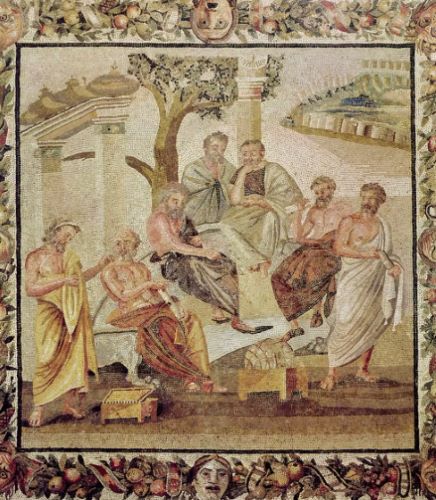
In the “Phaedrus” dialogue, foolish lovers seek a friends-with-benefits arrangement, afraid of the unwieldy passions that come with falling in love. Socrates entertains their question: Is it better to separate affection from sexual entanglements, since the force of desire can erode one’s ethical principles?
His answer is emphatically “No.” For Socrates, sexual attraction steers the soul toward divine goodness and beauty, just as great art or acts of justice can do.
The idea of friends with benefits, he warns, cleaves the ethical self from the erotic self. Here and elsewhere, Plato insists that to be whole people, we must embrace the risks that come with love.
A Necessary Madness
Socrates has one more lesson to teach. Erotic love is indeed a kind of madness – but a madness necessary for wisdom.
In “Phaedrus,” Socrates suggests that love is a madness given by the gods, a fire blazing like artistic inspiration or sacred rites. Sexual desire disorients us, but only because it is reorienting lovers toward another world. The “goal of loving,” according to one dialogue, is to “catch sight” of pure beauty and goodness.
In erotic longing we bump up against something greater than us, a thread that we can trace back to the divine. And for Socrates, this pathway from eros to God is reason. In desire, a shimmer of light cracks through the broken crust of the material world, inspiring us to yearn for things that last.
The contemporary philosopher Jean-Luc Marion has suggested that modern academic philosophy has totally failed when it comes to the topic of desire. There are vast subfields devoted to the philosophies of language, mind, law, science and mathematics, yet curiously there is no philosophy of eros.
Like the ancient Greeks and medieval Christians, Marion warns philosophers against assuming that love is irrational. Far from it. If love looks like madness, he says, that’s because it possesses a “greater rationality.”
In the words of another French philosopher, Blaise Pascal: “The heart has its reasons, which reason knows nothing of.”
Originally published by The Conversation, 02.09.2024, under the terms of a Creative Commons Attribution/No derivatives license.
About the Author