The Nizari Ismailis of Alamut used targeted assassination to survive amid hostile powers, while medieval propaganda transformed their calculated strategy into the enduring myth of the “Assassins.”

By Matthew A. McIntosh
Public Historian
Brewminate
Introduction: Political Violence and Minority Survival
Throughout history, small political or religious communities surrounded by hostile powers have often relied on unconventional strategies to survive. When military confrontation with stronger states was impossible, minority groups sometimes turned to asymmetric tactics designed to compensate for their numerical weakness. These strategies could include guerrilla warfare, clandestine organization, or the targeted killing of political opponents. Such methods rarely produced large-scale battlefield victories, but they could disrupt hostile regimes, deter persecution, and reshape political calculations. The Nizari Ismailis of the medieval Middle East developed one of the most famous examples of this form of asymmetric political violence.
The Nizari movement emerged during a period of intense political and religious conflict in the Islamic world during the late eleventh century. After the death of the Fatimid caliph al-Mustansir in 1094, a succession dispute divided the Ismaili community and produced the Nizari branch under the leadership of Hasan-i Sabbah. The Sunni Seljuk Empire dominated much of the eastern Islamic world and actively suppressed Ismaili religious movements that it regarded as heretical and politically subversive. Within this hostile environment, the Nizaris faced severe military and political pressure from powerful rulers who possessed far greater resources and armies.
Rather than attempting to confront these adversaries through conventional warfare, the Nizaris developed an approach built around fortified mountain strongholds, disciplined organization, and targeted political violence. Operating from bases such as the fortress of Alamut in northern Persia, Nizari agents carried out carefully planned assassinations of influential officials, military commanders, and religious leaders who threatened their community. These killings were intended not simply as acts of vengeance but as calculated interventions that removed key figures whose authority sustained hostile policies. In this way, assassination functioned as a strategic instrument for a minority group attempting to survive within a political landscape dominated by far stronger powers.
The interpretation of these actions, however, has been profoundly shaped by the narratives of the Nizaris’ enemies. Medieval Sunni chroniclers and later European writers portrayed the group as fanatical murderers who used terror and deception to manipulate rulers across the Middle East. These accounts gave rise to enduring legends about the so-called “Assassins,” including stories of secret cult rituals and the use of intoxicating drugs to control followers. Modern scholarship has increasingly questioned these narratives, recognizing that many of the most sensational claims originated in hostile propaganda rather than reliable evidence. Examining the Nizari movement within its historical context requires separating myth from reality and understanding how political violence, minority survival, and narrative construction intersected in the medieval Middle East.
The Ismaili Schism and the Rise of the Nizari Movement
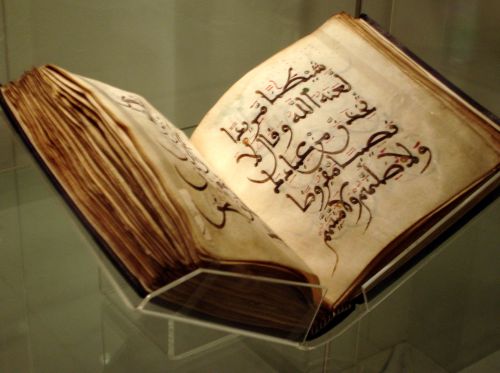
The origins of the Nizari Ismaili movement lie in a succession crisis that shook the Fatimid Caliphate at the end of the eleventh century. The Fatimids, who ruled from Cairo and claimed descent from the Prophet Muhammad through the line of Ismail, had long served as the political and spiritual center of the Ismaili branch of Shiʿi Islam. Their authority rested on the belief that the Fatimid caliph was also the rightful imam, a divinely guided leader whose lineage conferred religious legitimacy. When Caliph al-Mustansir died in 1094 after a long reign, the question of who would inherit this combined political and religious authority produced a profound rupture within the Ismaili community.
The dispute centered on two rival claimants: Nizar, the elder son of al-Mustansir, and his younger brother al-Mustaʿli. Court politics in Cairo played a decisive role in determining the outcome. The powerful vizier al-Afdal Shahanshah supported al-Mustaʿli, who was proclaimed caliph shortly after al-Mustansir’s death. Nizar rejected this decision and asserted his own claim to the imamate, arguing that the succession should follow the principle of designation by the previous imam. His rebellion was quickly suppressed by Fatimid forces, and he was captured and executed in Alexandria. Yet the conflict did not end with Nizar’s death. Across the broader Ismaili world, many followers rejected the legitimacy of al-Mustaʿli and continued to recognize Nizar as the rightful imam, thereby creating a permanent division within the movement.
This schism produced two distinct branches of Ismaili Islam. The Mustaʿli faction remained loyal to the Fatimid state centered in Egypt, while supporters of Nizar formed what became known as the Nizari Ismaili movement. The split was not merely a theological disagreement over succession. It had significant political implications, since allegiance to one claimant or the other determined loyalty to competing centers of authority. For communities scattered across Persia, Syria, and Central Asia, the dispute forced local leaders and missionaries to choose between continued alignment with the Fatimid court or adherence to the alternative line of imams descending from Nizar.
In Persia, the most influential figure to champion the Nizari cause was Hasan-i Sabbah, an Ismaili missionary who had already established a strong network of followers before the Fatimid succession crisis erupted. Hasan had traveled widely through the eastern Islamic world as part of the Fatimid daʿwa, the missionary organization responsible for spreading Ismaili teachings. After the schism, he rejected the authority of the Mustaʿli caliphs in Cairo and instead organized Persian Ismaili communities around loyalty to the Nizari line. Under his leadership, the movement began to develop an independent political and religious identity separate from the Fatimid state. Hasan’s approach was methodical rather than revolutionary. He emphasized disciplined organization, careful recruitment, and the strengthening of local missionary networks that could operate even under hostile political conditions. This restructuring of the Ismaili mission laid the institutional foundation for what would become a durable and resilient movement capable of surviving beyond the collapse of Fatimid authority in Egypt.
The shift toward independence was accelerated by the political environment of the eastern Islamic world, where the Seljuk Empire dominated much of the region. The Seljuks were staunch defenders of Sunni orthodoxy and viewed Ismaili doctrines as both religiously deviant and politically dangerous. As Seljuk authority expanded across Persia and Iraq, Ismaili communities increasingly faced persecution, surveillance, and suppression. These pressures made it difficult for the Nizaris to operate openly, encouraging them to develop clandestine networks and fortified centers of resistance that could withstand pressure from powerful states.
Out of these circumstances emerged a new form of Ismaili political organization. The Nizari movement gradually shifted from a dispersed missionary network into a defensive political community anchored in strategically located fortresses. These strongholds provided secure bases from which the Nizaris could maintain communication between scattered communities, preserve their religious leadership, and resist hostile authorities. The establishment of this system would soon transform the Nizari Ismailis from a persecuted religious faction into a distinctive political force whose survival depended on strategy, secrecy, and the careful manipulation of power. This network of fortified positions allowed the Nizaris to maintain autonomy despite living within territories dominated by much larger states. Rather than attempting to control wide expanses of land, they focused on controlling defensible terrain and maintaining internal cohesion. This strategy would prove remarkably durable, allowing the Nizaris to endure for generations despite repeated campaigns launched by powerful regional rulers determined to eliminate them.
Hasan-i Sabbah and the Creation of the Alamut State
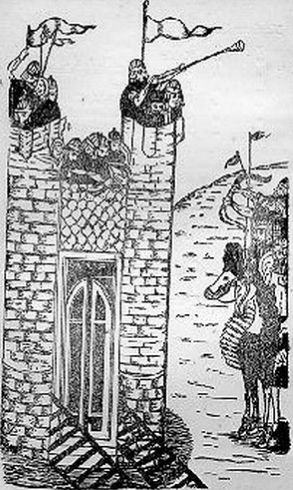
The emergence of the Nizari Ismailis as a durable political force was closely tied to the leadership of Hasan-i Sabbah and his strategic establishment of a secure territorial base in northern Persia. Hasan, an Ismaili missionary trained within the Fatimid daʿwa network, possessed both theological authority and organizational skill. His efforts to consolidate Nizari communities coincided with a period when the Seljuk Empire dominated the eastern Islamic world and actively suppressed Ismaili religious activity. Facing overwhelming military opposition, Hasan recognized that the survival of the movement required not only ideological cohesion but also defensible geographic positions from which Nizari communities could operate with relative autonomy.
In 1090 Hasan-i Sabbah seized control of the mountain fortress of Alamut in the rugged Alborz range south of the Caspian Sea. According to later accounts, he gained possession of the fortress through a combination of careful infiltration, persuasion, and the gradual conversion of its inhabitants rather than through direct military assault. The fortress itself occupied a narrow ridge surrounded by steep cliffs, making it exceptionally difficult for conventional armies to capture. Once established there, Hasan transformed Alamut into the administrative and ideological center of the Nizari movement in Persia. From this base he coordinated missionary activity, communicated with distant communities, and oversaw the development of a network of loyal followers.
Alamut’s geographic position proved crucial to the survival of the Nizaris. Situated in a remote mountainous region, the fortress allowed the community to resist repeated attempts by Seljuk authorities to eliminate them. The terrain limited the effectiveness of large armies and favored defenders who were familiar with the landscape. Hasan-i Sabbah exploited these advantages by strengthening the fortress’s defenses and encouraging the acquisition of additional strongholds throughout the surrounding region. The Nizaris developed a dispersed system of fortified castles across northern Persia, each capable of functioning independently while remaining connected to the broader movement. These fortifications were often positioned along mountain ridges or within narrow valleys where access routes could be controlled and defended by relatively small garrisons. This geographic strategy allowed the Nizaris to compensate for their lack of manpower and resources, forcing enemies to confront a defensive network that was both difficult to penetrate and costly to attack.
Hasan’s leadership also shaped the internal structure of the Nizari community. He emphasized strict discipline, loyalty to the imam, and the careful training of dedicated followers who would carry out the movement’s objectives. These individuals were part of the Nizari missionary hierarchy and were tasked with spreading Ismaili teachings, maintaining communication between strongholds, and protecting the community against hostile authorities. The organization that developed under Hasan’s direction combined religious authority with political strategy, allowing a relatively small population to maintain coherence despite operating under constant external pressure. Loyalty to the imam formed the ideological foundation of this system, while the practical demands of survival required secrecy, coordination, and disciplined obedience. Hasan’s leadership fused theological commitment with political pragmatism, shaping a movement that functioned simultaneously as a religious community and a defensive political network.
Through the establishment of Alamut and its network of associated fortresses, Hasan-i Sabbah created what modern historians often describe as the Nizari “state,” although it did not resemble a conventional territorial kingdom. Instead, it functioned as a decentralized system of fortified enclaves linked by ideological loyalty and strategic coordination. This structure allowed the Nizaris to survive in an environment dominated by powerful states and hostile religious authorities. The Alamut state became the center of a resilient political community whose survival depended not on territorial expansion but on strategic positioning, internal discipline, and the careful management of conflict with surrounding powers.
Targeted Killing as Strategy: The Logic of Asymmetric Violence
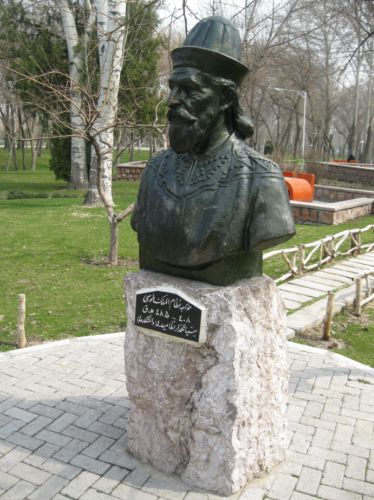
The Nizari Ismailis confronted a political environment in which conventional military confrontation with surrounding powers was effectively impossible. The Seljuk Empire controlled vast territories and possessed armies far larger than anything the Nizari communities could field. Direct warfare would have exposed the movement to rapid destruction. Instead, the Nizaris developed a strategy that focused on selective political violence directed at key individuals whose authority shaped the policies of hostile regimes. By targeting influential officials rather than large military forces, the Nizaris sought to alter political outcomes while avoiding the costs of conventional warfare.
One of the earliest and most famous examples of this strategy occurred in 1092 with the assassination of Nizam al-Mulk, the powerful Seljuk vizier who had long served as the administrative architect of Seljuk rule. According to medieval accounts, a Nizari agent disguised as a Sufi approached the vizier and killed him with a dagger while presenting a petition. Whether the assassination was carried out solely by Nizari operatives or occurred within a broader climate of Seljuk political intrigue remains debated among historians. Nevertheless, the death of Nizam al-Mulk demonstrated the potential impact of targeted killing within a political system dependent on powerful administrators. Eliminating a single influential figure could destabilize authority in ways that far exceeded the capabilities of a small insurgent community on the battlefield.
The Nizaris focused their efforts on individuals whose positions made them particularly significant within the political hierarchy of the medieval Islamic world. Viziers, provincial governors, military commanders, and prominent religious scholars all served as potential targets because their authority helped sustain the policies that threatened the Nizari community. These assassinations were not random acts of violence but carefully selected interventions aimed at weakening specific structures of power. Removing a governor hostile to Ismaili communities or intimidating officials who supported anti-Ismaili campaigns could reshape local political conditions and create opportunities for survival.
Equally important was the psychological dimension of these operations. Because the Nizaris lacked the ability to defeat large armies directly, the symbolic impact of their actions became a crucial strategic asset. The knowledge that even powerful rulers could be reached by Nizari agents created an atmosphere of uncertainty among political elites. Medieval chroniclers frequently described the fear that such attacks generated among officials who suddenly found themselves vulnerable despite their wealth, rank, and military protection. This fear had tangible political consequences. Officials who believed they might become targets sometimes moderated policies toward Ismaili communities, avoided particularly aggressive campaigns, or diverted resources toward personal security. The visibility of the attacks reinforced this effect, since assassinations often occurred in public spaces where the message of vulnerability could not be ignored. In this way the psychological power of selective violence amplified the strategic influence of a group whose material resources were otherwise limited.
This strategy represented a form of asymmetric warfare long before the concept acquired modern terminology. By focusing on selective violence against politically significant individuals, the Nizaris converted their weakness into a form of leverage within a political system dominated by stronger states. Their actions did not aim to overthrow the Seljuk Empire or conquer vast territories. Instead, they sought to ensure the survival of a minority community by imposing costs on those who attempted to destroy it. Through this calculated use of targeted violence, the Nizaris carved out a precarious but enduring space for themselves within the volatile political landscape of the medieval Middle East.
Assassination in Practice: Methods, Symbolism, and Public Display
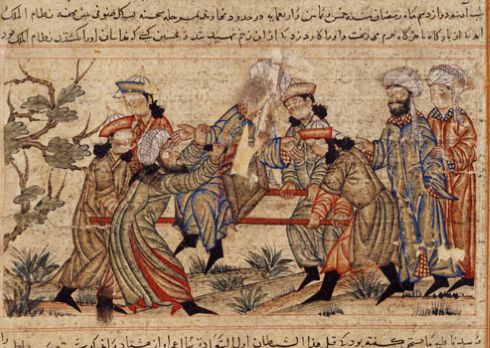
The assassinations carried out by Nizari operatives were not simply acts of violence but carefully structured operations designed to maximize political impact. These killings typically targeted individuals who played important roles in governing structures that threatened the Nizari community. Unlike battlefield engagements, which required armies and resources the Nizaris did not possess, targeted assassination allowed a small number of trained agents to alter political dynamics by removing key figures from positions of authority. The practical execution of these operations reflected the movement’s broader emphasis on discipline and secrecy.
One distinctive feature of Nizari assassinations was the reliance on close-range weapons, particularly daggers. Medieval sources consistently describe the use of concealed blades rather than bows, crossbows, or poison. This method required the operative to approach the target directly and strike at a moment when escape was often impossible. Such attacks demanded careful preparation and personal commitment from the assassin, who understood that survival was unlikely once the act was carried out. The choice of weapon also had symbolic significance, emphasizing the immediacy and certainty of the act. A dagger strike delivered at close range conveyed the message that even the most powerful political figures could not shield themselves behind guards or social rank. In a political culture where authority was often displayed publicly through ceremonial gatherings and court appearances, this type of attack transformed the vulnerability of elite figures into a visible spectacle.
Preparation for these operations often involved extended periods of infiltration and observation. Nizari agents were known to embed themselves within communities where their targets lived or traveled, sometimes posing as servants, soldiers, merchants, or religious figures. By studying routines and identifying moments of vulnerability, they could select the precise opportunity to carry out the attack. This method required patience and organizational coordination, since information gathered by one agent could be transmitted through the movement’s network to guide the planning of future operations. In some cases, agents reportedly spent months or even years positioning themselves close to a target, waiting for the moment when a successful strike could be executed. The effectiveness of these operations depended not on numbers but on intelligence, discipline, and timing within the Nizari movement.
The public setting of many assassinations formed another important aspect of the Nizari strategy. Medieval chronicles frequently describe attacks carried out in crowded marketplaces, mosques, or court gatherings. These locations ensured that the killing would be witnessed by a wide audience, amplifying its psychological impact. When a high-ranking official could be killed in the presence of guards, courtiers, and bystanders, the event sent a powerful message about the vulnerability of political authority. The spectacle of the act was part of its strategic value.
Symbolism also played a role in shaping the meaning of these assassinations. By striking during religious festivals, public ceremonies, or gatherings of political elites, Nizari operatives ensured that the act carried broader social significance. The killing of a governor or religious leader in such settings transformed the event into a dramatic challenge to the authority structures that governed the region. Observers did not simply witness the death of an individual but the sudden disruption of the hierarchy that individual represented. In societies where public reputation and honor were central components of political legitimacy, the sudden and visible elimination of a powerful figure carried profound symbolic weight. These attacks functioned not only as practical acts of violence but also as carefully staged moments of political theater that reinforced the movement’s ability to reach even the most protected elites.
Although medieval sources often portrayed these acts as the work of fanatical killers driven by blind devotion, modern historians emphasize the strategic logic underlying them. The Nizari leadership carefully selected targets and locations to produce the greatest possible political effect with minimal resources. Each assassination was intended to serve as both a practical intervention and a symbolic statement about the reach of the movement. Through this combination of method, spectacle, and strategic calculation, the Nizaris developed a distinctive form of political violence that left a lasting impression on both contemporaries and later historical memory.
The Crusader World and the Nizari Presence in Syria
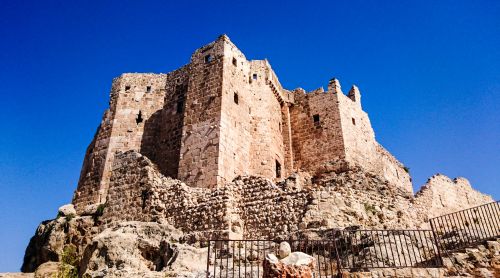
While the Nizari movement first consolidated its power in Persia under Hasan-i Sabbah, Nizari communities also emerged in the Levant during the twelfth century. These Syrian Nizaris developed their own network of fortified strongholds, most notably in the mountainous regions of western Syria. Castles such as Masyaf, al-Kahf, and Qadmus served as centers of Nizari activity in the region. Like their Persian counterparts centered on Alamut, these fortresses allowed relatively small communities to defend themselves against larger neighboring powers while maintaining communication with other Nizari enclaves.
The Syrian Nizaris operated within a complex political environment shaped by the presence of both Muslim dynasties and Crusader states. After the First Crusade established Latin Christian principalities across the eastern Mediterranean, the political landscape of the region became fragmented among competing rulers. Muslim leaders such as the Zengids and later the Ayyubids sought to reassert control over territories lost to the Crusaders, while Crusader princes attempted to maintain and expand their own fragile states. Within this unstable environment, the Nizaris were neither fully aligned with Muslim rulers nor consistently opposed to the Crusader states, instead pursuing pragmatic relationships that could protect their own survival.
The leadership of the Syrian Nizaris eventually centered on figures such as Rashid al-Din Sinan, who governed the community during the mid-twelfth century and became widely known in medieval sources as the “Old Man of the Mountain.” Although European chroniclers often portrayed him as a mysterious and absolute ruler commanding unquestioned obedience, modern scholarship suggests that Sinan functioned as a regional leader within a broader Nizari hierarchy connected to Alamut. Under his leadership, the Syrian Nizaris maintained their fortified positions and continued the practice of targeted assassination against individuals who posed direct threats to their autonomy. Sinan’s reputation was amplified by both Muslim and European chroniclers, many of whom attributed dramatic acts of loyalty and secret discipline to his followers. These stories contributed to the development of the Assassin legend in medieval literature, though historians now approach many of these accounts with caution. What can be established with greater confidence is that Sinan successfully maintained the independence of the Syrian Nizari community during a period of intense regional conflict, balancing internal cohesion with a pragmatic approach to diplomacy and political survival.
Interactions between the Syrian Nizaris and the Crusader states further illustrate the pragmatic political calculations that shaped Nizari strategy. While medieval European sources often described the group as implacable enemies, evidence suggests that the Nizaris sometimes negotiated with Crusader rulers or even paid tribute to maintain peaceful relations. These arrangements reflected the Nizaris’ broader strategy of survival through flexible alliances rather than rigid ideological confrontation. In a region where power constantly shifted among competing factions, maintaining diplomatic channels could be as important as military defense.
The Syrian Nizaris remained deeply embedded in the political conflicts of the region. Their assassinations of prominent figures occasionally intersected with the broader struggles between Muslim dynasties and Crusader powers, adding another layer of complexity to the political landscape of the Levant. One of the most notable incidents involved an attempt on the life of the Ayyubid ruler Saladin, who narrowly survived attacks attributed to Nizari operatives during his campaigns in Syria. Whether these attempts were undertaken independently by the Nizaris or were influenced by shifting alliances among regional actors remains debated, but the episodes demonstrate how Nizari operations could intersect with larger geopolitical struggles. By targeting influential individuals rather than confronting armies directly, the Syrian Nizaris continued to pursue the same asymmetric strategy that had defined the movement in Persia. Their actions reinforced the perception among contemporaries that even the most powerful rulers of the region were vulnerable to carefully planned acts of political violence.
Medieval Propaganda and the Birth of the “Assassin” Myth

The enduring image of the Nizari Ismailis as mysterious and fanatical “Assassins” owes far more to medieval propaganda than to the realities of their political organization. Much of what later generations believed about the group came from chroniclers who were openly hostile to Ismaili doctrines and political ambitions. Sunni historians writing within the Seljuk and later Islamic political spheres frequently described the Nizaris as dangerous heretics whose methods threatened the stability of legitimate authority. In these accounts, their acts of targeted violence were framed not as strategic responses to political pressure but as evidence of moral corruption and religious deviance.
One of the most influential components of this hostile narrative involved the claim that Nizari operatives were drugged with hashish before carrying out assassinations. According to these stories, followers were supposedly intoxicated and then promised access to a paradise-like garden as a reward for their obedience. After experiencing this illusion, they were said to undertake assassination missions believing that death would return them to this paradise. These tales appeared in several medieval narratives and became closely associated with the supposed origins of the word “Assassin,” which some writers connected to the Arabic term hashishiyyin. However, the linguistic and historical basis of this interpretation remains highly contested. Modern historians have found little reliable evidence that such practices existed within the Nizari community. Instead, scholars increasingly interpret these stories as polemical inventions designed to discredit the movement by portraying its members as drugged fanatics incapable of rational judgment. By attributing Nizari political violence to intoxication and manipulation, hostile chroniclers could dismiss the movement’s strategic motivations and reduce it to a caricature of irrational extremism.
The term “Assassin” itself reflects the transmission of these hostile portrayals into European languages. Crusader chronicles and later travelers’ accounts introduced the name into Western literature, often drawing on rumors circulating in the eastern Mediterranean. The word entered European languages as a general term for a political murderer, detached from its original historical context. This linguistic transformation reinforced the image of the Nizaris as archetypal killers, further embedding the legend within cultural memory. By the time the stories reached medieval Europe, they had already been shaped by layers of reinterpretation that obscured the political circumstances in which the Nizaris actually operated.
European writers added further embellishments to these narratives. Accounts attributed to travelers such as Marco Polo repeated elaborate descriptions of secret gardens, elaborate rituals, and absolute obedience to a shadowy leader known as the “Old Man of the Mountain.” These stories circulated widely in medieval Europe and helped solidify the mythic image of the Assassins as members of a secret cult dedicated to murder. Yet historians have long noted that Polo never visited the Persian fortress of Alamut, which had already been destroyed decades before he traveled through Central Asia. The dramatic episodes he described relied on stories already circulating in the region rather than direct observation. These accounts blended rumor, political hostility, and imaginative storytelling, transforming the Nizaris into figures of legend whose actions appeared mysterious and almost supernatural.
The persistence of these stories illustrates how political conflict can shape historical memory. For Sunni chroniclers, portraying the Nizaris as fanatics served to delegitimize a rival religious movement and justify campaigns against them. Depicting them as drugged killers or members of a secret cult also reinforced broader efforts to frame Ismaili beliefs as dangerous deviations from accepted religious authority. For European audiences, meanwhile, the stories provided dramatic and exotic narratives about the unfamiliar political and religious landscape of the Middle East. Medieval readers encountered the Assassins not through careful historical analysis but through sensational tales that emphasized secrecy, loyalty, and sudden violence. In both contexts the Nizaris were transformed into symbolic figures whose reputation bore little resemblance to the historical realities of their political strategy and social organization.
Modern historians have approached medieval descriptions of the Assassins with considerable caution. By comparing hostile chronicles with newly studied Ismaili texts and archaeological evidence from former Nizari strongholds, scholars have reconstructed a more nuanced understanding of the movement. Rather than a secret cult driven by intoxication and blind obedience, the Nizari community emerges as a disciplined religious minority navigating a dangerous political environment. The myths that surrounded them reveal as much about the fears and prejudices of their enemies as they do about the group itself.
Historiography and the Modern Reassessment of the Nizaris
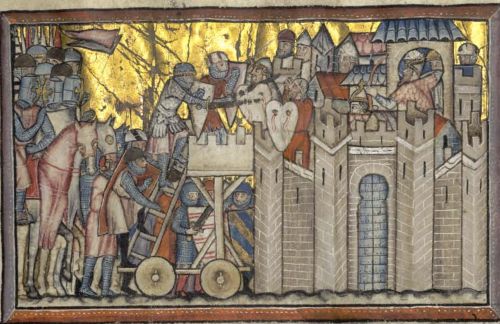
For centuries, historical understanding of the Nizari Ismailis was shaped primarily by hostile medieval narratives and the legends that grew from them. Early modern European scholars relied heavily on Crusader chronicles and Sunni historical works, which portrayed the group as a secretive sect devoted to ritualized murder and manipulation. Because few internal Nizari sources were widely known or accessible, these hostile accounts dominated historical interpretation. As a result, the image of the “Assassins” as fanatical killers became deeply embedded in both scholarly literature and popular imagination.
During the twentieth century, historians began to reexamine these narratives more critically. Scholars increasingly recognized that the surviving medieval sources were written almost entirely by the Nizaris’ political and religious enemies. These writers had strong incentives to portray the movement in the most negative possible terms, framing its actions as irrational fanaticism rather than calculated political strategy. By placing these texts within their historical context, historians began to identify elements of exaggeration, misunderstanding, and polemical distortion that had shaped earlier portrayals of the group. Careful comparison of different chronicles also revealed how stories about the Nizaris changed as they were repeated and transmitted across regions and generations. Details were added, episodes were dramatized, and rumors gradually hardened into widely accepted “facts.” Recognizing these processes encouraged historians to treat many traditional accounts with caution and to analyze them not simply as records of events but also as reflections of the fears and political interests of the societies that produced them.
A major turning point in the historiography of the Nizaris came with the systematic study of Ismaili sources and traditions that had previously remained inaccessible to most scholars. The recovery and publication of Nizari texts allowed historians to examine the movement from an internal perspective rather than relying solely on external accounts. This shift made it possible to reconstruct the intellectual, religious, and political structures that sustained the community. Instead of a secret cult driven by irrational devotion, the Nizari movement increasingly appeared as a disciplined religious minority that had developed sophisticated strategies for survival in a hostile political environment.
Modern scholarship has also emphasized the broader historical context in which the Nizaris operated. By situating the movement within the political structures of the Seljuk Empire and the fragmented power dynamics of the medieval Middle East, historians have shown that Nizari actions were closely tied to the pressures they faced. Their use of targeted assassination, for example, can be understood as one form of asymmetric political strategy available to a community that lacked the resources to wage conventional war. This approach highlights how political violence functioned within a broader system of power rather than existing as an isolated phenomenon. In regions where imperial authority was contested and local rulers struggled for influence, the removal of a single powerful official could reshape alliances, weaken hostile policies, or create temporary space for vulnerable communities to survive. Understanding these dynamics allows historians to interpret Nizari actions as responses to specific historical circumstances rather than as evidence of inherent fanaticism.
As a result of these historiographical developments, the modern understanding of the Nizaris differs significantly from earlier portrayals. While their use of assassination remains a defining feature of their historical reputation, scholars now recognize that the legends surrounding the “Assassins” reflect layers of propaganda, cultural misunderstanding, and narrative embellishment accumulated over centuries. The reassessment of the Nizaris illustrates a broader challenge within historical scholarship: the need to disentangle myth from evidence and to reconstruct the past through careful analysis of competing sources.
Conclusion: Power, Narrative, and the Politics of Fear
The history of the Nizari Ismailis illustrates how political violence can emerge as a survival strategy for communities confronting overwhelming power. Surrounded by hostile states and religious authorities, the Nizaris lacked the military resources necessary for conventional warfare. Instead, they developed a strategy centered on fortified strongholds, disciplined organization, and carefully targeted acts of violence against influential individuals. These actions allowed a relatively small minority to influence political outcomes and deter some of the pressures directed against them. Within the context of the medieval Islamic world, assassination functioned not as random brutality but as a calculated form of asymmetric political intervention.
The legacy of the Nizaris demonstrates how narratives about violence can shape historical memory as much as the events themselves. Medieval chroniclers writing within hostile political environments framed the Nizaris as fanatics and heretics whose actions threatened the stability of legitimate authority. These portrayals served immediate political purposes by delegitimizing a rival religious movement and justifying campaigns against it. These narratives acquired a life of their own, spreading beyond the political conflicts that originally produced them and entering broader cultural traditions.
The transformation of the Nizaris into the legendary “Assassins” illustrates how fear and rumor can reshape historical understanding. Stories about secret rituals, intoxicating drugs, and absolute obedience to a mysterious leader circulated widely across both the Islamic world and medieval Europe. These tales reinforced the perception that the Nizaris represented a uniquely sinister threat to political order. Yet modern historical scholarship has shown that many of these elements originated in hostile propaganda or in later literary embellishment rather than in reliable evidence. The enduring power of the Assassin myth reflects not only the dramatic nature of Nizari operations but also the broader human tendency to transform political enemies into symbols of danger and mystery.
Reexamining the history of the Nizaris reveals the importance of separating narrative construction from historical reality. The actions of the Nizaris appear politically less as the product of fanaticism and more as the strategies of a vulnerable minority navigating a dangerous political landscape. Their story demonstrates how power, fear, and narrative interact in the formation of historical memory. By critically reassessing the sources that shaped the legend of the Assassins, historians can move beyond inherited myths and gain a clearer understanding of how political violence and propaganda shaped the medieval world.
Bibliography
Affiliate disclosure: Amazon links on this site are paid links. As an Amazon Associate I earn from qualifying purchases.
- Daftary, Farhad. The Assassin Legends: Myths of the Isma’ilis. London: I.B. Tauris, 1994.
- —-. The Isma’ilis: Their History and Doctrines. 2nd ed. Cambridge: Cambridge University Press, 2007.
- —-. “The “Order of the Assassins:” J. von Hammer and the Orientalist Misrepresentations of the Nizari Ismailis.” Iranian Studies 39:1 (2006), 71-81.
- —-. A Short History of the Ismailis. Princeton: Markus Wiener Publishers, 1998.
- Halm, Heinz. The Fatimids and Their Traditions of Learning. London: I.B. Tauris, 1997.
- Hill, Donald R. Islamic Science and Engineering. Edinburgh: Edinburgh University Press, 1993.
- Hodgson, Marshall G. S. The Order of Assassins: The Struggle of the Early Nizari Isma’ilis Against the Islamic World. Philadelphia: University of Pennsylvania Press, 1955.
- Ibn al-Athir. The Chronicle of Ibn al-Athir for the Crusading Period from al-Kamil fi’l-Ta’rikh. Translated by D. S. Richards. Aldershot: Ashgate, 2006.
- Lewis, Bernard. The Assassins: A Radical Sect in Islam. London: Weidenfeld and Nicolson, 1967.
- Polo, Marco. The Travels of Marco Polo. Translated by Ronald Latham. London: Penguin Classics, 1958.
- Riley-Smith, Jonathan. The Crusades: A History. 3rd ed. London: Bloomsbury Academic, 2014.
- Smarandache, Bogdan. “The Franks and the Nizārī Ismāʿīlīs in the Early Crusade Period.” Al-Masāq: Journal of the Medieval Mediterranean 24:3 (2012), 221-239.
- Virani, Shafique N. “An Old Man, a Garden, and an Assembly of Assassins: Legends and Realities of the Nizari Ismaili Muslims.” Journal of the British Institute of Persian Studies 61:2 (2023), 272-284.
- Willey, Peter. The Castles of the Assassins. Cambridge: Cambridge University Press, 1963.
Originally published by Brewminate, 03.18.2026, under the terms of a Creative Commons Attribution-NonCommercial-NoDerivatives 4.0 International license.
About the Author