Women’s communities shaped Mesoamerican life through labor, ritual, healing, markets, kinship, and sacred memory across households, courts, temples, and neighborhoods.

By Matthew A. McIntosh
Public Historian
Brewminate
Introduction: Seeing Women’s Communities beyond the Household
To write the history of women in Mesoamerica is to begin with a problem of visibility. Kings, warriors, priests, tribute lists, conquest narratives, and monumental inscriptions often stand closest to the surviving record, while the communities through which women shaped daily and sacred life appear more indirectly. They emerge in houses, burials, spindle whorls, painted manuscripts, ritual speeches, household architecture, marketplace activity, legal disputes, dynastic marriages, and colonial descriptions written under conditions of rupture. That uneven evidence has often encouraged a false separation between public history and domestic life, as though power belonged only to palaces, armies, temples, and councils, while women’s work belonged to some quieter space outside history. Mesoamerican evidence resists that division. The household was not a private refuge sealed away from politics or religion. It was a place where labor was organized, children were trained, food was prepared for ritual and survival, cloth was produced for tribute and exchange, marriages linked families, and sacred obligations were enacted through repeated gestures of discipline, care, and memory.
The phrase “communities of women” must be used carefully. It should not imply that all women shared a single experience, a single status, or a single political interest. A Classic Maya queen, a Mexica noblewoman, a commoner weaver, a midwife, a market seller, a temple attendant, a servant, an enslaved woman, and a colonial-era litigant lived within different structures of power. Class, lineage, age, marital status, ethnicity, city, conquest, and imperial extraction shaped what female association could mean. A woman born into a ruling house could become a bearer of dynastic memory and diplomatic legitimacy, while another woman’s work at the loom might be absorbed into tribute demands that enriched elites and strengthened imperial power. A midwife could command ritual respect inside the community while remaining excluded from the kinds of formal authority recognized by male officeholders. A noble girl trained in disciplined religious service did not inhabit the same world as a captive woman, a servant, or a commoner whose household labor sustained others’ wealth. Even among women, authority could flow downward as well as outward, and female spaces could contain hierarchy, dependence, coercion, and expectation alongside mutual care. Yet the phrase remains useful because women’s lives were rarely isolated. They were formed through dense networks of kinship, apprenticeship, ritual duty, shared production, healing knowledge, neighborhood obligation, and intergenerational instruction. Some of these networks were elite and dynastic, organized around royal courts and marriage alliances. Others were practical and local, rooted in weaving, child-rearing, food labor, market exchange, and the moral authority of elder women. Still others were sacred, visible in temple service, goddess cults, childbirth rites, and the ritual language surrounding fertility, blood, earth, death, and renewal.
Here I follow those communities chronologically, not to force every Mesoamerican society into a single pattern, but to show how women’s collective lives changed across time and place. The Formative world offers evidence for gendered labor, household ritual, and emerging social hierarchy. Classic Maya courts reveal royal women as bearers of dynastic legitimacy, diplomatic connection, and ritual authority. Postclassic societies, especially in central Mexico, show the growing importance of textile production, tribute economies, market exchange, temple discipline, and neighborhood organization. The Mexica world provides unusually rich evidence through the Florentine Codex, but that evidence must be read with caution, since it was produced after conquest through collaboration between Franciscan Bernardino de Sahagún and Nahua elders, writers, and artists under colonial conditions. The colonial archive preserves voices and practices that might otherwise be lost, but it also translates Indigenous life through Christian, Spanish, and male-authored frameworks. It reveals women, but it also rearranges them.
The central argument is that women’s communities were part of the hidden architecture of Mesoamerican society. They sustained ruling houses, tribute systems, ritual calendars, household economies, healing traditions, and cultural memory. Their power was often relational rather than solitary, embodied rather than monumental, and practical rather than officially proclaimed. That does not make it lesser. It makes it harder to see when historians look only for offices, armies, kings, and public decrees. To recover these communities is not to romanticize them as spaces of automatic solidarity, since women’s networks could also reproduce hierarchy, servitude, coercion, and exclusion. It is instead to recognize that Mesoamerican history cannot be understood without the women who organized labor, guarded knowledge, transmitted ritual, joined families, served gods, raised children, produced wealth, and carried memory through the ordinary institutions that made civilization durable.
Formative Foundations: Gender, Household Labor, and Sacred Production
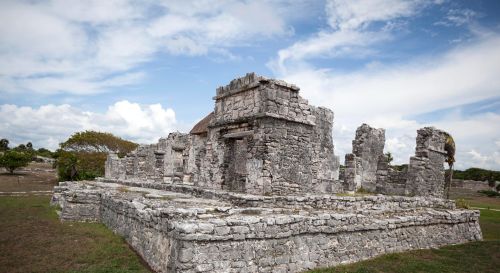
The Formative period, stretching broadly from the second millennium BCE into the centuries before the Common Era, does not give historians the kind of written testimony available for later Maya or Nahua societies. There are no surviving household diaries, ritual speeches, market records, or inscriptions that explain how women understood themselves as women, workers, mothers, ritual participants, or members of local communities. What survives instead is material evidence: houses, burials, ceramics, figurines, grinding stones, storage areas, ritual deposits, craft debris, and the spatial organization of early villages and ceremonial centers. That evidence is fragmentary, but it is not silent. It shows that the earliest recoverable communities of women in Mesoamerica must be approached through labor, embodiment, domestic space, food preparation, fertility symbolism, and the repeated practices by which households made social life durable. The point is not to imagine a timeless feminine world stretching unchanged from the Formative to the Mexica period. It is to recognize that before queens, priestesses, market women, and midwives become visible in later records, the foundations of female association were already being laid in the shared work of households and neighborhoods.
In early Mesoamerican villages, the household was not a passive container for private life. It was a productive institution. Food had to be grown, gathered, processed, stored, cooked, served, and offered. Children had to be nursed, watched, instructed, disciplined, and folded into the rhythms of kinship. Clay, fiber, stone, and plant materials moved through domestic labor systems that required skill, memory, and repeated cooperation. Grinding maize, preparing meals, tending hearths, shaping clay, maintaining storage, producing cloth or cordage, caring for the young, and preserving knowledge about plants, seasons, tools, and bodies were not small background tasks beneath the notice of history. They were the daily technologies of survival, and they required forms of expertise that were learned slowly, corrected repeatedly, and carried across generations. The metate, the hearth, the storage jar, the spindle or fiber tool, the basket, the water vessel, and the prepared field were all part of a material world in which labor trained the body and bound people into obligation. When these tasks were shared among mothers, daughters, sisters, in-laws, neighbors, servants, and elders, they created communities of practice. Such communities may not have had formal names or offices, but they organized knowledge as surely as any palace or temple did. A girl learned how to work not from a manual but from watching, correcting, repeating, listening, and being drawn into the bodily discipline of household life. She learned how long maize should be ground, how food should be portioned, when a child needed correction or comfort, how elders expected a household to be ordered, and how ordinary work could carry social meaning beyond its immediate usefulness. In that sense, the earliest women’s communities were pedagogical communities. They trained hands, memory, posture, endurance, taste, timing, and judgment.
The Formative household also carried ritual weight. In Mesoamerican societies generally, later evidence makes clear that cooking, sweeping, grinding, weaving, childbirth, burial, and offering could never be reduced to mere practical acts, and it would be artificial to imagine that early household labor was spiritually empty until temples and kings appeared. Hearths, floors, thresholds, burials beneath or near houses, and figurines found in domestic or ritual contexts all point toward a world in which household space helped mediate relationships among the living, the dead, ancestors, fertility, and community renewal. Women’s labor was likely central to this mediation because so much of household continuity depended on the transformation of raw materials into food, children into social persons, and domestic space into ritually ordered space. This does not mean that women monopolized household ritual or that every figurine must be read as a goddess, mother, or fertility charm. That older habit of interpretation risks turning all female imagery into biological symbolism. A more careful reading sees figurines, bodies, gestures, costume, and domestic deposits as evidence for the social making of gender, in which femininity, fertility, age, rank, and ritual identity could be represented, performed, idealized, and contested.
The rise of larger Formative centers, especially in the Gulf Coast Olmec world, complicates this picture. Monumental sculpture, elite precincts, long-distance exchange, and ceremonial architecture show that hierarchy was intensifying, but hierarchy did not erase household production. It depended on it. The food that fed laborers, the vessels that held offerings, the cloth and fiber goods that circulated through exchange, the children who reproduced lineages, and the ritual maintenance of domestic groups all formed part of the broader political economy. Women’s communities belonged not outside emerging complexity but inside it. As elite lineages grew more powerful, women’s reproductive, marital, and productive roles would have become increasingly important to the formation of status. Yet the evidence does not support a simple story in which early Mesoamerica moved from egalitarian female freedom to patriarchal oppression in a straight line. It shows something more subtle: gendered labor and symbolism were woven into the making of social hierarchy from the beginning, and women could be both essential to that process and constrained by it.
This early period also requires caution about the word “community.” The women who worked together in a household or neighborhood were not necessarily equals. Age mattered. Senior women likely possessed authority over younger women through experience, kinship position, marriage ties, ritual knowledge, and control over household routines. Girls, daughters-in-law, servants, captives, or dependents may have learned within women’s spaces while also being disciplined by them. Female community, then, should not be romanticized as automatic sisterhood. It was a structure of cooperation and instruction, but also one of hierarchy, obligation, and social expectation. That complexity is crucial because it prevents us from turning women’s networks into sentimental refuges from male power. Formative women’s communities were not outside society’s inequalities. They were among the places where social order was made, reproduced, negotiated, and sometimes imposed.
The Formative foundations of women’s history in Mesoamerica lie in the relationship between household practice and sacred production. Before later sources name priestesses, midwives, market sellers, royal mothers, or noblewomen, archaeology reveals the deeper conditions that made such roles possible: the household as a school of labor, the body as an instrument of memory, food as a social and ritual substance, fertility as both biological and political, and domestic space as a place where community was continually remade. These foundations matter because they challenge the old assumption that women enter Mesoamerican history only when they appear beside kings or inside colonial documents. Long before that, women’s collective labor had already shaped the material and symbolic order of Mesoamerican life. If their earliest communities are difficult to see, it is not because they were insignificant. It is because they were built into the ordinary acts that allowed society itself to endure.
Classic Maya Royal Women: Dynastic Memory, Marriage, and Political Legitimacy

The Classic Maya period makes women more visible than the Formative world, but visibility remains uneven. Royal inscriptions, carved monuments, painted ceramics, tombs, and palace architecture reveal elite women in ways that household archaeology alone cannot, yet those sources still privilege rank, dynasty, ritual, and political crisis. They show queens, mothers, wives, daughters, and noblewomen where their lives touched rulership, succession, alliance, warfare, or ceremonial display. This means that Classic Maya royal women appear most clearly when they mattered to the continuity of power. Their communities were not simply “female spaces” in the domestic sense, but dynastic networks: courts of mothers, daughters, brides, attendants, scribes, ritual specialists, servants, and allied kin whose influence moved through bloodlines, marriage, memory, and sacred performance. The archive does not preserve every woman equally, but it does make one point unmistakable. Maya rulership was not produced by men alone.
Dynastic legitimacy in the Classic Maya world depended on ancestry, ritual authority, and the successful public presentation of descent. Royal women were central to that process because they carried lineage across houses and polities. A marriage between noble families could stabilize a throne, bind rival groups, or connect a local dynasty to a more powerful regional order. A royal mother could become the visible source of a ruler’s legitimacy, especially when her lineage was more prestigious, better connected, or politically necessary. A daughter could become the bridge through which influence moved from one court to another. In these settings, women’s bodies and names were not private possessions of the household. They were instruments of dynastic continuity, not because women lacked personhood, but because personhood itself was entangled with house, lineage, ancestor, title, and place. A bride who entered another court carried more than marital value. She carried memory, claims, ritual associations, diplomatic expectation, and the symbolic weight of the polity from which she came. Her presence could help explain why one dynasty claimed connection to another, why a child possessed legitimate status, or why a ruler’s accession could be presented as the continuation of older sacred authority rather than the seizure of power by force. This does not mean royal women were merely exchanged objects in male diplomacy, though some marriages surely served strategic purposes shaped by male rulers and elite interests. It means that royal women entered political history through the same structures that made power durable: descent, marriage, ritual memory, and public commemoration. Their authority was often mediated through relationship, but relationship was not weakness in Maya political culture. It was the grammar through which rulership explained itself.
The best-known Classic Maya examples show how difficult it is to separate queenship from ritual. Royal women appear on monuments performing bloodletting, conjuring ancestors, participating in accession ceremonies, or standing within visual programs that linked living rulers to divine and ancestral forces. Their authority was not always identical to kingship, but it could be indispensable to kingship. The famous carved lintels from Yaxchilán, for example, present Lady K’abal Xook in scenes of bloodletting and visionary ritual, not as a passive consort but as a ritual actor whose bodily sacrifice helped authorize dynastic power. Such imagery matters because Maya kingship was not merely administrative. It was cosmological. To sustain rule was to place the royal house in relation to ancestors, gods, calendrical time, and sacred obligations. When royal women participated in those rites, they were not decorating male authority. They were helping produce it.
Royal motherhood added another layer to this power. A queen who bore an heir did more than continue a family line in the biological sense. She helped secure the future of a polity. When succession was contested, when heirs were young, or when marriage linked two important dynasties, the identity of a ruler’s mother could become politically charged. A mother’s lineage could be displayed, remembered, and invoked as part of a ruler’s claim. Women’s communities at court were also communities of memory. They preserved and transmitted the stories, rituals, alliances, and claims that surrounded royal children. The nursery, the palace chamber, the marriage alliance, and the monument were connected. A prince did not emerge from the maternal world into politics only when he became a man. His political identity had already been shaped through maternal ancestry, female attendants, courtly education, ritual sponsorship, and the commemorative labor that placed him inside a dynastic past. Around royal motherhood gathered other women whose names usually disappear: attendants who managed the embodied routines of infancy, noble kinswomen who helped situate a child within courtly etiquette, elder women who remembered genealogical claims, and servants whose work made elite reproduction possible as a political institution. The birth of an heir was not simply an intimate family event, even if it surely carried private griefs, fears, and hopes. It was a dynastic event surrounded by ritual expectation, household management, and public consequence. When a ruler later claimed authority through a mother’s name, he drew upon a wider female world that had guarded, instructed, and symbolically prepared him long before his accession became visible in stone.
Some royal women moved beyond legitimating male rulers and exercised direct or near-direct political authority. Lady Six Sky of Naranjo remains one of the most striking cases. She arrived from Dos Pilas in the late seventh century CE and became central to the political revival of Naranjo, appearing on monuments that associate her with ritual action, calendrical observance, dynastic renewal, and military imagery. Her career should not be treated as proof that Classic Maya society was broadly egalitarian, but neither should it be dismissed as an odd exception with no wider significance. It shows that under certain dynastic conditions, especially when legitimacy, alliance, and succession were fragile, a royal woman could become the visible axis around which political reconstruction turned. Recent work on royal women associated with Waka’ and the Kaanul or Snake dynasty makes the same larger point: women could help build political consolidation across kingdoms, not merely inhabit the marriages that men arranged. The queen was sometimes the route through which empire, alliance, and memory traveled.
Still, royal women’s authority was not the same thing as women’s collective liberation. The court was hierarchical, and the women around a queen were not all queens. Noblewomen, attendants, servants, captives, craft specialists, and secondary wives or partners may have formed part of the broader female world of the palace, but they occupied very different positions within it. Elite women could command labor from other women even as they themselves were constrained by dynastic expectation. A royal daughter might be honored in stone because her marriage served a political purpose, while the women who fed, clothed, bathed, trained, accompanied, or served her left few names behind. The phrase “communities of women” has to hold two truths at once. Female networks made royal power possible, but those networks also contained inequality. Courtly women could share ritual spaces, kinship obligations, and political vulnerability without sharing the same authority.
Classic Maya royal women reveal one of the central themes with special clarity: women’s communities often shaped history most powerfully when they made power appear continuous. Through marriage, royal birth, ritual performance, alliance, mourning, regency, and commemoration, elite women helped courts remember themselves across generations. They were not always sovereigns, and they did not always control the terms under which they were represented. Yet the monuments that preserve their names make clear that dynastic power needed women’s bodies, women’s bloodlines, women’s ritual actions, and women’s memory-work. If Maya kingship was carved in stone, it was also carried through mothers, wives, daughters, and female courts whose labor allowed royal houses to survive political danger and claim sacred time as their own.
Palace Women and the Internal Economy of Elite Households

Royal women did not live or act alone. Around every queen, noble bride, royal mother, and princess stood a wider palace world made up of attendants, servants, kin women, craft specialists, ritual assistants, food workers, child-minders, and dependents whose names rarely entered inscriptions. The palace was not simply a residence for rulers or a ceremonial backdrop for dynastic display. It was a dense institution of production, storage, training, redistribution, and social discipline. Elite households had to feed guests, sponsor feasts, clothe retainers, prepare ritual goods, receive tribute, educate children, host visitors, maintain courtyards and rooms, and present the royal house as ordered, abundant, and sacred. Women’s communities inside these settings were not ornamental extensions of dynastic life. They were part of the machinery through which elite households turned wealth into authority.
The internal economy of a palace depended on work that later observers might mistakenly call domestic because it occurred near kitchens, storerooms, sleeping chambers, patios, and weaving areas. Yet in a Maya court, such labor had political significance. Food preparation supported feasting, and feasting helped rulers create obligation among allies, dependents, visitors, and subordinate elites. Textile production clothed bodies, marked rank, supplied gifts, and helped transform raw materials into visible hierarchy. Childcare did not merely preserve private family life. It protected dynastic futures. Ritual preparation did not simply assist priests or rulers. It made ceremonial display possible. A palace woman who ground maize, prepared cacao, dyed thread, wove cloth, stored goods, dressed a noble child, or maintained ritual space participated in an economy of status. Her work might not have been commemorated in stone, but it helped make the commemorated world possible. The political life of the palace depended on the conversion of ordinary materials into signs of abundance: maize into feasts, cacao into hospitality, cotton into rank, pigments into display, stored goods into generosity, and trained children into heirs. None of those transformations happened automatically. They required organized labor, supervised routines, inherited knowledge, and careful attention to timing, etiquette, and ritual appropriateness. A badly prepared feast, a poorly managed storehouse, an insufficient gift, or a neglected ritual object could damage the image of royal competence. In that sense, the internal economy of elite households was not hidden because it was insignificant. It was hidden because successful labor often made itself disappear behind the public illusion of effortless royal power.
Palace women’s communities were also educational communities. Girls and young women born or brought into elite households learned the expectations of rank through observation and repetition. They learned how to move in courtly space, how to prepare and distribute goods, how to recognize status, how to serve, how to command, how to speak or remain silent, and how to understand the social meaning of objects. An elite girl’s training likely differed sharply from that of a servant or dependent, but both were shaped by palace discipline. The palace taught hierarchy through bodies. It taught who could sit, who had to stand, who served whom, who touched sacred or prestigious objects, who handled food, who clothed another person, who entered restricted spaces, and who remained unseen when public ritual took place. Women’s communities within elite households did not merely preserve social order. They rehearsed it every day. That rehearsal was not limited to formal instruction. It was embedded in correction, gesture, imitation, gossip, praise, rebuke, and the quiet enforcement of expectation. A senior woman might teach a girl how to dress for ceremony, how to receive a visitor, how to supervise a worker, or how to maintain composure in a court where alliances could shift dangerously. A servant might teach another servant how to anticipate needs before they were spoken, how to move through elite space without offense, or how to perform invisible labor with precision. These lessons produced different kinds of knowledge according to rank, but they were all part of palace formation. The court made women into political actors, ritual assistants, disciplined servants, noble wives, mothers of heirs, and managers of material abundance through repeated practice. Education was not merely intellectual. It was social conditioning, economic training, and political preparation carried through the daily life of women together.
The same palace networks could create both intimacy and inequality. A queen or noblewoman may have depended emotionally and practically on attendants who had known her since childhood, accompanied her into marriage, cared for her children, or helped her navigate a foreign court. Female kin could provide advice, continuity, and protection in an environment where political danger was constant. Those relationships were structured by rank. Attendants, servants, captives, and dependent women could be absorbed into elite households without sharing the security or prestige of the women they served. A palace could be a place of female cooperation, but it could also be a place where women supervised other women’s labor, enforced discipline, and translated dynastic needs into daily obligation. The community of palace women was not a sisterhood outside power. It was one of the places where power became ordinary.
This internal economy matters because it changes how royal authority should be imagined. A ruler did not stand above a palace as a solitary figure of command. He or she emerged from a household system that organized food, cloth, ritual objects, dependents, children, guests, ancestors, and memory. Elite women were central to that system at multiple levels: as royal mothers whose children carried dynastic claims, as noble brides who linked courts, as senior women who supervised labor, as attendants who maintained courtly bodies, and as unnamed workers who turned tribute and resources into useable forms. If Classic Maya monuments show the public face of rulership, palace women reveal its hidden infrastructure. Behind the carved image of dynastic continuity stood rooms full of work, instruction, hierarchy, and care.
Weaving Women: Textile Communities, Tribute, and Sacred Labor
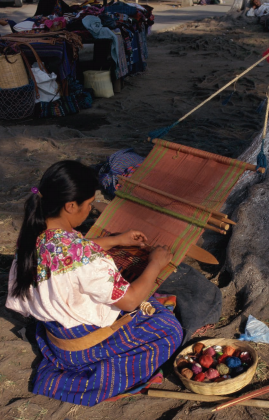
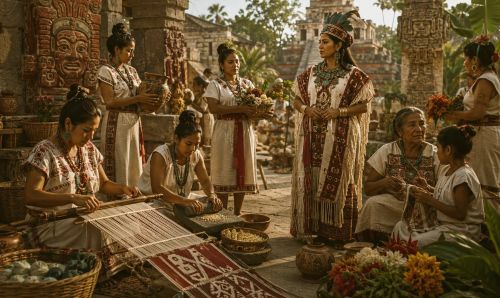
Textile production offers one of the clearest ways to see women’s communities in Mesoamerican history because it joins the ordinary, the economic, and the sacred in a single field of work. Spinning and weaving were not simply household chores performed in the background of more important events. They helped clothe bodies, mark rank, create gifts, pay tribute, sustain markets, prepare offerings, and teach girls the bodily discipline expected of adult women. The spindle, the loom, the cotton thread, the maguey fiber, the dyed cloth, and the finished garment belonged to a material world in which gender was made through practice. A woman did not become socially legible merely by being born female. She was trained into womanhood through repeated acts of production, correction, endurance, and skill. Textile work reveals women’s communities not as sentimental gatherings of shared identity, but as institutions of labor and instruction through which households and states reproduced themselves. It also reveals how easily modern categories can mislead. To call weaving “domestic” is not wrong, but it is incomplete, because domestic production could feed tribute systems, shape markets, adorn rulers, and enter ritual circulation. To call it “economic” is also insufficient, because cloth carried moral, bodily, social, and sacred meanings. Weaving sat precisely at the point where these categories met, which is why it offers such a powerful window into women’s collective lives.
The work itself required knowledge that was both technical and social. Fiber had to be prepared, spun, dyed, measured, woven, stored, exchanged, worn, or offered. Cotton and maguey did not become cloth by accident. They passed through hands trained by mothers, grandmothers, sisters, neighbors, servants, and elder women whose authority rested on experience as much as status. Girls learned the rhythm of spinning, the tension of thread, the handling of tools, the preparation of dyes, and the expectations attached to different kinds of cloth. They also learned patience, bodily control, and responsibility. Textile communities were pedagogical communities, much like the early household networks already discussed, but with a sharper economic and symbolic focus. The lesson was never only how to make cloth. It was how to become a useful member of a household, how to contribute to tribute and exchange, how to participate in ritual order, and how to inhabit a gendered place within the community.
The economic importance of textiles became especially visible in societies where cloth circulated as tribute, gift, commodity, and marker of rank. In central Mexico, textiles were central to imperial extraction and redistribution. Tribute lists recorded cloth alongside foodstuffs, precious materials, warrior costumes, and other goods that sustained elite households and political centers. This meant that women’s labor was built into the fiscal life of the state. Cloth moved from households and communities into storerooms, palaces, markets, temples, and elite networks, carrying with it the disciplined work of women who might never appear by name in tribute records. That invisibility matters. The state could count cloth more easily than it could count the women’s time embedded in it. A finished textile was a portable object, but it condensed hours of preparation, skill, and bodily labor. Every garment or tribute bundle represented not only material wealth but also the organized capacity of households to command female labor. Textile tribute turned women’s work into an imperial resource while leaving many of the producers outside the formal language of power. The cloth could be listed, stored, redistributed, worn, or sacrificed, but the women whose hands made it were often absorbed into the anonymity of the household or community from which it came. This was one of the quiet paradoxes of textile economies: the more necessary women’s labor became to state power, the more easily that labor could be hidden behind the finished object.
This does not mean that weaving women simply served the state passively. Textile production gave women social value, practical authority, and forms of economic participation that could not be dismissed as marginal. A woman skilled in spinning, dyeing, or weaving possessed knowledge that mattered to household survival and public exchange. Cloth could circulate in markets, accompany marriages, appear in ritual contexts, and mark the status of families. In many Mesoamerican societies, garments did not merely cover the body. They communicated age, rank, gender, office, regional identity, ritual role, and political relationship. To make cloth was to participate in the making of social visibility itself. The woman at the loom helped produce the signs through which hierarchy could be seen. She made the surfaces on which status appeared.
Textile communities were not free of pressure or inequality. The symbolic elevation of weaving could coexist with heavy labor demands. A noblewoman supervising textile production, a commoner woman producing cloth for household needs, a servant weaving under direction, and a tribute-burdened woman working to satisfy obligations did not experience textile labor in the same way. Elite households and states could transform women’s skill into extracted value. A task celebrated as feminine discipline could also become a mechanism of control. The same loom that signified moral womanhood could bind women to repetitive work, tribute requirements, and household expectation. This tension is essential. Mesoamerican textile production should not be romanticized as pure female creativity, nor reduced to exploitation. It was both an art of skill and a labor regime, both a source of identity and a channel through which power moved downward into women’s hands and backs.
The sacred dimension of weaving deepened that complexity. Later Nahua sources make clear that women’s domestic labor could be given cosmic meaning, and weaving belonged within that moral and ritual universe. Spinning and weaving disciplined the body, ordered materials, and turned loose fiber into structured form. That transformation carried symbolic force. It echoed wider Mesoamerican concerns with order, fertility, binding, wrapping, dressing, offering, and renewal. Cloth wrapped sacred bundles, adorned ritual participants, clothed images, marked life-cycle transitions, and accompanied exchange between humans, rulers, gods, and ancestors. The woman who made cloth was not necessarily a priestess, but her work could enter sacred circulation. The boundary between labor and ritual was porous. A textile could begin in a household and end in a temple, a palace, a marriage, a burial, or a tribute storehouse. Its path joined women’s work to the visible structures of sacred and political life. Even the act of making cloth could be understood as a disciplined ordering of the world, a transformation of loose, vulnerable material into something bounded, patterned, useful, and meaningful. In that sense, weaving did not merely produce things. It produced order. The loom became a site where bodily repetition, social training, economic demand, and sacred symbolism converged, making women’s work central to the maintenance of both household stability and cosmic imagination.
Textile communities reveal why the history of Mesoamerican women cannot be confined to either the household or the throne. Weaving linked the two. It connected girls to mothers, households to markets, commoners to tribute systems, noblewomen to palace economies, and ritual practice to material production. It also shows how women’s collective work could become historically powerful while remaining individually unnamed. The women who spun and wove may not have carved monuments or ruled cities, but they made the cloth through which rank was displayed, obligation was paid, bodies were clothed, gods were honored, and households survived. Their communities were built around tools, posture, memory, skill, and shared discipline. In the long history of Mesoamerica, the loom was not a minor domestic object. It was one of the quiet engines of civilization.
Postclassic Maya and Central Mexican Women: Local Communities, Markets, and Household Authority

By the Postclassic period, women’s communities appear in a world shaped by denser towns, intensified exchange, militarized polities, tribute systems, and increasingly visible forms of social hierarchy. The Classic Maya court had made some elite women legible through dynastic inscription and royal ritual, but Postclassic evidence draws attention toward other arenas of female life: households, markets, neighborhood groups, craft production, marriage arrangements, and local ritual obligations. These were not marginal spaces left over after politics had happened elsewhere. They were the places where political economy touched the body. Tribute had to be produced. Food had to be processed. Cloth had to be woven. Children had to be raised into obligation. Marriages had to connect households. Goods had to move from producers to consumers, from local exchange to elite demand, from household stores to market stalls. Women’s authority in this world was often not expressed through formal office, but through competence, seniority, productive skill, and the ability to maintain the practical networks on which community life depended.
The Maya Postclassic world should not be treated merely as a diminished afterlife of Classic dynasties. In Yucatán, highland Guatemala, and other regions, political organization changed, but households and local communities remained crucial engines of social continuity. Women participated in kinship strategies, household production, food preparation, ritual life, and local exchange within societies that had become more mobile, commercially connected, and politically fragmented. The sources are uneven, especially because much of what is known comes through archaeology, later colonial accounts, and ethnohistoric reconstruction, but the broad pattern is clear enough to matter. Women’s communities were embedded in houses, patios, neighborhood compounds, markets, fields, shrines, and kin networks. They helped stabilize life in a period when older royal centers no longer monopolized political imagination. Female authority often appeared less as spectacle and more as continuity. Women made households durable across political change.
Central Mexico provides the fullest documentary evidence for this local female world, especially through Nahua sources recorded after the Spanish conquest. These sources must be handled carefully because they reflect colonial conditions, missionary translation, and post-conquest memory. Still, they preserve important traces of preconquest life. Nahua society was organized through households, kin groups, neighborhood communities, and altepetl structures that linked local identity to land, tribute, and political belonging. Within this world, women were not isolated dependents. They were producers, mothers, wives, widows, ritual participants, vendors, textile workers, healers, and managers of household goods. Their labor connected the household to broader systems of exchange and obligation. A woman grinding maize or weaving cloth was not simply performing “private” labor, because the products of that labor fed families, sustained guests, supported tribute, and moved through markets. The household was local, but its work reached outward. It reached into the tribute demands of rulers, the moral training of children, the ritual expectations of neighborhood life, and the public economy of the marketplace. A woman’s authority might begin at the hearth, the loom, the storage jar, or the grinding stone, but it did not remain there. The materials she handled circulated outward as food, cloth, obligation, reputation, and survival. In that sense, Nahua household authority was not sealed away from public life. It was one of the ways public life was materially sustained.
Markets were especially important because they made women’s economic presence visible. In central Mexican cities and towns, market exchange involved food, cloth, tools, dyes, herbs, prepared goods, pottery, and many other products of household and specialized production. Women could appear as sellers, buyers, producers, and managers of small-scale exchange. Their presence in markets complicates any simple model in which men occupied public life while women remained inside the home. The market was public, noisy, regulated, social, and economically essential, yet it depended heavily on goods produced through household labor. Women who sold food, cloth, or other items did not step outside domestic economy so much as extend it into public space. The market turned women’s household knowledge into visible economic action. It also created female networks of information, reputation, bargaining, credit, competition, and mutual dependence. Women who returned regularly to market spaces could learn the reliability of sellers, the needs of neighbors, the quality of cloth or produce, the fluctuation of prices, and the social consequences of debt or dishonesty. A market woman’s authority depended not only on what she sold, but on how well she understood the human world around the goods: kinship claims, household shortages, festival needs, seasonal rhythms, and local reputation. The marketplace was not merely a place where goods changed hands. It was a community of knowledge, and women were among its essential interpreters.
This market activity did not erase hierarchy. Large-scale trade, long-distance merchant prestige, and imperial redistribution could be dominated by male institutions or elite interests, while women’s commercial activity often clustered around local exchange, food, textiles, and household goods. That distinction matters, but it should not be turned into a dismissal. Local markets were not trivial simply because they were local. They fed cities, connected producers to consumers, and allowed households to convert labor into necessities, social ties, and sometimes surplus. A woman who knew prices, quality, kin obligations, neighborhood gossip, seasonal scarcity, and the moral expectations of exchange possessed practical knowledge that sustained community life. Her authority may not have resembled that of a ruler, merchant lord, or tribute official, but it was real within the everyday economy. It was also vulnerable. Markets could expose women to regulation, debt, competition, insult, and the demands of officials or elites who benefited from the circulation of goods.
Household authority formed the other major foundation of women’s local power. In Nahua and other Mesoamerican societies, marriage created alliances between families, but the married household remained a workplace and moral community, not simply a sentimental unit. Women managed food preparation, child care, textile production, household storage, ritual cleanliness, and the social training of children. Senior women likely played important roles in disciplining younger women, advising daughters, instructing daughters-in-law, preserving kin memory, and mediating everyday conflict. Their authority was relational and cumulative. It grew from age, reputation, skill, fertility, household management, ritual knowledge, and the ability to make things function. This kind of authority is easy to miss because it rarely announces itself in the language of command. It appears instead in the ability to direct labor, correct behavior, arrange care, maintain stores, and define what counted as proper conduct.
Women’s local communities also connected households to neighborhood identity. In central Mexico, the calpulli or related local units organized tribute, land, labor, and belonging. Women’s participation in these structures was often mediated through household membership rather than formal political office, but that mediation should not be mistaken for irrelevance. Neighborhood life required cooperative labor, shared ritual obligations, child-rearing support, marriage connections, mourning practices, food exchange, and mutual aid. Women were deeply involved in those activities because they sustained the social fabric through which local communities reproduced themselves. A neighborhood was not only a fiscal unit or a male political association. It was also a lived environment of patios, houses, paths, grinding stones, market routes, shrines, water sources, and kin-linked obligations. Women’s movements through these spaces created the everyday geography of community. They knew which households were struggling, which children needed watching, which elders required care, which marriages brought tension, which families had stores to share, and which ritual obligations had to be prepared before public ceremony could occur. This was social knowledge at ground level. It did not always become written law or formal office, but it shaped how communities survived scarcity, conflict, illness, birth, death, and seasonal demand. Female neighborhood networks could function as systems of both care and surveillance, binding women into mutual obligation while also enforcing expectations about conduct, labor, sexuality, and respectability.
Postclassic women’s communities reveal a kind of authority that was practical, negotiated, and embedded rather than singular or monumental. Women could hold power as producers, vendors, household managers, ritual participants, mothers, widows, elders, and transmitters of knowledge. Yet that power operated within constraints shaped by gender, class, marital status, tribute demands, and imperial politics. The local world could give women leverage, but it could also burden them with obligation. Markets could make women visible, but not necessarily equal. Households could give senior women authority, but that authority might be exercised over younger or dependent women. Neighborhood networks could provide support, but also surveillance and discipline. The strength of these communities lay precisely in that complexity. They were not utopian spaces outside power. They were the local institutions through which Mesoamerican society became livable, unequal, productive, and continuous.
Priestesses, Temple Schools, and Ritual Sisterhoods

Women’s religious communities in Postclassic Mesoamerica are easiest to see in central Mexican sources, especially those that describe Nahua and Mexica education, ritual service, temple discipline, and the ceremonial labor expected of girls and young women. The evidence must be handled carefully, because much of it comes from sixteenth-century colonial texts that filtered Indigenous institutions through Christian categories of chastity, sin, idolatry, and clerical order. Spanish friars could describe temple women in language that made them resemble nuns, and that comparison can mislead if it is taken too literally. Yet the underlying evidence remains significant. Girls and women could be trained in ritual discipline, attached to temple service, involved in offerings, songs, sweeping, fasting, food preparation, and the maintenance of sacred order. These were not merely private devotional acts. They created religious communities in which female labor, bodily restraint, instruction, and sacred obligation were woven together.
The Mexica educational system is especially important because it placed young people within institutions that trained them for social, moral, and ritual life. Boys and girls did not receive identical instruction, but both were shaped by discipline. Elite youths could be connected to the calmecac, associated with priestly education, noble formation, ritual knowledge, and austerity, while commoner training was often linked to household and community expectations. Girls were taught gendered labor, obedience, modesty, reverence, and ritual duties, but this should not be reduced to simple domestic submission. In Nahua moral thought, disciplined labor was a form of social and cosmic order. Sweeping, grinding, weaving, preparing food, observing ritual restraint, and honoring the gods could all carry moral force. Women’s ritual communities emerged from the same practices that organized daily life. The temple did not replace the household as a sacred space. It extended and intensified the sacred meanings already attached to bodily discipline, service, and ordered labor. This is why female religious training cannot be separated from the broader moral education of girls. A young woman learned how to hold herself, how to regulate speech, how to perform work without disorder, how to respect elders, how to prepare materials for ritual use, and how to understand ordinary tasks as part of a larger sacred economy. Instruction moved through correction, repetition, fear, pride, and expectation. It shaped not only what girls did but how they inhabited their bodies. In that sense, temple education and household training belonged to the same moral universe, even when they occurred in different institutional settings.
Temple service also gave some women a recognized place in the maintenance of public religion. Young women attached to temples could participate in the preparation of offerings, the care of ritual spaces, and the performance of songs or ceremonies connected to particular deities and calendrical observances. Their duties were not equivalent to sovereign priestly command, and it would be dangerous to overstate their institutional independence. Still, their presence matters because it shows that women were not absent from formal religious life. Sacred order required more than male priests, warriors, and rulers. It required food, cloth, flowers, incense, song, sweeping, bodily purity, ritual timing, and careful preparation. Much of that work was gendered, and some of it was performed collectively by women or girls under supervision. The result was a female religious community organized around service, training, restraint, and repetition.
The language of “sisterhood” is useful only if it remains historically disciplined. These temple women were not modern sisters in an egalitarian spiritual community, nor were they medieval Christian nuns, even if Spanish authors sometimes reached for those analogies. Their relationships were shaped by age, status, rank, household origin, and institutional control. Senior women, priestly authorities, and elite families may have held power over younger women who entered ritual service. Some girls may have experienced temple discipline as honor, training, and sacred participation, while others may have felt its burdens as surveillance, restriction, or obligation. Female ritual community could produce solidarity through shared labor and shared danger, but it could also produce obedience. It taught girls how to control the body, regulate speech, endure fasting, maintain cleanliness, and act within the expectations of gods, elders, and community. That training made women spiritually significant, but it also made them governable.
Goddess veneration deepened the sacred meaning of women’s ritual labor. Mesoamerican religious worlds included powerful female deities associated with earth, fertility, maize, water, weaving, sexuality, childbirth, purification, death, and renewal. In the Nahua world, figures such as Toci, Tlazolteotl, Chalchiuhtlicue, Chicomecoatl, and Cihuacoatl reveal the many-sided nature of sacred femininity. These goddesses were not gentle symbols of womanhood in any simple sense. They could nourish, cleanse, create, devour, punish, and transform. Their power reflected the dangerous importance of the processes associated with women’s bodies and labor: birth, blood, sexuality, food, weaving, and the maintenance of life from substances that could decay, bleed, or die. Women’s ritual communities operated in the shadow of that sacred ambiguity. To serve female deities was not merely to celebrate femininity. It was to participate in a religious imagination that understood life-making as powerful, necessary, and perilous. The sacred feminine could authorize women’s ritual importance while also surrounding women’s bodies with anxiety, expectation, and control. Childbirth, sexual conduct, menstruation, food preparation, textile work, and cleansing were not neutral activities in this worldview. They belonged to a moral and cosmic system in which female-associated processes could preserve order or threaten disorder. Goddesses made that contradiction visible. They were sources of fertility and danger, protection and punishment, abundance and terror. Women who served within ritual communities moved through that charged symbolic field, where their labor could be honored because it touched sacred power and regulated because that power was feared.
The presence of goddesses did not mean that women enjoyed equality with men in religious or political life. Divine femininity could elevate the symbolic value of women’s labor while actual women remained constrained by male authority, class hierarchy, family expectation, and imperial discipline. This tension is essential. A society could imagine earth, fertility, childbirth, weaving, or purification through female sacred figures while still restricting women’s formal authority. The sacred and the social did not map neatly onto each other. Female deities gave ritual language to women’s work, but they did not automatically produce female autonomy. Instead, they made women’s labor symbolically indispensable. The same culture that honored goddesses could also demand that women embody discipline, modesty, obedience, productivity, and reproductive responsibility. Sacred value and social control were not opposites. They often reinforced each other.
Priestesses, temple girls, and ritual communities occupy a crucial place in the history of Mesoamerican women. They show that women’s collective life was not limited to kinship, markets, or textile labor, but reached into the ceremonial structures through which society understood time, purity, fertility, death, and renewal. Their work linked household discipline to temple service, bodily training to cosmic order, and female labor to public religion. Yet their communities must be read without fantasy. They were not proof of a hidden matriarchy, nor were they simply victims of religious patriarchy. They were disciplined actors inside a sacred world that needed women’s hands, voices, bodies, and restraint. Through them, Mesoamerican religious life becomes visible not only as sacrifice, priesthood, and divine kingship, but also as sweeping, singing, fasting, preparing, weaving, feeding, and teaching. The sacred was not only on the pyramid. It was also in the trained bodies of women who helped keep the world ritually alive.
Midwives, Healers, and the Female Transmission of Embodied Knowledge

Midwives and healers occupied one of the most respected and intimate forms of women’s authority in Mesoamerican life. Their communities were not always formal guilds in the institutional sense, but they were unmistakably communities of knowledge, practice, memory, and ritual responsibility. A midwife did not simply assist at birth. She entered the dangerous threshold between life and death, mother and child, household and cosmos. Her work required practical skill, verbal authority, knowledge of bodies, familiarity with herbs and treatments, and the ability to speak in moments when ordinary household confidence gave way to fear. Because childbirth carried risk for both mother and infant, the woman who managed it became more than a helper. She was a mediator between vulnerability and survival.
The Nahua evidence is especially rich because the Florentine Codex preserves speeches and descriptions associated with childbirth, infancy, healing, moral instruction, and ritual practice. These passages must be read with the same caution applied elsewhere, since they were recorded after conquest in a colonial setting shaped by Franciscan interests and Nahua memory. Even so, they reveal a world in which midwives possessed recognized social authority. They bathed newborns, addressed infants with formal speech, instructed mothers, interpreted the meaning of birth, and helped place the child within a moral and cosmic order. Their words did not merely soothe. They named obligation. A newborn was not treated as a private biological event alone, but as a new participant in a world of labor, discipline, danger, gender, and divine expectation. The midwife’s speech helped transform birth into social belonging. She could speak to the infant as one entering a difficult world, to the mother as one who had crossed a dangerous threshold, and to the household as a community now responsible for receiving and shaping a new life. In these speeches, childbirth appears not only as physiology but as moral drama. The child entered a world already organized by gendered expectations, future labor, ritual duty, and vulnerability to divine and social forces. The midwife stood at the doorway of that transformation, giving language to what the body had endured and what society now required.
This authority was embodied because it lived in hands, voice, timing, and experience. Midwives learned by watching, assisting, remembering, correcting, and eventually acting with confidence in moments of crisis. Their knowledge was not abstract in the way later medical writing often imagines expertise. It was tactile, situational, and relational. They had to read pain, blood, breath, exhaustion, fear, fetal position, household tension, and the emotional state of the mother. They also had to command the room. The birth chamber was a female-centered space, but not necessarily a gentle one. It required instruction, pressure, ritual language, bodily management, and sometimes hard decisions. In that space, older women’s authority became immediate. The midwife’s power did not come from office, monument, or written title. It came from being the person everyone needed when life was most uncertain.
Healers likewise preserved specialized knowledge that moved across generations through practice. Mesoamerican medicine drew on herbs, minerals, bathing, massage, ritual speech, diagnosis, divination, diet, and an understanding of the body as inseparable from social and sacred forces. Not all healers were women, and healing was not a single profession with one fixed structure. Still, women’s roles in childbirth, postpartum care, infant care, household treatment, food preparation, and ritual cleansing placed them close to the everyday management of health. A mother, grandmother, midwife, or female healer might know which plants eased pain, which foods restored strength, which symptoms signaled danger, and which ritual actions were necessary when illness seemed to exceed ordinary explanation. Such knowledge was practical, but it was not merely practical. It joined body, environment, household, and sacred order. It also depended on accumulated observation: how a fever behaved, how a wound changed, how a mother recovered after childbirth, how an infant fed or failed to feed, how seasonal scarcity affected bodies, and how emotional distress appeared in physical form. Healing knowledge was both empirical and interpretive. It grew from close attention to the human body, but also from a worldview in which imbalance, impurity, fright, divine displeasure, social disorder, and environmental danger could all belong to the explanation of suffering. Women who cared for bodies inside households became interpreters of these overlapping causes, moving between remedy, ritual, food, touch, and speech.
These communities of embodied knowledge also carried moral authority. Midwives and elder women instructed younger women about sexuality, pregnancy, motherhood, household conduct, endurance, and responsibility. Their counsel could be supportive, but it could also be disciplinary. They taught women how to behave under pressure, how to bear pain, how to care for infants, how to maintain household order, and how to understand their bodies within the expectations of community and gods. This made female healing networks both protective and regulatory. They preserved life, but they also transmitted norms. A young mother received care, but she also received instruction. A child entered the world through women’s hands, but also through women’s words, which began the long process of making that child legible within gendered society. The midwife belonged not only to medicine but to education, ritual, and social reproduction.
Midwives and healers reveal a form of women’s community that is easy to underestimate because it rarely leaves monumental evidence. Their archive was not carved stone but remembered speech, repeated technique, plant knowledge, bathing practice, birth ritual, and the trained reading of bodies. Through them, women transmitted knowledge at the most vulnerable points of life: birth, illness, infancy, recovery, pain, and death. Their authority was not unlimited, and it operated within larger structures of gender hierarchy, family expectation, and religious discipline. Yet it was indispensable. If weaving shows how women made social order visible in cloth, midwifery and healing show how women carried social order through flesh, breath, blood, and care. Mesoamerican communities survived not only because rulers commanded, priests sacrificed, or warriors fought, but because women knew how to bring children into the world, keep bodies alive, and speak meaning over danger.
Calpulli, Neighborhood Women, and Commoner Mutuality
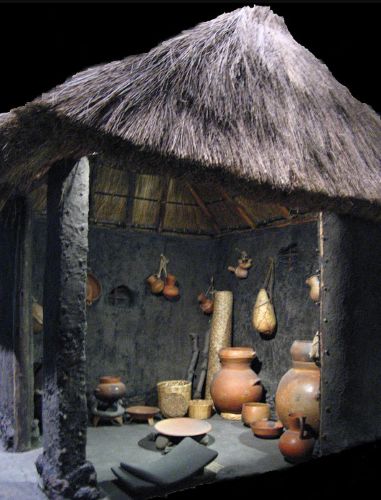
The calpulli, often described as a kin-based or neighborhood unit in central Mexico, offers one of the clearest ways to understand commoner women’s communities below the level of courts, temples, and imperial offices. It organized land, labor, tribute, local identity, and mutual obligation, but it was also lived through the ordinary geography of houses, patios, paths, fields, water sources, shrines, and markets. Women’s participation in this world was often mediated through households rather than formal office, yet that mediation should not be confused with absence. A commoner woman’s daily labor connected her family to the local community through food production, textile work, child care, ritual preparation, exchange, and the maintenance of neighborhood relationships. If elite women helped dynasties remember themselves, commoner women helped communities keep functioning.
The neighborhood was a social organism, not simply an administrative unit. It depended on people knowing one another’s needs, obligations, reputations, marriages, illnesses, debts, rituals, and seasonal rhythms. Women were central to that knowledge because their work carried them repeatedly across the small circuits of local life. They went to water sources, exchanged food and goods, visited kin, watched children, prepared for ceremonies, participated in market activity, and managed household resources. These movements created practical familiarity. A woman might know which household lacked maize, which child was sick, which elder needed care, which marriage was strained, which family had failed in an obligation, and which neighbor could be trusted in a moment of need. Such knowledge was not formal political authority, but it shaped the possibilities of cooperation and survival. Communities do not endure by law alone. They endure because people remember who needs help and who owes it.
Commoner mutuality was especially important because tribute demands and household vulnerability were not abstract burdens. They arrived as labor, cloth, food, goods, and obligations that had to be met by real bodies under real constraints. Women’s work was deeply implicated in this system. Textile production, food preparation, storage management, child-rearing, and small-scale exchange all helped households meet demands placed upon them by local and imperial structures. Yet mutuality softened some of the harshness of those demands by creating webs of shared support. Women could borrow, lend, exchange, advise, assist in childbirth, help with children, share knowledge of remedies, cooperate in preparation for ritual occasions, and sustain one another through scarcity. This does not mean the calpulli was an egalitarian refuge. It means that neighborhood life made survival collective. In a world where tribute, illness, crop failure, widowhood, childbirth, and political violence could threaten household stability, women’s local networks were often the first line of resilience.
Female elders likely held particular authority within these neighborhood communities. Age brought memory, experience, and the right to instruct. Older women could teach younger women how to grind, cook, weave, store, nurse, clean, prepare ritual materials, behave in marriage, and understand the expectations of the community. They could also discipline. Their authority might appear in advice, correction, scolding, matchmaking, mediation, or ritual preparation rather than in named office. This kind of power is easy to overlook because it did not always produce documents, monuments, or titles. Yet it shaped the moral life of the neighborhood. A young woman did not learn community expectations from abstract rules alone. She learned them through the voices and gestures of older women who had survived marriage, childbirth, labor, hunger, grief, and obligation before her.
Commoner women’s mutuality could become surveillance. The same networks that offered help also enforced conformity. Neighbors noticed disorder. Elders judged sexual conduct, laziness, poor household management, disrespect, neglect of children, ritual failure, and failures of reciprocity. A woman who depended on the community also lived under its eyes. This made female neighborhood life both protective and restrictive. It could rescue a household in crisis, but it could also discipline those who violated expectations. Such tension should not be treated as contradiction. It is the nature of close communities. Mutual aid and social control often travel together, especially where survival depends on cooperation and reputation. Women’s communities in the calpulli were not sentimental spaces of automatic solidarity. They were practical structures that bound people together through need, obligation, memory, and judgment.
The importance of neighborhood women lies in the way they reveal Mesoamerican history from below. They show how large systems such as tribute, markets, religion, and household production were made livable at the local level. Rulers could demand cloth, food, labor, and obedience, but communities had to organize the daily means of meeting those demands. Priests could define sacred calendars, but households had to prepare offerings and observe ritual discipline. Markets could circulate goods, but women’s labor and knowledge supplied many of the objects and relationships that made exchange possible. The calpulli was one of the places where women’s collective life joined economy, ritual, kinship, and survival. Commoner women may not have appeared as queens, priestesses, or named dynastic actors, but their neighborhood networks formed one of the quiet infrastructures of Mesoamerican society.
Limits, Hierarchies, and the Unequal Meaning of Female Community
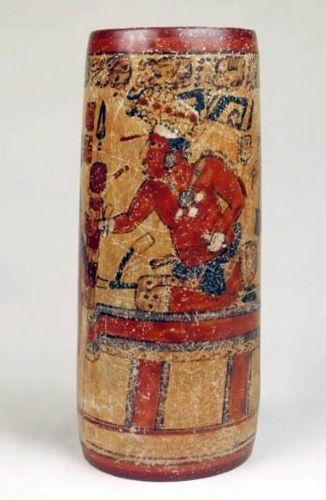
To speak of women’s communities in Mesoamerican history is not to imagine women living in a world apart from power. The phrase can illuminate networks of labor, kinship, ritual, healing, market exchange, and memory, but it can also mislead if it turns female association into automatic solidarity. Women gathered, worked, learned, prayed, healed, traded, gave birth, instructed, and mourned together, but they did so inside societies structured by rank, age, lineage, servitude, tribute, conquest, and gendered expectation. A queen and her attendant, a noble bride and a captive servant, a senior midwife and a frightened young mother, a marketplace vendor and a debt-burdened producer of cloth could all belong to female-centered spaces without sharing the same power within them. Community did not erase hierarchy. Often, it organized hierarchy at close range.
Elite women especially reveal this tension. Royal women could carry dynastic legitimacy, supervise palace labor, sponsor ritual, and bind polities through marriage, but their authority often depended on structures that subordinated other women. A noblewoman’s household required attendants, food workers, textile producers, child-minders, servants, and sometimes captives or dependent laborers. The prestige of elite female life rested partly on the work of women whose names disappeared into the background of courtly abundance. A queen’s ritual performance might be carved in stone, while the women who prepared garments, food, offerings, incense, rooms, or children for that ceremony remained unrecorded. The problem is not that elite women were false or unimportant actors. They were very real actors. The problem is that their visibility can tempt historians to mistake elite female authority for women’s authority in general. The palace actually made some women powerful by making many others useful.
Commoner women faced different constraints. Their communities were often rooted in mutual aid, household labor, market exchange, and neighborhood obligation, but these forms of belonging could become burdens as well as protections. Textile production could give women skill, identity, and economic importance, yet it could also bind them to tribute demands and repetitive labor. Market participation could make women visible, informed, and economically active, yet it exposed them to regulation, competition, debt, and the judgment of others. Neighborhood networks could provide help during childbirth, illness, scarcity, or mourning, but they also watched, corrected, criticized, and disciplined. The same elder woman who preserved knowledge could enforce obedience. The same female community that helped a young mother survive could also judge whether she had met the moral expectations attached to marriage, sexuality, motherhood, work, and respectability. This dual character was not accidental. In communities where survival depended on reputation, reciprocity, and visible labor, mutual aid could not be separated from moral scrutiny. A woman’s standing was shaped by whether she worked properly, raised children well, honored kin, fulfilled ritual expectations, managed household resources, and avoided conduct that neighbors interpreted as disorder. Help and judgment moved along the same paths. The woman who lent food might also remember the debt. The elder who instructed a daughter-in-law might also measure her obedience. The neighbor who assisted at birth might later speak about the mother’s conduct. Community was a form of security, but it was also a system of memory.
Age sharpened these inequalities. Older women often possessed authority within households, neighborhoods, healing networks, and ritual spaces because they had experience, memory, and social standing. They could teach younger women how to grind maize, weave, cook, store food, prepare offerings, care for infants, survive marriage, and read the signs of illness or danger. This authority mattered deeply, but it was not always gentle. Instruction could come as correction, rebuke, fear, humiliation, or pressure. Young women learned inside communities shaped by expectation as much as affection. Daughters-in-law, apprentices, servants, and girls entering ritual or household training could depend on elder women while also being controlled by them. Female authority did not always resist patriarchy. At times, it translated broader social demands into the intimate language of household discipline.
Servitude and captivity expose the hardest edge of this problem. Mesoamerican households, courts, and polities could absorb dependent women into systems of labor, exchange, and status that made them members of a community without making them secure within it. A captive woman might serve inside a household, prepare food, produce cloth, accompany an elite woman, or become part of reproductive and domestic arrangements shaped by coercion. A servant might live in close proximity to noblewomen and still remain socially vulnerable. Such women could share female spaces, but their experience of those spaces was marked by dependence. They heard women’s speech, learned women’s labor, and participated in women’s routines, yet under conditions that limited choice. This matters because the language of community can soften domination if it is not handled carefully. Belonging is not the same as equality. Inclusion can be a form of control.
The unequal meaning of female community is central here, not a qualification added at the end. Women’s networks were powerful precisely because they operated where society reproduced itself: in houses, palaces, markets, temples, birth rooms, weaving spaces, neighborhood paths, and ritual preparations. But those same locations were also where inequality became daily life. Women could support one another, teach one another, protect one another, and remember together. They could also command, discipline, exploit, shame, and exclude. A senior woman might preserve knowledge that saved lives while enforcing rules that narrowed younger women’s choices. An elite woman might perform ritual labor that strengthened dynastic continuity while relying on unnamed women whose work gave her authority material form. A neighborhood might shelter a widow, assist a mother, or share food in crisis while also judging those who failed to meet local expectations. These contradictions do not weaken the concept of women’s community. They make it historically honest. To recover women’s communities in Mesoamerican history honestly, we have to hold both realities at once. These communities were not imaginary, and they were not innocent. They were human institutions, made of care and coercion, skill and hierarchy, memory and labor, shared danger and unequal power.
Conquest, Colonial Records, and the Rewriting of Indigenous Women’s Communities
The following video from National Geographic is a documentary about the Spanish Conquistadors:
The Spanish conquest did not simply interrupt Mesoamerican women’s communities. It changed the conditions under which those communities could be seen, described, governed, and remembered. War, epidemic disease, forced labor, Christian missionization, tribute reorganization, displacement, enslavement, and the destruction or repurposing of temples altered the institutions through which women had worked, worshipped, healed, traded, and raised children. Yet conquest also produced an enormous colonial archive that preserved traces of Indigenous women’s lives at the very moment those lives were being reordered. This archive is simultaneously indispensable and dangerous. It allows historians to hear echoes of women’s ritual speech, household instruction, healing knowledge, market activity, marriage conflict, property claims, and moral worlds. But it rarely gives those things back untouched. Indigenous women appear through Spanish legal categories, Christian moral language, missionary suspicion, tribute administration, court petitions, and male-authored memory. The record preserves women by translating them.
The Florentine Codex is the most important example of this double reality. Compiled in the sixteenth century by Franciscan Bernardino de Sahagún in collaboration with Nahua elders, scribes, painters, and informants, it preserves extraordinary detail about Nahua religion, social life, medicine, education, childbirth, moral instruction, and conquest. It gives historians some of the richest surviving descriptions of midwives, female household labor, girls’ training, ritual obligations, market life, illness, healing, and the moral language surrounding women’s bodies. Yet the text cannot be treated as a transparent window into preconquest life. It was created after military defeat, demographic catastrophe, and the imposition of Christianity. It was also shaped by Sahagún’s missionary purpose, by translation between Nahuatl and Spanish, and by the difficult position of Indigenous contributors who preserved knowledge under colonial scrutiny. The women in the Florentine Codex are not simply “pre-Hispanic women” recovered intact. They are Indigenous women remembered, explained, disciplined, and partially reframed within the intellectual wreckage of conquest. The text’s power lies precisely in that tension. It records speeches to newborns, descriptions of female instruction, medicinal knowledge, ritual service, and social expectations with a richness that no historian can ignore, but it also arranges that knowledge inside a project concerned with conversion, classification, and the exposure of what missionaries understood as error. Nahua contributors were not passive informants, and their participation allowed Indigenous categories, metaphors, memories, and voices to survive inside the manuscript. Still, survival inside a colonial text was never neutral. The codex preserves Indigenous women’s worlds through an encounter between memory and surveillance, and that makes it both a source of recovery and a document of control.
Christian missionization deeply affected the interpretation of women’s communities. Temple service, goddess veneration, ritual speech, sweeping, fasting, childbirth rites, healing practices, and household offerings could be reclassified as idolatry, superstition, sin, or dangerous survivals of paganism. Spanish friars often understood Indigenous women through Christian expectations of modesty, chastity, marriage, motherhood, obedience, and domestic order. This did not mean that Indigenous women simply abandoned older practices. Many forms of knowledge persisted inside households, healing routines, foodways, language, naming, midwifery, ritual memory, and local custom. But colonial Christianity changed what could be said openly, what had to be hidden, what could be reinterpreted, and what would be condemned. Women’s communities became sites of negotiation between inherited practice and imposed morality. The same older woman who taught a younger one how to care for a newborn or prepare ritual food might now have to navigate priestly disapproval, baptismal expectations, Christian marriage rules, and the changing moral vocabulary of colonial society.
Colonial law also transformed women’s lives by redefining marriage, inheritance, property, sexuality, and household authority. Indigenous women could and did appear in colonial courts as litigants, witnesses, widows, property holders, wives, daughters, and community members seeking recognition or protection. These records show agency, but agency under pressure. A woman who entered court might use Spanish law to defend land, challenge abuse, claim inheritance, contest marriage arrangements, or negotiate household conflict. Yet the very need to enter such a system shows how colonial rule was reshaping older forms of authority. Kinship, landholding, neighborhood obligation, and gendered labor were increasingly translated into legal forms legible to Spanish officials. Women’s voices in court are invaluable, but they are mediated by scribes, interpreters, formulas, and the strategic language required to win a case. The colonial record gives women speech, but often only after forcing that speech into imperial grammar.
The conquest also disrupted elite women’s communities in distinctive ways. Noble Indigenous women could serve as cultural mediators, marriage partners, translators, property holders, and links between Spanish colonizers and Indigenous ruling houses. Some used lineage, baptismal status, marriage alliances, and legal petitions to preserve family standing within the new order. Others were coerced, displaced, or absorbed into colonial households and sexual economies. The best-known figure, Malintzin, often called Doña Marina in Spanish sources, reveals the danger of reducing Indigenous women to symbols. She was made into an interpreter, mediator, captive, consort, mother, traitor, survivor, and mythic figure by different historical traditions. Her life cannot stand for all Indigenous women, but it does expose how conquest turned some women’s linguistic, diplomatic, and bodily labor into instruments of imperial power. Elite and intermediary women could acquire influence, but under conditions shaped by violence, gendered vulnerability, and colonial need. Their importance often came from the same conditions that endangered them. A noblewoman’s lineage could matter to Spaniards because it made conquest governable, marriage useful, land claims negotiable, or Indigenous communities easier to incorporate into colonial administration. A translator’s skill could open space for survival and influence while also binding her to the ambitions of men with military and imperial power. Elite Indigenous women occupied a painfully ambiguous position. They could preserve memory, negotiate status, protect kin, and use colonial institutions with intelligence, but they often did so inside structures that had shattered the political worlds from which their authority came.
Commoner women faced equally profound changes, though they are often less visible as individuals. Tribute continued under Spanish rule in altered forms, and households still had to produce food, cloth, labor, and service. Epidemic disease fractured families, reduced communities, created widows and orphans, and increased the burdens on survivors. Markets continued, but they operated within colonial taxation, regulation, and new economic pressures. Midwives, healers, weavers, vendors, and household managers remained essential, but their work now existed under new religious and administrative scrutiny. Female mutual aid likely became even more important as communities endured demographic collapse and social upheaval. Women cared for the sick, raised surviving children, preserved food knowledge, maintained ritual memory where possible, and helped households adapt to a world remade by conquest. Their communities did not vanish. They were strained, redirected, and forced to survive in altered forms.
The colonial archive also changed memory itself. Preconquest women’s communities had often transmitted knowledge through speech, practice, ritual, household repetition, textile skill, healing technique, and embodied instruction. Colonial rule increasingly privileged alphabetic writing, Christian doctrine, legal record, tribute account, and male ecclesiastical interpretation. This shift did not destroy oral and practical memory, but it changed which memories became historically visible. A midwife’s speech survives if a colonial project recorded it. A market woman appears if law, tribute, or description needed her. A healer becomes visible when her practice attracted curiosity or suspicion. A noblewoman appears when property, marriage, or lineage mattered to colonial administration. The women who continued to teach, cook, weave, heal, mourn, and remember outside those moments remain harder to recover. The archive does not merely reveal the past. It sorts the past according to colonial need. It rewards moments of conflict, conversion, taxation, litigation, punishment, and explanation, while leaving quieter forms of continuity in shadow. That imbalance matters because women’s communities often worked through ordinary repetition rather than dramatic event. A grandmother teaching a girl how to prepare food, a midwife correcting a younger assistant, a widow negotiating help from neighbors, or a healer passing on plant knowledge might sustain Indigenous life more deeply than many acts recorded by officials, but such moments usually entered writing only when they intersected with authority. Historians must treat silence not as absence, but as a clue to the kinds of women’s work colonial institutions did not know how, or did not care, to preserve.
For that reason, conquest must be treated not as the endpoint of Indigenous women’s communities, but as a violent transformation in both lived experience and historical visibility. Women’s networks persisted through household labor, healing, markets, kinship, neighborhood care, legal adaptation, and religious negotiation. The sources that allow historians to reconstruct those networks were produced by a colonial order that sought to convert, discipline, tax, classify, and govern Indigenous life. This creates the final methodological challenge. To write about Mesoamerican women after conquest is to read against the grain without pretending the grain is not there. The task is not to recover a pure precolonial female world untouched by colonial mediation. It is to see how Indigenous women’s communities endured through rupture, how they were rewritten by conquest, and how their survival can still be traced in the very records that tried to contain them.
Conclusion: Women’s Communities as the Hidden Architecture of Mesoamerican Life
Women’s communities in Mesoamerican history were rarely marginal, even when the surviving record makes them appear secondary. They were not always formal institutions with titles, offices, or public monuments, but they organized the labor, memory, ritual, care, and social reproduction on which larger structures depended. In early households, women’s shared work helped turn food, fiber, children, and domestic space into durable community life. In Classic Maya courts, royal women carried dynastic memory through marriage, motherhood, ritual action, and political alliance. In palace households, unnamed women transformed tribute and resources into feasts, garments, ceremonies, heirs, and displays of abundance. In weaving communities, women made cloth that clothed bodies, marked rank, satisfied tribute, entered markets, and moved into sacred circulation. Their labor was everywhere, even when their names were not.
The same pattern appears in markets, neighborhoods, temples, birth rooms, and healing spaces. Postclassic women sustained local economies through household production, exchange, food labor, and practical authority. Temple women and girls helped maintain sacred order through discipline, song, sweeping, offerings, and ritual preparation. Midwives and healers preserved embodied knowledge at the thresholds of birth, illness, recovery, and death. Commoner women in neighborhood communities made survival collective through mutual aid, shared labor, elder instruction, child care, and the memory of obligation. These were not small histories. They were the systems through which Mesoamerican societies renewed themselves from one generation to the next. Rulers could command tribute, priests could measure sacred time, and warriors could seek glory, but none of those structures could endure without women’s continuous work in the spaces where life was actually sustained.
Yet the importance of women’s communities does not make them innocent. They were shaped by hierarchy, servitude, age, rank, tribute, conquest, and discipline. Elite women could hold authority that depended on the labor of attendants, servants, captives, and commoners. Senior women could preserve knowledge while enforcing obedience. Neighborhood networks could protect the vulnerable while also watching, judging, and correcting them. Textile work could confer identity and value while binding women to heavy production demands. Ritual service could give women sacred significance while also training their bodies into restraint and submission. Female community, then, was not a separate moral world outside power. It was one of the intimate places where power became daily life. A queen’s authority, a midwife’s instruction, a market woman’s reputation, a grandmother’s correction, a temple girl’s discipline, and a servant’s labor all belonged to the same broad history of gendered association, but they did not belong to it equally. Some women commanded while others obeyed. Some transmitted memory while others were absorbed into silence. Some found protection in women’s networks, while others experienced those networks as obligation, surveillance, or coercion. That unevenness is not a reason to abandon the idea of women’s communities. It is the reason to take them seriously as historical institutions rather than sentimental ideals. Their history must be written with both admiration and caution, honoring women’s collective strength without turning their communities into fantasies of equality.
To see these communities is to change what counts as historical architecture. Mesoamerican life was built not only in pyramids, palaces, markets, temples, courts, and tribute systems, but also in kitchens, patios, looms, birth rooms, healing spaces, neighborhood paths, and women’s remembered speech. The archive often makes these places harder to see because it favors kings, conquests, inscriptions, lawsuits, missionary descriptions, and imperial accounts. But beneath those visible structures lay the work that made society livable: feeding, weaving, healing, teaching, birthing, mourning, exchanging, preparing, correcting, remembering, and surviving. Women’s communities were hidden only if history looked for power in the wrong places. Once the ordinary is recognized as structural, they appear not at the edges of Mesoamerican civilization, but at its center.
Bibliography
- Anawalt, Patricia Rieff. Indian Clothing before Cortés: Mesoamerican Costumes from the Codices. Norman: University of Oklahoma Press, 1981.
- Ardren, Traci, ed. Ancient Maya Women. Walnut Creek, CA: AltaMira Press, 2002.
- Berdan, Frances F. The Aztecs of Central Mexico: An Imperial Society. 2nd ed. Belmont, CA: Wadsworth, 2004.
- Bernardino de Sahagún. Florentine Codex: General History of the Things of New Spain. Translated by Arthur J. O. Anderson and Charles E. Dibble. Santa Fe: School of American Research, 1950.
- Boone, Elizabeth Hill. Cycles of Time and Meaning in the Mexican Books of Fate. Austin: University of Texas Press, 2007.
- Brumfiel, Elizabeth M. “Cloth, Gender, Continuity, and Change: Fabricating Unity in Anthropology.” American Anthropologist 108:4 (2006), 862–877.
- —-. “Specialization, Market Exchange, and the Aztec State: A View from Huexotla.” Current Anthropology 21:4 (1980), 459–478.
- Brumfiel, Elizabeth M., and Cynthia Robin, eds. “Gender, Households, and Society: Unraveling the Threads of the Past and the Present.” Archaeological Papers of the American Anthropological Association 18:1 (2008), 1-16.
- Burkhart, Louise M. The Slippery Earth: Nahua-Christian Moral Dialogue in Sixteenth-Century Mexico. Tucson: University of Arizona Press, 1989.
- Calnek, Edward E. “The Internal Structure of Tenochtitlan.” In The Valley of Mexico: Studies in Pre-Hispanic Ecology and Society, edited by Eric R. Wolf, 287–302. Albuquerque: University of New Mexico Press, 1976.
- Carballo, David M. “Advances in the Household Archaeology of Highland Mesoamerica.” Journal of Archaeological Research 19:2 (2011), 133-189.
- Clendinnen, Inga. Aztecs: An Interpretation. Cambridge: Cambridge University Press, 1991.
- Cline, Sarah L. Colonial Culhuacan, 1580–1600: A Social History of an Aztec Town. Albuquerque: University of New Mexico Press, 1986.
- Coe, Michael D. and Rex Koontz. Mexico: From the Olmecs to the Aztecs. 7th ed. London: Thames & Hudson, 2013.
- Cyphers, Ann. Escultura Olmeca de San Lorenzo Tenochtitlán. Mexico City: Universidad Nacional Autónoma de México, 2004.
- Diel, Lori Boornazian. “Women and Political Power: The Inclusion and Exclusion of Noblewomen in Aztec Pictorial Histories.” RES: Anthropology and Aesthetics 47 (2005), 82-106.
- Drucker, Philip. La Venta, Tabasco: A Study of Olmec Ceramics and Art. Bureau of American Ethnology Bulletin 153. Washington, DC: Smithsonian Institution, 1952.
- Drucker, Philip, Robert F. Heizer, and Robert J. Squier. Excavations at La Venta, Tabasco, 1955. Bureau of American Ethnology Bulletin 170. Washington, DC: Smithsonian Institution, 1959.
- Durán, Diego. The History of the Indies of New Spain. Translated by Doris Heyden. Norman: University of Oklahoma Press, 1994.
- Evans, Susan Toby, and Joanne Pillsbury, eds. Palaces of the Ancient New World. Washington, DC: Dumbarton Oaks, 2004.
- Hassig, Ross. Trade, Tribute, and Transportation: The Sixteenth-Century Political Economy of the Valley of Mexico. Norman: University of Oklahoma Press, 1985.
- Hendon, Julia A. Houses in a Landscape: Memory and Everyday Life in Mesoamerica. Durham: Duke University Press, 2010.
- Hewitt, Erika A. “What’s in a Name: Gender, Power, and Classic Maya Women Rulers.” Ancient Mesoamerica 10:2 (1999), 251-262.
- Inomata, Takeshi, and Stephen D. Houston, eds. Royal Courts of the Ancient Maya. 2 vols. Boulder, CO: Westview Press, 2001.
- Joyce, Rosemary A. Gender and Power in Prehispanic Mesoamerica. Austin: University of Texas Press, 2000.
- Kellogg, Susan. Law and the Transformation of Aztec Culture, 1500–1700. Norman: University of Oklahoma Press, 1995.
- —-. “The Woman’s Room: Some Aspects of Gender Relations in Tenochtitlan in the Late Pre-Hispanic Period.” Ethnohistory 42:4 (1995), 563-576.
- Lockhart, James. The Nahuas after the Conquest: A Social and Cultural History of the Indians of Central Mexico, Sixteenth through Eighteenth Centuries. Stanford: Stanford University Press, 1992.
- Looper, Matthew G. To Be Like Gods: Dance in Ancient Maya Civilization. Austin: University of Texas Press, 2009.
- Marcus, Joyce, and Kent V. Flannery. Zapotec Civilization: How Urban Society Evolved in Mexico’s Oaxaca Valley. London: Thames & Hudson, 1996.
- Martin, Simon, and Nikolai Grube. Chronicle of the Maya Kings and Queens: Deciphering the Dynasties of the Ancient Maya. 2nd ed. London: Thames & Hudson, 2008.
- McCafferty, Sharisse D., and Geoffrey G. McCafferty. “Spinning and Weaving as Female Gender Identity in Post-Classic Mexico.” In Textile Traditions of Mesoamerica and the Andes: An Anthology, edited by Margot Blum Schevill , Janet Catherine Berlo and Edward B. Dwyer. Austin: University of Texas Press (1996), 19-44.
- Nash, June. “The Aztecs and the Ideology of Male Dominance.” Signs 4:2 (1978), 349–362.
- Navarro-Farr, Olivia C., Mary Kate Kelly, and David A. Freidel. “Snake Queens and Political Consolidation: How Royal Women Helped Create Kaan: A View from Waka’.” Ancient Mesoamerica 35, no. 3 (2024): 401–418.
- Ortiz de Montellano, Bernard R. Aztec Medicine, Health, and Nutrition. New Brunswick, NJ: Rutgers University Press, 1990.
- Pennock, Caroline Dodds. Bonds of Blood: Gender, Lifecycle, and Sacrifice in Aztec Culture. Basingstoke: Palgrave Macmillan, 2008.
- Pohl, John M. D. The Politics of Symbolism in the Mixtec Codices. Nashville: Vanderbilt University Publications in Anthropology, 1994.
- Powers, Karen Vieira. Women in the Crucible of Conquest: The Gendered Genesis of Spanish American Society, 1500–1600. Albuquerque: University of New Mexico Press, 2005.
- Read, Kay Almere. Time and Sacrifice in the Aztec Cosmos. Bloomington: Indiana University Press, 1998.
- Restall, Matthew. Seven Myths of the Spanish Conquest. New York: Oxford University Press, 2003.
- Robin, Cynthia. Everyday Life Matters: Maya Farmers at Chan. Gainesville: University Press of Florida, 2012.
- Schele, Linda, and Mary Ellen Miller. The Blood of Kings: Dynasty and Ritual in Maya Art. New York: George Braziller, 1986.
- Schroeder, Susan, Stephanie Wood, and Robert Haskett, eds. Indian Women of Early Mexico. Norman: University of Oklahoma Press, 1997.
- Sharer, Robert J., and Loa P. Traxler. The Ancient Maya. Stanford: Stanford University Press, 2006.
- Smith, Michael E. The Aztecs. 3rd ed. Malden, MA: Wiley-Blackwell, 2011.
- Stone, Andrea, and Marc Zender. Reading Maya Art: A Hieroglyphic Guide to Ancient Maya Painting and Sculpture. London: Thames & Hudson, 2011.
- Townsend, Camilla. Malintzin’s Choices: An Indian Woman in the Conquest of Mexico. Albuquerque: University of New Mexico Press, 2006.
- Treviño, Carlos Viesca. Medicina Prehispánica de México: El Conocimiento Médico de los Nahuas. Mexico City: Panorama Editorial, 1986.
Originally published by Brewminate, 05.27.2026, under the terms of a Creative Commons Attribution-NonCommercial-NoDerivatives 4.0 International license.
About the Author