Across ancient and traditional African societies, parenting was communal, spiritual, and practical, forming children through kinship, labor, ritual, memory, and moral responsibility.

By Matthew A. McIntosh
Public Historian
Brewminate
Introduction: Beyond the “Village” Slogan
The phrase “it takes a village to raise a child” has become the most familiar modern shorthand for African communal parenting, but it is too smooth to carry the full weight of African history by itself. It points toward something real: the widespread importance of kinship, elders, neighbors, age-mates, ritual authorities, and ancestral obligation in the formation of children. Yet it can also mislead if treated as a timeless, continent-wide proverb that neatly describes thousands of societies across deserts, forests, savannas, river valleys, kingdoms, pastoral camps, trading towns, and farming villages. Parenting in ancient and traditional African societies was not one system. It was a family of systems, shaped by ecology, language, religion, social rank, gender, labor, migration, and political organization. The “village,” then, should not be understood merely as a charming rural image. It should be read as a social principle: the child was rarely imagined as belonging only to two biological parents.
That wider belonging began with the household but usually extended beyond it. In many African societies, the child entered a dense web of obligations before the child could understand those obligations consciously. Mothers, fathers, grandparents, elder siblings, co-wives, aunts, uncles, lineage heads, ritual specialists, neighbors, and age-grade companions all helped shape the child’s daily world. Feeding, discipline, storytelling, work training, ritual protection, moral correction, and social recognition were distributed across these relationships. This does not mean that biological parents were unimportant. They were often central, emotionally and materially. But parenthood was embedded in larger structures of descent and community, so that the making of a person required more than affection inside a private home. A child had to be taught how to speak properly, greet respectfully, remember kin, honor elders, work competently, endure difficulty, understand spiritual danger, and eventually take a recognized place among adults.
The subject must also be approached with caution because the evidence is uneven. Some ancient African societies, especially Egypt, Nubia, and Aksum, left written, artistic, archaeological, and monumental records that allow glimpses into family ideals, moral instruction, inheritance, elite education, and religious formation. Many other societies transmitted knowledge orally, materially, and ritually rather than through texts preserved in archives. Later ethnography, oral tradition, missionary records, colonial reports, and anthropological fieldwork can illuminate older patterns, but none of these sources should be used carelessly. Colonial observers often misunderstood African family life by measuring it against European nuclear household ideals, while modern romantic accounts can make communal parenting seem gentler, more harmonious, and more uniform than it really was. The historian must hold two truths together: African communal child-rearing was often a powerful system of belonging and protection, and it could also enforce hierarchy, gender discipline, age authority, and social conformity.
Parenting in ancient and traditional African societies was best understood as social reproduction in its deepest sense. Children were not only cared for; they were incorporated into worlds. Through touch, naming, nursing, work, play, praise, correction, initiation, storytelling, and ritual, they were gradually made into members of households, lineages, communities, religions, and moral orders. The task of parenting was larger than keeping children alive, though survival itself was never a small matter in premodern societies marked by illness, famine, conflict, and high childhood vulnerability. Parenting transmitted memory, skill, identity, obligation, and hope. The child was a biological descendant, but also a future worker, spouse, parent, elder, ritual participant, storyteller, ancestor, and bearer of communal continuity. To move beyond the “village” slogan is not to abandon it entirely. It is to recover the harder and more historically serious truth beneath it: in many African societies, raising a child meant raising the future of the community itself.
Deep Time and the Foraging Child: Contact, Responsiveness, and Shared Care
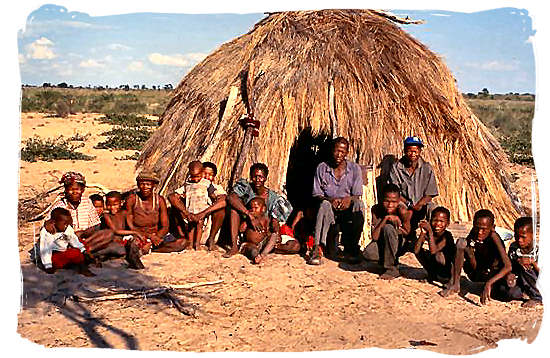
Any discussion of parenting in ancient Africa must begin long before kingdoms, written texts, formal schools, or named ethnic traditions. Africa was the first human homeland, and the oldest patterns of human childhood developed in small-scale communities where survival depended on close contact, flexible cooperation, and shared attention to vulnerable young. The foraging child lived in a social world very different from the isolated nursery or privatized household imagined by later modern societies. Infants were carried against bodies, heard constantly, watched by many eyes, and gradually introduced to a living landscape of food, danger, movement, kinship, and imitation. This does not mean that contemporary African foragers can be treated as unchanged relics of prehistory. They are modern peoples with their own histories. Yet the study of societies such as the Aka of Central Africa, the Ju/’hoansi of southern Africa, and other foraging or mixed-subsistence communities helps illuminate older human possibilities: parenting as a network rather than a narrow parental enclosure.
The first principle of this world was proximity. Infants in many foraging societies spent much of early life in bodily contact with caregivers, moving through daily tasks rather than being separated from adult labor. Carrying, nursing, touching, sleeping near others, and responding quickly to distress were not indulgences but forms of practical care in settings where mobility, temperature, predators, hunger, and social belonging all mattered. A crying infant was rarely only a private parental concern, because sound itself entered the shared life of the camp. Comfort might come from the mother, but it might also come from a father, sibling, grandmother, aunt, or nearby adult. The infant’s body was introduced early to the central lesson of communal life: safety was relational. The child learned the world first through skin, rhythm, smell, voice, and motion before the child learned it through instruction.
The Aka are especially important because they disrupt one of the most persistent assumptions about early parenting: that men were primarily distant hunters or providers while women alone performed intimate infant care. Barry S. Hewlett’s work on Aka fathers showed unusually high levels of paternal holding, soothing, proximity, and responsiveness, not as sentimental exceptions but as part of a wider social pattern shaped by camp life, marital cooperation, subsistence practices, and the constant visibility of children. This evidence does not prove that all ancient African fathers behaved in the same way. It does something more useful. It widens the historical imagination. Fatherhood in African societies cannot be reduced to authority, discipline, or provision alone. In some settings, paternal care included tenderness, holding, play, and bodily intimacy, placing fathers within the immediate emotional architecture of infancy rather than outside it. The father who carried a child, soothed crying, or remained close to an infant did not cease to be a hunter, spouse, or adult man; rather, those roles existed alongside caregiving instead of being separated from it by a rigid ideology of masculinity. This matters historically because it challenges later assumptions, often imported through colonial, missionary, or industrial categories, that nurturing care is naturally feminine while male responsibility begins only with discipline or material support. Among the Aka, intimacy itself could be paternal, and the infant’s earliest experience of community included male bodies, male voices, and male touch as part of the child’s ordinary world.
Shared care also altered the meaning of motherhood. Mothers remained central, especially through pregnancy, birth, nursing, and early responsiveness, but they were not sealed off from others in a private maternal sphere. Alloparenting, the care of children by individuals other than the biological parents, allowed human childhood to become longer, more socially dense, and more educative. Older siblings carried infants, children watched younger children, grandparents held knowledge of feeding and danger, and adults moved in and out of caregiving according to work, availability, and kinship obligation. The child’s social education began before speech. To be passed from arm to arm was to be introduced to the community as a field of trust, obligation, and recognition. The child was not merely attached to one person, but gradually woven into a circle of persons.
Play was another form of education in these early social worlds. Foraging children learned by watching, imitating, handling, trailing, testing, and experimenting. They practiced digging, carrying, gathering, tracking, throwing, climbing, dancing, singing, and caring for smaller children. Their play often mirrored adult work without being identical to it, allowing skill to emerge through repetition rather than formal command. This form of learning mattered because foraging knowledge could not be reduced to abstract rules. Children needed to know seasons, plants, animals, paths, tools, gestures, tones of warning, and the subtle expectations of cooperation. They learned not by being removed from life into a separate institution, but by entering life gradually, unevenly, and socially. The camp itself was the first classroom, and attention was one of its first disciplines. In this world, children did not simply receive culture from adults as passive vessels. They rehearsed it, tested it, misread it, corrected themselves, and watched the consequences of competence and error unfold around them. A child who followed older children gathering food, watched adults divide meat, listened to teasing around a fire, or handled a tool under loose supervision was absorbing a full moral and practical curriculum. Skill, generosity, restraint, courage, humor, patience, and situational awareness were taught together because life required them together. Play belonged to the serious work of becoming human, not because adults turned every game into a lesson, but because the boundary between play, learning, work, and belonging was far more porous than later school-centered models allow.
The foraging child reveals a foundational theme in African parenting: childhood was formed through participation before it was formalized through instruction. Contact taught security. Responsiveness taught trust. Shared care taught belonging. Play taught competence. The child’s early world was not simply maternal, paternal, or domestic; it was communal, mobile, sensory, and ecological. Later African farming villages, pastoral camps, trading towns, kingdoms, and ritual systems would develop different structures of discipline, inheritance, schooling, initiation, and gendered training. Yet beneath those later forms remained an older human logic: children survived and became persons through the labor of many. The “village” began, in deep time, not as a proverb but as a pattern of bodies gathered around the young.
The Child of the Compound: Agriculture, Kinship, and the Extended Household
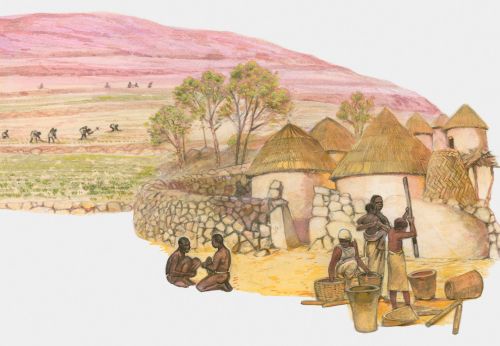
The movement from mobile foraging communities into more settled agricultural and pastoral worlds did not end communal parenting, but it changed its architecture. The child was now increasingly formed inside compounds, homesteads, cattle enclosures, farmsteads, lineage settlements, and village clusters where production and reproduction were bound together. Food was grown, stored, cooked, exchanged, inherited, and defended through household labor, and children entered that world not as sentimental dependents alone but as future participants in the survival of the group. Agriculture made childhood more visibly tied to land, season, lineage, and labor. A child learned early that belonging was not abstract. It was marked by whose field one entered, whose granary fed the household, whose animals had to be watched, whose ancestors guarded the compound, and whose name gave the child a place among the living.
The compound was not simply a building arrangement. It was a social map. In many African societies, domestic life unfolded through extended households that included parents, children, grandparents, unmarried siblings, married sons or daughters, co-wives, servants, clients, dependents, fostered children, and visitors whose relationship to the household might be temporary or long-standing. The boundaries of such a household were often more flexible than modern nuclear-family expectations allow. A child might sleep near one caregiver, eat from another hearth, run errands for an elder, accompany older siblings to fields, or spend part of the day under the correction of neighbors. This did not erase parental authority, but it placed it inside a thicker world of seniority, kinship, and reciprocal obligation. To be raised in a compound was to be raised in layers.
Lineage gave those layers historical depth. The child was not only the son or daughter of named parents, but a descendant, an inheritor, and a future representative of a descent group. Among the Tallensi, as Meyer Fortes famously showed, kinship was not decorative language added to social life; it was one of the organizing principles through which authority, obligation, ritual responsibility, and belonging were made intelligible. The child’s place depended on birth, descent, gender, seniority, and ritual connection to ancestors. Adults did not merely ask whether a child was loved or fed, though those matters were vital. They also asked where the child belonged, whose rights and duties the child would inherit, which elders could command obedience, and how the child’s conduct reflected on the lineage. Parenting was inseparable from social classification. A child had to be located before the child could be fully formed.
Agriculture also sharpened the educational role of work. Children in farming and pastoral communities often learned through gradual participation rather than formal separation from adult activity. They carried water, watched animals, scared birds from fields, gathered fuel, helped with younger children, pounded grain, accompanied adults to markets, and learned the rhythms of planting, harvest, cooking, storage, and exchange. These tasks were not merely economic. They were moral training. A child who learned to carry a calabash without spilling, greet elders while passing through a compound, share food properly, care for a younger sibling, or return animals safely at dusk was learning reliability, restraint, attentiveness, and accountability. Work introduced the child to responsibility, but it also introduced the child to social judgment. Competence was seen. Laziness was seen. Generosity was seen. Childhood unfolded in public.
The extended household also complicated the meaning of motherhood and fatherhood. Mothers remained central to early nourishment, bodily care, emotional security, and the daily rhythms of infancy, but mothering could be supported, watched, interrupted, judged, and reinforced by other women in the compound. Grandmothers, aunts, elder sisters, and co-wives might teach feeding practices, childcare techniques, ritual protections, discipline, and domestic labor. Fathers, meanwhile, could occupy several roles at once: provider, disciplinarian, ritual representative, landholder, teacher, protector, storyteller, or affectionate caregiver. The degree of direct fatherly intimacy varied widely by society and circumstance, but fatherhood was rarely reducible to simple absence. In compound life, adult men could shape children through instruction, example, labor organization, dispute settlement, and the public performance of authority. The child encountered gendered adulthood not through abstract doctrine, but through watching how women and men worked, spoke, corrected, negotiated, and endured.
Yet the compound should not be romanticized as a perfect shelter. Extended kinship could protect children, but it could also discipline them sharply, rank them unequally, and bind them to duties they did not choose. Birth order, gender, maternal status, legitimacy, slavery, clientage, fostering, and household wealth could all affect a child’s treatment. In polygynous households, children of different mothers might share a father but not identical security. Fostered children might be loved, trained, exploited, or all three at once, depending on circumstance. Girls and boys could be prepared for different futures, sometimes with deep care and sometimes with restrictive force. Communal parenting widened the circle of responsibility, but a wider circle was not automatically a gentler one. The same social density that surrounded a child with caregivers also surrounded the child with expectations.
For this reason, the agricultural compound is one of the most important settings for understanding African parenting historically. It shows that the “village” was not merely a sentimental crowd of kindly adults, but a structured world of descent, labor, authority, affection, correction, ritual, and survival. The child of the compound was made through repetition: meals taken with others, greetings practiced daily, chores assigned and corrected, stories heard at night, disputes observed, elders obeyed, fields entered, animals followed, names remembered, and ancestors invoked. Parenting was not a private project hidden inside the walls of a home. It was the slow incorporation of the young into a household that was itself part of a lineage, a settlement, and a moral order. The child learned where to stand because the compound taught the child who stood before them, who stood beside them, and who would one day depend on them. This is why the household must be understood not only as a place of residence, but as a historical institution of formation. It trained memory as much as behavior, binding children to stories of origin, claims over land, remembered obligations, and the reputations of the dead. It trained the body through repeated tasks, but it also trained the conscience through praise, rebuke, shame, imitation, and expectation. A child who grew up in such a world did not simply acquire useful skills one by one. The child absorbed an entire grammar of belonging: how to ask, how to defer, how to help, how to wait, how to share, how to endure correction, and how to recognize that one’s conduct carried consequences beyond the self. In that sense, the compound made childhood communal not by dissolving the family, but by enlarging it until family became the first visible form of society.
Ancient Kingdoms, Households, and the Political Value of Children

As African societies formed larger kingdoms, urban centers, priestly establishments, and administrative hierarchies, children remained rooted in households, but their significance widened into the political life of the state. In ancient complex societies, the child could be heir, apprentice, ritual participant, diplomatic link, labor contributor, dynastic promise, or future officeholder. This did not replace the intimate world of feeding, protection, play, discipline, and kinship. Rather, it layered public value onto domestic life. In a compound or village, a child represented continuity for a household or lineage. In a kingdom, that same principle could be magnified until children became symbols of succession, legitimacy, taxation, labor, military strength, priestly service, and social order.
The evidence is clearest in literate and monumental societies, especially Egypt, where elite families left texts, tomb scenes, inscriptions, legal records, and wisdom literature. Egyptian sources cannot stand for all African parenting, but they show how household formation could be attached to state ideology. Instructional texts preserved in collections such as Miriam Lichtheim’s Ancient Egyptian Literature present an elite moral world in which the young were urged toward discipline, obedience, restraint, literacy, proper speech, and service within the ordered structure of society. Such texts were not parenting manuals in a modern sense. They were cultural scripts, often written by or for elite men, that imagined the well-formed child as one who could eventually become a reliable servant of household, office, temple, and crown. Education, in this world, was not merely personal improvement. It was preparation for ordered participation in the cosmic and political order the Egyptians called ma’at.
The political value of children appears most visibly in royal and elite families, where birth could decide succession, alliance, and legitimacy. Egyptian royal children belonged not only to families but to dynasties whose continuity was represented in ritual, architecture, titulary, marriage, and memory. Queens, royal mothers, and daughters could matter intensely because their reproductive and symbolic roles helped stabilize kingship. Household, gender, sexuality, and royal ideology cannot be separated from one another in Egyptian evidence. The royal child was never merely private. A son could become a king, a daughter could carry dynastic significance, and a mother could become a figure through whom legitimacy was articulated. This political weight did not mean children were unloved symbols. It means that in elite contexts, childhood was watched by power. The nursery, if such a term can be used cautiously, stood close to the throne because reproduction itself was a political matter. A child’s birth could calm anxieties about succession, strengthen a queen’s position, extend the memory of a ruling house, or become part of the symbolic language by which kingship presented itself as stable and divinely favored. Even when the surviving evidence speaks mainly through monuments and elite ideology rather than private feeling, it shows that children occupied a charged space between affection and strategy. They were vulnerable young bodies, but they were also possible futures around which adults organized ambition, inheritance, ritual performance, and dynastic memory.
Nubia and Kush complicate the picture in important ways. The Nile Valley was not an Egyptian monopoly of civilization, kinship, or kingship, and Nubian societies developed their own forms of authority, burial practice, political identity, and household organization. Archaeology rather than preserved literary instruction often carries more of the evidence, which means children may appear through graves, material culture, settlement remains, and patterns of social differentiation rather than through explicit statements about child-rearing. The political value of children can be read less through school texts and more through the reproduction of status, lineage, and community membership. Burial treatment, bodily adornment, household goods, and placement within cemeteries may reveal how societies understood age, status, dependency, and belonging. The child was part of political continuity not only when named as an heir, but when incorporated materially into the symbolic order of the community. Such evidence demands caution, because grave goods and burial placement cannot be translated mechanically into parental emotion or social rank. Yet they do show that children were not invisible in the ritual imagination of Nubian and Kushite communities. Their bodies could be placed within landscapes of ancestry, memory, and status, suggesting that childhood mattered not only as biological immaturity but as a recognized stage within the life of the group. In kingdoms where power depended on descent, territorial authority, sacred kingship, and controlled memory, the treatment of children after death may also reveal how deeply societies connected the young to lineage endurance. Even a child who did not live to adulthood could still be drawn into the political and ritual grammar of continuity.
Aksum and the northern Horn add another dimension because they show how African state formation, trade, monarchy, writing, coinage, and Christianity could reshape household expectations. As Aksum developed into a major polity connected to the Red Sea, Arabia, the Mediterranean, and northeast Africa, children in elite settings could be tied to inheritance, religious education, court culture, and the transmission of status across generations. With Christianization, family life became increasingly linked to ecclesiastical language, baptismal identity, scriptural learning, and new models of moral formation. This did not erase older kinship patterns; rather, it created layered identities in which children could simultaneously belong to households, lineages, churches, and kingdoms. The child’s value was not only economic or dynastic. It was also religious and civilizational, bound to the reproduction of a Christian African polity.
The rise of kingdoms also sharpened inequalities among children. Elite children might receive training in literacy, administration, ritual, military leadership, or courtly conduct, while most children learned through agricultural labor, craft production, household duty, herding, local trade, and oral instruction. Some children were born into security, inheritance, and recognized kinship, while others entered households as dependents, captives, servants, enslaved persons, or marginal members whose labor could be claimed without equal status. State formation did not create inequality from nothing, but it gave inequality new instruments: taxation, conscription, legal hierarchy, temple service, palace labor, and social ranking. The political value of children had a double edge. Children could embody continuity and hope, but they could also become resources to be organized, disciplined, transferred, or exploited by households and states.
Ancient African kingdoms reveal a crucial development in the history of parenting: the child’s meaning expanded as political structures expanded. In small-scale communities, the child belonged to a circle of kin and caregivers. In agricultural compounds, the child became a bearer of lineage, labor, and household continuity. In kingdoms and states, children could also become instruments of succession, symbols of legitimacy, pupils of administrative culture, servants of temple or palace, and future guardians of social order. The family remained the first site of formation, but the state increasingly had an interest in what the family produced. This did not make parenting less intimate. It made intimacy politically consequential. To raise a child in an ancient African kingdom was to form not only a person, but a future participant in a world of land, office, ritual, rank, memory, and power.
Spiritual Parenting: Ancestors, Naming, Blessing, Protection, and Moral Personhood
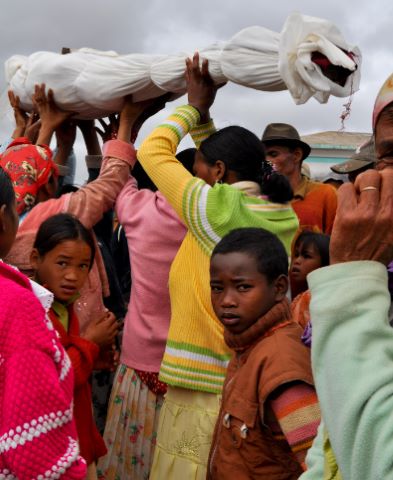
Parenting in many ancient and traditional African societies was never only a biological or domestic act. It was also a spiritual labor, a process by which a child was brought safely into the visible world and gradually connected to forces, persons, and obligations that exceeded ordinary sight. Birth did not simply add another individual to a household. It opened a relationship between the living, the dead, the unborn, the land, the lineage, and the powers believed to guard or threaten human life. Parents cared for children through feeding, carrying, washing, watching, and teaching, but they also cared through naming, blessing, ritual protection, moral instruction, and the careful placement of the child within an ancestral order. To raise a child was to help the child become not merely alive, but recognized.
This recognition often began with naming. Across many African societies, names could mark ancestry, circumstance, hope, gratitude, birth order, reincorporated memory, divine favor, family anxiety, or the conditions surrounding a child’s arrival. A name might recall an ancestor, answer a misfortune, acknowledge survival after infant loss, praise a deity, invoke protection, or locate the child in a kinship history older than the child’s body. Naming was not a decorative act added after birth. It was a social and spiritual declaration that the child had entered a field of meaning. The child became speakable, addressable, rememberable, and accountable. Naming joined language to belonging. It told the community who had arrived, whose memory might be returning, what hopes had been placed upon the infant, and what dangers the family wished to avert. A name could also carry a story that the child would grow into over time, hearing its meaning repeated by parents, elders, siblings, and neighbors until personal identity became inseparable from communal memory. Some names preserved grief, especially after repeated child loss, while others announced joy, defiance, gratitude, or renewed trust in spiritual protection. The child did not choose this first public identity, but the name gave the child a place from which personhood could begin. It was a verbal cradle, holding the infant within a network of interpretation before the child could speak back.
The ancestral dimension of parenting was especially important because the dead were often understood not as absent, but as continuing members of the moral community. Ancestors could guard fertility, judge conduct, punish disorder, bless descendants, or demand remembrance. A child, then, was not only descended from the dead in a genealogical sense. The child might be understood as living under ancestral attention, carrying ancestral obligations, or extending ancestral presence into the future. This gave parenting a vertical depth. Adults were not simply raising children for themselves or for the present community. They were raising children before the remembered dead and for generations not yet born. A poorly formed child could dishonor the lineage; a morally sound child could strengthen it. The household, in this worldview, was populated by more than the living.
Protection was another crucial part of spiritual parenting. In societies marked by high infant vulnerability, illness, environmental danger, and uncertain survival, the care of children often included amulets, medicines, prayers, sacrifices, taboos, seclusion practices, ritual washing, protective speech, and restrictions placed on mothers, infants, or visitors. Such practices should not be dismissed as superstition in contrast to “real” care. They were part of a coherent moral and practical response to fragility. Parents and elders used every available means to secure the child’s life, including herbal knowledge, ritual specialists, ancestral appeal, and communal watchfulness. Protection could surround the infant’s body, the mother’s body, the doorway of the home, the naming ceremony, the sleeping place, or the child’s passage into new stages of development. Spiritual protection was a language through which communities acknowledged that childhood was precious because it was precarious.
Moral personhood also emerged gradually. In many African philosophical and religious traditions, a human being became fully formed through relationship, obligation, conduct, and recognition. Biology began life, but community shaped personhood. The child had to learn respect, generosity, restraint, courage, speech discipline, sexual responsibility, hospitality, reverence for elders, and proper relations with the spiritual world. This education was not always separated into religious and secular categories. A child who failed to greet elders, mocked ritual authority, ignored kinship obligations, stole food, spoke arrogantly, or refused communal duties was not merely impolite. Such behavior could be read as a sign of disorder in the person and danger to the community. Moral training carried spiritual weight. To become a good person was to become rightly related. This kind of formation was slow and cumulative, unfolding through correction, imitation, praise, shame, story, ritual participation, and the repeated observation of adult conduct. Children learned not only that certain actions were forbidden, but that every action placed the self in relation to others. Speech mattered because words could heal, insult, bless, deceive, or disturb social peace. Food mattered because sharing revealed character. Deference mattered because elderhood linked age to memory and authority. The child’s inner life was not treated as detached from public conduct. Character became visible in behavior, and behavior revealed whether the child was becoming someone capable of sustaining the relationships that made human life possible.
Blessing helped make that right relation visible. Elders’ blessings, parental prayers, ritual words, and public affirmations could accompany childhood at key moments: birth, naming, first public presentation, healing, initiation, marriage preparation, or departure into new duties. Blessing did not only express affection. It transmitted authority. The elder who blessed a child spoke as someone standing closer to the ancestors, closer to memory, and closer to the moral center of the lineage. Blessing could reveal how deeply children depended on intergenerational continuity. A child did not bless himself into belonging. Belonging was given, spoken, confirmed, and then gradually earned through conduct. The voice of the elder helped place the young within a chain of life that neither began nor ended with them.
Spiritual parenting could also be demanding and restrictive. The same systems that protected children and gave them identity could impose fear, hierarchy, gendered expectations, and heavy obligations. Children might be taught to fear spiritual retaliation, ancestral displeasure, witchcraft, impurity, taboo violation, or public shame. Girls and boys could be prepared differently for ritual, domestic, sexual, and social responsibilities, sometimes in ways that affirmed their value and sometimes in ways that narrowed their choices. Some children, especially those marked by unusual births, disability, maternal misfortune, enslavement, illegitimacy, or suspected spiritual danger, might occupy vulnerable positions within the moral imagination of the community. A serious history of African parenting must resist both colonial contempt and romantic nostalgia. Spiritual systems could shelter children, but they could also classify them.
Even so, spiritual parenting remains one of the clearest ways to see how African societies imagined childhood as more than dependence. The child was a threshold being, newly arrived from mystery, not yet fully disciplined into human obligation, and still especially exposed to danger, blessing, and interpretation. Through naming, ancestors, protection, blessing, correction, and ritual instruction, adults helped the child cross from vulnerability into recognized personhood. This process made parenting a sacred form of social labor. It taught children that they belonged to the living community, but also to a moral universe older and wider than the household itself. To raise a child was to guard a life, remember the dead, honor the unseen, and prepare the future to carry the names, duties, and hopes of those who had come before.
Mothers, Fathers, Grandparents, and Siblings: The Distributed Parent
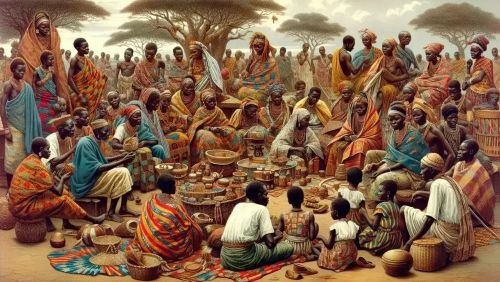
The phrase “parent” can become misleading if it is narrowed too quickly to the biological mother and father alone. In many ancient and traditional African societies, child-rearing was distributed across a wide circle of kin and near-kin whose authority varied by age, gender, seniority, residence, ritual knowledge, and social standing. Mothers and fathers mattered deeply, but they did not exhaust the child’s world of care. Grandparents, elder siblings, aunts, uncles, co-wives, neighbors, age-mates, and sometimes unrelated dependents or household members could all participate in the work of forming the young. This was not an accidental overflow of parental responsibility. It reflected a broader understanding of childhood as a communal process, in which the child’s body, behavior, speech, work habits, and moral instincts were shaped by many hands. The distributed parent was not a substitute for the family. It was the family extended into social practice. It also reminds us that African kinship systems often treated personhood as relational before it was individual. A child became recognizable through the many people who claimed, corrected, named, fed, watched, teased, protected, and instructed that child. Parenting was not a single role but a field of obligations distributed across the household and beyond it. The child learned early that care and authority could come from more than one direction, and that belonging meant being answerable to a community of adults and older children, not only to the two people who had given life.
Mothers usually stood at the center of early life, especially through pregnancy, birth, nursing, bodily care, and the constant attentiveness required in infancy. Their work was intimate, repetitive, and physically demanding, but it was not isolated. Other women often surrounded mother and child, offering instruction, correction, relief, and judgment. Grandmothers might advise on feeding, illness, protection, herbal remedies, ritual precautions, and the management of difficult transitions. Aunts and elder sisters might help carry, bathe, watch, discipline, and entertain children. In polygynous or compound households, co-wives could become part of a child’s daily caregiving environment, though these relationships could range from deeply cooperative to tense and unequal. Motherhood was both personal and social. A mother’s care formed the child, but the mother herself was also embedded in a network of older women, peers, kin obligations, and household expectations.
Fatherhood was equally diverse and cannot be reduced to a single model of distance, command, or provision. In some African contexts, fathers were closely involved with infants and young children through holding, play, soothing, and daily proximity, as studies of Aka paternal care have shown. In other settings, fatherhood operated more through land, lineage authority, protection, moral instruction, labor organization, public discipline, or ritual representation. These differences matter because they warn against replacing one stereotype with another. African fathers were not uniformly tender companions, nor were they uniformly remote patriarchs. Their roles depended on subsistence systems, household organization, marriage patterns, gender expectations, age, rank, and personality. Yet across many societies, fatherhood carried a formative weight that exceeded material provision. Fathers could teach children how to speak before elders, how to work, how to respect household boundaries, how to understand descent, and how to carry family reputation in public life.
Grandparents often occupied a distinctive position because they joined affection to memory. They were not merely older helpers in the household; they were living archives of genealogy, custom, dispute, migration, ritual obligation, and moral precedent. Grandmothers could be especially important in early childcare, birth knowledge, food practices, and the socialization of girls, while grandfathers might transmit lineage history, land memory, political stories, craft knowledge, or ritual authority. Their power rested partly in age, but also in their proximity to the ancestral world. They stood closer than the young to the remembered dead and could interpret the obligations that linked past and future. This made their role in parenting both practical and symbolic. A grandparent who corrected a child was not only enforcing household discipline. Such correction could carry the weight of memory: this is how our people speak, this is what our family does, this is what must not be forgotten. Grandparents could also soften the severity of parental discipline, offering affection, humor, indulgence, and perspective when parents were exhausted by the burdens of work and household survival. Their authority could be formidable, especially when age itself was understood as a source of wisdom and moral legitimacy. In their presence, children encountered a longer view of life. They heard stories of famine, migration, marriage, conflict, healing, loss, and endurance. They learned that the household had a history before their own memories began, and that growing up meant entering a chain of obligations already shaped by those who had lived, suffered, worked, and remembered before them.
Siblings also formed part of the parenting system, especially older children who cared for younger ones while adults worked, traveled, cooked, farmed, traded, or performed ritual duties. This sibling care was not trivial babysitting. It trained both sides of the relationship. Younger children received comfort, supervision, play, food, instruction, and protection from older siblings, while older children learned responsibility, patience, authority, and competence through the care of those smaller than themselves. Childhood was internally layered. Children were not all simply dependents before adults; they occupied ranks among one another. A child might be subordinate to parents and elders while also responsible for a younger sibling. This gave social life a graduated structure in which authority was learned by receiving it, watching it, and then practicing it in smaller forms. The older sibling became a rehearsal figure for future parenthood.
The distributed parent reveals one of the central strengths of communal child-rearing: children were surrounded by multiple models of adulthood. They saw mothers nurse and negotiate, fathers instruct and labor, grandmothers remember and correct, grandfathers bless or admonish, older siblings imitate adult authority, and neighbors intervene when conduct crossed accepted boundaries. This gave children a dense education in social life. Yet it also meant that the child could rarely escape notice. The same network that protected, fed, and taught also watched, judged, ranked, and disciplined. Communal parenting was not simply warmth multiplied. It was authority multiplied as well. To be raised by many was to belong to many, and belonging carried demands. The child formed by distributed parenting learned early that the self was never entirely private. One’s behavior answered to mother, father, sibling, elder, lineage, household, and community, each of which claimed some part of the child’s becoming.
Learning by Watching: Work, Play, Tools, and the Education of Responsibility
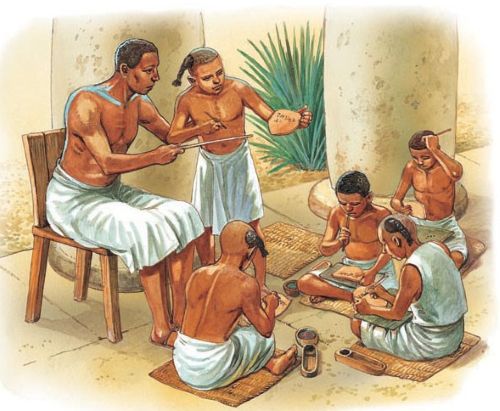
In many ancient and traditional African societies, children learned less by being separated from adult life than by being gradually drawn into it. Education was not confined to a schoolhouse, a written curriculum, or a formal lesson, though such institutions existed in particular times and places. Much of childhood education unfolded in fields, compounds, cattle camps, kitchens, workshops, forests, riversides, markets, shrines, and pathways between households. Children watched before they were expected to perform. They imitated before they were fully trusted. They handled small tasks before they were given larger ones. This kind of learning did not treat childhood as a waiting room before real life began. It made childhood the first apprenticeship in responsibility.
Work was one of the earliest classrooms. A small child might begin by carrying light objects, fetching water in a small vessel, watching goats near the compound, gathering sticks, helping an older sibling, pounding grain clumsily beside an adult, or imitating the motions of planting and harvesting. These tasks could look minor, even playful, but they taught timing, endurance, bodily control, attention, and social usefulness. A child learned that work was not simply an economic activity. It was a way of showing that one belonged to others. To help was to become visible as a person who could be trusted. To neglect a task was to expose not only personal laziness, but a failure of relation, because household labor connected the stomachs, bodies, and reputations of many people. Responsibility was not introduced as an abstract virtue. It was carried in baskets, balanced on heads, watched in animals, stirred in pots, and practiced through repeated correction.
Play belonged to this same educational world. Children did not only copy adult work because they were forced into usefulness; they also transformed adult life into games, contests, songs, mock households, miniature hunts, pretend markets, dances, and improvised performances. Through play, they rehearsed the gestures, tools, speech, cooperation, rivalry, humor, and authority structures they observed around them. A boy imitating a herder, a girl arranging a pretend cooking space, a group of children staging a mock court, or younger children repeating the songs of older ones were not merely passing time. They were experimenting with social roles before those roles became binding. Play created a protected space where children could fail, exaggerate, laugh, correct one another, and test the meanings of adulthood. It was education without the heaviness of full adult consequence, though adults often watched closely enough to correct what seemed improper or dangerous. This made play morally important as well as practical. Children learned how far teasing could go before it became cruelty, how competition could sharpen skill without breaking solidarity, and how imitation could honor adults or mock them too sharply. In play, the child practiced the grammar of the community in miniature. The game might be light, but the patterns inside it were serious: leadership, deference, sharing, courage, patience, negotiation, and the ability to stop when an elder intervened. Play was not a retreat from social life. It was one of the ways children entered social life safely, testing its forms before bearing its full burdens.
Tools intensified this education because they brought children into contact with skill, risk, and trust. In many societies, children learned through age-appropriate tools, miniature versions of adult implements, or carefully supervised use of real objects. A digging stick, small hoe, knife, basket, pestle, herding switch, fishing line, loom element, clay vessel, or musical instrument taught more than technique. It taught respect for the material world. A tool could feed the household, injure the careless, signal maturity, or reveal whether a child had learned patience. Adults did not need to explain every moral lesson verbally. The tool itself disciplined the body. It required the hand to slow down, the eye to measure, the ear to listen, and the child to notice how experienced people moved. Mastery came through repetition, but repetition was never merely mechanical. Each attempt showed whether the child was becoming attentive enough to be entrusted with more. The first successful use of a tool could also mark a small but meaningful social promotion. A child trusted with a sharper blade, a heavier vessel, a longer errand, a more difficult animal, or a more delicate craft task had been publicly recognized as more capable than before. That recognition mattered because competence was social capital. It changed how adults spoke to the child, how younger children watched them, and how the child understood their own place in the household. Tools stood at the meeting point of labor and identity. They taught children that maturity was not merely a matter of age, but of steadiness, care, judgment, and the ability to handle power without causing harm.
This participatory education also trained children in social intelligence. A child had to learn when to speak, when to remain silent, when to ask for help, when to withdraw, how to read an elder’s mood, how to respond to teasing, how to share food, how to avoid shame, and how to cooperate with age-mates without disrupting adult work. Robert Serpell’s work on African concepts of intelligence is useful here because it shows that competence in many African contexts could not be reduced to individual cleverness or abstract reasoning alone. Intelligence was also measured by social responsibility, helpfulness, respect, and practical judgment. A child who knew many things but refused to help was not fully well-formed. A child who could work with others, observe carefully, and act at the right moment showed a kind of knowledge rooted in relationship. Learning by watching trained the mind, but it also trained the moral instincts.
The education of responsibility did not mean that children were treated as miniature adults. Age mattered, and expectations usually increased gradually. Young children were often allowed to drift between play and small tasks, while older children became more accountable for siblings, animals, chores, craft work, market errands, or ritual preparation. This gradualism was important because it allowed competence to grow inside social trust. The child was watched, corrected, teased, praised, and sometimes shamed into better performance. Errors could be dangerous, especially around tools, animals, water, fire, or food preparation, but they were also part of learning. What mattered was not instant mastery but steady incorporation. The child learned that adulthood was not granted suddenly. It was assembled through thousands of acts of attention, imitation, correction, and usefulness. In that world, to learn was to become dependable, and to become dependable was to become more fully a member of the community.
Oral Pedagogy: Proverbs, Folktales, Songs, Praise, and Correction
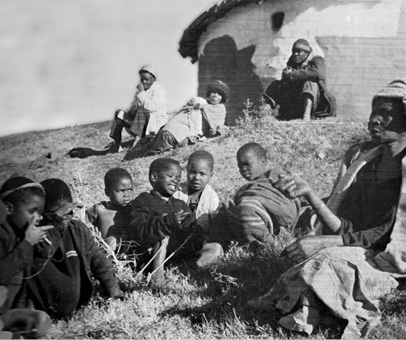
If work taught children how to act, oral tradition taught them how to interpret action. Across many ancient and traditional African societies, speech was one of the central instruments of parenting: not only direct command, but proverb, story, song, praise-name, riddle, warning, teasing, genealogy, and remembered example. Children learned from the spoken world that surrounded them in compounds, fields, markets, initiation spaces, fireside gatherings, funerals, ceremonies, and ordinary domestic labor. This was not “informal” education in the sense of being casual or unstructured. Oral pedagogy had its own disciplines of timing, repetition, performance, audience, memory, and authority. A proverb spoken at the right moment could correct behavior more sharply than a lecture. A folktale could make greed, laziness, arrogance, courage, cunning, betrayal, or generosity memorable by giving those qualities bodies, voices, and consequences. In a world where much knowledge was carried by people rather than books, the trained ear became one of childhood’s most important tools.
Proverbs were especially powerful because they compressed social judgment into memorable form. They could discipline without open humiliation, advise without seeming to command, and link a child’s small act to a wider moral pattern. A child who grabbed food greedily, interrupted elders, mocked another child, neglected a task, or failed to greet properly might be corrected through a saying whose force depended on communal recognition. The proverb did not need to explain everything. Its authority came from being already known, already tested, already larger than the speaker. Adults used inherited speech to place children under the judgment of collective memory. The child was not merely being told, “I disapprove.” The child was being reminded, “Our people know what this kind of behavior becomes.” Proverbs transformed discipline into cultural continuity, teaching children that moral wisdom had been stored before their own lives began.
Folktales and songs expanded this pedagogy by giving children emotional access to social truth. Animal trickster tales, stories of foolish husbands or clever wives, accounts of disobedient children, songs of praise, work songs, lullabies, initiation songs, and historical narratives all trained memory and feeling together. A child might laugh at the trickster, pity the vulnerable, fear the consequences of disobedience, admire endurance, or recognize the shame of selfishness before being able to state the lesson abstractly. This emotional dimension mattered. Oral teaching did not simply transfer information; it shaped desire, disgust, admiration, caution, and sympathy. Songs could soothe infants, coordinate labor, preserve genealogy, mock misconduct, praise courage, or carry coded instruction about sexuality, marriage, endurance, and communal duty. The lesson entered through rhythm as much as explanation. It was remembered because it had been sung, laughed over, repeated, and shared.
Praise and correction also worked together. Children were not formed only by rebuke; they were formed by being named as capable, brave, generous, skillful, beautiful, respectful, quick, patient, or worthy of family honor. Praise-names, public encouragement, ritual commendation, and elder approval could teach a child what kind of person the community hoped they would become. Correction then operated against that horizon of expectation. When a child was rebuked, the rebuke often implied an alternative identity: you are not meant to behave like this; you are the child of this house, this lineage, this people. Such speech could be deeply formative because it connected behavior to belonging. It could also become burdensome, especially when praise and shame were used to enforce rigid gender roles, social rank, or obedience to authority. Oral pedagogy, like communal parenting more broadly, could nurture dignity while also disciplining difference.
The spoken word made parenting portable. It traveled with children into fields, paths, markets, sleeping spaces, ceremonies, and play. Long before formal schooling became widespread in many regions, children were being educated by voices that carried memory, warning, humor, affection, ridicule, blessing, and law-like authority. Oral pedagogy trained them to listen, remember, interpret, and respond. It taught that knowledge was not only something written down or possessed privately, but something performed between generations. Through proverbs, folktales, songs, praise, and correction, African communities made childhood audible. The child became a person not only by being fed and watched, but by being spoken into a moral world where language carried the weight of ancestors, elders, neighbors, and the future.
Discipline, Shame, Praise, and Moral Correction

Discipline in many ancient and traditional African societies was not imagined as a purely private matter between parent and child. Because children belonged to households, lineages, age-groups, and communities, their behavior reflected on more than themselves. A child who insulted an elder, refused a task, stole food, mishandled animals, mocked ritual authority, or disrupted communal life did not merely embarrass a mother or father. Such conduct could be read as a failure of household training, a stain on lineage reputation, or a danger to social harmony. For that reason, moral correction could come from many directions: parents, grandparents, older siblings, neighbors, elders, ritual authorities, and sometimes age-mates. Discipline was distributed because responsibility was distributed. The child was watched by the community because the child was being prepared for the community.
Shame was one of the most powerful tools within this system, though it must be understood carefully. Shame did not always mean cruelty or degradation. At its best, it functioned as social conscience, reminding the child that behavior was visible and that one’s actions affected others. Teasing, public rebuke, proverbial correction, comparison with respected kin, or the withdrawal of approval could teach a child to notice boundaries before formal punishment became necessary. The sting of shame taught that conduct had consequences beyond appetite, impulse, or anger. Yet shame could also wound. It could enforce hierarchy, silence dissent, intensify gender discipline, or mark children whose status was already insecure. A historically serious account must recognize both sides: shame could cultivate moral awareness, but it could also become a mechanism of social control. Its power came from the fact that children were raised in dense relational worlds where reputation was not abstract. A child’s conduct was remembered, discussed, corrected, and sometimes folded into stories told later as warnings or examples. Shame worked because the child cared, or was taught to care, about being seen as worthy of trust. It could call a child back into proper relation by making selfishness, arrogance, laziness, or disrespect feel socially unbearable. But that same visibility could become oppressive when the community judged too quickly, punished difference, or used ridicule to force obedience rather than understanding. Shame was a delicate instrument: capable of moral formation when held within affection and proportion, but damaging when sharpened into humiliation or fear.
Praise worked beside shame, not merely as its opposite but as its necessary balance. Children were encouraged through approval, naming, admiration, joking affection, small privileges, public recognition, and the trust that came with being given more serious tasks. A child praised for generosity might be drawn toward generosity again; a child trusted with a tool, a younger sibling, an animal, or an errand learned that responsibility could bring honor. Praise made moral formation aspirational. It did not simply say, “Do not behave badly.” It said, “This is the kind of person you are becoming.” In societies where reputation mattered intensely, praise could give children a social identity to grow into. A well-spoken child, a patient child, a brave child, a careful child, or a respectful child was not merely complimented. Such a child was being publicly imagined into maturity.
Physical punishment and stern correction also existed, and they should neither be exaggerated as the essence of African parenting nor erased in favor of a romantic communal ideal. Many societies accepted corporal discipline, fear of elders, ritual warning, and sharp verbal rebuke as legitimate means of training children. These practices were shaped by age hierarchy, ideas about obedience, the dangers of disorder, and the belief that children had to be formed before they could safely carry adult responsibility. But discipline was usually embedded in relationship. Correction by a grandparent, elder, or parent drew force from the existing moral bond between child and community. The aim, at least ideally, was not punishment for its own sake but restoration: the child had to be returned to proper conduct, proper speech, proper duty, and proper relation. When correction became excessive or unjust, the same communal structure that gave it authority could make resistance difficult.
Moral correction reveals the hard edge of communal parenting. The same village that fed, protected, praised, and taught the child also judged the child. It offered belonging but belonging required conformity to shared expectations. Discipline trained children to control speech, respect elders, honor kin, work reliably, share food, restrain selfishness, and recognize that personal conduct was never entirely personal. This was one of the central differences between communal and highly individualized models of child-rearing. The child was not being shaped only for self-expression or private success. The child was being prepared for a world in which survival depended on cooperation, reputation, obligation, and moral predictability. Discipline, shame, praise, and correction were not separate from love. They were among the ways communities tried, sometimes tenderly and sometimes harshly, to make children fit for life with others.
Gendered Childhoods: Girls, Boys, Labor, Sexuality, and Preparation for Marriage
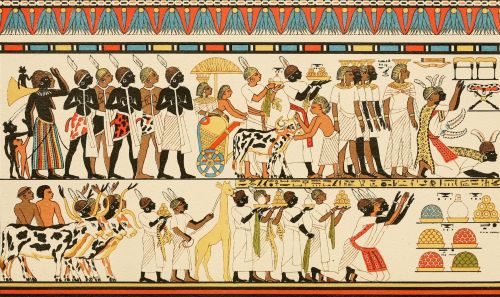
Gender shaped childhood in many ancient and traditional African societies, but it did not do so in a single uniform way. Girls and boys often shared early experiences of nursing, play, sibling care, household movement, and communal correction before their training gradually diverged. As children grew, societies increasingly prepared them for different adult expectations: farming, herding, marriage, childbirth, warfare, trade, ritual service, public speech, craft production, household management, and lineage responsibility. These distinctions were not merely practical. They carried moral, symbolic, and spiritual meaning. A girl or boy was not only being taught useful skills. Each was being introduced into a social imagination of what women and men were expected to become, how they should speak, whom they should obey, what labor they should perform, and how their bodies would matter to the future of the household.
Girls’ childhoods were often closely tied to domestic labor, food production, care work, and preparation for marriage, though these categories should not be mistaken for narrow confinement. In many African societies, women’s labor was economically central, especially in agriculture, market exchange, food processing, pottery, weaving, healing, ritual performance, and the management of household networks. Girls learned by watching mothers, grandmothers, aunts, elder sisters, and co-wives work across spaces that joined the domestic to the public. Cooking, carrying water, tending younger children, preparing grain, gathering fuel, cultivating crops, selling goods, or learning bodily discipline could all become part of a girl’s education. Such training prepared girls for marriage, but it also prepared them for competence, authority, and survival. A woman who could manage food, kinship, childbirth knowledge, market relationships, and household reputation was not marginal to society. She stood at one of its working centers.
Boys’ childhoods, meanwhile, often moved increasingly toward herding, farming, hunting, craft labor, public authority, ritual obligation, warfare, or the defense and representation of the lineage. Boys might learn to manage animals, clear land, make or repair tools, accompany men to fields or hunting grounds, observe dispute settlement, carry messages, or practice forms of courage and endurance expected of adult men. This training could cultivate confidence, discipline, and practical judgment, but it could also place boys under pressure to display toughness, restraint, and obedience to male elders. Male childhood was not simply freedom from domestic obligation. Boys were also watched, corrected, ranked, and prepared for burdens they did not choose: the burden of representing a household publicly, defending kin, controlling anger, submitting to senior men, and eventually becoming husbands, fathers, elders, or political actors within the community.
Sexuality marked one of the most sensitive areas of gendered childhood. As girls and boys approached puberty, adults often became more deliberate in teaching bodily restraint, fertility expectations, modesty, courtship rules, marriage obligations, and the dangers of sexual misconduct. Elder women might instruct girls about menstruation, fertility, pregnancy, domestic responsibility, sexuality, and the expectations of wives and mothers. Elder men might instruct boys about self-control, marriage duty, labor, lineage responsibility, and the conduct expected of husbands and fathers. These teachings varied dramatically across regions and societies, but they shared a common concern: sexuality was not treated as purely private desire. It was tied to kinship, inheritance, fertility, honor, bridewealth, alliance, household stability, and spiritual danger. The adolescent body became a matter of communal concern because it carried consequences beyond the individual.
Marriage preparation gave gendered childhood much of its forward pull. Children were often raised with the expectation that adulthood would involve household formation, reproduction, alliance between families, and the continuation of descent. Girls might be taught how to manage food, fertility, hospitality, domestic diplomacy, and relations with affinal kin. Boys might be taught how to provide labor, show respect to in-laws, negotiate household obligations, protect dependents, and act responsibly within marriage. Yet marriage was not merely a private union between two persons. It could bind lineages, redistribute wealth, reorganize residence, create obligations between families, and determine the future status of children. For this reason, preparation for marriage began long before the marriage itself. It was woven into daily chores, joking relationships, gendered advice, ritual speech, bodily training, and the public evaluation of character.
Gender systems across Africa were far more complex than simple binaries imposed by later European observers. Some societies recognized social roles in which women could hold forms of authority often coded elsewhere as male, whether through age, wealth, ritual knowledge, motherhood, political office, market power, or kinship position. Ifi Amadiume’s study of Nnobi society, for example, challenged rigid Western assumptions about gender by examining categories such as “male daughters” and “female husbands,” showing that social authority, descent, and gendered status did not always map neatly onto biological sex. Oyèrónkẹ́ Oyěwùmí likewise warned against reading African social worlds through Western gender categories without careful historical and linguistic attention. This matters for childhood because girls and boys were not trained into one universal African gender system. They were trained into particular social worlds, some deeply hierarchical, some more flexible, and many internally complex.
Gendered childhood reveals both formation and constraint. It taught children how to become useful, honorable, marriageable, spiritually protected, and socially recognizable. It gave girls and boys models to imitate, skills to master, elders to obey, and futures to imagine. But it also imposed limits. Girls could be burdened early with care work, sexual surveillance, and expectations of fertility. Boys could be pushed toward hardness, dominance, or public responsibility before they were emotionally ready. Children whose bodies, temperaments, desires, or social positions did not fit expected patterns could become vulnerable to ridicule, correction, or exclusion. The historian must hold the balance carefully. Gendered parenting in ancient and traditional African societies was not simply oppression, nor was it simply organic communal wisdom. It was one of the primary ways societies reproduced themselves, transmitting labor systems, sexual norms, marriage expectations, authority structures, and moral visions from one generation to the next.
Initiation, Puberty, and the Social Birth of Adulthood

Puberty did not simply mark biological change in many ancient and traditional African societies. It often opened a formal social passage in which children were instructed, tested, secluded, celebrated, disciplined, and returned to the community with a new status. The body changed first, but society had to interpret that change. Menstruation, bodily strength, sexual maturity, fertility, voice, endurance, and emotional discipline all required guidance because they carried consequences for kinship, marriage, labor, ritual responsibility, and public reputation. Initiation transformed parenting from daily care into collective formation. The mother, father, grandparent, sibling, and neighbor remained important, but puberty often brought the young person under the intensified authority of elders, ritual specialists, age-grade leaders, and mentors who spoke not only for the household but for the community’s moral order.
The structure of initiation varied widely across the continent. Some societies emphasized seclusion, instruction, bodily marking, circumcision, dance, song, ritual washing, endurance, fasting, sexual instruction, or symbolic death and rebirth. Others used less dramatic but still meaningful forms of puberty teaching, public recognition, elder counsel, or gradual incorporation into age-sets and adult labor. Arnold van Gennep’s classic model of rites of passage, separation, transition, and incorporation, is useful here, though it must not be applied mechanically. African initiation systems were not illustrations of an abstract theory; they were historically specific institutions shaped by gender, ecology, religion, political authority, and kinship structure. Still, the broader pattern is clear. Adolescence required social handling because maturity was not trusted to emerge automatically from the body. One did not become an adult merely by aging. One had to be made adult. That making could be dramatic or quiet, painful or celebratory, secretive or public, but it always involved a shift in how the community understood the young person’s body and conduct. Puberty created potential; initiation gave that potential a social grammar. It told the adolescent what the body now meant, which obligations had become urgent, which forms of speech were now expected, which dangers had to be avoided, and which elders now possessed the authority to instruct or restrain them. Initiation was not only a passage through ritual time. It was a reorganization of accountability.
For girls, initiation and puberty instruction often centered on fertility, menstruation, bodily discipline, sexuality, marriage, domestic authority, and the knowledge transmitted by older women. Audrey Richards’s study of the Bemba chisungu ceremony remains especially important because it shows that girls’ initiation could be intellectually and ritually dense rather than merely restrictive. Songs, symbols, instruction, seclusion, and performance taught girls how to understand reproduction, marital life, household responsibility, sexual conduct, kinship expectations, and the moral seriousness of womanhood. Such instruction could affirm girls as bearers of future life and household continuity, but it could also place them under intense surveillance. A girl’s body was not treated as hers alone. It became connected to family honor, fertility, bridewealth, alliance, and the continuity of descent. Puberty brought recognition, but recognition came with burden. Older women often served as the interpreters of this burden, translating bodily change into social knowledge and preparing girls for the negotiations, dangers, authority, and vulnerabilities of adult womanhood. Their instruction could include practical matters, but it could also involve metaphor, song, gesture, taboo, and symbolic language whose meanings unfolded as time passed. The girl was not simply told what marriage or motherhood required. She was drawn into a world of female memory in which older women had themselves endured, adapted, suffered, instructed, and survived. Initiation made girlhood a site of intergenerational transmission, where the adolescent body became the place upon which society wrote both value and expectation.
For boys, initiation often emphasized endurance, courage, secrecy, discipline, self-control, loyalty to age-mates, respect for elders, and preparation for male labor, marriage, warfare, ritual obligation, or political participation. In societies with age-set systems, boys might pass through formal grades that organized social identity for years or even a lifetime. These systems could create powerful bonds among age-mates, joining young men into cohorts responsible for labor, defense, ritual service, or future leadership. Instruction might include practical knowledge, sexual restraint, history, law, cattle care, hunting, farming, or the responsibilities of husbands and fathers. Yet boys’ initiation could also produce anxiety, pain, fear, and conformity. It trained boys not only to act, but to endure being acted upon by the community. Masculinity was not merely expressed. It was imposed, tested, and publicly recognized.
The social force of initiation lay in its ability to transfer the young from one moral category to another. Before initiation, a child might be indulged, corrected, taught, and protected as one not yet fully accountable. After initiation, the same person could be expected to display adult restraint, sexual discipline, labor competence, ritual seriousness, and loyalty to the community’s codes. This did not mean that young people instantly became mature. The ceremony did not magically complete human development. But it changed the terms under which development was judged. The initiated person could now be praised, shamed, married, instructed, punished, or entrusted differently because the community had publicly altered their status. Initiation made visible what puberty alone could not: the claim that the young person now belonged to the adult future of the group. It also created memory. Those who passed through initiation carried not only lessons but experiences that bound them to others who had endured the same passage. Songs, scars, seclusion, teachings, jokes, warnings, ritual objects, and remembered fear or pride could become part of a shared generational identity. This is why initiation often mattered long after the ceremony ended. It gave adults a story about when childhood ceased, how obligation began, and who had witnessed the transformation. The rite did not merely announce maturity to others. It gave the young person a remembered threshold against which later failures, successes, duties, and claims to dignity could be measured.
Initiation reveals one of the deepest principles of African communal parenting: childhood ended socially, not only biologically. The passage into adulthood was watched, staged, narrated, sung, marked, and remembered because the community had a stake in what kind of adult emerged. These rites could protect young people by giving them mentors, language, solidarity, and a recognized path through the dangers of adolescence. They could also constrain them by enforcing gender hierarchy, secrecy, obedience, bodily discipline, and communal control over sexuality. The historian must read initiation with both respect and caution. It was not a colorful custom added to childhood. It was one of the central institutions by which societies reproduced adulthood itself. Through initiation, the child was not merely told to grow up. The child was publicly carried across the threshold into obligation.
Parenting Under Islam, Christianity, and Expanding Trade Worlds

As African societies entered wider religious, commercial, and intellectual networks, parenting was reshaped by new institutions without losing its older foundations in kinship, household, lineage, and community. Islam, Christianity, long-distance trade, urban growth, and expanding literate cultures introduced additional forms of moral instruction, schooling, religious discipline, and social ambition. Children could now be formed not only by elders, ancestors, fields, cattle, compounds, and initiation, but also by Qur’anic teachers, priests, monks, merchants, scribes, caravan towns, churches, mosques, monasteries, and courts. These developments did not arrive everywhere at once, and they did not affect all children equally. A child in a pastoral community, a Saharan trading town, a Coptic household, a Swahili port, an Ethiopian Christian court, or a West African Muslim scholarly family might inhabit very different worlds. Yet across these varied settings, one common pattern appears: older systems of communal parenting were not simply erased. They were layered with new religious and commercial expectations. A household might continue to rely on grandparents, siblings, lineage elders, and oral instruction while also sending a child to a Qur’anic teacher, a church school, an artisan, a merchant relative, or a clerical patron. This layering is crucial because it prevents a false opposition between “traditional” African parenting and “world religion” or “trade.” Families adapted new institutions into older social logics, using them to strengthen status, secure moral discipline, expand opportunity, or protect children within changing political and economic worlds.
Islam brought especially important changes across North Africa, the Sahara, the Sahel, the Horn, and the Swahili coast. Qur’anic education created new settings in which children learned recitation, memorization, Arabic letters, prayer, moral conduct, and submission to religious discipline. In some communities, boys were more likely than girls to receive formal Qur’anic schooling, but girls also learned Islamic norms through mothers, female kin, local teachers, domestic instruction, and participation in ritual life. The child’s training increasingly included not only lineage respect and communal obligation, but also knowledge of God, scripture, prayer, purity, fasting, lawful conduct, and the moral authority of learned persons. This did not make Islamic parenting less African. Rather, Islam entered African kinship worlds and was interpreted through local household arrangements, marriage systems, commercial ties, and political histories. The child became answerable both to family elders and to a broader religious order whose authority crossed ethnic and territorial boundaries.
Christianity created different but equally significant transformations. In Egypt, Nubia, Ethiopia, and later other regions, Christian households and institutions shaped children through baptismal identity, liturgy, saints’ stories, scriptural memory, church calendars, monastic example, clerical education, and moral teaching about sin, obedience, charity, sexuality, and salvation. In the Ethiopian and Eritrean highlands especially, Christianity became deeply tied to kingship, writing, sacred history, and the reproduction of learned religious culture. Children connected to elite or clerical households might encounter Ge’ez literacy, biblical instruction, hymnody, church service, and the authority of priests or monks. Yet Christian parenting also remained domestic and communal. Mothers, fathers, grandparents, godparents, clergy, and local religious communities all participated in making a child Christian, not merely in name. Baptism, blessing, fasting, feast days, and liturgical memory added new rhythms to older patterns of household formation. These rhythms could reshape childhood’s calendar, teaching children to experience time through sacred seasons, saints’ commemorations, fasts, feasts, and liturgical repetition. Christianity also gave new meanings to obedience, purity, charity, suffering, and humility, but those meanings were filtered through African kinship, kingship, language, and local devotional life. The Christian child was not removed from older worlds of family authority and communal instruction. Rather, the child was formed at the intersection of household, church, scripture, ritual, and inherited social duty.
Trade widened childhood in another way. Caravans, markets, ports, and urban centers exposed children to goods, languages, strangers, currencies, writing, contracts, crafts, and new forms of social mobility. In trans-Saharan towns, Nile Valley settlements, Red Sea ports, and Indian Ocean communities, children might grow up hearing multiple languages, watching merchants negotiate trust, seeing enslaved and free labor intermix, or learning that kinship could stretch across distance through trade partnerships and marriage alliances. Apprenticeship became especially important in commercial and craft settings. A child might be attached to a relative, master, merchant, scholar, artisan, or religious teacher, learning through service, observation, repetition, and correction. This was still parenting in an expanded sense, because the child’s formation had been entrusted to another adult within a recognized network of obligation. The teacher, master, or patron did not replace the family, but could become part of the child’s moral and practical upbringing.
These religious and trade worlds also changed how literacy functioned in childhood. I have emphasized oral pedagogy, but Islamic and Christian contexts created powerful written cultures that existed alongside speech, memory, and performance. Qur’anic tablets, manuscripts, liturgical books, inscriptions, contracts, letters, royal documents, and commercial records gave some children access to forms of authority carried by writing. Memorization still mattered intensely; literacy did not end oral culture. Written learning often deepened the importance of recitation, listening, repetition, and embodied discipline. A child learning scripture was not only learning words. The child was learning posture, voice, humility before a teacher, reverence for sacred text, and the social prestige attached to knowledge. Literacy could elevate a child’s future, opening pathways into scholarship, administration, trade, clerical work, or court service. But access was unequal, shaped by gender, class, location, religious affiliation, and family resources.
Religious change also complicated gendered parenting. Islamic and Christian moral systems could reinforce expectations concerning modesty, marriage, sexuality, obedience, household order, and gendered labor. Girls might receive intensified instruction in chastity, domestic virtue, piety, fertility, and proper marital conduct, while boys might be trained for public religious participation, scholarship, trade, or household authority. Yet the story was never simply one of narrowing. Women in many African Muslim and Christian societies transmitted religious knowledge within households, sponsored rituals, taught children prayers and moral habits, preserved genealogies, shaped marriage negotiations, and participated in devotional economies. In some settings, learned women, royal women, market women, mothers of clerics, and women of ritual authority played significant roles in forming children’s religious worlds. Parenting under Islam and Christianity remained gendered, but it was also mediated by local power, household strategy, and the practical authority of women as transmitters of faith and social memory.
The growth of religious and commercial institutions did not eliminate communal parenting; it multiplied the number of communities with claims upon the child. A child could belong to a lineage, a household, an age-group, a market network, a congregation, a Qur’anic school, a monastic culture, a craft apprenticeship, or a trading diaspora. Each taught different habits: reverence, calculation, memorization, endurance, purity, honesty in exchange, obedience to teachers, respect for elders, skill with goods, control of speech, and awareness of strangers. This expansion could be enriching, giving children access to broader worlds of learning and mobility. It could also be burdensome, drawing them into stricter discipline, longer apprenticeships, religious surveillance, labor extraction, or distant movement from their natal households. The child’s world became larger, but not always freer. In trade and religion alike, opportunity and control often traveled together. A child sent away to learn scripture, craft, commerce, or service might gain knowledge and status, but might also experience homesickness, dependence, harsh discipline, or vulnerability inside another household’s authority. These wider institutions could give children new futures beyond the limits of local subsistence, opening paths into scholarship, clerical office, trade, administration, or skilled labor. The expansion of childhood’s horizons produced tension: families could use religious and commercial networks to strengthen their children’s prospects, but those same networks could pull children into obligations that exceeded family protection.
Parenting under Islam, Christianity, and expanding trade worlds marks a major transition in African childhood. The village, compound, lineage, and ancestral order remained powerful, but children were increasingly formed within networks that crossed deserts, seas, kingdoms, and sacred geographies. The child might still learn from a grandmother’s proverb, a father’s correction, a sibling’s example, and a mother’s daily care, but also from a Qur’anic board, a church chant, a market bargain, a caravan story, a merchant’s ledger, or the discipline of a master craftsman. These worlds did not produce a single African childhood. They produced layered childhoods, in which local belonging and wider religious or commercial horizons met inside the growing person. To raise a child was to prepare them not only for the household that knew them, but for roads, texts, trades, prayers, and obligations that reached far beyond it.
Crisis, Captivity, and the Fragility of Communal Parenting

Communal parenting depended on social continuity. It required households that could feed children, elders who could instruct them, siblings who could watch them, land or herds that could sustain them, and kinship networks capable of absorbing vulnerability. Yet African childhood was also shaped by crisis: drought, famine, war, raiding, enslavement, debt, migration, disease, political collapse, and the violent expansion of external trade systems. These disruptions did not merely threaten children as individuals. They attacked the very structures that made distributed care possible. When a household lost land, cattle, grain, elders, mobility, or legal protection, the child’s world could shrink abruptly. The same child who had once belonged to many might suddenly find that many had been scattered, killed, impoverished, displaced, or forced to surrender the young to others.
Captivity exposed the fragility of communal parenting with particular force. In many African societies, children could become captives through warfare, raiding, debt arrangements, judicial punishment, famine sale, or incorporation into dependent households. Their status varied widely. Some captives were gradually assimilated into kinship groups, married into households, or became clients and dependents whose descendants could gain more secure belonging. Others remained enslaved, stigmatized, exploited, transferable, or excluded from full lineage recognition. For children, captivity was especially destabilizing because it could sever the ordinary chain of name, memory, ancestry, and protection. A child removed from kin did not lose only shelter. The child might lose the stories that explained who they were, the elders who knew their birth, the rituals that placed them among ancestors, and the social witnesses who could defend their claims. This rupture was especially profound because communal parenting depended on recognition: someone had to know the child’s name, parentage, clan, obligations, wounds, temperament, and place in the moral memory of the household. Captivity could replace that web of recognition with ownership, dependency, suspicion, or conditional acceptance. Even when a child survived and was absorbed into a new community, survival did not automatically restore what had been broken. The child might learn a new language, answer to a new name, serve a new household, and submit to new authorities while carrying an origin that others ignored, erased, or treated as shameful. Captivity attacked childhood at the level of identity, not merely residence.
The household itself could become both refuge and danger. African systems of incorporation sometimes allowed vulnerable children to survive by entering new homes as fostered dependents, apprentices, servants, pawns, or captives absorbed into domestic labor. This could preserve life when famine, war, or orphanhood made survival impossible in the natal household. But incorporation was not the same as equality. A child taken into another household might receive food, instruction, discipline, and eventual marriage prospects, while also being burdened with heavier labor, lower status, fewer inheritance rights, and weaker protection from mistreatment. Communal parenting had a double edge in periods of crisis. Its flexibility allowed households to absorb children beyond the biological family, but that same flexibility could blur the line between care and exploitation. Survival could come at the price of subordination.
Famine and ecological stress also tested the moral claims of kinship. In prosperous times, the ideal that children belonged to a wide circle of kin could seem natural and generous. In scarcity, the same ideal became harder to sustain. Food shortages forced choices about distribution, migration, labor, marriage, and dependency. Children might be sent to relatives, attached to wealthier households, pledged in debt, apprenticed early, or drawn into labor before they were physically or emotionally ready. Such decisions should not be read only through moral judgment from a distance. Families under crisis often acted within terrible constraints, trying to preserve life, lineage, and future possibility. Yet the result for children could be painful: separation from mothers, loss of siblings, early burden, hunger, fear, and dependence on adults whose authority was not softened by affection or memory. Crisis made visible how much ordinary parenting depended on material security. It also revealed that communal ideals were never self-sustaining abstractions. They required grain in storage, animals in the enclosure, rain in season, safe roads, functioning exchange, and enough adults alive and strong enough to uphold obligation. When those conditions collapsed, moral systems could bend under pressure. Relatives might take in children generously, but they might also rank them after their own offspring. Elders might speak the language of duty while making desperate calculations about who could be fed, who could work, and who could be sent away. Childhood became painfully negotiable, not because affection vanished, but because scarcity forced affection to contend with survival.
War and political violence fractured childhood in still other ways. Raiding could transform children into spoils, hostages, servants, soldiers, or symbols of victory. Warfare could remove fathers, brothers, and elders from daily life, leaving households reorganized around grief, defense, and survival. Girls and boys faced different vulnerabilities: forced movement, sexual danger, coerced labor, strategic marriage, or incorporation into victorious communities. In militarized settings, boys might be trained earlier in endurance, obedience, weapon use, or loyalty to age-mates and patrons, while girls might be guarded more closely because their sexuality, fertility, and marriageability were tied to household honor and alliance. War intensified the gendered dimensions of parenting. It made protection urgent, but also made control harsher.
External slave trades magnified these older vulnerabilities into systems of enormous violence. The trans-Saharan, Red Sea, Indian Ocean, and Atlantic slave trades did not create all forms of captivity in Africa, but they expanded the incentives and routes through which children could be torn from households and communities. Children were valuable because they could be transported, trained, assimilated, controlled, and made to labor over long periods. Their youth made them vulnerable not only physically but culturally, because they could be separated from language, kinship, ritual memory, and ancestral identity before those bonds were fully secured. For parents and communities, the capture or sale of children was not only demographic loss. It was an assault on continuity itself. A lineage could survive the death of elders if children remained. But when children were removed, the future was stolen in advance.
The history of crisis complicates any easy celebration of the communal child. The “village” could raise children, but it could also be burned, emptied, raided, indebted, converted into a marketplace, or forced to choose among its vulnerable. Communal parenting was powerful precisely because it rested on networks larger than the nuclear family, but those networks were historically fragile. They depended on land, security, memory, reciprocity, and recognized belonging. When those foundations broke, children often bore the deepest consequences. They became the measure of social fracture: the fostered child, the captive child, the hungry child, the displaced child, the child renamed in another household, the child whose ancestry could no longer be publicly defended. To understand parenting in ancient and traditional Africa, then, one must study not only how communities formed children, but how violence and scarcity could unmake the worlds that children needed become whole.
The Colonial Rewriting of African Parenting
The following video from “Knowledgia” covers the “Scramble for Africa”:
Colonialism did not simply interrupt African parenting systems from the outside. It also rewrote them conceptually, translating household, lineage, discipline, childhood, labor, marriage, sexuality, and education into categories that served colonial rule. European administrators, missionaries, physicians, teachers, and ethnographers often approached African family life with assumptions formed by Victorian domestic ideology, Christian moral reform, racial hierarchy, and emerging colonial labor needs. They looked for the nuclear family, the male-headed household, formal schooling, church marriage, written records, and individualized parental responsibility. When they found extended compounds, fosterage, polygyny, age-grades, initiation, child work, ritual instruction, and distributed caregiving, they frequently described them as backward, disorderly, neglectful, immoral, or insufficiently civilized. The problem was not only that colonial observers misunderstood African parenting. It was that their misunderstandings had power.
Missionaries were among the most influential agents of this reinterpretation. They often saw African children as souls to be saved, pupils to be disciplined, future Christian spouses to be trained, and bridges into the conversion of entire households. Mission schools offered literacy, scriptural instruction, new forms of discipline, and sometimes real opportunities for social mobility. Yet they also challenged older systems of oral pedagogy, initiation, ancestor-centered morality, and gendered instruction by elders. The missionary classroom competed with the compound, the shrine, the initiation lodge, the grandmother’s stories, and the father’s lineage authority. Children could become the point at which Christian reform entered the household. A child taught to read scripture, reject certain rituals, question elder authority, or aspire to wage employment could unsettle the moral economy through which older generations had understood proper upbringing.
Colonial governments also transformed parenting by redefining children through law, taxation, labor, and schooling. Administrators wanted legible households, accountable fathers, taxable laborers, obedient subjects, and future workers. Customary law was often codified through selective consultation with male elders, which could freeze flexible social practices into rigid rules and make colonial versions of “tradition” more patriarchal than lived practice had sometimes been. Marriage, custody, inheritance, bridewealth, legitimacy, and guardianship became matters filtered through colonial courts, Native Authorities, mission registers, and administrative files. The child who had once belonged to a network of kin could be reclassified through categories useful to the state: legitimate or illegitimate, school-age or laboring, Christian or heathen, dependent or delinquent, ward or subject. These categories did not merely describe childhood. They reorganized the authority around it. A dispute over a child’s residence, labor, marriage prospects, or inheritance could now be pulled into legal arenas where colonial officials claimed the right to decide which relatives counted, which customs were valid, and which elders had recognizable authority. This mattered because African systems of child-rearing often depended on negotiated flexibility, with obligations adjusted through kinship discussion, household need, age, status, and circumstance. Colonial legalism tended to demand fixed answers where older social practice had often allowed ambiguity. It could consequently turn living custom into administrative rule, and children into objects of jurisdiction.
Schooling was the most visible arena of this change. Colonial education often presented itself as rescue from ignorance, but it also trained children into new hierarchies of language, time, discipline, religion, and work. The school bell interrupted agricultural rhythms. The classroom privileged written knowledge over embodied apprenticeship. European languages or standardized colonial languages could displace local speech as the route to advancement. The teacher became a new kind of elder, one whose authority came not from lineage age or ritual memory but from certificates, mission affiliation, state recognition, and literacy. For some children and families, schooling opened paths to clerical work, teaching, church leadership, political activism, and broader worlds of opportunity. For others, it was coercive, alienating, or unevenly accessible. In either case, it changed what parents had to imagine when they imagined a child’s future.
Colonial rule also altered the moral evaluation of children’s labor. In many African societies, children’s participation in work had long been part of gradual education in responsibility. They learned through carrying, herding, farming, cooking, trading, sibling care, craft work, and household service. Colonial observers often failed to distinguish between educative participation, household necessity, apprenticeship, exploitation, and coerced labor. Colonial economies intensified labor demands in ways that placed new burdens on children and families. Cash-crop production, taxation, migrant labor, domestic service, mission boarding schools, and urban employment changed how children’s work was valued and controlled. The colonial state could condemn African child-rearing as primitive while simultaneously drawing children and young people into labor systems that served imperial economies. This hypocrisy is essential to the story. Colonialism did not simply protect children from tradition. It often made childhood more vulnerable while claiming the language of reform.
Gender was one of the fields most deeply rewritten. Missionaries and administrators frequently promoted Christian monogamy, female domesticity, modesty, and male household headship as signs of civilization. These ideals could collide with African systems in which women held substantial agricultural, market, ritual, or political authority. Girls’ education was often justified in terms of producing Christian wives, mothers, and domestic managers, while boys’ education aimed more openly toward literacy, clerical labor, church leadership, and colonial employment. Some girls and women used mission schooling to gain new power, mobility, and literacy, but the institutional framework often narrowed the meaning of female respectability. Practices surrounding puberty, sexuality, initiation, marriage preparation, and fertility became frequent targets of reform, sometimes for reasons that addressed real harm, sometimes because colonial agents could not tolerate African authority over bodies, marriage, and reproduction. This gendered rewriting reached directly into parenting because it altered what adults were encouraged, pressured, or punished into teaching children about adulthood. A girl who might once have been trained by elder women for agricultural authority, market competence, ritual participation, or complex obligations within extended kinship could now be redirected toward the narrower ideal of the obedient Christian wife in a male-headed household. A boy might be taught to see wage labor, literacy, and colonial office as routes to masculine respectability, even when those routes separated him from land, elders, and local forms of accountability. The colonial project did not merely describe African gender roles incorrectly; it tried to manufacture new ones and then call them moral progress.
Colonialism also changed intergenerational authority. Older people had long played central roles in parenting as transmitters of memory, genealogy, ritual knowledge, land history, and moral correction. Colonial schools, churches, courts, wage labor, and urban migration could weaken that authority by giving children access to alternative institutions and futures. A literate son might interpret contracts his father could not read. A mission-educated daughter might question marriage arrangements or ritual obligations. A child in town might learn new habits of dress, speech, worship, and ambition that made village elders seem less absolute. This was not simply a story of loss. Younger Africans used new tools to resist forced labor, challenge unjust authority, build churches, join nationalist movements, and reinterpret family obligations. But the shift was real. Colonial modernity made the child a site of generational contest.
The colonial rewriting of African parenting worked through a double movement: it misread older systems while creating new conditions that made those systems harder to sustain. The village, compound, lineage, age-grade, shrine, initiation space, and oral household did not disappear, but they now competed with mission schools, colonial courts, wage labor, written law, church marriage, urban migration, and bureaucratic definitions of childhood. African parents and elders did not passively accept these transformations. They negotiated them, resisted them, adapted them, and sometimes used them strategically. They sent some children to school and kept others at home. They accepted literacy while preserving initiation. They used courts when useful and ignored them when possible. They incorporated Christianity or Islam into household life while retaining older obligations of kinship and memory. Colonialism did not end African communal parenting, but it forced it to defend, disguise, translate, and reorganize itself in a world that increasingly claimed authority over the child.
Conclusion: The Child as a Communal Future
The familiar “village” image endures because it captures something real, but it only becomes historically useful when stripped of sentimentality and restored to complexity. In ancient and traditional African societies, children were often raised within overlapping worlds of kinship, labor, ritual, speech, gender, age, authority, and memory. The village was not merely a benevolent crowd surrounding the young. It was a social architecture that could feed, protect, instruct, bless, praise, discipline, and incorporate children into a moral order larger than the household. Yet that same architecture could also constrain, rank, shame, exploit, and expose children to the pressures of hierarchy, scarcity, captivity, and colonial intrusion. The communal child was not a romantic abstraction. The communal child was a historical person, formed inside systems that were nurturing because they were dense, and demanding for the same reason.
Across the long history traced here, parenting appears less as a private possession than as a shared social task. In foraging communities, children were carried, comforted, watched, and introduced to the world through contact, responsiveness, and play. In agricultural compounds, they learned belonging through land, lineage, chores, food, seniority, and household repetition. In kingdoms, children acquired political value as heirs, workers, ritual participants, pupils, and symbols of continuity. Through naming, blessing, initiation, oral instruction, discipline, and religious education, they were gradually made into moral persons. The child was not simply born into society. The child had to be taught how to stand inside it: how to greet, listen, work, remember, defer, speak, share, restrain, marry, worship, and eventually guide others.
This social formation was also future-oriented. A child embodied more than present vulnerability. The child carried the promise of future harvests, future households, future marriages, future rituals, future elders, future ancestors, and future memory. That is why children mattered so intensely to lineages and communities. They were not only dependents receiving care; they were the means by which the community continued to exist beyond the death of the present generation. To raise a child was to preserve a name, extend a lineage, transmit a skill, repair a loss, honor the dead, and prepare someone not yet ready for obligations that would one day become unavoidable. Parenting joined tenderness to strategy, affection to discipline, and daily labor to historical continuity. The child was loved as a child, but also watched as a future bearer of the world.
To move beyond the “village” slogan, then, is not to abandon the insight that children were communally raised. It is to understand the depth of what communal raising meant. It meant that childhood belonged to the body and the spirit, to the mother’s arms and the elder’s proverb, to the father’s instruction and the grandmother’s memory, to play beside the work of adults and to ritual thresholds that remade the young as accountable persons. It meant that parenting was one of the central ways African societies reproduced themselves, not mechanically, but morally, materially, and imaginatively. The child was the place where the past made a claim on the future. In that sense, the deepest lesson of African communal parenting is not simply that it took a village to raise a child. It is that the child was how the village imagined its own survival.
Bibliography
- Amadiume, Ifi. Male Daughters, Female Husbands: Gender and Sex in an African Society. London: Zed Books, 1987.
- Berger, Iris, and E. Frances White, eds. Women in Sub-Saharan Africa: Restoring Women to History. Bloomington: Indiana University Press, 1999.
- Berman, Edward H. African Reactions to Missionary Education. New York: Teachers College Press, 1975.
- Bledsoe, Caroline H. Women and Marriage in Kpelle Society. Stanford, CA: Stanford University Press, 1980.
- Blurton-Jones, Nicholas G., Kristen Hawkes, and James F. O’Connell. “Some Current Ideas about the Evolution of the Human Life History.” In Human Life History and Evolution, edited by Kristen Hawkes and Richard R. Paine, 140–166. Santa Fe, NM: School of American Research Press, 2006.
- Brenner, Louis. Controlling Knowledge: Religion, Power and Schooling in a West African Muslim Society. Bloomington: Indiana University Press, 2000.
- Comaroff, Jean, and John L. Comaroff. Of Revelation and Revolution, Volume One: Christianity, Colonialism, and Consciousness in South Africa. Chicago: University of Chicago Press, 1991.
- Cooper, Frederick. Decolonization and African Society: The Labor Question in French and British Africa. Cambridge: Cambridge University Press, 1996.
- Edwards, David N. The Nubian Past: An Archaeology of the Sudan. London: Routledge, 2004.
- Finnegan, Ruth. Oral Literature in Africa. Oxford: Clarendon Press, 1970.
- Fortes, Meyer. The Dynamics of Clanship among the Tallensi: Being the First Part of an Analysis of the Social Structure of a Trans-Volta Tribe. London: Oxford University Press for the International African Institute, 1967.
- —-. Oedipus and Job in West African Religion. Cambridge: Cambridge University Press, 1959.
- —-. The Web of Kinship among the Tallensi: The Second Part of an Analysis of the Social Structure of a Trans-Volta Tribe. London: Oxford University Press for the International African Institute, 1949.
- Goody, Jack. Production and Reproduction: A Comparative Study of the Domestic Domain. Cambridge: Cambridge University Press, 1976.
- Gyekye, Kwame. An Essay on African Philosophical Thought: The Akan Conceptual Scheme. Cambridge: Cambridge University Press, 1987.
- Harkness, Sara, and Charles M. Super. “The Developmental Niche: A Conceptualization at the Interface of Child and Culture.” International Journal of Behavioral Development 9:4 (1986), 545–569.
- Hewlett, Barry S., ed. Father-Child Relations: Cultural and Biosocial Contexts. New York: Aldine de Gruyter, 1992.
- —-. Intimate Fathers: The Nature and Context of Aka Pygmy Paternal Infant Care. Ann Arbor: University of Michigan Press, 1991.
- Horton, Mark, and John Middleton. The Swahili: The Social Landscape of a Mercantile Society. Oxford: Blackwell, 2000.
- Hrdy, Sarah Blaffer. Mothers and Others: The Evolutionary Origins of Mutual Understanding. Cambridge, MA: Belknap Press of Harvard University Press, 2009.
- Kaplan, Steven. The Monastic Holy Man and the Christianization of Early Solomonic Ethiopia. Wiesbaden: Franz Steiner Verlag, 1984.
- Klein, Martin A. Slavery and Colonial Rule in French West Africa. Cambridge: Cambridge University Press, 1998.
- Konner, Melvin. The Evolution of Childhood: Relationships, Emotion, Mind. Cambridge, MA: Belknap Press of Harvard University Press, 2010.
- Kopytoff, Igor, ed. The African Frontier: The Reproduction of Traditional African Societies. Bloomington: Indiana University Press, 1987.
- Kopytoff, Igor, and Suzanne Miers. “African ‘Slavery’ as an Institution of Marginality.” In Slavery in Africa: Historical and Anthropological Perspectives, edited by Suzanne Miers and Igor Kopytoff, 3–81. Madison: University of Wisconsin Press, 1977.
- La Fontaine, J. S. Initiation: Ritual Drama and Secret Knowledge across the World. Harmondsworth: Penguin Books, 1985.
- Lancy, David F. The Anthropology of Childhood: Cherubs, Chattel, Changelings. Cambridge: Cambridge University Press, 2008.
- Lee, Richard B. The Dobe Ju/’hoansi. 4th ed. Belmont, CA: Wadsworth Cengage Learning, 2012.
- Levtzion, Nehemia, and Randall L. Pouwels, eds. The History of Islam in Africa. Athens: Ohio University Press, 2000.
- Lichtheim, Miriam, trans. Ancient Egyptian Literature. 3 vols. Berkeley: University of California Press, 1973–1980.
- Lovejoy, Paul E. Transformations in Slavery: A History of Slavery in Africa. 3rd ed. Cambridge: Cambridge University Press, 2011.
- Madhavan, Sangeetha. “Kin in Daily Routines: Time Use and Childrearing in Rural South Africa.” Journal of Marriage and Family 75:4 (2013), 844–859.
- Mangan, J. A., ed. The Imperial Curriculum: Racial Images and Education in the British Colonial Experience. London: Routledge, 1993.
- Mbiti, John S. African Religions and Philosophy. Portsmouth, NH: Heinemann, 1969.
- Meillassoux, Claude. The Anthropology of Slavery: The Womb of Iron and Gold. Translated by Alide Dasnois. Chicago: University of Chicago Press, 1986.
- Miers, Suzanne, and Igor Kopytoff, eds. Slavery in Africa: Historical and Anthropological Perspectives. Madison: University of Wisconsin Press, 1977.
- Morkot, Robert G. The Black Pharaohs: Egypt’s Nubian Rulers. London: Rubicon Press, 2000.
- Nsamenang, A. Bame. Human Development in Cultural Context: A Third World Perspective. Newbury Park, CA: Sage Publications, 1992.
- Okpewho, Isidore. African Oral Literature: Backgrounds, Character, and Continuity. Bloomington: Indiana University Press, 1992.
- Oyěwùmí, Oyèrónkẹ́. The Invention of Women: Making an African Sense of Western Gender Discourses. Minneapolis: University of Minnesota Press, 1997.
- Parrinder, Geoffrey. African Traditional Religion. 3rd ed. London: Sheldon Press, 1976.
- Peek, Philip M., and Kwesi Yankah, eds. African Folklore: An Encyclopedia. New York: Routledge, 2003.
- Phillipson, David W. Foundations of an African Civilisation: Aksum and the Northern Horn, 1000 BCE–1300 CE. Woodbridge: James Currey, 2012.
- Ray, Benjamin C. African Religions: Symbol, Ritual, and Community. 2nd ed. Upper Saddle River, NJ: Prentice Hall, 1999.
- Richards, Audrey I. Chisungu: A Girl’s Initiation Ceremony among the Bemba of Zambia. London: Faber and Faber, 1956.
- Roberts, Richard. Litigants and Households: African Disputes and Colonial Courts in the French Soudan, 1895–1912. Portsmouth, NH: Heinemann, 2005.
- Robertson, Claire C., and Martin A. Klein, eds. Women and Slavery in Africa. Madison: University of Wisconsin Press, 1983.
- Robins, Gay. Women in Ancient Egypt. Cambridge, MA: Harvard University Press, 1993.
- Rogoff, Barbara. The Cultural Nature of Human Development. Oxford: Oxford University Press, 2003.
- Serpell, Robert. The Significance of Schooling: Life-Journeys in an African Society. Cambridge: Cambridge University Press, 1993.
- Smith, Stuart Tyson. Wretched Kush: Ethnic Identities and Boundaries in Egypt’s Nubian Empire. London: Routledge, 2003.
- Sudarkasa, Niara. “The ‘Status of Women’ in Indigenous African Societies.” Feminist Studies 12:1 (1986), 91–103.
- Tempels, Placide. Bantu Philosophy. Translated by Colin King. Paris: Présence Africaine, 1945.
- Tronick, Edward Z., Gilda A. Morelli, and Steve Winn. “Multiple Caretaking of Efe Pygmy Infants.” American Anthropologist 89:1 (1987), 96–106.
- Turner, Victor. The Forest of Symbols: Aspects of Ndembu Ritual. Ithaca, NY: Cornell University Press, 1967.
- Van Allen, Judith. “‘Sitting on a Man’: Colonialism and the Lost Political Institutions of Igbo Women.” Canadian Journal of African Studies 6, no. 2 (1972): 165–181.
- Van Gennep, Arnold. The Rites of Passage. Translated by Monika B. Vizedom and Gabrielle L. Caffee. Chicago: University of Chicago Press, 1960.
- Vaughan, Megan. Curing Their Ills: Colonial Power and African Illness. Stanford, CA: Stanford University Press, 1991.
- Welsby, Derek A. The Medieval Kingdoms of Nubia: Pagans, Christians and Muslims along the Middle Nile. London: British Museum Press, 2002.
- White, Luise. The Comforts of Home: Prostitution in Colonial Nairobi. Chicago: University of Chicago Press, 1990.
- Wilson, Monica. Rituals of Kinship among the Nyakyusa. London: Oxford University Press, 1957.
- Winkler, Andreas, ed. The Old Nubian Texts from Attiri. Warsaw: Raphael Taubenschlag Foundation, 2014.
- Yankah, Kwesi. Speaking for the Chief: Okyeame and the Politics of Akan Royal Oratory. Bloomington: Indiana University Press, 1995.
Originally published by Brewminate, 05.28.2026, under the terms of a Creative Commons Attribution-NonCommercial-NoDerivatives 4.0 International license.
About the Author