Hot air balloons did more than begin human flight. They transformed the sky into a space of science, spectacle, danger, war, tourism, and imagination.

By Matthew A. McIntosh
Public Historian
Brewminate
Introduction: The First Human Ascent
Before the airplane, before the dirigible, and before the rocket, the first sustained human flight began with fire, fabric, and astonishment. In 1783, the Montgolfier brothers transformed an old human dream into a public fact: bodies could rise into the air and return alive. Their hot air balloon did not conquer distance in the way later aircraft would, nor did it offer the speed, steering, or reliability that modern transport would demand. Yet its significance was immediate and profound. It proved that the atmosphere was not merely weather, mystery, or divine space above human reach. It could become an environment entered by experiment, witnessed by crowds, and described in the language of science.
The first balloon ascents belonged to the world of the Enlightenment, but they were never only scientific events. They were also performances, royal spectacles, commercial opportunities, political symbols, and emotional shocks. When a sheep, a duck, and a rooster rose before the French court at Versailles in September 1783, the experiment answered a practical question about whether living creatures could survive above the earth. But it also staged a larger question before monarchy, academy, and public: what did it mean for terrestrial life to leave the ground? Two months later, when Jean-François Pilâtre de Rozier and François Laurent, Marquis d’Arlandes, drifted over Paris in the first untethered human flight, the event did more than inaugurate aviation. It altered the scale of human self-understanding.
The hot air balloon should not be treated simply as a charming ancestor of the airplane or as a technological curiosity quickly surpassed by more practical machines. Its history matters because it opened the sky as a human space before flight became fast, steerable, military, industrial, or routine. Ballooning made ascent visible. It gave crowds a new spectacle, scientists a new platform, armies a new vantage point, writers and artists a new symbol, and later tourists a new form of wonder. Its weaknesses (drift, fragility, dependence on weather, difficulty of control) were real, but they do not diminish its historical importance. They help explain what kind of breakthrough it was: not the mastery of air travel, but the first repeatable human departure from the surface of the earth. In that sense, the balloon belongs to a different history of technology than the airplane. It was less a vehicle of conquest than a machine of revelation. It made the invisible atmosphere suddenly tangible, something that could lift weight, carry bodies, shape risk, and produce new knowledge. It also introduced a tension that would remain central to aviation history: the desire to command the air and the persistent reminder that the air could never be entirely commanded. The balloon rose by scientific principle, but it traveled by wind; it depended on human calculation, but also on accident, weather, and improvisation. That unstable balance between control and surrender made ballooning both limited and powerful, and it helps explain why the balloon continued to fascinate long after more efficient aircraft had surpassed it.
The story of hot air balloons moves between invention and imagination. It begins with the Montgolfiers’ paper and fabric envelopes in eighteenth-century France, but it does not remain there. It passes through hydrogen rivalry, balloon mania, military observation, scientific exploration, decline in the age of powered aircraft, and modern reinvention through nylon envelopes and propane burners. Across those changes, the balloon retained a peculiar symbolic power. It was always both machine and metaphor: a technology of ascent that depended on surrender to the air. To follow its history is to follow the moment when human beings first learned not merely to look up, but to go up.
Air and Enlightenment Curiosity before 1783

Long before the Montgolfier brothers launched their first great paper-and-linen balloon, human beings had imagined ascent through myth, magic, machinery, and natural philosophy. Ancient stories of flying figures, medieval legends of artificial birds, and early modern schemes for aerial vessels all reveal a persistent fascination with leaving the ground. The dream appeared in many forms: as punishment for overreaching ambition, as a sign of divine favor, as a magical escape from ordinary limits, or as a mechanical puzzle that might someday be solved by human ingenuity. Icarus, Daedalus, winged angels, flying saints, and imagined aerial machines all belonged to different intellectual worlds, but they shared a common assumption that the sky marked a boundary between the human and the more-than-human. To rise was not merely to move upward; it was to cross into a realm associated with gods, birds, weather, and wonder. Yet most of these dreams remained symbolic, literary, or speculative. They imagined flight as escape, divine privilege, mechanical marvel, or impossible ambition, but they did not yet produce a repeatable technology of human ascent. The significance of the eighteenth-century balloon was not that people suddenly began dreaming of flight. It was that a long dream became a public experiment.
The most important prehistory of the balloon lay in changing ideas about air itself. Earlier natural philosophy often treated air as an elemental substance, an invisible surrounding medium whose behavior was difficult to isolate. By the seventeenth century, air was increasingly understood through pressure, weight, elasticity, vacuum, combustion, and experiment. Evangelista Torricelli’s barometer, Blaise Pascal’s work on atmospheric pressure, Robert Boyle’s air pump, and Otto von Guericke’s demonstrations with evacuated spheres all helped make air into something measurable and manipulable. These experiments did not create ballooning directly, but they changed the intellectual atmosphere in which ballooning became thinkable. Air was no longer merely the empty space between things. It had force, density, resistance, and structure.
Early schemes for flight often depended on this new experimental imagination. Francesco Lana de Terzi, a seventeenth-century Jesuit, proposed an aerial vessel lifted by evacuated copper spheres. The design could not have worked as imagined, because the spheres would have collapsed under atmospheric pressure, but the proposal was historically revealing. Lana’s idea assumed that flight might be achieved not by flapping wings like a bird, but by exploiting the physical properties of air. In the early eighteenth century, Bartolomeu Lourenço de Gusmão also became associated with proposals for a flying machine in Portugal, usually remembered under the name Passarola. The historical details are surrounded by exaggeration and legend, but Gusmão’s reputation points to a broader fact: by the early modern period, Europeans were increasingly willing to imagine aerial navigation as a technical problem rather than a purely miraculous one.
The missing piece was not simply courage or imagination. It was a workable relationship between materials, heat, gases, and lift. Here the eighteenth century’s culture of experiment mattered enormously. Public demonstrations of electricity, chemistry, pneumatics, magnetism, and combustion drew elite and popular audiences. Instruments moved between laboratories, lecture halls, salons, workshops, and courts. Scientific knowledge was not confined to universities; it circulated through academies, artisans, printers, entrepreneurs, and spectators. The balloon emerged from this world of practical curiosity. It was both an object of experimental science and an object of public theater, and that dual character was present before the first human ever stepped into a basket.
Chemistry also reshaped the possibilities of flight. During the eighteenth century, investigators increasingly distinguished among different kinds of “airs,” including gases associated with combustion, respiration, and metals dissolved in acids. Henry Cavendish’s work on “inflammable air,” later understood as hydrogen, was important for the history of gas ballooning, while Joseph Priestley and Antoine-Laurent Lavoisier helped transform the broader study of gases and combustion. The Montgolfiers themselves misunderstood the exact mechanism of their balloon’s lift, believing that smoke or a special light gas from combustion might be responsible rather than simply heated air being less dense than cooler air. Yet that misunderstanding should not be treated as mere ignorance. It shows how ballooning emerged at the edge of a scientific transition, when experiment could produce spectacular results even before theory had fully clarified them.
The world before 1783 was already prepared for the balloon in several overlapping ways. It had old dreams of flight, new theories of air, better instruments, more sophisticated materials, expanding print networks, and a public eager to witness wonders that looked both natural and artificial. The Montgolfier breakthrough did not appear from nowhere. It stood at the meeting point of artisanal skill, Enlightenment experiment, theatrical display, and a rapidly changing science of the atmosphere. When the first balloons rose, they seemed miraculous because they fulfilled an ancient longing. But they were also deeply modern because they depended on a new conviction: that the invisible forces surrounding human life could be tested, harnessed, and made to carry bodies into the sky.
The Montgolfier Brothers and the Invention of Public Flight
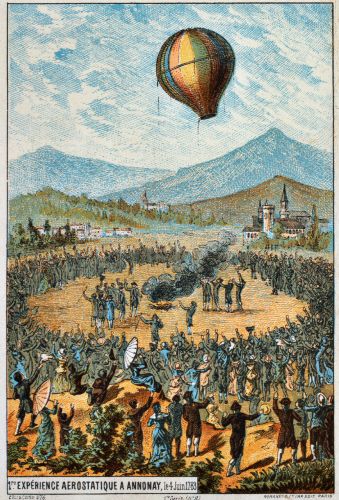
The ascent at Annonay on June 4, 1783, was not the beginning of human curiosity about flight, but it was the moment when that curiosity became visible as a collective public fact. Joseph-Michel and Jacques-Étienne Montgolfier were not university philosophers or court mathematicians. They were paper manufacturers from a family enterprise in southern France, and that background mattered deeply. Ballooning began not only in theory but in craft: in knowledge of paper, fabric, sizing, glue, strength, lightness, heat, and the behavior of large assembled surfaces. The brothers’ achievement depended on the world of artisanal experimentation as much as on Enlightenment science. They did not fully understand why their balloon rose, but they understood enough to make a large envelope lift itself from the ground before a crowd.
The Annonay demonstration was carefully staged. The balloon, made of cloth and paper and filled by heated air from a fire, rose above the assembled spectators and traveled roughly a mile before descending. In technical terms, it was an unmanned flight. In social terms, it was something larger: a public conversion of doubt into belief. The people who watched did not simply hear that ascent was possible; they saw it happen. That mattered in an eighteenth-century culture in which scientific claims often depended on demonstration, witnessing, and circulation through letters, newspapers, academies, and official reports. The balloon entered public life almost immediately because its proof was visual, dramatic, and difficult to ignore.
The Montgolfiers’ success quickly moved from provincial demonstration to royal and academic spectacle. Their invention attracted the attention of scientific authorities and court patrons because it seemed to join natural philosophy, useful possibility, and theatrical wonder. At Versailles on September 19, 1783, before Louis XVI, Marie Antoinette, members of the court, representatives of learned institutions, and an enormous crowd of spectators, the brothers’ balloon carried a sheep, a duck, and a rooster aloft. The choice of animals was practical as well as symbolic. The sheep stood in for a human body of comparable size and vulnerability; the duck represented a creature already adapted to altitude and air; the rooster, a bird not known for sustained high flight, offered another kind of living test subject. If living creatures could survive the ascent, then the risk to human passengers might be judged tolerable. But the event also transformed the balloon into a public drama about the limits of life itself. The animals became experimental subjects, royal entertainers, and heralds of a new age in which the sky could be entered by bodies from the earth. Their return mattered almost as much as their ascent, because survival turned spectacle into evidence. The balloon had not simply lifted an object; it had carried life into an unfamiliar atmospheric space and brought it back for inspection, interpretation, and celebration. In that moment, the boundary between experiment and theater nearly disappeared. Courtly grandeur, scientific testing, animal vulnerability, and popular amazement all converged around a single rising machine.
The transition from animal flight to human flight occurred with remarkable speed. Caution did not disappear, but ambition outran hesitation. On November 21, 1783, Jean-François Pilâtre de Rozier and François Laurent, Marquis d’Arlandes, made the first untethered human flight in a Montgolfier balloon, lifting off from the Château de la Muette and drifting over Paris. Their flight lasted only a short time, but duration was not the central issue. What mattered was that two men had left the ground without a tower, mountain, mast, or bridge beneath them. They were not suspended by ropes or lifted by religious imagination. They were carried by a machine, however fragile, into the open air above one of Europe’s great capitals.
This first human ascent was a technological event, a scientific event, and a political-cultural event all at once. It unfolded in late Bourbon France, where royal patronage, aristocratic display, academies, print culture, and popular curiosity overlapped uneasily. The balloon’s rise did not cause political revolution, but it belonged to the same world of spectacle and instability in which authority increasingly had to be seen, judged, and discussed by publics beyond the court. To watch a balloon was to watch elite science and artisanal skill produce a wonder that no monarch could fully contain. The sky became a stage on which invention, ambition, and publicity met. The Montgolfier balloon helped create not only aviation but public aviation: flight as something witnessed, reported, debated, imitated, celebrated, and commodified.
Yet the Montgolfier achievement also revealed the limits of early hot air ballooning from the beginning. The machine could rise, but it could not steer with precision. It depended on heat, weather, envelope strength, and favorable winds. Its danger was obvious, its use uncertain, and its theory still unsettled. But those limitations did not weaken its impact. They made the accomplishment more dramatic. The Montgolfiers had not invented modern air transportation; they had invented the first repeatable public passage from ground to sky. Their balloon changed flight from a myth into an event, from a dream into a demonstration, and from a private speculation into a shared human experience.
The Two Futures of Ballooning
The Montgolfier balloon did not stand alone for long. Almost as soon as heated air had carried a fabric envelope into the sky, another solution appeared: hydrogen. This rival technology emerged from the same Enlightenment fascination with air, chemistry, and public experiment, but it pointed ballooning in a different direction. The Montgolfiers had lifted their balloons with hot air generated by combustion, even if they misunderstood the precise cause of the lift. Jacques Alexandre César Charles, working with the Robert brothers, pursued a more chemical path. He used “inflammable air,” later known as hydrogen, a gas far lighter than ordinary air and already central to the new experimental chemistry of the eighteenth century. The difference mattered because it revealed that flight was not tied to one miraculous device or one family of inventors. It could be achieved through competing principles, different materials, and rival scientific cultures. If the Montgolfière made ascent possible through heat, the Charlière made ascent possible through chemistry. One seemed to belong to flame, paper, craft, and spectacle; the other to gas, varnished silk, laboratory knowledge, and the invisible properties of matter. From the beginning, ballooning was not a single road into the sky but a divided field of experimentation.
The rivalry between hot air and hydrogen was not merely a technical dispute. It represented two different futures for flight. Hot air balloons were visually dramatic, relatively direct in principle, and closely tied to fire, spectacle, and public theatricality. They could be inflated in a way spectators understood: flames heated air, the envelope swelled, and the balloon rose. Hydrogen balloons were less intuitive but in some respects more promising. They did not require the constant maintenance of a large open fire beneath a fragile envelope. They could remain aloft longer, potentially rise higher, and travel farther. Yet they also required chemical production, gas-tight materials, careful sealing, and the management of a dangerous, highly flammable lifting gas. Each type of balloon solved one problem while exposing another.
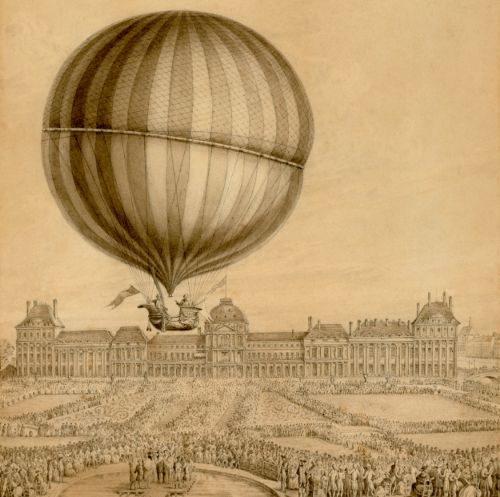
Charles and the Robert brothers demonstrated the power of hydrogen ballooning in Paris in late 1783, only months after the Montgolfiers’ first public ascent. Their balloon belonged to a different experimental culture from the smoky grandeur of the Montgolfier launches. It drew on the chemistry of gases, the fabrication of varnished silk, and the practical problem of containing hydrogen long enough to make flight possible. In December 1783, Charles and Nicolas-Louis Robert made a celebrated manned hydrogen balloon flight from the Tuileries. After landing, Charles ascended again alone, reaching a far greater altitude and experiencing the cold, pressure, and isolation of the upper air more directly than the first hot air aeronauts had done. The event helped prove that ballooning was not a single invention but a family of technologies organized around the same physical principle: a vessel lighter than the surrounding air could rise. This distinction mattered because early observers often treated “ballooning” as one astonishing phenomenon, while practitioners quickly learned that different lifting methods produced different possibilities. A hot air balloon was limited by fuel consumption, heat management, envelope damage, and fire risk. A hydrogen balloon was limited by gas production, leakage, cost, and explosion risk. A hot air balloon could be launched with dramatic speed and visible energy; a hydrogen balloon might require elaborate preparation, specialized materials, and chemical infrastructure. A hot air balloon seemed elemental, almost archaic in its dependence on flame; a hydrogen balloon seemed modern, chemical, invisible, and more closely tied to the laboratory. The two forms did not simply compete. They divided the meaning of flight between spectacle and endurance, fire and gas, craft and chemistry.
The rivalry also altered the social identity of the aeronaut. The Montgolfier balloonist appeared as a daring passenger of fire, rising in a machine whose instability was part of its drama. The hydrogen balloonist increasingly appeared as an experimental navigator of an invisible medium, dependent on barometers, valves, ballast, gas behavior, and atmospheric judgment. Neither figure truly controlled direction, because both remained at the mercy of winds. But hydrogen ballooning encouraged a stronger association between flight and scientific instrumentation. Aeronauts could measure temperature, pressure, altitude, and atmospheric conditions while aloft. The balloon became not only a spectacle to be watched from below, but a platform from which the atmosphere could be observed from within.
This is why hydrogen did not simply replace hot air, even when it seemed technically superior for duration and altitude. The two forms answered different desires. Hot air remained tied to the primal drama of visible ascent, to the swelling envelope, the roar or crackle of heat, the crowd’s immediate grasp of cause and effect. Hydrogen opened a path toward longer voyages, record attempts, military observation, and later hybrid designs such as the Rozière balloon, which combined a gas cell with controlled heating. That hybrid future is important because it shows that the history of ballooning was never a clean succession from primitive to advanced. It was a process of adaptation in which older and newer principles could be recombined for particular purposes.
By the end of 1783, ballooning already contained two futures. One future led toward the hot air balloon as spectacle, recreation, symbolic ascent, and eventually modern sport revived by nylon envelopes and propane burners. The other led through gas ballooning toward long-distance flight, high-altitude science, military observation, and hybrid endurance voyages. Both began in the same extraordinary year, and both depended on the same unsettling realization: the atmosphere could carry human beings if they could build the right kind of vessel. The rivalry between the Montgolfière and the Charlière did not weaken the meaning of the first balloon age. It expanded it. Flight was no longer a single miracle. It had become an experimental field.
Balloon Mania and the Public Imagination
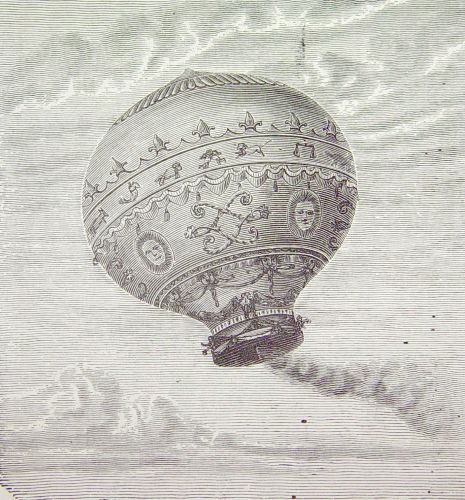
The balloon did not remain a scientific instrument for long. Almost immediately after the flights of 1783, it became a cultural event, a commercial image, and a shared public obsession. “Balloon mania” was not simply enthusiasm for a new machine; it was the rapid transformation of flight into spectacle, fashion, print, satire, and social conversation. The balloon rose into the sky, but it also descended into daily life as an image reproduced on fans, snuffboxes, plates, wallpaper, medals, songs, poems, and shop signs. It gave people who never entered a basket a way to participate in the conquest of the air. To own a balloon print, wear a balloon-shaped ornament, or discuss the latest ascent was to join a modern public fascinated by invention.
The visual character of ballooning made it powerful. Some technologies could be understood only by experts, but a balloon explained itself through drama. It swelled, strained, lifted, drifted, and vanished. It turned scientific principle into a sequence of visible moments that spectators could follow even if they knew little about physics or chemistry. The inflation itself was theatrical, often as important as the ascent. Crowds watched the envelope fill, the fabric tremble, the ropes tighten, and the aeronauts prepare for departure. Then came the moment of release, when the machine separated from the ground and made the impossible appear simple. Ballooning belonged naturally to the culture of public demonstration that had already made electricity, magnetism, chemistry, and mechanical curiosities into forms of Enlightenment entertainment.
Print culture multiplied that experience far beyond the launch field. Engravings of the Montgolfier flights, the Charles and Robert hydrogen ascents, and later celebrity aeronauts circulated across Europe, allowing distant readers to see what they had missed. These images were not neutral records. They arranged crowds, landscapes, buildings, and balloons into scenes of wonder, often exaggerating scale or drama to convey the emotional force of ascent. Printed descriptions did the same in words, turning flights into narratives of courage, danger, novelty, and triumph. Newspapers, pamphlets, broadsides, poems, and collected accounts made each ascent part of a growing archive of aerial modernity. They also helped standardize the drama of ballooning: the preparation, the anxious crowd, the release, the ascent, the disappearance, the landing, and the aeronaut’s report afterward. In that sense, print did not merely document balloon mania; it taught readers how to understand it. The balloon became a media event because it was perfectly suited to reproduction: a bold shape against the sky, a crowd below, and a story that seemed to announce the arrival of a new age.
Fashion responded with equal speed. Balloon motifs appeared on clothing and accessories, while hairstyles, hats, and decorative objects borrowed the rounded form of the aerostat. This did not trivialize the invention; it showed how deeply it entered the symbolic economy of late eighteenth-century society. Fashion allowed ballooning to become wearable modernity. A person did not need to understand hydrogen, heated air, barometric pressure, or envelope construction to recognize the balloon as a sign of novelty and daring. Like later trains, bicycles, automobiles, airplanes, and rockets, the balloon became a style before it became a settled technology. Its image moved faster than its practical use.
Satire also followed quickly, because ballooning invited mockery as much as admiration. Caricaturists and critics used balloons to comment on ambition, vanity, speculation, political instability, and the absurdity of fashionable enthusiasms. A balloon could symbolize Enlightenment progress, but it could just as easily symbolize inflated pride, social climbing, empty schemes, or ideas detached from the ground. This double meaning gave balloon imagery unusual flexibility. It could celebrate the triumph of reason over nature, or ridicule a society intoxicated by novelty. The very word “inflation” carried moral and political possibilities. A balloon was a machine, but it was also a metaphor waiting to be used. That metaphor could be turned against philosophers, financiers, courtiers, fashionable women, political reformers, or anyone accused of rising too quickly above their proper station. The balloon’s ascent made it visually irresistible as a language of social and political imbalance: some rose, others watched, and everyone wondered whether the flight would end in triumph or collapse. Its comic potential depended on the same uncertainty that made it thrilling. No one knew exactly where a balloon would land, and that unpredictability made it an ideal emblem for an age increasingly aware of novelty’s risks as well as its promises.
Balloon mania also changed the way people imagined space. To rise above a city was to see the world from a position previously reserved for towers, mountains, birds, angels, and God. Even when spectators remained on the ground, they imagined the view from above. Ballooning encouraged a new aerial consciousness before aerial photography or aviation made such views familiar. Streets, fields, rivers, walls, and crowds could now be imagined from a detached height. The balloon did not yet make the world small in the way railroads, steamships, telegraphs, and airplanes later would, but it did make the ground newly visible as something that could be looked down upon. That shift mattered for art, urban imagination, military thought, geography, and the emotional history of modernity.
The public imagination also turned aeronauts into a new kind of celebrity. They were not simply inventors or pilots, because the categories did not yet exist in modern form. They were performers of risk, interpreters of the atmosphere, and living proof that ascent was possible. Their bodies mattered. Audiences wanted to know what they felt, saw, feared, and endured. Reports of cold, height, silence, drifting, landing, and danger gave ballooning an experiential language. The aeronaut became a witness from another realm, someone who had briefly entered the sky and returned to describe it. This helped make ballooning more than a mechanical achievement. It became a human story about perception, courage, and transformation.
Balloon mania reveals why the first age of ballooning cannot be understood only through technical progress. The balloon’s cultural success came from the fact that it joined science to spectacle and machine to metaphor. It was useful before its uses were clear because it gave modern society an image of itself: inventive, ambitious, theatrical, restless, and uncertain whether its own ascent was glorious or absurd. The crowds, prints, fashions, songs, and satires were not decorative aftereffects of the invention. They were part of what the invention meant. The public did not passively receive ballooning as an expert achievement handed down from above; it helped produce the meaning of ballooning by buying its images, repeating its stories, mocking its pretensions, dressing in its forms, and turning its flights into shared occasions of wonder. That is why balloon mania deserves to be treated as part of the history of aviation rather than as a quaint cultural footnote. Public imagination gave ballooning its social lift. Ballooning became public flight because the public did not merely watch it rise; it absorbed the balloon into the visual, commercial, and imaginative life of the age.
Danger and the Heroic Aeronaut
The first age of ballooning was inseparable from danger. A balloon might appear graceful once aloft, but every ascent depended on fragile materials, uncertain weather, imperfect theory, and public faith in a machine that no one yet fully understood. Hot air balloons carried open fire beneath envelopes of paper, cloth, varnish, or silk. Hydrogen balloons avoided that constant flame but introduced a different terror: an invisible, highly flammable gas contained only by seams, coatings, and luck. Early aeronauts rose before meteorology had become a mature predictive science, before pilots had reliable knowledge of upper winds, and before landing procedures could be standardized by long experience. The sky had become accessible, but it had not become safe.
The danger began before launch. Inflation required labor, heat, crowd control, fuel, ropes, ballast, and timing. A balloon could tear, scorch, leak, collapse, or break free too soon. Spectators pressed close because the spectacle was most powerful at the moment when the inert envelope became a living object, swelling and straining against its restraints. That same intimacy made ballooning hazardous as public theater. A failed launch could injure workers or bystanders; a successful launch could still become disastrous if wind carried the aeronaut toward buildings, trees, rivers, roofs, or open sea. Unlike later aircraft, early balloons had no engine with which to choose a route and no reliable means of return. Once released, the aeronaut entered a world of partial control, where ascent and descent could be managed more easily than direction. Even decisions that seemed simple from the ground became complicated in the air. To rise higher might mean finding a different current, escaping an obstacle, or entering colder, thinner, less predictable conditions. To descend might mean reaching safety, or it might mean coming down among chimneys, forests, marshes, military posts, or frightened villagers. Ballast, valves, vents, fuel, and flame offered tools of management, but not mastery. Early ballooning was dangerous not because aeronauts were reckless alone, but because the technology placed them inside a medium whose behavior could be read only imperfectly and negotiated only moment by moment.
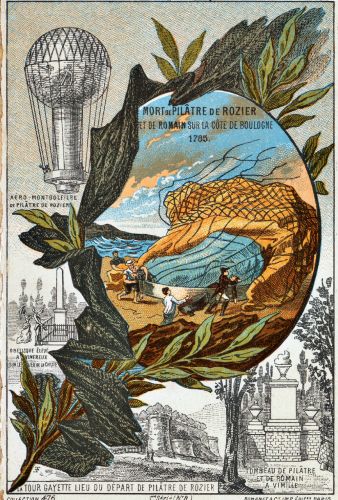
The death of Jean-François Pilâtre de Rozier in 1785 gave this danger its most powerful early symbol. Rozier had been one of the first two men to make an untethered human flight in 1783, and his name was already attached to the triumph of human ascent. His fatal attempt to cross the English Channel with Pierre Romain exposed the lethal consequences of combining ambition, technical experimentation, and public expectation. Their hybrid balloon, using both hydrogen and heated air, was meant to solve problems of lift and duration, but it also joined two dangerous systems in one apparatus. When the balloon failed and crashed, Rozier became not only a pioneer of flight but one of aviation’s first martyrs. The meaning of his death was sharpened by the contrast between the earlier miracle of ascent and the sudden proof that the sky could kill.
Disaster did not end ballooning; in many ways, it intensified its heroic culture. The aeronaut became a figure who publicly accepted danger on behalf of wonder, knowledge, and reputation. Balloonists performed courage in the most literal sense: they rose in view of crowds who could see the vulnerability of the machine and the exposure of the body. Their reports from the air described cold, silence, dizziness, awe, drifting, and fear. Their landings often became dramas of their own, especially when villagers, farmers, soldiers, or authorities encountered a strange descending machine in fields or roads. To survive a flight was to return with a story; to fail was to confirm that the achievement had never been ordinary. The aeronaut’s authority came not simply from technical skill, but from having passed through danger and come back. This helped create a new kind of modern hero, different from the soldier, sailor, explorer, or natural philosopher, but borrowing something from each. Like a sailor, the aeronaut depended on winds and weather; like an explorer, he or she entered unfamiliar space; like a scientist, the aeronaut observed and reported; like a performer, the aeronaut needed an audience. The balloonist’s body became the site where experiment, spectacle, and risk converged. In that sense, early aeronauts were not merely operators of machines. They were living evidence that the age of public science could demand physical courage as well as intellectual daring.
The nineteenth century expanded this culture of risk. Professional aeronauts staged public ascents for paying crowds, crossed borders, performed experiments, carried passengers, and sometimes added parachute descents, fireworks, or other theatrical enhancements. Jean-Pierre Blanchard, André-Jacques Garnerin, Sophie Blanchard, and other celebrated aeronauts helped turn ballooning into a profession of spectacle. Sophie Blanchard’s death in 1819, after her balloon caught fire during a night ascent with pyrotechnics, revealed the terrible logic of that profession. The more familiar ballooning became, the more performers had to heighten danger to preserve astonishment. Risk was not merely an unfortunate byproduct of public ballooning; it could become part of what audiences paid to see. This was true as ballooning moved from the extraordinary novelty of the 1780s into a more competitive entertainment economy. A simple ascent that once seemed miraculous could, after repeated exhibitions, appear insufficient. Aeronauts experimented with timing, altitude, location, passenger flights, parachute drops, illuminations, and dramatic departures from pleasure gardens or fairgrounds. The public wanted wonder renewed, and renewal often meant escalation. The balloon, originally celebrated as proof of Enlightenment progress, could become a stage for danger that bordered on melodrama. Yet this did not make the performances meaningless. They kept alive the public sense that flight was a bodily ordeal, not merely a mechanical trick, and they preserved the aeronaut’s status as someone who risked death to make ascent visible again and again.
The heroic aeronaut complicates any simple story of technological progress. Ballooning advanced through experiment, but experiment was often conducted in public, under pressure, and at bodily risk. Its disasters were not accidental interruptions of the story; they helped define what ballooning meant. The balloonist stood between Enlightenment science and popular entertainment, between rational experiment and theatrical danger, between mastery of nature and submission to wind. That tension made the aeronaut compelling. To rise in a balloon was to demonstrate human ingenuity, but also to expose the fragility of that ingenuity in the face of atmosphere, flame, gas, gravity, and chance. The first flyers did not simply conquer the sky. They made visible the cost of entering it.
Balloons at War
The military value of the balloon lay in a simple but radical fact: it gave armies height without requiring mountains, towers, or aircraft engines. From the ground, commanders saw terrain through the limits of roads, ridges, smoke, forests, fortifications, and rumor. From above, even a tethered balloon could turn the battlefield into a visible field of patterns: roads, columns, camps, artillery positions, river crossings, entrenchments, and moving troops. Balloons did not solve the ancient problem of command in war, but they changed one part of it by separating the observer’s eye from the surface of the earth. In that sense, military ballooning was not mainly about flight as travel. It was about flight as vision.
The French Revolutionary Wars provided one of the earliest demonstrations of this new military eye. In 1794, the French army created the Compagnie d’aérostiers, an aerostatic corps intended to use tethered balloons for reconnaissance. At the Battle of Fleurus, the balloon L’Entreprenant was used to observe enemy movements and relay information to commanders below. The practical impact of the balloon at Fleurus should not be exaggerated; battles were still decided by infantry, cavalry, artillery, logistics, morale, and command. Yet its symbolic and conceptual importance was enormous. Less than a dozen years after the Montgolfiers’ first public ascent, the balloon had moved from court spectacle and scientific wonder into the machinery of modern war. The sky had become a military position. That shift mattered because revolutionary warfare already depended on mass mobilization, rapid movement, and the difficult coordination of large bodies of men across complex terrain. A balloon could not command those forces by itself, but it promised to make their movements more intelligible. It also joined military power to the culture of Enlightenment science: chemistry produced the lifting gas, engineering managed the apparatus, trained observers interpreted the landscape, and officers translated what was seen into tactical knowledge. The aerostatic corps represented more than a curiosity attached to an army. It suggested that modern war would increasingly depend on organized networks of information, not merely courage on the field.
The usefulness of balloons in war depended on their tethered character. Free balloons could drift unpredictably and were poorly suited to battlefield reconnaissance, but tethered balloons could be raised and lowered from a controlled position. This turned ascent into a temporary observation post. The balloon itself remained vulnerable to weather, enemy fire, poor handling, and logistical difficulty, but the principle was clear. An army that could lift observers above the battlefield could gain a broader view than an army confined to ground level. The balloon did not eliminate uncertainty, but it promised to reduce it. Military commanders had always sought better information; the balloon offered information from a new dimension.
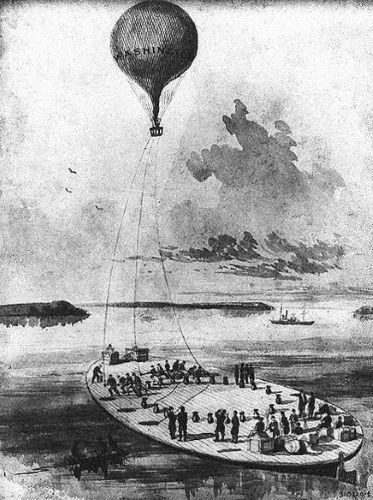
During the American Civil War, balloon reconnaissance became more elaborate through the work of Thaddeus S. C. Lowe and the Union Army Balloon Corps. Lowe’s balloons, including the Intrepid, Union, and Constitution, were used to observe Confederate positions, particularly around Washington, the Virginia Peninsula, and other contested landscapes where visibility mattered. The Civil War made clear both the promise and the frustration of military aerostation. Observers could identify roads, camps, earthworks, smoke, troop concentrations, and movement, but they still had to communicate what they saw quickly and accurately. Telegraph lines from balloon baskets to commanders below helped turn aerial observation into actionable intelligence. In principle, the balloon was becoming not just an elevated eye but a node in a military information system.
The Civil War also exposed the institutional weakness of early military ballooning. Lowe’s work required specialized equipment, inflation systems, trained crews, transport, fuel, and cooperation from commanders who did not always understand or value the service. Balloons could be difficult to move, awkward to deploy, and dependent on weather at precisely the moments when commanders wanted certainty. Some officers praised their usefulness; others regarded them as expensive novelties. The Balloon Corps never became a permanent, fully integrated arm of the Union war machine, and it was eventually discontinued. Yet this failure should not obscure its importance. The problem was not that aerial reconnaissance lacked value, but that the military institutions, communications networks, and aircraft technologies of the period were not yet fully prepared to absorb it. Lowe’s experience revealed a recurring pattern in the history of military innovation: a device may demonstrate genuine usefulness before an army knows how to organize, fund, protect, and interpret it. A balloon could provide a view, but that view still had to pass through human judgment, chain of command, skepticism, rivalry, and bureaucratic resistance. It also required commanders to trust a form of knowledge that seemed unfamiliar, mediated, and indirect. For officers accustomed to scouting by cavalry, reports from the ground, and personal reconnaissance, information from the air could appear both powerful and uncertain. The balloon’s weakness was not only technical. It was institutional and cultural.
Balloons continued to serve military purposes into the late nineteenth and early twentieth centuries, especially as observation platforms. Their significance grew again with the increasing importance of artillery. Once guns could fire at longer ranges and indirect fire became more central, seeing the target and correcting fire from above became more valuable. Observation balloons were used in colonial wars, European military exercises, and eventually on a massive scale during the First World War, where tethered balloons became part of the surveillance and artillery-spotting systems of industrial combat. By then, they shared the sky with airplanes, but they had not disappeared. Their slower, tethered stability could still be useful where sustained observation mattered more than speed.
The military history of ballooning reveals a central theme in the larger history of flight: the first conquest of the air was not movement but surveillance. Before aircraft became bombers, transports, or fighters, ascent made the earth legible in new ways. Balloons taught armies to think vertically. They anticipated later aerial reconnaissance, artillery spotting, battlefield photography, and eventually the satellite view of war. Their limits were obvious: they were slow, vulnerable, weather-bound, and difficult to integrate into command structures. But those limits make their achievement more historically precise. Balloons did not revolutionize warfare by carrying armies through the sky. They changed warfare by teaching commanders that the sky could be used as a place from which to see.
Science in the Sky

Ballooning’s scientific importance came from a simple transformation: it allowed investigators to enter the atmosphere rather than merely observe it from below. Before balloons, weather was experienced at the surface, recorded from towers, inferred from clouds, or measured by instruments that remained tied to the ground. The balloon changed that relationship by making vertical inquiry possible. It turned the atmosphere into a layered space through which a human observer, instruments, and later unmanned recording devices could travel. Scientific ballooning did not treat the sky as an empty passageway. It treated the sky as an object of study.
Early aeronauts quickly discovered that ascent altered nearly everything familiar about the lower world. Temperature fell, pressure changed, winds shifted, sound behaved differently, and the landscape below became newly abstract. These experiences were not only poetic or emotional; they were data. Barometers, thermometers, hygrometers, chronometers, and notebooks accompanied many balloon flights, turning the basket into a small moving observatory. The limitations were obvious. Instruments were delicate, readings were difficult to take in cold and motion, altitude could be uncertain, and the aeronaut’s own body became part of the experiment. But those difficulties also reveal why balloon science mattered. It forced investigators to confront the atmosphere as a dynamic vertical environment, not simply a ceiling over human life.
James Glaisher’s nineteenth-century ascents with Henry Tracey Coxwell became among the most famous examples of balloon meteorology. Glaisher, a meteorologist and astronomer, hoped to measure the upper air directly, recording temperature, humidity, pressure, and other conditions at heights that no ordinary observatory could reach. The celebrated 1862 ascent, during which Glaisher lost consciousness and Coxwell had to release the valve with his teeth because his hands were disabled by cold, dramatized both the scientific promise and physical danger of high-altitude observation. The flight became legendary partly because it showed how far human bodies could be pushed in the service of atmospheric knowledge. Yet its deeper importance lay in the measurements themselves. Ballooning provided evidence that the atmosphere was structured, variable, and scientifically accessible in ways surface observation alone could not reveal.
The scientific balloon also helped change the meaning of instruments. On the ground, instruments extended the senses. In the air, they became survival tools, witnesses, and substitutes for bodily reliability. The higher balloonists rose, the less they could trust ordinary sensation. Cold, hypoxia, dizziness, confusion, and fear could distort judgment. Instruments promised a more disciplined account of what the aeronaut experienced imperfectly. Balloon science depended on the credibility of the observer, who had to read, remember, record, and interpret conditions under extreme circumstances. The basket was a place where human perception and mechanical measurement worked together uneasily. Ballooning made the atmosphere visible, but it also revealed that scientific seeing required mediation.
By the late nineteenth and early twentieth centuries, unmanned balloons increasingly extended this work beyond the limits of the human body. Small balloons carrying self-recording instruments could rise higher than crewed flights and gather data without risking aeronauts. Kites, captive balloons, pilot balloons, and later radiosondes became part of an expanding system of upper-air observation. The radiosonde was important because it allowed instruments carried by balloon to transmit measurements of pressure, temperature, and humidity back to the ground by radio. This shifted balloon science from heroic ascent toward routine atmospheric surveillance. The balloon did not lose its importance when the human observer left the basket; in some respects, it became more scientifically powerful. It could now serve meteorology not as an occasional adventure but as part of a recurring global practice of measuring the upper air. That shift also changed the social character of atmospheric science. Instead of relying primarily on spectacular ascents by famous aeronauts, meteorology increasingly depended on standardized instruments, scheduled launches, comparative data, and networks of stations. The balloon became a quiet servant of prediction, allowing weather to be studied in three dimensions and not merely as a surface event. Upper-air data helped make possible more sophisticated understandings of storm systems, pressure patterns, wind circulation, and atmospheric layers. In this form, ballooning became less visible to the public but more deeply embedded in modern life. The balloon no longer needed to astonish a crowd in order to matter. It could rise almost unnoticed and still contribute to the forecasts, aviation planning, military operations, and scientific models on which twentieth-century societies increasingly depended.
The stratospheric flights of the twentieth century returned some of the heroic drama to scientific ballooning while transforming its technological requirements. Auguste Piccard’s pressurized gondola made it possible to carry human beings safely into regions of the atmosphere where low pressure and lack of oxygen made open-basket ascent deadly. Piccard’s flights in the early 1930s joined older ballooning traditions to new concerns in physics, cosmic rays, atmospheric structure, and the future of high-altitude exploration. The sealed gondola was not merely a safer basket. It was a miniature laboratory and a precursor to later pressure cabins, spacecraft capsules, and deep-sea vessels. In Piccard’s work, the balloon became a bridge between meteorology and space-age imagination: still lifted by buoyancy but now associated with the technological problem of keeping human life intact in hostile environments. The drama lay not only in altitude but in enclosure. Earlier aeronauts had confronted the air directly, exposed to wind, cold, and thinning oxygen; Piccard entered the upper atmosphere inside a sealed technological shell. That difference marked a profound change in the relationship between body and sky. Human ascent was no longer only a matter of courage, clothing, and endurance. It required artificial environments, pressure control, oxygen management, scientific instrumentation, and careful engineering of the boundary between life and atmosphere. The stratospheric balloon pointed both backward and forward. It preserved the old ballooning dream of rising by lighter-than-air principles, but it also anticipated the central problem of spaceflight: how to carry a habitable world into a place where the human body could not naturally survive.
Scientific ballooning occupies a central place in the history of flight precisely because it was not primarily about transportation. Balloons helped investigators measure, classify, and inhabit the atmosphere. They contributed to meteorology, physiology, high-altitude medicine, cosmic-ray research, military weather forecasting, and eventually space science. Their slow ascent, once a limitation for travel, became an advantage for observation. They could linger, rise gently, carry instruments, and enter atmospheric layers that other machines reached differently or later. From Glaisher’s open basket to Piccard’s pressurized gondola to the radiosonde, the balloon repeatedly turned upward movement into knowledge. It made the sky not only reachable, but readable.
Why Balloons Did Not Become Ordinary Transportation

The balloon opened the sky, but it did not make the sky into a dependable road. That distinction is central to understanding its place in the history of transportation. A balloon could rise, carry people, cross rivers, drift over cities, and occasionally travel impressive distances, but it could not reliably depart at a fixed time, follow a chosen route, arrive at a planned destination, or return by the same path. Ordinary transportation depends on repeatability. Roads, canals, railways, steamships, automobiles, and airplanes became transformative not simply because they moved bodies and goods, but because they could be organized into schedules, routes, networks, fares, stations, depots, timetables, and expectations. Balloons rarely offered that kind of order. They made ascent possible, but they did not turn movement through the air into a regular service.
The basic problem was direction. A free balloon could ascend or descend, but horizontal movement depended on wind. Skilled aeronauts learned to read weather, choose launch times, manage ballast, vent gas, heat air, and seek different currents at different altitudes, but these techniques gave influence rather than control. The balloonist could negotiate with the atmosphere, not command it. Sometimes this produced extraordinary journeys; at other times it produced anticlimax, danger, or embarrassment. A flight might travel farther than expected, land almost immediately, cross political borders, descend in a field, drift toward water, or become trapped by changing weather. For transportation, the problem was not that balloons never went anywhere. It was that they could not promise to go somewhere specific often enough to become ordinary. This made them fundamentally different from vehicles that could be incorporated into everyday life. A traveler could plan around a road, a canal, a railway, or eventually an airline because the route itself imposed discipline on movement. The balloon had no such corridor. Its “route” existed only temporarily, formed by currents of air that were invisible, shifting, and imperfectly understood. Even when aeronauts developed remarkable practical skill, their knowledge remained probabilistic. They could choose conditions, interpret signs, and respond to change, but they could not guarantee arrival. That uncertainty was thrilling for spectators and adventurous passengers, but it was fatal to the balloon’s claim as ordinary transportation.
Payload and infrastructure posed further limits. Balloons required large envelopes, inflation sites, crews, gas or fuel supplies, ropes, ballast, repair materials, and safe landing spaces. Hydrogen balloons needed chemical production or access to gas infrastructure; hot air balloons needed fuel and constant heat management. Even when passengers could be carried, the ratio between size, lift, cost, risk, and usefulness remained unfavorable for routine transport. A coach, canal boat, railway carriage, or steamship might not have been glamorous, but it could carry many people or goods along known routes. A balloon, by contrast, demanded elaborate preparation for a journey whose destination could remain uncertain. It was spectacularly modern in one sense and stubbornly impractical in another.
Safety also mattered. Ordinary transportation does not require perfect safety, as the history of steam boilers, rail accidents, shipwrecks, and early automobiles makes clear. But it does require risks that can be routinized, insured, regulated, and socially accepted. Ballooning’s risks were harder to domesticate because they were tied to weather, landing, fire, gas leakage, envelope failure, and the unpredictability of drift. A passenger railway accident might be horrifying, but the railway itself remained anchored to rails, stations, staff, and timetables. A balloon accident seemed to confirm something more fundamental: that the air was not yet an obedient transport medium. The very qualities that made ballooning emotionally powerful (exposure, silence, height, drift, and surrender) made it difficult to integrate into the everyday systems of commerce and commuting.
Competition from other technologies sharpened these weaknesses. The nineteenth century was the age of steam, iron, and infrastructure. Railways compressed time across land; steamships made ocean travel more predictable; telegraphs separated communication from physical travel altogether. Later, bicycles, automobiles, airships, and airplanes each answered needs that balloons could not. Dirigibles promised steerable lighter-than-air travel, while airplanes eventually offered speed, route control, and military and commercial scalability. The balloon had been first into the sky, but being first did not guarantee dominance. Its importance lay in proving that humans could rise, not in establishing the practical method by which modern people would move through air. This is one reason balloon history complicates simple stories of technological progress. The first successful form of human flight did not become the leading form of aviation because later technologies solved different problems, not merely because they were newer. The railway solved regularity across land; the steamship solved power against wind and current; the airship tried to solve steerability in the air; the airplane eventually joined lift, propulsion, speed, and direction in a far more scalable way. Balloons remained outside that logic. They were aerial, but not infrastructural; mobile, but not reliably directional; transportive but not suited to transportation systems. Their decline as practical vehicles was not a failure of imagination. It was a consequence of the specific kind of movement they made possible.
Yet the balloon’s failure as ordinary transportation should not be mistaken for historical failure. It clarifies what the balloon did best. It served spectacle, science, reconnaissance, sport, atmospheric research, and symbolic ascent more effectively than mass travel. Its slowness could be a defect for commerce but an advantage for observation. Its dependence on wind could frustrate passengers but intensify wonder. Its lack of ordinary usefulness preserved its extraordinary character. Balloons did not become the aerial equivalent of the omnibus, train, or airplane because they could not make the sky predictable enough. But they changed transportation history anyway by revealing that the air could be entered, inhabited, measured, and imagined as a space of human movement. They did not build the aerial highway. They made people believe such a highway might someday exist.
New Technology and the Eclipse of the Balloon
The balloon’s eclipse did not happen because ascent lost its power. It happened because ascent alone was no longer enough. Once human beings had entered the air, the central problem shifted from rising to navigating. A free balloon could float, drift, and occasionally travel great distances, but it could not reliably choose its path. The dream of aerial transportation moved toward the dirigible, or steerable airship: a lighter-than-air craft that retained the buoyant principle of the balloon while adding propulsion, control surfaces, and a more elongated form. In that sense, the airship was not a rejection of ballooning but an attempt to complete it. It accepted the balloon’s great achievement, buoyant flight, while trying to overcome its defining weakness: dependence on the wind.
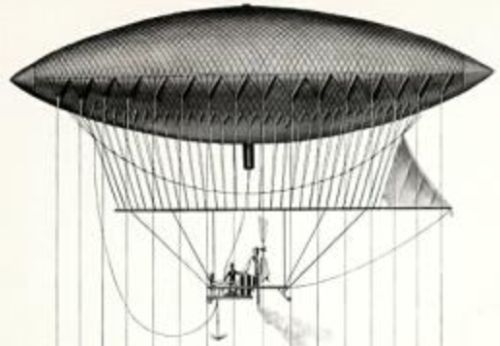
The nineteenth century produced a long series of experiments in steerable flight. Henri Giffard’s steam-powered dirigible in 1852 showed that a powered lighter-than-air craft could move through the air, though with serious limits. Later, Charles Renard and Arthur Krebs’s La France demonstrated more effective control with electric propulsion in the 1880s. These machines belonged to a transitional world between balloon and aircraft. They still depended on gas-filled envelopes and buoyancy, but they promised route, return, and intention. By the end of the century, the rigid airship, especially under Count Ferdinand von Zeppelin, gave this promise a more imposing form. The Zeppelin was large, engineered, militarized, and spectacular in a new way. It did not drift like a balloon over a crowd; it moved with apparent purpose across national skies. It made lighter-than-air flight look less like wonder and more like infrastructure, power, and empire.
Yet the rise of the airship also pushed the older balloon into a narrower role. The round free balloon increasingly appeared archaic beside the long, powered forms of dirigibles. The balloon had symbolized the first conquest of vertical space; the airship symbolized the attempt to make the sky directional. This shift changed public expectations. Spectators and governments no longer wanted only the marvel of ascent. They wanted range, control, military usefulness, commercial possibility, and national prestige. Airships could carry more people, remain aloft longer, and at least in principle connect places by air. They were still vulnerable to weather, gas hazards, cost, and operational difficulty, but they addressed the transportation problem more directly than free balloons ever could. The balloon remained beautiful, but the airship seemed more practical, more modern, and more commanding. It also fit more easily into the political imagination of the late nineteenth and early twentieth centuries. A balloon was individual, episodic, and dependent on local conditions; an airship suggested organization, capital, engineering, trained crews, military planning, and national ambition. Its very size mattered. The rigid airship did not merely rise into the air; it occupied the sky as a visible sign of industrial power. This made the older balloon seem increasingly like a relic of the Enlightenment and the fairground, while the airship appeared to belong to the age of steel, engines, empire, and mass politics.
The airplane then changed the terms again. The Wright brothers’ powered flights in 1903 did not immediately make balloons obsolete, but they opened a different future: heavier-than-air flight based on lift, propulsion, control, and speed rather than buoyancy. Airplanes were at first fragile, short-ranged, and experimental, but their potential was unmistakable. They could be steered with increasing precision, improved rapidly, and scaled into military, postal, commercial, and passenger systems. During the First World War, airplanes became scouts, fighters, bombers, and artillery spotters, while observation balloons remained important but increasingly vulnerable. The war did not eliminate balloons from military use; it clarified their place. Balloons could watch from tethered positions, but airplanes could range, pursue, attack, photograph, and return. The aerial future was becoming faster, more aggressive, and more mechanically dynamic. The difference was not only technical but conceptual. The balloon had made flight an ascent; the airplane made it a route, a weapon, a profession, and eventually an industry. Pilots no longer merely entered the air and submitted to its currents. They banked, climbed, descended, corrected course, followed targets, crossed front lines, and returned to bases. That expanding control changed the meaning of aviation itself. By the time governments, militaries, newspapers, and publics began to imagine air power as a decisive modern force, the balloon seemed too passive to carry the symbolic burden of the future. It remained useful, but it no longer defined what flight was becoming.
This did not mean that balloons simply vanished. Observation balloons continued in war. Gas balloons persisted in sport and record attempts. Scientific balloons remained valuable because they could rise gently, carry instruments, and reach atmospheric regions where other machines were less suitable or more expensive. Even in the age of airplanes, balloons retained advantages in slowness, stability, altitude research, and spectacle. Their eclipse was relative, not absolute. What disappeared was the possibility that the free balloon might become the central vehicle of aerial modernity. The airplane claimed that role because it made the air behave more like a transport network: routes could be planned, schedules imagined, cargo carried, passengers sold tickets, and military strategy reorganized around speed and range.
The eclipse of the balloon reveals an important distinction between technological priority and technological dominance. The balloon came first, but it did not define the mature system of aviation. Airships and airplanes inherited its challenge while changing its meaning. They took the sky from vertical astonishment toward powered mobility, from drifting ascent toward planned movement, from spectacle toward infrastructure and war. Yet the older balloon never lost its historical importance. It remained the first proof that humans could inhabit the air, and later aircraft depended on the imaginative rupture it had already achieved. The balloon was eclipsed because aviation outgrew mere ascent. But without that first ascent, the later conquest of direction, distance, speed, and altitude would have belonged to a different history.
Reinvention in Nylon and Propane: Ed Yost and the Modern Hot Air Balloon
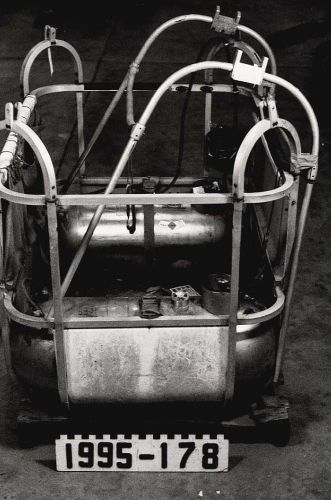
The modern hot air balloon was not simply a survival of the eighteenth century. It was a reinvention. By the middle of the twentieth century, free ballooning still existed, but the familiar image of the safe, colorful, recreational hot air balloon had not yet become ordinary. Earlier hot air balloons had depended on open fires, heavy or fragile materials, and limited control over heat. Gas balloons had done much of the serious long-distance and scientific work, while airplanes and airships had long since displaced balloons from the center of aviation’s future. The hot air balloon needed new materials, new fuel systems, and a new practical identity before it could return as a widely flown aircraft. That reinvention came through the work of Ed Yost and the small circle of engineers and experimenters who transformed an old principle into a modern machine.
Yost’s achievement lay in recognizing that the central problem of hot air ballooning was not the physics of lift, which had been understood since the eighteenth century, but the control of heat in a lightweight envelope. Synthetic fabrics made it possible to build envelopes that were stronger, lighter, and more manageable than the paper, linen, silk, and varnished materials of earlier ballooning. Nylon, properly treated and sewn, gave the modern balloon a practical skin. It could be folded, transported, repaired, and reused in ways that made ordinary sport ballooning far more plausible. The propane burner gave it a controllable fire. Instead of relying on a smoky, awkward, and dangerous open flame, the pilot could add heat quickly and repeatedly, managing ascent and descent with far greater precision. That control mattered because hot air ballooning depends on constant adjustment rather than continuous power. The pilot does not steer in the airplane sense, but by heating, cooling, climbing, descending, and reading winds at different altitudes, the pilot can shape the flight more deliberately than early aeronauts could. The result was not merely a safer version of the Montgolfier balloon. It was a new operational structure built from old aerostatic principles and modern industrial materials.
The context of Yost’s work also matters. His experiments developed in relation to postwar American aviation, military research, and a broader culture of technical improvisation. The United States Navy and associated research interests had reasons to explore balloons for training, escape systems, observation, and other specialized uses, even after airplanes dominated the skies. Raven Industries, based in South Dakota, became central to this revival. The company’s work linked ballooning to the practical world of plastics, fabrics, fuel systems, and small-team engineering rather than to the aristocratic spectacle of 1783 or the fairground showmanship of the nineteenth century. Modern ballooning emerged not from royal patronage or Parisian crowds, but from workshops, contracts, test flights, and the search for a controllable, reusable lighter-than-air craft.
Yost’s October 22, 1960, flight near Bruning, Nebraska, is usually treated as the founding moment of modern hot air ballooning. The flight was short by the standards of aviation records, but historically decisive. What mattered was not distance or altitude alone, but repeatability. The balloon used a nylon envelope and propane burner in a form that pointed directly toward the recreational balloons flown today. This was the crucial shift from spectacle to practical sport. The pilot could carry fuel, regulate heat, descend, land, and fly again without reconstructing the entire experiment from scratch. In the eighteenth century, a hot air ascent had been an extraordinary public event. In the twentieth century, Yost helped make it into a manageable aircraft operation.
The change also altered the social world of ballooning. Modern hot air balloons became attractive because they combined technological reliability with emotional slowness. They did not compete with airplanes on speed, distance, or utility. Instead, they offered something modern aviation had largely lost: quiet ascent, open-air visibility, dependence on wind, and a sense of floating rather than driving through the sky. Propane and nylon did not destroy the older romance of ballooning; they made it safer and more repeatable. This is why modern ballooning became suited to recreation, instruction, festivals, tourism, photography, and sport. It turned the balloon’s old weaknesses (slowness, drift, and limited transport value) into virtues. A flight that would have seemed useless to a transportation planner could be deeply valuable to a tourist, hobbyist, photographer, or competitor. The balloon’s route did not need to be efficient if the experience itself was the destination. Its dependence on wind, once a fatal flaw for commercial transport, became part of its appeal because every flight remained partly improvised and unrepeatable. Modern ballooning did not revive the eighteenth-century dream of practical aerial travel so much as reinterpret it. It made the ancient pleasure of ascent available within a framework of licensing, training, equipment standards, weather judgment, and recreational culture.
The reinvention of the hot air balloon completes one of the strangest arcs in aviation history. The first successful human aircraft became obsolete as transportation, survived as spectacle and science, and then returned as a recreational craft precisely because it did not behave like modern transport. Yost’s modern balloon did not undo the eclipse of the balloon by airplanes. It accepted that eclipse and found another future. Nylon and propane made the oldest form of human flight newly practical, not by turning it into an airliner, but by preserving its distinctive relationship to wind, height, landscape, and wonder. The modern hot air balloon is both ancient and recent: an Enlightenment dream rebuilt with twentieth-century materials, an old ascent made newly flyable.
Recreation and the Balloon Festival
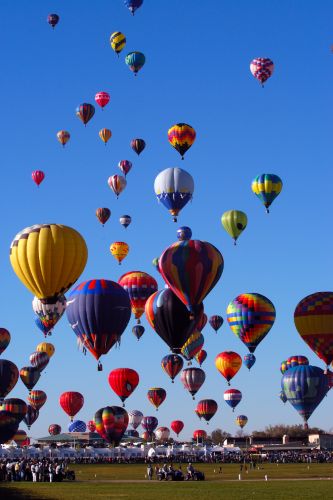
Modern hot air ballooning found its strongest identity not by competing with the airplane, but by refusing the airplane’s values. Airplanes made flight fast, directional, enclosed, scheduled, and increasingly ordinary. The balloon offered nearly the opposite: slowness, drift, openness, dependence on weather, and a heightened awareness of landscape. This made it poorly suited to mass transportation but unusually well suited to recreation and tourism. A balloon ride is not valuable because it delivers passengers efficiently from one place to another. It is valuable because it suspends them between departure and arrival, turning movement itself into the experience. The modern balloon’s appeal lies in this reversal. What had once been a technological limitation became a leisure virtue. Passengers board not to defeat distance, but to feel distance differently: to watch the ground recede, to hear the burner punctuate the quiet, to move with air rather than against it, and to surrender destination to weather, pilot judgment, and chance. In an age when commercial flight often hides the sky behind airports, security lines, pressurized cabins, and tight schedules, the hot air balloon restores flight to sensation. It makes ascent slow enough to be noticed.
Recreational ballooning developed around the idea that flight could be intimate rather than industrial. The balloon basket kept passengers close to the air, the pilot, and one another. There was no fuselage separating them completely from wind, sound, temperature, and height. The landscape below moved slowly enough to be contemplated rather than merely crossed. Fields, rivers, roads, neighborhoods, animals, and shadows became part of the journey. Modern balloon tourism revived one of the earliest emotional effects of 1783: the astonishment of seeing the earth from above without the violence of speed. Passengers did not need to become aviators in the technical sense. They could participate in ascent as witnesses, much as eighteenth-century crowds had participated from below.
The growth of balloon festivals gave that private experience a public form. Festivals transformed individual flights into mass spectacles of color, coordination, and community. The most famous example is the Albuquerque International Balloon Fiesta, which began in 1972 with a small gathering of balloons and grew into one of the world’s best-known ballooning events. Its success depended on more than numbers. Albuquerque offered a favorable combination of landscape, climate, local enthusiasm, open space, and the distinctive wind patterns often described by balloonists as the “Albuquerque Box,” in which pilots may use winds at different altitudes to change direction. The festival turned ballooning into a civic identity. Balloons were no longer occasional visitors to the sky; they became seasonal markers, tourist attractions, photographic icons, and symbols of place.
The visual power of balloon festivals is difficult to separate from their economic and social importance. A mass ascension fills the sky with a form of movement that is both ordered and unpredictable. Balloons rise together, yet each flight remains subject to wind and pilot judgment. Special-shape balloons add another layer of popular appeal, turning the sky into a moving pageant of animals, characters, objects, and corporate images. This does not reduce ballooning to mere advertising or decoration. It shows how thoroughly the balloon’s old gift for spectacle survived into the modern tourism economy. The eighteenth-century balloon appeared on fans, prints, ceramics, and medals; the modern balloon appears in postcards, broadcast images, social media feeds, travel campaigns, and regional branding. The medium changed, but the visual logic endured.
Tourism also changed the social meaning of the aeronaut. In the early balloon age, the aeronaut was a heroic experimenter or professional showman. In modern recreational ballooning, the pilot became a guide, instructor, safety manager, and interpreter of landscape. This did not eliminate risk or skill; it reframed them. Modern balloon pilots must read weather, manage burners, judge landing sites, coordinate crews, communicate with landowners, and comply with aviation regulations. Yet their authority is often exercised in a setting of leisure and celebration rather than military observation or scientific extremity. The pilot’s task is to make a technically complex act feel serene. The apparent gentleness of the flight depends on training, equipment, discipline, and judgment that passengers may only partly see.
The balloon festival also depends on labor that spectators often overlook. Behind the beauty of mass ascent are crews, chase vehicles, weather briefings, inspectors, volunteers, sponsors, local officials, emergency services, tourism boards, vendors, photographers, and land-use negotiations. A balloon may seem to float free of modern infrastructure, but the festival does not. It is a highly organized event built around a technology that appears delightfully unorganized once airborne. This contrast is part of the charm. The balloon symbolizes freedom because it drifts, but the festival succeeds because people plan, regulate, coordinate, and manage that drift. Modern balloon culture joins spontaneity to administration, wonder to logistics, and aerial romance to the practical needs of tourism. It also depends on the careful management of risk without destroying the impression of ease. Weather cancellations, launch windows, pilot briefings, crowd boundaries, propane handling, chase coordination, and emergency planning all remind organizers that ballooning remains subject to forces no festival can command. The public sees color and grace; the event staff sees wind limits, surface conditions, communication networks, insurance requirements, and the constant need to balance spectacle with safety. In that sense, the modern balloon festival is not a simple return to preindustrial wonder. It is a modern system designed to preserve the feeling of wonder.
Recreation and festival ballooning reveal why the hot air balloon survived its eclipse by more useful aircraft. It did not survive by becoming more like the airplane. It survived by preserving an older, slower, more vulnerable relationship to the air and making that relationship safe enough for ordinary people to experience. The balloon festival is not a nostalgic afterlife of aviation’s first machine. It is one of the balloon’s most successful modern forms. In festivals, tourist flights, competitions, and local celebrations, the hot air balloon continues to do what it has done since 1783: it makes ascent public, beautiful, shared, and emotionally legible. It reminds modern spectators that flight can still be an event rather than a commute.
The Return of the Heroic Aeronaut
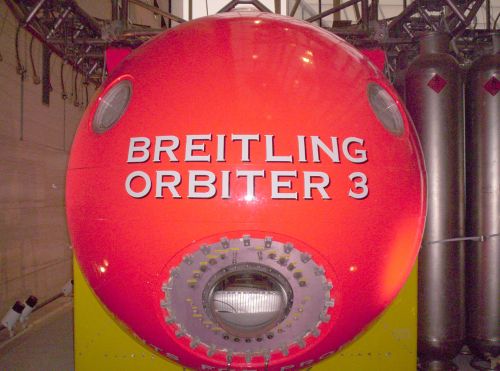
In the late twentieth century, balloons no longer stood at the center of transportation or military aviation, but they retained a powerful claim on endurance, altitude, and symbolic achievement. The very limitations that had once prevented balloons from becoming ordinary vehicles made them compelling record machines. They were slow, exposed, dependent on weather, and difficult to command with precision. A record flight seemed to test not only equipment but patience, judgment, meteorology, bodily endurance, and luck. Balloon records belonged to a different emotional world from jet speed records or rocket launches. They made the oldest form of human flight appear dangerous, difficult, and unfinished again.
Long-distance ballooning revived the romance of drift while surrounding it with modern constructs of control. The great endurance flights of the late twentieth century depended on satellite communication, weather modeling, pressurized capsules, advanced fabrics, fuel management, navigational computers, and international coordination. Yet they also depended on something recognizable from the eighteenth century: the search for favorable winds. Modern aeronauts did not defeat the atmosphere by brute force. They learned to enter large-scale wind systems, especially jet streams, and ride them across continents and oceans. This made record ballooning a paradoxical form of modern adventure. It was technologically sophisticated, but it still required surrender to atmospheric movement. The aeronaut did not so much conquer the wind as negotiate passage through it. That negotiation could be intensely strategic. Crews on the ground studied global weather patterns, tracked political boundaries, calculated fuel consumption, and advised pilots when to climb, descend, wait, or alter course. The balloon in the sky was connected to an invisible network of experts, computers, communications methods, and permissions. Even so, no amount of planning could remove contingency. A change in wind, a diplomatic denial of airspace, a fuel problem, a storm system, or a mechanical failure could end an attempt that had taken years to prepare. The drama of long-distance ballooning came from this uneasy balance between modern calculation and atmospheric humility.
The most famous example was the 1999 circumnavigation of the globe by Bertrand Piccard and Brian Jones in Breitling Orbiter 3. Their flight was often described in popular language as a ballooning triumph, but technically it depended on a Rozière design, combining a helium gas cell with a hot-air component. That hybrid form linked the flight to both branches of the balloon tradition: the hydrogen and helium lineage of long-duration gas flight and the hot-air lineage of controlled heating. Piccard and Jones launched from Château-d’Oex, Switzerland, on March 1, 1999, and completed the first non-stop balloon circumnavigation after nearly twenty days aloft, landing in Egypt after crossing the finish line over North Africa. The Fédération Aéronautique Internationale describes Breitling Orbiter 3 as the first balloon to circumnavigate the globe non-stop, with a flight of 19 days, 21 hours, and 55 minutes.
That flight mattered because it presented ballooning as one of aviation’s last great endurance challenges. By 1999, powered aircraft had crossed oceans, broken the sound barrier, carried passengers around the world, and reached the edge of space. Yet a non-stop balloon circumnavigation still remained elusive because it required an unusual combination of weather opportunity, fuel economy, crew endurance, diplomacy, and technical reliability. The gondola had to function as a miniature habitat, command center, and survival capsule. The crew had to manage sleep, oxygen, temperature, navigation, stress, and emergency decisions in a confined space for weeks. The record balloonist resembled not only the eighteenth-century aeronaut but also the polar explorer, submarine commander, and astronaut. Ballooning had returned to the frontier of human endurance by becoming a test of life-support systems and psychological resilience as much as lift. The achievement also depended on the discipline of waiting. Record ballooning was not only the visible flight itself but the long preparation before launch: choosing the right season, studying atmospheric circulation, designing systems light enough to fly but robust enough to survive, and assembling a team capable of supporting two people who would be isolated yet never truly alone. The public story centered on the gondola, but the flight’s success depended on the collaboration between airborne decision-making and ground-based expertise. That combination made the circumnavigation both heroic and collective, a personal feat made possible by a technological and logistical community.
Altitude records expressed the same return of heroic ballooning in vertical rather than horizontal form. High-altitude hot air balloon flights showed how far the modernized Montgolfier principle could be pushed when combined with enormous envelopes, specialized burners, oxygen systems, protective clothing, and careful meteorological planning. Vijaypat Singhania’s 2005 flight over Mumbai, reaching 21,027 meters, or 68,986 feet, demonstrated that the hot air balloon could still produce record-setting ascent more than two centuries after the Montgolfiers. Guinness World Records lists Singhania’s November 26, 2005, flight in a Cameron Z-1600 hot-air balloon as the highest flight by a hot air balloon. The achievement was not transportation in any ordinary sense. It was a controlled confrontation with altitude, cold, pressure, oxygen scarcity, and the technical limits of an aircraft type often associated with gentle leisure. Such flights remind us that “hot air balloon” can mean very different things depending on context. The same basic principle that carries tourists over vineyards or festival grounds can, when enlarged and engineered for extremes, carry a pilot into a zone closer to stratospheric exploration than recreation. The contrast is striking. At low altitude, the hot air balloon suggests calm, color, and pleasure; at record altitude, it becomes an apparatus of risk, calculation, and bodily vulnerability. The pilot’s experience is no longer primarily scenic. It is physiological and technical, shaped by oxygen supply, temperature management, communications, structural limits, and emergency planning. Altitude records restore a severity to hot air ballooning that modern tourism can obscure.
Records also reveal how ballooning repeatedly blurs the boundary between sport, science, spectacle, and self-fashioning. A record attempt must be verified, measured, sponsored, reported, and remembered. It depends on official bodies, manufacturers, media narratives, support crews, meteorologists, engineers, and sometimes corporate branding. Yet the public meaning of the record still concentrates on the aeronaut’s body in the air. The balloon itself may be a product of teams and systems, but the story often becomes personal: Piccard and Jones alone in the gondola, Singhania rising above Mumbai, earlier aeronauts facing cold and unconsciousness, later adventurers pursuing endurance at the edge of safety. Record ballooning is both modern and archaic. It depends on advanced technology, but it preserves the old drama of a human being lifted into a dangerous sky.
The return of the heroic aeronaut does not mean that ballooning escaped modernity. It means that ballooning found a modern use for its own anachronism. In an aviation world dominated by speed, automation, and networks, the record balloon remained compelling because it appeared fragile, slow, and contingent. Its achievements were impressive precisely because success could never be reduced to engine power alone. Records and endurance flights showed that the balloon’s history was not merely a closed chapter before the airplane. The balloon could still produce feats that seemed to belong simultaneously to Enlightenment spectacle, romantic exploration, high-altitude science, and modern media culture. Its old vulnerability became the source of its renewed heroism.
The Balloon as a Symbol of Freedom and Dreams
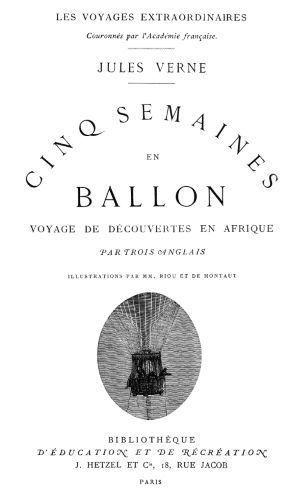
The hot air balloon has always meant more than its mechanics. Its physical principle is simple enough: heated air or lighter-than-air gas lifts an envelope, and a basket rises beneath it. But the emotional and symbolic power of the balloon comes from the way that simple motion appears to violate ordinary human limits. The balloon does not leap, roar, or cut through the air like later aircraft. It rises. That upward motion gives it a symbolic language older than aviation itself: elevation, release, escape, transcendence, ambition, and danger. To watch a balloon ascend is to see a visible separation from the earth, a moment when gravity seems not defeated by violence but gently negotiated. This is why balloons have remained powerful even after airplanes, jets, and rockets surpassed them in every practical measure. They still make ascent look wondrous.
The balloon’s symbolism is built on a contradiction. It suggests freedom, but it is never fully free. It leaves the ground, yet it depends on wind. It gives the passenger a godlike view, yet it exposes the body to weather, height, landing, and chance. It appears serene from below, but its operation requires fuel, judgment, crew, instruments, and discipline. This tension gives the balloon much of its cultural richness. It is a machine of liberation that constantly reminds observers of vulnerability. Unlike the airplane, which often symbolizes power, speed, mastery, and modern command, the balloon symbolizes a more delicate form of freedom. It rises by yielding to the atmosphere rather than conquering it. Its freedom is real, but conditional.
That conditional freedom made the balloon useful to writers and artists. From the eighteenth century onward, balloons appeared as signs of Enlightenment daring, comic vanity, technological optimism, and dangerous overreach. In satire, a balloon could mock inflated ambition or social pretension. In adventure literature, it could carry explorers across unknown landscapes. In children’s literature and fantasy, it could become a vehicle of escape from ordinary rules. Jules Verne’s Five Weeks in a Balloon turned aerostation into imperial adventure and geographical imagination, while later popular culture repeatedly used balloons to mark departure from the familiar world. Even when a balloon appears briefly, its meaning is usually immediate: someone is leaving the ground, and therefore leaving ordinary life.
The balloon also carries a powerful visual innocence. Its rounded form, bright colors, and slow movement make it seem gentle, even when its history contains fire, crashes, war, and record-setting danger. This innocence helps explain its modern use in tourism, festivals, advertising, children’s imagery, and celebrations. A balloon can symbolize joy without needing explanation. It belongs easily to birthdays, fairs, fairscapes, fantasy worlds, and civic spectacles. Yet this innocence is partly historical amnesia. The same object that now evokes leisure also once embodied scientific uncertainty, military reconnaissance, public risk, and fatal ambition. The modern festival balloon is cheerful because the technology has been domesticated, but its symbolic depth comes from the older drama still faintly attached to it: the human body rising into a space where it does not naturally belong. That double memory gives the balloon its unusual emotional flexibility. It can decorate a child’s room, advertise a tourist destination, appear in a fantasy story, or mark a civic celebration, while still carrying a trace of the sublime. The viewer may not consciously think of Rozier’s fatal crash, wartime observation balloons, or the dangerous ascents of nineteenth-century showmen, but the basic fact remains: a balloon is beautiful because it is vulnerable. Its lightness is inseparable from its exposure. It reassures because it rises gently, but it moves us because we know, even instinctively, that such gentleness depends on fragile fabric, heated air, human judgment, and favorable weather.
Balloons have often symbolized the desire to see differently. The aerial view changes the moral and emotional scale of the world. From a balloon, roads become lines, crowds become patterns, borders seem less natural, and familiar places become strange. This visual transformation has helped make ballooning a symbol of detachment as well as freedom. To rise is not only to escape the ground but to look back at it from a new perspective. That can be exhilarating, but it can also be unsettling. The balloon gives distance without total separation. The earth remains visible, recognizable, and close enough to return to. It offers transcendence with a tether of memory.
This is why the balloon has remained such an effective metaphor for modernity itself. Modern societies repeatedly imagine progress as ascent: rising standards, upward mobility, elevated knowledge, higher perspectives, technological advance. Yet modernity also produces anxieties about drift, inflation, instability, and collapse. The balloon contains both meanings. It can stand for invention and optimism, but also for speculation, illusion, and ideas cut loose from practical grounding. Its symbolic range depends on the fact that it is both successful and precarious. A balloon that rises beautifully may still be at the mercy of winds no one can see. That makes it an unusually honest emblem of technological ambition: it shows both the dream of control and the persistence of forces beyond control. In this respect, the balloon differs from many later machines of progress. The locomotive thunders along rails, the steamship powers through water, the airplane cuts a route through the air, and the rocket announces escape through force. The balloon’s movement is quieter and more ambiguous. It rises through human design but travels by currents it cannot command. That ambiguity made it useful for celebration and satire alike, because it could represent both genuine elevation and dangerous detachment. A society intoxicated by its own innovations could see in the balloon an image of triumph; a critic could see in the same image a warning against inflated confidence. Few machines have carried the language of both hope and folly so gracefully.
The balloon’s long symbolic life strengthens the larger argument. Hot air balloons mattered not only because they began human flight, nor only because they contributed to science, war, recreation, and records. They mattered because they gave modern culture one of its most enduring images of ascent. The balloon made the sky emotionally available. It turned upward motion into a public drama, a visual icon, a tourist experience, a military vantage point, a scientific platform, and a metaphor for hope. Its fragility is not incidental to that meaning. It is the reason the balloon continues to move the imagination. It rises, but never absolutely; it escapes, but never entirely; it dreams of freedom while carrying the evidence of dependence. That is why the balloon remains one of aviation’s most human machines.
Was the Hot Air Balloon a Technological Dead End?
The following video from “Rex’s Hangar” covers the history of hot air balloons:
The strongest challenge to any expansive history of the hot air balloon is that the machine may appear, in practical terms, to have been a technological dead end. It was the first successful aircraft, but it did not become the foundation of ordinary aerial transportation. It could rise but not steer reliably; it could inspire crowds but not build transport networks; it could carry passengers but not establish dependable routes. Within months of the Montgolfier flights, hydrogen balloons offered longer duration and greater altitude. Within a century, dirigibles promised controlled lighter-than-air navigation. In the early twentieth century, airplanes rapidly claimed the future of aviation because they could combine lift, propulsion, speed, and directional control in ways balloons could not. From this perspective, the hot air balloon’s fame may seem disproportionate to its practical legacy.
This objection is important because it pushes against the romance of “firsts.” Histories of technology often exaggerate the importance of the earliest successful device by treating it as the ancestor of everything that followed. The hot air balloon can suffer from exactly this problem. It did not lead in a simple line to the passenger airplane, the military bomber, the jetliner, or the spacecraft. Many of the later achievements associated with ballooning belonged more directly to gas balloons, Rozière hybrids, airships, radiosondes, high-altitude research balloons, and heavier-than-air aircraft. Even modern recreational hot air ballooning, revived through nylon envelopes and propane burners, did not prove that the original Montgolfier system had been waiting to become practical transportation. It proved almost the opposite: the hot air balloon became modern by accepting that its proper domain was leisure, spectacle, sport, and controlled experience rather than mass mobility.
The counterargument also reminds us that cultural importance should not be confused with technical dominance. Balloon mania, festival tourism, symbolic ascent, and heroic record flights all show that balloons mattered deeply to public imagination, but imagination is not the same thing as infrastructure. Railroads reorganized cities, labor, markets, timekeeping, and migration. Steamships reshaped oceans and empires. Airplanes transformed war, mail, travel, tourism, logistics, and global time-space relations. Hot air balloons did not do that. Their impact was intermittent, spectacular, and specialized. They produced moments of astonishment rather than durable systems of everyday dependence. A skeptical historian might argue that the balloon’s real history is not the opening chapter of modern aviation, but a brilliant episode in Enlightenment spectacle followed by a long afterlife in entertainment and symbolism.
Yet this critique modifies the argument more than it destroys it. The hot air balloon was indeed a poor candidate for ordinary transportation, and any serious interpretation must admit that limitation. But to call it a dead end assumes that the only meaningful technologies are those that become dominant infrastructure. That is too narrow. Technologies can matter because they reorganize perception, create new publics, generate scientific practices, alter military imagination, produce symbolic languages, or make later ambitions thinkable. The hot air balloon did all of these. Its failure to become the aerial railway does not erase its role in making the sky experimentally, publicly, and emotionally accessible. It changed what people believed the atmosphere could be: not merely weather above them, but a space that could be entered by bodies, instruments, armies, tourists, and dreamers.
The better conclusion is that the hot air balloon was a technological dead end only if judged by the standards of transport efficiency. Judged by the history of ascent, spectacle, atmospheric science, aerial vision, and the imagination of flight, it was anything but a dead end. Its limits were part of its significance. Because it could not master direction, it dramatized the difference between entering the air and controlling it. Because it could not become ordinary transportation, it preserved flight as an event. Because it remained fragile, weather-bound, and dependent on wind, it continued to symbolize a form of freedom that was real but never absolute. The hot air balloon did not define the future of aviation as infrastructure. It defined the first human encounter with the sky as a reachable world.
Conclusion: The Sky Made Human
The hot air balloon did not make flight ordinary, but it made flight human. Before the Montgolfiers, the sky belonged to birds, weather, gods, angels, imagination, and mathematical speculation. After 1783, it became a place into which living bodies could rise, look down, measure, fear, perform, and return. That transformation was not only technical. It was experiential and cultural. The first balloonists did not simply prove a principle of buoyancy; they changed the emotional geography of the world. The atmosphere was no longer only something above human life. It became a medium that could carry human beings, however briefly and imperfectly, beyond the surface of the earth.
The balloon’s history is best understood as a history of ascent rather than a history of transportation alone. Its failures are real and important. It could not reliably steer, follow routes, build schedules, or compete with railways, steamships, airships, and airplanes as a practical system of movement. But those limits clarify rather than diminish its importance. The balloon’s power lay in opening possibilities before those possibilities became systems. It gave science access to the upper air, armies a new vantage point, publics a spectacle of invention, tourists a gentle form of wonder, and record-seekers a stage for endurance. Its meaning repeatedly exceeded its utility because its most important cargo was not always passengers, instruments, or military observers. Often, it carried expectation.
Across more than two centuries, the hot air balloon has survived by changing what its limitations mean. In the eighteenth century, drift made it dangerous and astonishing. In nineteenth-century spectacle, danger made the aeronaut heroic. In scientific work, slow ascent made the atmosphere readable. In war, tethered height made the battlefield visible. In modern recreation, dependence on wind became part of the pleasure. In record flights, fragility became the basis of renewed heroism. The same qualities that kept balloons from becoming ordinary transportation allowed them to remain emotionally extraordinary. They remind us that not every important technology triumphs by becoming faster, stronger, larger, or more efficient. Some endure because they preserve an experience that later technologies obscure.
The sky made human was not immediately mastered, and perhaps that is why the balloon still matters. It represents the first successful human departure from the ground, but also the humility of that departure. A balloon rises through knowledge, craft, fuel, fabric, weather judgment, and courage, yet it never fully escapes dependence on the air that carries it. That is its beauty and its lesson. The Montgolfier balloon did not lead in a straight line to modern aviation, but it made the first decisive break in the old boundary between earth and sky. Every later aircraft inherited a world in which that boundary had already been crossed. The balloon was not the final answer to flight. It was the moment human beings first learned that the sky could be entered.
Bibliography
- Albuquerque International Balloon Fiesta. Official Program and Historical Materials. Albuquerque, NM: Albuquerque International Balloon Fiesta, various years.
- Anderson, Katharine. Predicting the Weather: Victorians and the Science of Meteorology. Chicago: University of Chicago Press, 2005.
- Bachelard, Gaston. Air and Dreams: An Essay on the Imagination of Movement. Translated by Edith R. Farrell and C. Frederick Farrell. Dallas: Dallas Institute Publications, 1988.
- Baum, L. Frank. The Wonderful Wizard of Oz. Chicago: George M. Hill, 1900.
- Blanchard, Jean-Pierre. Journal et détails de la première traversée de la Manche en ballon. London and Paris, 1785.
- Boyle, Robert. New Experiments Physico-Mechanical, Touching the Spring of the Air, and Its Effects. Oxford: H. Hall, 1660.
- Cavallo, Tiberius. The History and Practice of Aerostation. London: Printed for the Author, 1785.
- Cavendish, Henry. “Three Papers, Containing Experiments on Factitious Air.” Philosophical Transactions of the Royal Society of London 56 (1766), 141–184.
- Charles, Jacques Alexandre César, and Nicolas-Louis Robert. “Relation du voyage aérien de MM. Charles et Robert.” In Barthélemy Faujas de Saint-Fond, Description des expériences de la machine aérostatique de MM. de Montgolfier, et de celles auxquelles cette découverte a donné lieu. Paris: Cuchet, 1783–1784.
- Crouch, Tom D. The Eagle Aloft: Two Centuries of the Balloon in America. Washington, DC: Smithsonian Institution Press, 1983.
- de Syon, Guillaume. Zeppelin! Germany and the Airship, 1900–1939. Baltimore: Johns Hopkins University Press, 2002.
- Edgerton, David. The Shock of the Old: Technology and Global History since 1900. Oxford: Oxford University Press, 2006.
- Faujas de Saint-Fond, Barthélemy. Description des expériences de la machine aérostatique de MM. de Montgolfier, et de celles auxquelles cette découverte a donné lieu. Paris: Cuchet, 1783–1784.
- Federal Aviation Administration. Balloon Flying Handbook. FAA-H-8083-11B. Washington, DC: U.S. Department of Transportation, 2021.
- Fédération Aéronautique Internationale. “10 Year Anniversary of Breitling Orbiter 3.” World Air Sports Federation. Published March 2009.
- Fleming, James Rodger. Inventing Atmospheric Science: Bjerknes, Rossby, Wexler, and the Foundations of Modern Meteorology. Cambridge, MA: MIT Press, 2016.
- Futrell, Robert Frank. Ideas, Concepts, Doctrine: Basic Thinking in the United States Air Force, 1907–1960. Maxwell Air Force Base, AL: Air University Press, 1989.
- Gibbs-Smith, Charles Harvard. Aviation: An Historical Survey from Its Origins to the End of World War II. London: Her Majesty’s Stationery Office, 1970.
- Gillespie, Richard. “Ballooning in France and Britain, 1783-1786: Aerostation and Adventurism.” Isis 75:2 (1984), 248-268.
- Gillispie, Charles Coulston. Science and Polity in France at the End of the Old Regime. Princeton, NJ: Princeton University Press, 1980.
- Glaisher, James, Camille Flammarion, W. de Fonvielle, and Gaston Tissandier. Travels in the Air. Edited by James Glaisher. London: Richard Bentley, 1871.
- Golinski, Jan. Science as Public Culture: Chemistry and Enlightenment in Britain, 1760–1820. Cambridge: Cambridge University Press, 1992.
- Green, Charles, Robert Hollond, and Thomas Monck Mason. Aeronautica; or, Sketches Illustrative of the Theory and Practice of Aerostation. London: F. C. Westley, 1838.
- Guinness World Records. “Highest Flight by a Hot Air Balloon.” Guinness World Records.
- Hallion, Richard P. Taking Flight: Inventing the Aerial Age, from Antiquity through the First World War. New York: Oxford University Press, 2003.
- Harper, Kristine C. Weather by the Numbers: The Genesis of Modern Meteorology. Cambridge, MA: MIT Press, 2008.
- Haydon, F. Stansbury. Military Ballooning during the Early Civil War. Baltimore: Johns Hopkins University Press, 1941.
- Hess, Victor F. “Über Beobachtungen der durchdringenden Strahlung bei sieben Freiballonfahrten.” Physikalische Zeitschrift 13 (1912), 1084–1091.
- Holmes, Richard. The Age of Wonder: How the Romantic Generation Discovered the Beauty and Terror of Science. New York: Pantheon Books, 2008.
- Jones, Brian. Around the World in 20 Days: The Story of Our History-Making Balloon Flight. London: Hodder & Stoughton, 1999.
- Lana Terzi, Francesco. Prodromo, overo saggio di alcune inventioni nuove. Brescia: Rizzardi, 1670.
- Lowe, Thaddeus S. C. Memoirs of Thaddeus S. C. Lowe, Chief of the Aeronautic Corps of the Army of the United States during the Civil War. Manuscript, Library of Congress, Washington, DC.
- Lunardi, Vincent. An Account of the First Aërial Voyage in England. London: Printed for the Author, 1784.
- Lynn, Michael R. The Sublime Invention: Ballooning in Europe, 1783–1820. London: Pickering & Chatto, 2010.
- MacCannell, Dean. The Tourist: A New Theory of the Leisure Class. Berkeley: University of California Press, 1976.
- Marion, Fulgence. Wonderful Balloon Ascents; or, The Conquest of the Skies. Translated by F. C. Valentine. New York: Scribner, Armstrong, 1870.
- Mercier, Louis-Sébastien. Tableau de Paris. Amsterdam, 1783.
- Middleton, W. E. Knowles. Invention of the Meteorological Instruments. Baltimore: Johns Hopkins University Press, 1969.
- National Balloon Museum. History of Ballooning. Indianola, IA: National Balloon Museum.
- National Weather Service. “A Brief History of Upper-Air Observations.” National Oceanic and Atmospheric Administration. Accessed June 27, 2026.
- Nebeker, Frederik. Calculating the Weather: Meteorology in the 20th Century. San Diego: Academic Press, 1995.
- Nye, David E. American Technological Sublime. Cambridge, MA: MIT Press, 1994.
- Piccard, Bertrand, and Brian Jones. Around the World in 20 Days: The Story of Our History-Making Balloon Flight. London: Orion, 1999.
- Poe, Edgar Allan. “The Balloon-Hoax.” New York Sun, April 13, 1844.
- Pointon, Marcia. Hanging the Head: Portraiture and Social Formation in Eighteenth-Century England. New Haven, CT: Yale University Press, 1993.
- Priestley, Joseph. Experiments and Observations on Different Kinds of Air. London: J. Johnson, 1775.
- Robinson, Douglas H. Giants in the Sky: A History of the Rigid Airship. Seattle: University of Washington Press, 1973.
- Rolt, L. T. C. The Aeronauts: A History of Ballooning, 1783–1903. New York: Walker, 1966.
- Ryan, Craig. The Pre-Astronauts: Manned Ballooning on the Threshold of Space. Annapolis, MD: Naval Institute Press, 1995.
- Santos-Dumont, Alberto. My Air-Ships. New York: Century Co., 1904.
- Schivelbusch, Wolfgang. The Railway Journey: The Industrialization of Time and Space in the Nineteenth Century. Berkeley: University of California Press, 1986.
- Scott, Arthur F. “The Invention of the Balloon and the Birth of Modern Chemistry.” Scientific American 250:1 (1984), 126-137.
- Shapin, Steven, and Simon Schaffer. Leviathan and the Air-Pump: Hobbes, Boyle, and the Experimental Life. Princeton, NJ: Princeton University Press, 1985.
- Singer, Bayla. Like Sex with Gods: An Unorthodox History of Flying. College Station: Texas A&M University Press, 2003.
- Smith, Maurice H. “Travel By Air Before 1900.” The Princeton University Library Chronicle 27:3 (1966), 143-155.
- Smithsonian National Air and Space Museum. Breitling Orbiter 3 Gondola Collection Materials. Washington, DC: Smithsonian Institution.
- Squires, J. Duane. “Aeronautics in the Civil War.” The American Historical Review 42:4 (1937), 652-669.
- Stafford, Barbara Maria. Artful Science: Enlightenment Entertainment and the Eclipse of Visual Education. Cambridge, MA: MIT Press, 1994.
- Stewart, Larry. The Rise of Public Science: Rhetoric, Technology, and Natural Philosophy in Newtonian Britain, 1660–1750. Cambridge: Cambridge University Press, 1992.
- Thébaud-Sorger, Marie. L’aérostation au temps des Lumières. Rennes: Presses universitaires de Rennes, 2009.
- Tucker, Jennifer. Nature Exposed: Photography as Eyewitness in Victorian Science. Baltimore: Johns Hopkins University Press, 2005.
- United States War Department. The War of the Rebellion: A Compilation of the Official Records of the Union and Confederate Armies. 128 vols. Washington, DC: Government Printing Office, 1880–1901.
- Urry, John. The Tourist Gaze: Leisure and Travel in Contemporary Societies. London: Sage, 1990.
- Urry, John, and Jonas Larsen. The Tourist Gaze 3.0. 3rd ed. London: Sage, 2011.
- Verne, Jules. Five Weeks in a Balloon; or, Journeys and Discoveries in Africa by Three Englishmen. Translated by William Lackland. New York: D. Appleton, 1869.
- Wohl, Robert. A Passion for Wings: Aviation and the Western Imagination, 1908–1918. New Haven, CT: Yale University Press, 1994.
- Wright, Orville, and Wilbur Wright. The Papers of Wilbur and Orville Wright. Edited by Marvin W. McFarland. 2 vols. New York: McGraw-Hill, 1953.
Originally published by Brewminate, 07.03.2026, under the terms of a Creative Commons Attribution-NonCommercial-NoDerivatives 4.0 International license.
About the Author