From Halley’s mapped shadow in 1715 to the 1919 test of general relativity, total solar eclipses helped reveal the corona, solar chemistry, and the curvature of spacetime.

By Matthew A. McIntosh
Public Historian
Brewminate
Introduction: The Laboratory That Moved Across the Earth
On the morning of April 22, 1715, May 3 according to the Gregorian calendar not yet adopted in Britain, people across England waited for a darkness that Edmond Halley had already translated into geography. His engraved broadside traced the predicted passage of the Moon’s shadow across familiar counties, identified the expected limits of totality, and invited observers to compare the calculation with what actually occurred above them. Slightly more than two centuries later, on May 29, 1919, British astronomers stationed on Príncipe and at Sobral in Brazil attempted another conversion of transitory darkness into durable evidence. Their photographic plates were intended to record the apparent positions of stars near the eclipsed Sun and thereby test whether gravity deflected light by the amount predicted by Albert Einstein’s general theory of relativity. Halley’s map and the 1919 plates belonged to different scientific worlds, yet both were material answers to the same fundamental problem: how could investigators extract reliable knowledge from a celestial event that vanished almost as soon as it began?
A total solar eclipse presented modern science with an unusual inversion of the conventional observatory. Astronomers ordinarily constructed permanent institutions around instruments whose position, alignment, and local conditions could be measured repeatedly, but the path of totality followed no institutional geography. The Moon’s umbral shadow crossed a narrow and shifting corridor, remained over any chosen station for only minutes, and offered no immediate second attempt if an instrument failed or clouds intervened. Scientists had to carry the observatory to the phenomenon. Calculators predicted the track; cartographers rendered it legible; governments and scientific societies supplied money and authority; instrument makers built portable cameras, telescopes, spectroscopes, clocks, and coelostats; and railways, steamships, naval vessels, telegraphs, consular networks, colonial administrations, local officials, and hired laborers helped place those devices beneath the expected shadow. Once assembled, an expedition had to transform unfamiliar ground into a disciplined observing station, synchronize numerous tasks to the second, and preserve the resulting observations for measurement after the Sun returned. Years of calculation, negotiation, travel, construction, and rehearsal might culminate in less than five minutes of work. A passing cloud could still reduce the entire enterprise to an account of what its members had hoped to see.
What scientists sought within that darkness also changed. For Halley and his contemporaries, an eclipse offered a conspicuous test of astronomical calculation and an opportunity to refine knowledge of the Moon’s motion. During the nineteenth century, totality became a privileged opening through which astronomers investigated solar prominences, the corona, the chemical composition of the Sun, and the relationship between terrestrial and celestial physics. In 1919 the obscured Sun served a different experimental purpose: by making nearby stars photographically visible, the eclipse temporarily converted the sky into a test of gravitation and the geometry of spacetime.
Eclipses did not accomplish these transformations independently, nor did they deliver scientific truth in isolated moments of revelation. Halley did not invent eclipse mapping, nineteenth-century solar physics depended upon techniques developed outside totality, and Einstein completed general relativity before an eclipse furnished observational evidence for its prediction about light. The historical importance of eclipses lay instead in their power to concentrate developing theories, technologies, institutions, and human networks into exacting public trials. They compelled universal claims about nature to succeed under irreducibly local conditions: at a selected station, through a particular instrument, during a few unrepeatable minutes, amid weather and material uncertainty. The history that follows treats the eclipse as a catalyst rather than an autonomous cause, first as a shadow made calculable and mappable, then as the destination of increasingly global scientific expeditions, and finally as the setting for one of the most celebrated tests in modern physics. The laboratory moved because the shadow moved, and science changed through the difficult work of following it.
Halley’s Eclipse: Turning the Moon’s Shadow into a Public Map
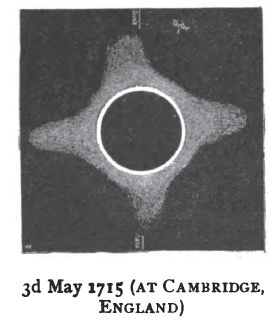
Edmond Halley’s 1715 broadside emerged from a developing European tradition of eclipse cartography rather than from nothing. Astronomers in France, the Dutch Republic, and the German lands had already experimented with projecting lunar shadows onto terrestrial maps, including maps produced for the eclipse of 1706. Halley himself possessed unusual experience in converting invisible natural variation into geographical form, having used curved lines to represent magnetic declination across his Atlantic and Indian Ocean charts at the beginning of the century. His achievement was neither the invention of eclipse mapping nor the simple application of an established convention. For the eclipse expected on April 22, 1715, he brought astronomical observation, lunar and solar tables, geometrical calculation, engraving, and commercial distribution together in a single public object. What distinguished his map was the combination of useful predictive accuracy, visual clarity, national geographical focus, and an explicit appeal to readers outside specialist astronomy. Rather than asking viewers to reconstruct the eclipse from abstract diagrams, Halley showed the Moon’s shadow approaching places they knew.
Engraved and sold by the mapmaker John Senex, with copies also available from the bookseller William Taylor, the sixpenny broadside presented England beneath a broad diagonal corridor of expected totality. Its lines marked the northern and southern limits of complete darkness, while an oval represented the approximate extent of the shadow near the middle of the eclipse at London. Halley explained that the shadow’s center would reach the Lizard shortly after nine in the morning and cross the kingdom in about eleven minutes, passing near Plymouth, Bristol, Gloucester, Daventry, Peterborough, and Boston. For London he supplied times for the beginning, middle, and end of the eclipse while candidly admitting uncertainty over whether the capital, situated near the predicted southern limit, would experience complete totality. The sheet converted a difficult celestial calculation into an immediately practical question: where did the observer stand in relation to the coming darkness?
The public character of Halley’s map was deliberately manufactured through the commercial machinery of early eighteenth-century print. Newspaper notices advertised the broadside before the eclipse, emphasized the rarity of the event, and informed provincial buyers that the map could be sent through the post for the same charge as a single letter. Senex used the occasion to promote not only Halley’s prediction but also globes, newer maps, astronomical books, and competing eclipse publications. The apparent issue of more than one edition suggests that the shadow had become both a scientific subject and a marketable commodity. At the same moment, William Whiston published a markedly more technical prediction based on John Flamsteed’s tables as corrected through Newtonian lunar theory. His broadside offered a geometrical construction viewed from the center of the Sun, supplied instructions for working with a pair of compasses, and advertised the “Copernicus,” a three-dimensional astronomical instrument that Whiston claimed produced superior results. Whiston shifted the predicted track approximately thirty miles north of Halley’s and concluded that London would probably fall just short of totality, making the broadsides participants in a visible contest over predictive authority. The contrast was not between science and mere popularization, since both productions joined calculation to commerce. Whiston displayed the machinery of computation, whereas Halley concealed much of that machinery behind a familiar national landscape. For purchasers who principally wanted to know what they would see and where they should stand, Halley’s geographical language made advanced astronomy portable, legible, and personally consequential.
The explanatory text surrounding the map also intervened in the unsettled politics of the new Hanoverian monarchy. George I had succeeded to the throne in 1714, and the following year brought disturbances, Jacobite anxiety, and ample material from which hostile interpreters might fashion a celestial warning. Halley described the eclipse as the necessary natural result of the motions of the Sun and Moon, explicitly seeking to prevent an uninformed population from treating the sudden darkness as an omen against the king and his government. By predicting both its time and its boundaries, he made the eclipse appear subject to mathematical order rather than political divination, although providential, astrological, and popular interpretations did not simply disappear because an astronomer had drawn lines across a map.
Halley also designed the broadside to gather information rather than merely distribute it. He asked “the Curious” throughout the kingdom to observe the eclipse carefully, especially the duration of total darkness, so that the position and dimensions of the shadow could be established more accurately. Such measurements, he hoped, would improve the prediction of later eclipses by supplying evidence unavailable from inherited tables alone. The map consequently functioned as an observing protocol and a recruitment instrument: it identified useful locations, told observers what to measure, and directed scattered attention toward a common astronomical problem. This participation was not socially unrestricted, since dependable timing required access to a pendulum clock as well as literacy, leisure, and the means to communicate a report. Nor did contributors possess equal authority, for Halley and the Royal Society retained the power to compare observations, judge their reliability, and incorporate them into astronomical calculation. Yet that asymmetry does not diminish the novelty of the arrangement. By placing a precise prediction before geographically dispersed readers, Halley exposed astronomical expertise to public comparison with the sky and turned a fleeting eclipse into a coordinated empirical trial before the shadow had even arrived.
After the Shadow Passed: The Eclipse of 1724
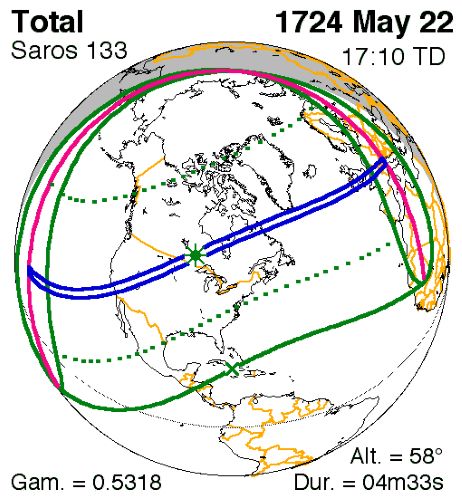
When the Moon began cutting into the Sun on April 22, 1715, Halley was waiting at the Royal Society’s house in Crane Court with an observing station prepared for the occasion. Under the Society’s orders, he had obtained a quadrant of nearly thirty inches’ radius fitted with telescopic sights, several additional telescopes, and a pendulum clock adjusted through observations of the Sun’s altitude. He recorded the eclipse beginning at approximately 8:06 in the morning, totality commencing at 9:09:03, sunlight returning at 9:12:26, and the final separation of Sun and Moon at 10:20. Totality at Crane Court lasted three minutes and twenty-three seconds. The abrupt extinction and return of sunlight made the central contacts easier to time than the gradual beginning and end of the partial phase. Halley’s report nevertheless extended well beyond numbers, describing a pearl-colored ring around the Moon, momentary flashes at its edge, a narrow streak of red light before the Sun reappeared, and the visibility of Jupiter, Mercury, Venus, Capella, and Aldebaran. He also recorded the chill, dampness, altered colors of the sky, and unease among people and animals, acknowledging that even disciplined observers could not watch the event without some sensation of horror. Clear weather held throughout the eclipse, only for clouds to cover the Sun soon afterward, a fortunate accident that allowed the carefully prepared London station to complete its work.
Crane Court was only one station within the observational network that Halley’s broadside had helped create. Reports arrived from James Pound at Wanstead, William Derham at Upminster, Roger Cotes at Cambridge, John Keill at Oxford, and numerous clergymen, officials, landowners, and other correspondents across the kingdom. Their evidence varied greatly in precision: observers at Barton in Northamptonshire and King’s Walden in Hertfordshire used good pendulum clocks to measure totalities of three minutes fifty-three seconds and three minutes fifty-two seconds, while reports of four minutes or more from several towns appeared to Halley suspiciously rounded, perhaps from readings taken with pocket minute-watches. Clouds prevented Keill from observing most of the Oxford eclipse, while the press of spectators around Cotes caused him to miss both the beginning of the eclipse and the beginning of totality. Distributed observation did not produce a collection of interchangeable facts; it produced testimony whose value depended upon instruments, calibration, weather, skill, local circumstances, and Halley’s judgment.
Reports from places near the limits of totality were valuable because they allowed Halley to reconstruct the shadow geographically. At Cranbrook in Kent, William Tempest reported that the Sun disappeared for only an instant before emerging again, placing the town almost exactly on the southern boundary. Observers at Wadhurst and Lewes experienced brief totality, whereas at Brightling a remnant of the Sun remained visible while the country to the north appeared enveloped in darkness. These accounts located the southern limit between Newhaven and Brighton before it crossed Kent near Cranbrook and passed just north of Canterbury. Evidence from Haverfordwest indicated that the northern boundary entered Wales through St. Bride’s Bay, while a totality of roughly one minute forty seconds at Shrewsbury helped trace it through Shropshire. Additional reports carried the line eastward past Cheshire, Derbyshire, and Yorkshire toward Flamborough Head. From observations nearer the middle of the track, Halley concluded that the shadow’s center had passed close to Plymouth, Exeter, Buckingham, and Huntingdon. No single correspondent had witnessed this national trajectory, and no observer could follow the umbra as it crossed the country in minutes. Halley produced the trajectory by converting scattered local statements (total here, partial there, darkness lasting so many seconds) into the boundaries and centerline of one moving geometrical figure.
The resulting post-eclipse broadside did not conceal the difference between prediction and event. Later comparisons indicate that portions of Halley’s original track were displaced by roughly twenty miles, while his estimate of the shadow’s width also required correction. He nevertheless emphasized that the adjustment was small, thanked the many observers whose communications made it possible, and redrew the passage of the shadow “as it really happened” according to the evidence he had assembled. By placing this reconstructed 1715 track beside a preliminary path for the eclipse expected in 1724, Halley made the sequence of prediction, observation, comparison, and renewed prediction visible on the same printed sheet.
The next eclipse, expected on May 11, 1724, according to the British calendar, allowed Halley to repeat the experiment from a position of greater institutional authority, for he had succeeded John Flamsteed as Astronomer Royal in 1720. In November 1723, John Senex reissued the combined map of the reconstructed 1715 shadow and the approaching 1724 track, revising its title and identifying Halley by his new office. Halley and Senex also produced a broader European map that followed the predicted shadow from western Ireland across southwestern England, France, Switzerland, northern Italy, and Venice. Halley associated the eclipse with the return of the shadow that had crossed continental Europe in 1706, arguing that observations of the earlier event gave grounds for confidence in the new prediction. He also widened the purpose of the observing campaign: properly timed eclipse contacts could help establish the longitude of observing places, while measurements at the edges of totality could refine the dimensions of the shadow and the underlying eclipse calculations. Once again, he asked observers near the predicted limits to count the vibrations of a pendulum clock during the few seconds in which the Sun disappeared. His map placed Dublin, Oxford, and London just beyond the northern edge, while including Cork, Kinsale, Plymouth, and Dartmouth within the shadow farther south. For London he predicted that the partial eclipse would begin at about 5:40 in the evening, become nearly total around 6:37, and end shortly before 7:30. What had begun in 1715 as a national request for reports was becoming an international program in which the map identified scientifically valuable stations before observers ever occupied them.
The 1724 eclipse exposed the continuing fragility of that program. Halley’s predicted band placed Reading and Windsor within totality, but the observed track lay approximately twenty-five miles away, leaving those locations with only a partial eclipse. James Logan of Philadelphia, then visiting England, traveled to Windsor and complained that the darkness Halley’s map had led him to expect never arrived; clouds further frustrated him and the many others who had moved westward from London. William Whiston’s competing track, drawn farther south, proved closer to the eclipse’s actual position in this part of England, although modern reconstruction places the true limits roughly between those predicted by the two men rather than vindicating Whiston without qualification. The accessibility that had made Halley’s maps effective also made their failures unusually conspicuous, because purchasers could compare printed boundaries with their own disappointed experience. Astronomical theory survived the mistake, but the reputation of a particular prediction could not be separated from the travelers, preparations, and expectations that prediction had set in motion.
The eclipses of 1715 and 1724 resist any simple account of calculation steadily conquering uncertainty. The first was a genuine achievement, but its empirical success depended upon favorable weather, unevenly distributed clocks, voluntary correspondence, and Halley’s power to select and interpret reports. The second demonstrated that correcting one eclipse did not eliminate uncertainties in lunar motion, the apparent dimensions of the Sun and Moon, or the geographical coordinates through which celestial calculation became a terrestrial path. Calling Halley’s correspondents “citizen scientists” risks imposing a modern identity upon participants whose social standing, equipment, knowledge, and authority differed markedly, and whose observations remained subject to metropolitan judgment. Yet their participation was indispensable, because the limits of a moving shadow could not be determined from Crane Court or Greenwich alone. Error became scientifically productive only when predictions were preserved, discrepancies reported, testimony evaluated, and revised results circulated in forms that could themselves be tested again. That recursive method (calculate, publish, mobilize, observe, compare, and correct) would outlast Halley’s inaccurate line across Windsor and eventually become the organizational foundation of the eclipse expedition.
In Pursuit of Totality: The Birth of the Eclipse Expedition
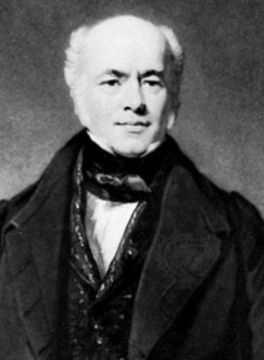
The eclipse expedition did not originate in a single journey or institutional decree. Halley’s campaigns of 1715 and 1724 had mobilized observers across a predicted shadow, but most participants remained at or near their ordinary places of residence and reported what passed above them. Eighteenth-century astronomers sometimes traveled to observe eclipses, while the international campaigns organized around the transits of Venus in 1761 and 1769 demonstrated how governments, academies, ships, instruments, and distant stations could be coordinated around a rare celestial event. By the early nineteenth century, improved lunar tables, national ephemerides, geographical surveys, marine chronometers, and more reliable maps allowed astronomers to choose observing sites with greater confidence. Expanding railway and steamship networks then made it increasingly practical to move people and delicate apparatus into the predicted path. These developments did not remove the risk of inaccurate boundaries, delayed transport, mechanical failure, or cloud, but they changed the scale on which those risks could be managed. The total eclipse of July 8, 1842, whose path crossed accessible regions of southern France and northern Italy, attracted astronomers from several European countries to stations selected specifically for totality. Rather than waiting for an eclipse to cross an established observatory, investigators temporarily reorganized their work around the geography of the Moon’s shadow. In this convergence of prediction, transport, instruments, and scientific purpose, the recognizable eclipse expedition began to emerge.
Francis Baily traveled to Pavia for the 1842 eclipse and produced an influential description of the brilliant corona and the immense rose-colored protuberances that appeared around the darkened Moon. George Biddell Airy observed from the Superga near Turin, while François Arago established a French station at Perpignan, allowing reports from widely separated locations to be compared after the event. The apparent persistence of the red prominences as the Moon moved across the Sun suggested that they were not irregularities on the lunar surface, yet observers continued to debate whether the prominences and corona belonged to the Sun, the Moon, or Earth’s atmosphere. Their inability to settle those questions transformed the next eclipse from another opportunity to witness a spectacle into a planned experiment directed at specific physical phenomena.
The total eclipse of July 28, 1851, carried this transition further because its track through Scandinavia and Prussia encouraged scientific societies to organize travel on a collective rather than predominantly individual basis. The Royal Astronomical Society formed a committee, circulated information, and helped prospective observers reach suitable stations, while British authorities assisted with transportation and the movement of instruments. Airy led a party to Gothenburg, and other astronomers dispersed through Sweden and Norway so that weather at one site would not necessarily defeat the entire British effort. Observers were instructed to record the corona’s form and extent, note the positions and colors of prominences, time the contacts, search for stars and possible intra-Mercurial planets, and describe changes in temperature and illumination. Each person could concentrate upon only a fraction of the event, making the expedition’s evidentiary product the combination of many deliberately differentiated observations. At Königsberg, Johann Julius Friedrich Berkowski obtained a daguerreotype that preserved the eclipsed Sun and part of its corona, demonstrating that a phenomenon previously dependent upon memory, sketches, and hurried description could be carried away from the shadow as a material record. Photography did not make visual testimony obsolete, for early plates had limited sensitivity, narrow fields, uncertain exposure times, and their own mechanical vulnerabilities. It did add another reason to transport specialized apparatus into the path and another kind of evidence that could be examined after totality. The reports from 1851 document more than a series of travelers looking upward; they reveal an emerging field operation in which stations, personnel, assigned tasks, instruments, and recording practices were coordinated before the eclipse began.
The eclipse of July 18, 1860, crossing northern Spain, marked a further maturation of this expeditionary form. Warren De la Rue carried the Kew photoheliograph to Rivabellosa, while Angelo Secchi established a photographic station at Desierto de las Palmas and other European parties occupied additional positions along the track. Images made from separated stations permitted investigators to compare the prominences with the changing position of the Moon and supplied powerful evidence that the prominences were solar rather than lunar or terrestrial phenomena. De la Rue’s party divided responsibility among photography, visual observation, timing, meteorology, and the handling of instruments, converting a few minutes of darkness into a sequence of rehearsed operations. The temporary station increasingly resembled a portable observatory constructed for one unrepeatable experiment and abandoned after it had served its purpose.
Coordination became the eclipse expedition’s defining technology. Astronomers first had to identify a station that lay safely inside the calculated limits while also offering favorable prospects for weather, transportation, accommodation, and an unobstructed horizon. Scientific societies and observatories then solicited government funds, negotiated leave for participants, borrowed instruments, purchased photographic chemicals, arranged insurance or protective cases, and secured permission to transport unusual cargo across borders. Railways and steamships shortened journeys, but telescopes, clocks, cameras, spectroscopes, batteries, chemicals, tents, timber, and provisions still had to arrive undamaged and in the correct order. At the destination, local officials, guides, interpreters, carpenters, laborers, military personnel, and property owners helped convert fields, courtyards, hilltops, and ruins into functioning observing stations. Instrument piers had to be stabilized, huts erected, sight lines cleared, clocks regulated, coordinates established, and optical equipment aligned under conditions unlike those of a permanent observatory. Teams rehearsed the sequence of totality repeatedly because no observer could pause the eclipse, reconsider an exposure, or ask the Moon to begin again. One participant might call out the remaining time while others removed caps, exposed plates, changed photographic holders, read thermometers, sketched the corona, counted seconds, or watched the solar limb through a spectroscope. Printed instructions and audible signals imposed order upon an event capable of overwhelming even experienced observers with its speed and unfamiliar appearance. Newspaper correspondents, amateur astronomers, wealthy patrons, local spectators, and early eclipse tourists gathered around the professional stations, making the expedition both a scientific operation and a public performance of disciplined attention. Nevertheless, all this organization remained subordinate to the weather: years of planning and a small fortune in apparatus could end with astronomers recording the brightness of the clouds.
The birth of the eclipse expedition was an organizational transformation rather than the sudden invention of scientific travel. Astronomers had long journeyed in search of observations, but the eclipse imposed an unusually severe combination of geographical restriction, temporal brevity, instrumental complexity, and complete dependence upon prediction. It encouraged scientific institutions to treat mobility, logistics, rehearsal, and redundancy as parts of observation itself rather than as merely preliminary arrangements. Authority became simultaneously more distributed and more concentrated: expeditions required numerous observers, assistants, officials, workers, and local intermediaries, yet metropolitan societies and senior astronomers retained control over which records were published and how conflicting testimony was evaluated. Between 1842 and 1860, totality changed from an occasion at which astronomers happened to witness strange solar phenomena into a purpose-built field laboratory for investigating them. The camera, and soon the spectroscope, gave investigators compelling new reasons to pursue the shadow across borders, seas, and empires, transforming the eclipse expedition into one of the characteristic enterprises of nineteenth-century astronomy.
The Camera Enters the Shadow: Photography and the Solar Atmosphere
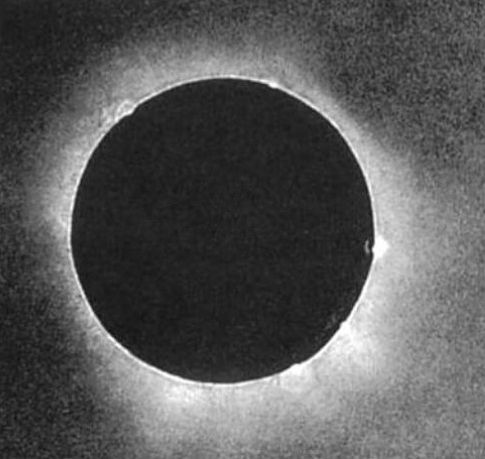
Before the camera entered the eclipse expedition, the nature of the phenomena surrounding the darkened Moon remained frustratingly uncertain. The rose-colored prominences appeared immense, sharply bounded, and sometimes flame-like, but observers disagreed over whether they projected from the Sun, rose from the Moon, or originated as optical effects within Earth’s atmosphere. The pale corona posed an even more difficult problem because its brightness, extent, symmetry, and streamers varied dramatically among visual reports and drawings. The Moon’s movement offered an important clue: if a prominence disappeared behind the advancing lunar limb and reappeared on the opposite side, it probably belonged to the Sun rather than the Moon. Yet totality passed too quickly for sustained comparison, while excitement, changing illumination, imperfect optics, and the eye’s adjustment to darkness influenced what each observer perceived. Photography promised to preserve the event after sunlight returned, replacing disputed recollection with an image that could be measured and compared. That promise was powerful, but it did not make the photograph an automatic or neutral witness.
The first successful attempt came during the total solar eclipse of July 28, 1851, at the Royal Observatory in Königsberg. Acting upon arrangements made by observatory director August Ludwig Busch, the local daguerreotypist Johann Julius Friedrich Berkowski attached a small refracting telescope to the clock-driven Fraunhofer heliometer. The refractor had an aperture of approximately six centimeters, while the heliometer’s mounting kept the instrument directed toward the moving Sun. Immediately after totality began, Berkowski exposed a sensitized plate for eighty-four seconds. The developed daguerreotype showed the Moon as a dark disk surrounded by part of the inner corona, with several prominences visible along the solar limb. A second, shorter exposure was spoiled when direct sunlight returned before it was completed, emphasizing how narrow the margin for success remained. Berkowski’s surviving image was the first properly exposed and scientifically useful photograph of a total solar eclipse, but the daguerreotype process produced a single direct-positive plate rather than a reproducible negative. The original eventually disappeared, leaving second-generation daguerreotypes, photographic copies, and an enlarged engraving to mediate its appearance. More importantly, one long exposure from one station could not record the motion of individual structures or supply the comparative views required to determine their location conclusively. Berkowski had demonstrated that the eclipsed Sun could be photographed, but turning that achievement into a controlled investigation required different photographic technology.
During the nine years separating the eclipses of 1851 and 1860, the wet-collodion process transformed the scientific possibilities of celestial photography. Glass negatives could preserve sharper detail, required shorter exposures than daguerreotypes, and permitted the production of multiple positive prints. Warren De la Rue applied the process first to the Moon and then to the Sun, designing the Kew photoheliograph to produce regularly scaled solar images suitable for measurement. A visit to Königsberg in 1858 allowed him to examine Berkowski’s eclipse image directly and sharpened his determination to photograph the next accessible total eclipse. By 1860, photography had consequently become a principal research program rather than an incidental attempt to secure a celestial souvenir.
De la Rue carried the Kew photoheliograph to Rivabellosa in northern Spain for the eclipse of July 18, 1860. The instrument enlarged the solar image to nearly four inches and photographed reference wires along with the Sun, providing an orientation system through which the resulting plates could later be measured. Its apparent mechanical precision concealed an elaborate chain of manual operations. Each glass plate had to be cleaned, coated with collodion, sensitized, loaded, exposed, developed, washed, and fixed before the chemical layer dried. The expedition transported not merely a telescope and camera but an entire temporary photographic laboratory, together with chemicals, water, plate holders, protective cases, a darkroom, an observing hut, and a team of assistants. De la Rue and his collaborators rehearsed the division of labor so that one person could regulate the instrument, another prepare plates, another record times, and others exchange holders or call out the remaining seconds of totality. Clouds threatened the program on the morning of the eclipse, but the sky cleared sufficiently for the team to obtain more than forty photographs of its partial and total phases. Only two plates were exposed during totality, one requiring approximately a minute to gather enough light. They recorded the prominences with a sharpness of contour and position unavailable in hurried sketches, although the much fainter outer corona remained poorly represented. The photographs taken before and after totality also preserved the changing relationship between the lunar limb and the solar surface, allowing the eclipse to be reconstructed as a sequence rather than remembered as a single overwhelming spectacle. After the expedition, negatives could be enlarged, converted into positive prints, measured through microscopes, compared with other observations, and translated into engravings for publication. The apparent objectivity of the final image depended upon instruments, chemicals, timing, practiced hands, and later acts of measurement and reproduction.
A second photographic program at Desierto de las Palmas, approximately five hundred kilometers from Rivabellosa, made the comparative experiment possible. Angelo Secchi joined the Spanish expedition organized under Antonio Aguilar, proposed and supervised much of its photographic work, and supplied the Cauchoix refractor with which the images were made. Later accounts commonly credited the resulting photographs to Secchi alone, but contemporary evidence identifies the Valencian chemist and experimentalist José Monserrat y Riutort as the person who performed the photographic exposures. The party obtained fourteen photographs during the partial phases and attempted five during totality, discarding one of the latter because of its poor quality. The four usable totality plates employed exposures ranging from approximately six to thirty seconds. Their corona was faint and their detail inferior to that produced by the Kew photoheliograph, yet they preserved the number, location, and shapes of the principal prominences well enough for comparison. The collaboration among Aguilar, Secchi, Monserrat, instrument makers, assistants, and local support personnel reveals why assigning a scientific photograph to one celebrated astronomer can obscure the distributed labor embodied in the plate.
Comparison between the Rivabellosa and Desierto photographs strengthened the conclusion that the prominences were genuine solar structures. Despite the distance separating the stations and the different positions of the Moon against the Sun, the principal forms appeared in corresponding locations relative to the solar disk. Successive photographs also showed the lunar limb covering some prominences and revealing others, just as the topographical or solar interpretation predicted. The evidence was strongest for the bright prominences; the plates captured too little of the faint outer corona to settle its structure, extent, or physical constitution with comparable authority. Nor did photography remove interpretation from eclipse science, since exposure time determined which layers became visible, imperfect focus softened boundaries, optical distortion altered scale, tracking errors blurred forms, chemical development changed contrast, and engravings could simplify what the negative contained. Investigators still had to decide which plates were reliable, how images from different instruments should be aligned, and whether an apparent feature belonged to the Sun or to the photographic process. What changed was the duration and location of that interpretive work. A phenomenon visible for seconds in Spain could now be inspected repeatedly in London, Rome, Madrid, and Paris, measured by people who had never stood beneath the shadow, and reconsidered long after the expedition ended. Photography did not allow the Sun to speak without mediation, but it converted its fleeting atmosphere into a durable scientific object. Once the prominences and corona could be treated as physical regions rather than evanescent eclipse effects, the next question was no longer simply where they belonged, but what their light could reveal about the constitution of the Sun.
Reading the Sun by Its Light
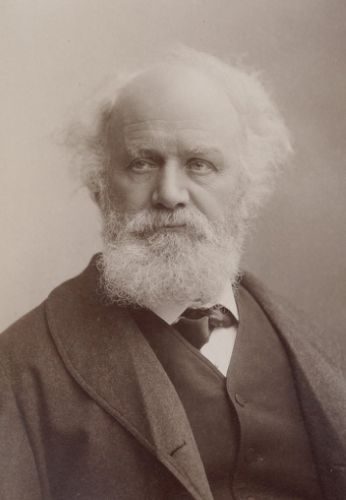
Photography could preserve the appearance of the eclipsed Sun, but spectroscopy promised something more radical: the identification of its physical constituents. Joseph von Fraunhofer had mapped hundreds of dark lines crossing the solar spectrum without fully explaining their origin. In 1859 and 1860, Gustav Kirchhoff and Robert Bunsen demonstrated that chemical elements produced characteristic patterns of bright and dark spectral lines. A glowing, rarefied vapor emitted bright lines at the same wavelengths that a cooler layer of the vapor absorbed from light passing through it. Comparing solar lines with spectra produced by terrestrial substances allowed investigators to infer the presence of sodium, iron, calcium, hydrogen, and other elements in the Sun. Astronomy was no longer confined to measuring where and when celestial bodies moved; it could ask what they were made of and under what physical conditions they emitted light. During an eclipse, the Moon temporarily suppressed the overwhelming continuous spectrum of the photosphere and allowed the fainter light of the prominences, chromosphere, and corona to be separated into its constituent wavelengths.
The total solar eclipse of August 18, 1868, carried this new method across southern India and toward Siam, drawing scientific parties to stations selected for an unusually long period of totality. Colonial officials facilitated transportation, communications, equipment, and access, while Indian assistants, observatory employees, servants, and laborers helped convert the predicted track into a functioning chain of observing sites. At Guntur in the Madras Presidency, the French astronomer Jules Janssen directed a spectroscope toward the brilliant red prominences exposed around the Moon. During more than six minutes of darkness, he observed bright emission lines rather than the continuous spectrum expected from an incandescent solid or liquid. Several corresponded to hydrogen, demonstrating that the prominences were immense masses of glowing gas associated with the Sun. A conspicuous yellow line also appeared near the familiar sodium lines designated D, although its precise identity was not settled during totality. Other observers in India, including Captain C. T. Haig, Lieutenant John Herschel at Jamkhandi, and Norman Robert Pogson at Masulipatam, recorded yellow or orange emission near the same region of the spectrum. Their instruments differed in dispersion, calibration, and resolving power, and some observers believed that the line coincided with sodium while others cautiously described it as merely close to D. Janssen’s first report to the French Academy emphasized the gaseous prominences and the method of observing them after the eclipse rather than announcing the discovery of an unknown element. The familiar statement that Janssen simply “discovered helium” during totality compresses a distributed and initially ambiguous set of observations into a single retrospective moment.
Janssen’s most immediate achievement was recognizing that the eclipse itself need not remain indispensable for observing prominences. By placing the spectroscope’s narrow slit along the solar limb and using sufficient dispersion, he could spread the photosphere’s brilliant continuous light into a faint background while the prominence emission remained concentrated in bright lines. During the days following the eclipse, he successfully observed prominences in ordinary daylight and tracked changes that no brief totality could reveal. Norman Lockyer had independently been pursuing the same method in England and obtained a clear daylight prominence spectrum on October 20, 1868. Communications from Janssen and Lockyer were presented at the same meeting of the French Academy on October 26, giving both men recognition for transforming an eclipse observation into a repeatable solar technique. The spectroscope had effectively created a controlled, narrow-band eclipse that could be reproduced whenever the Sun was visible.
Lockyer’s higher-dispersion observations made the yellow line consequential. It lay close to the sodium doublet but did not coincide with either of its components, and it was consequently designated D3. Its failure to match a known terrestrial spectrum did not automatically prove that it belonged to a new element, because nineteenth-century investigators did not yet know how temperature, pressure, ionization, or molecular dissociation might alter familiar spectra. Lockyer collaborated with the chemist Edward Frankland and considered whether the line could represent hydrogen under unusual solar conditions. No laboratory experiment produced a satisfactory terrestrial counterpart. In his 1871 presidential address to the British Association, William Thomson reported that Frankland and Lockyer proposed calling the hypothetical substance “helium,” from the Greek hēlios, meaning Sun. This appears to have been the name’s first published use, several years after the eclipse that later accounts identified as helium’s discovery. Janssen and Lockyer conventionally share credit because their independent work established the prominence spectrum and brought attention to the anomalous yellow line, but neither possessed a sample, an atomic weight, or chemical reactions through which the proposed substance could be defined. The episode demonstrates that discovery may refer to several different acts: seeing an unexplained line, distinguishing it from known lines, interpreting it as a new substance, naming that substance, and finally isolating it as matter.
For more than two decades, helium remained principally a solar hypothesis embodied in a yellow mark. In 1895 William Ramsay released an unfamiliar gas from cleveite, a uranium-bearing mineral, and William Crookes found that its spectrum contained the solar D3 line. Per Teodor Cleve and Abraham Langlet soon obtained the gas independently in Sweden and helped determine its atomic weight, establishing helium as a terrestrial chemical element rather than an exclusively solar substance. Only then did the eclipse line, the proposed name, and an isolable gas become securely joined, completing a discovery that had begun twenty-seven years earlier without making its intervening uncertainties disappear.
The eventual confirmation of helium made another unknown solar line appear more plausibly elemental. During the North American eclipse of August 7, 1869, Charles Augustus Young observed from Burlington, Iowa, with a five-prism spectroscope, while William Harkness used a modified single-prism chemical instrument at Des Moines. Working independently, both detected a bright green emission line belonging to the corona rather than to the lower prominences. Young initially placed it near 1474 on Kirchhoff’s spectral scale, a position associated with iron, but the presence of ordinary iron vapor so high above the photosphere appeared physically improbable. Later measurements fixed the principal line near 5303 angstroms without identifying a convincing counterpart in any laboratory spectrum. The green emission also appeared against a continuous coronal spectrum, indicating that the corona could not be explained as one simple layer composed of one emitting substance. Nevertheless, the line’s visibility beyond the prominences supplied powerful evidence that at least part of the corona was a genuinely solar, self-luminous gas rather than an optical effect produced by Earth’s atmosphere or the Moon. In 1887 Anton Grünwald introduced the name “coronium” for the hypothetical source of the unexplained coronal lines. Once terrestrial helium had been confirmed, the reasoning behind coronium appeared stronger: spectroscopy had already revealed one solar element before chemistry found it on Earth, so it might reasonably have done so again. Some theorists attempted to place coronium among elements lighter than hydrogen, while successive eclipse expeditions sought sharper spectra, more precise wavelengths, and additional lines through which its supposed properties could be reconstructed. A fleeting green line generated a research problem that survived long after the eclipse that revealed it.
Solving that problem required twentieth-century atomic physics rather than the discovery of another element. In 1939 Walter Grotrian recognized that laboratory measurements of highly ionized atoms offered promising matches for several coronal lines, and Bengt Edlén developed the interpretation comprehensively in 1941. The green line at 5303 angstroms proved to arise from Fe XIV, ordinary iron stripped of thirteen of its twenty-six electrons, while other mysterious coronal lines came from highly ionized iron, nickel, calcium, and related elements. These were “forbidden” transitions that occurred only rarely under ordinary laboratory conditions but could radiate effectively in the extremely thin coronal plasma, where collisions were too infrequent to interrupt long-lived excited states. Producing such extreme ionization required temperatures on the order of a million degrees, revealing that the corona was vastly hotter than the visible solar surface beneath it. Coronium consequently disappeared from the periodic table, but its disappearance created the deeper problem of explaining how the outer solar atmosphere attained and maintained such extraordinary temperatures. Its long career was not evidence that spectroscopy had failed; it showed that a spectral line identified a physical process, not necessarily a unique new element. Helium and coronium emerged from the same interpretive method, yet one became matter that could be captured in a laboratory while the other dissolved into an unfamiliar state of common matter. By reading the Sun through its light, eclipse observers had moved beyond depicting the solar atmosphere and begun uncovering conditions that no human eye could directly see.
The Global Eclipse
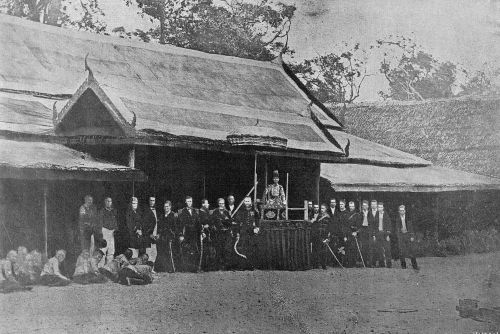
Spectroscopy made distant eclipses newly valuable at precisely the moment when imperial expansion made distant totality more accessible to European and American astronomers. A total eclipse’s path remained indifferent to political borders, but reaching that path required entry into territories governed, surveyed, and connected by human institutions. By the late nineteenth century, an expedition’s effective apparatus extended far beyond its telescope, camera, and spectroscope. Naval hydrographic surveys supplied coastal charts, government survey departments fixed coordinates, and meteorological offices advised organizers about seasonal weather. Steamship companies carried observers and tons of boxed equipment, while colonial railways transported fragile instruments from ports to stations deep inland. Telegraph systems transmitted revised predictions, confirmed shipping arrangements, and carried preliminary results back toward metropolitan newspapers and scientific societies. Consuls negotiated with host governments, customs officers admitted unusual chemicals and machinery, and military authorities supplied ships, tents, carpenters, signalmen, and disciplined crews. Colonial administrators secured buildings, identified possible observing grounds, arranged police protection, and found workers able to transform a fort, plantation, or open field into a temporary observatory. These systems were not merely conveniences surrounding an otherwise self-contained experiment; they were components of the experiment’s material possibility. When metropolitan astronomers described themselves as pursuing the Moon’s shadow into remote regions, they often concealed how completely their mobility depended upon routes, knowledge, and authority already established for trade, warfare, taxation, surveying, and administration. The “global eclipse” was both a celestial event and an earthly network whose reach reflected the unequal distribution of power.
Yet imperial pressure did not turn every host into a passive provider of territory. When the eclipse of August 18, 1868, crossed Siam, King Mongkut established his court near Wako and invited both a French scientific commission and Sir Harry Ord, the British governor of the Straits Settlements, to witness it. The French party approached through colonial Cochinchina, and its preliminary coastal survey by gunboat understandably troubled a monarch who had watched France impose its protection upon neighboring Cambodia only five years earlier. Mongkut nevertheless supplied accommodations and observing facilities, assembled his own court and instruments, and ensured that British as well as French naval power was visibly represented near the royal camp. His announced location and timing proved impressively accurate, reflecting his use of Siamese, Indian, and European astronomical knowledge rather than simple dependence upon foreign experts. French accounts frequently treated his learning with condescension, yet the king used the eclipse to display command over his territory, challenge court astrologers, introduce his heir to foreign dignitaries, and present Siam as a state capable of engaging modern science without surrendering its sovereignty. What appeared from Paris as an expedition to a scientifically useful beach appeared from Bangkok as a carefully managed exercise in diplomacy.
British India exposed more directly how eclipse science could ride upon the institutions of colonial rule while still depending upon Indian expertise. During the 1868 eclipse, the Royal Astronomical Society supported Major James Francis Tennant’s party at Guntur, while the Madras Observatory distributed observers among several stations across the path. One of those observers, Chinthamani Ragoonatha Chary, commanded a party at Vanpurthy rather than serving merely as an anonymous assistant to a European astronomer. Chary had entered the Madras Observatory in a low-ranking position and risen through sustained mathematical and observational work to become its first assistant. Before the eclipse of December 1871, he published calculations of its circumstances in the Monthly Notices of the Royal Astronomical Society and subsequently participated in observations at Avanashi; in 1872 he became the first Indian elected a fellow of the Society. His career complicates any narrative in which modern eclipse astronomy simply traveled from Europe to India fully formed. The British expedition directed by Norman Lockyer in 1871 nevertheless enjoyed advantages that made the colonial structure unmistakable: a government grant of £2,000, reduced fares from the Peninsular and Oriental Steam Navigation Company, access to military sites, and assistance from officials throughout the journey. At Bekal Fort, Lockyer’s instruments occupied a structure built for territorial defense, while local authorities helped maintain the conditions he required for observing. He later described inhabitants preparing a bonfire below the fort, interpreted it as an attempt to restore the darkening Sun, and obtained police intervention before its smoke could obstruct his spectroscope. In popular retellings, the episode became a neat confrontation between scientific reason and local superstition. Read within its colonial setting, it also demonstrates whose understanding of the eclipse could summon armed authority to suppress another community’s actions and clear the sky for metropolitan science.
Permission could be as essential to an expedition as optical glass. Foreign ministries, consulates, naval commands, princely courts, and colonial offices determined who could land instruments, occupy a fort, employ workers, cross restricted territory, or communicate quickly with distant institutions. Rival nations exchanged predictions and compared photographs while also competing for the sharpest spectrum, the most disciplined camp, and the greatest public prestige. For several weeks, an eclipse station could function simultaneously as an observatory, an embassy, and a stage upon which governments performed scientific modernity.
The total eclipse of January 22, 1898, displayed this global organization at unprecedented scale across India. Parties associated with the Royal Observatory at Greenwich, the Solar Physics Observatory, the British Astronomical Association, the Lick and Chabot observatories in California, Indian institutions, missionary colleges, and other organizations occupied separate stations along the calculated track. Government maps and railway schedules allowed organizers to distribute these groups so that one cloud bank would not defeat every program, while officials coordinated sites, transportation, customs arrangements, and supplies. At Viziadrug, now Vijaydurg, Norman Lockyer converted another coastal fort into an elaborate observing camp with assistance from the officers and sailors of HMS Melpomene. Naval personnel erected structures, aligned instruments, rehearsed timed operations, and staffed devices requiring several people to expose plates, call seconds, adjust mechanisms, and record observations during totality. This concentration of British and American institutions did not exhaust the eclipse’s scientific geography. At Jeur, Kavasji Dadabhai Naegamvala directed an independently organized Indian program associated with the Maharaja Takhtasingji Observatory, using a horizontal photographic telescope and spectroscopic equipment to obtain an important record of the flash spectrum. His extensive report, published in 1902, demonstrated that Indian astronomers were not simply supplying local knowledge to visiting investigators but designing instruments, directing teams, interpreting spectra, and entering international disputes over solar physics. Naegamvala’s observatory itself had emerged through princely patronage and Indian fundraising, revealing networks of scientific support that cannot be reduced to the colonial government. Yet the limits of recognition remained visible: although Lockyer considered Naegamvala the strongest candidate to direct the new Kodaikanal Solar Observatory, the position went to the British physicist Charles Michie Smith. The eclipse brought scientific communities into contact, but it did not place them on equal institutional ground.
Behind every named expedition stood a much larger workforce whose presence diminished as observations were converted into published results. Sailors unloaded crates, surveyors fixed coordinates, carpenters constructed huts and camera towers, porters carried equipment, cooks provisioned camps, interpreters negotiated with residents, and servants supplied the water upon which wet chemistry and daily life depended. Official reports sometimes acknowledged the “officers and men” of a naval vessel, yet lower-ranking participants usually appeared collectively, while Indian workers were often compressed into categories such as “servants,” “assistants,” or “natives,” if they appeared at all. Their anonymity should not be confused with unskilled labor, since a tilted pier, late signal, contaminated plate, misplaced cable, or delayed supply cart could destroy work prepared over several years. Gender produced another form of disappearance. During the Lick Observatory’s 1898 Indian expedition, Elizabeth Campbell managed correspondence, provisions, relations with local authorities, and the hiring and supervision of servants, thereby maintaining the camp in which her husband William Wallace Campbell conducted the publicly recognized astronomical program. The hierarchy of credit separated “scientific” observation from the logistical, domestic, and manual work that made observation possible, even though totality itself respected no such distinction.
To describe nineteenth-century eclipse science as imperial is not to claim that every observation was propaganda or that its physical conclusions were invalid. A spectral line did not become less real because a naval vessel carried the spectroscope, and photographs from separated stations could provide genuine evidence about the solar atmosphere. Nor were all host societies passive or all non-European participants invisible: Mongkut manipulated diplomatic rivalry, Chary commanded an observing party, and Naegamvala constructed an astrophysical program with ambitions of its own. The more precise conclusion is that imperial systems distributed opportunity unevenly, allowing some investigators to cross oceans, requisition transport, occupy commanding sites, mobilize police, and carry evidence home with extraordinary ease. Published reports then rearranged the collaboration once more, placing eminent astronomers at the center while reducing sailors, women, colonial employees, artisans, interpreters, and local workers to the margins. “Global” consequently described the reach of eclipse science more accurately than it described equality within its community. By the beginning of the twentieth century, the scientific instrument had expanded into a network encompassing the camera, ship, railway, cable, government office, temporary camp, and human body trained to act at a shouted signal. The expeditions of 1919 would inherit this entire structure when British astronomers traveled to Brazil and the Portuguese island of Príncipe to test whether the Sun could bend starlight. The Moon’s shadow briefly equalized daylight, but it did not equalize authority beneath it.
From Newton’s Universe to Einstein’s: Why an Eclipse Could Test Gravity

At the opening of the twentieth century, Newtonian gravity was not a decaying relic awaiting replacement but one of the most successful intellectual structures ever constructed. Newton’s Principia had united falling bodies, planetary orbits, tides, comets, and the shape of Earth beneath one inverse-square law. Later astronomers used that framework to calculate perturbations among the planets, predict the return of Halley’s comet, and infer Neptune’s existence from irregularities in the motion of Uranus. Even Mercury’s orbit largely obeyed Newtonian calculation, although its perihelion advanced approximately forty-three arcseconds per century more than the known planetary influences could explain. Astronomers attempted to preserve the existing system by proposing an unseen planet called Vulcan, rings of matter near the Sun, errors in the solar shape, or slight modifications to the force law. None provided a persuasive and enduring solution, yet one stubborn anomaly did not erase two centuries of accomplishment. Newton’s universe remained compelling because it made nature mathematically predictable, not because every feature had been explained. A successful rival would have to reproduce that precision while revealing why gravity behaved differently under conditions where Newton’s assumptions ceased to be adequate.
Light occupied an uncertain position within this otherwise ordered universe. Newton had suggested in Opticks that bodies might act upon light at a distance and bend its rays, although he did not calculate the deflection of starlight passing the Sun. Johann Georg Soldner performed such a calculation in a study written in 1801 and printed in the Berliner Astronomisches Jahrbuch for 1804, treating light as rapidly moving particles subject to Newtonian attraction. His result became associated with a solar-limb deflection of approximately 0.84 arcsecond. During the nineteenth century, the triumph of wave optics weakened the assumption that light consisted of material corpuscles upon which gravity acted like an ordinary force. The so-called Newtonian value invoked in later eclipse debates was consequently a retrospective reconstruction rather than a standard prediction that generations of astronomers had been actively attempting to measure.
Einstein approached the problem from a different conflict within classical physics. His special theory of relativity, published in 1905, made the measured speed of light constant for inertial observers and rejected absolute space and time, while Newtonian gravitation appeared to transmit attraction instantaneously across distance. In 1907 Einstein introduced the principle of equivalence as a first route toward reconciling gravity with relativity. An observer enclosed within a small laboratory could not distinguish locally between a uniform gravitational field and the effects of constant acceleration. If a beam of light crossed an upward-accelerating chamber, its path would appear to curve downward relative to the chamber; by equivalence, light should likewise bend in a gravitational field. Einstein developed this reasoning in 1911 and also concluded that gravity should alter clock rates and shift the frequencies of emitted light. For a ray grazing the Sun, he calculated a deflection of approximately 0.83 arcsecond, essentially the value obtainable from a corpuscular application of Newtonian mechanics. Because rays bent toward the Sun would appear to arrive from positions slightly farther away from it, stars photographed near the solar limb should seem displaced outward. Einstein explicitly urged astronomers to search for this displacement during a total eclipse. His prediction was bold and experimentally accessible, but it still emerged from an incomplete theory that incorporated the gravitational behavior of time without yet possessing a fully developed geometry of curved spacetime.
During the following four years, Einstein struggled through a succession of mathematical formulations before arriving at the field equations of general relativity in November 1915. Gravity now ceased to be simply a force transmitted between bodies: matter and energy shaped spacetime, while planets and light followed the paths permitted by that geometry. When Einstein recalculated a ray passing the Sun, the complete metric, including the contribution associated with spatial curvature, doubled his earlier result to approximately 1.7 or 1.75 arcseconds at the solar limb. The same theoretical structure accounted for Mercury’s unexplained perihelion advance without requiring Vulcan, giving Einstein a powerful retrospective success even before an eclipse tested the new light-deflection value.
The predicted difference was minute, but a total eclipse created the rare conditions under which it could be photographed. On an ordinary day, sunlight scattered through Earth’s atmosphere overwhelms stars appearing close to the solar disk, precisely where gravitational deflection should be greatest. Totality removes the photosphere’s brilliance for a few minutes and allows sufficiently bright stars in the surrounding field to register on photographic plates. The eclipse of May 29, 1919, was particularly promising because the Sun would lie before the Hyades, a conspicuous group containing several stars suitable for measurement. Astronomers could photograph that field during totality and compare the relative stellar positions with plates made when the Sun had moved elsewhere and the same stars were visible at night. General relativity predicted that the stars would appear displaced radially away from the eclipsed Sun, with the amount decreasing as their angular distance from the solar center increased. A star apparently touching the limb would show the full 1.75-arcsecond displacement, while the more distant stars actually recorded would exhibit smaller shifts that had to be fitted to the predicted pattern. The measurement depended upon relative separations among multiple stars rather than one conspicuously displaced point. Changes in telescope focus, thermal expansion, atmospheric refraction, imperfect tracking, emulsion distortion, and differences in plate scale could imitate or conceal effects of the same order. Comparison exposures, stable instruments, redundant stations, and careful mathematical reduction were as essential to the test as clear weather during totality. The eclipse became a gravitational experiment only because photographic astrometry converted an almost invisible displacement into a measurable relationship between two sets of plates.
What the eclipse could test was narrower than the later claim that it “proved Einstein right,” yet conceptually more dramatic. A result near the smaller value would support the treatment represented by Einstein’s 1911 approximation and the reconstructed Newtonian calculation, whereas a result near the doubled value would favor general relativity’s curved spacetime; no reliable displacement would threaten both expectations. Light bending was particularly persuasive because it applied a theory of gravity to something that Newtonian astronomy had never comfortably incorporated into a single accepted framework. The experiment also joined two histories that had developed largely apart: the theoretical reconstruction of space, time, and gravity, and the practical tradition of carrying cameras, clocks, telescopes, and trained teams into a moving lunar shadow. Maps, ships, colonial communications, diplomatic permissions, instrument makers, comparison photographs, and human labor all became parts of a test whose final quantity was smaller than the apparent width of a star image on glass. An eclipse could test gravity because the Moon temporarily turned down the Sun’s light while leaving its gravitational field untouched. In that brief separation between solar brightness and solar mass, astronomers could ask whether the universe was governed by a force acting through space or by the geometry of spacetime itself.
Science after War: Organizing the Expeditions of 1919
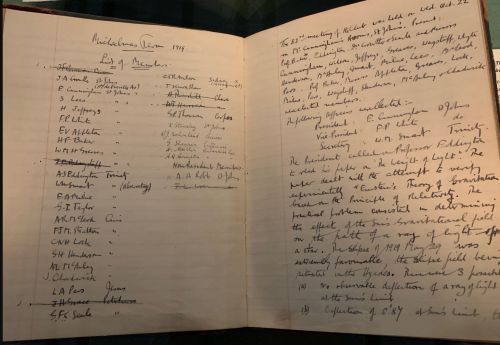
The expeditions of 1919 were conceived during the First World War, not improvised in the calm that followed it. Einstein completed general relativity in Berlin in 1915 while Britain and Germany were attempting to destroy one another, and ordinary channels of scientific communication had fractured under censorship, interrupted travel, and organized hostility toward enemy scholarship. The crucial intermediary was Willem de Sitter, who used the neutrality of the Netherlands to convey Einstein’s ideas and their astronomical consequences to British colleagues. As secretary of the Royal Astronomical Society and director of the Cambridge Observatory, Arthur Stanley Eddington was unusually well positioned to receive, understand, and circulate this difficult new physics. He worked through de Sitter’s papers, reconstructed the theory’s mathematical structure, and became one of its most informed British expositors. At the Physical Society of London’s request, he prepared his Report on the Relativity Theory of Gravitation, completed in 1918 as one of the first substantial English-language accounts of general relativity. That document made the theory discussable within British physics before most investigators could read Einstein’s original publications easily. Frank Watson Dyson, the Astronomer Royal, recognized that an astronomical test could convert an abstruse foreign theory into a definite observational problem. In March 1917, he drew attention to the eclipse of May 29, 1919, when the Sun would stand before the unusually bright Hyades and a long totality might reveal as many as thirteen measurable stars.
Converting Dyson’s opportunity into an expedition fell to the Joint Permanent Eclipse Committee of the Royal Society and the Royal Astronomical Society. The committee already possessed roughly a quarter century of experience evaluating sites, lending instruments, obtaining public funds, and coordinating observers. Chaired by Dyson, it joined the authority of Britain’s principal scientific societies to the practical resources of the Royal Observatory and Cambridge Observatory. On November 10, 1917, it resolved, if wartime conditions permitted, to send parties to Sobral in northern Brazil and Príncipe in the Gulf of Guinea. Two widely separated stations offered protection against local clouds, transport failures, and the loss of any single photographic program. An initial government grant of £1,100 was later supplemented by another £250 when uncertain travel and maintenance costs made the original estimate inadequate.
War also shaped the human composition of the expeditions. Eddington was a lifelong Quaker whose religious convictions made participation in military service impossible for him. Cambridge University had initially secured his exemption from conscription on the ground that his scientific work served the national interest, but the Ministry of National Service challenged that occupational exemption in 1918. During hearings in June and July, Eddington openly presented himself as a conscientious objector and offered to perform ambulance or agricultural work rather than enter the armed forces. Dyson supplied a letter emphasizing Eddington’s scientific importance and the need for his participation in the forthcoming eclipse expedition. The tribunal recognized his claim and granted twelve months’ exemption on condition that he continue his astronomical work, with preparation for the eclipse explicitly before it. Popular accounts sometimes reduce this episode to the claim that the expedition saved Eddington from prison, but the contemporary record reveals a more complicated convergence of conscience, professional indispensability, and institutional advocacy. The Armistice arrived before the exemption expired, removing the immediate threat of conscription without erasing the expedition’s connection to Eddington’s pacifism. War had meanwhile depleted the personnel from whom observing parties might normally have been drawn. The first and second assistants at Cambridge who could have accompanied Eddington had both been killed in action. A proposed electrical improvement to the instruments’ driving mechanisms was abandoned because its designer, George Gibbs, had been called into service. Edwin Turner Cottingham, an experienced clockmaker and scientific instrument specialist who had maintained equipment for both Cambridge and Greenwich, consequently became not a makeshift assistant but an essential member of the Príncipe team.
The observing sites themselves emerged from cooperation extending well beyond London. Henrique Morize, director of Brazil’s National Observatory, investigated possible stations across northeastern Brazil and sought information from people who understood their terrain and infrastructure. Telegraph engineer Benjamin de Oliveira prepared a technical report that helped identify Sobral as accessible, adequately supplied, and situated beneath more than five minutes of totality, although his contribution largely disappeared from Morize’s published account. Morize then circulated a French-language memorandum describing the Brazilian eclipse zone to foreign astronomers and began arranging the reception of visiting parties. For Príncipe, Eddington contacted César Augusto de Campos Rodrigues and Frederico Oom of the Astronomical Observatory of Lisbon on November 11, 1918, the day the Armistice was signed, to request meteorological, geographical, and logistical assistance. Portuguese officials and colonial intermediaries subsequently helped direct the astronomers toward the Sundy cocoa plantation, whose buildings and open ground could accommodate their apparatus. The two stations connected the British committee to a sovereign Brazilian scientific program on one side of the Atlantic and to Portuguese colonial administration on the other.
Only four British travelers were ultimately assigned to the two stations, but each carried a carefully differentiated responsibility. Andrew Crommelin, an experienced eclipse astronomer, and Charles Rundle Davidson of the Royal Observatory formed the Sobral party; Eddington and Cottingham represented Cambridge at Príncipe; Dyson remained in Britain as the enterprise’s principal organizer and director. Cottingham’s mastery of clockwork mechanisms allowed him to regulate and operate the coelostat while Eddington concentrated upon the telescope, plates, and timed exposures. At Sobral, the principal instrument was a thirteen-inch astrographic object glass from Greenwich paired with a sixteen-inch coelostat. A four-inch lens of nineteen-foot focal length, lent by the Jesuit astronomer Aloysius Cortie and mounted with a smaller coelostat, supplied an independent photographic system rather than merely an incidental spare. The Príncipe party carried the thirteen-inch astrographic object glass from the Radcliffe Observatory at Oxford together with another sixteen-inch coelostat. Each coelostat used a clock-driven mirror to reflect the moving celestial field into a stationary horizontal camera, avoiding the need to move the long photographic telescope during totality. The planners also understood that eclipse photographs alone could not reveal deflection; the same stars had to be photographed without the Sun so that differences in position and plate scale could be calculated. Reference exposures for the Príncipe instrument were made at Oxford in January and February, while the Sobral observers expected to remain in Brazil after the eclipse until the Hyades field became observable at night. Telescopes and mirrors were only the center of a much larger consignment containing observing huts, plate holders, photographic chemicals, clocks, darkroom materials, tools, timber, protective cases, and replacement components. The committee’s final accounts recorded £1,117 12s. in expenditures divided among instruments, insurance, carriage, travel, maintenance, telegrams, photographic supplies, and structures. Such bookkeeping reveals that testing gravity required an administrative machine capable of moving fragile observatory equipment across oceans and making it function in unfamiliar heat and humidity. Before departure, the observers inspected the optics, adjusted the driving mechanisms, practiced exchanging plates, and rehearsed the sequence that would govern every second of totality.
The Armistice made the voyages politically possible, but it did not instantly restore prewar transport or scientific normality. The four observers left Liverpool together aboard the Anselm on March 8, 1919, then separated at Madeira when Eddington and Cottingham transferred to the Portugal for Príncipe while Crommelin and Davidson continued toward Brazil. By late April both parties had reached their stations and begun turning borrowed ground into temporary observatories. In Sobral, Brazilian authorities supplied transportation, accommodation, interpreters, and workers, while Leocádio Araújo translated complicated instructions and porters, bricklayers, and carpenters erected supports and protective structures. At Sundy, Portuguese astronomers and administrators, plantation owner Jerónimo Carneiro, manager Atalaia, cable-station employees, and plantation laborers helped move crates, communicate with residents, construct the station, and sustain daily operations. That assistance was not socially equivalent at the two sites, for the Príncipe expedition rested partly upon a colonial plantation economy whose coercive labor practices had already attracted international condemnation. Eddington would later present the British examination of a theory developed in wartime Berlin as an emblem of science healing national enmity, and his pacifism unquestionably shaped the meaning he gave the venture. Yet reconciliation was only one strand within an enterprise also produced by Dyson’s institutional leadership, government money, Dutch mediation, Brazilian scientific initiative, Portuguese colonial access, technical expertise, and largely uncredited labor. By May 29, two portable observatories stood beneath the eclipse track, ready to test the geometry of the universe with machinery assembled from both the ruins and the surviving networks of the prewar world.
Sobral and Príncipe
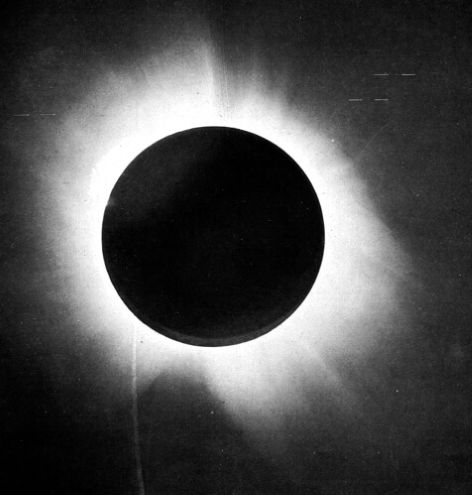
At Sobral, the eclipse test first became a race against a sky that had looked unpromising at dawn. At first contact on May 29, 1919, approximately nine-tenths of the sky was covered, threatening to nullify weeks of preparation at the Jockey Club grounds. Short intervals of sunlight nevertheless allowed Andrew Crommelin and Charles Davidson to center the Sun’s image on their ground glass and make final adjustments to the coelostat clocks. About one minute before totality, a broad opening in the clouds reached the Sun. Observers watching the shrinking crescent issued warnings fifty-eight, twenty-two, and twelve seconds before its disappearance, after which the command to begin was given. Leocádio Araújo started a metronome and called every tenth beat, providing a common temporal framework for exposures made by two different instruments. Crommelin and Davidson then executed the rehearsed sequence of exchanging plate holders, opening shutters, recording times, and monitoring the tracking mirrors. Nineteen plates were exposed through the thirteen-inch astrographic lens, stopped down to eight inches, with exposures alternating between five and ten seconds. Eight more received twenty-eight-second exposures through the four-inch Cortie lens. During Sobral’s five minutes and thirteen seconds of totality, thin cloud crossed the field for about a minute and prevented stars from registering on some exposures. For most of the interval, the region immediately surrounding the Sun remained sufficiently clear to record both the corona and an unusually rich field of stars.
Príncipe delivered almost the reverse combination of fortune and disappointment. A heavy thunderstorm continued until approximately 11:30 on the morning of the eclipse, after which clouds still concealed most of the sky above the Sundy plantation. The Sun became intermittently visible around 1:30, only about forty minutes before totality began at 2:13. Eddington and Edwin Turner Cottingham had devised a method of aiming the telescope by reference to a terrestrial landmark if the Sun remained hidden, but the brief openings allowed them to align the apparatus directly. Once totality arrived, Eddington exchanged plate holders while Cottingham tended the clockwork, mirror, and exposure sequence. They made sixteen photographs through drifting cloud, Eddington glancing at the eclipse only twice because the demands of changing plates occupied nearly every second. The cloud gradually thinned near the end, allowing the brightest stars to penetrate during the final exposures. His first telegram to Britain offered neither triumph nor defeat, only the compressed judgment: “Through cloud, hopeful.”
Photographic glass transformed those hurried operations into objects that could be developed, inspected, measured, and compared, but it did not guarantee that the desired information had been captured. Each plate carried a light-sensitive emulsion in which the corona, prominences, defects, clouds, and star images were registered together as variations in density. At Príncipe, stars appeared on seven of the sixteen plates, yet only two contained five stellar images sufficiently distinct for serious measurement. Most of the remaining plates preserved the eclipsed Sun and a spectacular arching prominence but supplied little usable astrometric evidence. The clouds that nearly ruined the experiment also reduced overexposure of the prominence, producing one of the eclipse’s most memorable photographs while obscuring the much fainter evidence the expedition had crossed an ocean to obtain.
Sobral’s astrographic series contained many more stars, but its apparent abundance concealed a severe instrumental failure. Most plates recorded twelve of the thirteen predicted stars, seemingly making the principal camera the expedition’s great success. When four plates were developed and examined during the night following the eclipse, their stellar images appeared enlarged, diffuse, and badly out of focus. Davidson recorded the problem at approximately three o’clock on the morning of May 30, before anyone had calculated a gravitational displacement or knew whether the plates favored Einstein. The telescope’s focusing scale remained at its expected setting, making accidental movement of the object glass an inadequate explanation. Suspicion instead fell upon the sixteen-inch coelostat mirror, which had stood in direct tropical sunlight and apparently expanded unevenly under the heat. Difficulties in silvering the large mirror before departure may have further reduced its performance, since cold weather and wartime labor shortages had forced the work away from Greenwich and left the expedition dissatisfied with parts of its reflective surface. Because the coelostat redirected light into the stationary telescope, even a slight warping of its supposedly flat surface could enlarge, elongate, or displace the stellar images. The observers could not immediately determine whether the heating had merely blurred the photographs or had also changed their scale. That distinction was decisive, because a minute alteration in scale could imitate or conceal a displacement comparable to the less-than-two-arcsecond effect they sought. Plates containing numerous stars were not necessarily superior to plates containing fewer but sharper images. The problem demonstrated how quickly the Sun’s ordinary heat could overwhelm an experiment designed to detect its extraordinary gravitational influence. Clear weather had supplied Sobral with abundant light, but the same light had compromised the instrument intended to measure it.
The auxiliary four-inch telescope escaped the larger instrument’s thermal failure. Its smaller eight-inch coelostat and long nineteen-foot focal length produced a narrower field, but seven of its eight plates displayed seven measurable stars with markedly better definition. One exposure made during the cloudy interval contained no useful stellar images, leaving seven photographs for comparison. The smaller camera had been carried as an independent safeguard rather than as the centerpiece of the expedition, yet its successful operation gave the Sobral program its strongest evidence. Photography still required a second observation because the eclipse plates alone showed only apparent positions rather than displacements. Crommelin and Davidson left Sobral for Fortaleza on June 7 and returned on July 9, when the Hyades field could be photographed before dawn at approximately the same altitude it had occupied during the eclipse. Over several mornings they made comparison exposures with both telescopes under conditions designed to reproduce the original orientation and atmospheric refraction as closely as possible. The astrographic images were now sharply focused without any adjustment to the object glass, strengthening the conclusion that solar heating of the coelostat had caused the eclipse-day failure. One plate was exposed through the back of the glass so that its emulsion could be placed directly against those of the eclipse and comparison plates, creating an intermediate scale plate through which tiny relative differences could be measured. The critical observations extended far beyond totality: the eclipse supplied one set of stellar positions, while July’s predawn sky supplied the control against which those positions acquired meaning.
Eddington could not obtain equivalent comparison photographs at Príncipe without waiting nearly six months for the Hyades to return to a suitable nighttime position. He instead relied upon plates of the eclipse field made with the Oxford astrograph in Britain, supplemented by check plates intended to reveal differences in scale between the instrument’s Oxford and Príncipe configurations. Developing the eclipse plates on the island, he used a portable micrometer to begin measurements before his departure and found by June 3 that one plate gave preliminary agreement with Einstein, with a second providing weaker support. That early result encouraged him, but it remained dependent upon sparse stars, uncertain images, imported comparison plates, and assumptions about the stability of the instrument’s scale. The eclipse ended without producing one self-evident photograph on which the fate of Newtonian gravity could be read directly. It produced three materially different bodies of evidence: sharp but narrowly framed plates from Sobral’s four-inch lens, star-rich but thermally damaged plates from its astrograph, and clouded plates from Príncipe containing only a handful of measurable stars. Cloud had obstructed light while moderating heat; clear sky had revealed stars while deforming glass; redundancy had succeeded where the principal apparatus failed. Determining what these plates said about gravity would require astronomers to distinguish deflection from changes in focus, scale, orientation, refraction, and photographic definition and then decide how much evidential weight each imperfect series deserved.
What the Plates Said
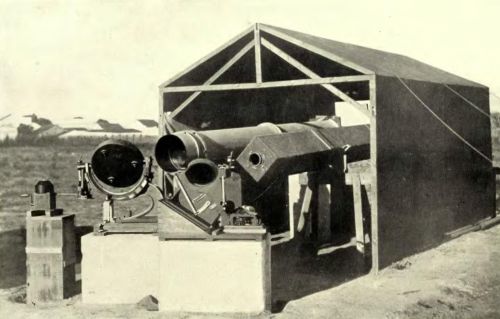
Glass plates did not deliver a verdict until astronomers converted dark specks in photographic emulsion into coordinates, corrections, equations, and estimates of uncertainty. At Greenwich, Charles Davidson and Herbert Henry Furner measured the Sobral plates under Frank Dyson’s supervision, while Eddington reduced the Príncipe observations independently at Cambridge. Measuring machines determined each star’s position on an eclipse plate relative to its position on comparison photographs, after which the investigators corrected for atmospheric refraction, aberration, plate orientation, and other predictable effects. Translational offsets could move an entire field, rotation could turn it, and a change in photographic scale could make every star appear farther from the plate’s center. That last effect was dangerous because gravitational deflection also displaced stars radially outward from the Sun. The two effects differed in pattern: a scale change increased with distance from the plate’s center, whereas Einsteinian deflection diminished with distance from the Sun. By comparing several stars distributed across the field, the astronomers attempted to solve simultaneously for orientation, scale, and a coefficient representing gravitational displacement. The result for each instrument was then converted into the equivalent deflection for a ray grazing the solar limb, allowing direct comparison with the predicted values. Every stage required judgment about which corrections were secure, which variables could be separated, and whether the photographic system had remained stable. The reductions were theory-guided, as all measurements of an otherwise invisible quantity must be, but theory-guided measurement was not automatically theory-dictated measurement.
The sharp plates from Sobral’s four-inch lens produced a limb deflection of 1.98 arcseconds with a quoted probable error of 0.12 arcsecond, equivalent to approximately 0.18 arcsecond in modern standard-deviation terms. Eddington’s two usable Príncipe plates yielded 1.61 arcseconds with a probable error of 0.30 arcsecond, or roughly 0.45 arcsecond as a standard deviation once systematic uncertainty was included. General relativity predicted approximately 1.75 arcseconds, while the reconstructed Newtonian or half-deflection value was approximately 0.87 arcsecond and the remaining alternative was no displacement at all. The Príncipe result was compatible with Einstein’s prediction but too imprecise by itself to exclude the smaller value decisively. The much more precise four-inch result lay somewhat above Einstein’s number yet remained statistically consistent with it and strongly inconsistent with either half deflection or zero. Considered together, the two accepted series favored the curved-spacetime prediction, although neither supplied the almost exact numerical match later popular accounts sometimes implied.
The difficulty lay with the sixteen useful plates from Sobral’s thirteen-inch astrograph. Their blurred stellar images could be measured only imperfectly, and the Greenwich team used just one coordinate rather than the two available from the sharply focused four-inch photographs. One reduction gave a deflection of approximately 0.93 arcsecond, strikingly close to the half-deflection value. That number depended upon interpreting an unexpectedly large difference between the eclipse and comparison plates as a genuine change in photographic scale. If the instrument had merely lost focus during totality without undergoing the corresponding change in scale, an alternative reduction yielded approximately 1.52 arcseconds, later rounded by Dyson to 1.56. Neither result received a reliable error estimate because the physical behavior of the coelostat and the statistical behavior of the measurements were unknown. The star images changed character during the eclipse sequence, later plates disagreed substantially with earlier ones, and the telescope had returned to focus when the comparison photographs were taken without anyone correcting its optical setting. Since the suspected thermal distortion could alter focus, scale, and stellar centroids simultaneously, additional arithmetic could not reconstruct with certainty what the apparatus had done. Crucially, Crommelin and Davidson had recognized the damaged images when they developed plates immediately after the eclipse, and Dyson publicly reported the loss of focus in June, months before the final deflections were calculated. The Greenwich group nevertheless measured the astrographic plates, attempted more than one reduction, and included both the discordant value and its instrumental explanation in the published report. “Discarding” the series meant withholding it from the final evidential conclusion, not hiding its existence or destroying an inconvenient result. Surviving reduction sheets further show that Dyson supervised this decision at Greenwich and that Eddington did not participate in measuring or reducing the Sobral observations. The plate series closest to the Newtonian value was excluded, but its visible defects, not its theoretical implication alone, supplied the stated reason.
When the findings were presented to a joint meeting of the Royal Society and Royal Astronomical Society on November 6, 1919, the speakers did not claim that all three instruments had agreed. Dyson described the competing results and the failure of the Sobral astrograph, while Eddington explained why the retained measurements favored general relativity. J. J. Thomson characterized the finding as momentous, and newspapers rapidly converted qualified measurements into the simpler announcement that a new theory of the universe had overthrown Newton. Astronomers remained more circumspect: Henry Norris Russell independently reduced the four-inch measurements and confirmed their result, while William Wallace Campbell later questioned the relative confidence assigned to the poorer Príncipe images and the sharper but distorted Sobral astrographic series. Such criticism concerned evidential weight and the need for replication rather than an accusation that the British observers had fabricated their conclusion. Confirmation from the Australian eclipse of 1922 greatly strengthened the case that 1919 had detected a real effect rather than an unsuspected peculiarity of one instrument or eclipse.
The more serious charge of bias emerged decades later. In 1980 philosophers John Earman and Clark Glymour argued that the British investigators had accepted weak Príncipe evidence, rejected Sobral evidence favorable to the Newtonian value, and restricted the experiment to a misleading choice among zero, half, and full deflection. Their interpretation became influential after Harry Collins and Trevor Pinch used the eclipse as a case study in the theory-laden character of experimentation. Eddington seemed an inviting central figure: he admired general relativity before the expedition, regarded international science as a vehicle of postwar reconciliation, and acknowledged his pleasure when Dyson informed him that the four-inch plates supported full deflection. Yet that biographical plausibility obscured the divided organization of the reductions. Correspondence and surviving Greenwich records show Eddington worrying that his own Príncipe analysis might be wrong when he first learned that the Sobral astrograph favored half deflection. He reviewed his calculations rather than attempting to suppress the conflicting series, and only later received Dyson’s independent four-inch result. Dyson, who controlled the Sobral reduction, had approached general relativity with considerably more skepticism and wrote afterward that the outcome had contradicted his expectations. None of this proves that personal expectations were absent, for decisions about instruments and errors inevitably draw upon prior knowledge. It does show that the popular image of Eddington personally removing Newton-friendly plates from a combined dataset is historically false. The contested exclusion was an institutional judgment by experienced Greenwich astrometrists confronting an instrument whose failure had been recorded before its numerical result was known.
Later analysis has further weakened the claim that the exclusion manufactured Einstein’s victory. In 1979 Geoffrey Harvey and E. D. Clements remeasured surviving Sobral plates with a modern measuring machine and obtained 1.90 ± 0.11 arcseconds from the four-inch series, closely reproducing the original result. Their reduction of the supposedly Newtonian astrographic series gave 1.55 ± 0.34 arcseconds, remarkably close to the alternative value that Dyson had reported when no physical scale change was assumed. More recent recalculation of the published 1919 measurements has likewise reproduced the accepted values while finding such large dispersion and possible systematic error in the astrographic data that the series cannot reliably distinguish zero, half, or full deflection. It has also shown that some later critiques confused the scatter among individual measurements with the uncertainty of a derived mean and assigned the damaged astrograph more statistical weight than its uncontrolled systematics warranted. These reassessments cannot transform the surviving plates into a modern precision experiment, recover the lost Príncipe originals, or demonstrate that every 1919 judgment was beyond dispute. They do establish that retaining all three numerical series with defensible weights would not force the combined result toward the Newtonian value. The familiar assertion that the eclipse conclusively “proved Einstein right” says too much, but the counterclaim that Eddington selected only the data necessary to produce a predetermined victory says too much in the opposite direction. The experiment supplied credible initial evidence for gravitational light bending near Einstein’s predicted magnitude, followed by the replication that its organizers themselves considered necessary. What the plates said was inseparable from human measurement and judgment, but judgment was the means through which damaged photographs became evidence, not proof that the evidence had been invented.
“Revolution in Science”: From Result to World Event
An astronomical result became a public event on November 6, 1919, when the Royal Society and Royal Astronomical Society convened a joint meeting in London to hear the eclipse findings. Frank Dyson described the observations, the three photographic series, and the instrumental difficulties, placing the numerical conclusions within the cautious language of positional astronomy. Eddington then explained why the accepted measurements favored general relativity’s doubled deflection rather than the smaller value associated with an older gravitational treatment of light. Presiding over the meeting, physicist J. J. Thomson characterized the result as one of the most momentous achievements in the history of human thought. The discussion that followed was not an unbroken chorus of assent, for participants questioned the errors, the competing reductions, and the theoretical meaning of the observations. Several speakers emphasized that additional eclipses would be required before the result could be treated as secure. Yet their caution coexisted with an unmistakable awareness that the meeting concerned more than another correction to an astronomical table. The familiar portrait of Newton overlooking the proceedings supplied later retellings with an irresistible image of one physical universe yielding to another. What entered the room as a difficult comparison of photographic plates emerged as a declaration about space, time, light, and the structure of reality.
The next morning, The Times gave that declaration its enduring public form. Beneath the headline “Revolution in Science,” the newspaper added the equally dramatic phrases “New Theory of the Universe” and “Newtonian Ideas Overthrown.” The formulation turned a qualified report into an intellectual succession, with Einstein replacing Newton as the sovereign of physics. A complicated comparison among uncertain measurements became a contest that readers could understand without mastering tensor calculus. In a few columns, the eclipse ceased to be merely evidence and became a historical dividing line.
The story crossed the Atlantic almost immediately and acquired an even more theatrical vocabulary. On November 10, The New York Times announced, “Lights All Askew in the Heavens,” reported that scientists were “more or less agog,” and reassured readers that nobody needed to worry because the stars were not where they had seemed to be. The playful final clause captured the combination of bewilderment and fascination upon which the coverage depended. Other newspapers repeated the language of revolution, overthrow, warped space, displaced stars, and a universe newly made strange. Editors recognized that the story contained nearly every ingredient of compelling news: remote expeditions, tropical storms, an eclipse, photographic evidence, an obscure mathematical prediction, and a conclusion affecting the whole cosmos. Britain’s role added a political drama that the equations alone could never have supplied. British institutions had tested a theory formulated in wartime Berlin by a German-based Jewish physicist, only months after the Treaty of Versailles had formalized the bitter peace. Newton was not merely a dead scientist but an English national monument, so the willingness of British astronomers to announce evidence against the sufficiency of Newtonian gravity appeared to authenticate both their impartiality and Einstein’s triumph. Wire services, translated reports, illustrated magazines, and syndicated commentary carried that interpretation far beyond the scientific societies that had produced it. What circulated globally was not the full observational record but a compact narrative: an eclipse had judged between two geniuses, and the universe had chosen Einstein.
Einstein had received preliminary news before the London announcement. In late September, Hendrik Lorentz informed him that the British measurements appeared to confirm the predicted deflection, allowing Einstein to share the result privately with friends and family. He greeted the confirmation with satisfaction but not astonishment, since he regarded general relativity as too deeply integrated to stand or fall emotionally with one set of eclipse plates. When newspaper reports transformed him into Newton’s conqueror, he tried to explain that the new theory did not render Newtonian mechanics useless. In a contribution published by The Times on November 28, he emphasized that Newton’s laws remained extraordinarily accurate within their proper domain, while relativity supplied a more general account under extreme gravitational conditions. He also presented the British investigation of a theory produced in an enemy country as evidence that scientific cooperation could survive national hatred. Einstein ended with a pointed joke that exposed the politics surrounding his identity: success would allow Germany to claim him as German and France to call him a citizen of the world, whereas failure would make him a Swiss Jew to Germans and a German scientist to the French. His response simultaneously welcomed international recognition and mocked the national categories through which that recognition was being distributed.
Before 1919, Einstein was respected within a comparatively small international community of theoretical physicists, but his name possessed little meaning for the broader public. Within weeks of the announcement, journalists sought interviews, publishers requested explanations, lecture halls filled, and photographers transformed the theorist into a recognizable personality. On December 14, the Berliner Illustrirte Zeitung placed his portrait on its cover and presented him as a new figure of world history whose achievement belonged beside those of Copernicus, Kepler, and Newton. His 1921 journey to the United States with Chaim Weizmann, undertaken partly to raise support for the proposed Hebrew University of Jerusalem, consequently unfolded as a celebrity tour as well as a scientific and political mission. Crowds gathered, reporters pursued him, universities honored him, and newspapers described his movements even when they could not explain his equations. The difficulty of relativity did not inhibit this fame; paradoxically, it helped create it. Claims that only a dozen people, or sometimes only three, understood the theory made Einstein appear the possessor of knowledge inaccessible to ordinary minds. A much-repeated joke later associated with Eddington, in which he struggled to identify the supposed third person who understood relativity, reinforced the mythology of intellectual exclusivity regardless of whether the exchange occurred exactly as remembered. Popular discussions converted curved spacetime into rubber sheets, fourth dimensions, disturbed clocks, and rays of light forced from straight paths. “Relativity” then escaped physics altogether, becoming a metaphor for artistic modernism, political uncertainty, changing moral standards, and the unsettling possibility that every viewpoint possessed its own truth. Einstein repeatedly objected that his theory did not mean that everything was subjective, since relativity sought invariant physical laws beneath differences in observation. Such corrections could not reverse the cultural transformation. The public had learned to recognize a scientist without understanding his science, making Einstein one of the first global intellectual celebrities produced through the combined power of experimental spectacle, mass journalism, photography, and modern publicity.
Celebrity also made Einstein a more visible target. In Germany, hostility toward relativity soon mixed technical disagreement with resentment of foreign acclaim, postwar humiliation, political reaction, and antisemitism. Paul Weyland organized a public anti-relativity campaign in 1920, while critics such as Ernst Gehrcke and Philipp Lenard attacked both the theory and the authority accumulating around its author. Some objections concerned legitimate questions about evidence and mathematical interpretation, but others portrayed relativity as fraudulent, foreign, or characteristically Jewish. Einstein’s international fame consequently became inseparable from the racial and nationalist politics of the Weimar Republic. Even the Nobel Committee proceeded cautiously, awarding him the 1921 Nobel Prize in Physics, announced the following year, especially for the photoelectric effect rather than explicitly for relativity. The eclipse result had made general relativity famous before every scientific institution was prepared to treat it as settled.
The phrase “Revolution in Science” was both an interpretation of the eclipse result and an active force in creating its historical meaning. The accepted plates offered credible early evidence for light deflection near Einstein’s predicted value, but they did not by themselves produce the instantaneous and universal conversion imagined by later legend. Newspapers magnified the announcement because it joined a genuine conceptual transformation to a comprehensible drama of rivalry, discovery, reconciliation, and overturned authority. That drama allowed curved spacetime to enter public culture, even when most readers encountered it through metaphors that Einstein would not have endorsed. It also compressed a collective enterprise into a confrontation among Newton, Einstein, and Eddington, pushing Dyson, Davidson, Crommelin, Cottingham, Morize, Naegamvala’s predecessors, instrument makers, colonial intermediaries, plantation workers, and generations of eclipse observers toward the edges of the story. Nevertheless, the revolutionary language was not simply journalistic invention, because general relativity did replace absolute space, universal time, and gravitational force with a dynamical geometry capable of affecting matter, clocks, and light. What the press supplied was not the revolution itself but the date, imagery, protagonists, and public ceremony through which that revolution could be remembered. May 29 provided the photographs, November 6 provided the institutional judgment, and the newspapers transformed both into a world event. The eclipse of 1919 endured because it gave an almost impossibly abstract theory a visible scene: stars appearing out of place beside a darkened Sun, as though the universe had briefly exposed the curvature beneath ordinary sight.
After 1919: Stronger Tests and the Eclipse’s Changing Scientific Role
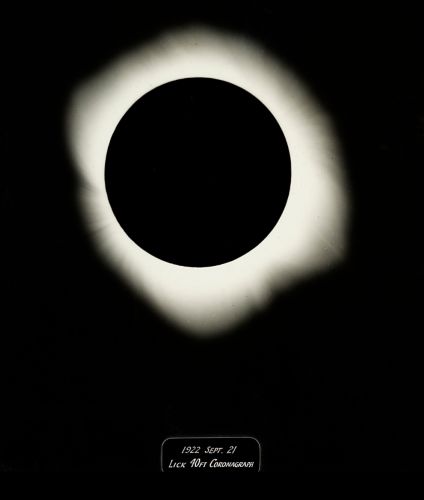
The announcement of 1919 began an experimental campaign rather than ending one. The next exceptional opportunity came with the total eclipse of September 21, 1922, whose path crossed Australia beneath a field containing far more measurable stars than had surrounded the Sun three years earlier. Several international parties attempted relativity observations, but the most consequential instruments belonged to the Lick Observatory expedition established at remote Wallal in Western Australia. Its director, William Wallace Campbell, had criticized the limited precision of the British results and insisted that only a better-controlled repetition could settle the question observationally. Robert Trumpler had already photographed the comparison field from Tahiti, allowing the eclipse plates to be matched against exposures made with the same equipment under carefully planned conditions. Clear skies at Wallal permitted the Lick astronomers to operate both fifteen-foot and five-foot cameras throughout more than five minutes of totality, producing plates containing thousands of stellar images rather than the handful measurable at Príncipe. Campbell and Trumpler’s initial reductions yielded a combined limb deflection of approximately 1.75 arcseconds with a quoted probable error of 0.09 arcsecond. Trumpler’s expanded analysis later obtained 1.72 ± 0.11 arcseconds from the fifteen-foot camera and 1.82 ± 0.15 from the five-foot system, values whose weighted combination remained strikingly close to general relativity’s prediction. The importance of Wallal lay not in achieving a perfect number but in reproducing the full deflection with different astronomers, instruments, comparison plates, and institutional expectations. Campbell’s earlier skepticism made his public acceptance persuasive: the theory no longer rested primarily upon the judgment of the British observers who had first announced its success.
Photographic eclipse measurements nevertheless remained stubbornly resistant to major increases in precision. Expeditions during subsequent decades repeatedly encountered clouds, poor stellar fields, atmospheric turbulence, optical distortion, temperature-dependent focus, and uncertain differences between eclipse and comparison exposures. Even improved measuring engines could not fully separate gravitational displacement from tiny changes in plate scale introduced before the light reached the emulsion. The Texas–Mauritania expedition of 1973, the last major professional effort using the classical eclipse method, obtained a deflection coefficient of 0.95 ± 0.11 times Einstein’s value, an agreement accurate to roughly ten percent, but not a revolutionary improvement over earlier work. By then, the eclipse had reached a methodological ceiling: its natural suppression of sunlight remained ingenious, but the few minutes of totality imposed too many uncontrolled conditions for precision gravitational physics.
Radio astronomy broke that ceiling by removing the need to wait for the Moon. Quasars provided bright, compact, and extremely distant radio sources whose apparent positions could be measured as their signals passed near the Sun, while interferometers separated by long distances created an effective telescope far larger than any photographic eclipse camera. Solar plasma still refracted radio waves and had to be modeled through observations at several frequencies, but measurements could be repeated over many days and compared among multiple sources. Early experiments around 1970 detected the expected displacement, and observations by Edward Fomalont and Richard Sramek in 1974 and 1975 found a mean deflection 1.007 ± 0.009 times that predicted by general relativity. Very-long-baseline interferometry eventually converted the effect into a measurement of the parametrized post-Newtonian quantity γ, which describes how strongly spatial curvature contributes to the propagation of light and equals one in Einstein’s theory. An analysis of geodetic observations collected between 1979 and 1999 obtained γ near 0.9998, with uncertainty measured in a few ten-thousandths rather than the tenths characteristic of eclipse plates. Irwin Shapiro’s gravitational time-delay test approached the same geometry differently, measuring the additional travel time of radar or spacecraft signals passing near the Sun. Radio tracking of the Cassini spacecraft in 2002 produced γ = 1 + (2.1 ± 2.3) × 10⁻⁵, testing the relevant prediction thousands of times more precisely than the 1919 photographs. General relativity was simultaneously examined through gravitational redshift experiments, lunar laser ranging, binary-pulsar timing, orbital dynamics, and eventually the direct detection of gravitational waves. These methods did not merely repeat one eclipse result with better equipment, because each isolated different consequences of the theory and different possibilities for deviation. The question gradually changed from whether light bent at all to whether Einstein’s equations remained exact across weak fields, strong fields, radiative systems, and vastly different physical scales.
Gravitational deflection also changed from an object of verification into an instrument of discovery. In 1979, Dennis Walsh, Robert Carswell, and Ray Weymann identified the nearly identical quasars Q0957+561A and B as two images of one distant source produced by an intervening gravitational lens. Astronomers subsequently found galaxies stretched into arcs, quasars multiplied around foreground masses, and background stars temporarily magnified by compact objects crossing their lines of sight. Strong lensing revealed otherwise inaccessible galaxies, weak lensing mapped the statistical distribution of dark matter, and microlensing exposed planets and faint bodies that emitted little or no detectable light. Time delays between multiple images supplied independent routes toward cosmological distances and the expansion rate of the universe. The intellectual reversal was profound: astronomers had once used stars to determine whether spacetime curved light, but they now trusted that curvature well enough to use distorted light as evidence for invisible mass.
Total eclipses consequently lost their privileged position in experimental relativity without losing either scientific value or symbolic force. Digital detectors, precise star catalogs, and modern astrometric software have allowed observers to reenact the original experiment, including a 2017 eclipse measurement that recovered Einstein’s value to roughly three percent, but such demonstrations cannot compete with radio and spacecraft tests reaching parts per hundred thousand. Totality instead remains valuable for examining the inner solar corona, magnetic structures, coronal temperature, the origins of the solar wind, and rapid responses in Earth’s atmosphere and ionosphere. Space-based coronagraphs provide continuous observations, yet the Moon offers an exceptionally clean natural occulting edge and permits measurements unusually close to the solar limb. Eclipses also continue to unite professional investigations, citizen science, historical reconstruction, and mass public observation in a way that routine instrumental data rarely can. Their altered role reveals the success of the 1919 experiment more clearly than endless repetition would have done. Once other techniques had established gravitational light bending with far greater precision, astronomers no longer needed the lunar shadow to decide whether spacetime curved around the Sun. The eclipse remained the scene in which that curvature first became publicly visible, while its former experimental question migrated into radio arrays, planetary radar, spacecraft links, pulsar clocks, gravitational-wave detectors, and the distorted images of the distant universe.
Did Eclipses Change Science or Only Dramatize It?
The following video from “NPR’s Skunk Bear” discusses the impact of eclipses on history:
Assigning too much causal power to the eclipse of 1919 risks converting a complicated scientific transition into a single decisive spectacle. General relativity had already transformed the conceptual foundations of gravitation before Eddington or Dyson proposed photographing the Hyades beside the Sun. Einstein’s equations replaced gravitational force with curved spacetime, accounted for the anomalous advance of Mercury’s perihelion, and generated predictions whose significance did not depend upon one British expedition. By 1919, theorists including Willem de Sitter, Max Planck, David Hilbert, Hermann Weyl, and Eddington had begun explaining, extending, or applying the theory within international scientific networks. The eclipse did not create those equations, solve their mathematical difficulties, or make Newtonian mechanics cease to function within the ordinary conditions where it remained extraordinarily accurate. Nor did the November announcement instantly compel every physicist and astronomer to accept Einstein’s system. Had clouds obscured both observing stations completely, general relativity would still have faced later tests involving light deflection, gravitational redshift, planetary motion, and other consequences of its field equations. The strongest skeptical interpretation is that the eclipse supplied a memorable public ceremony for an intellectual revolution already occurring elsewhere.
Even within astronomy, the November 1919 meeting was less final than retrospective narratives suggest. The accepted measurements contained substantial uncertainties, one instrument had failed, and the Príncipe result rested upon only two useful plates. Some astronomers found the result persuasive, while others awaited a better eclipse under clearer conditions. Acceptance unfolded through continued calculation, teaching, replication, and comparison rather than through collective conversion on a single afternoon.
Yet describing the eclipse as “only” a dramatization creates an equally misleading separation between scientific knowledge and the processes by which knowledge acquires authority. A theory may exist in equations without occupying the same position in textbooks, observatories, professional debate, or research agendas. Before 1919, general relativity remained mathematically forbidding, imperfectly understood outside a limited community, and difficult to evaluate experimentally. Mercury’s perihelion offered important support, but Einstein had constructed the theory while working toward the known anomaly, allowing critics to distinguish explanation from successful advance prediction. The deflection of starlight supplied a different kind of test because the predicted full effect diverged sharply from the half-sized value associated with an older gravitational treatment of light. Organizing expeditions around that prediction forced observatories to translate curved spacetime into instrument design, photographic procedures, comparison plates, correction equations, and explicit criteria for judging competing results. The 1919 observations consequently connected theoretical physics to positional astronomy in a form that institutions could investigate publicly. Their imperfections also generated productive disagreement over plate scale, instrumental failure, error estimation, and the legitimate exclusion of compromised data. Campbell’s determination to obtain stronger evidence at the 1922 eclipse arose partly from dissatisfaction with the British measurements, making criticism of 1919 one cause of a more decisive replication. Later radio, radar, and spacecraft experiments inherited the same basic problem while replacing the eclipse camera with techniques capable of far greater precision. The eclipse did not originate experimental relativity, but it helped establish gravitational light bending as a durable research question whose measurement could be refined across successive technologies.
Its most unmistakable changes occurred beyond the narrow calculation of deflection. The eclipse gave journalists a concrete scene through which they could narrate an otherwise inaccessible transformation in geometry, gravity, space, and time. It made Einstein a global celebrity, expanded the audience for theoretical physics, and encouraged universities, publishers, newspapers, and lecture societies to treat relativity as a defining subject of modern thought. The expedition also supplied postwar internationalism with a powerful emblem: British astronomers had tested a theory associated with defeated Germany and publicly announced that nature favored its prediction. That symbolism simplified the expedition’s multinational labor, colonial setting, and institutional complexity, but it nevertheless affected how scientists and publics imagined the moral authority of international inquiry. Publicity also produced opposition, since Einstein’s prominence intensified nationalist, philosophical, and antisemitic campaigns against both him and relativity. Dramatization was not something that happened outside science after the real work had ended; it altered reputations, controversies, audiences, and the cultural resources available to scientific institutions.
The most defensible conclusion depends upon what is meant by “change.” The eclipse did not change the mathematical content of general relativity, and the measured value was too uncertain to constitute an unanswerable proof. It did not overthrow Newton in the crude sense proclaimed by newspaper headlines, because Newtonian mechanics retained its explanatory and practical power within its established domain. It did change the speed, reach, and institutional setting of relativity’s reception. It converted one difficult theoretical prediction into publicly inspectable evidence, stimulated replication, sharpened arguments about experimental judgment, and transformed Einstein from a respected specialist into the personification of modern science. Without the eclipse, relativity probably would have secured acceptance through accumulated theoretical and observational success, but the route would have been slower, less concentrated, and far less visible. The distinction between changing science and dramatizing science is too rigid. A scientific revolution consists not only of new equations but also of tests, instruments, professional judgments, institutional commitments, teaching practices, and shared narratives about what has been discovered. The eclipse changed none of these alone, yet it brought them together beneath one darkened Sun. Its historical power lay precisely in making an ongoing transformation visible, and by making it visible, helping that transformation advance.
Conclusion: What the Moon’s Shadow Made Visible
Between Halley’s eclipse map of 1715 and the relativity expeditions of 1919, total eclipses became instruments for investigating a universe ordinarily concealed by sunlight. Astronomers learned to calculate where the lunar shadow would fall, position observers along its path, and coordinate measurements across distances that no single observatory could command. Prediction converted an apparently sudden interruption of nature into a scheduled encounter, while clocks, telescopes, spectroscopes, cameras, and comparison plates extended what could be extracted from a few minutes of darkness. Those practices revealed solar prominences, the structure and spectrum of the corona, unfamiliar elements, stars beside the obscured Sun, and finally the apparent displacement of starlight by gravitation. Yet eclipses never became ordinary laboratory events. Clouds could erase years of preparation, heat could distort optical systems, and the motion of the Moon imposed a deadline that no observer could postpone. Awe, uncertainty, and human fallibility persisted inside increasingly sophisticated programs of calculation. Modern science did not disenchant the eclipse so much as give its darkness additional meanings.
The Moon itself remained the experiment’s indispensable apparatus. By covering the photosphere, it removed the overwhelming glare that concealed phenomena astronomers wished to examine. But the shadow never spoke without mediation: instruments had to preserve what eyes could glimpse, and investigators had to decide what imperfect records deserved confidence. What became visible depended as much upon preparation, calibration, comparison, and interpretation as upon totality.
The 1919 eclipse brought both the power and the limitations of that method into unusually sharp focus. Einstein’s predicted deflection transformed stars near the darkened Sun into markers of spacetime curvature, but the photographs obtained at Sobral and Príncipe were clouded, thermally distorted, uneven in quality, and incapable of announcing their own meaning. Dyson, Eddington, Davidson, and their colleagues had to distinguish gravitational displacement from changes in scale, focus, orientation, and atmospheric refraction. Their accepted results provided credible evidence near the value predicted by general relativity, although the damaged Sobral astrograph and sparse Príncipe images left room for legitimate criticism. The experiment’s importance lay neither in perfect precision nor in an instantaneous overthrow of Newton. It lay in translating an abstract geometrical theory into a measurable astronomical effect and placing that effect before scientific institutions capable of debating it. The stronger Australian observations of 1922 and later radio, radar, spacecraft, and interferometric tests supplied levels of confirmation that eclipse photography could never attain. General relativity did not survive because one expedition had been declared decisive; it survived because different techniques continued to recover its predictions under increasingly demanding conditions. Gravitational deflection eventually ceased to be merely a test and became an astronomical tool through which lensing could expose distant galaxies, dark matter, planets, and the large-scale structure of the cosmos. The eclipse method receded from precision physics because the question it had helped establish migrated into more controllable and powerful technologies. That obsolescence was not evidence of failure but one measure of success: the lunar shadow had opened a line of inquiry that science no longer needed the Moon to pursue.
What eclipses made visible was larger than any isolated feature of the Sun or test of gravitation. Their study exposed the collective machinery through which knowledge was produced: prediction, travel, public cooperation, imperial routes, local labor, instrument making, institutional authority, numerical reduction, criticism, and replication. It also revealed tensions within that machinery, including unequal credit, colonial dependence, national rivalry, and the temptation of newspapers to compress uncertain evidence into stories of conquest and revolution. The shadow joined people who experienced totality as wonder to specialists who treated it as data, without requiring either response to cancel the other. In 1919, that conjunction made curved spacetime imaginable to millions who could not follow Einstein’s equations but could understand that stars had appeared displaced beside a darkened Sun. The Moon did not create the physical realities that eclipses revealed, nor did a single period of totality complete the sciences built around them. It briefly removed the brilliance that hid those realities and gave observers a narrow interval in which to record, measure, and argue about them. What the shadow ultimately made visible was not only the hidden universe, but science itself in the act of learning how to see.
Bibliography
Affiliate disclosure: Amazon links on this site are paid links. As an Amazon Associate I earn from qualifying purchases.
- Airy, George Biddell. “Account of the Total Eclipse of the Sun on 1851, July 28, as Observed at Göteborg.” Memoirs of the Royal Astronomical Society 21 (1852), 1–18.
- Almassi, Ben. “Trust in Expert Testimony: Eddington’s 1919 Eclipse Expedition and the British Response to General Relativity.” Studies in History and Philosophy of Modern Physics 40:1 (2009), 57–67.
- Armitage, Geoff. The Shadow of the Moon: British Solar Eclipse Mapping in the Eighteenth Century. Tring, Hertfordshire: Map Collector Publications, 1997.
- Aubin, David. “Eclipse Politics in France and Thailand, 1868.” Centaurus 44:1-2 (2002), 76–117.
- Aubin, David, Charlotte Bigg, and H. Otto Sibum, eds. The Heavens on Earth: Observatories and Astronomy in Nineteenth-Century Science and Culture. Durham, NC: Duke University Press, 2010.
- Baily, Francis. “The Total Eclipse of the Sun, July 8, 1842.” Monthly Notices of the Royal Astronomical Society 5 (1842), 208–211.
- Bartlett, Jennifer Lynn, and Thomas Hockey. “The Total Solar Eclipse of 1869 as Stimulus for Adoption of Physical-Astronomy Techniques in the United States.” Physics in Perspective 27 (2025), 3–25.
- Berliner Illustrirte Zeitung. “Ein neuer Großer der Weltgeschichte: Albert Einstein.” December 14, 1919.
- Bertotti, Bruno, Luciano Iess, and Paolo Tortora. “A Test of General Relativity Using Radio Links with the Cassini Spacecraft.” Nature 425:6956 (2003), 374–376.
- British Astronomical Association. The Indian Eclipse, 1898: Report of the Expeditions Organized by the British Astronomical Association to Observe the Total Solar Eclipse of 1898 January 22. Edited by E. Walter Maunder. London: Hazell, Watson, and Viney, 1899.
- Bruns, Donald G. “Gravitational Starlight Deflection Measurements during the 21 August 2017 Total Solar Eclipse.” Classical and Quantum Gravity 35:7 (2018), 075009.
- Campbell, William Wallace. “The Total Eclipse of the Sun, September 21, 1922.” Publications of the Astronomical Society of the Pacific 35:203 (1923), 11–44.
- Campbell, William Wallace, and Robert Trumpler. “Observations on the Deflection of Light in Passing through the Sun’s Gravitational Field, Made during the Total Solar Eclipse of September 21, 1922.” Publications of the Astronomical Society of the Pacific 35:205 (1923), 158–163.
- Chapman, Allan. “Edmond Halley’s Use of Historical Evidence in the Advancement of Science.” Notes and Records of the Royal Society of London 48:2 (1994), 167–191.
- Chinnici, Ileana. Decoding the Stars: A Biography of Angelo Secchi, Jesuit and Scientist. Leiden: Brill, 2019.
- Collins, Harry, and Trevor Pinch. The Golem: What Everyone Should Know about Science. Cambridge: Cambridge University Press, 1993.
- Crelinsten, Jeffrey. Einstein’s Jury: The Race to Test Relativity. Princeton, NJ: Princeton University Press, 2006.
- Crispino, Luís C. B. “Expeditions for the Observation in Sobral, Brazil, of the May 29, 1919 Total Solar Eclipse.” International Journal of Modern Physics D 27:11 (2018), 1843004.
- Crommelin, Andrew C. D. “The Eclipse Expedition to Sobral.” The Observatory 42 (1919), 368–371.
- —-. “Results of the Total Solar Eclipse of May 29 and the Relativity Theory.” Nature 104 (1919), 280–281.
- De la Rue, Warren. “The Bakerian Lecture: On the Total Solar Eclipse of July 18th, 1860, Observed at Rivabellosa, near Miranda de Ebro, in Spain.” Philosophical Transactions of the Royal Society of London 152 (1862), 333–416.
- de Sitter, Willem. “On Einstein’s Theory of Gravitation and Its Astronomical Consequences. First Paper.” Monthly Notices of the Royal Astronomical Society 76 (1916), 699–728.
- Dyson, Frank Watson. “Relativity and the Eclipse Observations of May, 1919.” Nature 106 (1921), 786–787.
- Dyson, F. W., A. S. Eddington, and C. Davidson. “A Determination of the Deflection of Light by the Sun’s Gravitational Field, from Observations Made at the Total Eclipse of May 29, 1919.” Philosophical Transactions of the Royal Society of London, Series A 220 (1920), 291–333.
- Earman, John, and Clark Glymour. “Relativity and Eclipses: The British Eclipse Expeditions of 1919 and Their Predecessors.” Historical Studies in the Physical Sciences 11:1 (1980), 49–85.
- Eddington, Arthur Stanley. Space, Time, and Gravitation: An Outline of the General Relativity Theory. Cambridge: Cambridge University Press, 1920.
- Einstein, Albert. “Explanation of the Perihelion Motion of Mercury from the General Theory of Relativity.” Sitzungsberichte der Königlich Preussischen Akademie der Wissenschaften (1915), 831–839.
- —-. “The Foundation of the General Theory of Relativity.” Annalen der Physik 49 (1916), 769–822.
- —-. “On the Influence of Gravitation on the Propagation of Light.” Annalen der Physik 35 (1911), 898–908.
- —-. “On the Relativity Principle and the Conclusions Drawn from It.” Jahrbuch der Radioaktivität und Elektronik 4 (1907), 411–462.
- —-. “Time, Space, and Gravitation.” The Times (London), November 28, 1919.
- Fölsing, Albrecht. Albert Einstein: A Biography. Translated by Ewald Osers. New York: Viking, 1997.
- Fomalont, Edward B., and Richard A. Sramek. “Measurements of the Solar Gravitational Deflection of Radio Waves in Agreement with General Relativity.” Physical Review Letters 36:25 (1976), 1475–1478.
- Gilmore, Gerard, and Gudrun Tausch-Pebody. “The 1919 Eclipse Results That Verified General Relativity and Their Later Detractors: A Story Re-Told.” Notes and Records: The Royal Society Journal of the History of Science 76:1 (2022), 155–180.
- Gingerich, Owen. “Astronomical Scrapbook: Eighteenth-Century Eclipse Paths.” Sky & Telescope 62 (1981), 324–327.
- Glick, Thomas F., ed. The Comparative Reception of Relativity. Dordrecht: D. Reidel, 1987.
- Haig, C. T. “Account of Spectroscopic Observations of the Eclipse of the Sun, August 18, 1868.” Proceedings of the Royal Society of London 17 (1868–1869), 74–80.
- Halley, Edmond. A Description of the Passage of the Shadow of the Moon over England, in the Total Eclipse of the Sun, on the 22d Day of April 1715 in the Morning. London: Printed and sold by John Senex, 1715.
- —-. “Observations of the Late Total Eclipse of the Sun on the 22d of April Last Past, Made before the Royal Society at Their House in Crane-Court in Fleet-Street, London.” Philosophical Transactions of the Royal Society of London 29 (1714–1716), 245–262.
- —-. A Description of the Passage of the Shadow of the Moon over England in the Total Eclipse of the Sun on the 11th Day of May 1724 in the Evening. Togather with the Passage of the Shadow as It Was Observed in the Last Total Eclipse of 1715. London: Engraved and sold by John Senex, 1723.
- —-. A Description of the Passage of the Shadow of the Moon over Europe, as It May Be Expected May 11th 1724 in the Evening. London: Engraved and sold by John Senex, 1724.
- Harvey, Geoffrey M. “Gravitational Deflection of Light: A Re-examination of the Observations of the Solar Eclipse of 1919.” The Observatory 99 (1979), 195–198.
- Hentschel, Klaus. Mapping the Spectrum: Techniques of Visual Representation in Research and Teaching. Oxford: Oxford University Press, 2002.
- Hingley, Peter D. “The First Photographic Eclipse?” Astronomy & Geophysics 42:1 (2001), 1.18–1.22.
- Hufbauer, Karl. Exploring the Sun: Solar Science since Galileo. Baltimore: Johns Hopkins University Press, 1991.
- Janssen, Pierre Jules César. “Indication de quelques-uns des résultats obtenus à Cocanada, pendant l’éclipse du mois d’août dernier, et à la suite de cette éclipse.” Comptes rendus hebdomadaires des séances de l’Académie des sciences 67 (1868), 838–839.
- Kapoor, R. C., and Wayne Orchiston. “Colonial Astronomy as an Element of Empire in British India.” Journal of Astronomical History and Heritage 26:1 (2023), 113–158.
- Kennefick, Daniel. No Shadow of a Doubt: The 1919 Eclipse That Confirmed Einstein’s Theory of Relativity. Princeton, NJ: Princeton University Press, 2019.
- —-. “Not Only Because of Theory: Dyson, Eddington, and the Competing Myths of the 1919 Eclipse Expedition.” In Einstein and the Changing Worldviews of Physics, edited by Christoph Lehner, Jürgen Renn, and Matthias Schemmel, 201–232. Boston: Birkhäuser, 2012.
- Kent, Deborah, Jesse Garrison, Megan Briers, Ileana Chinnici, Frédéric Soulu, and Daniel Belteki. “Towards a Global History of the 1860 Total Solar Eclipse.” HoST—Journal of History of Science and Technology 19:1 (2025), 8–38.
- Kirchhoff, Gustav, and Robert Bunsen. “Chemical Analysis by Spectrum-Observations.” Philosophical Magazine, 4th ser., 20:130 (1860), 89–109.
- Kochhar, R. K. “French Astronomers in India during the Seventeenth–Nineteenth Centuries.” Journal of the British Astronomical Association 101:2 (1991), 95–100.
- Kragh, Helge. “The Solar Element: A Reconsideration of Helium’s Early History.” Annals of Science 66:2 (2009), 157–182.
- Lockyer, J. Norman. Contributions to Solar Physics: I. A Popular Account of Inquiries into the Physical Constitution of the Sun, with Special Reference to Recent Spectroscopic Researches; II. Communications to the Royal Society of London and the French Academy of Sciences, with Notes. London: Macmillan, 1874.
- —-. “Notice of an Observation of the Spectrum of a Solar Prominence.” Proceedings of the Royal Society of London 17 (1868–1869), 91–92.
- Lockyer, J. Norman, Captain Chisholm-Batten, and Alexander Pedler. “Total Eclipse of the Sun, January 22, 1898: Observations at Viziadrug.” Philosophical Transactions of the Royal Society of London, Series A 197 (1901), 151–228.
- Longair, Malcolm. “Bending Space–Time: A Commentary on Dyson, Eddington and Davidson (1920), ‘A Determination of the Deflection of Light by the Sun’s Gravitational Field.’” Philosophical Transactions of the Royal Society A 373:2039 (2015), 20140287.
- Meadows, A. J. Early Solar Physics. Oxford: Pergamon Press, 1970.
- —-. Science and Controversy: A Biography of Sir Norman Lockyer. Cambridge, MA: MIT Press, 1972.
- Missner, Marshall. “Why Einstein Became Famous in America.” Social Studies of Science 15:2 (1985), 267–291.
- Naegamvala, Kavasji Dadabhai. Report on the Total Solar Eclipse of January 21–22, 1898, as Observed at Jeur in Western India. Bombay: Government Central Press, 1902.
- Nath, Biman B. The Story of Helium and the Birth of Astrophysics. New York: Springer, 2013.
- Nath, Biman B., and Wayne Orchiston. “Norman Robert Pogson and Observations of the Total Solar Eclipse of 1868 from Masulipatam, India.” Journal of Astronomical History and Heritage 24:3 (2021), 629–651.
- The New York Times. “Lights All Askew in the Heavens.” November 10, 1919.
- Newton, Isaac. Opticks: Or, A Treatise of the Reflections, Refractions, Inflections and Colours of Light. London: William Innys, 1704.
- Norton, John D. “What Was Einstein’s Principle of Equivalence?” Studies in History and Philosophy of Science 16:3 (1985), 203–246.
- Pais, Abraham. “Subtle Is the Lord”: The Science and the Life of Albert Einstein. Oxford: Oxford University Press, 1982.
- Pang, Alex Soojung-Kim. Empire and the Sun: Victorian Solar Eclipse Expeditions. Stanford, CA: Stanford University Press, 2002.
- —-. “Gender, Culture, and Astrophysical Fieldwork: Elizabeth Campbell and the Lick Observatory–Crocker Eclipse Expeditions.” Osiris 11 (1996), 17–43.
- —-. “The Social Event of the Season: Solar Eclipse Expeditions and Victorian Culture.” Isis 84:2 (1993), 252–277.
- Pasachoff, Jay M. “Halley as an Eclipse Pioneer: His Maps and Observations of the Total Solar Eclipses of 1715 and 1724.” Journal of Astronomical History and Heritage 2:1 (1999), 39–54.
- Ragoonatha Chary, C. “On the Total Eclipse of the Sun, on December the 11th, 1871, as Visible in the Madras Presidency.” Monthly Notices of the Royal Astronomical Society 31 (1871), 137–146.
- Ramsay, William. “On a Gas Showing the Spectrum of Helium, the Reputed Cause of D3, One of the Lines in the Coronal Spectrum: Preliminary Note.” Proceedings of the Royal Society of London 58 (1895), 65–67.
- Renn, Jürgen, ed. The Genesis of General Relativity. 4 vols. Dordrecht: Springer, 2007.
- Rothermel, Holly. “Images of the Sun: Warren De la Rue, George Biddell Airy and Celestial Photography.” British Journal for the History of Science 26:2 (1993), 137–169.
- Russell, Alexander J. B. “Commentary: Discovery of the Sun’s Million-Degree Hot Corona.” Frontiers in Astronomy and Space Sciences 5 (2018), 9.
- Russell, Henry Norris. “Note on the Sobral Eclipse Photographs.” Monthly Notices of the Royal Astronomical Society 81 (1920), 154–164.
- Sauer, Tilman. “Soldner, Einstein, Gravitational Light Deflection and Factors of Two.” Annalen der Physik 533:11 (2021), 2100203.
- Schaffer, Simon. “Astronomers Mark Time: Discipline and the Personal Equation.” Science in Context 2:1 (1988), 115–145.
- Schielicke, Reinhard E., and Axel D. Wittmann. “On the Berkowski Daguerreotype (Königsberg, 1851 July 28): The First Correctly Exposed Photograph of the Solar Corona.” In Development of Solar Research/Entwicklung der Sonnenforschung, edited by Axel D.
- The Times (London). “Revolution in Science: New Theory of the Universe: Newtonian Ideas Overthrown.” November 7, 1919. Wittmann, Gudrun Wolfschmidt, and Hilmar W. Duerbeck, 128–147. Acta Historica Astronomiae 25. Frankfurt am Main: Verlag Harri Deutsch, 2005.
- Schneider, Peter, Jürgen Ehlers, and Emilio E. Falco. Gravitational Lenses. Berlin: Springer, 1992.
- Secchi, Angelo. Relazione delle osservazioni fatte in Spagna durante l’ecclisse totale del 18 luglio 1860. Rome: Tipografia delle Belle Arti, 1860.
- Shapiro, Irwin I. “Fourth Test of General Relativity.” Physical Review Letters 13:26 (1964), 789–791.
- Simões, Ana, Hugo Soares, and Luís Miguel Carolino. “The British and Brazilian Expeditions and the 1919 Total Solar Eclipse: Regimes of Labour and Degrees of Invisibility.” British Journal for the History of Science 58:3 (2025), 447–461.
- Soldner, Johann Georg von. “On the Deflection of a Light Ray from Its Rectilinear Motion, by the Attraction of a Celestial Body at Which It Nearly Passes By.” Translated by Stanley L. Jaki. Foundations of Physics 8:11-12 (1978), 927–950. Originally published in 1801.
- Sen, Joydeep. Astronomy in India, 1784–1876. London: Pickering & Chatto, 2014.
- Stachel, John. Einstein from “B” to “Z.” Boston: Birkhäuser, 2002.
- Stanley, Matthew. Einstein’s War: How Relativity Conquered Nationalism and Shook the World. New York: Dutton, 2019.
- —-. “‘An Expedition to Heal the Wounds of War’: The 1919 Eclipse and Eddington as Quaker Adventurer.” Isis 94:1 (2003), 57–89.
- Stéphan, Édouard. “Voyage de la Commission française envoyée par le Ministre de l’Instruction publique sur la côte orientale de la presqu’île de Malacca, pour y observer l’éclipse totale de Soleil du 18 août 1868.” Annales scientifiques de l’École Normale Supérieure, 1st ser., 7 (1870), 99–162.
- Stewart, Larry. The Rise of Public Science: Rhetoric, Technology, and Natural Philosophy in Newtonian Britain, 1660–1750. Cambridge: Cambridge University Press, 1992.
- Ten Ros, Antonio E., Joaquín Castro Soler, and José María López Piñero. “José Monserrat y Riutort y el primer descubrimiento de la fotografía astronómica: Las fotografías del eclipse de sol de 1860.” Archives Internationales d’Histoire des Sciences 47:138 (1997), 3–26.
- Tennant, James Francis. “Report on the Total Eclipse of the Sun, August 17–18, 1868.” Memoirs of the Royal Astronomical Society 37 (1869), 1–55.
- Texas–Mauritania Eclipse Team. “Gravitational Deflection of Light: Solar Eclipse of 30 June 1973. I. Description of Procedures and Final Results.” Astronomical Journal 81:6 (1976), 452–454.
- Thomson, William. “Inaugural Address of Sir William Thomson.” Nature 4:92 (1871), 261–278.
- Trumpler, Robert. “Final Results on the Light Deflections in the Sun’s Gravitational Field from Observations Made at the Total Solar Eclipse of September 21, 1922.” Publications of the Astronomical Society of the Pacific 40:234 (1928), 130–134.
- United States Naval Observatory. Reports on Observations of the Total Eclipse of the Sun, August 7, 1869. Washington, DC: Government Printing Office, 1870.
- Van Gent, Robert H. “Mapping the Lunar Shadow: The Earliest Solar Eclipse Maps.” In Development of Solar Research/Entwicklung der Sonnenforschung, edited by Axel D. Wittmann, Gudrun Wolfschmidt, and Hilmar W. Duerbeck, 103–127. Frankfurt am Main: Verlag Harri Deutsch, 2005.
- Venkateswaran, T. V. “Ragoonatha Charry and Observations of the Total Solar Eclipse of 1868 from Vanpurthy (Wanparthy), India.” Journal of Astronomical History and Heritage 24:2 (2021), 363–388.
- von Klüber, Hans. “The Determination of Einstein’s Light-Deflection in the Gravitational Field of the Sun.” Vistas in Astronomy 3 (1960), 47–77.
- Walsh, Dennis, Robert F. Carswell, and Ray J. Weymann. “0957+561 A, B: Twin Quasistellar Objects or Gravitational Lens?” Nature 279:5712 (1979), 381–384.
- Walters, Alice N. “Ephemeral Events: English Broadsides of Early Eighteenth-Century Solar Eclipses.” History of Science 37:1 (1999), 1–43.
- Wazeck, Milena. Einstein’s Opponents: The Public Controversy about the Theory of Relativity in the 1920s. Translated by Thomas Dunlap. Cambridge: Cambridge University Press, 2014.
- Weatherill, Lorna. Consumer Behaviour and Material Culture in Britain, 1660–1760. 2nd ed. London: Routledge, 1996.
- Whiston, William. A Calculation of the Great Eclipse of the Sun, April 22d 1715 in the Morning, from Mr. Flamsteed’s Tables; as Corrected according to Sir Isaac Newton’s Theory of the Moon in the Astronomical Lectures; with Its Construction for London, Rome, and Stockholme. London: Engraved and sold by John Senex and William Taylor, 1715.
- Will, Clifford M. “The 1919 Measurement of the Deflection of Light.” Classical and Quantum Gravity 32:12 (2015), 124001.
- —-. “The Confrontation between General Relativity and Experiment.” Living Reviews in Relativity 17 (2014), 4.
Originally published by Brewminate, 08.14.2026, under the terms of a Creative Commons Attribution-NonCommercial-NoDerivatives 4.0 International license.
About the Author