Rudolph Valentino’s sudden death in 1926 drew crowds as tabloid fabrications and newsreel cameras transformed private grief into the defining spectacle of modern celebrity mourning.

By Matthew A. McIntosh
Public Historian
Brewminate
Introduction: The Face in the Coffin and the Crowd in the Camera
On August 24, 1926, thousands of people converged upon the Frank E. Campbell Funeral Church at Broadway and Sixty-sixth Street in New York. Inside lay Rudolph Valentino, the thirty-one-year-old silent-film star who had died the previous day after complications from emergency abdominal surgery. The face that audiences had watched in enormous close-up was now motionless and displayed at human scale in an open casket. Outside, mourners and curiosity seekers pressed toward the entrances while police erected barricades and called in additional officers. Mounted patrolmen forced people back from the building, broken windows testified to the pressure of the crowd, and ambulances removed those injured or overcome in the crush. Newspaper photographers searched for dramatic faces amid the disorder. Newsreel cameramen recorded the surging crowd, the police response, and the people who paused to stare directly into the lens. A public that had come to look upon a dead celebrity was itself being transformed into a moving-picture spectacle.
Most of those waiting outside Campbell’s had never occupied the same room as Valentino while he was alive, yet many felt that his death had taken someone familiar from them. Silent cinema had carried his image across national and linguistic boundaries, while the close-up invited spectators to study expressions that would have remained private in an ordinary social encounter. Fan magazines, studio portraits, interviews, and publicity stories extended that visual familiarity into an imagined knowledge of his personality. Admirers encountered him repeatedly as the Sheik, the ardent lover, the wounded aristocrat, and the object of desires rarely acknowledged so openly in respectable public culture. Their attachment was mediated and commercially cultivated, but neither fact made the emotions produced by it necessarily counterfeit.
The resulting funeral has often been divided into two incompatible stories: one of spontaneous mass grief and another of cynical manipulation. That separation is too neat for the evidence. Campbell’s establishment professionally staged the viewing, Valentino’s manager sought to protect and direct his posthumous image, and newspapers enlarged every disturbance because scenes of uncontrolled mourning sold copies. Pola Negri asserted her place as the principal mourner before an audience of reporters, photographers, and skeptical film executives. American Blackshirts appeared beside the bier and encouraged the claim that Benito Mussolini had honored Valentino, although the supposed official tribute was far less straightforward than contemporary publicity suggested. Isolated reports of suicide were gathered into stories of an emotional epidemic, while women who fainted in an overcrowded street were presented as proof of irrational sexual hysteria. Yet publicity did not summon the crowds from nothing, nor does theatrical behavior prove the absence of sorrow. The spectacle emerged through the interaction of mourners, promoters, journalists, police, and onlookers who did not share a single purpose. Contemporary newspapers and surviving films serve as indispensable evidence, but they must also be examined as participants that helped produce the event they claimed merely to record.
Valentino’s funeral did not originate public mourning for entertainers. Enrico Caruso, Sarah Bernhardt, and other celebrated performers had already received funerals attended by immense crowds, and theatrical publicity had long converted private lives into public property. Crowd size alone cannot reveal whether those outside Campbell’s came from grief, fascination, or the desire to witness a sensational event. What August 1926 brought into unusually sharp focus was a modern circuit connecting cinematic intimacy to serialized illness coverage, public access to the celebrity corpse, filmed observation of the mourners, and the commercial repetition of selected images. Here I examine how that circuit operated, who benefited from it, and how later retellings converted uncertain claims into enduring facts. Its argument is not that the press manufactured grief, but that the institutions of celebrity gave grief its public roles and memorable forms. The face in the coffin drew the crowd; the camera preserved the crowd, ensuring that the mourners as well as the dead star became part of the show.
From Rodolfo Guglielmi to “the Great Lover”: Manufacturing an International Face
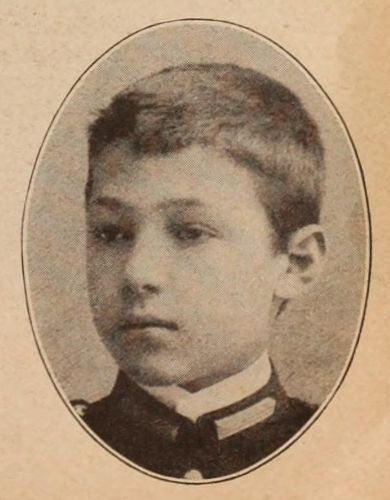
Before he became Rudolph Valentino, he was Rodolfo Guglielmi, a provincial Italian youth whose background contained little of the desert romance later attached to his name. Born in Castellaneta, Apulia, on May 6, 1895, he was the son of Giovanni Guglielmi, a veterinary surgeon, and Marie Berthe Gabrielle Barbin, who had been born in France. His family possessed social respectability but neither the wealth nor the aristocratic distinction that publicity departments would eventually insinuate. After an uneven education, he completed agricultural training at Nervi near Genoa but showed little interest in pursuing a conventional career. He sailed for the United States in 1913, arriving in New York as an eighteen-year-old immigrant with limited money and no clear profession. Later accounts turned that departure into the opening scene of an inevitable ascent, but nothing about his arrival distinguished him from the many young southern Europeans seeking an uncertain future in the city.
New York introduced Guglielmi to the unstable economy of service work, nightlife, and commercial entertainment. He supported himself intermittently as a waiter, restaurant dancer, exhibition partner, and performer available to wealthy women who wanted instruction in the fashionable tango. Dancing allowed him to convert qualities that exposed him to nativist suspicion (his accent, complexion, manners, and foreignness) into elements of cultivated allure. Newspaper attention surrounding his associations with prominent women also taught him that a public identity could be imposed by scandal before it was deliberately fashioned through fame.
Guglielmi reached California in 1917 after traveling west with a theatrical company and soon began obtaining minor screen roles. Hollywood did not initially recognize him as a romantic hero. Casting directors more often employed him as a cabaret dancer, seducer, criminal, or vaguely foreign antagonist whose appearance communicated danger without requiring elaborate explanation. These assignments reflected the racial hierarchy of American film, in which Mediterranean men could be treated as legally white yet visually marked as less fully Anglo-Saxon. His dark hair, careful dress, and controlled physical movement made him useful for characters coded as Italian, French, Spanish, South American, or simply “exotic.” Producers repeatedly treated those identities as interchangeable because cinematic ethnicity operated through costume and gesture more readily than national precision. During these years his professional name passed through several forms before settling into Rudolph Valentino, an elegant construction that preserved a trace of Italian origin while making it easier for American audiences to pronounce and remember. The future idol was not discovered whole; he emerged gradually from a succession of roles that taught filmmakers how his difference might be sold.
The decisive transformation came with Rex Ingram’s The Four Horsemen of the Apocalypse in 1921. Screenwriter and Metro executive June Mathis pressed for Valentino to play Julio Desnoyers, the pleasure-seeking grandson of an Argentine landowner who is morally transformed by the First World War. In the film’s celebrated tango sequence, Valentino commands attention through posture, rhythm, and an intense awareness of the camera rather than through dialogue. His character could appear sensuous without becoming ridiculous and foreign without remaining permanently outside the moral community represented by the film. The picture’s extraordinary commercial success elevated a supporting player into a nationally recognizable personality almost immediately. More important than the speed of that ascent was its visual foundation: audiences remembered the angle of Valentino’s head, the precision of his movements, and the face brought near by the close-up.
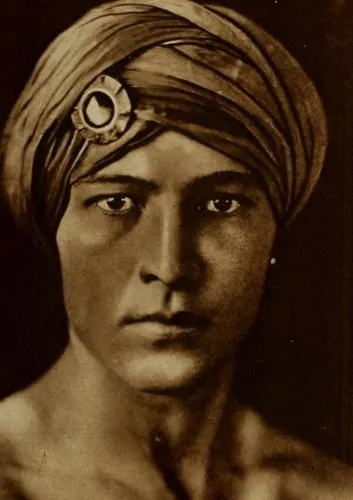
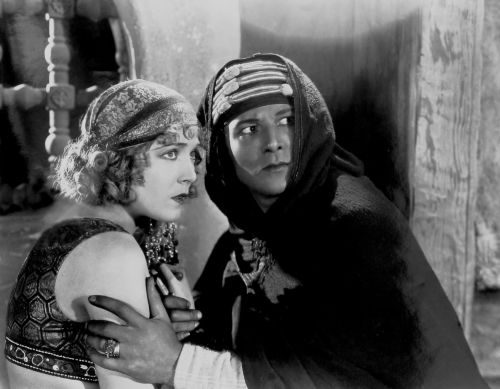
The Sheik, released later in 1921, converted that sudden visibility into a durable romantic identity. Valentino played Ahmed Ben Hassan, who abducts the Englishwoman Diana Mayo and subjects her to an erotic authority that the film simultaneously invites and disavows. The revelation that Ahmed is the son of European parents made his apparent racial difference thrilling but ultimately containable for white American audiences. Valentino’s performance allowed female spectatorship to become unusually explicit, since the camera lingered upon his eyes, clothing, and body as objects intended to be examined. Publicity increasingly described him through such phrases as “the Latin Lover” and “the Great Lover,” labels broad enough to encompass roles having little geographical consistency. In Blood and Sand he became the Spanish bullfighter Juan Gallardo, while The Eagle placed him within an imagined imperial Russia and The Son of the Sheik returned him to the desert fantasy that had most firmly defined his stardom. These characters were not identical: some displayed vulnerability, humor, divided loyalties, or moral weakness that the simplified lover image could not contain. Nevertheless, posters and fan magazines extracted a recognizable Valentino from their differences. Because silent films could travel with translated intertitles, his face and movements crossed linguistic borders more readily than the personality of a performer whose appeal depended upon a particular speaking voice. Hollywood had produced an international figure by making national ambiguity itself part of his attraction.
That figure was sustained between films by an expanding publicity apparatus. Studio portraits, fan-magazine profiles, ghostwritten statements, and reports about Valentino’s marriages invited readers to treat his private life as an extension of his screen romances. His partnership with costume and set designer Natacha Rambova added an element of artistic sophistication, while their troubled marriage supplied journalists with a continuing domestic drama. During a contract dispute that kept him away from filmmaking, Valentino and Rambova undertook a heavily publicized national dance tour sponsored by Mineralava beauty products, meeting audiences who had previously known him only as projected light. Such promotion manufactured familiarity, but it worked because Valentino contributed actively to the process and because admirers used the resulting material to form interpretations that studios could never completely control.
“The Great Lover” was never a secure or universally admired creation. Male commentators frequently treated Valentino’s clothing, cosmetics, jewelry, dancing, and apparent appeal to women as evidence that modern consumer culture was weakening American masculinity. The most notorious attack came in the Chicago Daily Tribune editorial “Pink Powder Puffs,” published in July 1926, which associated a powder dispenser in a men’s washroom with the feminizing influence supposedly represented by Valentino. He answered by challenging the anonymous writer to a boxing match and publicly demonstrating that elegance did not preclude physical courage. The dispute unfolded as The Son of the Sheik restored him to his most successful romantic type, giving his career the appearance of renewed momentum shortly before his fatal illness. By then Valentino signified contradictory things to different audiences: erotic confidence, foreign danger, artistic sensitivity, racial uncertainty, and a form of masculinity organized around being watched. When he died, admirers did not mourn an unmediated private man, but neither did they grieve an empty advertising invention. They mourned a face whose accumulated meanings had become intimate precisely because cinema and publicity had carried it so far beyond the person who possessed it.
Intimacy Without Acquaintance: Why Audiences Felt They Knew Valentino
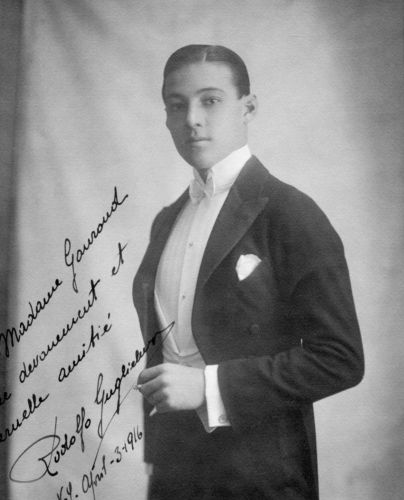
To say that Valentino’s admirers felt they knew him does not mean that they mistook a film performance for an ordinary friendship. Motion pictures had created a different kind of familiarity, one based upon repeated visual access without reciprocal contact. The close-up revealed minute changes in expression that would ordinarily have been visible only across a small physical distance. Repeated screenings allowed spectators to study the same gestures until they became as recognizable as the mannerisms of an acquaintance. Because silent films did not provide a standardized recorded voice, audiences could imagine accents, tones, and emotional shades that varied from one theater or spectator to another. Between pictures, photographs and magazine stories kept the star present even when he had no new film in circulation. The result was an intimacy assembled from fragments but experienced through the habits of ordinary life.
The developing star system carried Valentino beyond the characters he played by promising access to the personality behind them. Publications such as Photoplay and Motion Picture Magazine displayed portraits, reported his romantic difficulties, described his clothing, and presented opinions attributed to him about love or marriage. Studio publicity departments supplied much of this material, although editors reshaped it and Valentino sometimes attempted to assert his own version of events. The contradictions between reports did not necessarily weaken audience interest; they gave admirers more material to interpret and debate. Valentino consequently existed in public culture as an unfinished story whose next film, relationship, interview, or dispute might disclose something more.
Social scientists Donald Horton and R. Richard Wohl introduced the term “parasocial interaction” in 1956 to describe the illusion of face-to-face intimacy created by mass media. Applied retrospectively, the concept helps explain how a performer can occupy an emotionally meaningful place in the life of someone he has never encountered. It should not be used to diagnose Valentino’s admirers as incapable of distinguishing fantasy from reality. Fans frequently understood that interviews were polished, photographs posed, and screen roles fictional. They compared publicity accounts, criticized studios, and distinguished between the characters Valentino portrayed and the personality they believed existed beneath them. Enjoyment often depended upon moving knowingly between belief and skepticism rather than accepting every story as fact. Fan clubs and magazine correspondence also converted individual attachment into social participation, allowing readers to exchange interpretations with people who shared their interest. Valentino did not speak privately to each admirer, but audiences could make him part of friendships, courtship fantasies, and arguments about modern life. The relationship was profoundly unequal, yet asymmetry did not prevent it from acquiring emotional force.
Valentino’s appeal became particularly consequential because his films made male beauty available for sustained female observation. In The Four Horsemen of the Apocalypse, The Sheik, and Blood and Sand, the camera invited spectators to examine his face, clothing, movement, and moments of emotional submission rather than treating the male body solely as the bearer of action. As Miriam Hansen has argued, his stardom opened an unstable space in which women could recognize their own desire while identifying with characters who resisted, negotiated, or surrendered to his authority. The narratives frequently attempted to contain that instability through marriage, sacrifice, or revelations of respectable ancestry, but the pleasure of looking could not be withdrawn once the image had been circulated.
Valentino’s public was never composed solely of women overwhelmed by romantic fantasy. Men watched his films, followed his disputes, imitated aspects of his dress, or defined their own masculinity by loudly rejecting his example. His Italian birth offered some immigrant spectators a source of pride, although the generalized “Latin Lover” image also reduced a particular national identity to an exotic commodity created for American consumption. Anglo-American admirers could interpret his foreignness as liberation from familiar courtship conventions, while nativist critics treated the same qualities as evidence of racial and sexual instability. International audiences encountered yet other Valentinos because distributors, translators, exhibitors, and local journalists adapted his image to different cultural settings. Class shaped the encounter as well: inexpensive movie admission made repeated visual access possible for clerks, factory workers, and young people whose opportunities to approach elite theatrical celebrities had been limited. No single interpretation explains his popularity. The very ambiguity of his appearance allowed spectators to attach incompatible meanings to the same face. What joined them was not agreement about who Valentino really was, but confidence that the accumulated images gave them some basis for deciding.
His sudden death disrupted a relationship organized around repetition and expectation. Admirers had assumed there would be another performance through which earlier impressions could be revised, confirmed, or replaced. Because Valentino was only thirty-one and had just returned to one of his most successful roles in The Son of the Sheik, his career appeared to promise continuation rather than closure. Reports from the hospital transformed private concern into a collective vigil as newspapers delivered successive claims of improvement, danger, and renewed hope. When he died, audiences mourned both the familiar image they had accumulated and the imagined future in which it would have continued to appear. The public viewing at Campbell’s offered the possibility of replacing photographic knowledge with one moment of physical proximity, even though death made reciprocity more impossible than ever. By gathering together, mourners confirmed that an attachment experienced privately in darkened theaters had also been shared by strangers around the world.
Eight Days of Bulletins: When Illness Became a Serial Drama
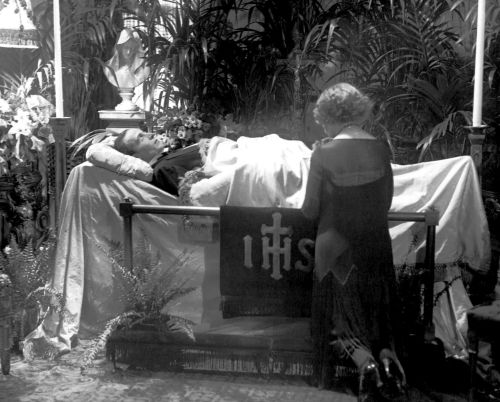
On August 15, 1926, Valentino suffered an acute attack of abdominal pain in his suite at New York’s Hotel Ambassador. He had experienced digestive discomfort before, but the severity of the new episode made ordinary explanations such as indigestion impossible to sustain. An ambulance carried him to the New York Polyclinic Hospital, where physicians confronted a rapidly developing abdominal emergency. The collapse came while The Son of the Sheik was renewing his commercial fortunes and the dispute over the “Pink Powder Puffs” editorial was keeping his name in newspapers. Valentino consequently entered the hospital not as a private patient but as a celebrity whose body had already become an object of public argument. His youth and carefully maintained appearance made the seriousness of his condition difficult for admirers to accept. Within hours, the promotion of a film star had been displaced by the management of a medical crisis.
The symptoms initially pointed toward appendicitis, but surgery revealed a perforated gastric ulcer that had released corrosive material into the abdominal cavity. The operation addressed the perforation and included removal of the appendix, leaving Valentino vulnerable to peritonitis and other postoperative complications. Physicians later applied the name “Valentino’s syndrome” to cases in which a perforated peptic ulcer produces pain resembling acute appendicitis. Contemporary newspapers presented the procedure more simply as a grave but successful double operation, language that encouraged readers to believe the principal danger had been overcome.
News of the hospitalization spread before doctors could establish a reliable prognosis. Medical statements issued through the hospital and Valentino’s manager, S. George Ullman, supplied newspapers with changes in temperature, pulse, breathing, pain, and alertness. Morning editions announced developments that afternoon papers revised, while wire services carried condensed versions across the United States and abroad. Each bulletin appeared to provide direct access to the sickroom even though readers received information selected by physicians, managers, and editors. Routine fluctuations acquired narrative importance because they could be interpreted as evidence of recovery or impending death. Valentino’s reported conversations, appetite, sleep, and expressions of confidence became public events. Optimistic phrases produced declarations that the danger had passed, only for later editions to restore suspense when his condition changed. Medical observation had become the raw material of a continuing celebrity story.
Admirers began gathering outside the Polyclinic, although their numbers remained smaller and more manageable than the crowds that would later surround Campbell’s funeral establishment. Flowers, telegrams, letters, and telephone inquiries arrived in quantities that strained the hospital’s ability to receive them. Messages came from film colleagues, political figures, fan organizations, and individuals who signed themselves simply as devoted admirers. Each public bulletin allowed this dispersed audience to participate in a collective vigil without entering Valentino’s room. The communications directed toward the hospital made an otherwise invisible network of attachment physically measurable.
The initial optimism was not entirely a creation of publicity. Valentino survived the operation, regained consciousness, spoke with attendants, and appeared for a time to be responding well enough that doctors discussed eventual recovery. Newspapers reported these signs with a confidence that exceeded the uncertainty inherent in major abdominal surgery before antibiotics. Infection remained an overwhelming danger, particularly after the contents of a perforated ulcer had entered the abdominal cavity. Valentino subsequently developed severe pleural and respiratory complications, and his strength declined as his breathing became more difficult. The language of the bulletins changed from “satisfactory” to “serious,” then to “grave” and “critical,” giving readers a sequence of recognizable narrative turns. Rumors moved into the spaces that medical statements could not fill. Some reports revived suggestions of poisoning, concealed violence, or a mysterious injury, while others claimed that the illness had been devised to advertise The Son of the Sheik. The implausibility of the publicity accusation did not prevent its circulation because Valentino’s public life had trained journalists and readers to search for promotion behind every event. Even genuine physical collapse could be interpreted as another performance.
By August 22, physicians acknowledged that Valentino was critically ill and offered little basis for the recovery predicted earlier in the week. His condition deteriorated through the night as infection and respiratory failure exhausted a body already weakened by surgery. He died at the Polyclinic at 12:10 p.m. on August 23, eight days after his collapse and only a few months after his thirty-first birthday. News services transmitted the announcement immediately, newspapers prepared extra editions, and crowds formed at locations associated with him before arrangements for the body had been completed.
The eight-day vigil changed the social meaning of Valentino’s death before the funeral began. Readers had followed his condition through a succession of episodes that reproduced the suspense of serial entertainment without offering the assurance that a hero would survive the final installment. Medical bulletins created an impression of shared presence, inviting strangers to experience themselves as witnesses standing just beyond the hospital door. The suspicion that the illness might be a publicity device revealed how thoroughly commercial performance had shaped expectations of Valentino, but it also showed that publicity depended upon an audience attentive enough to question what it was being shown. By the time the announcement of death arrived, millions had already invested attention in the possibility of recovery. The crowds outside Campbell’s did not materialize solely in response to a completed death; they emerged from a public vigil that had accumulated anxiety over more than a week. Illness had prepared the audience, and the removal of Valentino’s body from the hospital gave that audience a new place to assemble.
Frank Campbell and the “Funeral Church”: When Death Entered Show Business

By 1926, Frank E. Campbell had become one of the most prominent figures in the transformation of American undertaking into a modern service industry. Earlier funerals had ordinarily centered upon the family residence, where relatives washed, watched, and displayed the dead with assistance from local tradesmen. Embalming, urbanization, apartment living, and the professional ambitions of undertakers gradually transferred many of those responsibilities to specialized establishments. Campbell, who founded his business in Manhattan in 1898, embraced that transition more confidently than competitors who continued to present themselves as discreet suppliers of coffins and hearses. He offered chapels, private viewing rooms, embalming facilities, transportation, floral coordination, and the management of ceremonies as parts of a unified service. His establishment promised to protect bereaved families from logistical burdens while giving death an appearance of controlled dignity. It was an approach suited to affluent New Yorkers and valuable when the deceased possessed a public reputation that made an ordinary household funeral impossible.
The phrase “Funeral Church” was central to Campbell’s presentation of his business. It replaced the workshop associations of the undertaking trade with the solemnity of sacred architecture, even though the establishment was commercial rather than consecrated space. Its rooms could accommodate people whose religious service would later occur in a Catholic, Protestant, or Jewish house of worship. The name joined spiritual reassurance to professional convenience while making the modern funeral home appear less like an intrusion of business into mourning.
Valentino’s body was transferred from the Polyclinic Hospital to Campbell’s establishment at Broadway and Sixty-sixth Street soon after his death on August 23. Campbell’s staff embalmed and prepared him for an extended public viewing that no private residence could have supported. He was dressed formally and placed in an ornate open casket within the room generally described as the Gold Room. Flowers, subdued lighting, expensive furnishings, and carefully controlled access framed the body in a setting designed to communicate distinction. The arrangement also preserved visual continuity between the dead man and the screen personality that admirers expected to recognize. Visitors would not merely confront human remains; they would search Valentino’s face for confirmation that the familiar image had belonged to an actual person. Embalming and cosmetic preparation made that recognition possible by delaying the visible effects of death. The open casket stood at the threshold between private mortality and the reproducible appearance upon which cinematic stardom depended.
Control over the body was divided among people whose authority came from different sources. S. George Ullman, Valentino’s manager, directed many of the immediate arrangements and sought to defend the reputation of a client who could no longer approve decisions for himself. Valentino’s closest relatives were outside New York, leaving friends and professional associates to act before the family could assume a substantial role. Campbell possessed the technical facilities and experience required to manage the remains, while Catholic clergy retained authority over the requiem Mass that would follow the viewing. Film executives, publicists, journalists, Pola Negri, and other claimants entered the process with their own ideas about how Valentino should be presented. The resulting spectacle did not proceed from a single plan imposed by one omnipotent funeral director.
Campbell nevertheless understood that famous deaths could advertise the competence and prestige of his establishment. His publicity representative, Frank Mallen, maintained relationships with reporters and supplied information that kept the Campbell name attached to prominent funerals. Announced viewing hours gave newspapers a specific place and time toward which they could direct Valentino’s admirers. Reporters received descriptions of the casket, flowers, rooms, visitors, and preparations, turning ordinary funeral decisions into publishable details. The resulting coverage promoted Valentino’s final appearance while demonstrating that Campbell’s organization had been entrusted with the most celebrated death in America. Mallen later portrayed funeral publicity as a field of calculated inventions and audacious promotional maneuvers, but his retrospective claims cannot be accepted without corroboration. Stories that Campbell’s employees hired mourners, planted Blackshirts, or deliberately caused disturbances often derive from recollections produced after the funeral had already become legendary. The absence of proof for complete orchestration does not make the establishment a passive bystander, since it created the public viewing, cultivated reporters, and benefited from the attention. It does mean that the dangerous crowd outside cannot be reduced to an audience assembled by one publicist’s command.
To say that death entered show business at Campbell’s is not to claim that professional funeral care was inherently fraudulent. Valentino’s body required preservation, shelter, transportation, and a setting in which mourners could approach it, and Campbell provided those services under extraordinary pressure. Yet the Funeral Church also converted the corpse into the center of a managed public occasion shaped by schedules, décor, publicity, and expectations of visual access. Its rooms borrowed the solemnity of religious ritual while offering the organized presentation associated with hotels and theaters. Inside, attendants attempted to move visitors past the casket in an orderly procession; outside, newspapers, cameras, police, and arriving spectators generated forces the establishment could not contain. Campbell had constructed a place where the public could encounter the dead star, but opening its doors also transferred the funeral’s meaning to the crowd gathering on Broadway.
Broadway and Sixty-sixth Street: Crowds and Mounted Police
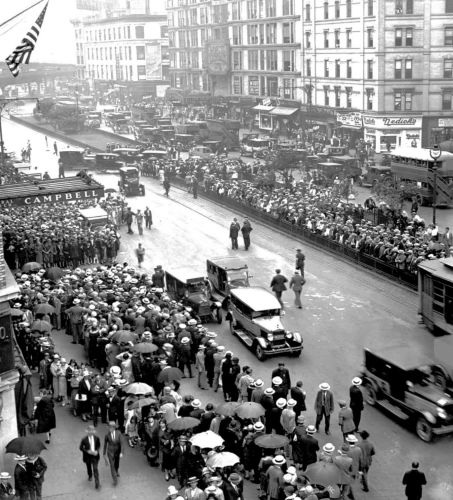
Before the public viewing opened on August 24, admirers had already begun gathering outside Campbell’s Funeral Church at Broadway and Sixty-sixth Street. Announcements of the viewing gave people a common destination, while newspaper reports of Valentino’s death encouraged them to arrive early enough to secure admission. The location stood within a busy commercial district whose ordinary traffic continued around the developing funeral crowd. Rain, umbrellas, streetcars, newspaper vendors, press photographers, and people stopping merely to discover what was happening complicated attempts to form an orderly line. Some visitors had traveled specifically to see Valentino, while others joined after encountering the crowd or reading rapidly issued newspaper extras. Police initially approached the gathering as a queue requiring direction rather than as a mass capable of filling the surrounding streets. By the time the doors opened, the distinction between a line of mourners and an urban crowd had largely disappeared.
Inside Campbell’s, attendants attempted to maintain movement by allowing visitors only a few moments before the open casket. One contemporary newspaper account estimated that approximately eighty people passed the bier each minute, a pace that would have moved thousands through the room during a single hour. Even that speed could not match the rate at which people arrived, and any interruption inside transmitted additional pressure to those waiting beyond the entrance. The system created public access by making the encounter extraordinarily brief: admirers waited for hours to receive seconds in the presence of the body.
As the crowd thickened, barricades shifted, people were forced against storefronts, and plate glass shattered near the funeral establishment. Police reserves arrived from surrounding precincts until contemporary reports placed roughly 200 officers in the area. Mounted patrolmen pushed through portions of the crowd while officers on foot attempted to open passages for traffic and emergency vehicles. Surviving newsreel outtakes confirm a dense gathering struggling around horses, police lines, and temporary barriers. They also show how difficult it was for individuals caught near the center to move independently of those around them. The footage does not establish the coordinated violence implied by the word “riot.” Newspaper estimates of injuries varied widely, sometimes combining people cut by glass with those who fainted, fell, or required assistance after being compressed in the crowd. Reports rarely explained whether the injured received hospital treatment or were merely examined at the scene. Genuine disorder occurred, but the most sensational totals cannot be treated as precise measurements.
Nor did the people outside Campbell’s constitute a psychologically uniform mob. Photographs and moving images show women and men of different ages, alongside photographers, newsboys, police, funeral employees, and spectators who may never have intended to enter the building. Some individuals were visibly distressed, but others watched with curiosity or appeared conscious of the cameras recording them. Police tactics treated this socially mixed gathering as a single physical hazard, an approach that could restore movement in one location while intensifying compression somewhere else. Fainting and panic under such conditions provide evidence of heat, exhaustion, fear, or restricted breathing as readily as they demonstrate uncontrollable grief.
The press transformed these unstable street conditions into a self-reinforcing spectacle. Photographers sought images of broken windows, mounted officers, and collapsing mourners because such scenes made the funeral legible as an extraordinary public emergency. Newsreel cameramen turned their lenses away from the building and toward the people, preserving the audience more extensively than the viewing taking place inside. Newspaper coverage published the next morning confirmed that Broadway and Sixty-sixth Street had become a place where history could be witnessed, encouraging further arrivals. Campbell’s open doors drew people toward the body, while police deployment and media attention made the crowd itself an additional attraction. Exact attendance figures remain impossible to verify because reports rarely distinguished those who passed the casket from those who entered the neighborhood or returned on another day. The documented core requires no exaggeration: an enormous crowd gathered, glass broke, people were injured, and hundreds of police officers struggled to control the streets. What cannot be recovered so easily is the motive of each person whose presence was absorbed into the single enduring image of mass mourning.
Who Was “Hysterical”? Gendering the Valentino Crowd
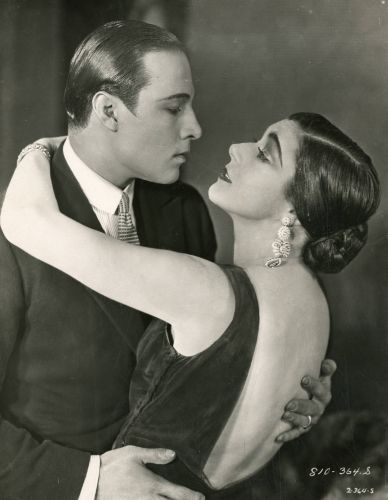
Contemporary reports did not merely describe the people outside Campbell’s; they assigned the crowd a gender and then used that gender to explain its behavior. The most persistent figure to emerge from the coverage was the emotionally ungovernable female admirer. Women were reported crying, fainting, screaming Valentino’s name, fighting for admission, and collapsing after viewing his body. Such incidents occurred, and there is no reason to assume that every expression of distress was invented for the newspapers. The distortion came from treating selected behavior as representative of an enormous gathering whose members had arrived for different reasons. Once the crowd became a mob of “hysterical women,” curiosity, physical exhaustion, police pressure, and sincere religious mourning could be compressed into a single sensational explanation. Before determining what the funeral revealed about female fandom, it is necessary to ask who benefited from describing women as incapable of governing themselves.
“Hysteria” carried a long history of medical and cultural association with the female body. By the 1920s, the word had moved far beyond formal diagnosis and functioned in popular journalism as shorthand for collective excitement considered irrational or excessive. Applied to Valentino’s mourners, it converted observable actions into symptoms while discouraging inquiry into the physical conditions under which those actions occurred. The same report could describe an aggressive man as unruly or curious while treating a fainting woman as evidence that celebrity worship had overwhelmed female reason.
The surviving visual record complicates that interpretation. Newsreel outtakes and press photographs show many women, but they also show men, boys, police officers, news vendors, funeral employees, and bystanders filling the streets around Campbell’s. Women may well have formed a large portion of the committed fan audience, yet the images do not permit a reliable count of those who intended to enter the funeral home. Camera placement favored the most congested locations and directed attention toward people whose reactions appeared dramatic. A crying mourner made a more marketable photograph than someone waiting quietly, while a woman losing consciousness supported an existing story about Valentino’s sexual power. Neither a photograph nor a few seconds of film can disclose whether the person depicted was grieving, frightened, exhausted, or reacting to the pressure of bodies nearby. Rain, prolonged standing, limited access to water, and restrictive clothing created ordinary conditions for physical collapse. Mounted police added another source of danger by introducing large animals into streets where individuals had little room to move. The images confirm distress, but the captions often supplied its gendered meaning.
Gender mattered because Valentino’s stardom had made women’s desire unusually public before his death. His films placed the male face and body under sustained visual examination, allowing female spectators to discuss attraction with a frankness that unsettled critics accustomed to treating women as objects rather than agents of the gaze. Mourning then carried that desire out of the darkened theater and into a public street where it could be photographed. H. L. Mencken recognized that male hostility toward Valentino reflected resentment of a performer whose appeal exposed the insecurity of his detractors. Describing the women outside Campbell’s as hysterical contained the threat by presenting their attraction as a disorder rather than a legitimate response to a new kind of screen masculinity.
The vocabulary of the funeral also distributed dignity unevenly among its participants. Male film executives, managers, pallbearers, clergy, and civic officials could perform grief through formal dress and ceremonial responsibility without having their sincerity questioned. Police commanders received credit for confronting disorder even when crowd-control tactics intensified fear or compression. Journalists who sought sensational scenes were treated as professionals rather than participants whose presence affected the event. Male spectators could disappear into the neutral category of “the crowd,” while female spectators were repeatedly identified by sex and interpreted through emotion. Pola Negri would become the most conspicuous example of this imbalance when her mourning was judged as acting, although calculated behavior by publicists and funeral managers remained classified as ordinary business. Some women undoubtedly performed for cameras or adopted recognizable gestures of romantic bereavement, but performance does not establish emotional emptiness. Public mourning always involves conventions through which people make private feeling intelligible to others. Female admirers possessed agency within those conventions even when newspapers reduced them to victims of their own desire.
Once the crowd had been represented as hysterically female, more extravagant stories became easier to believe. Reports of isolated suicides, attempted self-harm, visions, and vows of eternal devotion appeared plausible because readers had already been shown women supposedly losing control outside the casket. Later retellings preserved those anecdotes while allowing the quieter mourners and the substantial male presence to recede from view. A critical account should not replace the stereotype with an equally unsupported picture of uniformly solemn fans. The evidence instead reveals a mixed gathering in which grief coexisted with curiosity, physical danger, opportunism, and awareness of the cameras. The important historical question is not whether any woman behaved hysterically, but why female emotion became the master explanation for an event produced by many institutions and many kinds of people.
The Tabloid Wake: Composographs and Séances
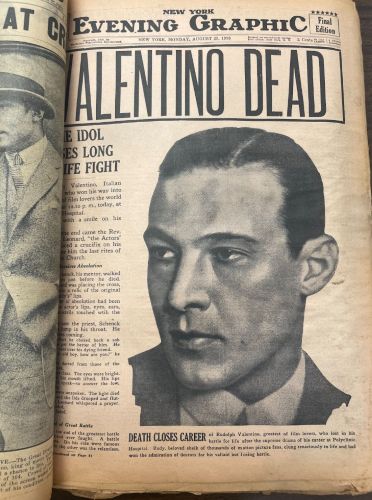
Valentino died during a period of ferocious competition among New York’s mass-circulation newspapers. The Daily News had demonstrated that a compact paper dominated by photographs, crime, scandal, and human-interest stories could attract an enormous urban readership. William Randolph Hearst’s Daily Mirror and Bernarr Macfadden’s Evening Graphic pursued much of the same audience with increasingly sensational material. These papers did not abandon conventional reporting, but they judged news partly by its capacity to produce emotion at a glance. Valentino offered an ideal subject because his face was instantly recognizable and his private life had already been narrated as continuing entertainment. Death added grief, mystery, and the possibility of excess to a personality constructed around romance. The funeral consequently became a competition over which newspaper could provide the closest, strangest, or most emotionally charged access to the dead star.
The hospital bulletins had already taught readers to expect another development with each edition. After Valentino died, newspapers transferred that rhythm to the removal of his body, the gathering crowd, the public viewing, and the approaching funeral. Vendors sold papers near Campbell’s to people who were simultaneously appearing in the next round of coverage. Reporting the spectacle and enlarging its audience became parts of the same commercial process.
The Evening Graphic, guided editorially by Emile Gauvreau, pushed that process furthest through images it called “composographs.” These were constructed photographs in which posed bodies, copied faces, painted settings, and other visual fragments were assembled to represent scenes no camera had actually recorded. The paper created a purported view of Valentino’s operation, supplying visual access to an event from which journalists had been excluded. It also fabricated an image of his lying in state when ordinary press photography could not deliver the desired intimacy. The most extravagant composition depicted Valentino entering heaven and being welcomed by Enrico Caruso, another immigrant performer whose death had inspired mass public mourning. Such pictures did not function exactly like concealed modern photographic forgeries, since the term “composograph” sometimes warned attentive readers that construction had occurred. Their page placement and realistic visual language nevertheless weakened the boundary between documentation and theatrical reconstruction. The image offered emotional satisfaction before a reader had time to ask whether the depicted event could possibly have been photographed. Valentino’s death became a production in which the absence of evidence licensed invention rather than imposing silence.
Séances extended that license beyond the grave. Spiritualism retained a substantial following after the First World War and the influenza pandemic had left millions searching for reassurance that death did not end personal communication. Newspapers promoted mediums who claimed to have contacted Valentino or received messages attributed to his spirit. Reports of these encounters gave the dead actor opinions, emotions, and continuing awareness, allowing an exclusive interview to occur without a subject capable of denying it. The séance converted Valentino’s silence into renewable copy while offering some admirers a form of consolation that conventional funeral reporting could not supply.
Stories of suicide performed a similar function by presenting Valentino’s emotional power as literally fatal. The familiar legend of numerous women killing themselves after his death emerged from reports that differed greatly in evidentiary quality. An unrelated death could acquire a Valentino connection through a photograph found in a room, a remark remembered by an acquaintance, or a reporter’s speculation about timing. Suicide attempts, threats, accidents, and completed deaths were then discussed together as though they demonstrated one coherent phenomenon. Wire-service repetition stripped away local uncertainty and made the same incident appear independently confirmed in several cities. Later summaries sometimes counted recycled versions as separate cases. The existing portrait of the hysterical female fan made such stories believable before verification, since readers had already been encouraged to imagine women surrendering reason to desire. Newspaper competition rewarded the first dramatic connection rather than the slow reconstruction of a deceased person’s circumstances. The surviving evidence supports scattered episodes of severe distress, but it does not establish a mass suicide epidemic caused by Valentino’s death.
The strongest documented case is that of London actress Peggy Scott, whose suicide was explicitly associated with Valentino in contemporary reporting. Even this case cannot bear the weight later placed upon it, because suicide ordinarily arises from circumstances more complicated than a single public event can explain. One death with a reported connection to Valentino does not validate unrelated stories or transform grief into a contagious female pathology. Treating Scott primarily as proof of Valentino’s irresistible power also erases her own history by turning her death into a supporting episode in the biography of a famous man.
The tabloid archive is indispensable and treacherous in equal measure. Newspapers preserved dates, locations, crowd scenes, official statements, and public reactions that cannot be recovered from later biographies alone. They also staged images, sponsored extraordinary claims, and repeated weakly supported anecdotes until familiarity gave them the appearance of fact. The most defensible history separates the well-documented scale of the response from the commercial legends attached to it. Genuine mourning made the funeral newsworthy, but tabloid methods selected the most extreme expressions and presented them as the essence of the event. The resulting “wake” occurred across newspaper pages, where Valentino could undergo surgery again, enter heaven, speak through mediums, and inspire deaths beyond his own. Once that imaginative authority had been established, a wreath and a group of Blackshirts could likewise be transformed into evidence that Mussolini himself had entered the funeral drama.
Blackshirts at the Bier: Mussolini, Italian Identity, and a Disputed Publicity Coup
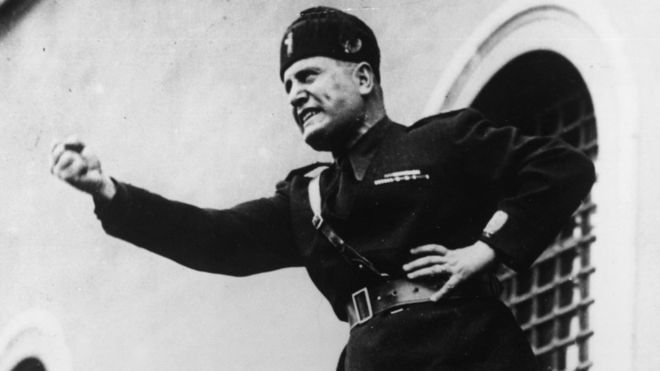
Among the most arresting photographs taken inside Campbell’s are images of men in black shirts standing near Valentino’s open casket. Their uniforms and Fascist salutes introduced an explicitly political symbol into a room otherwise organized around cinematic fame and personal mourning. Contemporary reports associated the men with a wreath said to have been sent by Benito Mussolini. From those visible elements emerged the enduring story that the Italian dictator had dispatched an official honor guard to watch over the dead actor. The photographs establish that Blackshirts were present, but they cannot reveal who summoned them or what authority they possessed. A uniform worn in New York did not automatically represent the Italian government. The distinction between documented presence and claimed sponsorship is the central problem beneath the familiar anecdote.
Fascism was not a remote European abstraction in New York during the 1920s. Mussolini’s consolidation of dictatorship inspired organizations among portions of the Italian diaspora, including local fasci whose members wore Blackshirts and participated in political ceremonies. Consular officials and Fascist organizers attempted to influence how Italian identity was represented abroad, while antifascists opposed them through labor associations, newspapers, and immigrant political networks. Italian Americans did not respond to Mussolini with a single ethnic loyalty. The appearance of Blackshirts at a famous Italian immigrant’s bier was a partisan intervention rather than a natural expression of communal mourning.
Valentino had left Italy in 1913, years before Mussolini’s movement took power, and his international celebrity had developed almost entirely outside Italian institutions. Hollywood presented him through a generalized exoticism that treated Arab, Spanish, Russian, Argentine, and Italian associations as commercially interchangeable. Fascist culture, by contrast, promoted an ideal of disciplined masculinity tied to military strength, national obedience, and political action. Valentino’s dancing, elaborate clothing, romantic vulnerability, and status as an object of female observation had exposed him to accusations of effeminacy in the United States. Those qualities made him an awkward representative of the Fascist “new man.” His worldwide fame nevertheless made him too valuable to ignore, especially when his death created an opportunity to claim that the most recognizable Italian face in American culture remained symbolically loyal to the homeland. Fascist appropriation did not require Valentino to have supported the regime; it required only that his nationality could be detached from his own political choices.
The wreath supposedly sent by Mussolini performed that appropriation with unusual efficiency. Floral tributes were not merely decorations but public messages whose ribbons identified the status and relationship of their donors. Attaching Mussolini’s name to a conspicuous arrangement placed the dictator among Valentino’s recognized mourners whether or not he had personally ordered it. The wreath converted the actor’s body into a site where political authority could be asserted without his consent.
Two competing explanations have dominated later accounts of the Blackshirts. The first repeats contemporary publicity and treats the men as an official delegation sent from Rome by Mussolini. The second presents the entire scene as a fabrication devised by Campbell’s press operation, often claiming that Frank Mallen hired four actors, supplied their uniforms, and invented the dictator’s wreath. Mallen’s later memoir encouraged the image of funeral publicity as a succession of ingenious deceptions, but recollections published decades afterward gave him a professional incentive to magnify his own cunning. Giorgio Bertellini’s reconstruction of the episode places it instead within the documented activity of American Fascists who were eager to associate themselves with both Mussolini and Valentino. Local Blackshirts did not need to be imported from Italy or invented in a funeral office. Campbell’s publicists may still have facilitated their appearance, alerted photographers, or allowed an uncertain claim of official sponsorship to circulate. Political activists and commercial promoters could cooperate because both benefited from the resulting images. No surviving evidence securely demonstrates that Mussolini personally dispatched the guard, but the opposite claim that every participant was simply an actor is no better established.
Newspaper presentation obscured those distinctions. A caption identifying the men as Mussolini’s honor guard was more dramatic than an explanation of competing Italian American political organizations. The Blackshirt uniform and Roman salute condensed a complicated chain of local initiative, possible consular involvement, and publicity into the apparent presence of the Fascist state. Supporters could interpret the photograph as proof that the Duce honored an Italian who had conquered Hollywood. Antifascists could regard the same image as evidence that Mussolini’s followers were exploiting a defenseless corpse. For readers with little knowledge of diaspora politics, the scene added an international flourish to an already extravagant funeral.
The Blackshirts at the bier should be understood neither as a fully authenticated state delegation nor as a harmless theatrical decoration. Their presence represented an attempt to define what kind of Italian Valentino would become after death. The actor could no longer resist being transformed into a national emblem, just as he could no longer control the romantic persona constructed by Hollywood. His body was claimed simultaneously as that of an Italian expatriate, an American success story, a Catholic awaiting burial, and an international screen idol. Fascism entered this contest because political movements understood that celebrity offered access to emotions conventional propaganda could not easily command. The disputed honor guard reveals how quickly mourning could become an argument over ethnic ownership and masculine legitimacy. Whether arranged by committed activists, encouraged by publicists, or produced through cooperation between them, the scene succeeded because the cameras made a temporary performance appear like an official act of history.
Pola Negri Takes the Stage: Grief, Performance, and the Position of Chief Mourner
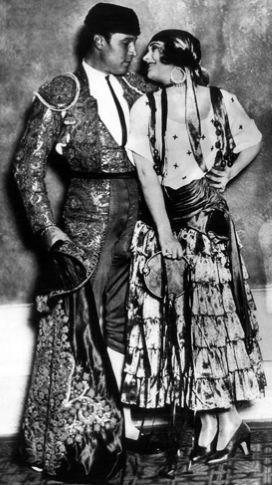
Valentino’s death brought another internationally recognizable face into the funeral drama. Pola Negri, the Polish-born actress who had risen through German cinema before becoming a Hollywood star, had been romantically associated with him during the final months of his life. She was in California when his illness became critical and began traveling east as newspapers followed both his condition and her progress. By the time she reached New York, Valentino was dead and the public viewing at Campbell’s had already become a national spectacle. Reporters met Negri not simply as a bereaved friend but as a celebrity whose reaction promised another chapter in the story. Her clothing, expressions, statements, and physical condition were scrutinized from the moment of her arrival. Private grief was impossible even before she entered the room containing Valentino’s body.
The relationship between Negri and Valentino was genuine enough to have been observed by friends and reported before his final illness. Whether they had reached a definite agreement to marry remains less certain. Negri publicly presented herself as his fiancée, while people within Valentino’s circle offered conflicting recollections about how firmly he had committed himself. Her later memoir strengthened the engagement narrative, but its retrospective account cannot substitute for contemporary confirmation from Valentino himself.
At Campbell’s, Negri asserted her relationship through gestures that photographers and reporters could immediately understand. A monumental floral tribute bearing her name made her presence visible even when she was not standing beside the casket. When she approached Valentino’s body, newspaper accounts described her embracing or leaning across the casket and then collapsing from grief. Reports of repeated fainting varied in detail, but the image of Negri overcome at the bier circulated far more widely than any precise reconstruction of what occurred inside the room. Attendants assisted her while cameras waited for the moments that would establish her as the funeral’s dominant female figure. Her behavior employed familiar conventions of melodrama, including the lover’s final approach to a body from which no answer could come. Those conventions did not originate with the press, but the press isolated them from the longer experience of exhaustion, shock, and bereavement surrounding the visit. By calling herself Valentino’s intended wife, Negri claimed an emotional authority that neither professional friendship nor membership in the film industry could have supplied. Valentino had no widow, and his family had not shaped the New York viewing, leaving a ceremonial position that she could occupy. Her visual prominence transformed an uncertain private status into the public role of chief mourner.
The simplest interpretation holds that Negri converted the funeral into an advertisement for herself. That conclusion overlooks the fact that she was an actress confronting loss in an environment where every spontaneous movement could be interpreted as professional technique. Theatrical expression may have been the language through which she habitually communicated intense emotion, especially when surrounded by strangers and cameras. Grief can be sincere while remaining conscious of its audience, just as restraint can conceal calculation rather than prove authenticity. The suspicion directed toward Negri also contrasted sharply with the tolerance granted to male managers, publishers, and publicists whose calculated actions were treated as ordinary work.
Negri continued to occupy the position she had claimed by appearing at the New York ceremonies and accompanying Valentino’s body westward. Her presence gave newspapers a recognizable protagonist who could carry the romantic narrative after the dead actor had become silent. It also exposed her to ridicule that outlasted the funeral, as later accounts reduced a successful international performer to the woman who collapsed theatrically over Valentino’s casket. Publicity offered no simple benefit: the same images that confirmed her importance also damaged her credibility. The role of chief mourner was manufactured through floral display, press repetition, and Negri’s own declarations, but manufacture did not make the underlying attachment imaginary. Like the Blackshirts who sought to define Valentino as an Italian national symbol, Negri attempted to establish a relationship with him that death had made impossible to clarify. Her claim was intimate rather than political, yet it likewise depended upon controlling the meaning of a body that could no longer answer. The lasting controversy over her conduct reveals how celebrity mourning turns the survivor’s grief into a public performance and then uses the visibility of that performance to question whether the grief was ever real.
From St. Malachy’s to Hollywood: The Funeral Journey Across America
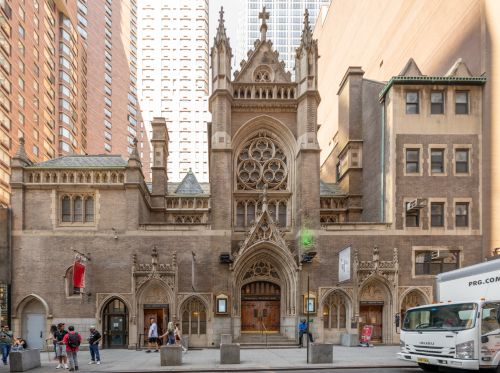
After several days of public viewing at Campbell’s, Valentino’s New York observances moved from a commercial funeral establishment into explicitly Catholic space. A requiem Mass was celebrated on August 30 at St. Malachy’s Church on West Forty-ninth Street. Known as the Actors’ Chapel because of its proximity and ministry to the theatrical district, St. Malachy’s connected Valentino’s religious identity with the profession that had made him famous. Attendance inside was restricted more carefully than access to the public viewing had been, allowing clergy and organizers to restore some ceremonial order. Valentino’s colleagues, managers, invited mourners, and representatives of the film industry occupied positions of recognized dignity within the church. The Mass located his death within Catholic ritual rather than the romantic mythology surrounding his screen roles. Yet the crowds outside ensured that the service could not become an entirely private religious occasion.
The transfer of the casket from Campbell’s to St. Malachy’s created another procession through streets already associated with the funeral spectacle. Police established barriers and attempted to prevent the pushing that had accompanied the public viewing. Inside, the liturgy subordinated individual celebrity to prayers for the dead, even as the identity of the deceased determined who received admission and why reporters waited nearby. Outside, those unable to enter watched the arrival of invited mourners and treated the passage of the casket as their final New York encounter with Valentino.
After the Mass, Valentino’s remains began a transcontinental railway journey to California. Railroads had long carried the bodies of political leaders and wealthy Americans, but motion-picture publicity gave this journey an unusually dispersed audience. Crowds assembled at stations along the route, sometimes waiting for a train that would pause only briefly before continuing west. Flowers and messages were brought to platforms even though admirers could not approach the sealed casket as they had at Campbell’s. Newspaper reports announced the train’s progress and allowed readers to imagine the dead actor moving through a national landscape his films had already traversed in projected form. S. George Ullman and members of the funeral party accompanied the body, preserving managerial oversight during the transfer. Pola Negri also traveled westward, extending her publicly claimed position as Valentino’s intended wife and principal mourner. Because the casket remained inaccessible, attention shifted toward the mourners who emerged from the train and the spectators waiting beside it. The railway journey transformed transportation into a succession of local memorial encounters without requiring a second public viewing in every city.
When the train reached Southern California, the film industry prepared a more controlled farewell than New York had managed. A second Catholic service took place at the Church of the Good Shepherd in Beverly Hills on September 7, 1926. Numerous later accounts assign the ceremony to September 14, but contemporary California newspapers reported the service and burial on September 7 itself. Police preparations, restricted admission, and the lessons of Campbell’s reduced the likelihood of another uncontrolled crush. Hollywood colleagues now occupied the ceremonial foreground, presenting the funeral as the return of an actor to the community in which his screen identity had been created.
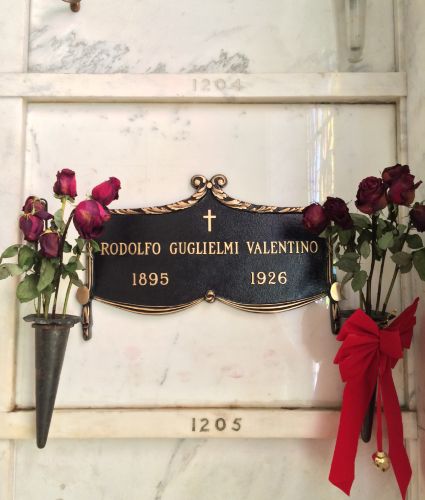
Following the church service, the casket was taken to Hollywood Memorial Park, the cemetery later renamed Hollywood Forever. Valentino had left no final plan specifying a permanent tomb, and the unexpectedness of his death forced friends and associates to improvise. June Mathis, the screenwriter who had championed his casting in The Four Horsemen of the Apocalypse, made available a crypt in the Cathedral Mausoleum. The arrangement was initially understood as temporary while a more elaborate memorial or another place of burial could be determined. No sufficiently supported alternative was completed, and the temporary interment gradually became permanent. The choice of Hollywood asserted that Valentino belonged where his cinematic identity had been made rather than in New York, where his public funeral had erupted, or in Italy, where he had been born. His relatives retained claims based upon family, while Mathis and the film community exercised practical authority derived from friendship and professional history. The cemetery absorbed those competing relationships by presenting the crypt as both an individual grave and a destination for admirers. An improvised solution thereby fixed Valentino within the geography of Hollywood memory.
The New York and California ceremonies framed different versions of the same death. Campbell’s had emphasized public access to the visible body, while Hollywood offered institutional closure through church ritual and cemetery interment. The railway joined those settings and allowed communities between them to participate without possessing the corpse. This national sequence complicates the tendency to reduce Valentino’s funeral to the disorder outside one Manhattan building. His mourning unfolded through a hospital vigil, an open casket, religious services, railway platforms, and final placement within a cinematic landscape. At each stage, a different group acquired temporary authority to define who Valentino had been. The journey across America demonstrated that celebrity mourning no longer required a single community gathered around a local grave; mass media could bind distant spectators to the movement of a body most of them would never see.
Anatomy of a Legend: What the Evidence Can and Cannot Establish
Few celebrity deaths possess an archive as abundant and as treacherous as Valentino’s. Newspapers published multiple editions each day, photographers crowded the streets, newsreel cameras recorded police and mourners, and participants later supplied memoirs claiming inside knowledge. This abundance creates the appearance that every familiar anecdote must be verifiable. Several newspapers often repeated the same wire report, while later authors copied details from one another without returning to the original source. A claim can appear in dozens of accounts while resting upon a single uncorroborated recollection. Photographs prove that something entered the camera’s frame, but captions may assign identities or motives the image cannot establish. Memoirs preserve information unavailable elsewhere while also allowing their authors to enlarge their own importance. A defensible reconstruction must distinguish what contemporary evidence demonstrates from what it merely suggests.
The secure core remains substantial. Valentino became critically ill after emergency abdominal surgery, died at the Polyclinic Hospital on August 23, and was prepared for an open-casket viewing at Campbell’s. Enormous crowds gathered, glass broke, injuries occurred, and police reserves struggled to manage the streets. Photographs confirm Pola Negri’s conspicuous floral tribute and the presence of Blackshirts near the bier, while church and newspaper records establish the New York Mass, the railway journey, the September 7 California service, and the interment at Hollywood Memorial Park.
Quantitative claims require more caution. Newspapers printed crowd estimates ranging through the tens of thousands and sometimes approaching 100,000, but they rarely explained whether those totals referred to one moment, an entire day, or everyone who entered the neighborhood. The frequently repeated figure of approximately 200 police officers is a contemporary estimate rather than a complete surviving deployment record. Reports that eighty mourners passed the casket each minute may accurately describe the intended pace without proving that it remained constant throughout the viewing. Injury totals likewise vary because some accounts counted those treated after falls or fainting, while others included everyone who requested assistance. Newsreel outtakes provide the strongest confirmation that dangerous crowd pressure and forceful policing occurred. They cannot count people outside the frame or explain what happened before the camera began recording. Editing, camera position, and the search for dramatic action shaped even apparently direct visual evidence. The word “riot” consequently describes the appearance newspapers gave the event more securely than it identifies a coordinated uprising against lawful authority. Disorder is certain; its scale and character remain open to qualification.
Motive is still more difficult to recover than numbers. The photographs of Blackshirts prove their presence but do not demonstrate that Mussolini personally dispatched them, that Campbell hired them, or that every man beside the casket understood his role in the same way. Negri’s visible collapse cannot establish whether she was acting, grieving without restraint, or experiencing both performance and sorrow simultaneously. A person waiting outside Campbell’s might have been a devoted admirer, a curious passerby, a newspaper seller, or someone drawn by the mounted police. Historical evidence can reconstruct the situations in which people acted more reliably than it can penetrate the private intention behind each action.
The weakest legends are those that replace evidentiary gaps with stories too vivid to resist repetition. No credible contemporary evidence supports the claim that a wax effigy was displayed while Valentino’s actual body remained hidden elsewhere. Embalmers, funeral employees, invited visitors, clergy, railway personnel, and cemetery workers handled or observed the remains at different stages, making such a substitution unnecessarily elaborate and practically implausible. The supposed epidemic of female suicides similarly dissolves when individual cases are traced. Peggy Scott’s death provides the strongest documented connection, but unrelated suicides, incomplete attempts, rumors, and recycled dispatches cannot be combined into a mass phenomenon. Claims that Campbell planted women to faint, hired people to start fights, or arranged the breaking of windows depend heavily upon later stories about publicity ingenuity rather than corroborated reports from 1926. Frank Mallen’s memoir is valuable evidence about the culture of funeral promotion, but it also rewards its author for portraying himself as the hidden architect of famous events. Emile Gauvreau’s recollections illuminate the Evening Graphic while celebrating the audacity of the newspaper he helped create. The equally popular assertion that Campbell simply hired four actors to impersonate Mussolini’s official guard reduces a more complicated Italian American political intervention to an elegant hoax. Later repetition turned each of these possibilities into a finished anecdote by removing the uncertainty that had accompanied the original event. Narrative completeness, rather than evidentiary strength, often determined what survived.
Critical separation of fact from legend does not diminish the funeral’s historical importance. The verified spectacle is already extraordinary without wax corpses, manufactured riots, an official command from Mussolini, or a wave of suicides. The legends matter because they expose contemporary fears that mass media could overpower women, blur politics with entertainment, and fabricate realities stronger than ordinary experience. They also reveal how celebrity history is produced when reporters become participants and memoirists inherit control over events whose other witnesses have disappeared. The historian’s task is not to recover a perfectly objective funeral hidden beneath every representation, since cameras, newspapers, and publicity helped create the event itself. It is to identify where the evidence ends and explain why particular inventions became more memorable than the complicated truths they replaced. That process of accumulation did not stop with Valentino’s burial; it continued as annual visitors, competing mourners, and the recurring Lady in Black turned a news event into ritual.
The Lady in Black: From News Event to Annual Ritual
Valentino’s interment did not bring the commercial or emotional life of his death to an end. Theaters promoted The Son of the Sheik as the final appearance of a star whose future performances had suddenly become impossible, while exhibitors revived earlier films for audiences seeking another encounter with his image. Fan magazines issued memorial articles, publishers produced commemorative volumes, and songwriters converted bereavement into material that could be purchased and repeated at home. The sale of Valentino’s possessions dispersed fragments of his domestic life among buyers who could claim physical contact with celebrity through ownership. His crypt at Hollywood Memorial Park provided something these commodities could not: a permanent location associated with the body itself. Admirers brought flowers and messages even when no organized ceremony was taking place. A death that had traveled through hospital bulletins and newspaper extras was beginning to settle into place.
The figure later known as the Lady in Black emerged from anniversary visits to the crypt. Dressed in mourning clothes, an unidentified woman reportedly appeared with red roses, creating an image simple enough for photographers to recognize and newspapers to repeat. Her anonymity made the gesture more compelling because it suggested a private bond surviving beyond publicity. Each return on August 23 converted an individual visit into the expectation of an annual appearance.
Ditra Flame eventually became the best-known claimant to the role. According to her account, Valentino had visited her while she was hospitalized as an adolescent and encouraged her by saying that she would outlive him. After his death, she said, she began bringing flowers to his crypt in fulfillment of a promise. The hospital encounter and the earliest visits have not been independently documented well enough to establish Flame as the unquestionable original Lady in Black. Other women appeared in similar clothing, left roses, or claimed that they had begun the tradition. Newspapers sometimes treated these visitors as rivals competing for authenticity, while cemetery publicity benefited from preserving the mystery. Publicists may have encouraged particular appearances, but that possibility does not demonstrate that every woman who adopted the role was hired. The search for one authentic claimant assumes that a legend must originate with a single continuous performer. The evidence more strongly supports a recurring role that different women could inhabit as personal devotion, imitation, and publicity became impossible to separate.
Organized memorial services gave the anniversary a structure broader than the Lady in Black’s appearance. Beginning soon after Valentino’s death, admirers and cemetery representatives gathered at the mausoleum for prayers, speeches, floral tributes, and recollections of his films. August 23 became a fixed date on Hollywood’s commemorative calendar, allowing mourning to recur without another news event to provoke it. The crypt’s originally provisional character disappeared as repetition made it an established place of pilgrimage. Later participants who had never seen Valentino during his lifetime could enter a tradition inherited from earlier fans rather than claiming direct memories of their own.
The ritual endured because it served several interests without belonging completely to any of them. Cemetery managers received attention for maintaining the grave of a celebrated actor, while journalists could return each year to the visually reliable contrast between black clothing and red roses. Fan organizations preserved knowledge that might otherwise have disappeared as silent cinema receded from commercial exhibition. Film historians and preservationists later used the memorial to reconnect Valentino’s sensational reputation with the surviving work of his career. None of these institutional uses invalidated the emotions of individual participants. Publicity can establish a setting in which sincere remembrance becomes possible even when it also attracts curiosity and commercial attention. The treatment of the Lady in Black nevertheless exposed another gendered division in celebrity mourning. A solitary, elegantly dressed woman leaving flowers could be romanticized as faithful, while the large and socially mixed female presence outside Campbell’s had been condemned as hysterical. Annual ritual disciplined female devotion into a quiet form that newspapers could admire without confronting the unsettling public desire visible in 1926.
On August 23, 2026, the centenary of Valentino’s death, Hollywood Forever presented the ninety-ninth annual memorial service at his crypt. Few participants could possess personal memories of the silent era, and none required acquaintance with Valentino to understand the ritual’s inherited forms. His face remained fixed at the age of thirty-one while successive generations of mourners aged, disappeared, and were replaced. The ceremony’s persistence does not prove an unbroken intensity of popular grief; it demonstrates the durability of an institution capable of renewing attention. The Lady in Black became the human emblem of that renewal because the role could survive the uncertain identity of any one woman. Through annual repetition, a sensational funeral ceased to be only an event remembered from 1926 and became a tradition that continually produced new acts of remembrance.
Did Valentino Really Give Birth to Celebrity Mourning?
The following video from “Mdriver1981” is a discussion of Rudolph Valentino’s funeral:
The strongest objection to treating Valentino’s funeral as the birth of celebrity mourning is that famous people had inspired large-scale public grief for centuries. Nineteenth-century actors, singers, military heroes, and celebrated writers attracted mourners who experienced their deaths as personal losses. Expanding newspapers allowed distant readers to follow final illnesses and funeral ceremonies well before Hollywood existed. Photography made dead celebrities visually present, while railways carried bodies and mourners across national landscapes. Public funerals already mingled sincere emotion with tourism, political symbolism, and commercial opportunity. Cinema inherited these practices rather than inventing the desire to approach the bodies of famous strangers. A claim of sudden birth in August 1926 can obscure the longer history from which Valentino’s funeral emerged.
Specific precedents make the objection more formidable. Enrico Caruso’s death in 1921 produced international coverage and enormous crowds in Naples, demonstrating that a performer’s voice could create attachments across borders. Sarah Bernhardt’s funeral procession through Paris in 1923 drew a vast public audience around an actress whose personality had been cultivated through photographs, interviews, touring, and theatrical publicity. The death of Wallace Reid that same year turned a silent-film idol’s fatal addiction into a national drama involving fans, studios, and moral reformers. Barbara La Marr’s death in January 1926 generated extensive press attention and public mourning only months before Valentino collapsed. None of these events reproduced his funeral exactly, but together they contained most of the elements later presented as unprecedented. Valentino was not the first screen actor to die young, the first entertainer mourned by strangers, or the first celebrity whose funeral became news.
A skeptical interpretation can go further by questioning whether the crowd outside Campbell’s measured grief at all. Attendance records cannot distinguish committed admirers from curiosity seekers drawn by headlines, mounted police, or the promise of witnessing disorder. Newspaper publishers had a financial interest in describing every person present as evidence of Valentino’s emotional power. Campbell’s establishment benefited when the funeral demonstrated its ability to handle a famous body, even if the streets escaped its control. Police deployment made the gathering appear more dangerous and newsworthy, encouraging additional spectators to come and look. Reports of female hysteria transformed ordinary crowd injuries into a story about sexual obsession. Composographs, séance claims, and suicide anecdotes then expanded the spectacle beyond anything directly observable. The surviving newsreels confirm density and confrontation but reveal little about what individuals felt. From this perspective, the funeral may tell historians more about tabloid competition, professional death care, and urban crowd management than about intimate attachment to Valentino.
That challenge does not make the event historically ordinary. Valentino brought an internationally circulated cinematic face into a media environment capable of reporting his illness by installments, opening his casket to a mass audience, and then filming the audience’s response. Each component had precedents, but their concentration around a young screen idol created a feedback network of unusual speed and visibility. The mourners became a second spectacle whose images could be distributed to people who had never joined the crowd.
“Birth” should be understood as a qualified interpretive claim rather than a declaration that modern celebrity mourning appeared without ancestry. Valentino did not invent public grief, nor did his admirers create practices unknown to followers of Caruso or Bernhardt. His funeral instead crystallized an emerging configuration in which screen intimacy, professional funeral management, tabloid competition, newsreel observation, and annual commemoration reinforced one another. The event’s importance lies less in chronological priority than in the clarity with which it exposed that system. Its enduring rituals further distinguished it from a temporary news sensation by giving later generations a script through which they could renew attachment. The counterpoint strengthens the argument by replacing a misleading claim of absolute origin with a more historically defensible claim of consolidation. Valentino’s death did not create celebrity mourning, but it helped give its modern media form one of its earliest and most recognizable demonstrations.
Conclusion: When the Mourners Became the Show
The surviving newsreel outtakes provide the most fitting final image of Valentino’s funeral. They show mounted officers forcing passages through the crowd, people straining against barriers, and spectators turning toward the camera as they realize they are being filmed. Valentino himself is largely absent from these scenes, concealed inside the building where visitors moved rapidly past his casket. That absence captures the transformation taking place outside Campbell’s. People had come hoping to replace a projected image with physical proximity to the man whose face they knew from theaters. Newsreel cameras redirected attention toward their reactions and converted the audience into material for another mass performance. The gaze that had made Valentino famous now rested upon those attempting to mourn him.
It is tempting to divide those mourners into sincere admirers and manipulated spectators. The evidence refuses such a clean separation because curiosity could coexist with sorrow, while awareness of publicity did not prevent emotional attachment. Campbell’s employees, tabloid editors, film executives, political activists, and Pola Negri all shaped the spectacle, but none possessed complete control over it. Publicity did not manufacture grief from nothing; it provided settings and recognizable roles through which grief became visible.
Valentino’s funeral was not the first mass mourning of a performer, as the earlier deaths of Enrico Caruso and Sarah Bernhardt make clear. What distinguished August 1926 was the density with which several established practices converged around an internationally recognizable screen personality. Hospital bulletins turned illness into suspense before the funeral home made the body publicly accessible. Newspaper competition rewarded disorder, and newsreels allowed distant audiences to inspect the people who had assembled in New York. Each visible expression of sorrow became fresh evidence of Valentino’s importance, encouraging further attention to the spectacle. Reports of female hysteria converted dangerous crowd conditions into judgments about women’s desire. Blackshirts attempted to claim the dead actor for Fascist prestige, while Negri asserted the intimate authority of a prospective widow whose actual status could no longer be confirmed. Later legends supplied wax effigies, hired mourners, official commands from Mussolini, and a nonexistent epidemic of suicides because those stories made a complicated event easier to retell. Annual memorial services then gave the spectacle a life beyond the news cycle. The funeral did not give birth to celebrity mourning without predecessors, but it revealed the modern system through which mourning itself could generate further celebrity.
Death fixed Valentino at thirty-one and protected his screen image from the aging that might have altered its meaning. The public viewing promised access to the physical man behind that image, yet almost everything later generations knew about the encounter came through photographs, film, newspapers, memoirs, and ritual repetition. By the centenary of his death, the mourners who had stood outside Campbell’s were gone, but their gestures remained available for inspection while new admirers continued gathering at his crypt. That persistence demonstrates the power of publicity to create frameworks that can outlive the commercial moment and acquire genuine commemorative meaning. Valentino’s body eventually disappeared behind the marble of his mausoleum, but the crowd outside the Funeral Church never entirely dispersed from cultural memory. The cameras had arrived to record a dead star and instead preserved the moment when his audience became the show.
Bibliography
Affiliate disclosure: Amazon links on this site are paid links. As an Amazon Associate I earn from qualifying purchases.
- Anderson, Mark Lynn. Twilight of the Idols: Hollywood and the Human Sciences in 1920s America. Berkeley: University of California Press, 2011.
- Barbas, Samantha. Movie Crazy: Fans, Stars, and the Cult of Celebrity. New York: Palgrave, 2001.
- Barnhurst, Kevin G., and John Nerone. The Form of News: A History. New York: Guilford Press, 2001.
- Basinger, Jeanine. Silent Stars. New York: Alfred A. Knopf, 1998.
- Bertellini, Giorgio. The Divo and the Duce: Promoting Film Stardom and Political Leadership in 1920s America. Oakland: University of California Press, 2019.
- —-. “Duce/Divo: Masculinity, Racial Identity, and Politics among Italian Americans in 1920s New York City.” Journal of Urban History 31:5 (2005), 685–726.
- Braudy, Leo. The Frenzy of Renown: Fame and Its History. New York: Oxford University Press, 1986.
- Brown, Clarence, dir. The Eagle. United Artists, 1925.
- Burke, Peter. Eyewitnessing: The Uses of Images as Historical Evidence. Ithaca, NY: Cornell University Press, 2001.
- Cannistraro, Philip V. Blackshirts in Little Italy: Italian Americans and Fascism, 1921–1929. West Lafayette, IN: Bordighera Press, 1999.
- Corriere d’America (New York). August 24–31, 1926.
- Chicago Daily Tribune. August 31–September 5, 1926.
- Daily Kennebec Journal (Augusta, ME). August 26, 1926.
- Daily Mirror (New York). August 16–September 1926.
- Daily News (New York). August 16–September 1926.
- deCordova, Richard. Picture Personalities: The Emergence of the Star System in America. Urbana: University of Illinois Press, 1990.
- Diggins, John P. Mussolini and Fascism: The View from America. Princeton, NJ: Princeton University Press, 1972.
- Doss, Erika. Memorial Mania: Public Feeling in America. Chicago: University of Chicago Press, 2010.
- Dyer, Richard. Stars. London: British Film Institute, 1998.
- Ellenberger, Allan R. Celebrities in Los Angeles Cemeteries: A Directory. Jefferson, NC: McFarland, 2001.
- —-. The Valentino Mystique: The Death and Afterlife of the Silent Film Idol. Jefferson, NC: McFarland, 2005.
- Evening Graphic (New York). August 16–September, 1926.
- Falasca-Zamponi, Simonetta. Fascist Spectacle: The Aesthetics of Power in Mussolini’s Italy. Berkeley: University of California Press, 1997.
- Farrell, James J. Inventing the American Way of Death, 1830–1920. Philadelphia: Temple University Press, 1980.
- Fielding, Raymond. The American Newsreel, 1911–1967. Norman: University of Oklahoma Press, 1972.
- Fitzmaurice, George, dir. The Son of the Sheik. United Artists, 1926.
- Fox Movietone News. “Rudolph Valentino Funeral—Outtakes.” August 1926. Fox Movietone News Collection, Moving Image Research Collections, University of South Carolina, Columbia.
- Fuller, Kathryn H. At the Picture Show: Small-Town Audiences and the Creation of Movie Fan Culture. Washington, DC: Smithsonian Institution Press, 1996.
- Gauvreau, Emile. My Last Million Readers. New York: E. P. Dutton, 1941.
- Gottlieb, Robert. Sarah: The Life of Sarah Bernhardt. New Haven, CT: Yale University Press, 2010.
- Hansen, Miriam. Babel and Babylon: Spectatorship in American Silent Film. Cambridge, MA: Harvard University Press, 1991.
- —-. “Pleasure, Ambivalence, Identification: Valentino and Female Spectatorship.” Cinema Journal 25:4 (1986), 6–32.
- Harris, Daniel. “Celebrity Deaths.” The Antioch Review 69:4 (2011), 884-892.
- Hollywood Forever Cemetery. “Celebrating Film Legend Rudolph Valentino 100 Years Later.” Memorial-service program, August 23, 2026.
- Horton, Donald, and R. Richard Wohl. “Mass Communication and Para-Social Interaction: Observations on Intimacy at a Distance.” Psychiatry 19:3 (1956), 215–229.
- Il Mattino (Naples). August 2–6, 1921.
- Il Progresso Italo-Americano (New York). August 24–31, 1926.
- Inglis, Fred. A Short History of Celebrity. Princeton, NJ: Princeton University Press, 2010.
- Ingram, Rex, dir. The Four Horsemen of the Apocalypse. Metro Pictures Corporation, 1921.
- Johnson, Marilynn S. Street Justice: A History of Police Violence in New York City. Boston: Beacon Press, 2003.
- Le Figaro (Paris). March 26–30, 1923.
- Kotowski, Mariusz. Pola Negri: Hollywood’s First Femme Fatale. Lexington: University Press of Kentucky, 2014.
- Laderman, Gary. Rest in Peace: A Cultural History of Death and the Funeral Home in Twentieth-Century America. New York: Oxford University Press, 2003.
- Leider, Emily W. Dark Lover: The Life and Death of Rudolph Valentino. New York: Farrar, Straus and Giroux, 2003.
- Lilti, Antoine. The Invention of Celebrity, 1750–1850. Translated by Lynn Jeffress. Cambridge: Polity, 2017.
- Los Angeles Times. Anniversary coverage of Rudolph Valentino’s death and memorial services, selected issues, 1927–2026.
- —-. January 18–25, 1923; January 30–February 5, 1926; August 16–September 8, 1926.
- Mallen, Frank. Sauce for the Gander. White Plains, NY: Baldwin Books, 1954.
- Marcus, Sharon. The Drama of Celebrity. Princeton, NJ: Princeton University Press, 2019.
- Melford, George, dir. The Sheik. Famous Players-Lasky Corporation, 1921.
- Mencken, H. L. “Valentino.” In Prejudices: Sixth Series. New York: Alfred A. Knopf, 1927.
- Micale, Mark S. Approaching Hysteria: Disease and Its Interpretations. Princeton, NJ: Princeton University Press, 1995.
- Moore, R. Laurence. In Search of White Crows: Spiritualism, Parapsychology, and American Culture. New York: Oxford University Press, 1977.
- Morgan, Simon. “Celebrity: Academic ‘Pseudo-Event’ or a Useful Concept for Historians?” Cultural and Social History 8:1 (2011), 95–114.
- Motion Picture Magazine. Selected issues, 1921–26.
- Negri, Pola. Memoirs of a Star. Garden City, NY: Doubleday, 1970.
- New York City Department of Health. Certificate of Death for Rudolph Valentino. August 23, 1926.
- New York Daily News. August 16–September 8, 1926.
- New York Times. August 2–6, 1921; March 26–30, 1923; August 16–September 8, 1926.
- Niblo, Fred, dir. Blood and Sand. Famous Players-Lasky Corporation, 1922.
- Oakland Tribune. September 7, 1926, 1.
- Peiss, Kathy. Cheap Amusements: Working Women and Leisure in Turn-of-the-Century New York. Philadelphia: Temple University Press, 1986.
- Photoplay. October-November, 1921–26.
- Ponce de Leon, Charles L. Self-Exposure: Human-Interest Journalism and the Emergence of Celebrity in America, 1890–1940. Chapel Hill: University of North Carolina Press, 2002.
- Rojek, Chris. Celebrity. London: Reaktion Books, 2001.
- Scott, Michael. The Great Caruso. New York: Alfred A. Knopf, 1988.
- Snyder, Sherri. Barbara La Marr: The Girl Who Was Too Beautiful for Hollywood. Lexington: University Press of Kentucky, 2017.
- Stamp, Shelley. Movie-Struck Girls: Women and Motion Picture Culture after the Nickelodeon. Princeton, NJ: Princeton University Press, 2000.
- Studlar, Gaylyn. “Discourses of Gender and Ethnicity: The Construction and De(con)struction of Rudolph Valentino as Other.” Film Criticism 13:2 (1989), 18-35.
- —-. This Mad Masquerade: Stardom and Masculinity in the Jazz Age. New York: Columbia University Press, 1996.
- Ullman, S. George. Valentino as I Knew Him. New York: A. L. Burt Company, 1926.
- Valentino Memorial Service. Programs and commemorative materials. Hollywood Memorial Park and Hollywood Forever Cemetery, 1927–2026.
- Valentino, Rudolph. Day Dreams. New York: Macfadden Publications, 1923.
- Variety. August 18, August 25, September 1, and September 8, 1926.
Originally published by Brewminate, 09.04.2026, under the terms of a Creative Commons Attribution-NonCommercial-NoDerivatives 4.0 International license.
About the Author