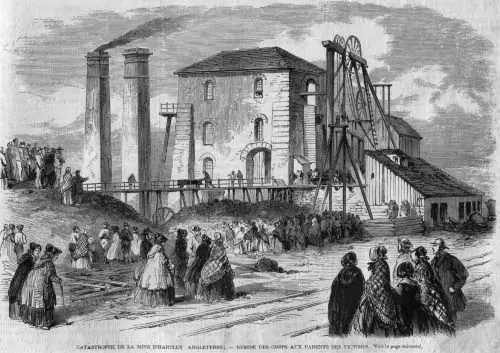
At Hartley in 1862, a broken engine beam blocked the mine’s only shaft, killing 204 men and boys and forcing Parliament to confront who could decide whether another exit was necessary.

By Matthew A. McIntosh
Public Historian
Brewminate
Introduction: The Shaft That Became a Barrier
On the morning of January 16, 1862, part of the cast-iron beam driving the pumping engine at New Hartley Colliery in Northumberland broke and fell into the mine’s only shaft. Its descent displaced timber and masonry, damaged an ascending cage, and left an obstruction above the workings through which the people below could no longer pass. The accident occurred during a change of shifts, bringing together workers preparing to leave and others beginning their underground labor. Several men sustained fatal injuries in the shaft, but the greater loss occurred among those imprisoned beneath the wreckage, beyond the rescuers’ reach as the underground atmosphere deteriorated. The disaster ultimately killed 204 men and boys, leaving a mining community bereaved and making the absence of another outlet a matter of national concern.
The equipment that precipitated this catastrophe had served an indispensable protective purpose. Hartley was troubled by water, and its powerful pumping engine helped maintain conditions in which coal could be extracted. Considerable machinery and technical effort had been directed toward sustaining the mine; its vulnerability cannot be explained simply by imagining an establishment in which nobody invested in precautions. Yet the shaft accommodated functions whose dependence on the same opening proved disastrous. A wooden partition, known as a brattice, separated the descending and returning ventilation currents, while the shaft also provided access for workers and space for pumping equipment. Dividing that opening allowed air to circulate during ordinary operation, but it did not create an independent passage through which the miners could leave if the shaft became blocked. The distinction was consequential. Confidence that existing arrangements would continue to function could coexist with inadequate provision for circumstances in which they failed. Hartley raises a question extending beyond the strength of one casting or the competence of particular employees. How should a mine be organized when the people working within it cannot control the capital decisions upon which their escape depends?
Public inspection already formed part of British mining administration, making the disaster a problem within an existing regulatory system. Afterward, Home Secretary Sir George Grey sought information from inspectors about single-shaft mines and commissioned a technical investigation. In Parliament, the discussion concerned which preventive measures could be made practicable and compulsory, as well as what the accident revealed about current arrangements. An official inquiry could identify a danger, but establishing an obligation to remedy it required a further decision about the authority of government over the operation of private property.
Hartley’s historical significance lies in that contested allocation of responsibility. The people bearing the expense of an additional outlet possessed legitimate interests in the feasibility of construction, while those descending into the workings depended on decisions they could not individually revise. Assessing those decisions requires attention to contemporary knowledge and the limits of the evidence concerning culpability; the eventual catastrophe does not establish that every earlier judgment was knowingly reckless. Nevertheless, uncertainty about particular failures left unresolved the public question of what protection an operating mine should be required to provide. The legislation passed in August 1862 addressed that question by making access to two shafts or outlets a statutory condition of ordinary working, subject to qualifications and a transitional timetable for existing mines. Its importance was institutional as well as architectural. Provision for escape acquired a legal basis beyond an operator’s assessment of what the establishment needed. Reconstructing the rescue and following the ensuing inquiries reveals how a disaster could change the terms under which industrial enterprise was permitted to expose workers to danger, even while arguments about expense and liability remained unsettled.
Who Ran Hartley and Who Bore Its Risks?
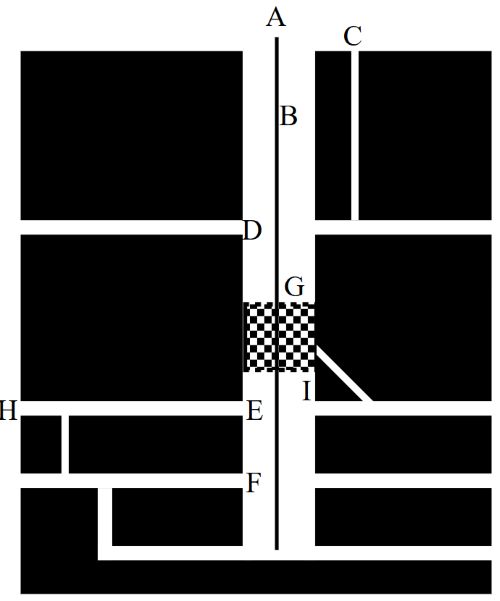
New Hartley had developed around the Hester Pit, opened in 1845, and its settlement reflected the concentration of employment at the colliery. Rows of houses stood near the workplace, while other employees lived in neighboring hamlets or Old Hartley. The nearby Blyth and Tyne Railway connected this local undertaking to a coal trade extending beyond the village. Such an establishment required coordination between underground extraction and the surface activities that prepared and transported coal for sale. Its commercial operation depended on people performing different jobs, frequently under different arrangements of payment and supervision. The resulting community was neither an isolated collection of laborers nor a self-contained household under one master. Families arrived from elsewhere, workers changed employers, and the mine participated in a regional economy whose opportunities could draw people toward it or away. Residence near the pit nevertheless gave employment a substantial influence over everyday life, placing the workplace within walking distance of homes whose occupants depended on its continued operation.
Proprietorship rested with the concern known as the Carr brothers, and Charles Carr occupied a prominent position in its management. Contemporary accounts identified him as the colliery’s viewer, while the Royal Collection’s identification of a photograph taken after the disaster also names him as an owner. A viewer was a technical and managerial officer employed to oversee a mining undertaking, a position involving considerably more than observation or occasional advice. At Hartley, the association between Carr’s managerial office and the proprietary family brought commercial authority into close contact with the direction of the establishment. Technical judgment consequently operated within the enterprise’s governing structure, where recommendations about the workings had to be considered alongside the resources and commitments of the business.
The resident official most closely associated with the underground workforce was Joseph Humble, generally identified as the under-viewer. His responsibilities centered on the organization and supervision of work below ground, within a hierarchy that also included overmen and deputies. These positions connected instructions from above with the particular conditions encountered by men in the workings, although they did not make every supervisor responsible for every department of the colliery. Machinery demanded its own skilled personnel, and the practical division between managing underground labor and maintaining mechanical equipment matters when assessing what an individual official could know or direct. Humble’s involvement in local affairs also extended beyond production. He served as a census enumerator in 1861, recording households among the people with whom his employment brought him into regular contact. That responsibility suggests the extent to which a resident manager could belong to the social world of the workforce while retaining authority over its employment. Familiarity might assist communication and sustain personal loyalty, but it could also make access to work depend on relationships with a recognizable local superior. Humble’s position requires a more precise description than either an impersonal company representative or a colleague possessing the same powers as the men he supervised.
At the coalface, skill gave workers a measure of discretion that descriptions of them as interchangeable hands obscure. Hewers extracted the coal, and their effectiveness depended partly on experience of the conditions in which they worked. Payment by results linked earnings to the quantity produced, but a quoted piece rate did not establish what a miner would actually receive over a year. Guy Solomon’s study of Townley Colliery in the 1850s demonstrates how the availability of work affected earnings, alongside differences in productivity and workers’ decisions about taking the work offered. Although Townley’s accounts cannot supply missing Hartley wage records, they show why income in the same regional industry must be examined through opportunities to earn as well as nominal rates. Labor relations also involved negotiation. James Alan Jaffe documents an earlier dispute at Lord Delaval’s Hartley Colliery in 1803, when miners resisted proposed terms and some transferred to other employers. That episode concerned an earlier establishment and ownership, but it establishes a local history of bargaining that long preceded the opening of Hester Pit. Workers could use scarce skills and mobility to influence an employer’s terms, particularly when demand for labor favored them. Their negotiating strength nevertheless fluctuated, and securing better remuneration did not give them equivalent authority over the organization of the undertaking.
Earnings from the pit supported dependents whose circumstances differed substantially from one household to another. Adam and Joan Bunting’s reconstruction from census returns and relief records identifies nineteen-year-old John Ainsley’s parents as both blind, and records twenty-three-year-old Thomas Bell’s seventy-four-year-old grandfather among the bereaved relatives. These examples show how a young worker’s income could sustain older generations, alongside the more familiar dependence of wives and children on an adult miner’s earnings. Consequently, the loss of employment or an earner could remove support from people whose own capacity to replace it was severely restricted.
A complaint published several months after the catastrophe supplies a particularly concrete account of the costs borne by workers who remained alive. Writing on behalf of Hartley survivors in May 1862, Robert Milburne sought recognition for their participation in the attempted rescue and described the material difficulties they faced afterward. He reported that their working tools had been left underground and that they could not obtain employment until replacement tools were secured, a process that took time. His letter also compared the treatment of the Hartley men with that of the specialist sinkers, connecting recognition of their labor with a claim to assistance. The testimonial committee’s honorary secretary, Thomas G. Hurst, answered that money had been allocated to the Hartley men and that Milburne had complained before receiving the promised explanation. This rebuttal prevents the letter from establishing an uncontested case of exclusion, but it does not erase the economic circumstances the survivors described. Tools represented working property in the possession of employees, and losing access to them could prolong the interruption of their earnings even when they were able and willing to seek another job. The exchange reveals workers presenting their own claims through the press, rather than appearing only as subjects of managerial statements or public sympathy. Employers and employees could both have a financial interest in the colliery’s prosperity while possessing markedly different resources for surviving the disruption of its work.
A Wet Mine with One Route to the Surface
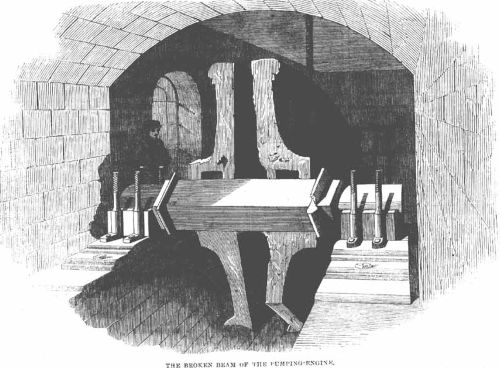
Contemporary descriptions placed the Hester shaft at approximately one hundred fathoms, or six hundred feet, in depth and twelve feet in diameter. It passed through the High Main, Yard, and Low Main coal seams, arranging the colliery’s workings at different elevations around a common point of access. By 1862, the High Main had been worked out, while the deeper seams remained part of the mine’s productive geography. This sequence of development mattered because the exhaustion of an upper seam did not remove the need to maintain the shaft passing through it. Reaching the remaining coal required continued use of an opening whose responsibilities extended through several underground levels.
Water exerted a persistent influence over the operation of these workings. Extraction depended on removing the water entering the mine, making drainage a continuing requirement throughout its productive life. An interruption to pumping could allow water to accumulate in places where men needed to travel or work, progressively restricting the ground available for employment. The pumping engine’s importance arose from the relationship between the surrounding geology and the practical conditions of extraction. Its beam transmitted the engine’s movement to pump rods descending into the mine, linking machinery at the surface with apparatus operating far below. Although the beam would become notorious as the object that fell, its ordinary function was to sustain this repeated mechanical action. Understanding that function distinguishes the pumping installation from the winding equipment used to raise and lower the cage, even though both served activities organized around the shaft. The engine, rods, pumps, and means of access consequently formed an installation whose components had different purposes but occupied closely related spaces. Maintenance of the drainage apparatus had to be considered within that physical arrangement, since equipment essential to keeping the workings usable stood over, or extended through, the opening by which they were reached. The engineering problem involved both the reliability of individual components and the consequences their position created for the surrounding mine.
Ventilation imposed another demand on the available space. Air had to circulate through occupied workings and return to the surface, carrying away contaminants and replenishing the atmosphere in which labor continued. The brattice established separate intake and return passages inside the Hester shaft, allowing one excavation to accommodate the two directions of circulation. Its condition mattered throughout the ventilation circuit. Damage to the division could interfere with the intended movement of air through the underground districts. The contemporary shaft record an arrangement in which the management of air depended partly on maintaining a timber structure within the same excavation used for mechanical equipment and human movement.
Underground connections require equally careful interpretation, because the extent of a mine’s internal passages does not establish how many ways its occupants could reach open air. Roadways might communicate between working districts, and vertical excavations could connect levels within the colliery. An internal shaft, commonly called a staple, belonged to this underground organization and could serve useful purposes without continuing to the surface. The staple appearing in contemporary descriptions of Hartley must consequently be distinguished from an additional entrance through which the workforce could leave the mine. Movement between seams might widen the area accessible below ground while leaving the final ascent dependent on Hester. A projected connection with the neighboring Mill Pit also formed part of the colliery’s history, but it had not furnished a usable alternative outlet when the accident occurred. That unfinished work deserves attention because it places the question of access within an undertaking that was still being developed. Establishing its intended purpose, the progress achieved, and the reasons for its timetable is necessary before assigning significance to the project as evidence of managerial foresight or delay. Its potential usefulness cannot supply missing evidence about what was available to the men during ordinary working in January 1862. A connection capable of supporting escape required an accessible passage from the occupied workings to another surface opening, with the intervening work sufficiently complete to permit that journey. For the workforce already employed below, the practical value of the proposed route depended on the stage construction had actually reached.
These details also introduce a distinction between developing a mine and operating an established colliery. Sinking, exploration, and the extension of underground roads proceeded through intermediate arrangements, some of which could be altered as additional workings became accessible. Evaluating those arrangements requires attention to their duration and to the activities conducted while construction continued. Hester had become a producing pit with regular shifts, extensive underground employment, and continuing requirements for drainage and ventilation. The relevant assessment was the suitability of its existing configuration for that sustained occupation, including the access available when equipment needed attention or a passage became obstructed. Viewed through the mine’s physical organization, the failure of the beam would raise questions extending beyond the damaged mechanism. The location of the equipment, the continuity of the ventilation passages, and the completion of another outlet all affected what could be done afterward. This is the setting in which the events of January 16 must be reconstructed, with the mine’s functioning systems and unfinished developments kept in view.
January 16: The Beam Falls
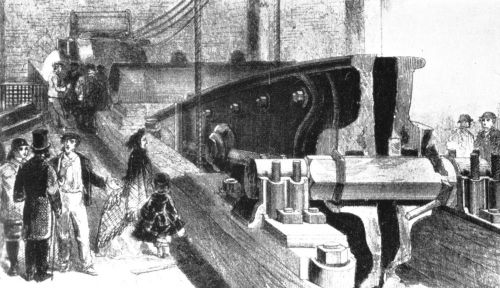
An ascending cage carrying eight men was in the Hester shaft when the pumping engine’s beam fractured on the morning of January 16, 1862. The winding equipment was conducting an ordinary journey toward the surface when a failure in another part of the installation exposed its passengers to falling machinery. Because the accident coincided with the turnover between shifts, the underground population included workers at different stages of their daily employment. Those preparing to leave had not all completed their ascent, while others had entered for the work ahead. The circumstances placed men in the shaft and in the workings beneath it within the reach of an accident whose effects would differ sharply according to their location.
Accounts published shortly afterward estimated the complete beam’s weight at approximately forty-two tons, with about half of it falling into the shaft. These figures conveyed the magnitude of the descending object, although newspaper estimates should not be mistaken for precise measurements of every fragment. The broken portion encountered structures and equipment within the excavation, damaging the cage and tearing through the timber arrangements below. Its passage dislodged additional material, so that the destruction extended beyond the path occupied by the iron itself. Timber and masonry contributed to an accumulation of wreckage that lodged above the Yard seam. The position of this obstruction separated the occupied workings from the accessible portion of the shaft above. The debris remained within a vertical excavation whose damaged fittings could release further material when disturbed. Anyone attempting to approach it faced uncertainty about the stability of what remained overhead and the support beneath individual pieces. Restoring passage consequently required more than removing the broken beam. The descent had produced an assemblage of displaced objects whose relationships had to be examined as work proceeded. The initial mechanical failure had become a difficult problem of recovering access through a damaged structure.
Five of the eight cage passengers died, while three survived and were brought to the surface. Their recovery represented the first limited success in reaching people directly affected by the accident. It also established a distinction within the eventual death toll, since fatal injuries in the shaft preceded the deaths of those confined farther underground. Bringing out the surviving passengers left the principal rescue task unresolved, with the much larger underground workforce still beyond the obstruction.
The fracture itself supplied an immediate explanation for the falling iron, but its underlying cause remained a matter for investigation. Early reporting raised the possibility of defects in the casting, directing attention to the condition of the material exposed where the beam had broken. Such observations were relevant evidence, although their interpretation required an examination of the machinery and the circumstances of its operation. The forces transmitted through the beam, the behavior of the pumping apparatus, and the condition of the iron belonged to a technical inquiry that could not be completed from the first descriptions reaching the press. John Kenyon Blackwell’s subsequent investigation formed part of that effort to explain the failure. For reconstructing the morning’s events, the secure starting point is the observed sequence of fracture, descent, and damage; a particular explanation of why the casting failed requires its own supporting evidence.
Rescue activity began locally before the arrival of the specialist sinkers whose work later attracted considerable public attention. Robert Milburne’s subsequent account emphasized this initial participation by Hartley men, making it important to preserve their place in the chronology even while treating his claims about recognition and assistance separately. People already at the colliery possessed familiarity with the installation and could begin responding without waiting for help from another undertaking. The summons to William Coulson, a master sinker, nevertheless brought a different body of experience to the emergency. Shaft sinking involved working within vertical excavations, handling heavy materials, and judging the conditions under which men could descend or continue labor. Those skills had particular relevance where a passage was obstructed and its internal structures had been damaged. The developing response brought together local knowledge and specialist practice, with neither alone furnishing an immediate solution. Mobilizing additional workers increased the labor available, but their usefulness depended on obtaining room to work and a sufficiently secure means of reaching the wreckage. The physical condition of the shaft governed how assistance could be applied, regardless of the number of men willing to undertake the task. During these opening efforts, urgency had to be reconciled with the possibility that disturbing the obstruction would inflict further injuries or make access still more difficult.
Beneath the damaged shaft, the emergency continued after the falling material had come to rest. People who had escaped the initial impact remained dependent on services whose operation had been disrupted, including the circulation of air and the removal of water. Their circumstances could deteriorate while work above addressed the visible obstruction. The surviving evidence does not provide a continuous account of every underground group’s first reactions, and the later recovery of bodies cannot establish precisely what each individual understood during these early hours. Above ground, the successful removal of three cage passengers offered an example of recovery without establishing when rescuers could reach the remaining workforce. By the end of January 16, passage to the workings had not been restored, and the effort had entered a period of prolonged uncertainty. The accident’s ultimate scale would emerge through the ensuing days; the immediate task was to make an approach to people whose fate could still be affected by the progress of the rescue.
The Rescue and the Limits of Access
During the days following the accident, rescuers descended on ropes to work against the obstruction from above. At points where secure footing was unavailable, men had to remain suspended while examining and removing material from the shaft. Cutting through shattered timber and extracting loose debris required physical exertion in circumstances that restricted movement and offered little protection from falling objects. The work demanded judgments about which pieces could be disturbed safely and which might be supporting other parts of the wreckage. These descents exposed rescuers to dangers that changed as clearance advanced, since removing material could alter the stability of what remained.
Contemporary reporting described places where only two or three men could work at once. This restriction determined the pace at which the available labor could be employed, however substantial the assistance assembled at the surface. Within the narrow working area, men needed sufficient space to handle tools, attach material for removal, and avoid interfering with one another’s movements. Debris then had to be drawn upward through the accessible shaft, using the passage through which workers and equipment also traveled. Lowering men and raising loads consequently required coordination between those suspended below and those operating above. Progress depended on a succession of manageable tasks, each of which had to leave the next operation practicable. A piece that appeared accessible might be entangled with damaged fittings or bear against material whose position could not yet be inspected adequately. Clearance involved discovering the arrangement of the wreckage while attempting to dismantle it. Coulson’s experience helped address these problems, but the shaft imposed conditions under which expertise could produce only gradual advances. The rescue’s duration reflected an excavation that had to be made usable through repeated, hazardous interventions.
Gas added a danger that the removal of solid material could not resolve by itself. Men descending toward the workings encountered an atmosphere capable of making them ill and preventing them from continuing. A rescuer overcome below required prompt assistance, placing further demands on the people and equipment supporting the descent. The effort depended on establishing tolerable breathing conditions wherever men were expected to work, as well as on creating enough physical space for them to proceed.
Evidence from beneath the obstruction establishes that at least some of the trapped workers survived into the following morning. A memorandum attributed to the overman James Amour was dated Friday, January 17, at approximately 2:30 a.m. It recorded illness among the men and mentioned a prayer meeting held earlier, at about 1:45. The entry supplies a rare contemporary record produced inside the emergency, giving the underground workforce a presence beyond descriptions written by observers at the surface. Its reference to illness indicates that bodily deterioration was already part of the experience being recorded, although the short text cannot establish the condition of every person in the workings. The prayer meeting also documents collective activity among men facing confinement, showing religious observance functioning within the circumstances of the accident. Reading it as evidence of that particular gathering preserves what the memorandum actually contributes without assigning a common state of mind to everyone underground. Some participants may have drawn reassurance from worship, but the entry does not disclose their individual expectations or the conversations surrounding it. The memorandum survives for the historian through its recovery and publication after the disaster, rather than as an uninterrupted account reaching the rescuers while events unfolded. Its strongest chronological contribution is specific. Living men were recording their circumstances many hours after the beam had fallen.
Ventilation remained a practical concern as the clearance continued. By Tuesday night, January 21, rescuers were putting a cloth brattice into place in an effort to improve the movement of air through the damaged shaft. This temporary partition applied the principle of separating air passages using material that could be installed during the recovery work. Its introduction shows that approaching the workings required active attention to the atmosphere encountered along the route. An opening sufficiently cleared for a man to enter could still expose him to conditions that prevented sustained work. The ventilation measures accordingly formed part of the attempt to turn physical penetration of the obstruction into an approach that rescuers could survive.
On Wednesday, January 22, rescuers finally reached the Yard seam and discovered that the imprisoned workers had died. No living person was recovered from the workings beneath the blockage. The discovery changed the purpose of subsequent descents, making the retrieval of bodies the central task. That work still required men to negotiate the damaged shaft, whose hazards continued after the prospect of saving those below had ended. Arrangements for bringing out the dead depended on maintaining access and managing the passage between the underground workings and the surface. Recovery also made possible the identification and examination through which the human consequences of the accident could be established more securely. Newspaper accounts had circulated varying totals during the emergency, and their figures reflected information gathered before the full loss was confirmed. The accepted death toll of 204 men and boys includes those fatally injured in the shaft as well as those who died while confined underground. Keeping those circumstances distinct is necessary to reconstruct how one accident produced deaths through different processes and over an uncertain interval.
The six elapsed days between the fracture and the entry into the Yard seam must be interpreted carefully. Amour’s memorandum establishes survival early on January 17, while the discovery on January 22 establishes that the rescuers arrived after the remaining occupants had died. The intervening record does not furnish a precise time of death for every worker or identify a single hour when the possibility of rescue disappeared. Accounts of the operation can document continuing efforts at the surface without supplying equivalent knowledge of conditions throughout the occupied districts below. This uneven evidence explains why a detailed chronology of the rescuers’ labor cannot become an equally complete chronology of the trapped men’s experience. The historical assessment must preserve that uncertainty alongside the demonstrated achievement of the rescue parties; they eventually recovered passage through the ruined shaft, but they could not establish access in time to bring anyone out alive from the workings.
A Mining Community Becomes a National Tragedy
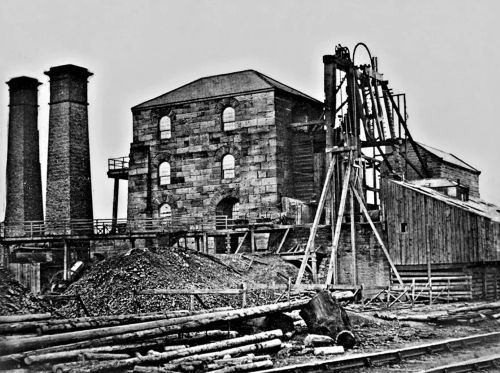
Telegraphic reporting allowed readers far from Northumberland to follow developments at Hartley while the rescue was still underway. Newspapers carried successive accounts of the work, creating an audience that waited for further information and hoped that the trapped miners might be reached. The disaster consequently entered public life through an unfolding narrative, with the announcement of death following several days of expectation. This sequence helps explain the force of the eventual news. Readers had already encountered the rescue as an urgent undertaking whose outcome remained uncertain. Hartley became a subject of national attention through communications that connected a particular mining settlement with people who had no direct acquaintance with its inhabitants.
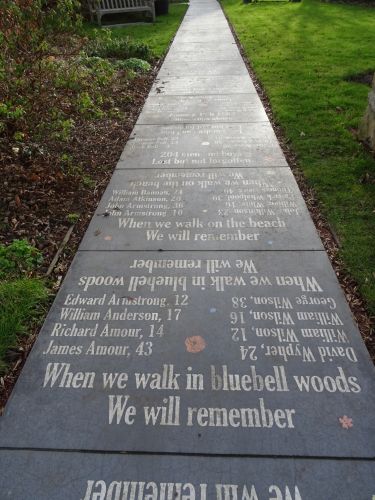
At Earsdon, the burial of victims gave that attention a public ceremonial expression. The parish churchyard became a place where the scale of the loss could be witnessed through the gathering of mourners and the interment of so many members of one working community. Attendance extended beyond the immediately bereaved households, bringing neighboring people into a collective observance of the deaths. Newspaper descriptions carried the occasion to a wider readership, allowing the funeral to become part of the disaster’s public history as well as an event in the lives of surviving relatives.
Bereavement also required an accounting of relationships that the colliery’s employment hierarchy could not adequately describe. A list of dead workers identified the people lost, but assistance depended on establishing who had relied on them and what resources remained available afterward. The Buntings’ reconstruction from census returns and relief documentation shows the value of connecting occupational identities with households and kinship. Their evidence makes it possible to examine the disaster through particular family circumstances rather than treating the death toll as a sufficient description of its effects. It also places New Hartley within a history of migration, including the presence of Scottish-born residents whose arrival contributed to the settlement’s growth. Where relatives retained connections elsewhere, bereavement could extend through networks reaching beyond the immediate neighborhood of the pit. The concentration of deaths at one workplace coexisted with a potentially dispersed community of affected kin. Understanding that combination gives greater precision to the idea of a local tragedy acquiring wider significance. The settlement itself contained relationships formed across geographical distances before newspapers brought the accident to national notice.
Queen Victoria’s expressions of concern introduced the sovereign’s voice into the published accounts of Hartley. Her messages appeared while she was mourning Prince Albert, who had died in December 1861, giving her communications a particular personal context. Their reproduction in the press presented royal sympathy as part of the response to the miners’ suffering and their families’ loss. The messages placed industrial workers within publicly expressed obligations of care between monarch and subjects, lending prominence to people whose employment ordinarily attracted much less attention. Royal participation contributed to a language of shared distress through which the disaster could be understood across differences of occupation and social position.
Subscriptions converted sympathy into a substantial undertaking of financial assistance. Contributions collected for the bereaved created resources that had to be administered beyond the immediate period of public mourning. Distributing this money required decisions about eligibility and the duration of support, together with reliable information about the people claiming assistance. The surviving relief records extend from 1862 to 1903, a span that indicates how far the administrative history reached beyond the accident’s first weeks. Read alongside census evidence, these materials allow historians to investigate dependency through documents produced for practical purposes. They also reveal why the work of relief could not be exhausted by announcing a sum collected. A fund needed arrangements for continuing payments and attention to circumstances that changed over time. Children grew older, and the situations of surviving adults could alter as households were reorganized. Administrators consequently became intermediaries between contributors expressing concern and recipients requiring support. That relationship gave organized philanthropy considerable practical authority, since the availability of money to an individual household depended on decisions made through the fund’s administration. Relief helped address material hardship while creating an enduring institutional response to a disaster that public reporting had initially presented as an immediate emergency.
Photography supplied another means of preserving people associated with Hartley’s rescue. On January 30, William and Daniel Downey photographed a group at the pit mouth that included Coulson, Carr, and Humble. The setting linked their identities to the site of the operation, while their presence together brought specialist labor and colliery management into one surviving image. Preserved in the Royal Collection, the photograph provides a durable record of named participants alongside the written accounts of their activities. Its historical value includes the way it makes particular individuals available for remembrance, giving faces to an undertaking otherwise described through reports of work and danger. Such images helped establish a visual history around the event, while the documents assembled for relief preserved a different body of information about the families living with its consequences.
National mourning enlarged the audience before which questions about mining safety would be considered. Readers encountered the dead through descriptions of families and funerals, making the consequences of industrial employment visible in terms that extended beyond production or engineering. The relief effort demonstrated a willingness to assume some responsibility for suffering through voluntary contributions. But those gifts did not themselves establish an employer’s legal obligation to compensate an injured worker or a bereaved dependent. Contemporary commentary could endorse assistance while also asking what should be required to prevent another disaster. These responses addressed different needs. Relief supported people after the loss, whereas preventive proposals concerned the conditions under which mining could continue. Hartley’s national significance emerged through their coexistence, as a public mobilized by grief became an audience for inquiry into the responsibilities attached to operating a colliery.
An Accidental Death Verdict with a Demand for Prevention
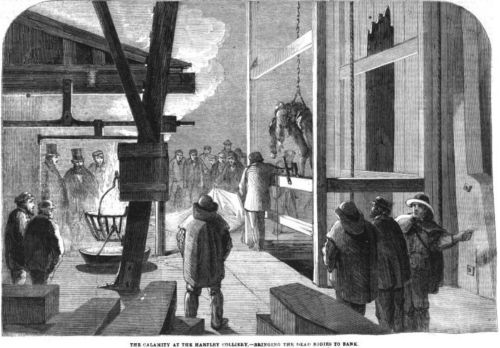
The official examination of the deaths developed through proceedings separated by the rescue and recovery operations. An initial inquest on January 21 concerned fatalities associated with the immediate accident, while the investigation conducted from February 4 to February 6 addressed the disaster more broadly. By the later hearings, the effort to reach living workers had ended, and evidence from the recovered bodies and damaged installation could be considered together. The coroner’s inquiry gave witnesses a forum in which their observations could be questioned and incorporated into a public account of the deaths. It also brought the operation of the colliery under scrutiny after the emergency had ceased to govern every decision made at the site.
Evidence about the machinery required attention to the periods and responsibilities through which particular witnesses knew it. The enginewright, John Short, had taken up his position approximately ten weeks before the accident, giving his testimony relevance to the installation’s recent operation and maintenance. That relatively brief tenure also limited the period for which he could speak from direct experience in the office. Questions about the beam’s longer history required information extending beyond his employment in that role. The distinction mattered because an account of what had been observed during ordinary operation could support only particular conclusions about the equipment’s condition. After the fracture, investigators could examine exposed iron and displaced machinery under circumstances unavailable during routine use. Assessing responsibility required care in relating these different opportunities for observation. A weakness identified afterward might explain the failure without establishing when it became detectable or who possessed enough information to recognize it beforehand. The hearings consequently required more than identifying an employee associated with the engine. They raised questions about the knowledge available within the maintenance system and the significance that could reasonably be attached to it.
On February 6, the jury returned a verdict of accidental death. That finding classified the fatalities according to the evidence presented at the inquest and did not assign criminal responsibility for them. Its accompanying recommendations nevertheless expressed dissatisfaction with arrangements whose continuation could expose other workers to comparable danger. The recorded outcome combined a conclusion about these deaths with proposals intended to change the conditions of future employment.
One recommendation concerned the material used for engine beams, with the jury favoring malleable iron over cast iron. This proposal addressed the component whose fracture had initiated the destruction and made material selection a matter of preventive concern. Its significance lay in the possibility of improving the machinery before another failure occurred. The recommendation also shows that the inquiry’s response retained an engineering dimension. Attention to escape arrangements did not displace the question of making the pumping installation more dependable. Yet preferring another material could not supply a complete explanation of the accident or establish that every beam already in service possessed the same weakness. Design and the forces imposed during operation remained relevant to the performance of an individual installation. The jury’s proposal should be read as a direction for improvement, with its practical application requiring further technical judgment. As a recommendation made through an inquest, it gave public authority to a preventive measure without itself creating a universal legal requirement for replacement.
The demand for a second outlet addressed a different part of the causal sequence. It concerned the fate of the underground workforce after the obstruction had formed, rather than the probability that this particular beam would break. Providing another means of reaching the surface would reduce dependence on the continued availability of the damaged shaft. The proposal extended the inquiry from the failed component to the arrangement of the mine as a workplace. It could remain pertinent even where owners believed their machinery well maintained, since the usefulness of another outlet did not depend on predicting the exact mechanism of the next accident. By placing that provision among its recommendations, the jury treated escape as a subject for an identifiable safeguard whose value survived uncertainty about individual mechanical failures. Implementing such a recommendation required powers and decisions beyond the verdict itself. The inquest could articulate the need for another outlet, but making that provision enforceable across operating collieries required a broader settlement of obligations. Questions about the time allowed for construction and the treatment of mines facing particular difficulties would have to be addressed through that process. The February outcome is consequently important for the relationship it established between retrospective investigation and prospective prevention. The jury’s classification of the deaths left room for a judgment that mining arrangements should change, without making reform depend on a finding of criminal misconduct. A publicly stated demand for another outlet could proceed from the demonstrated consequences of the accident, while questions of personal culpability remained governed by the evidence concerning particular people and acts.
The Second Exit Was Already a Subject of Debate
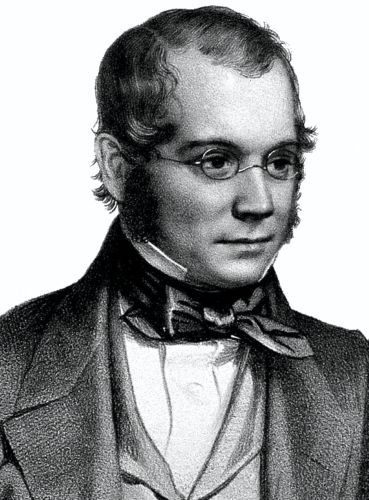
Arguments over additional outlets developed within an established controversy about the reach of mining legislation. The Mines and Collieries Act of 1842 prohibited the underground employment of women and girls and excluded boys under ten, placing statutory restrictions on practices previously governed largely within the industry. Northern coal owners disputed provisions affecting their operations and advanced claims about the practical knowledge needed to regulate them. A. J. Heesom’s study of that opposition shows how disagreements concerned whose account of mining conditions should carry authority, alongside the consequences of particular restrictions. Proposals for safer access entered a political setting in which the relationship between industrial expertise and legislative intervention was already contested.
By 1845, the geologist David Thomas Ansted had advocated providing mines with more than one outlet. This dated intervention places the principle of alternative escape within contemporary discussion well before the Hartley accident. Ansted’s position addressed a recognizable vulnerability of underground employment. Interruption of communication with the surface could endanger people who had suffered no injury from the event causing it. Considering that possibility required an assessment of the mine’s organization across a range of potential accidents. The practical proposal had an anticipatory character, asking how workers would leave if their usual passage became unavailable. Its rationale did not require a prediction that a particular pumping beam would fracture in January 1862. An additional route could have value across circumstances that differed in their initiating cause but produced confinement below ground. Early advocacy supplied a reason for examining access independently of assurances about the reliability of individual pieces of equipment. What remained unsettled was the standing such a recommendation should possess when those responsible for an undertaking considered its existing arrangements sufficient.
Blackwell had likewise supported additional outlets by 1850. His earlier position matters because the government subsequently selected him to investigate the machinery involved at Hartley. The history connects preventive discussion before the disaster with technical examination afterward, demonstrating that the question of access was familiar to someone entrusted with explaining the failure. It also establishes continuity among the specialists considering mining dangers, even as the accident gave one previously discussed vulnerability a much more prominent public significance.
Workers had also argued for a second means of escape by 1852, bringing experience of underground employment into the debate. Their participation deserves attention because proposals for protection depended partly on what kinds of testimony public authorities were prepared to credit. A miner encountered the workings through journeys and tasks that could reveal difficulties inadequately represented in a description of the installation at the surface. Such experience provided grounds for discussing the consequences of losing access, including the distance between working places and an available ascent. Turning that knowledge into a public demand involved a claim to participate in decisions about the organization of mining. Robert Colls’s history of the northern coalfield places collective action within the occupational culture that had developed during the preceding decades, providing context for workers’ interventions on conditions affecting their lives. Advocacy for another outlet belonged to that wider history of seeking influence beyond the immediate execution of assigned work. Its significance extended to the audience addressed. A demand presented through public discussion sought consideration from people capable of establishing obligations across undertakings. The pre-Hartley debate included workers contributing to the formulation of a safeguard, with their knowledge entering a field also occupied by scientific advisers and proprietors.
Practical consideration of another outlet nevertheless involved questions that a statement of its protective value could not settle alone. Excavation required capital and time, while the work necessary to obtain usable access varied with the position and condition of existing workings. Contemporary descriptions such as John R. Leifchild’s account of coal mining make clear that shafts formed part of substantial engineering undertakings, with their construction embedded in the development of a productive mine. A general proposal had to accommodate differences among establishments if it was to become a workable requirement. Those differences gave arguments about feasibility an evidentiary role, since the same objective could entail markedly different construction demands. The political difficulty arose when an operator’s judgment about those demands also determined whether the workforce would receive the protection under discussion. Establishing necessity through that arrangement left the assessment closely connected to the interests responsible for meeting the expense.
The chronological record supports a specific conclusion about the knowledge available before 1862. Alternative escape had an articulated rationale and advocates drawn from more than one part of the mining debate. The existence of those arguments does not establish which statements Carr had encountered or how he assessed their applicability to Hartley, questions that require evidence concerning the particular undertaking. It does establish that the subsequent demand for another outlet belonged to a continuing discussion whose central proposal preceded the catastrophe. Hartley increased the urgency and public force of that discussion through the demonstrated consequences of confinement. Understanding why earlier advocacy had not produced a compulsory standard requires examining the institutions through which recommendations could be assessed and acted upon, especially the statutory powers of the inspectors already supervising coal mines.
Inspection without a Compulsory Second Outlet
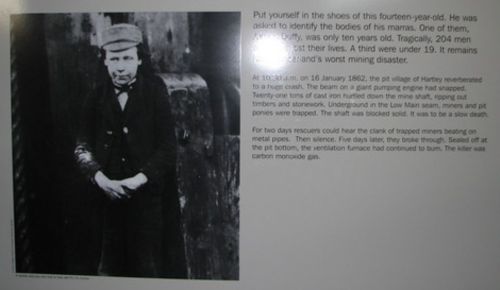
Statutory inspection of coal mines had begun before Hartley’s destruction, with the Coal Mines Inspection Act of 1850 establishing a dedicated system of public supervision. The legislation empowered inspectors to enter mines and examine their condition, giving government access to workplaces whose organization had previously been subject chiefly to internal management. The Act of 1855 developed this framework and introduced general safety rules, including requirements concerning ventilation. By January 1862, coal mining operated within a regulatory structure that imposed obligations and provided officials through whom conditions could be investigated. That structure had yet to make access through two shafts or outlets a general legal condition of ordinary working.
An inspector’s authority depended on the obligations established by Parliament and the procedures available for applying them. Entry into a mine provided opportunities to examine conditions, consult plans, and question the people responsible for its operation. The resulting knowledge could support recommendations and action concerning requirements already imposed by law. It did not automatically turn every proposed improvement into an enforceable duty. In the case of another outlet, there was no straightforward statutory requirement that could be applied simply by establishing that a producing mine had only one surface opening. This matters when interpreting the presence of inspection at Hartley. Official access to the establishment cannot itself demonstrate that every feature of its design had received an independent guarantee of adequacy. Inspectors also needed substantial practical knowledge to interpret the workings they visited, making experience within the industry an important resource for public supervision. Such knowledge could assist them in identifying hazards and assessing proposed remedies, while leaving unresolved how far the law authorized a particular intervention. The inspectorate combined powers of investigation with duties defined through legislation, and its effectiveness in securing any particular safeguard depended on the relationship between those two elements.
Grey’s circular of January 28, 1862, sought information from inspectors about mines operating through a single shaft. His statement to the House of Commons on February 13 made this inquiry part of the government’s publicly reported response to Hartley. Gathering returns from the districts could establish how widely the arrangement persisted and help assess the practical demands of obtaining additional access. The circular moved discussion beyond the circumstances of one colliery toward information on which a more general measure could be based.
Matthias Dunn’s reply of February 25 illustrates the contribution an inspector could make to that assessment. He explained the difficulty of estimating the expense and time involved in establishing connections between mines, emphasizing the circumstances of particular workings. A connection to an existing outlet and the sinking of another shaft presented different engineering demands. Water encountered during sinking could make additional pumping equipment necessary or require tubing to exclude it from the shaft. The cost of obtaining access consequently extended beyond the excavation itself and could depend on conditions encountered as construction proceeded. Dunn’s observations gave administrative form to practical considerations that a compulsory measure would have to accommodate. His letter is useful because it identifies reasons for variation without supplying a simple figure that could stand for every establishment. These qualifications deserve weight as evidence about implementation, with their significance assessed separately from the broader question of whether additional escape should be required. A government considering legislation needed to know what work compliance might entail and how its timetable could be framed. Inspection supplied a channel through which that knowledge could reach the authority capable of establishing the obligation.
The surviving response requires an assessment of regulation more specific than the claim that mining had been left wholly to its proprietors. Government possessed means of investigating conditions and, after Hartley, used the inspectorate to gather information relevant to a proposed safeguard. The decisive limitation concerned the legal standing of additional access within that existing system. Recommendations could explain its value, but the absence of a general two-outlet requirement left its provision dependent on decisions made under other obligations and practical arrangements. Dunn’s account of construction difficulties also shows why the legislative task involved determining workable terms alongside establishing the protection itself. Hartley exposed a weakness in the content of regulation, making a particular provision for escape the subject of a decision that Parliament could no longer leave at the level of technical advice.
Who Should Pay When the Workers Died?
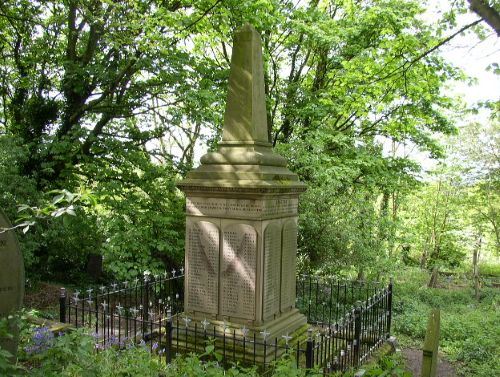
Financial responsibility for industrial injury depended on legal distinctions that could sharply restrict an employee’s remedies. Under the doctrine of common employment, an employer could escape liability for injuries attributed to the negligence of another employee engaged in the same undertaking. Claims based on the employer’s own negligence remained possible, but their success required evidence connecting the injury with a legally actionable failure of duty. Employment status could affect a claimant’s position even where the underlying harm resembled an injury suffered by someone outside the enterprise. The history of compensation examined by P. W. J. Bartrip and S. B. Burman places these restrictions within a prolonged controversy over how industrial losses should be distributed between businesses and the people working for them.
The Commons debate on the Accidents Compensation Bill on March 19, 1862, brought that controversy into direct contact with Hartley. Acton Smee Ayrton sought to enlarge the remedies available against employers, challenging limitations that left workers in a less favorable position than other injured people. His proposal concerned liability across employment relationships and should be distinguished from the coal-mining measure that subsequently required additional outlets. The issue before the House was the reach of a right to recover damages after injury or death. A rule denying recovery because the negligent person was a fellow employee gave considerable importance to a relationship the injured worker had not necessarily chosen or controlled. Employers selected and organized a workforce, while individual employees ordinarily possessed much less influence over the appointment and conduct of the people around them. Expanding liability would consequently alter the financial significance of decisions made within the business. It could give an employer a stronger reason to attend to preventable injuries by making their consequences more directly relevant to the undertaking’s expenses. Such an approach still required attention to the grounds on which a claim could succeed; enlarged remedies did not necessarily mean payment for every mishap irrespective of negligence. Ayrton’s intervention nevertheless made the allocation of loss a legislative question, asking whether existing doctrine provided an adequate basis for deciding whose resources should absorb the consequences of industrial accidents.
Henry Austin Bruce invoked Hartley in resisting that expansion. He emphasized the widespread use of cast-iron engine beams and raised the prospect of liability to the widows and orphans left by the disaster. His example presented generally accepted machinery as a reason for questioning the obligations that a broader compensation measure might impose. The argument concerned the appropriate scope of liability, rather than establishing that the proposed bill would necessarily require payment for every death caused by a fractured beam.
William Edward Forster also opposed a general enlargement of liability while supporting specific preventive legislation. His position allowed Parliament to intervene where a practical safeguard could be identified without accepting the wider alteration of remedies advocated by Ayrton. This distinction gave legislative action a different relationship to the evidence of an accident. A preventive rule could specify what an operating establishment must provide in future, whereas an action for damages required grounds for assigning responsibility for a loss already suffered. Forster’s preference placed weight on defining the precaution itself and applying it through a targeted measure. It also demonstrates that support for intervention in mine safety could coexist with resistance to imposing broader financial obligations after injury.
The parliamentary disagreement involved competing approaches to protection within industrial employment, each carrying different consequences for employers and workers. Forster’s approach offered a route toward an enforceable precaution while leaving much of the controversy over compensation within the existing legal framework.
These positions implied different distributions of expense before and after an accident. A compulsory mining safeguard could require a proprietor to commit capital as part of the conditions under which the business operated. Restrictive rules governing damages could simultaneously leave substantial losses with injured employees or bereaved dependents when the conditions for a successful claim could not be established. The March debate exposes the importance of considering those arrangements together. Imposing a preventive obligation did not resolve the financial position of people harmed when protection failed. Hartley’s relevance lay partly in the scale of loss that Bruce used to test proposals for liability, but the opposing arguments also reached beyond this particular colliery. Parliament could move toward a defined requirement for safer working while preserving considerable limits on an employee’s right to recover damages, making prevention and compensation distinct achievements in the history of industrial responsibility.
Making a Safeguard Compulsory
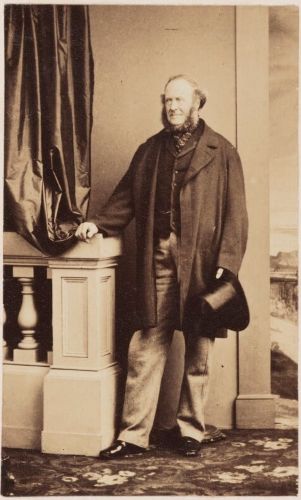
The Coal Mines Bill reached its third reading in the House of Lords on July 24, 1862. Its purpose included establishing additional access as a requirement governing the operation of mines, giving legislative force to a precaution previously advanced through expert advice and public discussion. Peers considered the necessity of the measure alongside the position of proprietors who would have to alter existing establishments. The recorded exchange also addressed the consequences of undertaking required work where private agreements might otherwise expose an operator to penalties. Passage depended on making the obligation practicable within the legal and commercial arrangements through which collieries were worked.
Henry Thomas Liddell, Lord Ravensworth, told the House that coal owners had offered no opposition to the bill. His statement is particularly significant because of his association with coal-owning interests, giving the recorded acceptance an industrial as well as a parliamentary setting. It places proprietors within the public settlement through which the requirement was advancing. The assertion should be read as evidence of the position represented at this stage of the legislative proceedings, rather than as a complete account of every owner’s private opinion or earlier conduct. Even within that scope, it changes the interpretation of the reform’s political history. The bill’s final progress cannot adequately be described as government overcoming a uniformly hostile body of operators determined to preserve single-shaft working. By July, a prominent representative of the industry could report acceptance of the proposed intervention. Discussion could consequently concentrate on the terms under which the obligation would operate, including protection for owners undertaking alterations. This recorded position also gives greater precision to the question of compulsion. A safeguard could acquire statutory force with support from people whose undertakings would bear its expense.
George Frederick Samuel Robinson, Earl de Grey and Ripon, defended the measure’s necessity while assuring the House that owners facing particular difficulties would receive indulgence. His intervention connected acceptance of the protective objective with flexibility in administering its application. The assurance mattered because compliance could require substantial work in establishments whose circumstances differed considerably. Dunn’s earlier observations had already identified practical reasons why a simple estimate could not represent the demands faced by every mine. Robinson’s statement gave those concerns a place within the government’s explanation of the bill, presenting accommodation as compatible with a compulsory standard. The extent of that accommodation would ultimately depend on the statute and the procedures it authorized; a ministerial assurance supplied an account of intended administration without independently determining every case.
Private agreements presented a further obstacle that the Lords addressed through an amendment. A proprietor carrying out alterations to comply with the proposed law might encounter contractual terms that attached penalties to changes in the existing arrangements. Mining enterprises operated through relationships with owners of land and minerals, so the people directing production did not necessarily possess unrestricted authority over every alteration required by legislation. The amendment sought protection against contractual penalties where changes were undertaken to satisfy the measure. Its rationale recognized that a statutory duty could be obstructed if the work necessary to fulfill it simultaneously exposed the operator to punishment under an earlier agreement. Addressing that conflict made compliance more legally secure. It also reveals a dimension of regulation obscured when the debate is reduced to a choice between spending money and retaining it. An enforceable precaution needed a legal setting in which the required construction could proceed through existing property relationships. Parliament considered the relationship between public duties and private contractual claims as part of making the safeguard effective. The proposed protection linked relief from those claims to the performance of work required by the legislation, adapting the conditions of compliance rather than relying solely on an instruction to provide another outlet.
Royal assent on August 7 enacted the measure as An Act to Amend the Law Relating to Coal Mines. The legislation established a statutory basis for requiring access through two shafts or outlets, with its application governed by the terms and qualifications Parliament adopted. Additional escape consequently became a criterion through which the legality of continued working could be assessed. The public record of the bill’s passage shows acceptance of the protection accompanied by concern for the circumstances of implementation. That combination gave the reform a different character from either an advisory recommendation or an unrestricted demand for immediate reconstruction. Its practical significance must be assessed through the provisions defining which mines were affected and when, together with the means available to apply the new duty.
What the 1862 Act Actually Required
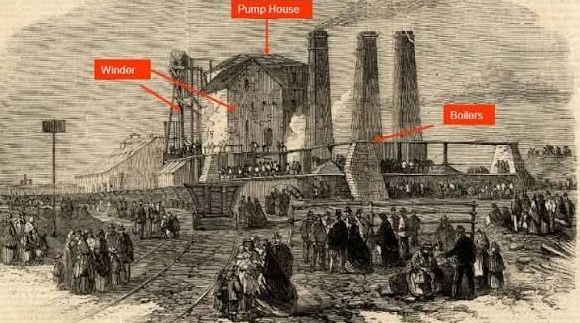
Existing collieries received a transitional period before the principal restriction on single-outlet working took effect on January 1, 1865. The provision governing the opening of new mines applied from the Act’s passage, giving new development and established production different statutory timetables. This distinction matters when assessing a mine that continued operating through one shaft after August 1862, since the date of enactment alone does not establish that its operation breached the new requirement. Parliament allowed time for alterations at existing establishments while placing new openings under the prospective rule. The transition consequently formed part of the protection adopted, determining when operators had to complete the work necessary for ordinary employment to continue legally.
Compliance required two shafts or outlets separated by natural strata at least ten feet in breadth. The specified separation gave the requirement a physical meaning that could be tested against the arrangement of an actual mine. Dividing one excavation into compartments could not supply the intervening natural ground demanded by the statute. Both outlets also had to communicate with every seam being worked, extending the obligation beyond a count of openings visible at the surface. An additional shaft reaching an unrelated or abandoned level would not, by its existence alone, furnish the communication required for occupied workings elsewhere. The relevant assessment followed the routes available from the productive seams through to the surface. As extraction extended into another working seam, the connections needed to satisfy that condition also required attention. The Act defined protection through the relationship between underground employment and accessible outlets, establishing a requirement whose application depended on the mine’s working geography.
An outlet in a neighboring mine could qualify, provided the necessary communication made it accessible from the workings concerned. This permitted compliance through a completed connection to an existing opening and allowed establishments to share access within a wider underground system. The statutory term “outlet” consequently accommodated arrangements extending beyond a shaft sunk solely for one proprietor’s undertaking. Continued compliance depended on preserving usable communication with the qualifying opening, making the condition of the connecting route legally significant.
Limited exceptions covered preliminary exploration and work undertaken to establish the necessary connections, subject to a limit of twenty people. These provisions recognized that obtaining compliant access could itself require underground employment before the finished arrangement existed. They gave operators a defined basis for carrying out developmental work while restricting the number exposed during that phase. The permitted activities mattered alongside the numerical limit, because the exception concerned specified purposes rather than a general freedom to conduct ordinary production with a small workforce. Assessing a claim to its protection required identifying what the people below were employed to do. The distinction between preliminary work and established extraction, already important to understanding the development of a colliery, acquired consequences for the application of the statutory rule.
Further qualifications allowed exemptions or extensions of time through arbitration, with grounds including the nature of the mine, approaching exhaustion, and other special circumstances. These provisions made the treatment of particular establishments part of a formal decision process. An extension adjusted the time available for obtaining compliant access, whereas an exemption could release a qualifying mine from the requirement. The difference was substantial, since additional time preserved a future obligation while exemption altered its application to the establishment concerned. Near exhaustion supplied one reason why the remaining duration of production might enter the assessment. Construction demands at a pit nearing the end of its working life presented a different practical case from those at a mine expected to continue for many years. The statute nevertheless placed such claims within a procedure for determining whether relief should be granted. A proprietor’s judgment about expense or remaining output had to be presented as grounds for that determination. Arbitration retained a role for knowledge of particular mines while subjecting the requested departure from the general rule to an authorized process. The qualifications affected both the scope of protection and who could decide that exceptional treatment was warranted.
Enforcement included a fine with a statutory maximum of ten pounds and provision for an injunction prohibiting continued working. The financial penalty must be considered alongside that power to restrain the activity through which the undertaking earned its income. An order stopping work could give the access requirement considerably greater practical force than the monetary ceiling suggests when read in isolation. Its use still depended on proceedings and a determination that the statutory conditions justified intervention. The Act’s existence established enforcement powers without demonstrating how consistently they would be exercised in particular districts or disputes. Crucially, the duty could be applied to a mine’s current arrangements once the relevant provisions were operative, without waiting for another fatal accident. Continued production had become subject to an access requirement whose deadlines and authorized exceptions were part of the law, with judicial restraint available where the conditions for lawful working were not met.
What Changed and What Remained Unsettled
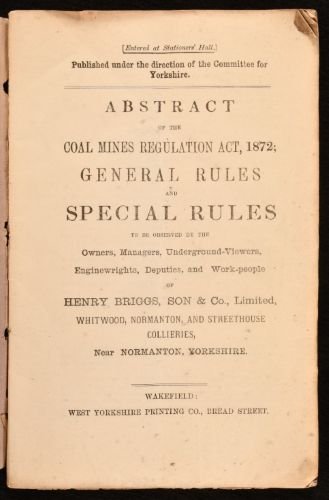
For establishments covered by the new requirement, additional access became a continuing commitment attached to production. Its expense entered the practical calculation of developing and working coal, with the necessary connections forming part of the arrangements through which employment could proceed lawfully. This consequence reached beyond the initial construction of an outlet, since changes underground could affect the routes available from occupied seams. A proprietor planning further extraction had to consider how the developing workings would remain connected to qualifying access. The reform gave escape provision an enduring place within mine development, extending its relevance beyond the exceptional circumstances that had brought it to Parliament’s attention.
The usefulness of that provision still depended on conditions encountered during an actual emergency. Workers needed to reach the alternative opening through passages that remained traversable, making the condition of connecting roads important to the protection afforded. Their practical knowledge of those routes also mattered, particularly where travel differed from the journey normally made at the beginning and end of a shift. Furthermore, separate surface openings could communicate through underground districts affected by the same dangerous atmosphere. A fire or an accumulation of gas might compromise movement across a wider area even where both shafts remained physically open. The existence of another ascent addressed a particular vulnerability without supplying complete protection against every danger of underground work. Ventilation continued to require attention throughout the occupied workings, and the machinery serving the mine still needed dependable operation. These tasks interacted with escape arrangements but retained their own technical demands. Evaluating the reform requires recognizing the specific protection it supplied while examining the other conditions on which survival could depend.
Material selection for engine beams illustrates the limits of the legislative response. The jury’s preference for malleable iron did not become a prohibition on cast-iron beams in the 1862 Act. The statute accordingly established an access obligation without prescribing that particular alteration to pumping machinery. Its terms cannot be used to infer a universal program of beam replacement, whose history would have to be established through engineering records and evidence from individual installations.
Subsequent legislation placed the outlet requirement within a broader framework of mine administration. The Coal Mines Regulation Act of 1872 introduced statutory certification of mine managers, making recognized competence part of the legal organization of the undertaking. This development addressed responsibility through the qualifications of people directing operations, adding another means by which government could influence conditions underground. A certificated manager nevertheless remained part of the enterprise’s management, while inspectors exercised public powers. The distinction preserved separate functions for the person organizing production and the official examining compliance. Formal qualifications could provide grounds for entrusting technical responsibilities to a manager without determining the answer to every disputed question arising within a mine. The later framework continued to depend on professional judgment while placing that judgment within an increasingly specified system of duties. Hartley’s legislative aftermath belongs to this longer development, through which access requirements became one element of a more extensive organization of industrial safety.
Remedies for injury also developed through legislation that reached beyond the settlement adopted in 1862. The Employers’ Liability Act of 1880 enlarged the circumstances in which employees could recover damages, providing specified routes around restrictions associated with common employment while retaining important limits. The Workmen’s Compensation Act of 1897 subsequently established compensation for injuries in designated employments, including mining, without making proof of employer negligence the ordinary foundation of a claim. These measures changed the legal basis on which an injured worker or bereaved dependent could seek financial support. Their dates also demonstrate the interval between Hartley’s access reform and the later adoption of substantially broader compensation arrangements. The history of protection consequently followed more than one legislative course, with the conditions of working and the allocation of losses developing through related but distinct measures.
Measuring the lives subsequently saved by the outlet requirement presents a different evidentiary task from establishing what Parliament enacted. Aggregate fatality figures combine accidents with different causes, so their movement cannot automatically identify the effect of a provision directed at confinement through loss of access. Comparisons would also need to account for the number of people employed and changes in the circumstances of extraction. Inspector reports and records of completed connections could help establish how the rule affected particular mines, while accident investigations could clarify when alternative access proved usable. The legal record supports a definite conclusion about the obligation created; a quantified assessment of its protective results requires further evidence connecting compliance with outcomes.
The reform also left the ordinary distribution of authority within a colliery substantially intact. Workers benefited from a condition imposed on the undertaking without having to secure it individually through negotiations over employment. The Act did not transfer managerial direction or control of investment to them, and matters outside its specified provisions continued to be decided through the wider arrangements governing industrial employment and property. Statutory protection could constrain a proprietor’s discretion in one consequential area while leaving extensive decisions within the business’s existing hierarchy. Collective representation remained relevant wherever employees sought influence over conditions extending beyond the safeguard Parliament had defined. The political significance of Hartley includes this limited but substantial alteration of authority, with a public obligation introduced into an industry whose employment relationships continued to generate disputes over the control and consequences of risk.
Did Hartley Expose Neglect or Change Reasonable Expectations?
The following video from The Mining Institute cover the Hartley Colliery disaster of 1862:
A charge of neglect becomes historically difficult when the standard used to judge an earlier decision acquired much greater authority after its consequences became known. Hartley’s fatalities established the terrible vulnerability of the mine’s arrangement, but they cannot, by themselves, establish how a competent proprietor should have evaluated that arrangement beforehand. The strongest challenge to my argument concerns the movement from a disastrous outcome to a judgment about prior conduct. Owners operated within an industry whose accepted methods combined considerable engineering expertise with dangers that remained incompletely understood and unevenly regulated. Calling their precautions inadequate requires attention to the knowledge, alternatives, and obligations available when decisions were made. Otherwise, the historian risks treating a requirement established through subsequent controversy as though it had already commanded an equally clear and enforceable consensus.
There is substantial evidence from which to construct this defense. Hartley’s pumping equipment represented a serious commitment of capital and technical effort to a problem that threatened the mine’s operation continually. The machinery’s destructive failure does not erase the protective work that it ordinarily performed, or establish that its installation had been an irresponsible choice. Bruce’s observation during the compensation debate that cast-iron beams were widely employed places the broken component within an established engineering practice, making its use insufficient evidence of exceptional carelessness. Mine development also involved competing demands on expenditure, with geological conditions affecting the cost and practicability of proposed improvements. Church’s history of the Victorian coal industry supplies an essential economic context for understanding such decisions. Investment supported a changing underground undertaking whose requirements could not be reduced to purchasing an isolated piece of safety equipment. An intended connection to the Mill Pit further complicates any claim that Hartley’s management simply rejected the possibility of another route. That unfinished project raises questions about scheduling, execution, and the purposes assigned to the connection, which its incomplete condition alone cannot answer. A convincing finding of culpable delay would require evidence about achievable progress, warnings received, resources available, and the decisions taken in response. The defense has particular force against an account that makes knowingly indifferent proprietors the sufficient explanation for the disaster.
Professional custom provides an uncertain measure of reasonable care when the customary arrangement itself is under examination. Widespread use demonstrates acceptance within an industry; its evidentiary value depends on how that acceptance developed and whether contrary experience received serious consideration. Neither an owner’s technical competence nor the prevalence of a method establishes that the interests of exposed employees carried adequate weight in decisions about its continued use. The historical question consequently extends to the procedures through which an accepted practice could be challenged, especially when changing it required expenditure controlled by the people who defended its adequacy.
Earlier proposals for additional outlets prevent the defense from treating Hartley’s lesson as an entirely unprecedented discovery. The significance of those proposals lies less in proving that every proprietor had received an authoritative warning than in establishing that alternative escape arrangements already belonged to contemporary discussions of prevention. Their existence makes it possible to assess the mine’s vulnerability through concerns articulated before January 1862, rather than relying exclusively on later expectations. Advocacy does not demonstrate agreement about when a particular connection was practicable, how urgently it should be completed, or what expenditure its construction justified. Those uncertainties weaken sweeping accusations against individuals while leaving a substantial question about the adequacy of discretionary decision-making. An operator could exercise informed judgment about machinery and still underestimate the consequences of concentrating access within one excavation. The case for another route did not depend on anticipating the exact fracture that occurred; it concerned the possibility that the existing passage might become unusable through any of several causes. The strongest justification for compulsory provision emerges from the limits of relying on a proprietor’s assessment to determine a condition affecting everyone employed below, even where that assessment was sincerely held and technically informed.
This changes my interpretation by giving institutional learning a larger place alongside criticism of established practice. Liddell’s report that coal owners offered no opposition to the bill is consistent with the possibility that the catastrophe enlarged their understanding of what adequate precautions required, although their legislative position cannot establish their earlier private judgments. Reform could attract support without resolving every disagreement about responsibility for the deaths, and acceptance of a new duty did not necessarily constitute an admission of previous wrongdoing. Neglect remains a conclusion requiring evidence about particular conduct, while the case for a binding safeguard can rest on a broader judgment about conditions under which employment should proceed. Hartley accordingly exposed a weakness that had already attracted criticism and gave that criticism sufficient political force to alter reasonable expectations across the industry. This reading strengthens the argument for public authority over essential escape provision while requiring greater restraint in assigning motives and personal blame to those whose decisions preceded the catastrophe.
Conclusion: Who Could Decide That One Exit Was Enough?
Rescue at Hartley began within physical conditions established long before any emergency arose. The people clearing the obstruction worked against the consequences of an arrangement that had concentrated access, ventilation, and machinery within a single excavation. Their extraordinary efforts could recover passage only through the damaged space that mine development had left available. This sequence gives the history of the disaster its governing significance. Decisions made during ordinary operation determined what assistance could accomplish when ordinary operation ceased. The essential opportunity to improve the prospects of escape belonged to the period before the beam fractured, when the construction and connection of underground workings remained matters for deliberate choice.
Employment placed practical authority and bodily exposure in different hands. Miners contributed knowledge indispensable to production, yet their familiarity with underground conditions did not give them command over the investment needed to establish another way out. Nor can accepting employment be treated as sufficient evidence that a worker endorsed every arrangement governing his safety. A decision to earn wages addressed the immediate need for income within the opportunities available; it cannot establish agreement with an engineering judgment or demonstrate an effective capacity to contest it. Even where departure was possible, leaving could remove an individual from danger while preserving the same conditions for the person who took his place. The adequacy of escape provision concerned the continuing organization of employment, reaching beyond the choices of particular employees. Workers’ earlier advocacy of additional outlets deserves a place in this history because it shows that the demand for protection could originate among those whose authority to obtain it remained limited. Hartley made that inequality consequential on a scale that drew the arrangements of one colliery into national deliberation.
Parliament resolved a defined part of the problem by attaching an access requirement to the lawful working of mines. The Act supplied a standard against which an undertaking could be examined, while its transitional provisions and procedures for exceptional circumstances acknowledged differences among collieries. Cost and feasibility remained subjects for judgment within that framework. Their assessment acquired a legal setting in which a proprietor’s preference could be questioned through processes extending beyond the management of the business.
The settlement also clarifies the relationship between expertise and public authority. Knowledge of geology and machinery remained necessary to establish workable protection, and government continued to need information from people experienced in the industry. The change concerned the weight that such knowledge carried when its possessors also controlled the expenditure under discussion. An explanation of why existing equipment should perform reliably could contribute to technical assessment, but it could no longer supply a sufficient answer to the absence of access required by statute. A preventive obligation carried implications different from a finding that a named individual had negligently caused particular deaths. The accidental-death verdict, disputed liability, and qualified reform could coexist because they addressed different questions about causation, financial responsibility, and the permissible conditions of future work. Keeping those questions distinct allows the disaster’s legislative importance to be recognized without making the historical argument depend on accusations that the surviving evidence cannot establish.
The people killed at Hartley give this dispute its human gravity, while the decisions taken afterward show how their deaths altered the terms of an industrial obligation. Public sympathy sustained bereaved households, and the rescue demonstrated the commitment of those who attempted to reach the confined miners. Lasting protection required a further step: translating concern into a condition that future operators would have to satisfy. The strongest interpretation of Hartley accommodates uncertainty about individual blame while identifying a substantial change in who could determine the adequacy of escape arrangements. The expense still had to be met, and practical difficulties still had to be addressed; their existence no longer gave the proprietor sole authority to decide that the safeguard could be omitted.
Bibliography
- Amour, James. Memorandum dated January 17, 1862. Reproduced in “The Hartley-Pit Tragedy,” Illustrated London News, February 1, 1862, 107–108.
- Bartrip, P. W. J., and S. B. Burman. The Wounded Soldiers of Industry: Industrial Compensation Policy, 1833–1897. Oxford: Clarendon Press, 1983.
- Blackwell, John Kenyon. Report on the Hartley Colliery accident, February 15, 1862. Reprinted in Newcastle Chronicle, May 24, 1862, 3.
- Bronstein, Jamie L. Caught in the Machinery: Workplace Accidents and Injured Workers in Nineteenth-Century Britain. Stanford, CA: Stanford University Press, 2008.
- —-. “The Hartley Colliery Disaster.” Victorian Review 40:2 (2014), 9–13.
- Bunting, Adam, and Joan Bunting. “The Hartley Families.” Northumberland and Durham Family History Society Journal 7:4 (September 1982).
- Church, Roy. The History of the British Coal Industry. Vol. 3, 1830–1913: Victorian Pre-eminence. Oxford: Clarendon Press, 1986.
- Colls, Robert. The Pitmen of the Northern Coalfield: Work, Culture, and Protest, 1790–1850. Manchester: Manchester University Press, 1987.
- Downey, W. and D. W. Coulson, Master Sinker, and Four of His Men. Pit Mouth, Hartley Colliery. January 30, 1862. Albumen print. Royal Collection, RCIN 2935021.
- Duckham, Helen, and Baron Duckham. Great Pit Disasters: Great Britain, 1700 to the Present Day. Newton Abbot: David & Charles, 1973.
- Dunn, Matthias. Letter to Sir George Grey, February 25, 1862. Durham Mining Museum transcription.
- Great Britain. An Act to Amend the Law Relating to Coal Mines. 25 & 26 Vict., c. 79. August 7, 1862.
- —-. Coal Mines Inspection Act 1850. 13 & 14 Vict., c. 100.
- —-. Coal Mines Inspection Act 1855. 18 & 19 Vict., c. 108.
- —-. Employers’ Liability Act 1880. 43 & 44 Vict., c. 42.
- —-. Mines and Collieries Act 1842. 5 & 6 Vict., c. 99.
- —-. Workmen’s Compensation Act 1897. 60 & 61 Vict., c. 37.
- Great Britain. Parliament. House of Commons. “The Hartley Colliery Accident.” Hansard Parliamentary Debates, 3rd ser., vol. 165, February 13, 1862.
- —-. “Accidents Compensation Bill—Second Reading.” Hansard Parliamentary Debates, 3rd ser., vol. 165, March 19, 1862, cols. 1834–53.
- Great Britain. Parliament. House of Lords. “Coal Mines Bill—Third Reading.” Hansard Parliamentary Debates, 3rd ser., vol. 168, July 24, 1862, col. 732.
- “The Hartley-Pit Tragedy.” Illustrated London News, February 1, 1862, 103–104, 107–108.
- Heesom, A. J. “The Northern Coal-Owners and the Opposition to the Coal Mines Act of 1842.” International Review of Social History 25:2 (1980), 236–271.
- Hurst, Thomas G. “Sinkers’ Testimonial Fund.” Newcastle Daily Journal, May 20, 1862, 2.
- Jaffe, James Alan. The Struggle for Market Power: Industrial Relations in the British Coal Industry, 1800–1840. Cambridge: Cambridge University Press, 1991.
- Leifchild, John R. Our Coal and Our Coal-Pits: The People in Them, and the Scenes Around Them. London: Longman, Brown, Green, and Longmans, 1853.
- Milburne, Robert. “The Survivors at New Hartley.” Newcastle Daily Journal, May 14, 1862, 2.
- Solomon, Guy. “Work and Earning in the Nineteenth Century: Townley Colliery as a Case Study.” Continuity and Change 37:3 (2022), 335–363.
Originally published by Brewminate, 10.06.2026, under the terms of a Creative Commons Attribution-NonCommercial-NoDerivatives 4.0 International license.
About the Author