Victorian mourning was not simply morbid fascination. Nineteenth-century Britain built a culture that kept the dead visibly and emotionally present among the living.

By Matthew A. McIntosh
Public Historian
Brewminate
Introduction: Remembering Death, Preserving Presence
Memento mori, “remember you must die,” was never only a warning. In Christian Europe, it had long been a discipline of attention, a way of forcing the living to measure ordinary ambition against the certainty of decay, judgment, and eternity. Skulls, hourglasses, funeral sermons, mourning rings, deathbed manuals, tomb inscriptions, and devotional images all taught the same lesson: death was not an interruption of life’s meaning but one of the conditions by which life was to be understood. By the nineteenth century, this older moral vocabulary entered a new world. Industrial cities grew; families migrated; disease moved through crowded streets; medical knowledge expanded without yet defeating many ordinary killers; and new technologies made memory more portable, reproducible, and visible than ever before. Victorian death culture emerged from that convergence. It was not simply medieval piety surviving into modernity, nor merely gothic fascination dressed in black. It was a modern culture of remembrance built from older religious habits, domestic grief, commercial goods, and new media.
The Victorian era was saturated by death in ways that were both intimate and public. Infants and children died with painful frequency. Tuberculosis, cholera, scarlet fever, typhus, and other diseases made bereavement a recurrent fact of household life. Many deaths occurred at home, where the dying body remained within the emotional and physical space of the family rather than being removed into a clinical setting. Grief had to be managed not only inwardly, as sorrow, but outwardly, as conduct. Families watched, washed, dressed, preserved, remembered, and displayed their dead according to habits that could be religious, affectionate, social, and highly material all at once. Mourning dress, black-bordered stationery, funeral cards, hairwork, lockets, cemetery monuments, family Bibles, deathbed scenes, and eventually photographs gave bereavement a form that could be touched, worn, stored, circulated, and revisited. The dead did not simply disappear from the family. They remained present through objects.
That material presence is the central subject here. Victorian mourning was not a single uniform system, and it was never experienced equally across class, gender, region, or religious identity. A wealthy widow in deep mourning, a working-class mother preserving a lock of hair from a dead child, a photographer making a last portrait, a family commissioning a memorial card, and Queen Victoria preserving the memory of Prince Albert all belonged to the same broad culture, but not to the same social world. Still, they shared a recognizable impulse: to resist the complete erasure of the dead from the lives of the living. Hair survived bodily corruption. Photographs fixed a face at the edge of disappearance. Jewelry made grief wearable. Cemeteries gave memory a landscape. Literature gave mourning a language. Ritual made sorrow legible. Victorian mourning was less a cult of death than a culture of continued relationship.
Yet I must also resist a common modern temptation. The Victorians have often been turned into caricatures of morbidity: people imagined as propping corpses upright for portraits, painting eyes on eyelids, hoarding hair, and turning grief into theatrical gloom. Some such practices existed in limited or misunderstood forms, but the broader picture is more subtle. Victorian death culture was shaped by love as much as fear, by social expectation as much as private anguish, by commerce as much as devotion, and by technological change as much as inherited faith. To study it seriously is not to marvel at strangeness from a safe modern distance. It is to ask how a society made mortality visible, how it kept the dead within the moral community of the living, and why its objects of grief still unsettle us. The Victorian dead remain powerful because they expose a modern discomfort: we have not ceased to mourn materially, but we have often forgotten how openly earlier societies did so.
Before Victoria: Memento Mori, Ars Moriendi, and the Long Christian Memory of Death
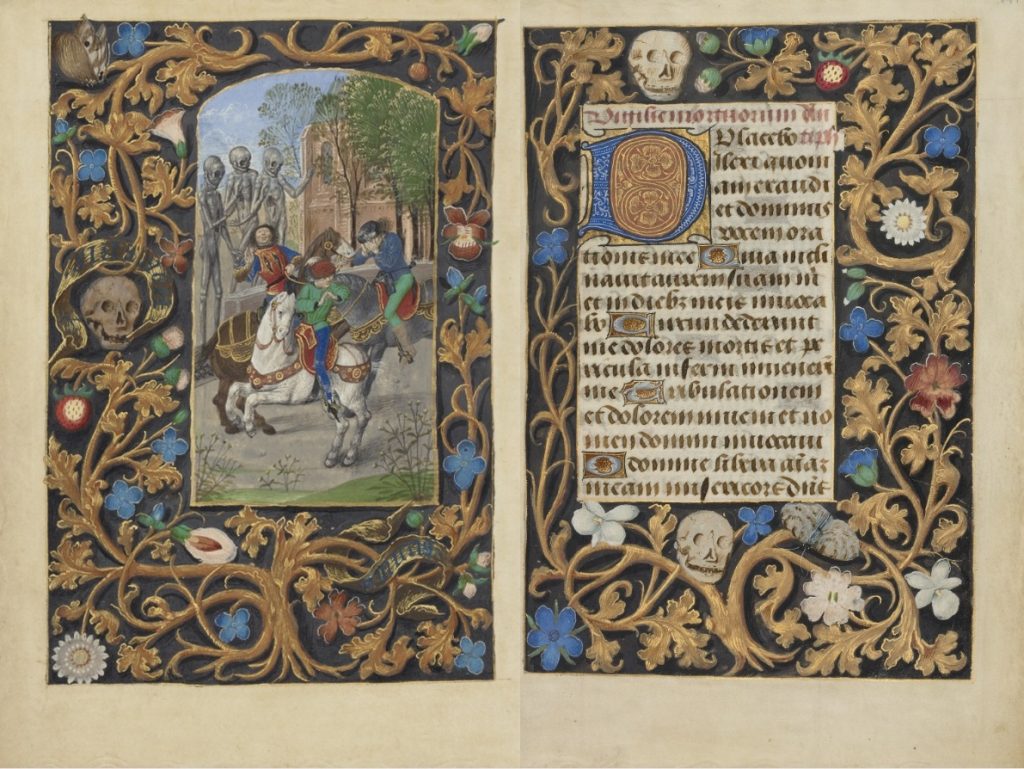
Long before the Victorians dressed grief in black crepe, braided hair into jewelry, or fixed the dead in photographic memory, European Christians had been taught to live under the sign of death. Memento mori was not originally a decorative phrase or a gothic mood. It belonged to a moral and devotional tradition that insisted death was the one certainty against which every human life had to be measured. Medieval churches, tombs, manuscripts, sermons, and devotional objects reminded worshippers that beauty decayed, wealth vanished, rank dissolved, and the body returned to dust. The skull, the hourglass, the extinguished candle, the wilting flower, and the crumbling ruin were not merely images of horror. They were instruments of instruction. They trained the eye to see worldly life as temporary and the soul as the true object of concern.
This tradition drew much of its force from the Christian understanding of death as both punishment and passage. Death entered the world through sin, but it was also the threshold to judgment, resurrection, heaven, hell, or purgatorial purification, depending on the theological framework. The dead were not simply gone. They remained morally and spiritually connected to the living through prayer, memory, liturgy, burial, and hope. In medieval Catholic culture in particular, the living could assist the dead through masses, almsgiving, chantry foundations, and commemorative prayer. Tombs and memorial brasses did not merely preserve names; they asked the living to remember, intercede, and prepare. The grave was a warning, but it was also a social bond between visible and invisible communities. The late medieval ars moriendi, or “art of dying,” gave this culture one of its most influential forms. Emerging in the fifteenth century amid plague, war, clerical anxiety, and pastoral concern, ars moriendi texts taught Christians how to die well when priests might not always be available. These works described the temptations that could assault the dying person (despair, impatience, pride, unbelief, attachment to worldly things) and offered prayers, questions, images, and consolations to guide the soul toward a holy death. The deathbed became a theater of salvation. Family members, attendants, clergy, angels, demons, and the dying person all participated in a final moral drama. To die well was not merely to expire peacefully. It was to remain spiritually alert at the edge of eternity.
This older tradition matters because it prevents us from treating Victorian mourning as a sudden eruption of morbidity. The Victorians inherited a long Christian habit of staging death as meaningful. Even after the Reformation transformed English attitudes toward purgatory, saints, intercession, and the dead, the moral pressure of mortality remained. Protestantism rejected many medieval mechanisms for aiding souls after death, but it did not make death less spiritually charged. Instead, emphasis shifted toward the individual’s faith, the exemplary deathbed, the memory of the godly life, and the consoling hope of reunion in heaven. Funeral sermons, elegies, mourning rings, printed memorials, and deathbed narratives carried forward the conviction that the dead could instruct the living. Death remained a text to be read.
The early modern period also deepened the relationship between memory and objects. Mourning rings, often inscribed with names, initials, skulls, coffins, or dates of death, allowed the living to wear remembrance on the body. Miniatures, relic-like locks of hair, embroidered memorial pictures, family records, and tomb inscriptions preserved the dead within domestic and social life. These objects were not yet “Victorian” in style, but they anticipated the Victorian hunger for tangible memory. They made grief portable. A person could carry the dead on a finger, in a locket, in a book, or in a household archive. By the eighteenth century, sentimental culture intensified this intimacy. The dead beloved, the mourned child, the virtuous wife, the lost friend, and the tearful mourner became familiar figures in poetry, fiction, portraiture, and decorative art.
The Georgian and Regency worlds also helped prepare the emotional language later associated with Victorian mourning. The culture of sensibility prized feeling, tears, sympathy, and refined emotional expression. Mourning became not only a religious obligation but a sign of tenderness, virtue, and moral depth. Memorial jewelry incorporated hair, pearls, urns, weeping willows, classical tombs, and painted scenes of grieving figures. The mourner’s feeling was made visible through objects that could be exchanged, displayed, inherited, or worn. Death was increasingly bound to affection and individuality. The dead were not remembered only as souls awaiting judgment or names in a lineage. They were remembered as irreplaceable persons whose emotional presence could linger in material form.
By the time Victoria came to the throne in 1837, Britain already possessed a dense inheritance of death-minded Christianity, Protestant deathbed piety, sentimental mourning, memorial objects, and domestic remembrance. The nineteenth century did not invent the desire to keep the dead close. What changed was the scale, visibility, and material range of that desire. Industrial production made mourning goods more available. Expanding print culture circulated poems, manuals, memorial cards, and sentimental images. Photography introduced a new promise: the face itself could be preserved. Queen Victoria’s grief for Prince Albert later gave mourning a powerful royal model, but she did not create the culture from nothing. Victorian mourning was the heir of centuries. Its black garments, hairwork, lockets, funeral cards, and photographs were modern forms of an older command: remember death, remember the dead, and remember what their absence demands of the living.
Death in the Early Victorian Household: Disease, Children, and Domestic Mourning

In the early Victorian household, death was not an exceptional visitor who arrived only after a long life. It entered through fever, childbirth, infection, polluted water, industrial accident, epidemic disease, and the fragile bodies of children. The family home was often the first sickroom, the death chamber, and the first place of mourning. Before the later expansion of hospital death and professionalized medical management, many people died within the domestic spaces where they had lived: in beds shared with spouses, in nurseries, in upstairs rooms, or in cramped lodgings where privacy itself was a luxury. This made death intimate in the most literal sense. The dying body remained among the living, and the household had to organize itself around decline, watching, prayer, washing, dressing, visitation, and burial preparation. Early Victorian Britain was also a society in which disease exposed the unequal conditions of modern life. Industrialization had drawn people into expanding towns and cities faster than sanitation systems, housing reform, and public health administration could manage. Overcrowded courts, contaminated water, poor drainage, insecure employment, and inadequate nutrition made illness a social fact as much as a biological one. Cholera epidemics in 1831–32, 1848–49, 1853–54, and 1866 revealed the terrifying speed with which disease could move through urban populations, while tuberculosis, typhus, scarlet fever, measles, whooping cough, and diarrheal diseases worked more steadily through families and neighborhoods. Death was both sudden and repetitive. It could arrive as a public crisis announced in newspapers and official reports, or as a private devastation marked by a child’s empty bed.
Child mortality gave Victorian mourning much of its emotional force. The loss of infants and young children was common enough to be widely anticipated, but it was not emotionally trivial. Older assumptions that parents must have been hardened by frequency risk flattening the historical record. Letters, diaries, poems, family Bibles, memorial cards, and preserved objects repeatedly show grief that was deep, particular, and often enduring. A dead child was not merely one more entry in a demographic pattern. The child had a name, a face, a place in the household imagination, and often a cluster of objects through which memory could be sustained. A lock of hair, a small garment, a toy, a cradle, a miniature portrait, or later a photograph could hold the emotional weight of a life that had barely begun.
The Victorian child deathbed became one of the period’s most powerful sentimental and religious scenes. In evangelical and broader Protestant culture, the dying child could be represented as innocent, spiritually perceptive, and close to heaven. Such representations appeared in memoirs, tracts, fiction, poetry, and family recollections. These narratives offered consolation by imagining the child not as lost into nothingness but as safely gathered into divine care. Yet this consolation carried its own pain. The more the child was idealized as pure, angelic, or heaven-bound, the more the family home could feel like a place from which innocence had been removed. The nursery, once a scene of care and noise, became a chamber of absence. Victorian domestic mourning often began in that altered room. Women bore much of the labor of domestic mourning, just as they often bore much of the labor of nursing the sick. Mothers, wives, sisters, daughters, servants, and female neighbors tended bodies before and after death. They watched through fevers, changed linens, administered medicines, prepared food, kept children quiet, received callers, and managed the emotional atmosphere of the household. After death, they might help wash and dress the corpse, select clothing, preserve hair, arrange flowers, keep vigil, and oversee the transformation of the room from sickroom to mourning space. This labor was practical, emotional, and symbolic. It made the dead presentable, protected the dignity of the family, and translated shock into recognizable forms of care.
The household also became an archive of bereavement. Victorian families commonly recorded deaths in family Bibles, kept letters of condolence, saved funeral cards, clipped newspaper notices, preserved locks of hair, and held onto black-edged stationery or memorial verses. Such objects did not simply document death. They organized memory. In an age before everyday photography became universal, and before sound or moving image could preserve a person’s presence, material traces mattered intensely. Hair was powerful because it belonged to the body but resisted decay. Written names and dates fixed the dead within family chronology. Objects associated with the body or the sickroom made grief tangible. They allowed the bereaved to return to the dead through touch, sight, and ritual handling.
Domestic mourning was shaped by class but not confined to the middle and upper ranks. Middle-class households had more access to mourning dress, printed stationery, memorial jewelry, framed portraits, and carefully staged funerals. They also had stronger incentives to display grief according to respectable social codes. Working-class families, by contrast, often faced the brutal economics of death: lost wages, funeral expenses, pawned goods, overcrowded rooms, and the fear of pauper burial. Yet poorer households also preserved memory where they could. A simple funeral card, a borrowed garment, a saved lock of hair, a burial club payment, or a modest grave marker could carry enormous significance. The difference was not between grief and no grief, but between different material capacities for expressing grief publicly and preserving it privately. By the early Victorian period, death in the household had become the ground from which larger mourning culture grew. The famous later images of black dress, mourning jewelry, cemetery sculpture, and post-mortem photography all depended on this more basic domestic reality: the dead had first been family members, patients, children, spouses, and neighbors. Victorian mourning began not in the shop window or the cemetery, but beside the bed. Disease and child mortality made death familiar; domestic affection made it unbearable; religion gave it a language; and objects gave it continuity. The early Victorian home was not merely a shelter from the world’s instability. It was one of the principal places where mortality was witnessed, interpreted, and transformed into memory.
Queen Victoria, Prince Albert, and the Public Model of Private Grief

When Prince Albert died at Windsor Castle on December 14, 1861, Queen Victoria’s grief became one of the most visible acts of mourning in nineteenth-century Britain. Albert had been more than a royal consort. He was Victoria’s husband, political adviser, domestic companion, intellectual partner, and the organizing presence behind much of the monarchy’s mid-century public image. His death from what was diagnosed at the time as typhoid fever struck at the center of the royal household and at the emotional mythology that Victoria and Albert had carefully cultivated: the monarchy as a moral family, disciplined by duty, domestic virtue, Protestant seriousness, and bourgeois respectability. The loss was private in its origin, but it could not remain private for long. A queen’s widowhood immediately became a national spectacle.
Victoria’s mourning did not invent Victorian mourning culture, but it gave that culture its most powerful living emblem. By 1861, Britain already possessed elaborate customs of mourning dress, memorial jewelry, funeral ritual, deathbed piety, and domestic remembrance. What changed after Albert’s death was the symbolic force with which royal grief confirmed and magnified those practices. Victoria withdrew from many public duties, wore black for the rest of her life, preserved Albert’s rooms and possessions, commissioned memorials, supported commemorative publications, and made his absence a permanent feature of royal identity. She transformed widowhood from a family condition into a political image. Her sorrow was not merely endured; it was displayed, curated, defended, and repeated until it became inseparable from the public meaning of her reign.
This mattered because Victoria’s monarchy had already been built around domestic respectability. Earlier British monarchs had often represented power through military glory, courtly spectacle, dynastic command, or aristocratic sociability. Victoria and Albert instead presented royal authority through marriage, parenthood, moral seriousness, industriousness, and family order. Portraits of the royal couple with their children, accounts of their household life, and public celebrations of their marriage helped make the palace legible to middle-class Britain. Albert was not only the queen’s husband in this public language; he was the diligent father, reforming prince, patron of improvement, organizer of the Great Exhibition, and symbol of disciplined masculine service within a constitutional monarchy. Victoria, in turn, appeared not only as sovereign but as wife and mother, a figure whose authority was softened and strengthened by domestic virtue. This was crucial in an age when monarchy had to justify itself within a society increasingly shaped by newspapers, parliamentary politics, middle-class opinion, and reform movements. The royal family became a kind of national household, and its emotional life was made to seem morally instructive. Albert’s death did not only remove a husband; it shattered a model of ideal domestic partnership that the monarchy had encouraged the nation to admire. Victoria’s mourning extended that model into bereavement. If royal marriage had been exemplary, royal widowhood now became exemplary too.
The queen’s grief also intensified the connection between mourning and objects. Albert did not survive merely as memory in Victoria’s mind. He survived through rooms, portraits, statues, photographs, clothing, letters, mausoleums, monuments, and ritual observances. The Royal Mausoleum at Frogmore, the Albert Memorial in Kensington Gardens, commemorative imagery, and the preservation of personal spaces all made grief architectural and material. This pattern echoed domestic mourning practices throughout the country, but on a grander scale. Just as a family might preserve a lock of hair, a photograph, or a chair associated with the dead, Victoria preserved Albert through an entire royal landscape of memory. The dead husband became spatially present: in the mausoleum, in the palace, in the archive, in public statuary, and in the ceremonial imagination of the monarchy.
Photography gave this memorial culture a particularly modern form. Victoria and Albert had both shown strong interest in photography before his death, and the medium fit perfectly with the nineteenth century’s desire to preserve likeness, intimacy, and family continuity. After Albert died, photographs and photographic reproductions helped circulate royal memory in ways earlier generations could not have imagined. The camera promised immediacy: not an allegorical figure, not a painted ideal, but the trace of a face, a body, a family arrangement, a room. It offered a form of remembrance that seemed at once mechanical and intimate, objective and emotional. For the royal family, photography could make monarchy appear private, domestic, and accessible while still preserving hierarchy. Images of Victoria, Albert, and their children had already helped construct a royal ideal of family life; after 1861, the same visual culture helped transform Albert into an absent presence. His likeness could be reproduced, collected, displayed, and absorbed into the ordinary habits of looking that increasingly defined modern memory. In the broader culture, photography would become one of the most important technologies of mourning because it seemed to rescue appearance from disappearance. It did not return the dead, but it made their former visibility repeatable. In Victoria’s case, it also helped bind private loss to public monarchy. The royal dead could be remembered not only through monuments and official language, but through images that entered albums, print culture, and popular imagination.
Yet Victoria’s mourning was never uncontested. Her long withdrawal from public life generated criticism, frustration, and republican anxiety. To some observers, the queen’s grief seemed excessive, self-indulgent, or politically irresponsible; to others, it proved her sincerity, femininity, and moral depth. This tension reveals the double nature of Victorian mourning itself. Grief was expected, but it had to be performed within social limits. Mourning could command sympathy, but it could also provoke impatience when it appeared to suspend ordinary duties for too long. Victoria’s widowhood offers a crucial bridge between private bereavement and public culture. It shows how mourning could legitimate authority, burden women, organize memory, create markets, inspire monuments, and become a national language. Albert’s death did not make Britain Victorian in its grief, but it gave Victorian grief a queen.
The Rules of Mourning: Dress, Time, Gender, and Social Performance
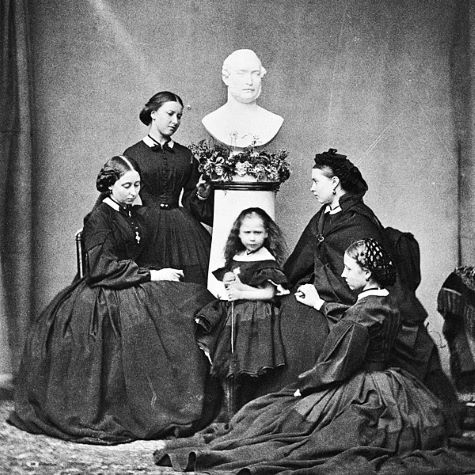
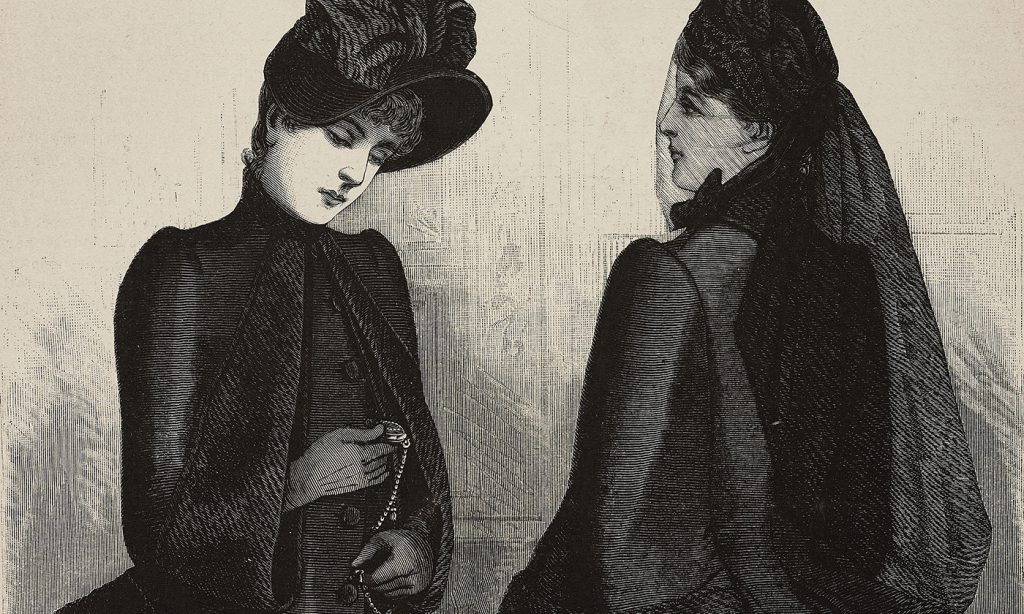
Victorian mourning was not only an emotion; it was a system of signs. Grief had fabrics, colors, durations, textures, accessories, and rules of conduct. To mourn properly was to make loss visible in a way that other people could read. Clothing announced bereavement before a word was spoken, and the details mattered: black crepe, dull silk, bombazine, veils, gloves, bonnets, armbands, hatbands, jet ornaments, and black-bordered stationery all communicated the mourner’s relation to the dead and the expected seriousness of the loss. Mourning stood at the intersection of private feeling and public discipline. A bereaved person might be shattered by grief, but society still expected that grief to appear in recognizable form.
The most elaborate rules surrounded widows. A woman who lost her husband entered a period of mourning that could extend for years, moving through stages usually described as deep mourning, second mourning, ordinary mourning, and half-mourning. In deep mourning, the widow wore plain black garments, heavy crepe, matte fabrics, and often a veil that concealed or subdued the face. Ornament was limited, shine was discouraged, and social life was sharply restricted. The widow’s body was supposed to become a visible sign of fidelity, self-control, and continuing attachment to the dead husband. Her clothing declared that marriage had not simply ended with death; it had been transformed into memory, obligation, and social identity. Eventually, the rules loosened. Crepe might be reduced, jewelry might return in carefully approved forms, and half-mourning colors such as gray, lavender, mauve, violet, white, or soft lilac might appear. Even this gradual reintroduction of color was regulated, as though grief had to be released in measured degrees rather than abandoned at once. The progression gave grief a timetable. It did not simply express sorrow; it organized sorrow into socially intelligible phases.
These rules made mourning visible, but they also made it burdensome. Proper mourning required money, time, knowledge, and access to goods. A middle-class woman might need dresses, bonnets, veils, gloves, capes, undergarments, stationery, jewelry, and household adjustments suitable to her new status. Because fashion changed, mourning attire could not always be treated as a permanent wardrobe stored away for reuse. Shops, warehouses, and specialist mourning establishments turned bereavement into a consumer category, promising correct goods for correct grief. This did not mean mourning was insincere. Rather, it shows how Victorian society translated feeling into material obligation. To fail to dress properly could suggest indifference, poverty, ignorance, disrespectability, or emotional impropriety. The mourner’s body became a public surface on which family honor and social discipline were displayed.
Gender shaped this system profoundly. Men mourned, but their mourning was usually less visually consuming and less socially restrictive. A widower might wear a black suit, black gloves, a hatband, an armband, a mourning ring, or darker accessories, but he was rarely expected to withdraw from public life for as long or as visibly as a widow. Women, by contrast, carried the symbolic labor of family grief. Their clothing, conduct, correspondence, and social availability were all more closely watched. Widowhood could mark a woman as faithful, dignified, respectable, and morally serious, but it could also confine her. The veil that signaled sorrow also regulated visibility. The black dress that honored the dead also announced sexual unavailability, social restraint, and continued attachment to the husband’s memory.
Mourning also worked through time. Different relationships demanded different durations of observance: a spouse, parent, child, sibling, grandparent, aunt, uncle, cousin, or in-law might each require a different period and intensity of mourning. Manuals and etiquette books offered guidance because grief had become socially codified enough to require instruction. These timetables might appear cold to modern eyes, but they helped Victorians manage the uncertainty of bereavement. They answered practical questions: when could one receive visitors, return calls, attend church, appear in society, write letters, host guests, or wear lighter colors? They also helped protect mourners from the immediate pressure of normal life by giving withdrawal a socially accepted form. A person in mourning could refuse invitations, suspend entertainments, limit correspondence, and mark the household as altered without needing to explain each refusal anew. Yet the rules also created anxiety. If mourning ended too soon, it could seem heartless. If it continued too long, it could seem excessive, theatrical, or unhealthy. The mourner’s calendar became a moral instrument, watched by relatives, neighbors, servants, acquaintances, and the wider social circle. Victorian mourners were expected to feel deeply, but not disorderly; visibly, but not beyond the boundaries of accepted conduct.
Class complicated every rule. Elite and middle-class families could observe elaborate mourning with a degree of precision unavailable to the poor. Working-class mourners might own few garments and have little ability to withdraw from labor, avoid public activity, or purchase specialized goods. For them, mourning might take the form of a black ribbon, a borrowed garment, a darkened dress, a funeral club subscription, or a modest alteration to ordinary clothing. Poverty did not mean weaker grief. It meant fewer acceptable ways to display grief according to middle-class standards. This distinction matters because Victorian mourning codes often claimed moral authority while quietly assuming material resources. Respectable grief could be expensive, and the inability to afford it could expose families to shame at the very moment they were most vulnerable.
The rules of mourning reveal one of the central paradoxes of Victorian death culture. Mourning dress and etiquette gave bereavement dignity, structure, and public recognition, but they also disciplined grief through gender, class, commerce, and social surveillance. They made sorrow visible, yet they also told mourners how long and in what manner sorrow should be seen. The dead were honored through the living body: through its clothing, movements, refusals, and reentries into society. To wear mourning was to carry the dead into public view, but also to submit private feeling to a grammar others claimed the right to read. Victorian mourning was not merely what people felt after death. It was what society required grief to look like.
Hair as Relic: Mourning Jewelry, Hairwork, and the Body Made Portable
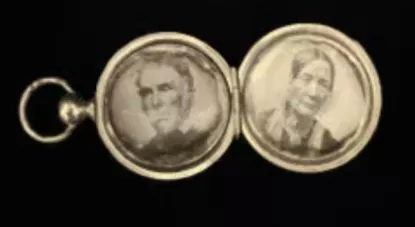
Hair occupied a uniquely powerful place in Victorian mourning because it seemed to survive where the rest of the body failed. Flesh decayed, faces changed, voices disappeared, and the dead body had to be buried, but hair could remain: cut, braided, curled, woven, sealed beneath glass, or hidden inside a locket. This made hair more than a symbol. It was a physical remnant of the person, an intimate fragment that had once grown from the living body and could now be preserved against disappearance. In a culture that often understood memory through touchable things, hair offered something extraordinary: not an image of the dead, not a written name, not an allegorical token, but matter from the beloved body itself. To keep hair was to keep presence in miniature.
Victorian hairwork drew on older traditions, but the nineteenth century greatly expanded its visibility, variety, and commercial availability. Locks of hair could be placed in rings, brooches, pendants, bracelets, watch chains, earrings, and lockets. Hair could be arranged in small curls beneath crystal, woven into geometric patterns, braided into cords, shaped into flowers, or worked into elaborate wreaths that represented family memory across generations. Some pieces were made at home by women as acts of domestic devotion; others were produced by jewelers or professional hairworkers. The practice belonged both to mourning and to sentiment more broadly. Hair might commemorate a dead child, spouse, parent, or friend, but it could also mark affection among the living, courtship, kinship, or friendship. That ambiguity matters. Modern viewers often read every Victorian hair object as macabre, but many such objects belonged to a wider culture of attachment in which bodily traces made relationships durable.
In mourning jewelry, the materials surrounding the hair helped shape its meaning. Gold settings, black enamel, seed pearls, jet, onyx, vulcanite, gutta-percha, bog oak, and glass all offered different registers of cost, fashion, symbolism, and accessibility. Jet, especially associated with Whitby, became one of the iconic materials of Victorian mourning, prized for its deep black surface and its suitability for necklaces, brooches, earrings, and bracelets. Seed pearls could evoke tears or innocence, making them common in memorials to children or young women. Black enamel and engraved inscriptions fixed names, dates, ages, and phrases of remembrance into wearable form. In some pieces, the hair was visible; in others, it was hidden, known only to the wearer. This distinction reveals two different modes of grief: mourning as public declaration and mourning as private possession. A brooch could tell the world that one mourned, while the hair inside it could sustain a more secret intimacy between the living and the dead.
Hairwork also transformed the body into an archive. A family wreath made from the hair of several relatives could turn kinship into a visible pattern, preserving not only one death but a lineage of attachments. Such wreaths often arranged hair into flowers, leaves, loops, and branching forms, creating a botanical language of family continuity in which each strand represented a person and each cluster suggested a relationship. The result was not merely decorative. It was genealogical, emotional, and almost archival, particularly in households where written records, portraits, or formal monuments were limited. Lockets with hair and photographs joined bodily relic and visual likeness in a single object, allowing the mourner to hold both the material remnant and the remembered face together. Rings and brooches made remembrance wearable, allowing the bereaved to carry the dead through ordinary movement: at the throat, wrist, finger, waist, or heart. Mourning jewelry did not merely memorialize loss after the fact. It extended the social life of the dead. The beloved remained present at meals, visits, church, travel, and domestic labor, not as a ghostly abstraction but as an object incorporated into the mourner’s clothing and body. The boundary between person and possession became emotionally charged. Hair was both keepsake and relic, both ornament and remains. It allowed grief to become habitual, not in the sense of being diminished, but in the sense of being carried into the routines of living. A widow fastening a brooch, a mother opening a locket, or a daughter preserving a braid did not simply remember the dead in isolated moments of ceremony. They folded remembrance into dress, touch, gesture, and daily time.
The power of hair as mourning material lay in its refusal to choose between beauty and decay. A carefully woven bracelet or brooch could be elegant, fashionable, and even commercially desirable, yet its emotional force depended on the knowledge that it was made from human remains. Victorian hairwork exposes one of the central tensions of the period’s death culture: the dead were preserved through objects that were at once tender, decorative, bodily, and unsettling. To the Victorians, such objects could express fidelity, affection, piety, and continuity. To many modern observers, they seem intimate almost to the point of discomfort. That discomfort is historically revealing. Hairwork reminds us that Victorian mourning did not always keep the dead at a symbolic distance. Sometimes it brought them as close as possible, turning the body itself into something that could be worn, touched, and carried forward.
Lockets, Miniatures, Memorial Cards, and the Domestic Archive of Loss
If hairwork made the body portable, lockets and memorial keepsakes made grief portable in a broader sense. Victorian mourning culture did not depend on one kind of object, but on the accumulation of traces: hair, photographs, inscriptions, dates, ribbons, cards, flowers, letters, and small personal possessions that could be gathered, stored, worn, opened, handled, and revisited. These items formed what might be called a domestic archive of loss. Unlike a public monument in a cemetery or churchyard, the domestic archive belonged to intimate space. It lived in drawers, albums, boxes, family Bibles, writing desks, dressing tables, parlors, and bedrooms. It preserved not only the fact that someone had died, but the emotional labor by which the living continued to make room for the dead. A cemetery marker gave the dead a public location, but a keepsake gave them a continuing place inside household life. The archive might be carefully arranged or almost accidental: a ribbon saved because it had touched a coffin, a condolence letter never thrown away, a photograph kept behind another photograph, a lock of hair folded into paper and forgotten until the next generation opened the drawer. Its power lay partly in that mixture of intention and survival. These objects did not simply record grief at the moment of bereavement. They allowed grief to reappear across time, sometimes quietly, sometimes suddenly, whenever the living encountered the preserved trace again.
The locket was one of the most powerful objects in this archive because it joined secrecy, bodily closeness, and revelation. Worn near the heart, at the throat, on a chain, or attached to a bracelet, it allowed the mourner to carry a private chamber of memory through public life. Inside might be a miniature portrait, a lock of hair, a small photograph, an inscription, a name, a date of death, or some combination of these. The locket could be opened in solitude or shown selectively to others, giving the mourner control over when grief became visible. This made it different from full mourning dress, which announced bereavement to everyone. The locket could hide its meaning beneath ordinary movement, turning the body itself into a guarded memorial space.
Miniatures and small portraits had prepared the way for this kind of intimate remembrance before photography became widely available. Painted likenesses, silhouettes, and miniature portraits allowed families to preserve the beloved face in a form that could be held in the hand or worn on the body. These objects mattered because they made memory visual. A name or date could identify the dead, but a likeness promised recognition. It preserved the curve of a mouth, the arrangement of hair, the posture of a child, or the face of a spouse as the bereaved wished to remember them. Miniatures and later photographs did not merely represent the dead. They helped discipline memory itself, fixing one version of the person against the blurring effects of time.
Memorial cards and funeral stationery extended remembrance beyond the body and the household into networks of kinship, friendship, church, and neighborhood. Printed cards bearing names, dates, ages, scriptural verses, mourning borders, funeral details, or brief devotional lines allowed death to circulate socially. They were small, inexpensive, and reproducible, which made them important in a culture where remembrance was both private feeling and communal obligation. A card could be placed in a Bible, tucked into a drawer, sent to a relative, or kept among family papers. It could travel farther than the body, carrying news of death to relatives who could not attend the funeral or to acquaintances whose relationship to the family required acknowledgment. Memorial print helped create a community of mourning beyond the immediate household. Its black border and formulaic language may seem impersonal, but that very formality gave grief a recognizable public grammar. The conventional phrase, the selected Bible verse, the careful typography, and the sober design all placed one family’s loss within a shared moral language. It allowed families to announce loss, invite sympathy, and mark the dead as worthy of remembrance.
These objects also reveal how Victorian households organized time. A date engraved inside a ring, written on a card, copied into a Bible, or printed beneath a photograph turned death into an anniversary that could be revisited. The domestic archive made mourning durable by giving memory a calendar and a material setting. Birth, baptism, marriage, illness, death, and burial could all be gathered into family record-keeping, creating a chronology in which the dead remained members of the household story. The archive was not always orderly. It might consist of a box of letters, a folded clipping, a lock of hair wrapped in paper, a photograph fading in an album, or a card preserved long after its original recipient had died. Yet even disorder could carry meaning. The survival of such fragments shows that mourning did not end when formal mourning dress was put away. It continued through custody.
The domestic archive of loss complicates any simple division between private grief and public mourning. Lockets, miniatures, memorial cards, and related keepsakes moved between both worlds. They were purchased in markets, shaped by fashion, printed by tradesmen, circulated among acquaintances, and governed by social expectation; yet they became powerful only when absorbed into personal memory. A printed card could become sacred because a mother kept it. A locket could become more than jewelry because it held the hair of a dead child. A miniature could outlive generations because descendants continued to identify it with a name. Victorian mourning culture depended on this transformation of ordinary things into relics. Through such objects, the dead remained not only buried in cemeteries or named on monuments, but folded into the intimate architecture of home.
Photography and the Last Image: Post-Mortem Portraiture in Context
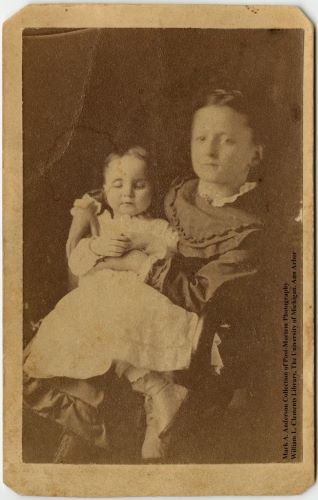
Photography gave Victorian mourning a new and unsettling power: the promise that the beloved face might be preserved at the very moment it was about to disappear forever. Earlier forms of remembrance (miniatures, silhouettes, painted portraits, mourning rings, hairwork, and memorial cards) had already made loss visible and portable, but photography altered the emotional economy of likeness. It seemed mechanical, direct, and evidentiary. The camera did not simply represent the dead through artistic interpretation; it appeared to capture a trace of their actual presence. In an age when many people might never have had a portrait made during life, a post-mortem photograph could become the only surviving likeness of a child, spouse, parent, or sibling. This helps explain why the practice cannot be reduced to morbid curiosity. For many families, it was an act of rescue, a last effort to hold appearance against oblivion.
Post-mortem photography developed within the broader expansion of nineteenth-century photographic culture. Daguerreotypes, ambrotypes, tintypes, cartes de visite, and cabinet cards all changed the relationship between memory, family, and image. Each format carried its own material and social possibilities: the daguerreotype offered a singular, precious image in a protective case; the ambrotype and tintype made portraiture somewhat more accessible; cartes de visite and cabinet cards encouraged circulation, collection, and album-making on a larger scale. As portrait photography became more available, families increasingly assembled albums that joined the living and the dead within a single visual genealogy. The album itself became a domestic space of encounter, where a dead infant might appear beside living siblings, grandparents, cousins, or parents, not as an isolated curiosity but as a member of the family record. The dead might be photographed in bed, in a coffin, in a cradle, on a couch, or in the arms of parents. Infants and young children were common subjects because their deaths often occurred before any living portrait had been taken. Many such images softened death by arranging the deceased as if asleep, surrounded by blankets, flowers, toys, or siblings. These visual choices mattered. Sleep offered a gentler language for death for children, while flowers and domestic textiles placed the body within codes of tenderness rather than spectacle. The purpose was not usually deception in the crude sense, but consolation. The photograph gave the family an image that could be touched, stored, copied, and revisited after burial had made the body inaccessible.
The studio and the home both mattered in this practice. Some post-mortem images were made by professional photographers called to the house, while others were arranged in studios or funeral contexts. The resulting photographs could be explicit or restrained. Some showed the coffin plainly; others framed the dead person as resting; still others included living relatives, whose touch, posture, or gaze made the image a scene of attachment rather than a mere record of the corpse. These photographs often worked like visual relics. They did not replace hair, jewelry, or memorial cards, but joined them in the domestic archive of loss. A photograph could be kept in an album, mounted in a case, placed in a locket, copied for relatives, or paired with hair and inscriptions. It translated the dead body into an image that could remain socially active inside the family long after the funeral.
Post-mortem photography is one of the areas where modern myth most easily distorts Victorian mourning. Popular accounts often claim that photographers routinely propped corpses upright on metal stands, painted pupils onto closed eyelids, or relied on the dead to appear sharper than the blurred living because corpses could remain still during long exposures. Such claims contain fragments of possibility but are frequently exaggerated, misapplied, or repeated without careful evidence. Posing stands were commonly used to steady living sitters, not to hold up dead bodies. Many photographs now circulated online as “Victorian post-mortems” are likely ordinary portraits of living people, misidentified because modern viewers read stiffness, solemnity, odd posture, or old photographic conventions as signs of death. The solemn face, fixed pose, and rigid studio arrangement were not unique to the dead; they were normal features of early portrait photography. The stronger historical interpretation is more careful: Victorians did make post-mortem photographs, especially of children and loved ones without prior portraits, but the practice was generally memorial, not theatrical.
This distinction matters for my larger argument. Post-mortem photography shows that Victorians did not necessarily deny death; they often tried to make death bearable by giving absence a visible form. The last image stood between presence and disappearance. It was taken because the body was still there, but kept because the body would soon be gone. Its emotional force came from that threshold. To modern eyes, such photographs can seem disturbing because they collapse categories that later culture often keeps separate: the family album and the corpse, affection and decay, portraiture and funerary ritual, memory and bodily finality. Yet for Victorian mourners, the photograph could be an act of care. Like hairwork, lockets, and memorial cards, it allowed the dead to remain inside the family’s material world. The camera did not conquer death, but it gave grief one more way to say: this person was here, this face was loved, and this absence must be remembered.
Mourning as Industry: Shops, Catalogues, Mass Production, and the Marketplace of Grief
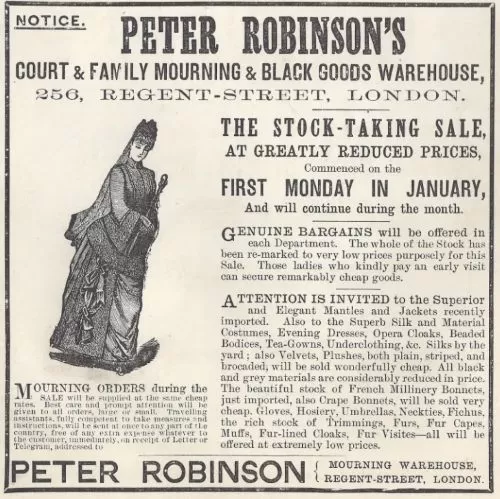
Victorian mourning was intensely personal, but it was also commercial. The black dress, the veil, the jet brooch, the memorial card, the coffin fitting, the funeral carriage, the stationery, the wreath, the cemetery monument, and the photograph all belonged to markets as well as emotions. This does not mean that grief became artificial once it passed through shops. Rather, Victorian culture translated sorrow into goods with remarkable thoroughness. Bereavement created practical needs, and commerce promised to meet them quickly, correctly, and respectably. The mourner did not simply ask, “How do I feel?” but also, “What must I wear, send, buy, display, arrange, and preserve?” In a society governed by social codes, grief required material literacy.
Specialist mourning businesses emerged to answer that anxiety. Drapers, milliners, jewelers, stationers, undertakers, photographers, florists, and monumental masons all participated in the economy of death. Some shops advertised their ability to supply mourning garments at short notice, an essential service in a culture where proper appearance had to begin almost immediately after a death. Mourning warehouses offered fabrics, veils, bonnets, gloves, ribbons, mantles, shawls, and dresses suited to different stages of bereavement. Their appeal lay not only in inventory but in expertise. A customer entering such a shop could be guided through a system of correct mourning: what was suitable for a widow, a daughter, a sister, a child, or a more distant relative; what fabric belonged to deep mourning; when crepe should be reduced; when half-mourning colors could appear; and which ornaments were acceptable without seeming frivolous.
Mass production expanded the reach of these customs. Industrial manufacturing made mourning goods more varied, reproducible, and accessible, even if access remained unequal. Black-bordered stationery, printed memorial cards, mourning envelopes, ready-made garments, vulcanite jewelry, imitation jet, inexpensive photographs, and standardized funeral goods allowed a wider range of families to participate in the visual culture of bereavement. The marketplace did not abolish hierarchy; it reproduced it in different materials. Wealthier mourners could buy Whitby jet, custom jewelry, elaborate funeral processions, private monuments, and carefully fitted wardrobes. Families with fewer resources might purchase cheaper substitutes, borrow garments, adapt existing clothing, or choose modest printed keepsakes. This mattered because the nineteenth-century market often offered not only luxury goods but graded alternatives: real jet and imitation jet, bespoke mourning gowns and altered dresses, elaborate cards and simple printed notices, full funeral display and more economical arrangements that still preserved a claim to respectability. Such gradations allowed mourning to become aspirational. Families could participate in the same symbolic language at different price points, even when the quality, scale, and durability of their goods marked their social position. Victorian mourning commerce democratized certain forms of remembrance while also making class difference visible.
The undertaker became an important figure in this transition from household grief to managed funeral display. Earlier burial customs had often depended heavily on family, parish, neighbors, and local trades. By the nineteenth century, funeral direction increasingly became a specialized profession, particularly in urban areas. Undertakers supplied coffins, coffin furniture, shrouds, hearses, mourning coaches, bearers, feathers, plumes, gloves, scarves, and other ceremonial goods. They also helped coordinate timing, transport, burial arrangements, and the visible dignity of the funeral procession. This professionalization could relieve families of difficult tasks at a moment of shock, but it also opened grief to performance and expense. A funeral was not only a farewell; it was a public statement about respectability, affection, religious seriousness, and household standing.
Advertising and catalogues helped standardize this culture. Mourning goods could be described, priced, compared, and classified in print. Newspapers and periodicals carried notices for mourning warehouses, funeral suppliers, jewelers, photographers, and cemetery services, while etiquette manuals and women’s magazines explained the rules that made those goods necessary. The marketplace and the conduct book reinforced each other. Etiquette created demand by defining what proper mourning required; shops satisfied that demand by supplying objects labeled as correct, tasteful, sober, and appropriate. The result was a circular system in which social anxiety, commercial opportunity, and emotional need fed one another. A bereaved family might sincerely wish to honor the dead, but the available language of honor had increasingly been shaped by retailers and advertisers.
This commercialization was morally ambiguous even to contemporaries. On one hand, mourning goods offered comfort, order, and dignity. They gave families a way to act when grief made action difficult. Buying black clothing, arranging a funeral, commissioning a card, or selecting a memorial could feel like a final service to the dead. These purchases gave sorrow a sequence of tasks, and that sequence could itself be consoling: choosing the coffin, ordering the cards, selecting flowers, dressing the household, arranging the procession, and preserving keepsakes all turned emotional paralysis into ritual action. On the other hand, the market could intensify pressure at precisely the wrong moment. Families were vulnerable to overspending, social comparison, and the fear of appearing disrespectful. Poor households faced the possibility that an inadequate funeral might be read as inadequate love. Burial clubs, friendly societies, and funeral insurance schemes emerged partly because the cost of respectable death could be crushing. The fear of pauper burial was not merely economic; it was moral and emotional, touching questions of dignity, family duty, and the social value of the dead person’s life. The Victorian marketplace of grief reveals both care and coercion: it enabled remembrance while also turning remembrance into obligation.
Mourning as industry shows how deeply Victorian death culture belonged to modernity. It was not merely the survival of old ritual in a sentimental age. It was a system shaped by factories, retail specialization, advertising, print culture, urban growth, consumer choice, and class aspiration. The dead were kept alive through objects, but those objects were increasingly produced, priced, marketed, and sold. This did not empty them of feeling. A cheap memorial card could be cherished for decades; an imitation jet brooch could carry real sorrow; a ready-made black dress could mark a genuine rupture in a woman’s life. Yet commerce changed the conditions under which grief appeared. Victorian mourning became one of the clearest examples of how nineteenth-century society made emotion material, and then made that material available for purchase.
Cemeteries, Funerals, and the Public Geography of Remembrance
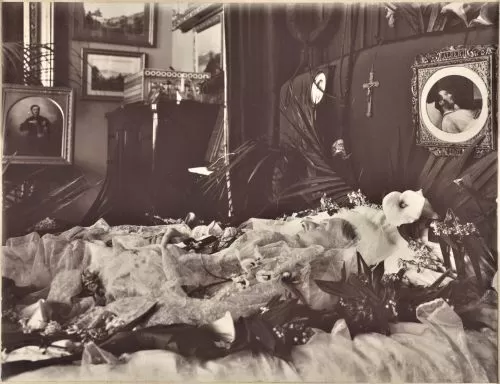
Victorian mourning did not remain confined to the body, the wardrobe, the locket, the photograph, or the domestic archive. It moved outward into streets, churches, graveyards, cemeteries, monuments, and processions. The dead were not only remembered privately; they were placed within a visible geography of community memory. This public geography mattered because nineteenth-century Britain was changing rapidly. Industrial cities expanded, populations grew, older parish burial grounds became overcrowded, and the management of the dead became increasingly entangled with questions of sanitation, urban planning, class order, religious identity, and civic respectability. The cemetery became one of the central spaces where Victorian society tried to reconcile the intimacy of grief with the public problem of mortality.
The older churchyard had long placed the dead close to the living, often at the center of parish life. Burial near the church joined memory, worship, locality, and Christian hope. By the early nineteenth century, many urban churchyards were severely overcrowded, poorly maintained, and increasingly viewed as threats to public health. Reformers described crowded burial grounds in language that combined sanitary alarm with moral disgust: bodies too shallow, graves reused too quickly, odors rising from the soil, and the dead compressed into spaces no longer adequate to the needs of the living city. These concerns did not abolish religious understandings of burial, but they changed the practical setting of death. The corpse became both a sacred human remnant and a public health problem. Victorian cemetery reform emerged from that uneasy combination.
The garden cemetery offered a powerful solution. Large, landscaped burial grounds outside crowded urban centers promised order, dignity, beauty, and sanitary improvement. They also transformed burial into a more expansive visual and emotional experience. Cemeteries such as Kensal Green, Highgate, West Norwood, Abney Park, Nunhead, Brompton, and Tower Hamlets in London became part of a broader movement toward planned landscapes of death. Winding paths, trees, chapels, terraces, monuments, family plots, and carefully managed vistas turned burial space into a place of visitation, contemplation, and display. These cemeteries were not simply disposal grounds. They were moral landscapes. The living could walk among the dead, read inscriptions, admire monuments, remember relatives, and encounter mortality in a setting designed to soften decay through architecture and nature. The design language mattered because it turned death away from the crowded, decaying churchyard and toward a managed vision of order. Trees suggested continuity and renewal; paths encouraged return visits; elevated monuments made family memory visible; chapels framed burial within religious solemnity; and carefully plotted grounds implied that even death could be brought within the discipline of planning. In that sense, the Victorian cemetery belonged as much to the history of urban modernity as to the history of mourning. It was a place where sanitation, sentiment, religion, commerce, class display, and landscape design converged.
Funeral processions carried this public geography into motion. The movement from home to church, chapel, cemetery, or grave made grief visible in the streets. Hearses, mourning coaches, horses, plumes, pallbearers, black garments, gloves, scarves, and slow ceremonial movement turned private loss into communal spectacle. The funeral procession announced that a household had been altered and that the dead person deserved recognition. Like mourning dress, it was a language of status as well as sorrow. A grand funeral could display wealth, respectability, kinship networks, religious affiliation, occupational standing, or civic importance. A modest funeral could still assert dignity, but the pressure to provide a “respectable” burial was intense. To be buried without proper ceremony, or worse, as a pauper, could be experienced as a second social death.
Monuments extended the funeral’s message beyond the day of burial. Victorian cemeteries filled with angels, urns, crosses, obelisks, broken columns, clasped hands, draped vessels, sleeping children, open books, lambs, anchors, ivy, wreaths, and other symbols of grief, hope, virtue, and remembrance. These forms drew from Christian iconography, classical motifs, sentimental imagery, and commercial pattern books. A grave marker could speak in many registers at once: it identified the dead, consoled the living, displayed family resources, expressed religious confidence, and invited future visitors to interpret the life beneath it. Children’s graves often leaned heavily on innocence, sleep, lambs, flowers, and heavenly reunion. Adult monuments might emphasize marital devotion, professional identity, patriarchal lineage, maternal virtue, or Christian resignation. The cemetery became a readable text, a landscape of names and symbols through which Victorian society narrated death. It also became a place where families could project continuity beyond the instability of individual lives. A family plot gathered generations together; an inscription joined birth, marriage, death, and relationship into a compressed biography; and a repeated surname on stone made kinship appear permanent even as bodies disappeared. Monumental language often transformed grief into virtue, presenting the dead as beloved, faithful, dutiful, innocent, patient, or redeemed. It gave mourners not only a record of loss but a story about what that loss meant.
Yet this public geography was never equally available to all. The grand family monument and the private grave existed alongside common graves, temporary markers, crowded burial plots, and pauper funerals. Nonconformists, Catholics, Jews, Anglicans, secularists, immigrants, the poor, and the wealthy did not always occupy death space in the same way or with the same authority. Burial location, monument size, inscription, and funeral display all registered social difference. Still, the cemetery’s broader cultural work remained striking: it gave the dead a place where the living could return. In a period when household grief was preserved through hair, lockets, photographs, and cards, the cemetery supplied a larger architecture of remembrance. It made memory walkable. Victorian mourning extended from the intimate object to the public landscape, from the body worn close to the heart to the grave visited under open sky.
Religion, Spiritualism, and the Hope That the Dead Remained Near
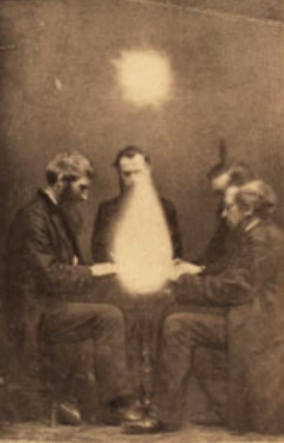
Victorian mourning cannot be understood apart from religion, even when it moved beyond orthodox belief. Death was not only a biological event or a social rupture; it was a spiritual problem. What had happened to the soul? Could the dead see the living? Would families be reunited in heaven? Did grief express faith, or did it reveal dangerous rebellion against divine will? These questions animated sermons, hymns, devotional manuals, deathbed narratives, children’s literature, consolation books, and private letters. The Victorian household might preserve the dead through hair, photographs, lockets, and memorial cards, but those objects usually existed within a larger moral universe in which death was interpreted through providence, resurrection, judgment, and reunion. The dead remained near not only because their images and relics survived, but because many Victorians believed human relationships could continue beyond the grave.
The Christian deathbed remained one of the central scenes of Victorian religious imagination. A “good death” ideally involved consciousness, repentance, resignation, farewell words, prayer, and evidence of spiritual readiness. Family members gathered not only to witness the body’s decline but to interpret the state of the soul. A calm death could console survivors by suggesting divine peace; final words could be treasured as testimony; a dying child’s apparent serenity could be read as proof of heavenly election or innocence. Such interpretations did not eliminate grief, but they gave grief a framework. The mourner could imagine the dead not as extinguished, but as translated into a better condition. The language of “falling asleep,” “going home,” “being called,” or “entering rest” softened death by placing it inside a Christian narrative of passage rather than annihilation.
Yet Victorian faith was not simple or static. The nineteenth century was also an age of religious questioning, biblical criticism, scientific controversy, denominational conflict, and anxiety over belief. Evangelical confidence in conversion and heavenly reunion coexisted with doubt, agnosticism, liberal theology, and intellectual unease. The publication of geological works, evolutionary theory, and higher criticism of the Bible unsettled inherited certainties for many educated Victorians, while urban poverty and epidemic disease raised moral questions about providence and suffering. For some, orthodox Christianity remained sufficient; for others, grief sharpened the need for evidence that the dead still existed somewhere. The death of a child, spouse, sibling, or intimate friend could turn theological abstraction into an urgent personal crisis: if the beloved was truly alive in God, where were they, what did they know, and could love still reach them? Victorian consolation literature often tried to answer these questions by emphasizing heaven as a place of recognition and reunion, not merely worshipful absorption into divine eternity. That emphasis mattered because it preserved the family itself as an imagined structure beyond death. Bereavement could intensify belief, but it could also expose its fragility. The desire to keep the dead near was not always a sign of confident faith. Sometimes it emerged from the fear that faith might not be enough.
This is the emotional and intellectual setting in which spiritualism gained force. Modern spiritualism, emerging from transatlantic currents in the mid-nineteenth century, promised communication with the dead through mediums, séances, table-rapping, automatic writing, trance speech, spirit messages, and later spirit photography. To critics, these practices were fraud, delusion, or dangerous superstition. To believers, they offered something conventional theology often could not: apparent evidence, even contact. The séance room transformed mourning into experiment. The bereaved did not merely pray for the dead or hope for reunion at the end of time; they attempted to hear from them now. A message, a knock, a materialized form, a voice, or an image could seem to collapse the distance between household and afterlife.
Spiritualism appealed in part because it translated older religious hopes into modern forms. It often borrowed Christian language of immortality, consolation, purity, and progress, but it also adopted the language of evidence, investigation, and demonstration. This made it well-suited to a culture fascinated by science, technology, photography, electricity, magnetism, and invisible forces. If the telegraph could send messages across distance, why might not some subtler medium carry messages across death? If photography could capture unseen details or preserve a vanishing face, why might it not record a spirit? Such analogies could be naïve, but they were historically powerful. Spiritualism did not simply reject modernity. It used modernity’s own fascination with instruments, traces, and communication to make the afterlife seem newly accessible.
Spirit photography occupies a revealing place in this culture. Like post-mortem photography, it joined technology and grief, but in a different way. Post-mortem photography preserved the body before burial; spirit photography claimed to reveal the dead after bodily absence. The resulting images often showed faint figures, veiled forms, or ghostly faces hovering near the living sitter. Skeptics exposed many such photographs as manipulations, double exposures, or staged effects, yet their emotional appeal is not hard to understand. They offered mourners a visual language of continued presence. In a culture already trained to trust photographs as traces of reality, the spirit photograph could seem to offer more than metaphor. It appeared to make reunion visible, to place the dead literally beside the living, and to convert hope into evidence. This was powerful because ordinary mourning objects (hair, lockets, portraits, and memorial cards) could only preserve what had once been present. Spirit photography claimed something more radical: that the dead remained active, visible under the right conditions, and capable of reentering the family image. Even when fraudulent, spirit photographs drew power from a sincere desire: to make the invisible beloved visible again.
Religion and spiritualism complicate any purely material account of Victorian mourning. Hair, jewelry, cards, photographs, cemeteries, and monuments mattered not only because they preserved memory, but because they intersected with beliefs about souls, heaven, providence, and continued relationship. The Victorian dead remained near through things, but also through expectation. Some families imagined them in heaven, watching and waiting. Some addressed them in poetry or prayer. Some sought them through mediums. Some doubted and clung harder to relics because relics were what remained when doctrine faltered. Across this range, the central impulse was remarkably consistent: death must not mean total severance. Whether through orthodox hope, sentimental memory, or spiritualist experiment, Victorian mourners searched for ways to keep the dead within reach.
Literature and the Sentimental Dead: Dickens, Tennyson, Brontë, and the Cultural Imagination
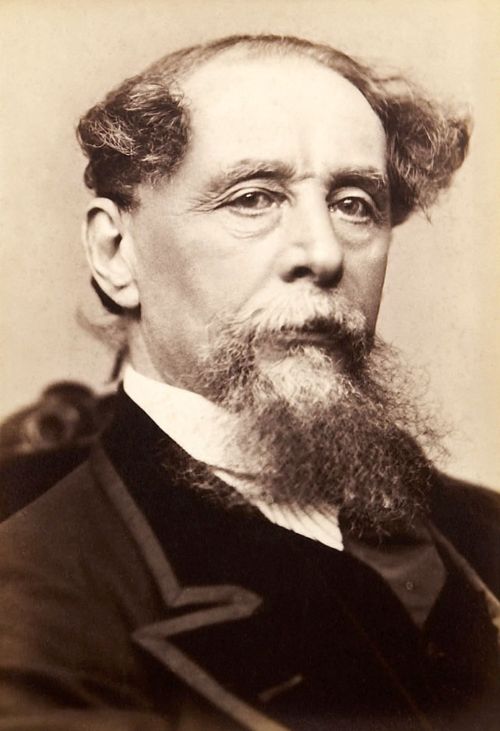
Victorian death culture did not live only in garments, cemeteries, photographs, jewelry, or religious ritual. It also lived in books. Literature gave mourning a language, a set of scenes, and a gallery of figures through which readers could recognize their own grief or learn how grief was supposed to feel. The dying child, the faithful widow, the haunted lover, the deathbed farewell, the relic of the beloved, the grave visited in memory, and the hope of reunion all circulated through poetry, fiction, devotional writing, and popular print. These literary forms did not simply reflect Victorian mourning customs after the fact. They helped produce them. They trained readers to imagine death sentimentally, morally, domestically, and spiritually, turning private bereavement into a shared emotional vocabulary.
Charles Dickens was one of the most powerful architects of this sentimental imagination. The death of Little Nell in The Old Curiosity Shop became one of the most famous scenes of nineteenth-century literary mourning, provoking intense response from readers who experienced the fictional child’s death as though it were a public bereavement. Dickens returned repeatedly to deathbeds, orphanhood, lost children, damaged families, and the moral claims of the vulnerable dead. His child deaths could be intensely sentimental, even manipulative, but their force lay in the way they joined innocence, social criticism, and consolation. The dead child became not merely an occasion for tears, but an indictment of a world that had failed to protect purity. In Dickens, mourning often asks the living to become morally better. The dead remain active because they continue to accuse, soften, instruct, and redeem.
Alfred Tennyson’s In Memoriam A.H.H. gave Victorian grief one of its most influential poetic structures. Written after the death of Arthur Henry Hallam, the poem does not move simply from sorrow to consolation. It circles, doubts, revises, remembers, argues, and returns. Its power comes from that movement: grief is not treated as a single emotion but as a long discipline of thought and feeling. Tennyson’s mourner wants Christian hope, but he also confronts the implications of modern science, natural violence, evolutionary time, and the apparent indifference of the material world. The dead friend becomes a point of attachment through which the poet wrestles with faith itself. In Memoriam belongs directly to the Victorian culture of keeping the dead near. Hallam is absent, but he remains intellectually and emotionally present, the center around which memory, doubt, theology, and poetic form continue to organize themselves.
Emily Brontë’s Wuthering Heights offers a darker version of the same problem. If Dickens often sentimentalized the dead and Tennyson searched for spiritual consolation, Brontë explored the terrifying persistence of attachment beyond death. Catherine Earnshaw does not disappear from Heathcliff’s world. She becomes memory, ghost, wound, obsession, and almost atmosphere. The novel refuses to make mourning orderly. It presents grief not as proper conduct or moral refinement, but as possession. Heathcliff’s longing for Catherine violates domestic peace, Christian resignation, and social reason. Yet the novel’s emotional power depends on the same broader Victorian anxiety: what if love survives death too violently to be contained by ritual? Wuthering Heights exposes the shadow side of remembrance. The dead may console the living, but they may also dominate them.
Victorian poetry and fiction repeatedly returned to relics, bodies, graves, and tokens because these objects made emotion legible. A lock of hair, a portrait, a letter, a garment, a grave marker, or a preserved room could carry narrative force out of proportion to its size. Such objects condensed personhood. They allowed characters to touch absence, to misread memory, to cling to the past, or to discover hidden histories. Christina Rossetti’s death poems, Elizabeth Barrett Browning’s elegiac writing, the Brontës’ graveside scenes, Dickens’s deathbeds, and sensation fiction’s fascination with secrets and remains all show how deeply Victorian literature depended on material traces. The dead often entered plots through things left behind. A relic could reveal love, guilt, inheritance, betrayal, legitimacy, or unresolved grief. It could also unsettle the boundary between evidence and emotion, because the object seemed to prove that the dead had existed while also inviting the living to imagine more than proof could supply. A portrait might preserve a face but also distort memory into idealization; a letter might restore a voice but also reopen wounds; a lock of hair might promise intimacy while reminding the mourner of bodily loss. Literary relics performed the same double work as actual Victorian mourning objects. They both preserved presence and exposed absence. The object left behind was never neutral. It drew the living back into relationship with the dead, sometimes tenderly, sometimes compulsively, and sometimes destructively. Literature mirrored and intensified the domestic archive of mourning found in actual Victorian homes.
The literary dead helped Victorians think about what mourning should do. Should grief lead to Christian resignation, moral reform, emotional discipline, social critique, or continued attachment? Should the dead be released, preserved, obeyed, idealized, or resisted? Victorian writing rarely answered these questions in only one way. It sentimentalized death and questioned sentimentality; it consoled readers and disturbed them; it turned children into angels and lovers into ghosts; it transformed private sorrow into public feeling and sometimes exposed the costs of doing so. This is why literature is essential to the history of Victorian mourning. It reveals not only what Victorians did with the dead, but what they imagined the dead could still do with them. In the cultural imagination, as in the locket, the photograph, and the cemetery, the dead remained active presences within the world of the living.
Late Victorian Change: Medicalization, Cremation, Professional Funerals, and the Fading of High Mourning

By the late nineteenth century, the culture of Victorian mourning had begun to change. Death did not become less important, nor did grief become less intense, but the settings, authorities, and assumptions surrounding death shifted. The earlier Victorian world in which the household so often served as sickroom, death chamber, mourning archive, and first funeral space increasingly gave way to a more professionalized and medicalized order. Doctors, undertakers, cemetery companies, sanitary reformers, cremation advocates, insurers, hospitals, and municipal authorities all claimed growing roles in the management of dying and the dead. The family still mourned, preserved, visited, and remembered, but it did so within a world where death was more likely to be handled by specialists and discussed through the language of hygiene, certification, regulation, and efficiency. This change did not happen all at once, and it did not affect all families equally. A rural household, a working-class urban family, a wealthy London widow, and a person dying in a workhouse infirmary might encounter very different versions of late Victorian death. Yet across these differences, a broad transition was visible: death was moving further into the hands of experts, institutions, and systems. The intimate culture of mourning remained, but it increasingly operated alongside a modern apparatus that measured, certified, transported, managed, and professionalized the dead body.
Medicalization changed the emotional geography of death. In the early and mid-Victorian household, the deathbed had often been a domestic and religious scene, watched by relatives and interpreted through prayer, resignation, last words, and spiritual readiness. By the later nineteenth century, the doctor’s presence carried increasing authority. Diagnosis, prognosis, pain relief, death certification, and the management of the body after death all became more firmly connected to professional medicine. This did not suddenly remove religion from the deathbed, but it altered the balance of interpretation. A dying person could still be imagined as preparing for eternity, yet the body was also increasingly understood through pathology, contagion, clinical observation, and medical failure or success. Death remained a moral and spiritual event, but it also became a case.
Hospitals and institutions contributed to this transformation, although unevenly. Many people still died at home, more so when families had the resources and space to nurse them there, but institutional death became more prominent in the public imagination and in urban practice. Workhouses, infirmaries, hospitals, asylums, and charitable institutions all shaped late Victorian experiences of dying, especially among the poor, the elderly, the chronically ill, and those without stable household support. This mattered because institutional death could weaken older domestic rituals. The body might be washed, moved, certified, and prepared under institutional rules before the family fully reclaimed it. The dying person might be surrounded by nurses, doctors, attendants, or other patients rather than by the idealized circle of kin so often celebrated in Victorian deathbed literature. The home did not disappear from mourning, but it no longer monopolized the dying scene.
The professional funeral also became more firmly established. Undertakers had already played an important role earlier in the century, but by the late Victorian period funeral direction was increasingly routinized, specialized, and commercially organized. Families might still make choices about clothing, flowers, burial place, memorial cards, processions, and monuments, but much of the practical work passed to professionals. Coffins, hearses, mourning carriages, embalming or preservation techniques in some cases, printed notices, grave arrangements, and ceremonial management could be coordinated through an expanding funerary trade. This professionalization could be comforting because it relieved families of logistical burdens at a moment of distress. It could also distance the bereaved from the body and from the older household labor of death. The dead were still loved, but they were increasingly handled through services.
Sanitary reform was central to this change. Throughout the nineteenth century, reformers had attacked overcrowded burial grounds, unsafe water, poor drainage, inadequate housing, and the dangers of unmanaged urban growth. By the later Victorian period, those concerns had reshaped burial practices and public expectations. Death could not be treated only as a private family matter because corpses, cemeteries, contagion, and urban space were understood to have public consequences. Registration, burial regulation, cemetery planning, and medical certification all reflected the expanding administrative reach of the modern state. This did not mean that the corpse ceased to be sacred or emotionally charged. Rather, the corpse became double-coded: it was the remains of a beloved person and an object requiring sanitary, legal, and bureaucratic management. Victorian mourning had always made the dead socially visible; late Victorian reform increasingly made them administratively visible as well.
Cremation brought these tensions into sharp focus. For much of Christian Europe, burial had carried deep theological, emotional, and customary authority. The grave preserved continuity with parish, family, resurrection hope, and ancestral place. It gave mourning a location and made memory spatial: the body lay somewhere, under a stone, within a family plot, in ground that could be visited, tended, and named. Cremation challenged that world by proposing a cleaner, more rational, more sanitary, and more efficient treatment of the dead. Advocates argued that cremation answered the problems of overcrowded cemeteries, urban land pressure, and public health. It also appealed to reformers who wanted death practices to conform to modern principles of science and civic management rather than inherited custom alone. Opponents worried about irreligion, the destruction of bodily integrity, the possible concealment of crime, and the severing of familiar rituals of grave visitation. The body reduced to ashes could seem too abrupt a transformation, too sharp a break from the older imagination of sleep, rest, and eventual resurrection. The founding of the Cremation Society of England in the 1870s and the gradual legalization and practice of cremation in the later nineteenth century marked a major cultural shift, even though cremation remained controversial and relatively limited at first. It suggested that modern death might be managed not by preserving the body in the earth, but by transforming it through fire.
Cremation also raised a deeper question for mourning: where, and how, should the dead remain present? Burial gave mourners a grave, a stone, a place to visit, and a body imagined beneath the ground. Cremation complicated that geography. Ashes could be buried, scattered, housed in urns, placed in columbaria, or kept in other ways, but the older relationship between body, grave, and family plot was altered. For some, cremation seemed to threaten the material continuity on which mourning depended. For others, it offered a dignified modern alternative that separated memory from the slow decay of the corpse. This debate reveals the larger late Victorian transition. The dead were still to be remembered, but remembrance was becoming less dependent on older forms of bodily preservation, churchyard continuity, and elaborate mourning display. The photograph, the memorial card, the monument, the obituary, the urn, the archive, and the professional funeral all competed or combined as technologies of memory.
By the end of the Victorian era, high mourning had begun to lose some of its cultural authority. The elaborate codes of deep mourning, prolonged seclusion, heavy crepe, strict half-mourning stages, and expensive wardrobes increasingly came under criticism as burdensome, unhealthy, artificial, or socially excessive. This change was gradual and uneven. Many people continued to wear mourning, preserve hair, visit graves, commission memorials, and observe funeral etiquette. Yet the most rigid version of mourning culture no longer seemed inevitable. Modern medicine, professional funerals, cremation debates, changing fashion, women’s changing social roles, and impatience with excessive display all weakened the old system. Victorian mourning did not vanish; it thinned, adapted, and passed into Edwardian and modern forms. The dead remained present, but the means of keeping them near shifted from the heavy public grammar of high mourning toward more varied, private, professional, photographic, and bureaucratic forms of remembrance.
Are We Mistaking Victorian Mourning for Victorian Morbidity?
The following video from “Timeline – World History Documentaries” discusses the Victorian death culture:
The strongest challenge to my argument is that “Victorian death culture” can easily become too coherent, too theatrical, and too strange. Modern readers often approach the nineteenth century through surviving objects that already look unusual: hair jewelry, post-mortem photographs, black mourning gowns, cemetery angels, spirit images, funeral cards, and elaborate monuments. These objects are visually powerful, but they are also selective evidence. They survive because they were preserved, collected, displayed, sold, or later interpreted as curiosities. If we build the entire history of Victorian mourning from the most dramatic remnants, we risk mistaking a partial archive for an entire culture. The Victorians did not all live in a permanent state of gothic grief, and they did not all treat death with the same degree of ritual elaboration.
This problem is clear in the modern fascination with post-mortem photography. Victorian families did commission photographs of the dead, particularly when no living likeness existed, and especially in cases involving infants and children. Yet many images circulated today as “Victorian post-mortems” are almost certainly misidentified portraits of living people. Early photography often required still poses, serious expressions, studio supports, and long exposures, all of which can appear eerie to modern viewers unfamiliar with nineteenth-century photographic conventions. Claims that corpses were routinely propped upright on stands, posed as though alive, or given painted eyes have often been exaggerated into folklore. The point is not that such staging never occurred in any form, but that it has become a sensational shorthand for a much broader and more ordinary practice of memorial portraiture. Modern culture often wants the Victorians to be macabre because that makes them easier to consume as spectacle.
The same caution applies to hairwork, mourning dress, and funerals. Hair jewelry could commemorate the dead, but it could also mark friendship, courtship, kinship, or affection among the living. Black dress could express grief, but it could also obey etiquette, display class status, or satisfy social expectation. Funeral display could arise from love, but also from fear of shame, commercial pressure, and the demand for respectability. Even Queen Victoria’s mourning for Albert, though enormously influential, should not be treated as the universal Victorian experience. Her widowhood was royal, wealthy, highly visible, politically charged, and unusually prolonged. A working-class widow, a servant, a rural laborer, a Nonconformist family, a Jewish family, an Irish Catholic household, or an urban poor family facing burial expenses did not necessarily inhabit the same mourning world. “Victorian mourning” was never one thing.
This counterpoint does not overturn the my argument, but it does discipline it. The better claim is not that Victorians were uniquely morbid, nor that they loved death more than other people did. The stronger interpretation is that nineteenth-century Britain made grief unusually visible and material at the intersection of older Christian traditions, high mortality, domestic death, sentimental literature, royal example, industrial production, consumer markets, cemetery reform, photography, and spiritualist experiment. What looks like morbidity from a modern distance often looks, in context, like an attempt to preserve relationship under conditions of repeated loss. The Victorians did not simply stare at death. They gave bereavement forms: garments, objects, images, words, spaces, rituals, timetables, and commodities.
The counterpoint strengthens the final interpretation by forcing a distinction between Victorian mourning and modern mythmaking about Victorian mourning. The hair brooch, the black veil, the cemetery angel, the deathbed poem, the memorial card, and the last photograph were not props in a gothic drama. They were tools by which families tried to manage absence. Yet they were also shaped by commerce, gender, class, etiquette, and social surveillance. Victorian death culture was intimate and artificial, sincere and performative, religious and commercial, consoling and coercive. Its complexity lies precisely there. To understand it well, we must neither romanticize it as beautiful devotion nor dismiss it as morbid excess. We must see it as a historical system for keeping the dead socially present in a world where death was painfully common and modern life was rapidly changing the ways memory could be made.
Conclusion: The Dead at the Heart of the Living World
Memento mori asked the living to remember death, but Victorian mourning did something more intimate: it asked them to remember the dead as continuing presences. The skull, hourglass, grave, and funeral sermon had long taught Christians that earthly life was temporary, but nineteenth-century Britain translated that old warning into a dense material culture of attachment. Hair, lockets, photographs, mourning dress, memorial cards, funeral processions, cemetery monuments, spirit images, poems, and preserved rooms all worked against disappearance. They did not deny that death had occurred. On the contrary, they insisted upon death’s reality so strongly that it had to be marked, worn, pictured, archived, visited, and narrated. Victorian mourning made absence visible.
This visibility emerged from historical pressure. High child mortality, epidemic disease, domestic deathbeds, urban crowding, religious hope, scientific doubt, royal example, industrial production, and new visual technologies all shaped the ways Victorians grieved. The dead body passed from sickroom to coffin to grave, but traces of the person remained in the household, on the mourner’s body, in albums, in jewelry, in stationery, in cemetery landscapes, and in literature. The dead were not remembered only at funerals or anniversaries. They were folded into daily life through objects that could be touched and routines that could be repeated. A widow’s black dress, a mother’s preserved lock of hair, a child’s photograph, a grave visited on a Sunday walk, or a poem read in sorrow all allowed grief to endure without becoming entirely formless.
Yet Victorian mourning was never merely tender. It was also disciplined by etiquette, gender, class, commerce, and social expectation. The culture that gave mourners meaningful forms also imposed burdensome ones. Women especially carried the visible labor of grief; poorer families struggled to afford respectable burial; shops and undertakers turned sorrow into a marketplace; and public mourning could become a test of propriety as much as affection. Nor should the Victorians be reduced to modern fantasies of morbidity. Their practices can seem strange because they brought death closer than many modern cultures prefer, but their purpose was often deeply recognizable: to preserve love after the body was gone. The discomfort these objects now produce may reveal less about Victorian oddity than about modern habits of hiding death from ordinary life.
The Victorian dead remained at the heart of the living world because mourning made them socially, materially, and imaginatively present. They rested in cemeteries, but also in lockets. They appeared in photographs, but also in poems and prayers. They survived in hair, inscriptions, albums, monuments, stories, and household memory. Victorian mourning did not conquer mortality, and it did not heal every wound it ritualized. But it offered a language for living with the dead without pretending they had vanished. In that sense, the Victorian culture of memento mori was not only a reminder that everyone must die. It was a declaration that those who had died still belonged to the living.
Bibliography
Affiliate disclosure: Amazon links on this site are paid links. As an Amazon Associate I earn from qualifying purchases.
- Altholz, Josef L. The Religious Press in Britain, 1760–1900. Westport, CT: Greenwood Press, 1989.
- Ariès, Philippe. The Hour of Our Death. Translated by Helen Weaver. New York: Alfred A. Knopf, 1981.
- Arnstein, Walter L. Queen Victoria. New York: Palgrave Macmillan, 2003.
- Auerbach, Nina. Woman and the Demon: The Life of a Victorian Myth. Cambridge, MA: Harvard University Press, 1982.
- Basham, Diana. The Trial of Woman: Feminism and the Occult Sciences in Victorian Literature and Society. New York: New York University Press, 1992.
- Batchen, Geoffrey. Forget Me Not: Photography and Remembrance. New York: Princeton Architectural Press, 2004.
- Beeton, Isabella. Mrs. Beeton’s Book of Household Management. London: S. O. Beeton, 1861.
- Bennett, Daphne. King without a Crown: Albert, Prince Consort of England, 1819–1861. London: Heinemann, 1977.
- Brontë, Emily. Wuthering Heights. London: Thomas Cautley Newby, 1847.
- Burns, Stanley B. Sleeping Beauty: Memorial Photography in America. Altadena, CA: Twelvetrees Press, 1990.
- Cadwallader, Jen. “Spirit Photography and the Victorian Culture of Mourning.” Modern Language Studies 37:2 (2008), 8-31.
- Chadwick, Edwin. A Supplementary Report on the Results of a Special Inquiry into the Practice of Interment in Towns. London: W. Clowes and Sons, 1843.
- Cooley, Arnold James. The Toilet and Cosmetic Arts in Ancient and Modern Times. London: Robert Hardwicke, 1866.
- Cunnington, C. Willett, and Phillis Cunnington. Handbook of English Costume in the Nineteenth Century. London: Faber and Faber, 1959.
- Curl, James Stevens. The Victorian Celebration of Death. Stroud: Sutton Publishing, 2000.
- Dickens, Charles. David Copperfield. London: Bradbury and Evans, 1850.
- —-. The Old Curiosity Shop. London: Chapman and Hall, 1841.
- Duffy, Eamon. The Stripping of the Altars: Traditional Religion in England, 1400–1580. New Haven: Yale University Press, 1992.
- Edwards, Elizabeth, and Janice Hart, eds. Photographs Objects Histories: On the Materiality of Images. London: Routledge, 2004.
- Finer, S. E. The Life and Times of Sir Edwin Chadwick. London: Methuen, 1952.
- Flanders, Judith. The Victorian House: Domestic Life from Childbirth to Deathbed. London: Harper Perennial, 2003.
- Gere, Charlotte, and Judy Rudoe. Jewellery in the Age of Queen Victoria: A Mirror to the World. London: British Museum Press, 2010.
- Gilbert, Sandra M., and Susan Gubar. The Madwoman in the Attic: The Woman Writer and the Nineteenth-Century Literary Imagination. New Haven: Yale University Press, 1979.
- Gittings, Clare. Death, Burial and the Individual in Early Modern England. London: Croom Helm, 1984.
- Hamlin, Christopher. Cholera: The Biography. Oxford: Oxford University Press, 2009.
- Holm, Christiane. “Sentimental Cuts: Eighteenth-Century Mourning Jewelry with Hair.” Eighteenth-Century Studies 38:1 (2004), 139–143.
- Homans, Margaret. Royal Representations: Queen Victoria and British Culture, 1837–1876. Chicago: University of Chicago Press, 1998.
- Houlbrooke, Ralph. Death, Religion, and the Family in England, 1480–1750. Oxford: Clarendon Press, 1998.
- Jalland, Pat. Death in the Victorian Family. Oxford: Oxford University Press, 1996.
- Jupp, Peter C. From Dust to Ashes: Cremation and the British Way of Death. Basingstoke: Palgrave Macmillan, 2006.
- Jupp, Peter C., and Clare Gittings, eds. Death in England: An Illustrated History. Manchester: Manchester University Press, 1999.
- Koven, Seth. Slumming: Sexual and Social Politics in Victorian London. Princeton: Princeton University Press, 2004.
- Kuchta, David. The Three-Piece Suit and Modern Masculinity: England, 1550–1850. Berkeley: University of California Press, 2002.
- Laqueur, Thomas W. The Work of the Dead: A Cultural History of Mortal Remains. Princeton: Princeton University Press, 2018.
- Larsen, Timothy. Crisis of Doubt: Honest Faith in Nineteenth-Century England. Oxford: Oxford University Press, 2006.
- Linkman, Audrey. Photography and Death. London: Reaktion Books, 2011.
- Litten, Julian. The English Way of Death: The Common Funeral since 1450. London: Robert Hale, 1991.
- Longford, Elizabeth. Victoria R.I. London: Weidenfeld & Nicolson, 1964.
- Lutz, Deborah. “The Dead Still Among Us: Victorian Secular Relics, Hair Jewelry, and Death Culture.” Victorian Literature and Culture 39:1 (2011), 127-142.
- —-. Relics of Death in Victorian Literature and Culture. Cambridge: Cambridge University Press, 2014.
- Lyden, Anne M. A Royal Passion: Queen Victoria and Photography. Los Angeles: J. Paul Getty Museum, 2014.
- Mack, Helen. The Art of Dressing Well: A Complete Guide to Economy, Style and Propriety of Costume. London: Ward, Lock, and Tyler, 1870.
- Marien, Mary Warner. Photography: A Cultural History. 5th ed. London: Laurence King Publishing, 2021.
- Matus, Jill L. Shock, Memory and the Unconscious in Victorian Fiction. Cambridge: Cambridge University Press, 2009.
- Morley, John. Death, Heaven and the Victorians. Pittsburgh: University of Pittsburgh Press, 1971.
- Mytum, Harold. Mortuary Monuments and Burial Grounds of the Historic Period. New York: Kluwer Academic/Plenum Publishers, 2004.
- Noakes, Richard. “Spiritualism, Science and the Supernatural in Mid-Victorian Britain.” In The Victorian Supernatural, edited by Nicola Bown, Carolyn Burdett, and Pamela Thurschwell, 23–43. Cambridge: Cambridge University Press, 2004.
- O’Connor, Mary Catharine. The Art of Dying Well: The Development of the Ars Moriendi. New York: Columbia University Press, 1942.
- Oppenheim, Janet. The Other World: Spiritualism and Psychical Research in England, 1850–1914. Cambridge: Cambridge University Press, 1985.
- Owen, Alex. The Darkened Room: Women, Power, and Spiritualism in Late Victorian England. Philadelphia: University of Pennsylvania Press, 1990.
- Parsons, Brian. Committed to the Cleansing Flame: The Development of Cremation in Nineteenth-Century England. Reading: Spire Books, 2005.
- Plunkett, John. Queen Victoria: First Media Monarch. Oxford: Oxford University Press, 2003.
- Pointon, Marcia. Brilliant Effects: A Cultural History of Gem Stones and Jewellery. New Haven: Yale University Press, 2009.
- Poovey, Mary. Making a Social Body: British Cultural Formation, 1830–1864. Chicago: University of Chicago Press, 1995.
- Queen Victoria of Great Britain. Leaves from the Journal of Our Life in the Highlands, from 1848 to 1861. Edited by Arthur Helps. London: Smith, Elder, 1868.
- Richardson, Ruth. Death, Dissection and the Destitute. 2nd ed. Chicago: University of Chicago Press, 2000.
- Rossetti, Christina. Goblin Market and Other Poems. Cambridge: Macmillan, 1862.
- Ruby, Jay. Secure the Shadow: Death and Photography in America. Cambridge, MA: MIT Press, 1995.
- Rugg, Julie. “Defining the Place of Burial: What Makes a Cemetery a Cemetery?” Mortality 5:3 (2000), 259–275.
- —-. “From Reason to Regulation: 1760–1850.” In Death in England: An Illustrated History, edited by Peter C. Jupp and Clare Gittings, 202–229. Manchester: Manchester University Press, 1999.
- Schwarzbach, F. S. and John Kucich. “The Victorians and Death.” PMLA 95:5 (1980), 875-877.
- Seiberling, Grace, with Carolyn Bloore. Amateurs, Photography, and the Mid-Victorian Imagination. Chicago: University of Chicago Press, 1986.
- Stannard, David E., ed. Death in America. Philadelphia: University of Pennsylvania Press, 1975.
- Strange, Julie-Marie. Death, Grief and Poverty in Britain, 1870–1914. Cambridge: Cambridge University Press, 2005.
- Tarlow, Sarah. Ritual, Belief and the Dead in Early Modern Britain and Ireland. Cambridge: Cambridge University Press, 2011.
- Taylor, Lou. Mourning Dress: A Costume and Social History. London: George Allen and Unwin, 1983.
- Tennyson, Alfred. In Memoriam A.H.H. London: Edward Moxon, 1850.
- Walvin, James. “Dust to Dust: Celebrations of Death in Victorian England.” Historical Reflections / Réflexions Historiques 9:3 (1982), 353-371.
- Waters, Catherine. Dickens and the Politics of the Family. Cambridge: Cambridge University Press, 1997.
- Weintraub, Stanley. Uncrowned King: The Life of Prince Albert. New York: Free Press, 1997.
- Wohl, Anthony S. Endangered Lives: Public Health in Victorian Britain. Cambridge, MA: Harvard University Press, 1983.
- Worpole, Ken. Last Landscapes: The Architecture of the Cemetery in the West. London: Reaktion Books, 2003.
- Young, Diana. “The Material Value of Color: The Estate Agent’s Tale.” In The Social Life of Materials: Studies in Materials and Society, edited by Adam Drazin and Susanne Küchler, 226–240. London: Bloomsbury Academic, 2015.
Originally published by Brewminate, 06.15.2026, under the terms of a Creative Commons Attribution-NonCommercial-NoDerivatives 4.0 International license.
About the Author