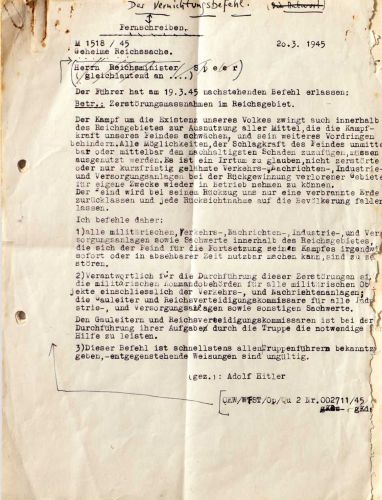
Hitler’s 1945 Nero Decree put civilian survival at risk by ordering infrastructure destruction. Its uneven execution exposes the limits of Nazi authority and Speer’s rescue narrative.

By Matthew A. McIntosh
Public Historian
Brewminate
Introduction: A Nation Ordered to Destroy Its Means of Survival
On March 19, 1945, Adolf Hitler issued an order that threatened to make Germany’s approaching defeat more destructive for the people who would survive it. Military commanders and regional Nazi authorities were instructed to destroy transport and communications facilities, industrial installations, and supply infrastructure that advancing enemy forces might use. The directive justified these measures through the nation’s struggle for existence, extending the demand for destruction to resources useful to the enemy either immediately or later. Yet a railway carrying military supplies could also deliver food, and an installation serving wartime production might remain indispensable after the fighting ended. The order endangered the material conditions through which civilian life could continue under occupation.
Germany’s predicament gave this decision its significance. Allied armies were advancing into the Reich, while years of warfare had already damaged the systems connecting production with everyday consumption. Further demolition would fall upon communities struggling to maintain essential services amid displacement and combat. For the Nazi leadership, acknowledging defeat required confronting a future in which Germany existed without the political order that claimed to represent its destiny. Hitler’s authority had depended heavily on promises of national restoration through struggle, and the regime continued demanding obedience when the military circumstances offered increasingly little prospect of achieving those promises. Fear of the approaching enemy helped sustain resistance, while coercion restricted the ability of soldiers and civilians to choose an end to it. The destruction directive emerged within this continuing war effort, where the claimed defense of Germany could authorize actions that endangered Germans beyond any immediate battlefield encounter. Explaining that relationship requires attention to the institutions that sustained resistance as well as to the decisions made at the summit of power.
Albert Speer’s response provides unusually direct evidence of the dispute over what should remain after defeat. In a letter dated March 29, the armaments minister recorded Hitler’s reported assertion that a defeated German nation had demonstrated its weakness and that the basic requirements of its survivors no longer deserved protection. Because this account was written during the regime’s final weeks, it cannot be dismissed as an invention first appearing in Speer’s postwar memoirs. Nevertheless, it remains his representation of a conversation, framed within an appeal intended to influence Hitler. Its meaning must also be assessed against Speer’s other actions. His advocacy of infrastructure preservation coexisted with a separate March 18 memorandum urging severe measures to prolong resistance in the hope of obtaining a more favorable outcome. He continued to serve a government whose war production depended on the exploitation of forced labor, and opposition to demolition did not erase that responsibility. His subsequent presentation of himself as Germany’s rescuer made these inconsistencies important for historical interpretation. The contemporary documents establish a disagreement over destruction, but they do not justify assigning Speer an uncomplicated humanitarian role or treating his later explanation of events as the measure of everyone else’s conduct.
Execution was uneven, and that unevenness belongs at the center of the decree’s history. Subsequent amendments altered the instructions, while local decisions and practical obstacles affected which installations were destroyed and which survived. Preserved industrial capacity could coexist with demolished bridges, and continued participation in Nazi violence could accompany efforts to protect certain facilities. Germany’s devastated condition cannot be attributed wholesale to the March 19 order, just as incomplete implementation cannot settle the question of what issuing it meant. The decree exposed a profound failure of the regime’s claim to protect the nation. Continued resistance was permitted to take precedence over the foreseeable needs of its surviving population. Its history turns on how far officials accepted that priority, what they actually accomplished, and why some foundations of civilian survival remained beyond the reach of the destructive mandate.
March 1945: The Military Emergency and the Exhaustion of the War Economy
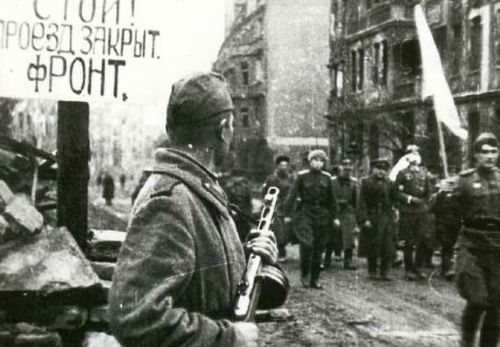
The eastern front had changed Germany’s strategic position before March began. During the Soviet offensive launched in January 1945, German forces lost much of the territory separating the Red Army from the Reich’s principal eastern regions. Soviet troops reached the Oder, placing them within striking distance of Berlin, although the final offensive against the capital would not begin until April. Fighting in Upper Silesia deprived Germany of important industrial resources, while the isolation of East Prussia disrupted military connections and intensified civilian flight. These losses reduced the territory available to sustain the war and placed additional demands on an already strained transport network. Holding the remaining front could delay further penetration, but it could not restore the resources surrendered during the preceding weeks.
In the west, the Rhine offered a substantial defensive obstacle whose value depended on preventing the Allies from establishing crossings. The failed Ardennes offensive had consumed equipment and fuel that Germany could ill afford to lose, without producing the strategic reversal Hitler had sought. On March 7, American forces captured the Ludendorff Bridge at Remagen and established a bridgehead on the eastern bank. That development preceded the destruction decree and demonstrated that the river could no longer be treated as an intact barrier behind which Germany might reorganize its defense. Additional crossings later in the month widened the breach. American troops crossed near Oppenheim on the night of March 22–23, followed by the major Allied operation across the lower Rhine beginning on March 23–24. These events brought the Ruhr’s industrial concentration into immediate danger and increasingly restricted movement between western Germany and the remaining territories under Nazi control. When Hitler issued his order on March 19, those later crossings had not yet occurred, but the possibility of defending the western industrial region already rested on deteriorating military foundations. The speed of the subsequent advance exposed how little time remained for arrangements premised on a stable front.
Economic exhaustion involved more than the destruction or capture of individual factories. Germany retained machinery and continued producing weapons, but production depended on connections that were breaking down across the country. Allied attacks on railway facilities, intensified during the closing months of 1944, disrupted the movement of coal and other essential freight. A mine might remain capable of extracting coal while the system carrying its output to consumers failed; an undamaged industrial plant could lose the energy required to operate. Damage to major junctions forced traffic onto less suitable routes, where congestion reduced the usefulness of whatever railway capacity remained. Repairs could restore a line without resolving shortages elsewhere or ensuring that trains reached their destinations. The postwar United States Strategic Bombing Survey identified transportation disruption as a central cause of Germany’s accelerating economic decline, although its assessments must be read with awareness of the institution’s interest in explaining the effectiveness of air power. The distinction between surviving productive assets and their effective operation is nevertheless essential. Industrial capacity on paper did not establish that an army could be supplied in the field, and completed weapons were of limited value when their delivery became uncertain. By March, the accumulation of interruptions was damaging the economic relationships that had previously allowed separate districts to support a common war effort.
Fuel imposed a severe constraint on military operations. The loss of access to Romanian oil in 1944 had increased Germany’s dependence on remaining sources, including synthetic production already subjected to repeated air attacks. Bombing these installations affected the ability to operate vehicles and restricted the training necessary to use them effectively. A newly manufactured aircraft could add to production totals without contributing a corresponding increase in combat power if fuel shortages limited its employment. Armored formations faced a comparable discrepancy between possession of equipment and freedom of movement. Germany’s commanders confronted shortages that reduced their ability to respond to Allied breakthroughs even where personnel and weapons remained available.
The history of armaments production also complicates any claim that the economy simply stopped functioning at a single identifiable moment. Output had risen substantially during much of the war, and some branches continued delivering equipment after conditions had become disastrous elsewhere. Those achievements depended partly on organizational changes and the diversion of resources toward military priorities, while coercive labor practices imposed immense suffering on workers drawn from occupied Europe. Speer’s later reputation for an extraordinary production “miracle” obscured both the contributions of other institutions and the conditions under which those gains had been obtained. Adam Tooze’s analysis places the production record within the larger resource limits confronting the Nazi economy, making clear why impressive manufacturing figures could coexist with strategic weakness.
By early 1945, preserving output increasingly required efforts to work around damaged facilities and interrupted supplies, often through dispersal or relocation. Such measures could keep operations running, but they could not compensate indefinitely for the loss of territory or the failure to move essential materials. Economic mobilization still produced results; the difficulty was converting those results into a sustainable capacity to fight.
Speer’s memorandum dated March 15, delivered to Hitler on March 18, gave the emergency a contemporary administrative formulation. It predicted that economic breakdown, followed by military incapacity, could occur within four to eight weeks. That interval should be understood as the minister’s assessment of a rapidly changing situation, rather than a precise timetable independently established by the subsequent course of events. His warning drew attention to the consequences of shortages and transport disruption for maintaining production and supporting the population. It also sought to influence decisions about the installations and connections that remained under German control. The document’s significance lies partly in showing that a senior official with extensive access to economic information regarded the system as approaching failure while individual factories still operated. Speer’s attempt to turn that diagnosis into preservation measures encountered a leadership whose decisions continued to assume that determined action might alter the outcome. Knowledge of the economy’s deterioration had entered the highest levels of government, but it did not produce agreement about what should follow from that knowledge.
Military defeat and economic collapse developed at different speeds across Germany. Some formations could continue fighting intensely while nearby production or distribution systems ceased to function, and local shortages did not always reveal the condition of the country as a whole. This unevenness left room for officials to emphasize surviving capabilities and postpone acknowledging what the cumulative losses meant. It also made destruction decisions consequential for German operations themselves. Demolishing an installation too early could remove resources still needed by retreating troops. Preserving facilities risked leaving them available to the advancing Allies. The March emergency sharpened that operational conflict as Germany lost the capacity to replace what it destroyed. Decisions increasingly concerned the use of dwindling resources over a short interval, while the regime continued demanding commitments appropriate to a war it expected to sustain.
A Nation Worthy Only of Victory? The Political Conditions of Nazi Protection
![Chart with the title “Die Nürnberger Gesetze” [Nuremberg Race Laws]](https://brewminate.com/wp-content/uploads/2023/02/020823-69-History.jpg "Hitler’s Nero Decree: Denying Germany a Future beyond the Reich 5")
Nazi definitions of the German nation made ancestry a condition of belonging and treated political obedience as an obligation of those admitted. The people whom Hitler claimed to represent were conceived as a racial collective whose interests took precedence over individual rights. That conception allowed the leadership to distinguish between inhabitants of the same country according to their supposed contribution to a common biological destiny. A person’s entitlement to assistance could depend on judgments about hereditary value or usefulness rather than on an equal claim to protection. The state assumed responsibility for strengthening the population it recognized as desirable, while institutions capable of challenging those judgments were subordinated or dismantled. Before defeat raised the question of what Germans should be allowed to retain, Nazi government had already established that safeguarding human life was a selective undertaking.
Promises of collective care helped make that selectivity politically persuasive. Nazi propaganda portrayed participation in the national community as an escape from the social divisions and insecurity associated with the Weimar Republic. Winter Relief campaigns presented giving as a public demonstration of solidarity, while assistance to approved families advertised the government’s commitment to people classified as racially valuable. Such programs could provide material benefits and encourage recipients to associate their security with the regime. Their existence matters to an explanation of Nazi protection. The leadership cultivated loyalty partly through the promise that recognized members would receive support. Nevertheless, this solidarity depended on boundaries that made exclusion appear compatible with moral responsibility. Claudia Koonz’s account of the Nazi conscience shows how concern for an idealized community could coexist with the suppression of sympathy for people represented as threats to it. The same language that encouraged generosity toward insiders helped make persecution elsewhere seem defensible. Membership offered advantages, but the leadership reserved the power to determine who belonged and what obligations followed.
Legislation gave these distinctions an institutional form. The Reich Citizenship Law of September 1935 separated German nationality from full political citizenship, reserving the latter for people of German or related blood whose conduct demonstrated their willingness and fitness to serve the German people and Reich. Subsequent regulations excluded Jews from Reich citizenship, despite the longstanding participation of German Jewish families in the country’s public life. Rights attached to political membership were made dependent on categories established by the dictatorship, providing an enforceable means of denying equality to people whom ordinary accounts of the German population would necessarily include.
People classified as hereditarily unhealthy encountered a different, although related, withdrawal of protection. Forced sterilization under the 1933 hereditary health legislation subjected individuals to interventions justified through the supposed interests of future generations. Medical murder during the war went further, authorizing the killing of patients whose lives officials and physicians represented as burdensome or without sufficient value. These policies involved distinct procedures and populations; compulsory sterilization did not automatically entail murder, and the killing programs did not target every disabled person. Their shared significance lay in permitting authorities to override the welfare of Germans through claims about the health of the larger collective. Physicians could participate in lethal decisions while presenting themselves as guardians of national well-being. Family objections and public protests also demonstrated that the official valuation of these lives was contested, contributing to the suspension of the centralized adult killing operation in 1941 without ending medical murder. The history establishes both the regime’s capacity to discard people within its own population and the importance of decisions about how far policies could be pursued.
In Hitler’s political writing, struggle supplied a further standard through which collective interests were judged. Mein Kampf treated the state as an instrument for maintaining the racial people, placing government within a larger account of competition between human groups. Military power acquired exceptional importance because conflict supposedly tested the ability of a people to secure its existence against rivals. This reasoning created a tension between assertions of enduring German superiority and the possibility that Germans might lose the struggle their leader had imposed upon them. Defeat could undermine the leadership’s claims, but it could also be interpreted as evidence that the population had failed to display the qualities demanded of it. Those alternatives carried different implications for responsibility. One directed attention toward political decisions, while the other permitted judgment to fall upon the people expected to carry them out. Racial doctrine did not prescribe every response to military disaster, yet it supplied assumptions through which suffering could be attributed to inadequate resolve and further sacrifice represented as a test of fitness. Memories of 1918 reinforced the demand that Germans endure rather than bring an unsuccessful war to an end. Hitler’s retrospective account of the First World War embraced the betrayal narrative, assigning responsibility for collapse to enemies within Germany instead of acknowledging the military circumstances that made defeat increasingly unavoidable. Antisemitism supplied an explanation of national misfortune in which Jews could be accused of undermining a people from which Nazi doctrine had already excluded them. The resulting lesson concerned political conduct as much as historical interpretation. Concessions to exhaustion or demands for peace could be represented as preparations for another betrayal. Preventing a repetition of November 1918 became a justification for suppressing dissent, making acknowledgment of failure dangerous even when further fighting offered little prospect of improvement.
Personal allegiance gave these expectations a powerful institutional anchor. The oath arrangements introduced in 1934 required soldiers to swear obedience to Hitler personally, while civil servants likewise pledged loyalty and obedience to him. Official duties were expressed through a relationship to a named leader whose authority was identified with Germany’s interests. An officer confronting a harmful command faced pressures extending beyond an assessment of its military consequences, because obedience itself had been invested with moral significance. Civilian administrators worked within a system that similarly rewarded conformity and exposed opposition to coercion.
The oath did not determine every individual’s conduct, and people could invoke professional responsibilities or local obligations when resisting instructions. It nevertheless strengthened the presumption that serving Hitler fulfilled a duty to Germany, leaving limited institutional means through which the population’s welfare could take precedence over his decisions.
Victory carried political weight within this arrangement because it promised to vindicate both the leadership and the sacrifices it demanded. Once that prospect receded, the dictatorship possessed no dependable procedure for transferring priority from its war aims to the needs of people who would remain alive after their failure. Welfare commitments and declarations of solidarity had operated within a system that made the leadership the judge of collective interests. Racially favored Germans could discover that membership offered little security when their continued existence appeared to conflict with those judgments. The destructive possibilities of 1945 emerged from this conditional relationship, although their realization still depended on specific choices and circumstances. A government claiming to defend its people had acquired the authority to decide that their losses demonstrated unworthiness rather than a failure of its own protection.
Bringing Scorched Earth Home: The Decree’s Wartime Predecessors
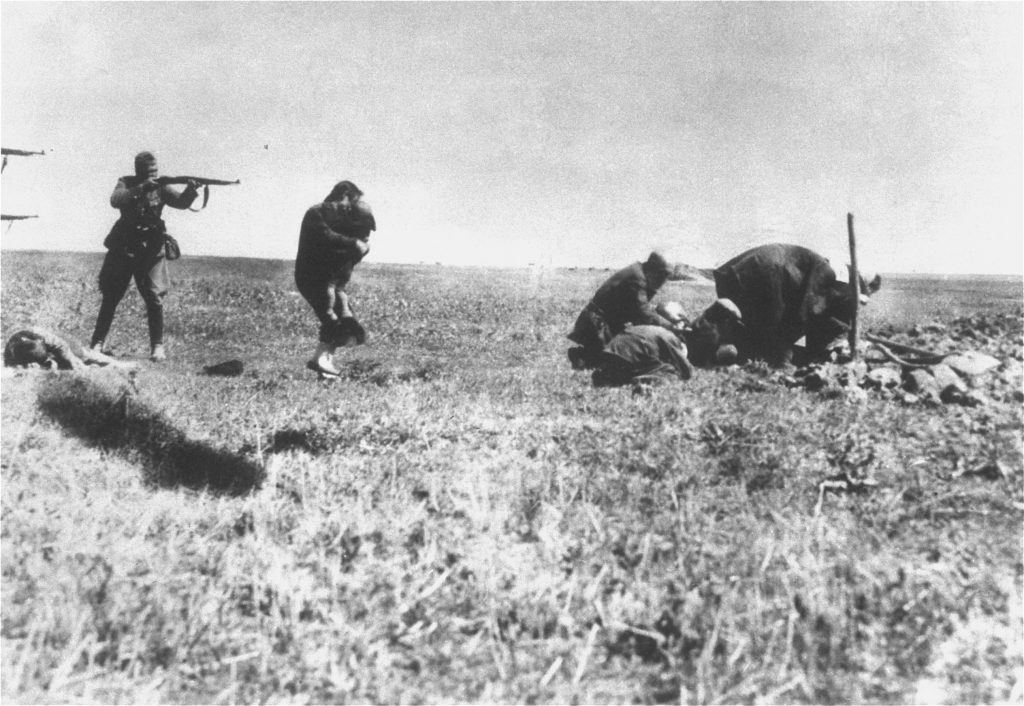
Demolition during withdrawal was familiar to German commanders long before the March 1945 directive. Destroying a crossing could delay pursuit, while wrecking an industrial installation could deny the enemy an asset that could not be removed. Nazi policy incorporated these methods into retreats from territories already subjected to extensive economic exploitation. By 1943, withdrawals from the occupied Soviet Union had produced administrative procedures connecting the removal of usable resources with the disabling or destruction of what remained.
Across occupied Soviet territory, retreat involved much more than abandoning positions and obstructing the roads behind departing troops. German authorities sought to retain resources previously acquired through occupation, including agricultural supplies and labor, while preventing their recovery by Soviet forces. Evacuation could mean compulsory displacement rather than an organized effort to bring civilians to safety. People were driven from their communities or transported westward under arrangements shaped by German labor requirements, and those unable to accompany the withdrawal faced the impacts of destruction around them. Johannes Spohr’s research on Ukraine in 1943–1944 places these practices within an occupation increasingly destabilized by the changing military balance. The approaching end of German control did not suspend its coercive character; withdrawal created further occasions for plunder and violence. Buildings could be burned after their contents had been appropriated, and food unavailable for German removal could be destroyed rather than left to sustain the inhabitants. Such actions operated within a war that had already treated Soviet civilian welfare as expendable. Military resource denial and the racialized occupation regime intersected in these decisions, although neither supplies a complete explanation for every local action. The documented treatment of communities requires attention to what commanders were attempting to deny the Red Army and to what German authorities were doing to people whose labor and possessions they continued to claim.
The abbreviation ARLZ gave this process an administrative vocabulary: Auflockerung, Räumung, Lähmung, Zerstörung, encompassing dispersal, evacuation, disablement, and destruction. These categories distinguished actions with different purposes and consequences. Removing machinery preserved an asset for German use, whereas disabling equipment might prevent its immediate operation without making restoration impossible. Destruction eliminated that possibility more decisively, but undertaking it required decisions about timing and available personnel. The categories could overlap in practice, yet their distinctions mattered because withdrawal did not necessarily entail an instruction to demolish everything within reach.
Preparations inside the Reich had also begun before the final spring of the war. Directives issued on July 13, 1944, addressed military authority in operational areas within Germany and the relationship between the armed forces and Nazi Party organizations. Their importance increased as the fighting approached German territory, and revisions in September extended arrangements for managing the threatened regions. Existing retreat procedures were being adapted to circumstances in which domestic administrations and industrial installations might soon confront occupation. Regional authorities developed their own preparations within this expanding framework. In Westfalen-Süd, Gauleiter Albert Hoffmann issued detailed instructions on October 30, 1944, under the designation “Aktion Richard,” providing for measures to be taken during immediate enemy threat or occupation. These preparations linked the handling of property to the conduct of the authorities themselves. They included instructions for destroying secret records and departing from threatened districts, with code words intended to activate measures through surviving communications channels. The paperwork is significant because it reveals anticipatory government action rather than improvisation beginning only when Hitler issued his March decree. Offices could prepare to withdraw, and installations could become objects of evacuation or demolition planning while the Reich still retained the territory concerned. Responsibility was already distributed among organizations whose cooperation would be necessary when an order had to become a physical operation. Nevertheless, preparations did not establish that every measure would be executed or that officials shared one understanding of what should be preserved. The possibility of future German recovery continued to affect the distinction between temporary disablement and irreversible loss.
The March 19 order intensified this existing practice. Its significance cannot be explained simply by saying that destruction crossed Germany’s borders for the first time, because domestic arrangements and earlier instructions had already contemplated such measures. The sharper change concerned the breadth of the destructive requirement and the rejection of preservation justified by anticipated recapture. Installations previously considered recoverable could now be designated for demolition on the assumption that leaving them intact would chiefly benefit the enemy. This reasoning narrowed the circumstances in which German authorities might retain assets for later use. It also connected a national directive to machinery of withdrawal that had developed through several years of warfare. The decree emerged from an identifiable administrative history, even though its scope and implications exceeded the circumstances in which many of its procedures had first been applied. Recognizing that history helps explain how an extreme instruction could be transmitted through established offices and understood in terms that officials already knew.
Describing this development as bringing scorched earth home identifies a change in the territory subjected to policy, rather than the beginning of destructive warfare against civilians. The communities harmed during German retreats abroad had already experienced the appropriation of their resources and the coercive movement of their inhabitants. Within the Reich, foreign forced laborers and persecuted prisoners also remained exposed to violence as German control contracted. The connection between these settings lies in the transfer and adaptation of practices that subordinated people and property to the requirements of continued German warfare. That continuity makes the decree intelligible without making its issuance inevitable.
Reading the Order: What March 19 Authorized
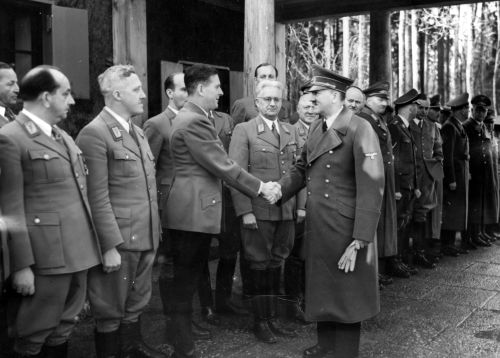
Under the formal heading “Destruction Measures within Reich Territory,” the document addressed the disposal of installations and property as enemy forces advanced. The familiar designation “Nero Decree” adds an interpretation to that administrative subject, whereas the original heading identifies the territorial setting of the command. Its provisions established categories of targets and assigned responsibility for acting upon them. Reading those provisions closely reveals both the extensive authority Hitler granted and the questions the text left unresolved.
The opening justification presented destruction as a means of weakening enemy fighting power and obstructing further advances. It demanded that opportunities to inflict lasting damage be exploited, giving the directive an expansive military rationale before specifying its targets. A further assertion excluded an important argument for retaining usable facilities. Hitler declared that preservation or temporary disablement would not benefit Germany even if lost territory were recovered, because the enemy would destroy those assets when retreating. That prediction must be understood as his stated premise, rather than as evidence of an established Allied policy applicable to every installation. Within the document, it performed a significant function. It removed the anticipated value of recaptured property from the calculation and represented German demolition as the execution of a loss supposedly unavoidable anyway. The argument also appropriated the destructive conduct attributed to the enemy as a reason for undertaking destruction first. No assessment of some facilities accompanied this generalization, and no distinction was drawn between assets readily replaceable and those whose reconstruction would require substantial resources. The preamble supplied an answer in advance to officials who might propose retaining equipment for subsequent German use. Its reasoning favored irreversible action by denying the practical benefit of the principal alternative.
The first numbered provision enumerated military installations alongside transport and communications facilities, industry, and supply installations, followed by the broader category of material assets. The comma after “military” in the German text matters. The list extended beyond installations devoted exclusively to armed operations. Eligibility rested on whether the enemy could use an object to continue the fight, immediately or in the foreseeable future. This wording established a military connection while leaving officials considerable latitude to assess potential usefulness. It required the destruction of qualifying assets without providing an inventory that would settle the status of each factory or utility. Ordinary buildings were not universally designated for demolition, but the general category of property widened the field beyond the specifically named installations.
Responsibility was divided between military commands and regional political authorities. Military commands were charged with destroying military objects, expressly including transport and communications installations, while Gauleiters and Reich Defense Commissioners received responsibility for industrial and supply installations and other material assets. The division placed substantial parts of the operation within the jurisdiction of Nazi officials administering threatened regions. It also required troops to provide those officials with the assistance they needed, connecting political decisions about property with military resources for carrying them out. This arrangement made cooperation an explicit obligation, although it did not eliminate possible disagreement over a target. A factory’s railway connection, for example, could implicate both an industrial undertaking and a transport installation, leaving the practical boundaries of responsibility less tidy than the categories suggested. The directive established who should act in broad terms without explaining how every overlap was to be resolved. Nor did it identify Speer as the sole official responsible for administering the destructive program. His absence from that allocation is important because retrospective accounts can make the original order appear to have passed directly from Hitler to an armaments minister who then chose whether to execute it. The March 19 text instead authorized several centers of action, including officials whose responsibilities combined party leadership with the conduct of regional defense. Speer’s later efforts to acquire greater control must be distinguished from the arrangement established at issuance. Preserving that distinction makes it possible to assess subsequent changes in authority without projecting them backward into the original command.
Urgency appeared in the final provision, which required prompt transmission to troop commanders and declared contrary instructions invalid. The circulation requirement sought to extend the directive’s reach rapidly through the armed forces, while the cancellation clause denied competing orders a continuing claim to govern the same decisions. Earlier instructions favoring the retention or temporary disablement of assets could be displaced wherever they conflicted with the new requirement. Nevertheless, the text supplied no single date on which demolition everywhere was to begin, and it specified no explicit punishment for noncompliance. Its force rested on Hitler’s command and the obligations assigned to the authorities addressed. Local decisions still had to translate general eligibility into identifiable targets and determine when action was practicable. The provision established precedence among instructions; whether that precedence governed conduct in a particular place remains a question for the implementation record.
Read as a whole, the order made foreseeable enemy usefulness the governing criterion for destruction. The population appeared in its justification as a people whose existence required an uncompromising military effort, but civilian dependence on the designated assets did not become an express safeguard in the operative provisions. There was no procedure for reserving essential services on that ground. The document authorized extensive demolition of physical resources without explicitly commanding the killing of their users. Its danger to civilians followed from what those resources enabled and from the absence of protection for that continuing function. That distinction fixes the scope of the command while preserving the severity of what it permitted.
Infrastructure as Life Support: What Destruction Would Mean for Civilians

A ration card recorded an entitlement to purchase food; its practical value depended on supplies reaching the seller. Rationing organized access to scarcity through allocations that households could plan around, however inadequately. Destroying a warehouse or processing installation could interrupt those arrangements without changing the entitlement printed on the card. People would then have to obtain provisions through whatever alternatives remained, often at greater distance or expense. For civilians already living with reduced rations, further disruption threatened their ability to meet ordinary needs long before the loss of an installation appeared in any comprehensive assessment of wartime damage.
Food provision extended from agricultural production to the preparation of something a household could actually eat. Grain required milling, and commercial processing depended on equipment and an adequate energy supply. Urban residents generally lacked the means to substitute their own labor for the facilities serving them, even when some agricultural produce remained available elsewhere. The destruction of these facilities could create shortages disproportionate to the quantity of food physically destroyed. Agriculture presented a related problem with a different timetable. Damage to fertilizer production or the loss of seed stocks could impair a subsequent harvest, extending results beyond the immediate interruption of deliveries. German farming still relied heavily on horses and human labor, so its vulnerability cannot be understood by imagining a uniformly mechanized countryside dependent on tractors. Local cultivation offered possibilities for adaptation, but those possibilities varied with access to land and the condition of the farms concerned. Rural self-provisioning also offered limited relief to densely populated industrial districts whose inhabitants could not readily relocate or produce enough food for themselves. The United States Strategic Bombing Survey’s account of nitrogen-fertilizer shortages illustrates that future cultivation was already being affected by attacks on industrial production, independently of Hitler’s demolition directive. Additional German destruction would have entered a food economy carrying losses from other causes, making the preservation of remaining facilities fateful for the next agricultural season as well as the next ration period.
Utilities connected domestic survival with medical treatment and public sanitation. Where pumping depended on electricity, interrupting power could reduce water delivery even without damaging the pipes themselves. Hospitals needed dependable water supplies for cleaning and the preparation of treatment, while damaged sewage systems increased the difficulty of maintaining sanitary conditions around crowded buildings. Emergency measures could sustain functions, but their effectiveness depended on local equipment and people able to operate it. Demolishing a utility installation risked worsening conditions in facilities already struggling with injuries and displacement. The foreseeable danger included diminished treatment capacity and deteriorating hygiene; establishing a disease outbreak as a result of the decree would require evidence beyond those general dependencies.
Access to substitutes was distributed unequally. Families driven from their homes lost stored provisions and familiar sources of assistance, increasing their reliance on arrangements organized by authorities whose own operations were becoming uncertain. Children depended on adults to secure food and carry it back, while older people or those with limited mobility could find an improvised supply point effectively inaccessible. The physical survival of a distribution center offered little reassurance if reaching it required a journey that someone could not undertake. Household resources mattered as well. Relatives in the countryside could provide opportunities unavailable to people without such connections. Foreign forced laborers confronted additional restrictions rooted in the system that had brought them to Germany. Their material circumstances differed by nationality and employment arrangement, with Soviet workers exposed to severe discrimination in provisioning. Employers or camp administrations controlled much of their access to necessities, limiting their ability to respond independently when established supplies failed. A worker whose workplace ceased operating might lose support while that movement and opportunities for acquiring food became more difficult. Prisoners held under guard faced still more constrained circumstances, although concentration-camp inmates and prisoners of war belonged to different administrative systems. For people prevented from leaving, survival could depend almost entirely on deliveries they had no power to replace. These inequalities meant that damage shared across a locality would impose different burdens on its inhabitants, according to both their physical capacities and the restrictions already governing their lives.
Assessing those outcomes requires identifying the causes of certain failures. Heilbronn’s April records document interruptions to water and electricity, followed by an assessment of damaged reservoirs and water mains after the fighting. They also describe communications losses partly associated with German bridge demolitions, within a wider pattern of destruction caused by bombing and ground combat. Such evidence demonstrates the condition civilians confronted without assigning every damaged service to the March 19 directive. The prospective consequences of demolition and its documented effects must be examined separately. What the infrastructure mandate put at risk becomes clearest when an installation is followed through to the people who depended on its operation.
Speer’s March Documents: Continued Fighting and Reported Indifference

Speer’s preservation proposals took written form before Hitler issued the destruction order. A memorandum dated March 15, delivered three days later, urged measures to retain installations needed for German subsistence and recovery. A separate memorandum dated March 18 advocated severe measures to sustain resistance at the Oder and Rhine. The letter written for Hitler on March 29 belongs beside both documents, because its protest against demolition retained a commitment to their common war effort. Their proximity makes a straightforward progression from obedient minister to opponent difficult to sustain.
The March 15 memorandum joined an assessment of impending economic failure to recommendations about what officials should do with the resources still available. Speer distinguished destruction required by military operations from measures that would obstruct food provision or make rebuilding harder. This distinction left room for demolitions serving an immediate battlefield purpose while challenging the wider disposal of industrial and supply facilities. His accompanying draft directive proposed a formal prohibition on industrial destruction and assigned implementation to the armaments minister. Preservation would be pursued through an order issued by Hitler and administered through Speer’s existing authority. The proposal is revealing both for its substance and for the means chosen to secure it. Speer sought to redirect the dictatorship’s command structure toward retaining productive assets, and success would have strengthened his position in decisions otherwise involving regional party officials. That institutional advantage warrants attention without establishing that the concern expressed for civilian provision was merely a pretext. The recommendations addressed identifiable dangers, especially where demolition would interrupt essential deliveries. They also demonstrated how advocacy on behalf of the population could be combined with a ministerial claim to greater control.
Continued resistance occupied the separate March 18 memorandum. Speer urged drastic action along the Oder and Rhine, including ruthless employment of the Volkssturm, whose mobilization drew civilians into the defense of threatened territory. He hoped that sustained fighting over the following weeks would impress the enemy and improve Germany’s prospects for a negotiated ending. The intended benefit was political, even as his economic assessment described the narrowing capacity to maintain operations. Preserving facilities and demanding further combat were simultaneous proposals. The civilians whose future he sought to secure could still be required to expose themselves to immediate danger in pursuit of the outcome he wanted.
In the letter dated March 29, Speer gave the demolition dispute a more accusatory meaning by recording remarks he attributed to Hitler during their March 18 encounter. He allowed for the possibility that he had misunderstood, but represented Hitler as saying that defeat would demonstrate the German people’s weakness and remove any need to consider the necessities of their remaining existence. The report assigned the future to the stronger eastern people and devalued surviving Germans on the grounds that the better ones had already died. This account extends beyond the decree’s express rationale of denying resources to advancing armies. It describes a judgment upon the population, with battlefield loss interpreted as a verdict on the worth of those left alive. Of impact is the status of survival. Remaining alive becomes evidence of diminished value rather than a reason for leadership to ensure continued provision. Within that reasoning, the sacrifices already demanded of Germans supply an argument against the claims of Germans who survive them. Speer associated the destruction order, together with subsequent evacuation instructions, with the intentions he believed those remarks disclosed. That association was his interpretation of the relationship between spoken words and administrative measures. The letter offers contemporary evidence of how a senior participant understood Hitler’s position, although the conversation reaches the historian through the account of a man attempting to change that position. Its evidentiary force depends on retaining both features. Treating it as an independently recorded speech would conceal the circumstances under which the account was produced.
Delivery presents a further complication. In his testimony at Nuremberg on June 20, 1946, Speer said that he had intended to give Hitler the letter after a period allowed for reflection, but that Hitler refused to accept it. This account of the attempted submission comes from Speer’s postwar testimony and should not be converted into an independently established delivery history. The document can be described as a letter dated March 29 and prepared for Hitler, without asserting that Hitler read its accusations that day. An absence of recorded rebuttal cannot, on that basis, be treated as confirmation that Hitler accepted Speer’s representation of their encounter.
The appeal itself remained framed by obligations Speer attributed to Hitler’s leadership. He invoked an earlier position in which Hitler had allegedly recognized a duty to preserve a defeated people from a heroic ending. This supplied grounds for asking the dictator to act consistently with his own authority, rather than demanding that someone else assume power. Speer also continued to characterize their cause as worthy and explained that a change in policy would restore his confidence and willingness to work energetically. His protest sought conditions under which he could continue performing his ministerial role. The complaint about labor mobilization makes that purpose clear; he described the difficulty of demanding workers’ maximum exertion while preparing to destroy the resources on which their lives depended. The contradiction concerned the credibility of the demands he was making as well as the fate of the people receiving them. Retaining industrial facilities would protect subsistence, but it would also preserve an economy whose armaments output continued to rely on coercive labor. The letter’s moral language belongs within that unresolved relationship. Speer protested against a destructive policy while asking for the confidence necessary to remain an effective participant in wartime government.
These documents support a substantial preservation effort whose political limits are equally substantial. They do not provide a secure basis for assigning every intervention exclusively to self-interest, since proposals benefiting Speer’s position could also avert serious harm. Conversely, concern about infrastructure does not establish a rejection of the demands for further fighting expressed in the March 18 memorandum. Heinrich Schwendemann’s examination of that neglected document is valuable because it restores the continued-resistance argument to an account often organized around the minister’s protest. The March papers show Speer trying to retain resources and influence the direction of the war while maintaining his relationship with Hitler. The disagreement concerned what that service should require, with impacts for Germans whose survival had become an object of dispute within the leadership.
From Directive to Demolition: Who Had the Power to Carry It Out?
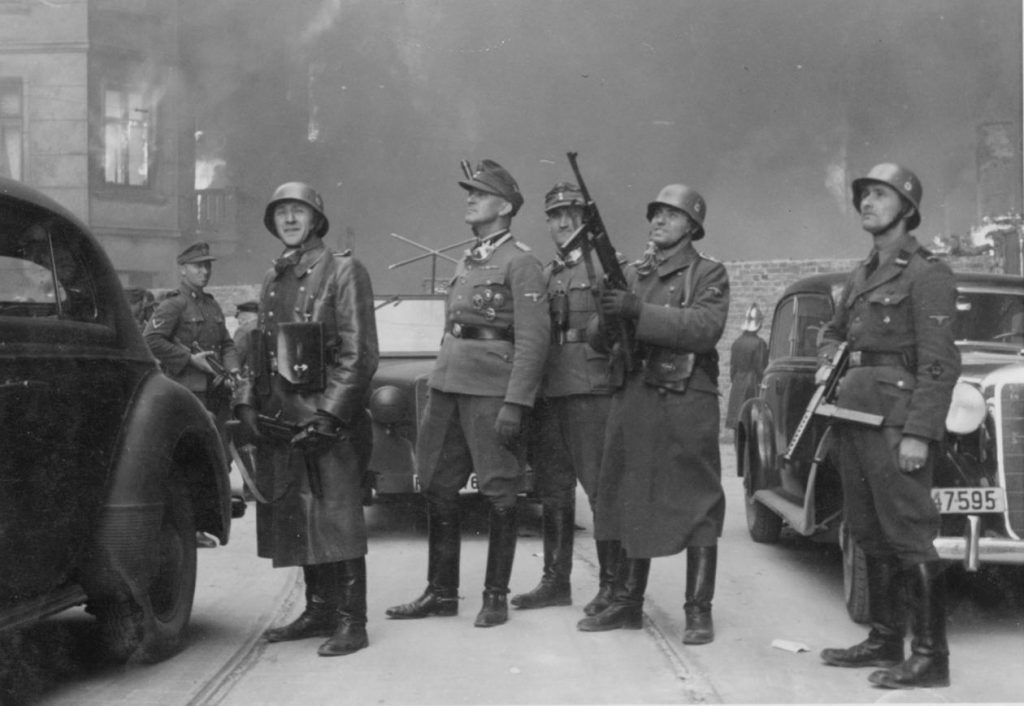
Copies of the destruction order entered several administrative channels on March 19. Military staffs and ministries received it through their respective networks, as did senior party offices and other authorities. The surviving transmitted copy dated March 20 illustrates the distinction between issuing a command and circulating it; that date does not establish when every intended recipient obtained the instructions. Thereafter, the order’s reach depended on officials passing it onward and converting its categories into decisions about certain installations.
Regional authority operated through organizations with different kinds of local knowledge. A Gauleiter could demand action across his territory, but identifying the facilities concerned required information held in district offices or among the people managing them. Municipal administrations knew which services supplied their inhabitants, while industrial personnel understood the equipment within their plants. Instructions moving through party channels could reach officials who possessed political influence without personally controlling the resources required for demolition. Military personnel brought other capabilities, including access to trained engineers, although their availability depended on operational demands. Existing retreat preparations provided ways of communicating with these different participants, but an established contact procedure did not guarantee that the necessary people remained at their posts. As the front moved, some offices relocated while others continued working locally, changing who could be reached and which decisions could still be coordinated. An installation might fall within an official’s declared jurisdiction while its personnel or immediate surroundings had become difficult to control. For a regional leader intent on destruction, securing cooperation meant obtaining access to the site and to people capable of acting there. The organizational demands extended well beyond forwarding Hitler’s words.
Heilbronn’s preparations expose some of those requirements with unusual clarity. On March 28, district party leader Richard Drauz assigned bridge demolition to a pioneer platoon and a Police-SS detachment. Industrial demolition was placed with district staff leader Karl Link working in conjunction with the Technische Nothilfe, an organization possessing personnel trained for technical tasks. Drauz accompanied these arrangements with a threat to shoot anyone who resisted the demolition orders. Political coercion stood alongside a division of work among specialized participants. The assignments show how a district leader attempted to turn a general destructive policy into operations, without establishing that every assigned task was subsequently completed.
Technical capacity imposed limits that threats could not remove. Damaging a facility sufficiently to interrupt its operation might require much less work than rendering it permanently unusable, and the difference depended on its construction. Large industrial establishments contained extensive machinery whose condition could be difficult for outsiders to assess, leaving demolition personnel reliant on employees’ knowledge. Conversely, some installations could be crippled through damage to a limited part of their equipment, making the judgment of specialists impactful. Explosives and engineers also had urgent military uses, so their presence in a threatened district did not mean that they could immediately be diverted to every industrial target. Preparations competed with the requirements of troops attempting to defend positions or withdraw from them. The timetable could change abruptly when Allied forces reached an area sooner than local authorities expected. Even officials determined to execute the command might then lack time to inspect targets, assemble personnel, or complete work already begun. Ralf Blank’s assessment of industrial preservation in the Ruhr emphasizes technical inability and the speed of the Allied advance, challenging explanations that assign surviving capacity chiefly to interventions by prominent Nazi officials. That assessment does not establish a single explanation for every intact plant. It does demonstrate why destructive intent must be evaluated alongside the physical undertaking necessary to give it effect.
Specialist dependence also created opportunities for obstruction. Personnel familiar with a plant could influence the pace of preparation and the assessment of what measures would accomplish. Their participation could help an authority destroy an installation, but their reluctance could make the same authority’s demands harder to fulfill. Delay mattered especially when an approaching army might end German control before the work was finished. Nevertheless, a postponed or incomplete demolition does not by itself identify deliberate resistance. Personnel might have been unavailable, or circumstances might have prevented execution despite their willingness. Establishing obstruction requires evidence of conduct and purpose, rather than an inference from the survival of the property alone. The distinction is important where later accounts attributed preservation to the courage of individuals without reconstructing what they had been asked to do or what resources they could actually command.
For Speer, this distribution of practical control made the right to authorize destruction an important object of intervention. Appeals to individual managers could assist preservation at some sites, but they left regional officials able to invoke the authority of Hitler’s directive. Changing the approval procedure offered a way to influence many decisions through an instruction that other participants could cite. Such a change could also reduce the exposure of technical personnel asked to choose between a destructive demand and an objection unsupported by higher authority. The struggle over implementation became a struggle over whose permission was necessary before local preparations could proceed.
Amending Destruction: The Orders of March 30 and April 7
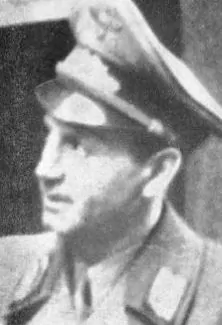
Hitler’s revision of March 30 changed the relationship between demolition and Germany’s remaining productive capacity. A further order on April 7 differentiated the treatment of transport facilities, including bridges, according to their operational importance and the circumstances of enemy approach. These amendments require separate examination because they changed different parts of the original mandate. They established substantial qualifications while retaining compulsory destruction in specified circumstances.
The March 30 instructions expressly required that destructive measures should not weaken Germany’s own fighting capacity. Production was to continue until the last possible moment, even where a rapid enemy advance might capture a factory intact. This accepted a risk that the March 19 directive had sought to eliminate through its sweeping requirement to deny usable assets. Industrial and supply installations were now to face action only under immediate enemy threat, and durable disablement could generally accomplish the required denial without complete demolition. Exceptions remained for important plants that Speer could designate for destruction on Hitler’s instruction, including certain munitions and chemical installations. Transport facilities, by contrast, remained subject to complete destruction under the March 30 provisions. The amendment also redistributed responsibilities within the industrial program. Gauleiters and Reich Defense Commissioners retained the power to initiate and supervise measures, while Speer’s offices and subordinate organizations received exclusive responsibility for their technical execution. Other authorities were required to assist them. Speer could issue individual instructions to regional commissioners, but his implementation regulations required Hitler’s approval. His ministry acquired considerable leverage over how industrial measures were performed without receiving independent control of policy or displacing every regional decision. That arrangement addressed a practical weakness in preservation efforts by placing technical execution within an organization whose minister was advocating limits on destruction.
An April 3 radiogram to Sigfried Uiberreither, the Gauleiter in Graz, shows Speer applying the revised policy to questions about certain installations. He advised that specialist disablement would suffice in almost all cases, including the works Uiberreither had mentioned. Destruction remained an option where disabling measures could not achieve the intended denial, and operation was to continue as long as possible. A concluding parenthesis specifically restricted electricity works to disablement. Speer characterized the March 30 order as ending scorched-earth policy, but that description was broader than the unqualified protection of every installation. His own message retained an exception permitting destruction, while the original amendment continued to distinguish industrial facilities from transport targets.
The April 7 order revised the treatment of those transport targets more extensively. Operationally important bridges still had to be destroyed, with the Armed Forces High Command determining the relevant areas case by case and severe penalties threatened for failure to execute the requirement. Other bridges were placed under a different procedure. Reich Defense Commissioners, acting in consultation with the responsible transport-ministry offices and representatives of Speer’s ministry, had to assess whether enemy pressure had stopped production or made evacuation impossible before authorizing demolition. This tied action to identifiable effects on activity that the authorities were still required to sustain. Other transport installations were to be durably disabled, and the same approach applied to communications operated by the Reichspost and Reichsbahn, as well as private networks. Transport was to serve production until the latest practicable moment. Except for the operational bridges covered by the mandatory demolition provision, measures were to permit restoration for German production following recapture. The original rejection of preserving assets for renewed German use had been materially revised. Administrative consultation could now provide grounds for withholding a demolition while production or evacuation remained possible, although it offered no general exemption for bridges designated essential to military operations. The order created a differentiated policy whose significance depended partly on which category officials assigned to a specific crossing.
Speer’s file note of March 30 supplies another account of the considerations surrounding these changes. Recording a meeting the previous day, he attributed to Hitler the judgment that scorched-earth methods were unsuitable for Germany’s relatively small geographical space, unlike the extensive territory available in Russia. This remains Speer’s contemporary representation of Hitler’s reasoning, with the same need for careful attribution that applies to his report of their earlier conversation. It nevertheless identifies a practical objection to comprehensive destruction. Within a contracting territory, German forces and production could lose access to resources they still required. The formal amendments addressed that problem by protecting continued operation and accepting the possibility that some facilities would fall intact into enemy hands. Preservation could be justified through the immediate requirements of German warfare without securing agreement about the needs of a population living permanently under occupation. The geographic argument and the revised provisions belong together as evidence of how the policy was adjusted within the leadership’s continuing strategic assumptions.
For regional authorities, the amended instructions made the status of a proposed demolition important in new ways. A commissioner could be required to maintain industrial activity while military personnel remained obliged to destroy a designated bridge. Consultation over other crossings introduced an additional opportunity to argue that the conditions for action had not yet arisen. Technical offices could invoke preservation provisions while remaining participants in an officially authorized denial program. By early April, officials were working under rules that offered meaningful protection to some assets while continuing to demand the destruction of others. Their application would depend on the orders received and the circumstances still permitting German authorities to act.
Uneven Execution: The Ruhr and Heilbronn
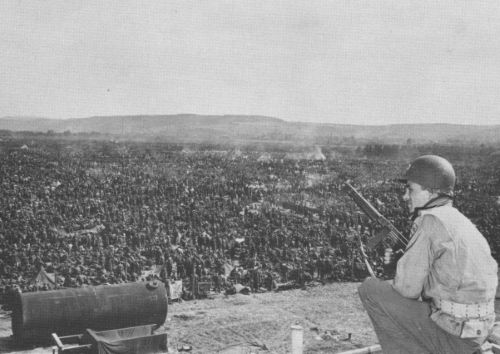
The encirclement of the Ruhr on April 1 placed a major concentration of German industry inside an area increasingly cut off from the rest of the Reich. Authorities there confronted destruction decisions while military control contracted around them. Installations that had supported production now occupied a changing landscape of isolated communities and withdrawing troops. Their fate depended partly on whether German personnel could still reach them before American forces took possession. This compressed timetable shaped the implementation of orders whose requirements had already been revised at the national level.
Substantial productive assets in the Ruhr escaped comprehensive German demolition, although that survival must be distinguished from continuous operation or an absence of war damage. Bombing had already impaired the region’s economy, and the final fighting brought additional disruption. Ralf Blank’s regional assessment gives considerable weight to the technical difficulty of carrying out the demanded destruction and to the speed of the Allied advance, tentatively assigning those factors greater importance than the rescue efforts subsequently claimed by prominent Nazi officials. That interpretation leaves room for interventions without making them the principal explanation for the regional outcome. It also directs attention toward installations whose preservation followed from German authorities losing the opportunity to act. Claims about military protection require comparable care. Army Group B, commanded by Field Marshal Walter Model, continued resistance within the pocket as its position deteriorated. Model ultimately dissolved the army group rather than negotiating its formal surrender, and the remaining forces capitulated in stages, with resistance ending by April 18. His conduct cannot be reconstructed from surviving factories alone. The preservation of industrial equipment coexisted with decisions that prolonged fighting, making an image of the military command as an uncomplicated guardian of the region inadequate to the evidence.
Hoffmann’s actions provide a more specific test of regional rescue claims. On April 13, he ordered important road bridges destroyed, including crossings at Hengsteysee and Hohensyburg connecting the Hagen and Dortmund areas, shortly before his flight. During proceedings in 1948, he nevertheless presented himself as a rescuer of the Ruhr. The demolitions do not establish what he did concerning every industrial facility, but they demonstrate his participation in the destructive program. Any assessment of his preservation efforts must account for those decisions alongside the assets that remained. His later description cannot substitute for identifying instructions he issued and the results they produced.
Heilbronn offers a smaller setting in which destruction and obstruction can be followed within the same locality. Much of the city had already been devastated by the air raid of December 4, 1944, before the demolition preparations of the following spring. Local plans extended to the canal port and supply installations as American forces approached. In the early morning of April 3, German troops destroyed the remaining intact Neckar bridges, physically severing crossings that had survived the earlier damage. Fighting in the main city continued until April 12, when American military government took possession; occupation of the city and its suburbs was complete the following day. These bridge losses formed part of the actual damage inhabitants would have to overcome, although their attribution requires attention to overlapping military and political instructions. Neither their timing nor their location alone proves that the March 19 decree was the exclusive cause.
The canal port experienced a different outcome. Heilbronn’s municipal chronicle credits port director Georg Vogel with delaying the execution of Drauz’s order sufficiently to prevent destruction of the whole facility. Its April 16 assessment records the survival of important equipment, such as the cranes, attributing preservation to several men, including Vogel, who did not carry out the destructive instructions. The reference to cranes supplies a concrete object for the account. Equipment essential to handling cargo remained available where a more extensive demolition had been demanded. The port’s escape from comprehensive destruction does not mean that it emerged undamaged from the fighting. The entries describe a claimed act of obstruction within a damaged locality, rather than the rescue of an untouched installation. Vogel’s position also helps explain how such an intervention could matter. A director responsible for operating the port possessed knowledge and working relationships that a political official issuing a demolition command would need to mobilize. According to the chronicle, that dependence created time in which destruction could be prevented. The event preceded the April 7 transport amendment, so the later qualifications cannot by themselves explain the earlier failure to demolish the port. The contrast with the bridge losses shows that adjacent facilities could experience sharply different treatment even during the same military emergency.
The chronicle’s perspective deserves recognition alongside its detailed record. The municipal archive identifies the reproduced material as originating in the records of city archivist Alexander Renz, who had joined the Nazi Party in 1933, and warns readers about its contemporary viewpoint. That provenance does not invalidate the dates or descriptions of surviving equipment. It does make the attribution of preservation to courageous individuals a claim to be assessed, rather than an independent conclusion established simply by its appearance in an official archive. The record is strongest when its account of conduct can be related to identifiable material outcomes.
The cases reveal variation within regions as well as between them. Ruhr industry could escape extensive German demolition while important crossings were destroyed, and Heilbronn’s port equipment could survive beside ruined bridges. These outcomes emerged during a period when changing instructions interacted with the loss of German control. Some preservation depended on interventions attributed to identifiable people; elsewhere, advancing armies or the practical limits of demolition supplied more persuasive explanations. The resulting benefits for civilians were real without establishing a corresponding transformation in the conduct of the authorities concerned. To recover those benefits historically requires keeping some decisions in view, including destructive acts performed by officials who later claimed credit for what survived.
Preserving Property while Continuing Terror
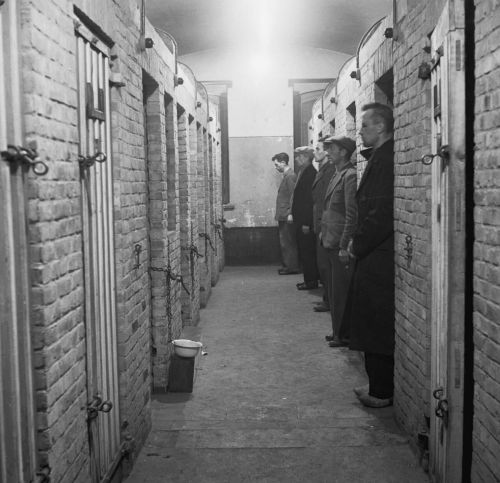
A decree issued on February 15, 1945, had already established summary courts in threatened Reich Defense districts. Regional commissioners appointed their members and confirmed sentences, including death sentences for offenses deemed to endanger Germany’s fighting capacity or determination. The regulations anticipated broken communications. Where a commissioner could not be reached and immediate execution was considered unavoidable, the prosecutor could exercise the relevant powers. Administrative disruption became a reason to delegate lethal authority rather than suspend it. This machinery remained available while other instructions increasingly qualified the destruction of economic assets.
In the Ruhr, military authority continued to cooperate with the apparatus of repression. On April 7, Model instructed that penitentiary inmates within his jurisdiction be transferred to the Gestapo for examination and further disposition. The action specified was a handover to police custody, and the instruction should not be enlarged into an explicit command to execute every prisoner. Nevertheless, it authorized cooperation with an organization actively conducting lethal operations as Allied forces approached. Markus Günnewig’s study of Dortmund reconstructs mass shootings in the Bittermark during March and further executions beginning before Good Friday, March 30, and continuing into April. Victims included foreign workers and German political opponents; the evidence also identifies two Jewish women transferred from Essen. Their circumstances varied, and describing all of them as resistance fighters would obscure the different routes through which they had become prisoners. The killings followed police decisions and practices whose reconstruction is complicated by destroyed records and the use of oral instructions. They cannot simply be attributed to Model’s prison-transfer order, still less to the infrastructure decree. Their occurrence does establish that constraints upon industrial demolition developed alongside organized violence against people held within the same regional system. Machinery could remain available for future production while prisoners were being selected for death.
Drauz’s conduct in the Heilbronn area likewise extended beyond threats against those refusing demolition duties. The municipal chronicle records that Karl Taubenberger, Sontheim’s deputy local party leader, was shot on Drauz’s orders on April 3 because he had failed to prevent the removal of a tank barrier. On April 6, Drauz’s party encountered houses displaying white flags along the Schweinsbergstraße toward Donnbronn and ordered shootings. The chronicle names Karl Kübler and Anna Kübler among the dead, together with Gustav Beyer and Elsa Drebinger. These acts sought to punish conduct interpreted as facilitating surrender while German forces were still defending the area. The preservation of port equipment occurred within a locality where attempts to reduce further fighting could expose inhabitants to lethal retaliation.
Camp evacuation supplied another setting in which the approaching loss of German control intensified danger. Heilbronn’s chronicle records the evacuation of the Neckargartach concentration camp on March 28, with prisoners unable to walk transported by rail and other groups forced toward Dachau on foot. It also records further deaths during the journey, including deaths associated with violence by SS guards. Such movements belonged to the camp system’s own policies and chains of command, requiring an explanation distinct from the handling of industrial installations. Daniel Blatman’s account of the death marches examines how evacuation decisions exposed prisoners to sustained coercion under conditions of diminishing coordination. Keeping people in custody could involve moving them through territory where accommodation and food provision were increasingly unreliable. Prisoners weakened by previous exploitation were compelled to undertake journeys that increased their exposure to exhaustion, while guards retained power over their movements. Regional decisions and conduct along the routes mattered because the collapse of a transport plan did not necessarily produce release. Orders became confused or impracticable, yet captives could remain subject to violence by those controlling them. These events demonstrate a form of continuing power that cannot be measured by the regime’s ability to maintain normal services. The failure of administrative arrangements could become lethal precisely because custody and coercion persisted after the arrangements intended to support movement had broken down.
Sven Keller’s study of violence in 1944–1945 connects these crimes to efforts to sustain Nazi rule and enforce the boundaries of the national community during collapse. Threats against people seeking surrender drew upon assumptions that refusal to endure endangered everyone else, allowing individual attempts to escape further harm to be represented as betrayal. Foreign workers and prisoners encountered additional hostility rooted in their longstanding exclusion and treatment as security risks. Decentralized authority gave officials opportunities to act upon those assumptions even when contact with superiors became difficult. The February court decree formalized one such adaptation, although many killings occurred outside judicial proceedings altogether. Declining coordination could coexist with continuing authorization to punish, reinforced by local initiative. An official who accepted a technical argument against wrecking a factory had not, through that decision alone, surrendered the powers or commitments that could place people in danger.
Violence during the final weeks also involved people outside the official command structure. Blatman emphasizes civilian participation in the treatment of prisoners, including assistance to victims as well as participation in pursuit and killing. The inhabitants experiencing infrastructural breakdown cannot be treated as a single body responding uniformly to Nazi coercion. Some sought to limit suffering, while others acted against people whom persecution had already made vulnerable. Shared exposure to the war’s material consequences did not remove those divisions. Efforts to retain the resources of ordinary life took place within communities whose conduct toward captive and displaced people could remain profoundly unequal.
After the Order: Survival and the Attribution of Damage
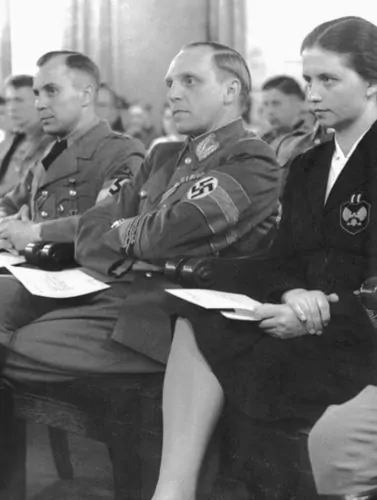
Occupation brought new administrative demands before essential services had been restored. In Heilbronn, notices recorded on April 16 called male inhabitants between fifteen and seventy years old into work service and threatened the withdrawal of food cards for noncompliance. The military government was mobilizing labor in a city whose damaged facilities constrained what that labor could accomplish. Its requirements formed part of an effort to establish order and maintain provision after German military control ended. The change of authority opened a new phase of decisions about scarce resources rather than immediately resolving the conditions civilians faced.
Restoration proceeded through connections and buildings. Heilbronn’s chronicle records that the consumer-cooperative bakery regained electricity on April 23 through cable repairs involving municipal personnel and an American officer, Captain David Kaplan. On April 28, electricity reached the hospital in the Jägerhausstraße, while reopened bakeries obtained flour from local stocks. These entries give recovery a more precise meaning than the assertion that a city’s utilities were either working or destroyed. A repaired connection could make equipment usable at one location while other premises remained without service. The availability of flour was a separate requirement for turning an operating bakery into a source of food. Hospital power likewise restored an important capability without establishing that adequate treatment was available to everyone needing it. Each improvement joined retained equipment to supplies or connections that had been missing. The participation of municipal staff also shows the continuing importance of technical knowledge held locally after the political administration changed. Facilities spared from demolition provided opportunities for such work, but realizing those opportunities required further decisions and effort. Their survival mattered because it reduced some tasks of reconstruction, even where the surrounding systems still needed extensive repair.
Food administration followed its own uneven course. Bread was distributed in Heilbronn without ration coupons on April 14, and rationing was reinstated on April 18 after organizational disruption following occupation. The latter entry records difficulties in maintaining contact with the regional food administration. Allocations on the new card had to last until May 27, extending the period over which households were expected to manage limited provisions. Emergency distribution and renewed rationing addressed different parts of the supply problem. Neither entry establishes that available quantities were sufficient, but they document attempts to resume provision amid damaged communications and uncertain deliveries.
Transport recovery also reflected the priorities of the occupying army. By April 30, Heilbronn’s chronicle described railway facilities supporting American military logistics and an operating route toward Karlsruhe and Paris. Those developments demonstrate the return of substantial movement without proving that civilian access had recovered to the same extent. The ability to move military supplies along a restored route depended on arrangements for handling traffic, and the purposes assigned to the route shaped who benefited immediately. Elsewhere, destroyed crossings still interrupted the more local journeys through which people reached work or obtained provisions. Repairing a railway connection did not replace the function of every road bridge in the surrounding district. Reconstruction involved several scales of movement, with improvements at one scale leaving serious restrictions at another. Occupation authorities had to allocate personnel and equipment among tasks that competed for attention, while municipalities confronted the losses dividing their own territory. The resulting timetable cannot be inferred solely from the amount of physical damage. A service might remain unavailable because a connection had not been repaired, or because the movement it enabled was reserved for other purposes. Following actual use alongside repair dates helps establish what the retention of transport assets meant during the first weeks after fighting ended.
Retrospective assessments require similar attention to their purposes and coverage. The United States Strategic Bombing Survey examined the effects of an Allied campaign and drew conclusions relevant to the future employment of air power. Its account of disrupted coal movement and industrial functioning is valuable, but it was not a comprehensive inventory assigning every German loss to its originating action. The survey acknowledged missing records and the inability to examine targets in Soviet-controlled territory. Municipal accounts supplied different kinds of detail, including descriptions of damage to individual services, but their estimates also reflected the information available when they were compiled. An early assessment of destroyed dwellings could record the scale of loss without identifying the cause of every destruction. For a bridge or plant, attribution depends on chronology and evidence of the action taken there. Damage sustained before March 19 cannot be assigned retrospectively to that directive, while later damage may require distinguishing German demolition from bombing or ground combat.
Mortality presents an additional difficulty. A decree-specific national total would require evidence connecting deaths to the installations destroyed under the relevant instructions, rather than simply drawing upon Germany’s overall wartime losses. An injured person’s death might involve interrupted treatment alongside the original injury, making the causal sequence more complex than the demolition record alone reveals. The same problem applies where reduced food access compounded existing illness or exhaustion. Documented service interruptions can establish serious consequences without yielding a reliable aggregate of deaths attributable to them. Precision about those limits permits an account of harm that remains proportionate to the evidence.
Household recovery cannot be measured through industrial equipment alone. Heilbronn’s post-battle assessment listed thousands of destroyed dwellings, placing the condition of housing beside losses to productive facilities. People returning to employment could still lack secure accommodation, and repairing their homes drew upon labor and materials also needed elsewhere. Richard Bessel’s treatment of Germany in 1945 emphasizes the demands of everyday survival across this transition, directing attention toward circumstances that summaries of retained capital can miss. A workplace capable of reopening offered prospects for earning a living, but its availability did not determine whether a family could obtain necessities through the arrangements then operating. Displacement further complicated the relationship between inhabitants and local resources, as people sought relatives or attempted to reach homes that might no longer exist. Former forced laborers confronted needs arising from captivity and removal from their own countries, making their welfare inseparable from questions of accommodation and return. These circumstances placed surviving assets within a society whose population and working relationships had been profoundly disrupted. Preservation supplied possibilities for recovery, while the pace and distribution of that recovery depended on people’s ability to make use of what remained.
Some documented demolition losses continued to restrict transport long after the immediate occupation period. The road bridges at Hengsteysee and Hohensyburg, destroyed on Hoffmann’s orders on April 13, were rebuilt only in the early 1950s. Their replacement dates extend the history of those orders beyond the closing weeks of German resistance. They do not make every intervening hardship a fallout of the decree, but they establish the duration of reconstruction tasks originating in identifiable German decisions. An operation justified through the requirements of continued fighting could leave losses whose repair outlasted the regime by years. The recovery record reveals that difference between the timetable of a military command and the time required to overcome its effects.
The Rescuer’s Reputation: Speer at Nuremberg and Afterward
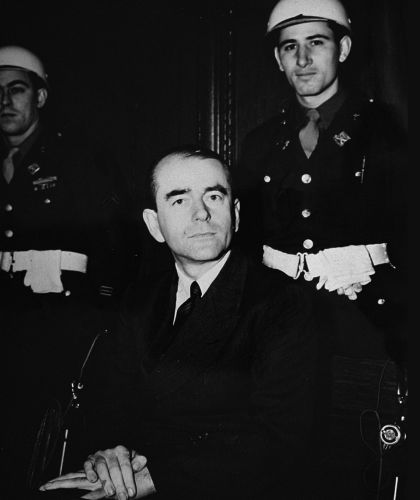
At Nuremberg, opposition to infrastructure destruction became part of Speer’s defense against charges arising from his service to the Nazi regime. His March documents supplied evidence that he had challenged a major policy while Hitler remained in power. In that setting, the dispute acquired significance beyond the fate of some installations; it could establish a capacity for independent judgment within a leadership accused of extensive criminal conduct. Speer’s presentation encouraged the tribunal to consider that intervention when assessing his responsibility. The public identity subsequently built around it began with a genuine policy disagreement whose implications were being contested in court.
A broad acknowledgment of responsibility accompanied efforts to limit admissions concerning certain crimes. In his June 20 testimony, Speer accepted responsibility as a leading member of the regime while advancing arguments about the boundaries of his jurisdiction and knowledge. This combination distinguished his presentation from an unrestricted confession to the offenses committed through the organizations he served. It also gave the demolition dispute an important role in his defense. Documents showing that he had opposed Hitler could support an account of a minister capable of recognizing when obedience became destructive. Speer further testified to a plan to kill Hitler that he said had not been carried out, enlarging the opposition narrative beyond the preservation of installations. That alleged planning remains his claim; it cannot be treated as a verified assassination attempt. The defense combined documentary evidence with assertions whose corroboration presented different difficulties. Accepting the former did not require accepting every detail of the latter, although their conjunction encouraged an interpretation of Speer as an exceptional figure within the leadership. His account offered the tribunal a defendant who admitted involvement while asking it to recognize a late break in conduct.
The judgment delivered on October 1, 1946, convicted Speer of war crimes and crimes against humanity and imposed twenty years’ imprisonment. It found that he had knowingly demanded coerced foreign labor and participated in the expansion and use of the compulsory labor system. His efforts against destructive measures were nevertheless considered in mitigation, with the judgment describing opposition undertaken “at considerable personal risk.” That recognition became an authoritative component of his later reputation. The court’s favorable assessment of these interventions neither established every subsequent rescue claim nor assigned a precise weight to them in determining his sentence. Its findings preserved criminal responsibility alongside acknowledged mitigation.
Following his release in 1966, Speer reached a much larger audience through Erinnerungen, published in 1969, and its English translation, Inside the Third Reich, in 1970. The memoir placed readers near Hitler through the experiences of a man who had enjoyed unusual access to him. Architecture and administrative work supplied the professional setting for an account that presented political involvement through personal encounters and the attraction of power. The culminating demolition dispute allowed the narrator to emerge as someone who had finally acted against the leader whose authority had dominated his career. This structure gave the closing weeks an explanatory reach extending across the preceding years. A reader could recognize wrongdoing while retaining an image of the narrator as a technically accomplished person whose eventual objection revealed an underlying capacity for moral judgment. The sequence was persuasive because it joined admission to a story of recovery. Service to the dictatorship was followed by an intervention represented as protection of Germany against its ruler. Yet arranging a life around that ending also affected the selection and presentation of evidence. Heinrich Schwendemann’s comparison of the March 29 letter with its memoir quotation identifies unmarked omissions that distort the meaning of the closing passage. The contemporary appeal’s continuing allegiance requires attention outside the retrospective frame through which Speer invited readers to encounter it. The memoir made the preservation dispute central to an account of personal development, while the documents retain commitments that complicate that development.
The production and reception of the book involved influential collaborators. Joachim Fest assisted Speer in preparing the memoir, while publisher Wolf Jobst Siedler helped bring his account before the public. Their participation mattered to the authority acquired by a text that was subsequently used as a source for accounts of the dictatorship. Fest’s later biography of Speer emerged from an earlier relationship with the construction of Speer’s own narrative and cannot automatically provide independent corroboration for it. Magnus Brechtken’s study examines this wider formation of reputation, including the willingness of many readers to accept a supposedly unpolitical professional whose errors could be explained through his proximity to Hitler. Such an identity offered ways of discussing participation in Nazism while restricting attention to the political choices made by the participant.
Documentary criticism challenged that restriction well before the most recent reassessments. Matthias Schmidt’s study, first published in German in 1982 and subsequently translated into English, confronted Speer’s account of his place within the regime. Later research pursued specific areas in which the image of detached technical service obscured political conduct. Susanne Willems’s reconstruction of housing policy provides a concrete example. As General Building Inspector, Speer’s office organized the eviction of Jewish Berliners to provide accommodation for residents displaced by his redevelopment plans. Urban planning involved decisions that advanced persecution, with consequences for people whose homes became resources for the project. This evidence concerns conduct during the establishment and exercise of his authority, years before the demolition dispute supplied grounds for claiming independence from Hitler. Schwendemann’s examination of the separate March 18 memorandum similarly changes the interpretation of the final weeks by restoring Speer’s advocacy of severe continued resistance. Brechtken places such findings within a career in which political commitment and the pursuit of influence were integral to administrative achievement. These approaches challenge the use of professional competence as an explanation that reduces responsibility. They also permit the preservation effort to be acknowledged without allowing it to organize the meaning of the entire career. The relevant comparison is between claims and documented actions at different stages, rather than between competing impressions of the memoir’s narrator.
For the history of the decree, Speer’s reputation affected whose agency remained most visible. A story centered on his confrontation with Hitler could compress the work of regional officials and technical personnel into supporting episodes in a ministerial rescue. It could also attach to his intervention outcomes produced partly by Allied advances or by the practical limits of demolition. His position justifies treating him as a major source, but the scale of his influence must be established through the record of decisions. Reconstructing that record distributes attention more widely than his public narrative did. The preservation of Germany’s resources then becomes a history of actions whose impacts can be assessed alongside, and sometimes apart from, the identity Speer fashioned from them.
Does “National Suicide” Misread a Military Denial Policy?
The following video from “WW2 Warpath” covers Hitler’s “Nero Decree”:
Describing the decree as “national suicide” risks assigning a single purpose to instructions whose treatment of resources changed substantially. The strongest objection is that the documents concern an extreme military denial policy, directed toward obstructing advancing armies rather than implementing a separate program to punish Germans for defeat. Civilian devastation could follow from that policy without proving that devastation was its ultimate objective. The phrase also implies a collective intention that the population did not possess. People exposed to demolition neither issued the command nor uniformly accepted its consequences. An explanation centered on suicide can obscure coercion while overstating agreement within the leadership.
The military interpretation has considerable documentary support. March 19 defined targets through their usefulness to the enemy in continuing the fight, placing the destructive requirement within an anticipated operational horizon. Earlier retreat practices supplied methods for carrying out such a requirement, so the decision need not be explained solely through Hitler’s reported contempt for surviving Germans. From this perspective, the escalation reflected an army losing territory and seeking to make that loss less advantageous to its opponents. The amendments strengthen the challenge to an interpretation of comprehensive annihilatory purpose. On March 30, Hitler required continued production and accepted the possibility that rapid enemy advances might capture factories intact. April 7 differentiated operationally important bridges from other crossings and required much of the affected infrastructure to remain capable of restoration after recapture. Those instructions contemplated retained German usefulness, even if the expectation of reconquest was increasingly detached from military reality. They also permitted resources to survive under circumstances the original order had treated more categorically. A claim that Hitler consistently intended the destruction of everything would have to account for these qualifications instead of treating them as incidental. The evidence supports a policy capable of modification in response to operational requirements, with different outcomes authorized for different assets.
Speer’s report supplies a connected evidentiary challenge. His March 29 letter attributes to Hitler a judgment upon the worth of defeated Germans, but it remains an account prepared by a participant attempting to influence policy. Its qualification concerning possible misunderstanding matters, as does the later use of preservation claims in Speer’s public identity. Contemporary composition gives the document weight without establishing an independent transcript or resolving every question about its author’s interpretation. Even if Hitler expressed the attitudes reported, private declarations cannot automatically be treated as a complete plan governing every subsequent operation. The inference of national punishment consequently requires more than placing the letter beside the decree and assuming that the former supplies an exhaustive explanation of the latter.
Nevertheless, military denial does not explain away the political priorities expressed through the original mandate. A resource could be simultaneously useful to an occupying army and indispensable to civilians; selecting enemy usefulness as the governing criterion left that second function without an equivalent claim in the operative instructions. The rejection of preservation for future German use made the March 19 policy extensive, because it removed a reason for restraint even within the leadership’s own military assumptions. Speer’s March 15 proposals show that a different balance was being advocated by a senior official who remained committed to the war effort. Preserving civilian provision was a contemporary alternative, not merely a standard imposed retrospectively by observers who knew the outcome. The later adoption of selective preservation confirms that the choice between retention and destruction remained politically negotiable. Yet restoration under the amended provisions generally referred to renewed German possession, rather than establishing an unconditional commitment to maintaining life under occupation. In this setting, Speer’s report of Hitler’s remarks gains significance through its relationship to decisions that already exposed civilians to foreseeable deprivation. Expected harm, accepted harm, and desired harm remain distinct propositions. The documentary record is strongest when used to examine what suffering the leadership was prepared to authorize, rather than to prove that every such consequence was separately intended.
The military-denial interpretation qualifies the argument by requiring a distinction between an operational objective and the costs accepted in pursuing it. “National suicide” is an imprecise summary of a differentiated policy imposed upon people whose wishes and circumstances varied. A more defensible interpretation concerns the conditions under which Hitler’s government recognized an obligation to preserve German resources and civilian provision. Military obstruction could remain a real purpose while the leadership subordinated the needs of survivors to continued resistance. The amendments demonstrate limits and adjustments to that subordination; they do not remove the significance of the authority originally granted to impose it.
Conclusion: A Future beyond the Regime
The order of March 19 placed resources necessary to German life at the disposal of a war the dictatorship was increasingly unable to sustain. Enemy resource denial supplied an operative reason for demolition, but the authority granted extended across facilities on which civilians depended. Hitler’s government continued to define the population’s interests through the requirements of its own struggle. The resulting danger arose from decisions about what could be sacrificed, even where destruction ultimately failed to occur. Claiming to represent Germany had become a means of authorizing losses that Germans would have to endure after Nazi power disappeared.
The outcome also reveals how incompletely that claim controlled events. Hitler amended the instructions, recognizing productive requirements that qualified the original demand for destruction and accepting circumstances in which useful assets might survive capture. Those adjustments preserved significant distinctions between installations, although their anticipated reuse remained tied largely to renewed German possession. Local execution introduced further differences. Political authority required cooperation from people whose technical knowledge could facilitate demolition or impede it, and advancing armies sometimes removed the opportunity to act altogether. The retained resources cannot consequently be assigned to a coordinated national refusal or to one minister’s intervention. Their survival emerged from actions with different purposes, including compliance with revised instructions. In the Ruhr and Heilbronn, preserved equipment existed alongside demolished crossings, leaving subsequent administrations to work with what remained and repair identifiable losses. This unevenness changes the assessment of Hitler’s effective power without diminishing the consequences of decisions actually carried out. It also establishes that Germany’s material future was never wholly contained within the command issued in its name.
Speer’s part in that history remains consequential within the limits established by the evidence. His proposals helped articulate an alternative to extensive demolition and contributed to changes in the administration of the policy. Yet his contemporaneous advocacy of continued resistance prevents those interventions from becoming an uncomplicated departure from Nazi purposes. His subsequent reputation amplified their significance across a career involving coercive labor and persecution, drawing attention away from conduct that preservation could neither explain nor redeem. Recognizing this combination allows beneficial actions to retain their importance while keeping responsibility attached to the people who performed other acts. The same discipline applies to regional officials whose protection of property accompanied repression. Choices remained possible within the collapsing system, and the record of those choices is more revealing than a division of its participants into rescuers and obedient instruments.
After German military control ended, surviving facilities acquired uses determined by authorities and inhabitants confronting immediate needs. Reconnection and repair converted some retained equipment into services, while other losses imposed reconstruction tasks lasting years. That work proceeded without requiring the restoration of the political order that had claimed exclusive possession of Germany’s destiny. The people left to live with the damage possessed interests extending beyond victory, and beyond the government that demanded it. Their future was not something the regime owned and could legitimately dispose of when its own prospects failed.
Bibliography
Affiliate disclosure: Amazon links on this site are paid links. As an Amazon Associate I earn from qualifying purchases.
- Bessel, Richard. Germany 1945: From War to Peace. New York: HarperCollins, 2009.
- Blank, Ralf. “19. März 1945—Der ‘Nero-Befehl.’” Internet-Portal Westfälische Geschichte. Landschaftsverband Westfalen-Lippe. Accessed October 14, 2026.
- —-. “Die Kriegsendphase an Rhein und Ruhr 1944/45.” In Kriegsende 1945: Verbrechen, Katastrophen, Befreiungen in nationaler und internationaler Perspektive, edited by Bernd-A. Rusinek, 88–124. Göttingen: Wallstein, 2004.
- Blatman, Daniel. The Death Marches: The Final Phase of Nazi Genocide. Translated by Chaya Galai. Cambridge, MA: Belknap Press of Harvard University Press, 2011.
- Brechtken, Magnus. Albert Speer: Eine deutsche Karriere. Munich: Siedler, 2017.
- Evans, Richard J. The Third Reich in Power. New York: Penguin Press, 2005.
- —-. The Third Reich at War. New York: Penguin, 2005.
- Germany. “Gesetz über die Vereidigung der Beamten und der Soldaten der Wehrmacht.” August 20, 1934. Reichsgesetzblatt, pt. I, 785.
- —-. “Reichsbürgergesetz.” September 15, 1935. Reichsgesetzblatt, pt. I, 1146.
- Günnewig, Markus. “Kriegsende 1945: Massenmord in Dortmund.” Heimat Dortmund, no. 1 (2015), 20–28.
- Henke, Klaus-Dietmar. Die amerikanische Besetzung Deutschlands. Munich: Oldenbourg, 1995.
- Herbert, Ulrich. Hitler’s Foreign Workers: Enforced Foreign Labor in Germany under the Third Reich. Translated by William Templer. Cambridge: Cambridge University Press, 1997.
- Hitler, Adolf. Amendment to the destruction order of March 19, 1945, March 30, 1945. Bundesarchiv, R 3/1623a.
- —-. “Destruction Measures within Reich Territory.” March 19, 1945. In Nazi Conspiracy and Aggression, supplement B, 950–51. Washington, DC: United States Government Printing Office, 1948.
- —-. Mein Kampf. Translated by Ralph Manheim. Boston: Houghton Mifflin, 1943.
- International Military Tribunal. Trial of the Major War Criminals before the International Military Tribunal. Vol. 16. Nuremberg, 1948.
- Keller, Sven. Volksgemeinschaft am Ende: Gesellschaft und Gewalt 1944/45. Munich: Oldenbourg, 2013.
- Kershaw, Ian. The End: The Defiance and Destruction of Hitler’s Germany, 1944–1945. New York: Penguin Press, 2011.
- —-. Hitler, 1936–1945: Nemesis. New York: W. W. Norton, 2000.
- Koonz, Claudia. The Nazi Conscience. MA: Belknap Press of Harvard University Press, 2003.
- Moll, Martin, ed. “Führer-Erlasse” 1939–1945. Stuttgart: Franz Steiner, 1997.
- Schmidt, Matthias. Albert Speer: The End of a Myth. Translated by Joachim Neugroschel. New York: St. Martin’s Press, 1982.
- Schwendemann, Heinrich. “‘Drastic Measures to Defend the Reich at the Oder and the Rhine…’: A Forgotten Memorandum of Albert Speer of 18 March 1945.” Journal of Contemporary History 38:4 (2003), 597–614.
- —-. “‘Verbrannte Erde’? Hitlers ‘Nero-Befehl’ vom 19. März 1945.” In Kriegsende in Deutschland, 158–167. Hamburg: Ellert & Richter, 2005.
- Speer, Albert. Letter to Adolf Hitler, March 29, 1945. In Der Prozess gegen die Hauptkriegsverbrecher vor dem Internationalen Militärgerichtshof, vol. 41, 425–429. Nuremberg, 1949.
- —-. Memorandum to Adolf Hitler, March 15, 1945. Bundesarchiv, R 3/1536.
- —-. Memorandum to Adolf Hitler, March 18, 1945. Bundesarchiv, R 3/1537.
- Spohr, Johannes. Die Ukraine 1943/44: Loyalitäten und Gewalt im Kontext der Kriegswende. Berlin: Metropol, 2021.
- Stadtarchiv Heilbronn. “April 1945.” Chronik vor 75 Jahren. Accessed October 14, 2026.
- Stargardt, Nicholas. The German War: A Nation under Arms, 1939–1945. New York: Basic Books, 2015.
- Tooze, Adam. The Wages of Destruction: The Making and Breaking of the Nazi Economy. New York: Viking, 2006.
- United States Strategic Bombing Survey. Summary Report (European War). Washington, DC: United States Government Printing Office, 1945.
- Willems, Susanne. Der entsiedelte Jude: Albert Speers Wohnungsmarktpolitik für den Berliner Hauptstadtbau. Berlin: Edition Hentrich, 2002.
Originally published by Brewminate, 10.16.2026, under the terms of a Creative Commons Attribution-NonCommercial-NoDerivatives 4.0 International license.
About the Author