The Qing emptied Xin’an’s coast to weaken Zheng resistance. Displacement and the struggle to rebuild reveal what imperial security demanded of the people it claimed to protect.

By Matthew A. McIntosh
Public Historian
Brewminate
Introduction: When Remaining at Home Became an Offense
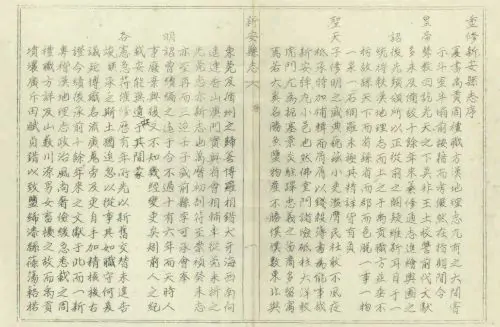
A Guangdong evacuation proclamation posted in March 1662 threatened execution for people who crossed the prescribed boundary to cultivate their fields or rebuild their houses. It also warned inhabitants who delayed departure that they would be treated as rebels. Activities through which households sustained themselves had become punishable because they occurred in territory the government required them to abandon. Xin’an County experienced this larger campaign of compulsory removal along China’s southeastern coast. Its inhabitants confronted an authority that could require them to surrender their homes while continuing to demand their obedience.
The clearances began in 1661 during the Qing dynasty’s struggle against maritime resistance associated with Zheng Chenggong, better known as Koxinga. Although the conquest had established Qing power across much of the mainland, possession of territory did not guarantee control over the commercial relationships connecting coastal inhabitants to forces operating at sea. The Zheng organization drew strength from maritime exchange and access to mainland resources, making ordinary economic activity a matter of military concern. Policies restricting commerce had already sought to interrupt those connections; compulsory evacuation extended intervention into the location of civilian residence itself. Under the government acting during the young Kangxi emperor’s minority, communities were ordered inland so that their settlements and productive resources could no longer sustain the adversary. The intended result was a coast deprived of the human presence through which supplies could circulate. Xin’an, encompassing much of present-day Shenzhen and Hong Kong, provides a concentrated setting in which to examine how that strategic calculation became an extended experience of dispossession. Its history also requires distinguishing the authorization of removal from successive decisions about enforcement and the conditions under which return became permissible.
For households dependent on coastal land or access to the water, relocation threatened the foundations of subsistence. Destruction and prolonged exclusion could impose losses far beyond the possessions people managed to carry inland. The county gazetteer compiled in 1688 associated the clearance with the impoverishment and diminished population of formerly prosperous coastal districts, while recording the restoration of county administration in 1669. Such evidence establishes profound disruption, although neither retrospective descriptions nor incomplete population records permit every missing inhabitant to be counted among the dead.
Restoration introduced a further question about the obligations of the government that had imposed those losses. Permission to resettle could reopen territory, but recovering a livelihood required resources and functioning relationships that an order alone could not supply. The later commemoration of Guangdong governor Wang Lairen and governor-general Zhou Youde, credited with obtaining relief, preserved the importance of official intervention while placing the evacuation within a history of gratitude. At Kam Tin, the Chou Wong Yi Kung Study Hall and ceremonies for the evacuation dead joined recognition of suffering to respect for imperial officials. These institutions warrant examination alongside administrative records because remembering benevolent service could shape how responsibility for the original devastation was expressed. Gazetteers likewise combined information about local hardship with the priorities of officials and established families, giving their accounts both evidentiary value and specific interests. These materials support an interpretation in which military purpose and civilian devastation remain inseparable. The Qing sought to consolidate authority by disabling economic connections it could not reliably control, then faced the work of restoring communities through which durable government depended on being exercised.
Xin’an before the Clearance: Communities Connected to the Coast
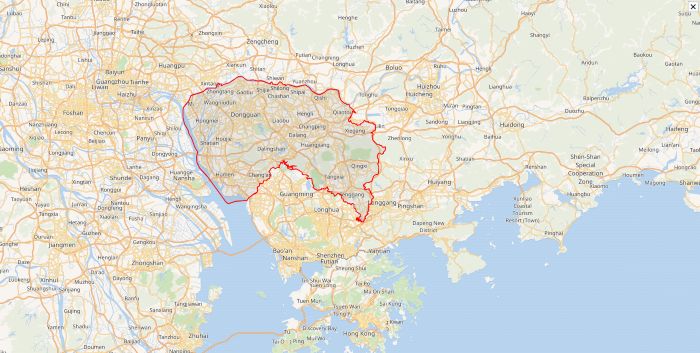
Xin’an acquired its own county administration in 1573, when the Ming government separated it from Dongguan following a petition made the previous year. Its seat at Nantou occupied an existing fortified settlement associated with the coastal defense arrangements established in 1394. Civil administration developed around a place already important to the management of the shoreline. The county remained subordinate to Guangzhou Prefecture, but its creation brought a magistrate closer to inhabitants whose affairs had previously been handled through Dongguan. The name Xin’an, conventionally translated as “New Peace,” expressed an aspiration to orderly government in a district exposed to maritime insecurity. By the seventeenth century, the area possessed an administrative history of its own, superimposed on older settlements and military establishments.
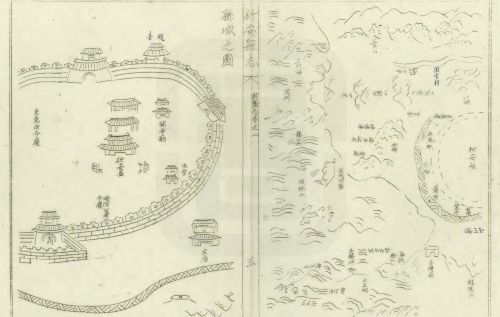
Physical geography gave that jurisdiction considerable internal variety. Toward the Pearl River estuary, coastal plains offered opportunities for cultivation, while much of the eastern territory consisted of steep hills interrupted by valleys and sheltered inlets. The distribution of usable land encouraged settlement in specific locations rather than evenly across the county. Water also provided connections between places separated by difficult overland routes. The 1688 gazetteer’s account of travel between Nantou and Dapeng describes mountain crossings and tidal obstacles, alongside an earlier passage by boat, illustrating how access by sea could shape the practical distance between communities. Although that description belongs to the period after restoration, the terrain it records helps explain the importance of maritime movement before the evacuation. A village situated beside an inlet could have easier contact with another coastal settlement than with inhabitants lying nearer on a map but beyond a ridge. Residence near the shore involved a combination of access and constraint. Productive ground might be limited, yet the water opened routes through which people obtained goods or reached other communities.
Agriculture remained central to Xin’an’s economy, and land taxation formed a principal basis of official revenue. Cultivation required continuing access to plots and the labor needed to maintain them, making possession or tenancy consequential well beyond the value of a harvest. The farming population consequently cannot be absorbed into a general category of seafaring inhabitants simply because the county bordered the ocean. Differences between landholders and households working land controlled by others also warn against treating settlement as evidence of equal economic independence. Maritime connections operated alongside these agrarian relationships.
Fishing and salt production nevertheless gave the county a distinctive economic character. In its discussion of local products, the 1688 gazetteer associated the pursuit of marine resources with mountainous terrain and proximity to the sea, and observed that everyday manufactured articles were supplied from other counties. That description suggests an economy in which specialization created dependence on exchange. Households earning income from the water needed access to buyers, while the purchasers of their products linked coastal work to consumption farther inland. Salt occupied an especially regulated position because its production and circulation were matters of fiscal concern as well as commerce. The gazetteer’s complaints about obstructed distribution and the difficulties experienced by producers reveal that extracting a commodity did not guarantee a satisfactory livelihood. Its account of fishing similarly connects catches to the availability of boats and the ability to sell what was obtained. These observations were written after the clearance and require care when reconstructing earlier conditions, but they identify relationships whose importance preceded the catastrophe. The relevant economic unit extended beyond a dwelling or workplace to include the routes and transactions that made its output useful. Without secure figures for production or occupational distribution, the evidence supports a connected local economy while leaving the scale of activities uncertain.
Established descent groups supplied another form of continuity across the district. At Ping Shan, the Yu Kiu Ancestral Hall is dated to the early sixteenth century, providing a concrete example of a place where Tang relatives could affirm shared ancestry well before 1661. Such institutions attached family history to specific locations and helped distinguish people with recognized local standing from those possessing fewer connections. David Faure’s work on South China explains how ancestral ritual and arrangements for holding property could bring descent organizations into relationships with imperial administration. The extent and timing of those arrangements must nevertheless be established community by community.
Rubie S. Watson’s study of Ha Tsuen traces the formation of a powerful lineage organization during the decades after 1669, demonstrating that later corporate strength cannot automatically be assigned to an earlier generation. Preexisting kinship ties could provide assistance or influence without already possessing every institution subsequently associated with lineage dominance. Recognizing these differences makes room for households whose interests were poorly represented by the histories of prominent families.
Governing Xin’an required officials to work through this uneven distribution of property and local knowledge. The magistrate’s office handled revenue and adjudication, but a dispersed population could not be managed through the county seat alone. Clerks and subordinate personnel translated official business into local practice, while people familiar with some communities helped make inhabitants and their obligations identifiable. Influential residents could facilitate that work, although their participation also gave them opportunities to advance their own claims. Military establishments introduced a further set of offices and responsibilities, so the administration of coastal life involved relationships between civilian jurisdiction and armed defense. This arrangement had developed amid recurrent insecurity, including the conflicts accompanying the Ming–Qing transition; the years before evacuation were already marked by instability. Even so, Xin’an’s inhabitants occupied a landscape organized through recognizable settlements and accumulated relationships. Understanding that existing organization matters because an administrative instruction affecting where people could reside would operate upon connections extending well beyond the houses in which they lived.
The Zheng Resistance and the Qing Problem at Sea
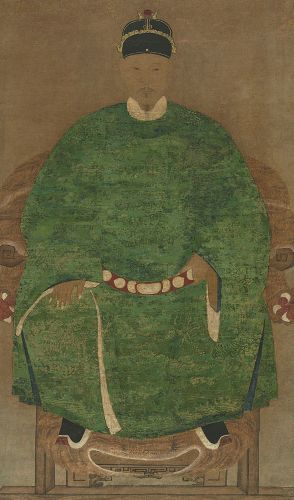
The fall of Beijing in 1644 did not settle the succession to the Ming empire. Resistance continued under rival claimants and commanders whose authority depended on their ability to retain troops and resources after the collapse of the former capital. Among them, Koxinga occupied an unusually powerful position because his father, Zheng Zhilong, had built a maritime following before entering Ming service. The elder Zheng’s submission to the Qing in 1646 divided the family’s political commitments rather than bringing its seaborne forces collectively into the new dynasty’s service. His son maintained allegiance to the Ming and developed an increasingly independent command. That divergence illustrates the instability of the conquest. The submission of a prominent leader could leave substantial military capabilities in the hands of relatives or former associates who continued to resist.
Koxinga’s strength rested on an organization capable of converting commercial earnings into sustained military action. Its principal bases in southern Fujian included Xiamen and Jinmen, where ships and personnel could be assembled for operations beyond the immediate reach of mainland armies. Overseas business connected the Zheng enterprise to Japan and other Asian destinations, providing revenues that supplemented what commanders obtained from territories under their influence. Xing Hang’s reconstruction of the family’s activities emphasizes the scale and organization of this commerce, showing why the force cannot be adequately described through the language of piracy alone. Armed protection and commercial privilege reinforced one another, while political command could determine who participated in profitable transactions. Maintaining an army demanded continuous attention to provisions and payments. Yang Ying, an official responsible for military finances and supplies, recorded the campaigns from within this administrative world. His account helps recover the practical work sustaining operations that later narratives might reduce to the achievements of a celebrated commander. The organization possessed resources and procedures through which resistance could survive between major engagements.
In 1659, the danger to Qing rule became unmistakable when Koxinga carried a substantial expedition into the Yangzi and threatened Nanjing. The campaign demonstrated that forces based along the coast could attempt an operation against a major center of mainland government. Defeat outside the city ended that advance, but surviving troops withdrew toward their maritime bases. Qing success at Nanjing checked an offensive without eliminating the organization that had mounted it. The regime still confronted an adversary capable of regrouping beyond the territory its victorious field armies could readily occupy.
Negotiation had offered another possible route to resolving that confrontation. During the 1650s, Qing representatives proposed titles and territorial authority in exchange for submission, while attempting to use Zheng Zhilong’s position in their custody to influence his son. These exchanges concerned the terms on which an armed maritime power might be incorporated into the dynasty. Recognition could preserve considerable authority for Koxinga, but acceptance would place that authority within an imperial hierarchy whose ultimate claims he would have to acknowledge. Requirements concerning the Qing hairstyle made submission publicly visible, attaching political significance to a practice that negotiators could not dismiss as ceremonial detail. Disagreement also extended to jurisdiction and the degree of autonomy his command would retain. The failure to reach a settlement accordingly involved more than personal obstinacy. Both sides understood that accommodating the Zheng organization would define who could govern substantial portions of the southeastern coast. For the court, concessions sufficient to secure agreement could also entrench an opponent whose independent power remained considerable.
Naval warfare likewise continued before the general clearance. Qing forces attacked Xiamen in 1660, employing southern maritime personnel and commanders familiar with the Zheng organization, including the defectors Huang Wu and Shi Lang. Their participation makes it misleading to explain evacuation simply as the response of a northern conquest regime incapable of fighting at sea. The Qing could recruit expertise and put ships into action, although possessing those resources did not guarantee a decisive victory. Maritime operations required coordination among forces whose commanders brought different histories and interests into imperial service. Koxinga’s ability to resist attack showed the difficulty of converting mainland superiority into control over defended island bases. Clearance entered a conflict in which naval recruitment and coercive diplomacy were already being attempted, rather than filling an otherwise empty repertoire of policy. Taiwan changed the geographical possibilities of that struggle. Koxinga’s expedition reached the island in April 1661, months before the broad evacuation orders issued later that year, so the clearance cannot explain the initial decision to undertake the conquest. Dutch colonial establishments there occupied territory inhabited by Indigenous societies and Chinese settlers, whose interests differed from those of either invading troops or the Dutch East India Company. The campaign brought these populations into a new contest over political control and access to land. After a prolonged siege, the Dutch surrendered Fort Zeelandia in February 1662, giving Koxinga a territorial base across the strait. Military settlement and cultivation could enlarge the resources available to his organization, although creating dependable supplies required labor and administrative arrangements that took time to develop. Taiwan also remained connected to overseas commerce, extending possibilities for survival beyond those available from mainland coastal districts alone. The Qing decision to empty those districts consequently coincided with an adversary’s acquisition of another base, complicating the expectation that denying mainland provisions would bring resistance to an early end.
Koxinga’s death in June 1662 introduced a contested succession, from which Zheng Jing eventually emerged as the principal leader. Continuing resistance depended on overcoming internal division as well as confronting Qing pressure. In 1663, defections weakened Zheng positions while Qing forces, assisted by Dutch warships, captured Xiamen and Jinmen. The Dutch East India Company’s cooperation reflected its own calculations after the loss of Taiwan, adding an external participant whose interests intersected with those of Qing commanders. Those operations demonstrate that changes in the war arose from several interacting causes; they cannot be assigned to coastal evacuation alone. Zheng Jing subsequently consolidated his position on Taiwan, where his government remained beyond Qing control when Xin’an’s reopening was authorized in 1669. The struggle changed location and form without reaching a settlement. Xin’an’s clearance belonged to this wider effort to overcome an adaptable opponent, although the county’s inclusion within the prohibited zone does not itself establish that certain villages had supplied Zheng forces.
Ordering Desolation: The Regency and Responsibility for Policy

The Shunzhi emperor’s death early in 1661 placed the Qing throne in the hands of a child, while the conduct of government passed to four regents: Sonin, Suksaha, Ebilun, and Oboi. Commands continued to carry imperial authority, but their issuance cannot be treated as evidence that the young Kangxi emperor personally formulated the measures they prescribed. The regents governed within an established structure of councils and ministerial offices, receiving information and recommendations from provincial officials. Their collective appointment also concealed differences in seniority and political influence. Oboi’s eventual predominance makes him central to the history of the period, yet it should not be projected backward into sole control over every decision made at the beginning of the reign.
Compulsory removal already had precedents before that succession. In 1660, governor-general Li Shuaitai requested the evacuation of Paitou and Fangtian in Fujian, and the court approved the proposal. A subsequent inspection by the central official Sunahai connected provincial experimentation to consideration at the capital. These developments complicate any explanation that locates the policy’s invention entirely within the new regency. Officials dealing directly with the maritime conflict helped define measures that imperial institutions could authorize and extend. The importance of such recommendations also challenges a simple division between a distant court issuing commands and regional administrators reluctantly obeying them. Provincial knowledge supplied arguments for coercion as well as, later, arguments for relief. The enlargement of localized removals into a much broader undertaking nevertheless required additional decisions about geographical scope and enforcement. An earlier approval establishes continuity in policy formation; it does not make the subsequent expansion an automatic consequence beyond the responsibility of those who accepted it.
Attributing the entire program to a single originator exceeds what the surviving documentation securely establishes. Accounts give prominence to different advisers, including Huang Wu and Sunahai, while emphasizing moments of recommendation or approval. Dahpon David Ho’s examination of the records cautions against selecting one such figure as the uniquely demonstrated architect of the clearance. He also identifies the absence of a surviving originating edict sufficient to reconstruct the whole decision from one text. That evidentiary gap limits claims about personal authorship, while leaving substantial evidence for governmental authorization and participation.
Reign-year dating introduces a separate difficulty. The designation “Shunzhi 18” remained in official use after the emperor’s death, until the following year, so a document carrying that date does not necessarily record an instruction issued during his lifetime. The Guangdong proclamation discussed earlier refers to authorization in the ninth lunar month of that year, corresponding to late 1661, although the notice itself was posted in March 1662. Its sequence separates approval from the later announcement of requirements to inhabitants. It also places that authorization within the government operating after the succession. Distinguishing the ruler named in a calendar from the people conducting administration is essential to assigning responsibility, notably when later descriptions compress the episode into an emperor’s personal command.
The proclamation’s heading provides unusually concrete evidence of how authority was presented outside the capital. It invoked Guangdong’s feudatory prince, Shang Kexi, alongside imperial commissioners and senior provincial military and civilian officers. The text attributed the specified boundary to official inspections and announced removal as the consequence of receiving an imperial decree. Multiple offices appeared together in an instruction that residents were expected to obey as binding law. But the document belongs to eastern Guangdong and its precise arrangements cannot be transferred to Xin’an without corroboration. Its wider significance lies in the administrative relationship it records. Imperial sanction acquired a local geographical definition through inspection, then became a published demand backed by officials possessing the means to enforce it. Choosing the boundary involved judgment about which settlements would fall outside permitted residence. Provincial participation consequently extended beyond transmitting words from Beijing. Inspectors made decisions that determined the reach of compulsion, while commanders supplied the force through which those decisions took effect. Examining their discretion helps explain differences in implementation without reducing the general policy to disconnected local acts.
Provision for evacuees belonged to the announced undertaking as well. The same notice directed those who had moved inland to await investigation by the governor-general and governor and the provision of land and housing. This promise acknowledged that removal required arrangements for people’s continued residence and subsistence. Its presence prevents an interpretation in which officials’ stated duties ended once departure had been secured. Yet an undertaking to allocate assistance establishes neither its adequacy nor its delivery. The relevant historical questions concern what provincial authorities arranged and how their actions compared with the obligations they had publicly assumed.
Responsibility also changed as the emperor’s position developed. An edict dated August 25, 1667, formally announced Kangxi’s assumption of personal rule, although Oboi retained substantial influence until his arrest in 1669. The period cannot be described as an unchanged regency extending uniformly from the initial orders to Xin’an’s restoration. Early authorization, continued enforcement, and decisions to modify restrictions occurred within a shifting distribution of political power. That chronology makes it necessary to distinguish responsibility for introducing a measure from responsibility for maintaining or revising it. The initial burden rested on the governing institutions that endorsed compulsory removal, while provincial participants exercised consequential judgment in applying it. Later officials inherited both an established prohibition and the task of assessing its effects. A differentiated account can recognize those variations while identifying the evacuation as an exercise of Qing government. Uncertainty about its first proponent does not dissolve the responsibilities created by approving the policy and sustaining its operation.
Drawing the Boundary: How Xin’an Was Cleared
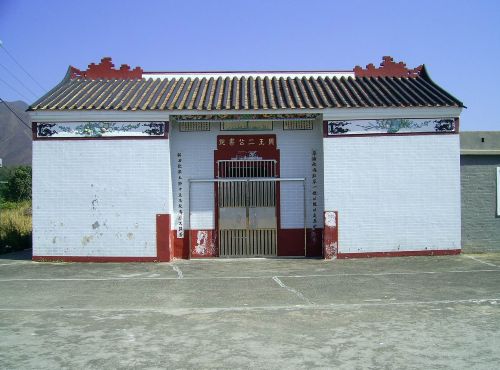
Surveying preceded the forced removal of Xin’an’s inhabitants. The 1688 county gazetteer places an initial coastal inspection in the twelfth lunar month of Shunzhi’s eighteenth year, a period extending across late 1661 and early 1662. It then records the establishment of the boundary in the second lunar month of 1662, followed by the arrival of troops to drive residents inland during the third. This sequence gives the local operation a more precise chronology than descriptions assigning everything to the year of the general order. Officials first identified the affected territory and subsequently compelled its inhabitants to leave. The resulting exclusion depended on a succession of acts whose completion required personnel to move through the county.
Measured reach was important, but the consequences exceeded what a distance alone conveys. Local accounts describe removal extending fifty li inland and estimate that the first demarcation affected two-thirds of Xin’an’s territory. The latter figure concerns the county’s geographical extent; it cannot establish the proportion of its inhabitants expelled or the share of agricultural production lost. Nor does the stated distance supply a complete reconstruction of the surveyed boundary. Along an indented shoreline, decisions about the points from which distance was measured would affect which settlements fell within the prohibited area. The relationship between bays and inhabited valleys made the practical reach of clearance dependent on more than an abstract measurement. In Xin’an, the recorded scale nevertheless establishes that the operation encompassed a substantial portion of an existing jurisdiction. The territory withdrawn from residence included districts whose significance came from concentrated settlement and productive activity, making acreage an incomplete measure of the disruption.
Advance notices did not necessarily prepare people for departure. The gazetteer reports that announcements had appeared, but inhabitants initially failed to understand the impending removal. Its account changes abruptly when soldiers arrive and residents abandon possessions while taking their families away. The text does not establish what every household had been told or how much time each received. It does distinguish publishing an instruction from securing practical comprehension of what that instruction would require.
Destruction then changed the condition of the places people had left. Accounts preserved through the commemorative tradition associated with Kam Tin recall houses and fields being burned during the evacuation. These descriptions establish deliberate devastation without furnishing a building-by-building inventory for the county. For inhabitants whose dwellings were destroyed, return would require obtaining materials and undertaking construction before ordinary domestic life could resume. A house provided working and storage space as well as shelter, so its destruction affected more than accommodation. Cultivation presented a related problem because expulsion prevented the continuing labor through which fields produced a harvest. Damage to crops and enforced abandonment were distinct mechanisms of loss, even where later accounts compressed them into a general description of ruined farmland. The soil did not have to be permanently destroyed for agricultural production to cease. Likewise, a structure that escaped burning could remain unusable because its occupants were forbidden to reside there. Physical devastation and restrictions on access reinforced one another, leaving the consequences dependent both on what survived and on what inhabitants were permitted to do with it.
Further inspections reopened decisions that the first demarcation appeared to have settled. The county’s records describe proposals to extend the restricted territory until very little of Xin’an would remain available for habitation. Governor-general Lu Xingzu intervened on the grounds that the initial removal had already affected so much of the county. His representation limited the additional expulsion to twenty-four communities on the eastern and western routes. That intervention narrowed the proposed expansion while accepting continued removal within the reduced area. It belongs to the history of enforcement as well as to the development of arguments against excessive displacement. Provincial objection altered the reach of the measure, but the households included in the remaining extension still faced expulsion.
In the third lunar month of 1664, garrison officer Jiang Hongrun and magistrate Zhang Pu carried out the removal of those twenty-four communities. The gazetteer identifies both the affected groups and the officials participating, giving this later operation a specificity absent from many general descriptions of the clearance. Their involvement also demonstrates that successive expulsions continued through county-level civil and military offices. Residents permitted to remain after the first survey could subsequently find their settlements included within an enlarged exclusion zone. Compliance with the earlier arrangement consequently offered no assurance that residence would continue to be allowed. For anyone who had sought accommodation near the permitted limit, an extension threatened the value of decisions already made in response to the first order. The surviving account does not trace individual itineraries sufficiently to show how many households moved twice. It does establish another organized expulsion, directed at identifiable communities after the initial operation had already displaced much of the county.
Administrative absorption followed the reduction of inhabited territory. According to the 1688 gazetteer, Zhang initiated the process through which the remaining land and population tax obligations were transferred to Dongguan in 1667. Xin’an consequently ceased to function as a separate county administration. This altered the jurisdiction responsible for the remnants of its registered population and fiscal affairs. The change gave institutional form to the contraction already imposed through successive removals. Surviving parts of the former county were now administered within another district.
Departure also carried people beyond the territory that these administrative decisions reorganized. The gazetteer describes evacuees scattering into Dongguan and Guishan, with others traveling farther away. It records exposed sleeping conditions and deaths during the upheaval, although it offers no dependable total for that immediate movement. These observations bring the account beyond the surveyed line to the uncertain destinations of those compelled to cross it. The requirement to go inland did not identify a settled place for every departing family. People moving toward relatives or possible employment might travel distances bearing little relationship to the prescribed depth of the clearance. Such dispersal helps explain why the removal of a community could be completed as a military operation while the whereabouts and circumstances of its former inhabitants remained difficult to establish. The authorities produced an excluded territory more readily than they produced a stable arrangement for the people removed from it.
Enforcing an Empty Coast

Maintaining the exclusion zone required an expanded military establishment. Xin’an’s gazetteer records an initial Qing garrison of five hundred men and the addition of another five hundred when the boundary was reestablished in 1664. Additional command appointments accompanied that enlargement, with responsibilities extending to the neighboring defense establishments at Dapeng and Dongguan. These figures describe the authorized establishment rather than proving that every post remained fully staffed, but they demonstrate the importance assigned to continuing military supervision. The government committed personnel to territory from which it had expelled a substantial civilian population. An “empty coast” remained occupied by people serving the authorities that prohibited others from living there. Its maintenance depended on organized armed presence and the capacity to intervene when exclusion failed.
Inspection continued after the principal removals. The local account describes visits to the boundary through all four seasons, indicating recurrent scrutiny of an arrangement already imposed. Such supervision required officials to determine whether the prohibited area remained unoccupied and whether the personnel enforcing it were performing their duties. It also kept the restriction administratively active between major decisions about extension or relief. Departure did not complete the government’s work, because the same territory had to remain closed over succeeding agricultural seasons.
Maritime prohibition operated alongside this regulation of residence. The distinction between haijin, restricting activities at sea, and qianjie, withdrawing inhabitants behind a prescribed boundary, matters because the measures affected different conduct. Preventing settlement reduced opportunities for provisioning maritime forces, while preventing departures by boat restricted movement and economic activity beyond the shoreline. Xin’an’s fiscal records preserve a concrete consequence of the latter. After the prohibition introduced in 1662, boat-dwelling fishing inhabitants dared not go to sea, and the associated fishery levy became uncollectable. This administrative acknowledgment supplies evidence of interruption among people whose livelihoods did not fit neatly into the category of a village household removed from a fixed dwelling. Their work required movement on the water, so restrictions reached them through control of that movement. The cessation of recorded revenue does not demonstrate the disappearance of every clandestine catch, but it establishes that officials recognized a substantial collapse in the activity from which the levy had ordinarily been obtained.
Some failures of exclusion involved armed groups. An entry for the eighth lunar month of 1664 records a group occupying Guanfu and Liyuan after refusing to move inside the boundary, then conducting raids from those places. The gazetteer describes its suppression by troops drawn from several commands, showing how enforcement could require coordinated operations against people who remained in the restricted territory. Its characterization of the occupants as raiders belongs to the official account and must be assessed as such. Nevertheless, the reported raids cannot simply be rewritten as an innocent household’s attempt to stay at home. This incident establishes one form of resistance without explaining the motives of everyone who remained outside or attempted to return. It also shows that compulsory evacuation had not produced territory beyond the need for military action.
Elsewhere on the coast, contemporary criticism exposes the opportunities that boundary policing created for abuse. In a memorial concerning Fujian, Hong Ruogao described a road used to separate permitted ground from the prohibited side. Livestock crossing that road drew their owners after them, whereupon patrols charged both with violating the restriction. Travelers unfamiliar with the divisions of the route could likewise be detained, and Hong complained that soldiers took their possessions even when they were subsequently released. These allegations concern Fujian and cannot establish that identical practices occurred in Xin’an. Their comparative importance lies in the relationship between a broadly defined offense and immediate control by armed personnel. A patrol’s decision that someone had crossed exposed that person to coercion before any later determination of the case. Release could fail to reverse losses already imposed during detention. The severity announced in official commands consequently has to be examined together with the discretion exercised by those encountering inhabitants along the line.
Recorded adaptations in Xin’an reveal a further complication in the operation of restriction. The gazetteer describes displaced people near Baishi and the county town carrying seawater inland and boiling it to produce salt. Their labor preserved a use of marine material even while the earlier arrangements for earning a living had been interrupted. Carrying water imposed work that differed from production in established coastal facilities, transferring part of the burden of adaptation onto the evacuees themselves. The passage does not specify the authorization governing every stage of that activity, so it cannot prove a general exemption from the ban. It does show that local economic conduct continued to change within the conditions created by clearance. Enforcement shaped the methods through which people sought subsistence as well as determining whether they could occupy their former settlements.
Supplying the enlarged garrison imposed continuing obligations of its own. The military chapter lists pay and grain allocations, identifying stores in Xin’an and Dongguan and grain associated with the Dongguan military establishment among the sources supporting the troops. Those arrangements demonstrate that armed supervision required a maintained system of provision, even as civilian production and fiscal collection had contracted. Men assigned to enforce exclusion needed regular sustenance and command arrangements capable of keeping them at their posts. The government preserved organized access to resources for military purposes while restricting the activities through which much of the local population had supported itself. Adequate provisioning also mattered to the conduct of enforcement. The gazetteer’s introductory discussion of military government linked discipline and support for soldiers to the protection of inhabitants. That expressed ideal provides a standard against which the exercise of coercion can be assessed without assuming that every officer or soldier behaved alike. Keeping the coast closed remained an undertaking requiring expenditure and supervision, with consequences extending into the lives of people who had already complied with removal.
Displacement Inland: Survival after Dispossession
As the prospect of an early return receded, displacement increasingly threatened the household itself. The 1688 Xin’an gazetteer describes evacuees initially resisting separation from their wives and children because they expected to recover their former lives. Prolonged difficulty in obtaining subsistence eventually made those arrangements unsustainable, and the account turns from families remaining together to husbands parting from wives and parents or older brothers sending younger dependents elsewhere. Its description makes the passage of time central to the experience of removal. Resources sufficient for an interruption could be exhausted during an absence with no dependable end. Decisions about who would remain together consequently became decisions about who could be supported, and by whom. The household, which had organized everyday work and care before evacuation, now had to be divided to preserve some possibility of survival.
The placement of women in domestic service reveals how sharply these decisions could redistribute dependence. According to the gazetteer, husbands urged their wives to become servants in other households when they could no longer maintain them. The term used for these women, bi, belongs to a vocabulary of subordinate domestic labor that could encompass forms of servitude, but this brief passage supplies neither contracts nor the legal circumstances of individual placements. It supports an account of constrained entry into service without establishing that every woman was purchased, permanently enslaved, or subject to identical conditions. A receiving household could provide food and accommodation while acquiring the labor of someone whose alternatives had been severely reduced. For the displaced family, such an arrangement might relieve an immediate burden of maintenance, although that relief depended on a wife living and working under another household’s authority. The account presents the decision through husbands and the county’s literate compiler, leaving women’s negotiations, preferences, and assessments largely inaccessible. That imbalance matters because the surviving description records the transfer of their labor more clearly than their participation in arranging it.
Sending a son or younger brother to work for another family or descent group offered a further way of obtaining support, according to the county account. It separately records affluent local residents and wealthy outsiders taking in displaced children and raising them without payment for their acquisition. That absence of a purchase price cautions against describing every transfer as a sale, although it leaves the child’s subsequent obligations and contact with relatives unclear. These arrangements could preserve life while relocating daily care and authority beyond the immediate family. The source does not establish a uniform distinction between temporary shelter and lasting incorporation into a receiving household. Recovering access to Xin’an would consequently leave the additional problem of locating dispersed children and other dependents.
Differences in available resources shaped which families encountered these pressures first and which alternatives they could pursue. In its concluding commentary on the evacuation, the gazetteer distinguishes people who carried substantial possessions away with them from poorer inhabitants who abruptly lost their livelihood and had little with which to sustain themselves. Possessions that could be transported offered an immediate advantage over productive assets that depended on continued access to a specific field, workshop, or shore. Even carried wealth could diminish through the costs of maintaining dependents during an extended absence. Kinship offered possible avenues of assistance, but shared ancestry did not ensure that every relative possessed land, spare accommodation, or the ability to support additional people. Rubie S. Watson’s study of class and kinship in Ha Tsuen, based on a much later social setting, provides a useful interpretive caution here. Relationships of descent could coexist with pronounced inequalities in control over resources. Her findings cannot reconstruct a seventeenth-century construct of refugee assistance, but they help prevent the assumption that lineage membership automatically supplied an effective guarantee of subsistence. The relevant question is how relationships could be converted into actual maintenance when the people approached for help might themselves have limited resources.
For adult men, entry into military camps offered another route to maintenance. The gazetteer describes men seeking subsistence in different camps, although it gives no terms of recruitment or indication of how long their service continued. Joining a camp could bring immediate support while imposing new obligations and removing another member from a household struggling to remain intact. Because the compiler explicitly places this movement among responses to material distress, the notice provides little basis for interpreting enlistment as proof of settled political allegiance.
Those unable to secure support through service or a receiving household could turn to begging in unfamiliar places and along the roads. The gazetteer’s references to this activity register a further loss of control over subsistence, as survival came to depend on assistance that the displaced person could request but could not reliably command. It also reports deaths by suicide within displaced families and explains them through an unwillingness to endure begging. That explanation belongs to the compiler’s moral interpretation of suffering, rather than to surviving testimony from each person concerned. Its emphasis on shame makes visible the importance attached to household independence and social standing, while also shaping which experiences received explicit acknowledgment. Deaths that could be narrated as responses to dishonor were legible within this account; the less dramatic endurance of people who continued soliciting food receives little comparable attention. We should resist allowing the reported suicides to define the dispositions or choices of the displaced population as a whole. People who accepted charity, domestic service, or separation from their dependents were also responding to circumstances that had sharply curtailed their options. Reading their persistence alongside the gazetteer’s accounts of death broadens the history of suffering to include the prolonged effort required to remain alive under conditions of dependence.
Attempts to accommodate the evacuees encountered a practical obstacle that individual acts of assistance could not overcome. The gazetteer credits senior officials and county magistrates with repeated efforts to arrange settlement, while identifying the difficulty as too many displaced people competing for too little land within the permitted area. This testimony qualifies any interpretation that makes the inland crisis simply the result of universal official indifference. It also exposes the limits of administrative intervention while the territorial restriction remained in force. Arranging access to an already constrained supply of land could not readily replace the productive opportunities from which the evacuees had been excluded. The source records these efforts in general terms, so their existence should not be converted into an assumption that accommodation was sufficient or distributed evenly. Meanwhile, families pursued arrangements that reached beyond settlement alone, placing members in other households or seeking maintenance through employment and charity. By the time return became possible, the population awaiting it included people whose family relationships and means of support had already been reorganized during their absence.
Measuring the Losses: What the Records Can Establish

Xin’an’s surviving numbers belong to an administrative record whose categories were designed chiefly to organize obligations and resources. The population entries in the 1688 gazetteer appear within its chapter on land and taxation, rather than in a separate investigation of evacuation casualties. They distinguish registered households, hu, from registered “mouths,” kou, while other entries use ding, a category associated with fiscal registration and taxable males. These terms cannot be exchanged without examining how the county employed them at a specified date. Cao Shuji’s reassessment of Ming and Qing population evidence emphasizes the institutional and regional variation behind apparently straightforward totals, including the persistence and recombination of fiscal quotas. His discussion supplies a reason to investigate local definitions rather than assume that ding always represented either a complete enumeration of adult men or a purely abstract unit. For Xin’an, numerical precision begins with retaining the distinctions made by the record itself.
The sequence of entries shows how easily a dramatic comparison can become a misleading one. For 1642, the gazetteer lists 3,589 households and 17,871 kou; an early Qing entry identifies 2,966 households and 6,851 kou but supplies no exact year. Following the removals of 1662 and 1664, it records 2,172 rending remaining, changing the category used for the population total. The undated figure should not be presented as a census taken immediately before the clearance, and the later ding figure cannot simply be subtracted from a total of mouths. A comparison extending back to 1642 also encompasses the violence and deprivation of the intervening dynastic transition. Those earlier losses belong to the county’s history, but they cannot all be assigned to an evacuation ordered almost two decades afterward. Xin’an’s temporary incorporation into Dongguan raises a further question about comparability, since administrative responsibility for its remaining taxable resources passed to another county. A rigorous calculation would require figures covering a stable geographical area as well as comparable registration practices at both ends of the interval. These entries record a major contraction during a prolonged crisis without isolating the clearance’s contribution to the decline.
One familiar number can be defined more securely: the 1,648 associated with the return of displaced residents. In the registration entry dated 1672, the gazetteer attributes 1,648 ding to the return of displaced inhabitants during 1669–1671. It consequently describes an accumulated administrative result over several years, rather than everyone who crossed back into Xin’an when permission to return was granted in 1669. The entry also cannot establish that physical arrival and registration occurred at the same moment. Preserving its unit and interval changes the historical question from how many people returned on a single occasion to how displaced registrants were progressively restored to the county’s records.
Mortality nevertheless requires direct attention, because the gazetteer makes a stronger claim than the fiscal entries alone could support. Its retrospective commentary states that deaths had exceeded half by the time of return, placing mass death at the center of its assessment of the evacuation. This is consequential testimony from a county compilation completed within living memory of the events, and it should not be dismissed merely because an accompanying list of victims is absent. Its evidentiary form remains important. The statement supplies no enumerated starting population, sequence of deaths, or procedure by which the proportion was calculated. James Hayes similarly warned that the familiar evacuation and return figures were uncertain in both their coverage and accuracy. Combining a rounded number of evacuees with the differently defined 1,648 would not independently confirm the gazetteer’s mortality claim. Permanent settlement elsewhere could reduce the number returning without implying death, while incomplete registration could reduce the recorded total without establishing either death or continued absence. The defensible distinction is between evidence that observers understood mortality to be enormous and evidence sufficient to calculate a countywide death rate. The former survives; the latter has not been established by these figures.
Land accounts offer a separate measure of disruption, provided their categories receive the same care. The gazetteer distinguishes cultivated and uncultivated land and includes resources such as ponds and hills within its fiscal accounting. An area removed from the accessible tax base was not necessarily an area physically destroyed, and an assessed land unit was not a measure of the harvest actually produced there. Entries recording renewed cultivation in successive years establish an extended process of reclamation. They do not yield a comprehensive inventory of damaged fields or a monetary valuation of everything lost.
Fiscal contraction also needs to be distinguished from the economic experience of inhabitants. An assessed grain obligation states what a category of property was expected to contribute; actual collections would establish what the administration obtained. Neither figure, by itself, measures how much food a household retained or how adequately its members could live. A renewed assessment might register an official expectation of productive recovery without demonstrating that cultivators had already achieved it. Reconstructing total economic damage would require evidence about output and consumption that the surviving schedules do not consistently provide. This problem cannot be solved by treating every later description as independent confirmation of the same quantities. A nineteenth-century gazetteer and a modern historical synthesis may reproduce material originating in one earlier compilation. Agreement between them can establish the endurance of an account without multiplying the number of independent observations behind it. Corroboration becomes stronger when evidence produced for different purposes converges on a specific event or condition, such as an evacuation order alongside a dated record of abandoned taxable land.
What the evidence permits is a differentiated assessment of a catastrophe whose complete dimensions remain unrecoverable. Registration entries document substantial administrative contraction, while narrative testimony identifies death as a major part of the experience. The chronology of reclamation supplies a further indication that reopening the county did not immediately restore its productive capacity. These findings can stand without assigning every missing registrant to a single fate or applying an unsupported multiplier to recover the unrecorded population. County totals also conceal differences among settlements, since the successive removals affected communities at different times and under different circumstances. The remaining uncertainty limits estimates while leaving strong evidence of the connection between enforced evacuation and severe losses. A careful history can identify the destructive consequences of the policy while keeping its numerical claims proportionate to the surviving record.
Obtaining Relief: Wang Lairen and
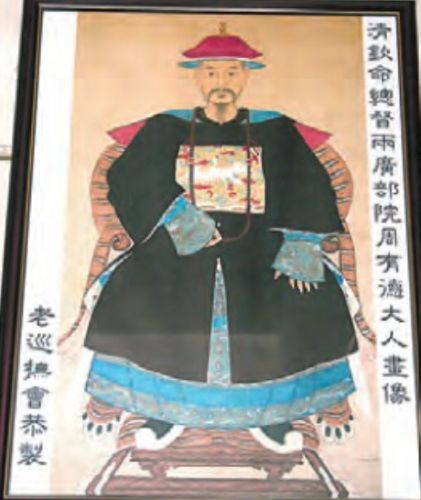
The case for reopening the coast acquired greater force when provincial officials carried it into deliberations at court. Wang Lairen, who became governor of Guangdong in 1665, occupied a position from which the consequences of clearance could be examined as a problem affecting the province’s administration. His office brought responsibility for revenue and public order into contact with the difficulties of maintaining a displaced population. Advocating a change involved more than describing suffering; it required explaining how an established imperial measure had become damaging to the purposes it was supposed to serve. Wang’s appeals belonged to this process of official reassessment, even though their eventual result extended beyond his career. He died in 1668, before inhabitants received the permission to return recorded for Xin’an in the following year.
A memorial attributed to Wang in Jiang Risheng’s early eighteenth-century Taiwan waiji presents a detailed argument about the relationship between military expenditure and civilian recovery. It criticizes the cost of maintaining numerous troops while evacuated land ceased to furnish revenue, leaving Guangdong dependent on financial assistance from other provinces. Wang proposed relaxing the boundary restrictions and transferring forces from the interior toward coastal positions where they could defend the territory directly. He also argued that uprooting inhabitants had helped generate inland banditry, making displacement itself a source of insecurity; this was his assessment of the policy’s consequences, rather than a demonstrated explanation for every local disturbance. The remedy joined the resumption of productive work to a different deployment of troops. Its reasoning made the condition of ordinary residents relevant to the maintenance of imperial authority, instead of treating their losses as a regrettable consequence outside the calculation of security. Financial considerations and concern for the people reinforced one another within this appeal. Wang asked the court to reconsider why defense against the Zheng resistance should depend on denying its own subjects access to their livelihoods.
The Xin’an gazetteer associates Wang’s request with the first lunar month of 1668 and follows it with an imperial commission to examine the boundary. The resulting inspection involved Zhou Youde, governor-general of Guangdong and Guangxi, together with Shang Kexi, the Prince Who Pacifies the South. This combination brought senior civil authority and a powerful military figure into the review. Reopening consequently developed through an authorized investigation, providing a means of translating advocacy into a revised territorial arrangement. The record’s sequence gives Wang and Zhou distinct contributions, rather than compressing their work into one jointly successful petition.
Zhou’s decisive intervention concerned the delay that preparation could impose on people already waiting to recover their former occupations. In the tenth lunar month of 1668, according to the county account, he requested that the boundary be reopened before the new defense arrangements were established. The later Qing shi gao preserves the practical reasoning behind his urgency. The coast was extensive, and waiting for the entire examination and settlement process to be completed would consume time that impoverished inhabitants could not afford. Administrative thoroughness could become an obstacle to relief if every preparatory task had to precede permission to return. Zhou sought to change that sequence while retaining the commitment to coastal protection. The significance lay in recognizing that the timetable of official review and the timetable of civilian survival were different. Jiang’s version of the appeal also identifies overgrown ground and the preparations required before spring planting, showing why authorization needed to leave sufficient time for agricultural work. Another delay could postpone a harvest as well as prolong displacement. Completion of a defensible plan offered reassurance to the authorities, but additional waiting imposed immediate costs on those without a secure occupation. Zhou made that difference a reason for action rather than another difficulty to be accommodated by the evacuees.
Property restoration gave the proposal a further practical dimension. The memorial attributed to Zhou in the Taiwan waiji called for former registers to guide the return of holdings and for protection against powerful occupiers and fraudulent claimants. Permission to reenter a district would have limited value if another person could prevent a returning household from recovering its former resources. These provisions anticipated disputes; they do not establish how frequently such disputes occurred or how effectively officials resolved them. Zhou also proposed continued baojia supervision, using local household organization for security checks. The contemplated protection of returning residents remained connected to practices for identifying and monitoring them.
Permission became effective in Xin’an in the first lunar month of 1669, when the gazetteer records the reopening of the boundary and authorization to resume former livelihoods. It adds that those unwilling to return were allowed to remain away. This qualification acknowledged that reopening did not erase the circumstances produced during the years of removal, although the text gives no individual reasons for declining to come back. In the seventh lunar month, the court approved the restoration of the county administration, with Lu Yi’ao appointed to act temporarily in charge. Authorization to return and reestablishment of local government were consequently related but separate steps. The restored jurisdiction could again provide an administrative center for the work that repopulation would require. These changes concerned residence and land access without establishing unrestricted maritime commerce. Restrictions on activity at sea persisted, so the concession represented a substantial revision of coastal government while other measures directed against the Zheng organization continued.
The subsequent pairing of Wang and Zhou as benefactors reflects a real achievement, but the documented process involved more than two persuasive personalities. Their influence operated through memorials and commissioned review, and final authorization still depended on the court. Provincial advocacy mattered because it gave the effects of a distant policy a place within decisions about its continuation. The recommendations also drew strength from arguments that civilian recovery would help make the province governable and its defenses sustainable. Recognizing this connection does not make concern for suffering insincere; it explains how such concern could become effective within the institutions of the Qing state. Honoring officials also leaves responsibility for the earlier evacuation open to scrutiny, since an administration could contain both the agents of coercion and advocates for its revision. Wang and Zhou helped secure acceptance of inhabited, productive communities as part of the arrangements for coastal security while the Zheng regime still survived. Their success opened a different course for Xin’an, whose residents would now face the task of making authorized return materially possible.
Returning to Xin’an: Permission and the Work of Reconstruction

When Li Kecheng arrived as magistrate in the seventh lunar month of 1670, he encountered a county still struggling to attract its displaced inhabitants. The 1688 gazetteer reports that many had not returned and that surviving returnees lacked dwellings in which to settle. Recruiting inhabitants and providing assistance consequently became connected tasks of his administration. His magistracy, which continued until 1675, gave these responsibilities a place within the routine business of governing the reestablished county. The measures associated with his tenure addressed the resources needed to remain in Xin’an, extending the work of restoration beyond the announcement that people could come back.
Cultivation depended on securing shelter before undertaking the heavier work of preparing land. In his administrative proposals, preserved in the gazetteer, Li expressly placed the construction of basic dwellings before the resumption of farming: returning people first needed somewhere to live. He then described clearing weeds and supplying seed to cultivators who lacked it. His official biography adds that he provided oxen as well as seed, while Patrick H. Hase’s study of his magistracy emphasizes the contribution of Li’s private resources to this assistance. These supplies could remove immediate obstacles that exhortation alone would leave untouched, although the accounts do not establish that every household received an equal allocation. Li also required reports of cultivation at twice-monthly intervals, connecting practical encouragement with administrative supervision. Newly reclaimed land, according to his proposals, would enter taxation after three years. The interval allowed cultivation to develop before the administration began collecting its anticipated contribution. His declared objective joined an increase in state revenue to the restoration of stable household property, making agricultural rehabilitation a means of rebuilding both livelihoods and the county’s fiscal foundations.
Some obstacles to resettlement existed in the records of obligation rather than in the condition of the soil. Li’s biography describes impoverished people who had fled burdens associated with registered men who had died. It credits him with investigating the relevant local registration units and clearing those liabilities so that the affected inhabitants could return without carrying the same demands back with them. Although written in praise of the magistrate, this passage identifies a concrete administrative impediment to repopulation. A household could recover access to its land yet remain exposed to claims calculated from circumstances that no longer existed. Correcting those claims belonged to the work of reconstruction as directly as providing agricultural supplies. The remedy involved adjustments to obligations, and should not be expanded into a claim that returning inhabitants enjoyed a general exemption from taxation.
Weather imposed additional losses on people trying to reestablish themselves. In the eighth lunar month of 1669, the gazetteer records a violent storm that destroyed newly built residential compounds soon after their occupants’ return. Another major typhoon in 1671 damaged dwellings and public structures, undoing work that had already consumed scarce materials and effort. Reconstruction consequently included repeated repairs to buildings recently rebuilt, alongside the first replacement of what evacuation had removed. Yet the same county compilation reports good harvests in 1671 and 1672, accompanied by low rice prices. Food supplies show evidence of improvement amid severe damage to buildings. Such improvement could ease provisioning while families continued repairing their homes, although low prices offered a different prospect to cultivators seeking cash from their produce. The brief notices do not establish the balance of these effects for individual households. They reveal different rates of recovery across the county, with gains in agricultural production existing alongside fresh destruction of shelter and infrastructure.
For people whose work depended on the water, renewed cultivation addressed only part of the economic difficulty. The gazetteer records a restored arrangement for salt distribution in 1671, demonstrating that some commercial organization resumed after reopening. Its commentary nevertheless describes impaired profits from fishing and salt, together with difficulty transporting goods. Those conditions could obstruct the exchange through which agricultural households obtained other necessities and maritime workers supported themselves. The functioning of a field or a salt outlet offered a narrower achievement than the recovery of the local commerce connecting these occupations.
Public reconstruction simultaneously altered the county’s defensive landscape. The twenty-one coastal positions authorized following the 1668 inspection were differentiated into twelve fortified posts and nine lookout sites, supplemented by road guardhouses and camps. These installations belonged to the arrangements for an inhabited coast, linking renewed settlement to a revised system of protection. The gazetteer records contributions from Li and other civil officials, alongside military officers and neighboring counties, toward the work. Its accounts also identify defenses damaged in the 1671 storm and the funds subsequently raised for repair. Such expenditure made recovery dependent on assembling resources through several offices and jurisdictions. Within Nantou, Li described repairs to the collapsed walls and obstructed moat as work approaching construction anew, despite being called restoration. His proposals refer to donated salary followed by the pledging or sale of property, illustrating the financial effort behind rebuilding structures through which local government sought to maintain security.
The county’s educational establishment followed a still longer course. Buildings that had deteriorated after the dynastic transition were devastated by the 1671 typhoon, and Li’s request to restore the county school and Confucian temple did not achieve its intended result. Further destruction accompanied the occupation of the county town by raiders in 1676; government control was recovered in the following year. A renewed building initiative began under Zhang Mingda in 1679, drawing on contributions from local officials and leading residents. The gazetteer records completion in the sixth lunar month of 1682. This chronology distinguishes Li’s efforts from an accomplishment secured by his successors and prevents the rehabilitation of the county from being assigned to one administration. It also shows that repairing institutions associated with education and public ritual could take much longer than securing the first improved harvests.
Reoccupation did not depend exclusively on people recovering their former homes. The gazetteer’s geographical chapter mentions inhabitants recruited from other counties to cultivate abandoned fields, placing the arrival of newcomers alongside the effort to bring evacuees back. A reopened village could consequently acquire a population whose relationship to its land differed from that of the community removed several years earlier. Retaining an old settlement name did not establish that every former household had returned, while the presence of new cultivators did not establish that older residents had disappeared altogether. The same passage urges strict local security registration because the authorities regarded unfamiliar arrivals as requiring supervision. Recruitment and scrutiny accompanied each other within the resettlement process. The source identifies these entrants through their origins in other counties without supplying a common ethnic description or a complete chronology of arrival. Reconstruction restored productive occupation while also creating new connections between people and land, helping shape a society that carried the consequences of clearance into its subsequent development.
Remembering the Evacuation: Suffering through the Language of Gratitude
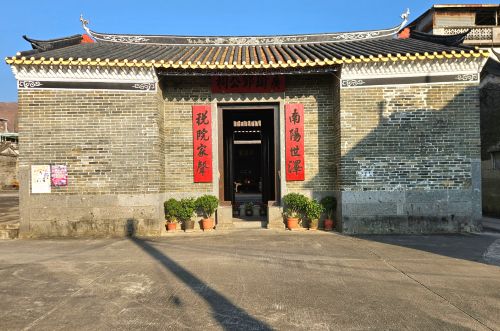
At Shui Tau Tsuen in Kam Tin, the Chou Wong Yi Kung Study Hall made the obtaining of relief the subject of an enduring institution. Established by the Tang community, it combined education with veneration of Zhou and Wang, linking the instruction of descendants to an obligation toward officials credited with making their return possible. A stone inscription associated with the building’s fifth reconstruction in 1965 dates the beginning of construction to 1684 and its completion to 1685. Chan Wing-hoi transcribed this later account in his study of the community’s festival. The inscription supplies evidence of how the foundation was remembered after repeated rebuilding, rather than an eyewitness description of the evacuation. Its emphasis on founding and renewal nevertheless reveals that maintaining the institution itself became part of transmitting the significance of relief.
The surviving commemorative objects give that significance a detailed vocabulary. Zhou and Wang’s spirit tablets occupy the rear hall, while a plaque bearing Fu Wo Xiang Ju celebrates the restoration of home and settlement; the Antiquities and Monuments Office renders the phrase as “restored my home.” Such praise directs attention toward a benefit that inhabitants had first been denied, so the acknowledgment of rescue also preserves a relationship to the injury preceding it. Naming benefactors gives the account identifiable agents whose intervention can be honored and revisited. Residents also assumed an active part in the relationship by establishing a place in which the officials would receive continuing honor. The benefit remembered was attributed to administrators, but the institution keeping that memory available was sustained locally. A commemorative shrine at Shek Wu Hui similarly honored the pair, showing that gratitude acquired a public setting in more than one community. The resulting memory evaluates government through the ability of officials to secure conditions in which people could inhabit their communities again. It can affirm legitimate authority while retaining knowledge that an earlier exercise of authority had made ordinary residence impossible. This interpretation follows from the recovery celebrated by the commemorative language; it does not establish that its makers intended a concealed political accusation.
Commemoration also included people who had not survived to benefit from reopening. The decennial jiao observances associated with the hall incorporated rites for the evacuation dead, alongside opera performances and ceremonies seeking protection for living residents. Addressing the dead gave the event a place within religious obligations extending beyond gratitude to the two officials. Those obligations could be renewed by generations with no personal recollection of displacement. The continuing ritual connection between death and communal welfare made relief an occasion for remembrance without making it a complete resolution of the suffering.
Accounts transmitted orally did not preserve the same sequence of events as the rebuilding inscription. During research centered on the 1985 festival, Chan heard a version in which Zhou and Wang had arrived with troops to assist villagers fighting bandits; other informants associated the observances with the officials having died in Kam Tin. These were later explanations whose details departed from the recorded history of memorials and boundary review. Their shared element was the pair’s identity as protectors during a period of danger. That persistence, despite changes in the account of their intervention, suggests that remembrance could retain a moral relationship more securely than an administrative chronology. Protection and reciprocal obligation provided a structure within which new explanations could remain recognizable to participants. Treating the stories simply as inaccurate history would overlook their religious and social significance, while adopting them as literal accounts would obscure the documented process through which relief was obtained. They establish how the officials’ reputations continued to develop within the community, rather than supplying additional seventeenth-century testimony.
Other parts of the former county developed their own ways of explaining evacuation and resettlement. Liu Xiaochun’s study of north-central Shenzhen distinguishes official narratives of necessary clearance and successful restoration from traditions associated with Liao Maliu legends and Three Realms temple worship. His analysis emphasizes interaction between these forms of remembrance, including cooperation as well as disagreement, rather than a permanent division between state orthodoxy and local interpretation. Such material broadens the range of communities through which Xin’an’s past can be approached. The Kam Tin institution belongs to this wider history, but its organization and honor for Zhou and Wang should not stand for every settlement’s inherited account. Different traditions could give prominence to different figures while drawing on the same broad history of disruption and renewed occupation. What became authoritative locally depended partly on the institutions through which a community continued to explain its origins and obligations.
The transmission of memory required people who could organize and sustain these practices. Chan’s account of the 1985 festival records participation by some residents outside the Tang lineage, alongside rules reserving its ritual representative positions to lineage members. Shared involvement coexisted with unequal authority to represent the community. This arrangement matters for interpreting the collective voice of commemoration, because a ceremony gathering many residents did not give every participant the same role in directing it. The survival of a hall and the repeated performance of its rites depended on continuing institutions, whose membership and leadership shaped the form in which the past remained present. Those institutions carried remembrance across generations while connecting it to relationships among living residents. Within this setting, participants gathered around a tradition that remembered danger through an enduring relationship with its protectors. Maintaining the observances gave that inherited relationship renewed public expression, enabling an event far beyond living memory to retain a place in the community’s understanding of itself.
Did Coastal Clearance Help Consolidate Qing Rule?
The following video from “HyperTale Studio” is a brief overview of the Great Clearance:
A policy can devastate communities and still improve a conquering dynasty’s position. The strongest challenge to an account centered on Xin’an’s suffering is that clearance changed the conditions of resistance in ways its immediate victims could neither control nor benefit from. Chae Kyungsoo advances this interpretation in his reassessment of the evacuation in Fujian, acknowledging that the policy failed to isolate the Zheng regime economically while arguing that it gradually disrupted the sharing of commercial profits between maritime forces and coastal residents. Once their interests became less closely connected, he suggests, recruitment and conciliation under Yao Qisheng could draw more inhabitants toward the Qing. This argument deserves consideration because it identifies a political effect beyond the quantity of goods reaching an enemy fleet. Its geographical and chronological scope nevertheless matters. Developments in Fujian, including those after 1669, cannot establish that removing Xin’an’s population was essential to producing them. They offer a serious alternative interpretation of the wider campaign, rather than direct evidence of this county’s military importance.
Evidence of supply difficulties gives the case for strategic effectiveness a firmer foundation. Xing Hang’s study of the Zheng organization describes how, following the Qing–Dutch capture of Xiamen and Jinmen in November 1663, Zheng Jing’s forces withdrew to remaining positions around Tongshan and encountered severe shortages because evacuation had deprived them of supplies from the adjacent countryside. Competition over food aggravated divisions among commanders and contributed to the decision to abandon those coastal positions for Taiwan. The implication is that clearance helped make a battlefield defeat more difficult to recover from. Possession of a few offshore bases offered limited security when the neighboring population and its production were no longer available. Such an effect should not be dismissed merely because the Zheng regime survived elsewhere. Yet the sequence also places restrictions on what evacuation can explain, since naval attack had already displaced the defenders, while succession disputes and defections weakened the organization through other means. Clearance worked within that combination, and the evidence does not allow its contribution to be isolated as either sufficient or indispensable. Pressures on forces concentrated near Fujian’s principal bases do not measure the usefulness of every cleared district along the much longer southeastern coastline. A credible argument for some military benefit consequently leaves the scale and distribution of that benefit open to investigation.
Zheng adaptation further complicates the assessment without reducing it to a verdict of total failure. Hang documents renewed mainland procurement through clandestine transactions and bribed garrisons, alongside agricultural development on Taiwan that reduced dependence on imported provisions. Continued access to goods demonstrates that the cordon remained permeable, but obtaining them under prohibition could still impose additional costs and uncertainty. The persistence of resistance is compatible with meaningful disruption of operations. What the surviving organization disproves is a claim of comprehensive economic isolation; it does not, by itself, disprove every strategic advantage the Qing obtained from restricting access to the shore.
Consolidation also involved changes within coastal society, and these require a different test from the fortunes of the Zheng fleet. In his study of Zhangpu County, Chen Boyi finds that evacuation weakened influential families and that closer household regulation subsequently extended the Qing administration’s reach into local communities. This comparative evidence makes it plausible that upheaval could diminish established intermediaries and create opportunities for a conquering regime to reorganize its subjects. It does not demonstrate an identical transformation in Xin’an, where the available records cannot sustain a general claim that powerful lineages collapsed or that their destruction had been the policy’s original purpose. The county gazetteer does connect reconstruction with restored revenue and tighter supervision. Li Kecheng’s proposals joined renewed cultivation to coastal defenses and the registration of households through the baojia system. Those measures sought to make returning residents governable while helping them resume productive lives. Their significance lies in the kind of authority they attempted to establish, which depended on an inhabited and economically functioning county. Dahpon David Ho adds a further complication by showing how clearance could enlarge the commercial and military influence of regional feudatories. Officials exercising coercive power under Qing authority did not invariably advance the court’s control over those officials themselves. Greater capacity to order villagers inland and greater imperial command of provincial resources were consequently distinct outcomes, even when both were described as serving dynastic security.
Civilian devastation cannot be treated as proof of military futility, and the eventual authorization of return does not establish that every earlier restriction had lacked strategic value. The evidence supports a more qualified finding. Evacuation contributed to pressure on the Zheng organization and, in some settings, altered the relationships through which the Qing governed coastal populations. It remains much harder to establish that those gains required the full extent of removal imposed on Xin’an, or that maintaining its exclusion for so long produced advantages proportionate to the damage. Nor can the sources demonstrate that a less destructive policy would have achieved exactly the same military results; that uncertainty should limit confident counterfactual claims on either side. The defensible criticism concerns the breadth of coercion and the transfer of its costs to residents whose involvement with the enemy was not established. Subsequent restoration also belongs within the explanation of Qing consolidation, since administration needed cultivators, taxable activity, and workable relations with local society. Recognizing partial strategic success makes the central problem more demanding. A government could strengthen its position through measures that severely injured the communities it then had to govern.
Conclusion: What Imperial Security Required of Its Subjects
The evacuation of Xin’an placed an extraordinary demand on imperial subjects. Surrender access to the places through which they maintained themselves because those places were judged useful to an opponent. Coastal livelihoods acquired a military significance that overrode the claims associated with ordinary residence and cultivation. The resulting orders encompassed communities without requiring the authorities to establish each household’s participation in Zheng resistance. People could lose the practical foundations of their lives through a decision about the strategic value of their surroundings. This was a form of conquest carried into the organization of everyday existence, extending the struggle for dynastic supremacy into relations between families and the land they occupied. The defining requirement was compliance even when compliance removed the household’s means of supporting itself. Xin’an’s importance lies in making that requirement visible at the scale of a county, where an imperial objective became a prolonged emergency for identifiable settlements.
Responsibility belonged to the government’s exercise of authority across several levels. The court sustained the policy, and provincial authorities determined much of its practical reach; officers and troops converted those decisions into restrictions on residence. Kangxi’s minority cautions against treating the young emperor as the personal author of every measure, while the uneven documentary record prevents certainty about the initiative of certain regents. Neither limitation alters the governmental character of the evacuation or the obligation to examine decisions made under Qing authority. The later intervention of Wang Lairen and Zhou Youde shows that the same administrative order contained arguments for protecting residents and restoring their livelihoods. Those arguments could challenge the continuation of clearance through recognized expectations of responsible officeholding, without rejecting the dynasty’s sovereignty. They also reveal that destructive enforcement was open to reconsideration within the political assumptions of the period, rather than becoming objectionable only when viewed through modern standards. The authorization of return in 1669 represented a change in what the government permitted; it cannot be read as an explicit imperial admission of wrongdoing. Subsequent gratitude toward officials who obtained relief preserves a judgment about the value of their intervention, even though it supplies no collective verdict from everyone displaced. Their commemoration places the protection of livelihoods among the qualities of government that local institutions chose to honor.
For returning households, the decisive question was whether renewed permission could become a usable livelihood. Rebuilding demanded effort and resources from people whose reserves had already been depleted, and official assistance could facilitate that work without undoing the years of displacement. Recovery proceeded unevenly, leaving the consequences of evacuation to outlast the boundary that had enforced it. The distinction gives 1669 its proper significance as the opening of a difficult process. It also keeps the labor of residents within the explanation of restoration, rather than allowing an administrative decision to stand for everything required to make a county habitable again.
Military utility remains part of this history. Clearance could restrict an adversary’s access to mainland resources, and the broader scholarship identifies circumstances in which it contributed to Qing gains. Accepting those findings makes it necessary to judge the policy through its varying geographical effects and duration, rather than assuming either that suffering proved failure or that eventual victory validated every application. Xin’an’s records establish extensive injury much more securely than they establish the county’s indispensable contribution to defeating the Zheng organization. They also expose a tension in imperial government. The capacity to compel withdrawal could undermine the social and economic activity on which continuing administration depended. Once resettlement was authorized, officials again pursued security through supervised settlement and resumed economic activity. That dependence places the burden demanded of evacuees at the center of the final interpretation. The dynasty could order a populated coast to be emptied, but a functioning Xin’an required its inhabitants to resume lives that those orders had interrupted. The maintenance of Qing government in the county depended in part on recovery undertaken by people whom its security policy had dispossessed.
Bibliography
Affiliate disclosure: Amazon links on this site are paid links. As an Amazon Associate I earn from qualifying purchases.
- Antiquities and Monuments Office. “Chou Wong Yi Kung Study Hall (Grade 2 Historic Building).” Government of the Hong Kong Special Administrative Region. Accessed October 12, 2026.
- —-. “Yu Kiu Ancestral Hall.” Government of the Hong Kong Special Administrative Region. Accessed October 12, 2026.
- Cao, Shuji. The Population History of China (1368–1953). Leiden: Brill, 2024.
- Chae, Kyungsoo. “Re-evaluation of the Strategic Implication of Great Clearance—Focusing on the Trend of Maritime Forces of the Coastal Regions of Fujian.” Journal of Ming-Qing Historical Studies 48 (2017), 75–113.
- Chan, Wing-hoi. “The Dangs of Kam Tin and Their Jiu Festival.” Journal of the Hong Kong Branch of the Royal Asiatic Society 29 (1989), 302–375.
- Chen, Boyi. “The Coastal Evacuation of Zhangpu County in Early Qing: Borders, Shifting Zones, and Social Change as Seen from Forts and Fortified Villages.” Journal of History and Anthropology 15:2 (2017), 89–127.
- Faure, David. Emperor and Ancestor: State and Lineage in South China. Stanford, CA: Stanford University Press, 2007.
- Hang, Xing. “Between Trade and Legitimacy, Maritime and Continent: The Zheng Organization in Seventeenth-Century East Asia.” PhD diss., University of California, Berkeley, 2010.
- —-. Conflict and Commerce in Maritime East Asia: The Zheng Family and the Shaping of the Modern World, c.1620–1720. Cambridge: Cambridge University Press, 2015.
- Hase, Patrick H. Forgotten Heroes: San On County and Its Magistrates in the Late Ming and Early Qing. Hong Kong: City University of Hong Kong Press, 2017.
- Hayes, James. “The Hong Kong Region: Its Place in Traditional Chinese Historiography and Principal Events since the Establishment of Hsin-an County in 1573.” Journal of the Hong Kong Branch of the Royal Asiatic Society 14 (1974), 108–135.
- Ho, Dahpon David. “The Empire’s Scorched Shore: Coastal China, 1633–1683.” Journal of Early Modern History 17:1 (2013), 53–74.
- —-. “Sealords Live in Vain: Fujian and the Making of a Maritime Frontier in Seventeenth-Century China.” PhD diss., University of California, San Diego, 2011.
- Hong Ruogao. “Zunyu chenyanshu” [Memorial Submitted in Response to Imperial Instructions]. In Nansha wenji, juan 3. Translated in Dahpon David Ho, “Sealords Live in Vain: Fujian and the Making of a Maritime Frontier in Seventeenth-Century China,” 228. PhD diss., University of California, San Diego, 2011.
- Jiang Risheng. Taiwan waiji [Unofficial History of Taiwan]. Author’s preface dated 1704. Entry for 1668.
- Jin Wenmo et al., comps. Xin’an xianzhi [Gazetteer of Xin’an County]. 1688. Juan 3.
- Kangxi Emperor. Edict announcing the assumption of personal rule. August 25, 1667. Archives of the Grand Secretariat, item 104782-001. Institute of History and Philology, Academia Sinica, Taipei.
- Kessler, Lawrence D. K’ang-hsi and the Consolidation of Ch’ing Rule, 1661–1684. Chicago: University of Chicago Press, 1976.
- Ng, Peter Y. L. New Peace County: A Chinese Gazetteer of the Hong Kong Region. Prepared for press with additional material by Hugh D. R. Baker. Hong Kong: Hong Kong University Press, 1983.
- Oxnam, Robert B. Ruling from Horseback: Manchu Politics in the Oboi Regency, 1661–1669. Chicago: University of Chicago Press, 1975.
- Ruan Minxi. Haishang jianwenlu [Record of Maritime Observations]. Taiwan wenxian congkan 24. Taipei: Taiwan yinhang jingji yanjiushi, 1958.
- Watson, Rubie S. “The Creation of a Chinese Lineage: The Teng of Ha Tsuen, 1669–1751.” Modern Asian Studies 16:1 (1982), 69–100.
- —-. Inequality Among Brothers: Class and Kinship in South China. Cambridge: Cambridge University Press, 1985.
- Wills, John E., Jr. Embassies and Illusions: Dutch and Portuguese Envoys to K’ang-hsi, 1666–1687. Cambridge, MA: Council on East Asian Studies, Harvard University, 1984.
- —-. Pepper, Guns, and Parleys: The Dutch East India Company and China, 1662–1681. Cambridge, MA: Harvard University Press, 1974.
- Yang Ying. Congzheng shilu [Veritable Record of Participation in the Campaigns]. Taiwan wenxian congkan 32. Taipei: Taiwan yinhang jingji yanjiushi, 1958.
- Zhao Erxun et al. Qing shi gao [Draft History of the Qing]. Beijing: Zhonghua shuju, 1977.
Originally published by Brewminate, 10.14.2026, under the terms of a Creative Commons Attribution-NonCommercial-NoDerivatives 4.0 International license.
About the Author