In June 1938, Chinese troops opened the Yellow River’s dike to obstruct Japanese forces. Villagers endured repeated flooding until 1947, when restoration brought new disputes over land and relief.

By Matthew A. McIntosh
Public Historian
Brewminate
Introduction: Whose Survival Counted?
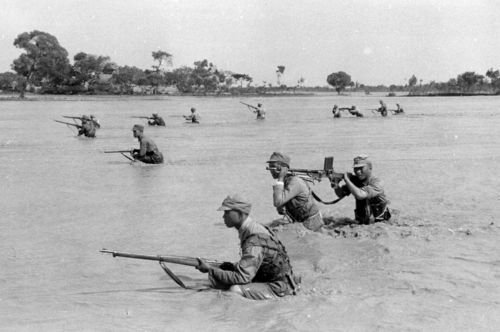
On June 9, 1938, Nationalist troops opened the Yellow River’s embankment at Huayuankou, north of Zhengzhou, allowing water to spread into the densely inhabited countryside of eastern Henan. Chiang Kai-shek had authorized the operation to obstruct Japanese forces advancing through northern China. The army turned an embankment maintained to protect farms and villages into a weapon against the Japanese advance. Warnings were severely restricted to preserve military secrecy, leaving much of the threatened population without adequate notice. The breach initiated a disaster that extended far beyond the immediate campaign. Recurring flooding continued until the river’s return to its former course in 1947, while cumulative losses reached hundreds of thousands of deaths and millions of displaced people.
Understanding that decision requires taking the Japanese invasion seriously as the emergency within which Nationalist commanders acted. By the summer of 1938, China had endured the loss of its capital at Nanjing and devastating violence against civilians, while Japanese advances threatened important connections between the remaining Chinese armies and the interior. Following the fall of Xuzhou, the railway junction at Zhengzhou assumed significance because its capture could facilitate further operations toward Wuhan, the principal wartime political center. Flooding offered a means of interrupting an advance that Chinese forces were struggling to contain through conventional resistance. Its military effects were substantial enough to appear in contemporary diplomatic reporting. On June 15, an American embassy telegram recorded a Japanese spokesman’s acknowledgment that the inundation had checked the advance toward Zhengzhou and threatened the proposed southward railway approach. Subsequent reporting described Japanese redeployment toward another line of attack. The reports document disrupted Japanese movements, but they do not show that the breach prevented China’s surrender or establish the length of any delay. Even a useful defensive measure left unanswered questions about warnings, evacuation, and relief.
The government’s public explanation further complicated the relationship between military purpose and civilian suffering. Nationalist authorities initially attributed the breach to Japanese attacks, concealing their own responsibility for the inundation. Later representations incorporated the catastrophe into an account of patriotic sacrifice, presenting the losses as contributions to China’s resistance. That language assigned collective meaning to suffering imposed through decisions made above the affected communities. Calling their losses a sacrifice could encourage assistance, but it could also deflect criticism of the authorities responsible for them.
The breach must be judged together with the warnings, rescue efforts, and relief that accompanied it. A reasonable military objective would not excuse avoidable civilian losses. This requires an extended chronology because the breached river continued to shape livelihoods after the Japanese advance had changed direction. Families who escaped the water could still lose the grain, livestock, and tools they needed to survive afterward. Returning the river in 1947 likewise required decisions about which communities would receive relief from flooding and which would face renewed exposure along its former channel. Military records explain why commanders wanted the flood; local reports and survivors’ accounts reveal what followed for those living in its path. Read together, they support a qualified judgment: the breach may have served China’s defense, but its military value did not release the government from responsibility for the people it displaced.
The River before the Breach: Protection Built on Continuing Work

Much of the Yellow River’s destructive potential came from the sediment it transported. Across the Loess Plateau, runoff carried fine particles from easily eroded soils into tributaries that fed the main channel, giving the river its characteristic color and unusually heavy sediment load. Cultivation and the removal of vegetation could increase that erosion, connecting changes in distant upland landscapes to conditions downstream. As the current slowed on the North China Plain, it deposited material that progressively altered the channel’s shape and capacity. Embankments restricted the space through which the water could move, but sediment continued to accumulate within them. In parts of the lower reaches, this process raised the channel above the surrounding countryside, making a failure capable of releasing water across extensive areas. Centuries of cultivation and embankment building had helped create this dangerous difference in elevation.
Keeping the water within its designated channel required recurring expenditure and physical work. Earthen defenses needed inspection and reinforcement, while damaged sections demanded repairs before another rise in the river exposed their weaknesses. Bank protection drew on locally available materials, including brushwood and crop stalks, as well as stone where conditions and resources permitted. Officials had to obtain supplies and organize workers across jurisdictions whose interests did not necessarily coincide. Technical judgments mattered because a structure that protected one bank or redirected the current could increase pressure elsewhere. Late imperial engineers consequently debated how confinement might concentrate the flow sufficiently to carry sediment onward, and how protective works should respond when the river undermined their assumptions. Their methods incorporated accumulated observation and practical experience, although results remained vulnerable to changing conditions. Even capable officials struggled to finance repairs and coordinate work across jurisdictions. A neglected section could endanger settlements protected by otherwise sound embankments.
The channel followed immediately before 1938 dated principally from the great diversion of 1855. After breaking through its defenses in Henan, the Yellow River established a northeasterly route across Shandong toward the Bohai Sea. This movement replaced the southern outlet through which its main flow had previously reached the coast. It also changed the locations where governments and communities needed to concentrate protective work. By 1938, the river had followed this northern route for only eighty-three years, and keeping it there still required maintenance.
Farther south, the Huai basin retained the consequences of the Yellow River’s earlier presence. During the centuries when the larger river discharged through that region, its sediment had obstructed drainage and altered waterways through which the Huai’s comparatively clearer water needed to escape. The departure of the main Yellow River flow in 1855 did not remove those deposits or automatically restore an effective outlet. Hongze Lake and connections toward the Yangtze remained important components of a drainage system shaped by earlier engineering and sedimentation. Management of this landscape had also been complicated by the requirements of the Grand Canal, which carried tribute grain toward the imperial capital. Measures intended to sustain navigation could conflict with the drainage needs of nearby agricultural districts. The Yellow River no longer flowed through the Huai basin, but its deposits still obstructed the basin’s drainage. A major influx from the north would enter a southern landscape already burdened by restricted drainage, where both the volume of water and the sediment accompanying it could create further problems.
During the Nanjing decade of 1927–1937, Nationalist reconstruction programs sought to address such inherited difficulties through more coordinated administration and modern engineering. The Huai River Conservancy Commission became an important institution within that effort, linking proposed improvements to wider ambitions for agricultural recovery and economic development. Surveys and technical planning promised more comprehensive management, but implementing projects required negotiations over funding and authority. Central plans encountered provincial priorities and the immediate concerns of communities expected to provide resources or accept changes in their surroundings. Foreign engineers contributed expertise alongside Chinese personnel, extending professional exchanges that had begun before Nationalist consolidation. Oliver J. Todd and S. Eliassen’s contemporary study of the Yellow River drew on investigations conducted through Chinese conservancy organizations and presented proposals for regulating its behavior. These investigations produced detailed proposals before 1938, although funding and administrative limits prevented the Nationalist government from implementing them all.
Earlier military interventions had already demonstrated that protective embankments could be deliberately opened to obstruct an enemy. In 1128, Song authorities breached Yellow River defenses while attempting to impede the advancing Jurchen forces, contributing to a prolonged reorganization of the river network. That episode did not instantly establish a single southern channel that remained unchanged for the next seven centuries; subsequent shifts and engineering decisions continued to reshape the waterways. The precedent showed that commanders could release the water held behind protective embankments against an approaching army. But the ground intended to obstruct the enemy contained farms and settlements. Once released, the water would follow local gradients and channels, spreading beyond any boundary drawn in a military plan.
The Military Emergency: From Xuzhou to the Threat against Zhengzhou
Two major railways crossed at Xuzhou. The north–south Jinpu railway, connecting Tianjin with Pukou near Nanjing, crossed the east–west Longhai line running through northern China. Japanese forces approaching from the north could converge with troops advancing from the lower Yangtze region, joining theaters that Chinese resistance had kept partially separated. Control of the junction would improve Japanese communications while opening opportunities to move westward along the Longhai corridor. For the Nationalists, retaining Xuzhou meant contesting that connection and preventing the enemy from turning separate territorial gains into a more continuous operational network. The railway geography encouraged both sides to commit substantial forces, making the campaign an important test of their ability to sustain fighting after the costly battles of 1937.
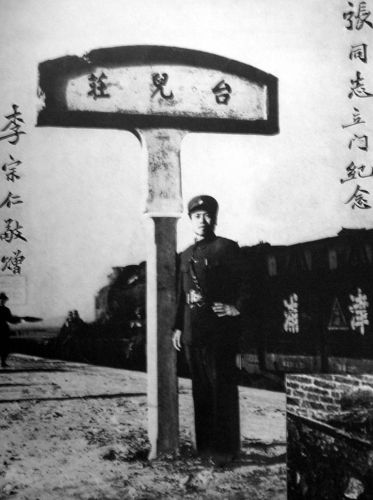
Chinese resistance initially frustrated expectations of another straightforward Japanese success. At Taierzhuang, northeast of Xuzhou, forces operating under Li Zongren’s Fifth War Zone command inflicted a major defeat on Japanese attackers in early April 1938. The victory demonstrated that Japanese superiority in equipment did not guarantee success under every combination of terrain and deployment. Chinese commanders could exploit exposed enemy formations, concentrate forces, and make effective use of positions where the attackers’ advantages were reduced. Its psychological importance was considerable after the reverses at Shanghai and Nanjing, and public celebrations made it evidence that sustained resistance remained possible. Nevertheless, the engagement did not eliminate Japan’s capacity to reinforce the theater or change the direction of its operations. Japanese commanders responded with a larger enveloping operation, seeking to surround the Chinese concentrations near Xuzhou and destroy the forces whose resistance had prolonged the campaign.
By May, remaining in the Xuzhou position threatened the defending armies with encirclement. Chinese forces withdrew as Japanese formations closed around the area, and Japanese troops occupied the city on May 19. Many defenders escaped the intended enclosure, preserving formations that could participate in subsequent operations. Losing the junction did not cost the Nationalists all the armies defending it. Yet those surviving units had to move through a disrupted theater and reestablish their organization, while the enemy gained access to routes the earlier defense had contested.
Fighting in eastern Henan made clear that the westward advance was neither an uncontested pursuit nor a perfectly coordinated execution of one Japanese design. Forces under Kenji Doihara pressed into the Longhai region, where their forward position created opportunities for Chinese counterattacks. Around Lanfeng, Chinese armies attempted to turn the advancing enemy’s exposure into an operational advantage. At Lanfeng, Chinese commanders were still trying to stop the advance through battle. Their counterattacks exposed the difficulty of coordinating formations of unequal strength under separate commands. Pressure on Doihara’s forces did not produce the decisive defeat the Chinese needed. As Chinese positions gave way, the danger moved farther west, and the evacuation of Lanfeng relieved the Japanese formation from a serious threat. A June 7 American diplomatic telegram reported that Kaifeng had fallen the previous day and treated the latest developments as indications that operations toward Hankou would follow. The telegram treated Japanese claims of further advances as unconfirmed.
Zhengzhou now mattered as the next major railway intersection, where the Longhai crossed the Pinghan line between Beiping and Hankou. Its capture could facilitate movement southward while disrupting Chinese communications between northern positions and the central Yangtze region. Nationalist demolition of the railway bridge across the Yellow River north of the city obstructed movement from that direction. It could not remove the threat posed by Japanese troops approaching through the corridor from Kaifeng. Destroying the bridge blocked the northern approach, but left Zhengzhou exposed from the east.
Wuhan’s importance increased the consequences attached to that threat. The urban complex of Hankou, Wuchang, and Hanyang brought together river transport and railway connections with a concentration of wartime political activity. Although Chongqing had already been designated the national capital in November 1937, Wuhan remained the active center of military direction and much of the public mobilization surrounding resistance during the following year. Its streets and institutions also accommodated refugees whose arrival made the war’s human consequences immediately visible. Losing access to this center would affect the movement of supplies and force another substantial adjustment in the organization of the Chinese war effort. Nevertheless, Wuhan was not the only place from which the government could continue functioning, and the earlier selection of Chongqing demonstrates that arrangements for deeper withdrawal predated the Yellow River operation. Nor did a potential attack from the Zhengzhou direction exhaust Japanese possibilities: routes through the Yangtze theater created additional dangers. Blocking the Pinghan approach would still leave Wuhan vulnerable to attack along the Yangtze.
Foreign observers also expected further Chinese withdrawals. On May 26, American ambassador Nelson T. Johnson reported Japanese progress along the Longhai line and judged the eventual loss of Hankou increasingly likely. His telegram also discussed the prospective departure of German military advisers and reported interruption of German munitions sales, developments that threatened support on which Chinese preparations had relied.
The Chinese ambassador’s public statement of June 8 offered a different emphasis, presenting withdrawals as part of an agreed strategy to fight in terrain less favorable to Japanese mechanized forces. It also denied reports of a split between Chiang and Li, making military unity itself an issue requiring public reassurance. This was a public defense of the withdrawals, not an operational account of how each had been ordered. Continuing the war required keeping effective armies in the field, and the approach toward Zhengzhou threatened to compress the time available for that effort. With Japanese troops approaching Zhengzhou, senior Nationalist leaders turned to the river.
Ordering the Breach: Chiang Kai-shek and the Chain of Command
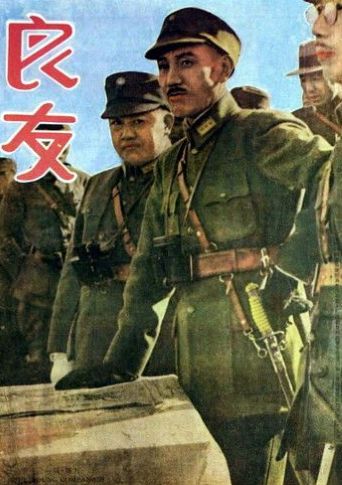
Military involvement in river administration preceded the excavation that released the water. In early May 1938, First War Zone commander Cheng Qian asked Chiang to place Yellow River conservancy operations under military direction as Japanese forces threatened eastern Henan. His proposal drew attention to the difficulty of coordinating protection along an extensive river frontage and sought a closer relationship between the conservancy agencies and his command. Chiang approved the arrangement, and representatives of the military and water administration met to discuss its implementation. A meeting opened by He Yaozu on May 15 illustrates that this institutional adjustment was already underway before the immediate crisis at Huayuankou. The arrangement initially concerned river defense, rather than a deliberate breach. It nevertheless placed conservancy personnel under stronger military authority before commanders ordered them to help divert the water.
Cheng’s position connected conditions at the front with decisions made at the highest level. After assessing the situation around Zhengzhou, he communicated the proposal to open the southern embankment west of the advancing Japanese forces. The desired result was to interrupt movement through the Longhai corridor by placing water across the enemy’s route. This recommendation required approval beyond the officers who would supervise excavation, because it entailed redirecting a major river through territory under Chinese jurisdiction. Cheng proposed the operation from the field; Chiang authorized it. Neither an account centered exclusively on Chiang nor one confined to the officers at the embankment explains the full decision.
Chiang’s diary provides evidence that the project had become an active concern before Kaifeng’s fall. On June 3, he asked about the progress of breaching the dike and producing a flood toward Zhoujiakou. The brief entry does not record the preceding deliberations or every instruction sent to subordinate commands. It does establish that Chiang was following the project six days before the successful opening at Huayuankou.
Zhaokou was the first location at which troops attempted to obtain the intended discharge. Between June 4 and June 6, efforts involving excavation and explosives failed to produce the required breach. An embankment had to be opened sufficiently for the river to enter and enlarge the gap; damage to its structure alone did not necessarily produce an effective diversion. The officers responsible for execution consequently faced a problem of engineering as well as obedience. Continuing at an unsuccessful site consumed time while the military situation was deteriorating, making the choice of location increasingly consequential. Chiang’s telephone calls from Wuhan pressed the Henan commanders to carry out his orders. When Zhaokou failed, they sought another site.
Huayuankou emerged from that search through consultation among officers familiar with the immediate surroundings. Accounts used by Rana Mitter identify division commander Jiang Zaizhen and his chief of staff, Xiong Xianyu, as participants in considering where the embankment could be opened. Xiong compared Huayuankou with Madukou, taking account of the time available before Japanese forces might approach. The decision involved an assessment of river topography alongside the distance separating possible work sites from the enemy. Wei Rulin, chief of staff of the Twentieth Army Group, also appears in the inspection and execution record. Jiang, Xiong, and Wei exercised judgment over the site and the work needed to open it. They were deciding how to execute an authorized diversion, rather than independently deciding whether to undertake one. The move to Huayuankou changed the means, while retaining Chiang’s objective.
At the replacement site, excavation eventually accomplished what the earlier attempts had not. Soldiers cut into the embankment, and on June 9 water began escaping through the opening. As water entered the cut, it enlarged the opening. Excavation at Huayuankou, followed by erosion, produced the successful breach; references to explosives should distinguish that work from the failed attempts at Zhaokou.
The surviving accounts were written at different times and for different audiences. Xiong’s diary entry for June 9 is contemporaneous testimony, although selections became available in a documentary compilation published decades afterward. Wei’s reports and subsequent statements must be distinguished by their individual dates, rather than treated collectively as a transcript of the days immediately preceding the flood. A report prepared for military superiors could explain the execution of an assigned task while leaving earlier policy deliberations largely outside its scope. Later recollections could add detail, but they also allowed participants to describe their actions after the consequences had become known and responsibility had become controversial. Headquarters records establish authorization, while reports from the embankment describe execution. Neither supplies the whole sequence. Their agreement supports the broad reconstruction, although reported conversations should not automatically be accepted as verbatim exchanges.
Commanders could anticipate destructive flooding without knowing how far it would spread. They wanted water to obstruct enemy movement, and the choice of a southern breach necessarily directed that water toward inhabited agricultural districts. It is reasonable to infer that they understood flooding would damage settlements along its path, although that inference does not establish that they possessed a reliable forecast of its eventual reach. The available evidence likewise does not justify attributing knowledge of the later cumulative death toll to officers making decisions in early June. Chiang approved the diversion and pressed for its completion. Subordinate officers selected the site and supervised the work. Their responsibilities differed, but the successful breach connected those decisions.
Military Secrecy and the Unequal Chance to Escape
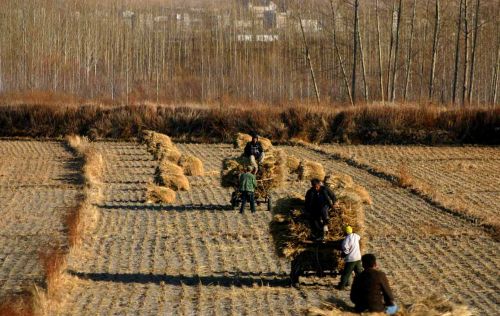
For residents downstream, the first obstacle to leaving was the restricted circulation of information about what the army intended to do. Commanders feared that public announcements would reveal the operation to Japanese forces and encourage an accelerated advance before the inundation could obstruct them. Keeping the operation secret also limited villagers’ preparations. A warning that homes were threatened need not have disclosed every detail of the military plan. Many residents lacked information already held by the officers supervising excavation. They could begin preparing only when the danger became apparent.
Some warnings reached settlements near the breach. Muscolino identifies some notification in the immediate vicinity of the breach, while a later recollection by Feng Zhaoxue shows that military activity itself attracted local attention. Feng had been a child living near Huayuankou and remembered soldiers passing through the village and taking tools from households before going onto the embankment. Seeing that activity did not mean residents understood its intended consequences. In his account, the first discharge appeared modest, and some people expected it to cease rather than develop into a much larger flood. They moved toward higher ground as the water increased, only to discover that places initially considered secure could also be inundated. Feng’s later recollection cannot establish what every neighboring household knew. It does show why watching soldiers work was no substitute for a clear warning about the flood.
The water’s initially slow movement created different intervals of uncertainty across the threatened countryside. Communities farther from Huayuankou did not experience the same circumstances as villages beside the opening. Additional time before inundation could permit preparation, but only if useful information arrived early enough to guide it. Watching water approach gave less assurance than knowing beforehand that the river was being diverted and might continue rising. The subsequent increase in discharge and rainfall also meant that decisions based on early appearances could become inadequate. The time available to leave differed from village to village.
The agricultural calendar made departure difficult. Wheat was ripe in the fields or had recently been harvested, placing the flood at a moment when households had substantial food and work invested in crops not yet secured. Leaving immediately could mean abandoning the resources needed to sustain the family after reaching safety. Saving livestock or carrying grain was consequently more than an attempt to protect accumulated wealth; it could preserve the means of feeding people during flight. Residents who tried to strengthen local embankments were likewise pursuing a response that might protect both their homes and their subsistence. Without reliable knowledge of the discharge’s likely extent, remaining briefly to defend a settlement could appear preferable to departing with little food and no clear destination. Some households delayed too long, but their decision was understandable: leaving meant abandoning food they would need after escape.
Transport introduced another distinction between deciding to leave and being able to do so. Accounts describe people using carts and wheelbarrows, while others carried possessions on shoulder poles or in their hands. These methods offered different capacities for moving provisions and assisting relatives who could not travel independently. A household with usable transport could attempt to preserve more of what it needed, although bulky loads could also slow departure or become impossible to move through deteriorating conditions. Someone traveling on foot faced sharper limits on what could be taken. Money might widen the possibilities for obtaining help, but wartime disruption could restrict available transport even for those able to pay. Transport and money affected what a household could save. These accounts do not establish that officials systematically evacuated wealthy families first.
Care for dependent relatives further shaped the pace and difficulty of flight. Muscolino’s account records efforts to rescue children and older people, showing that evacuation frequently involved moving a household rather than an individual. An adult who could walk rapidly alone might need assistance to move someone unable to keep pace. Carrying another person also reduced the capacity to carry food or equipment. Illness could make an otherwise manageable journey difficult, while separating from relatives introduced dangers of its own. A warning alone could not move a household whose members needed to be carried. The accounts describe these difficulties without establishing mortality rates by age or sex.
As conditions worsened, local assistance could save people whose own preparations had failed. Feng recalled residents undertaking rescues by boat with encouragement from local authorities, but he also remembered that the area requiring assistance exceeded the number of boats available. Muscolino describes officials attempting to organize protective work and ordering evacuation once flooding had begun, while inhabitants sought refuge on embankments or became stranded above the surrounding water. Officials and neighbors did attempt rescues, but the boats could not reach everyone. Assistance after villagers had become stranded could not replace preparations made before the water arrived. Assessing the precautions requires attention to where and when additional information could realistically have changed a decision. The approaching Japanese forces imposed serious constraints, and a claim that the entire threatened population could easily have been removed would require evidence that is not available. Nonetheless, the reason for concealing the operation before its execution cannot by itself answer every question about communicating danger after water began escaping. Preparatory notice and later evacuation instructions presented different military circumstances. Their usefulness also depended on whether recipients had transport and a destination that remained accessible. What matters is the interval in which a household could convert information into action. Restricted warning shortened or eliminated that interval for many residents, while differences in resources determined what others could accomplish within it. The unequal chance to escape emerged through that interaction, rather than through a simple division between people who obeyed a warning and people who refused one.
How the Flood Became a Regional Catastrophe
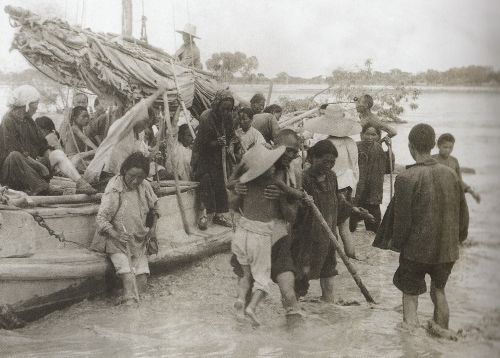
Once the discharge spread beyond Huayuankou, its course depended on the waterways and gradients of eastern Henan. The land generally fell toward the southeast, encouraging water to enter smaller channels connected with the Huai drainage system. The Jialu and Shuangji rivers became important parts of this movement, but neither could accommodate the additional volume within its existing banks. Overflow extended the inundation laterally, exposing settlements outside the channels through which the water initially traveled. Rising river levels also weakened defenses at Zhaokou, adding further openings to the developing disaster. The flood expanded through a combination of movement along waterways and failures that released water across adjoining fields. This was not an orderly substitution of one river channel for another. The diversion disrupted a network whose components had previously carried much smaller flows.
By early July 1938, floodwaters had reached the Huai headwaters and spread into Anhui, continuing toward the lower basin and Hongze Lake. Along the way, inundation crossed the Jinpu railway, widening the disruption of transport beyond the Longhai corridor that had figured prominently in military planning. Hongze Lake overflowed, and water entered parts of Jiangsu before finding routes toward the coast. Heavy summer precipitation increased the volume passing through an already overwhelmed drainage system. Damage in the receiving basin reflected more than proximity to the original opening. Local channel capacity and the condition of surrounding defenses influenced where water accumulated. Areas farther from Huayuankou could suffer extensively because they received flows concentrated through successive waterways. Provincial administrations encountered different stages of a process whose causes lay partly beyond their jurisdictions. The passage from Henan through Anhui into Jiangsu transformed a military intervention at one location into an emergency requiring responses across a much larger region.
Sediment made the consequences persist after some stretches of land ceased to be submerged. Material deposited in smaller rivers reduced their capacity to drain surrounding districts, while accumulation on fields complicated the resumption of cultivation. The depth and character of those deposits varied, so inundated land should not be described as uniformly or permanently ruined. Nevertheless, agricultural recovery required more than waiting for standing water to disappear. Obstructed channels could leave rainfall with fewer effective outlets, increasing the likelihood of renewed flooding. Changes in the riverbed also redirected subsequent flows, altering which settlements faced the greatest exposure. New embankments constructed during the war further influenced that distribution, sometimes containing water locally while changing the pressure exerted elsewhere. The damaged drainage system became a continuing source of danger, rather than simply a record of where the first flood had passed.
Repeated inundation is visible in reports compiled while the war was still underway. A 1940 survey described Weishi County as having suffered flooding three times and recorded successive departures and returns among its inhabitants. The same document reported more than 1,800 flooded villages in Fugou and described scattered higher ground surrounded by water. These observations establish recurrence within identifiable districts without implying that every affected settlement remained continuously submerged. They also show why an apparent opportunity to resume ordinary life could be followed by another evacuation. Local losses accumulated through renewed exposure, making the history of a damaged village more complicated than a single date of destruction.
Reports from the first summer also reveal a rapid deterioration in conditions for people who survived the inundation. Relief personnel visiting Zhongmu in July described widespread epidemic disease, and subsequent reports indicated worsening illness with inadequate medical supplies. Crowded places of refuge brought people into close contact while damage to settlements compromised access to clean water. Cholera and dysentery figured among the diseases reported in the affected districts. Food shortages could weaken people while that displacement increased their exposure to infection. Deaths associated with these conditions belonged to the disaster’s human consequences, but they were different from deaths caused by the immediate force of the water. This distinction matters when evaluating descriptions of the flood:n account limited to drowning would omit losses developing after escape, while attributing every wartime death in the region to the breach would exceed what the evidence can establish.
Postwar investigations attempted to measure destruction that wartime observers had been unable to enumerate comprehensively. The 1948 study by Han Qitong and Nan Zhongwan assembled figures for forty-four affected counties: twenty in Henan, eighteen in Anhui, and six in Jiangsu. Its tables recorded almost twenty million mu of inundated cultivated land, approximately 35 percent of the original cultivation within the surveyed areas. They also estimated 893,303 deaths and 3,911,354 displaced people across the three provinces. These frequently repeated numbers are retrospective estimates for the extended catastrophe, not a register of people drowned when the embankment opened on June 9. Their precision on the printed page should not be mistaken for equivalent precision in the underlying evidence. Records assembled after years of warfare had to contend with disrupted administration and populations whose whereabouts had changed repeatedly. Comparisons also require attention to geographical coverage and to whether a source counts immediate deaths or includes subsequent mortality associated with deprivation and disease. Separate estimates for the Henan famine cannot simply be added without investigating their relationship to the flood figures. The survey demonstrates extraordinary losses, while leaving the exact measurement and attribution of those losses open to scrutiny.
Anhui’s figures make clear why the catastrophe cannot be understood through Henan alone. Han and Nan recorded more than 2.5 million displaced people in the surveyed Anhui districts, the largest provincial component of their total. Almost half the cultivated land within those districts was reported inundated, compared with approximately one-third in the surveyed Henan areas. These proportions describe the affected counties, rather than the entirety of either province, but they establish substantial differences within the disaster region. The location of the military decision and the distribution of civilian damage were far from identical. Communities well to the southeast encountered consequences produced by the passage of water through the connected basin, with effects shaped by conditions in the places receiving it. Huayuankou remained the initiating site, while the resulting history encompassed losses that unfolded across distant districts and through successive seasons.
What the Flood Achieved Militarily and What Remains Uncertain
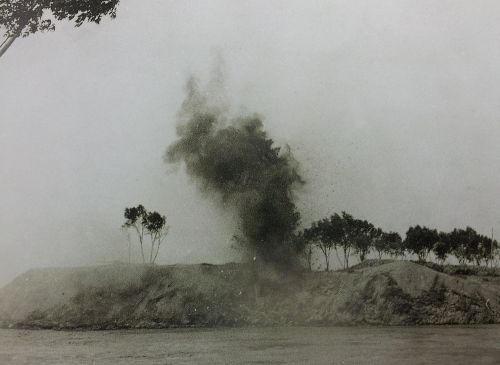
The Japanese advance toward Zhengzhou stopped after the breach, and contemporary observers connected that interruption directly with the inundation. A June 15 telegram from the American embassy recorded a Japanese spokesman’s acknowledgment that the water had checked the westward movement and threatened the proposed southward approach along the Pinghan railway. This evidence supports a concrete operational effect. Troops approaching an important junction encountered conditions that obstructed their movement. It also indicates that the consequences extended beyond inconvenience to individual units, since the railway approach formed part of a larger possibility for attacking Hankou. Nevertheless, the report recorded a spokesman’s explanation rather than reproducing the orders governing every Japanese formation. Its value lies in documenting an assessment made while the effects were unfolding. Determining how much those effects changed the campaign requires comparing that assessment with subsequent movements and the decisions already being made within Japanese headquarters. By June 28, diplomatic reporting described Japanese troops leaving the Longhai front and moving eastward before turning south toward Nanjing to join forces advancing up the Yangtze. Other troops were reportedly moving north across the Yellow River, although the purposes of those movements remained less certain. The report did not establish how many men were reassigned, so it cannot support a precise calculation of the resources Japan expended in responding to the flood. It does describe an adjustment beyond the immediate cessation of movement toward Zhengzhou. Forces had to be incorporated into operations using different communications and supply arrangements. The same telegram discussed separate flooding near the Yangtze, which affected the selection of routes there and must not be attributed to Huayuankou. Distinguishing those events prevents all changes in Japanese activity during June from being credited to one Chinese operation. The evidence is strongest when tied to certain formations and routes, rather than converted into a claim that the entire invasion had been arrested.
Enemy casualties provide a less secure measure of effectiveness. Military accounts describe Japanese elements being isolated or impeded by the flood, but those descriptions do not establish the destruction of whole divisions. The operation’s principal function was to interfere with movement, and it could accomplish that without killing large numbers of soldiers. Conversely, accounts of Japanese deaths cannot demonstrate how long communications remained disrupted. Reliable comparison would require unit records separating drowning from combat losses and other causes of death. In the absence of sufficiently consistent figures, numerical claims about Japanese casualties should not carry the argument.
The American assessment of July 19 identified an additional advantage that reached beyond the immediate defense of Zhengzhou. It associated the blocked advance with continued Chinese access to northern and northwestern territories and the safeguarding of the Xi’an–Lanzhou route carrying supplies from the Soviet Union. Maintaining that connection mattered because imported military equipment supported resistance after the loss of important coastal areas. The report treated the operation as contributing to the preservation of a wider logistical position, rather than merely delaying an assault on one city. This was an assessment of benefits observed after the breach, not proof that every such benefit had been specified when the decision was authorized. It also cannot establish that the route would necessarily have been severed without inundation or that no other defensive arrangement could have protected it. Nevertheless, it supplies a contemporary basis for recognizing strategic value beyond the most frequently repeated claim about gaining time for Wuhan.
The causal relationship between flooding and the Japanese halt remains contested in scholarship. Hans van de Ven argues that Japanese authorities had already instructed forward forces to stop, and he cites military historian Ma Zhonglian’s conclusion that the westward advance ended through Japanese decisions rather than because of the breach. That interpretation challenges any account in which the water alone explains the cessation of movement. It deserves attention because Japanese operations involved disagreements between higher command and officers seeking to extend advances in the field. An instruction to halt could precede the inundation while questions remained about its implementation and subsequent operational choices. The contemporary reports, meanwhile, attributed substantial effects to the water but did not establish the complete sequence of Japanese orders. These bodies of evidence require reconciliation rather than the dismissal of one on the strength of the other. A prior restriction on further movement would weaken the claim that flooding uniquely prevented an imminent capture of Zhengzhou. It would not establish that the inundation caused no disruption or left commanders free to resume the same approach whenever they chose.
Japanese forces retained the capacity to attack through the Yangtze theater, where Chinese resistance depended on more than difficult terrain. The campaign involved cooperation between ground troops and naval forces, including efforts to overcome fortified positions that obstructed movement upriver. Di Wu’s study of Chinese riverine defense shows how attacks on land could neutralize batteries and make subsequent waterborne movement possible. This interdependence complicates descriptions of the Japanese simply circumventing the Yellow River flood by choosing an easy alternative. The revised approach encountered defended positions, and Chinese efforts imposed costs and required further Japanese adjustments. Wu also distinguishes Huayuankou from later inundations along the Yangtze, some of which facilitated enemy supply movements or hindered Chinese counterattacks. Success in obstructing a railway approach could not establish that releasing water would be advantageous in every operational setting. The effects depended on the capabilities of both armies and the terrain through which they were fighting.
Attributing the whole interval between June and Wuhan’s fall in October to the Yellow River operation overstates what the chronology can demonstrate. The period included Japanese preparations and fighting at positions along the Yangtze, while Chinese commanders continued to organize the defense and decide when to withdraw. Establishing an exact delay would require a credible reconstruction of how the campaign would have proceeded with the northern railway approach still available. Neither the later date of occupation nor the abandonment of that approach supplies such a reconstruction by itself. The possibility that inundation created useful time is stronger than a claim assigning every intervening month to its effects. The same July 19 assessment that credited the breach with important benefits concluded that Hankou’s loss would not mean the collapse of Chinese resistance. That judgment was supported by preparations for continued fighting in the interior, making the assumption of immediate surrender difficult to sustain. Wuhan’s eventual capture likewise does not prove that time gained beforehand was worthless. Military delay can permit movements and preparations that remain useful after a defended position is lost. What remains uncertain is the operation’s indispensable contribution to those outcomes, rather than whether an interrupted route could have mattered.
Continued use of the diverted river as a defensive boundary introduces a question about duration. Its presence influenced later deployments, but maintaining a useful barrier required work and consumed resources. Those demands fell within a countryside whose productive capacity had been damaged, potentially complicating the provisioning of Chinese troops as well as denying advantages to the invader. Military utility changed with conditions and cannot be assigned once for the entire period before restoration. Later efforts to preserve the river’s defensive function demonstrate that commanders continued to value it; they do not establish that each effort produced benefits proportionate to its demands. The most defensible assessment recognizes documented obstruction and contemporary judgments of logistical gain, while leaving broader claims about China’s survival dependent on evidence that the operation alone cannot supply.
Becoming Refugees: Survival beyond the Water’s Edge
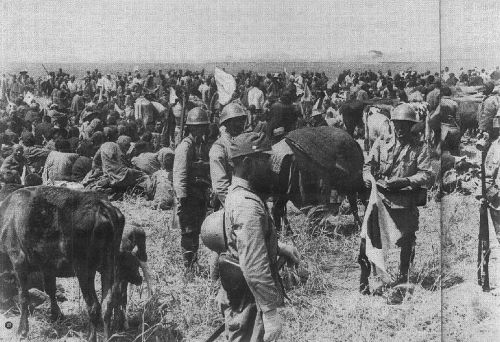
For many rural survivors, leaving home began as a temporary arrangement whose duration they could not determine. Henan’s inhabitants already used migration to supplement agricultural earnings and cope with periodic hardship, but the flooding after 1938 disrupted the possibility of returning to a functioning farm. A household could reach an unflooded village and still lack the means to establish itself there. Remaining near its former fields preserved the prospect of resuming cultivation, while moving farther away might offer employment at the cost of greater separation. These decisions changed as provisions diminished and opportunities appeared elsewhere. Becoming a refugee was an extended process in which successive attempts to secure a livelihood could carry people increasingly far from the lives they expected to recover.
The experience of Xu Guangdao’s extended family reveals how displacement reorganized relationships within a household. According to a later recollection discussed by Micah S. Muscolino, Xu’s grandparents accompanied his third uncle to a friend’s home elsewhere in Zhongmu, where the uncle obtained hired work. Another uncle’s family entered petty trade, while Xu’s younger brother and sister-in-law joined her uncle’s household and cultivated land for a wealthy family. Xu himself joined the army. Their survival depended on several arrangements that placed relatives in different occupations and locations. Connections through marriage mattered alongside paternal kinship, and friendship provided assistance beyond the family itself. Such dispersal complicates any assumption that an extended household either remained intact or simply ceased to function; its relationships could enable members to survive even while common residence became impossible. Diana Lary’s broader study of wartime Chinese society emphasizes the contraction and disruption of family life under prolonged insecurity. Xu’s case adds a qualification to that interpretation, showing how separation could proceed through the use of existing relationships. The family’s capacity to help its members persisted, but it operated through smaller groups whose circumstances increasingly diverged.
Receiving communities became part of the disaster’s social geography. Henan’s provincial government instructed counties outside the inundated area to accommodate refugees through baojia, the local household organization used for administration and mutual security. This arrangement recognized that newcomers needed support beyond their first arrival. Its effectiveness nevertheless depended on what receiving households and local officials could provide. Access to an unflooded settlement offered an opportunity to rebuild daily life, but residence alone did not establish a dependable income or settle how long assistance would remain available.
Employment changed the practical meaning of survival. In a September 1947 survey, A. J. Parenti retrospectively described displaced people working in transport, agricultural labor, street selling, and domestic service, while identifying textile work and laundering among women’s occupations. These activities placed refugees within the economies of the places where they sought shelter, often in work that depended on immediate demand for their labor. A former farmer working for another household had to obtain subsistence through a relationship quite different from cultivating land whose produce helped sustain the family. Small commerce offered another possibility, although it required something to sell and customers able to purchase it. The range of occupations also shows why refugees should not be understood solely as recipients waiting for assistance. They worked to support themselves, frequently combining activities as circumstances allowed. Women’s earnings deserve attention because accounts organized around male employment can obscure how much household survival depended on their contributions. Paid domestic work or laundering could coexist with responsibility for children and other relatives, making the allocation of time within a displaced family notably important. Lary’s analysis of changing family economies during the war helps explain why earning money and maintaining a household must be considered together. Occupational adaptation demonstrated initiative, yet a succession of available jobs could sustain a family without giving it the security needed to plan beyond its immediate expenses.
Military recruitment drew on the same population struggling to find civilian employment. An October 1939 relief proposal discussed refugees’ survival strategies, and Muscolino places enlistment among the responses of men whose agricultural livelihoods had disappeared. Wealthier families also hired substitutes for military service, creating opportunities for impoverished refugees to assume obligations that others could pay to avoid. This practice connected displacement to differences in the ability to manage wartime demands. A payment might provide urgently needed support, but accepting it transferred exposure to military danger onto someone whose alternatives had narrowed. Individual recruits could sincerely oppose the Japanese invasion while also entering the army because civilian employment no longer sustained them. Patriotic commitment and economic necessity could operate together, making the circumstances of recruitment essential to understanding what an apparent choice represented.
Farther west, migration opened another possibility. Obtaining land in Shaanxi rather than searching indefinitely for employment near the flooded region. Muscolino’s research on Huanglongshan traces the Nationalist government’s resettlement of thousands of Henan refugees in an agricultural reclamation area. The program had begun receiving war refugees before the breach, and the relocation of Yellow River flood victims followed in October 1938. Its provisions included land allocations, food support, and assistance with agricultural supplies, offering displaced cultivators a prospect of renewed production. But establishing farms required substantial work in surroundings unfamiliar to the settlers, and the project also served government objectives for wartime economic mobilization. Reclamation brought refugees into organized production and associated expectations of discipline. This combination gave resettlement an appeal that emergency distributions alone could not offer, while making its success depend on continuing support and workable local conditions. The clearance of wooded land also extended the environmental impacts of displacement into the receiving region. Refugees’ search for subsistence connected the altered landscape of eastern Henan with new pressures on land elsewhere, carried through policies intended to strengthen resistance to Japan.
Movement changed what recovery would require. A household dispersed among employers, relatives, and a reclamation settlement faced problems that could not all be resolved by making its former fields cultivable again. Members might have acquired obligations where they now lived, while the resources needed to reassemble the household remained uncertain. For such families, the possibility of return had to be weighed against arrangements already supporting their survival. The relevant measure of assistance extended beyond the provision of temporary shelter or a single distribution of grain. It included whether displaced people could maintain a livelihood without repeatedly breaking up their households or accepting increasingly insecure terms of work. Their efforts to survive made relief an ongoing relationship between refugees and the communities and institutions on which they depended.
Relief and State Power: Assistance That Could Also Exhaust
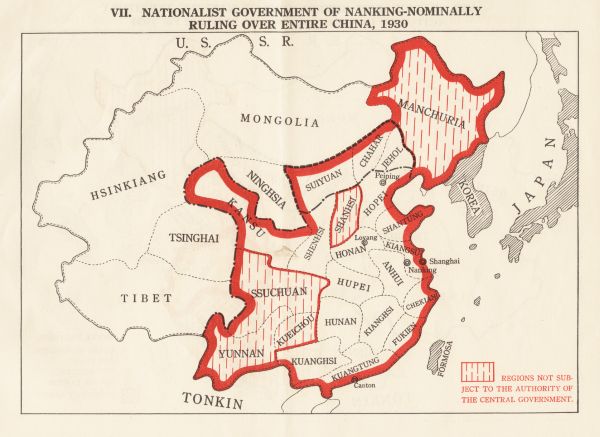
The Nationalist response included public fundraising and the dispatch of relief personnel during the summer of 1938. In July, the party organization in Henan appealed to members and the public to participate in a one-day donation campaign for flood victims. Government agencies worked alongside charitable organizations and foreign missionaries, producing a relief effort with several sources of support and uneven reach. Japanese military operations restricted access to affected communities and complicated the movement of supplies, while displacement increased the number of people requiring assistance. Within these constraints, relief became a practical test of governmental authority. Arranging a collection or assigning personnel had to be followed by delivery that households could actually use.
Work relief, commonly described as gongzhen, offered a way to connect immediate assistance with the construction of protective infrastructure. Paying disaster victims to repair embankments could provide subsistence while reducing the likelihood that another inundation would destroy recovering farms. The interests of villagers and military authorities could coincide in such projects, as a petition from Huaiyang in March 1940 demonstrates. Local representatives requested funds for a new dike that would protect fields becoming available for cultivation, arguing that it would also improve Chinese defensive positions against the Japanese. Their appeal secured a favorable response, and the resulting project, completed in 1941, reportedly protected approximately 300 villages. The episode shows residents trying to influence government expenditure through an argument officials were prepared to accept. Invoking military usefulness gave their request greater administrative force, but the benefits to cultivation were substantial in their own right. Such an undertaking could offer a durable form of assistance, provided its construction costs did not overwhelm the communities it was intended to protect.
Distribution through local intermediaries could undermine that promise. A government inspection report from 1940 described work-relief payments passing through ward and mutual-security headmen, who diverted money or deducted miscellaneous charges before it reached poor households. Laborers undertook strenuous work without receiving the support intended to sustain them. The same report identified a damaging arrangement for households lacking able-bodied men; they had to pay other people to fulfill their dike-labor obligations. What was supposed to produce relief income could instead create a debt, and the investigators connected these debts with the sale of property and even children. These were reported outcomes of administrative practices, rather than evidence that every relief project operated identically. Their significance lies in how the practices reversed the program’s stated purpose. A household could be assessed for work because it belonged to a locality, yet have too little labor or money to meet the requirement. Selling productive possessions to cover that obligation reduced its ability to support itself afterward. Local headmen also occupied a powerful position because they mediated both the demand for labor and access to payment. The report’s criticism treated these abuses as a failure of relief administration, making clear that the problem was recognized within the governmental system itself.
The inspectors proposed assigning easier tasks to women and children, acknowledging that available labor differed from the adult male workforce assumed by many construction arrangements. This was a recommendation whose implementation cannot be presumed across the flood zone. It might widen access to earnings, but its value would depend on the suitability of the work and the support participants received. Households unable to spare any worker still required assistance. Organizing relief chiefly around construction risked making physical capacity a condition for obtaining help, even where the need for support was greatest.
Inadequate funding posed another problem that could persist independently of misconduct. A July 1941 report on dike works stated that the Yellow River Conservancy Commission supplied four jiao, or 0.4 yuan, for each cubic meter of earth strengthened. The report estimated that a worker could complete about one cubic meter daily but needed two yuan per day as grain prices rose. Counties were left to meet the difference between the central contribution and the actual cost of maintaining the workforce. These figures describe a funding gap in the works under investigation; they should not be treated as a uniform wage schedule for every project. Nevertheless, they expose a mechanism through which an approved relief allocation could impose additional expenses locally. The adequacy of a payment depended on what it purchased when work occurred, as well as the sum entered in an appropriation. Administrative accounts could register expenditure while the people supplying labor remained insufficiently supported. For damaged rural economies, meeting construction deadlines under these terms could draw resources away from cultivation and household consumption.
Kathryn Edgerton-Tarpley’s study of the flood locates its political consequences in the exhausting character of Nationalist intervention. Assistance brought the government into closer contact with displaced farmers, but those encounters could generate dissatisfaction when official requirements exceeded the benefits received. Huaiyang’s successful request and the inspection reports’ accounts of harmful administration reveal considerable variation within that relationship. Protective intentions could coexist with procedures that depleted recipients’ means of subsistence. Criticism from within the administration establishes that officials had reasons to reconsider how obligations were assigned and payments distributed. Recognizing those failures did not itself give villagers the means to correct them. Relief could strengthen confidence in public authority when it supported locally valued protection. The damaging arrangements documented by investigators show how the collection of labor could become more dependable than its compensation.
Living beside a Militarized River, 1938–1945
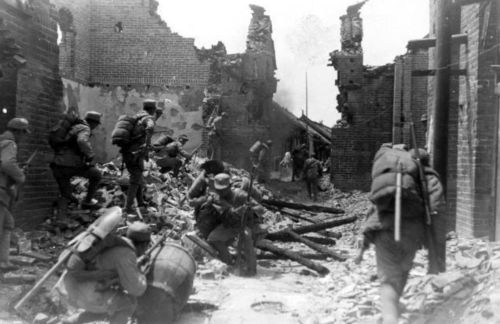
Along the Yellow River’s diverted course, embankments became places where military command entered ordinary routines. After the Nationalists completed their western defensive dike in 1939, personnel supervised maintenance throughout the year, while telegraph connections linked its sections to the wider defense system. Japanese forces and the Chinese administrations operating under occupation organized works on the opposite side. The resulting frontier depended on structures that required attention between major campaigns, giving the armies continuing reasons to intervene in nearby settlements. For inhabitants who remained within reach of those installations, residence involved recurring contact with troops and engineering officials. Decisions about a stretch of bank could alter the conditions under which neighboring villages cultivated their land or moved between settlements.
Japanese commanders actively reshaped the flood rather than merely accepting the obstacle created in June 1938. Their forces closed the opening at Zhaokou and excavated another breach near Huayuankou during an assault in July 1939, concentrating the river’s discharge through the latter area. Chinese collaborationist authorities also participated in constructing and administering defenses in occupied territory. Opposing engineering projects could then direct the current toward one another’s positions. A Nationalist report from 1941 described ten Japanese deflection dikes opposite Hansiying in Fugou and sixteen counterstructures erected on the Chinese side. These works made the location of flowing water an object of continued military competition. Diverting the current could protect one bank while exposing another to stronger erosion or a greater danger of inundation. The villagers living nearby experienced the consequences through changes in the water approaching their homes and fields. Their predicament arose within a continuing Japanese occupation, compounded by a form of defense in which the armies’ efforts to protect their own positions could transfer danger across the river.
At some construction sites, Japanese artillery determined when civilians could work. Beginning in late November 1941, more than ten thousand laborers dredged near Zhongmu at night in freezing weather to reduce their exposure to shellfire. The operation sought to strengthen a water barrier against further Japanese movement. For the workers, tactical concealment required accepting difficult conditions after dark. Their participation placed them close to combat even though their assigned task was excavation, making the separation between civilian work and military danger narrow.
Village embankments introduced another source of disagreement because their purpose did not always correspond to that of the larger defenses. At a conference in Xihua in May 1943, water-conservancy technician Wang Heting recommended removing civilian dikes that endangered the government’s principal embankment, while retaining those that reinforced it. His proposal judged local structures according to their effect on the broader system. There were practical reasons for doing so: a small protective bank could impede drainage or redirect water toward another vulnerable section. Nevertheless, the recommendation placed farmers’ attempts to protect plots under an external judgment about which works should survive. It also exposed a difficulty inherent in collective protection along a contested river. The arrangement best suited to preserving one settlement’s fields could conflict with the configuration officials considered necessary for the main defensive line.
Control extended to materials that villagers needed for everyday use. In December 1939, refugees near Huayuankou cut more than two hundred willows planted for dike protection and repairs; a Zheng County proclamation the following year ordered local headmen and river personnel to guard the trees against further damage. The trees had several uses, providing fuel while also stabilizing soil and supplying branches for construction. Reserving them for river defense affected what people could gather from the immediate surroundings. Fuel collection supplied both civilian households and armies, bringing ordinary efforts to obtain income into the provisioning of military forces. Under these circumstances, protecting vegetation required more than issuing a prohibition. It depended on whether people had other sources of fuel and whether military consumption left enough material for local needs. Cutting the trees could weaken defenses on which residents themselves depended, but preserving them did not resolve the need to cook food or obtain something marketable. The competing uses of scarce wood joined domestic necessity to the maintenance of the front.
Commercial movement produced a different relationship with the water. A Nationalist investigation published in 1944 described trade across the flood zone’s enemy lines, where waterways provided routes around disrupted railway connections. At Poxie in Fugou, a harbor supported exchanges between the river’s banks, and merchants obtained passage by paying military personnel stationed there. The trade included household necessities such as cloth, as well as narcotics and other restricted goods. Its economic importance cannot be assessed simply through the official category of smuggling. Some transactions brought supplies into areas where war had made them scarce; others sustained profitable enterprises whose interests were bound to the continuation of restrictions. Soldiers’ involvement also complicates the image of a frontier enforced consistently by the forces defending it. Armed control could create opportunities to collect payments and participate in commerce, even while those same units guarded against the enemy. River settlements could develop active markets amid widespread rural impoverishment. For civilians carrying goods or conducting small exchanges, the terms of passage depended partly on arrangements with the people controlling the crossing. Political division changed commercial connections without extinguishing them, and military presence could facilitate transactions as well as obstruct them.
The geography of occupation changed again during Japan’s Ichigo offensive in 1944. As Yung-fa Chen’s reconstruction of the Henan campaign shows, Japanese forces crossed the diverted Yellow River and overwhelmed important Nationalist defensive positions. The waterway’s military value depended on the troops and preparations supporting it, and a successful crossing could alter the authority under which surrounding communities lived. Extensive river works coexisted with the possibility of renewed invasion. Japan’s surrender in 1945 ended the war against the occupiers, but the Yellow River continued along the course established during the conflict. Its flow still passed through landscapes modified by rival defenses, with local access to usable land dependent on the condition of those works. For riverine villages, the end of the war arrived while much of the infrastructure governing everyday activity remained an unfinished responsibility.
Flooding and the Henan Famine of 1942–1943
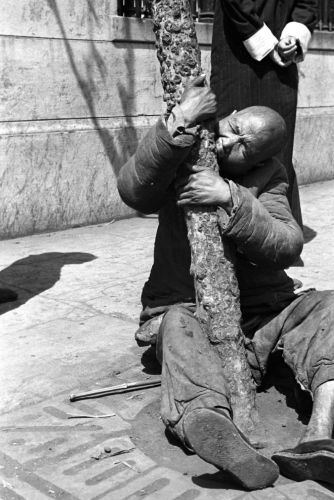
Four years after Huayuankou, Henan’s food crisis brought an additional consequence of the river’s diversion into view. The erosion of households’ ability to survive a failed harvest. Repeated inundation had reduced cultivation and depleted reserves in parts of the province, leaving families less able to compensate when agricultural conditions deteriorated in 1942. The famine nevertheless extended beyond the flood zone, and its geography cannot be reconstructed simply by tracing where the diverted river had flowed. Nor can deaths from starvation be attributed to the breach through chronology alone. The connection lies in the diminished capacity to absorb further losses, a condition that interacted with drought and wartime demands rather than independently determining the disaster.
The agricultural calendar helps explain how this vulnerability became acute. Drought damaged the 1942 wheat harvest, while the still poorer autumn crops disappointed hopes that later production would replenish exhausted supplies. Missing two successive opportunities to obtain food left a much longer interval before the next substantial harvest than a single crop failure would have produced. Locusts aggravated the shortage, and their relationship to flooding was more complicated than the apparent opposition between excessive water and drought might suggest. Muscolino describes how previously inundated ground, once dried, could provide favorable breeding sites, while abandoned, overgrown land and population loss hindered effective control. This connection identifies one way that earlier environmental disruption contributed to the later emergency; it does not establish that every infestation originated in the diverted river’s path. A field might suffer from flooding in one season and become part of a landscape vulnerable to insects in another. Evaluating the breach over several years requires attention to these changing conditions, rather than assuming that flooded land remained uniformly submerged or that its subsequent drying restored dependable production.
Grain collection placed another claim upon the reduced harvest. From 1941, the Nationalist government collected the land tax in kind, while compulsory purchases imposed additional demands on rural supplies. John S. Service’s report of November 5, 1942, drawing on an October visit principally to Luoyang and interviews with officials and relief workers, identified a damaging discrepancy between assessed obligations and actual production. When quotas reflected normal harvests, a poor crop made the same assessment consume a larger proportion of the grain available. Collection could remain administratively successful while leaving cultivators unable to feed themselves. Service also reported complaints that influential families secured favorable treatment, shifting heavier burdens onto households with less local protection. His interviews were neither a comprehensive provincial survey nor an exact measurement of every levy, but they expose a mechanism through which scarcity could intensify without any formal increase in a village’s assessment. Subsequent reductions and waivers complicate any suggestion that demands remained wholly unchanged throughout the crisis. Their existence does not establish that adjustments reached communities before collection had depleted their provisions. The decisive question was whether officials revised demands quickly enough to preserve subsistence, especially where earlier flooding had already reduced the margin between an ordinary shortage and destitution.
Japanese occupation imposed its own coercive demands on food supplies. Research by Odoric Y. K. Wou, discussed by Mark Baker, shows how extraction in occupied and contested districts included military grain raids launched from garrison strongholds. Villagers could lose stored food through armed seizure even where cultivation had remained possible. Japanese aggression continued to shape the famine through the appropriation of provisions and the disruption of movement. Recognizing that responsibility also sharpens the assessment of Nationalist policy. Invasion explains the pressure to provision resistance, while leaving open whether collections needlessly endangered those expected to sustain it.
A poor harvest also changed what a household’s remaining possessions could buy. In his account of Sishui, the journalist Li Rui described families attempting to exchange household goods for food at disastrously unfavorable rates; a set of old books might obtain only about 250 grams of flour. Baker uses such observations to examine the rapid deterioration of access to food alongside the physical contraction of supplies. The distinction matters because ownership of property offered little security when many desperate sellers competed for buyers while grain became increasingly expensive. Liquidation might provide a meal without furnishing the means to survive until the next harvest, and each completed sale reduced what remained available for a later emergency. These transactions also complicate an interpretation centered exclusively on official requisitioning. Food could become inaccessible through market exchange even after a family had met its assessed obligations. Conversely, attention to purchasing power must not imply that Henan possessed ample food which merely required fairer distribution. Crop losses and coercive extraction restricted supply, while deteriorating exchange conditions determined how that shortage reached households. Earlier flood damage belongs in this analysis because families that had already consumed savings or lost productive property entered the market with fewer assets to sell.
Warnings preceded the worst winter deprivation, although warning and effective intervention were different achievements. Service’s November report described an impending deterioration as remaining stocks ran out; its predictions must be read as contemporary assessments of danger, rather than retrospective counts of people who had died. By April 1943, an American diplomatic dispatch from John Carter Vincent recorded Chinese press reports of wheat shipments from Shaanxi, releases from military granaries, and priority use of the Longhai railway for relief supplies. Vincent also noted that reported arrivals were still small and that emergency conditions persisted in parts of Henan. Because much of the dispatch summarized official news reports, it documents announced measures and reported deliveries more securely than it establishes what individual villages actually received. Even with that qualification, the evidence rules out a simple claim that the government provided no assistance. It redirects scrutiny toward the interval between recognizing the emergency and supplying enough food to affected communities. Grain delivered shortly before harvest might keep weakened people alive, but it could not undo deaths during the preceding months. Timing was part of relief’s adequacy, not merely a logistical detail added to the amount distributed.
The scale of mortality remains disputed. Muscolino gives an estimate of 1.5–2 million famine deaths, whereas Anthony Garnaut’s quantitative reconstruction places the toll below one million; Baker, interpreting Garnaut’s evidence somewhat more pessimistically, adopts approximately one million. These differences should remain visible rather than disappear into an apparently settled total. Population decline cannot automatically be equated with mortality, since flight and disrupted registration complicate comparison, while estimates assembled from contemporary accounts present other uncertainties. The famine figures also cannot simply be added to cumulative estimates of deaths attributed to the 1938 flood and its aftermath. Overlapping periods and populations create a substantial risk of counting the same losses twice. Uncertainty about the total limits numerical claims without erasing the evidence that starvation became a catastrophe across a province already damaged by war. The improved wheat harvest of 1943 eased the immediate crisis in many places, but renewed availability did not return households to their earlier productive strength. Selling or slaughtering draft animals could preserve life during the shortage while making subsequent cultivation more difficult. The distinction between obtaining food today and retaining the means to grow it tomorrow is essential to understanding how famine prolonged the consequences of previous destruction. In the flood-affected districts, recovery depended upon agricultural resources as well as access to usable land; an exposed field could not compensate by itself for the loss of an animal or the exhaustion of its cultivators. The famine modifies the assessment of Huayuankou without supplying a single-cause explanation for it. The diversion had helped create circumstances in which a later failure of rainfall became harder to withstand, while occupation and grain policy influenced whether that vulnerability resulted in starvation. Recovery had to be judged across more than one agricultural season, by whether cultivators could replace working animals and retain enough of the new harvest to sow again. A fall in food prices could end the immediate emergency while leaving that capacity seriously impaired.
Denial, National Sacrifice, and the Ownership of Suffering
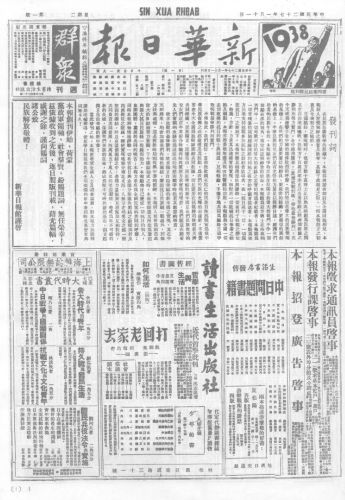
The official explanation of the flood determined how readers were invited to understand the people caught in it. By attributing the breach to Japanese bombing, the Nationalist government placed their losses within an already familiar account of violence inflicted by the invader. A 1938 article in Dongfang zazhi, identified in Edgerton-Tarpley’s research, incorporated that attribution into its title, “Huanghe beizha jingguo ji zaiqu jiuji,” an account of the river’s bombing and assistance to the affected region. The issue was more than the concealment of a military operation. Readers could acknowledge the destruction and support its victims while remaining misinformed about the decision that had exposed them to danger. Actual Japanese atrocities made the accusation politically plausible, but they did not make the stated explanation of this breach true.
Outside China, attribution was already contested, and the dispute accompanied efforts to obtain international assistance. In an August 2, 1938, telegram from Geneva, the American consul reported that China had requested League of Nations help in planning flood-control measures. The Chinese communication emphasized that Japanese occupation obstructed conservation and relief. Charles E. Smets of the League Secretariat observed that both governments accused the other of destroying the dikes and privately anticipated political difficulties in undertaking the work. He also stressed the absence of sufficient technical information and funding. This document cannot establish that Nationalist denial alone prevented an international intervention, nor does it independently adjudicate the competing accusations. Its significance lies in showing that humanitarian cooperation had to proceed amid disputed responsibility, occupation, and practical constraints. China’s request also demonstrates that maintaining the bombing narrative did not require concealing the existence of the emergency. Official representatives could seek outside help for extensive damage while withholding the government’s own causal role.
Sacrificial justification had nevertheless appeared within the military record from the beginning. Xiong Xianyu’s diary entry for June 9, 1938, described the operation as a “great sacrifice” undertaken for eventual victory. That formulation matters here as evidence of how an officer represented the meaning of the action, rather than as another account of its execution. It expressed the commitment of those conducting the operation without establishing the assent of the civilians exposed to its consequences. The distinction between deciding upon a sacrifice and bearing its costs is obscured when both are incorporated into a single patriotic undertaking. It would be misleading to imagine that officials first understood the event solely as an enemy atrocity and discovered its sacrificial meaning only after the war. Internal acknowledgment of purposeful destruction could coexist with a public account that assigned the breach to Japan.
Patriotic language also circulated publicly while responsibility remained concealed. On June 25, 1938, the Communist-associated Xinhua ribao characterized the victims’ losses as a “sacrifice borne for the nation,” in a passage quoted by Edgerton-Tarpley. The newspaper’s political affiliation makes this example revealing. The interpretation belonged to a wider wartime culture of resistance, rather than exclusively to Nationalist publicity. Nor did praising the sufferers require the newspaper to announce that Chinese forces had opened the dike. People injured by what was presented as enemy violence could still be honored for contributing to the national struggle. Such recognition potentially gave displaced villagers a claim upon readers who otherwise knew little of their circumstances, and appeals to common patriotism could encourage assistance. Yet it also shifted attention from the decisions producing their predicament to the national value assigned to their endurance. The victims became evidence of China’s commitment before their own judgments about the flood had been established. None of this proves that readers uniformly accepted the interpretation or that patriotic appeals were insincere. It does show how sympathy could expand without a corresponding expansion of public scrutiny, allowing recognition of suffering and protection of the government’s reputation to operate together.
Edgerton-Tarpley places this rhetoric within a longer change in the relationship between disaster and political legitimacy. Her comparison with late-imperial responses identifies a growing emphasis on civilians’ contribution to national survival, alongside technical explanations of catastrophe. That distinction should not become a claim that earlier rulers invariably protected their subjects or that modern nationalism eliminated expectations of relief. The important change concerns the direction of obligation. Describing people as contributors to a collective struggle could make continued endurance an obligation owed by them, even while their need for assistance remained publicly acknowledged.
Later recollections introduce judgments that cannot be recovered from patriotic descriptions alone. Shao Heniu, a survivor whose account Muscolino reproduces from Mei Sangyu’s work, remembered traveling with other refugees to a village where relief was rumored to be available, only to find nobody distributing it. Her narrative assessed institutions through an encounter with unmet need, and situated that disappointment within the losses experienced by her family. It supplies a perspective substantially different from a newspaper’s attribution of national meaning to anonymous sufferers. Retrospective testimony must be read with attention to when it was recorded and the circumstances of its publication. A recollection preserved decades afterward cannot establish what every resident understood about the breach in June 1938, and its appearance in print does not make it independent of later political interpretations. These limitations do not deprive it of historical value. They require distinguishing an individual’s remembered experience from claims about the population’s collective response. The surviving record contains unequal opportunities to speak, so neither official praise nor a particularly bitter recollection can legitimately stand for all those affected.
After Japan’s defeat, the Nationalist defense of the breach increasingly emphasized its contribution to resistance, as Muscolino explains. Acknowledging Chinese agency altered the explanation of the catastrophe without necessarily conceding that the decision had been wrong. The eventual victory offered supporters an outcome against which to vindicate the losses, although success in the war could not by itself demonstrate the indispensability of this measure. This retrospective argument also changed the position assigned to civilians. Those previously depicted as targets of enemy destruction could now be represented as participants in a successful national defense. Participation in that account still required no demonstration that they had agreed to the danger or approved the government’s conduct afterward. Historical recognition raises a question distinct from factual disclosure. Whether those affected could contest the meaning attributed to their losses while retaining a claim to support. Praise could preserve their place in the history of resistance, but it could also treat their contribution as completed once victory had been achieved. For people still unable to resume ordinary life, the obligations arising from the catastrophe remained unfinished, regardless of how convincingly it could be incorporated into a national account of the war.
Planning Restoration: Relief, Engineering, and International Assistance
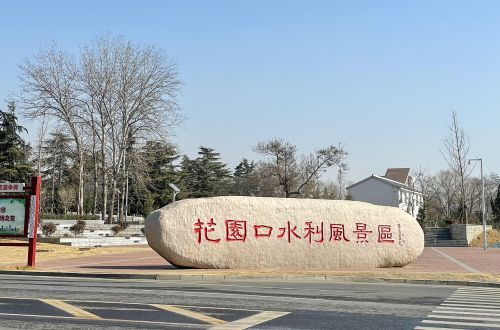
Returning the Yellow River to its northern course required deciding what restoration was supposed to accomplish. Stopping the flow through Huayuankou would relieve the districts inundated since 1938, but it would also send water into a corridor whose conditions had changed during the intervening years. The earlier channel could not be treated as an empty receptacle, and repairing the breach could not substitute for preparing the country downstream. Japanese occupation and prolonged warfare had fragmented the administration of a river system that depended on coordinated maintenance. A defensible plan needed to connect work at the opening with downstream protection, while making provision for agricultural recovery in the area from which the river would withdraw.
International assistance gave this undertaking resources that the affected region could not readily supply, although it did not create a single authority over reconstruction. The United Nations Relief and Rehabilitation Administration, or UNRRA, cooperated with the Nationalist government’s Chinese National Relief and Rehabilitation Administration, known as CNRRA. The Yellow River Conservancy Commission brought another institutional responsibility to the project, while local administrations had to organize activities within their jurisdictions. UNRRA appointed the American engineer Oliver Julian Todd, whose experience in China extended back well before the war, as an adviser to the commission. This arrangement combined foreign assistance with Chinese engineering and administrative structures. It also distributed responsibility across organizations whose capacities and territorial access differed. Identifying an international sponsor tells only part of the story. A central allocation still had to become a usable delivery at a construction site or a village. Planning required agreement about who would procure materials, direct their use, and provide support when the work crossed administrative or military boundaries.
At Huayuankou, engineers faced the problem of constructing a closure within an active watercourse. The scheme used trestles and stone placement, together with substantial earthworks, to block the diverted flow and direct the river toward its former bed. Work on the old course had to advance alongside that operation, because progress upstream could increase danger downstream. Zhou Enlai’s memorandum to George C. Marshall of May 22, 1946, records an oral understanding reached with UNRRA representatives four days earlier that made this relationship explicit. It permitted continued work on trestles but conditioned further stone placement upon downstream preparations and agreement between the parties. The proposed restrictions also covered excavation connecting with the old bed and the removal of a railway and parallel highway that crossed its path. These provisions show how an engineering schedule could become a negotiated system of safeguards. They were intended to prevent the closure works from committing downstream communities to a changed flow before protective preparations were adequate. The document records Zhou’s account of the understanding, rather than independently proving that every provision was accepted and implemented. Nevertheless, it establishes that the order of construction was already recognized as a matter affecting civilian security.
The supply program connected Huayuankou to production centers far outside Henan. American shipments included lumber and steel materials, while jute sandbags came from India; Chinese procurement supplied stone and large quantities of plant material for the river works. Imported flour helped sustain the labor force during construction. These deliveries joined specialized equipment to methods that still relied heavily on workers moving earth and assembling protective structures. Their importance lay in making specific operations possible at specific stages. Materials waiting at a distant depot could not secure an embankment, and machinery required fuel and operators. Construction planning had to follow supplies through their arrival and use, rather than treating procurement itself as evidence of readiness.
Agricultural surveys raised a different problem. Extensive damage did not mean that every affected field had become permanently infertile. Investigations discussed by Muscolino, including W. S. Chepil’s November 1946 survey, distinguished between deposits and locations instead of treating the flooded region as uniformly ruined. Sandy ground vulnerable to wind erosion required attention, while much finer alluvial material retained considerable agricultural potential. Chepil recommended protective tree planting, drawing upon practices that Henan cultivators already knew. This assessment mattered because a prediction of universal desertification could discourage investment in land capable of supporting crops. Conversely, recognizing potential fertility supplied no warrant for assuming that farming would resume without assistance. Clearing vegetation and preparing the ground remained practical tasks, and a favorable soil assessment did not equip a household to perform them. Survey findings needed to inform decisions about where to concentrate reclamation resources and which forms of protection a locality required. They also supplied a check upon generalized promises. The acreage expected to return to production had to be evaluated through conditions on the ground, rather than inferred directly from the disappearance of floodwater.
Provision for civilians and construction workers also required attention to conditions that could disrupt the engineering schedule. UNRRA health advisers identified sanitation and adequate medical care as necessary for laborers crowded together at Huayuankou. Their recommendations made disease prevention part of the project’s practical requirements. For returning households, support had to extend beyond arrival to the months before fields yielded food. These needs implied overlapping schedules. A closure could be completed on one date, while maintaining the workforce and sustaining resettlement required provision over longer intervals.
The old riverbed’s inhabitants made the territorial limits of cooperation apparent. People had established homes and cultivated land in the channel left dry after 1938, and much of the receiving corridor lay under Communist authority. Closing Huayuankou required assistance for one population to be coordinated with protection for another across an increasingly hostile political division. Zhou’s May memorandum proposed a joint committee for people living in the old bed, including representatives of the Nationalists and Communists alongside UNRRA and CNRRA. It also stipulated that supplies for downstream work should remain unaffected by political and military considerations. By June 29, Zhou was telling Marshall that promised support had largely failed to arrive. His memorandum complained of inadequate flour deliveries, unpaid expenses, and absent medical assistance. These statements were part of Communist diplomacy and cannot be accepted as a complete independent audit. They nevertheless reveal a concrete disagreement about the relationship between commitments made at the negotiating table and resources received by those preparing the lower course. Edgerton-Tarpley’s study places these disputes within the developing civil war, in which a restored river could alter communications and military movement as well as reduce flooding. Neither party’s strategic interests should erase the inhabitants’ need for protection. The planning problem was to make that protection effective without requiring civilians to wait for a political settlement that was becoming less attainable.
Beyond immediate rehabilitation, the Yellow River undertaking also attracted ambitions for a different agricultural future. Jiayi Tao’s research shows that technical assistance formed part of Nationalist expectations of international aid, and that the project incorporated proposals for mechanized farming in the flooded region. Such ambitions extended the meaning of reconstruction from recovering lost production toward changing how production would be organized. Tao also emphasizes that development was not a settled program shared identically by all participants; experts with different backgrounds brought differing expectations to the work. Reading the project through these varied expectations helps distinguish its agreed tasks from the wider ambitions that experts promoted. New equipment might expand the possibilities of reclamation, while its continuing use would depend upon institutions capable of maintaining it and making its services available. The immediate engineering target remained more definite than these wider aspirations. Yet a plan organized around closing the breach could succeed on that measure while leaving agricultural support or downstream safeguards incomplete. Before the river was returned, the unresolved issue was whether these separate commitments could advance together under conditions of renewed war.
Returning the River in 1947: Recovery for Whom?
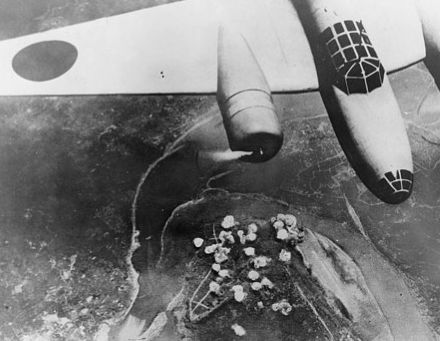
On March 15, 1947, the closure at Huayuankou returned the Yellow River to its pre-1938 course and accelerated the recession of water in the southern flooded region. Cultivation had already resumed in some districts, but the diversion opened additional ground for planting and reduced the uncertainty created by the river’s continued passage through the Huai drainage system. Farmers put summer crops into newly exposed land, often using hand tools rather than waiting for machinery. Their work, supported by supplies from UNRRA and CNRRA, produced a substantial agricultural recovery during 1947. This achievement deserves recognition without being treated as evidence that the affected population had recovered uniformly. Renewed cultivation measured one important result; it did not reveal whether a returning household possessed a secure home or retained the land it had farmed before displacement.
For inhabitants of the restored northern channel, the same operation could bring a fresh disaster. The dry riverbed had supported settlements and cultivation during the years of diversion, and returning the water threatened livelihoods that had developed there. The danger had been recognized before closure. In a January 23, 1947, dispatch, John Leighton Stuart described disagreements over the time needed to evacuate settlers and reported that UNRRA’s Glen B. Edgerton favored postponement despite engineering risks. Stuart also criticized the Nationalist government’s failure to make promised payments, while attributing military calculations to both Chinese parties. His account shows that civilian exposure was a known problem requiring decisions, rather than an unforeseen consequence discovered only after the river returned. The operation nevertheless proceeded without adequate protection for all those in its path. Muscolino cites reported estimates of approximately five hundred villages submerged and more than one hundred thousand people made homeless. These losses concerned the receiving channel, rather than another episode of flooding throughout the region devastated since 1938. Edgerton-Tarpley’s analysis makes the resulting conflict clear: communities relieved of one river course and communities endangered by another had different interests, which neither national reconstruction rhetoric nor party allegiance could reconcile automatically. Ending a prolonged catastrophe in the south still required arrangements for people whose exposure increased in the north.
Armed conflict also continued to endanger the relief operations accompanying restoration. Stuart reported on April 4 that Nationalist aircraft had attacked a landing ship unloading supplies on the Shandong coast, seriously injuring its master and wounding four crew members. The attack followed promises against further attacks on Yellow River workers and orders from the Nationalist chief of staff. It exposed a failure to make announced protection effective within the government’s own military system. Such incidents made assistance depend partly upon whether supplies and personnel could reach their destinations safely, even after the major closure had been accomplished.
Within the recovering southern districts, access to land became an administrative question with immediate consequences for household security. Flooding had obscured boundaries, while displacement and destruction had deprived some former owners of their deeds. A rule requiring documentary proof could disadvantage people whose inability to produce records arose from the disaster itself. CNRRA’s 1947 arrangements allowed counties to manage and rent unclaimed land, with a three-year period during which original owners could recover it by establishing their rights; land not restored within that period would become nationally owned. This provision offered a route to restitution, but made recovery depend upon satisfying an evidentiary requirement within a specified time. UNRRA personnel recommended using testimony from village elders and neighbors where written credentials were unavailable. That recommendation acknowledged the difference between a missing document and an extinguished claim, although its implementation in individual offices requires separate evidence. Earlier distress sales presented another difficulty, since an identifiable tract might already have passed to a purchaser. Returning to a village did not guarantee returning as the proprietor of the same farm. The legal and administrative treatment of wartime losses helped determine whether restored cultivation supported former owners or people who had acquired their property cheaply.
Mechanized reclamation could further concentrate the benefits of assistance when services followed existing ownership. In an April 9, 1947, report reproduced by Muscolino, the UNRRA officer Irving Barnett warned that tractors were working large estates and could enable landlords to dispense with tenants. Related relief reports described cases in which mechanized cultivation was followed by tenants losing their customary share of the crop. Machinery addressed a real shortage of draft animals and could bring difficult ground into production, but those technical gains did not determine who received the harvest. The effects depended upon ownership and the terms under which laborers participated. CNRRA organized cooperative arrangements that divided returns among owners, workers, and management, attempting to connect reclamation with a broader distribution of its proceeds. Some villages benefited, while relief observers also encountered organizations that served as devices for obtaining supplies or extending official control over land. The resulting record contains successes alongside arrangements that disadvantaged cultivators. Agricultural output and household security could move in different directions, making the organization of recovery as important as the equipment employed.
The approaching end of UNRRA’s operations added uncertainty to a recovery still requiring outside support. In an April 7, 1947, request transmitted by Stuart three days later, Foreign Minister Wang Shijie estimated that agricultural rehabilitation in the Yellow River basin would require at least 160,000 tons of food before the year ended, against 21,000 tons that UNRRA could supply. These were government estimates submitted in an appeal for further aid, rather than verified measures of deliveries or an independent census of need. Even with that qualification, the request demonstrates that the Nationalist administration did not regard the river’s return as making continued assistance unnecessary. Its appeal also described medical programs restricted by delayed supplies and equipment. Restoration took place within a changing international relief framework as well as a continuing civil war. For a household rebuilding a farm, the relevant issue was whether support remained available through the interval before it could sustain itself, rather than whether an agency’s assignment had officially ended. Assessments of the year’s accomplishments have to follow both the harvest and the arrangements that would sustain the next season. Families who had recovered access to land could still face a precarious winter if their new crops and continuing relief proved insufficient.
Was the Breach a Defensible Choice under an Existential Threat?
The following video from “Asianometry” discusses the 1938 Yellow River flood:
A defense of Huayuankou begins with the possibility that refusing to flood the plain might have exposed a much larger population to defeat and occupation. From this perspective, the government’s obligation to protect civilians included sustaining an army capable of resisting Japan, even when a defensive measure injured communities within China itself. The Japanese invasion had already demonstrated that the loss of territory could bring severe violence, so preserving organized resistance had a humanitarian importance extending beyond the survival of Chiang’s administration. A commander confronting that danger could regard the destruction of a heavily populated region as the cost of preventing a worse outcome elsewhere. This is the strongest challenge to an interpretation centered on the inhabitants of the flooded region. Their catastrophic losses do not, by themselves, settle the comparative consequences of the available choices. The relevant comparison would include the dangers of military collapse, rather than setting the actual flood against an imagined alternative in which China remained secure without comparable suffering. Because that alternative cannot be reconstructed with confidence, categorical condemnation of the initial decision demands more than a recital of its consequences.
The military literature gives this defense substantive support, although it also exposes its limits. Di Wu judges the Huayuankou operation militarily effective, emphasizing the interruption of the northern advance and the shift toward fighting along the Yangtze, where Chinese commanders believed they possessed better defensive opportunities. His assessment is reinforced in a narrower sense by contemporary diplomatic reporting. On June 15, 1938, an American embassy telegram recorded a Japanese spokesman acknowledging that the flood had checked the advance toward Zhengzhou. Van de Ven presents a sharply different interpretation in China at War, drawing attention to Japanese orders halting forward units and questioning whether Chiang’s feared sequence of enemy advances would actually have occurred. This disagreement concerns more than how much credit to assign the flood; it affects the claim that the expected danger demanded such an extreme response. Nevertheless, information recovered from Japanese records cannot simply be treated as knowledge available to the Chinese command at the moment of decision. An enemy’s existing instructions could also change, while the loss of an important position might create opportunities beyond an immediate operational plan. These possibilities prevent hindsight from disposing of the defense through a single fact about Japanese intentions. They equally prevent the defender from converting a plausible fear into proof that China would otherwise have been defeated. Strategic usefulness supports the case for the breach more securely than the stronger claim that no less destructive workable course existed.
Nor does the absence of civilian consent automatically settle the question. Military defense commonly entails compulsory obligations, and a government facing invasion cannot make every emergency operation depend upon agreement from everyone exposed to its effects. Correspondence before the breach already acknowledged the heavy sacrifice it would entail, so recognition of substantial harm cannot be dismissed as a product of hindsight. The more persuasive objection concerns the precautions that remained feasible within those constraints, and whether the authorities treated civilian preservation as part of the operation’s purpose. Emergency authority can explain why a decision was taken without ordinary consultation while still leaving its implementation open to judgment.
The argument also needs an attainable standard for evaluating relief. Edgerton-Tarpley’s research establishes that Nationalist institutions continued to intervene in the inundated region, even though their activities often exhausted and alienated its inhabitants. That finding rules out treating every inadequate result as evidence that the government had simply abandoned the population. Occupation obstructed access, warfare damaged transportation, and depleted local resources restricted what administrators could accomplish. An assessment that demanded comprehensive protection regardless of these limitations would mistake incapacity for deliberate neglect and discount assistance that helped people survive. Yet institutional weakness was itself uneven, and the existence of resources for military purposes made decisions about their allocation relevant to civilian outcomes. Standards of responsibility should be connected to opportunities for action, rather than inferred from an abstract expectation that the state could prevent all hardship. They should also change with time. The pressures surrounding the original breach cannot supply an unchanged explanation for subsequent decisions about grain collection or the management of the damaged region.
It remains historically plausible that a defensive breach could be reasonably chosen under an existential threat, even with foreseeable civilian losses and without certainty that the measure would determine the war’s outcome. We should avoid making demonstrated indispensability the minimum requirement for every defensible military decision. Its firmer argument is that deciding to undertake the breach created continuing duties toward those exposed to it. Those duties included practicable precautions during the operation and assistance directed toward restoring secure livelihoods afterward. Wu’s recognition of operational effectiveness alongside criticism of civilian expendability shows that a favorable strategic assessment leaves these duties unresolved. Subsequent relief and restoration must receive credit where they improved lives, while failures require examination according to the resources and alternatives available at the time. This approach also preserves distinctions among harms directly unleashed by the breach and later disasters shaped by additional decisions and conditions. The resulting interpretation permits a qualified defense of emergency action while rejecting the idea that invoking national survival settled the government’s obligations for the remainder of the war. Those obligations continued whenever authorities made choices affecting whether the people placed at risk could recover.
Conclusion: National Defense and the People Required to Bear It
Japanese aggression gave the Nationalist defense of the breach its most compelling justification, while the experience of the inundated communities established the limits of that justification. Chiang’s government confronted a war in which territorial loss could expose civilians to occupation and violence, and preserving its capacity to fight served a purpose larger than the preservation of its own offices. The flood disrupted military movement, making a serious defense of the decision possible even though its precise contribution to China’s eventual survival remains uncertain. Recognizing that possibility places responsibility within the circumstances of an invaded country. It also brings the people of the affected region inside the meaning of national protection. Their security was part of the objective for which resistance was maintained, and their losses required consideration beyond their usefulness in impeding an enemy. The central failure was the ease with which a claim to defend the whole country could authorize exceptional exposure for certain communities without providing commensurate means of protection. An emergency could justify difficult choices while still requiring an account of how their costs were assigned.
Once the river had been diverted, its consequences required continuing administration over a much longer period than the decision itself. Families had to accommodate altered waterways and recurring demands upon the resources needed for ordinary subsistence. Official intervention continued, but its effectiveness depended upon priorities that frequently joined flood management to military requirements. The gap between sustained administrative activity and adequate support central to the historical judgment. A measure chosen amid a rapidly developing campaign became a condition of rural life, repeatedly renewed through decisions about maintaining the river and obtaining resources from its surroundings.
Restoration in 1947 makes the distribution of those costs difficult to overlook. Bringing the water back to its northern course enabled substantial reclamation in the region flooded after 1938, and returning cultivators, supported by relief agencies, achieved real gains. The inhabitants of the receiving channel faced a different prospect, as their settlements and crops lay in the path of the rediverted river. Within the recovering southern districts, a household’s relationship to land also mattered. Possession of documentary evidence, or the consequences of an earlier distress sale, could determine whether renewed production benefited the former cultivator. Mechanized assistance sometimes strengthened owners who could reduce their dependence upon tenants. Physical rehabilitation could consolidate changes in property and livelihood produced during the catastrophe instead of reversing them. This outcome depended upon local arrangements, and the surviving evidence records cooperation and assistance as well as exclusion. It nevertheless demonstrates why reclaimed acreage cannot serve as a complete account of recovery. The work of returning refugees belongs in that account as an achievement in its own right, while their ability to remain securely on the land requires a separate assessment. A successful change in the river’s direction repaired one part of the damage; society had meanwhile undergone transformations that engineering alone could not undo.
The authority exercised at Huayuankou must finally be judged through the relationship it established between public purposes and particular lives. Uncertainty about the course of the war without the flood limits confident claims about the original choice, but the record supplies firmer grounds for examining the treatment of those affected. Relief initiatives deserve recognition, and shortages cannot all be attributed to indifference. Decisions that subordinated civilian needs to other demands remain consequential even when officials acted within severe constraints. The case calls for a judgment attentive to what authorities could accomplish at successive moments and to whose claims they recognized when distributing assistance. Its significance extends beyond the sincerity of Chiang’s intention to resist Japan. An asserted national purpose acquired historical meaning through the conditions imposed upon actual people. The families exposed to the flood remained members of the country whose defense had supplied its justification. Their claim to a viable future persisted after the military advantage had passed and after the river had been returned.
Bibliography
Affiliate disclosure: Amazon links on this site are paid links. As an Amazon Associate I earn from qualifying purchases.
- Baker, Mark. “The Slow, the Quick and the Dead: Environment, Politics and Temporality in the Henan Famine, 1942–43.” International Review of Environmental History 4:2 (2018), 93–109.
- Barnett, Irving. “Land Problems in the Flooded Area.” Report to Herbert Hummel, April 9, 1947. United Nations Archives and Records Management Section, S-528-0358. Quoted and discussed in Muscolino, The Ecology of War in China, 218–219.
- Chen, Yung-fa. “Chiang Kai-shek and the Japanese Ichigo Offensive, 1944.” In Chiang Kai-shek and His Time: New Historical and Historiographical Perspectives, edited by Laura De Giorgi and Guido Samarani, 37–74. Venice: Edizioni Ca’ Foscari, 2017.
- Chepil, W. S. “Report of Survey of the Yellow River Flooded Area of Honan.” November 11, 1946. United Nations Archives and Records Management Section, S-528-0357 AR17a. Discussed in Muscolino, The Ecology of War in China, 185–189.
- Chiang Kai-shek. Diary entry for June 3, 1938. Quoted in Micah S. Muscolino, The Ecology of War in China: Henan Province, the Yellow River, and Beyond, 1938–1950, 26. Cambridge: Cambridge University Press, 2015.
- Chinese National Relief and Rehabilitation Administration, Henan Branch. Shanhou jiuji zongshu Henan fenshu zhoubao, no. 84 (August 18, 1947): 6. Discussed in Muscolino, The Ecology of War in China, 217.
- Dodgen, Randall A. Controlling the Dragon: Confucian Engineers and the Yellow River in Late Imperial China. Honolulu: University of Hawai‘i Press, 2001.
- Eastman, Lloyd E. “Facets of an Ambivalent Relationship: Smuggling, Puppets, and Atrocities during the War, 1937–1945.” In The Chinese and the Japanese: Essays in Political and Cultural Interactions, edited by Akira Iriye, 275–303. Princeton, NJ: Princeton University Press, 1980.
- Edgerton-Tarpley, Kathryn. “Between War and Water: Farmer, City, and State in China’s Yellow River Flood of 1938–1947.” Agricultural History 90:1 (2016), 94–116.
- —-. “From ‘Nourish the People’ to ‘Sacrifice for the Nation’: Changing Responses to Disaster in Late Imperial and Modern China.” Journal of Asian Studies 73:2 (2014), 447–469.
- —-. “A River Runs through It: The Yellow River and the Chinese Civil War, 1946–1947.” Social Science History 41:2 (2017), 141–173.
- Feng Zhaoxue. Recollections of the 1938 Yellow River flood. Recorded in Mei Sangyu, Xuezhan yu honghuo: 1938 Huanghe Huayuankou juedi jishi, 207. Beijing: Zhongguo chengshi chubanshe, 2009. Quoted in Micah S. Muscolino, The Ecology of War in China, 60.
- Garnaut, Anthony. “A Quantitative Description of the Henan Famine of 1942.” Modern Asian Studies 47:6 (2013), 2007–2045.
- Han Qitong and Nan Zhongwan. Huangfanqu de sunhai yu shanhou jiuji. Shanghai: Xingzhengyuan shanhou jiuji zongshu, 1948. Statistical tables reproduced in Micah S. Muscolino, “Yellow River Flood, 1938–47,” DisasterHistory.org.
- “Huaiyang xian zaimin daibiao ni qing bo kuan zhu di.” March 1940. MG4.1–51. Yellow River Archives, Zhengzhou. Discussed in Micah S. Muscolino, The Ecology of War in China, 42–43. New York: Cambridge University Press, 2015.
- “Huanghe beizha jingguo ji zaiqu jiuji.” Dongfang zazhi 35:15 (1938), 57–58. Cited in Edgerton-Tarpley, “From ‘Nourish the People’ to ‘Sacrifice for the Nation.’”
- “Huanghe shuili weiyuanhui ji Xihua xian dang zheng jiguan shishen zuotanhui.” May 25, 1943. MG4.1–218. Yellow River Conservancy Commission Archives, Zhengzhou. Discussed in Micah S. Muscolino, The Ecology of War in China, 131–133. New York: Cambridge University Press, 2015.
- “Huikan Huanghe fangfan xindi baogao.” 1940. 18-20-02-18-02. Institute of Modern History Archives, Academia Sinica, Taipei. Quoted in Micah Muscolino, “Yellow River Flood, 1938–47,” DisasterHistory.org.
- Lamouroux, Christian. “From the Yellow River to the Huai: New Representations of a River Network and the Hydraulic Crisis of 1128.” In Sediments of Time: Environment and Society in Chinese History, edited by Mark Elvin and Liu Ts’ui-jung, 545–584. Cambridge: Cambridge University Press, 1998.
- Lary, Diana. The Chinese People at War: Human Suffering and Social Transformation, 1937–1945. Cambridge: Cambridge University Press, 2010.
- —-. “Drowned Earth: The Strategic Breaching of the Yellow River Dyke, 1938.” War in History 8:2 (2001), 191–207.
- Li Rui. “Zaicun fengjingxian.” April 1943. Reprinted in Henan wenshi ziliao 13 (March 1985): 36–40. Discussed and quoted in Baker, “The Slow, the Quick and the Dead.”
- Liu Zhongyuan et al. “Liu Zhongyuan deng jiang dian.” Telegram, June 3, 1938. Reprinted in Zhengzhou wenshi ziliao 2 (1986): 4. Quoted in Muscolino, The Ecology of War in China, 26.
- Ma Yonghe, Xu Guangdao, and Zhou Xueshi. “Huanghe hen.” Zhongmu wenshi ziliao 4 (1991): 45–46. Discussed in Micah S. Muscolino, The Ecology of War in China, 71. New York: Cambridge University Press, 2015.
- MacKinnon, Stephen. “The Defense of the Central Yangtze.” In The Battle for China: Essays on the Military History of the Sino-Japanese War of 1937–1945, edited by Mark Peattie, Edward Drea, and Hans van de Ven, 181–206. Stanford, CA: Stanford University Press, 2011.
- Mei Sangyu. Xuezhan yu honghuo: 1938 Huanghe Huayuankou juedi jishi. Beijing: Zhongguo chengshi chubanshe, 2009. Shao Heniu’s recollection, 206; quoted in Muscolino, The Ecology of War in China, 80.
- Mitter, Rana. Forgotten Ally: China’s World War II, 1937–1945. Boston: Houghton Mifflin Harcourt, 2013.
- Mostern, Ruth. The Yellow River: A Natural and Unnatural History. New Haven, CT: Yale University Press, 2021.
- Muscolino, Micah S. The Ecology of War in China: Henan Province, the Yellow River, and Beyond, 1938–1950. Cambridge: Cambridge University Press, 2015.
- —-. “Refugees, Land Reclamation, and Militarized Landscapes in Wartime China: Huanglongshan, Shaanxi, 1937–45.” Journal of Asian Studies 69:2 (2010), 453–478.
- —-. “Violence against People and the Land: The Environment and Refugee Migration from China’s Henan Province, 1938–1945.” Environment and History 17:2 (2011), 291–311.
- Pai, Pi-Ling. “Where Military and Fluvial Geographies Disastrously Conjoined: The Huayuankou Flood of 1938–1947 during the Sino-Japanese War.” Journal of Historical Geography 81 (2023), 146–161.
- Parenti, A. J., to Newton Bowles. “Part I, Survey of Flooded Area Refugees as Basis for Estimating Post-UNRRA Food Requirements.” September 7, 1947. S-0528-0543, A.R. 8B. United Nations Archives, New York. Quoted and discussed in Muscolino, The Ecology of War in China, 63, 71.
- Pietz, David A. Engineering the State: The Huai River and Reconstruction in Nationalist China, 1927–1937. New York: Routledge, 2002.
- Service, John S. “The Famine in Honan Province.” November 5, 1942. In Lost Chance in China: The World War II Despatches of John S. Service, edited by Joseph W. Esherick, 9–19. New York: Random House, 1974.
- “Shin Kōga karyū ibban kaikyo chōsa hōkokusho.” September 24, 1943. MG10–140. Yellow River Conservancy Commission Archives, Zhengzhou. Discussed in Muscolino, The Ecology of War in China, 38–41.
- Tao, Jiayi. “Towards Development: The Yellow River Project and UNRRA’s Technical Assistance to China, 1944–1947.” Journal of Global History 19:2 (2024), 301–321.
- Tobe, Ryoichi. “The Japanese Eleventh Army in Central China, 1938–1941.” In The Battle for China: Essays on the Military History of the Sino-Japanese War of 1937–1945, edited by Mark Peattie, Edward Drea, and Hans van de Ven, 207–30. Stanford, CA: Stanford University Press, 2011.
- Todd, Oliver J. “The Yellow River Reharnessed.” Geographical Review 39, no. 1 (1949): 38–56. Discussed in Muscolino, The Ecology of War in China, 172–173, 201–202.
- Todd, Oliver J., and S. Eliassen. “The Yellow River Problem.” Transactions of the American Society of Civil Engineers 105:1 (1940), 346–416.
- United States Department of State. “The Consul at Geneva (Bucknell) to the Secretary of State.” August 2, 1938. In Foreign Relations of the United States, Diplomatic Papers, 1938, The Far East, vol. 3, document 505. Washington, DC: Government Printing Office, 1955.
- —-. Foreign Relations of the United States, Diplomatic Papers, 1937. Vol. 3, The Far East. Washington, DC: U.S. Government Printing Office, 1954. Document 768, memorandum and enclosed Chinese government statement concerning the relocation of the national capital, November 20, 1937.
- —-. Foreign Relations of the United States, Diplomatic Papers, 1938. Vol. 3, The Far East. Washington, DC: U.S. Government Printing Office, 1955. Documents 186 and 195, “The First Secretary of Embassy in China (Salisbury) to the Secretary of State,” June 15 and June 28, 1938.
- United Nations Relief and Rehabilitation Administration. “Survey Report on Yellow River Flooded Areas in Honan, Anhwei and Kiangsu.” July 1947. United Nations Archives and Records Management Section, S-0528-0070. Discussed in Muscolino, The Ecology of War in China, 208–219.
- Van de Ven, Hans. China at War: Triumph and Tragedy in the Emergence of the New China. Cambridge, MA: Harvard University Press, 2017.
- —-. War and Nationalism in China, 1925–1945. London: RoutledgeCurzon, 2003.
- Vincent, John Carter. “The Chargé in China (Vincent) to the Secretary of State.” April 23, 1943. In Foreign Relations of the United States, Diplomatic Papers, 1943, China, document 178. Washington, DC: Government Printing Office, 1957.
- Wei Rulin. Ershi jituanjun canmouzhang Wei Rulin shubao Huang He juekou jingguo. Wuhan, 1938. Second Historical Archives of China, Nanjing, 787/3496. Cited in Diana Lary, “Drowned Earth: The Strategic Breaching of the Yellow River Dyke, 1938.”
- Wou, Odoric Y. K. “Food Shortage and Japanese Grain Extraction in Henan.” In China at War: Regions of China, 1937–1945, edited by Stephen R. MacKinnon, Diana Lary, and Ezra F. Vogel, 175–206. Stanford, CA: Stanford University Press, 2007. Discussed in Baker, “The Slow, the Quick and the Dead.”
- Wu, Di. “The Cult of Geography: Chinese Riverine Defence during the Battle of Wuhan, 1937–1938.” War in History 29:1 (2022), 185–204.
- Xinhua ribao. June 25, 1938. Quoted in Edgerton-Tarpley, “From ‘Nourish the People’ to ‘Sacrifice for the Nation.’”
- Xiong Xianyu. Diary entry for June 9, 1938. In “1938 nian Huanghe juedi shiliao yizu,” Minguo dangan, no. 3 (1997): 11. Cited in Micah S. Muscolino, The Ecology of War in China, 27.
- “Zheng xian zhengfu bugao.” 1940. MG4.1–43. Yellow River Conservancy Commission Archives, Zhengzhou. Quoted and discussed in Muscolino, The Ecology of War in China, 75–77.
- “Zhongguo guomindang wei juxing Huangzai jiuji juankuan yiri yundong gao dangyuan minzhong shu.” July 1938. M2-25-690. Henan Provincial Archives. Cited in Muscolino, The Ecology of War in China, 62–63.
- Zhongyang diaocha tongjiju tezhong jingji diaochachu. “Liu nian lai Huangfanqu zhi zousi.” Diwei jingji cankao ziliao, no. 68 (1944). Discussed in Muscolino, The Ecology of War in China, 72–74.
- Zhou Enlai. “Memorandum by General Chou En-lai to General Marshall.” May 22, 1946. In Foreign Relations of the United States, 1946, The Far East: China, vol. 9, document 467. Washington, DC: Government Printing Office, 1972.
- —-. “Memorandum by General Chou En-lai to General Marshall.” June 29, 1946. In Foreign Relations of the United States, 1946, The Far East: China, vol. 9, document 611. Washington, DC: Government Printing Office, 1972.
- “Zhuan’an baogao: Huangfan digong qingxing.” July 27, 1941. KMT Project 003, reel 212, file 1717. Hoover Institution Archives, Stanford, CA. Quoted and discussed in Muscolino, The Ecology of War in China, 52–53.
Originally published by Brewminate, 10.15.2026, under the terms of a Creative Commons Attribution-NonCommercial-NoDerivatives 4.0 International license.
About the Author