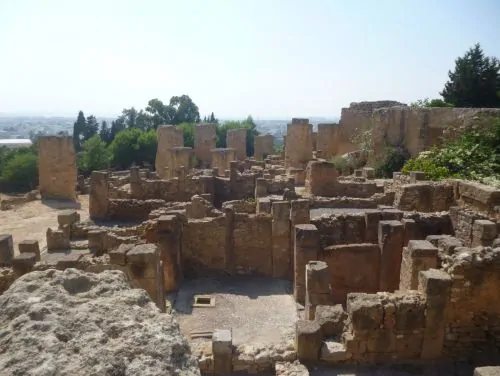
Recovering Carthage in 468 could have restored Western Rome’s access to African tax revenues. Turning that wealth into lasting imperial strength would require more than victory at sea.

By Matthew A. McIntosh
Public Historian
Brewminate
The fleet that might have prolonged the Western Roman Empire instead became a floating disaster. In 468 CE, a massive Roman expedition approached Vandal-held Carthage, the great North African port captured by King Gaiseric in 439. Eastern emperor Leo I supplied the main invasion force, cooperating with western emperor Anthemius. Other Roman forces recovered Sardinia and advanced westward from Tripolitania. Then Vandal fireships struck the fleet commanded by Basiliscus near Cape Bon. Burning vessels collided as their crews struggled to escape, and the campaign collapsed. Its failure left the western government without the African revenues it desperately wanted back. Yet this was no doomed expedition sent against an unbeatable enemy. The Romans had assembled enough force to make reconquest a serious possibility. What might victory have allowed them to rebuild?
A workable divergence begins with Basiliscus refusing the pause that, according to the later historian Procopius, Gaiseric requested before launching his attack. Instead of leaving his crowded fleet exposed while negotiations dragged on, the commander maintains active patrols and presses the campaign. This does not make Carthage fall automatically. Procopius’s claim that immediate action would have guaranteed victory deserves skepticism. For this scenario, assume that the fleet survives and its army establishes a secure position ashore. Pressure from the separate Roman advance then helps bring about Carthage’s capture before the campaigning season ends. Gaiseric might retreat or negotiate rather than disappear from history; taking his capital would not instantly eliminate every Vandal force. The essential outcome is narrower. Rome recovers Carthage and enough of its productive African hinterland to hold them. One further condition matters. Leo agrees that the recovered territory will provide revenue to Anthemius’s western administration, with eastern troops assisting during the transition. Since Constantinople supplied much of the expedition’s strength, a western financial recovery would depend on that political agreement. Roman possession alone would not settle which imperial treasury received the taxes.
The first benefit would be income, although probably less immediate income than a victorious court might advertise. Vandal Africa had retained productive estates and active commerce; conquest had not turned it into an economic wasteland. African produce continued circulating through Mediterranean markets, so reconquest would change who controlled and taxed that wealth rather than simply revive a vanished economy. Occupation would initially consume money. Officials would have to secure collections while troops protected the countryside. Disputes over confiscated property could further complicate cooperation with local landowners. Only a durable settlement could turn military success into dependable annual revenue.
In Italy, that revenue could alter the struggle between the emperor and the men commanding his armies. Historically, Anthemius’s relationship with the powerful general Ricimer deteriorated into civil war, ending with the emperor’s killing in 472. Victory in Africa would give Anthemius prestige and, eventually, greater means to support troops whose advancement depended on him. A government able to supply and pay its soldiers had more room to negotiate than one repeatedly seeking emergency assistance. Ricimer would remain influential, but challenging a successful emperor backed by eastern support could become more dangerous. Perhaps both men would preserve their uneasy partnership because neither could easily overthrow the other. That is a plausible consequence, rather than an inevitable reconciliation. Anthemius might instead use his stronger position to provoke a confrontation sooner. Nor would additional revenue solve the problem of armed followers attaching their loyalties to individual commanders. The crucial test would come when the money began arriving: could the court use it to sustain a military establishment that outlasted its current patron? Avoiding the destructive conflict of 472 would provide valuable breathing room, but preserving that advantage through the next succession would be harder.
Beyond Italy, recovery would demand restraint. Visigothic power in Gaul and Hispania would not evaporate because an imperial standard returned to Carthage. Campaigning there would still require soldiers who were also needed to secure Africa. A sensible western government might accept much of the existing territorial fragmentation while protecting the sea routes connecting Italy with its recovered provinces. Its most sustainable future could be a smaller Mediterranean empire, bargaining with neighboring kingdoms instead of trying immediately to reverse decades of losses. Even that arrangement would face Vandal resistance and the possibility that an African commander might withhold revenue or claim imperial power himself. Constantinople would have interests and emergencies of its own. Eastern help could establish the settlement without guaranteeing permanent rescue whenever western politics broke down. Survival would mean repeatedly maintaining an agreement among people who possessed enough force to wreck it.
Under those conditions, the deposition of Romulus Augustulus in 476 would become less likely to occur in its familiar form. A better-funded western court might continue for decades, although predicting its eventual boundaries would exceed what this single victory can support. Its survival could also consist largely of preserving an imperial title above increasingly autonomous regional powers. Recovering Carthage would matter most if it gave the government something more substantial than another claim on a map. The West needed territory whose surplus it could collect and convert into military strength. Victory in 468 could have restored that capacity. But the actual empire’s collapse involved both the loss of resources and the struggles over who commanded them. Recovering Africa could ease the first problem while leaving Romans dangerously capable of perpetuating the second.
Originally published by Brewminate, 10.26.2026, under the terms of a Creative Commons Attribution-NonCommercial-NoDerivatives 4.0 International license.
About the Author