Venice’s quarantine islands made travelers and cargo wait before entering the city, creating an uneasy balance between preventing plague and sustaining the trade that kept its economy alive.

By Matthew A. McIntosh
Public Historian
Brewminate
Before a traveler from a suspect Mediterranean port could enter eighteenth-century Venice, even his letters might have to undergo fumigation. Officials feared that paper, or a cloth sample tucked inside it, could introduce plague. Reaching the lagoon did not necessarily mean that a voyage was over. Passengers could face weeks of confinement, with their merchandise held separately under guard. For a city whose wealth depended on receiving ships, making arrivals wait was an expensive precaution. Letting them through could prove more expensive still.
That dilemma had become particularly urgent after the Black Death struck Venice in 1348. Further outbreaks kept the danger alive across subsequent centuries. Venetian merchants maintained connections with eastern Mediterranean ports, bringing goods into a city that processed imports and redistributed them across Europe. Those connections supported employment far beyond the merchants who arranged a voyage. Closing the port threatened the business of waterfront laborers and manufacturers who needed imported materials. An epidemic could destroy those livelihoods too, while killing the people who depended on them. The choice was therefore uncomfortable even for anyone thinking strictly in commercial terms. Other trading cities faced the same problem. In 1377, Ragusa, now Dubrovnik, required people arriving from plague-affected places to spend thirty days apart before entering. Venice did not invent every element of maritime quarantine, but it helped turn such precautions into an enduring system. Waiting offered an alternative to permanently excluding suspect arrivals: people and goods could eventually enter once authorities judged the danger had passed.
The lagoon supplied Venice with places to enforce that separation. In 1423, the Senate established a plague hospital on the island of Santa Maria di Nazareth, later known as Lazzaretto Vecchio. Its patients were already sick. A second facility, authorized in 1468 and called Lazzaretto Nuovo, developed a preventive role, accommodating suspect arrivals and their merchandise. The distinction mattered. Someone who appeared healthy could still be considered dangerous because of where a ship had been. Keeping that person apart from the city allowed time for illness to reveal itself without immediately placing the traveler among known plague patients.
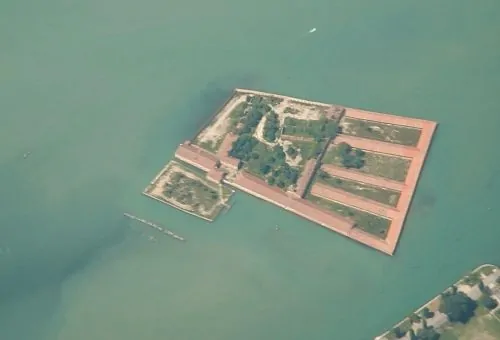
As the system developed, deciding who should wait became an elaborate administrative task. A bill of health issued at a departure port supplied information about conditions there, but it was no guarantee of admission. Officials also considered a vessel’s journey and reports of disease elsewhere. In the eighteenth century, Venetian authorities treated Ottoman territories as persistently suspect, so a clean document from an eastern port did not necessarily spare its holder quarantine. The Italian quaranta, meaning forty, gave quarantine its name. Actual periods varied with regulations and assessments of danger; the familiar forty days were never a single timetable applied unchanged to every arrival over centuries. Why forty became the favored number remains uncertain. Officials worked without knowledge of the bacterium responsible for plague. Cargo demanded its own treatment because goods, especially textiles, were believed capable of retaining infection. Bales were opened and their contents aired in designated spaces. The broad covered storage areas at Lazzaretto Nuovo made this work part of the port’s physical infrastructure. Quarantine consequently involved much more than leaving a ship at anchor. It required accommodation ashore and room to handle merchandise while preventing unauthorized contact. The city had built facilities for interrupting commercial movement until officials would authorize its resumption.
For those detained, that carefully organized pause carried costs. Merchandise could not earn its expected return while it remained unavailable for sale, and further handling risked damage. A ship delayed in the lagoon was also unavailable for its next voyage. The mature system charged merchants for services that included supervising and handling their cargo, adding a direct expense to lost time. Workers assigned to potentially infected goods faced a sharper danger: they had to touch the materials everyone else was being kept away from, and remained with the cargo throughout its quarantine. Yet officials made distinctions intended to reduce unnecessary obstruction. Goods considered unlikely to carry infection could receive different treatment from suspect wrappings or textiles. Such exemptions reveal how closely public protection remained entangled with the practical work of keeping commerce moving. Every additional restriction needed people to enforce it and someone to bear its expense.
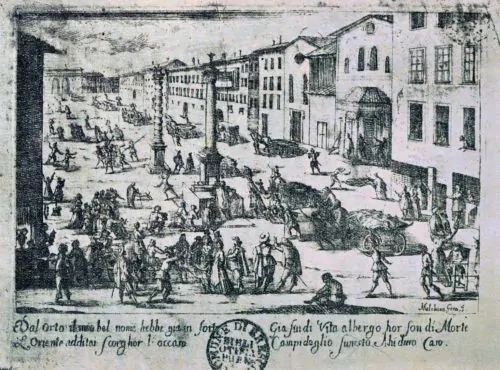
Venice nevertheless continued to suffer plague, including the devastating epidemic of 1630–1631. The islands formed part of a defense that could fail, despite generations of investment and increasingly elaborate rules. Quarantine made a healthy appearance insufficient grounds for entry and gave officials power to postpone business on which livelihoods depended. That power reached an apparently harmless letter as readily as a valuable bale of cloth. After a long voyage, the final stretch into Venice could therefore be measured in waiting days rather than distance. The cargo might already be in the lagoon, with buyers beyond the water, while permission to complete the transaction remained in someone else’s hands.
Originally published by Brewminate, 10.27.2026, under the terms of a Creative Commons Attribution-NonCommercial-NoDerivatives 4.0 International license.
About the Author